© ABCC Australia 2015 www.new-physics.com
WAVE-PARTICLE EQUATION
SK Deriving de Broglie’s
© ABCC Australia 2015 www.new-physics.com
de Broglie Wave Equation
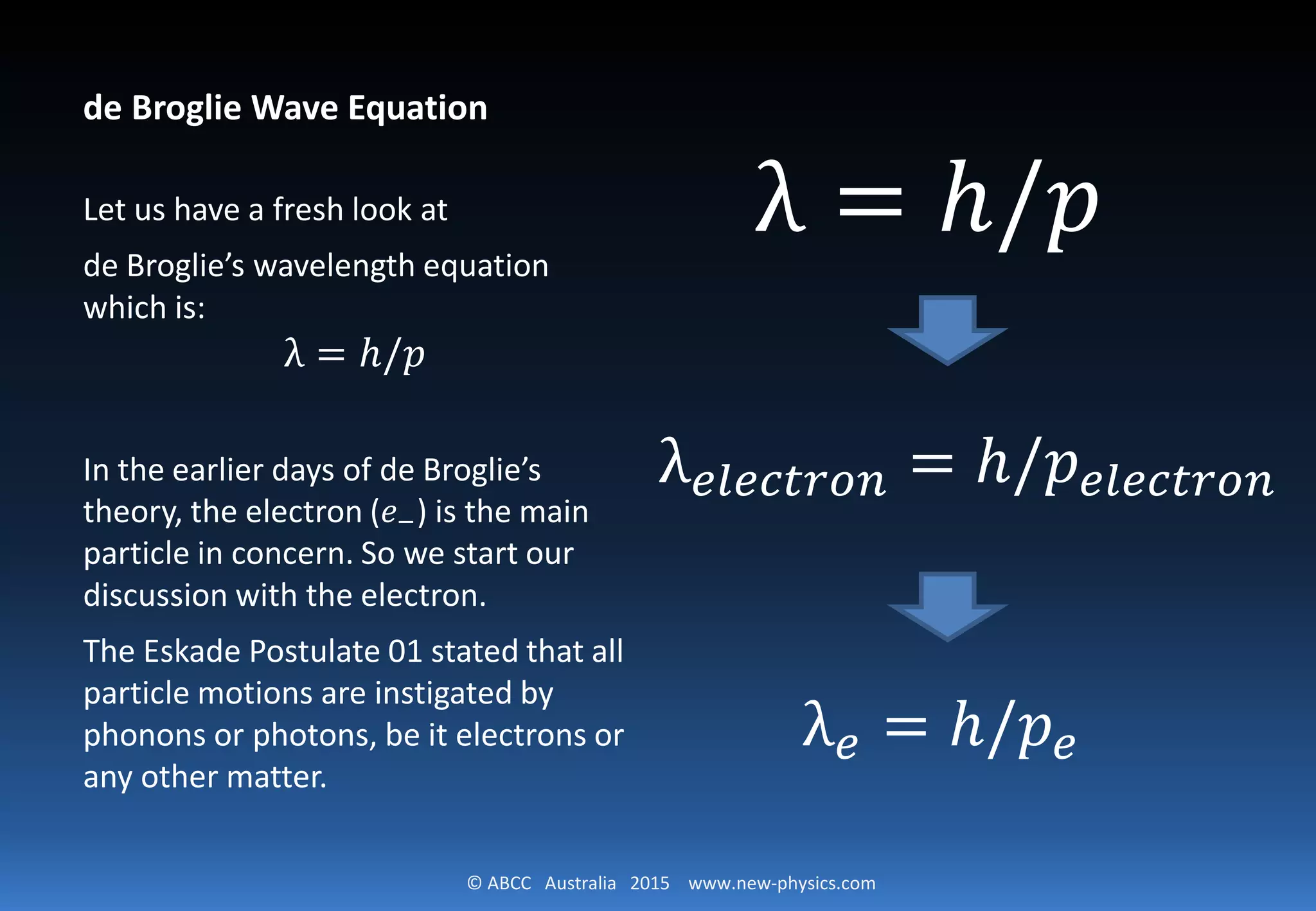
Let us have a fresh look at
de Broglie’s wavelength equation
which is:
λ = ℎ/𝑝𝑝
In the earlier days of de Broglie’s
theory, the electron (𝑒𝑒−) is the main
particle in concern. So we start our
discussion with the electron.
The Eskade Postulate 01 stated that all
particle motions are instigated by
phonons or photons, be it electrons or
any other matter.
λ = ℎ/𝑝𝑝
λ𝑒𝑒𝑒𝑒𝑒𝑒𝑒𝑒𝑒𝑒𝑒𝑒𝑒𝑒𝑒𝑒 = ℎ/𝑝𝑝𝑒𝑒𝑒𝑒𝑒𝑒𝑒𝑒𝑒𝑒𝑒𝑒𝑒𝑒𝑒𝑒
λ𝑒𝑒 = ℎ/𝑝𝑝𝑒𝑒
© ABCC Australia 2015 www.new-physics.com
Eskade Carrier Postulate
By the carrier postulate (Eskade
postulate 01), and by the principle
of the conservation of energy, the
energy of the moving electron
comes entirely from the
incorporated photon. So the energy
of the composition resides with
photons:
Electron kinetic energy
= Photon kinetic energy
1
2
𝑚𝑚𝑒𝑒 𝑣𝑣𝑒𝑒
2
=
1
2
𝑚𝑚𝛾𝛾 𝑐𝑐𝛾𝛾
2
𝑚𝑚𝑒𝑒 𝑣𝑣𝑒𝑒
2
= 𝑚𝑚𝛾𝛾 𝑐𝑐𝛾𝛾
2
1
2
𝑚𝑚𝑒𝑒 𝑣𝑣𝑒𝑒
2 =
1
2
𝑚𝑚𝛾𝛾 𝑐𝑐𝛾𝛾
2
Kinetic energy
of particle
Kinetic energy
of photon
𝑚𝑚𝑒𝑒 𝑣𝑣𝑒𝑒
2 = 𝑚𝑚𝛾𝛾 𝑐𝑐𝛾𝛾
2
Eliminating ½ from both sides
© ABCC Australia 2015 www.new-physics.com
Momentum of Wave
Now 𝑚𝑚𝑒𝑒 𝑣𝑣𝑒𝑒 = 𝑝𝑝𝑒𝑒 is the momentum of
the electron; and 𝑚𝑚𝛾𝛾 𝑐𝑐𝛾𝛾
2
= 𝑓𝑓𝑓 is the
energy of the photon. So:
𝑚𝑚𝑒𝑒 𝑣𝑣𝑒𝑒
2
= 𝑚𝑚𝛾𝛾 𝑐𝑐𝛾𝛾
2
Becomes:
𝑝𝑝𝑒𝑒 𝑣𝑣𝑒𝑒 = 𝑓𝑓𝛾𝛾ℎ
Swapping the relevant items, we have:
𝑣𝑣𝑒𝑒/𝑓𝑓𝛾𝛾 = ℎ/𝑝𝑝𝑒𝑒
This is in accordance with the principle
of energy conservation. The photon is
still vibrating at the same frequency.
𝑚𝑚𝑒𝑒 𝑣𝑣𝑒𝑒
2 = 𝑚𝑚𝛾𝛾 𝑐𝑐𝛾𝛾
2
2 x Kinetic energy
of photon
Planck energy
of photon
𝑣𝑣𝑒𝑒/𝑓𝑓𝛾𝛾 = ℎ/𝑝𝑝𝑒𝑒
𝑝𝑝𝑒𝑒 𝑣𝑣𝑒𝑒 = 𝑓𝑓𝛾𝛾ℎ
𝑚𝑚𝑒𝑒 𝑣𝑣𝑒𝑒 = 𝑝𝑝𝑒𝑒 is the momentum of the electron
© ABCC Australia 2015 www.new-physics.com
The de Broglie Wave
Equation
The equation 𝑣𝑣𝑒𝑒/𝑓𝑓𝛾𝛾 gives us the
wavelength 𝜆𝜆𝑒𝑒:
𝑣𝑣𝑒𝑒
𝑓𝑓𝛾𝛾
= 𝜆𝜆𝑒𝑒
Thus the de Broglie wavelength
equation is:
𝜆𝜆𝑒𝑒 =
ℎ
𝑝𝑝𝑒𝑒
Which was proposed by de Broglie in
1924.
𝑣𝑣𝑒𝑒/𝑓𝑓𝛾𝛾 = ℎ/𝑝𝑝𝑒𝑒
𝜆𝜆 𝑒𝑒 = ℎ/𝑝𝑝𝑒𝑒
© ABCC Australia 2015 www.new-physics.com
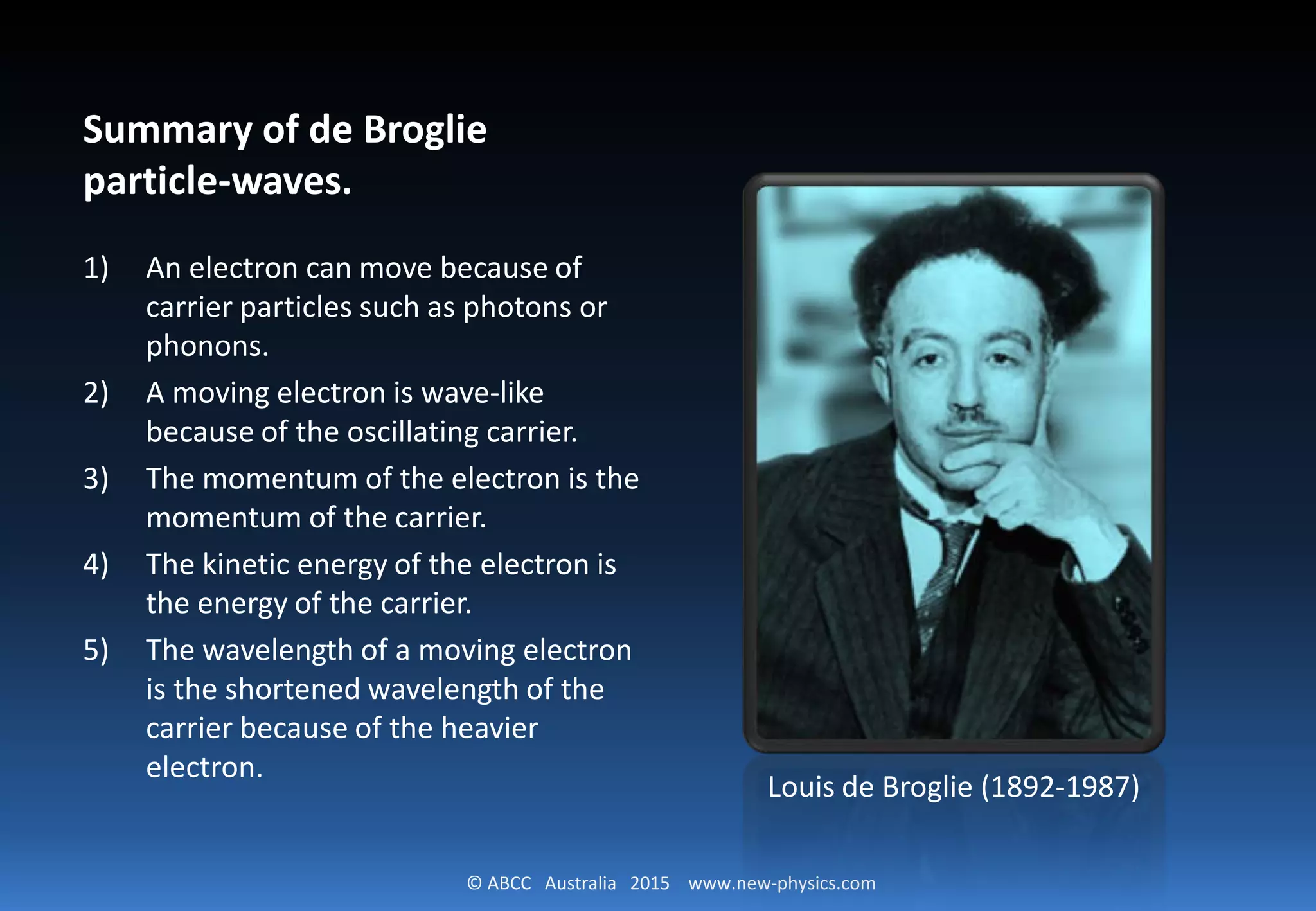
Summary of de Broglie
particle-waves.
1) An electron can move because of
carrier particles such as photons or
phonons.
2) A moving electron is wave-like
because of the oscillating carrier.
3) The momentum of the electron is the
momentum of the carrier.
4) The kinetic energy of the electron is
the energy of the carrier.
5) The wavelength of a moving electron
is the shortened wavelength of the
carrier because of the heavier
electron.
Louis de Broglie (1892-1987)
© ABCC Australia 2015 www.new-physics.com
Summary of Eskade
Postulates
1) Particles are moved by
carrier particles mainly
photons or phonons.
2) The vibrating nature of
matter are due to the
photons or phonons as in
de Broglie waves.
3) Photons retain their
vibration in free or bound
state, leading to the
principle of energy and
momentum conservations
in low energy cases.
© ABCC Australia 2015 www.new-physics.com
CIRCULAR MOTION
This article is related to:
ABCC

De Broglie wave equation - Derivation by SK

  • 1.
    © ABCC Australia2015 www.new-physics.com WAVE-PARTICLE EQUATION SK Deriving de Broglie’s
  • 2.
    © ABCC Australia2015 www.new-physics.com de Broglie Wave Equation Let us have a fresh look at de Broglie’s wavelength equation which is: λ = ℎ/𝑝𝑝 In the earlier days of de Broglie’s theory, the electron (𝑒𝑒−) is the main particle in concern. So we start our discussion with the electron. The Eskade Postulate 01 stated that all particle motions are instigated by phonons or photons, be it electrons or any other matter. λ = ℎ/𝑝𝑝 λ𝑒𝑒𝑒𝑒𝑒𝑒𝑒𝑒𝑒𝑒𝑒𝑒𝑒𝑒𝑒𝑒 = ℎ/𝑝𝑝𝑒𝑒𝑒𝑒𝑒𝑒𝑒𝑒𝑒𝑒𝑒𝑒𝑒𝑒𝑒𝑒 λ𝑒𝑒 = ℎ/𝑝𝑝𝑒𝑒
  • 3.
    © ABCC Australia2015 www.new-physics.com Eskade Carrier Postulate By the carrier postulate (Eskade postulate 01), and by the principle of the conservation of energy, the energy of the moving electron comes entirely from the incorporated photon. So the energy of the composition resides with photons: Electron kinetic energy = Photon kinetic energy 1 2 𝑚𝑚𝑒𝑒 𝑣𝑣𝑒𝑒 2 = 1 2 𝑚𝑚𝛾𝛾 𝑐𝑐𝛾𝛾 2 𝑚𝑚𝑒𝑒 𝑣𝑣𝑒𝑒 2 = 𝑚𝑚𝛾𝛾 𝑐𝑐𝛾𝛾 2 1 2 𝑚𝑚𝑒𝑒 𝑣𝑣𝑒𝑒 2 = 1 2 𝑚𝑚𝛾𝛾 𝑐𝑐𝛾𝛾 2 Kinetic energy of particle Kinetic energy of photon 𝑚𝑚𝑒𝑒 𝑣𝑣𝑒𝑒 2 = 𝑚𝑚𝛾𝛾 𝑐𝑐𝛾𝛾 2 Eliminating ½ from both sides
  • 4.
    © ABCC Australia2015 www.new-physics.com Momentum of Wave Now 𝑚𝑚𝑒𝑒 𝑣𝑣𝑒𝑒 = 𝑝𝑝𝑒𝑒 is the momentum of the electron; and 𝑚𝑚𝛾𝛾 𝑐𝑐𝛾𝛾 2 = 𝑓𝑓𝑓 is the energy of the photon. So: 𝑚𝑚𝑒𝑒 𝑣𝑣𝑒𝑒 2 = 𝑚𝑚𝛾𝛾 𝑐𝑐𝛾𝛾 2 Becomes: 𝑝𝑝𝑒𝑒 𝑣𝑣𝑒𝑒 = 𝑓𝑓𝛾𝛾ℎ Swapping the relevant items, we have: 𝑣𝑣𝑒𝑒/𝑓𝑓𝛾𝛾 = ℎ/𝑝𝑝𝑒𝑒 This is in accordance with the principle of energy conservation. The photon is still vibrating at the same frequency. 𝑚𝑚𝑒𝑒 𝑣𝑣𝑒𝑒 2 = 𝑚𝑚𝛾𝛾 𝑐𝑐𝛾𝛾 2 2 x Kinetic energy of photon Planck energy of photon 𝑣𝑣𝑒𝑒/𝑓𝑓𝛾𝛾 = ℎ/𝑝𝑝𝑒𝑒 𝑝𝑝𝑒𝑒 𝑣𝑣𝑒𝑒 = 𝑓𝑓𝛾𝛾ℎ 𝑚𝑚𝑒𝑒 𝑣𝑣𝑒𝑒 = 𝑝𝑝𝑒𝑒 is the momentum of the electron
  • 5.
    © ABCC Australia2015 www.new-physics.com The de Broglie Wave Equation The equation 𝑣𝑣𝑒𝑒/𝑓𝑓𝛾𝛾 gives us the wavelength 𝜆𝜆𝑒𝑒: 𝑣𝑣𝑒𝑒 𝑓𝑓𝛾𝛾 = 𝜆𝜆𝑒𝑒 Thus the de Broglie wavelength equation is: 𝜆𝜆𝑒𝑒 = ℎ 𝑝𝑝𝑒𝑒 Which was proposed by de Broglie in 1924. 𝑣𝑣𝑒𝑒/𝑓𝑓𝛾𝛾 = ℎ/𝑝𝑝𝑒𝑒 𝜆𝜆 𝑒𝑒 = ℎ/𝑝𝑝𝑒𝑒
  • 6.
    © ABCC Australia2015 www.new-physics.com Summary of de Broglie particle-waves. 1) An electron can move because of carrier particles such as photons or phonons. 2) A moving electron is wave-like because of the oscillating carrier. 3) The momentum of the electron is the momentum of the carrier. 4) The kinetic energy of the electron is the energy of the carrier. 5) The wavelength of a moving electron is the shortened wavelength of the carrier because of the heavier electron. Louis de Broglie (1892-1987)
  • 7.
    © ABCC Australia2015 www.new-physics.com Summary of Eskade Postulates 1) Particles are moved by carrier particles mainly photons or phonons. 2) The vibrating nature of matter are due to the photons or phonons as in de Broglie waves. 3) Photons retain their vibration in free or bound state, leading to the principle of energy and momentum conservations in low energy cases.
  • 8.
    © ABCC Australia2015 www.new-physics.com CIRCULAR MOTION This article is related to: ABCC