Sound waves
Mechanical Waves
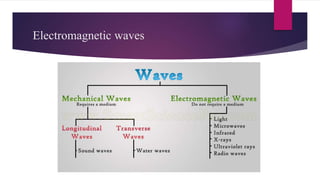
 Mechanical Waves are waves which propagate through a material medium (solid, liquid,
or gas) .
 There are two basic types of wave motion for mechanical waves: longitudinal waves
and transverse waves.
Mechanical Waves
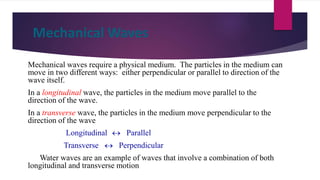
Mechanical waves require a physical medium. The particles in the medium can
move in two different ways: either perpendicular or parallel to direction of the
wave itself.
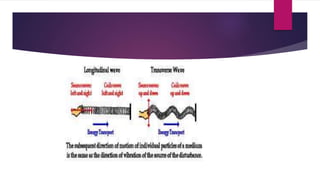
In a longitudinal wave, the particles in the medium move parallel to the
direction of the wave.
In a transverse wave, the particles in the medium move perpendicular to the
direction of the wave
Longitudinal  Parallel
Transverse  Perpendicular
Water waves are an example of waves that involve a combination of both
longitudinal and transverse motion
Sound waves
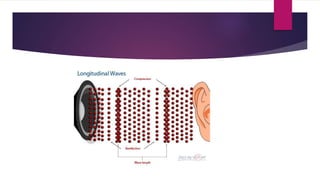
 Sound waves is a series of longitudinal or compression waves that
move through air or other materials.
 Sound does not travel through in a vacuum.
Electromagnetic waves
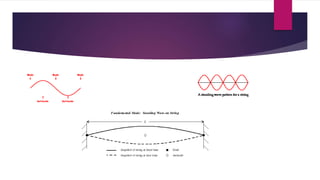
Standing waves/stationary waves
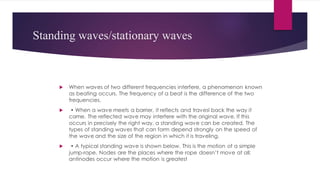
A standing wave, also known as a stationary wave, is a wave
that remains in a constant position. This phenomenon can
occur because the medium is moving in the opposite
direction to the wave, or it can arise in a stationary medium
as a result of interference between two waves traveling in
opposite directions
Interference of sound waves
 When two or more sound waves from different sources are present
at the same time,they interect with each other to produce a new
wave.The new wave is the sum of all the different waves.Wave
interaction is called interference.
Interference of sound waves
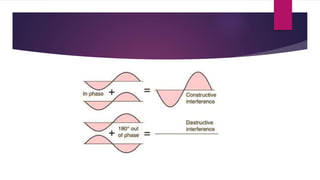
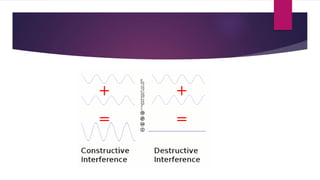
 Constructive interference occurs when two waves combine to
create a larger wave. This occurs when the peaks of two waves line
up.
 • Destructive interference occurs when two waves combine and
cancel each other out. This occurs when a peak in one wave lines
up with a trough in the other wave.
Infrasonics
Infrasonic are the sound waves, having frequency below those
of the sound waves that can be detected by the human ear-
i.e,below 20 hertz.
Infrasonic,covering sounds beneath 20Hz down to 0.001Hz.
This frequency range is utilized for monitoring
earthquakes,charting rocks and petroleum formation below
the earth
The waves of frequency less than 20Hz are known as infrasonic
waves.
Application of infrasonic waves: there are following applications of
infrasonic waves.
a Infrasonic waves are produced by large vibrating bodies.
b. Its frequency is less than 20 Hz.
Ultrasonic
Ultrasonic: sound waves with frequencies above the normal
human range of hearing.
Sound is generally classed as ultrasonic when its frequency
exceeds 20,000 hertz
The waves of frequency greater than 20,000Hz are known as
ultrasonic waves
Bats can produce ultrasonic waves
Dolphins also produce ultrasonic waves. They can also detect the
ultrasonic waves
Application of ultrasonic waves: There are following applications
ultrasonic waves.
a. Ultrasonic waves are used to establish ship to ship to communication.
b. Ultrasonic waves are used for welding plastics.
c. These waves are used to analyze the development of unborn child.
e. Ultrasonic waves are used to determine the depth of a sea.
Normal hearing band
Hearing range usually describes the range of frequencies that can be
heard by humans or other animals.
In humans the audible range of frequencies is usually 20 to 20,000
Hz.,although there is considerable variation between individual.

Sound waves

  • 1.
  • 2.
    Mechanical Waves  MechanicalWaves are waves which propagate through a material medium (solid, liquid, or gas) .  There are two basic types of wave motion for mechanical waves: longitudinal waves and transverse waves.
  • 3.
    Mechanical Waves Mechanical wavesrequire a physical medium. The particles in the medium can move in two different ways: either perpendicular or parallel to direction of the wave itself. In a longitudinal wave, the particles in the medium move parallel to the direction of the wave. In a transverse wave, the particles in the medium move perpendicular to the direction of the wave Longitudinal  Parallel Transverse  Perpendicular Water waves are an example of waves that involve a combination of both longitudinal and transverse motion
  • 6.
    Sound waves  Soundwaves is a series of longitudinal or compression waves that move through air or other materials.  Sound does not travel through in a vacuum.
  • 7.
  • 8.
  • 9.
    A standing wave,also known as a stationary wave, is a wave that remains in a constant position. This phenomenon can occur because the medium is moving in the opposite direction to the wave, or it can arise in a stationary medium as a result of interference between two waves traveling in opposite directions
  • 11.
    Interference of soundwaves  When two or more sound waves from different sources are present at the same time,they interect with each other to produce a new wave.The new wave is the sum of all the different waves.Wave interaction is called interference.
  • 12.
    Interference of soundwaves  Constructive interference occurs when two waves combine to create a larger wave. This occurs when the peaks of two waves line up.  • Destructive interference occurs when two waves combine and cancel each other out. This occurs when a peak in one wave lines up with a trough in the other wave.
  • 16.
    Infrasonics Infrasonic are thesound waves, having frequency below those of the sound waves that can be detected by the human ear- i.e,below 20 hertz. Infrasonic,covering sounds beneath 20Hz down to 0.001Hz. This frequency range is utilized for monitoring earthquakes,charting rocks and petroleum formation below the earth The waves of frequency less than 20Hz are known as infrasonic waves.
  • 17.
    Application of infrasonicwaves: there are following applications of infrasonic waves. a Infrasonic waves are produced by large vibrating bodies. b. Its frequency is less than 20 Hz.
  • 18.
    Ultrasonic Ultrasonic: sound waveswith frequencies above the normal human range of hearing. Sound is generally classed as ultrasonic when its frequency exceeds 20,000 hertz The waves of frequency greater than 20,000Hz are known as ultrasonic waves Bats can produce ultrasonic waves Dolphins also produce ultrasonic waves. They can also detect the ultrasonic waves
  • 19.
    Application of ultrasonicwaves: There are following applications ultrasonic waves. a. Ultrasonic waves are used to establish ship to ship to communication. b. Ultrasonic waves are used for welding plastics. c. These waves are used to analyze the development of unborn child. e. Ultrasonic waves are used to determine the depth of a sea.
  • 20.
    Normal hearing band Hearingrange usually describes the range of frequencies that can be heard by humans or other animals. In humans the audible range of frequencies is usually 20 to 20,000 Hz.,although there is considerable variation between individual.