This document describes the method of indirect leveling using a theodolite to determine relative heights of points. There are three cases: [1] when the base of the object is accessible, [2] when the base is inaccessible but the instrument stations and object are in the same vertical plane, and [3] when the base is inaccessible and stations/object are not in the same plane. Corrections must be applied for earth's curvature and refraction over long distances. The reciprocal method can be used to eliminate these corrections. Equations are provided to calculate elevations of points for each case.
1
PREPARED BY :ASST. PROF. VATSAL D. PATEL
MAHATMA GANDHI INSTITUTE OF
TECHNICAL EDUCATION &
RESEARCH CENTRE, NAVSARI.
2.
This isan indirect method of levelling.
In this method the relative heights (elevations) of various
points (objects) are determined from the vertical angle
measured with a theodolite and the horizontal distances
measured with a tape.
2
3.
If thedistance between instrument station and object is small,
correction for earth’s curvature and refraction is not required.
If the distance between instrument station and object is large,
the combined correction = 0.0673 D2 for earth's curvature and
refraction is required. Where D = distance in KM.
If the vertical angle is (+ve), the correction is taken as (+ve) &
If the vertical angle is (-ve), the correction is taken as (-ve).
3
4.
Depending uponthe field conditions and the measurements
that can be made with the instruments available, the following
three cases are involved :
Case-1: Base of the object is accessible
Case-2: Base of the object inaccessible and instrument stations
and the elevated object are in the same vertical plane
Case-3: Base of the object inaccessible and instrument stations
and the elevated object are not in the same vertical plane
4
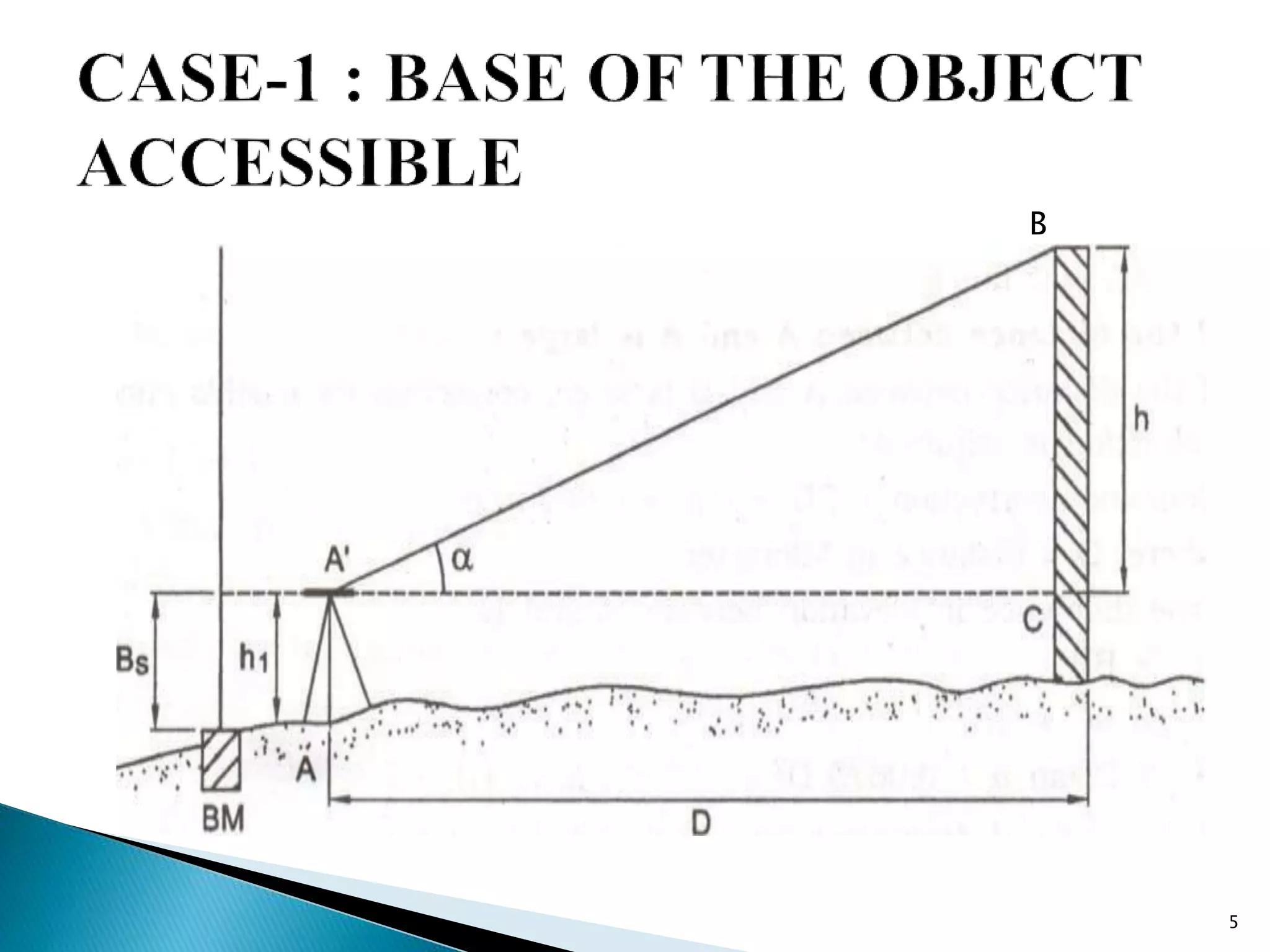
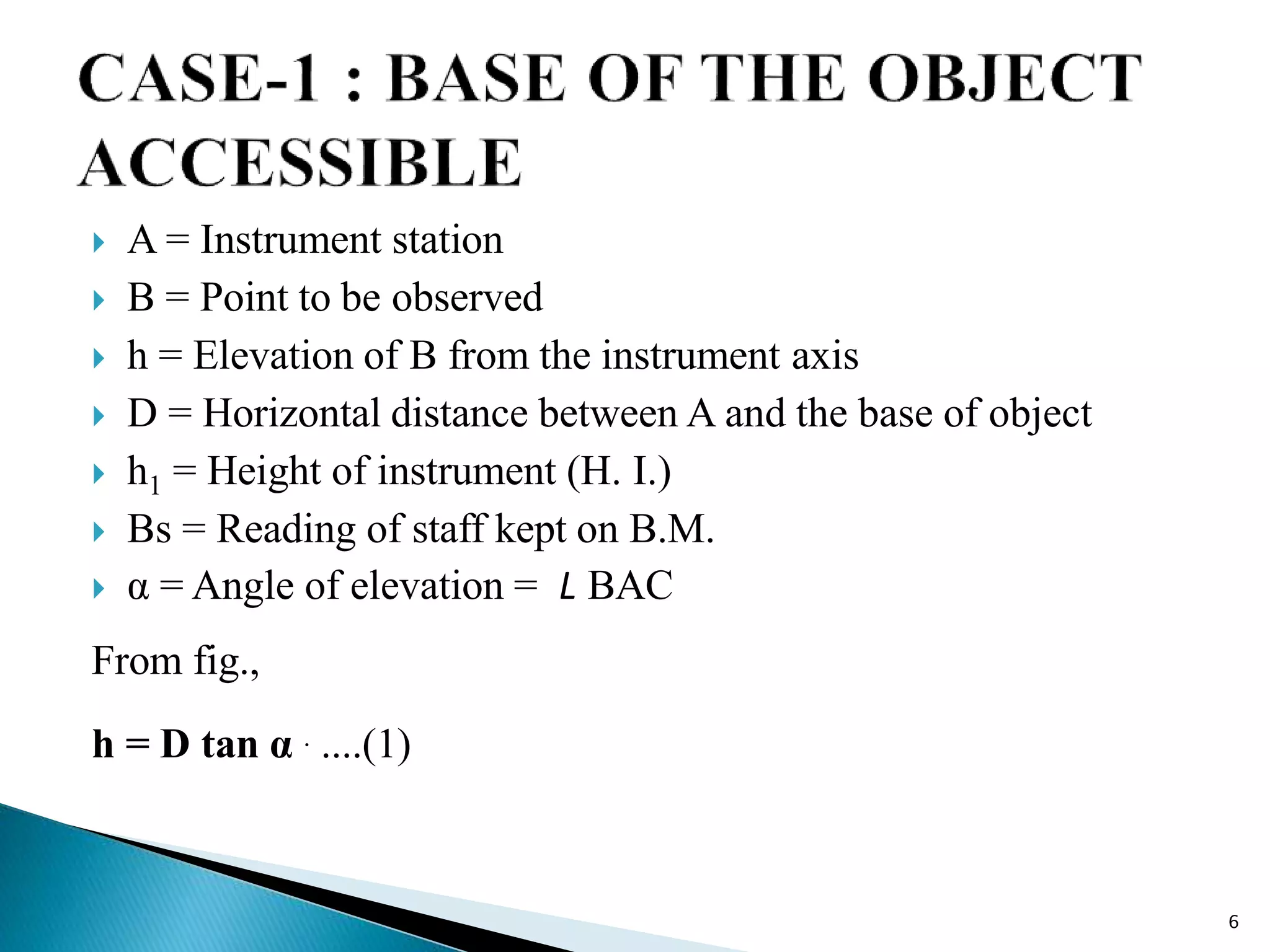
A =Instrument station
B = Point to be observed
h = Elevation of B from the instrument axis
D = Horizontal distance between A and the base of object
h1 = Height of instrument (H. I.)
Bs = Reading of staff kept on B.M.
α = Angle of elevation = L BAC
From fig.,
h = D tan α . ....(1)
6
7.
R.L. of B= R.L. of B.M. + Bs + h
= R.L. of B.M. + Bs + D. tan α . ....(2)
Now when the distance between instrument station and object
is large, then correction for earth’s curvature and refraction is
required.
Combined correction = 0.0673 D2, Where D = distance in KM
R.L. of B = R.L. of B.M. + Bs + D. tan α + 0.0673 D2
7
8.
If Distancebetween A & B is Small,
AB' = AC = D
L ACB = 900
Similarly,
BA' = BC' = D
L AC'B = 900
BC = D tan α
AC' = D tan β
8
9.
If Distancebetween A & B is large,
The correction for earth's curvature and refraction is required.
Combined correction = 0.0673 D2, Where D= distance in KM.
The difference in elevation between A & B,
H = BB'
= BC + CB'
= D tan α + 0.0673 D2. ....(1)
9
10.
If theangle of Depression B to A is measured,
AC'=D tan β [ BC'= D ]
True difference in elevation between A & B,
H = AA'
= AC’ – A’C’
= D tan β - 0.0673 D2 ....(2)
10
11.
Adding equation(1) & (2),
H = D tan α + D tan β
H = D/2 [tan α + D tan β] ..... (3)
From equation (3), it can be seen that by reciprocal method of
observation, the correction for earth’s curvature and refraction
can be eliminated.
R.L of station B = R.L. of station A + H
= R.L. of station A + D/2 [tan α + D tan β]
11
12.
This methodis used when it is not possible to measure the
horizontal distance (D) between the instrument station and the
base of the object.
In this method, the instrument is set on the two different
stations and the observations of the object are taken.
12
13.
There maybe two cases:
1. Instrument axes at the same level
2. Instrument axes at different levels
A. Height of instrument axis nearer to the object is lower
B. Height of instrument axis near to the object is higher
13
A, B= Instrument station
h = Elevation of top of the object (P) from the instrument axis
b = Horizontal distance between A & B
D = Horizontal distance between A and the base of the object
α1 = Angle of elevation from A to P
α2 = Angle of elevation from B to P
15
16.
From, Δ PA’P’, h1 = D tan α1 .....(1)
Δ PB’P’, h2 = (b + D) tan α2 ....(2)
Equating (1) & (2),
D tan α1 = (b + D) tan α2
D tan α1 = b tan α2 + D tan α2
D (tan α1 - tan α2 ) = b tan α2
16
17.
Substitute valueof D in equation (1),
R.L. OF P = R.L. Of B.M. + Bs + h
17
18.
In thefield, it is very difficult to keep the same height of
instrument axis, at different stations.
Therefore, the instrument is set at two different stations and
the height of instrument axis in both the cases is determined
by taking back sight on B.M.
There are two cases:
A. Height of instrument axis nearer to the object is lower
B. Height of instrument axis near to the object is higher
18
From, Δ PA’P’, h1 = D tan α1.....(1)
Δ PB’P’’, h2 = (b + D) tan α2....(2)
Deducting equation (2) from equation (1),
h1 – h2 = D tan α1 - (b + D) tan α2
= D tan α1 - b tan α2 – D tan α2
hd = D (tan α1 - tan α2 ) – btan α2 (hd = h1 - h2 )
hd + b tan α2 = D (tan α1 - tan α2 )
20
From, Δ PA’P’, h1 = D tan α1......(1)
Δ PB’P’’, h2 = (b + D) tan α2....(2)
Deducting equation (1) from equation (2),
h2 – h1 = (b + D) tan α2 - D tan α1
= b tan α2 + D tan α2 – D tan α1
hd = b tan α2 + D (tan α2 - tan α1) (hd = h1 - h2 )
hd - b tan α2 = D (tan α2 - tanα1)
- hd + b tan α2 = D (tan α1 - tan α2)
23
Let Aand B be the two instrument stations not in the same
vertical plane as that of P.
Procedure:
Select two survey stations A and B on the level ground and
measure b as the horizontal distance between them.
Set the instrument at A and level it accurately. Set the vertical
Vernier to 0 degree. Bring the altitude level bubble at the
centre and take a back sight hs on the staff kept at B.M.
27
28.
Measure theangle of elevation α1 to P.
Measure the horizontal angle at A, L BAC = θ
Shift the instrument to B and measure the angle of elevation α2
to P.
Measure the horizontal angle at B as α.
28
29.
α1 = angleof elevation from A to P
α2 = angle of elevation from B to P
θ = Horizontal angle L BAC at station A (clockwise)
α = Horizontal angle L CBA at station B (clockwise)
B = Horizontal distance between A & B
h1= PP1= Height of object P from instrument axis of A
h2= PP2= Height of object P from instrument axis of B
In ΔABC, L BAC = θ
L ABC = α
So, L ACB = 180 – (θ + α)
AB = b
29
30.
We know,three angles and one side of ΔABC.
Therefore using Sine Rule, we can calculate distance AC &
BC as below.
30
31.
Now, h1= ACtan α1 & h2= BC tan α2
Values of AC & BC are obtained from eq. (1) & (2) as above.
R.L. of P = Height of instrument axis at A + h1 OR
R.L. of P = Height of instrument axis at B + h2
Height of instrument axis at A,
= R.L. of B.M. + B.S.
= R.L. of B.M. + hs
Height of instrument axis at B = R.L. of B.M. + B.S.
31
32.
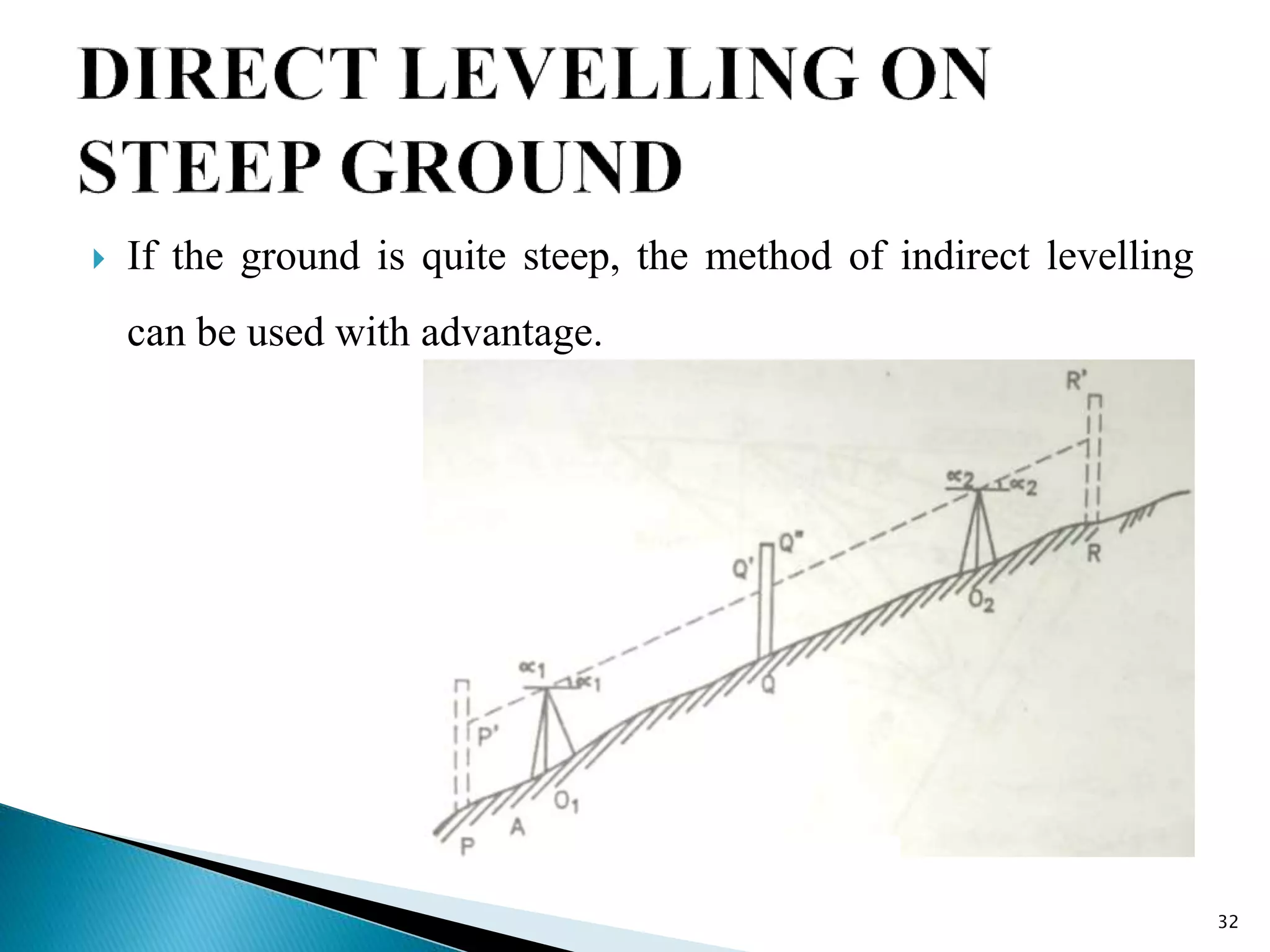
If theground is quite steep, the method of indirect levelling
can be used with advantage.
32
33.
The followingprocedure can be used to determine the
difference of elevations between P and R.
Set up the instrument at a convenient station O1 on the line PR.
Make the line of collimation roughly parallel to the slope of
the ground. Clamp the telescope.
Take a back sight PP’ on the staff held at P. Also measure the
vertical angle α1 to P’.
33
34.
Determine R.L.of P’ as,
R.L. of P’ = R.L. of P + PP’
Take a foresight QQ’ on the staff held at the turning point Q.
without changing the vertical angle α1. Measure the slope
distance PQ between P and Q.
R.L. of Q = R.L. of P’ + PQ sin α1 – QQ’ OR
R.L. of Q = R.L. of P + PP’ + PQ sin α1 – QQ’
34
35.
Shift theinstrument to the station O2 midway between Q and
R. Make the line of collimation roughly parallel to the slope of
the grounds. Clamp the telescope.
Take a back sight QQ” on the staff held at the turning point Q.
Measure the vertical angle α2.
R.L. of Q” = R.L. of Q + QQ”
35
36.
Take aforesight RR’ on the staff held at the point R without
changing the vertical angle α2. Measure the sloping distance
QR.
∴ R.L. of R = R.L. of Q” + QR sin α2 –RR’
Thus,
R.L. of R = (R.L. of P + PP’ + PQ sin α1 – QQ’) + QQ” + (QR
sin α2 – RR’)
36