
UNIT 3
TACHEOMETRIC SURVEYING
( 8 MARKS)
COURSE OUTCOMES
C . Find distances and elevation using
tacheometer
PRACTICAL OUTCOMES
14. Use theodolite as a tacheometer to
compute reduced levels and horizontal
distances
UNIT OUTCOMES
3a. Explain
the functions
of given
component(s)
of
tacheometer
3d. Determine
RLs of stations
and distances
between
stations using
tacheometric
survey using
given data
3c.Calculate
constant of
tacheometer
from given
data
3b.Determine
horizontal and
vertical
distances
using
tacheometric
formula in the
given
situation
Introduction
Tacheometric is a branch of surveying in which horizontal and
vertical distances are determined by taking angular
observation with an instrument known as a tachometer.
Tacheometric surveying is adopted in rough and difficult
terrain where direct leveling and chaining are either not
possible or very tedious.
Suitability/uses
Preparation of topographic map where
both horizontal and vertical distances are
required to be measured
Survey work in difficult terrain where
direct methods of measurements are
inconvenient
Establishment of secondary control points
reconnaissance survey for highways and
railways etc.
Instruments used for tacheometric surveying
Tacheometer Levelling and stadia
staff rod
Tacheometer
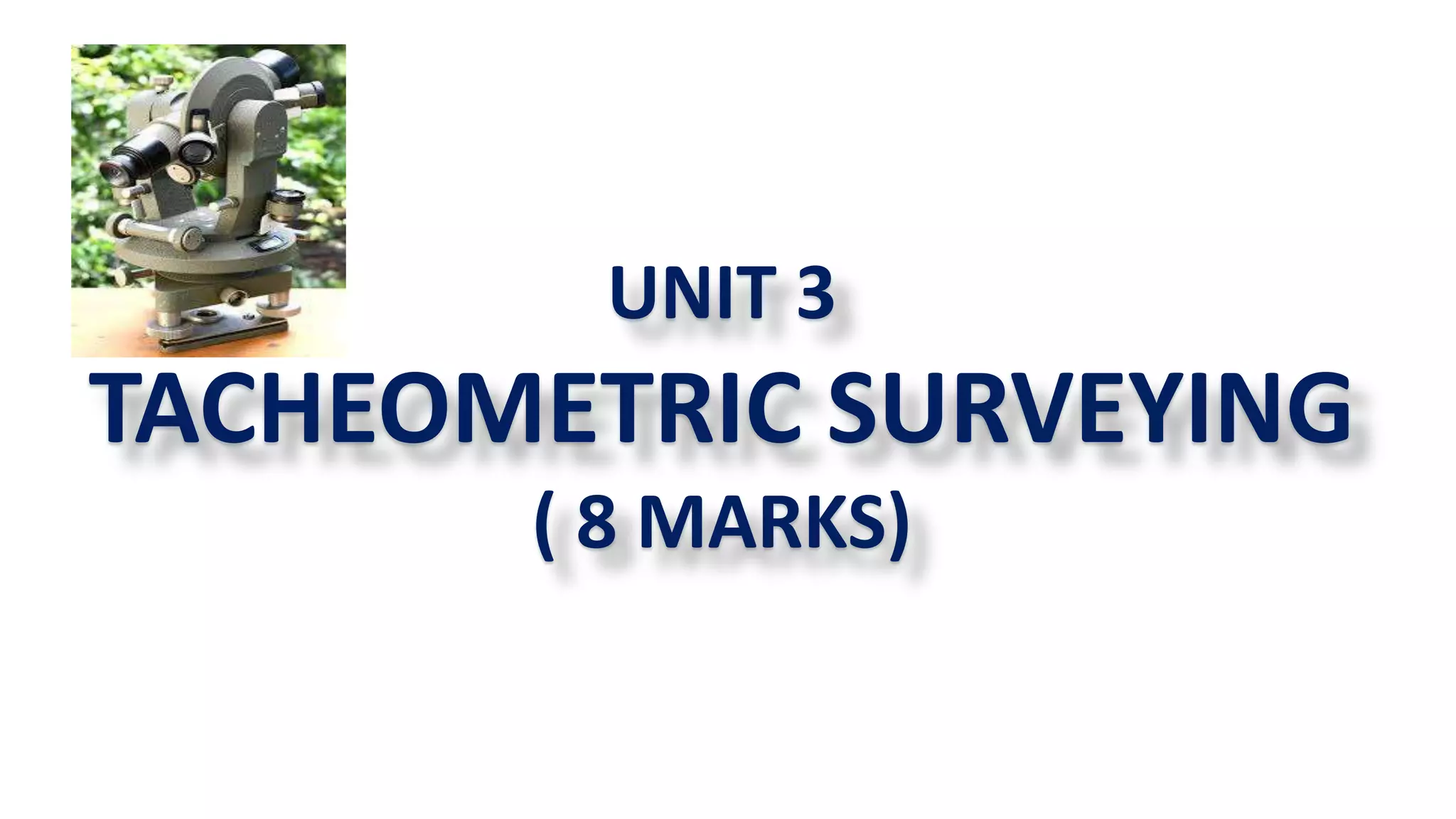
A tacheometer is similar to an ordinary
transit theodolite, generally a vernier
theodolite itself, fitted with two stadia
wires in addition to the central cross-
hair and anallatic lens.
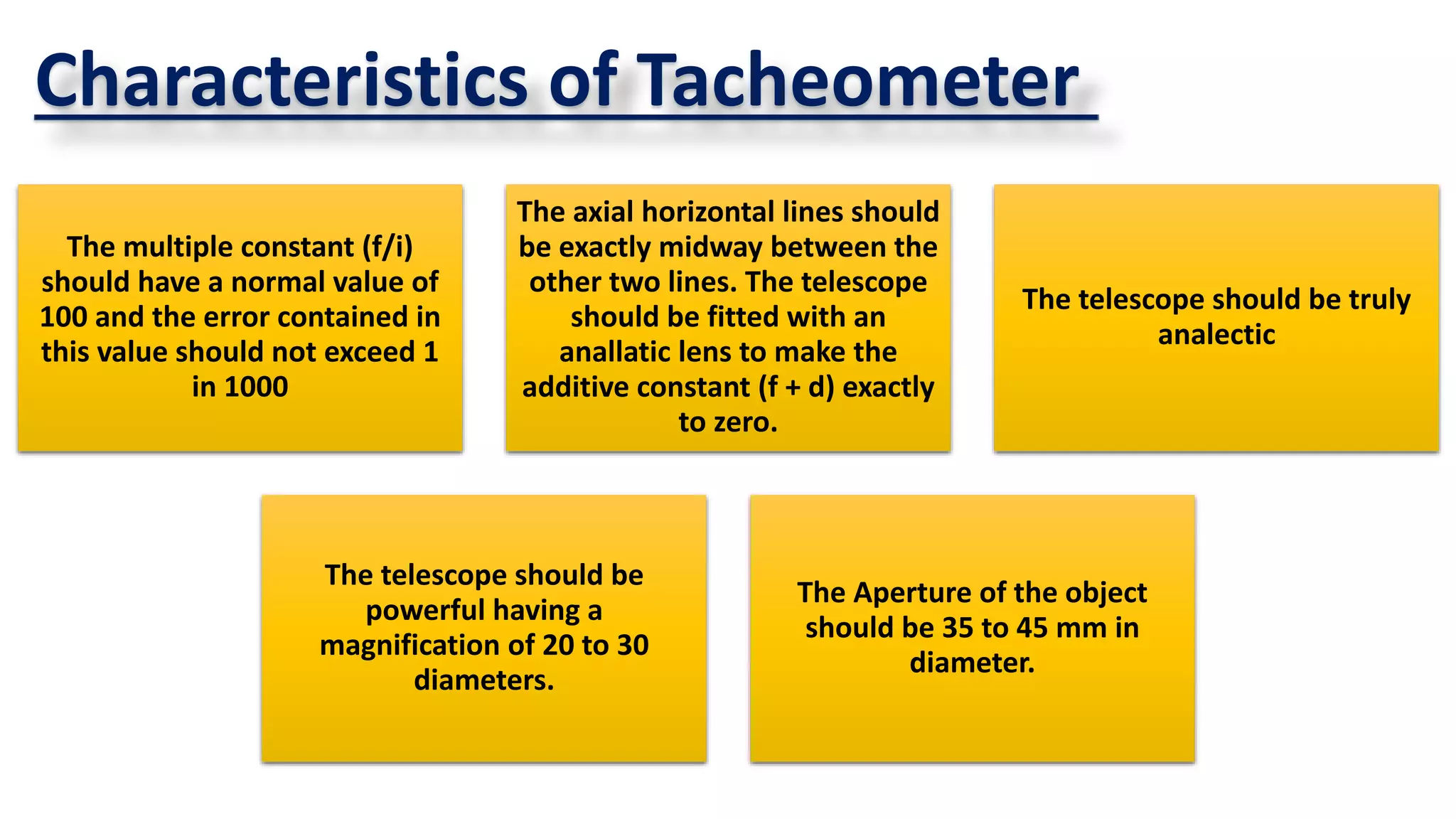
Characteristics of Tacheometer
The multiple constant (f/i)
should have a normal value of
100 and the error contained in
this value should not exceed 1
in 1000
The axial horizontal lines should
be exactly midway between the
other two lines. The telescope
should be fitted with an
anallatic lens to make the
additive constant (f + d) exactly
to zero.
The telescope should be truly
analectic
The telescope should be
powerful having a
magnification of 20 to 30
diameters.
The Aperture of the object
should be 35 to 45 mm in
diameter.
Stadia diaphragm
Upper hair
Lower hair
Middle hair
Levelling or stadia staff rod
For short distances, ordinary leveling
staves are used. The leveling staff
normally 4m long, and it can be folded
with here parts. The graduations are so
marked that a minimum reading of 0.005
or 0.001m can be taken.
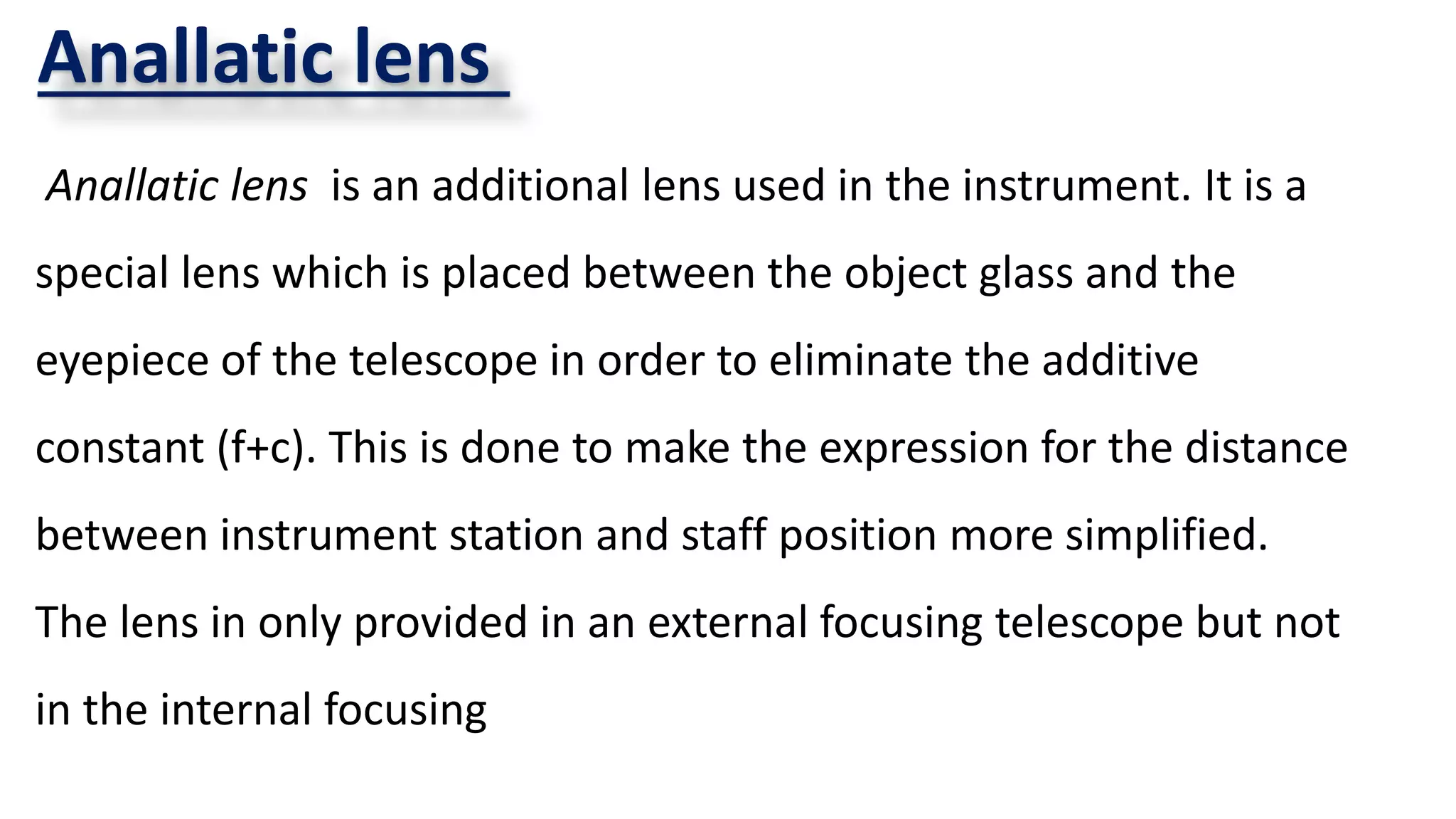
Anallatic lens
Anallatic lens is an additional lens used in the instrument. It is a
special lens which is placed between the object glass and the
eyepiece of the telescope in order to eliminate the additive
constant (f+c). This is done to make the expression for the distance
between instrument station and staff position more simplified.
The lens in only provided in an external focusing telescope but not
in the internal focusing
Principle of tacheometry
Principle of tacheometry is based on principle of similar
isosceles triangle in which corresponding sides &
altitudes are proportional The ratio of distance of base
from apex and length of base is always constant.
Principle of tacheometry
In fig. Oa1a2, Ob1b2, Oc1c2 are all isosceles triangles where D1, D2, D3 are the
distances of bases from the apices (distances of staff stations from instrument
stations) and S1, S2, S3 are the lengths of the bases also called staff intercepts.
According to stated principle.
D1/S1 = D2/S2=D3/ S3=f/i=Constant
Where f=focal length of object and i =stadia intercept
D1
D2
D3
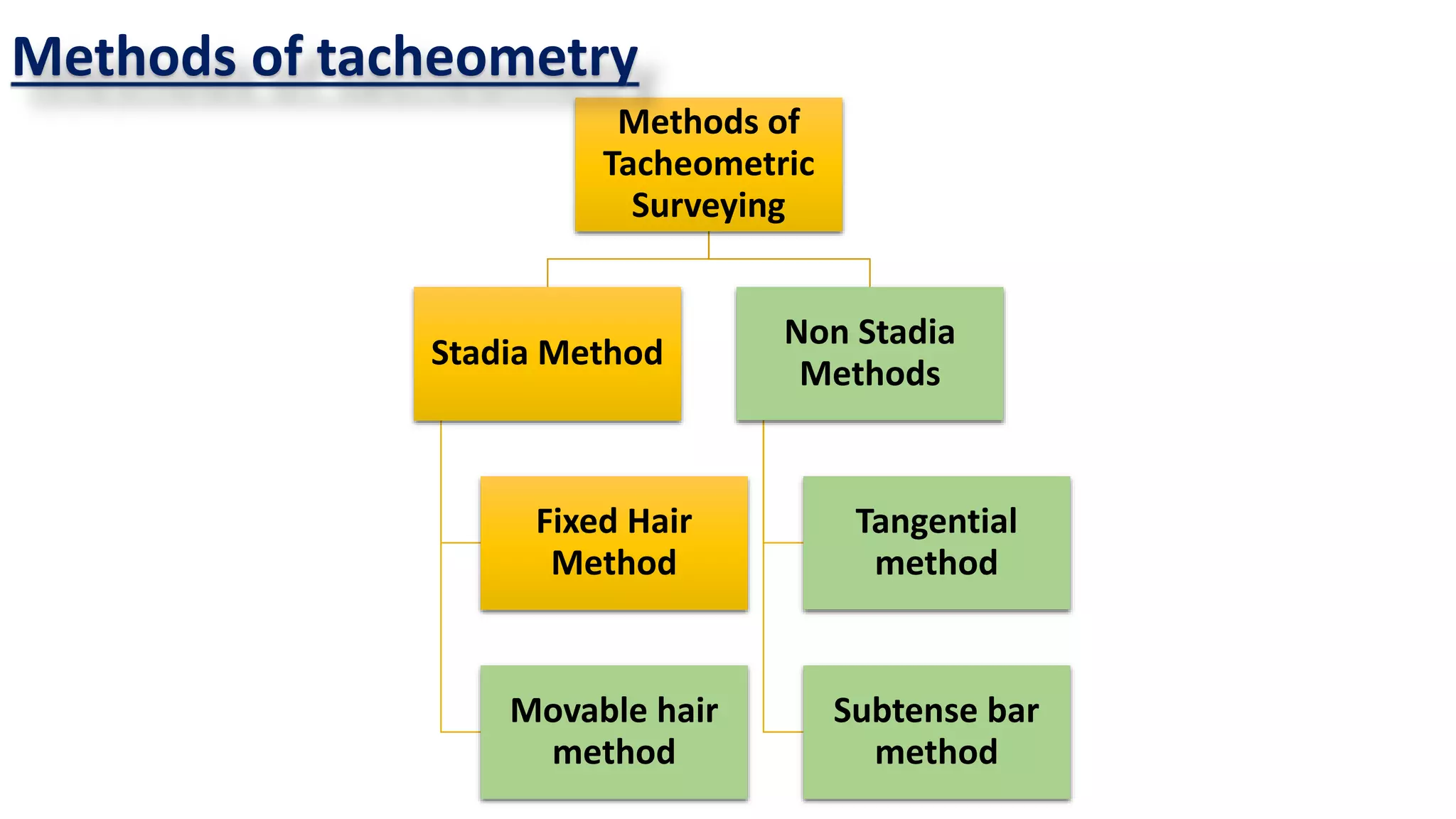
Methods of
Tacheometric
Surveying
Stadia Method
Fixed Hair
Method
Movable hair
method
Non Stadia
Methods
Tangential
method
Subtense bar
method
Methods of tacheometry
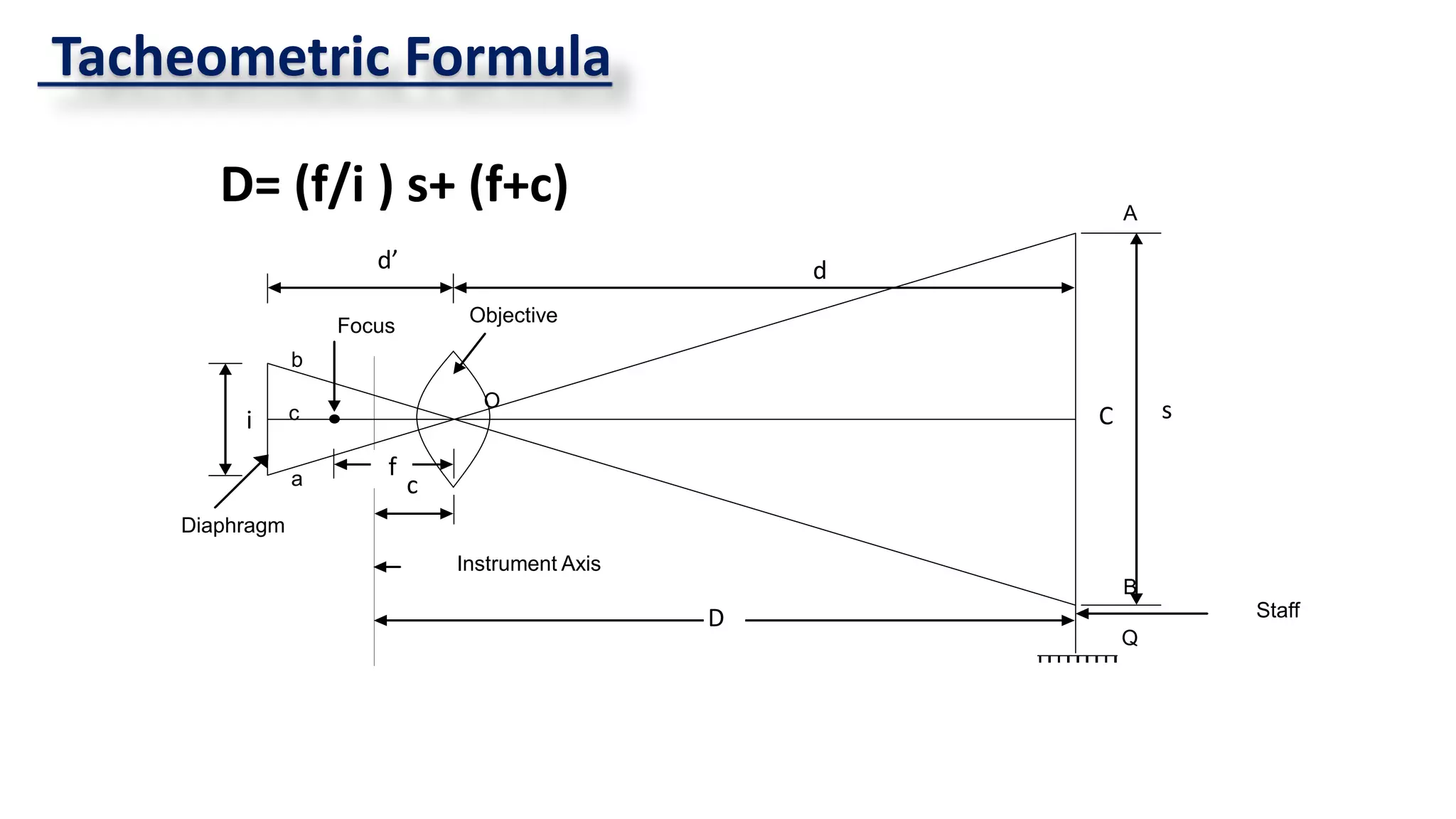
Tacheometric Formula
Q
B
A
b
c
a
Instrument Axis
Staff
ObjectiveFocus
O
Diaphragm
f
c
i sC
d’ d
D= (f/i ) s+ (f+c)
D
Tacheometric Formula
O is the optical centre of the object glass
f = focal length of the object glass,
i = stadia hair interval = ab,
s = staff intercept = AB,
c = distance from O to the vertical axis of the
instrument,
d = distance from O to the staff,
d′= distance from O to the plane of the
diaphragm, and
D = horizontal distance from the vertical axis to
the staff.
Tacheometric Formula
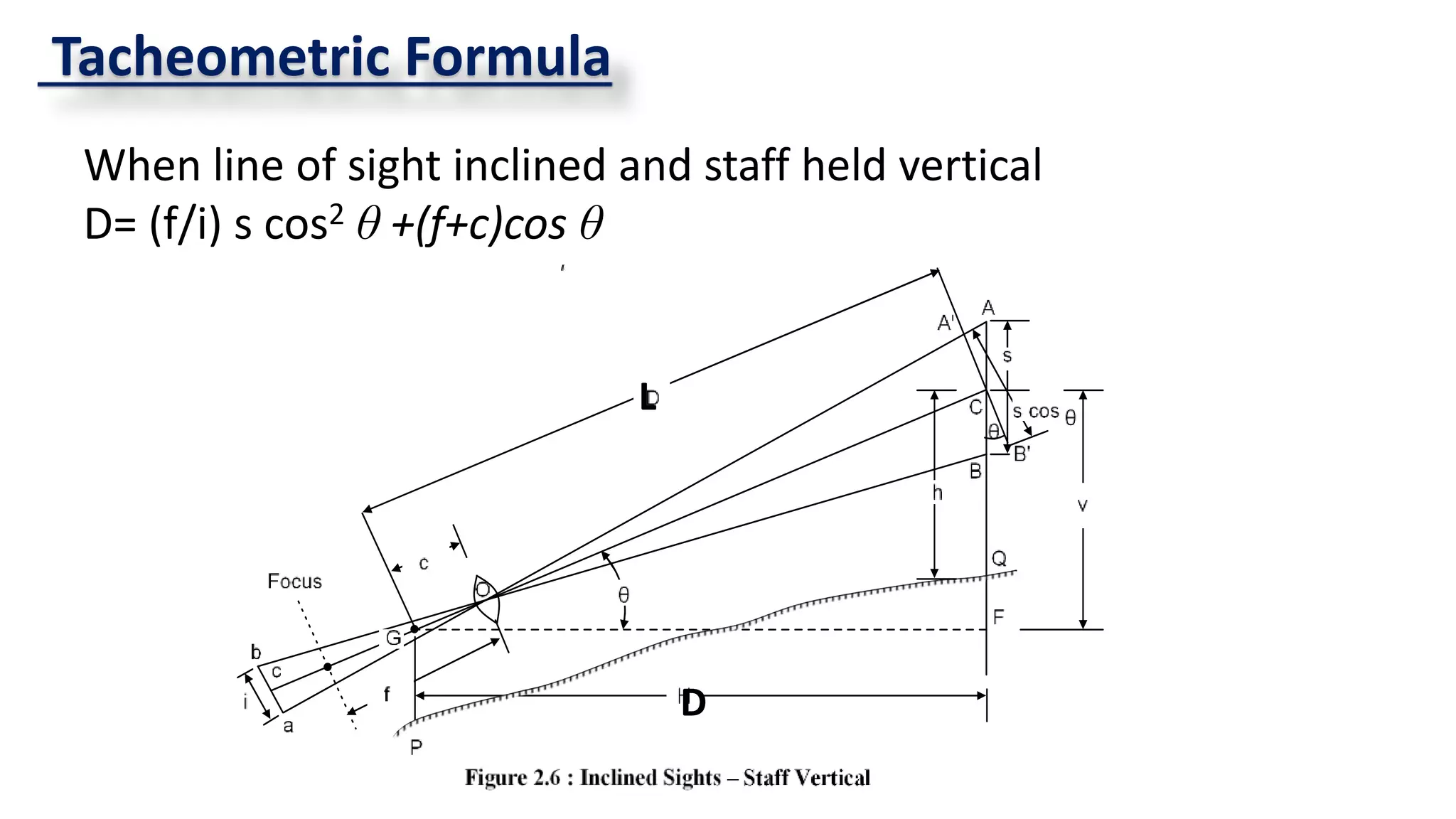
When line of sight inclined and staff held vertical
D= (f/i) s cos2 θ +(f+c)cos θ
L
D
Tacheometric Formula
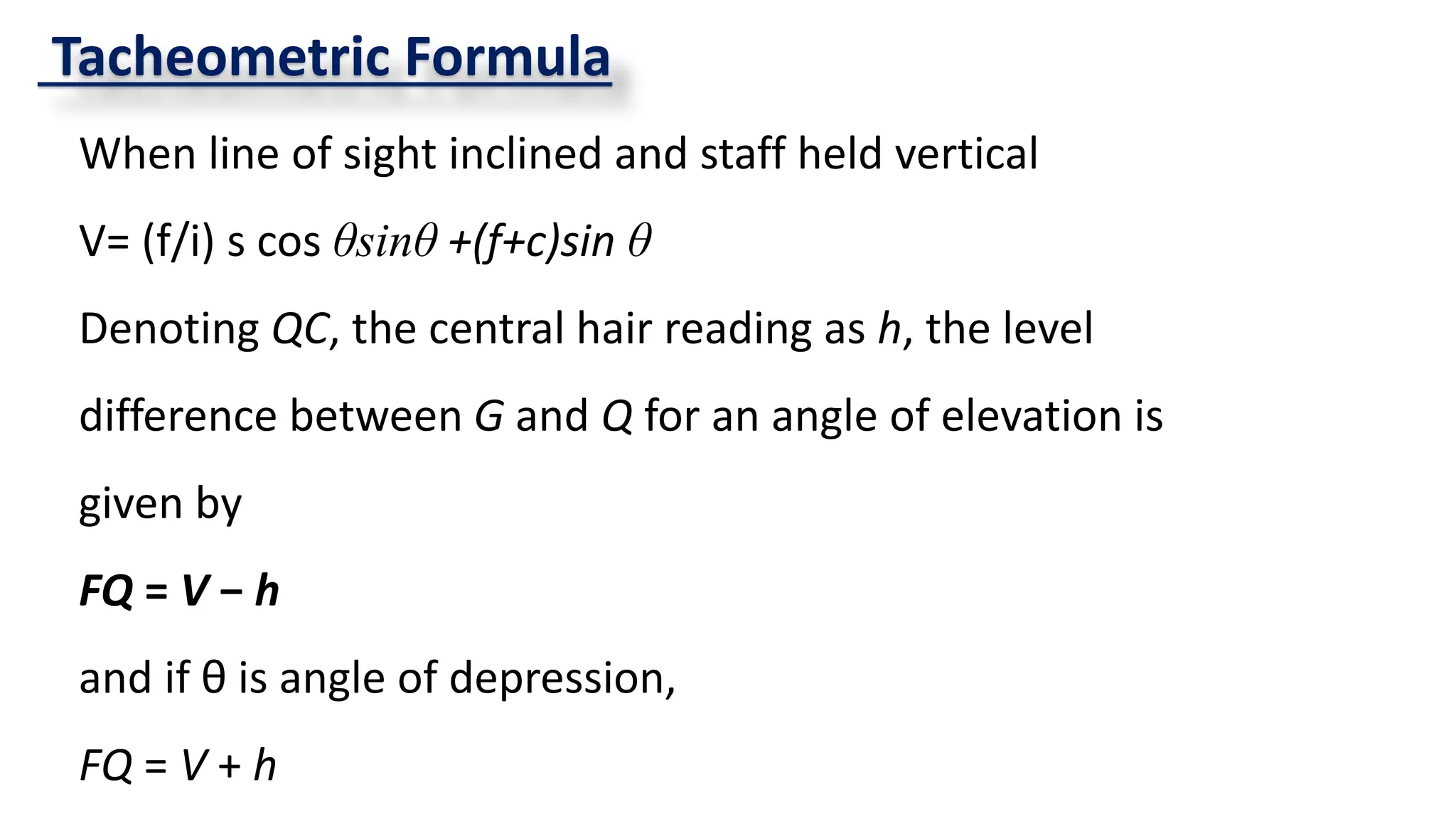
When line of sight inclined and staff held vertical
V= (f/i) s cos θsinθ +(f+c)sin θ
Denoting QC, the central hair reading as h, the level
difference between G and Q for an angle of elevation is
given by
FQ = V − h
and if θ is angle of depression,
FQ = V + h
Now, if we express the level of
collimation line above datum by Height
of Instrument (HI), then
RL of Q = HI + V − h
In case of a depressed sight
RL of Q = HI – V − h (Staff Normal )
Tacheometric Formula
Field method for determining constant of Thacheometer
1. Fix instrument at O
2. Take stadia hair readings at A,Band C .
3. Measure distances OA,OB,OC with help of
tape.
4. Calculate the staff interval at A,B and C .
5. Put values of horizontal distances and staff
intervals in tacheometric formula and make
three equations.
6. Solving these equations constants (f/i) and
( f+c) can be obtained.
Limitations of Tacheometric Surveying
Less accurate method and chaining is
completely eliminated.
Small error in observing stadia rod gives
large error in calculation of horizontal
distance and RL. Therefore method is used
for relatively small precision job.
It has been recommended that error in single
horizontal distance should be in 1 in 500.
This method is not suitable for precise survey.
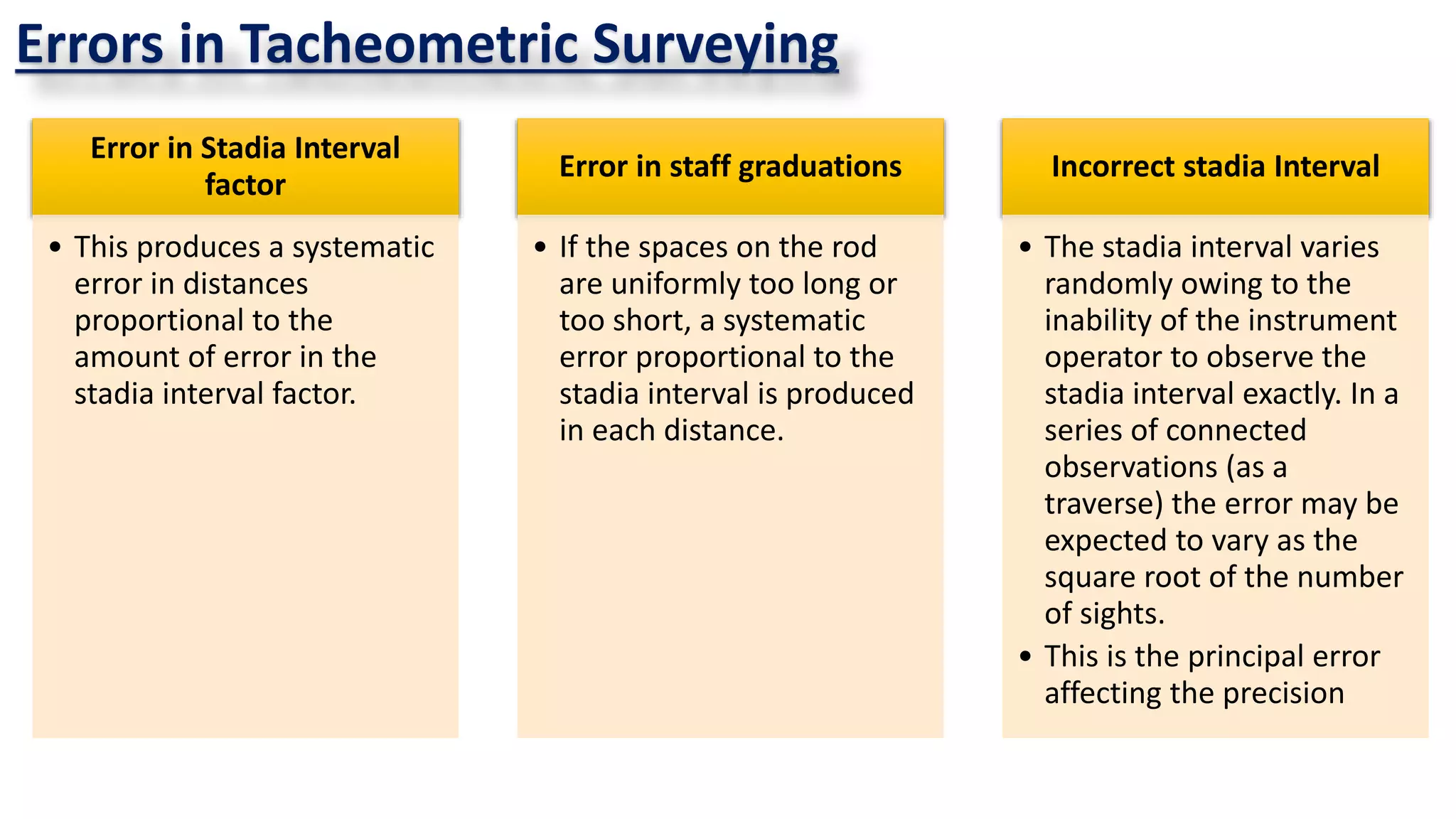
Errors in Tacheometric Surveying
Error in Stadia Interval
factor
• This produces a systematic
error in distances
proportional to the
amount of error in the
stadia interval factor.
Error in staff graduations
• If the spaces on the rod
are uniformly too long or
too short, a systematic
error proportional to the
stadia interval is produced
in each distance.
Incorrect stadia Interval
• The stadia interval varies
randomly owing to the
inability of the instrument
operator to observe the
stadia interval exactly. In a
series of connected
observations (as a
traverse) the error may be
expected to vary as the
square root of the number
of sights.
• This is the principal error
affecting the precision
Tacheometric surveying ppt

Tacheometric surveying ppt

  • 1.
  • 2.
    COURSE OUTCOMES C .Find distances and elevation using tacheometer
  • 3.
    PRACTICAL OUTCOMES 14. Usetheodolite as a tacheometer to compute reduced levels and horizontal distances
  • 4.
    UNIT OUTCOMES 3a. Explain thefunctions of given component(s) of tacheometer 3d. Determine RLs of stations and distances between stations using tacheometric survey using given data 3c.Calculate constant of tacheometer from given data 3b.Determine horizontal and vertical distances using tacheometric formula in the given situation
  • 5.
    Introduction Tacheometric is abranch of surveying in which horizontal and vertical distances are determined by taking angular observation with an instrument known as a tachometer. Tacheometric surveying is adopted in rough and difficult terrain where direct leveling and chaining are either not possible or very tedious.
  • 6.
    Suitability/uses Preparation of topographicmap where both horizontal and vertical distances are required to be measured Survey work in difficult terrain where direct methods of measurements are inconvenient Establishment of secondary control points reconnaissance survey for highways and railways etc.
  • 7.
    Instruments used fortacheometric surveying Tacheometer Levelling and stadia staff rod
  • 8.
    Tacheometer A tacheometer issimilar to an ordinary transit theodolite, generally a vernier theodolite itself, fitted with two stadia wires in addition to the central cross- hair and anallatic lens.
  • 9.
    Characteristics of Tacheometer Themultiple constant (f/i) should have a normal value of 100 and the error contained in this value should not exceed 1 in 1000 The axial horizontal lines should be exactly midway between the other two lines. The telescope should be fitted with an anallatic lens to make the additive constant (f + d) exactly to zero. The telescope should be truly analectic The telescope should be powerful having a magnification of 20 to 30 diameters. The Aperture of the object should be 35 to 45 mm in diameter.
  • 10.
  • 11.
    Levelling or stadiastaff rod For short distances, ordinary leveling staves are used. The leveling staff normally 4m long, and it can be folded with here parts. The graduations are so marked that a minimum reading of 0.005 or 0.001m can be taken.
  • 12.
    Anallatic lens Anallatic lensis an additional lens used in the instrument. It is a special lens which is placed between the object glass and the eyepiece of the telescope in order to eliminate the additive constant (f+c). This is done to make the expression for the distance between instrument station and staff position more simplified. The lens in only provided in an external focusing telescope but not in the internal focusing
  • 13.
    Principle of tacheometry Principleof tacheometry is based on principle of similar isosceles triangle in which corresponding sides & altitudes are proportional The ratio of distance of base from apex and length of base is always constant.
  • 14.
    Principle of tacheometry Infig. Oa1a2, Ob1b2, Oc1c2 are all isosceles triangles where D1, D2, D3 are the distances of bases from the apices (distances of staff stations from instrument stations) and S1, S2, S3 are the lengths of the bases also called staff intercepts. According to stated principle. D1/S1 = D2/S2=D3/ S3=f/i=Constant Where f=focal length of object and i =stadia intercept D1 D2 D3
  • 15.
    Methods of Tacheometric Surveying Stadia Method FixedHair Method Movable hair method Non Stadia Methods Tangential method Subtense bar method Methods of tacheometry
  • 16.
  • 17.
    Tacheometric Formula O isthe optical centre of the object glass f = focal length of the object glass, i = stadia hair interval = ab, s = staff intercept = AB, c = distance from O to the vertical axis of the instrument, d = distance from O to the staff, d′= distance from O to the plane of the diaphragm, and D = horizontal distance from the vertical axis to the staff.
  • 18.
    Tacheometric Formula When lineof sight inclined and staff held vertical D= (f/i) s cos2 θ +(f+c)cos θ L D
  • 19.
    Tacheometric Formula When lineof sight inclined and staff held vertical V= (f/i) s cos θsinθ +(f+c)sin θ Denoting QC, the central hair reading as h, the level difference between G and Q for an angle of elevation is given by FQ = V − h and if θ is angle of depression, FQ = V + h
  • 20.
    Now, if weexpress the level of collimation line above datum by Height of Instrument (HI), then RL of Q = HI + V − h In case of a depressed sight RL of Q = HI – V − h (Staff Normal ) Tacheometric Formula
  • 21.
    Field method fordetermining constant of Thacheometer 1. Fix instrument at O 2. Take stadia hair readings at A,Band C . 3. Measure distances OA,OB,OC with help of tape. 4. Calculate the staff interval at A,B and C . 5. Put values of horizontal distances and staff intervals in tacheometric formula and make three equations. 6. Solving these equations constants (f/i) and ( f+c) can be obtained.
  • 22.
    Limitations of TacheometricSurveying Less accurate method and chaining is completely eliminated. Small error in observing stadia rod gives large error in calculation of horizontal distance and RL. Therefore method is used for relatively small precision job. It has been recommended that error in single horizontal distance should be in 1 in 500. This method is not suitable for precise survey.
  • 23.
    Errors in TacheometricSurveying Error in Stadia Interval factor • This produces a systematic error in distances proportional to the amount of error in the stadia interval factor. Error in staff graduations • If the spaces on the rod are uniformly too long or too short, a systematic error proportional to the stadia interval is produced in each distance. Incorrect stadia Interval • The stadia interval varies randomly owing to the inability of the instrument operator to observe the stadia interval exactly. In a series of connected observations (as a traverse) the error may be expected to vary as the square root of the number of sights. • This is the principal error affecting the precision