Prepared By , 
Amit Bhoghara (CL 1309) 
Akash khunt (CL 1342) 
Siddhant Patel (CL 1343) 
Arpan Malaviya (CL 1344) 
Guided By, 
Hardik Sir
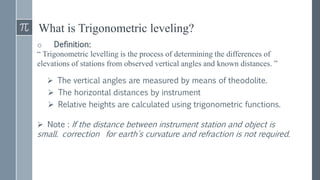
What is Trigonometric leveling? 
o Definition: 
“ Trigonometric levelling is the process of determining the differences of 
elevations of stations from observed vertical angles and known distances. ” 
 The vertical angles are measured by means of theodolite. 
 The horizontal distances by instrument 
 Relative heights are calculated using trigonometric functions. 
 Note : If the distance between instrument station and object is 
small. correction for earth's curvature and refraction is not required.
Method of Observation 
1) Direct Method: 
 Where is not possible to set the instrument over the station whose 
elevation is to be determined. 
 Combined correction is required.
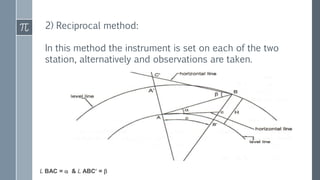
2) Reciprocal method: 
In this method the instrument is set on each of the two 
station, alternatively and observations are taken. 
L BAC =  & L ABC = 
Distance between A & B is Small 
AB' = AC = D 
L ACB = 900 
Similarly, 
BA' = BC' = D 
L AC'B = 900 
BC = D tan  
AC' = D tan 
Distance between A & B is Large 
Cc & Cr required 
CB' = C'A' = 0.0673D2 
True Difference A-B 
H=BB' 
=BC + CB' 
=D tan  + 0.0673 D2 
Depression angle B to A 
AC'=D tan  [ BC'= D ] 
True Difference A-B 
H=AA' 
=BC + CB' 
=D tan  - 0.0673 D2 
Adding Blue colour equation 
2 H = D tan  + D tan  
R.L of station B = R.L. of station A + H 
= R.L. of station A + D/2 [ tan  + tan  ]
METHODS OF DETERMINING THE ELEVATION OF A POINT BY 
THEODOLITE: 
Case 1. Base of the object accessible 
Case 2. Base of the object inaccessible, Instrument stations in the 
vertical plane as the elevated object. 
Case 3. Base of the object inaccessible, Instrument stations not in the 
same vertical plane as the elevated object.
Case 1. Base of the object accessible 
B 
A = Instrument station 
B = Point to be observed 
h = Elevation of B from the 
instrument axis 
D = Horizontal distance between A and the 
base of object 
h1 = Height of instrument (H. I.) 
Bs = Reading of staff kept on B.M. 
= Angle of elevation = L BAC 
h = D tan  
R.L. of B = R.L. of B.M. + Bs + h 
= R.L. of B.M. + Bs + D. tan  
If distance is large than add Cc & Cr 
R.L. of B = R.L. of B.M. + Bs + D. tan  + 0.0673 D2
Case 2. Base of the object inaccessible, Instrument stations 
in the vertical plane as the elevated object. 
There may be two cases. 
(a) Instrument axes at the same level 
(b) Instrument axes at different levels. 
1) Height of instrument axis never to the object is 
lower: 
2) Height of instrument axis to the object is higher:
Case 2. Base of the object inaccessible, Instrument stations in the vertical plane as the 
elevated object. 
(a) Instrument axes at the same level 
 PAP, h= D tan 1 
 PBP, h= (b+D) tan 2 
D tan 1 = (b+D) tan 2 
D tan 1 = b tan 2 + D tan 2 
D(tan 1 - tan 2) = b tan 2 
R.L of P = R.L of B.M + Bs + h
(b) Instrument axes at different levels. 
1) Height of instrument axis never to the object is lower: 
 PAP, h1 = D tan 1 
 PBP, h2 = (b+D) tan 2 
hd is difference between two height 
hd = h1 – h2 
hd = D tan 1 - (b+D) tan 2 
= D tan 1 - b tan 2 -D tan 2 
hd = D(tan 1 - tan 2) - b tan 2 
hd + b tan 2 = D(tan 1 - tan 2) 
h1 = D tan 1
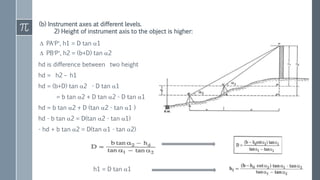
(b) Instrument axes at different levels. 
2) Height of instrument axis to the object is higher: 
 PAP, h1 = D tan 1 
 PBP, h2 = (b+D) tan 2 
hd is difference between two height 
hd = h2 – h1 
hd = (b+D) tan 2 - D tan 1 
= b tan 2 + D tan 2 - D tan 1 
hd = b tan 2 + D (tan 2 - tan 1 ) 
hd - b tan 2 = D(tan 2 - tan 1) 
- hd + b tan 2 = D(tan 1 - tan 2) 
h1 = D tan 1
In above two case the equations of D and h1 are, 
D h1
Case 3. Base of the object inaccessible, Instrument stations not in the same 
vertical plane as the elevated object. 
Set up instrument on A 
Measure 1 to P 
L BAC =  
Set up instrument on B 
Measure 2 to P 
L ABC =  
L ACB = 180 – (  +  ) 
Sin Rule: 
BC= 
b· sin 
sin{180˚ - (+ )} 
AC= 
b· sin 
sin{180˚ - ( +  
h1 = AC tan 1 
h2 = BC tan 2
Trigonometric leveling

Trigonometric leveling

  • 1.
    Prepared By , Amit Bhoghara (CL 1309) Akash khunt (CL 1342) Siddhant Patel (CL 1343) Arpan Malaviya (CL 1344) Guided By, Hardik Sir
  • 2.
    What is Trigonometricleveling? o Definition: “ Trigonometric levelling is the process of determining the differences of elevations of stations from observed vertical angles and known distances. ”  The vertical angles are measured by means of theodolite.  The horizontal distances by instrument  Relative heights are calculated using trigonometric functions.  Note : If the distance between instrument station and object is small. correction for earth's curvature and refraction is not required.
  • 3.
    Method of Observation 1) Direct Method:  Where is not possible to set the instrument over the station whose elevation is to be determined.  Combined correction is required.
  • 4.
    2) Reciprocal method: In this method the instrument is set on each of the two station, alternatively and observations are taken. L BAC =  & L ABC = 
  • 5.
    Distance between A& B is Small AB' = AC = D L ACB = 900 Similarly, BA' = BC' = D L AC'B = 900 BC = D tan  AC' = D tan 
  • 6.
    Distance between A& B is Large Cc & Cr required CB' = C'A' = 0.0673D2 True Difference A-B H=BB' =BC + CB' =D tan  + 0.0673 D2 Depression angle B to A AC'=D tan  [ BC'= D ] True Difference A-B H=AA' =BC + CB' =D tan  - 0.0673 D2 Adding Blue colour equation 2 H = D tan  + D tan  R.L of station B = R.L. of station A + H = R.L. of station A + D/2 [ tan  + tan  ]
  • 7.
    METHODS OF DETERMININGTHE ELEVATION OF A POINT BY THEODOLITE: Case 1. Base of the object accessible Case 2. Base of the object inaccessible, Instrument stations in the vertical plane as the elevated object. Case 3. Base of the object inaccessible, Instrument stations not in the same vertical plane as the elevated object.
  • 8.
    Case 1. Baseof the object accessible B A = Instrument station B = Point to be observed h = Elevation of B from the instrument axis D = Horizontal distance between A and the base of object h1 = Height of instrument (H. I.) Bs = Reading of staff kept on B.M. = Angle of elevation = L BAC h = D tan  R.L. of B = R.L. of B.M. + Bs + h = R.L. of B.M. + Bs + D. tan  If distance is large than add Cc & Cr R.L. of B = R.L. of B.M. + Bs + D. tan  + 0.0673 D2
  • 9.
    Case 2. Baseof the object inaccessible, Instrument stations in the vertical plane as the elevated object. There may be two cases. (a) Instrument axes at the same level (b) Instrument axes at different levels. 1) Height of instrument axis never to the object is lower: 2) Height of instrument axis to the object is higher:
  • 10.
    Case 2. Baseof the object inaccessible, Instrument stations in the vertical plane as the elevated object. (a) Instrument axes at the same level  PAP, h= D tan 1  PBP, h= (b+D) tan 2 D tan 1 = (b+D) tan 2 D tan 1 = b tan 2 + D tan 2 D(tan 1 - tan 2) = b tan 2 R.L of P = R.L of B.M + Bs + h
  • 11.
    (b) Instrument axesat different levels. 1) Height of instrument axis never to the object is lower:  PAP, h1 = D tan 1  PBP, h2 = (b+D) tan 2 hd is difference between two height hd = h1 – h2 hd = D tan 1 - (b+D) tan 2 = D tan 1 - b tan 2 -D tan 2 hd = D(tan 1 - tan 2) - b tan 2 hd + b tan 2 = D(tan 1 - tan 2) h1 = D tan 1
  • 12.
    (b) Instrument axesat different levels. 2) Height of instrument axis to the object is higher:  PAP, h1 = D tan 1  PBP, h2 = (b+D) tan 2 hd is difference between two height hd = h2 – h1 hd = (b+D) tan 2 - D tan 1 = b tan 2 + D tan 2 - D tan 1 hd = b tan 2 + D (tan 2 - tan 1 ) hd - b tan 2 = D(tan 2 - tan 1) - hd + b tan 2 = D(tan 1 - tan 2) h1 = D tan 1
  • 13.
    In above twocase the equations of D and h1 are, D h1
  • 14.
    Case 3. Baseof the object inaccessible, Instrument stations not in the same vertical plane as the elevated object. Set up instrument on A Measure 1 to P L BAC =  Set up instrument on B Measure 2 to P L ABC =  L ACB = 180 – (  +  ) Sin Rule: BC= b· sin sin{180˚ - (+ )} AC= b· sin sin{180˚ - ( +  h1 = AC tan 1 h2 = BC tan 2