“PORT AMENITIES &
OPERATIONS”
1
PREPARED BY : ASST. PROF. VATSAL D. PATEL
MAHATMA GANDHI INSTITUTE OF
TECHNICAL EDUCATION &
RESEARCH CENTRE, NAVSARI.
FERRY
 A ferry is a boat or ship (a merchant ship) used to carry (or
ferry) primarily passengers and sometimes vehicles and
cargo as well, across a body of water.
 Most ferry operates on regular, frequent, return services.
 Also known as water bus or water taxi.
 Ferry design depend on the length of the route, passenger
or vehicle capacity required, speed requirements and the
water conditions the craft must deal with.
TYPES OF FERRY
 The following are the type of ferries:
 Double-Ended ferry.
 Hydrofoil.
 Hovercraft.
 Catamaran.
 Ro-ro ferry.
 Cruise ferry.
 Fast RoPax ferry.
 Turntable ferry.
 Pontoon ferry
 Foot ferry.
 Cable ferry.
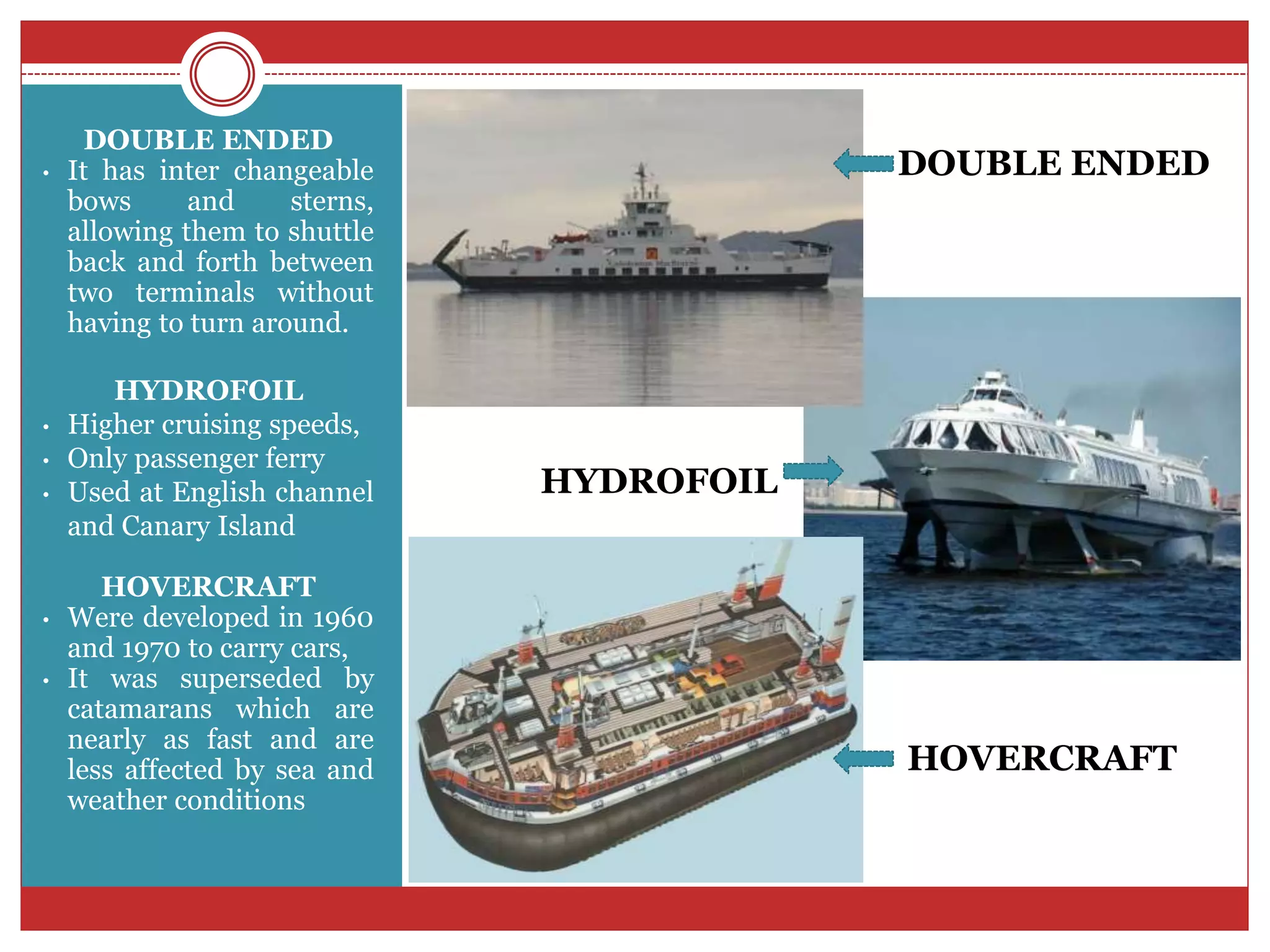
DOUBLE ENDED
• It has inter changeable
bows and sterns,
allowing them to shuttle
back and forth between
two terminals without
having to turn around.
HYDROFOIL
• Higher cruising speeds,
• Only passenger ferry
• Used at English channel
and Canary Island
HOVERCRAFT
• Were developed in 1960
and 1970 to carry cars,
• It was superseded by
catamarans which are
nearly as fast and are
less affected by sea and
weather conditions
DOUBLE ENDED
HYDROFOIL
HOVERCRAFT
CATAMARAN
• It is normally associated
with high speed ferry
service,
• Water jet powered vessels
RO-RO
• Roll on/ roll off ferries are
large, conventional ferries
named for the ease by
which vehicles can board
and leave
CRUISE FERRY
• A ship that combines
features of a cruise ship
with a Ro-Ro ferry.
FAST ROPAX
FERRY
• Introduced in 1995,
• Conventional ferry with
large garage intake,
• Large passenger capacity,
• Diesel propulsion and
propellers that sail over
25 knots.
CATAMARAN RO-RO
FAST ROPAX FERRY CRUISE FERRY
TURNTABLE FERRY
• Allows vehicles to load
from side.
• The vehicle platform can
be turned sideways to
allow sideways loading of
vehicles.
PONTOON FERRY
• Used in less developed
countries with large river,
• One or more vehicles are
carried on a pontoon with
ramps at either end for
vehicle to drive on and off,
• Motorized and able to be
steered independently like
a boat.
FOOT FERRY
• Small craft used to ferry
foot passengers, and often
also cyclist, over rivers,
• Self propelled craft or
cable ferries.
PONTOON
FERRY
FOOT
FERRY
TURNTABLE
FERRY
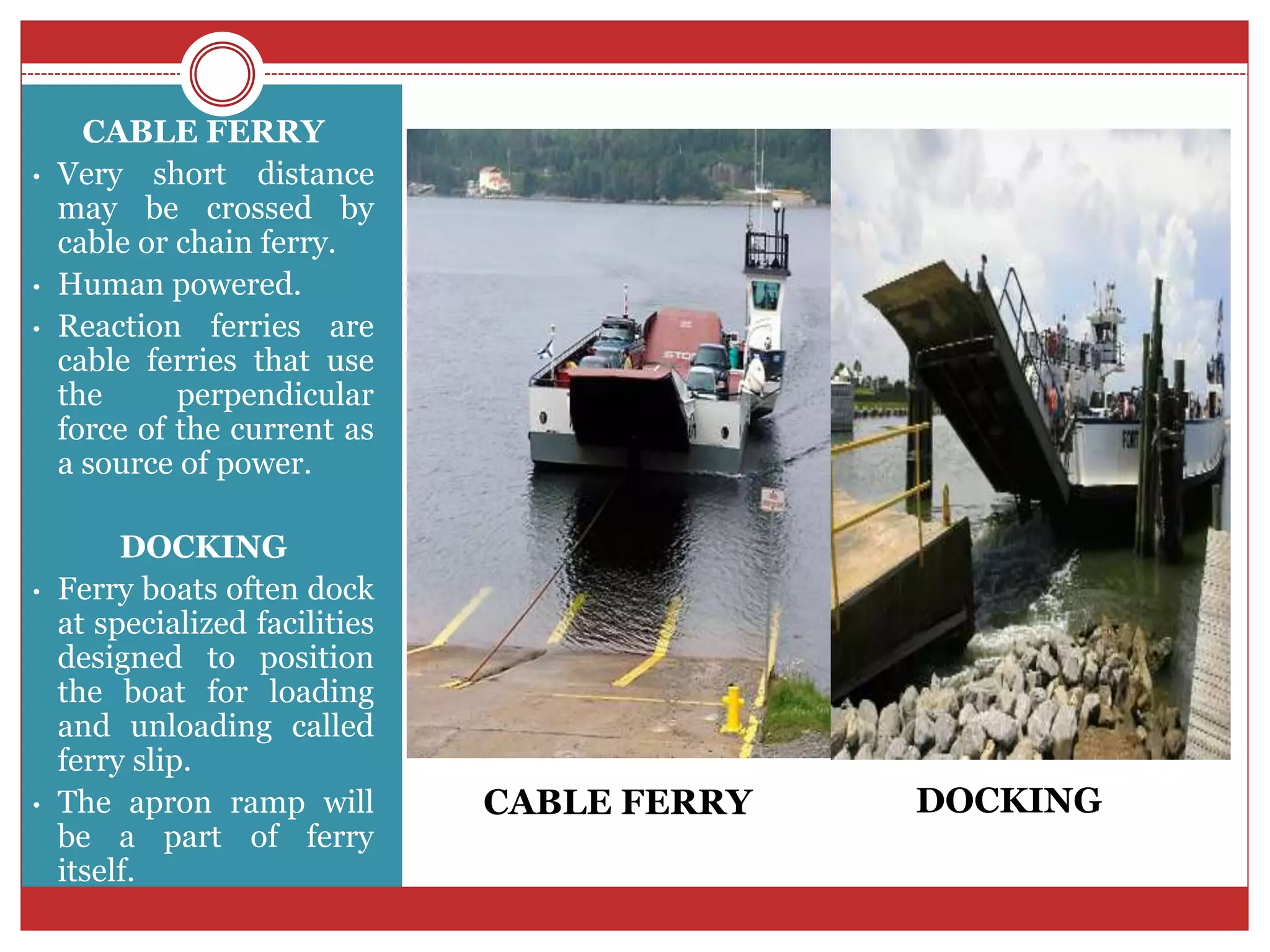
CABLE FERRY
• Very short distance
may be crossed by
cable or chain ferry.
• Human powered.
• Reaction ferries are
cable ferries that use
the perpendicular
force of the current as
a source of power.
DOCKING
• Ferry boats often dock
at specialized facilities
designed to position
the boat for loading
and unloading called
ferry slip.
• The apron ramp will
be a part of ferry
itself.
CABLE FERRY DOCKING
FERRY SLIP or
TRANSFER BRIDGE
• A ferry slip is a
specialized docking
facility that receives a
ferry boat or train
ferry,
• A similar structure
called a barge slip
receives a barge or
car float that is used
to carry wheeled
vehicles across a body
of water,
• In other cases, the
ramp is installed at
the ferry slip and is
called a link span or
apron,
• Such ramp is
adjustable to
accommodate varying
water heights and
ferry loadings and to
move it out of the way
during approach and
exit.
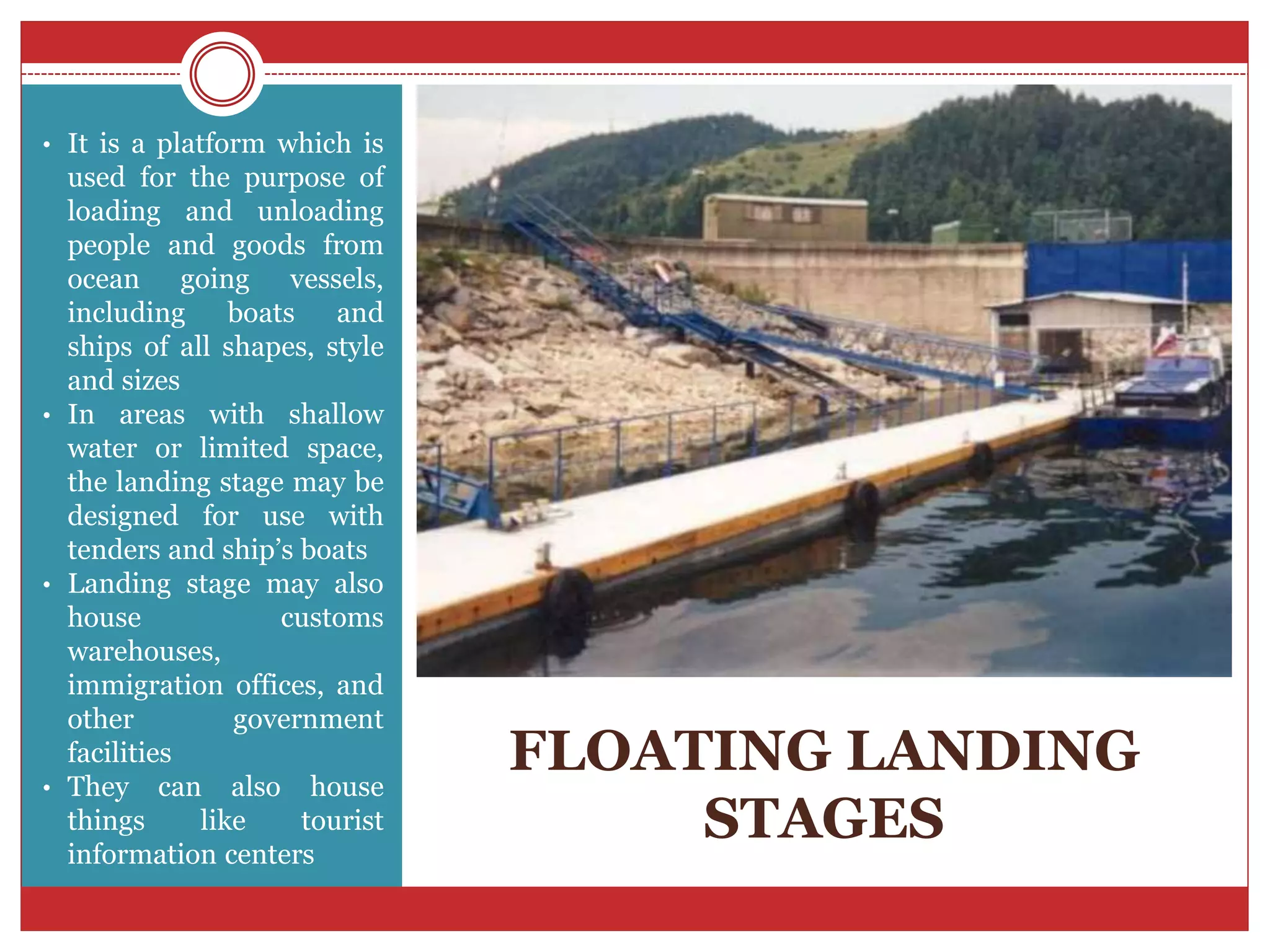
FLOATING LANDING
STAGES
• It is a platform which is
used for the purpose of
loading and unloading
people and goods from
ocean going vessels,
including boats and
ships of all shapes, style
and sizes
• In areas with shallow
water or limited space,
the landing stage may be
designed for use with
tenders and ship’s boats
• Landing stage may also
house customs
warehouses,
immigration offices, and
other government
facilities
• They can also house
things like tourist
information centers
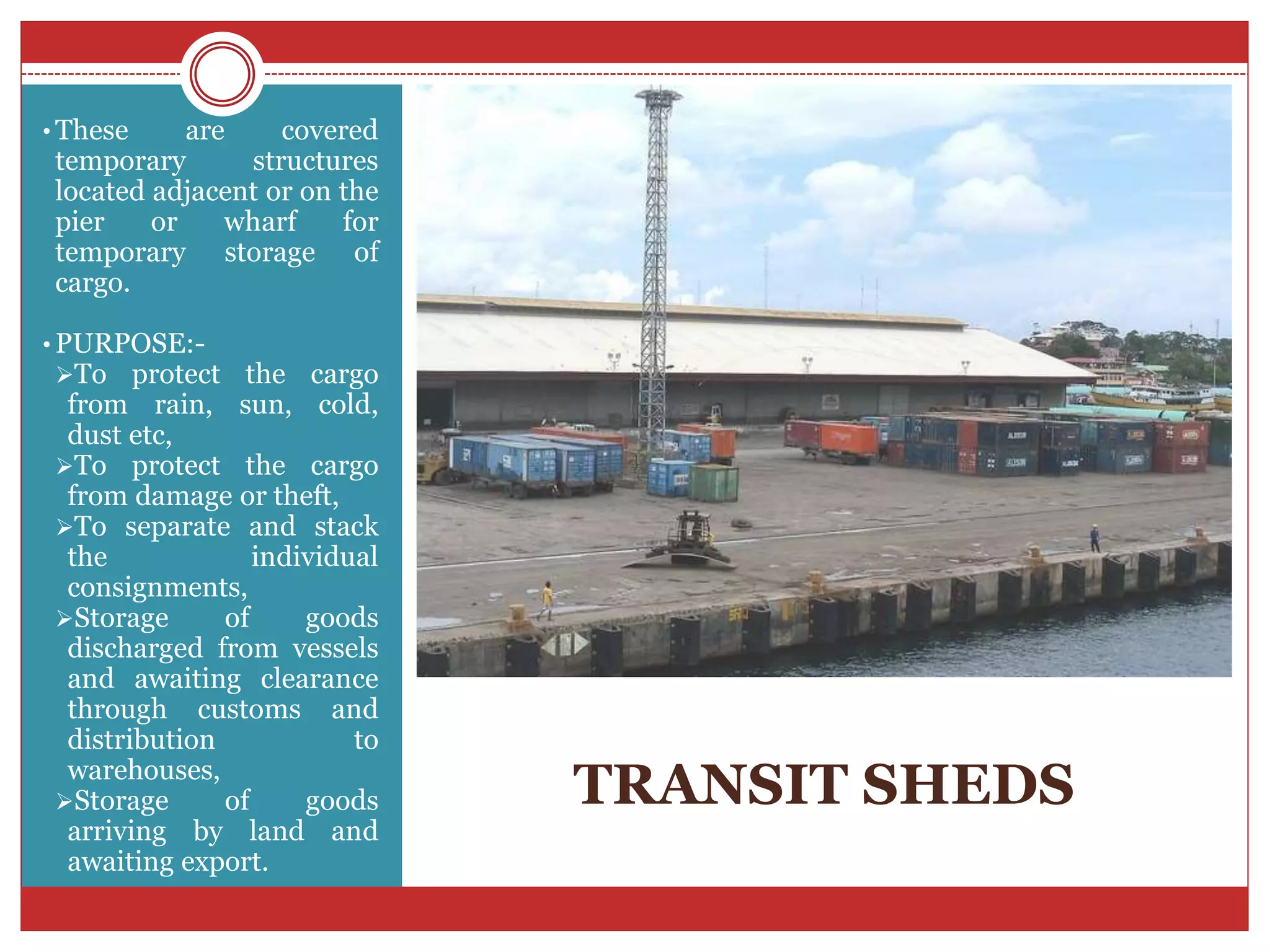
TRANSIT SHEDS
• These are covered
temporary structures
located adjacent or on the
pier or wharf for
temporary storage of
cargo.
• PURPOSE:-
To protect the cargo
from rain, sun, cold,
dust etc,
To protect the cargo
from damage or theft,
To separate and stack
the individual
consignments,
Storage of goods
discharged from vessels
and awaiting clearance
through customs and
distribution to
warehouses,
Storage of goods
arriving by land and
awaiting export.
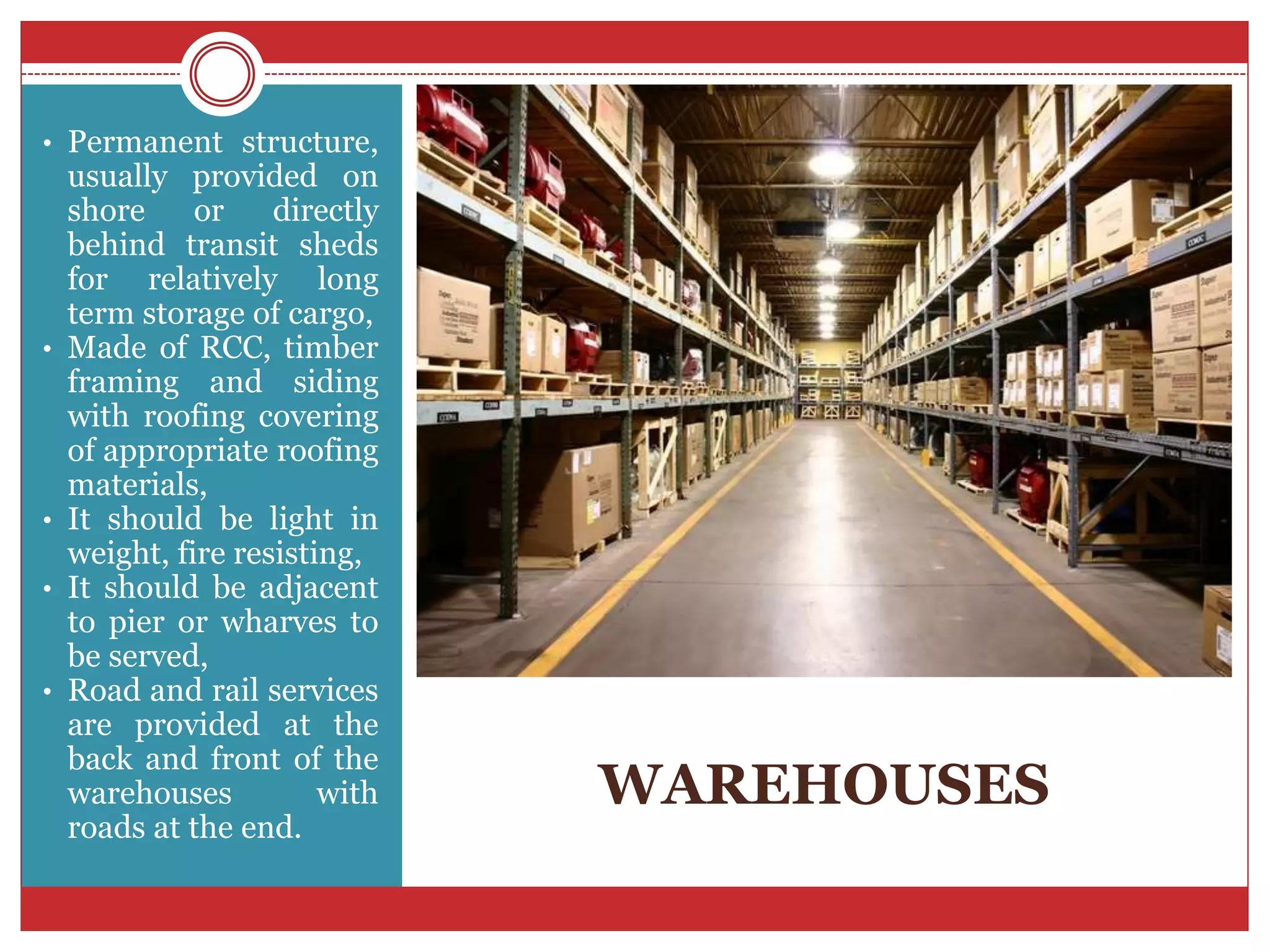
WAREHOUSES
• Permanent structure,
usually provided on
shore or directly
behind transit sheds
for relatively long
term storage of cargo,
• Made of RCC, timber
framing and siding
with roofing covering
of appropriate roofing
materials,
• It should be light in
weight, fire resisting,
• It should be adjacent
to pier or wharves to
be served,
• Road and rail services
are provided at the
back and front of the
warehouses with
roads at the end.
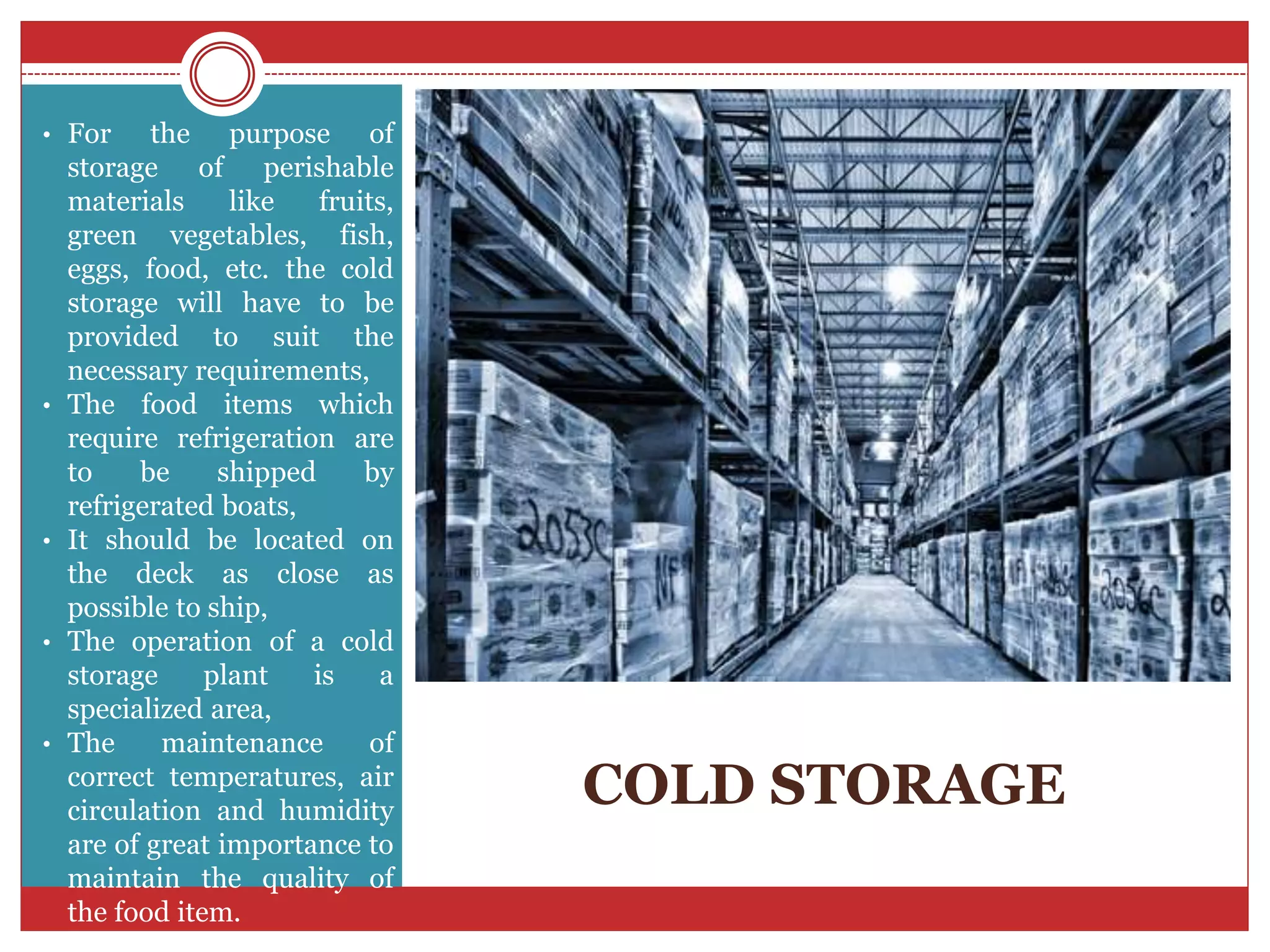
COLD STORAGE
• For the purpose of
storage of perishable
materials like fruits,
green vegetables, fish,
eggs, food, etc. the cold
storage will have to be
provided to suit the
necessary requirements,
• The food items which
require refrigeration are
to be shipped by
refrigerated boats,
• It should be located on
the deck as close as
possible to ship,
• The operation of a cold
storage plant is a
specialized area,
• The maintenance of
correct temperatures, air
circulation and humidity
are of great importance to
maintain the quality of
the food item.
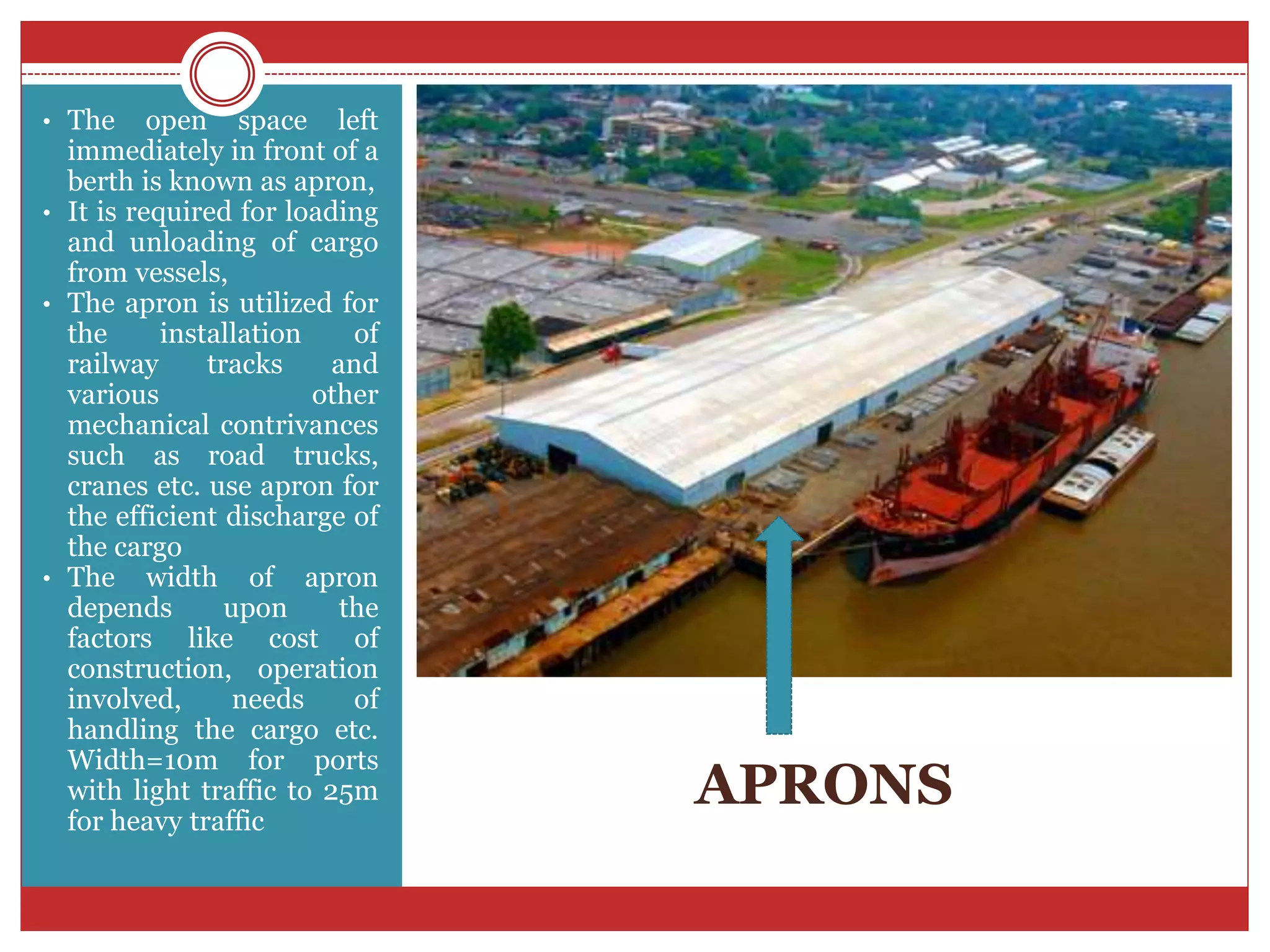
APRONS
• The open space left
immediately in front of a
berth is known as apron,
• It is required for loading
and unloading of cargo
from vessels,
• The apron is utilized for
the installation of
railway tracks and
various other
mechanical contrivances
such as road trucks,
cranes etc. use apron for
the efficient discharge of
the cargo
• The width of apron
depends upon the
factors like cost of
construction, operation
involved, needs of
handling the cargo etc.
Width=10m for ports
with light traffic to 25m
for heavy traffic
CARGO
HANDLING
EQUIPMENTS
• Cranes
• Mechanical trucks
• Tractors and trailors
• Dock locomotives
• Piling and stacking
machines
• Conveyors and elevators
• Pneumatics handling
equipments
• Oil handling equipment
STACK AREA
Stack dates are set by
the port in conjunction
with the vessel operator
based on the eta of the
vessel at a port.
One of the main
reasons for
the stack dates is so
that all the containers
planned to be loaded on
a vessel are present at
the port and ready for
operations by the time
the vessel berths
SINGLE
POINT
MOORING
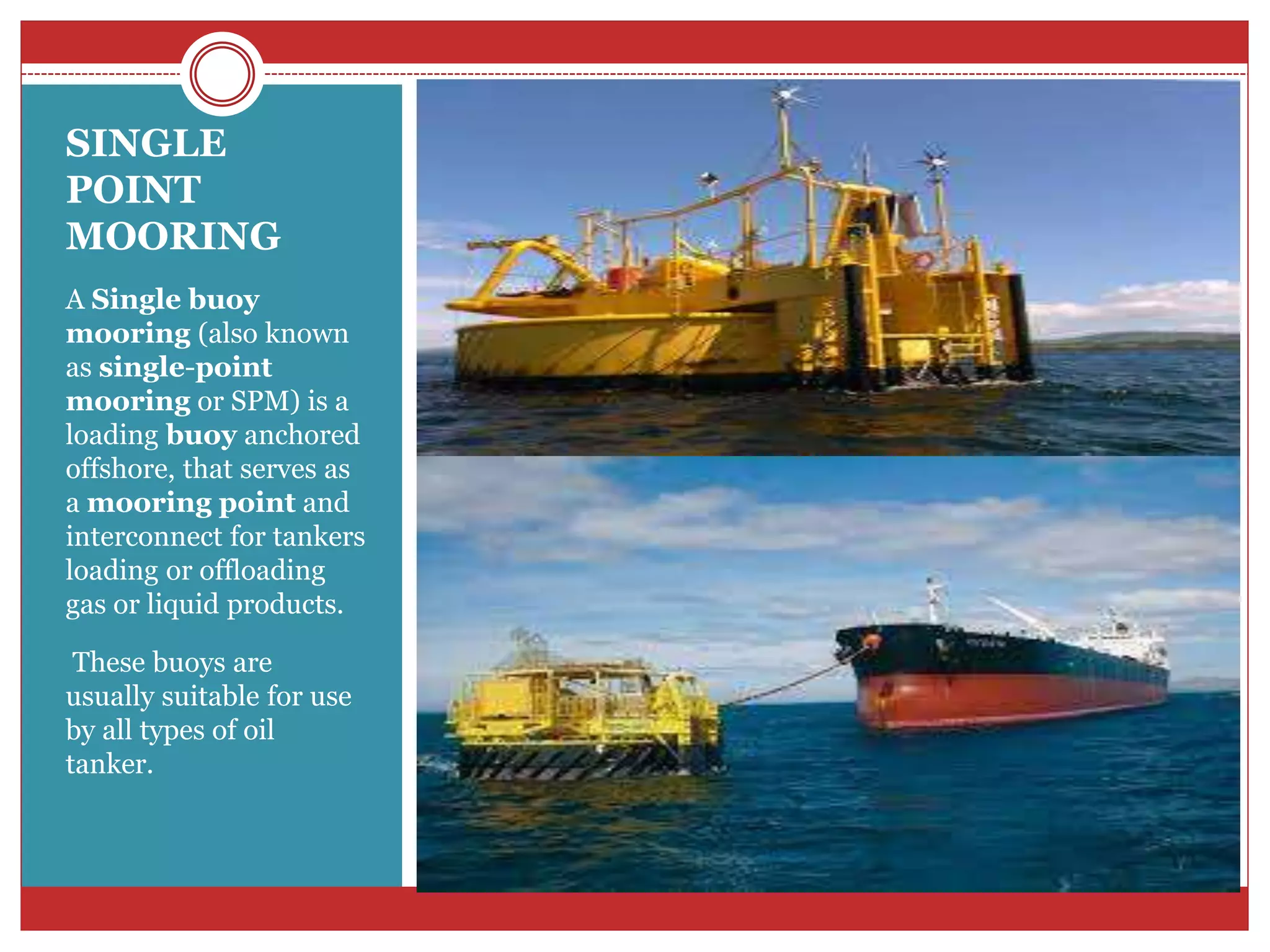
A Single buoy
mooring (also known
as single-point
mooring or SPM) is a
loading buoy anchored
offshore, that serves as
a mooring point and
interconnect for tankers
loading or offloading
gas or liquid products.
These buoys are
usually suitable for use
by all types of oil
tanker.
17

5. PORT AMENITIES & OPERATIONS (PHE) GTU 3170623

  • 1.
    “PORT AMENITIES & OPERATIONS” 1 PREPAREDBY : ASST. PROF. VATSAL D. PATEL MAHATMA GANDHI INSTITUTE OF TECHNICAL EDUCATION & RESEARCH CENTRE, NAVSARI.
  • 2.
    FERRY  A ferryis a boat or ship (a merchant ship) used to carry (or ferry) primarily passengers and sometimes vehicles and cargo as well, across a body of water.  Most ferry operates on regular, frequent, return services.  Also known as water bus or water taxi.  Ferry design depend on the length of the route, passenger or vehicle capacity required, speed requirements and the water conditions the craft must deal with.
  • 3.
    TYPES OF FERRY The following are the type of ferries:  Double-Ended ferry.  Hydrofoil.  Hovercraft.  Catamaran.  Ro-ro ferry.  Cruise ferry.  Fast RoPax ferry.  Turntable ferry.  Pontoon ferry  Foot ferry.  Cable ferry.
  • 4.
    DOUBLE ENDED • Ithas inter changeable bows and sterns, allowing them to shuttle back and forth between two terminals without having to turn around. HYDROFOIL • Higher cruising speeds, • Only passenger ferry • Used at English channel and Canary Island HOVERCRAFT • Were developed in 1960 and 1970 to carry cars, • It was superseded by catamarans which are nearly as fast and are less affected by sea and weather conditions DOUBLE ENDED HYDROFOIL HOVERCRAFT
  • 5.
    CATAMARAN • It isnormally associated with high speed ferry service, • Water jet powered vessels RO-RO • Roll on/ roll off ferries are large, conventional ferries named for the ease by which vehicles can board and leave CRUISE FERRY • A ship that combines features of a cruise ship with a Ro-Ro ferry. FAST ROPAX FERRY • Introduced in 1995, • Conventional ferry with large garage intake, • Large passenger capacity, • Diesel propulsion and propellers that sail over 25 knots. CATAMARAN RO-RO FAST ROPAX FERRY CRUISE FERRY
  • 6.
    TURNTABLE FERRY • Allowsvehicles to load from side. • The vehicle platform can be turned sideways to allow sideways loading of vehicles. PONTOON FERRY • Used in less developed countries with large river, • One or more vehicles are carried on a pontoon with ramps at either end for vehicle to drive on and off, • Motorized and able to be steered independently like a boat. FOOT FERRY • Small craft used to ferry foot passengers, and often also cyclist, over rivers, • Self propelled craft or cable ferries. PONTOON FERRY FOOT FERRY TURNTABLE FERRY
  • 7.
    CABLE FERRY • Veryshort distance may be crossed by cable or chain ferry. • Human powered. • Reaction ferries are cable ferries that use the perpendicular force of the current as a source of power. DOCKING • Ferry boats often dock at specialized facilities designed to position the boat for loading and unloading called ferry slip. • The apron ramp will be a part of ferry itself. CABLE FERRY DOCKING
  • 8.
    FERRY SLIP or TRANSFERBRIDGE • A ferry slip is a specialized docking facility that receives a ferry boat or train ferry, • A similar structure called a barge slip receives a barge or car float that is used to carry wheeled vehicles across a body of water, • In other cases, the ramp is installed at the ferry slip and is called a link span or apron, • Such ramp is adjustable to accommodate varying water heights and ferry loadings and to move it out of the way during approach and exit.
  • 9.
    FLOATING LANDING STAGES • Itis a platform which is used for the purpose of loading and unloading people and goods from ocean going vessels, including boats and ships of all shapes, style and sizes • In areas with shallow water or limited space, the landing stage may be designed for use with tenders and ship’s boats • Landing stage may also house customs warehouses, immigration offices, and other government facilities • They can also house things like tourist information centers
  • 10.
    TRANSIT SHEDS • Theseare covered temporary structures located adjacent or on the pier or wharf for temporary storage of cargo. • PURPOSE:- To protect the cargo from rain, sun, cold, dust etc, To protect the cargo from damage or theft, To separate and stack the individual consignments, Storage of goods discharged from vessels and awaiting clearance through customs and distribution to warehouses, Storage of goods arriving by land and awaiting export.
  • 11.
    WAREHOUSES • Permanent structure, usuallyprovided on shore or directly behind transit sheds for relatively long term storage of cargo, • Made of RCC, timber framing and siding with roofing covering of appropriate roofing materials, • It should be light in weight, fire resisting, • It should be adjacent to pier or wharves to be served, • Road and rail services are provided at the back and front of the warehouses with roads at the end.
  • 12.
    COLD STORAGE • Forthe purpose of storage of perishable materials like fruits, green vegetables, fish, eggs, food, etc. the cold storage will have to be provided to suit the necessary requirements, • The food items which require refrigeration are to be shipped by refrigerated boats, • It should be located on the deck as close as possible to ship, • The operation of a cold storage plant is a specialized area, • The maintenance of correct temperatures, air circulation and humidity are of great importance to maintain the quality of the food item.
  • 13.
    APRONS • The openspace left immediately in front of a berth is known as apron, • It is required for loading and unloading of cargo from vessels, • The apron is utilized for the installation of railway tracks and various other mechanical contrivances such as road trucks, cranes etc. use apron for the efficient discharge of the cargo • The width of apron depends upon the factors like cost of construction, operation involved, needs of handling the cargo etc. Width=10m for ports with light traffic to 25m for heavy traffic
  • 14.
    CARGO HANDLING EQUIPMENTS • Cranes • Mechanicaltrucks • Tractors and trailors • Dock locomotives • Piling and stacking machines • Conveyors and elevators • Pneumatics handling equipments • Oil handling equipment
  • 15.
    STACK AREA Stack datesare set by the port in conjunction with the vessel operator based on the eta of the vessel at a port. One of the main reasons for the stack dates is so that all the containers planned to be loaded on a vessel are present at the port and ready for operations by the time the vessel berths
  • 16.
    SINGLE POINT MOORING A Single buoy mooring(also known as single-point mooring or SPM) is a loading buoy anchored offshore, that serves as a mooring point and interconnect for tankers loading or offloading gas or liquid products. These buoys are usually suitable for use by all types of oil tanker.
  • 17.