Advanced Surveying
Unit-6
Trignometric Levelling
Content
1. Trignometric Levelling
2. Terrestrial refraction,
3. Angular corrections for curvature and refraction,
4. Axis signal correction, Determination of difference in
elevation by single observation and reciprocal
observations.
Prepared by –Prof.S.M.Gunjal
Definition-Trignometric Levelling
 A method in which the relative elevation of different station are
found out from the measured vertical angle and known plane
horizontal distance or geodetic distance, is called as the
trigonometric levelling.
Terrestrial refraction
1. The effect of refraction is to make the object appear
higher than they really are in plan surveying where a
graduated staff isobserved either horizontal line of sight
or inclined line of sight ,the effect of refraction is to
decrease the staff reading and the correction is applied
linearly to the observed staff reading.
2. In trignometric levelling employed the elevation of
widely distributed points ,the correction is applied to the
observed angles.
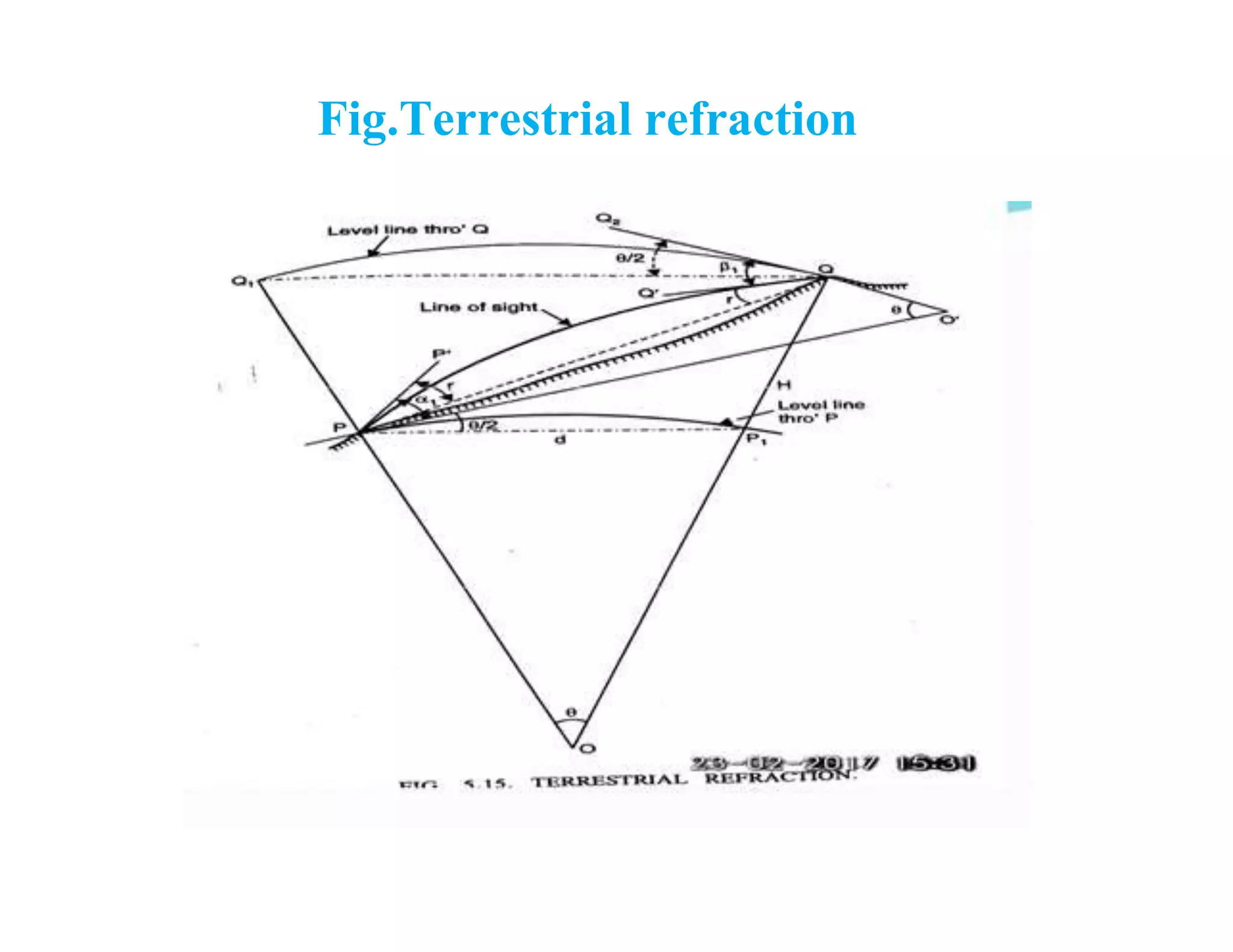
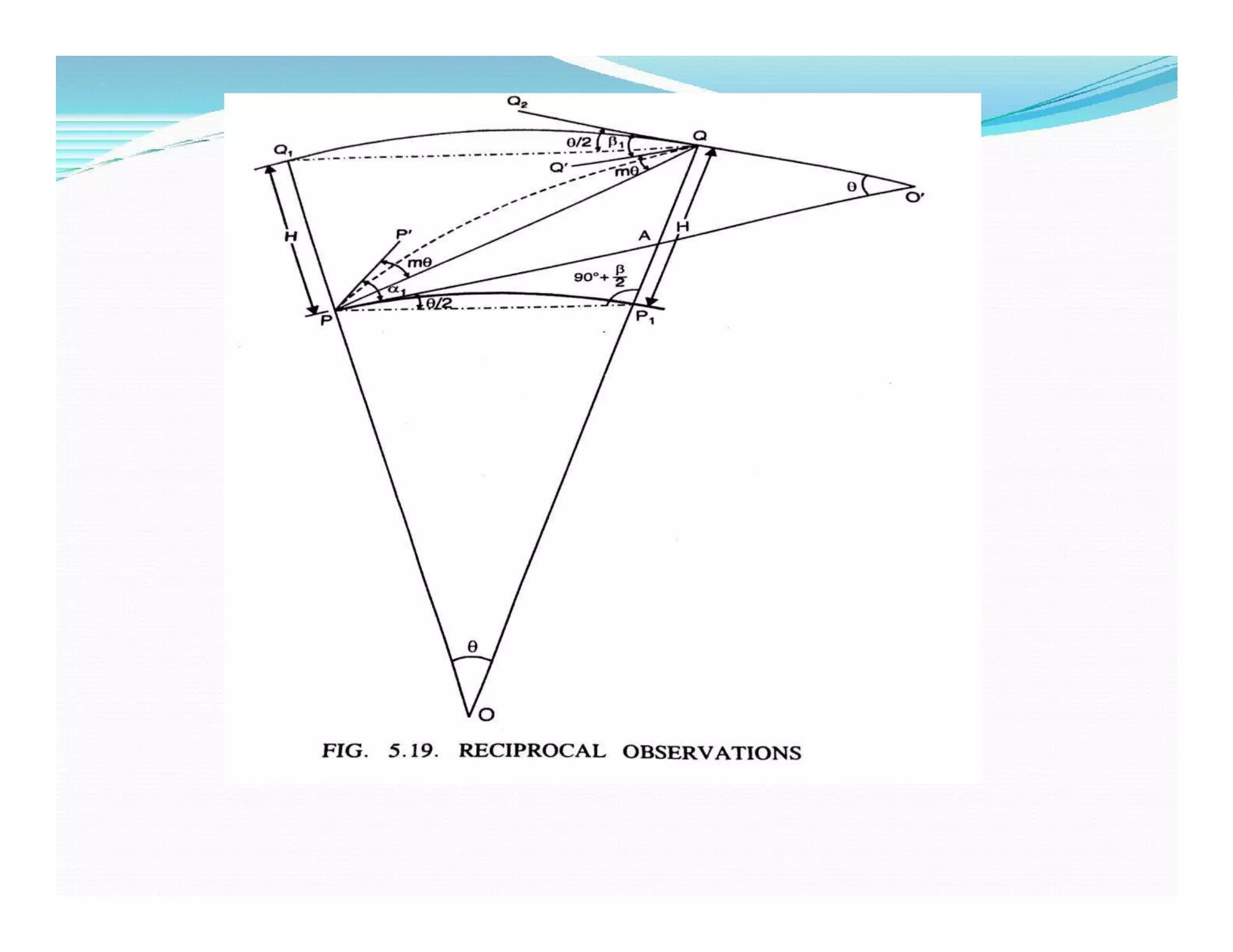
Fig.Terrestrial refraction
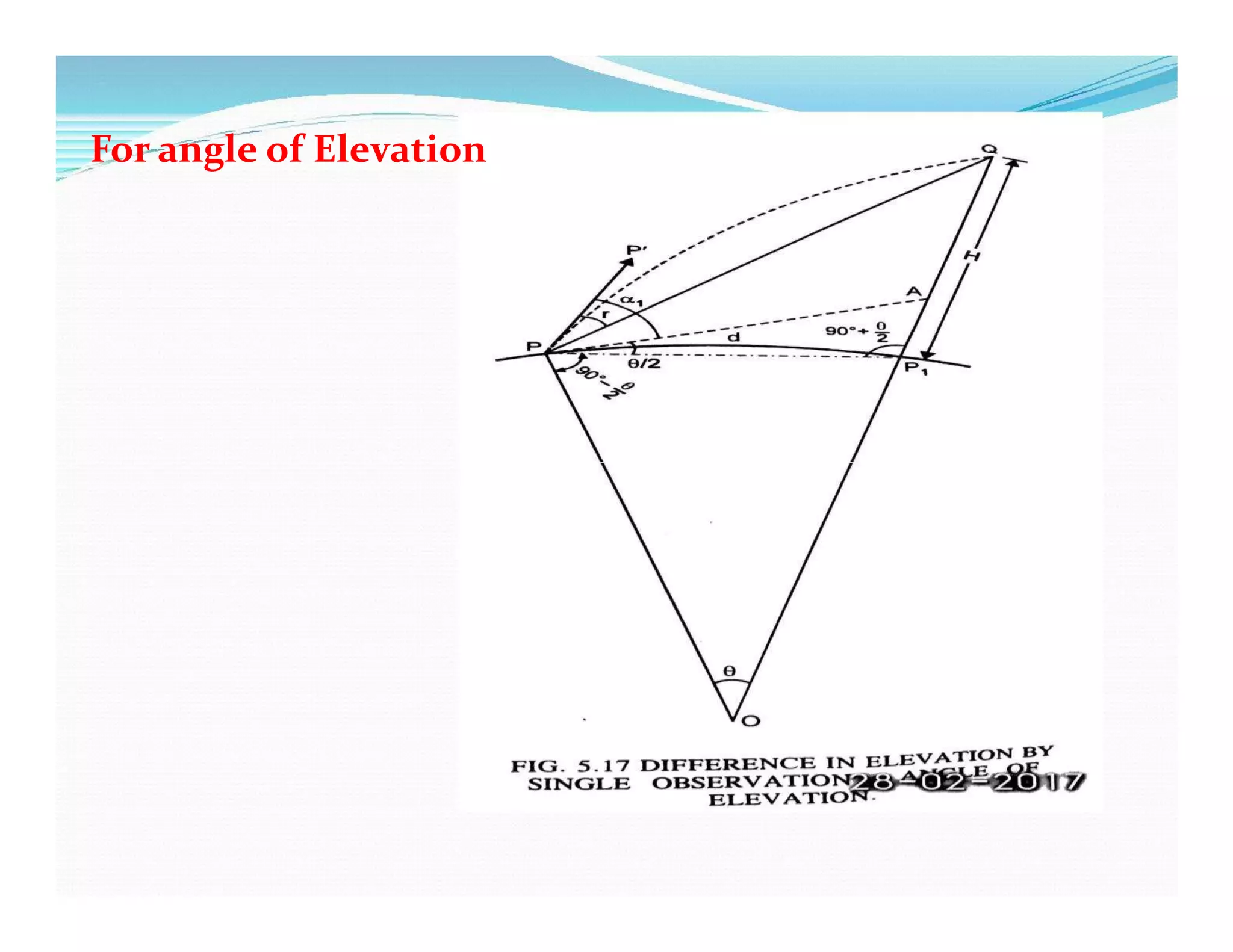
P and Q are the two points the difference in elevation between
these being required .
Let,
O = centre of the earth
PO’ = tangent to the level line through P = horizontal line at P
QO’ = horizontal line at Q
<P’PO’ = α1 = observed angle of elevation from P to Q.
<Q’QQ2 = β1 = observed angle of depression from Q to P.
r = angle of refraction or angular correction for refraction
= <P’PQ
PP’ = tangent at P to the curve line of sight
PQ=apparent sight .
QQ’ = tangent at Q to the curved line of sight QP
=parent sight
d = horizontal distance between P and Q
R = mean radius of the earth = 6370 km
m = Co-efficient of refraction
Ɵ = angle subtended at the centre by distance PP1 over
which the observation are made.
The actual line of sight between P and Q should
have been along the straight line PQ but due to the
effect of the terrestrial refraction ,the actual line of
sight curved concave towards the ground surface .PP’
is,therefore the apparent sight from Q to P and QQ’
is the apparent from Q to P.since the angle are
measured on the circle of a theodolite ,they are
measured in the horizontal plane .
The angle measured at P towards Q is ,therefore ,the angle between the
apparent sight P’P and the horizontal line PQ’ hence <P’PO’ = observed
angle α1 ,the true angle elevation ,in the absence of refraction is
<P’PQ.calling this as r ,the correction is evidently subtractive
Thus ,correct angle = <QPO’ = < P’PQ = α1- r Similarly,the angle measured
at Q towards P is <Q’QQ= β1 .the true angle of depression . In the absence
of refraction is <PQQ2.
Hence the correction for refraction is <PQQ’ and be added to the observed
angle to get the correct angle.
Thus the correct angle = < PQQ2 = < Q’QQ2 + <Q’QP =
β1 +r
Thus the correction for the refraction is subtractive to the angle of
elevation and additive for the angle of
depression
Coefficient of refraction:-
The co-efficient of refraction (m) is the ratio
of the angle of refraction and the angle
subtended at the centre of the earth by the
distance over which observation are tken
Thus, m = r/Ɵ or r = m. Ɵ
The value of ‘m’ varies roughly between 0.06
to 0.08
Determination of correction refraction :-
In order to determine the angle of refraction r.
Case:-I : Distance ‘d’ small and ‘H’ large :-
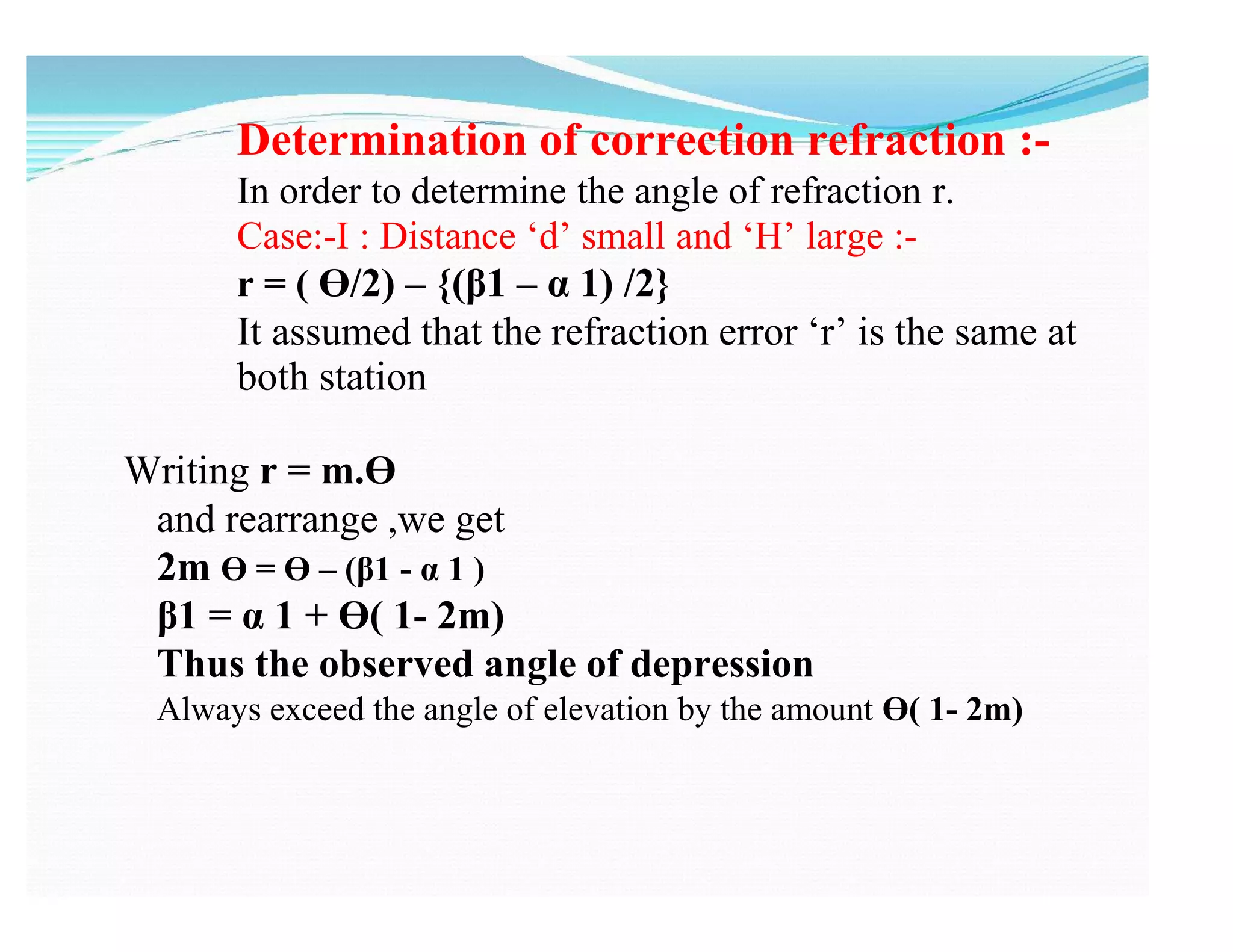
r = ( Ɵ/2) – {(β1 – α 1) /2}
It assumed that the refraction error ‘r’ is the same at
both station
Writing r = m.Ɵ
and rearrange ,we get
2m Ɵ = Ɵ – (β1 - α 1 )
β1 = α 1 + Ɵ( 1- 2m)
Thus the observed angle of depression
Always exceed the angle of elevation by the amount Ɵ( 1- 2m)
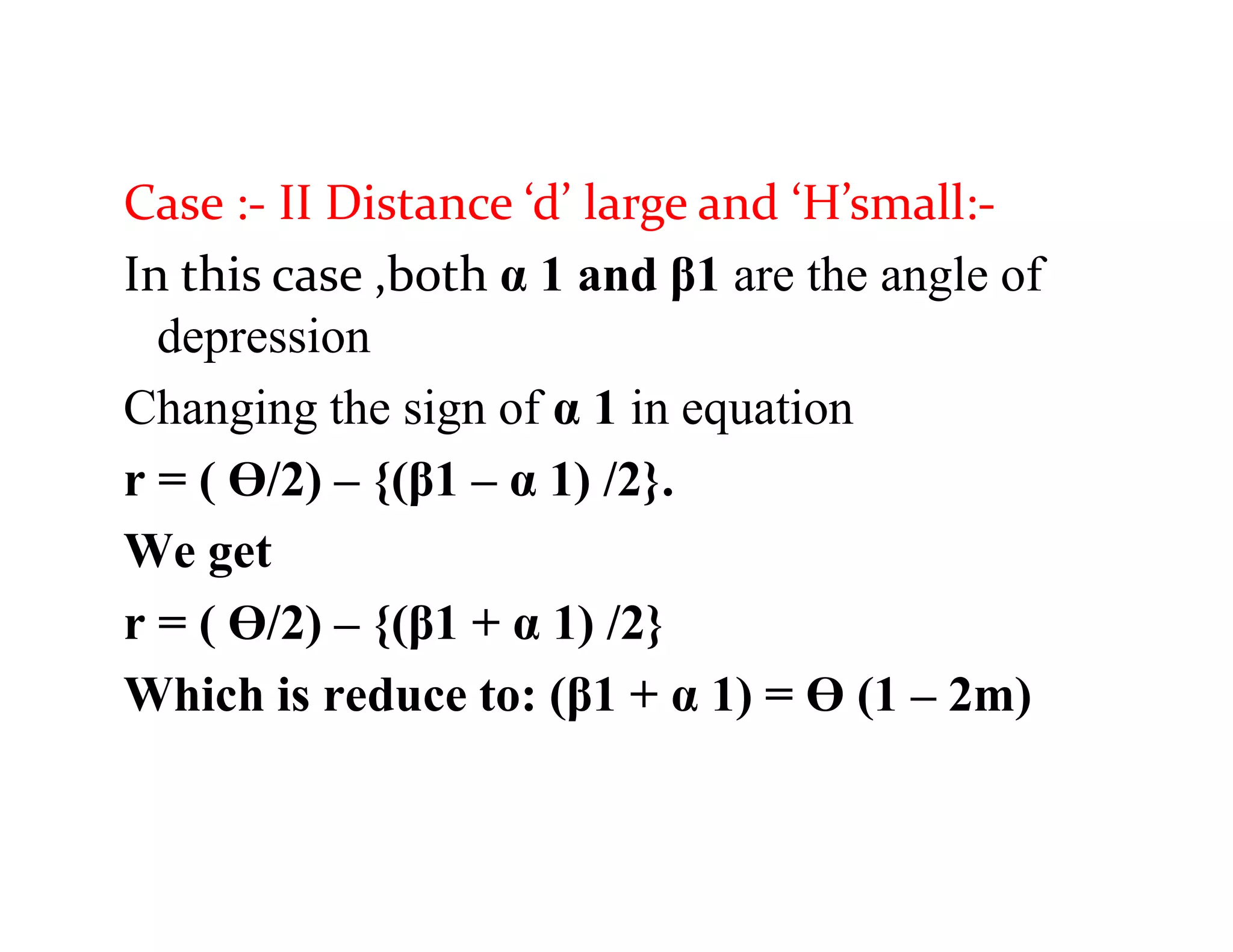
Case :- II Distance ‘d’ large and ‘H’small:-
In this case ,both α 1 and β1 are the angle of
depression
Changing the sign of α 1 in equation
r = ( Ɵ/2) – {(β1 – α 1) /2}.
We get
r = ( Ɵ/2) – {(β1 + α 1) /2}
Which is reduce to: (β1 + α 1) = Ɵ (1 – 2m)
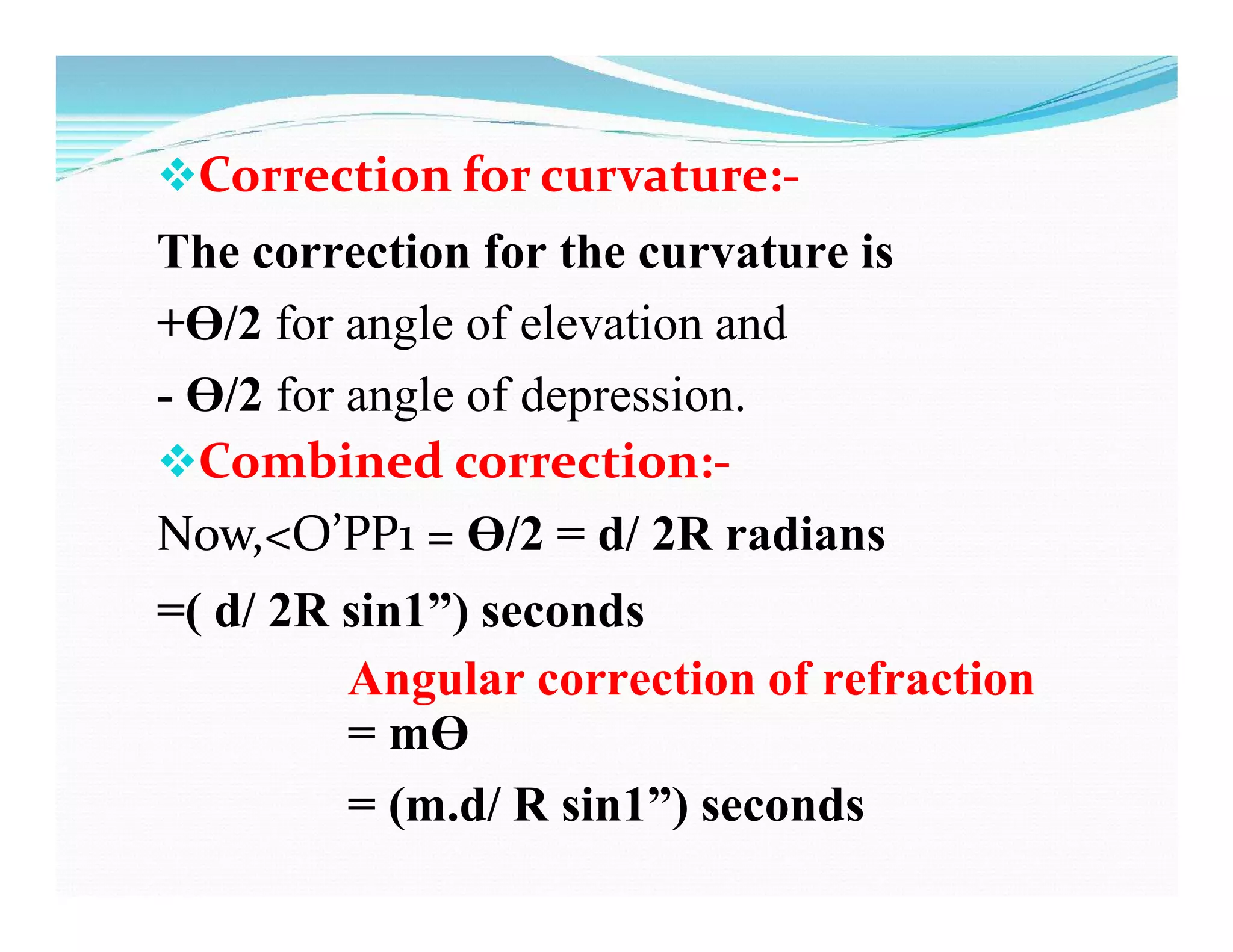
Correction for curvature:-
The correction for the curvature is
+Ɵ/2 for angle of elevation and
- Ɵ/2 for angle of depression.
Combined correction:-
Now,<O’PP1 = Ɵ/2 = d/ 2R radians
=( d/ 2R sin1”) seconds
Angular correction of refraction
= mƟ
= (m.d/ R sin1”) seconds
Hence , Combined angular correction
=[ (d/ 2R sin1”) –(m.d/ R sin1”) ]
= ( 1 – 2m ) d Seconds
2R sin1”
The combined correction is positive for angles
of elevation and negative for angle of
depression
Axis signal correction
(Eye & Object Correction)
 In order to observe the points from the
theodolite station .signals of appropriate
heights are erected at points to be observed
.The signal may or may not be same height
as that of the instrument .
 If height of the signal is not same as that of
the height of instrument axis above the
station , a correction known as the axis
signal correction or eye and object
correction is to be applied.
Let ,
h1= height of instrument at P,for observation to
Q.
h2 = height of instrument at Q,for bservation to
P.
s1 = height of instrument at P ,instrument being Q.
s2 = height of instrument at Q ,instrument being P.
d=horizontal distance between P and Q
α = Observed angle of elevation uncorrected for
the axis signal
β=Observed angle of depression uncorrected for
the axis signal.
α1= angle of elevation corrected for axis signal
β1=angle of depression corrected for axis signal.
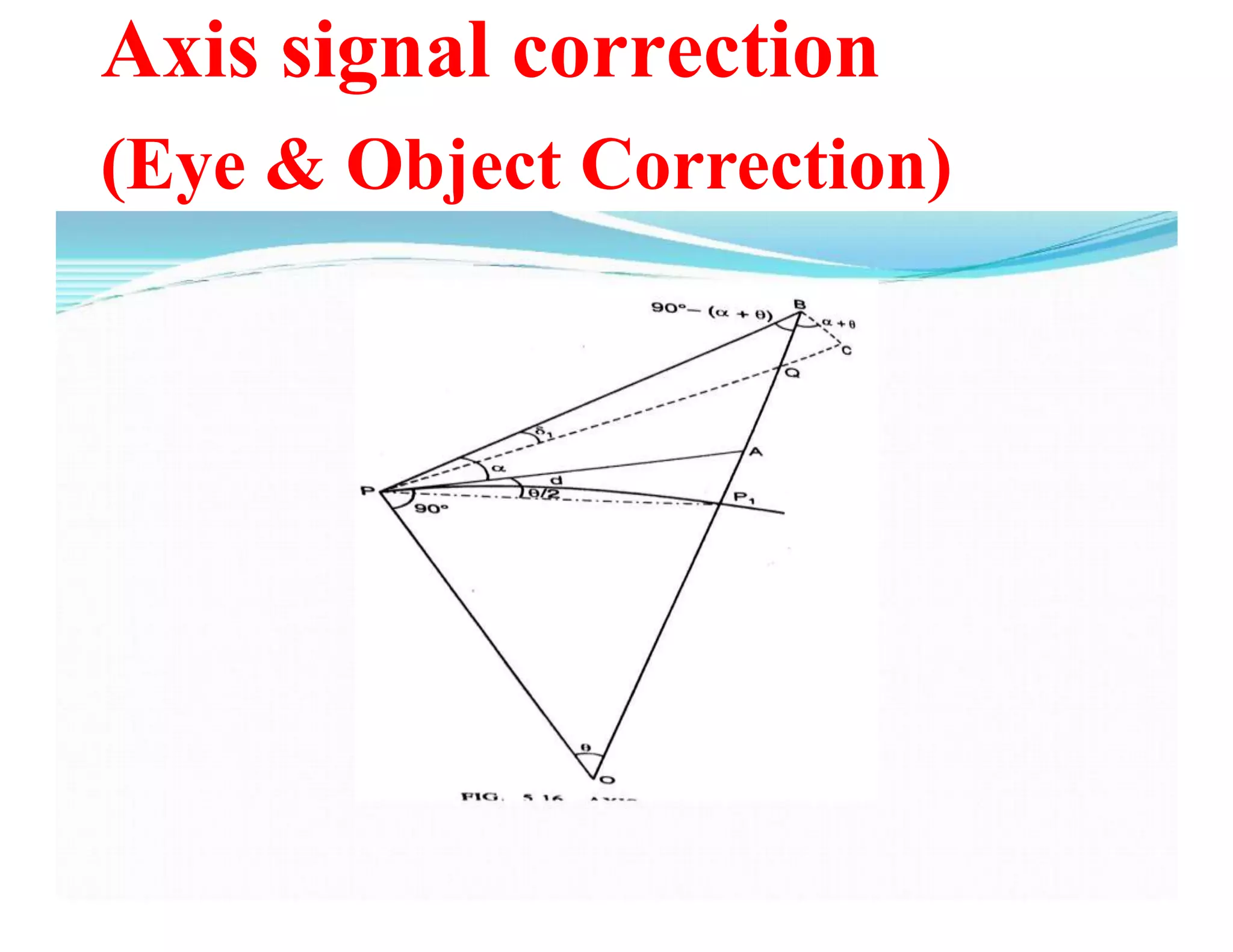
In figure.
PA = horizontal line at P
Q= Point observed
BQ= difference in the height of signal at Q and
the height of instrument at P
= (s2-s1)
<BPA= α = angle observed from P to Q
<BPQ= δ1 = axis signal correction ( angular )at
P.
At B ,draw BC perpendicular to BP , to meet PQ
produce in C,
For triangle PBO
<BPO = <BPA + <APO = α + 900
<POB = Ɵ
<PBO = 180 – ( 90 + α ) – Ɵ
= 90 – (α + Ɵ)
<QBC = 90 – [ 90- (α + Ɵ)]
= (α + Ɵ)
The angle δ1 is usually very small and hence <BCQ can
be approximately taken equal to 900.
BC = BQ cos (α + Ɵ) very nearly
= (s2-h1)cos (α + Ɵ)] ………………………(1)
For triangle PP1B,
<BPP1= α + Ɵ/2
<PBP1= 90 – (α + Ɵ)
<PP1B = 180 –[ 90 - (α + Ɵ)]-(α +
Ɵ/2)
= (90 + Ɵ/2)
Now PB = PP1
sin PP1B sin PBP1
PB = [(d.sin (90 + Ɵ/2)]/[sin(90 – (α + Ɵ)]
= d.[ (cos Ɵ/2 ) / cos (α + Ɵ)]…………………..(2)
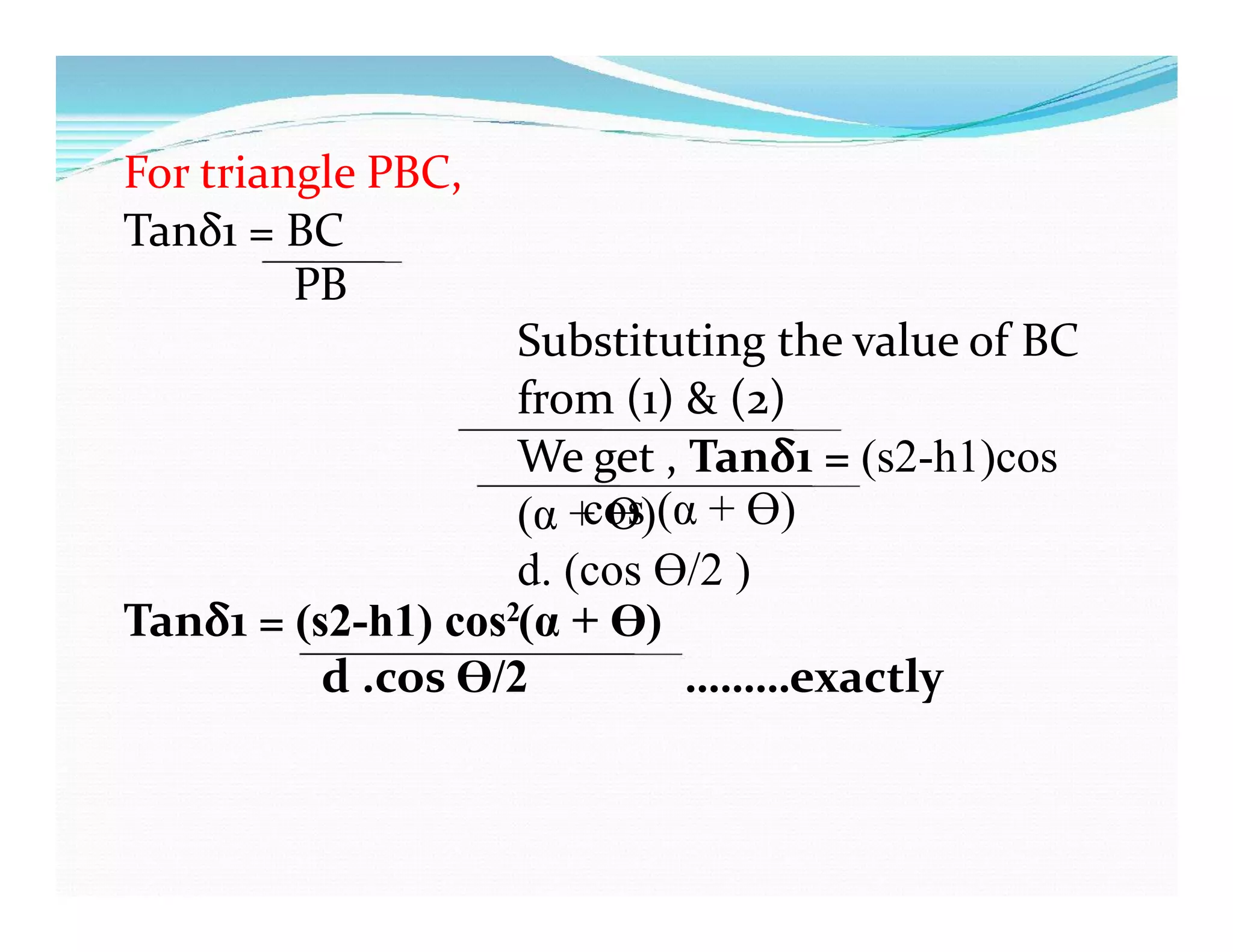
For triangle PBC,
Tanδ1 = BC
PB
Substituting the value of BC
from (1) & (2)
We get , Tanδ1 = (s2-h1)cos
(α + Ɵ)
d. (cos Ɵ/2 )
cos (α + Ɵ)
Tanδ1 = (s2-h1) cos (α + Ɵ)2
d .cos Ɵ/2 ………exactly
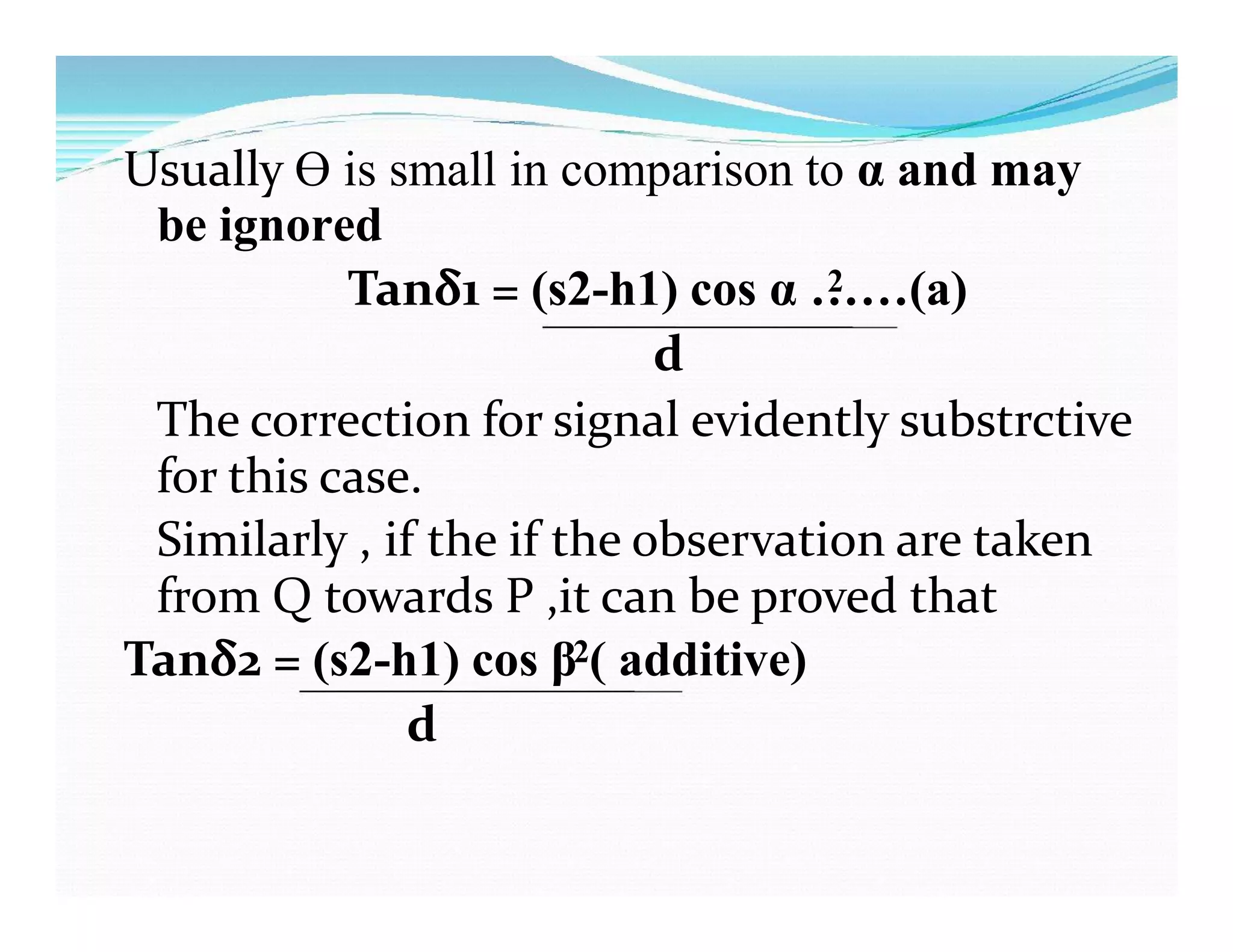
Usually Ɵ is small in comparison to α and may
be ignored
Tanδ1 = (s2-h1) cos α ……(a)2
d
The correction for signal evidently substrctive
for this case.
Similarly , if the if the observation are taken
from Q towards P ,it can be proved that
Tanδ2 = (s2-h1) cos β ( additive)2
d
The correction of axis signal is negative for angles of
elevation and positive for angle of depression .
If , however angle α or β is very small ,we can take ,with
sufficient accuracy
Tanδ1 = δ1 =( s2-h1) / d sin 1” seconds………….(b)
Tanδ2 = δ2 =( s2-h2) / d sin 1” ………………………(c)
By considering PB= PQ= PP1=d nd taking the arc with radius
equal to d. then
δ1 = [BQ/ d ]radians
= [( s2-h1) / d ]
= [( s2-h1) / d sin 1”] seconds
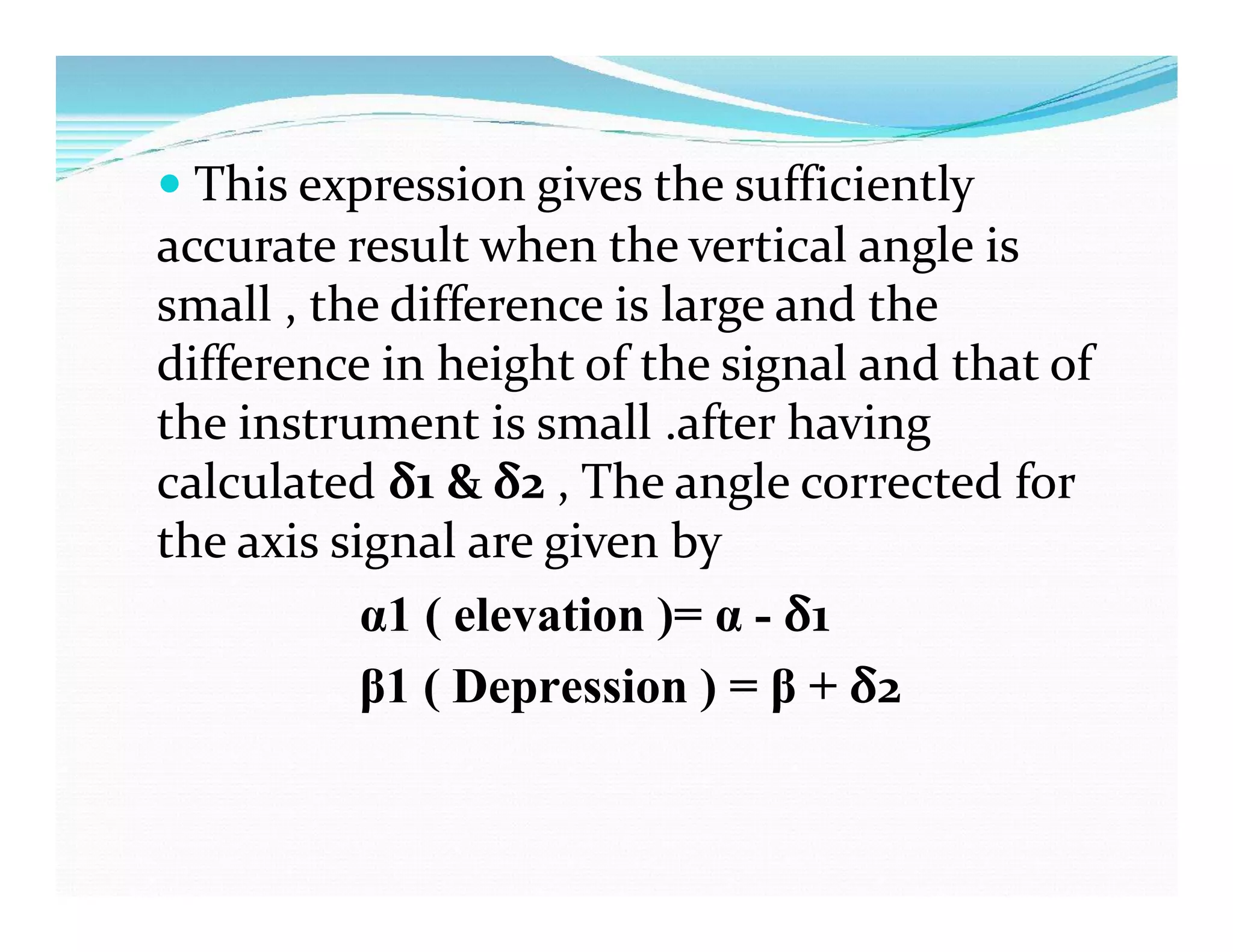
 This expression gives the sufficiently
accurate result when the vertical angle is
small , the difference is large and the
difference in height of the signal and that of
the instrument is small .after having
calculated δ1 & δ2 , The angle corrected for
the axis signal are given by
α1 ( elevation )= α - δ1
β1 ( Depression ) = β + δ2
DETERMINATION OF DIFFRENCE IN
ELEVATION:
The difference in elevation between the two points
P & Q can be found out by two method
(a) By single observation
(b) By reciprocal observation.
(a) By single observation:
The following correction will have to applied:
(1) Correction for Curvature.
(2) Correction for refraction.
(3) Correction for axis signal.
Since the sign of these correction will depend
upon the sign of the angle observed,
We shall consider following cases:
(i) When the observed angle is the angle of
elevation.
(ii) When the observed angle is the angle of
depression .
For angle of Elevation
α = observed angle of elevation to Q
α1 = observed angle corrected for axis signal
= (α - δ1 )
= [α – (s2 –h1)/d sin 1”] seconds.
Therefore
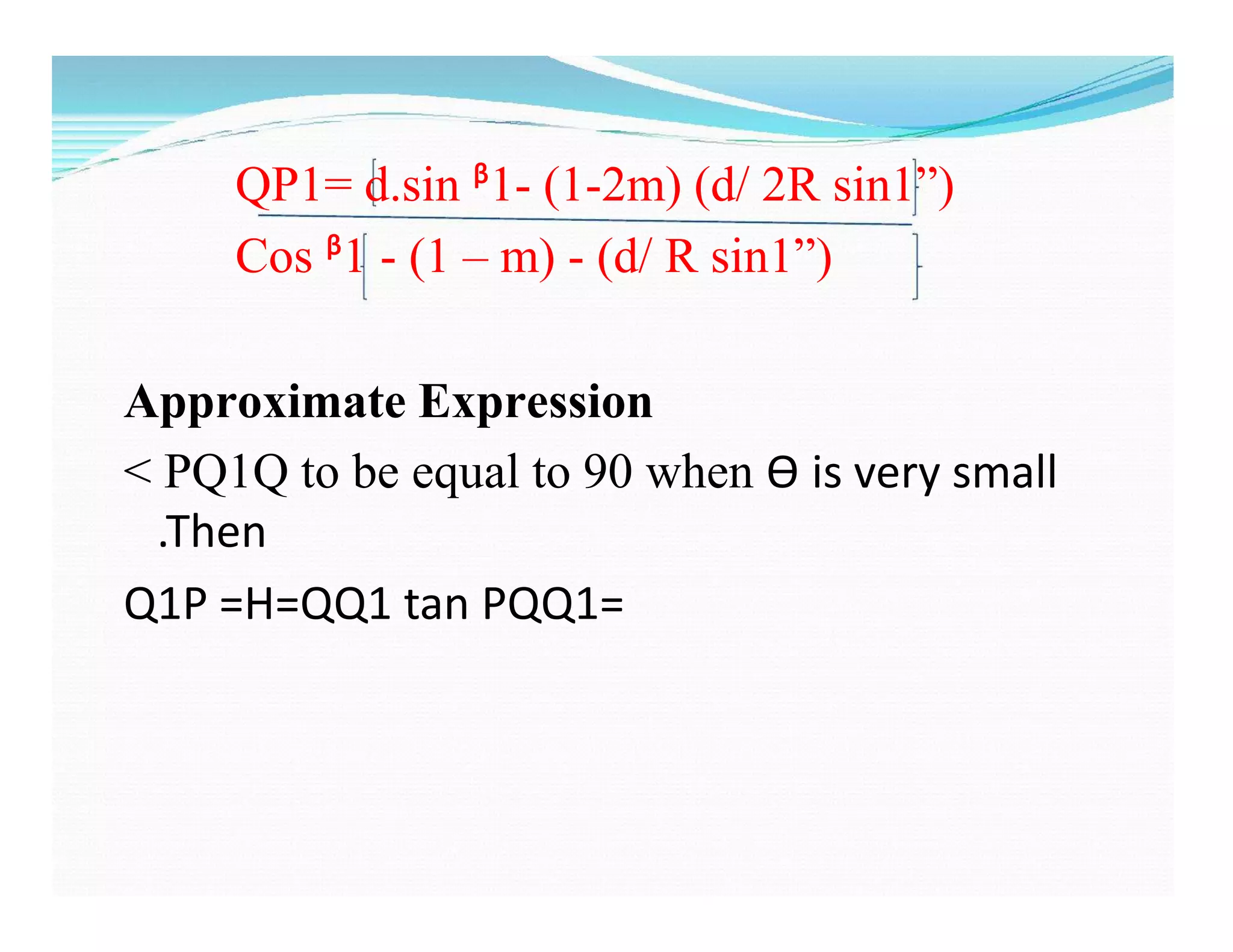
QP1= d.sin α1+(m.d/Rsin1”) +(d/ 2R sin1”)
Cos α1+(m.d/Rsin1”) +(d/ 2R sin1”)
QP1= d.sin α1+(1-2m) (d/ 2R sin1”)
Cos α1+(1 – m) (d/ R sin1”)
Where the quantities (1-2m) (d/ 2R sin1”) and
(1 – m) (d/ R sin1”) are in seconds.
Approximate Expressions:
˂PP1Q= 90,Ѳ is very small
QP1 =H = PP1 tan QPP1= d tan [α1 - m Ѳ + Ѳ/2]
= d tan [α1 - (1-2m) (d/ 2R sin1”) ]
QP1= d.sin ᵝ1- (1-2m) (d/ 2R sin1”)
Cos ᵝ1 - (1 – m) - (d/ R sin1”)
Approximate Expression
˂ PQ1Q to be equal to 90 when Ѳ is very small
.Then
Q1P =H=QQ1 tan PQQ1=
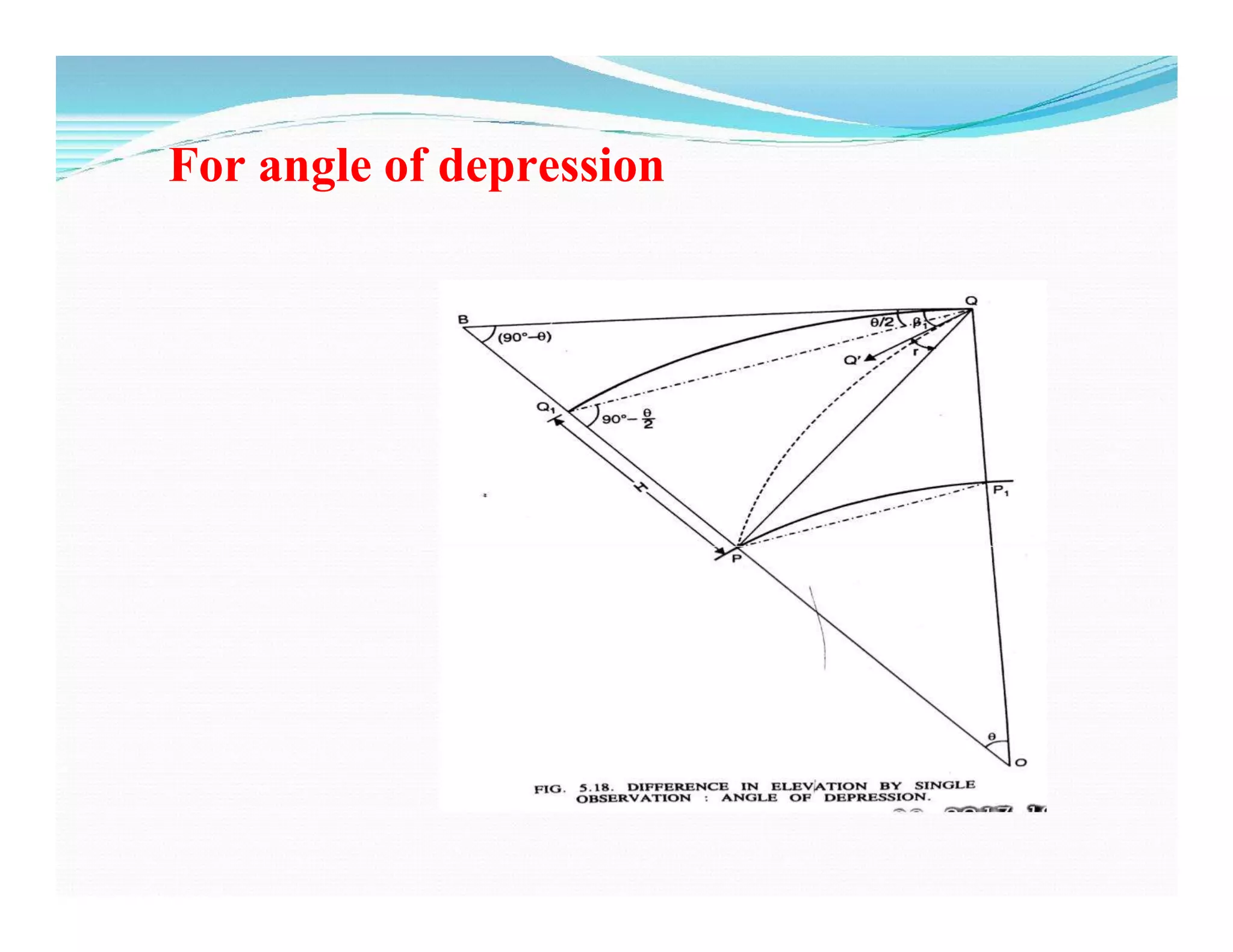
For angle of depression
ᵝ = observed angle of depression to P
ᵝ1 = observed angle corrected for axis signal
= ᵝ + δ2
= [ᵝ – (s1 –h2)/d sin 1”] seconds
d = horizontal distance =
arc QQ1 = chord QQ1= QB
ᵝ = observed angle of depression to P
ᵝ1 = observed angle corrected for axis signal
= ᵝ + δ2
= [ᵝ – (s1 –h2)/d sin 1”] seconds
d = horizontal distance =
arc QQ1 = chord QQ1= QB
= d tan [ᵝ1 - (1-2m) (d/ 2R sin1”) ]
Difference in elevation by
Reciprocal :-
Reciprocal observation are generally
made to eliminate the effect of
refraction. in this method ,observation
are made simultaneously from both
station ( i.e P and Q )
Both α1 and β1 are the angle of
depression ,the expression for H can
be obtained by changing the sign of
α1 .
H = d sin[ (β1 - α1 )/2]
cos [(β1 - α1 )/2 +Ɵ/2]

Trigonometric Levelling Unit 6

  • 1.
    Advanced Surveying Unit-6 Trignometric Levelling Content 1.Trignometric Levelling 2. Terrestrial refraction, 3. Angular corrections for curvature and refraction, 4. Axis signal correction, Determination of difference in elevation by single observation and reciprocal observations. Prepared by –Prof.S.M.Gunjal
  • 2.
    Definition-Trignometric Levelling  Amethod in which the relative elevation of different station are found out from the measured vertical angle and known plane horizontal distance or geodetic distance, is called as the trigonometric levelling.
  • 3.
    Terrestrial refraction 1. Theeffect of refraction is to make the object appear higher than they really are in plan surveying where a graduated staff isobserved either horizontal line of sight or inclined line of sight ,the effect of refraction is to decrease the staff reading and the correction is applied linearly to the observed staff reading. 2. In trignometric levelling employed the elevation of widely distributed points ,the correction is applied to the observed angles.
  • 4.
  • 5.
    P and Qare the two points the difference in elevation between these being required . Let, O = centre of the earth PO’ = tangent to the level line through P = horizontal line at P QO’ = horizontal line at Q <P’PO’ = α1 = observed angle of elevation from P to Q. <Q’QQ2 = β1 = observed angle of depression from Q to P. r = angle of refraction or angular correction for refraction = <P’PQ PP’ = tangent at P to the curve line of sight PQ=apparent sight . QQ’ = tangent at Q to the curved line of sight QP =parent sight
  • 6.
    d = horizontaldistance between P and Q R = mean radius of the earth = 6370 km m = Co-efficient of refraction Ɵ = angle subtended at the centre by distance PP1 over which the observation are made. The actual line of sight between P and Q should have been along the straight line PQ but due to the effect of the terrestrial refraction ,the actual line of sight curved concave towards the ground surface .PP’ is,therefore the apparent sight from Q to P and QQ’ is the apparent from Q to P.since the angle are measured on the circle of a theodolite ,they are measured in the horizontal plane .
  • 7.
    The angle measuredat P towards Q is ,therefore ,the angle between the apparent sight P’P and the horizontal line PQ’ hence <P’PO’ = observed angle α1 ,the true angle elevation ,in the absence of refraction is <P’PQ.calling this as r ,the correction is evidently subtractive Thus ,correct angle = <QPO’ = < P’PQ = α1- r Similarly,the angle measured at Q towards P is <Q’QQ= β1 .the true angle of depression . In the absence of refraction is <PQQ2. Hence the correction for refraction is <PQQ’ and be added to the observed angle to get the correct angle. Thus the correct angle = < PQQ2 = < Q’QQ2 + <Q’QP = β1 +r Thus the correction for the refraction is subtractive to the angle of elevation and additive for the angle of depression
  • 8.
    Coefficient of refraction:- Theco-efficient of refraction (m) is the ratio of the angle of refraction and the angle subtended at the centre of the earth by the distance over which observation are tken Thus, m = r/Ɵ or r = m. Ɵ The value of ‘m’ varies roughly between 0.06 to 0.08
  • 9.
    Determination of correctionrefraction :- In order to determine the angle of refraction r. Case:-I : Distance ‘d’ small and ‘H’ large :- r = ( Ɵ/2) – {(β1 – α 1) /2} It assumed that the refraction error ‘r’ is the same at both station Writing r = m.Ɵ and rearrange ,we get 2m Ɵ = Ɵ – (β1 - α 1 ) β1 = α 1 + Ɵ( 1- 2m) Thus the observed angle of depression Always exceed the angle of elevation by the amount Ɵ( 1- 2m)
  • 10.
    Case :- IIDistance ‘d’ large and ‘H’small:- In this case ,both α 1 and β1 are the angle of depression Changing the sign of α 1 in equation r = ( Ɵ/2) – {(β1 – α 1) /2}. We get r = ( Ɵ/2) – {(β1 + α 1) /2} Which is reduce to: (β1 + α 1) = Ɵ (1 – 2m)
  • 11.
    Correction for curvature:- Thecorrection for the curvature is +Ɵ/2 for angle of elevation and - Ɵ/2 for angle of depression. Combined correction:- Now,<O’PP1 = Ɵ/2 = d/ 2R radians =( d/ 2R sin1”) seconds Angular correction of refraction = mƟ = (m.d/ R sin1”) seconds
  • 12.
    Hence , Combinedangular correction =[ (d/ 2R sin1”) –(m.d/ R sin1”) ] = ( 1 – 2m ) d Seconds 2R sin1” The combined correction is positive for angles of elevation and negative for angle of depression
  • 13.
    Axis signal correction (Eye& Object Correction)
  • 14.
     In orderto observe the points from the theodolite station .signals of appropriate heights are erected at points to be observed .The signal may or may not be same height as that of the instrument .  If height of the signal is not same as that of the height of instrument axis above the station , a correction known as the axis signal correction or eye and object correction is to be applied.
  • 15.
    Let , h1= heightof instrument at P,for observation to Q. h2 = height of instrument at Q,for bservation to P. s1 = height of instrument at P ,instrument being Q. s2 = height of instrument at Q ,instrument being P. d=horizontal distance between P and Q α = Observed angle of elevation uncorrected for the axis signal
  • 16.
    β=Observed angle ofdepression uncorrected for the axis signal. α1= angle of elevation corrected for axis signal β1=angle of depression corrected for axis signal. In figure. PA = horizontal line at P Q= Point observed BQ= difference in the height of signal at Q and the height of instrument at P
  • 17.
    = (s2-s1) <BPA= α= angle observed from P to Q <BPQ= δ1 = axis signal correction ( angular )at P. At B ,draw BC perpendicular to BP , to meet PQ produce in C,
  • 18.
    For triangle PBO <BPO= <BPA + <APO = α + 900 <POB = Ɵ <PBO = 180 – ( 90 + α ) – Ɵ = 90 – (α + Ɵ) <QBC = 90 – [ 90- (α + Ɵ)] = (α + Ɵ) The angle δ1 is usually very small and hence <BCQ can be approximately taken equal to 900. BC = BQ cos (α + Ɵ) very nearly = (s2-h1)cos (α + Ɵ)] ………………………(1)
  • 19.
    For triangle PP1B, <BPP1=α + Ɵ/2 <PBP1= 90 – (α + Ɵ) <PP1B = 180 –[ 90 - (α + Ɵ)]-(α + Ɵ/2) = (90 + Ɵ/2) Now PB = PP1 sin PP1B sin PBP1 PB = [(d.sin (90 + Ɵ/2)]/[sin(90 – (α + Ɵ)] = d.[ (cos Ɵ/2 ) / cos (α + Ɵ)]…………………..(2)
  • 20.
    For triangle PBC, Tanδ1= BC PB Substituting the value of BC from (1) & (2) We get , Tanδ1 = (s2-h1)cos (α + Ɵ) d. (cos Ɵ/2 ) cos (α + Ɵ) Tanδ1 = (s2-h1) cos (α + Ɵ)2 d .cos Ɵ/2 ………exactly
  • 21.
    Usually Ɵ issmall in comparison to α and may be ignored Tanδ1 = (s2-h1) cos α ……(a)2 d The correction for signal evidently substrctive for this case. Similarly , if the if the observation are taken from Q towards P ,it can be proved that Tanδ2 = (s2-h1) cos β ( additive)2 d
  • 22.
    The correction ofaxis signal is negative for angles of elevation and positive for angle of depression . If , however angle α or β is very small ,we can take ,with sufficient accuracy Tanδ1 = δ1 =( s2-h1) / d sin 1” seconds………….(b) Tanδ2 = δ2 =( s2-h2) / d sin 1” ………………………(c) By considering PB= PQ= PP1=d nd taking the arc with radius equal to d. then δ1 = [BQ/ d ]radians = [( s2-h1) / d ] = [( s2-h1) / d sin 1”] seconds
  • 23.
     This expressiongives the sufficiently accurate result when the vertical angle is small , the difference is large and the difference in height of the signal and that of the instrument is small .after having calculated δ1 & δ2 , The angle corrected for the axis signal are given by α1 ( elevation )= α - δ1 β1 ( Depression ) = β + δ2
  • 24.
    DETERMINATION OF DIFFRENCEIN ELEVATION: The difference in elevation between the two points P & Q can be found out by two method (a) By single observation (b) By reciprocal observation. (a) By single observation: The following correction will have to applied: (1) Correction for Curvature. (2) Correction for refraction. (3) Correction for axis signal.
  • 25.
    Since the signof these correction will depend upon the sign of the angle observed, We shall consider following cases: (i) When the observed angle is the angle of elevation. (ii) When the observed angle is the angle of depression .
  • 26.
    For angle ofElevation
  • 27.
    α = observedangle of elevation to Q α1 = observed angle corrected for axis signal = (α - δ1 ) = [α – (s2 –h1)/d sin 1”] seconds. Therefore QP1= d.sin α1+(m.d/Rsin1”) +(d/ 2R sin1”) Cos α1+(m.d/Rsin1”) +(d/ 2R sin1”)
  • 28.
    QP1= d.sin α1+(1-2m)(d/ 2R sin1”) Cos α1+(1 – m) (d/ R sin1”) Where the quantities (1-2m) (d/ 2R sin1”) and (1 – m) (d/ R sin1”) are in seconds. Approximate Expressions: ˂PP1Q= 90,Ѳ is very small QP1 =H = PP1 tan QPP1= d tan [α1 - m Ѳ + Ѳ/2] = d tan [α1 - (1-2m) (d/ 2R sin1”) ]
  • 29.
    QP1= d.sin ᵝ1-(1-2m) (d/ 2R sin1”) Cos ᵝ1 - (1 – m) - (d/ R sin1”) Approximate Expression ˂ PQ1Q to be equal to 90 when Ѳ is very small .Then Q1P =H=QQ1 tan PQQ1=
  • 30.
    For angle ofdepression
  • 31.
    ᵝ = observedangle of depression to P ᵝ1 = observed angle corrected for axis signal = ᵝ + δ2 = [ᵝ – (s1 –h2)/d sin 1”] seconds d = horizontal distance = arc QQ1 = chord QQ1= QB
  • 32.
    ᵝ = observedangle of depression to P ᵝ1 = observed angle corrected for axis signal = ᵝ + δ2 = [ᵝ – (s1 –h2)/d sin 1”] seconds d = horizontal distance = arc QQ1 = chord QQ1= QB = d tan [ᵝ1 - (1-2m) (d/ 2R sin1”) ]
  • 33.
    Difference in elevationby Reciprocal :- Reciprocal observation are generally made to eliminate the effect of refraction. in this method ,observation are made simultaneously from both station ( i.e P and Q )
  • 35.
    Both α1 andβ1 are the angle of depression ,the expression for H can be obtained by changing the sign of α1 . H = d sin[ (β1 - α1 )/2] cos [(β1 - α1 )/2 +Ɵ/2]