Lecture 31:
Molecular techniques
III. PCR and DNA sequencing
Readings (chapter 10)
Course 281
Lessons for life
AIMS
• Understand the process of PCR and the
components needed for the reaction.
• Understand why PCR is important in molecular
biology.
• Understand the importance of DNA
sequencing.
• Understand Sanger sequencing method as an
example of DNA sequencing.
Polymerase chain reaction
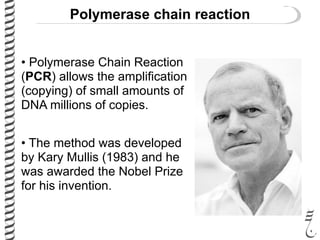
• Polymerase Chain Reaction
(PCR) allows the amplification
(copying) of small amounts of
DNA millions of copies.
• The method was developed
by Kary Mullis (1983) and he
was awarded the Nobel Prize
for his invention.
Polymerase chain reaction
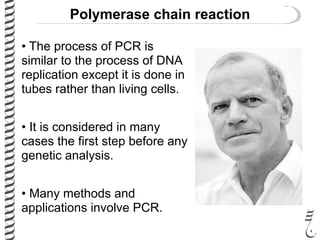
• The process of PCR is
similar to the process of DNA
replication except it is done in
tubes rather than living cells.
• It is considered in many
cases the first step before any
genetic analysis.
• Many methods and
applications involve PCR.
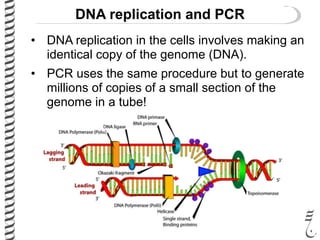
DNA replication and PCR
• DNA replication in the cells involves making an
identical copy of the genome (DNA).
• PCR uses the same procedure but to generate
millions of copies of a small section of the
genome in a tube!
Why PCR?
PCR is used:
1. To amplify small quantities of DNA.
2. For DNA quantification.
3. For genetic profile analyses:
• RFLP
• Microsatellite
• Mitochondrial DNA genotyping
and sequencing.
4. For sequencing small section of the
genome or the genome.
Components
What do we need to replicate (copy) DNA?
1. DNA template.
2. Building block of DNA (dNTPs).
3. DNA copier (an enzyme).
4. 3’OH (primer).
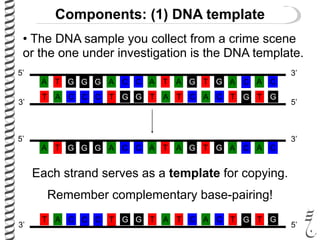
Components: (1) DNA template
• The DNA sample you collect from a crime scene
or the one under investigation is the DNA template.
G A
C T
A
T
T
A
G
C
G
C
A
T
C
G
C
G
G
C
T
A
A
T
T
A
G
C
A
T
C
G
A
T
C
G
5’
5’
3’
3’
C TT A C C TG G CA T A C T G T G
5’3’
G AA T G G AC C GT A T G A C A C
5’ 3’
Each strand serves as a template for copying.
Remember complementary base-pairing!
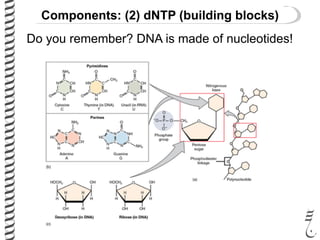
Components: (2) dNTP (building blocks)
Do you remember? DNA is made of nucleotides!
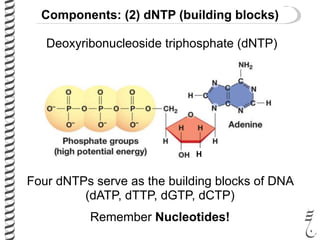
Deoxyribonucleoside triphosphate (dNTP)
H
Four dNTPs serve as the building blocks of DNA
(dATP, dTTP, dGTP, dCTP)
Remember Nucleotides!
Components: (2) dNTP (building blocks)
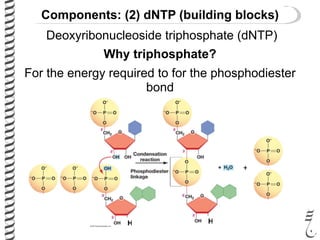
Deoxyribonucleoside triphosphate (dNTP)
Why triphosphate?
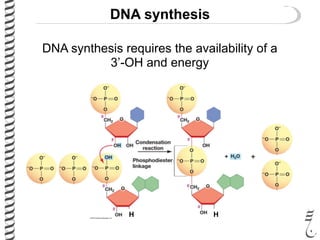
For the energy required to for the phosphodiester
bond
+
H H
Components: (2) dNTP (building blocks)
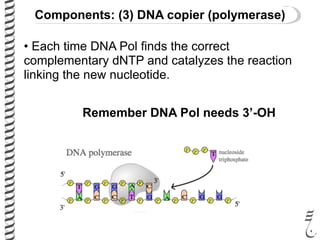
Components: (3) DNA copier (polymerase)
• DNA polymerase is the DNA copier in the cell.
• Uses the dNTPs (DNA building blocks) to make
a complementary strand to the template.
• Uses the available 3’-OH of a previous
nucleotide and 5’phsphate from dNTP to form a
phosphodiester bond.
Components: (3) DNA copier (polymerase)
• Each time DNA Pol finds the correct
complementary dNTP and catalyzes the reaction
linking the new nucleotide.
Remember DNA Pol needs 3’-OH
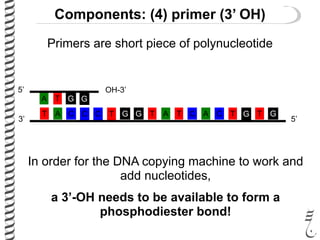
Primers are short piece of polynucleotide
G
C T
A
T
T
A
G
C C TG G CA T A C T G T G
5’
5’
OH-3’
3’
In order for the DNA copying machine to work and
add nucleotides,
a 3’-OH needs to be available to form a
phosphodiester bond!
Components: (4) primer (3’ OH)
PCR Process
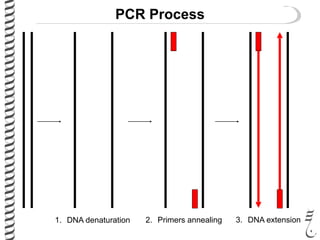
• Three steps are involved in PCR:
1. DNA template denaturation:
separation of the two strands of DNA.
2. Primers annealing: small
oligonucleotide attaches to each
separated strand providing the 3’OH
for DNA polymerase.
3. DNA polymerization (extension):
DNA polymerase extends the primers
on both strands and adds nucleotides.
PCR Process
1. DNA denaturation 2. Primers annealing 3. DNA extension
PCR cycles
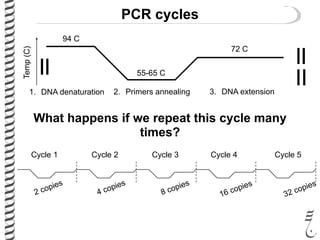
1. DNA denaturation 2. Primers annealing 3. DNA extension
Temp(C)
94 C
55-65 C
72 C
What happens if we repeat this cycle many
times?
2 copies
4 copies
8 copies
16 copies
32 copies
Cycle 1 Cycle 2 Cycle 3 Cycle 4 Cycle 5
PCR cycles
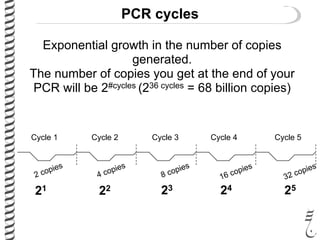
21 22 23 24 25
Exponential growth in the number of copies
generated.
The number of copies you get at the end of your
PCR will be 2#cycles (236 cycles = 68 billion copies)
2 copies
4 copies
8 copies
16 copies
32 copies
Cycle 1 Cycle 2 Cycle 3 Cycle 4 Cycle 5
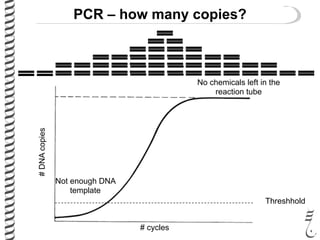
PCR – how many copies?
#DNAcopies
# cycles
Threshhold
Not enough DNA
template
No chemicals left in the
reaction tube
Problems!
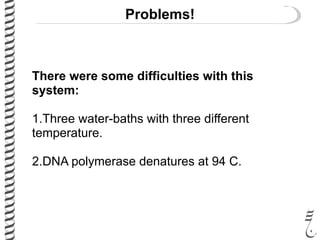
There were some difficulties with this
system:
1.Three water-baths with three different
temperature.
2.DNA polymerase denatures at 94 C.
Problems!
DNA denature
(94 C)
Primer annealing
(55-65 C)
Extension
(72 C)
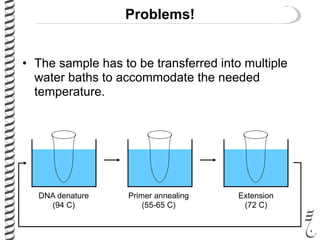
• The sample has to be transferred into multiple
water baths to accommodate the needed
temperature.
Problems!
DNA denature
(94 C)
Primer annealing
(55-65 C)
Extension
(72 C)
Adding
DNA Pol
DNA Pol
denatures
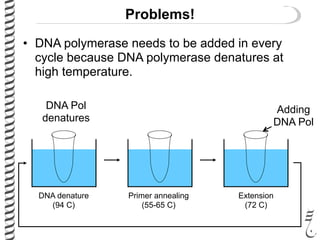
• DNA polymerase needs to be added in every
cycle because DNA polymerase denatures at
high temperature.
Improvement 1
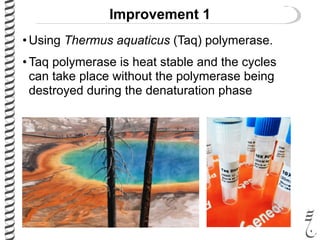
• Using Thermus aquaticus (Taq) polymerase.
• Taq polymerase is heat stable and the cycles
can take place without the polymerase being
destroyed during the denaturation phase
Improvement 2
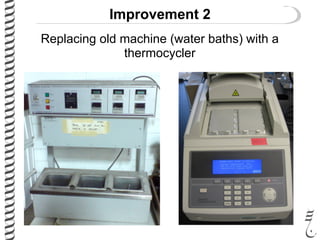
Replacing old machine (water baths) with a
thermocycler
To consider
• Length and GC content of your primer.
• Compatibility of your forward and reverse primers.
• Primer’s sequences do not complement each
other (primer dimer).
• Annealing temperature of both primers should be
the same.
• Length of the target DNA piece ( the longer the
target the longer the extension time).
• DNA polymerase, primers and other chemicals’
concentration should be precisely calculated.
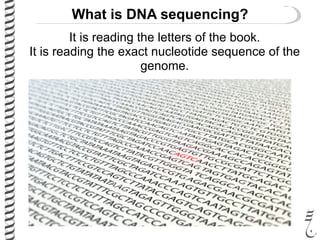
What is DNA sequencing?
It is reading the letters of the book.
It is reading the exact nucleotide sequence of the
genome.
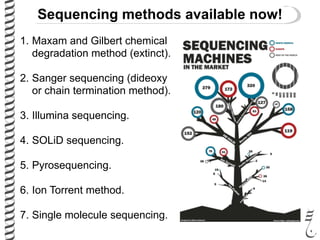
Sequencing methods available now!
1. Maxam and Gilbert chemical
degradation method (extinct).
2. Sanger sequencing (dideoxy
or chain termination method).
3. Illumina sequencing.
4. SOLiD sequencing.
5. Pyrosequencing.
6. Ion Torrent method.
7. Single molecule sequencing.
Why DNA sequencing?
• DNA sequencing can be considered the ultimate
characterization of gene(s) or fragment(s) of DNA.
• DNA Sequencing is used for:
• Mapping genomes
• Determining gene structure and thus function
• Detecting polymorphism (single nucleotide
polymorphism SNP)
• Analyzing genetic variation
• Predicting the possible product(s) of DNA
fragments
• Many purposes depending on the questions one is
asking
Sanger sequencing (the great method)
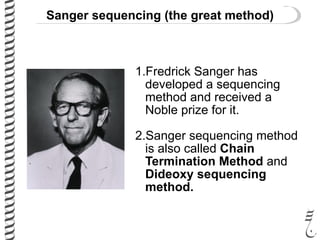
1.Fredrick Sanger has
developed a sequencing
method and received a
Noble prize for it.
2.Sanger sequencing method
is also called Chain
Termination Method and
Dideoxy sequencing
method.
Sanger sequencing (the great method)
• Employs:
• specific primers
• dNTPs
• ddNTPs
• DNA polymerase
• DNA template
DNA synthesis
+
H H
DNA synthesis requires the availability of a
3’-OH and energy
DNA synthesis
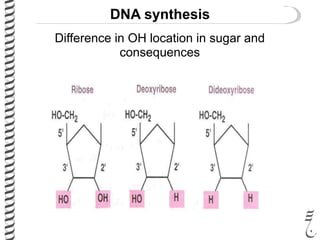
Difference in OH location in sugar and
consequences
DNA synthesis
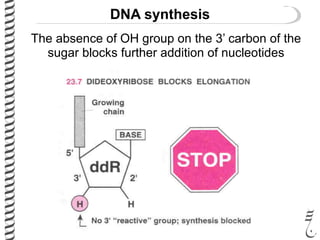
The absence of OH group on the 3’ carbon of the
sugar blocks further addition of nucleotides
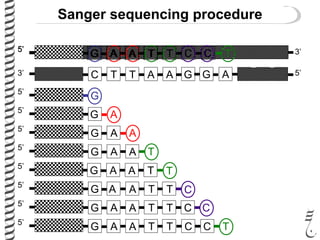
Sanger sequencing procedure
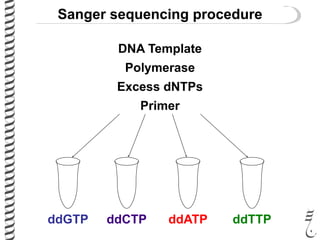
ddGTP ddCTP ddATP ddTTP
DNA Template
Polymerase
Excess dNTPs
Primer
3’5’5’5’
G5’
G A5’
AG A5’
AG A T5’
AG TA TAG TA T5’
C C5’
AG CTA TAG CTA T T5’
C
Sanger sequencing procedure
AG TA TGAATTC3’ 5’
5’
G
5’
G A
5’
AG A
5’
AG A T
5’
AG TA T
AG TA T5’
C
C5’
AG CTA T
AG CTA T T5’
C
A T G C
+
3’
5’
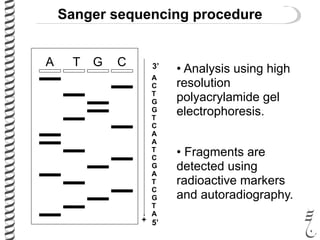
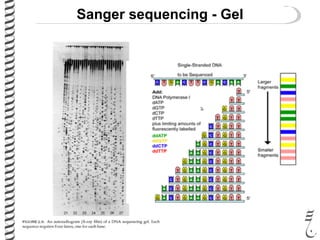
• Analysis using high
resolution
polyacrylamide gel
electrophoresis.
• Fragments are
detected using
radioactive markers
and autoradiography.
A
C
T
G
G
T
C
A
A
T
C
G
A
T
C
G
T
A
Sanger sequencing procedure
Sanger sequencing - Gel
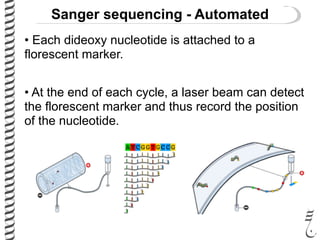
• Each dideoxy nucleotide is attached to a
florescent marker.
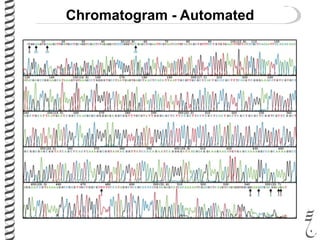
• At the end of each cycle, a laser beam can detect
the florescent marker and thus record the position
of the nucleotide.
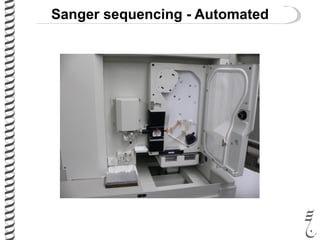
Sanger sequencing - Automated
Chromatogram - Automated
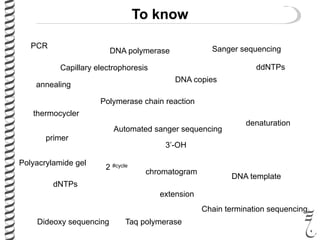
To know
Polymerase chain reaction
PCR
DNA template
dNTPs
ddNTPs
DNA polymerase
Taq polymerase
primer
3’-OH
denaturation
annealing
extension
DNA copies
2 #cycle
thermocycler
Sanger sequencing
Dideoxy sequencing
Chain termination sequencing
Polyacrylamide gel
Automated sanger sequencing
Capillary electrophoresis
chromatogram
Expectations
• You know PCR’s components and process.
• You know the phases of PCR and what
happens in each phase.
• You know how important it is for molecular
applications.
• You know DNA sequencing using Sanger
method.
For a smile

281 lec31 mol_tech3

  • 1.
    Lecture 31: Molecular techniques III.PCR and DNA sequencing Readings (chapter 10) Course 281
  • 2.
  • 3.
    AIMS • Understand theprocess of PCR and the components needed for the reaction. • Understand why PCR is important in molecular biology. • Understand the importance of DNA sequencing. • Understand Sanger sequencing method as an example of DNA sequencing.
  • 4.
    Polymerase chain reaction •Polymerase Chain Reaction (PCR) allows the amplification (copying) of small amounts of DNA millions of copies. • The method was developed by Kary Mullis (1983) and he was awarded the Nobel Prize for his invention.
  • 5.
    Polymerase chain reaction •The process of PCR is similar to the process of DNA replication except it is done in tubes rather than living cells. • It is considered in many cases the first step before any genetic analysis. • Many methods and applications involve PCR.
  • 6.
    DNA replication andPCR • DNA replication in the cells involves making an identical copy of the genome (DNA). • PCR uses the same procedure but to generate millions of copies of a small section of the genome in a tube!
  • 7.
    Why PCR? PCR isused: 1. To amplify small quantities of DNA. 2. For DNA quantification. 3. For genetic profile analyses: • RFLP • Microsatellite • Mitochondrial DNA genotyping and sequencing. 4. For sequencing small section of the genome or the genome.
  • 8.
    Components What do weneed to replicate (copy) DNA? 1. DNA template. 2. Building block of DNA (dNTPs). 3. DNA copier (an enzyme). 4. 3’OH (primer).
  • 9.
    Components: (1) DNAtemplate • The DNA sample you collect from a crime scene or the one under investigation is the DNA template. G A C T A T T A G C G C A T C G C G G C T A A T T A G C A T C G A T C G 5’ 5’ 3’ 3’ C TT A C C TG G CA T A C T G T G 5’3’ G AA T G G AC C GT A T G A C A C 5’ 3’ Each strand serves as a template for copying. Remember complementary base-pairing!
  • 10.
    Components: (2) dNTP(building blocks) Do you remember? DNA is made of nucleotides!
  • 11.
    Deoxyribonucleoside triphosphate (dNTP) H FourdNTPs serve as the building blocks of DNA (dATP, dTTP, dGTP, dCTP) Remember Nucleotides! Components: (2) dNTP (building blocks)
  • 12.
    Deoxyribonucleoside triphosphate (dNTP) Whytriphosphate? For the energy required to for the phosphodiester bond + H H Components: (2) dNTP (building blocks)
  • 13.
    Components: (3) DNAcopier (polymerase) • DNA polymerase is the DNA copier in the cell. • Uses the dNTPs (DNA building blocks) to make a complementary strand to the template. • Uses the available 3’-OH of a previous nucleotide and 5’phsphate from dNTP to form a phosphodiester bond.
  • 14.
    Components: (3) DNAcopier (polymerase) • Each time DNA Pol finds the correct complementary dNTP and catalyzes the reaction linking the new nucleotide. Remember DNA Pol needs 3’-OH
  • 15.
    Primers are shortpiece of polynucleotide G C T A T T A G C C TG G CA T A C T G T G 5’ 5’ OH-3’ 3’ In order for the DNA copying machine to work and add nucleotides, a 3’-OH needs to be available to form a phosphodiester bond! Components: (4) primer (3’ OH)
  • 16.
    PCR Process • Threesteps are involved in PCR: 1. DNA template denaturation: separation of the two strands of DNA. 2. Primers annealing: small oligonucleotide attaches to each separated strand providing the 3’OH for DNA polymerase. 3. DNA polymerization (extension): DNA polymerase extends the primers on both strands and adds nucleotides.
  • 17.
    PCR Process 1. DNAdenaturation 2. Primers annealing 3. DNA extension
  • 18.
    PCR cycles 1. DNAdenaturation 2. Primers annealing 3. DNA extension Temp(C) 94 C 55-65 C 72 C What happens if we repeat this cycle many times? 2 copies 4 copies 8 copies 16 copies 32 copies Cycle 1 Cycle 2 Cycle 3 Cycle 4 Cycle 5
  • 19.
    PCR cycles 21 2223 24 25 Exponential growth in the number of copies generated. The number of copies you get at the end of your PCR will be 2#cycles (236 cycles = 68 billion copies) 2 copies 4 copies 8 copies 16 copies 32 copies Cycle 1 Cycle 2 Cycle 3 Cycle 4 Cycle 5
  • 20.
    PCR – howmany copies? #DNAcopies # cycles Threshhold Not enough DNA template No chemicals left in the reaction tube
  • 21.
    Problems! There were somedifficulties with this system: 1.Three water-baths with three different temperature. 2.DNA polymerase denatures at 94 C.
  • 22.
    Problems! DNA denature (94 C) Primerannealing (55-65 C) Extension (72 C) • The sample has to be transferred into multiple water baths to accommodate the needed temperature.
  • 23.
    Problems! DNA denature (94 C) Primerannealing (55-65 C) Extension (72 C) Adding DNA Pol DNA Pol denatures • DNA polymerase needs to be added in every cycle because DNA polymerase denatures at high temperature.
  • 24.
    Improvement 1 • UsingThermus aquaticus (Taq) polymerase. • Taq polymerase is heat stable and the cycles can take place without the polymerase being destroyed during the denaturation phase
  • 25.
    Improvement 2 Replacing oldmachine (water baths) with a thermocycler
  • 26.
    To consider • Lengthand GC content of your primer. • Compatibility of your forward and reverse primers. • Primer’s sequences do not complement each other (primer dimer). • Annealing temperature of both primers should be the same. • Length of the target DNA piece ( the longer the target the longer the extension time). • DNA polymerase, primers and other chemicals’ concentration should be precisely calculated.
  • 27.
    What is DNAsequencing? It is reading the letters of the book. It is reading the exact nucleotide sequence of the genome.
  • 28.
    Sequencing methods availablenow! 1. Maxam and Gilbert chemical degradation method (extinct). 2. Sanger sequencing (dideoxy or chain termination method). 3. Illumina sequencing. 4. SOLiD sequencing. 5. Pyrosequencing. 6. Ion Torrent method. 7. Single molecule sequencing.
  • 29.
    Why DNA sequencing? •DNA sequencing can be considered the ultimate characterization of gene(s) or fragment(s) of DNA. • DNA Sequencing is used for: • Mapping genomes • Determining gene structure and thus function • Detecting polymorphism (single nucleotide polymorphism SNP) • Analyzing genetic variation • Predicting the possible product(s) of DNA fragments • Many purposes depending on the questions one is asking
  • 30.
    Sanger sequencing (thegreat method) 1.Fredrick Sanger has developed a sequencing method and received a Noble prize for it. 2.Sanger sequencing method is also called Chain Termination Method and Dideoxy sequencing method.
  • 31.
    Sanger sequencing (thegreat method) • Employs: • specific primers • dNTPs • ddNTPs • DNA polymerase • DNA template
  • 32.
    DNA synthesis + H H DNAsynthesis requires the availability of a 3’-OH and energy
  • 33.
    DNA synthesis Difference inOH location in sugar and consequences
  • 34.
    DNA synthesis The absenceof OH group on the 3’ carbon of the sugar blocks further addition of nucleotides
  • 35.
    Sanger sequencing procedure ddGTPddCTP ddATP ddTTP DNA Template Polymerase Excess dNTPs Primer
  • 36.
    3’5’5’5’ G5’ G A5’ AG A5’ AGA T5’ AG TA TAG TA T5’ C C5’ AG CTA TAG CTA T T5’ C Sanger sequencing procedure AG TA TGAATTC3’ 5’ 5’ G 5’ G A 5’ AG A 5’ AG A T 5’ AG TA T AG TA T5’ C C5’ AG CTA T AG CTA T T5’ C
  • 37.
    A T GC + 3’ 5’ • Analysis using high resolution polyacrylamide gel electrophoresis. • Fragments are detected using radioactive markers and autoradiography. A C T G G T C A A T C G A T C G T A Sanger sequencing procedure
  • 38.
  • 39.
    • Each dideoxynucleotide is attached to a florescent marker. • At the end of each cycle, a laser beam can detect the florescent marker and thus record the position of the nucleotide. Sanger sequencing - Automated
  • 40.
  • 41.
  • 42.
    To know Polymerase chainreaction PCR DNA template dNTPs ddNTPs DNA polymerase Taq polymerase primer 3’-OH denaturation annealing extension DNA copies 2 #cycle thermocycler Sanger sequencing Dideoxy sequencing Chain termination sequencing Polyacrylamide gel Automated sanger sequencing Capillary electrophoresis chromatogram
  • 43.
    Expectations • You knowPCR’s components and process. • You know the phases of PCR and what happens in each phase. • You know how important it is for molecular applications. • You know DNA sequencing using Sanger method.
  • 44.