Lecture 29:
Molecular techniques
I. DNA extraction
Readings (chapter 10)
Course 281
Lessons for life
AIMS
• Understand the sources of DNA in different
organisms.
• Understand the cellular structure that needs to
be disrupted to extract DNA.
• Understand the process of DNA isolation and
the different methods employed.
• Understand the reasons for using specific
chemicals in DNA extraction and what each
does.
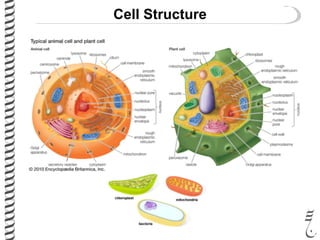
Cell Structure
Cells and DNA
• In an animal cell, DNA is found in the nucleus
and mitochondria.
• In a plant cell, DNA is found in the nucleus,
mitochondria, and chloroplast.
• In bacteria, DNA is found in plasmids and
bacterial chromosome.
Where Do we get the DNA from?
Cells and DNA
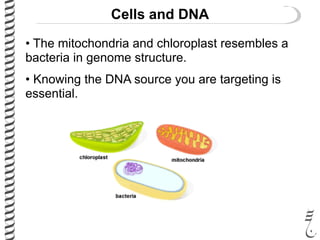
• The mitochondria and chloroplast resembles a
bacteria in genome structure.
• Knowing the DNA source you are targeting is
essential.
Cells and DNA
In humans, where can we get DNA from?
Cell Structure
• All living cells contain hereditary information
coded in DNA (some exceptions! What are
they?).
• DNA in human cells is found in the nucleus
and mitochondria.
• The DNA of the mitochondria resembles that of
bacteria.
• The DNA in the nucleus is packaged into 22
pairs of autosomal chromosomes and one pair of
sex chromosomes (XX or XY – some exceptions).
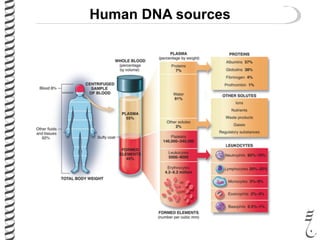
Human DNA sources
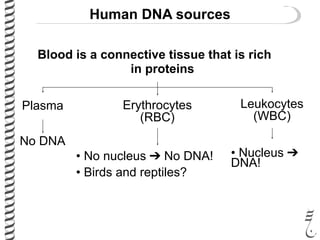
Blood is a connective tissue that is rich
in proteins
Plasma
No DNA
Erythrocytes
(RBC)
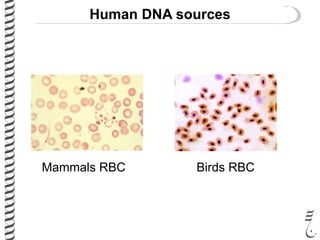
• No nucleus ➔ No DNA!
• Birds and reptiles?
Leukocytes
(WBC)
• Nucleus ➔
DNA!
Human DNA sources
Mammals RBC Birds RBC
Human DNA sources
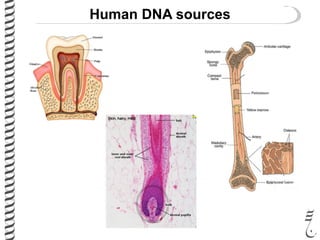
• We can get DNA only from living cells.
• Can we get DNA from trimmed hair?
• Can we get DNA from teeth enamels?
• What about bone?
Human DNA sources
Human DNA sources
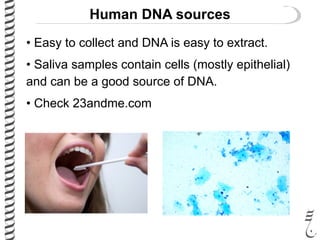
• Easy to collect and DNA is easy to extract.
• Saliva samples contain cells (mostly epithelial)
and can be a good source of DNA.
• Check 23andme.com
Human DNA sources
Cells and DNA
What about other organisms?
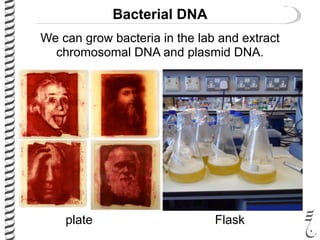
Bacterial DNA
We can grow bacteria in the lab and extract
chromosomal DNA and plasmid DNA.
plate Flask
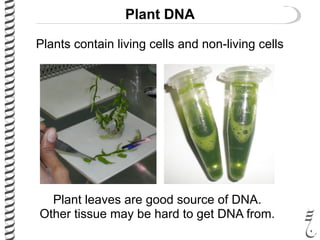
Plant DNA
Plants contain living cells and non-living cells
Plant leaves are good source of DNA.
Other tissue may be hard to get DNA from.
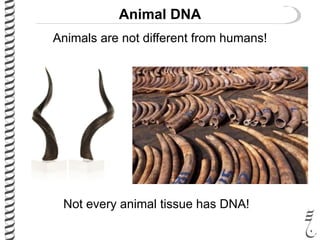
Animal DNA
Animals are not different from humans!
Not every animal tissue has DNA!
Getting DNA
How to get DNA out of the cell?
Getting DNA
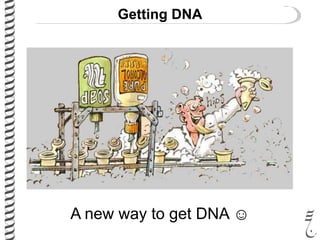
A new way to get DNA ☺
DNA isolation
1. Cell and tissue disruption
2. Lysis of cell membrane
3. Separating DNA from the rest of the
cell content.
DNA isolation
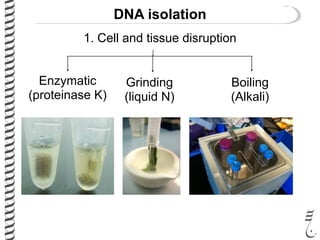
1. Cell and tissue disruption
Enzymatic
(proteinase K)
Grinding
(liquid N)
Boiling
(Alkali)
DNA isolation
2. Lysis of cell membrane
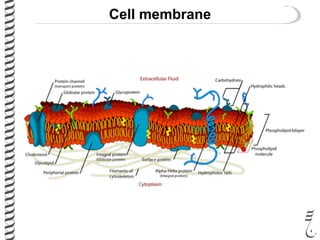
What is the cell membrane?
What does the cell membrane contain?
Cell membrane
Cell membrane
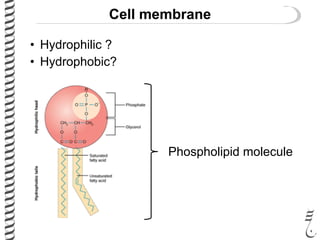
Phospholipid molecule
• Hydrophilic ?
• Hydrophobic?
DNA isolation
2. Lysis of cell membrane
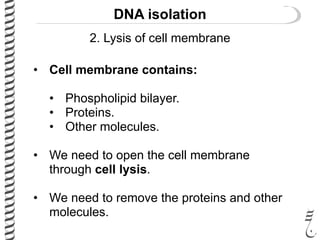
• Cell membrane contains:
• Phospholipid bilayer.
• Proteins.
• Other molecules.
• We need to open the cell membrane
through cell lysis.
• We need to remove the proteins and other
molecules.
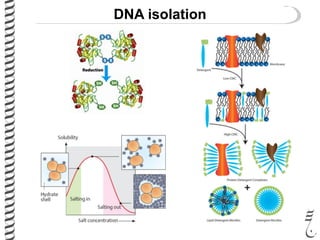
DNA isolation
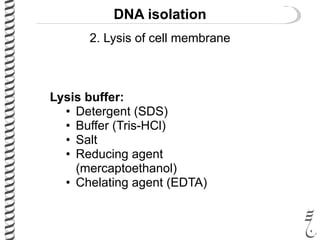
Lysis buffer:
• Detergent (SDS)
• Buffer (Tris-HCl)
• Salt
• Reducing agent
(mercaptoethanol)
• Chelating agent (EDTA)
2. Lysis of cell membrane
DNA isolation
DNA isolation
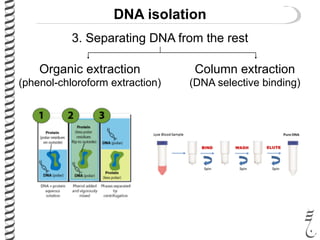
3. Separating DNA from the rest
Organic extraction
(phenol-chloroform extraction)
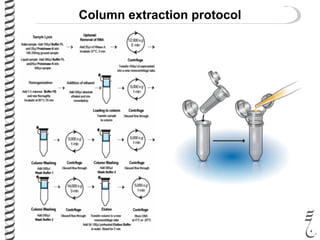
Column extraction
(DNA selective binding)
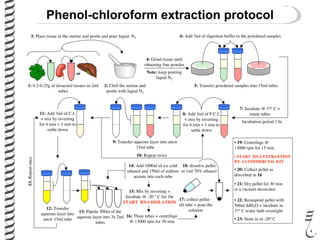
Phenol-chloroform extraction protocol
1: 0.2-0.25g of dissected tissues in 2ml
tubes
or
2: Chill the mortar and
pestle with liquid N2
3: Place tissue in the mortar and pestle and pour liquid N2
4: Grind tissue until
obtaining fine powder
Note: keep pouring
liquid N2
6: Add 3ml of digestion buffer to the powdered samples
5: Transfer powdered samples into 15ml tubes
7: Incubate @ 37º C +
rotate tubes
Incubation period 1 hr
8: Add 3ml of P.C.I.
+ mix by inverting
for 4 min + 1 min to
settle down
9: Transfer aqueous layer into anew
15ml tube
10: Repeat twice
11: Add 3ml of C.I.
+ mix by inverting
for 4 min + 1 min to
settle down
12: Transfer
aqueous layer into
anew 15ml tube
13:Repeatonce
13: Pipette 500ul of the
aqueous layer into 3x 2ml
tubes
14: Add 1000ul of ice cold
ethanol and 150ul of sodium
acetate into each tube
15: Mix by inverting +
Incubate @ -20 º C for 1hr
16: Thaw tubes + centrifuge
@ 13000 rpm for 30 min
START RNA ISOLATION
17: collect pellet -
tilt tube + pour the
solution
18: dissolve pellet
in 1ml 70% ethanol
• 19: Centrifuge @
13000 rpm for 15 min
• 20: Collect pellet as
described in 16
• 21: Dry pellet for 30 min
in a vacuum dessicator
• 22: Resuspend pellet with
500ul ddH2O + incubate in
37º C water bath overnight
• 23: Store in in -20º C
• START DNA EXTRAXTION
BY A COMMERCIAL KIT
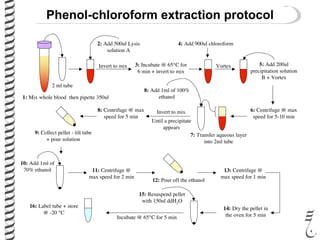
Phenol-chloroform extraction protocol
1: Mix whole blood then pipette 350ul
2 ml tube
2: Add 500ul Lysis
solution A
Invert to mix 3: Incubate @ 65°C for
6 min + invert to mix
4: Add 900ul chloroform
Vortex 5: Add 200ul
precipitation solution
B + Vortex
6: Centrifuge @ max
speed for 5-10 min
7: Transfer aqueous layer
into 2ml tube
8: Add 1ml of 100%
ethanol
Invert to mix
Until a precipitate
appears
8: Centrifuge @ max
speed for 5 min
9: Collect pellet - tilt tube
+ pour solution
10: Add 1ml of
70% ethanol 11: Centrifuge @
max speed for 2 min
12: Pour off the ethanol
13: Centrifuge @
max speed for 1 min
14: Dry the pellet in
the oven for 5 min
15: Resuspend pellet
with 150ul ddH2O
Incubate @ 65°C for 5 min
16: Label tube + store
@ -20 °C
Column extraction protocol
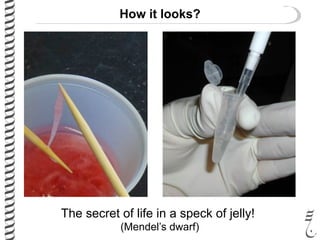
How it looks?
The secret of life in a speck of jelly!
(Mendel’s dwarf)
DNA storage
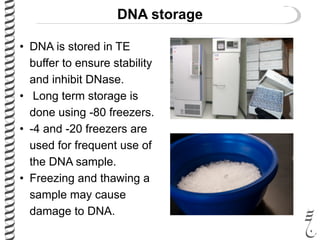
• DNA is stored in TE
buffer to ensure stability
and inhibit DNase.
• Long term storage is
done using -80 freezers.
• -4 and -20 freezers are
used for frequent use of
the DNA sample.
• Freezing and thawing a
sample may cause
damage to DNA.
To know
Genomic DNA
Mitochondrial DNA
Plasmid DNA
Chloroplast DNA
RBC in mammals
RBC in birds
WBC DNA
Cell and tissue disruption
Cell lysis
DNA isolation
Cell membrane
hydrophilic
Hydrophobic
Detergent
salt
Reducing agent
Organic extraction
Column extraction
Phospholipid bilayer
DNA storage
Expectations
• You know the sources of DNA in various
organisms.
• You know not all material from a living organism
can be a source of DNA.
• You know the process of isolating DNA.
• You know the chemicals and what they do in
DNA extraction protocol.
• You know the two major protocols of DNA
extraction.
• You know DNA storage methods and stability.
For a smile

281 lec29 mol_tech1

  • 1.
    Lecture 29: Molecular techniques I.DNA extraction Readings (chapter 10) Course 281
  • 2.
  • 3.
    AIMS • Understand thesources of DNA in different organisms. • Understand the cellular structure that needs to be disrupted to extract DNA. • Understand the process of DNA isolation and the different methods employed. • Understand the reasons for using specific chemicals in DNA extraction and what each does.
  • 4.
  • 5.
    Cells and DNA •In an animal cell, DNA is found in the nucleus and mitochondria. • In a plant cell, DNA is found in the nucleus, mitochondria, and chloroplast. • In bacteria, DNA is found in plasmids and bacterial chromosome. Where Do we get the DNA from?
  • 6.
    Cells and DNA •The mitochondria and chloroplast resembles a bacteria in genome structure. • Knowing the DNA source you are targeting is essential.
  • 7.
    Cells and DNA Inhumans, where can we get DNA from?
  • 8.
    Cell Structure • Allliving cells contain hereditary information coded in DNA (some exceptions! What are they?). • DNA in human cells is found in the nucleus and mitochondria. • The DNA of the mitochondria resembles that of bacteria. • The DNA in the nucleus is packaged into 22 pairs of autosomal chromosomes and one pair of sex chromosomes (XX or XY – some exceptions).
  • 9.
  • 10.
    Blood is aconnective tissue that is rich in proteins Plasma No DNA Erythrocytes (RBC) • No nucleus ➔ No DNA! • Birds and reptiles? Leukocytes (WBC) • Nucleus ➔ DNA! Human DNA sources
  • 11.
    Mammals RBC BirdsRBC Human DNA sources
  • 12.
    • We canget DNA only from living cells. • Can we get DNA from trimmed hair? • Can we get DNA from teeth enamels? • What about bone? Human DNA sources
  • 13.
  • 14.
    • Easy tocollect and DNA is easy to extract. • Saliva samples contain cells (mostly epithelial) and can be a good source of DNA. • Check 23andme.com Human DNA sources
  • 15.
    Cells and DNA Whatabout other organisms?
  • 16.
    Bacterial DNA We cangrow bacteria in the lab and extract chromosomal DNA and plasmid DNA. plate Flask
  • 17.
    Plant DNA Plants containliving cells and non-living cells Plant leaves are good source of DNA. Other tissue may be hard to get DNA from.
  • 18.
    Animal DNA Animals arenot different from humans! Not every animal tissue has DNA!
  • 19.
    Getting DNA How toget DNA out of the cell?
  • 20.
    Getting DNA A newway to get DNA ☺
  • 21.
    DNA isolation 1. Celland tissue disruption 2. Lysis of cell membrane 3. Separating DNA from the rest of the cell content.
  • 22.
    DNA isolation 1. Celland tissue disruption Enzymatic (proteinase K) Grinding (liquid N) Boiling (Alkali)
  • 23.
    DNA isolation 2. Lysisof cell membrane What is the cell membrane? What does the cell membrane contain?
  • 24.
  • 25.
    Cell membrane Phospholipid molecule •Hydrophilic ? • Hydrophobic?
  • 26.
    DNA isolation 2. Lysisof cell membrane • Cell membrane contains: • Phospholipid bilayer. • Proteins. • Other molecules. • We need to open the cell membrane through cell lysis. • We need to remove the proteins and other molecules.
  • 27.
    DNA isolation Lysis buffer: •Detergent (SDS) • Buffer (Tris-HCl) • Salt • Reducing agent (mercaptoethanol) • Chelating agent (EDTA) 2. Lysis of cell membrane
  • 28.
  • 29.
    DNA isolation 3. SeparatingDNA from the rest Organic extraction (phenol-chloroform extraction) Column extraction (DNA selective binding)
  • 30.
    Phenol-chloroform extraction protocol 1:0.2-0.25g of dissected tissues in 2ml tubes or 2: Chill the mortar and pestle with liquid N2 3: Place tissue in the mortar and pestle and pour liquid N2 4: Grind tissue until obtaining fine powder Note: keep pouring liquid N2 6: Add 3ml of digestion buffer to the powdered samples 5: Transfer powdered samples into 15ml tubes 7: Incubate @ 37º C + rotate tubes Incubation period 1 hr 8: Add 3ml of P.C.I. + mix by inverting for 4 min + 1 min to settle down 9: Transfer aqueous layer into anew 15ml tube 10: Repeat twice 11: Add 3ml of C.I. + mix by inverting for 4 min + 1 min to settle down 12: Transfer aqueous layer into anew 15ml tube 13:Repeatonce 13: Pipette 500ul of the aqueous layer into 3x 2ml tubes 14: Add 1000ul of ice cold ethanol and 150ul of sodium acetate into each tube 15: Mix by inverting + Incubate @ -20 º C for 1hr 16: Thaw tubes + centrifuge @ 13000 rpm for 30 min START RNA ISOLATION 17: collect pellet - tilt tube + pour the solution 18: dissolve pellet in 1ml 70% ethanol • 19: Centrifuge @ 13000 rpm for 15 min • 20: Collect pellet as described in 16 • 21: Dry pellet for 30 min in a vacuum dessicator • 22: Resuspend pellet with 500ul ddH2O + incubate in 37º C water bath overnight • 23: Store in in -20º C • START DNA EXTRAXTION BY A COMMERCIAL KIT
  • 31.
    Phenol-chloroform extraction protocol 1:Mix whole blood then pipette 350ul 2 ml tube 2: Add 500ul Lysis solution A Invert to mix 3: Incubate @ 65°C for 6 min + invert to mix 4: Add 900ul chloroform Vortex 5: Add 200ul precipitation solution B + Vortex 6: Centrifuge @ max speed for 5-10 min 7: Transfer aqueous layer into 2ml tube 8: Add 1ml of 100% ethanol Invert to mix Until a precipitate appears 8: Centrifuge @ max speed for 5 min 9: Collect pellet - tilt tube + pour solution 10: Add 1ml of 70% ethanol 11: Centrifuge @ max speed for 2 min 12: Pour off the ethanol 13: Centrifuge @ max speed for 1 min 14: Dry the pellet in the oven for 5 min 15: Resuspend pellet with 150ul ddH2O Incubate @ 65°C for 5 min 16: Label tube + store @ -20 °C
  • 32.
  • 33.
    How it looks? Thesecret of life in a speck of jelly! (Mendel’s dwarf)
  • 34.
    DNA storage • DNAis stored in TE buffer to ensure stability and inhibit DNase. • Long term storage is done using -80 freezers. • -4 and -20 freezers are used for frequent use of the DNA sample. • Freezing and thawing a sample may cause damage to DNA.
  • 35.
    To know Genomic DNA MitochondrialDNA Plasmid DNA Chloroplast DNA RBC in mammals RBC in birds WBC DNA Cell and tissue disruption Cell lysis DNA isolation Cell membrane hydrophilic Hydrophobic Detergent salt Reducing agent Organic extraction Column extraction Phospholipid bilayer DNA storage
  • 36.
    Expectations • You knowthe sources of DNA in various organisms. • You know not all material from a living organism can be a source of DNA. • You know the process of isolating DNA. • You know the chemicals and what they do in DNA extraction protocol. • You know the two major protocols of DNA extraction. • You know DNA storage methods and stability.
  • 37.