Lecture 4:
The identity and location
of the genetic material
Readings (chapter 2)
Course 281
Introduction to Molecular Biology
Lessons for life
Aims
• Introduce the experiments that led to
discovering the identity of the genetic code.
• Explain the progression of scientific
thought and evidence associated with DNA
discovery.
• Explain when the lines of evidence were
sufficient to conclude DNA is the genetic
code.
The cell
Cells
Mid 1800s, animals and plants are made of cells.
Cells divide but do not know how.
The nucleus
A specific part was identified as the nucleus and it
has specific chemical and physical characteristics.
Nuclein
Nuclein
Fredrick Miescher
bloody bandages
(1869)
• Bloody bandages as a source of cells.
• When added HCl, got pure nuclei (singular =
nucleus).
• When adding a base then an acid to the nuclei,
got a gray precipitate.
Nuclein
• The molecule is different than other molecules
(contain C, O, N, H, and P – not known to be in
proteins).
• Since the molecule came from nucleus, he called
it Nuclein (today called DNA).
Chromatin
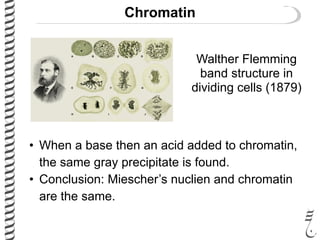
Walther Flemming
band structure in
dividing cells (1879)
• Used cells of salamanders and staining
techniques to study cell division (he called it
mitosis).
• The intensely stained parts of the nucleus he
called chromatin (chroma is Greek for color).
Chromatin
Chromatin
Walther Flemming
band structure in
dividing cells (1879)
• When a base then an acid added to chromatin,
the same gray precipitate is found.
• Conclusion: Miescher’s nuclien and chromatin
are the same.
Chromosomes
Hermann Fol and Oscar
Hertwig (1870-1880)
• Observed fertilization and fusion of the eggs
and sperms nuclei.
• Chromatin is called chromosomes.
Chromosomes
• The study of fertilization using light
microscopy led to:
• Eggs and sperms have equal number of
chromosomes.
• Chromosomes get passed to future
generations.
• By 1890 almost everybody agreed that
nuclien = chromatin = chromosomes are
the basis of heredity.
Chromosomes and heredity
• Chromosomes are proteins and nucleic acid.
Which one is the genetic molecule?
• Many suspected proteins to be the hereditary
molecule because of the high capacity to store info
(20 amino acids – now 22) compared to 4
nucleotides in DNA.
Characteristics of genetic material
• What should the hereditary molecule have?
• Contain the information in a stable form.
• Able to self replicate and pass to future
generations.
• Can be changed (allowing for adaptation
and evolution).
The hereditary molecule
Proteins or DNA?
Need some cool
experiments
Griffith’s transformation experiment
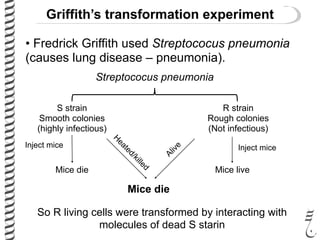
• Fredrick Griffith used Streptococus pneumonia
(causes lung disease – pneumonia).
S strain
Smooth colonies
(highly infectious)
Streptococus pneumonia
R strain
Rough colonies
(Not infectious)
Mice die
Inject mice Inject mice
H
eated/killed
Alive
Mice die
So R living cells were transformed by interacting with
molecules of dead S starin
Mice live
Griffith’s transformation experiment
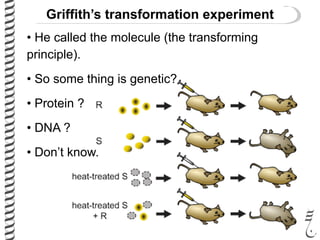
• He called the molecule (the transforming
principle).
• So some thing is genetic?
• Protein ?
• DNA ?
• Don’t know.
Griffith’s transformation experiment
• He called the molecule (the transforming
principle).
• So something is genetic?
• Is it Protein ?
• Is it DNA ?
• Don’t know.
What is the chemical identity of the genetic
material?
Avery’s transformation experiment
• Avery is asking the question: which component of
the S cells is the transforming principle (genetic
code)?
• Rerun Griffith’s experiment with some
modifications.
• lysed cells contain:
• Proteins
• Polysaccharides
• RNA
• DNA
One of these molecules
must be the genetic
material
Avery’s	
  transformation	
  experiment
• He used enzymes to degrade a specific class of
molecules at a time then study the transformed
cells.
• When DNA was degraded with DNase, no
transformation occurred.
• Thus, DNA is the transformation principle!
• Clever right?
• Not good enough and convincing for some
scientists. Why?
• Because the degrading enzymes were not pure!
Avery’s transformation experiment
• Need more evidence that DNA is the genetic
code.
• Hershey and Chase used a bacterial parasite
(virus) to study the genetic code.
• Bacteriophage (phage):
• Protein body.
• DNA inside.
• Use the knowledge about the life
cycle to study the genetic code.
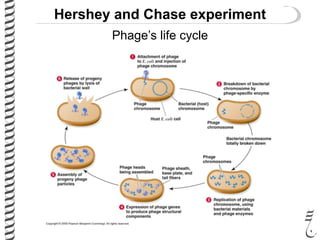
• What is phage’s life cycle?
Hershey and Chase experiment
Phage’s life cycle
Hershey and Chase experiment
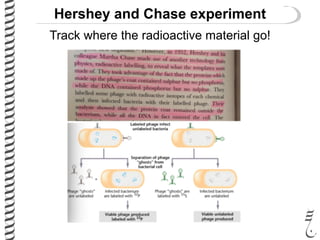
Track where the radioactive material go!
• Labeled proteins with radioactive S35.
• Labeled DNA with radioactive P32.
• The molecule that would enter the cell is the
hereditary molecule.
• Study where the molecule go (in pellet or in
supernatant)?
Hershey and Chase experiment
Track where the radioactive material go!
DNA is the genetic material!!!
Hershey and Chase experiment
Track where the radioactive material go!
To study
Transforming principle
Griffith’s transformation experiment
Avery’s transformation experiment
Hershey and Chase experiment
S Strain
R Strain
Bacteriophage
Phage
Nuclien
Phage life cycle
Radioactive P
Radioactive S
Dominant
Expectations
• Know the experiments that lead to the
conclusion that DNA is the genetic material.
• Know what each experiment added to the
previous knowledge.
• You know a bit of the story to tell your
friends and family.
For a smile

281 lec4 identity_location

  • 1.
    Lecture 4: The identityand location of the genetic material Readings (chapter 2) Course 281 Introduction to Molecular Biology
  • 2.
  • 3.
    Aims • Introduce theexperiments that led to discovering the identity of the genetic code. • Explain the progression of scientific thought and evidence associated with DNA discovery. • Explain when the lines of evidence were sufficient to conclude DNA is the genetic code.
  • 4.
  • 5.
    Cells Mid 1800s, animalsand plants are made of cells. Cells divide but do not know how.
  • 6.
    The nucleus A specificpart was identified as the nucleus and it has specific chemical and physical characteristics.
  • 7.
  • 8.
    Nuclein Fredrick Miescher bloody bandages (1869) •Bloody bandages as a source of cells. • When added HCl, got pure nuclei (singular = nucleus). • When adding a base then an acid to the nuclei, got a gray precipitate.
  • 9.
    Nuclein • The moleculeis different than other molecules (contain C, O, N, H, and P – not known to be in proteins). • Since the molecule came from nucleus, he called it Nuclein (today called DNA).
  • 10.
    Chromatin Walther Flemming band structurein dividing cells (1879) • Used cells of salamanders and staining techniques to study cell division (he called it mitosis). • The intensely stained parts of the nucleus he called chromatin (chroma is Greek for color).
  • 11.
  • 12.
    Chromatin Walther Flemming band structurein dividing cells (1879) • When a base then an acid added to chromatin, the same gray precipitate is found. • Conclusion: Miescher’s nuclien and chromatin are the same.
  • 13.
    Chromosomes Hermann Fol andOscar Hertwig (1870-1880) • Observed fertilization and fusion of the eggs and sperms nuclei. • Chromatin is called chromosomes.
  • 14.
    Chromosomes • The studyof fertilization using light microscopy led to: • Eggs and sperms have equal number of chromosomes. • Chromosomes get passed to future generations. • By 1890 almost everybody agreed that nuclien = chromatin = chromosomes are the basis of heredity.
  • 15.
    Chromosomes and heredity •Chromosomes are proteins and nucleic acid. Which one is the genetic molecule? • Many suspected proteins to be the hereditary molecule because of the high capacity to store info (20 amino acids – now 22) compared to 4 nucleotides in DNA.
  • 16.
    Characteristics of geneticmaterial • What should the hereditary molecule have? • Contain the information in a stable form. • Able to self replicate and pass to future generations. • Can be changed (allowing for adaptation and evolution).
  • 17.
    The hereditary molecule Proteinsor DNA? Need some cool experiments
  • 18.
    Griffith’s transformation experiment •Fredrick Griffith used Streptococus pneumonia (causes lung disease – pneumonia). S strain Smooth colonies (highly infectious) Streptococus pneumonia R strain Rough colonies (Not infectious) Mice die Inject mice Inject mice H eated/killed Alive Mice die So R living cells were transformed by interacting with molecules of dead S starin Mice live
  • 19.
    Griffith’s transformation experiment •He called the molecule (the transforming principle). • So some thing is genetic? • Protein ? • DNA ? • Don’t know.
  • 20.
    Griffith’s transformation experiment •He called the molecule (the transforming principle). • So something is genetic? • Is it Protein ? • Is it DNA ? • Don’t know. What is the chemical identity of the genetic material?
  • 21.
    Avery’s transformation experiment •Avery is asking the question: which component of the S cells is the transforming principle (genetic code)? • Rerun Griffith’s experiment with some modifications. • lysed cells contain: • Proteins • Polysaccharides • RNA • DNA One of these molecules must be the genetic material
  • 22.
    Avery’s  transformation  experiment •He used enzymes to degrade a specific class of molecules at a time then study the transformed cells. • When DNA was degraded with DNase, no transformation occurred. • Thus, DNA is the transformation principle! • Clever right? • Not good enough and convincing for some scientists. Why? • Because the degrading enzymes were not pure!
  • 23.
  • 24.
    • Need moreevidence that DNA is the genetic code. • Hershey and Chase used a bacterial parasite (virus) to study the genetic code. • Bacteriophage (phage): • Protein body. • DNA inside. • Use the knowledge about the life cycle to study the genetic code. • What is phage’s life cycle? Hershey and Chase experiment
  • 25.
    Hershey and Chaseexperiment Phage’s life cycle
  • 26.
    Hershey and Chaseexperiment Track where the radioactive material go! • Labeled proteins with radioactive S35. • Labeled DNA with radioactive P32. • The molecule that would enter the cell is the hereditary molecule. • Study where the molecule go (in pellet or in supernatant)?
  • 27.
    Hershey and Chaseexperiment Track where the radioactive material go! DNA is the genetic material!!!
  • 28.
    Hershey and Chaseexperiment Track where the radioactive material go!
  • 29.
    To study Transforming principle Griffith’stransformation experiment Avery’s transformation experiment Hershey and Chase experiment S Strain R Strain Bacteriophage Phage Nuclien Phage life cycle Radioactive P Radioactive S Dominant
  • 30.
    Expectations • Know theexperiments that lead to the conclusion that DNA is the genetic material. • Know what each experiment added to the previous knowledge. • You know a bit of the story to tell your friends and family.
  • 31.