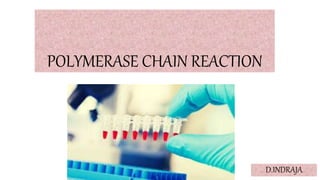
POLYMERASE CHAIN REACTION
D.INDRAJA
Introduction
• PCR is a invitro DNA amplification technique used in the lab to make millions of copies of a particular
section of DNA. It was first developed in the 1980s.
• Sometimes called "molecular photocopying," the polymerase chain reaction (PCR) is a fast and
inexpensive technique used to "amplify" - copy - small segments of DNA
Discovery
The polymerase chain reaction (PCR) was originally developed in 1983 by the American biochemist Kary
Mullis. He was awarded the Nobel Prize in Chemistry in 1993 for his pioneering work.
Principle
• To amplify a segment of DNA using PCR, the sample is first heated so the DNA denatures, or separates
into two pieces of single-stranded DNA. Next, an enzyme called "Taq polymerase" synthesizes - builds -
two new strands of DNA, using the original strands as templates. This process results in the duplication of
the original DNA, with each of the new molecules containing one old and one new strand of DNA. Then
each of these strands can be used to create two new copies, and so on, and so on
• The entire cycling process of PCR is automated and can be completed in just a few hours. It is directed
by a machine called a thermocycler, which is programmed to alter the temperature of the reaction every
few minutes to allow DNA denaturing and synthesis.
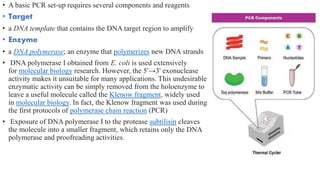
• A basic PCR set-up requires several components and reagents
• Target
• a DNA template that contains the DNA target region to amplify
• Enzyme
• a DNA polymerase; an enzyme that polymerizes new DNA strands
• DNA polymerase I obtained from E. coli is used extensively
for molecular biology research. However, the 5'→3' exonuclease
activity makes it unsuitable for many applications. This undesirable
enzymatic activity can be simply removed from the holoenzyme to
leave a useful molecule called the Klenow fragment, widely used
in molecular biology. In fact, the Klenow fragment was used during
the first protocols of polymerase chain reaction (PCR)
• Exposure of DNA polymerase I to the protease subtilisin cleaves
the molecule into a smaller fragment, which retains only the DNA
polymerase and proofreading activities.
• In the original PCR procedure, one problem was that the DNA polymerase had to be replenished after
every cycle because it is not stable at the high temperatures needed for denaturation. This problem was
solved in 1987 with the discovery of a heat-stable DNA polymerase called Taq, an enzyme isolated from
the thermophilic bacterium Thermus aquaticus, which inhabits hot springs.
• Primers
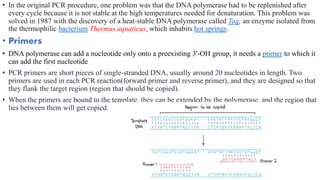
• DNA polymerase can add a nucleotide only onto a preexisting 3'-OH group, it needs a primer to which it
can add the first nucleotide
• PCR primers are short pieces of single-stranded DNA, usually around 20 nucleotides in length. Two
primers are used in each PCR reaction(forward primer and reverse primer), and they are designed so that
they flank the target region (region that should be copied).
• When the primers are bound to the template, they can be extended by the polymerase, and the region that
lies between them will get copied.
Nucleotides (dNTPs or deoxynucleotide triphosphates)
• single units of the bases A, T, G, and C, which are essentially "building blocks" for new DNA strands.
buffer solution
• a buffer solution providing a suitable chemical environment for optimum activity and stability of the DNA
polymerase
bivalent cations
• bivalent cations, typically magnesium (Mg) or manganese (Mn) ions; Mg2+ is the most common, but Mn2+ can be
used for PCR-mediated DNA mutagenesis, as a higher Mn2+ concentration increases the error rate during DNA
synthesis,and monovalent cations, typically potassium (K) ions
Thermal cycler
• The reaction is commonly carried out in a volume of 10–200 μL in small reaction tubes (0.2–0.5 mL volumes) in
a thermal cycler.
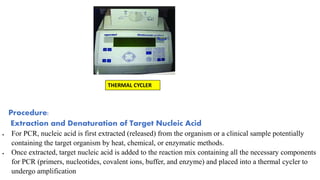
• The thermal cycler heats and cools the reaction tubes to achieve the temperatures required at each step of the
reaction .
• Many modern thermal cyclers make use of the Peltier effect, which permits both heating and cooling of the block
holding the PCR tubes simply by reversing the electric current.
• Thin-walled reaction tubes permit favorable thermal conductivity to allow for rapid thermal equilibrium.
• Most thermal cyclers have heated lids to prevent condensation at the top of the reaction tube. Older thermal cyclers
lacking a heated lid require a layer of oil on top of the reaction mixture or a ball of wax inside the tube.
Procedure:
Extraction and Denaturation of Target Nucleic Acid
 For PCR, nucleic acid is first extracted (released) from the organism or a clinical sample potentially
containing the target organism by heat, chemical, or enzymatic methods.
 Once extracted, target nucleic acid is added to the reaction mix containing all the necessary components
for PCR (primers, nucleotides, covalent ions, buffer, and enzyme) and placed into a thermal cycler to
undergo amplification
THERMAL CYCLER
Denaturation(95°C )
 The reaction mixture is heated to 95°C for a short time period (about 15–30 sec) to denature the target
DNA into single strands that can act as templates for DNA synthesis
Annealing (55 - 65C°)
 Cool the reaction so the primers can bind to their complementary sequences on the single-stranded
template DNA.
 This annealing temperature is calculated carefully to ensure that the primers bind only to the desired
DNA sequences (usually around 55oC).
• One primer binds to each strand. The two parental strands do not re-anneal with each other because the
primers are in large excess over parental DNA
Extension(72°C)
 The temperature of the mixture is raised to 72°C (usually) and kept at this temperature for a pre-set
period of time to allow DNA polymerase to elongate each primer by copying the single-stranded
templates.
 Annealing of primers to target sequences provides the necessary template format that allows the DNA
polymerase to add nucleotides to the 3’ terminus (end) of each primer and extend sequence
complementary to the target template
 Taq polymerase is the enzyme commonly used for primer extension, which occurs at 72°C. This
enzyme is used because of its ability to function efficiently at elevated temperatures and to withstand
the denaturing temperature of 94°C through several cycles
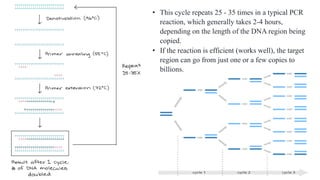
• This cycle repeats 25 - 35 times in a typical PCR
reaction, which generally takes 2-4 hours,
depending on the length of the DNA region being
copied.
• If the reaction is efficient (works well), the target
region can go from just one or a few copies to
billions.
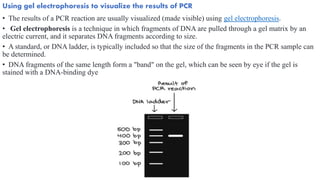
Using gel electrophoresis to visualize the results of PCR
• The results of a PCR reaction are usually visualized (made visible) using gel electrophoresis.
• Gel electrophoresis is a technique in which fragments of DNA are pulled through a gel matrix by an
electric current, and it separates DNA fragments according to size.
• A standard, or DNA ladder, is typically included so that the size of the fragments in the PCR sample can
be determined.
• DNA fragments of the same length form a "band" on the gel, which can be seen by eye if the gel is
stained with a DNA-binding dye
Applications of PCR
 DNA sequencing has been greatly simplified using PCR, and this application is now common.
 By using suitable primers, it is possible to use PCR to create point mutations, deletions and insertions of
target DNA which greatly facilitates the analysis of gene expression and function
 PCR is used in many research labs, and it also has practical applications in forensics, genetic testing,
and diagnostics.
 For instance, PCR is used to amplify genes associated with genetic disorders from the DNA of patients
(or from fetal DNA, in the case of prenatal testing).
• PCR can also be used to test for a bacterium or DNA virus in a patient's body: if the pathogen is present,
it may be possible to amplify regions of its DNA from a blood or tissue sample.
• PCR in bioremediation to identify genetically modified organismsin the enviroinment
• PCR in genetic engineering
• Detection and diagnosis of infectious disease
• Detection of mutations
• Evolutionary studies
• Site directed mutagenesis
Types of PCR : some of them are
 Colony PCR
 Colony PCR is a method in which, where identification of DNA of interest inserted into the plasmid is
obtained by designing the inserted DNA specific primers.
 A bacterial colony is taken and added TO MICROFUGE TUBES and heated to extract the nucleic acids
from the colonies and centrifuge and collect the supernatant and add into the master mix containing all
other PCR reagents.
 The main application of colony PCR is in the identification of correct ligation and insertion of inserted
DNA into bacteria as well as yeast plasmid.
• Hot start PCR
 Hot start PCR is a novel form of conventional polymerase chain reaction (PCR) that reduces the
occurrence of undesired products and formation of primer-dimers due to non-specific DNA
amplification at room temperatures.
 The basic principle of hot-start PCR is the separation of one or more reagents from the reaction mix
until the mixture reaches the denaturation temperature upon heating.
 Hot start PCR significantly reduces non-specific binding, the formation of primer-dimers, and often
increases product yields. It also requires less effort and reduces the risk of contamination.
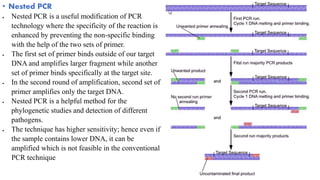
• Nested PCR
 Nested PCR is a useful modification of PCR
technology where the specificity of the reaction is
enhanced by preventing the non-specific binding
with the help of the two sets of primer.
 The first set of primer binds outside of our target
DNA and amplifies larger fragment while another
set of primer binds specifically at the target site.
 In the second round of amplification, second set of
primer amplifies only the target DNA.
 Nested PCR is a helpful method for the
phylogenetic studies and detection of different
pathogens.
 The technique has higher sensitivity; hence even if
the sample contains lower DNA, it can be
amplified which is not feasible in the conventional
PCR technique
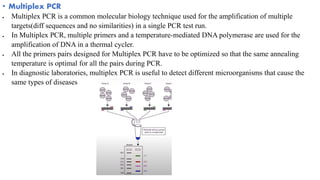
• Multiplex PCR
 Multiplex PCR is a common molecular biology technique used for the amplification of multiple
targets(diff sequences and no similarities) in a single PCR test run.
 In Multiplex PCR, multiple primers and a temperature-mediated DNA polymerase are used for the
amplification of DNA in a thermal cycler.
 All the primers pairs designed for Multiplex PCR have to be optimized so that the same annealing
temperature is optimal for all the pairs during PCR.
 In diagnostic laboratories, multiplex PCR is useful to detect different microorganisms that cause the
same types of diseases
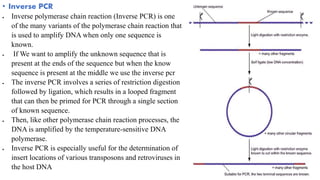
• Inverse PCR
 Inverse polymerase chain reaction (Inverse PCR) is one
of the many variants of the polymerase chain reaction that
is used to amplify DNA when only one sequence is
known.
 If We want to amplify the unknown sequence that is
present at the ends of the sequence but when the know
sequence is present at the middle we use the inverse pcr
 The inverse PCR involves a series of restriction digestion
followed by ligation, which results in a looped fragment
that can then be primed for PCR through a single section
of known sequence.
 Then, like other polymerase chain reaction processes, the
DNA is amplified by the temperature-sensitive DNA
polymerase.
 Inverse PCR is especially useful for the determination of
insert locations of various transposons and retroviruses in
the host DNA
• Long-Range PCR
 Long-Range PCR is a method for the amplification of longer DNA lengths that cannot typically be
amplified using routine PCR methods or reagents.
 Long-range PCR can be achieved by using modified high-efficiency polymerases with enhanced DNA
binding, resulting in highly processive and accurate amplification of long fragments.
 This method allows the amplification of more extended targets within a shorter period and with
efficient use of resources.
• Reverse Transcriptase PCR (RT-PCR)
 Reverse transcription PCR (RT-PCR) is a modification of conventional PCR, whereby RNA molecules
are first converted into complementary DNA (cDNA) molecules that can then be amplified by PCR.
 In RT-PCR, the RNA template is first converted into a complementary DNA (cDNA) using reverse
transcriptase. The cDNA then acts as a template for exponential amplification using PCR.
 RT-PCR can be conducted either in a single tube or as two steps in different tubes. The one-step method
is more effective with fewer chances of contamination and incorporation of variations.
 RT-PCR is used in research methods, gene insertion, genetic disease diagnosis and cancer detection.
• Real-Time PCR (Quantitative PCR (qPCR))
 Quantitative PCR (qPCR), also called real-time PCR or quantitative real-time PCR, is a PCR-based
technique that couples amplification of a target DNA sequence with quantification of the concentration
of that DNA species in the reaction.
 Conventional PCR is a time-consuming process where the PCR products are analysed through gel
electrophoresis. qPCR facilitates the analysis by providing real time detection of products during the
exponential phase.
 The principle of real-time PCR depends on the use of fluorescent dye.
 The concentration of the nucleic acid present into the sample is quantified using the fluorescent dye or
using the fluorescent labelled oligonucleotides.
 q-PCR is applied in genotyping and quantification of pathogens, microRNA analysis, cancer detection,
microbial load testing and GMOs detection.
• Reverse-Transcriptase Real-Time PCR (RT-qPCR)
 RT-PCR is commonly associated with q-PCR forming Reverse Transcriptase Real-Time PCR (RT-
qPCR).
 This allows quantification of DNA in real-time after the amplification.
• Amplified fragment length polymorphism (AFLP) PCR
 It is a PCR-based technique that uses selective amplification of a section of digested DNA fragments to
generate unique fingerprints for genomes of interest.
 AFLP PCR uses restriction enzymes to digest genomic DNA and allows attachment of adaptors to the
sticky ends of the fragments.
 A part of the restriction fragments is then selected to be amplified by using primers that are
complementary to the adaptor sequence.
 The amplified sequences are separated and visualized on denaturing on agarose gel electrophoresis.
 AFLP PCR is employed for a variety of applications, as to assess genetic diversity within species or
among closely related species, to infer population-level phylogenies and biogeographic patterns, to
generate genetic maps and to determine relatedness among cultivars.
• Asymmetric PCR
 Asymmetric PCR is a variation of PCR used to preferentially amplify one strand of the original DNA
more than the other.
 Asymmetric PCR differs from regular PCR by the excessive amount of primers for a chosen strand.
 Consequently, linear synthesis of the targeted single DNA strand from the excess primer is formed after
depletion of the limiting primer.
 It is useful when amplification of only one of the two complementary strands is needed, such as in
sequencing and hybridization probing
• Variable Number of Tandem Repeats (VNTR) PCR
• They are important markers for the individualization in forensic science.
• In VNTR PCR, fragments are amplified that showed little variation within a species, but did show
differences between species.
• It can successfully amplify from a very small amount of genomic deoxyribonucleic acid (DNA) by the
polymerase chain reaction (PCR)
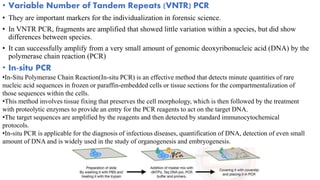
• In-situ PCR
•In-Situ Polymerase Chain Reaction(In-situ PCR) is an effective method that detects minute quantities of rare
nucleic acid sequences in frozen or paraffin-embedded cells or tissue sections for the compartmentalization of
those sequences within the cells.
•This method involves tissue fixing that preserves the cell morphology, which is then followed by the treatment
with proteolytic enzymes to provide an entry for the PCR reagents to act on the target DNA.
•The target sequences are amplified by the reagents and then detected by standard immunocytochemical
protocols.
•In-situ PCR is applicable for the diagnosis of infectious diseases, quantification of DNA, detection of even small
amount of DNA and is widely used in the study of organogenesis and embryogenesis.
Polymerase chain reaction

Polymerase chain reaction

  • 1.
  • 2.
    Introduction • PCR isa invitro DNA amplification technique used in the lab to make millions of copies of a particular section of DNA. It was first developed in the 1980s. • Sometimes called "molecular photocopying," the polymerase chain reaction (PCR) is a fast and inexpensive technique used to "amplify" - copy - small segments of DNA Discovery The polymerase chain reaction (PCR) was originally developed in 1983 by the American biochemist Kary Mullis. He was awarded the Nobel Prize in Chemistry in 1993 for his pioneering work. Principle • To amplify a segment of DNA using PCR, the sample is first heated so the DNA denatures, or separates into two pieces of single-stranded DNA. Next, an enzyme called "Taq polymerase" synthesizes - builds - two new strands of DNA, using the original strands as templates. This process results in the duplication of the original DNA, with each of the new molecules containing one old and one new strand of DNA. Then each of these strands can be used to create two new copies, and so on, and so on • The entire cycling process of PCR is automated and can be completed in just a few hours. It is directed by a machine called a thermocycler, which is programmed to alter the temperature of the reaction every few minutes to allow DNA denaturing and synthesis.
  • 3.
    • A basicPCR set-up requires several components and reagents • Target • a DNA template that contains the DNA target region to amplify • Enzyme • a DNA polymerase; an enzyme that polymerizes new DNA strands • DNA polymerase I obtained from E. coli is used extensively for molecular biology research. However, the 5'→3' exonuclease activity makes it unsuitable for many applications. This undesirable enzymatic activity can be simply removed from the holoenzyme to leave a useful molecule called the Klenow fragment, widely used in molecular biology. In fact, the Klenow fragment was used during the first protocols of polymerase chain reaction (PCR) • Exposure of DNA polymerase I to the protease subtilisin cleaves the molecule into a smaller fragment, which retains only the DNA polymerase and proofreading activities.
  • 4.
    • In theoriginal PCR procedure, one problem was that the DNA polymerase had to be replenished after every cycle because it is not stable at the high temperatures needed for denaturation. This problem was solved in 1987 with the discovery of a heat-stable DNA polymerase called Taq, an enzyme isolated from the thermophilic bacterium Thermus aquaticus, which inhabits hot springs. • Primers • DNA polymerase can add a nucleotide only onto a preexisting 3'-OH group, it needs a primer to which it can add the first nucleotide • PCR primers are short pieces of single-stranded DNA, usually around 20 nucleotides in length. Two primers are used in each PCR reaction(forward primer and reverse primer), and they are designed so that they flank the target region (region that should be copied). • When the primers are bound to the template, they can be extended by the polymerase, and the region that lies between them will get copied.
  • 5.
    Nucleotides (dNTPs ordeoxynucleotide triphosphates) • single units of the bases A, T, G, and C, which are essentially "building blocks" for new DNA strands. buffer solution • a buffer solution providing a suitable chemical environment for optimum activity and stability of the DNA polymerase bivalent cations • bivalent cations, typically magnesium (Mg) or manganese (Mn) ions; Mg2+ is the most common, but Mn2+ can be used for PCR-mediated DNA mutagenesis, as a higher Mn2+ concentration increases the error rate during DNA synthesis,and monovalent cations, typically potassium (K) ions Thermal cycler • The reaction is commonly carried out in a volume of 10–200 μL in small reaction tubes (0.2–0.5 mL volumes) in a thermal cycler. • The thermal cycler heats and cools the reaction tubes to achieve the temperatures required at each step of the reaction . • Many modern thermal cyclers make use of the Peltier effect, which permits both heating and cooling of the block holding the PCR tubes simply by reversing the electric current. • Thin-walled reaction tubes permit favorable thermal conductivity to allow for rapid thermal equilibrium. • Most thermal cyclers have heated lids to prevent condensation at the top of the reaction tube. Older thermal cyclers lacking a heated lid require a layer of oil on top of the reaction mixture or a ball of wax inside the tube.
  • 6.
    Procedure: Extraction and Denaturationof Target Nucleic Acid  For PCR, nucleic acid is first extracted (released) from the organism or a clinical sample potentially containing the target organism by heat, chemical, or enzymatic methods.  Once extracted, target nucleic acid is added to the reaction mix containing all the necessary components for PCR (primers, nucleotides, covalent ions, buffer, and enzyme) and placed into a thermal cycler to undergo amplification THERMAL CYCLER
  • 7.
    Denaturation(95°C )  Thereaction mixture is heated to 95°C for a short time period (about 15–30 sec) to denature the target DNA into single strands that can act as templates for DNA synthesis Annealing (55 - 65C°)  Cool the reaction so the primers can bind to their complementary sequences on the single-stranded template DNA.  This annealing temperature is calculated carefully to ensure that the primers bind only to the desired DNA sequences (usually around 55oC). • One primer binds to each strand. The two parental strands do not re-anneal with each other because the primers are in large excess over parental DNA Extension(72°C)  The temperature of the mixture is raised to 72°C (usually) and kept at this temperature for a pre-set period of time to allow DNA polymerase to elongate each primer by copying the single-stranded templates.  Annealing of primers to target sequences provides the necessary template format that allows the DNA polymerase to add nucleotides to the 3’ terminus (end) of each primer and extend sequence complementary to the target template  Taq polymerase is the enzyme commonly used for primer extension, which occurs at 72°C. This enzyme is used because of its ability to function efficiently at elevated temperatures and to withstand the denaturing temperature of 94°C through several cycles
  • 8.
    • This cyclerepeats 25 - 35 times in a typical PCR reaction, which generally takes 2-4 hours, depending on the length of the DNA region being copied. • If the reaction is efficient (works well), the target region can go from just one or a few copies to billions.
  • 9.
    Using gel electrophoresisto visualize the results of PCR • The results of a PCR reaction are usually visualized (made visible) using gel electrophoresis. • Gel electrophoresis is a technique in which fragments of DNA are pulled through a gel matrix by an electric current, and it separates DNA fragments according to size. • A standard, or DNA ladder, is typically included so that the size of the fragments in the PCR sample can be determined. • DNA fragments of the same length form a "band" on the gel, which can be seen by eye if the gel is stained with a DNA-binding dye
  • 10.
    Applications of PCR DNA sequencing has been greatly simplified using PCR, and this application is now common.  By using suitable primers, it is possible to use PCR to create point mutations, deletions and insertions of target DNA which greatly facilitates the analysis of gene expression and function  PCR is used in many research labs, and it also has practical applications in forensics, genetic testing, and diagnostics.  For instance, PCR is used to amplify genes associated with genetic disorders from the DNA of patients (or from fetal DNA, in the case of prenatal testing). • PCR can also be used to test for a bacterium or DNA virus in a patient's body: if the pathogen is present, it may be possible to amplify regions of its DNA from a blood or tissue sample. • PCR in bioremediation to identify genetically modified organismsin the enviroinment • PCR in genetic engineering • Detection and diagnosis of infectious disease • Detection of mutations • Evolutionary studies • Site directed mutagenesis
  • 11.
    Types of PCR: some of them are  Colony PCR  Colony PCR is a method in which, where identification of DNA of interest inserted into the plasmid is obtained by designing the inserted DNA specific primers.  A bacterial colony is taken and added TO MICROFUGE TUBES and heated to extract the nucleic acids from the colonies and centrifuge and collect the supernatant and add into the master mix containing all other PCR reagents.  The main application of colony PCR is in the identification of correct ligation and insertion of inserted DNA into bacteria as well as yeast plasmid. • Hot start PCR  Hot start PCR is a novel form of conventional polymerase chain reaction (PCR) that reduces the occurrence of undesired products and formation of primer-dimers due to non-specific DNA amplification at room temperatures.  The basic principle of hot-start PCR is the separation of one or more reagents from the reaction mix until the mixture reaches the denaturation temperature upon heating.  Hot start PCR significantly reduces non-specific binding, the formation of primer-dimers, and often increases product yields. It also requires less effort and reduces the risk of contamination.
  • 12.
    • Nested PCR Nested PCR is a useful modification of PCR technology where the specificity of the reaction is enhanced by preventing the non-specific binding with the help of the two sets of primer.  The first set of primer binds outside of our target DNA and amplifies larger fragment while another set of primer binds specifically at the target site.  In the second round of amplification, second set of primer amplifies only the target DNA.  Nested PCR is a helpful method for the phylogenetic studies and detection of different pathogens.  The technique has higher sensitivity; hence even if the sample contains lower DNA, it can be amplified which is not feasible in the conventional PCR technique
  • 13.
    • Multiplex PCR Multiplex PCR is a common molecular biology technique used for the amplification of multiple targets(diff sequences and no similarities) in a single PCR test run.  In Multiplex PCR, multiple primers and a temperature-mediated DNA polymerase are used for the amplification of DNA in a thermal cycler.  All the primers pairs designed for Multiplex PCR have to be optimized so that the same annealing temperature is optimal for all the pairs during PCR.  In diagnostic laboratories, multiplex PCR is useful to detect different microorganisms that cause the same types of diseases
  • 14.
    • Inverse PCR Inverse polymerase chain reaction (Inverse PCR) is one of the many variants of the polymerase chain reaction that is used to amplify DNA when only one sequence is known.  If We want to amplify the unknown sequence that is present at the ends of the sequence but when the know sequence is present at the middle we use the inverse pcr  The inverse PCR involves a series of restriction digestion followed by ligation, which results in a looped fragment that can then be primed for PCR through a single section of known sequence.  Then, like other polymerase chain reaction processes, the DNA is amplified by the temperature-sensitive DNA polymerase.  Inverse PCR is especially useful for the determination of insert locations of various transposons and retroviruses in the host DNA
  • 15.
    • Long-Range PCR Long-Range PCR is a method for the amplification of longer DNA lengths that cannot typically be amplified using routine PCR methods or reagents.  Long-range PCR can be achieved by using modified high-efficiency polymerases with enhanced DNA binding, resulting in highly processive and accurate amplification of long fragments.  This method allows the amplification of more extended targets within a shorter period and with efficient use of resources. • Reverse Transcriptase PCR (RT-PCR)  Reverse transcription PCR (RT-PCR) is a modification of conventional PCR, whereby RNA molecules are first converted into complementary DNA (cDNA) molecules that can then be amplified by PCR.  In RT-PCR, the RNA template is first converted into a complementary DNA (cDNA) using reverse transcriptase. The cDNA then acts as a template for exponential amplification using PCR.  RT-PCR can be conducted either in a single tube or as two steps in different tubes. The one-step method is more effective with fewer chances of contamination and incorporation of variations.  RT-PCR is used in research methods, gene insertion, genetic disease diagnosis and cancer detection.
  • 16.
    • Real-Time PCR(Quantitative PCR (qPCR))  Quantitative PCR (qPCR), also called real-time PCR or quantitative real-time PCR, is a PCR-based technique that couples amplification of a target DNA sequence with quantification of the concentration of that DNA species in the reaction.  Conventional PCR is a time-consuming process where the PCR products are analysed through gel electrophoresis. qPCR facilitates the analysis by providing real time detection of products during the exponential phase.  The principle of real-time PCR depends on the use of fluorescent dye.  The concentration of the nucleic acid present into the sample is quantified using the fluorescent dye or using the fluorescent labelled oligonucleotides.  q-PCR is applied in genotyping and quantification of pathogens, microRNA analysis, cancer detection, microbial load testing and GMOs detection. • Reverse-Transcriptase Real-Time PCR (RT-qPCR)  RT-PCR is commonly associated with q-PCR forming Reverse Transcriptase Real-Time PCR (RT- qPCR).  This allows quantification of DNA in real-time after the amplification.
  • 17.
    • Amplified fragmentlength polymorphism (AFLP) PCR  It is a PCR-based technique that uses selective amplification of a section of digested DNA fragments to generate unique fingerprints for genomes of interest.  AFLP PCR uses restriction enzymes to digest genomic DNA and allows attachment of adaptors to the sticky ends of the fragments.  A part of the restriction fragments is then selected to be amplified by using primers that are complementary to the adaptor sequence.  The amplified sequences are separated and visualized on denaturing on agarose gel electrophoresis.  AFLP PCR is employed for a variety of applications, as to assess genetic diversity within species or among closely related species, to infer population-level phylogenies and biogeographic patterns, to generate genetic maps and to determine relatedness among cultivars. • Asymmetric PCR  Asymmetric PCR is a variation of PCR used to preferentially amplify one strand of the original DNA more than the other.  Asymmetric PCR differs from regular PCR by the excessive amount of primers for a chosen strand.  Consequently, linear synthesis of the targeted single DNA strand from the excess primer is formed after depletion of the limiting primer.  It is useful when amplification of only one of the two complementary strands is needed, such as in sequencing and hybridization probing
  • 18.
    • Variable Numberof Tandem Repeats (VNTR) PCR • They are important markers for the individualization in forensic science. • In VNTR PCR, fragments are amplified that showed little variation within a species, but did show differences between species. • It can successfully amplify from a very small amount of genomic deoxyribonucleic acid (DNA) by the polymerase chain reaction (PCR) • In-situ PCR •In-Situ Polymerase Chain Reaction(In-situ PCR) is an effective method that detects minute quantities of rare nucleic acid sequences in frozen or paraffin-embedded cells or tissue sections for the compartmentalization of those sequences within the cells. •This method involves tissue fixing that preserves the cell morphology, which is then followed by the treatment with proteolytic enzymes to provide an entry for the PCR reagents to act on the target DNA. •The target sequences are amplified by the reagents and then detected by standard immunocytochemical protocols. •In-situ PCR is applicable for the diagnosis of infectious diseases, quantification of DNA, detection of even small amount of DNA and is widely used in the study of organogenesis and embryogenesis.