
Prepared By: Row Two
FREDERICK SANGER
SANGER TECHNIQUE
 Has been used since its development in 1977
for DNA sequencing.
 It is called “Chain Terminator Method’’
because it is a very clever method of
determining the location of a specific place on
a DNA fragment, based on where synthesis of
a new DNA chain stops.
THE METHODOLOGY
 It depends on the fact that:
a) Synthesis of a double-stranded DNA segment from a single
strand of DNA will be initiated in the presence of DNA
polymerase, and;
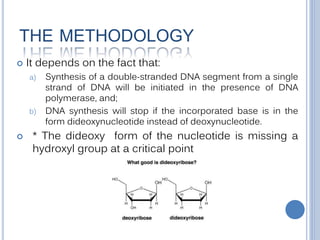
b) DNA synthesis will stop if the incorporated base is in the
form dideoxynucleotide instead of deoxynucleotide.
 * The dideoxy form of the nucleotide is missing a
hydroxyl group at a critical point
SANGER TECHNIQUE
 So, if you provide a batch of synthesizing DNA
molecule with, for example,
dideoxynucleoadenoside (ddATP) in a mixture
that also contains deoxynucleoadenoside
(dATP), as well as the other three
deoxynucleotides, the synthesize of the double
chain will stop when the ddATP molecule is
incorporated instead of the dATP molecule.
 By the laws of probability, some of the
synthesizing DNA will be stopped at every
point that adenosine is required.
 The Sanger Technique uses the
dideoxynucleotide for all four of the required
nucleotides.
 There are four batches of reagents, one
devoted to each nucleotide.
 The same single-stranded DNA molecule is
incubated in each batch with one of the
nucelotides provided in the dideoxy form as
well as its normal deoxy form.
 Among the four batches, synthesis has been
arrested at every site in the DNA fragment.
 You keep the batches separate and run gel
electrophoresis on all four batches.
 Because the length of the migration in the
electrophoresis fields depends on the size of
molecule, the DNA fragments should distribute
themselves in linear fashion according to size.
 To use the ddATP example, there will be some
DNA fragments truncated at each adenosine
site.
 Some DNA fragments will be small, where the
adenosine appears early in the chain, and
some will be long, where the adenosine
appears later in the DNA chain sequence. You
can tell the location of the adenosines by the
length of this various fragments.
SANGER METHOD
PREPARED BY:
 De Guzman, Ashley
 Villaverde, Abegail
 Oliquiano, Louise Andrea
 Evangelista, Raenamil Viol
 Ragundiaz, Reneline
 Felonia, Hannah Mae
 De Leon, Ron Samuel
 Detera, Rochelle
 Bandal, Ayessa Mae
 Dolom, Maricho

Sanger Technique

  • 1.
    Prepared By: RowTwo FREDERICK SANGER
  • 2.
    SANGER TECHNIQUE  Hasbeen used since its development in 1977 for DNA sequencing.  It is called “Chain Terminator Method’’ because it is a very clever method of determining the location of a specific place on a DNA fragment, based on where synthesis of a new DNA chain stops.
  • 3.
    THE METHODOLOGY  Itdepends on the fact that: a) Synthesis of a double-stranded DNA segment from a single strand of DNA will be initiated in the presence of DNA polymerase, and; b) DNA synthesis will stop if the incorporated base is in the form dideoxynucleotide instead of deoxynucleotide.  * The dideoxy form of the nucleotide is missing a hydroxyl group at a critical point
  • 4.
    SANGER TECHNIQUE  So,if you provide a batch of synthesizing DNA molecule with, for example, dideoxynucleoadenoside (ddATP) in a mixture that also contains deoxynucleoadenoside (dATP), as well as the other three deoxynucleotides, the synthesize of the double chain will stop when the ddATP molecule is incorporated instead of the dATP molecule.  By the laws of probability, some of the synthesizing DNA will be stopped at every point that adenosine is required.
  • 5.
     The SangerTechnique uses the dideoxynucleotide for all four of the required nucleotides.  There are four batches of reagents, one devoted to each nucleotide.  The same single-stranded DNA molecule is incubated in each batch with one of the nucelotides provided in the dideoxy form as well as its normal deoxy form.  Among the four batches, synthesis has been arrested at every site in the DNA fragment.  You keep the batches separate and run gel electrophoresis on all four batches.
  • 6.
     Because thelength of the migration in the electrophoresis fields depends on the size of molecule, the DNA fragments should distribute themselves in linear fashion according to size.  To use the ddATP example, there will be some DNA fragments truncated at each adenosine site.  Some DNA fragments will be small, where the adenosine appears early in the chain, and some will be long, where the adenosine appears later in the DNA chain sequence. You can tell the location of the adenosines by the length of this various fragments.
  • 7.
  • 8.
    PREPARED BY:  DeGuzman, Ashley  Villaverde, Abegail  Oliquiano, Louise Andrea  Evangelista, Raenamil Viol  Ragundiaz, Reneline  Felonia, Hannah Mae  De Leon, Ron Samuel  Detera, Rochelle  Bandal, Ayessa Mae  Dolom, Maricho