Name: Habib U Rahman
F.SC: MLT
BS MLT (progress)
Discipline: MLT
Presentation Topic : PCR
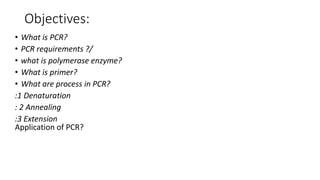
Objectives:
• What is PCR?
• PCR requirements ?/
• what is polymerase enzyme?
• What is primer?
• What are process in PCR?
:1 Denaturation
: 2 Annealing
:3 Extension
Application of PCR?
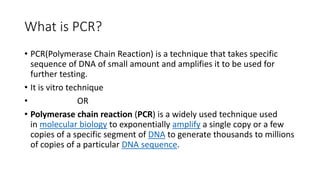
What is PCR?
• PCR(Polymerase Chain Reaction) is a technique that takes specific
sequence of DNA of small amount and amplifies it to be used for
further testing.
• It is vitro technique
• OR
• Polymerase chain reaction (PCR) is a widely used technique used
in molecular biology to exponentially amplify a single copy or a few
copies of a specific segment of DNA to generate thousands to millions
of copies of a particular DNA sequence.
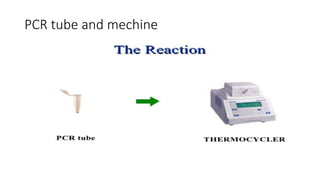
PCR tube and mechine
What is polymerase enzyme?
• DNA polymerase is an enzyme that
synthesizes DNA molecules from deoxyribonucleotides, the building
blocks of DNA. These enzymes are essential for DNA replication and
usually work in pairs to create two identical DNA strands from a single
original DNA molecule. During this process, DNA polymerase "reads"
the existing DNA strands to create two new strands that match the
existing ones.
• In PCR polymerase we get from Bacteria (thermus aquaticus ) which
can live in high temperature. ( heat resistant bacteria)
conti…..
OR
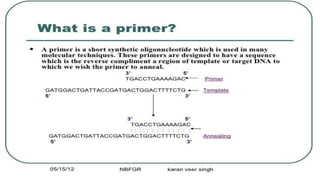
• A primer is a short single strand of RNA or DNA (generally about 18-
22 bases) that serves as a starting point for DNA synthesis. It is
required for DNA replication because the enzymes that catalyze this
process, DNA polymerases, can only add new nucleotides to an
existing strand of DNA. The polymerase starts replication at the 3′-
end of the primer, and copies the opposite strand.
• In PCR primers we prepare comercialy
Process in PCR:
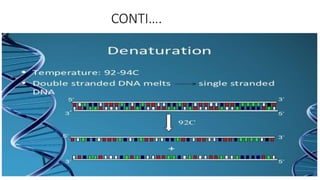
• 1 . Denaturing – when the double-stranded template DNA is heated
to separate it into two single strands.
• It is first step in PCR in which DNA strands are separated by heating.
• The hydrogen bond between two breaks down and strands separates
in to two..
• Denaturation require high temperature 92-95C (94C)
• Heat it for one minute on 94 C
CONTI….
Process in PCR:
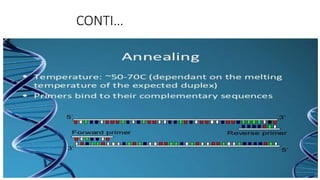
• 2. Annealing – when the temperature is lowered to enable the DNA
primers to attach to the template DNA.
• Is process of allowing two sequences of DNA to form hydrogen bond.
• Annealing of the target sequences and primers is done by cooling the
DNA to 55C .
• Annealing require low temperature compare to Denaturation and
extension .
• Temprature for annealing is between 50 -70C.
• Time taken to anneal is 45 seconds
CONTI…
Process in PCR
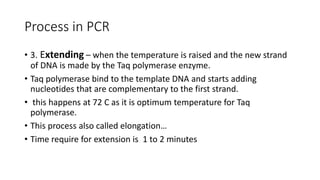
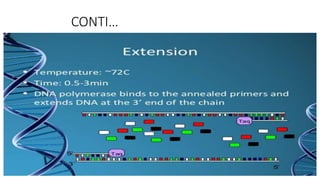
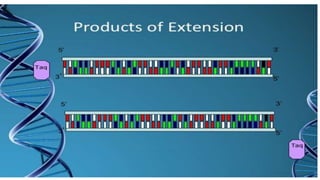
• 3. Extending – when the temperature is raised and the new strand
of DNA is made by the Taq polymerase enzyme.
• Taq polymerase bind to the template DNA and starts adding
nucleotides that are complementary to the first strand.
• this happens at 72 C as it is optimum temperature for Taq
polymerase.
• This process also called elongation…
• Time require for extension is 1 to 2 minutes
CONTI…
•Thank YOU Dear
fellows
•Keep remember me
in Your prayers…..

PCR biotechnology

  • 1.
    Name: Habib URahman F.SC: MLT BS MLT (progress) Discipline: MLT Presentation Topic : PCR
  • 2.
    Objectives: • What isPCR? • PCR requirements ?/ • what is polymerase enzyme? • What is primer? • What are process in PCR? :1 Denaturation : 2 Annealing :3 Extension Application of PCR?
  • 4.
    What is PCR? •PCR(Polymerase Chain Reaction) is a technique that takes specific sequence of DNA of small amount and amplifies it to be used for further testing. • It is vitro technique • OR • Polymerase chain reaction (PCR) is a widely used technique used in molecular biology to exponentially amplify a single copy or a few copies of a specific segment of DNA to generate thousands to millions of copies of a particular DNA sequence.
  • 5.
    PCR tube andmechine
  • 6.
    What is polymeraseenzyme? • DNA polymerase is an enzyme that synthesizes DNA molecules from deoxyribonucleotides, the building blocks of DNA. These enzymes are essential for DNA replication and usually work in pairs to create two identical DNA strands from a single original DNA molecule. During this process, DNA polymerase "reads" the existing DNA strands to create two new strands that match the existing ones. • In PCR polymerase we get from Bacteria (thermus aquaticus ) which can live in high temperature. ( heat resistant bacteria)
  • 8.
    conti….. OR • A primeris a short single strand of RNA or DNA (generally about 18- 22 bases) that serves as a starting point for DNA synthesis. It is required for DNA replication because the enzymes that catalyze this process, DNA polymerases, can only add new nucleotides to an existing strand of DNA. The polymerase starts replication at the 3′- end of the primer, and copies the opposite strand. • In PCR primers we prepare comercialy
  • 10.
    Process in PCR: •1 . Denaturing – when the double-stranded template DNA is heated to separate it into two single strands. • It is first step in PCR in which DNA strands are separated by heating. • The hydrogen bond between two breaks down and strands separates in to two.. • Denaturation require high temperature 92-95C (94C) • Heat it for one minute on 94 C
  • 11.
  • 12.
    Process in PCR: •2. Annealing – when the temperature is lowered to enable the DNA primers to attach to the template DNA. • Is process of allowing two sequences of DNA to form hydrogen bond. • Annealing of the target sequences and primers is done by cooling the DNA to 55C . • Annealing require low temperature compare to Denaturation and extension . • Temprature for annealing is between 50 -70C. • Time taken to anneal is 45 seconds
  • 13.
  • 14.
    Process in PCR •3. Extending – when the temperature is raised and the new strand of DNA is made by the Taq polymerase enzyme. • Taq polymerase bind to the template DNA and starts adding nucleotides that are complementary to the first strand. • this happens at 72 C as it is optimum temperature for Taq polymerase. • This process also called elongation… • Time require for extension is 1 to 2 minutes
  • 15.
  • 21.
    •Thank YOU Dear fellows •Keepremember me in Your prayers…..