Hasan Alhaddad, Ph.D.
Kuwait University
January 2016 - University of Missouri
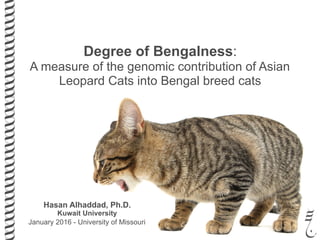
Degree of Bengalness:
A measure of the genomic contribution of Asian
Leopard Cats into Bengal breed cats
Barbara Gandolfi
Hasan Alhaddad
Mike Montague
Mona Abdi
Erica K Creighton
Bianca Haase
Maria Longeri
Rashid Saif
Carlyn Peterson
Brian Davis
William Murphy
Ettore Randi
Shannon Joslin
Grace Lan
Jeff Brockman
Mike Hamilton
Nick Dodman
Richard Malik
Clare Rusbridge
Nick Gustafson
Diane Shelton
Robert A Grahn
Jens Haggstrom
Serina Filler
Hannes Lohi
James C Mullikin
Chris Helps
Niels C Pedersen
Wes Warren
Leslie A Lyons
A work team & a teamwork
Outline
• Introduction
•Aim1 - Diagnostic panel
•Aim2 - Degree of Bengalness
•Aim3 - Bengal breed
•Conclusion and significance
Outline
• Introduction
• Asian Leopard cat and the domestic
cat
• Hybridization and Bengal breed
• Aims
• Aim1 - Diagnostic panel
• Aim2 - Degree of Bengalness
• Aim3 - Bengal breed
• Conclusion and significance
• Introduction
• Asian Leopard cat and the domestic
cat
• Hybridization and Bengal breed
• Aims
Introduction
Fig. 5. Relationships among species of Felidae, continued from Fig. 4. Numbers are posterior probability values with a second number representing sup
I. Agnarsson et al. / Molecular Phylogenetics and Evolution 54 (2010) 726–745
I. Agnarsson et al. / Molecular Phylogenetics and Evolution 54 (2010) 726–745 737
P. bengalensis and F.s. catus
Fig. 5. Relationships among species of Felidae, continued from Fig. 4. Numbers are posterior probability values with a second number representing sup
I. Agnarsson et al. / Molecular Phylogenetics and Evolution 54 (2010) 726–745
Hybridization
Bengal breed
AIMS
1- Diagnostic panel
Identify diagnostic markers of Asian Leopard
Cat (ALC) alleles in the Feline SNP array
2 - Degree of Bengalness
Estimate ALC allele proportions in known
pedigree, Bengal breed, and other cat breeds
3 - Bengal breed
Use “Degree of Bengalness” to understand
and maintain Bengal cat breed
AIMS
Aim1- Diagnostic panel
Identify diagnostic markers of Asian Leopard
Cat (ALC) alleles in the Feline SNP array
Dataset-Analysis -Findings
Aim2 - Degree of Bengalness
Aim3 - Bengal breed
Aim1- Diagnostic panel
Identify diagnostic markers of Asian Leopard
Cat (ALC) alleles in the Feline SNP array
Dataset-Analysis -Findings
Data and Analysis
ALC
N = 9
63K SNPs
DOM*
N = 1765
63K SNPs
* Non-Bengal, 41 Breeds
• Select markers from the 63K array that are:
1.Fixed with allele 1 (A1) in ALC
2.A1 frequency in domestic cats = 0 or
MAF <= 0.05.
Findings
SNP Relative Position (Mb)
A1
A2
A3
B1
B2
B3
B4
C1
C2
D1
D2
D3
D4
E1
E2
E3
F1
F2
X
0 25 50 75 100 125 150 175 200 225 250
674 markers identified
Findings
• To be concerned about:
• Number of markers
• Inter-marker distances
• Linkage disequilibrium
SNP Relative Position (Mb)
0 25 50 75 100 125 150 175 200 225 250
A1
A2
A3
B1
B2
B3
B4
C1
C2
D1
D2
D3
D4
E1
E2
E3
F1
F2
X
Findings
287 markers (~ 5Mb apart)
AIMS
Aim1- Diagnostic panel
Aim2 - Degree of Bengalness
Estimate ALC allele proportions in known
pedigree, Bengal breed, and other cat breeds
Dataset-Analysis -Findings
Aim3 - Bengal breed
Aim2 - Degree of Bengalness
Estimate ALC allele proportions in known
pedigree, Bengal breed, and other cat breeds
Dataset-Analysis -Findings
Data and Analysis
ALC-DOM
pedigree
N = 98
Bengal cats
N = 98
33 cat
breeds
N = 1452
• Use only autosomal markers (262 SNPs).
• Calculate % ALC alleles in each individual
(degree bengalness).
• Use pedigree to validate degree of bengalness.
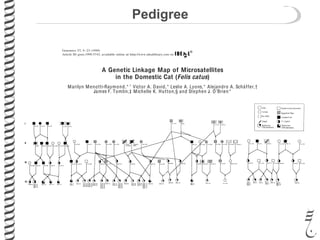
Pedigree
A Genetic Linkage Map of Microsatellites
in the Domestic Cat (Felis catus)
Marilyn Menotti-Raymond,*,1
Victor A. David,* Leslie A. Lyons,* Alejandro A. Scha¨ ffer,†
James F. Tomlin,‡ Michelle K. Hutton,§ and Stephen J. O’Brien*
*Laboratory of Genomic Diversity, NCI–FCRDC, Frederick, Maryland 21702; †NHGRI/IDRB and ‡CIT/CBEL/BIMAS,
National Institutes of Health, Bethesda, Maryland 20892; and §PE AgGen, Inc., Davis, California 95616
Received September 18, 1998; accepted January 6, 1999
Of the nonprimate mammalian species with devel-
oping comparative gene maps, the feline gene map
(Felis catus, Order Carnivora, 2N ‫؍‬ 38) displays the
highest level of syntenic conservation with humans,
with as few as 10 translocation exchanges discriminat-
ing the human and feline genome organization. To
extend this model, a genetic linkage map of microsat-
ellite loci in the feline genome has been constructed
including 246 autosomal and 7 X-linked loci. Two hun-
dred thirty-five dinucleotide (dC ⅐ dA)n ⅐ (dG ⅐ dT)n and
18 tetranucleotide repeat loci were identified and
genotyped in a two-family, 108-member multigenera-
tion interspecies backcross pedigree between the do-
mestic cat (F. catus) and the Asian leopard cat (Prio-
nailurus bengalensis). Two hundred twenty-nine loci
were linked to at least one other marker with a lod
score >3.0, identifying 34 linkage groups. Representa-
tive markers from each linkage group were assigned
to specific cat chromosomes by somatic cell hybrid
analysis, resulting in chromosomal assignments to 16
of the 19 feline chromosomes. Genome coverage spans
approximately 2900 cM, and we estimate a genetic
length for the sex-averaged map as 3300 cM. The map
has an average intragroup intermarker spacing of 11
cM and provides a valuable resource for mapping phe-
notypic variation in the species and relating it
to gene maps of other mammals, including
human. © 1999 Academic Press
Cyprus and Jordan (Davis, 1989). Within the 33 regis-
tered domestic cat breeds recognized in the United
States (Cat Fancy Association, Manasquan, NJ), some
100 disorders that demonstrate Mendelian patterns of
inheritance have been identified and characterized
(Nicholas et al., 1998; Migaki, 1982; Robinson, 1977).
Many of these pathologies are analogous to human
inherited disorders, including autosomal dominant
polycystic kidney disease (Biller et al., 1996), retinal
atrophy (Narfstro¨m, 1983), primary hyperoxaluria
Type 2 (Danpure et al., 1989), glycogen storage disease
Type IV (Fyfe et al., 1992), and hypothyroidism (Ta-
nase et al., 1991). Genes associated with some of these
feline disorders have been genetically mapped and
characterized including loci for glycogen branching en-
zyme, arylsulfatase B, and lipoprotein lipase (Gilbert et
al., 1988; Fyfe et al., 1992; Jackson et al., 1992; Ginz-
inger et al., 1996), and corrective gene therapy strate-
gies have even been examined for some disorders,
including feline arylsulfatase B deficiency and
mucopolysaccharidosis Type VI (Gasper et al., 1984;
Peters et al., 1991; Byers et al., 1997). Nonetheless,
genes associated with the majority of feline disorders
have yet to be identified.
The value of animal models has been demonstrated
repeatedly with hundreds of characterized mouse mu-
tations. Model animal systems serve to elucidate mo-
Genomics 57, 9–23 (1999)
Article ID geno.1999.5743, available online at http://www.idealibrary.com on
FIG. 1. Domestic cat/Asian leopard cat interspecific backcross pedigree. Fca, domestic cat (Felis catus); Pbe, Asian leopard cat (Prionailurus
bengalensis); LXD, progeny of Asian leopard cat ϫ domestic cat cross; BXD, progeny of F1 female backcrossed to domestic cat; BXL, progeny of F1
female backcrossed to Asian leopard cat.
17FELINELINKAGEMAP
FIG. 1—Continued
18MENOTTI-RAYMONDETAL.
Pedigree simplified
ALC DOM
LxDBxL BxD
Pedigree provides expected values of ALC
alleles
Findings
ALC
% ALC Allele
frequency
0 20 40 60 80 100
02468
BxL
% ALC Allele
frequency
0 20 40 60 80 100
01234
LxD
% ALC Allele
frequency
0 20 40 60 80 100
0246810
BxD
% ALC Allele
frequency
0 20 40 60 80 100
0246810
Bengal
% ALC Allele
frequency
0 20 40 60 80 100
05101520253035
Other Domestic
% ALC Allele
frequency
0 20 40 60 80 100
0200400600800
Theoretical and Observed degree of bengalness
are in agreement
%Bengalness
0255075100
ALC LxD BEN ACURL BOM BUR CREX EGY MANEE PERM MCOON MUNCH ORI PBALD RBLUE SREX SIR SPH VAN
BxL BxD ABY BIR BSH CHR DREX JBOB KOR LYK MANX NFC PER RAG SFOLD SIA SOM TREX WIR
Findings
• Bengal breed and its unique degree of bengalness.
• Turkish Van (probably T. Angora)
and high degree bengalness (?).
AIMS
Aim1- Diagnostic panel
Aim2 - Degree of Bengalness
Aim3 - Bengal breed
Use “Degree of Bengalness” to understand
and maintain Bengal cat breed
Dataset-Analysis -Findings
Aim3 - Bengal breed
Use “Degree of Bengalness” to understand
and maintain Bengal cat breed
Dataset-Analysis -Findings
Data and Analysis
Bengal cats
N = 98
• Use degree of bengalness to understand
breeding history of Bengal breed.
• % Bengalness = 100 x (1/2)#generations
ALC-DOM
pedigree
N = 98
Findings
0 1 2 3 4 5 10 15 20 25
0
1.6875
3.375
6.75
12.5
25
50
100
Generation Crossed to Domestic
%Bengalness
Theoritical
Asian Leopard Cats
BxL
LxD
BxD
Random Bengal Breed cats
10 15 20 25
Generation Crossed to Domestic
Theoritical
Asian Leopard Cats
BxL
LxD
BxD
Random Bengal Breed cats
• Variation in backcrosses.
• Less variation in Bengals cats.
• Generation 4 (6.75%).
• Bengalness equilibrium in
Bengal cats.
Conclusion and Significance
• Genome-wide SNP panel is selected to
measure degree of bengalness in Bengal cat
breed.
• The panel can be used to study the genetics
of ALC-DOM hybrid zones and the
conservation genetics of ALC.
Leslie A. Lyons, PhD
Barbara Gandolfi, PhD
Department of Veterinary Medicine and Surgery
Acknowledgment
Mona Abdi, M.Sc. student
Department of Biological Sciences
Robert A Grahn, PhD
Veterinary Genetics Laboratory
Questions?
Disclaimer
Figures, photos, and graphs in my lectures are
collected using google searches. I do not claim to have
personally produced all the material (except for some).
I do cite only articles or books used. I thank all owners
of the visual aid that I use and apologize for not citing
each individual item. If anybody finds the inclusion of
their material into my lectures a violation of their copy
rights, please contact me via email.
hhalhaddad@gmail.com

Bengalness UM 2016

  • 1.
    Hasan Alhaddad, Ph.D. KuwaitUniversity January 2016 - University of Missouri Degree of Bengalness: A measure of the genomic contribution of Asian Leopard Cats into Bengal breed cats
  • 2.
    Barbara Gandolfi Hasan Alhaddad MikeMontague Mona Abdi Erica K Creighton Bianca Haase Maria Longeri Rashid Saif Carlyn Peterson Brian Davis William Murphy Ettore Randi Shannon Joslin Grace Lan Jeff Brockman Mike Hamilton Nick Dodman Richard Malik Clare Rusbridge Nick Gustafson Diane Shelton Robert A Grahn Jens Haggstrom Serina Filler Hannes Lohi James C Mullikin Chris Helps Niels C Pedersen Wes Warren Leslie A Lyons A work team & a teamwork
  • 3.
    Outline • Introduction •Aim1 -Diagnostic panel •Aim2 - Degree of Bengalness •Aim3 - Bengal breed •Conclusion and significance
  • 4.
    Outline • Introduction • AsianLeopard cat and the domestic cat • Hybridization and Bengal breed • Aims • Aim1 - Diagnostic panel • Aim2 - Degree of Bengalness • Aim3 - Bengal breed • Conclusion and significance • Introduction • Asian Leopard cat and the domestic cat • Hybridization and Bengal breed • Aims
  • 5.
    Introduction Fig. 5. Relationshipsamong species of Felidae, continued from Fig. 4. Numbers are posterior probability values with a second number representing sup I. Agnarsson et al. / Molecular Phylogenetics and Evolution 54 (2010) 726–745 I. Agnarsson et al. / Molecular Phylogenetics and Evolution 54 (2010) 726–745 737 P. bengalensis and F.s. catus Fig. 5. Relationships among species of Felidae, continued from Fig. 4. Numbers are posterior probability values with a second number representing sup I. Agnarsson et al. / Molecular Phylogenetics and Evolution 54 (2010) 726–745
  • 6.
  • 7.
    AIMS 1- Diagnostic panel Identifydiagnostic markers of Asian Leopard Cat (ALC) alleles in the Feline SNP array 2 - Degree of Bengalness Estimate ALC allele proportions in known pedigree, Bengal breed, and other cat breeds 3 - Bengal breed Use “Degree of Bengalness” to understand and maintain Bengal cat breed
  • 8.
    AIMS Aim1- Diagnostic panel Identifydiagnostic markers of Asian Leopard Cat (ALC) alleles in the Feline SNP array Dataset-Analysis -Findings Aim2 - Degree of Bengalness Aim3 - Bengal breed Aim1- Diagnostic panel Identify diagnostic markers of Asian Leopard Cat (ALC) alleles in the Feline SNP array Dataset-Analysis -Findings
  • 9.
    Data and Analysis ALC N= 9 63K SNPs DOM* N = 1765 63K SNPs * Non-Bengal, 41 Breeds • Select markers from the 63K array that are: 1.Fixed with allele 1 (A1) in ALC 2.A1 frequency in domestic cats = 0 or MAF <= 0.05.
  • 10.
    Findings SNP Relative Position(Mb) A1 A2 A3 B1 B2 B3 B4 C1 C2 D1 D2 D3 D4 E1 E2 E3 F1 F2 X 0 25 50 75 100 125 150 175 200 225 250 674 markers identified
  • 11.
    Findings • To beconcerned about: • Number of markers • Inter-marker distances • Linkage disequilibrium
  • 12.
    SNP Relative Position(Mb) 0 25 50 75 100 125 150 175 200 225 250 A1 A2 A3 B1 B2 B3 B4 C1 C2 D1 D2 D3 D4 E1 E2 E3 F1 F2 X Findings 287 markers (~ 5Mb apart)
  • 13.
    AIMS Aim1- Diagnostic panel Aim2- Degree of Bengalness Estimate ALC allele proportions in known pedigree, Bengal breed, and other cat breeds Dataset-Analysis -Findings Aim3 - Bengal breed Aim2 - Degree of Bengalness Estimate ALC allele proportions in known pedigree, Bengal breed, and other cat breeds Dataset-Analysis -Findings
  • 14.
    Data and Analysis ALC-DOM pedigree N= 98 Bengal cats N = 98 33 cat breeds N = 1452 • Use only autosomal markers (262 SNPs). • Calculate % ALC alleles in each individual (degree bengalness). • Use pedigree to validate degree of bengalness.
  • 15.
    Pedigree A Genetic LinkageMap of Microsatellites in the Domestic Cat (Felis catus) Marilyn Menotti-Raymond,*,1 Victor A. David,* Leslie A. Lyons,* Alejandro A. Scha¨ ffer,† James F. Tomlin,‡ Michelle K. Hutton,§ and Stephen J. O’Brien* *Laboratory of Genomic Diversity, NCI–FCRDC, Frederick, Maryland 21702; †NHGRI/IDRB and ‡CIT/CBEL/BIMAS, National Institutes of Health, Bethesda, Maryland 20892; and §PE AgGen, Inc., Davis, California 95616 Received September 18, 1998; accepted January 6, 1999 Of the nonprimate mammalian species with devel- oping comparative gene maps, the feline gene map (Felis catus, Order Carnivora, 2N ‫؍‬ 38) displays the highest level of syntenic conservation with humans, with as few as 10 translocation exchanges discriminat- ing the human and feline genome organization. To extend this model, a genetic linkage map of microsat- ellite loci in the feline genome has been constructed including 246 autosomal and 7 X-linked loci. Two hun- dred thirty-five dinucleotide (dC ⅐ dA)n ⅐ (dG ⅐ dT)n and 18 tetranucleotide repeat loci were identified and genotyped in a two-family, 108-member multigenera- tion interspecies backcross pedigree between the do- mestic cat (F. catus) and the Asian leopard cat (Prio- nailurus bengalensis). Two hundred twenty-nine loci were linked to at least one other marker with a lod score >3.0, identifying 34 linkage groups. Representa- tive markers from each linkage group were assigned to specific cat chromosomes by somatic cell hybrid analysis, resulting in chromosomal assignments to 16 of the 19 feline chromosomes. Genome coverage spans approximately 2900 cM, and we estimate a genetic length for the sex-averaged map as 3300 cM. The map has an average intragroup intermarker spacing of 11 cM and provides a valuable resource for mapping phe- notypic variation in the species and relating it to gene maps of other mammals, including human. © 1999 Academic Press Cyprus and Jordan (Davis, 1989). Within the 33 regis- tered domestic cat breeds recognized in the United States (Cat Fancy Association, Manasquan, NJ), some 100 disorders that demonstrate Mendelian patterns of inheritance have been identified and characterized (Nicholas et al., 1998; Migaki, 1982; Robinson, 1977). Many of these pathologies are analogous to human inherited disorders, including autosomal dominant polycystic kidney disease (Biller et al., 1996), retinal atrophy (Narfstro¨m, 1983), primary hyperoxaluria Type 2 (Danpure et al., 1989), glycogen storage disease Type IV (Fyfe et al., 1992), and hypothyroidism (Ta- nase et al., 1991). Genes associated with some of these feline disorders have been genetically mapped and characterized including loci for glycogen branching en- zyme, arylsulfatase B, and lipoprotein lipase (Gilbert et al., 1988; Fyfe et al., 1992; Jackson et al., 1992; Ginz- inger et al., 1996), and corrective gene therapy strate- gies have even been examined for some disorders, including feline arylsulfatase B deficiency and mucopolysaccharidosis Type VI (Gasper et al., 1984; Peters et al., 1991; Byers et al., 1997). Nonetheless, genes associated with the majority of feline disorders have yet to be identified. The value of animal models has been demonstrated repeatedly with hundreds of characterized mouse mu- tations. Model animal systems serve to elucidate mo- Genomics 57, 9–23 (1999) Article ID geno.1999.5743, available online at http://www.idealibrary.com on FIG. 1. Domestic cat/Asian leopard cat interspecific backcross pedigree. Fca, domestic cat (Felis catus); Pbe, Asian leopard cat (Prionailurus bengalensis); LXD, progeny of Asian leopard cat ϫ domestic cat cross; BXD, progeny of F1 female backcrossed to domestic cat; BXL, progeny of F1 female backcrossed to Asian leopard cat. 17FELINELINKAGEMAP FIG. 1—Continued 18MENOTTI-RAYMONDETAL.
  • 16.
    Pedigree simplified ALC DOM LxDBxLBxD Pedigree provides expected values of ALC alleles
  • 17.
    Findings ALC % ALC Allele frequency 020 40 60 80 100 02468 BxL % ALC Allele frequency 0 20 40 60 80 100 01234 LxD % ALC Allele frequency 0 20 40 60 80 100 0246810 BxD % ALC Allele frequency 0 20 40 60 80 100 0246810 Bengal % ALC Allele frequency 0 20 40 60 80 100 05101520253035 Other Domestic % ALC Allele frequency 0 20 40 60 80 100 0200400600800 Theoretical and Observed degree of bengalness are in agreement
  • 18.
    %Bengalness 0255075100 ALC LxD BENACURL BOM BUR CREX EGY MANEE PERM MCOON MUNCH ORI PBALD RBLUE SREX SIR SPH VAN BxL BxD ABY BIR BSH CHR DREX JBOB KOR LYK MANX NFC PER RAG SFOLD SIA SOM TREX WIR Findings • Bengal breed and its unique degree of bengalness. • Turkish Van (probably T. Angora) and high degree bengalness (?).
  • 19.
    AIMS Aim1- Diagnostic panel Aim2- Degree of Bengalness Aim3 - Bengal breed Use “Degree of Bengalness” to understand and maintain Bengal cat breed Dataset-Analysis -Findings Aim3 - Bengal breed Use “Degree of Bengalness” to understand and maintain Bengal cat breed Dataset-Analysis -Findings
  • 20.
    Data and Analysis Bengalcats N = 98 • Use degree of bengalness to understand breeding history of Bengal breed. • % Bengalness = 100 x (1/2)#generations ALC-DOM pedigree N = 98
  • 21.
    Findings 0 1 23 4 5 10 15 20 25 0 1.6875 3.375 6.75 12.5 25 50 100 Generation Crossed to Domestic %Bengalness Theoritical Asian Leopard Cats BxL LxD BxD Random Bengal Breed cats 10 15 20 25 Generation Crossed to Domestic Theoritical Asian Leopard Cats BxL LxD BxD Random Bengal Breed cats • Variation in backcrosses. • Less variation in Bengals cats. • Generation 4 (6.75%). • Bengalness equilibrium in Bengal cats.
  • 22.
    Conclusion and Significance •Genome-wide SNP panel is selected to measure degree of bengalness in Bengal cat breed. • The panel can be used to study the genetics of ALC-DOM hybrid zones and the conservation genetics of ALC.
  • 23.
    Leslie A. Lyons,PhD Barbara Gandolfi, PhD Department of Veterinary Medicine and Surgery Acknowledgment Mona Abdi, M.Sc. student Department of Biological Sciences Robert A Grahn, PhD Veterinary Genetics Laboratory
  • 24.
  • 25.
    Disclaimer Figures, photos, andgraphs in my lectures are collected using google searches. I do not claim to have personally produced all the material (except for some). I do cite only articles or books used. I thank all owners of the visual aid that I use and apologize for not citing each individual item. If anybody finds the inclusion of their material into my lectures a violation of their copy rights, please contact me via email. hhalhaddad@gmail.com