Lecture 26:
DNA Mutation
Readings (chapter 7, 16)
Course 281
Lessons for life
AIMS
• Understand basic principle of genetics.
• Understand the progression in our
understanding of the mutation concept.
• Understand the cell type and location where
mutations have hereditary consequences.
• Understand the location of mutations within the
genome.
• Understand the two major types of DNA
mutation (general view)
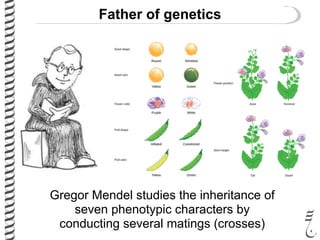
Father of genetics
Gregor Mendel studies the inheritance of
seven phenotypic characters by
conducting several matings (crosses)
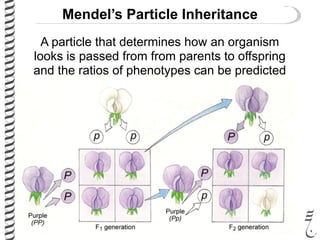
Mendel’s Particle Inheritance
A particle that determines how an organism
looks is passed from from parents to offspring
and the ratios of phenotypes can be predicted
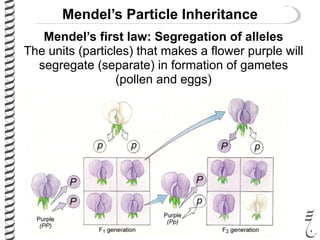
Mendel’s Particle Inheritance
Mendel’s first law: Segregation of alleles
The units (particles) that makes a flower purple will
segregate (separate) in formation of gametes
(pollen and eggs)
Take home message
The phenotype of an organism is controlled
by particles that get passed by parents to
offspring
This may seem very simple for us now when
we know all about DNA and genetics but at the
time (mid 1800) nothing was yet known
Fly genetics
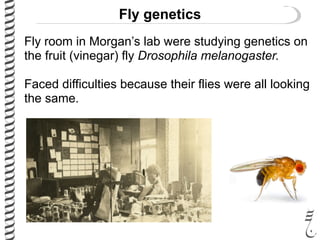
Fly room in Morgan’s lab were studying genetics on
the fruit (vinegar) fly Drosophila melanogaster.
Faced difficulties because their flies were all looking
the same.
Fly genetics
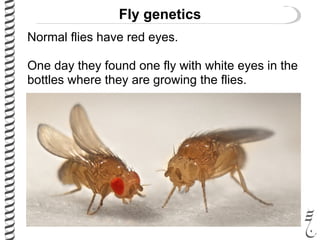
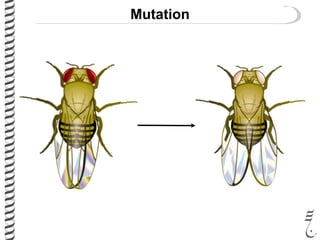
Normal flies have red eyes.
One day they found one fly with white eyes in the
bottles where they are growing the flies.
Phenotypic mutants
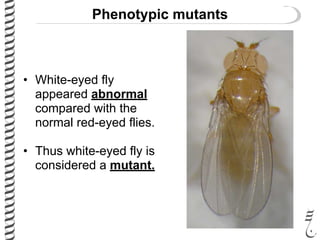
• White-eyed fly
appeared abnormal
compared with the
normal red-eyed flies.
• Thus white-eyed fly is
considered a mutant.
Phenotypic mutants
What is a mutant?
An organism showing a phenotype that differs
from the wild-type.
Phenotypic mutants
So can you define the process that makes
mutants?
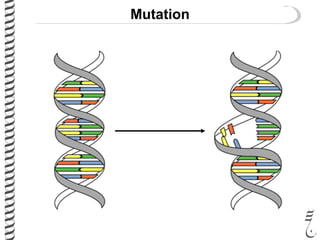
Mutation
• Mutation (old definition): is the process that
generates a phenotype differs from the
normal one.
What is the definition after we know a lot
about inheritance, genetics, and DNA?
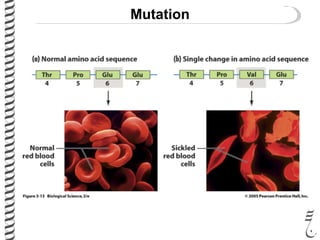
• Mutation (new) definition: is the process
that results in changes in the sequence of the
DNA.
Mutation
• The changes of DNA can be:
1. Changes to the bases of the DNA
2. Changes to the chromosome
Mutation
Mutation
Mutation
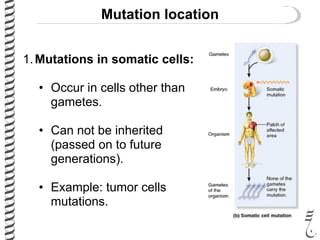
Mutation location
1.Mutations in somatic cells:
• Occur in cells other than
gametes.
• Can not be inherited
(passed on to future
generations).
• Example: tumor cells
mutations.
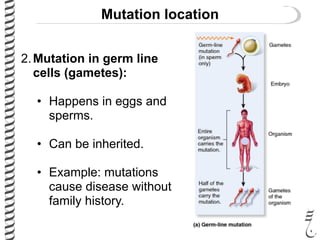
Mutation location
2.Mutation in germ line
cells (gametes):
• Happens in eggs and
sperms.
• Can be inherited.
• Example: mutations
cause disease without
family history.
Somatic cell mutation
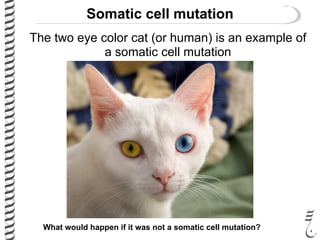
The two eye color cat (or human) is an example of
a somatic cell mutation
What would happen if it was not a somatic cell mutation?
Somatic cell mutation
What would happen if it was not a somatic
cell mutation?
Germ line mutation
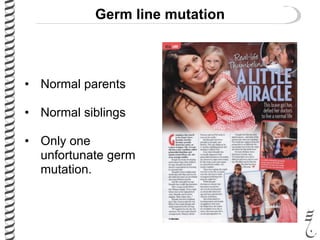
• Normal parents
• Normal siblings
• Only one
unfortunate germ
mutation.
Spontaneous mutations
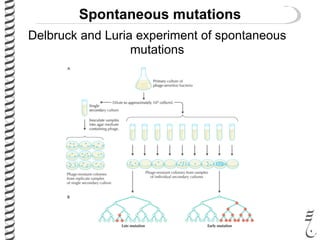
Delbruck and Luria experiment of spontaneous
mutations
Spontaneous mutations
Can mutations occurring randomly be
quantified?
Spontaneous mutations
• The occurrence of random mutations can be
quantified by measuring its probability of
happening over a time period. This is called
mutation rate.
• Mutation frequency is a measure of how
many individuals carry the mutation. This can
give us an idea of when the mutation took
place.
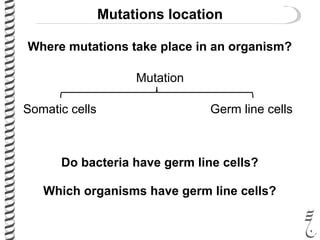
Mutations location
Mutation
Somatic cells Germ line cells
Where mutations take place in an organism?
Do bacteria have germ line cells?
Which organisms have germ line cells?
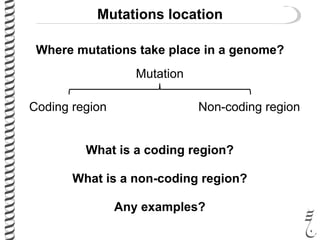
Mutations location
Mutation
Coding region Non-coding region
Where mutations take place in a genome?
What is a coding region?
What is a non-coding region?
Any examples?
To know
Coding region
Non-coding region
Chromosomal mutation
DNA mutation
Somatic cell mutation
Germ line mutation
Mutation rate
Mutation frequency
Expectations
• You know the basic inheritance principles and
their relation to mutations.
• You know that the study of mutations moved
from looking at a phenotype to understanding the
DNA changes associated.
• You know where mutations (what cells)
mutations have genetic consequences.
• You know that somatic cell mutations have
health consequences.
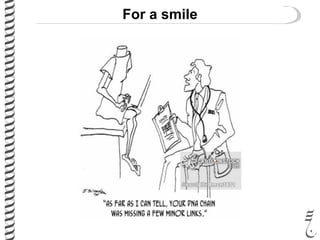
For a smile

281 lec26 mutation

  • 1.
    Lecture 26: DNA Mutation Readings(chapter 7, 16) Course 281
  • 2.
  • 3.
    AIMS • Understand basicprinciple of genetics. • Understand the progression in our understanding of the mutation concept. • Understand the cell type and location where mutations have hereditary consequences. • Understand the location of mutations within the genome. • Understand the two major types of DNA mutation (general view)
  • 4.
    Father of genetics GregorMendel studies the inheritance of seven phenotypic characters by conducting several matings (crosses)
  • 5.
    Mendel’s Particle Inheritance Aparticle that determines how an organism looks is passed from from parents to offspring and the ratios of phenotypes can be predicted
  • 6.
    Mendel’s Particle Inheritance Mendel’sfirst law: Segregation of alleles The units (particles) that makes a flower purple will segregate (separate) in formation of gametes (pollen and eggs)
  • 7.
    Take home message Thephenotype of an organism is controlled by particles that get passed by parents to offspring This may seem very simple for us now when we know all about DNA and genetics but at the time (mid 1800) nothing was yet known
  • 8.
    Fly genetics Fly roomin Morgan’s lab were studying genetics on the fruit (vinegar) fly Drosophila melanogaster. Faced difficulties because their flies were all looking the same.
  • 9.
    Fly genetics Normal flieshave red eyes. One day they found one fly with white eyes in the bottles where they are growing the flies.
  • 10.
    Phenotypic mutants • White-eyedfly appeared abnormal compared with the normal red-eyed flies. • Thus white-eyed fly is considered a mutant.
  • 11.
    Phenotypic mutants What isa mutant? An organism showing a phenotype that differs from the wild-type.
  • 12.
    Phenotypic mutants So canyou define the process that makes mutants?
  • 13.
    Mutation • Mutation (olddefinition): is the process that generates a phenotype differs from the normal one. What is the definition after we know a lot about inheritance, genetics, and DNA? • Mutation (new) definition: is the process that results in changes in the sequence of the DNA.
  • 14.
    Mutation • The changesof DNA can be: 1. Changes to the bases of the DNA 2. Changes to the chromosome
  • 15.
  • 16.
  • 17.
  • 18.
    Mutation location 1.Mutations insomatic cells: • Occur in cells other than gametes. • Can not be inherited (passed on to future generations). • Example: tumor cells mutations.
  • 19.
    Mutation location 2.Mutation ingerm line cells (gametes): • Happens in eggs and sperms. • Can be inherited. • Example: mutations cause disease without family history.
  • 20.
    Somatic cell mutation Thetwo eye color cat (or human) is an example of a somatic cell mutation What would happen if it was not a somatic cell mutation?
  • 21.
    Somatic cell mutation Whatwould happen if it was not a somatic cell mutation?
  • 22.
    Germ line mutation •Normal parents • Normal siblings • Only one unfortunate germ mutation.
  • 23.
    Spontaneous mutations Delbruck andLuria experiment of spontaneous mutations
  • 24.
    Spontaneous mutations Can mutationsoccurring randomly be quantified?
  • 25.
    Spontaneous mutations • Theoccurrence of random mutations can be quantified by measuring its probability of happening over a time period. This is called mutation rate. • Mutation frequency is a measure of how many individuals carry the mutation. This can give us an idea of when the mutation took place.
  • 26.
    Mutations location Mutation Somatic cellsGerm line cells Where mutations take place in an organism? Do bacteria have germ line cells? Which organisms have germ line cells?
  • 27.
    Mutations location Mutation Coding regionNon-coding region Where mutations take place in a genome? What is a coding region? What is a non-coding region? Any examples?
  • 28.
    To know Coding region Non-codingregion Chromosomal mutation DNA mutation Somatic cell mutation Germ line mutation Mutation rate Mutation frequency
  • 29.
    Expectations • You knowthe basic inheritance principles and their relation to mutations. • You know that the study of mutations moved from looking at a phenotype to understanding the DNA changes associated. • You know where mutations (what cells) mutations have genetic consequences. • You know that somatic cell mutations have health consequences.
  • 30.