PCR, RAPD dan
RFLP
Polymerase Chain
Reaction
PCR
The polymerase chain
reaction(PCR) is to used to
amplify a sequence of DNA
using a pair of primers each
complementary to one end
of the DNA target sequence
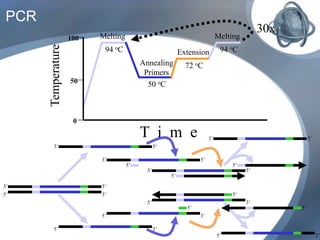
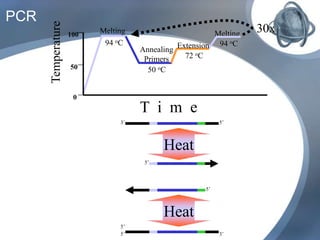
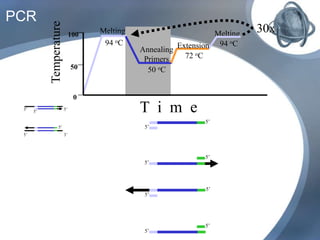
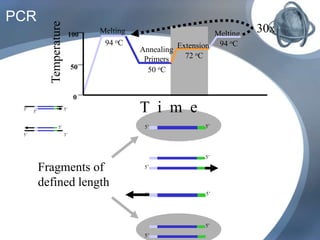
The PCR cycle
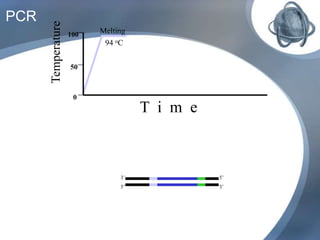
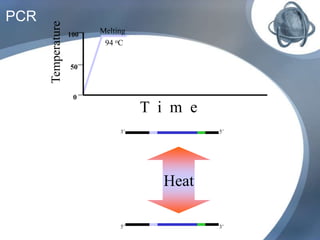
• Denaturation: The target DNA (template) is
separated into two strands by heating to 95℃
• Primer annealing: The temperature is
reduced to around 55℃ to allow the primers to
anneal.
• Polymerization (elongation, extension):
The temperature is increased to 72℃ for optimal
polymerization step which uses up dNTPs and
required Mg++.
The PCR Process
PCR works like this:
– DNA and two primers are combined in a salt solution
with dNTPs and a heat stable DNA polymerase
enzyme
– The primers match some sequence in the target DNA
– The solution is rapidly heated to DNA denaturing
temperatures (~95°C) and cooled to a temperature
where the polymerase can function
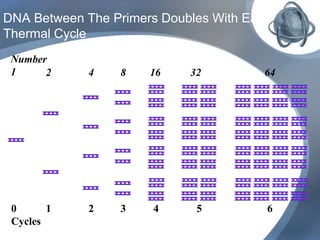
– Each thermal cycle generates copies of the sequence
between the primers, so the total number of fragments
amplifies in an exponential fashion: 2, 4, 8,16, 32, 64,
etc.
PCR
Melting
94 oC
Melting
94 oC
Annealing
Primers
50 oC
Extension
72 oC
Temperature
100
0
50
T i m e
30x
5’3’
3’5’
3’5’
5’
5’3’
5’
3’5’
5’
5’
5’
5’3’
3’5’
3’5’
5’3’
5’3’
5’
PCR
Melting
94 oC
Temperature
100
0
50
T i m e
5’3’
3’5’
PCR
Melting
94 oC
Temperature
100
0
50
T i m e
3’5’
5’3’
Heat
PCR
Melting
94 oC
Annealing
Primers
50 oC
Extension
72 oCTemperature
100
0
50
T i m e
3’5’
5’3’
5’
5’
Melting
94 oC
PCR
Melting
94 oC
Melting
94 oC
Annealing
Primers
50 oC
Extension
72 oCTemperature
100
0
50
T i m e
30x
3’5’
5’3’
Heat
Heat
5’
5’
5’
PCR
Melting
94 oC
Melting
94 oC
Annealing
Primers
50 oC
Extension
72 oCTemperature
100
0
50
T i m e
30x
3’5’
5’3’
5’
5’
5’
5’
5’
5’
PCR
Melting
94 oC
Melting
94 oC
Annealing
Primers
50 oC
Extension
72 oCTemperature
100
0
50
T i m e
30x
3’5’
5’3’
5’
5’
5’
5’
5’
5’
Heat
Heat
PCR
Melting
94 oC
Melting
94 oC
Annealing
Primers
50 oC
Extension
72 oCTemperature
100
0
50
T i m e
30x
3’5’
5’3’
5’
5’
5’
5’
5’
5’
5’
5’
5’
5’
Fragments of
defined length
PCR
Melting
94 oC
Melting
94 oC
Annealing
Primers
50 oC
Extension
72 oCTemperature
100
0
50
T i m e
30x
3’5’
5’3’
5’
5’ 5’
5’
5’
5’
5’
5’
5’
5’
DNA Between The Primers Doubles With Each
Thermal Cycle
0
Cycles
Number
1
3
8
2
4
1
2
4
16
5
32
6
64
Template
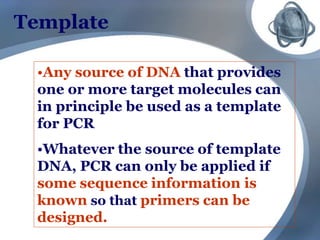
•Any source of DNA that provides
one or more target molecules can
in principle be used as a template
for PCR
•Whatever the source of template
DNA, PCR can only be applied if
some sequence information is
known so that primers can be
designed.
Primers
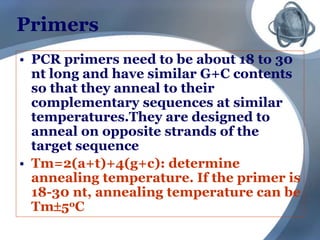
• PCR primers need to be about 18 to 30
nt long and have similar G+C contents
so that they anneal to their
complementary sequences at similar
temperatures.They are designed to
anneal on opposite strands of the
target sequence
• Tm=2(a+t)+4(g+c): determine
annealing temperature. If the primer is
18-30 nt, annealing temperature can be
Tm5oC
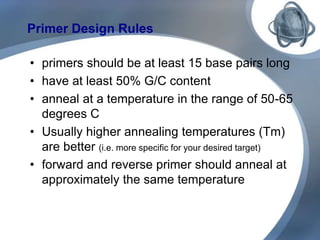
Primer Design Rules
• primers should be at least 15 base pairs long
• have at least 50% G/C content
• anneal at a temperature in the range of 50-65
degrees C
• Usually higher annealing temperatures (Tm)
are better (i.e. more specific for your desired target)
• forward and reverse primer should anneal at
approximately the same temperature
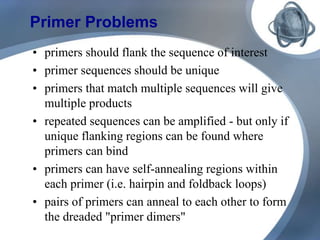
Primer Problems
• primers should flank the sequence of interest
• primer sequences should be unique
• primers that match multiple sequences will give
multiple products
• repeated sequences can be amplified - but only if
unique flanking regions can be found where
primers can bind
• primers can have self-annealing regions within
each primer (i.e. hairpin and foldback loops)
• pairs of primers can anneal to each other to form
the dreaded "primer dimers"
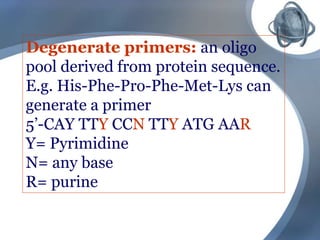
Degenerate primers: an oligo
pool derived from protein sequence.
E.g. His-Phe-Pro-Phe-Met-Lys can
generate a primer
5’-CAY TTY CCN TTY ATG AAR
Y= Pyrimidine
N= any base
R= purine
Specific Primers : Primers
designed from already known
DNA sequences (genes)
Random Amplified
Polymorphic DNA
RAPD
Recognizing/producing
polymorphism caused by
differential amplification
of DNA sequence
History
 Shortly after Kary Mullis invented the
Polymerase Chain Reaction (PCR) it was
realized that short primers would bind to
several locations in a genome and thus could
produce multiple fragments
 Williams et al. (1990) developed Random
Amplified Polymorphic DNA (RAPD) a technique
using very short 10 base primers to generate
random fragments from template DNAs
 RAPD fragments can be separated and used as
genetic markers or a kind of DNA fingerprint
Components of a PCR and
RAPD Reactions
RAPD
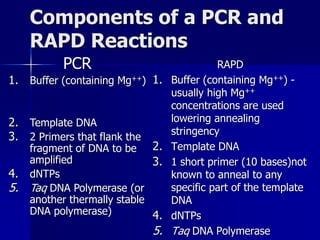
1. Buffer (containing Mg++) -
usually high Mg++
concentrations are used
lowering annealing
stringency
2. Template DNA
3. 1 short primer (10 bases)not
known to anneal to any
specific part of the template
DNA
4. dNTPs
5. Taq DNA Polymerase
PCR
1. Buffer (containing Mg++)
2. Template DNA
3. 2 Primers that flank the
fragment of DNA to be
amplified
4. dNTPs
5. Taq DNA Polymerase (or
another thermally stable
DNA polymerase)
Modifying Thermal
Cycling
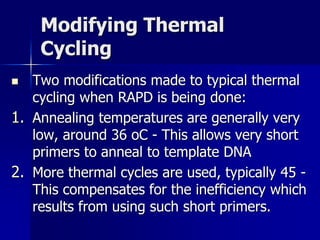
 Two modifications made to typical thermal
cycling when RAPD is being done:
1. Annealing temperatures are generally very
low, around 36 oC - This allows very short
primers to anneal to template DNA
2. More thermal cycles are used, typically 45 -
This compensates for the inefficiency which
results from using such short primers.
RAPD
Template
DNA
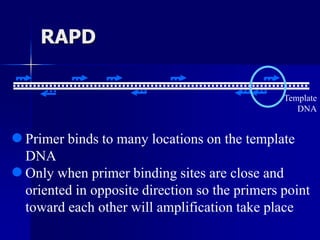
 Primer binds to many locations on the template
DNA
 Only when primer binding sites are close and
oriented in opposite direction so the primers point
toward each other will amplification take place
RAPD
Template
DNA
Primers point away
from each other, so
amplification
won’t happen
RAPD
Template
DNA
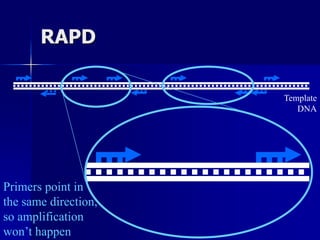
Primers point in
the same direction,
so amplification
won’t happen
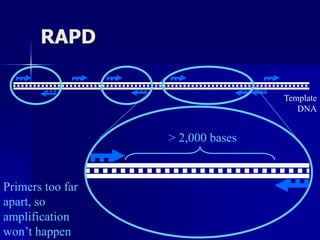
RAPD
Template
DNA
Primers too far
apart, so
amplification
won’t happen
> 2,000 bases
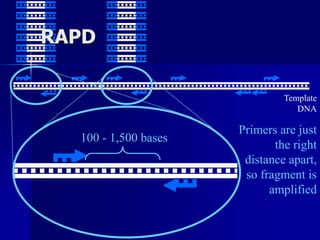
Template
DNA
Primers are just
the right
distance apart,
so fragment is
amplified
100 - 1,500 bases
RAPD
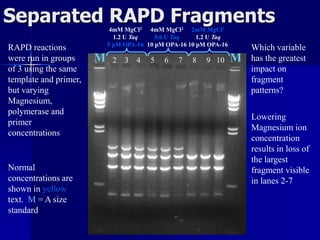
MM 2 3 4 5 6 7 8 9 10
Separated RAPD Fragments4mM MgCl2
1.2 U Taq
5 pM OPA-16
4mM MgCl2
0.6 U Taq
10 pM OPA-16
2mM MgCl2
1.2 U Taq
10 pM OPA-16
Normal
concentrations are
shown in yellow
text. M = A size
standard
Lowering
Magnesium ion
concentration
results in loss of
the largest
fragment visible
in lanes 2-7
RAPD reactions
were run in groups
of 3 using the same
template and primer,
but varying
Magnesium,
polymerase and
primer
concentrations
Which variable
has the greatest
impact on
fragment
patterns?
Restriction Fragment
Length Polymorphism
RFLP
Recognizing/producing
polymorphism caused by
differential recognition
site of restriction enzyme
on DNA sequence
AGATCT
Wild-type allele
Mutant allele
TCTAGA
A single nucleotide change can
make a difference
AGAGCT
TCTCGA
Restriction site
Not a restriction site
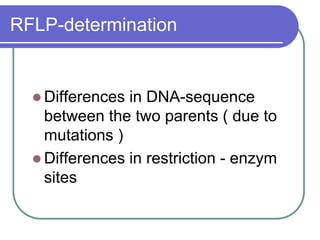
RFLP-determination
 Differences in DNA-sequence
between the two parents ( due to
mutations )
 Differences in restriction - enzym
sites
Dominant vs Co-dominant
 Most organisms we study are diploid
 Two sets of chromosomes
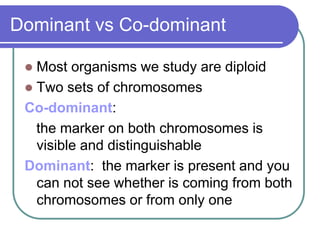
Co-dominant:
the marker on both chromosomes is
visible and distinguishable
Dominant: the marker is present and you
can not see whether is coming from both
chromosomes or from only one
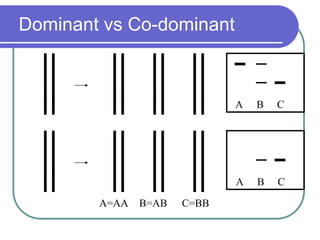
B=AB C=BB
B CA
B C
A=AA
A
Dominant vs Co-dominant
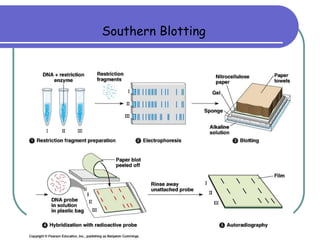
The laboratory steps involved in
RFLP detection
 Isolation of DNA
 Restriction digestion and gel
electrophoresis
 DNA transfer by Southern blotting
 DNA hybridisation
Southern Blotting
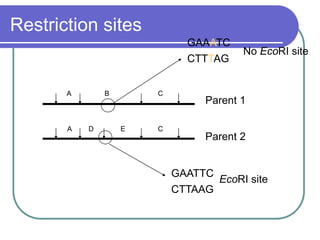
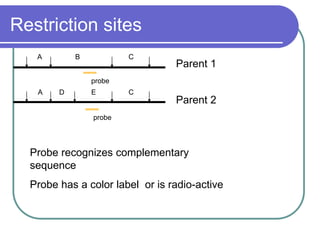
Restriction sites
B C
A D E C
A
Parent 2
Parent 1
GAATTC
CTTAAG
GAAATC
CTTTAG
No EcoRI site
EcoRI site
Restriction sites
B C
A D E C
A
Parent 2
Parent 1
probe
Probe recognizes complementary
sequence
Probe has a color label or is radio-active
probe
A
C C
A
D
E
B C
A D E C
A
Parent 2
Parent 1
probe
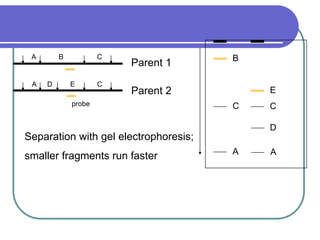
Separation with gel electrophoresis;
smaller fragments run faster
B
A
C C
A
D
E
B C
A D E C
A
Parent 2
Parent 1
probe
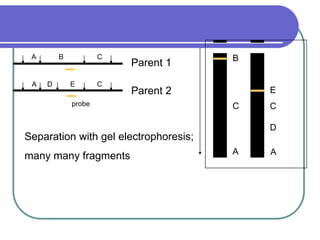
Separation with gel electrophoresis;
many many fragments
B
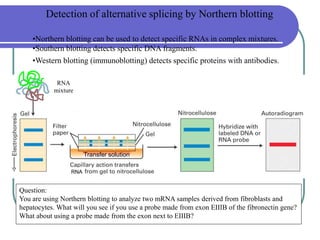
Question:
You are using Northern blotting to analyze two mRNA samples derived from fibroblasts and
hepatocytes. What will you see if you use a probe made from exon EIIIB of the fibronectin gene?
What about using a probe made from the exon next to EIIIB?
Detection of alternative splicing by Northern blotting
•Northern blotting can be used to detect specific RNAs in complex mixtures.
•Southern blotting detects specific DNA fragments.
•Western blotting (immunoblotting) detects specific proteins with antibodies.
RNA
RNA
mixture
Transfer solution

Pcr, rapd dan rflp

  • 1.
  • 2.
  • 3.
    The polymerase chain reaction(PCR)is to used to amplify a sequence of DNA using a pair of primers each complementary to one end of the DNA target sequence
  • 4.
    The PCR cycle •Denaturation: The target DNA (template) is separated into two strands by heating to 95℃ • Primer annealing: The temperature is reduced to around 55℃ to allow the primers to anneal. • Polymerization (elongation, extension): The temperature is increased to 72℃ for optimal polymerization step which uses up dNTPs and required Mg++.
  • 5.
    The PCR Process PCRworks like this: – DNA and two primers are combined in a salt solution with dNTPs and a heat stable DNA polymerase enzyme – The primers match some sequence in the target DNA – The solution is rapidly heated to DNA denaturing temperatures (~95°C) and cooled to a temperature where the polymerase can function – Each thermal cycle generates copies of the sequence between the primers, so the total number of fragments amplifies in an exponential fashion: 2, 4, 8,16, 32, 64, etc.
  • 6.
    PCR Melting 94 oC Melting 94 oC Annealing Primers 50oC Extension 72 oC Temperature 100 0 50 T i m e 30x 5’3’ 3’5’ 3’5’ 5’ 5’3’ 5’ 3’5’ 5’ 5’ 5’ 5’3’ 3’5’ 3’5’ 5’3’ 5’3’ 5’
  • 7.
  • 8.
  • 9.
    PCR Melting 94 oC Annealing Primers 50 oC Extension 72oCTemperature 100 0 50 T i m e 3’5’ 5’3’ 5’ 5’ Melting 94 oC
  • 10.
    PCR Melting 94 oC Melting 94 oC Annealing Primers 50oC Extension 72 oCTemperature 100 0 50 T i m e 30x 3’5’ 5’3’ Heat Heat 5’ 5’ 5’
  • 11.
    PCR Melting 94 oC Melting 94 oC Annealing Primers 50oC Extension 72 oCTemperature 100 0 50 T i m e 30x 3’5’ 5’3’ 5’ 5’ 5’ 5’ 5’ 5’
  • 12.
    PCR Melting 94 oC Melting 94 oC Annealing Primers 50oC Extension 72 oCTemperature 100 0 50 T i m e 30x 3’5’ 5’3’ 5’ 5’ 5’ 5’ 5’ 5’ Heat Heat
  • 13.
    PCR Melting 94 oC Melting 94 oC Annealing Primers 50oC Extension 72 oCTemperature 100 0 50 T i m e 30x 3’5’ 5’3’ 5’ 5’ 5’ 5’ 5’ 5’ 5’ 5’ 5’ 5’
  • 14.
    Fragments of defined length PCR Melting 94oC Melting 94 oC Annealing Primers 50 oC Extension 72 oCTemperature 100 0 50 T i m e 30x 3’5’ 5’3’ 5’ 5’ 5’ 5’ 5’ 5’ 5’ 5’ 5’ 5’
  • 15.
    DNA Between ThePrimers Doubles With Each Thermal Cycle 0 Cycles Number 1 3 8 2 4 1 2 4 16 5 32 6 64
  • 16.
    Template •Any source ofDNA that provides one or more target molecules can in principle be used as a template for PCR •Whatever the source of template DNA, PCR can only be applied if some sequence information is known so that primers can be designed.
  • 17.
    Primers • PCR primersneed to be about 18 to 30 nt long and have similar G+C contents so that they anneal to their complementary sequences at similar temperatures.They are designed to anneal on opposite strands of the target sequence • Tm=2(a+t)+4(g+c): determine annealing temperature. If the primer is 18-30 nt, annealing temperature can be Tm5oC
  • 18.
    Primer Design Rules •primers should be at least 15 base pairs long • have at least 50% G/C content • anneal at a temperature in the range of 50-65 degrees C • Usually higher annealing temperatures (Tm) are better (i.e. more specific for your desired target) • forward and reverse primer should anneal at approximately the same temperature
  • 19.
    Primer Problems • primersshould flank the sequence of interest • primer sequences should be unique • primers that match multiple sequences will give multiple products • repeated sequences can be amplified - but only if unique flanking regions can be found where primers can bind • primers can have self-annealing regions within each primer (i.e. hairpin and foldback loops) • pairs of primers can anneal to each other to form the dreaded "primer dimers"
  • 20.
    Degenerate primers: anoligo pool derived from protein sequence. E.g. His-Phe-Pro-Phe-Met-Lys can generate a primer 5’-CAY TTY CCN TTY ATG AAR Y= Pyrimidine N= any base R= purine
  • 21.
    Specific Primers :Primers designed from already known DNA sequences (genes)
  • 22.
  • 23.
  • 24.
    History  Shortly afterKary Mullis invented the Polymerase Chain Reaction (PCR) it was realized that short primers would bind to several locations in a genome and thus could produce multiple fragments  Williams et al. (1990) developed Random Amplified Polymorphic DNA (RAPD) a technique using very short 10 base primers to generate random fragments from template DNAs  RAPD fragments can be separated and used as genetic markers or a kind of DNA fingerprint
  • 25.
    Components of aPCR and RAPD Reactions RAPD 1. Buffer (containing Mg++) - usually high Mg++ concentrations are used lowering annealing stringency 2. Template DNA 3. 1 short primer (10 bases)not known to anneal to any specific part of the template DNA 4. dNTPs 5. Taq DNA Polymerase PCR 1. Buffer (containing Mg++) 2. Template DNA 3. 2 Primers that flank the fragment of DNA to be amplified 4. dNTPs 5. Taq DNA Polymerase (or another thermally stable DNA polymerase)
  • 26.
    Modifying Thermal Cycling  Twomodifications made to typical thermal cycling when RAPD is being done: 1. Annealing temperatures are generally very low, around 36 oC - This allows very short primers to anneal to template DNA 2. More thermal cycles are used, typically 45 - This compensates for the inefficiency which results from using such short primers.
  • 27.
    RAPD Template DNA  Primer bindsto many locations on the template DNA  Only when primer binding sites are close and oriented in opposite direction so the primers point toward each other will amplification take place
  • 28.
    RAPD Template DNA Primers point away fromeach other, so amplification won’t happen
  • 29.
    RAPD Template DNA Primers point in thesame direction, so amplification won’t happen
  • 30.
    RAPD Template DNA Primers too far apart,so amplification won’t happen > 2,000 bases
  • 31.
    Template DNA Primers are just theright distance apart, so fragment is amplified 100 - 1,500 bases RAPD
  • 32.
    MM 2 34 5 6 7 8 9 10 Separated RAPD Fragments4mM MgCl2 1.2 U Taq 5 pM OPA-16 4mM MgCl2 0.6 U Taq 10 pM OPA-16 2mM MgCl2 1.2 U Taq 10 pM OPA-16 Normal concentrations are shown in yellow text. M = A size standard Lowering Magnesium ion concentration results in loss of the largest fragment visible in lanes 2-7 RAPD reactions were run in groups of 3 using the same template and primer, but varying Magnesium, polymerase and primer concentrations Which variable has the greatest impact on fragment patterns?
  • 33.
  • 34.
    Recognizing/producing polymorphism caused by differentialrecognition site of restriction enzyme on DNA sequence
  • 35.
    AGATCT Wild-type allele Mutant allele TCTAGA Asingle nucleotide change can make a difference AGAGCT TCTCGA Restriction site Not a restriction site
  • 36.
    RFLP-determination  Differences inDNA-sequence between the two parents ( due to mutations )  Differences in restriction - enzym sites
  • 37.
    Dominant vs Co-dominant Most organisms we study are diploid  Two sets of chromosomes Co-dominant: the marker on both chromosomes is visible and distinguishable Dominant: the marker is present and you can not see whether is coming from both chromosomes or from only one
  • 38.
    B=AB C=BB B CA BC A=AA A Dominant vs Co-dominant
  • 39.
    The laboratory stepsinvolved in RFLP detection  Isolation of DNA  Restriction digestion and gel electrophoresis  DNA transfer by Southern blotting  DNA hybridisation
  • 40.
  • 41.
    Restriction sites B C AD E C A Parent 2 Parent 1 GAATTC CTTAAG GAAATC CTTTAG No EcoRI site EcoRI site
  • 42.
    Restriction sites B C AD E C A Parent 2 Parent 1 probe Probe recognizes complementary sequence Probe has a color label or is radio-active probe
  • 43.
    A C C A D E B C AD E C A Parent 2 Parent 1 probe Separation with gel electrophoresis; smaller fragments run faster B
  • 44.
    A C C A D E B C AD E C A Parent 2 Parent 1 probe Separation with gel electrophoresis; many many fragments B
  • 45.
    Question: You are usingNorthern blotting to analyze two mRNA samples derived from fibroblasts and hepatocytes. What will you see if you use a probe made from exon EIIIB of the fibronectin gene? What about using a probe made from the exon next to EIIIB? Detection of alternative splicing by Northern blotting •Northern blotting can be used to detect specific RNAs in complex mixtures. •Southern blotting detects specific DNA fragments. •Western blotting (immunoblotting) detects specific proteins with antibodies. RNA RNA mixture Transfer solution