1
Stoichiometric Calculations:
Volumetric Analysis
In this section we look at calculations involved
in titration processes as well as general
quantitative reactions. In a volumetric
titration, an analyte of unknown
concentration is titrated with a standard in
presence of a suitable indicator. For a
reaction to be used in titration the following
characteristics should be satisfied:
2
1. The stoichiometry of the reaction
should be exactly known. This means
that we should know the number of
moles of A reacting with 1 mole of B.
2. The reaction should be rapid and
reaction between A and B should
occur immediately and instantly after
addition of each drop of titrant (the
solution in the burette).
3. There should be no side reactions. A
reacts with B only.
3
4. The reaction should be quantitative. A
reacts completely with B.
5. There should exist a suitable indicator
which has distinct color change.
6. There should be very good agreement
between the equivalence point
(theoretical) and the end point
(experimental). This means that Both
points should occur at the same
volume of titrant or at most a very
close volume.
4
Standard solutions
A standard solution is a solution of known and
exactly defined concentration. Usually
standards are classified as either primary
standards or secondary standards. There are
not too many secondary standards available
to analysts and standardization of other
substances is necessary to prepare
secondary standards. A primary standard
should have the following properties:
5
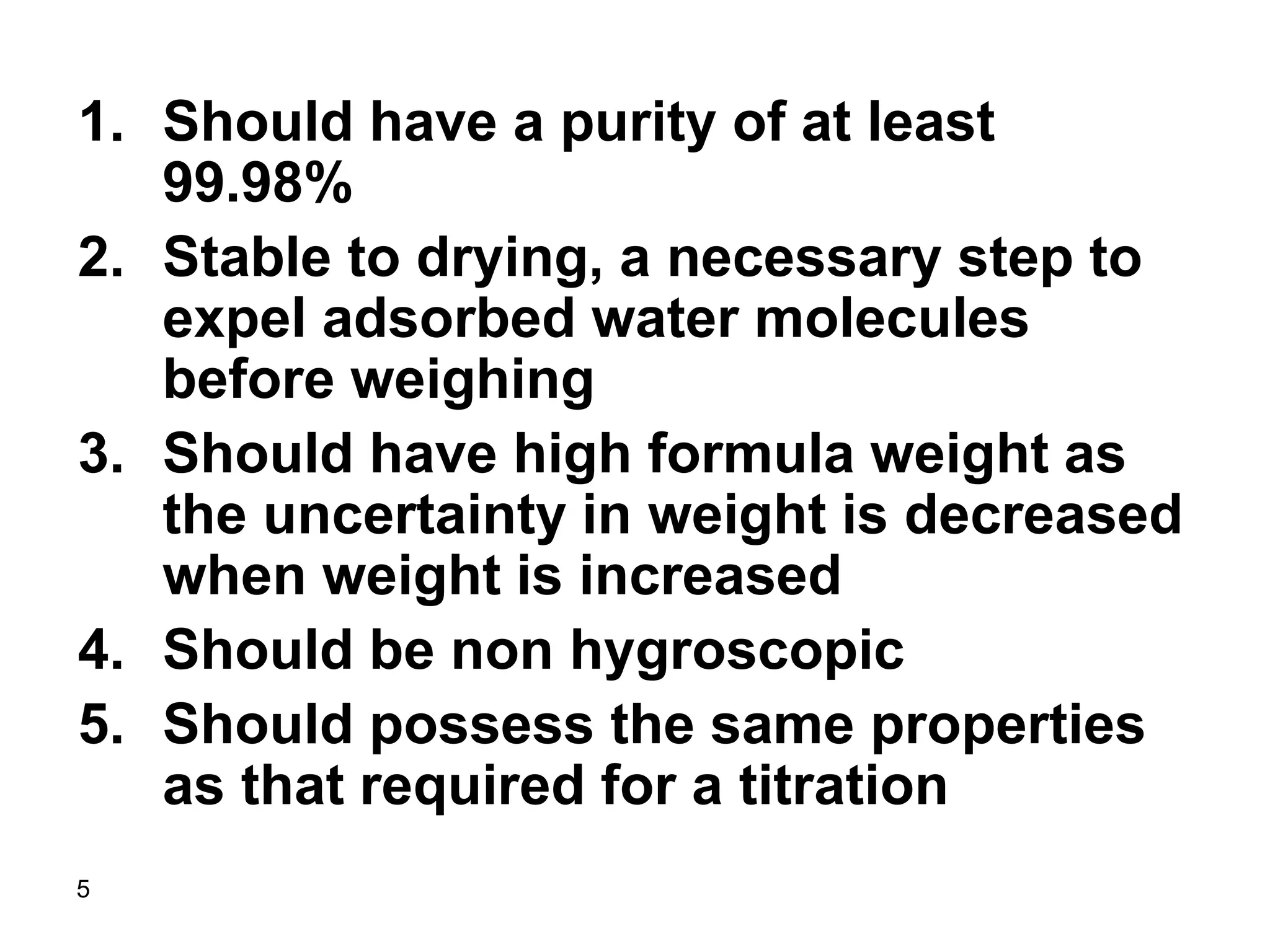
1. Should have a purity of at least
99.98%
2. Stable to drying, a necessary step to
expel adsorbed water molecules
before weighing
3. Should have high formula weight as
the uncertainty in weight is decreased
when weight is increased
4. Should be non hygroscopic
5. Should possess the same properties
as that required for a titration
6
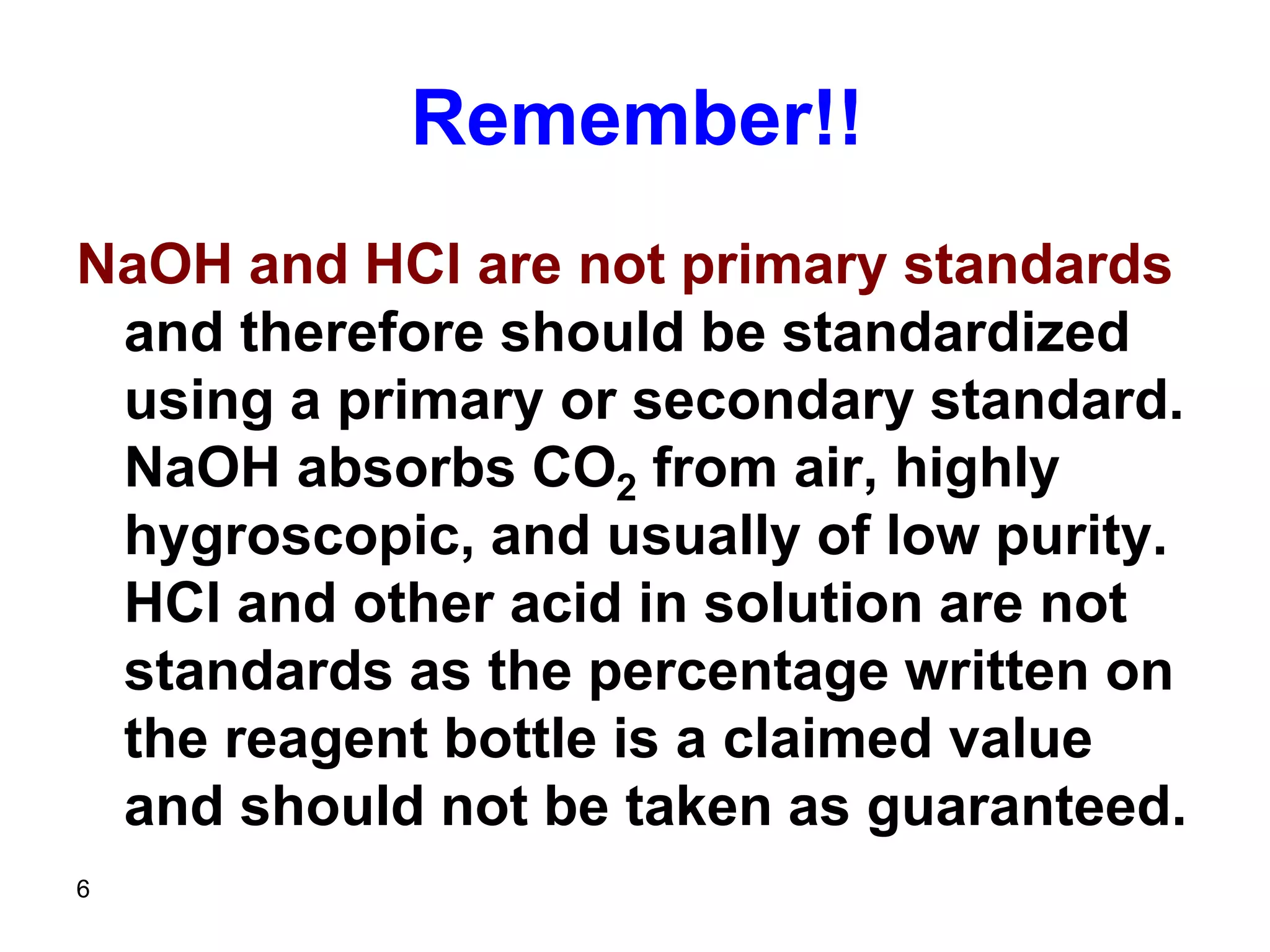
Remember!!
NaOH and HCl are not primary standards
and therefore should be standardized
using a primary or secondary standard.
NaOH absorbs CO2 from air, highly
hygroscopic, and usually of low purity.
HCl and other acid in solution are not
standards as the percentage written on
the reagent bottle is a claimed value
and should not be taken as guaranteed.
7
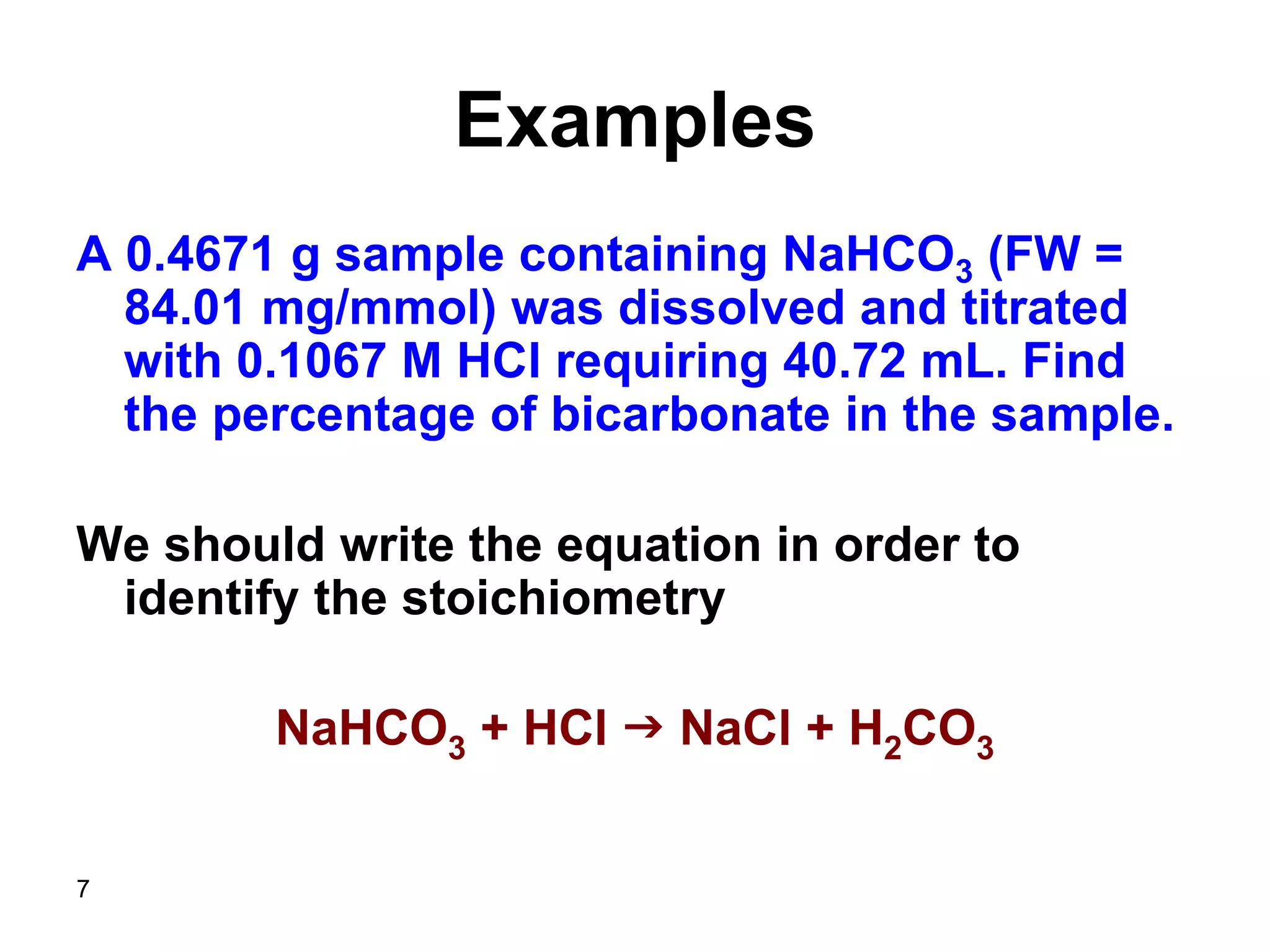
Examples
A 0.4671 g sample containing NaHCO3 (FW =
84.01 mg/mmol) was dissolved and titrated
with 0.1067 M HCl requiring 40.72 mL. Find
the percentage of bicarbonate in the sample.
We should write the equation in order to
identify the stoichiometry
NaHCO3 + HCl g NaCl + H2CO3
8
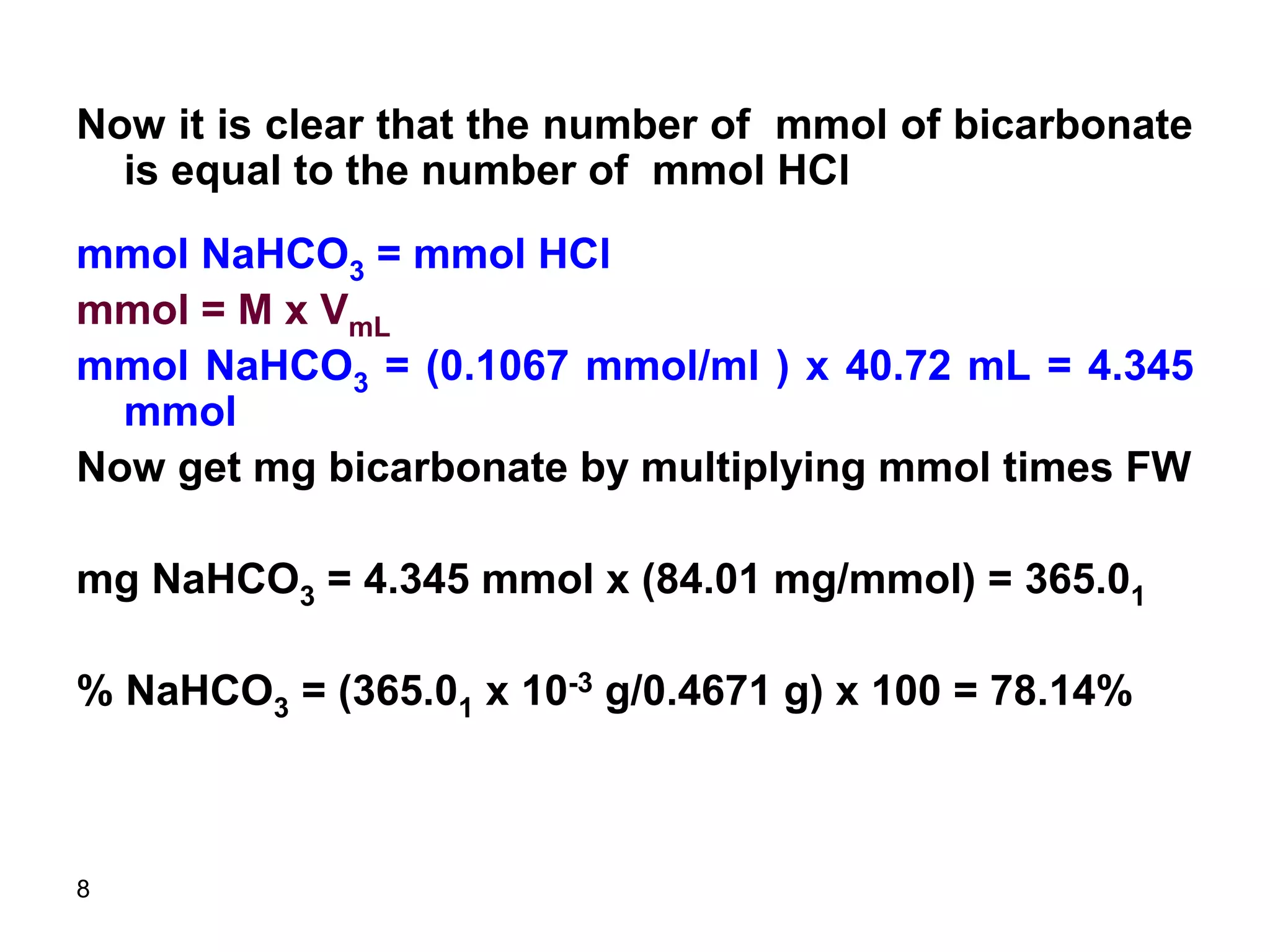
Now it is clear that the number of mmol of bicarbonate
is equal to the number of mmol HCl
mmol NaHCO3 = mmol HCl
mmol = M x VmL
mmol NaHCO3 = (0.1067 mmol/ml ) x 40.72 mL = 4.345
mmol
Now get mg bicarbonate by multiplying mmol times FW
mg NaHCO3 = 4.345 mmol x (84.01 mg/mmol) = 365.01
% NaHCO3 = (365.01 x 10⁻³ g/0.4671 g) x 100 = 78.14%
9
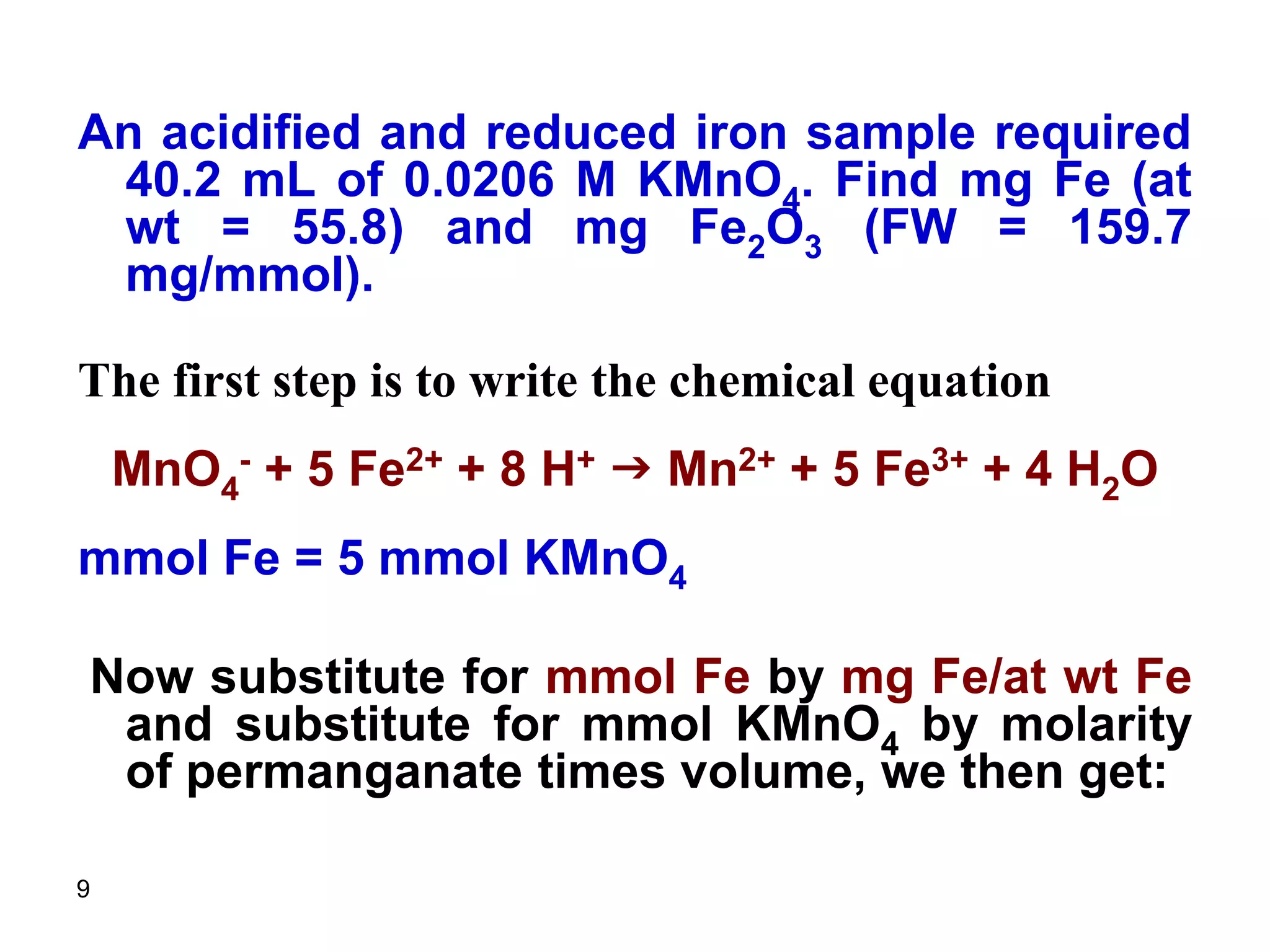
An acidified and reduced iron sample required
40.2 mL of 0.0206 M KMnO4. Find mg Fe (at
wt = 55.8) and mg Fe2O3 (FW = 159.7
mg/mmol).
The first step is to write the chemical equation
MnO4
- + 5 Fe2+ + 8 H+ g Mn2+ + 5 Fe3+ + 4 H2O
mmol Fe = 5 mmol KMnO4
Now substitute for mmol Fe by mg Fe/at wt Fe
and substitute for mmol KMnO4 by molarity
of permanganate times volume, we then get:
10
[mg Fe/(55.8 mg/mmol)] = 5 x (0.0206
mmol/mL) x 40.2 mL
mg Fe = 231 mg
This can also be done in a single step as
follows:
? mg Fe = (0.0206 mmol KMnO4 /mL) x
40.2 mL x (5 mmol Fe/mmol KMnO4) x
(55.8 mg Fe/mmol Fe) = 231 mg
11
To calculate the mg Fe2O3 we set the following:
2Fe g Fe2O3
mmol Fe = 2 mmol Fe2O3
Substitute for mmol Fe in equation 1
2* [mg Fe2O3/ (159.7 mg/mmol)] = 5 x (0.0206 mmol/mL)
x 40.2 mL
mg Fe2O3 = 331 mg
12
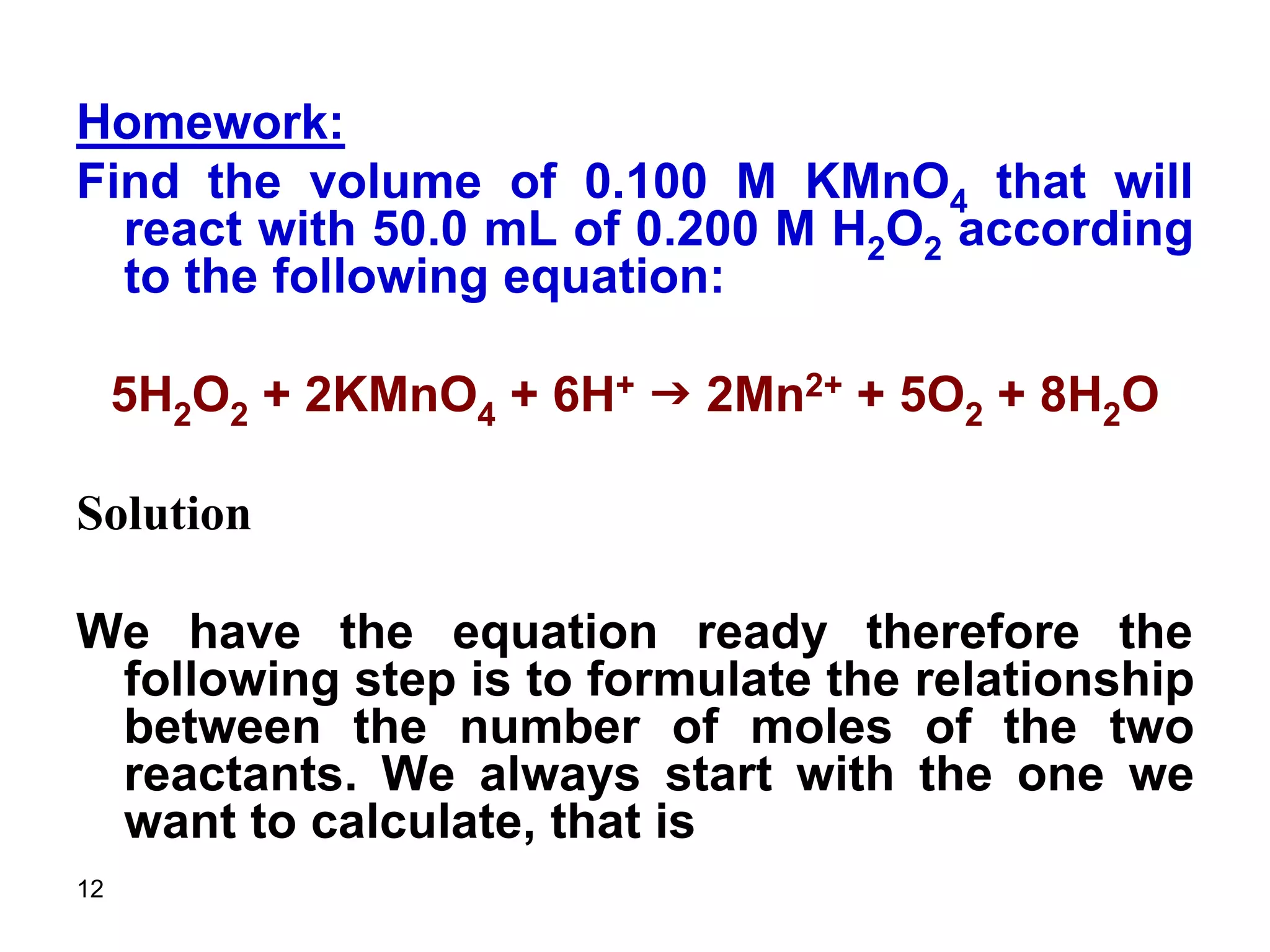
Homework:
Find the volume of 0.100 M KMnO4 that will
react with 50.0 mL of 0.200 M H2O2 according
to the following equation:
5H2O2 + 2KMnO4 + 6H+ g 2Mn2+ + 5O2 + 8H2O
Solution
We have the equation ready therefore the
following step is to formulate the relationship
between the number of moles of the two
reactants. We always start with the one we
want to calculate, that is
13
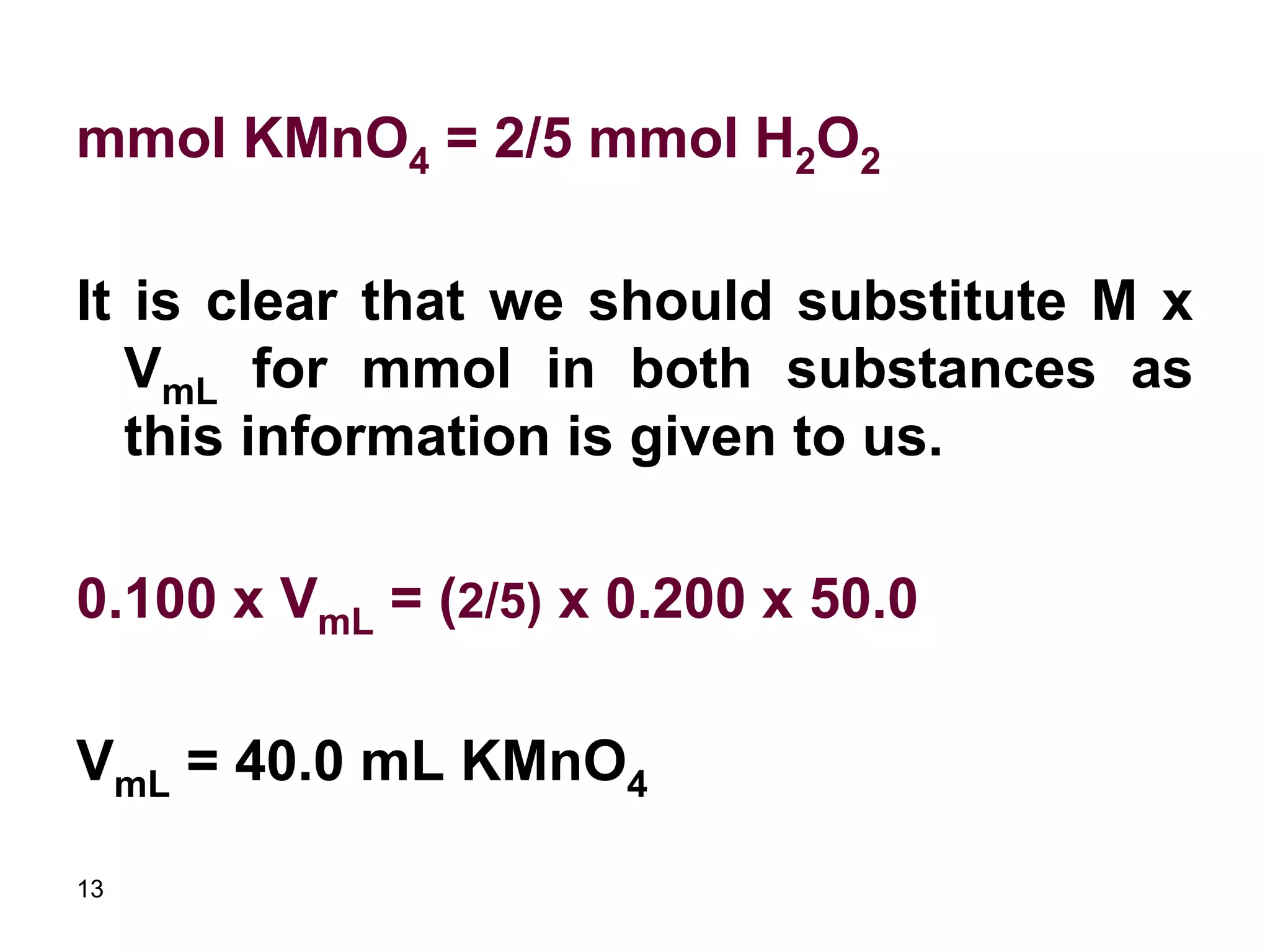
mmol KMnO4 = 2/5 mmol H2O2
It is clear that we should substitute M x
VmL for mmol in both substances as
this information is given to us.
0.100 x VmL = (2/5) x 0.200 x 50.0
VmL = 40.0 mL KMnO4
14
Back-Titrations
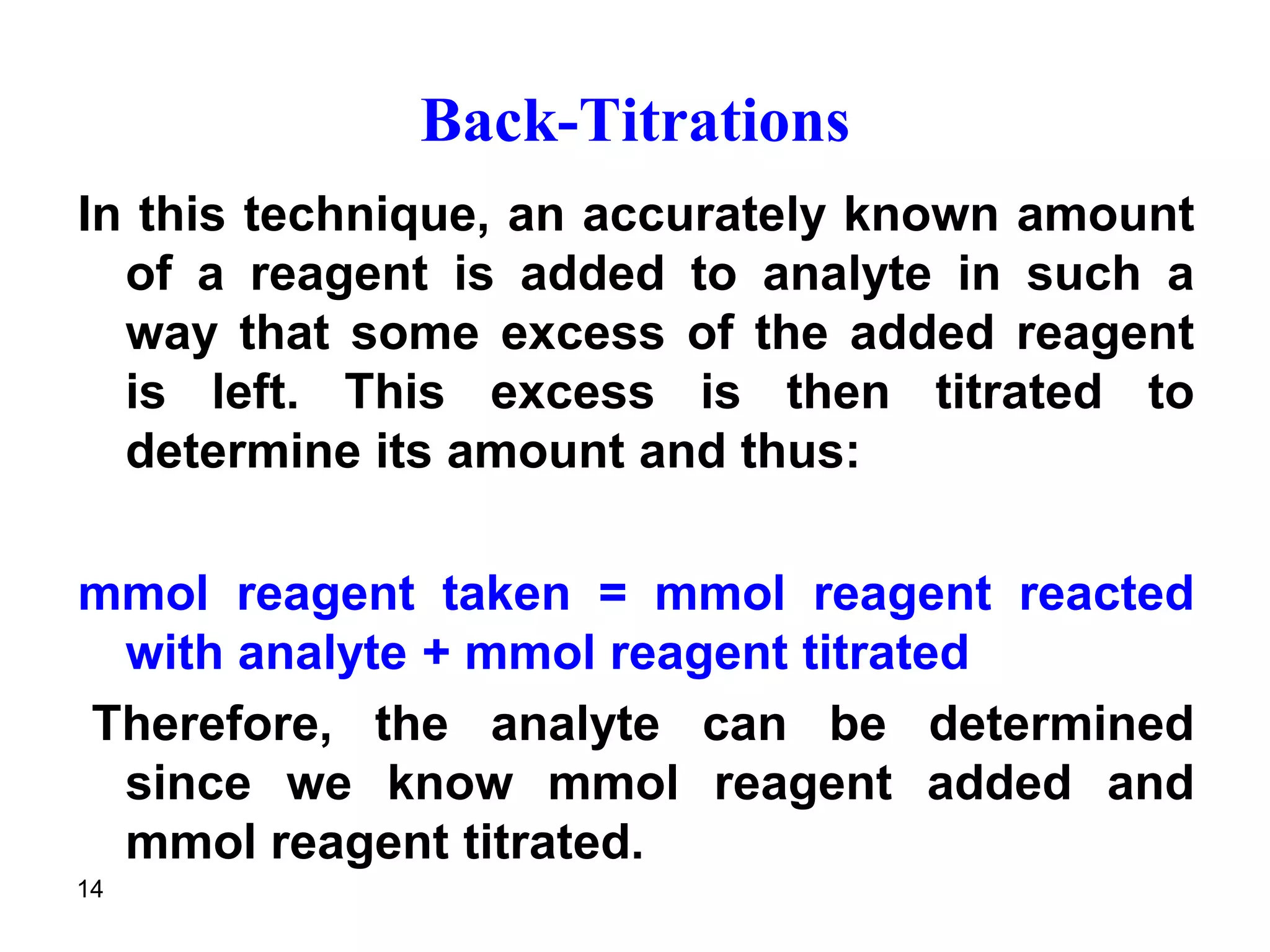
In this technique, an accurately known amount
of a reagent is added to analyte in such a
way that some excess of the added reagent
is left. This excess is then titrated to
determine its amount and thus:
mmol reagent taken = mmol reagent reacted
with analyte + mmol reagent titrated
Therefore, the analyte can be determined
since we know mmol reagent added and
mmol reagent titrated.
15
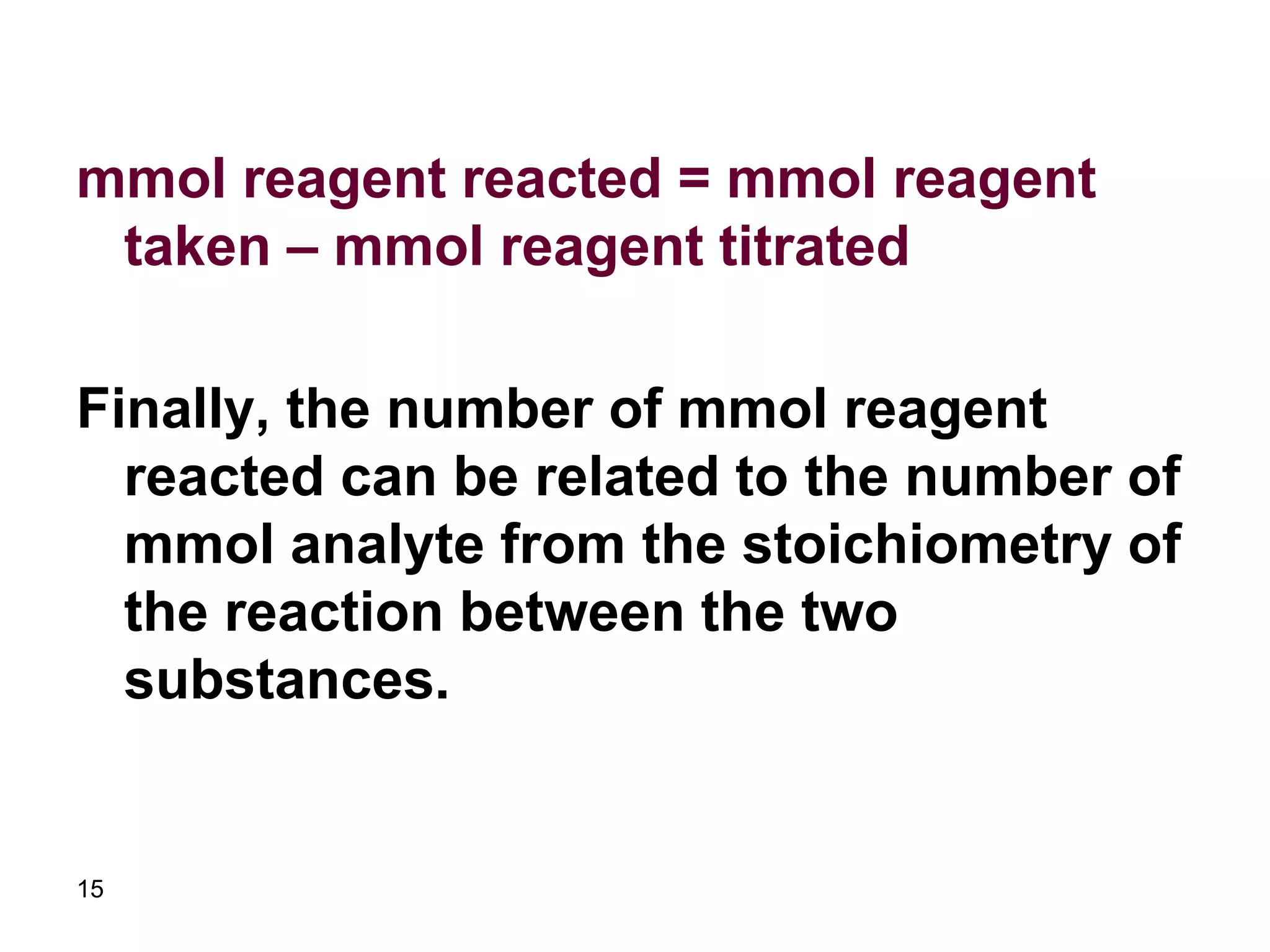
mmol reagent reacted = mmol reagent
taken – mmol reagent titrated
Finally, the number of mmol reagent
reacted can be related to the number of
mmol analyte from the stoichiometry of
the reaction between the two
substances.
16
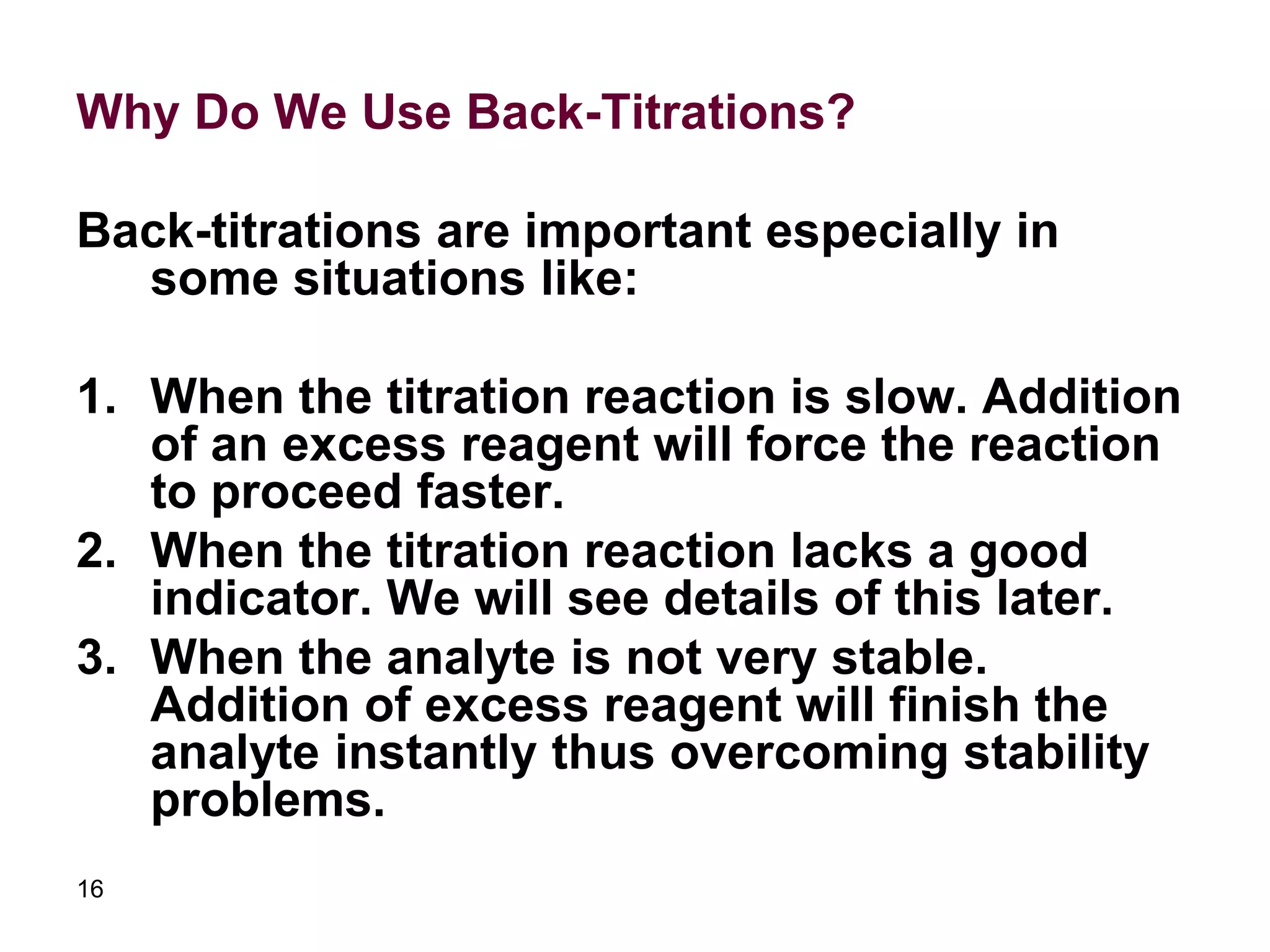
Why Do We Use Back-Titrations?
Back-titrations are important especially in
some situations like:
1. When the titration reaction is slow. Addition
of an excess reagent will force the reaction
to proceed faster.
2. When the titration reaction lacks a good
indicator. We will see details of this later.
3. When the analyte is not very stable.
Addition of excess reagent will finish the
analyte instantly thus overcoming stability
problems.
17
Examples
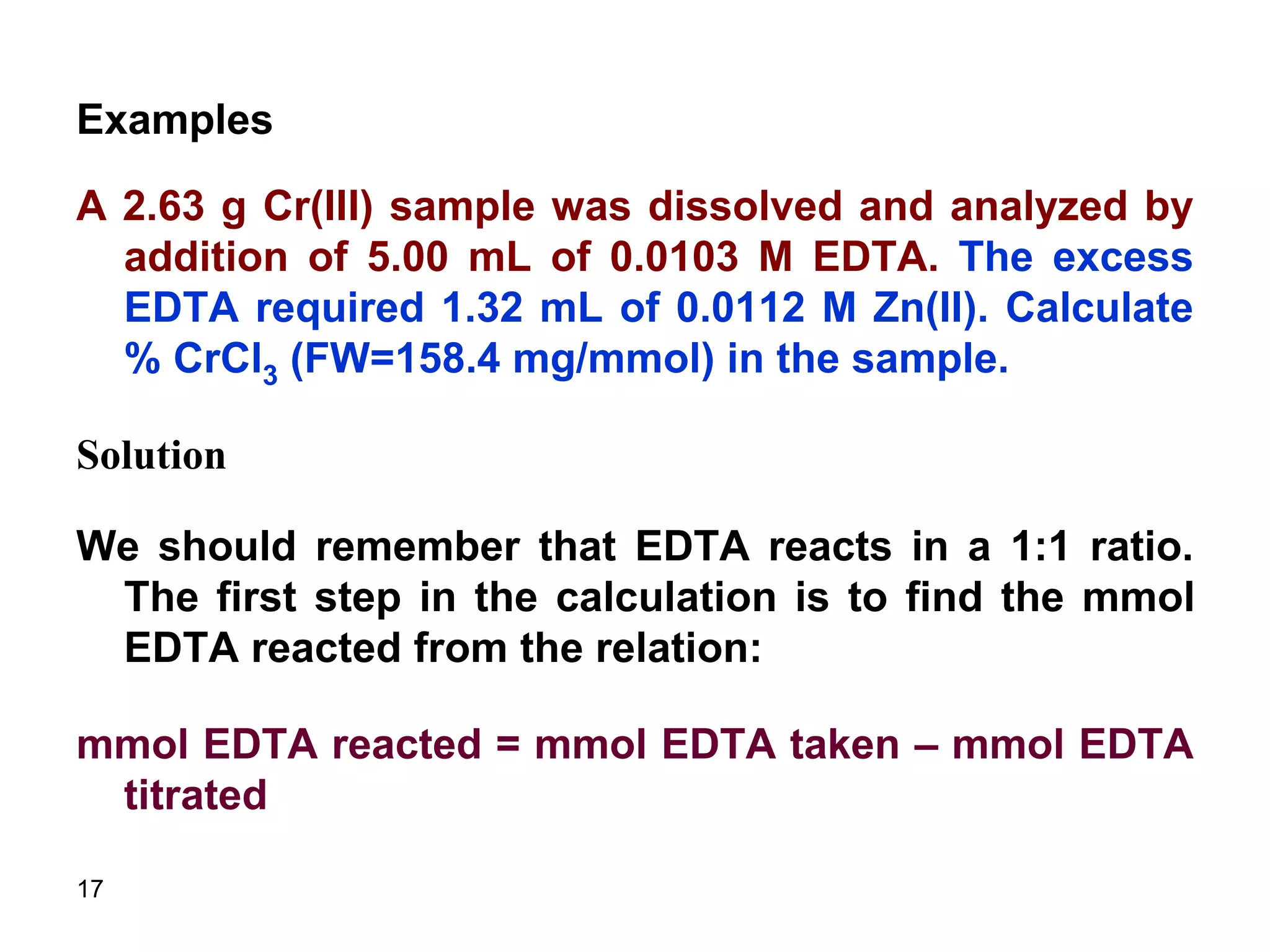
A 2.63 g Cr(III) sample was dissolved and analyzed by
addition of 5.00 mL of 0.0103 M EDTA. The excess
EDTA required 1.32 mL of 0.0112 M Zn(II). Calculate
% CrCl3 (FW=158.4 mg/mmol) in the sample.
Solution
We should remember that EDTA reacts in a 1:1 ratio.
The first step in the calculation is to find the mmol
EDTA reacted from the relation:
mmol EDTA reacted = mmol EDTA taken – mmol EDTA
titrated
18
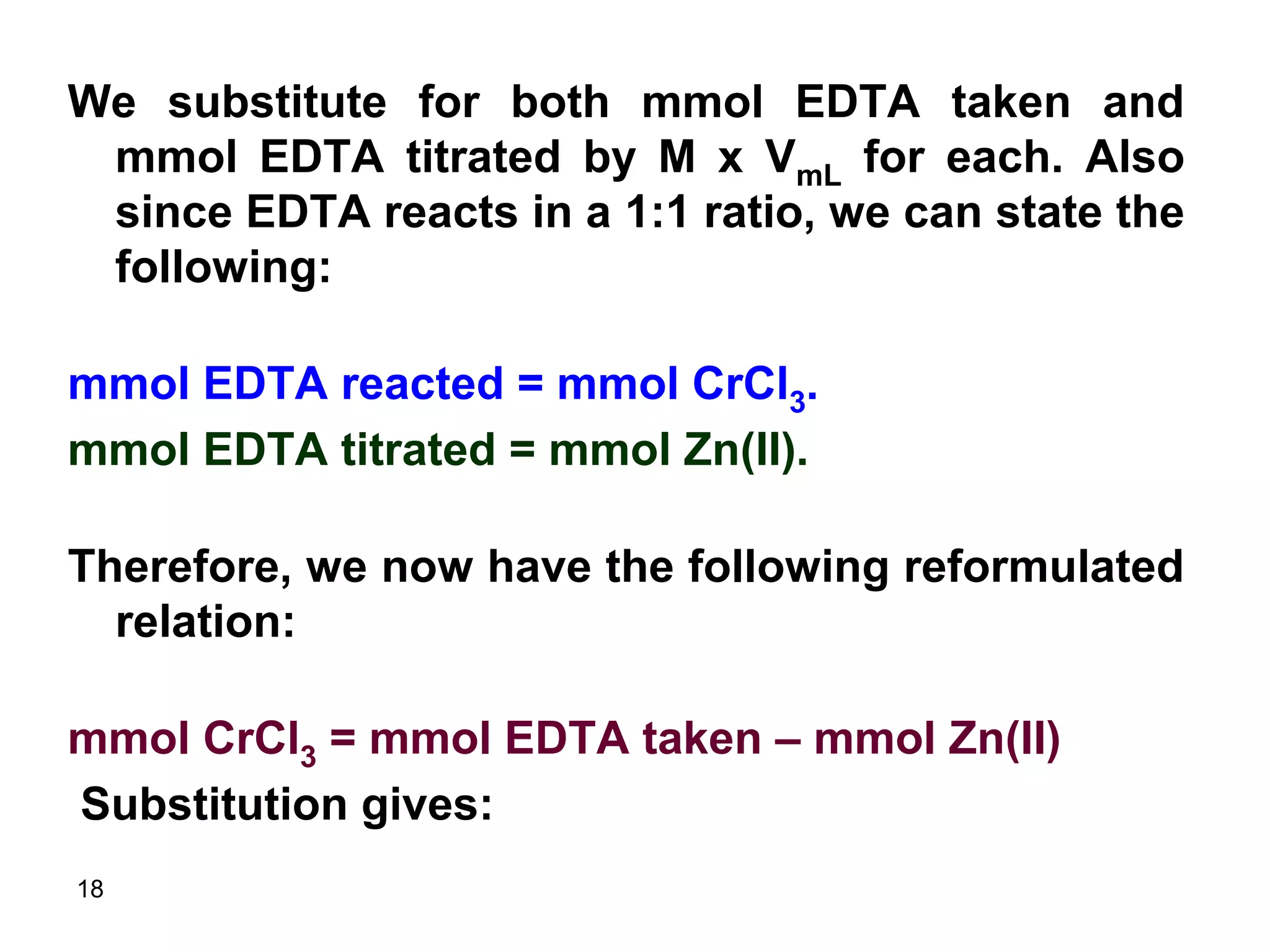
We substitute for both mmol EDTA taken and
mmol EDTA titrated by M x VmL for each. Also
since EDTA reacts in a 1:1 ratio, we can state the
following:
mmol EDTA reacted = mmol CrCl3.
mmol EDTA titrated = mmol Zn(II).
Therefore, we now have the following reformulated
relation:
mmol CrCl3 = mmol EDTA taken – mmol Zn(II)
Substitution gives:
19
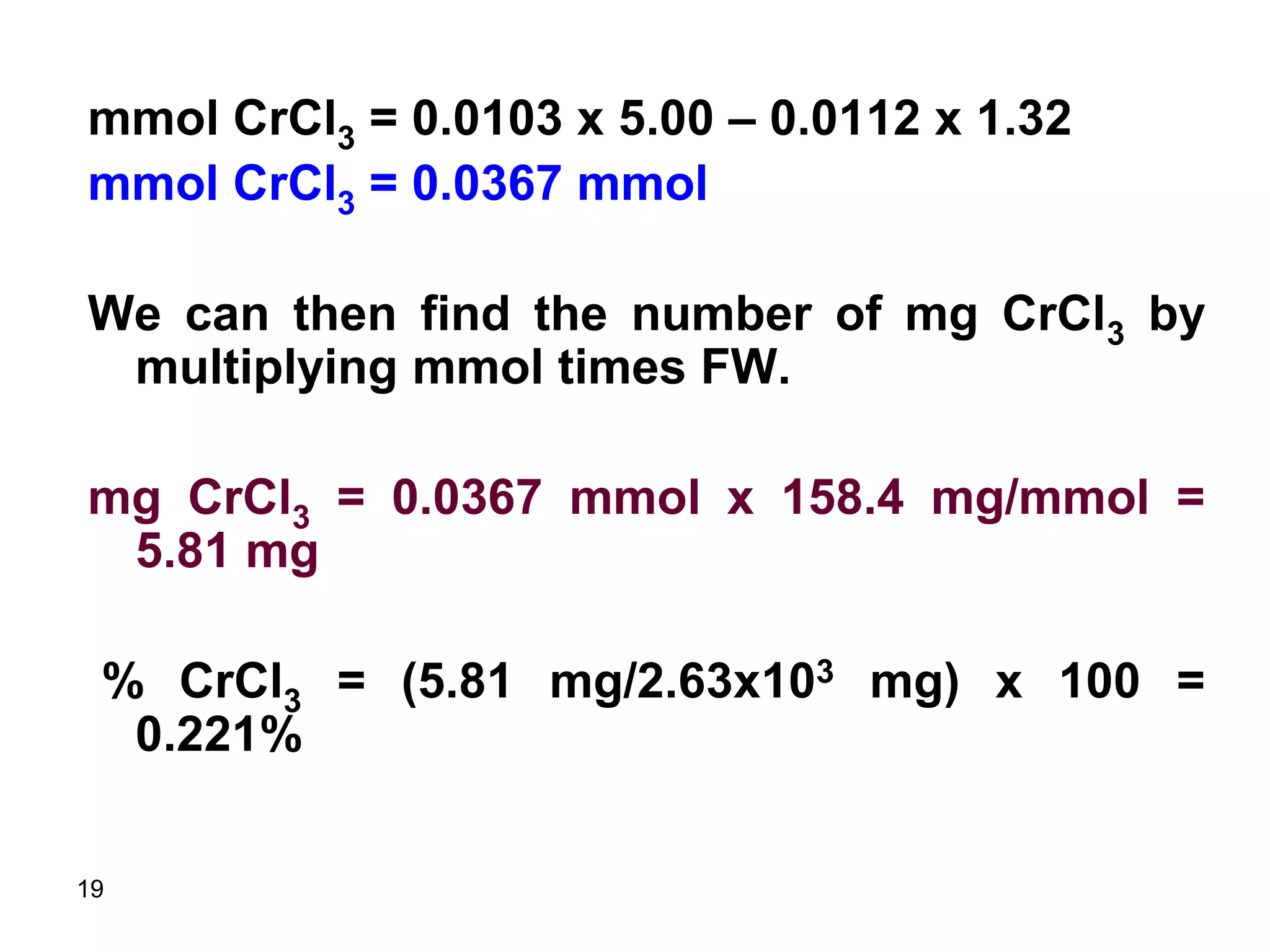
mmol CrCl3 = 0.0103 x 5.00 – 0.0112 x 1.32
mmol CrCl3 = 0.0367 mmol
We can then find the number of mg CrCl3 by
multiplying mmol times FW.
mg CrCl3 = 0.0367 mmol x 158.4 mg/mmol =
5.81 mg
% CrCl3 = (5.81 mg/2.63x103 mg) x 100 =
0.221%
20
Homework:
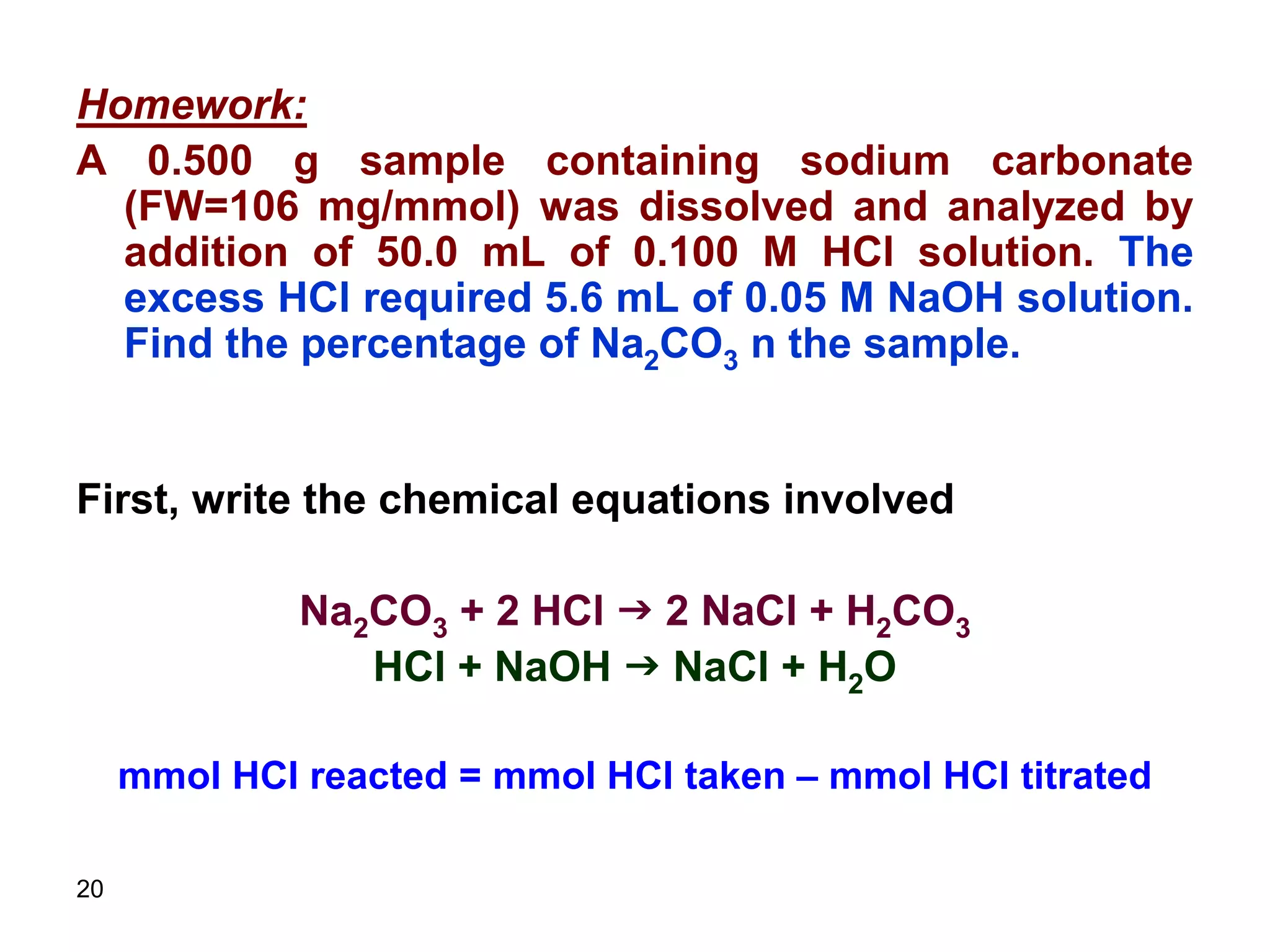
A 0.500 g sample containing sodium carbonate
(FW=106 mg/mmol) was dissolved and analyzed by
addition of 50.0 mL of 0.100 M HCl solution. The
excess HCl required 5.6 mL of 0.05 M NaOH solution.
Find the percentage of Na2CO3 n the sample.
First, write the chemical equations involved
Na2CO3 + 2 HCl g 2 NaCl + H2CO3
HCl + NaOH g NaCl + H2O
mmol HCl reacted = mmol HCl taken – mmol HCl titrated
21
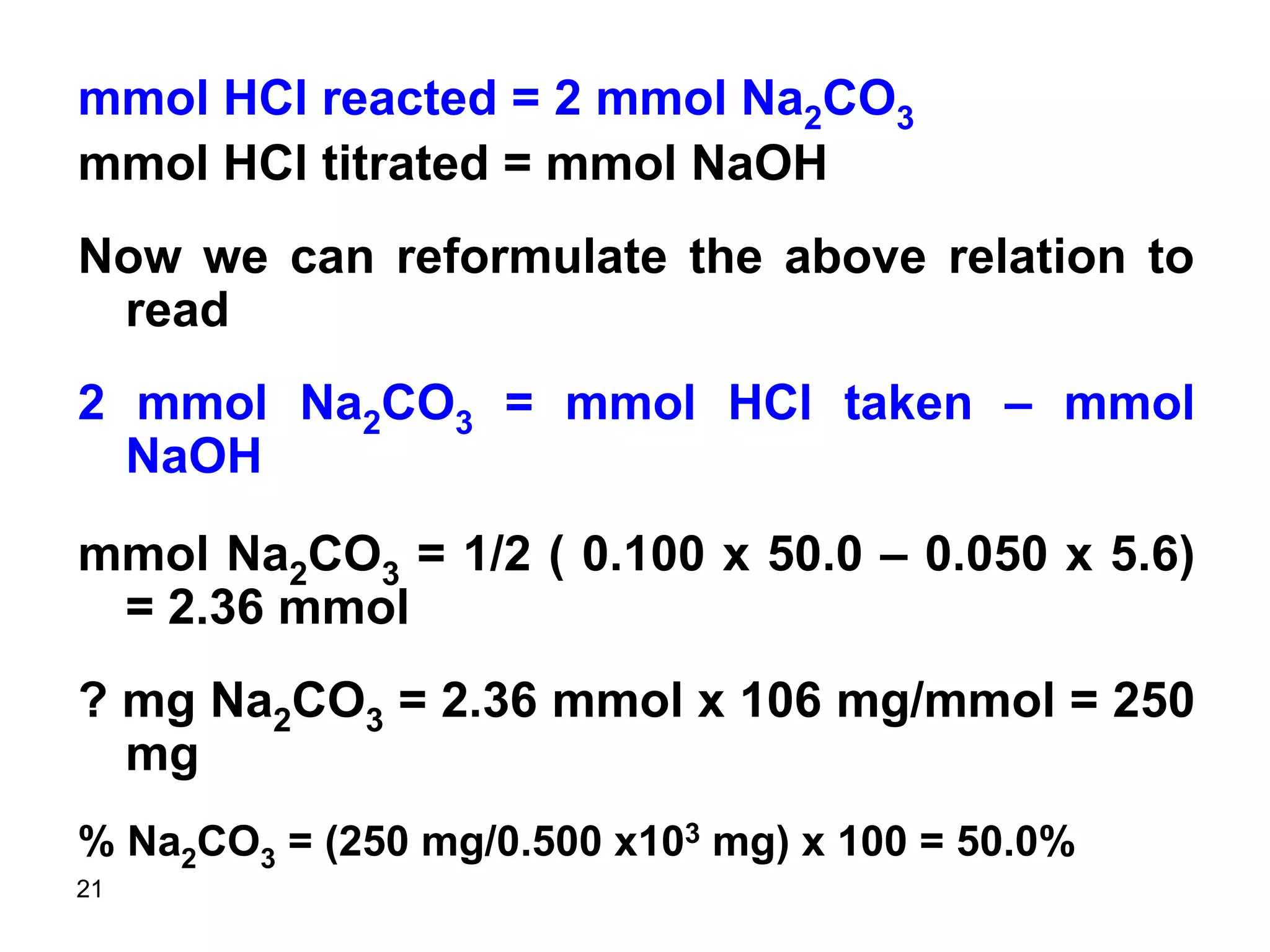
mmol HCl reacted = 2 mmol Na2CO3
mmol HCl titrated = mmol NaOH
Now we can reformulate the above relation to
read
2 mmol Na2CO3 = mmol HCl taken – mmol
NaOH
mmol Na2CO3 = 1/2 ( 0.100 x 50.0 – 0.050 x 5.6)
= 2.36 mmol
? mg Na2CO3 = 2.36 mmol x 106 mg/mmol = 250
mg
% Na2CO3 = (250 mg/0.500 x103 mg) x 100 = 50.0%
22
Normality volumetric
Calculations
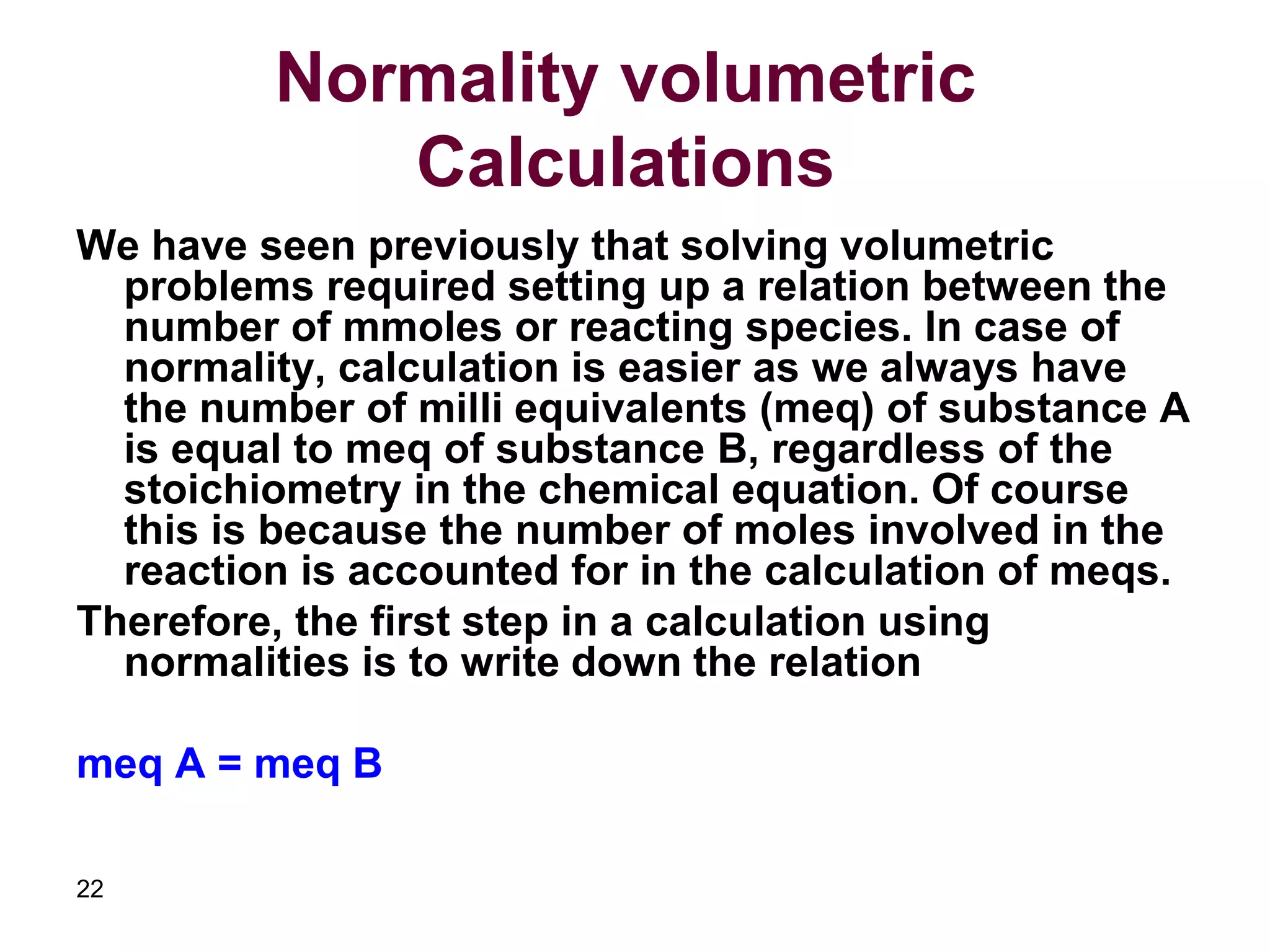
We have seen previously that solving volumetric
problems required setting up a relation between the
number of mmoles or reacting species. In case of
normality, calculation is easier as we always have
the number of milli equivalents (meq) of substance A
is equal to meq of substance B, regardless of the
stoichiometry in the chemical equation. Of course
this is because the number of moles involved in the
reaction is accounted for in the calculation of meqs.
Therefore, the first step in a calculation using
normalities is to write down the relation
meq A = meq B
23
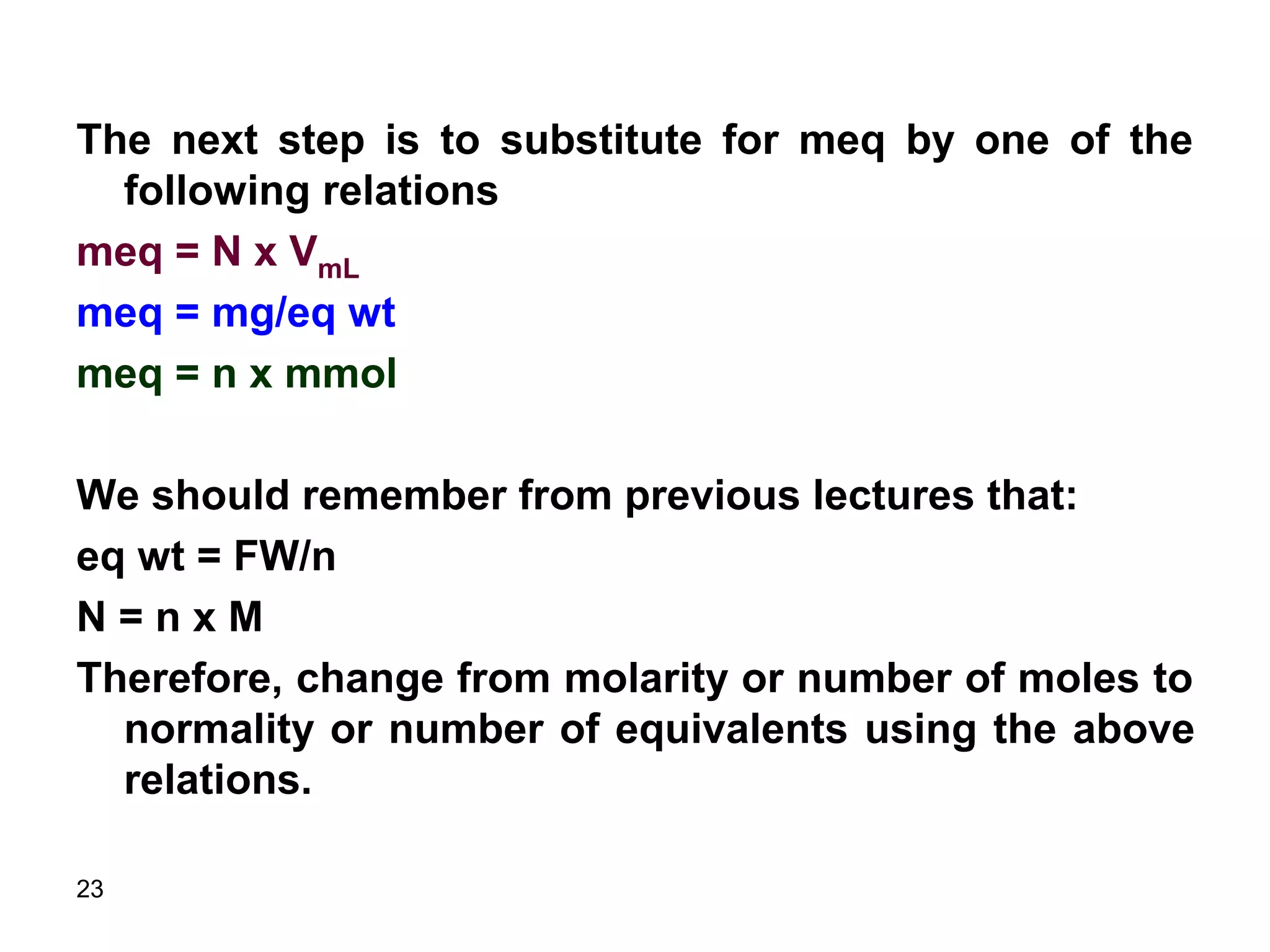
The next step is to substitute for meq by one of the
following relations
meq = N x VmL
meq = mg/eq wt
meq = n x mmol
We should remember from previous lectures that:
eq wt = FW/n
N = n x M
Therefore, change from molarity or number of moles to
normality or number of equivalents using the above
relations.
24
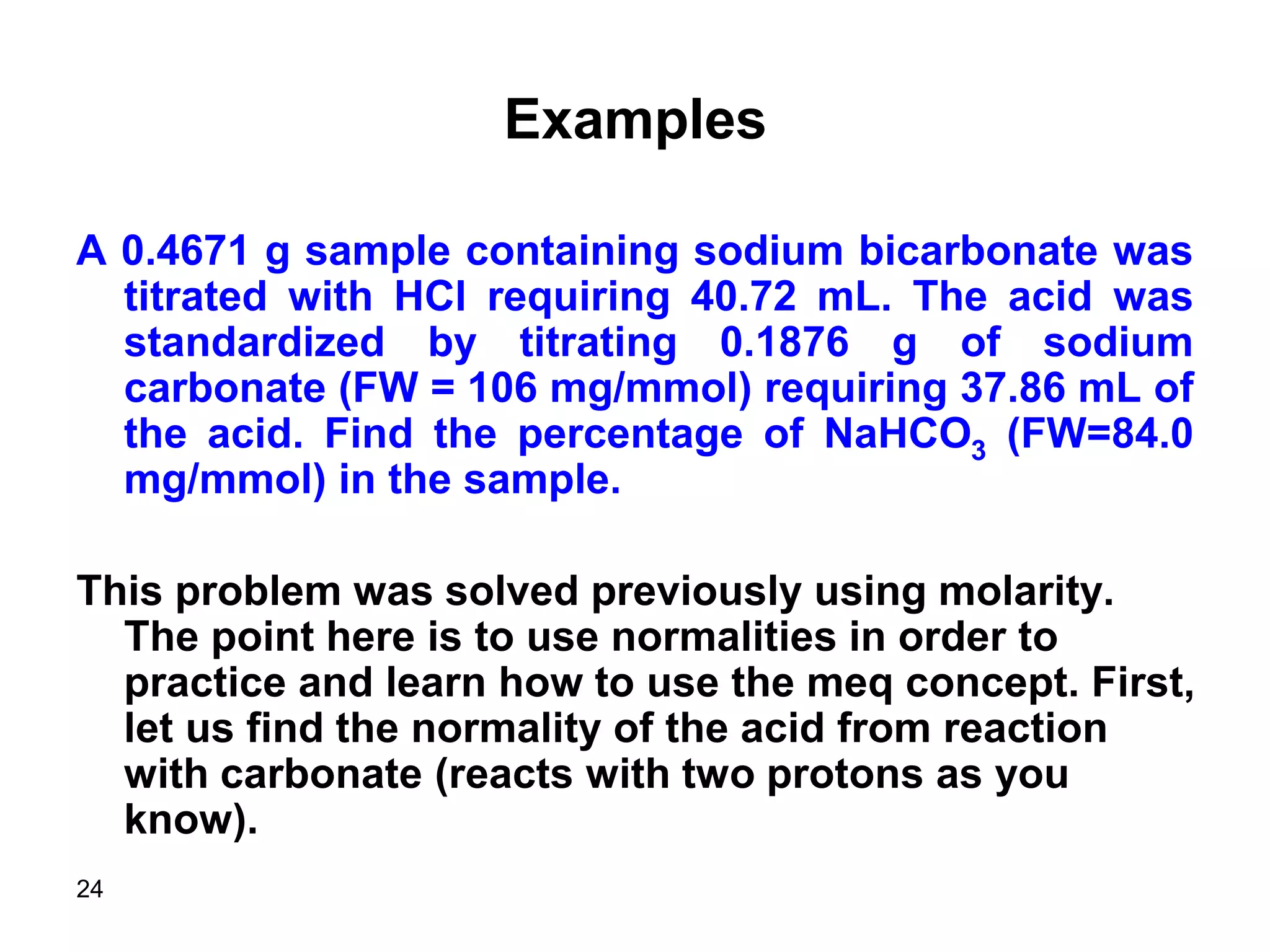
Examples
A 0.4671 g sample containing sodium bicarbonate was
titrated with HCl requiring 40.72 mL. The acid was
standardized by titrating 0.1876 g of sodium
carbonate (FW = 106 mg/mmol) requiring 37.86 mL of
the acid. Find the percentage of NaHCO3 (FW=84.0
mg/mmol) in the sample.
This problem was solved previously using molarity.
The point here is to use normalities in order to
practice and learn how to use the meq concept. First,
let us find the normality of the acid from reaction
with carbonate (reacts with two protons as you
know).
25
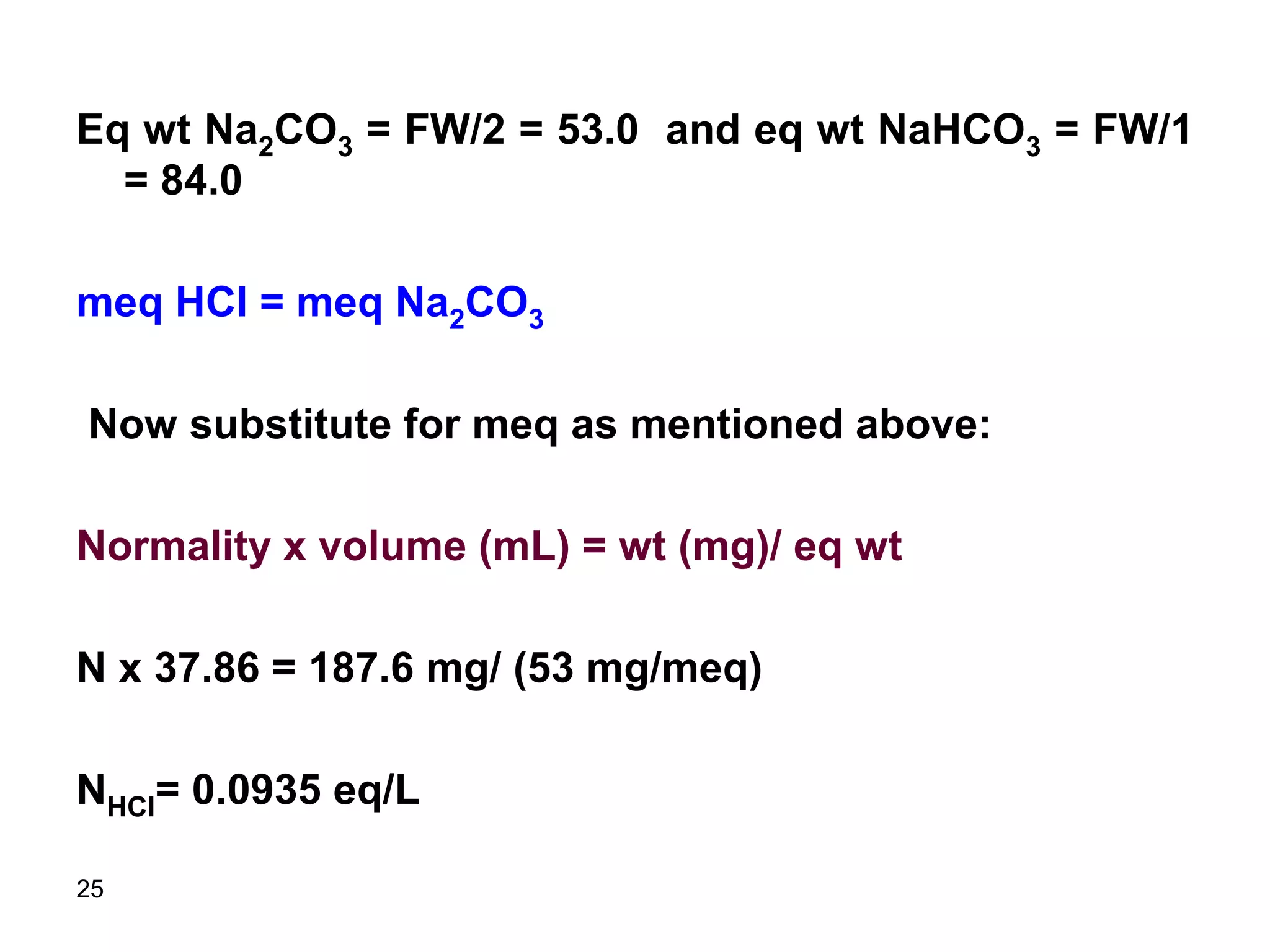
Eq wt Na2CO3 = FW/2 = 53.0 and eq wt NaHCO3 = FW/1
= 84.0
meq HCl = meq Na2CO3
Now substitute for meq as mentioned above:
Normality x volume (mL) = wt (mg)/ eq wt
N x 37.86 = 187.6 mg/ (53 mg/meq)
NHCl= 0.0935 eq/L
26
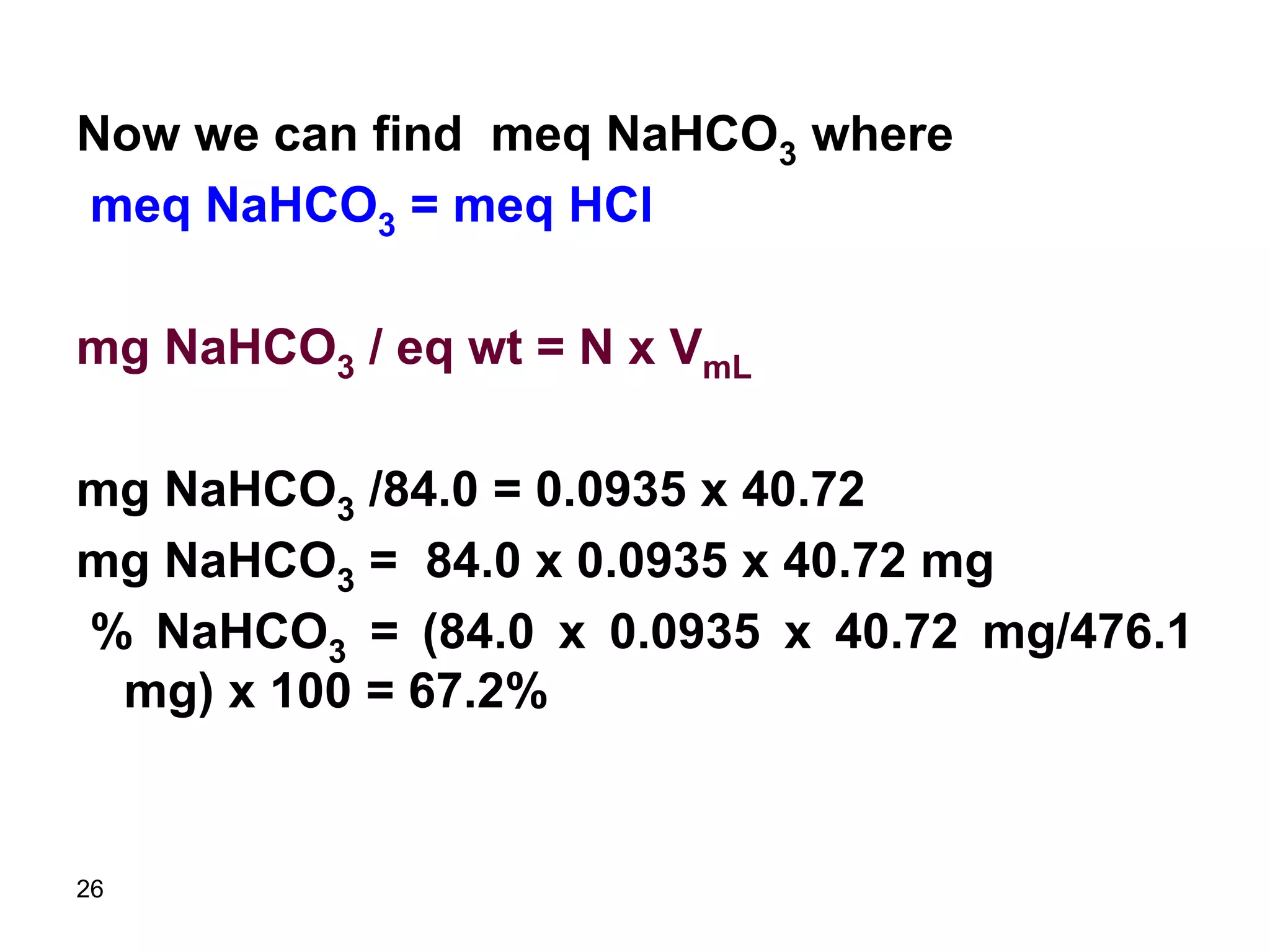
Now we can find meq NaHCO3 where
meq NaHCO3 = meq HCl
mg NaHCO3 / eq wt = N x VmL
mg NaHCO3 /84.0 = 0.0935 x 40.72
mg NaHCO3 = 84.0 x 0.0935 x 40.72 mg
% NaHCO3 = (84.0 x 0.0935 x 40.72 mg/476.1
mg) x 100 = 67.2%
27
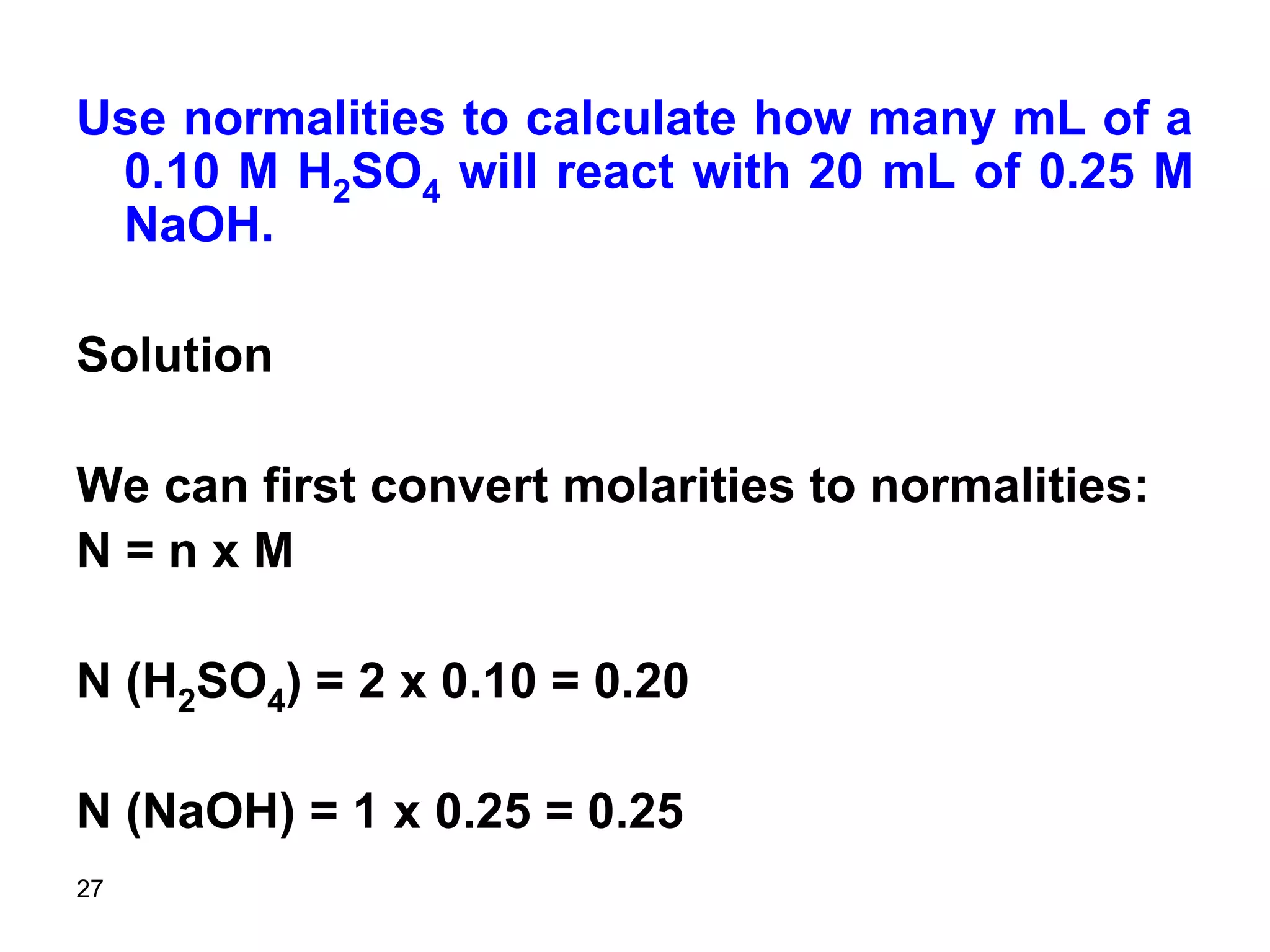
Use normalities to calculate how many mL of a
0.10 M H2SO4 will react with 20 mL of 0.25 M
NaOH.
Solution
We can first convert molarities to normalities:
N = n x M
N (H2SO4) = 2 x 0.10 = 0.20
N (NaOH) = 1 x 0.25 = 0.25
28
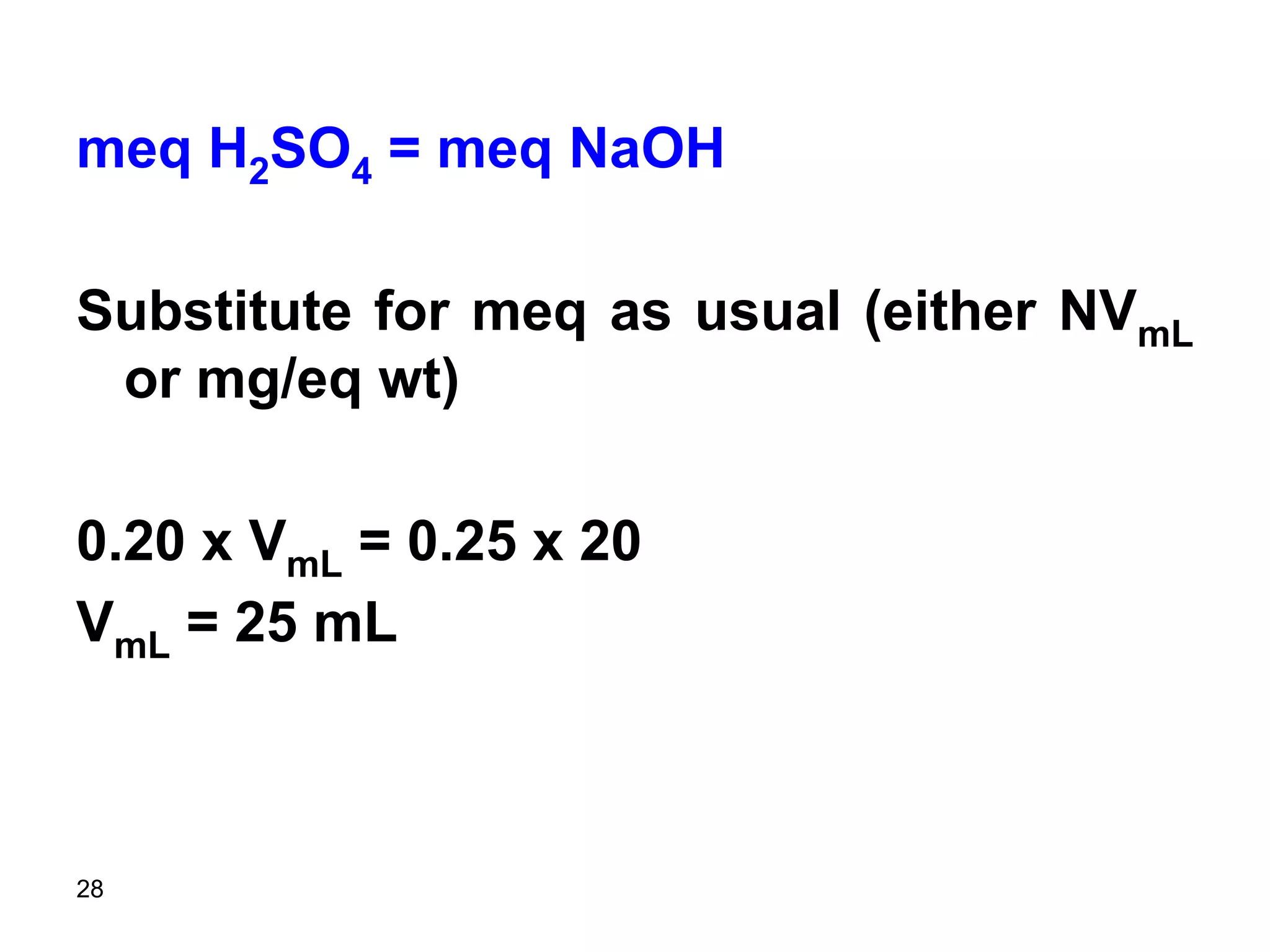
meq H2SO4 = meq NaOH
Substitute for meq as usual (either NVmL
or mg/eq wt)
0.20 x VmL = 0.25 x 20
VmL = 25 mL
29
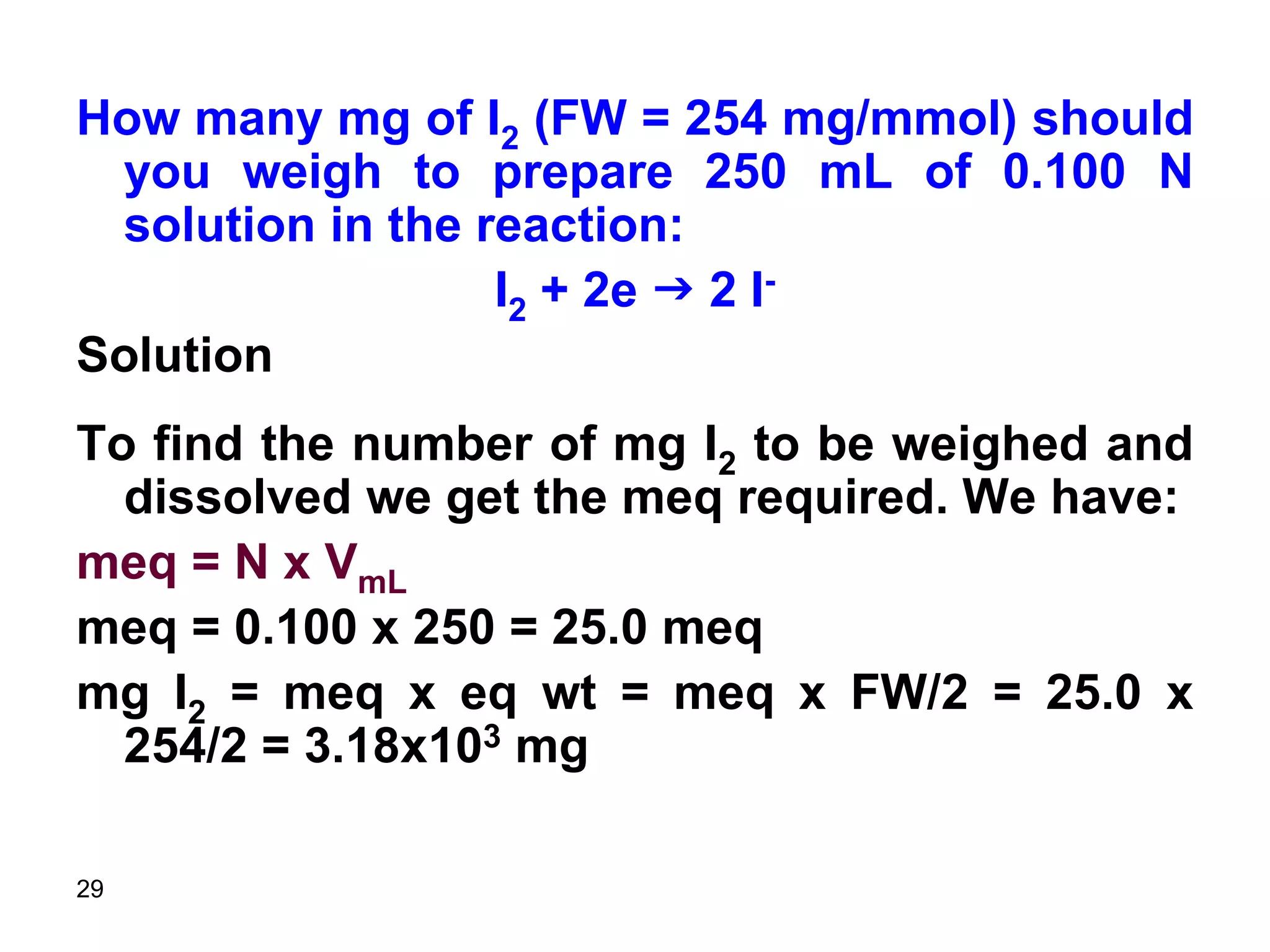
How many mg of I2 (FW = 254 mg/mmol) should
you weigh to prepare 250 mL of 0.100 N
solution in the reaction:
I2 + 2e g 2 I-
Solution
To find the number of mg I2 to be weighed and
dissolved we get the meq required. We have:
meq = N x VmL
meq = 0.100 x 250 = 25.0 meq
mg I2 = meq x eq wt = meq x FW/2 = 25.0 x
254/2 = 3.18x10³ mg
30
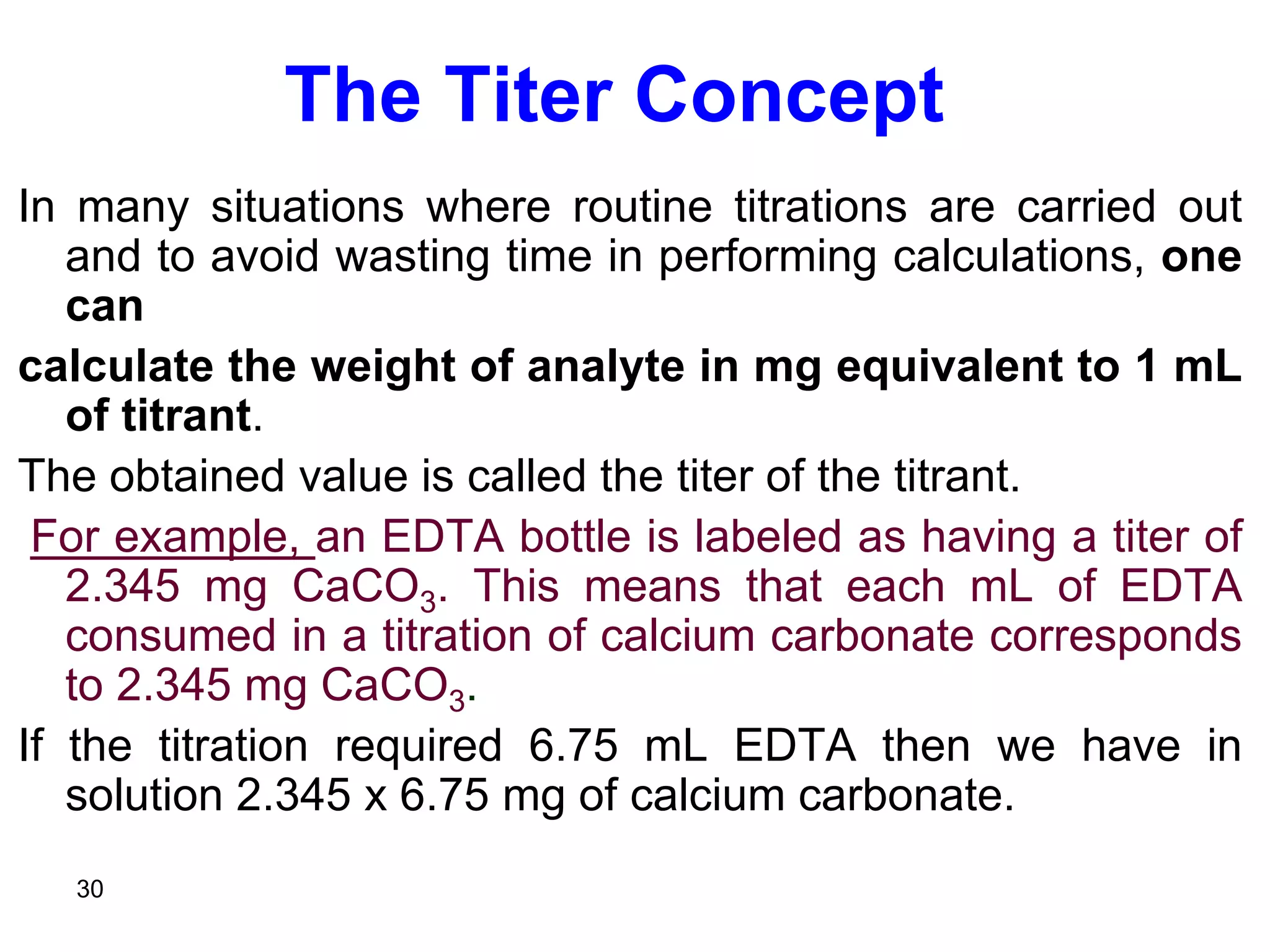
The Titer Concept
In many situations where routine titrations are carried out
and to avoid wasting time in performing calculations, one
can
calculate the weight of analyte in mg equivalent to 1 mL
of titrant.
The obtained value is called the titer of the titrant.
For example, an EDTA bottle is labeled as having a titer of
2.345 mg CaCO3. This means that each mL of EDTA
consumed in a titration of calcium carbonate corresponds
to 2.345 mg CaCO3.
If the titration required 6.75 mL EDTA then we have in
solution 2.345 x 6.75 mg of calcium carbonate.
31
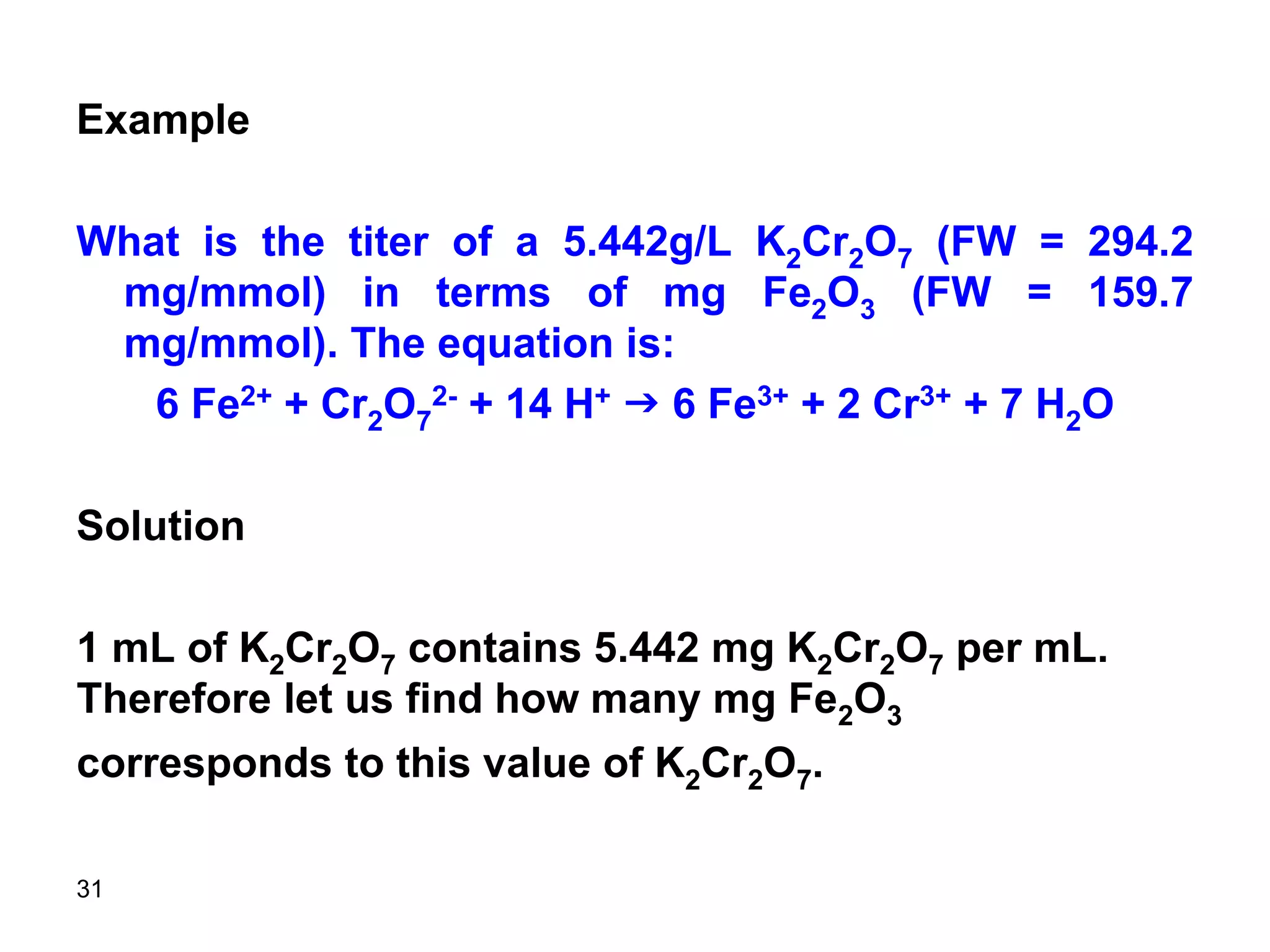
Example
What is the titer of a 5.442g/L K2Cr2O7 (FW = 294.2
mg/mmol) in terms of mg Fe2O3 (FW = 159.7
mg/mmol). The equation is:
6 Fe2+ + Cr2O7
2- + 14 H+ g 6 Fe3+ + 2 Cr3+ + 7 H2O
Solution
1 mL of K2Cr2O7 contains 5.442 mg K2Cr2O7 per mL.
Therefore let us find how many mg Fe2O3
corresponds to this value of K2Cr2O7.
32
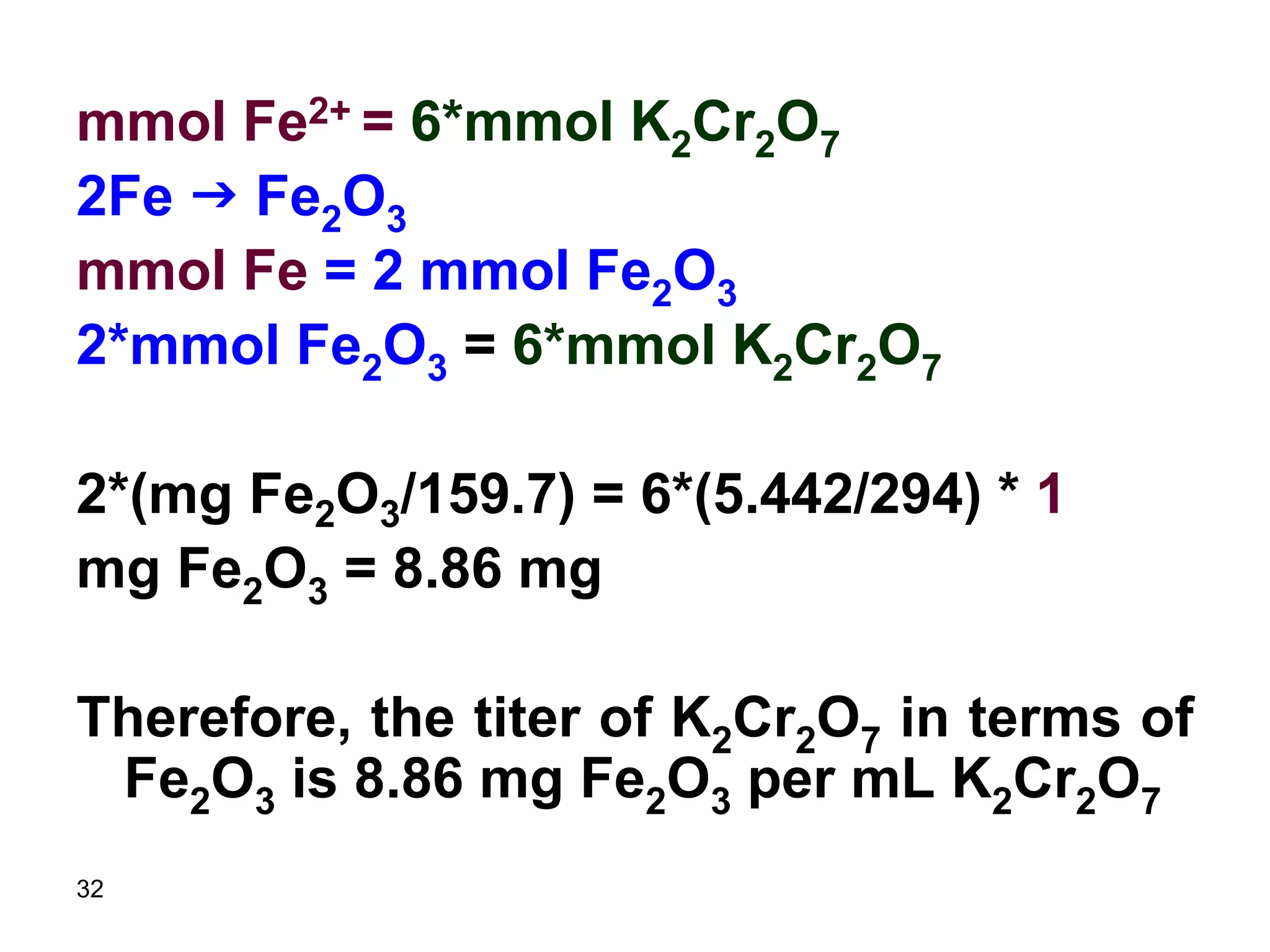
mmol Fe2+ = 6*mmol K2Cr2O7
2Fe g Fe2O3
mmol Fe = 2 mmol Fe2O3
2*mmol Fe2O3 = 6*mmol K2Cr2O7
2*(mg Fe2O3/159.7) = 6*(5.442/294) * 1
mg Fe2O3 = 8.86 mg
Therefore, the titer of K2Cr2O7 in terms of
Fe2O3 is 8.86 mg Fe2O3 per mL K2Cr2O7

Stoichiometric-calculations part 2.ppt

  • 1.
    1 Stoichiometric Calculations: Volumetric Analysis Inthis section we look at calculations involved in titration processes as well as general quantitative reactions. In a volumetric titration, an analyte of unknown concentration is titrated with a standard in presence of a suitable indicator. For a reaction to be used in titration the following characteristics should be satisfied:
  • 2.
    2 1. The stoichiometryof the reaction should be exactly known. This means that we should know the number of moles of A reacting with 1 mole of B. 2. The reaction should be rapid and reaction between A and B should occur immediately and instantly after addition of each drop of titrant (the solution in the burette). 3. There should be no side reactions. A reacts with B only.
  • 3.
    3 4. The reactionshould be quantitative. A reacts completely with B. 5. There should exist a suitable indicator which has distinct color change. 6. There should be very good agreement between the equivalence point (theoretical) and the end point (experimental). This means that Both points should occur at the same volume of titrant or at most a very close volume.
  • 4.
    4 Standard solutions A standardsolution is a solution of known and exactly defined concentration. Usually standards are classified as either primary standards or secondary standards. There are not too many secondary standards available to analysts and standardization of other substances is necessary to prepare secondary standards. A primary standard should have the following properties:
  • 5.
    5 1. Should havea purity of at least 99.98% 2. Stable to drying, a necessary step to expel adsorbed water molecules before weighing 3. Should have high formula weight as the uncertainty in weight is decreased when weight is increased 4. Should be non hygroscopic 5. Should possess the same properties as that required for a titration
  • 6.
    6 Remember!! NaOH and HClare not primary standards and therefore should be standardized using a primary or secondary standard. NaOH absorbs CO2 from air, highly hygroscopic, and usually of low purity. HCl and other acid in solution are not standards as the percentage written on the reagent bottle is a claimed value and should not be taken as guaranteed.
  • 7.
    7 Examples A 0.4671 gsample containing NaHCO3 (FW = 84.01 mg/mmol) was dissolved and titrated with 0.1067 M HCl requiring 40.72 mL. Find the percentage of bicarbonate in the sample. We should write the equation in order to identify the stoichiometry NaHCO3 + HCl g NaCl + H2CO3
  • 8.
    8 Now it isclear that the number of mmol of bicarbonate is equal to the number of mmol HCl mmol NaHCO3 = mmol HCl mmol = M x VmL mmol NaHCO3 = (0.1067 mmol/ml ) x 40.72 mL = 4.345 mmol Now get mg bicarbonate by multiplying mmol times FW mg NaHCO3 = 4.345 mmol x (84.01 mg/mmol) = 365.01 % NaHCO3 = (365.01 x 10⁻³ g/0.4671 g) x 100 = 78.14%
  • 9.
    9 An acidified andreduced iron sample required 40.2 mL of 0.0206 M KMnO4. Find mg Fe (at wt = 55.8) and mg Fe2O3 (FW = 159.7 mg/mmol). The first step is to write the chemical equation MnO4 - + 5 Fe2+ + 8 H+ g Mn2+ + 5 Fe3+ + 4 H2O mmol Fe = 5 mmol KMnO4 Now substitute for mmol Fe by mg Fe/at wt Fe and substitute for mmol KMnO4 by molarity of permanganate times volume, we then get:
  • 10.
    10 [mg Fe/(55.8 mg/mmol)]= 5 x (0.0206 mmol/mL) x 40.2 mL mg Fe = 231 mg This can also be done in a single step as follows: ? mg Fe = (0.0206 mmol KMnO4 /mL) x 40.2 mL x (5 mmol Fe/mmol KMnO4) x (55.8 mg Fe/mmol Fe) = 231 mg
  • 11.
    11 To calculate themg Fe2O3 we set the following: 2Fe g Fe2O3 mmol Fe = 2 mmol Fe2O3 Substitute for mmol Fe in equation 1 2* [mg Fe2O3/ (159.7 mg/mmol)] = 5 x (0.0206 mmol/mL) x 40.2 mL mg Fe2O3 = 331 mg
  • 12.
    12 Homework: Find the volumeof 0.100 M KMnO4 that will react with 50.0 mL of 0.200 M H2O2 according to the following equation: 5H2O2 + 2KMnO4 + 6H+ g 2Mn2+ + 5O2 + 8H2O Solution We have the equation ready therefore the following step is to formulate the relationship between the number of moles of the two reactants. We always start with the one we want to calculate, that is
  • 13.
    13 mmol KMnO4 =2/5 mmol H2O2 It is clear that we should substitute M x VmL for mmol in both substances as this information is given to us. 0.100 x VmL = (2/5) x 0.200 x 50.0 VmL = 40.0 mL KMnO4
  • 14.
    14 Back-Titrations In this technique,an accurately known amount of a reagent is added to analyte in such a way that some excess of the added reagent is left. This excess is then titrated to determine its amount and thus: mmol reagent taken = mmol reagent reacted with analyte + mmol reagent titrated Therefore, the analyte can be determined since we know mmol reagent added and mmol reagent titrated.
  • 15.
    15 mmol reagent reacted= mmol reagent taken – mmol reagent titrated Finally, the number of mmol reagent reacted can be related to the number of mmol analyte from the stoichiometry of the reaction between the two substances.
  • 16.
    16 Why Do WeUse Back-Titrations? Back-titrations are important especially in some situations like: 1. When the titration reaction is slow. Addition of an excess reagent will force the reaction to proceed faster. 2. When the titration reaction lacks a good indicator. We will see details of this later. 3. When the analyte is not very stable. Addition of excess reagent will finish the analyte instantly thus overcoming stability problems.
  • 17.
    17 Examples A 2.63 gCr(III) sample was dissolved and analyzed by addition of 5.00 mL of 0.0103 M EDTA. The excess EDTA required 1.32 mL of 0.0112 M Zn(II). Calculate % CrCl3 (FW=158.4 mg/mmol) in the sample. Solution We should remember that EDTA reacts in a 1:1 ratio. The first step in the calculation is to find the mmol EDTA reacted from the relation: mmol EDTA reacted = mmol EDTA taken – mmol EDTA titrated
  • 18.
    18 We substitute forboth mmol EDTA taken and mmol EDTA titrated by M x VmL for each. Also since EDTA reacts in a 1:1 ratio, we can state the following: mmol EDTA reacted = mmol CrCl3. mmol EDTA titrated = mmol Zn(II). Therefore, we now have the following reformulated relation: mmol CrCl3 = mmol EDTA taken – mmol Zn(II) Substitution gives:
  • 19.
    19 mmol CrCl3 =0.0103 x 5.00 – 0.0112 x 1.32 mmol CrCl3 = 0.0367 mmol We can then find the number of mg CrCl3 by multiplying mmol times FW. mg CrCl3 = 0.0367 mmol x 158.4 mg/mmol = 5.81 mg % CrCl3 = (5.81 mg/2.63x103 mg) x 100 = 0.221%
  • 20.
    20 Homework: A 0.500 gsample containing sodium carbonate (FW=106 mg/mmol) was dissolved and analyzed by addition of 50.0 mL of 0.100 M HCl solution. The excess HCl required 5.6 mL of 0.05 M NaOH solution. Find the percentage of Na2CO3 n the sample. First, write the chemical equations involved Na2CO3 + 2 HCl g 2 NaCl + H2CO3 HCl + NaOH g NaCl + H2O mmol HCl reacted = mmol HCl taken – mmol HCl titrated
  • 21.
    21 mmol HCl reacted= 2 mmol Na2CO3 mmol HCl titrated = mmol NaOH Now we can reformulate the above relation to read 2 mmol Na2CO3 = mmol HCl taken – mmol NaOH mmol Na2CO3 = 1/2 ( 0.100 x 50.0 – 0.050 x 5.6) = 2.36 mmol ? mg Na2CO3 = 2.36 mmol x 106 mg/mmol = 250 mg % Na2CO3 = (250 mg/0.500 x103 mg) x 100 = 50.0%
  • 22.
    22 Normality volumetric Calculations We haveseen previously that solving volumetric problems required setting up a relation between the number of mmoles or reacting species. In case of normality, calculation is easier as we always have the number of milli equivalents (meq) of substance A is equal to meq of substance B, regardless of the stoichiometry in the chemical equation. Of course this is because the number of moles involved in the reaction is accounted for in the calculation of meqs. Therefore, the first step in a calculation using normalities is to write down the relation meq A = meq B
  • 23.
    23 The next stepis to substitute for meq by one of the following relations meq = N x VmL meq = mg/eq wt meq = n x mmol We should remember from previous lectures that: eq wt = FW/n N = n x M Therefore, change from molarity or number of moles to normality or number of equivalents using the above relations.
  • 24.
    24 Examples A 0.4671 gsample containing sodium bicarbonate was titrated with HCl requiring 40.72 mL. The acid was standardized by titrating 0.1876 g of sodium carbonate (FW = 106 mg/mmol) requiring 37.86 mL of the acid. Find the percentage of NaHCO3 (FW=84.0 mg/mmol) in the sample. This problem was solved previously using molarity. The point here is to use normalities in order to practice and learn how to use the meq concept. First, let us find the normality of the acid from reaction with carbonate (reacts with two protons as you know).
  • 25.
    25 Eq wt Na2CO3= FW/2 = 53.0 and eq wt NaHCO3 = FW/1 = 84.0 meq HCl = meq Na2CO3 Now substitute for meq as mentioned above: Normality x volume (mL) = wt (mg)/ eq wt N x 37.86 = 187.6 mg/ (53 mg/meq) NHCl= 0.0935 eq/L
  • 26.
    26 Now we canfind meq NaHCO3 where meq NaHCO3 = meq HCl mg NaHCO3 / eq wt = N x VmL mg NaHCO3 /84.0 = 0.0935 x 40.72 mg NaHCO3 = 84.0 x 0.0935 x 40.72 mg % NaHCO3 = (84.0 x 0.0935 x 40.72 mg/476.1 mg) x 100 = 67.2%
  • 27.
    27 Use normalities tocalculate how many mL of a 0.10 M H2SO4 will react with 20 mL of 0.25 M NaOH. Solution We can first convert molarities to normalities: N = n x M N (H2SO4) = 2 x 0.10 = 0.20 N (NaOH) = 1 x 0.25 = 0.25
  • 28.
    28 meq H2SO4 =meq NaOH Substitute for meq as usual (either NVmL or mg/eq wt) 0.20 x VmL = 0.25 x 20 VmL = 25 mL
  • 29.
    29 How many mgof I2 (FW = 254 mg/mmol) should you weigh to prepare 250 mL of 0.100 N solution in the reaction: I2 + 2e g 2 I- Solution To find the number of mg I2 to be weighed and dissolved we get the meq required. We have: meq = N x VmL meq = 0.100 x 250 = 25.0 meq mg I2 = meq x eq wt = meq x FW/2 = 25.0 x 254/2 = 3.18x10³ mg
  • 30.
    30 The Titer Concept Inmany situations where routine titrations are carried out and to avoid wasting time in performing calculations, one can calculate the weight of analyte in mg equivalent to 1 mL of titrant. The obtained value is called the titer of the titrant. For example, an EDTA bottle is labeled as having a titer of 2.345 mg CaCO3. This means that each mL of EDTA consumed in a titration of calcium carbonate corresponds to 2.345 mg CaCO3. If the titration required 6.75 mL EDTA then we have in solution 2.345 x 6.75 mg of calcium carbonate.
  • 31.
    31 Example What is thetiter of a 5.442g/L K2Cr2O7 (FW = 294.2 mg/mmol) in terms of mg Fe2O3 (FW = 159.7 mg/mmol). The equation is: 6 Fe2+ + Cr2O7 2- + 14 H+ g 6 Fe3+ + 2 Cr3+ + 7 H2O Solution 1 mL of K2Cr2O7 contains 5.442 mg K2Cr2O7 per mL. Therefore let us find how many mg Fe2O3 corresponds to this value of K2Cr2O7.
  • 32.
    32 mmol Fe2+ =6*mmol K2Cr2O7 2Fe g Fe2O3 mmol Fe = 2 mmol Fe2O3 2*mmol Fe2O3 = 6*mmol K2Cr2O7 2*(mg Fe2O3/159.7) = 6*(5.442/294) * 1 mg Fe2O3 = 8.86 mg Therefore, the titer of K2Cr2O7 in terms of Fe2O3 is 8.86 mg Fe2O3 per mL K2Cr2O7