Steps in titration
Finally, take a reasonable volume of
solution B required in titration
The conical flask used in titration has to be cleaned by washing with
water. (It should not be washed with the solution it is to hold.) The
washed conical flask need not be dried before use. Explain.
• The conical flask is to hold a specific volume of a solution (usually
25.0 cm3) and hence a specific amount of the solute. The conical flask
has to be washed with water to get rid of impurities, which may affect
titration results. It should not be washed with the solution, since an
additional amount of solution would certainly affect titration results.
• After washing, a little water would remain in the conical flask.
This will not change the amount of solute present. Thus we should
not waste time in drying the conical flask.
Cleansing by washing with water/ solution to be contained?
• Get rid of impurities? ( Distilled water should be used.)
• Additional amount of solution would certainly affect titration results?
(i.e. Will affect the total amount of solute present in the container,
BUT IS IT IMPORTANT?)
End Point Detection in Acid-Alkali Titrations
Titration type Example Suitable indicator(s)
Strong acid - strong alkali HCl(aq) vs. NaOH(aq) methyl orange;
phenolphthalein
Strong acid - weak alkali
(Strong acid - carbonate)
HNO3(aq) vs. NH3(aq)
HCl(aq) vs. Na2CO3(aq)
methyl orange
Weak acid - strong alkali CH3COOH(aq) vs. KOH(aq) phenolphthalein
Weak acid - weak alkali CH3COOH(aq) vs. NH3(aq) no suitable indicator
1. By use of indicators
An Indicator is a substance which changes colour within a specific pH range. Commonly used indicators
are methyl orange and phenolphthalein..
End Point Detection in Acid-Alkali Titrations
Titration type Example Suitable indicator(s)
Strong acid - strong alkali HCl(aq) vs. NaOH(aq) methyl orange;
phenolphthalein
Strong acid - weak alkali
(Strong acid - carbonate)
HNO3(aq) vs. NH3(aq)
HCl(aq) vs. Na2CO3(aq)
methyl orange
Weak acid - strong alkali CH3COOH(aq) vs. KOH(aq) phenolphthalein
Weak acid - weak alkali CH3COOH(aq) vs. NH3(aq) no suitable indicator
Name a suitable indicator for titration of each of the following complete neutralizations:
a. H2SO4(aq) vs. K2CO3(aq)
b. H2SO4(aq) vs. KOH(aq)
a. methyl orange
b. methyl orange or phenolphthalein.
End Point Detection in Acid-Alkali Titrations
2. By use of pH meter
pH meter is an instrument which gives direct reading of pH on the scale 0 to 14.
When 0.1 M HCl is titrated against 25 cm3 of 0.1 M NaOH, the following graph would be obtained:
End Point Detection in Acid-Alkali Titrations
3. By conductivity measurements
Changing concentration of hydrogen or hydroxide ions in a solution causes a change in the conductivity of that
solution. As acid-base titrations involve change of ionic concentrations, thus the reaction can be followed by
means of conductivity measurement.
Again let us consider the addition of 0.1 M HCl from a burette into a conical flask containing 25 cm3 of 0.1 M
NaOH and note the conductivity of the solution.
End Point Detection in Acid-Alkali Titrations
At A : Conductivity high due to presence of large number of mobile OH- ions from NaOH.
A to E : Conductivity falls as mobile OH- are replaced by less mobile Cl-.
At E : The end-point. Conductivity is at a minimum when the neutralization is complete.
Na+(aq) + OH-(aq) + H+(aq) + Cl-(aq) → Na+(aq) + Cl-(aq) + H2O(l)
The conductivity at the end-point is not zero as the solution contains sodium and chloride ions.
E to B : Conductivity increases due to the addition of excess mobile H+ from HCl. The graph
rises more steeply than from A to E as H+ ions are more mobile than OH- ions.
Additional Info on Conductivity Measurements
• 2017/DSE/1B/Q1c
(c) (i) White precipitate forms
(ii) (1) Ba2+ react with SO4
2- to form insoluble BaSO4.
The concentration of mobile ion decrease.
(2) Extra unreacted H2SO4 added increases the
concentration of mobile ion (More H+ and SO4
2-)
End Point Detection in Acid-Alkali Titrations
4. By thermometric titration
The reaction H+(aq) + OH-(aq) → H2O(l) is exothermic.
There is the greatest temperature rise at end point.
Consider 25 cm3 of 0.1 M NaOH places in a polystyrene beaker together with a thermometer. 0.1
M HCl is added, a definite quantity at a time, the temperature being noted after each addition. The
following graph is obtained:
End Point Detection in Acid-Alkali Titrations
A to E : Temperature rises as more heat is liberated by adding more acid.
At E : The end-point. Temperature is maximum.
E to B : Temperature drops as more acid added will not liberate more heat but will cool the solution.
Preparing a soluble salt by titration
To prepare NaCl by titration
Step 1: Place a known volume of NaOH in a conical flask and a few drops of acid-base indicator are added.
Step 2: Titrate the NaOH by hydrochloric acid until the indicator change just changes colour (end point is
reached)
Step 3: Repeat the experiment with the same volume of alkali. Do not use any indicator this time. Add the
volume of acid needed for neutralization (as found from the first experiment).
Step 4: Evaporate the reaction mixture slowly to obtain the salt.
Calculations on Volumetric Analysis
1. Mole ratio from equation
Problems on volumetric analysis can be solved by using the mole concept.
We have to write a balanced equation for each reaction that takes place. We should then find mole
ratio of reactants from the equations.
Consider two examples:
a. H2SO4(aq) + 2NaOH(aq) → Na2SO4(aq) + 2H2O(l)
The mole ratio of H2SO4 to NaOH is 1:2. In other words, 1 mole of H2SO4 required 2 moles of
NaOH for complete neutralization.
b. CH3COOH(aq) + NaOH(aq) → CH3COONa(aq) + H2O(l)
The mole ratio of CH3COOH to NaOH is 1:1. In other words, 1 mole of CH3COOH requires 1 mole
of NaOH for complete neutralization.
Calculations on Volumetric Analysis
Example
Find number of moles of hydrochloric acid required for complete neutralization of 30 cm3 of 0.50 M ammonia
solution.
Answer
HCl(aq) + NH3(aq) → NH4Cl(aq)
no. of moles of NH3 = (0.50M)(0.03 dm3) = 0.015 mol.
According to the equation, 1 mole of HCl reacts with 1 mole of NH3
therefore, the no. of moles of HCl required = 0.015 mol
Calculations on Volumetric Analysis
2. Applications of volumetric analysis :
To determine :
(1) concentration of a solution (standardization).
(2) number of water of crystallization of a hydrated salt.
(3) composition of a mixture.
(4) charge of ion.
(5) percentage of ammonia in an ammonium salt (or percentage purity of an ammonium salt).
(6) molar mass of a substance.
(7) atomic mass of a metal.
Calculations on Volumetric Analysis
Example 1
2.65 g of sodium carbonate (Na2CO3) were dissolved in water and made up to 250 cm3 solution. 25
cm3 of this required 20.0 cm3 of a hydrochloric acid solution for complete reaction. Find the molarity
of the hydrochloric acid.
Answer
Molar mass of Na2CO3 = 106 g
Number of mole of Na2CO3 in 250 cm3 of solution = 2.65/106 = 0.0250
Number of mole of Na2CO3 in 25.0 cm3 of solution = 0.0250 × (25.0/250) = 0.0025
2HCl(aq) + Na2CO3(aq) → 2NaCl(aq) + H2O(l) + CO2(g)
From the equation, 2 moles of HCl react with 1 mole of Na2CO3,
∴ number of moles of HCl in 20.0 cm3 of solution = 0.0025 × 2 = 0.0050
Number of moles of HCl in 1000 cm3 of solution = 0.0050 × (1000/20.0) = 0.250
∴ Molarity of the HCl solution = 0.250 M
Calculations on Volumetric Analysis
Example 2
4.0 g of a sample of hydrated sodium carbonate, of formula Na2CO3.nH2O, are dissolved in water
and the solution made up to 250 cm3. Using methyl orange as indicator, 25 cm3 of this solution
require 29 cm3 of 0.05 M sulphuric acid for neutralization. Calculate n, the number of molecules of
water of crystallization, in the sample of sodium carbonate.
Molar mass of Na2CO3.nH2O = (23 × 2 + 12 + 16 × 3 + 18n)g
Number of moles of Na2CO3.nH2O in 250 cm3 of solution = 4.0/(106 + 18n)
Number of moles of Na2CO3.nH2O in 25 cm3 of solution =
According to the equation
Na2CO3.nH2O(aq) + H2SO4 (aq) ⎯⎯→ Na2SO4(aq) + CO2(g) + (n+1)H2O(l)
Number of moles of Na2CO3.nH2O in 25 cm3 of solution
= number of moles of H2SO4 in 29cm3 of 0.05 M H2SO4
= 0.05 × 29/1000 = 0.00145
∴ = 0.00145
∴ n = 9.4
Calculations on Volumetric Analysis
Example 3
0.949 g of a mixture of sodium hydroxide and anhydrous sodium carbonate was dissolved in 100 cm3 of water. This
solution requires 30.0 cm3 of 0.650 M hydrochloric acid for complete reaction. Find the percentage by mass of the mixture.
Let y g be the mass of NaOH, then the mass of Na2CO3 = (0.949 - y) g
Molar mass of NaOH = 40 g
Molar mass of Na2CO3 = 106 g
NaOH(aq) + HCl(aq) ⎯⎯→ NaCl(aq) + H2O(l)
no. of moles of HCl required to neutralize NaOH = y/40
Na2CO3(aq) + 2HCl(aq) ⎯⎯→ 2NaCl(aq) + CO2(g) + H2O(l)
no. of moles of HCl required to neutralize Na2CO3 = 2× [(0.949-y)/106]
Therefore the total no. moles of HCl = y/40 + 2× [(0.949-y)/106]
From the given data, the no. of moles of HCl = 0.650 x 30.0/1000 = 0.0195
y/40 + 2× [(0.949-y)/106] = 0.0195
y = 0.260
∴ % by mass of NaOH = 0.260/0.949 × 100% = 27.4%
% by mass of Na2CO3 = 100% - 27.4% = 72.6%
DSE/2014/1B/Q7
2 marks
DSE/2014/1B/Q7
2 marks
What if the question value 3 marks?
Add a point that ‘Rinse the beaker containing the sodium carbonate solution by several times and drain all the
washings into the volumetric flask.
DSE/2014/1B/Q7
DSE/2014/1B/Q7
Make sure you have the concept that concentrated hydrochloric acid is volatile
→ Loss of solute in form of acid mist
→ Exact no. of moles of HCl decreases
→ Concentration of HCl(aq) is less than the expected value.
Back Titration
Back titration
Back titration is a method used to find out the number of mole of acid (or alkali) left after a main
reaction.
After finding the number of mole of acid (or alkali), the number of mole of acid (or alkali) reacted
in the main reaction can be calculated.
e.g. An excess amount of acid (or alkali) are added to react with X
Main reaction:
X + Acid (or alkali) → Product
(Excess)
The amount of acid (or alkali) left can be found by reacting with a standard alkali (or acid) solution.
Tiitration solution:
Standard alkali + Acid (Left) → Product
or Standard acid + Alkali (Left) → Product
Back Titration
Back titration
Calculation procedure:
1. Calculate the number of mole of standard alkali (or acid) used.
2. Calculate the number of mole of acid (or alkali) left.
3. Calculate the number of mole of acid (or alkali) reacted with X in the
main reaction by
4. Calculate the number of mole of X.
Number of mole of
acid (or alkali) reacted
with X
Number of mole of
acid (or alkali) added
at the start
Number of mole of
acid (or alkali) left
= -
Calculation Problems on Back Titration
EXERCISE:
2. 25.0 cm3 of a 1.0 M solution of sodium hydroxide were placed in a flask. 1.40 g of an impure specimen of ammonium
chloride was added.
The flask and its contents were then carefully heated until no more ammonia gas was evolved.
The resulting solution was found to be alkaline and was diluted to exactly 250 cm3. 50 cm3 of this solution required 5.10 cm3
of 0.1 M hydrochloric acid for neutralization.
Calculate the percentage purity of the original impure ammonium chloride.
Answer:
NaOH(aq) + NH4Cl(aq) → NH3(g) + NaCl(aq) + H2O(l)
NaOH(aq) + HCl(aq) → NaCl(aq) + H2O(l)
no. of moles of HCl = (0.1M)(0.0051 dm3) = 5.1×10⁻⁴ mol
no. of moles of NaOH in the 50 cm3 solution = 5.1×10⁻⁴ mol
no. of moles of NaOH in the 250 cm3 solution = (5.1×10⁻⁴ mol)(250 / 50) = 2.55×10⁻³ mol
The initial no. of moles of NaOH = (1.0M)(0.025 dm3) = 0.025 mol
The no. of moles of NaOH reacted with NH4Cl = 0.025 mol - 2.55×10⁻³ mol = 0.02245 mol
no. of moles of NH4Cl reacted = 0.02245 mol
mass of NH4Cl = (0.02245)(14.0 + 1.0×4 + 35.5) = 1.201 g
percentage purity = (1.201 / 1.4)(100%) = 85.79%
Calculation Problems on Back Titration
HOMEWORK:
1. A drug tablet can relieve stomach aches. It contains aluminium hydroxide (Al(OH)3), as the only active
ingredient. A student performed the following experiment to determine the amount of aluminium hydroxide
contained in one drug tablet.
Step 1: One drug tablet was dissolved in 50.0cm3 of 1.00 mol dm-3 hydrochloric acid to form a solution.
Step 2: The solution was placed in a volumetric flask and then diluted to 250.0cm3 with distilled water.
Step 3: 25.0 cm3 of the diluted solution were titrated with 0.190 mol dm-3 sodium hydroxide solution using a
suitable indicator. 18.1 cm3 of sodium hydroxide solution were needed to reach the end point.
(a) Calculate the number of moles of excess hydrochloric acid in 25.0cm3 of the diluted solution from
the data obtained in the titration.
(b) Calculate the number of moles of hydrochloric acid that was added in Step 1.
(c) Hence calculate the mass of aluminium hydroxide in one drug tablet.
(Relative atomic masses: H = 1.0, O = 16.0, Al = 27.0)
Calculation Problems on Back Titration
HOMEWORK:
2. The following experiment was carried out to determine the concentration of copper(II) ions in a copper(II)
nitrate solution:
Step 1: 25.0 cm3 of 0.660 mol dm-3 sodium hydroxide solution were added to 25.0 cm3 of copper(II) nitrate
solution to precipitate out the copper(II) hydroxide.
Step 2: The copper(II) hydroxide was removed from the reaction mixture.
Step 3: The alkali left over in the reaction mixture was titrated against 0.200 mol dm-3 hydrochloric acid using a
suitable indicator. 20.5 cm3 of the acid were required to reach the end point.
(a) Write an ionic equation for the reaction that occurred in step 1.
(b) Suggest a method to remove the copper(II) hydroxide from the reaction mixture in step 2.
(c)(i) Based on the titration result in Step 3, calculate the number of moles of hydroxide ions left over in the
reaction mixture.
(ii) Calculate the number of moles of sodium hydroxide that was added in Step 1.
(iii) Calculate the concentration of copper(II) ions in the copper(II) nitrate solution.
Calculation Problems on Back Titration
HOMEWORK:
Calculations on Volumetric Analysis
EXERCISE:
1. 1.5 g of a dibasic acid containing two molecules of water of crystallization are dissolved in distilled water
and the solution made up to 250 cm3. 25 cm3 of this solution require for neutralization 26.2 cm3 of 0.1 M
sodium hydroxide solution.
Calculate the relative molecular mass of the crystalline solid acid.
Answer: Let the formula of the crystalline solid acid be H2A.2H2O.
H2A(aq) + 2NaOH(aq) → Na2A(aq) + 2H2O(l)
no. of moles of the NaOH solution = (0.1M)(0.0262 dm3) = 0.00262 mol
no. of moles of H2A in the 25 cm3 solution = (0.00262 mol) /2 = 0.00131 mol
no. of moles of H2A in the 250 cm3 solution = (0.00131 mol)(250 / 25) = 0.0131 mol
Because 1 unit of H2A.2H2O(s) gives one unit of H2A(aq)
therefore, the no. of moles of H2A.2H2O = 0.0131 mol
Since no. of moles = mass / molar mass
therefore, the relative molecular mass of the solid acid = 1.5 / 0.0131 = 114.5 (no unit!)
Calculations on Volumetric Analysis
EXERCISE:
3. 25.0 cm3 of 0.0527 M sodium carbonate solution were pipetted into a conical flask. Two drops of methyl
orange were added. Sulphuric acid was then added from a burette, until the solution just turned from yellow to
red. The titration was repeated 2 more times.
Calculate the molarity of the sulphuric acid.
Answer
Na2CO3(aq) + H2SO4(aq) → Na2SO4(aq) + CO2(g) + H2O(l)
Average volume of sulphuric acid used = (25.70 + 25.90)/2 = 25.80 cm3
no. of moles of Na2CO3 = (0.0527M)(0.025dm3) = 1.3175×10⁻³ mol
no. of moles of H2SO4 = 1.3175×10⁻³ mol
concentration of H2SO4 = (1.3175×10⁻³ mol) / 0.0258 dm3 = 0.051 M
Titration 1 2 3
Final burette reading (cm3) 26.90 27.90 26.90
Initial burette reading (cm3) 0.30 2.20 1.00
Volume of acid added (cm3) 26.60 25.70 25.90
Calculations on Volumetric Analysis
EXERCISE:
4. 2.17 g of ethanedioic acid (COOH)2.2H2O were made up to 250 cm3 of solution. 25.0 cm3 of the solution
required 29.3 cm3 of 0.119 M sodium hydroxide solution for complete neutralization. Find the basicity of the
acid.
Answer
molecular mass of the solid acid = (12.0 + 16.0×2 + 1.0)2 + 18.0×2 = 126.0
no. of moles of the solid acid = (2.17)/(126) = 0.01722 mol
since 1 unit of (COOH)2
.2H2O(s) gives 1 unit of (COOH)2(aq)
therefore, the no. of moles of (COOH)2(aq) in 250cm3 solution = 0.01722 mol
no.of moles of (COOH)2(aq) in 25 cm3 solution = 0.01722mol / 10 = 0.001722 mol
no. of moles of NaOH = (0.119M)(0.0293 dm3) = 0.00349 mol
no. of moles of NaOH / no. of moles of (COOH)2(aq) = 0.00349 / 0.001722 = 2.024
therefore, the basicity of the acid is 2.
(H2A + 2NaOH → Na2A + 2H2O)
Calculations on Volumetric Analysis
EXERCISE:
5. 2.00 g of a solid dibasic acid (H2A) were dissolved in water and made up to 250 cm3. 25.0 cm3 of this
solution required 31.8 cm3 of 0.10 M sodium hydroxide solution for complete neutralization. Find the molar
mass of the acid.
Answer
H2A(aq) + 2NaOH(aq) → Na2A(aq) + 2H2O(l)
no. of moles of NaOH = (0.10M)(0.0318dm3) = 0.00318 mol
no. of moles of H2A in the 25 cm3 solution = 0.00318 mol /2 = 0.00159 mol
no. of moles of H2A in the 250 cm3 solution = 0.00159 mol ×10 = 0.0159 mol
molar mass of H2A = (2.00g)/(0.0159 mol) = 125.8 g mol-1
Calculations on Volumetric Analysis
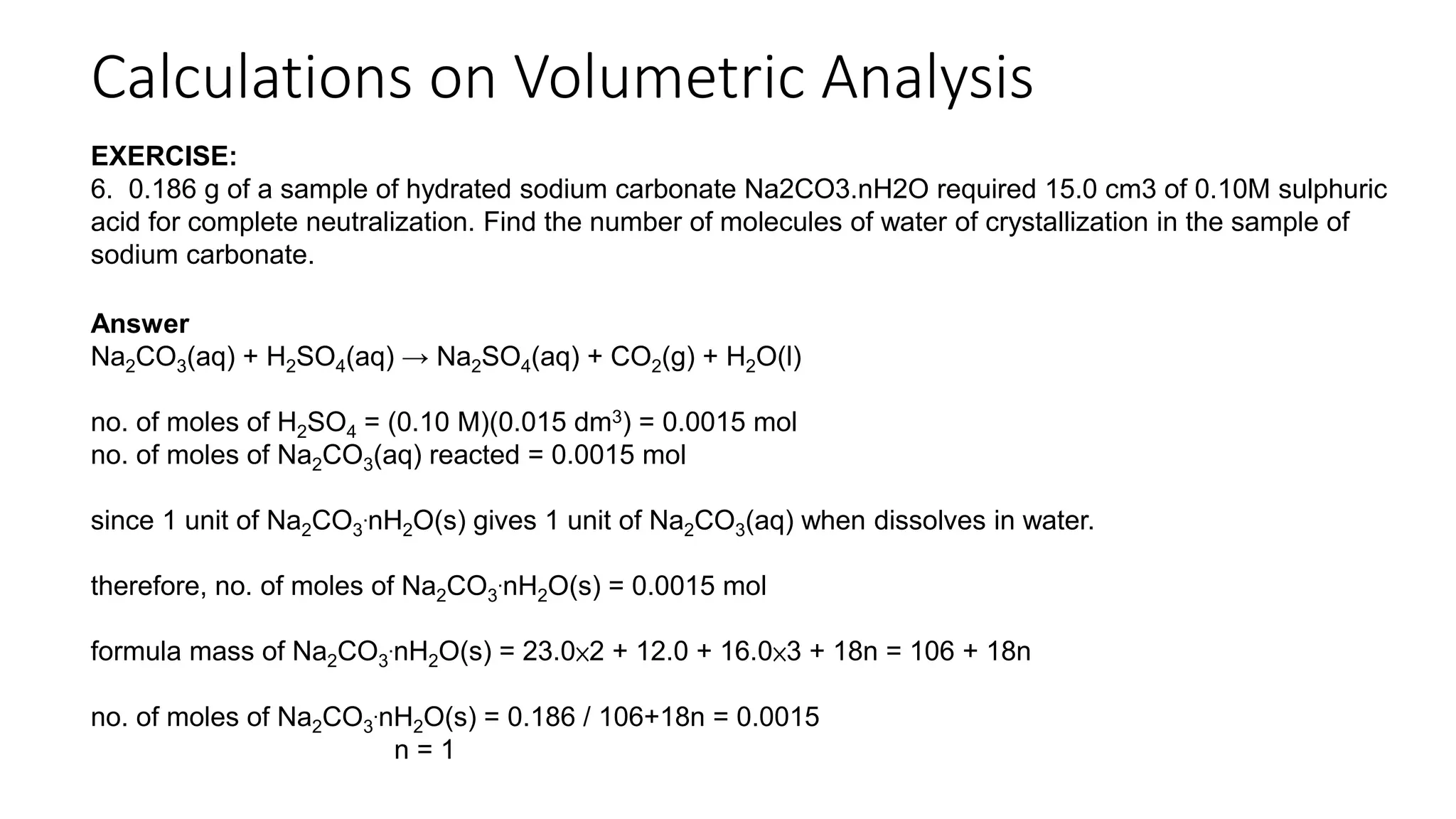
EXERCISE:
6. 0.186 g of a sample of hydrated sodium carbonate Na2CO3.nH2O required 15.0 cm3 of 0.10M sulphuric
acid for complete neutralization. Find the number of molecules of water of crystallization in the sample of
sodium carbonate.
Answer
Na2CO3(aq) + H2SO4(aq) → Na2SO4(aq) + CO2(g) + H2O(l)
no. of moles of H2SO4 = (0.10 M)(0.015 dm3) = 0.0015 mol
no. of moles of Na2CO3(aq) reacted = 0.0015 mol
since 1 unit of Na2CO3
.nH2O(s) gives 1 unit of Na2CO3(aq) when dissolves in water.
therefore, no. of moles of Na2CO3
.nH2O(s) = 0.0015 mol
formula mass of Na2CO3
.nH2O(s) = 23.0×2 + 12.0 + 16.0×3 + 18n = 106 + 18n
no. of moles of Na2CO3
.nH2O(s) = 0.186 / 106+18n = 0.0015
n = 1
Calculations on Volumetric Analysis
EXERCISE:
7. 0.509 g of an impure sample of anhydrous potassium carbonate (containing potassium chloride as impurity)
dissolves in water. The resulting solution required 35.0 cm3 of 0.20 M hydrochloric acid for complete
neutralization. Find the percentage purity of the anhydrous potassium carbonate sample.
Answer
K2CO3(aq) + 2HCl(aq) → 2KCl(aq) + CO2(g) + H2O(l)
no. of moles of HCl = (0.20 M)(0.035 dm3) = 0.007 mol
no. of moles of K2CO3 reacted = (0.007 mol) /2 = 0.0035 mol
mass of K2CO3 = (0.0035 mol)(39.0×2 + 12.0 + 16.0×3) = 0.483 g
percentage purity = (0.483 g / 0.509 g) ×100% = 94.89%

Topic 4 - Acids and Bases (Titration).pdf

  • 1.
    Steps in titration Finally,take a reasonable volume of solution B required in titration
  • 2.
    The conical flaskused in titration has to be cleaned by washing with water. (It should not be washed with the solution it is to hold.) The washed conical flask need not be dried before use. Explain. • The conical flask is to hold a specific volume of a solution (usually 25.0 cm3) and hence a specific amount of the solute. The conical flask has to be washed with water to get rid of impurities, which may affect titration results. It should not be washed with the solution, since an additional amount of solution would certainly affect titration results. • After washing, a little water would remain in the conical flask. This will not change the amount of solute present. Thus we should not waste time in drying the conical flask.
  • 3.
    Cleansing by washingwith water/ solution to be contained? • Get rid of impurities? ( Distilled water should be used.) • Additional amount of solution would certainly affect titration results? (i.e. Will affect the total amount of solute present in the container, BUT IS IT IMPORTANT?)
  • 4.
    End Point Detectionin Acid-Alkali Titrations Titration type Example Suitable indicator(s) Strong acid - strong alkali HCl(aq) vs. NaOH(aq) methyl orange; phenolphthalein Strong acid - weak alkali (Strong acid - carbonate) HNO3(aq) vs. NH3(aq) HCl(aq) vs. Na2CO3(aq) methyl orange Weak acid - strong alkali CH3COOH(aq) vs. KOH(aq) phenolphthalein Weak acid - weak alkali CH3COOH(aq) vs. NH3(aq) no suitable indicator 1. By use of indicators An Indicator is a substance which changes colour within a specific pH range. Commonly used indicators are methyl orange and phenolphthalein..
  • 5.
    End Point Detectionin Acid-Alkali Titrations Titration type Example Suitable indicator(s) Strong acid - strong alkali HCl(aq) vs. NaOH(aq) methyl orange; phenolphthalein Strong acid - weak alkali (Strong acid - carbonate) HNO3(aq) vs. NH3(aq) HCl(aq) vs. Na2CO3(aq) methyl orange Weak acid - strong alkali CH3COOH(aq) vs. KOH(aq) phenolphthalein Weak acid - weak alkali CH3COOH(aq) vs. NH3(aq) no suitable indicator Name a suitable indicator for titration of each of the following complete neutralizations: a. H2SO4(aq) vs. K2CO3(aq) b. H2SO4(aq) vs. KOH(aq) a. methyl orange b. methyl orange or phenolphthalein.
  • 6.
    End Point Detectionin Acid-Alkali Titrations 2. By use of pH meter pH meter is an instrument which gives direct reading of pH on the scale 0 to 14. When 0.1 M HCl is titrated against 25 cm3 of 0.1 M NaOH, the following graph would be obtained:
  • 7.
    End Point Detectionin Acid-Alkali Titrations 3. By conductivity measurements Changing concentration of hydrogen or hydroxide ions in a solution causes a change in the conductivity of that solution. As acid-base titrations involve change of ionic concentrations, thus the reaction can be followed by means of conductivity measurement. Again let us consider the addition of 0.1 M HCl from a burette into a conical flask containing 25 cm3 of 0.1 M NaOH and note the conductivity of the solution.
  • 8.
    End Point Detectionin Acid-Alkali Titrations At A : Conductivity high due to presence of large number of mobile OH- ions from NaOH. A to E : Conductivity falls as mobile OH- are replaced by less mobile Cl-. At E : The end-point. Conductivity is at a minimum when the neutralization is complete. Na+(aq) + OH-(aq) + H+(aq) + Cl-(aq) → Na+(aq) + Cl-(aq) + H2O(l) The conductivity at the end-point is not zero as the solution contains sodium and chloride ions. E to B : Conductivity increases due to the addition of excess mobile H+ from HCl. The graph rises more steeply than from A to E as H+ ions are more mobile than OH- ions.
  • 9.
    Additional Info onConductivity Measurements • 2017/DSE/1B/Q1c (c) (i) White precipitate forms (ii) (1) Ba2+ react with SO4 2- to form insoluble BaSO4. The concentration of mobile ion decrease. (2) Extra unreacted H2SO4 added increases the concentration of mobile ion (More H+ and SO4 2-)
  • 10.
    End Point Detectionin Acid-Alkali Titrations 4. By thermometric titration The reaction H+(aq) + OH-(aq) → H2O(l) is exothermic. There is the greatest temperature rise at end point. Consider 25 cm3 of 0.1 M NaOH places in a polystyrene beaker together with a thermometer. 0.1 M HCl is added, a definite quantity at a time, the temperature being noted after each addition. The following graph is obtained:
  • 11.
    End Point Detectionin Acid-Alkali Titrations A to E : Temperature rises as more heat is liberated by adding more acid. At E : The end-point. Temperature is maximum. E to B : Temperature drops as more acid added will not liberate more heat but will cool the solution.
  • 12.
    Preparing a solublesalt by titration To prepare NaCl by titration Step 1: Place a known volume of NaOH in a conical flask and a few drops of acid-base indicator are added. Step 2: Titrate the NaOH by hydrochloric acid until the indicator change just changes colour (end point is reached) Step 3: Repeat the experiment with the same volume of alkali. Do not use any indicator this time. Add the volume of acid needed for neutralization (as found from the first experiment). Step 4: Evaporate the reaction mixture slowly to obtain the salt.
  • 13.
    Calculations on VolumetricAnalysis 1. Mole ratio from equation Problems on volumetric analysis can be solved by using the mole concept. We have to write a balanced equation for each reaction that takes place. We should then find mole ratio of reactants from the equations. Consider two examples: a. H2SO4(aq) + 2NaOH(aq) → Na2SO4(aq) + 2H2O(l) The mole ratio of H2SO4 to NaOH is 1:2. In other words, 1 mole of H2SO4 required 2 moles of NaOH for complete neutralization. b. CH3COOH(aq) + NaOH(aq) → CH3COONa(aq) + H2O(l) The mole ratio of CH3COOH to NaOH is 1:1. In other words, 1 mole of CH3COOH requires 1 mole of NaOH for complete neutralization.
  • 14.
    Calculations on VolumetricAnalysis Example Find number of moles of hydrochloric acid required for complete neutralization of 30 cm3 of 0.50 M ammonia solution. Answer HCl(aq) + NH3(aq) → NH4Cl(aq) no. of moles of NH3 = (0.50M)(0.03 dm3) = 0.015 mol. According to the equation, 1 mole of HCl reacts with 1 mole of NH3 therefore, the no. of moles of HCl required = 0.015 mol
  • 15.
    Calculations on VolumetricAnalysis 2. Applications of volumetric analysis : To determine : (1) concentration of a solution (standardization). (2) number of water of crystallization of a hydrated salt. (3) composition of a mixture. (4) charge of ion. (5) percentage of ammonia in an ammonium salt (or percentage purity of an ammonium salt). (6) molar mass of a substance. (7) atomic mass of a metal.
  • 16.
    Calculations on VolumetricAnalysis Example 1 2.65 g of sodium carbonate (Na2CO3) were dissolved in water and made up to 250 cm3 solution. 25 cm3 of this required 20.0 cm3 of a hydrochloric acid solution for complete reaction. Find the molarity of the hydrochloric acid. Answer Molar mass of Na2CO3 = 106 g Number of mole of Na2CO3 in 250 cm3 of solution = 2.65/106 = 0.0250 Number of mole of Na2CO3 in 25.0 cm3 of solution = 0.0250 × (25.0/250) = 0.0025 2HCl(aq) + Na2CO3(aq) → 2NaCl(aq) + H2O(l) + CO2(g) From the equation, 2 moles of HCl react with 1 mole of Na2CO3, ∴ number of moles of HCl in 20.0 cm3 of solution = 0.0025 × 2 = 0.0050 Number of moles of HCl in 1000 cm3 of solution = 0.0050 × (1000/20.0) = 0.250 ∴ Molarity of the HCl solution = 0.250 M
  • 17.
    Calculations on VolumetricAnalysis Example 2 4.0 g of a sample of hydrated sodium carbonate, of formula Na2CO3.nH2O, are dissolved in water and the solution made up to 250 cm3. Using methyl orange as indicator, 25 cm3 of this solution require 29 cm3 of 0.05 M sulphuric acid for neutralization. Calculate n, the number of molecules of water of crystallization, in the sample of sodium carbonate. Molar mass of Na2CO3.nH2O = (23 × 2 + 12 + 16 × 3 + 18n)g Number of moles of Na2CO3.nH2O in 250 cm3 of solution = 4.0/(106 + 18n) Number of moles of Na2CO3.nH2O in 25 cm3 of solution = According to the equation Na2CO3.nH2O(aq) + H2SO4 (aq) ⎯⎯→ Na2SO4(aq) + CO2(g) + (n+1)H2O(l) Number of moles of Na2CO3.nH2O in 25 cm3 of solution = number of moles of H2SO4 in 29cm3 of 0.05 M H2SO4 = 0.05 × 29/1000 = 0.00145 ∴ = 0.00145 ∴ n = 9.4
  • 18.
    Calculations on VolumetricAnalysis Example 3 0.949 g of a mixture of sodium hydroxide and anhydrous sodium carbonate was dissolved in 100 cm3 of water. This solution requires 30.0 cm3 of 0.650 M hydrochloric acid for complete reaction. Find the percentage by mass of the mixture. Let y g be the mass of NaOH, then the mass of Na2CO3 = (0.949 - y) g Molar mass of NaOH = 40 g Molar mass of Na2CO3 = 106 g NaOH(aq) + HCl(aq) ⎯⎯→ NaCl(aq) + H2O(l) no. of moles of HCl required to neutralize NaOH = y/40 Na2CO3(aq) + 2HCl(aq) ⎯⎯→ 2NaCl(aq) + CO2(g) + H2O(l) no. of moles of HCl required to neutralize Na2CO3 = 2× [(0.949-y)/106] Therefore the total no. moles of HCl = y/40 + 2× [(0.949-y)/106] From the given data, the no. of moles of HCl = 0.650 x 30.0/1000 = 0.0195 y/40 + 2× [(0.949-y)/106] = 0.0195 y = 0.260 ∴ % by mass of NaOH = 0.260/0.949 × 100% = 27.4% % by mass of Na2CO3 = 100% - 27.4% = 72.6%
  • 19.
  • 20.
    DSE/2014/1B/Q7 2 marks What ifthe question value 3 marks? Add a point that ‘Rinse the beaker containing the sodium carbonate solution by several times and drain all the washings into the volumetric flask.
  • 21.
  • 22.
    DSE/2014/1B/Q7 Make sure youhave the concept that concentrated hydrochloric acid is volatile → Loss of solute in form of acid mist → Exact no. of moles of HCl decreases → Concentration of HCl(aq) is less than the expected value.
  • 23.
    Back Titration Back titration Backtitration is a method used to find out the number of mole of acid (or alkali) left after a main reaction. After finding the number of mole of acid (or alkali), the number of mole of acid (or alkali) reacted in the main reaction can be calculated. e.g. An excess amount of acid (or alkali) are added to react with X Main reaction: X + Acid (or alkali) → Product (Excess) The amount of acid (or alkali) left can be found by reacting with a standard alkali (or acid) solution. Tiitration solution: Standard alkali + Acid (Left) → Product or Standard acid + Alkali (Left) → Product
  • 24.
    Back Titration Back titration Calculationprocedure: 1. Calculate the number of mole of standard alkali (or acid) used. 2. Calculate the number of mole of acid (or alkali) left. 3. Calculate the number of mole of acid (or alkali) reacted with X in the main reaction by 4. Calculate the number of mole of X. Number of mole of acid (or alkali) reacted with X Number of mole of acid (or alkali) added at the start Number of mole of acid (or alkali) left = -
  • 25.
    Calculation Problems onBack Titration EXERCISE: 2. 25.0 cm3 of a 1.0 M solution of sodium hydroxide were placed in a flask. 1.40 g of an impure specimen of ammonium chloride was added. The flask and its contents were then carefully heated until no more ammonia gas was evolved. The resulting solution was found to be alkaline and was diluted to exactly 250 cm3. 50 cm3 of this solution required 5.10 cm3 of 0.1 M hydrochloric acid for neutralization. Calculate the percentage purity of the original impure ammonium chloride. Answer: NaOH(aq) + NH4Cl(aq) → NH3(g) + NaCl(aq) + H2O(l) NaOH(aq) + HCl(aq) → NaCl(aq) + H2O(l) no. of moles of HCl = (0.1M)(0.0051 dm3) = 5.1×10⁻⁴ mol no. of moles of NaOH in the 50 cm3 solution = 5.1×10⁻⁴ mol no. of moles of NaOH in the 250 cm3 solution = (5.1×10⁻⁴ mol)(250 / 50) = 2.55×10⁻³ mol The initial no. of moles of NaOH = (1.0M)(0.025 dm3) = 0.025 mol The no. of moles of NaOH reacted with NH4Cl = 0.025 mol - 2.55×10⁻³ mol = 0.02245 mol no. of moles of NH4Cl reacted = 0.02245 mol mass of NH4Cl = (0.02245)(14.0 + 1.0×4 + 35.5) = 1.201 g percentage purity = (1.201 / 1.4)(100%) = 85.79%
  • 26.
    Calculation Problems onBack Titration HOMEWORK: 1. A drug tablet can relieve stomach aches. It contains aluminium hydroxide (Al(OH)3), as the only active ingredient. A student performed the following experiment to determine the amount of aluminium hydroxide contained in one drug tablet. Step 1: One drug tablet was dissolved in 50.0cm3 of 1.00 mol dm-3 hydrochloric acid to form a solution. Step 2: The solution was placed in a volumetric flask and then diluted to 250.0cm3 with distilled water. Step 3: 25.0 cm3 of the diluted solution were titrated with 0.190 mol dm-3 sodium hydroxide solution using a suitable indicator. 18.1 cm3 of sodium hydroxide solution were needed to reach the end point. (a) Calculate the number of moles of excess hydrochloric acid in 25.0cm3 of the diluted solution from the data obtained in the titration. (b) Calculate the number of moles of hydrochloric acid that was added in Step 1. (c) Hence calculate the mass of aluminium hydroxide in one drug tablet. (Relative atomic masses: H = 1.0, O = 16.0, Al = 27.0)
  • 27.
    Calculation Problems onBack Titration HOMEWORK: 2. The following experiment was carried out to determine the concentration of copper(II) ions in a copper(II) nitrate solution: Step 1: 25.0 cm3 of 0.660 mol dm-3 sodium hydroxide solution were added to 25.0 cm3 of copper(II) nitrate solution to precipitate out the copper(II) hydroxide. Step 2: The copper(II) hydroxide was removed from the reaction mixture. Step 3: The alkali left over in the reaction mixture was titrated against 0.200 mol dm-3 hydrochloric acid using a suitable indicator. 20.5 cm3 of the acid were required to reach the end point. (a) Write an ionic equation for the reaction that occurred in step 1. (b) Suggest a method to remove the copper(II) hydroxide from the reaction mixture in step 2. (c)(i) Based on the titration result in Step 3, calculate the number of moles of hydroxide ions left over in the reaction mixture. (ii) Calculate the number of moles of sodium hydroxide that was added in Step 1. (iii) Calculate the concentration of copper(II) ions in the copper(II) nitrate solution.
  • 28.
    Calculation Problems onBack Titration HOMEWORK:
  • 29.
    Calculations on VolumetricAnalysis EXERCISE: 1. 1.5 g of a dibasic acid containing two molecules of water of crystallization are dissolved in distilled water and the solution made up to 250 cm3. 25 cm3 of this solution require for neutralization 26.2 cm3 of 0.1 M sodium hydroxide solution. Calculate the relative molecular mass of the crystalline solid acid. Answer: Let the formula of the crystalline solid acid be H2A.2H2O. H2A(aq) + 2NaOH(aq) → Na2A(aq) + 2H2O(l) no. of moles of the NaOH solution = (0.1M)(0.0262 dm3) = 0.00262 mol no. of moles of H2A in the 25 cm3 solution = (0.00262 mol) /2 = 0.00131 mol no. of moles of H2A in the 250 cm3 solution = (0.00131 mol)(250 / 25) = 0.0131 mol Because 1 unit of H2A.2H2O(s) gives one unit of H2A(aq) therefore, the no. of moles of H2A.2H2O = 0.0131 mol Since no. of moles = mass / molar mass therefore, the relative molecular mass of the solid acid = 1.5 / 0.0131 = 114.5 (no unit!)
  • 30.
    Calculations on VolumetricAnalysis EXERCISE: 3. 25.0 cm3 of 0.0527 M sodium carbonate solution were pipetted into a conical flask. Two drops of methyl orange were added. Sulphuric acid was then added from a burette, until the solution just turned from yellow to red. The titration was repeated 2 more times. Calculate the molarity of the sulphuric acid. Answer Na2CO3(aq) + H2SO4(aq) → Na2SO4(aq) + CO2(g) + H2O(l) Average volume of sulphuric acid used = (25.70 + 25.90)/2 = 25.80 cm3 no. of moles of Na2CO3 = (0.0527M)(0.025dm3) = 1.3175×10⁻³ mol no. of moles of H2SO4 = 1.3175×10⁻³ mol concentration of H2SO4 = (1.3175×10⁻³ mol) / 0.0258 dm3 = 0.051 M Titration 1 2 3 Final burette reading (cm3) 26.90 27.90 26.90 Initial burette reading (cm3) 0.30 2.20 1.00 Volume of acid added (cm3) 26.60 25.70 25.90
  • 31.
    Calculations on VolumetricAnalysis EXERCISE: 4. 2.17 g of ethanedioic acid (COOH)2.2H2O were made up to 250 cm3 of solution. 25.0 cm3 of the solution required 29.3 cm3 of 0.119 M sodium hydroxide solution for complete neutralization. Find the basicity of the acid. Answer molecular mass of the solid acid = (12.0 + 16.0×2 + 1.0)2 + 18.0×2 = 126.0 no. of moles of the solid acid = (2.17)/(126) = 0.01722 mol since 1 unit of (COOH)2 .2H2O(s) gives 1 unit of (COOH)2(aq) therefore, the no. of moles of (COOH)2(aq) in 250cm3 solution = 0.01722 mol no.of moles of (COOH)2(aq) in 25 cm3 solution = 0.01722mol / 10 = 0.001722 mol no. of moles of NaOH = (0.119M)(0.0293 dm3) = 0.00349 mol no. of moles of NaOH / no. of moles of (COOH)2(aq) = 0.00349 / 0.001722 = 2.024 therefore, the basicity of the acid is 2. (H2A + 2NaOH → Na2A + 2H2O)
  • 32.
    Calculations on VolumetricAnalysis EXERCISE: 5. 2.00 g of a solid dibasic acid (H2A) were dissolved in water and made up to 250 cm3. 25.0 cm3 of this solution required 31.8 cm3 of 0.10 M sodium hydroxide solution for complete neutralization. Find the molar mass of the acid. Answer H2A(aq) + 2NaOH(aq) → Na2A(aq) + 2H2O(l) no. of moles of NaOH = (0.10M)(0.0318dm3) = 0.00318 mol no. of moles of H2A in the 25 cm3 solution = 0.00318 mol /2 = 0.00159 mol no. of moles of H2A in the 250 cm3 solution = 0.00159 mol ×10 = 0.0159 mol molar mass of H2A = (2.00g)/(0.0159 mol) = 125.8 g mol-1
  • 33.
    Calculations on VolumetricAnalysis EXERCISE: 6. 0.186 g of a sample of hydrated sodium carbonate Na2CO3.nH2O required 15.0 cm3 of 0.10M sulphuric acid for complete neutralization. Find the number of molecules of water of crystallization in the sample of sodium carbonate. Answer Na2CO3(aq) + H2SO4(aq) → Na2SO4(aq) + CO2(g) + H2O(l) no. of moles of H2SO4 = (0.10 M)(0.015 dm3) = 0.0015 mol no. of moles of Na2CO3(aq) reacted = 0.0015 mol since 1 unit of Na2CO3 .nH2O(s) gives 1 unit of Na2CO3(aq) when dissolves in water. therefore, no. of moles of Na2CO3 .nH2O(s) = 0.0015 mol formula mass of Na2CO3 .nH2O(s) = 23.0×2 + 12.0 + 16.0×3 + 18n = 106 + 18n no. of moles of Na2CO3 .nH2O(s) = 0.186 / 106+18n = 0.0015 n = 1
  • 34.
    Calculations on VolumetricAnalysis EXERCISE: 7. 0.509 g of an impure sample of anhydrous potassium carbonate (containing potassium chloride as impurity) dissolves in water. The resulting solution required 35.0 cm3 of 0.20 M hydrochloric acid for complete neutralization. Find the percentage purity of the anhydrous potassium carbonate sample. Answer K2CO3(aq) + 2HCl(aq) → 2KCl(aq) + CO2(g) + H2O(l) no. of moles of HCl = (0.20 M)(0.035 dm3) = 0.007 mol no. of moles of K2CO3 reacted = (0.007 mol) /2 = 0.0035 mol mass of K2CO3 = (0.0035 mol)(39.0×2 + 12.0 + 16.0×3) = 0.483 g percentage purity = (0.483 g / 0.509 g) ×100% = 94.89%