QUARTER
2
GENERAL CHEMISTRY 1
LESSON
1:
QUANTUM
NUMBERS
20XX PRESENTATION TITLE 2
INTRODUCTI
ON
If you ride an airplane, you need a ticket
to get in. Your ticket may likely specify a
gate number, a section number, a row,
and a seat number. No other ticket can
have the same four parts to it. It may
have the same gate, section, and seat
number, but it would have to be in a
different row. Each seat is unique and
allows only one occupant to fill it.
20XX PRESENTATION TITLE 3
REVIEW
20XX PRESENTATION TITLE 4
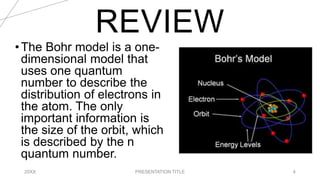
•The Bohr model is a one-
dimensional model that
uses one quantum
number to describe the
distribution of electrons in
the atom. The only
important information is
the size of the orbit, which
is described by the n
quantum number.
REVIEW
20XX PRESENTATION TITLE 5
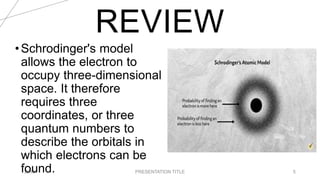
•Schrodinger's model
allows the electron to
occupy three-dimensional
space. It therefore
requires three
coordinates, or three
quantum numbers to
describe the orbitals in
which electrons can be
found.
20XX PRESENTATION TITLE 6
QUANTUM NUMBERS
20XX PRESENTATION TITLE 7
•Specify the properties of the atomic
orbitals and the electrons in those
orbitals. An electron in an atom or
ion has four quantum numbers to
describe its state.
FOUR QUANTUM
NUMBERS
20XX PRESENTATION TITLE 8
•principal quantum number (n),
•the orbital angular momentum
quantum number (𝑙),
•the magnetic quantum number (𝑚𝑙),
and
•the electron spin quantum number
(𝑚𝑠)
FOUR QUANTUM
NUMBERS
20XX PRESENTATION TITLE 9
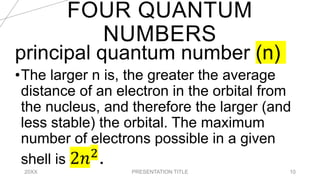
principal quantum number (n)
•Designates the main energy level (floor) or shell.
•Values: 1, 2, 3, …….∞. n = 7 is the highest
number of shell used for the atoms known.
•Describes the CLOUD SIZE. The larger the
value of n, the larger the cloud size.
FOUR QUANTUM
NUMBERS
20XX PRESENTATION TITLE 10
principal quantum number (n)
•The larger n is, the greater the average
distance of an electron in the orbital from
the nucleus, and therefore the larger (and
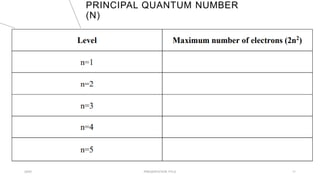
less stable) the orbital. The maximum
number of electrons possible in a given
shell is 2𝑛2
.
PRINCIPAL QUANTUM NUMBER
(N)
20XX PRESENTATION TITLE 11
FOUR QUANTUM
NUMBERS
20XX PRESENTATION TITLE 12
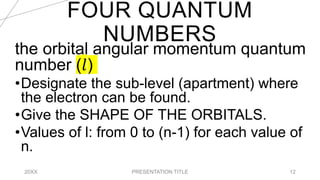
the orbital angular momentum quantum
number (𝑙)
•Designate the sub-level (apartment) where
the electron can be found.
•Give the SHAPE OF THE ORBITALS.
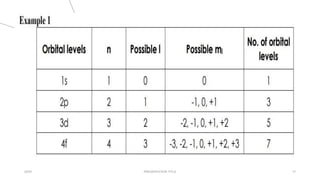
•Values of l: from 0 to (n-1) for each value of
n.
FOUR QUANTUM NUMBERS
20XX PRESENTATION TITLE 13
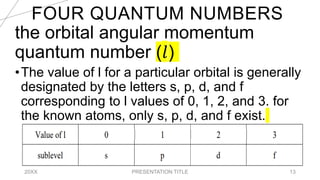
the orbital angular momentum
quantum number (𝑙)
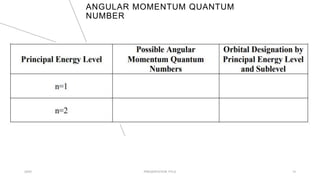
•The value of l for a particular orbital is generally
designated by the letters s, p, d, and f
corresponding to l values of 0, 1, 2, and 3. for
the known atoms, only s, p, d, and f exist.
ANGULAR MOMENTUM QUANTUM
NUMBER
20XX PRESENTATION TITLE 14
FOUR QUANTUM NUMBERS
20XX PRESENTATION TITLE 15
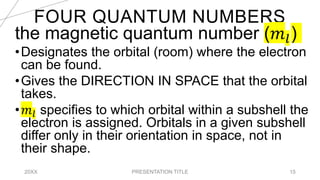
the magnetic quantum number (𝑚𝑙)
•Designates the orbital (room) where the electron
can be found.
•Gives the DIRECTION IN SPACE that the orbital
takes.
•𝑚𝑙 specifies to which orbital within a subshell the
electron is assigned. Orbitals in a given subshell
differ only in their orientation in space, not in
their shape.
FOUR QUANTUM NUMBERS
20XX PRESENTATION TITLE 16
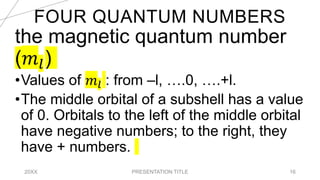
the magnetic quantum number
(𝑚𝑙)
•Values of 𝑚𝑙 : from –l, ….0, ….+l.
•The middle orbital of a subshell has a value
of 0. Orbitals to the left of the middle orbital
have negative numbers; to the right, they
have + numbers.
20XX PRESENTATION TITLE 17
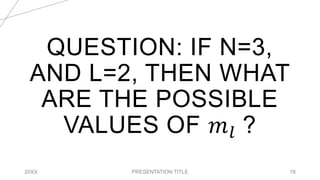
QUESTION: IF N=3,
AND L=2, THEN WHAT
ARE THE POSSIBLE
VALUES OF 𝑚𝑙 ?
20XX PRESENTATION TITLE 18
FOUR QUANTUM
NUMBERS
20XX PRESENTATION TITLE 19
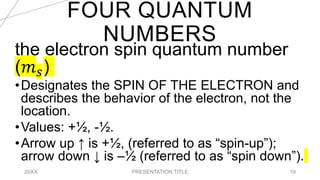
the electron spin quantum number
(𝑚𝑠)
•Designates the SPIN OF THE ELECTRON and
describes the behavior of the electron, not the
location.
•Values: +½, -½.
•Arrow up ↑ is +½, (referred to as “spin-up”);
arrow down ↓ is –½ (referred to as “spin down”).
FOUR QUANTUM
NUMBERS
20XX PRESENTATION TITLE 20
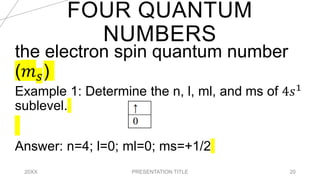
the electron spin quantum number
(𝑚𝑠)
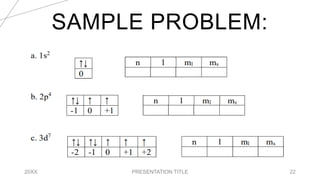
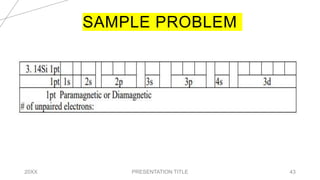
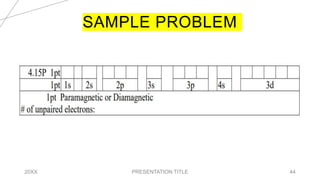
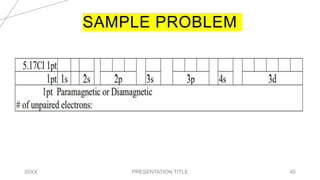
Example 1: Determine the n, l, ml, and ms of 4𝑠1
sublevel.
Answer: n=4; l=0; ml=0; ms=+1/2
FOUR QUANTUM
NUMBERS
20XX PRESENTATION TITLE 21
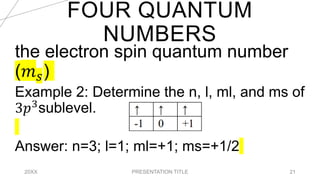
the electron spin quantum number
(𝑚𝑠)
Example 2: Determine the n, l, ml, and ms of
3𝑝3
sublevel.
Answer: n=3; l=1; ml=+1; ms=+1/2
SAMPLE PROBLEM:
20XX PRESENTATION TITLE 22
LESSON
2:
MAGNETIC
PROPERTIES OF THE
ATOM BASED ON ITS
ELECTRONIC
CONFIGURATION
20XX PRESENTATION TITLE 23
INTRODUCTI
ON
Whether you see it or not, there are
thousands of chemical reactions
happening inside and outside of us
every second. Chemistry has done so
much to enable our hands to create
new things in our homes, shops, and
laboratories. Creativity and reactions
work, and it has changed the
trajectory of humanity’s way of life.
20XX PRESENTATION TITLE 24
REVIEW
20XX PRESENTATION TITLE 25
•Element is a substance that consists of only
one type of atom. Each atom from an element
retains all the characteristics of that element.
•Atoms are made up of subatomic particles called
protons, neutrons, and electrons and inside the
subatomic particles are elementary particles.
•The nucleus of the atom contains protons and
neutrons. Nearly all of the mass of the atom is
concentrated in the nucleus.
REVIEW
20XX PRESENTATION TITLE 26
• Atomic number is equal to the number of protons in the
nucleus of an atom of an element. The numbers of protons in
an atom never change. The protons are positively charged
subatomic particles.
• Neutron is an uncharged subatomic particle. When there is an
added number of neutrons in an atom of the same element,
we call them isotopes.
• The electrons are negatively charged subatomic particles
found at large distances from the nucleus. Electrons in the
outer shell of an atom are the most important in determining
chemical properties
• In the neutral state, the number of electrons is equal to the
number of protons.
REVIEW
20XX PRESENTATION TITLE 27
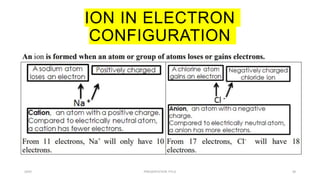
• Ion is a charged atom or substance formed by the
addition or removal of one or more electron(s) from a
neutral atom.
• A group contains elements with similar properties in
the periodic table of elements. Elements in the group
have the same number of outer electrons.
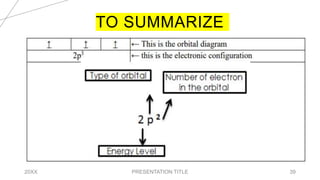
• An electronic configuration is the arrangement of
electrons in energy levels around the nucleus.
REVIEW
20XX PRESENTATION TITLE 28
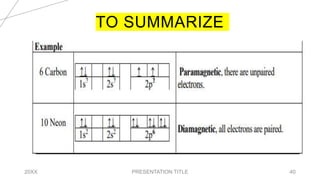
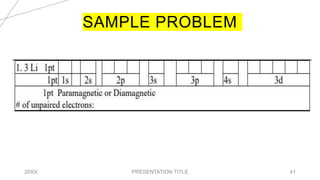
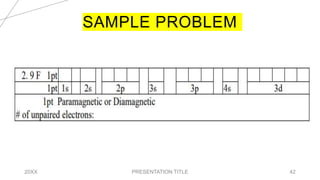
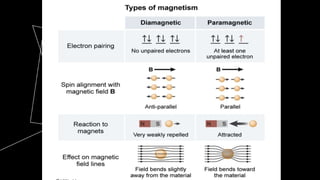
•Magnetism is the behavior of substance
when exposed to a magnetic field. If an
element has at least one half-filled orbital or
unpaired electron, they are called
paramagnetic. If an element has no half-
filled orbital, or all electrons are paired, it is
called diamagnetic.
Reviewing these key terms is important
because foundation matters.
RULES AND PRINCIPLES FOR
ELECTRONIC CONFIGURATION
20XX PRESENTATION TITLE 29
1.Aufbau Principle
2. Pauli Exclusion Principle
3. The Hund’s Rule
1. AUFBAU PRINCIPLE
20XX PRESENTATION TITLE 30
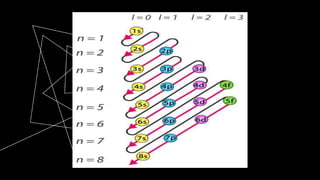
States that in the ground state of an atom,
electrons fill atomic orbitals of the lowest
available energy levels before occupying
higher levels.
1s > 2s > 2p >3s > 3p > 4s >3 d > 4p > 5s
> 4d > 5p > 6s > 4f . . .
The s orbital is a sphere, and it can hold 2
electrons, and it exists in all energy levels.
2. PAULI EXCLUSION PRINCIPLE
20XX PRESENTATION TITLE 32
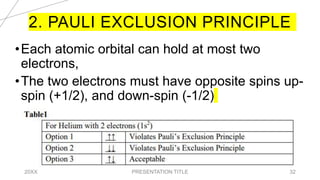
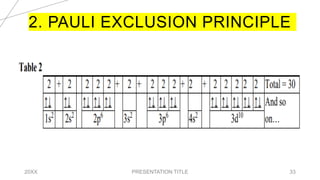
•Each atomic orbital can hold at most two
electrons,
•The two electrons must have opposite spins up-
spin (+1/2), and down-spin (-1/2)
2. PAULI EXCLUSION PRINCIPLE
20XX PRESENTATION TITLE 33
3. THE HUND’S RULE
20XX PRESENTATION TITLE 34
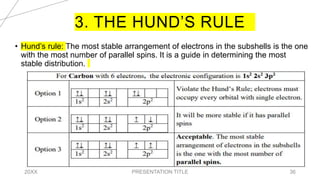
•Hund's Rule states that electrons
must occupy every orbital with a
single electron, and only then we
can put the second electron into the
orbital.
3. THE HUND’S RULE
20XX PRESENTATION TITLE 35
•This may leave the atom with
many unpaired electrons.
Because unpaired electrons can
spin in either direction, they
display magnetic moments in
any direction.
3. THE HUND’S RULE
20XX PRESENTATION TITLE 36
• Hund’s rule: The most stable arrangement of electrons in the subshells is the one
with the most number of parallel spins. It is a guide in determining the most
stable distribution.
ION IN ELECTRON
CONFIGURATION
20XX PRESENTATION TITLE 38
TO SUMMARIZE
20XX PRESENTATION TITLE 39
TO SUMMARIZE
20XX PRESENTATION TITLE 40
SAMPLE PROBLEM
20XX PRESENTATION TITLE 41
SAMPLE PROBLEM
20XX PRESENTATION TITLE 42
SAMPLE PROBLEM
20XX PRESENTATION TITLE 43
SAMPLE PROBLEM
20XX PRESENTATION TITLE 44
SAMPLE PROBLEM
20XX PRESENTATION TITLE 45

GENCHEM1-LESSON 1-2-QUANTUM NUMBERS.pptx

  • 1.
  • 2.
  • 3.
    INTRODUCTI ON If you ridean airplane, you need a ticket to get in. Your ticket may likely specify a gate number, a section number, a row, and a seat number. No other ticket can have the same four parts to it. It may have the same gate, section, and seat number, but it would have to be in a different row. Each seat is unique and allows only one occupant to fill it. 20XX PRESENTATION TITLE 3
  • 4.
    REVIEW 20XX PRESENTATION TITLE4 •The Bohr model is a one- dimensional model that uses one quantum number to describe the distribution of electrons in the atom. The only important information is the size of the orbit, which is described by the n quantum number.
  • 5.
    REVIEW 20XX PRESENTATION TITLE5 •Schrodinger's model allows the electron to occupy three-dimensional space. It therefore requires three coordinates, or three quantum numbers to describe the orbitals in which electrons can be found.
  • 6.
  • 7.
    QUANTUM NUMBERS 20XX PRESENTATIONTITLE 7 •Specify the properties of the atomic orbitals and the electrons in those orbitals. An electron in an atom or ion has four quantum numbers to describe its state.
  • 8.
    FOUR QUANTUM NUMBERS 20XX PRESENTATIONTITLE 8 •principal quantum number (n), •the orbital angular momentum quantum number (𝑙), •the magnetic quantum number (𝑚𝑙), and •the electron spin quantum number (𝑚𝑠)
  • 9.
    FOUR QUANTUM NUMBERS 20XX PRESENTATIONTITLE 9 principal quantum number (n) •Designates the main energy level (floor) or shell. •Values: 1, 2, 3, …….∞. n = 7 is the highest number of shell used for the atoms known. •Describes the CLOUD SIZE. The larger the value of n, the larger the cloud size.
  • 10.
    FOUR QUANTUM NUMBERS 20XX PRESENTATIONTITLE 10 principal quantum number (n) •The larger n is, the greater the average distance of an electron in the orbital from the nucleus, and therefore the larger (and less stable) the orbital. The maximum number of electrons possible in a given shell is 2𝑛2 .
  • 11.
    PRINCIPAL QUANTUM NUMBER (N) 20XXPRESENTATION TITLE 11
  • 12.
    FOUR QUANTUM NUMBERS 20XX PRESENTATIONTITLE 12 the orbital angular momentum quantum number (𝑙) •Designate the sub-level (apartment) where the electron can be found. •Give the SHAPE OF THE ORBITALS. •Values of l: from 0 to (n-1) for each value of n.
  • 13.
    FOUR QUANTUM NUMBERS 20XXPRESENTATION TITLE 13 the orbital angular momentum quantum number (𝑙) •The value of l for a particular orbital is generally designated by the letters s, p, d, and f corresponding to l values of 0, 1, 2, and 3. for the known atoms, only s, p, d, and f exist.
  • 14.
  • 15.
    FOUR QUANTUM NUMBERS 20XXPRESENTATION TITLE 15 the magnetic quantum number (𝑚𝑙) •Designates the orbital (room) where the electron can be found. •Gives the DIRECTION IN SPACE that the orbital takes. •𝑚𝑙 specifies to which orbital within a subshell the electron is assigned. Orbitals in a given subshell differ only in their orientation in space, not in their shape.
  • 16.
    FOUR QUANTUM NUMBERS 20XXPRESENTATION TITLE 16 the magnetic quantum number (𝑚𝑙) •Values of 𝑚𝑙 : from –l, ….0, ….+l. •The middle orbital of a subshell has a value of 0. Orbitals to the left of the middle orbital have negative numbers; to the right, they have + numbers.
  • 17.
  • 18.
    QUESTION: IF N=3, ANDL=2, THEN WHAT ARE THE POSSIBLE VALUES OF 𝑚𝑙 ? 20XX PRESENTATION TITLE 18
  • 19.
    FOUR QUANTUM NUMBERS 20XX PRESENTATIONTITLE 19 the electron spin quantum number (𝑚𝑠) •Designates the SPIN OF THE ELECTRON and describes the behavior of the electron, not the location. •Values: +½, -½. •Arrow up ↑ is +½, (referred to as “spin-up”); arrow down ↓ is –½ (referred to as “spin down”).
  • 20.
    FOUR QUANTUM NUMBERS 20XX PRESENTATIONTITLE 20 the electron spin quantum number (𝑚𝑠) Example 1: Determine the n, l, ml, and ms of 4𝑠1 sublevel. Answer: n=4; l=0; ml=0; ms=+1/2
  • 21.
    FOUR QUANTUM NUMBERS 20XX PRESENTATIONTITLE 21 the electron spin quantum number (𝑚𝑠) Example 2: Determine the n, l, ml, and ms of 3𝑝3 sublevel. Answer: n=3; l=1; ml=+1; ms=+1/2
  • 22.
  • 23.
    LESSON 2: MAGNETIC PROPERTIES OF THE ATOMBASED ON ITS ELECTRONIC CONFIGURATION 20XX PRESENTATION TITLE 23
  • 24.
    INTRODUCTI ON Whether you seeit or not, there are thousands of chemical reactions happening inside and outside of us every second. Chemistry has done so much to enable our hands to create new things in our homes, shops, and laboratories. Creativity and reactions work, and it has changed the trajectory of humanity’s way of life. 20XX PRESENTATION TITLE 24
  • 25.
    REVIEW 20XX PRESENTATION TITLE25 •Element is a substance that consists of only one type of atom. Each atom from an element retains all the characteristics of that element. •Atoms are made up of subatomic particles called protons, neutrons, and electrons and inside the subatomic particles are elementary particles. •The nucleus of the atom contains protons and neutrons. Nearly all of the mass of the atom is concentrated in the nucleus.
  • 26.
    REVIEW 20XX PRESENTATION TITLE26 • Atomic number is equal to the number of protons in the nucleus of an atom of an element. The numbers of protons in an atom never change. The protons are positively charged subatomic particles. • Neutron is an uncharged subatomic particle. When there is an added number of neutrons in an atom of the same element, we call them isotopes. • The electrons are negatively charged subatomic particles found at large distances from the nucleus. Electrons in the outer shell of an atom are the most important in determining chemical properties • In the neutral state, the number of electrons is equal to the number of protons.
  • 27.
    REVIEW 20XX PRESENTATION TITLE27 • Ion is a charged atom or substance formed by the addition or removal of one or more electron(s) from a neutral atom. • A group contains elements with similar properties in the periodic table of elements. Elements in the group have the same number of outer electrons. • An electronic configuration is the arrangement of electrons in energy levels around the nucleus.
  • 28.
    REVIEW 20XX PRESENTATION TITLE28 •Magnetism is the behavior of substance when exposed to a magnetic field. If an element has at least one half-filled orbital or unpaired electron, they are called paramagnetic. If an element has no half- filled orbital, or all electrons are paired, it is called diamagnetic. Reviewing these key terms is important because foundation matters.
  • 29.
    RULES AND PRINCIPLESFOR ELECTRONIC CONFIGURATION 20XX PRESENTATION TITLE 29 1.Aufbau Principle 2. Pauli Exclusion Principle 3. The Hund’s Rule
  • 30.
    1. AUFBAU PRINCIPLE 20XXPRESENTATION TITLE 30 States that in the ground state of an atom, electrons fill atomic orbitals of the lowest available energy levels before occupying higher levels. 1s > 2s > 2p >3s > 3p > 4s >3 d > 4p > 5s > 4d > 5p > 6s > 4f . . . The s orbital is a sphere, and it can hold 2 electrons, and it exists in all energy levels.
  • 32.
    2. PAULI EXCLUSIONPRINCIPLE 20XX PRESENTATION TITLE 32 •Each atomic orbital can hold at most two electrons, •The two electrons must have opposite spins up- spin (+1/2), and down-spin (-1/2)
  • 33.
    2. PAULI EXCLUSIONPRINCIPLE 20XX PRESENTATION TITLE 33
  • 34.
    3. THE HUND’SRULE 20XX PRESENTATION TITLE 34 •Hund's Rule states that electrons must occupy every orbital with a single electron, and only then we can put the second electron into the orbital.
  • 35.
    3. THE HUND’SRULE 20XX PRESENTATION TITLE 35 •This may leave the atom with many unpaired electrons. Because unpaired electrons can spin in either direction, they display magnetic moments in any direction.
  • 36.
    3. THE HUND’SRULE 20XX PRESENTATION TITLE 36 • Hund’s rule: The most stable arrangement of electrons in the subshells is the one with the most number of parallel spins. It is a guide in determining the most stable distribution.
  • 38.
  • 39.
  • 40.
  • 41.
  • 42.
  • 43.
  • 44.
  • 45.