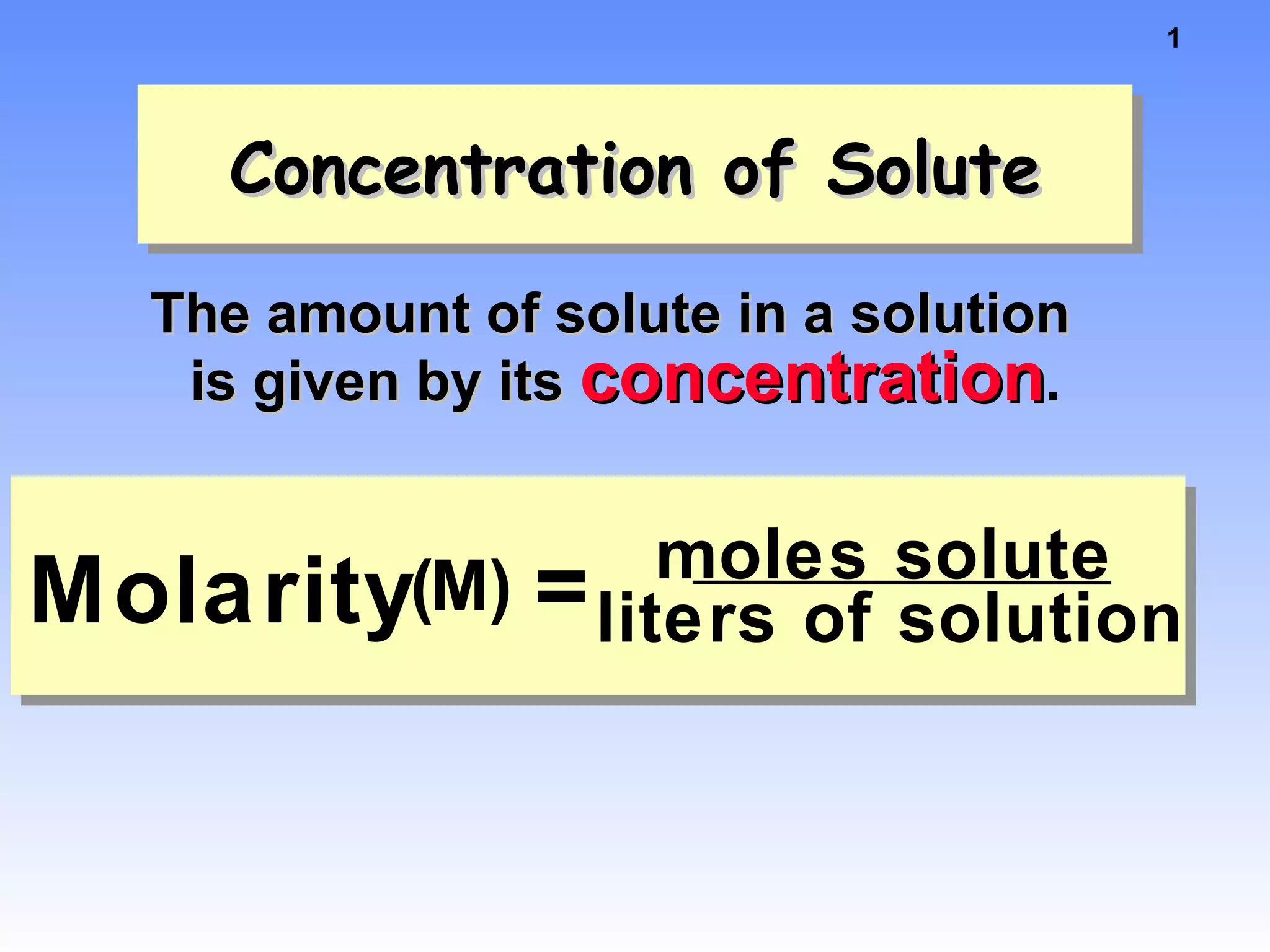
Concentration of Solute The amount of solute in a solution is given by its  concentration . Molarity ( M ) = moles solute liters of solution
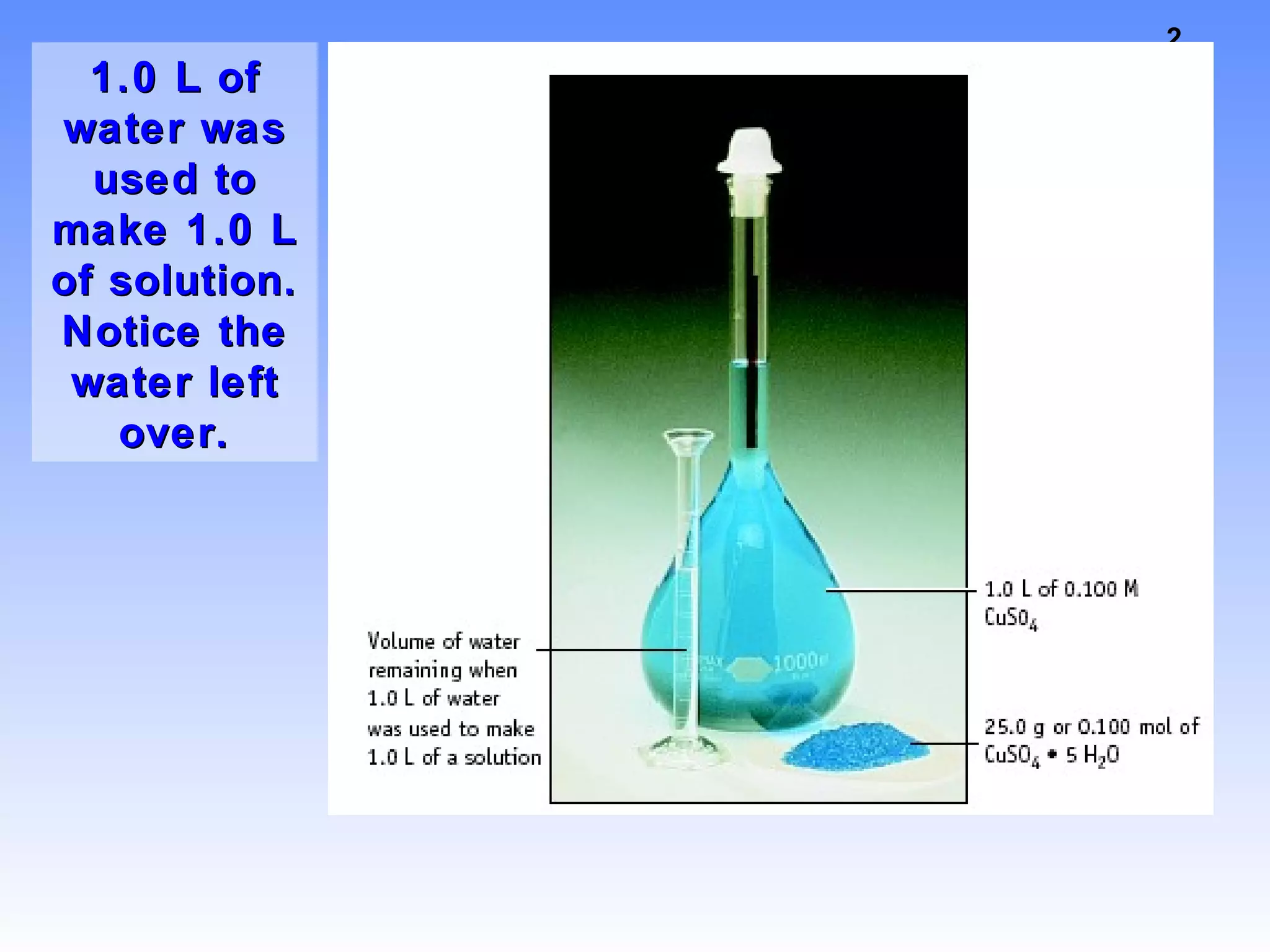
1.0 L of water was used to make 1.0 L of solution. Notice the water left over.
PROBLEM:  Dissolve 5.00 g of NiCl 2 •6 H 2 O in enough water to make 250 mL of solution.  Calculate the Molarity. Step 1:  Calculate moles of NiCl 2 •6H 2 O Step 2:  Calculate Molarity [ NiCl 2 •6 H 2 O   ] = 0.0841 M
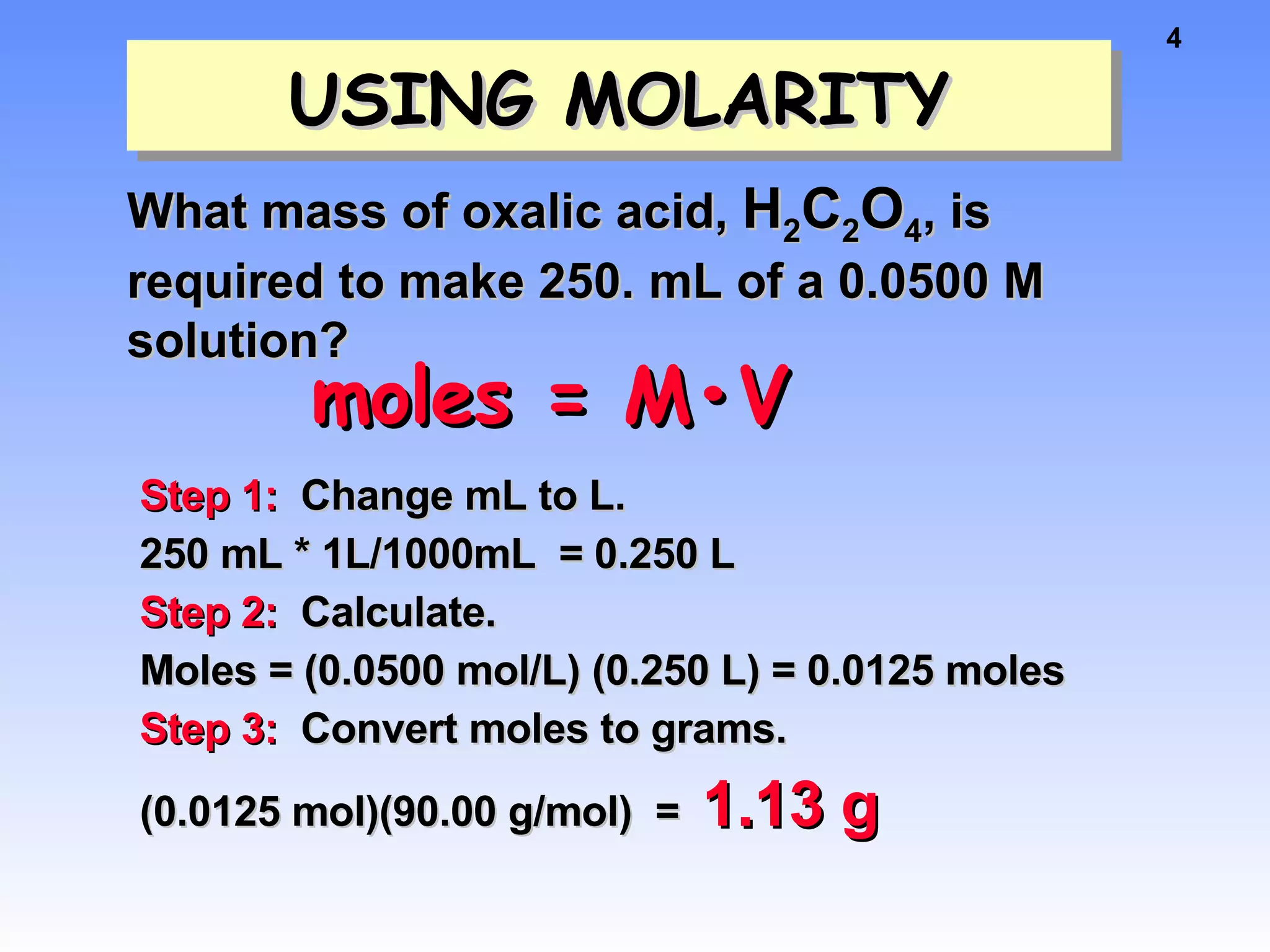
Step 1:  Change mL to L. 250 mL * 1L/1000mL  = 0.250 L Step 2:  Calculate. Moles = (0.0500 mol/L) (0.250 L) = 0.0125 moles Step 3:  Convert moles to grams. (0.0125 mol)(90.00 g/mol)  =  1.13 g USING MOLARITY moles = M•V What mass of oxalic acid,  H 2 C 2 O 4 , is required to make 250. mL of a 0.0500 M solution?
Learning Check How many grams of NaOH are required to prepare 400. mL of 3.0  M  NaOH solution? 1) 12 g 2) 48 g 3)  300 g
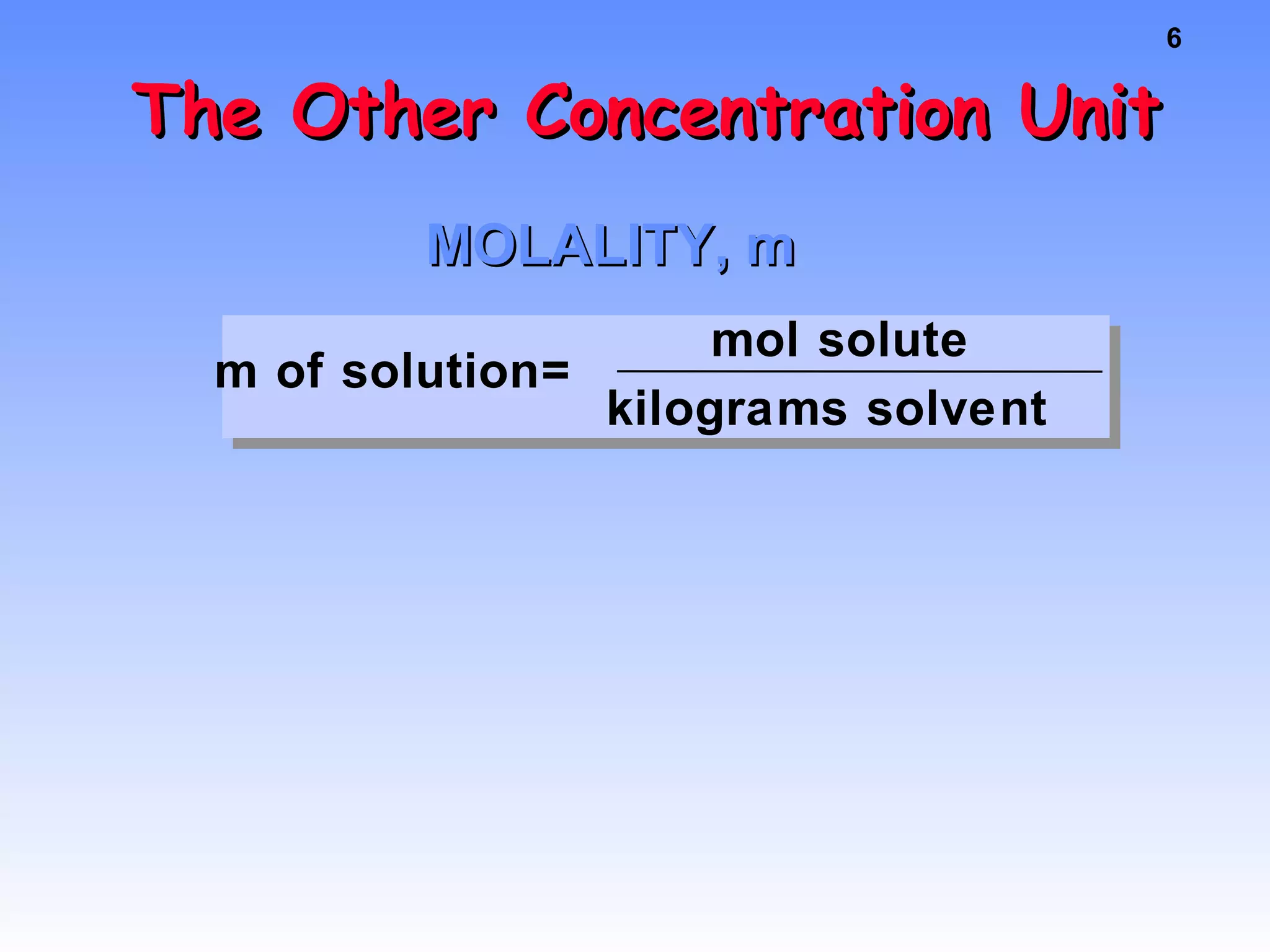
The Other Concentration Unit MOLALITY, m m of solution = mol solute kilograms solvent
Calculating Concentrations Dissolve 62.1 g (1.00 mol) of ethylene glycol in 250. g of H 2 O. Calculate molality ethylene glycol.
Try this molality problem 25.0 g of NaCl is dissolved in 5000. mL of water.  Find the molality (m) of the resulting solution. m = mol solute / kg solvent 25 g NaCl  1 mol NaCl    58.5 g NaCl =  0.427 mol NaCl Since the density of water is 1 g/mL, 5000 mL = 5000 g, which is 5 kg 0.427 mol NaCl 5 kg water = 0.0854 m salt water
Preparing Solutions Weigh out a solid solute and dissolve in a given quantity of solvent. Dilute a concentrated solution to give one that is less concentrated.
Dilutions Dilutions are especially important in the lab Solutions are shipped in concentrated form, but need to be diluted for use in labs Important:   When you dilute a solution you are NOT changing the number of moles of solute, just volume of solvent The concentration of  the sample is the SAME  concentration as the  original solution
Solving a dilution problem You start with 1 L of a 5 M solution.  How would you make this into a 2.5 M solution? What if you only wanted 1 L of the 2.5 M solution, and didn’t want to waste any of the 5 M solution? We know that any moles brought into the solution stay in the solution.  So… How many moles do we need in our final solution? m = M * V m = 2.5 M * 1 L = 2.5 moles How what volume of stock solution contains that many moles? V = m/M V = 2.5 moles /5 M = .5 L We need to take out .5 L of stock solution then add water to make 1 L of solution
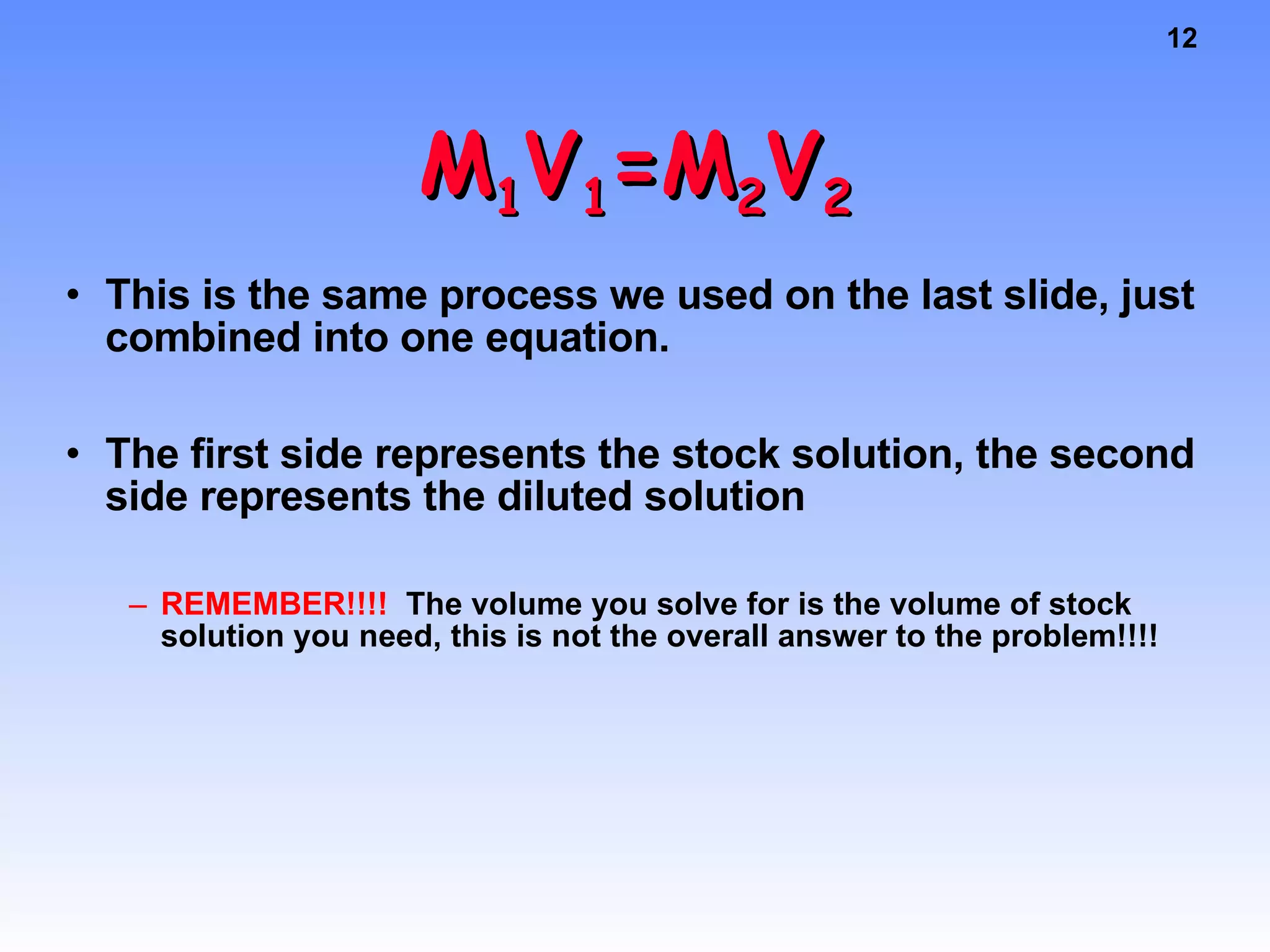
M 1 V 1 =M 2 V 2 This is the same process we used on the last slide, just combined into one equation. The first side represents the stock solution, the second side represents the diluted solution REMEMBER!!!!   The volume you solve for is the volume of stock solution you need, this is not the overall answer to the problem!!!!
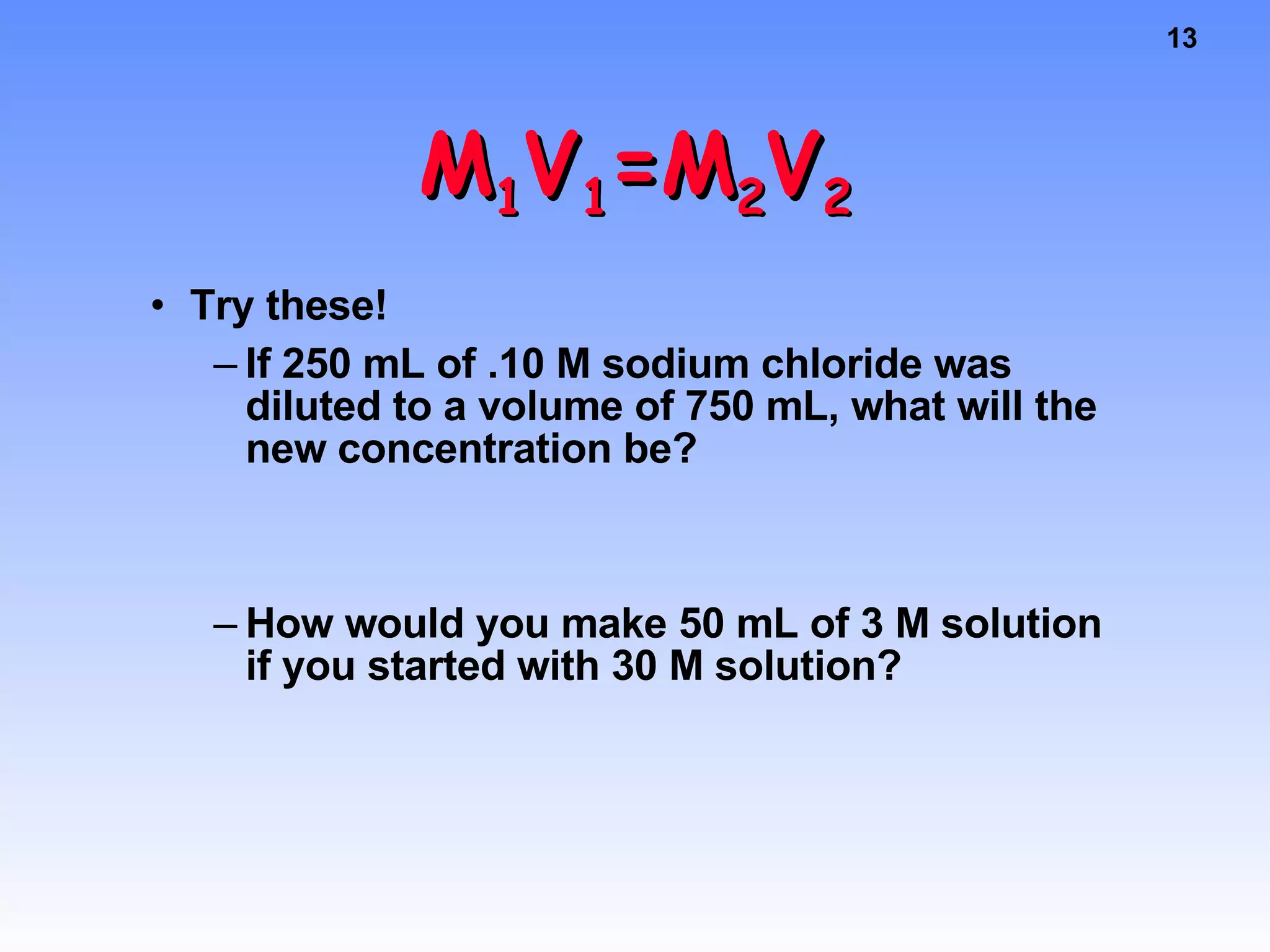
Try these! If 250 mL of .10 M sodium chloride was diluted to a volume of 750 mL, what will the new concentration be? How would you make 50 mL of 3 M solution if you started with 30 M solution? M 1 V 1 =M 2 V 2

Molarity Molality Dilutions

  • 1.
    Concentration of SoluteThe amount of solute in a solution is given by its concentration . Molarity ( M ) = moles solute liters of solution
  • 2.
    1.0 L ofwater was used to make 1.0 L of solution. Notice the water left over.
  • 3.
    PROBLEM: Dissolve5.00 g of NiCl 2 •6 H 2 O in enough water to make 250 mL of solution. Calculate the Molarity. Step 1: Calculate moles of NiCl 2 •6H 2 O Step 2: Calculate Molarity [ NiCl 2 •6 H 2 O ] = 0.0841 M
  • 4.
    Step 1: Change mL to L. 250 mL * 1L/1000mL = 0.250 L Step 2: Calculate. Moles = (0.0500 mol/L) (0.250 L) = 0.0125 moles Step 3: Convert moles to grams. (0.0125 mol)(90.00 g/mol) = 1.13 g USING MOLARITY moles = M•V What mass of oxalic acid, H 2 C 2 O 4 , is required to make 250. mL of a 0.0500 M solution?
  • 5.
    Learning Check Howmany grams of NaOH are required to prepare 400. mL of 3.0 M NaOH solution? 1) 12 g 2) 48 g 3) 300 g
  • 6.
    The Other ConcentrationUnit MOLALITY, m m of solution = mol solute kilograms solvent
  • 7.
    Calculating Concentrations Dissolve62.1 g (1.00 mol) of ethylene glycol in 250. g of H 2 O. Calculate molality ethylene glycol.
  • 8.
    Try this molalityproblem 25.0 g of NaCl is dissolved in 5000. mL of water. Find the molality (m) of the resulting solution. m = mol solute / kg solvent 25 g NaCl 1 mol NaCl 58.5 g NaCl = 0.427 mol NaCl Since the density of water is 1 g/mL, 5000 mL = 5000 g, which is 5 kg 0.427 mol NaCl 5 kg water = 0.0854 m salt water
  • 9.
    Preparing Solutions Weighout a solid solute and dissolve in a given quantity of solvent. Dilute a concentrated solution to give one that is less concentrated.
  • 10.
    Dilutions Dilutions areespecially important in the lab Solutions are shipped in concentrated form, but need to be diluted for use in labs Important: When you dilute a solution you are NOT changing the number of moles of solute, just volume of solvent The concentration of the sample is the SAME concentration as the original solution
  • 11.
    Solving a dilutionproblem You start with 1 L of a 5 M solution. How would you make this into a 2.5 M solution? What if you only wanted 1 L of the 2.5 M solution, and didn’t want to waste any of the 5 M solution? We know that any moles brought into the solution stay in the solution. So… How many moles do we need in our final solution? m = M * V m = 2.5 M * 1 L = 2.5 moles How what volume of stock solution contains that many moles? V = m/M V = 2.5 moles /5 M = .5 L We need to take out .5 L of stock solution then add water to make 1 L of solution
  • 12.
    M 1 V1 =M 2 V 2 This is the same process we used on the last slide, just combined into one equation. The first side represents the stock solution, the second side represents the diluted solution REMEMBER!!!! The volume you solve for is the volume of stock solution you need, this is not the overall answer to the problem!!!!
  • 13.
    Try these! If250 mL of .10 M sodium chloride was diluted to a volume of 750 mL, what will the new concentration be? How would you make 50 mL of 3 M solution if you started with 30 M solution? M 1 V 1 =M 2 V 2