Metrics, Measurement and
Calculations
Aim- To study Metrics, Measurements and Calculations
Introduction:-
Definition and Examples of Metrics. Definitions of Molarity, Normality and
percent solutions.
Procedure:- Examples of 1N NaCl, 1N NaOH,1N H2SO4
Examples of C1v1=c2v2 given in the slides.
Result:-Metrics and units of measurements were discussed. Concepts of
molarity, normality and percent solutions were studied.
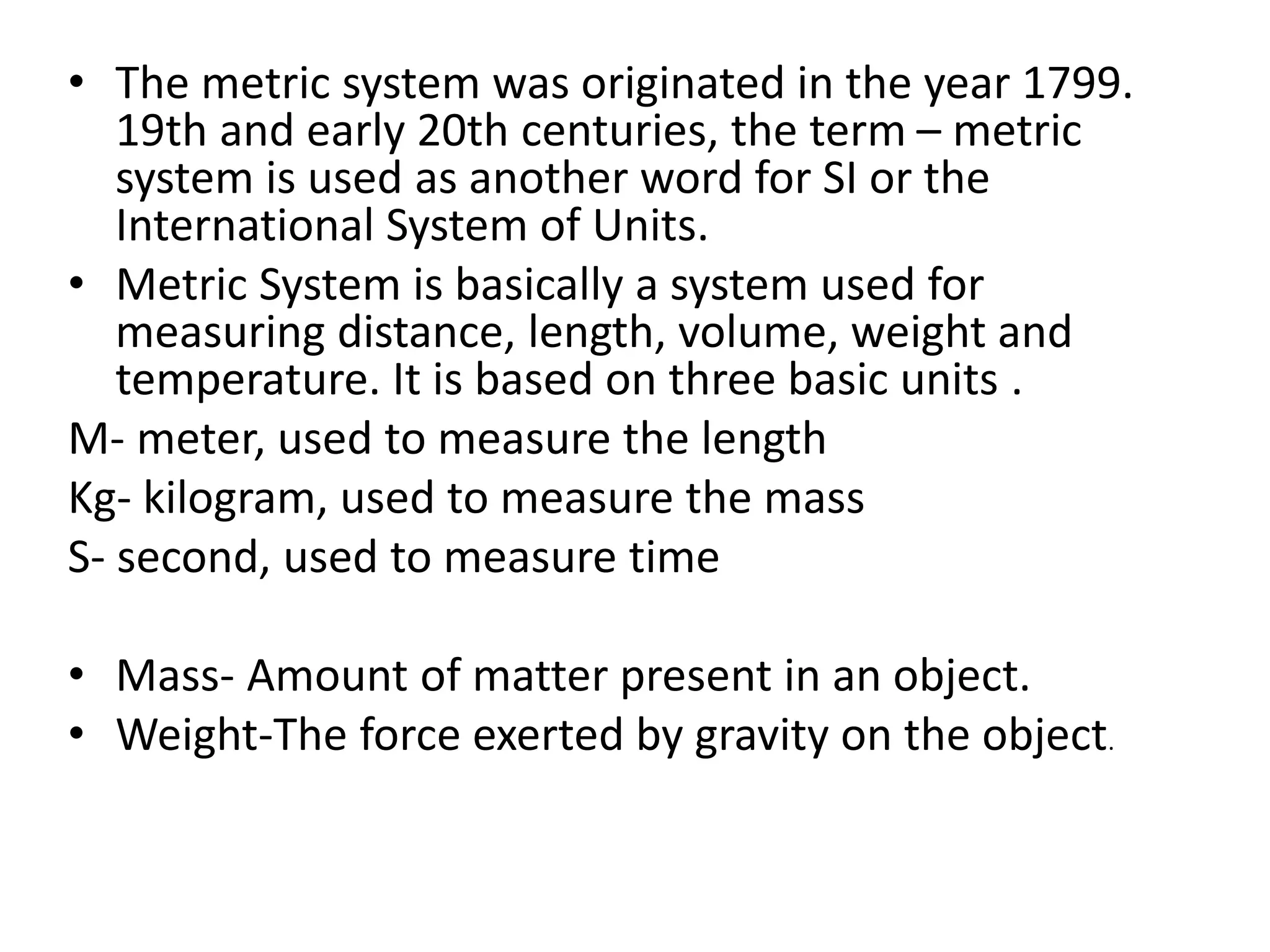
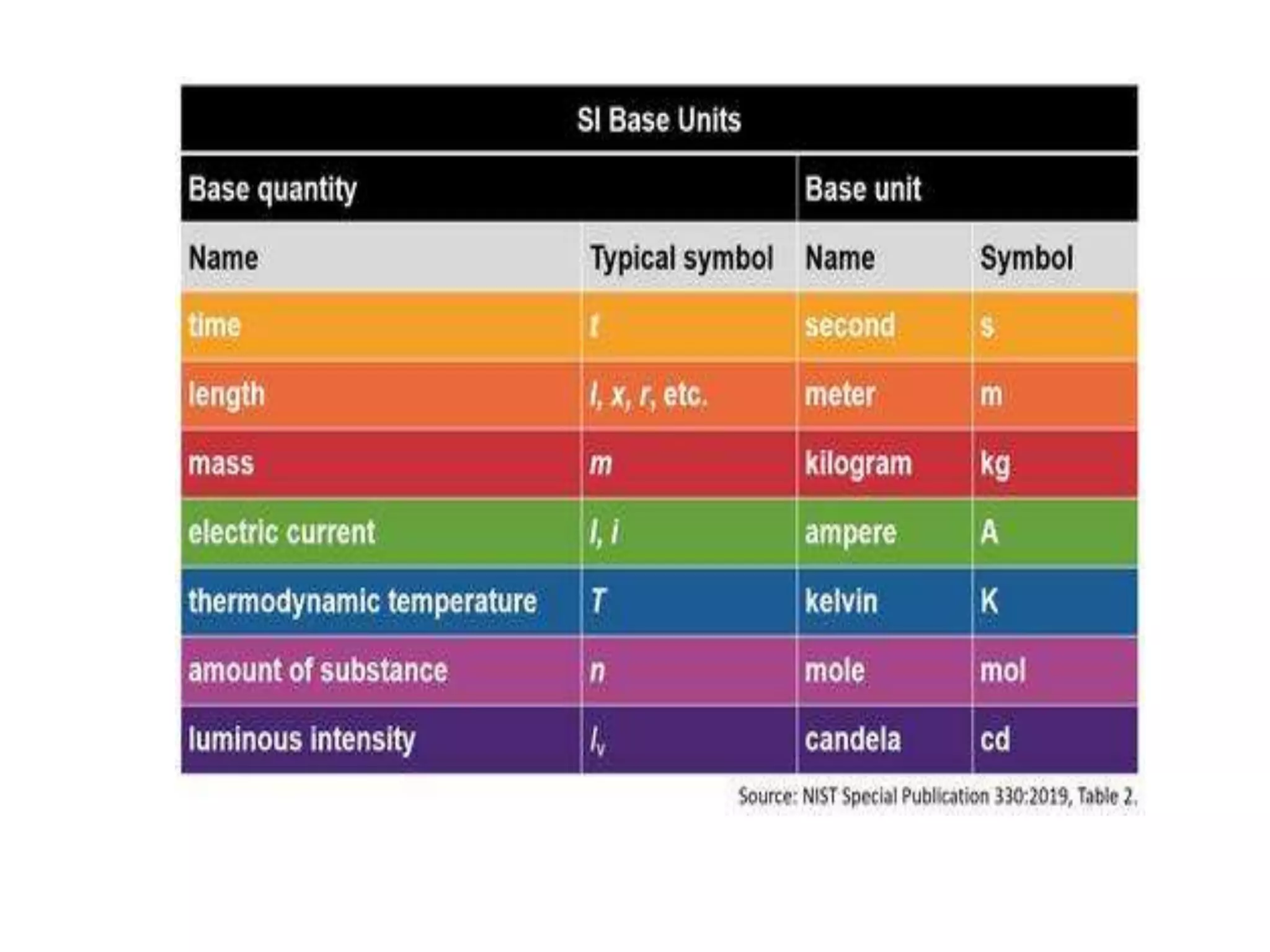
• The metric system was originated in the year 1799.
19th and early 20th centuries, the term – metric
system is used as another word for SI or the
International System of Units.
• Metric System is basically a system used for
measuring distance, length, volume, weight and
temperature. It is based on three basic units .
M- meter, used to measure the length
Kg- kilogram, used to measure the mass
S- second, used to measure time
• Mass- Amount of matter present in an object.
• Weight-The force exerted by gravity on the object.
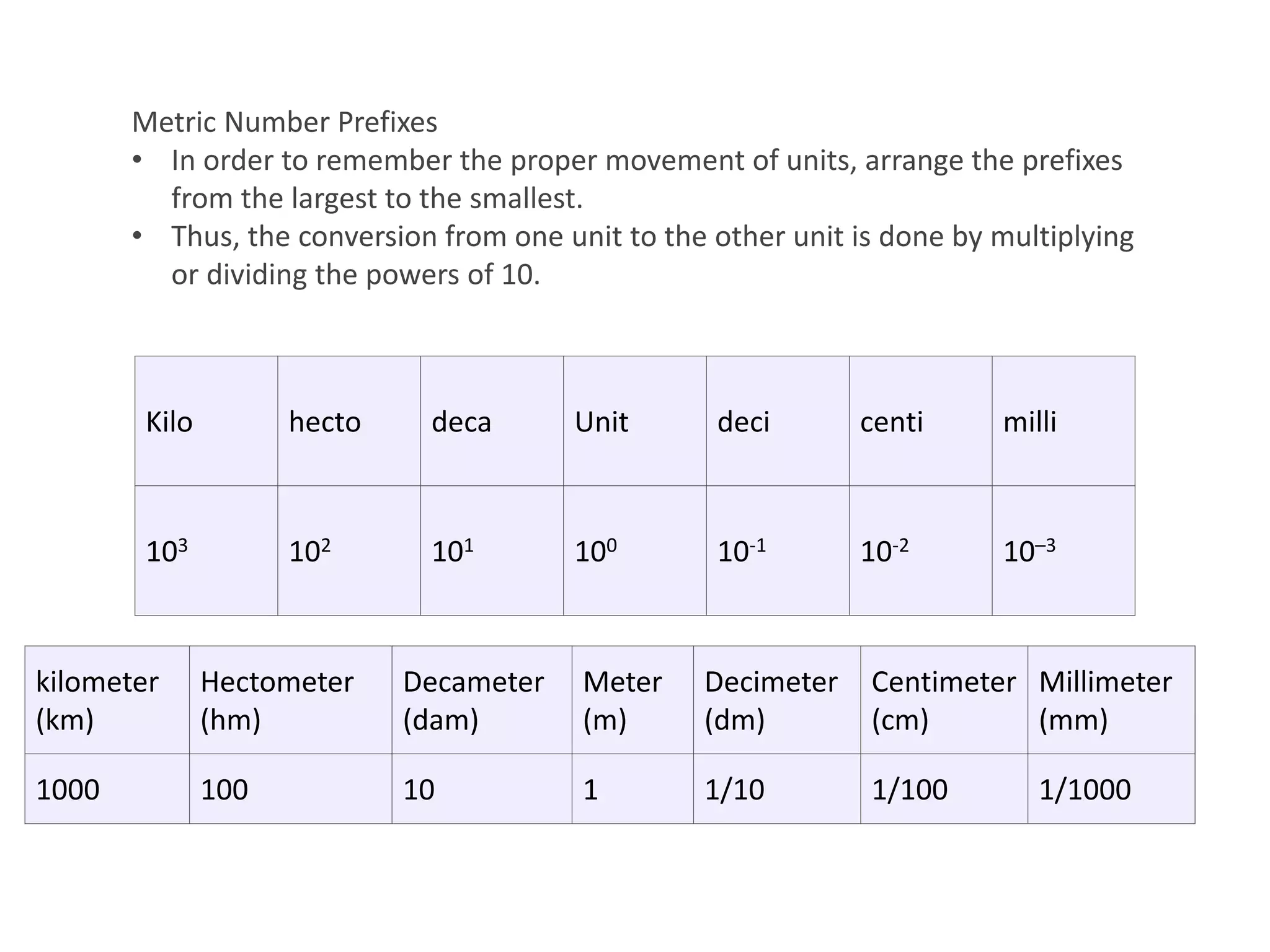
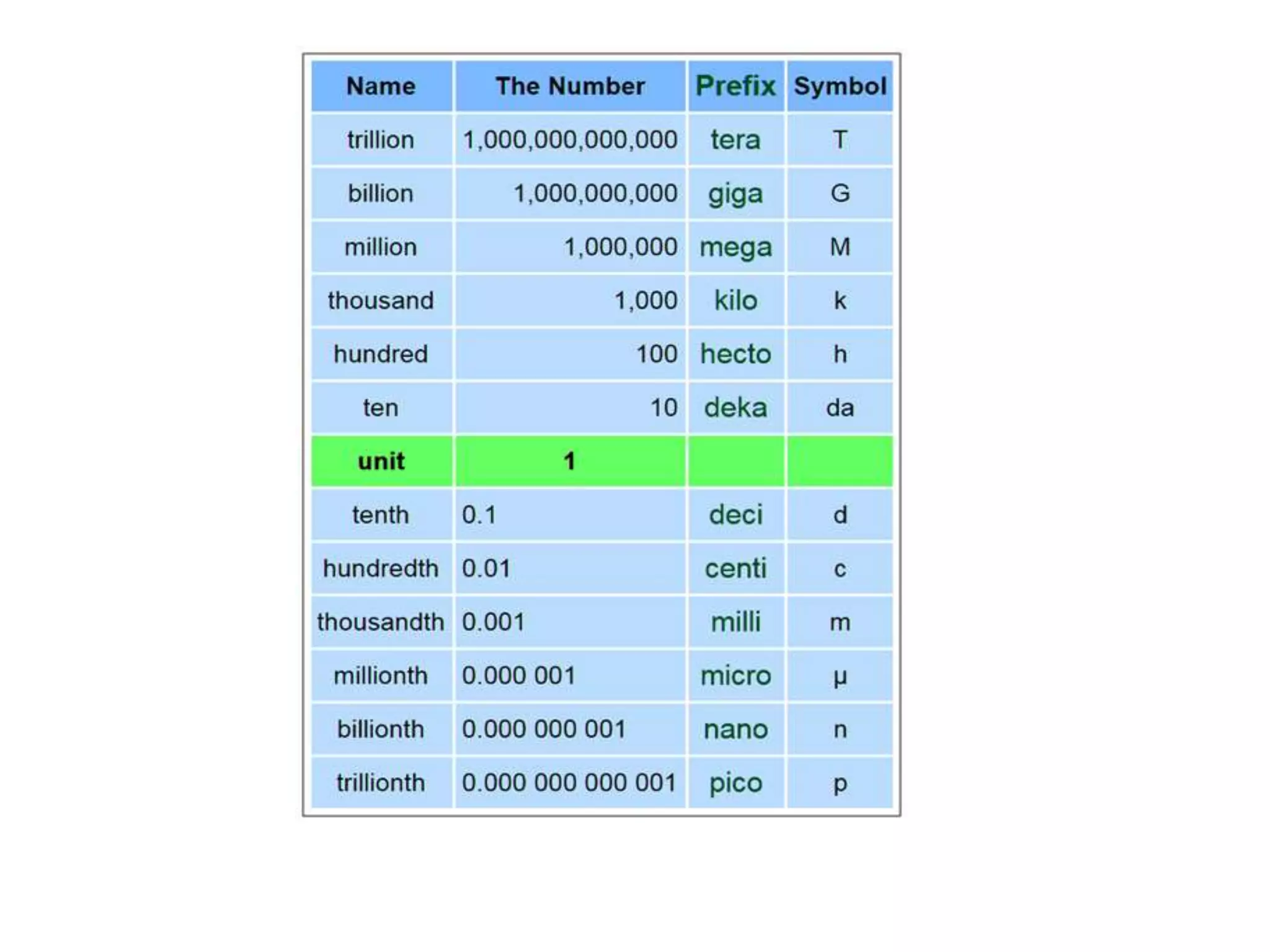
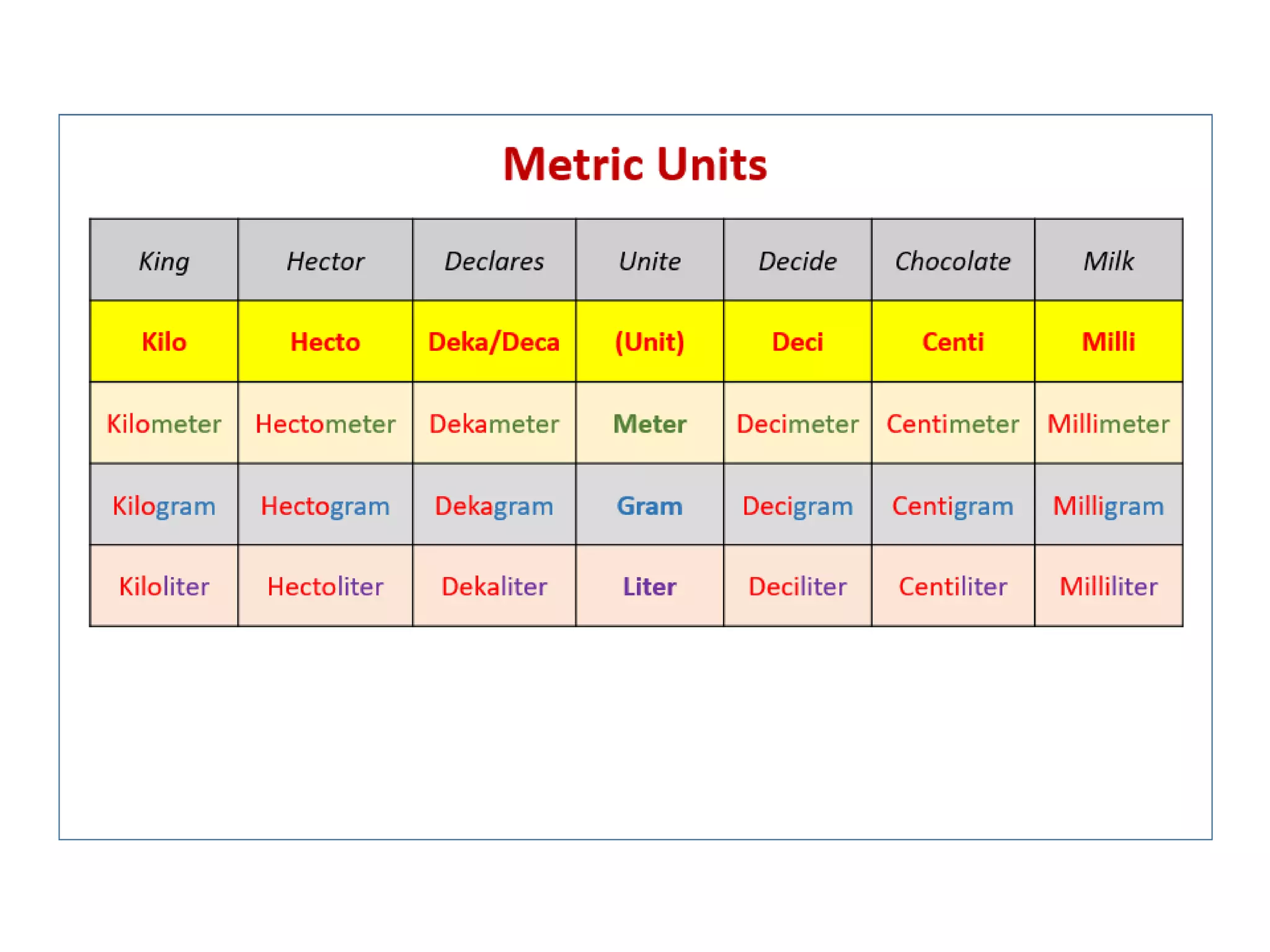
Kilo hecto deca Unit deci centi milli
103 102 101 100 10-1 10-2 10–3
Metric Number Prefixes
• In order to remember the proper movement of units, arrange the prefixes
from the largest to the smallest.
• Thus, the conversion from one unit to the other unit is done by multiplying
or dividing the powers of 10.
kilometer
(km)
Hectometer
(hm)
Decameter
(dam)
Meter
(m)
Decimeter
(dm)
Centimeter
(cm)
Millimeter
(mm)
1000 100 10 1 1/10 1/100 1/1000
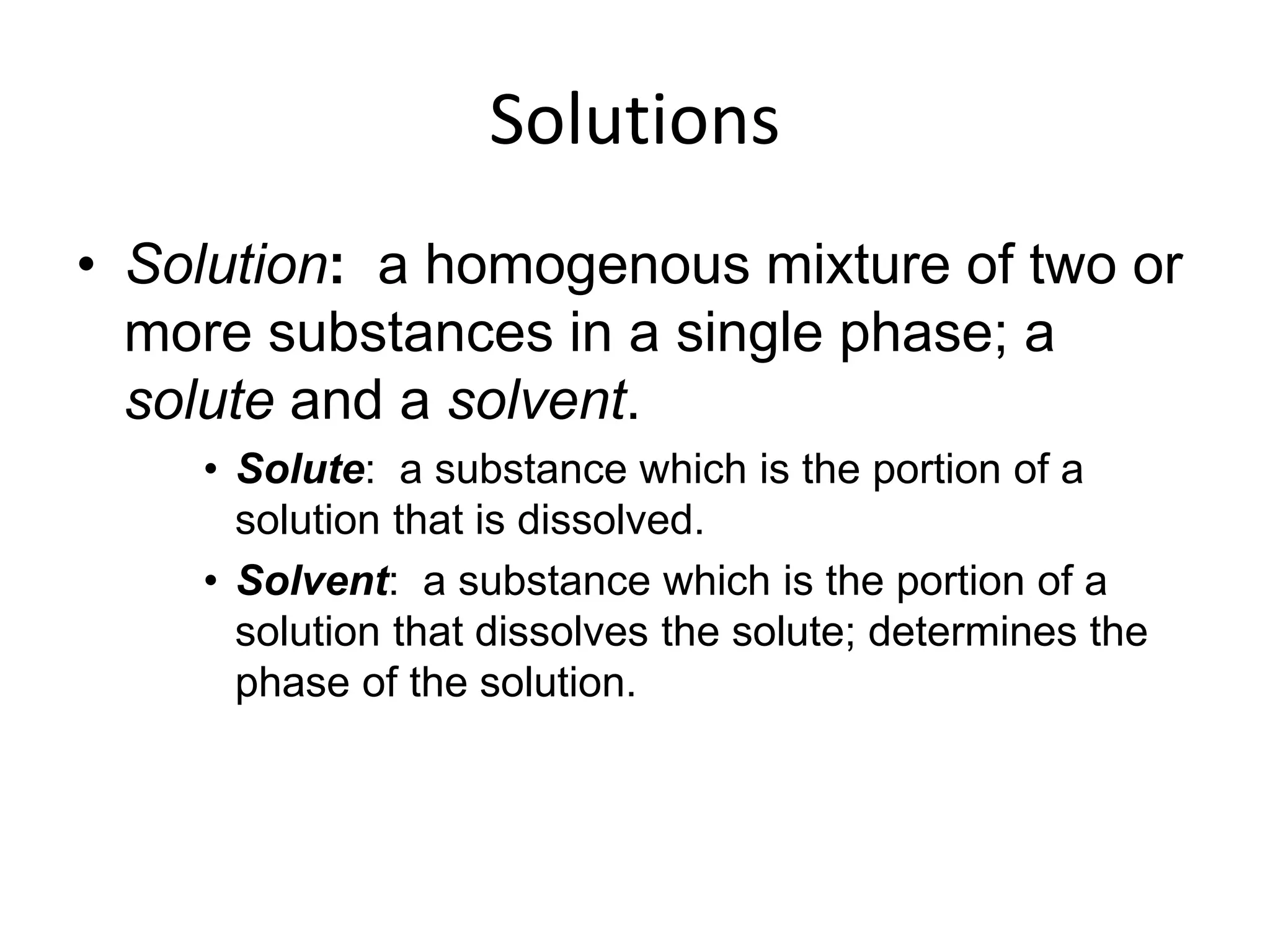
Solutions
• Solution: a homogenous mixture of two or
more substances in a single phase; a
solute and a solvent.
• Solute: a substance which is the portion of a
solution that is dissolved.
• Solvent: a substance which is the portion of a
solution that dissolves the solute; determines the
phase of the solution.
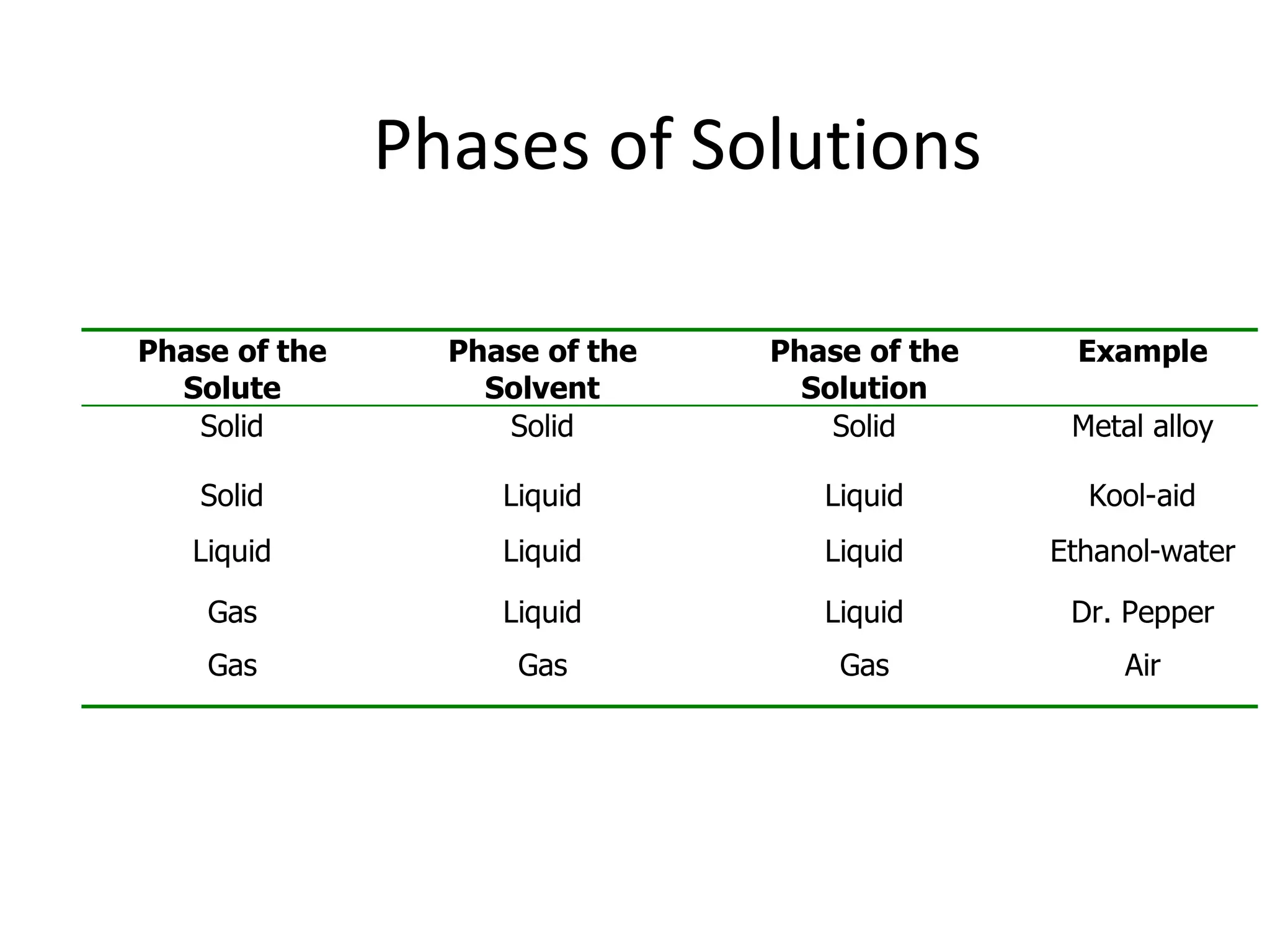
Phases of Solutions
Phase of the
Solute
Phase of the
Solvent
Phase of the
Solution
Example
Solid Solid Solid Metal alloy
Solid Liquid Liquid Kool-aid
Liquid Liquid Liquid Ethanol-water
Gas Liquid Liquid Dr. Pepper
Gas Gas Gas Air
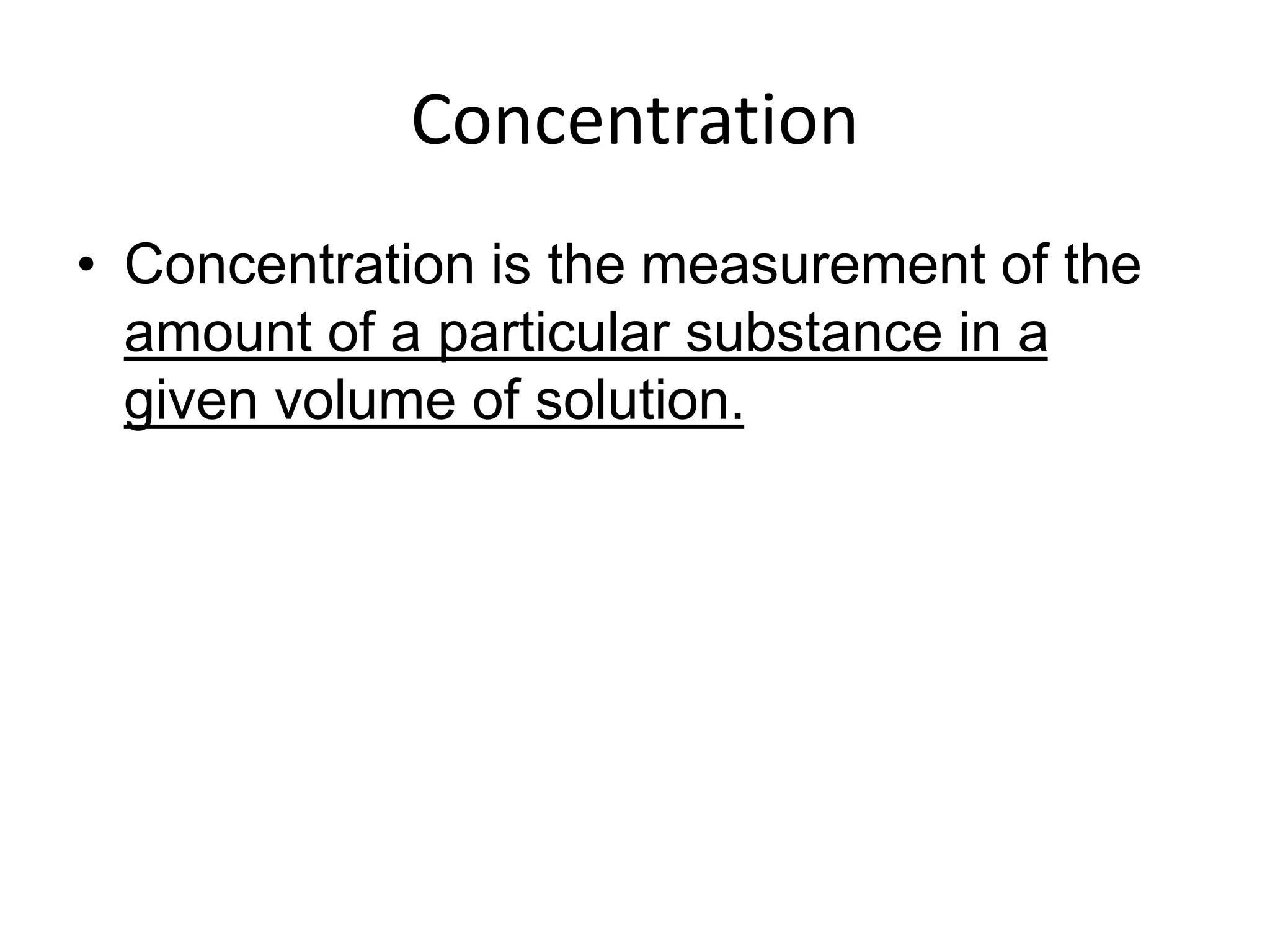
Concentration
• Concentration is the measurement of the
amount of a particular substance in a
given volume of solution.
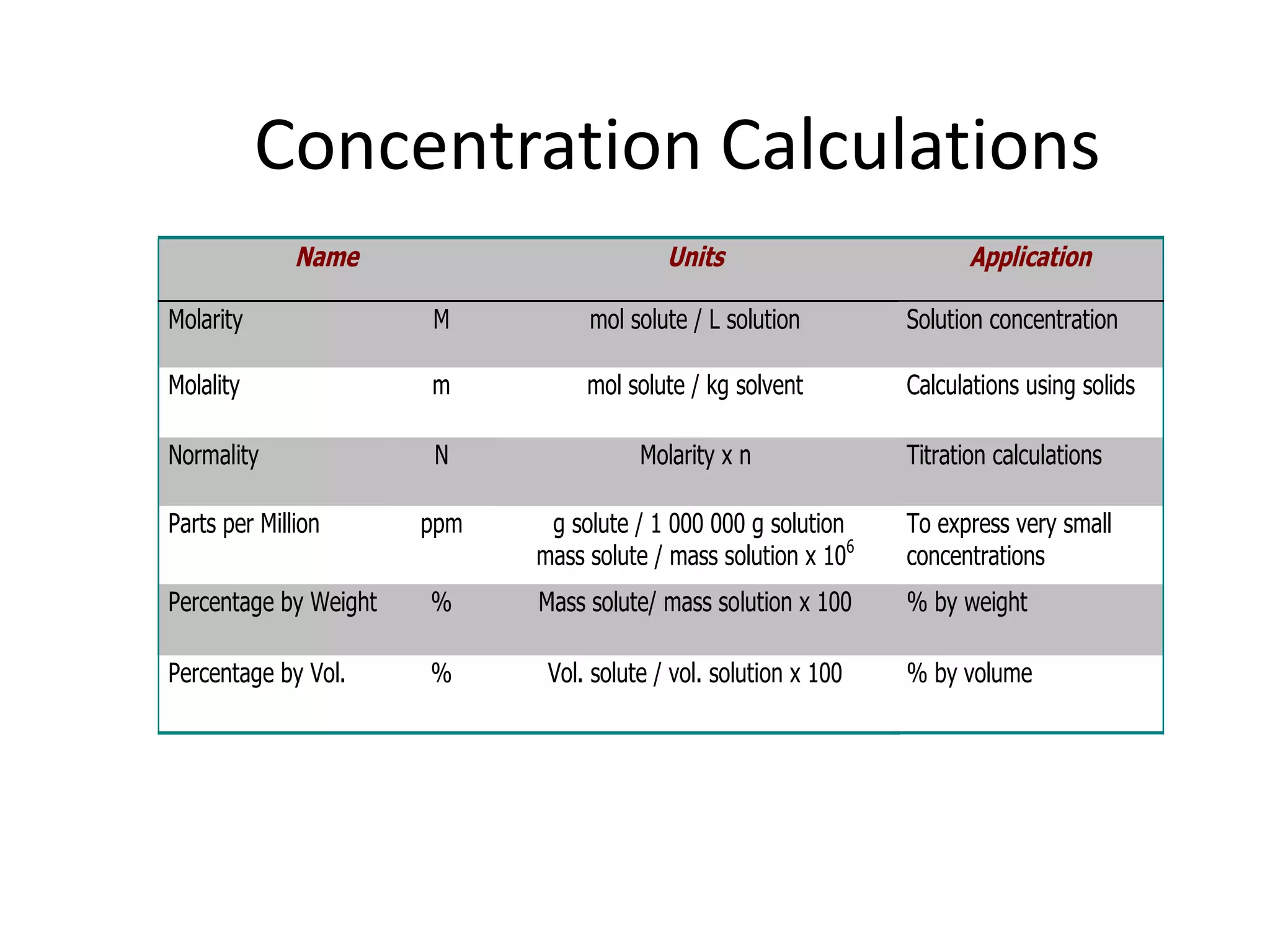
Concentration Calculations
Name Units Application
Molarity M mol solute / L solution Solution concentration
Molality m mol solute / kg solvent Calculations using solids
Normality N Molarity x n Titration calculations
Parts per Million ppm g solute / 1 000 000 g solution
mass solute / mass solution x 106
To express very small
concentrations
Percentage by Weight % Mass solute/ mass solution x 100 % by weight
Percentage by Vol. % Vol. solute / vol. solution x 100 % by volume
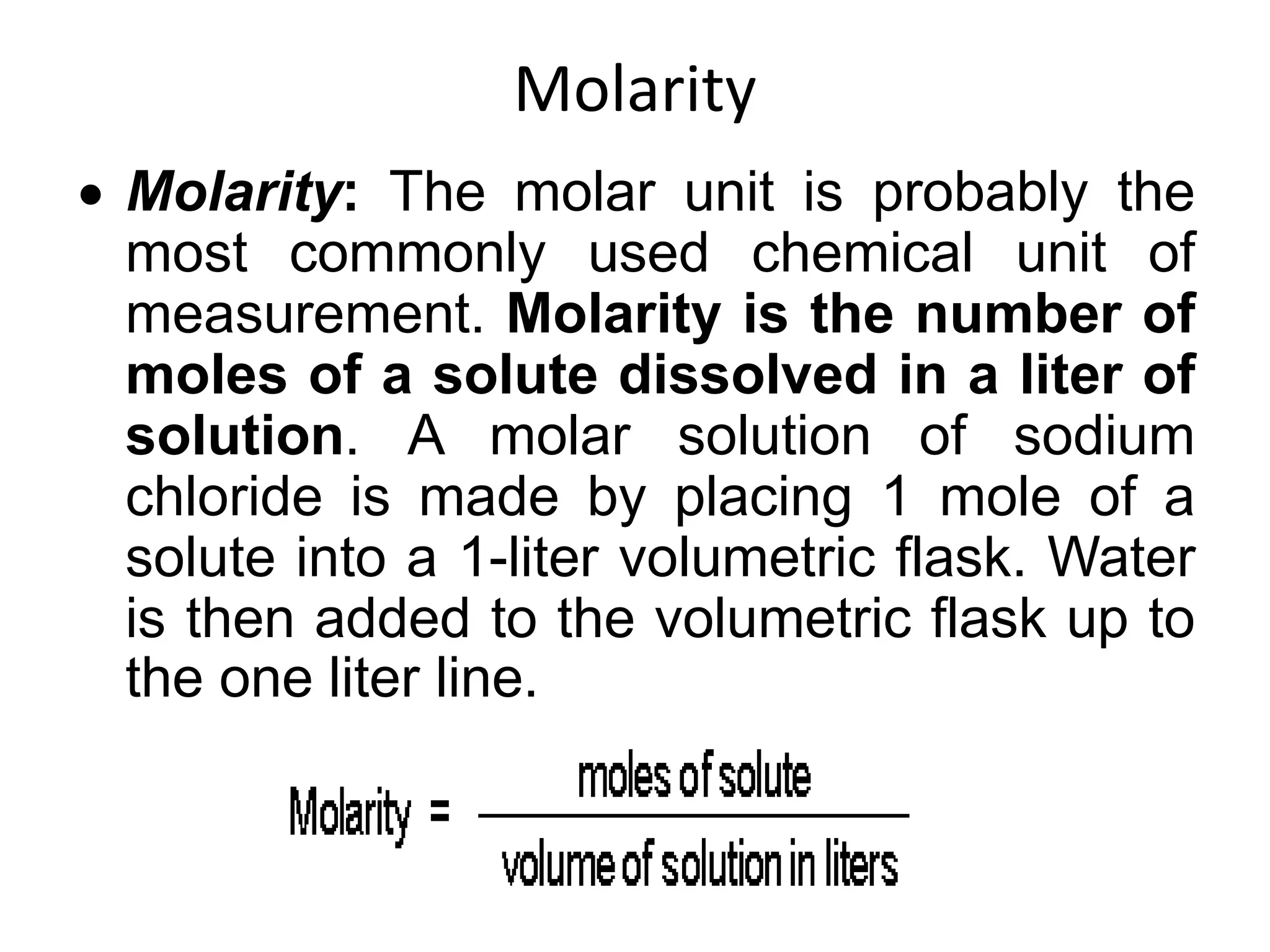
Molarity
 Molarity: The molar unit is probably the
most commonly used chemical unit of
measurement. Molarity is the number of
moles of a solute dissolved in a liter of
solution. A molar solution of sodium
chloride is made by placing 1 mole of a
solute into a 1-liter volumetric flask. Water
is then added to the volumetric flask up to
the one liter line.
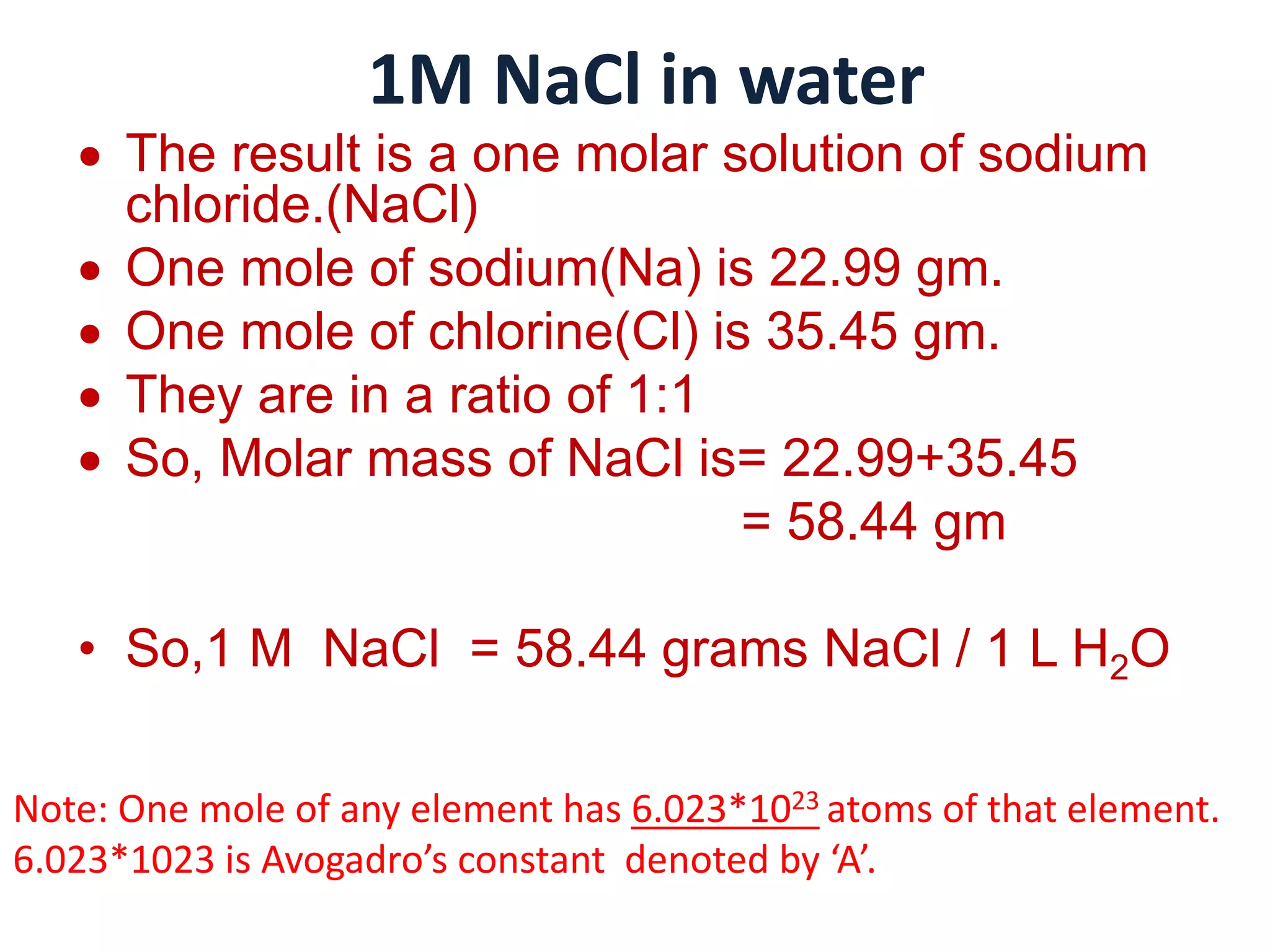
1M NaCl in water
 The result is a one molar solution of sodium
chloride.(NaCl)
 One mole of sodium(Na) is 22.99 gm.
 One mole of chlorine(Cl) is 35.45 gm.
 They are in a ratio of 1:1
 So, Molar mass of NaCl is= 22.99+35.45
= 58.44 gm
• So,1 M NaCl = 58.44 grams NaCl / 1 L H2O
Note: One mole of any element has 6.023*1023 atoms of that element.
6.023*1023 is Avogadro’s constant denoted by ‘A’.
Normality
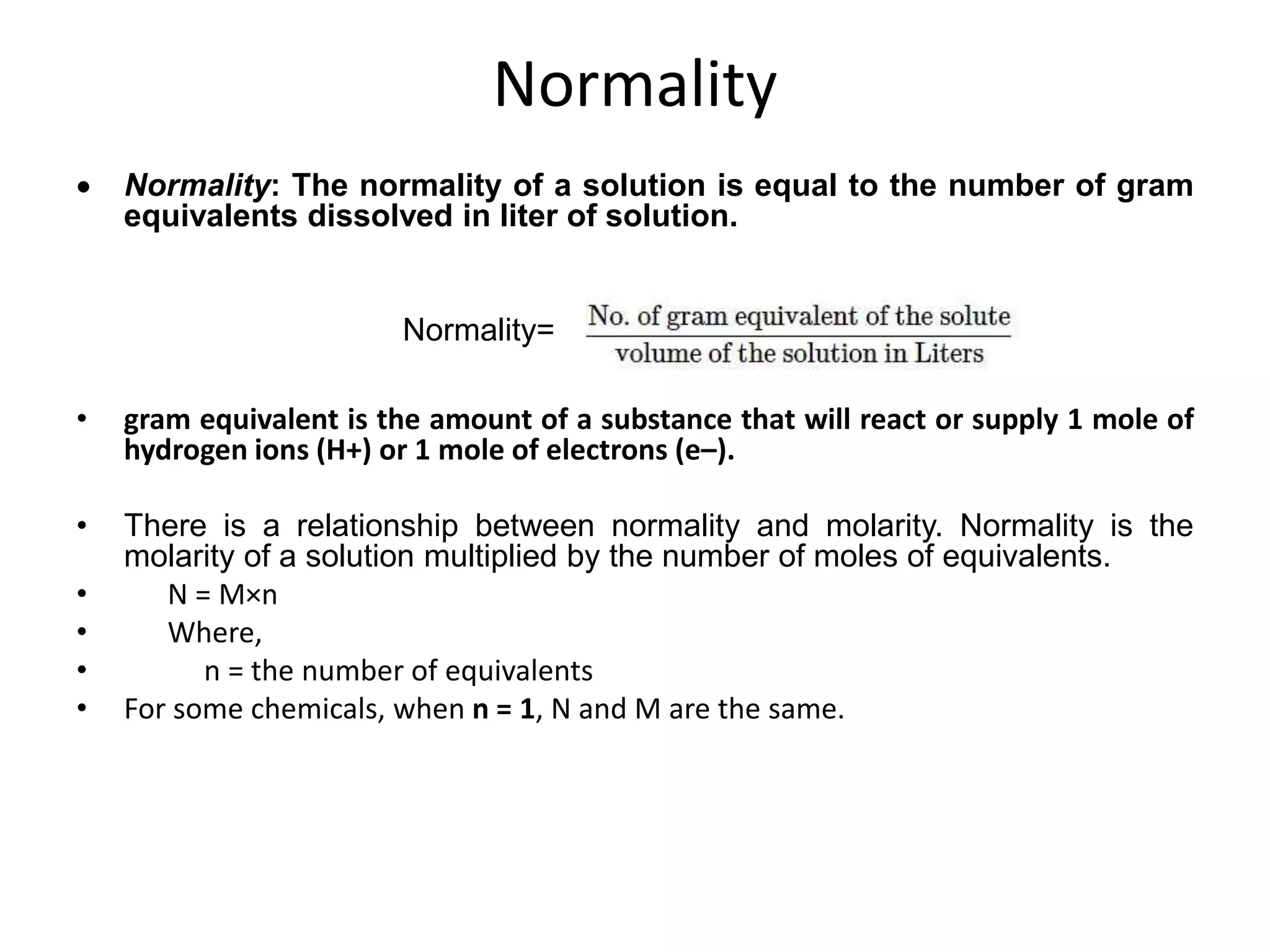
 Normality: The normality of a solution is equal to the number of gram
equivalents dissolved in liter of solution.
Normality=
• gram equivalent is the amount of a substance that will react or supply 1 mole of
hydrogen ions (H+) or 1 mole of electrons (e–).
• There is a relationship between normality and molarity. Normality is the
molarity of a solution multiplied by the number of moles of equivalents.
• N = M×n
• Where,
• n = the number of equivalents
• For some chemicals, when n = 1, N and M are the same.
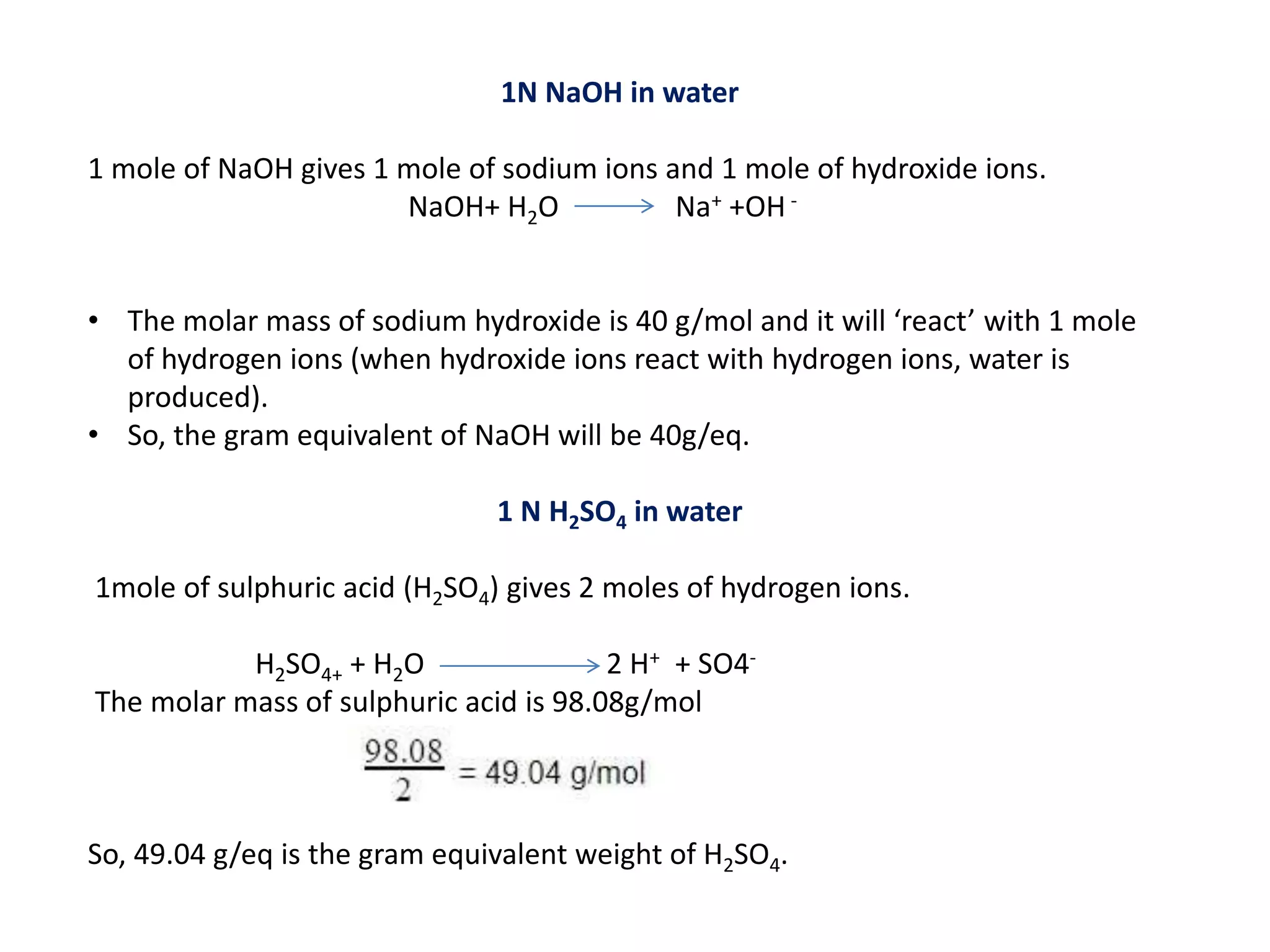
1N NaOH in water
1 mole of NaOH gives 1 mole of sodium ions and 1 mole of hydroxide ions.
NaOH+ H2O Na+ +OH -
• The molar mass of sodium hydroxide is 40 g/mol and it will ‘react’ with 1 mole
of hydrogen ions (when hydroxide ions react with hydrogen ions, water is
produced).
• So, the gram equivalent of NaOH will be 40g/eq.
1 N H2SO4 in water
1mole of sulphuric acid (H2SO4) gives 2 moles of hydrogen ions.
H2SO4+ + H2O 2 H+ + SO4-
The molar mass of sulphuric acid is 98.08g/mol
So, 49.04 g/eq is the gram equivalent weight of H2SO4.
Normality and its Formula isn’t the most common way to measure
concentration, and its use is not acceptable for all chemical
solutions under all circumstances. Normality is commonly used in
acid-base chemical reactions, redox reactions, and precipitation
reactions. It depends on the chemical process under observation
and the temperature.
% by Weight
 Percent by weight: To make up a solution
based on percentage by weight, one
would simply determine what percentage
was desired (for example, a 20% by
weight aqueous solution of sodium
chloride) and the total quantity to be
prepared.
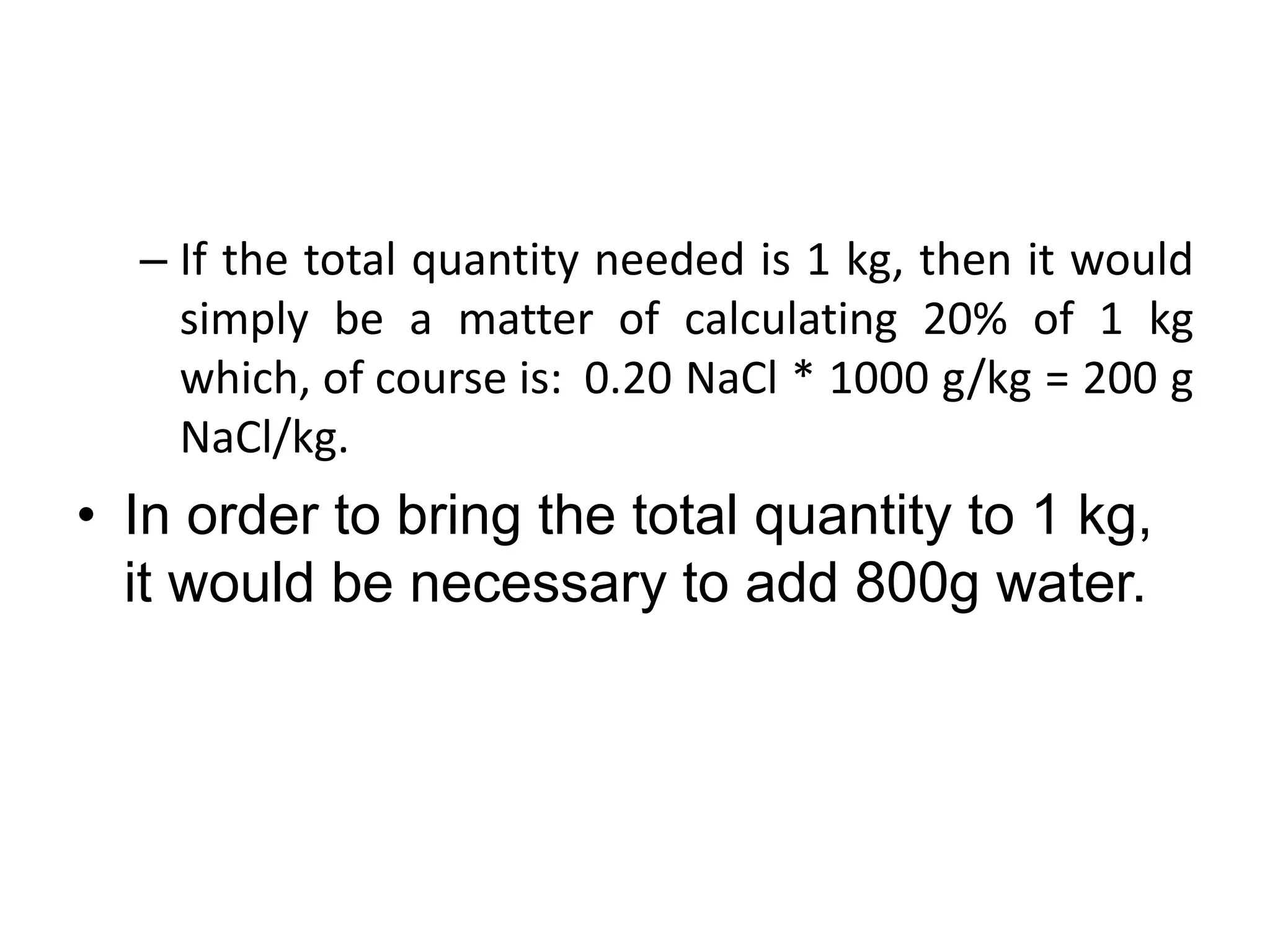
– If the total quantity needed is 1 kg, then it would
simply be a matter of calculating 20% of 1 kg
which, of course is: 0.20 NaCl * 1000 g/kg = 200 g
NaCl/kg.
• In order to bring the total quantity to 1 kg,
it would be necessary to add 800g water.
% by Volume
 Percent by volume: Solutions based on
percent by volume are calculated the
same as for percent by weight, except that
calculations are based on volume. Thus
one would simply determine what
percentage was desired (for example, a
20% by volume aqueous solution of
sodium chloride) and the total quantity to
be prepared.
– If the total quantity needed is 1 liter, then it would
simply be a matter of calculating 20% of 1 liter
which, of course is: 0.20 NaCl * 1000 ml/l = 200
ml NaCl/l.
 Percentages are used more in the
technological fields of chemistry (such as
environmental technologies) than they are
in pure chemistry.
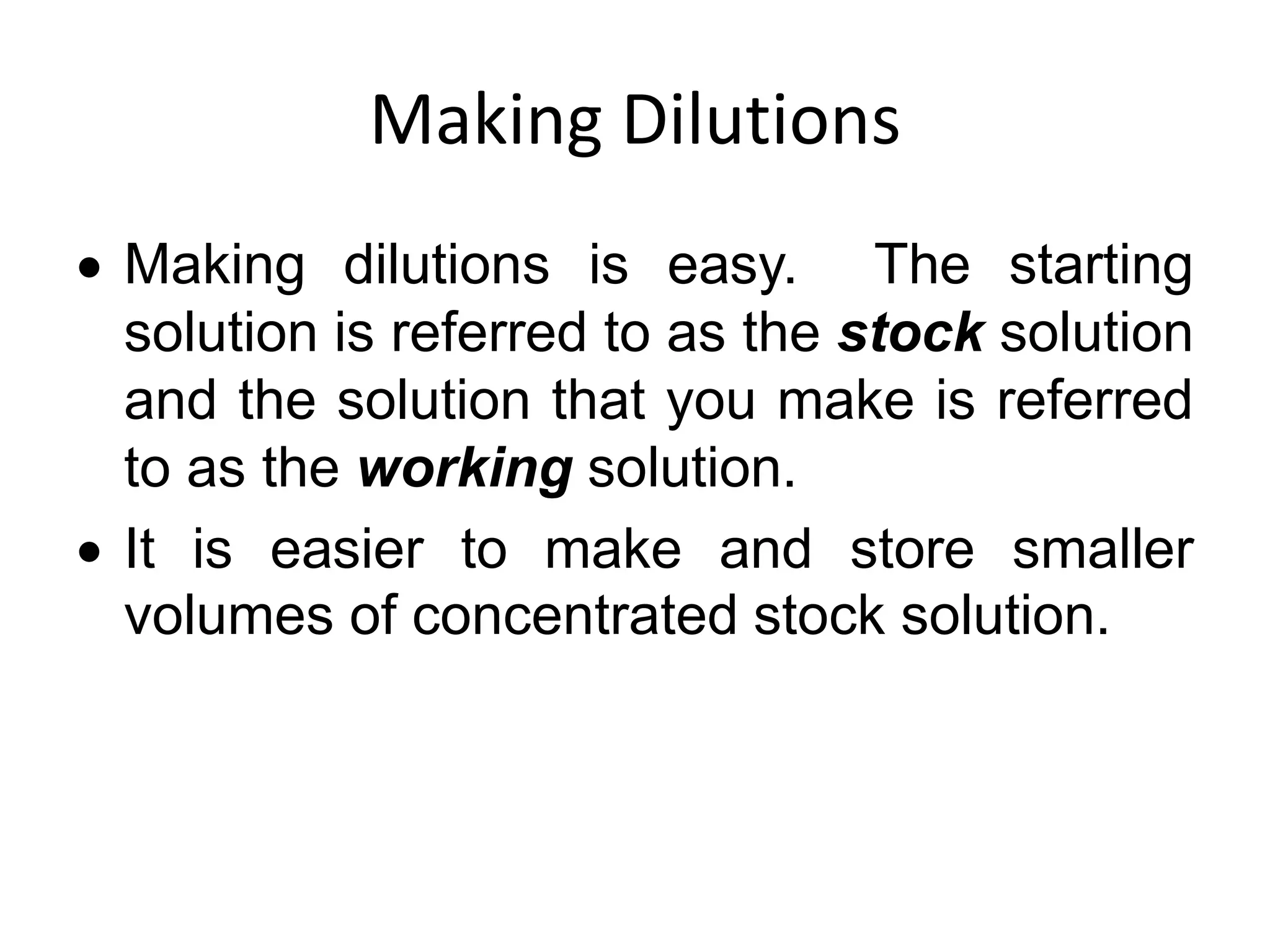
Making Dilutions
 Making dilutions is easy. The starting
solution is referred to as the stock solution
and the solution that you make is referred
to as the working solution.
 It is easier to make and store smaller
volumes of concentrated stock solution.
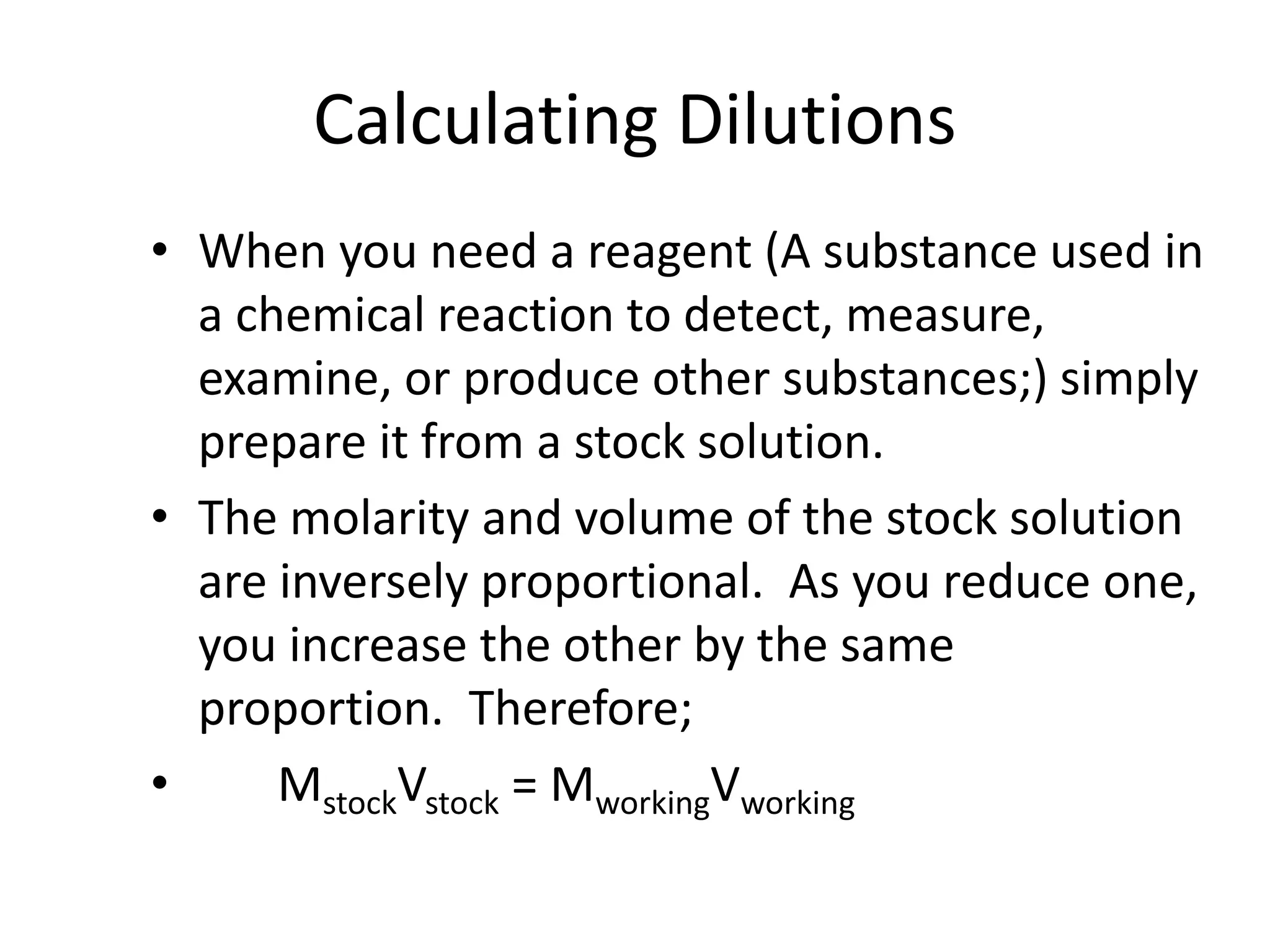
Calculating Dilutions
• When you need a reagent (A substance used in
a chemical reaction to detect, measure,
examine, or produce other substances;) simply
prepare it from a stock solution.
• The molarity and volume of the stock solution
are inversely proportional. As you reduce one,
you increase the other by the same
proportion. Therefore;
• MstockVstock = MworkingVworking
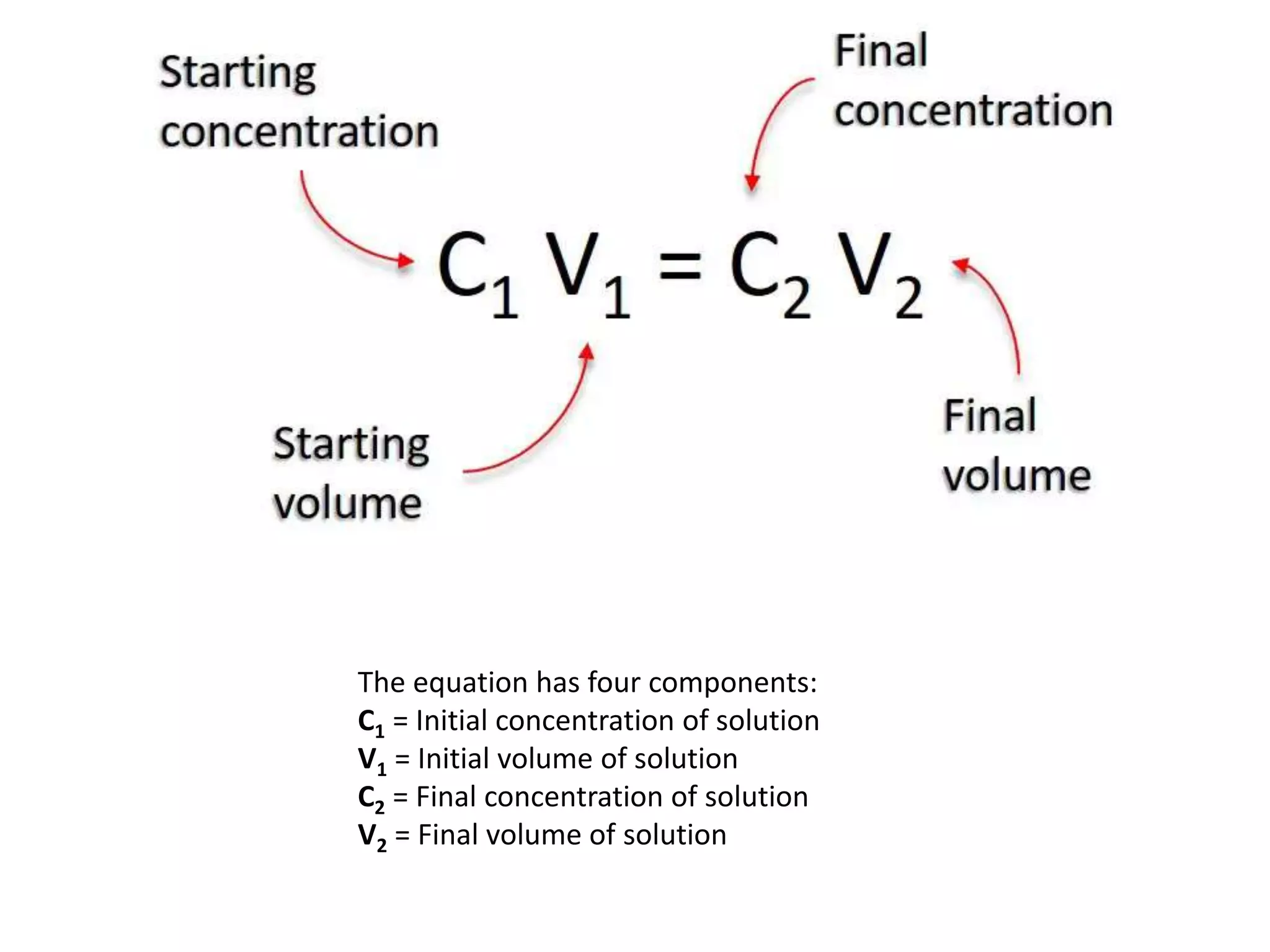
The equation has four components:
C1 = Initial concentration of solution
V1 = Initial volume of solution
C2 = Final concentration of solution
V2 = Final volume of solution
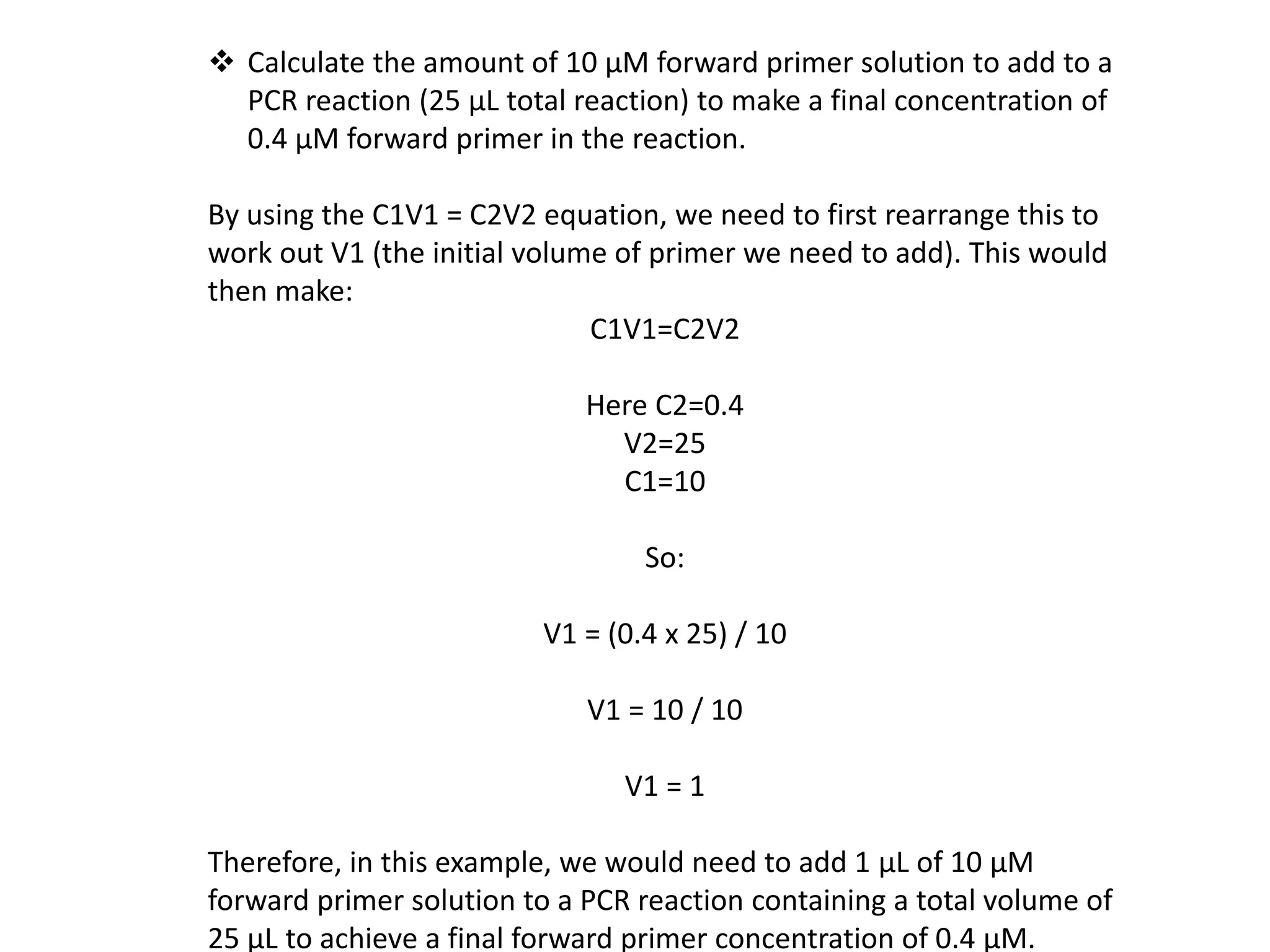
 Calculate the amount of 10 μM forward primer solution to add to a
PCR reaction (25 μL total reaction) to make a final concentration of
0.4 μM forward primer in the reaction.
By using the C1V1 = C2V2 equation, we need to first rearrange this to
work out V1 (the initial volume of primer we need to add). This would
then make:
C1V1=C2V2
Here C2=0.4
V2=25
C1=10
So:
V1 = (0.4 x 25) / 10
V1 = 10 / 10
V1 = 1
Therefore, in this example, we would need to add 1 μL of 10 μM
forward primer solution to a PCR reaction containing a total volume of
25 μL to achieve a final forward primer concentration of 0.4 μM.
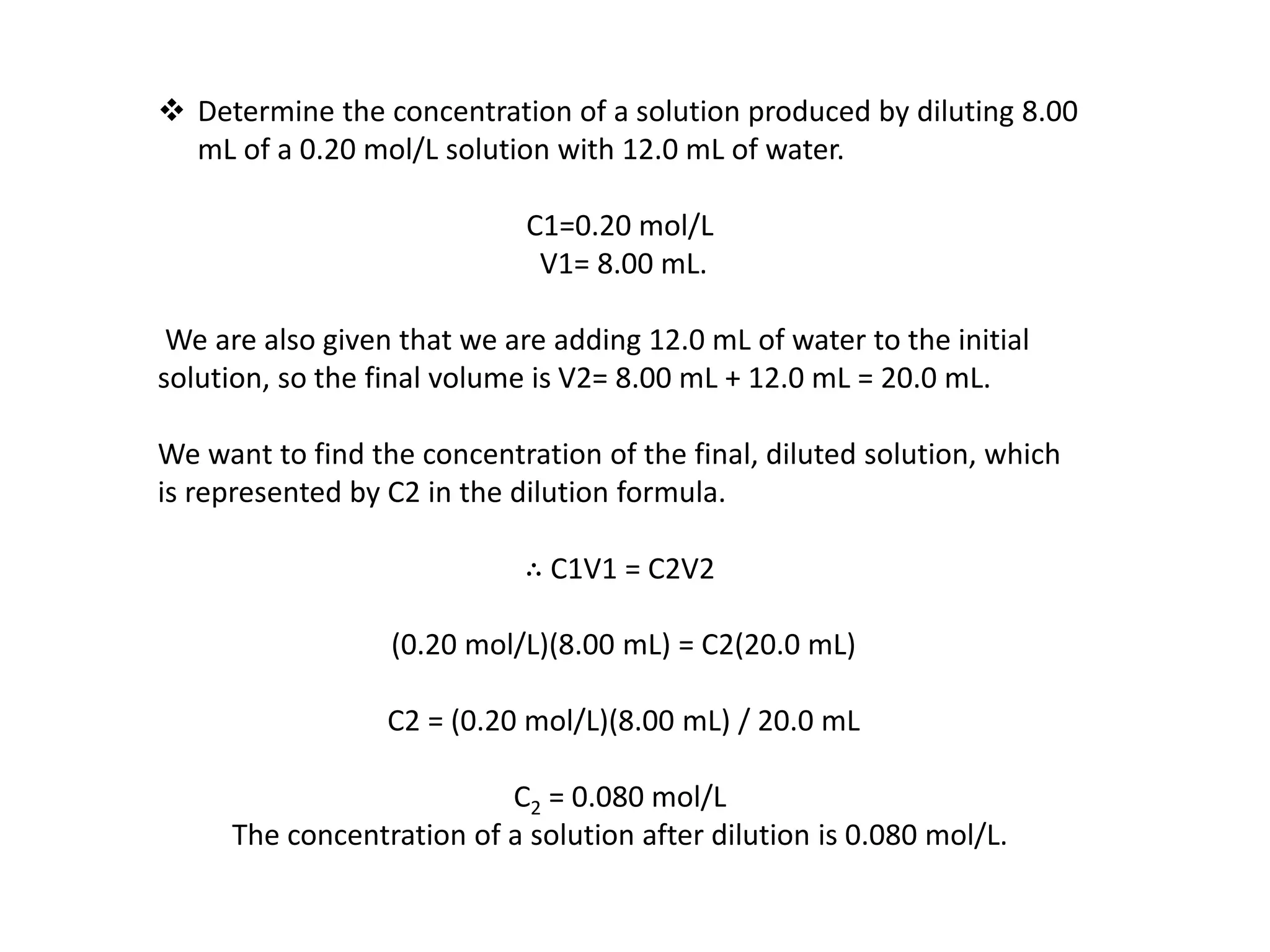
 Determine the concentration of a solution produced by diluting 8.00
mL of a 0.20 mol/L solution with 12.0 mL of water.
C1=0.20 mol/L
V1= 8.00 mL.
We are also given that we are adding 12.0 mL of water to the initial
solution, so the final volume is V2= 8.00 mL + 12.0 mL = 20.0 mL.
We want to find the concentration of the final, diluted solution, which
is represented by C2 in the dilution formula.
∴ C1V1 = C2V2
(0.20 mol/L)(8.00 mL) = C2(20.0 mL)
C2 = (0.20 mol/L)(8.00 mL) / 20.0 mL
C2 = 0.080 mol/L
The concentration of a solution after dilution is 0.080 mol/L.
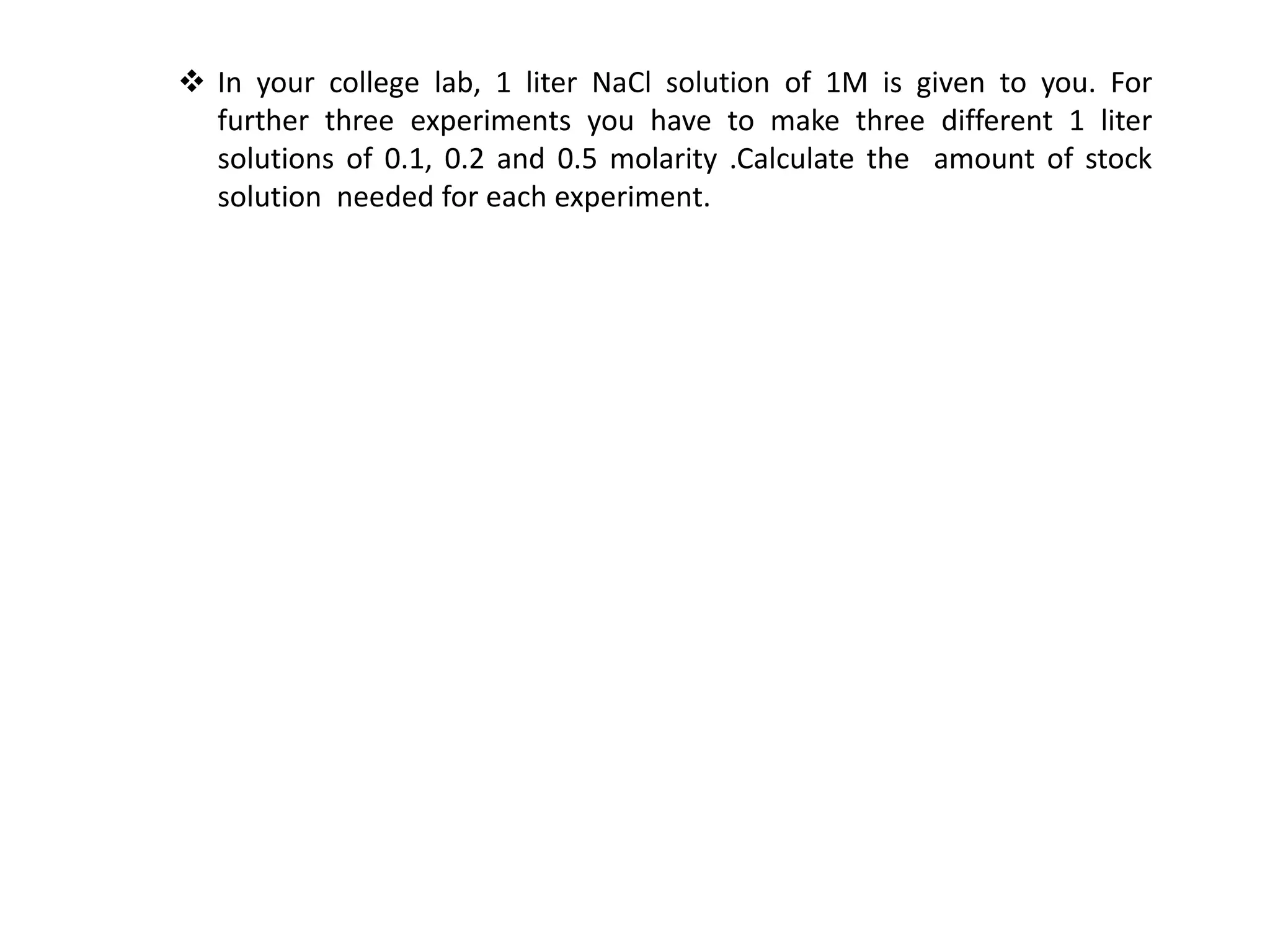
 In your college lab, 1 liter NaCl solution of 1M is given to you. For
further three experiments you have to make three different 1 liter
solutions of 0.1, 0.2 and 0.5 molarity .Calculate the amount of stock
solution needed for each experiment.

Practical 3-Metrics

  • 1.
  • 2.
    Aim- To studyMetrics, Measurements and Calculations Introduction:- Definition and Examples of Metrics. Definitions of Molarity, Normality and percent solutions. Procedure:- Examples of 1N NaCl, 1N NaOH,1N H2SO4 Examples of C1v1=c2v2 given in the slides. Result:-Metrics and units of measurements were discussed. Concepts of molarity, normality and percent solutions were studied.
  • 3.
    • The metricsystem was originated in the year 1799. 19th and early 20th centuries, the term – metric system is used as another word for SI or the International System of Units. • Metric System is basically a system used for measuring distance, length, volume, weight and temperature. It is based on three basic units . M- meter, used to measure the length Kg- kilogram, used to measure the mass S- second, used to measure time • Mass- Amount of matter present in an object. • Weight-The force exerted by gravity on the object.
  • 5.
    Kilo hecto decaUnit deci centi milli 103 102 101 100 10-1 10-2 10–3 Metric Number Prefixes • In order to remember the proper movement of units, arrange the prefixes from the largest to the smallest. • Thus, the conversion from one unit to the other unit is done by multiplying or dividing the powers of 10. kilometer (km) Hectometer (hm) Decameter (dam) Meter (m) Decimeter (dm) Centimeter (cm) Millimeter (mm) 1000 100 10 1 1/10 1/100 1/1000
  • 8.
    Solutions • Solution: ahomogenous mixture of two or more substances in a single phase; a solute and a solvent. • Solute: a substance which is the portion of a solution that is dissolved. • Solvent: a substance which is the portion of a solution that dissolves the solute; determines the phase of the solution.
  • 9.
    Phases of Solutions Phaseof the Solute Phase of the Solvent Phase of the Solution Example Solid Solid Solid Metal alloy Solid Liquid Liquid Kool-aid Liquid Liquid Liquid Ethanol-water Gas Liquid Liquid Dr. Pepper Gas Gas Gas Air
  • 10.
    Concentration • Concentration isthe measurement of the amount of a particular substance in a given volume of solution.
  • 11.
    Concentration Calculations Name UnitsApplication Molarity M mol solute / L solution Solution concentration Molality m mol solute / kg solvent Calculations using solids Normality N Molarity x n Titration calculations Parts per Million ppm g solute / 1 000 000 g solution mass solute / mass solution x 106 To express very small concentrations Percentage by Weight % Mass solute/ mass solution x 100 % by weight Percentage by Vol. % Vol. solute / vol. solution x 100 % by volume
  • 12.
    Molarity  Molarity: Themolar unit is probably the most commonly used chemical unit of measurement. Molarity is the number of moles of a solute dissolved in a liter of solution. A molar solution of sodium chloride is made by placing 1 mole of a solute into a 1-liter volumetric flask. Water is then added to the volumetric flask up to the one liter line.
  • 13.
    1M NaCl inwater  The result is a one molar solution of sodium chloride.(NaCl)  One mole of sodium(Na) is 22.99 gm.  One mole of chlorine(Cl) is 35.45 gm.  They are in a ratio of 1:1  So, Molar mass of NaCl is= 22.99+35.45 = 58.44 gm • So,1 M NaCl = 58.44 grams NaCl / 1 L H2O Note: One mole of any element has 6.023*1023 atoms of that element. 6.023*1023 is Avogadro’s constant denoted by ‘A’.
  • 14.
    Normality  Normality: Thenormality of a solution is equal to the number of gram equivalents dissolved in liter of solution. Normality= • gram equivalent is the amount of a substance that will react or supply 1 mole of hydrogen ions (H+) or 1 mole of electrons (e–). • There is a relationship between normality and molarity. Normality is the molarity of a solution multiplied by the number of moles of equivalents. • N = M×n • Where, • n = the number of equivalents • For some chemicals, when n = 1, N and M are the same.
  • 15.
    1N NaOH inwater 1 mole of NaOH gives 1 mole of sodium ions and 1 mole of hydroxide ions. NaOH+ H2O Na+ +OH - • The molar mass of sodium hydroxide is 40 g/mol and it will ‘react’ with 1 mole of hydrogen ions (when hydroxide ions react with hydrogen ions, water is produced). • So, the gram equivalent of NaOH will be 40g/eq. 1 N H2SO4 in water 1mole of sulphuric acid (H2SO4) gives 2 moles of hydrogen ions. H2SO4+ + H2O 2 H+ + SO4- The molar mass of sulphuric acid is 98.08g/mol So, 49.04 g/eq is the gram equivalent weight of H2SO4.
  • 16.
    Normality and itsFormula isn’t the most common way to measure concentration, and its use is not acceptable for all chemical solutions under all circumstances. Normality is commonly used in acid-base chemical reactions, redox reactions, and precipitation reactions. It depends on the chemical process under observation and the temperature.
  • 17.
    % by Weight Percent by weight: To make up a solution based on percentage by weight, one would simply determine what percentage was desired (for example, a 20% by weight aqueous solution of sodium chloride) and the total quantity to be prepared.
  • 18.
    – If thetotal quantity needed is 1 kg, then it would simply be a matter of calculating 20% of 1 kg which, of course is: 0.20 NaCl * 1000 g/kg = 200 g NaCl/kg. • In order to bring the total quantity to 1 kg, it would be necessary to add 800g water.
  • 19.
    % by Volume Percent by volume: Solutions based on percent by volume are calculated the same as for percent by weight, except that calculations are based on volume. Thus one would simply determine what percentage was desired (for example, a 20% by volume aqueous solution of sodium chloride) and the total quantity to be prepared.
  • 20.
    – If thetotal quantity needed is 1 liter, then it would simply be a matter of calculating 20% of 1 liter which, of course is: 0.20 NaCl * 1000 ml/l = 200 ml NaCl/l.  Percentages are used more in the technological fields of chemistry (such as environmental technologies) than they are in pure chemistry.
  • 21.
    Making Dilutions  Makingdilutions is easy. The starting solution is referred to as the stock solution and the solution that you make is referred to as the working solution.  It is easier to make and store smaller volumes of concentrated stock solution.
  • 22.
    Calculating Dilutions • Whenyou need a reagent (A substance used in a chemical reaction to detect, measure, examine, or produce other substances;) simply prepare it from a stock solution. • The molarity and volume of the stock solution are inversely proportional. As you reduce one, you increase the other by the same proportion. Therefore; • MstockVstock = MworkingVworking
  • 23.
    The equation hasfour components: C1 = Initial concentration of solution V1 = Initial volume of solution C2 = Final concentration of solution V2 = Final volume of solution
  • 24.
     Calculate theamount of 10 μM forward primer solution to add to a PCR reaction (25 μL total reaction) to make a final concentration of 0.4 μM forward primer in the reaction. By using the C1V1 = C2V2 equation, we need to first rearrange this to work out V1 (the initial volume of primer we need to add). This would then make: C1V1=C2V2 Here C2=0.4 V2=25 C1=10 So: V1 = (0.4 x 25) / 10 V1 = 10 / 10 V1 = 1 Therefore, in this example, we would need to add 1 μL of 10 μM forward primer solution to a PCR reaction containing a total volume of 25 μL to achieve a final forward primer concentration of 0.4 μM.
  • 25.
     Determine theconcentration of a solution produced by diluting 8.00 mL of a 0.20 mol/L solution with 12.0 mL of water. C1=0.20 mol/L V1= 8.00 mL. We are also given that we are adding 12.0 mL of water to the initial solution, so the final volume is V2= 8.00 mL + 12.0 mL = 20.0 mL. We want to find the concentration of the final, diluted solution, which is represented by C2 in the dilution formula. ∴ C1V1 = C2V2 (0.20 mol/L)(8.00 mL) = C2(20.0 mL) C2 = (0.20 mol/L)(8.00 mL) / 20.0 mL C2 = 0.080 mol/L The concentration of a solution after dilution is 0.080 mol/L.
  • 26.
     In yourcollege lab, 1 liter NaCl solution of 1M is given to you. For further three experiments you have to make three different 1 liter solutions of 0.1, 0.2 and 0.5 molarity .Calculate the amount of stock solution needed for each experiment.