SOLUTION
STOICHIOMETRY
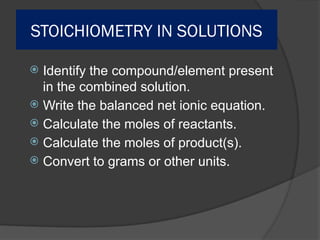
STOICHIOMETRY IN SOLUTIONS
 Identify the compound/element present
in the combined solution.
 Write the balanced net ionic equation.
 Calculate the moles of reactants.
 Calculate the moles of product(s).
 Convert to grams or other units.
3
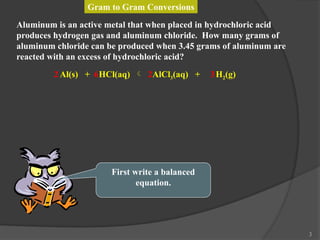
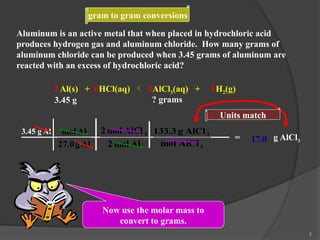
Aluminum is an active metal that when placed in hydrochloric acid
produces hydrogen gas and aluminum chloride. How many grams of
aluminum chloride can be produced when 3.45 grams of aluminum are
reacted with an excess of hydrochloric acid?
First write a balanced
equation.
Al(s) + HCl(aq)  AlCl3(aq) + H2(g)
2 6 2 3
Gram to Gram Conversions
4
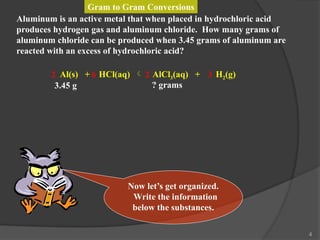
Aluminum is an active metal that when placed in hydrochloric acid
produces hydrogen gas and aluminum chloride. How many grams of
aluminum chloride can be produced when 3.45 grams of aluminum are
reacted with an excess of hydrochloric acid?
Al(s) + HCl(aq)  AlCl3(aq) + H2(g)
2 6 2 3
Now let’s get organized.
Write the information
below the substances.
3.45 g ? grams
Gram to Gram Conversions
5
Aluminum is an active metal that when placed in hydrochloric acid
produces hydrogen gas and aluminum chloride. How many grams of
aluminum chloride can be produced when 3.45 grams of aluminum are
reacted with an excess of hydrochloric acid?
Al(s) + HCl(aq)  AlCl3(aq) + H2(g)
2 6 2 3
3.45 g ? grams
Let’s work the problem.
= g AlCl3
3.45 g Al
Al
g
27.0
Al
mol
We must always convert to moles.
Now use the molar ratio.
Al
mol
2
AlCl
mol
2 3
Now use the molar mass to
convert to grams.
3
3
AlCl
mol
AlCl
g
133.3
17.0
Units match
gram to gram conversions
6
Molarity
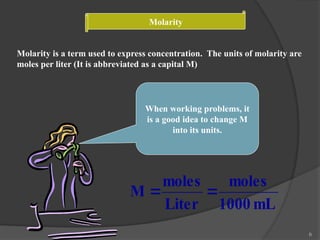
Molarity is a term used to express concentration. The units of molarity are
moles per liter (It is abbreviated as a capital M)
When working problems, it
is a good idea to change M
into its units.
mL
1000
moles
Liter
moles
M 

7
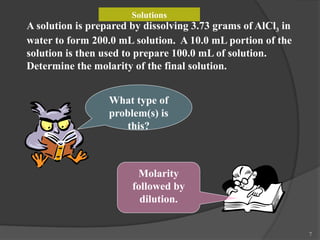
A solution is prepared by dissolving 3.73 grams of AlCl3 in
water to form 200.0 mL solution. A 10.0 mL portion of the
solution is then used to prepare 100.0 mL of solution.
Determine the molarity of the final solution.
What type of
problem(s) is
this?
Molarity
followed by
dilution.
Solutions
8
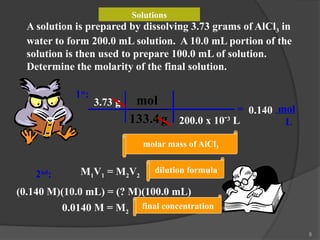
A solution is prepared by dissolving 3.73 grams of AlCl3 in
water to form 200.0 mL solution. A 10.0 mL portion of the
solution is then used to prepare 100.0 mL of solution.
Determine the molarity of the final solution.
1st
:
= mol
L
3.73 g
g
133.4
mol
200.0 x 10⁻³
L
0.140
2nd
: M1V1 = M2V2
(0.140 M)(10.0 mL) = (? M)(100.0 mL)
0.0140 M = M2
molar mass of AlCl3
dilution formula
final concentration
Solutions
9
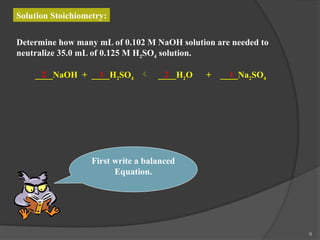
Solution Stoichiometry:
Determine how many mL of 0.102 M NaOH solution are needed to
neutralize 35.0 mL of 0.125 M H2SO4 solution.
First write a balanced
Equation.
____NaOH + ____H2SO4  ____H2O + ____Na2SO4
2 1 2 1
10
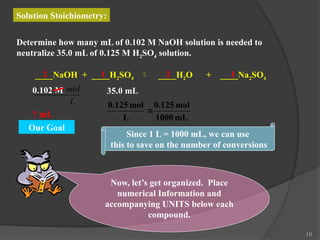
Solution Stoichiometry:
Determine how many mL of 0.102 M NaOH solution is needed to
neutralize 35.0 mL of 0.125 M H2SO4 solution.
Now, let’s get organized. Place
numerical Information and
accompanying UNITS below each
compound.
____NaOH + ____H2SO4  ____H2O + ____Na2SO4
2 1 2 1
0.102 M
L
mol
? mL
35.0 mL
mL
1000
mol
0.125
L
mol
0.125

Since 1 L = 1000 mL, we can use
this to save on the number of conversions
Our Goal
11
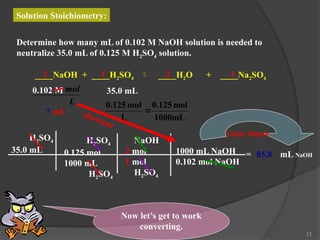
Determine how many mL of 0.102 M NaOH solution is needed to
neutralize 35.0 mL of 0.125 M H2SO4 solution.
Now let’s get to work
converting.
____NaOH + ____H2SO4  ____H2O + ____Na2SO4
2 1 2 1
0.102 M
L
mol
? mL
35.0 mL
mL
1000
mol
0.125
L
mol
0.125

= mL NaOH
H2SO4
35.0 mL
H2SO4
0.125 mol
1000 mL
H2SO4
NaOH
2 mol
1 mol
H2SO4
1000 mL NaOH
0.102 mol NaOH
85.8
Units Match
Solution Stoichiometry:
shortcut
12
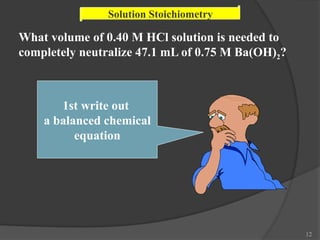
What volume of 0.40 M HCl solution is needed to
completely neutralize 47.1 mL of 0.75 M Ba(OH)2?
1st write out
a balanced chemical
equation
Solution Stoichiometry
13
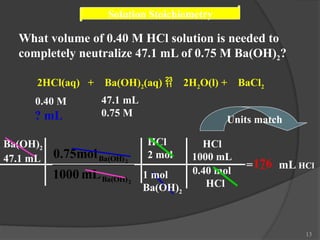
What volume of 0.40 M HCl solution is needed to
completely neutralize 47.1 mL of 0.75 M Ba(OH)2?
2HCl(aq) + Ba(OH)2(aq)  2H2O(l) + BaCl2
0.40 M 47.1 mL
0.75 M
? mL
= mL HCl
Ba(OH)2
47.1 mL
2
2
Ba(OH)
Ba(OH)
mL
1000
0.75mol
1 mol
Ba(OH)2
HCl
2 mol
0.40 mol
HCl
HCl
1000 mL
176
Units match
Solution Stoichiometry
14
Solution Stochiometry Problem:
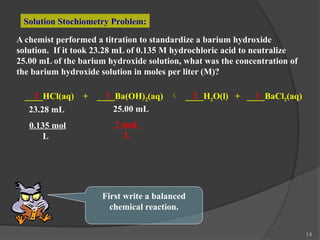
A chemist performed a titration to standardize a barium hydroxide
solution. If it took 23.28 mL of 0.135 M hydrochloric acid to neutralize
25.00 mL of the barium hydroxide solution, what was the concentration of
the barium hydroxide solution in moles per liter (M)?
First write a balanced
chemical reaction.
____HCl(aq) + ____Ba(OH)2(aq)  ____H2O(l) + ____BaCl2(aq)
2 1 2 1
23.28 mL
0.135 mol
L
25.00 mL
? mol
L
15
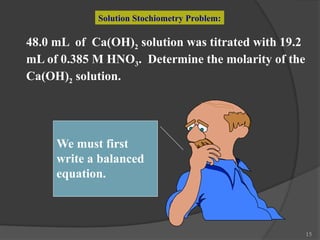
48.0 mL of Ca(OH)2 solution was titrated with 19.2
mL of 0.385 M HNO3. Determine the molarity of the
Ca(OH)2 solution.
We must first
write a balanced
equation.
Solution Stochiometry Problem:
16
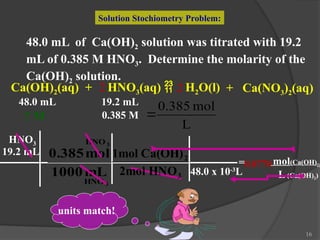
48.0 mL of Ca(OH)2 solution was titrated with 19.2
mL of 0.385 M HNO3. Determine the molarity of the
Ca(OH)2 solution.
Ca(OH)2(aq) + HNO3(aq)  H2O(l) + Ca(NO3)2(aq)
2 2
48.0 mL 19.2 mL
0.385 M
L
mol
0.385

= mol(Ca(OH)2)
L (Ca(OH)2)
19.2 mL
HNO3
3
3
HNO
HNO
mL
1000
mol
0.385
3
2
HNO
2mol
Ca(OH)
1mol
48.0 x 10⁻³
L
? M
units match!
0.0770
Solution Stochiometry Problem:
17
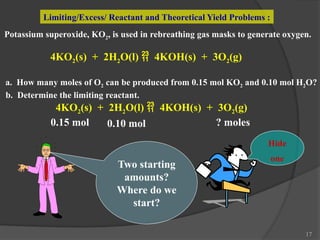
Limiting/Excess/ Reactant and Theoretical Yield Problems :
Potassium superoxide, KO2, is used in rebreathing gas masks to generate oxygen.
4KO2(s) + 2H2O(l)  4KOH(s) + 3O2(g)
a. How many moles of O2 can be produced from 0.15 mol KO2 and 0.10 mol H2O?
b. Determine the limiting reactant.
4KO2(s) + 2H2O(l)  4KOH(s) + 3O2(g)
0.15 mol 0.10 mol ? moles
Two starting
amounts?
Where do we
start?
Hide
one
18
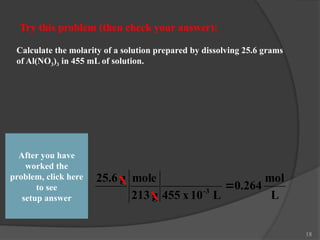
Calculate the molarity of a solution prepared by dissolving 25.6 grams
of Al(NO3)3 in 455 mL of solution.
L
mol
0.264
L
10
x
455
g
213
mole
g
25.6
3
-

After you have
worked the
problem, click here
to see
setup answer
Try this problem (then check your answer):

solutionstoichiometry.pptx analytical ppt

  • 1.
  • 2.
    STOICHIOMETRY IN SOLUTIONS Identify the compound/element present in the combined solution.  Write the balanced net ionic equation.  Calculate the moles of reactants.  Calculate the moles of product(s).  Convert to grams or other units.
  • 3.
    3 Aluminum is anactive metal that when placed in hydrochloric acid produces hydrogen gas and aluminum chloride. How many grams of aluminum chloride can be produced when 3.45 grams of aluminum are reacted with an excess of hydrochloric acid? First write a balanced equation. Al(s) + HCl(aq)  AlCl3(aq) + H2(g) 2 6 2 3 Gram to Gram Conversions
  • 4.
    4 Aluminum is anactive metal that when placed in hydrochloric acid produces hydrogen gas and aluminum chloride. How many grams of aluminum chloride can be produced when 3.45 grams of aluminum are reacted with an excess of hydrochloric acid? Al(s) + HCl(aq)  AlCl3(aq) + H2(g) 2 6 2 3 Now let’s get organized. Write the information below the substances. 3.45 g ? grams Gram to Gram Conversions
  • 5.
    5 Aluminum is anactive metal that when placed in hydrochloric acid produces hydrogen gas and aluminum chloride. How many grams of aluminum chloride can be produced when 3.45 grams of aluminum are reacted with an excess of hydrochloric acid? Al(s) + HCl(aq)  AlCl3(aq) + H2(g) 2 6 2 3 3.45 g ? grams Let’s work the problem. = g AlCl3 3.45 g Al Al g 27.0 Al mol We must always convert to moles. Now use the molar ratio. Al mol 2 AlCl mol 2 3 Now use the molar mass to convert to grams. 3 3 AlCl mol AlCl g 133.3 17.0 Units match gram to gram conversions
  • 6.
    6 Molarity Molarity is aterm used to express concentration. The units of molarity are moles per liter (It is abbreviated as a capital M) When working problems, it is a good idea to change M into its units. mL 1000 moles Liter moles M  
  • 7.
    7 A solution isprepared by dissolving 3.73 grams of AlCl3 in water to form 200.0 mL solution. A 10.0 mL portion of the solution is then used to prepare 100.0 mL of solution. Determine the molarity of the final solution. What type of problem(s) is this? Molarity followed by dilution. Solutions
  • 8.
    8 A solution isprepared by dissolving 3.73 grams of AlCl3 in water to form 200.0 mL solution. A 10.0 mL portion of the solution is then used to prepare 100.0 mL of solution. Determine the molarity of the final solution. 1st : = mol L 3.73 g g 133.4 mol 200.0 x 10⁻³ L 0.140 2nd : M1V1 = M2V2 (0.140 M)(10.0 mL) = (? M)(100.0 mL) 0.0140 M = M2 molar mass of AlCl3 dilution formula final concentration Solutions
  • 9.
    9 Solution Stoichiometry: Determine howmany mL of 0.102 M NaOH solution are needed to neutralize 35.0 mL of 0.125 M H2SO4 solution. First write a balanced Equation. ____NaOH + ____H2SO4  ____H2O + ____Na2SO4 2 1 2 1
  • 10.
    10 Solution Stoichiometry: Determine howmany mL of 0.102 M NaOH solution is needed to neutralize 35.0 mL of 0.125 M H2SO4 solution. Now, let’s get organized. Place numerical Information and accompanying UNITS below each compound. ____NaOH + ____H2SO4  ____H2O + ____Na2SO4 2 1 2 1 0.102 M L mol ? mL 35.0 mL mL 1000 mol 0.125 L mol 0.125  Since 1 L = 1000 mL, we can use this to save on the number of conversions Our Goal
  • 11.
    11 Determine how manymL of 0.102 M NaOH solution is needed to neutralize 35.0 mL of 0.125 M H2SO4 solution. Now let’s get to work converting. ____NaOH + ____H2SO4  ____H2O + ____Na2SO4 2 1 2 1 0.102 M L mol ? mL 35.0 mL mL 1000 mol 0.125 L mol 0.125  = mL NaOH H2SO4 35.0 mL H2SO4 0.125 mol 1000 mL H2SO4 NaOH 2 mol 1 mol H2SO4 1000 mL NaOH 0.102 mol NaOH 85.8 Units Match Solution Stoichiometry: shortcut
  • 12.
    12 What volume of0.40 M HCl solution is needed to completely neutralize 47.1 mL of 0.75 M Ba(OH)2? 1st write out a balanced chemical equation Solution Stoichiometry
  • 13.
    13 What volume of0.40 M HCl solution is needed to completely neutralize 47.1 mL of 0.75 M Ba(OH)2? 2HCl(aq) + Ba(OH)2(aq)  2H2O(l) + BaCl2 0.40 M 47.1 mL 0.75 M ? mL = mL HCl Ba(OH)2 47.1 mL 2 2 Ba(OH) Ba(OH) mL 1000 0.75mol 1 mol Ba(OH)2 HCl 2 mol 0.40 mol HCl HCl 1000 mL 176 Units match Solution Stoichiometry
  • 14.
    14 Solution Stochiometry Problem: Achemist performed a titration to standardize a barium hydroxide solution. If it took 23.28 mL of 0.135 M hydrochloric acid to neutralize 25.00 mL of the barium hydroxide solution, what was the concentration of the barium hydroxide solution in moles per liter (M)? First write a balanced chemical reaction. ____HCl(aq) + ____Ba(OH)2(aq)  ____H2O(l) + ____BaCl2(aq) 2 1 2 1 23.28 mL 0.135 mol L 25.00 mL ? mol L
  • 15.
    15 48.0 mL ofCa(OH)2 solution was titrated with 19.2 mL of 0.385 M HNO3. Determine the molarity of the Ca(OH)2 solution. We must first write a balanced equation. Solution Stochiometry Problem:
  • 16.
    16 48.0 mL ofCa(OH)2 solution was titrated with 19.2 mL of 0.385 M HNO3. Determine the molarity of the Ca(OH)2 solution. Ca(OH)2(aq) + HNO3(aq)  H2O(l) + Ca(NO3)2(aq) 2 2 48.0 mL 19.2 mL 0.385 M L mol 0.385  = mol(Ca(OH)2) L (Ca(OH)2) 19.2 mL HNO3 3 3 HNO HNO mL 1000 mol 0.385 3 2 HNO 2mol Ca(OH) 1mol 48.0 x 10⁻³ L ? M units match! 0.0770 Solution Stochiometry Problem:
  • 17.
    17 Limiting/Excess/ Reactant andTheoretical Yield Problems : Potassium superoxide, KO2, is used in rebreathing gas masks to generate oxygen. 4KO2(s) + 2H2O(l)  4KOH(s) + 3O2(g) a. How many moles of O2 can be produced from 0.15 mol KO2 and 0.10 mol H2O? b. Determine the limiting reactant. 4KO2(s) + 2H2O(l)  4KOH(s) + 3O2(g) 0.15 mol 0.10 mol ? moles Two starting amounts? Where do we start? Hide one
  • 18.
    18 Calculate the molarityof a solution prepared by dissolving 25.6 grams of Al(NO3)3 in 455 mL of solution. L mol 0.264 L 10 x 455 g 213 mole g 25.6 3 -  After you have worked the problem, click here to see setup answer Try this problem (then check your answer):