Exponential functions
To explore the properties of exponential functions and
their graphs.
To understand the nature and behavior of exponential
growth and decay.
To solve problems leading to exponential equations
Exponential Functions
In an exponential function the unknown appears 
in the exponent like in:
f(x)= 2x
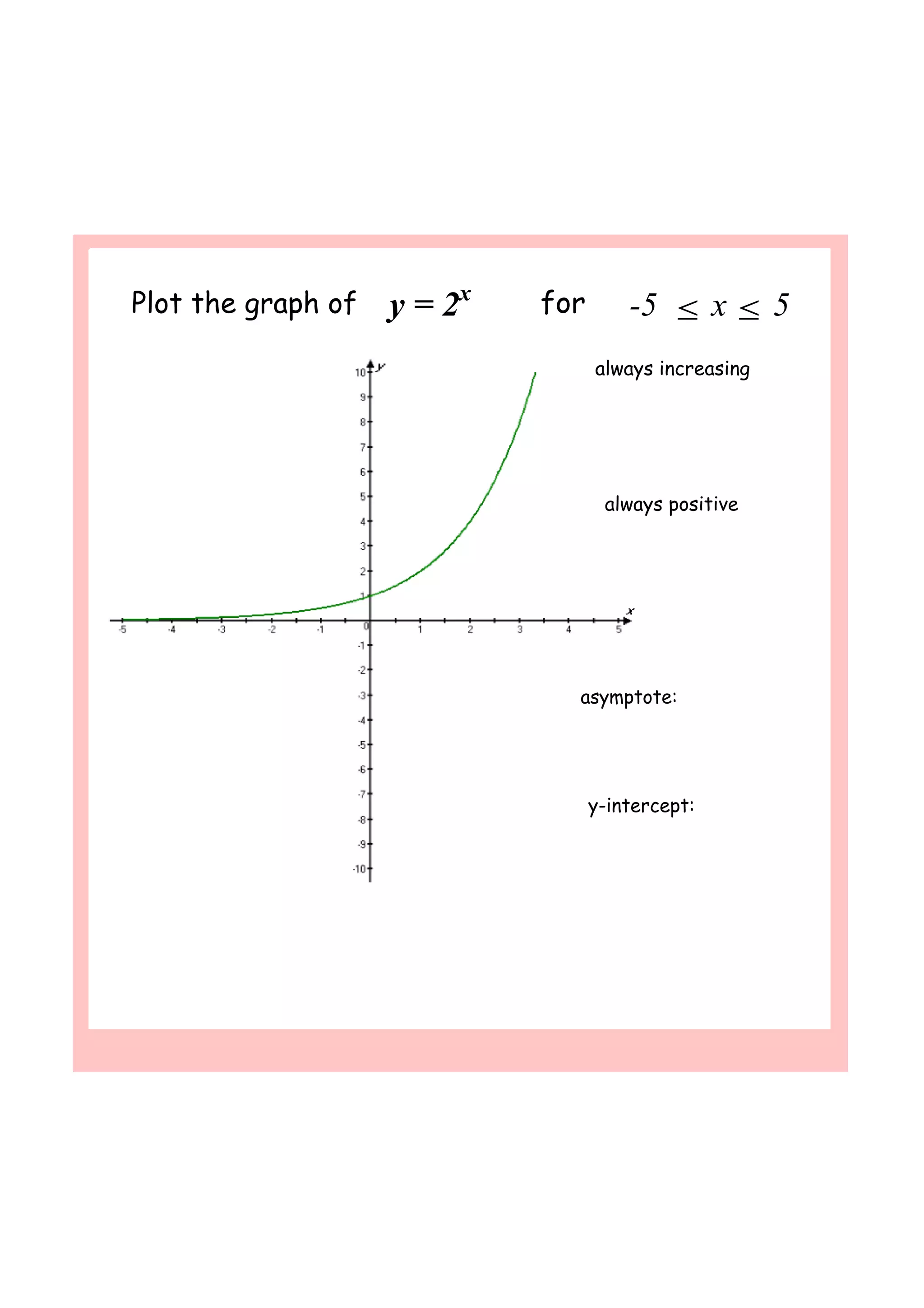
Plot the graph of y = 2x
for ­5  ≤ x ≤ 5
Exponential Functions
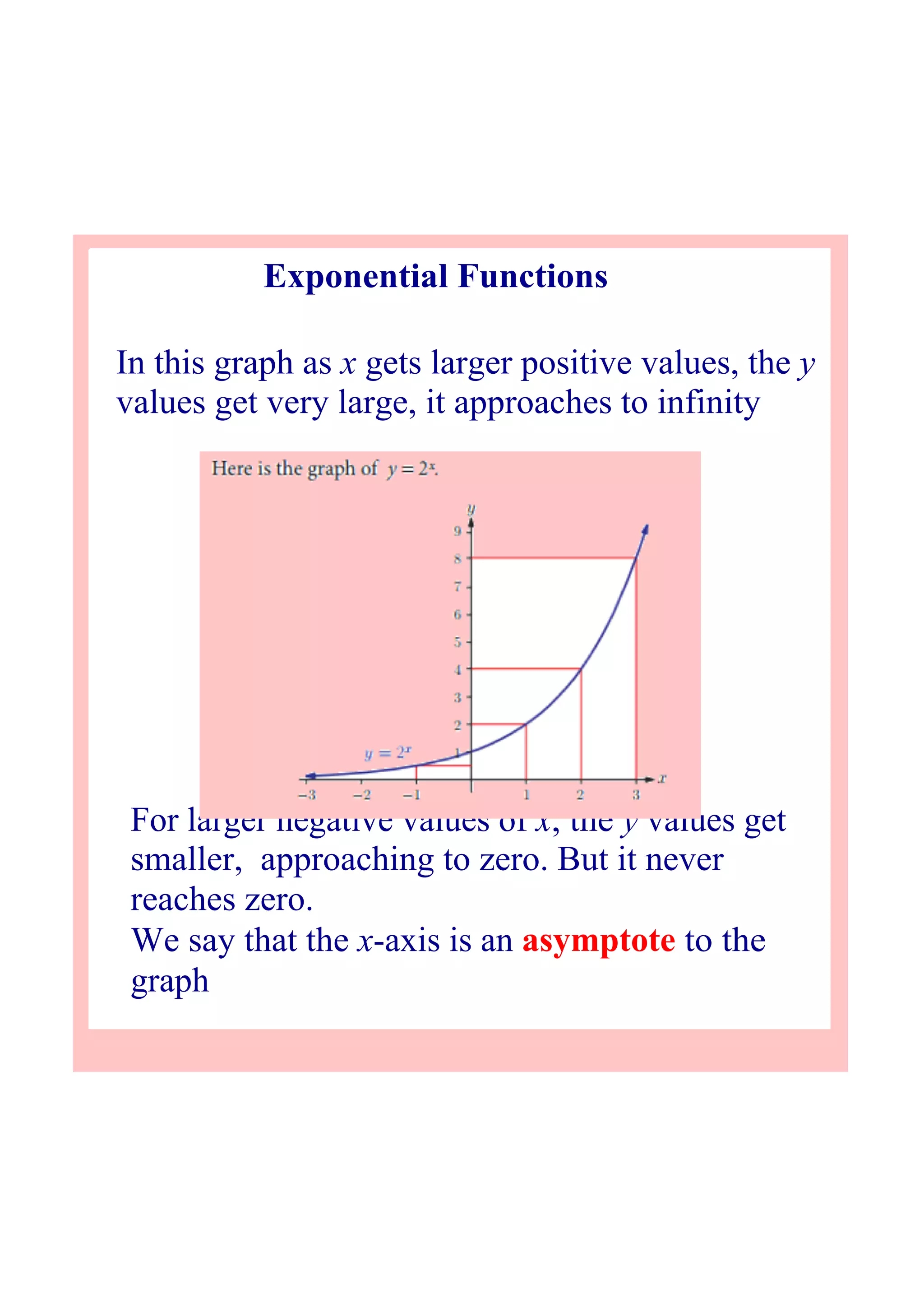
In this graph as x gets larger positive values, the y 
values get very large, it approaches to infinity 
For larger negative values of x, the y values get  
smaller,  approaching to zero. But it never 
reaches zero.
We say that the x­axis is an asymptote to the 
graph
Plot the graph of y = 2x
for ­5  ≤ x ≤ 5
always increasing
always positive
asymptote:
y-intercept:
On GDC explore the graphs of: 
g (x) = 3 x
h(x) = 4 x
f (x) = 2 x
y=2xy=3xy=4x
y- intercept:
asymptote:
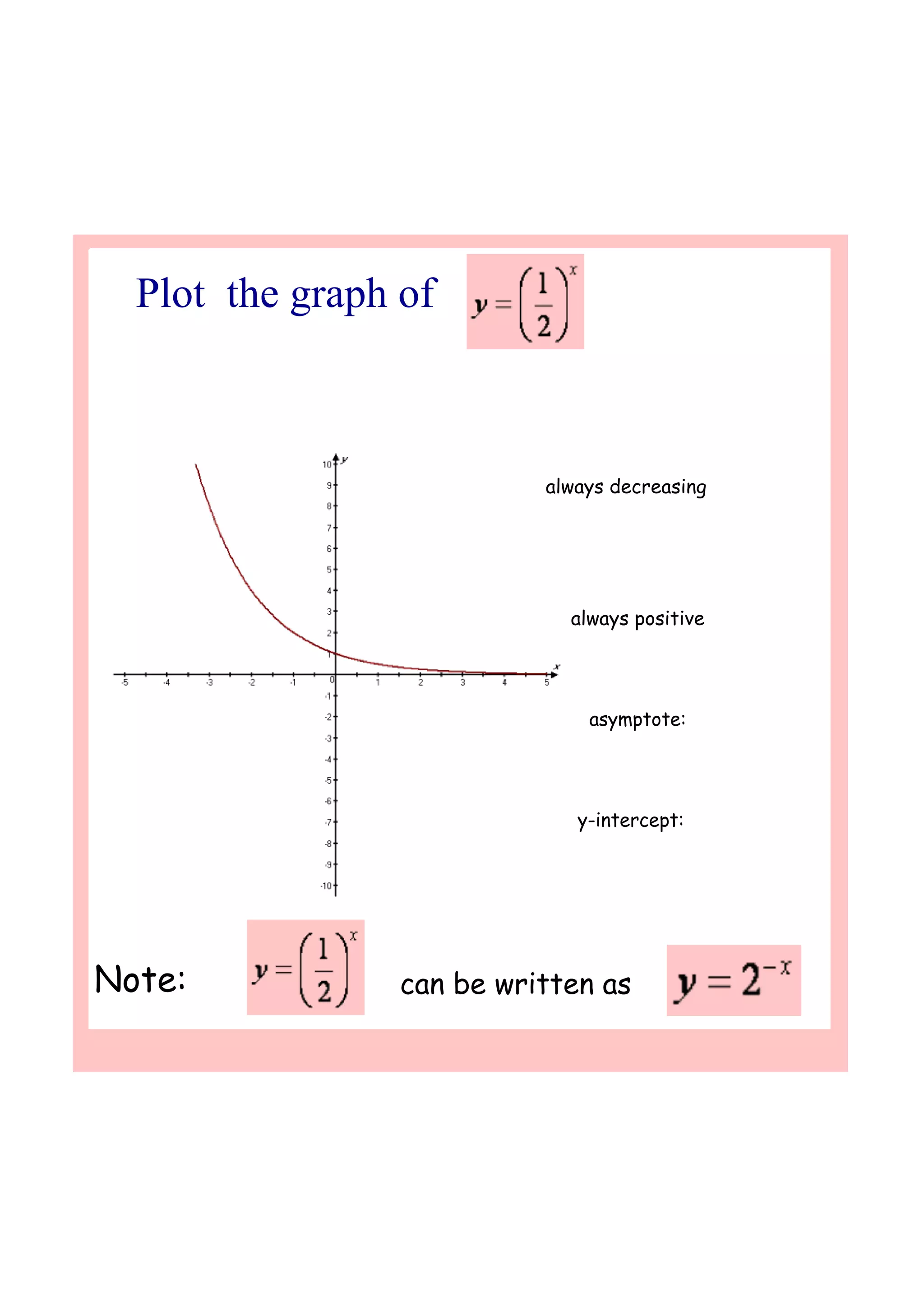
Plot  the graph of 
always decreasing
always positive
asymptote:
y-intercept:
Note: can be written as
Conclusions: y = a x
,a > 1   
Exponential growth
Asymptote: y = 0
y- intercept: (0, 1 )
the graph is above the
x-axis
as in y = 2x
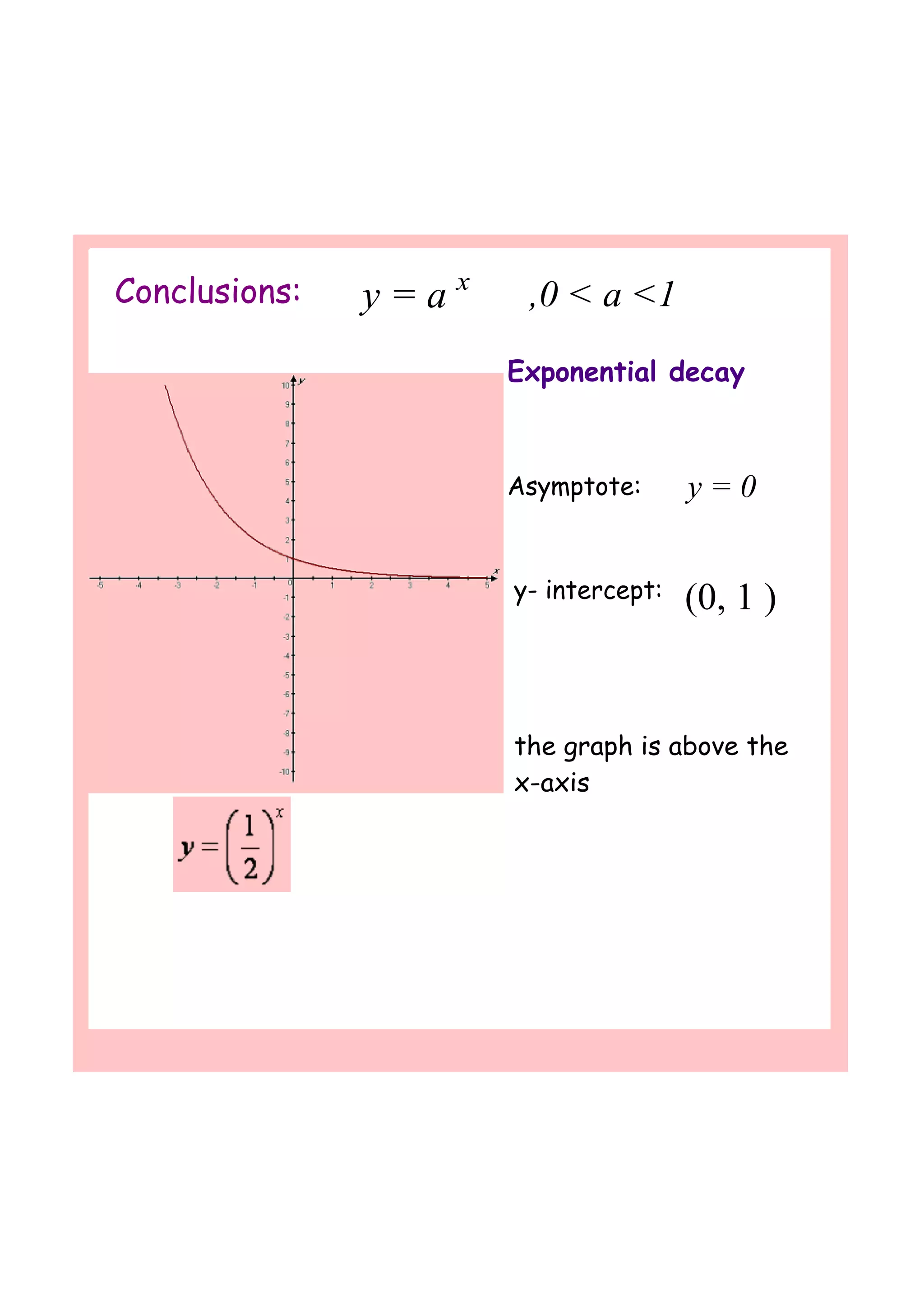
Conclusions: y = a x
,0 < a <1   
Exponential decay
Asymptote: y = 0
y- intercept: (0, 1 )
the graph is above the
x-axis
Exponential functions can be used to model 
real life situations as: growing of an investment, 
of a tumor, of a population,etc.
The number of bacteria in a culture, N, is modelled 
by the function: N = 1000 x  20.2t
  , t≥ 0
where t is measured in days.
• Find the initial number of bacteria in the culture.
• Find the number of bacteria after 5 days.
• How long does it take for the number of bacteria 
to grow to 4000?
1000
2000
10 days
• Use your GDC to plot the graph of N(t).
Mexico's population is increasing at a rate of
 2 % per year. Calculate how long will it take for 
Mexico's population to double.
In Nigeria the population is increasing at a rate of
 6.2 % per year. Calculate how long will it take for 
Nigeria's population to double.
The temperature T, in degrees Celsius, of a 
cooling liquid is modelled by the equation:
T  = 24 +72 (0.6)3t
where t is the time in minutes after the 
cooling begins.
a) What is the initial temperature of the liquid?
b) Find the temperature of the liquid after 2 min.
c) How long does it take for the liquid to cool to 
26o
C?
d) What temperature does the model predict the 
liquid will eventually reach?
We have been working with examples of 
exponential growth and decay and we used 
different bases, bases like 10 and 2 are commonly 
used for modelling certain applications. However 
the most important base is an irrational number 
denoted with the letter "e". ( e≈2.71828)
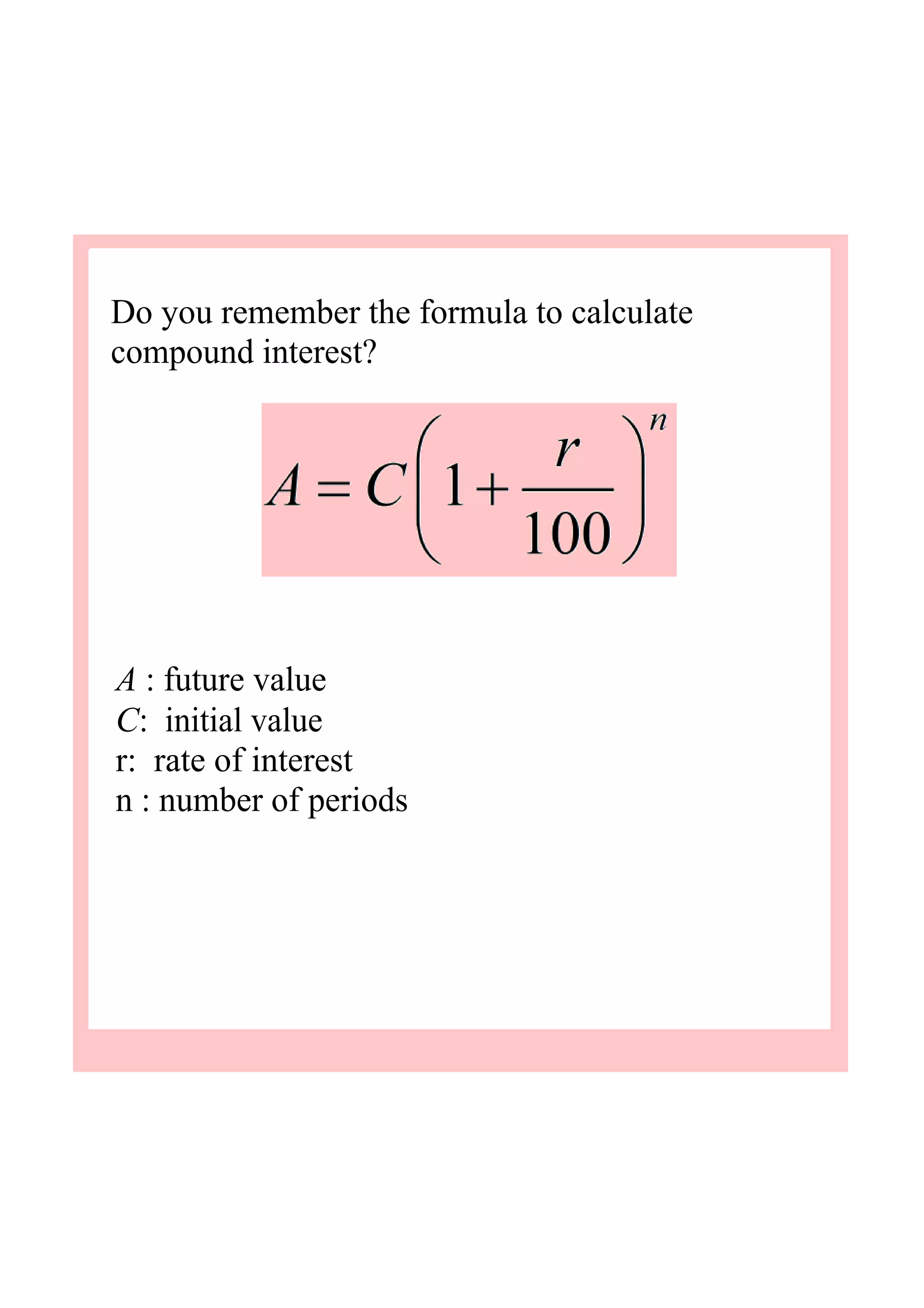
Do you remember the formula to calculate 
compound interest?
A : future value
C:  initial value
r:  rate of interest
n : number of periods
we are going to study what happens when we 
compound the interest continuously
we can write r as a decimal , then the formula will 
be:
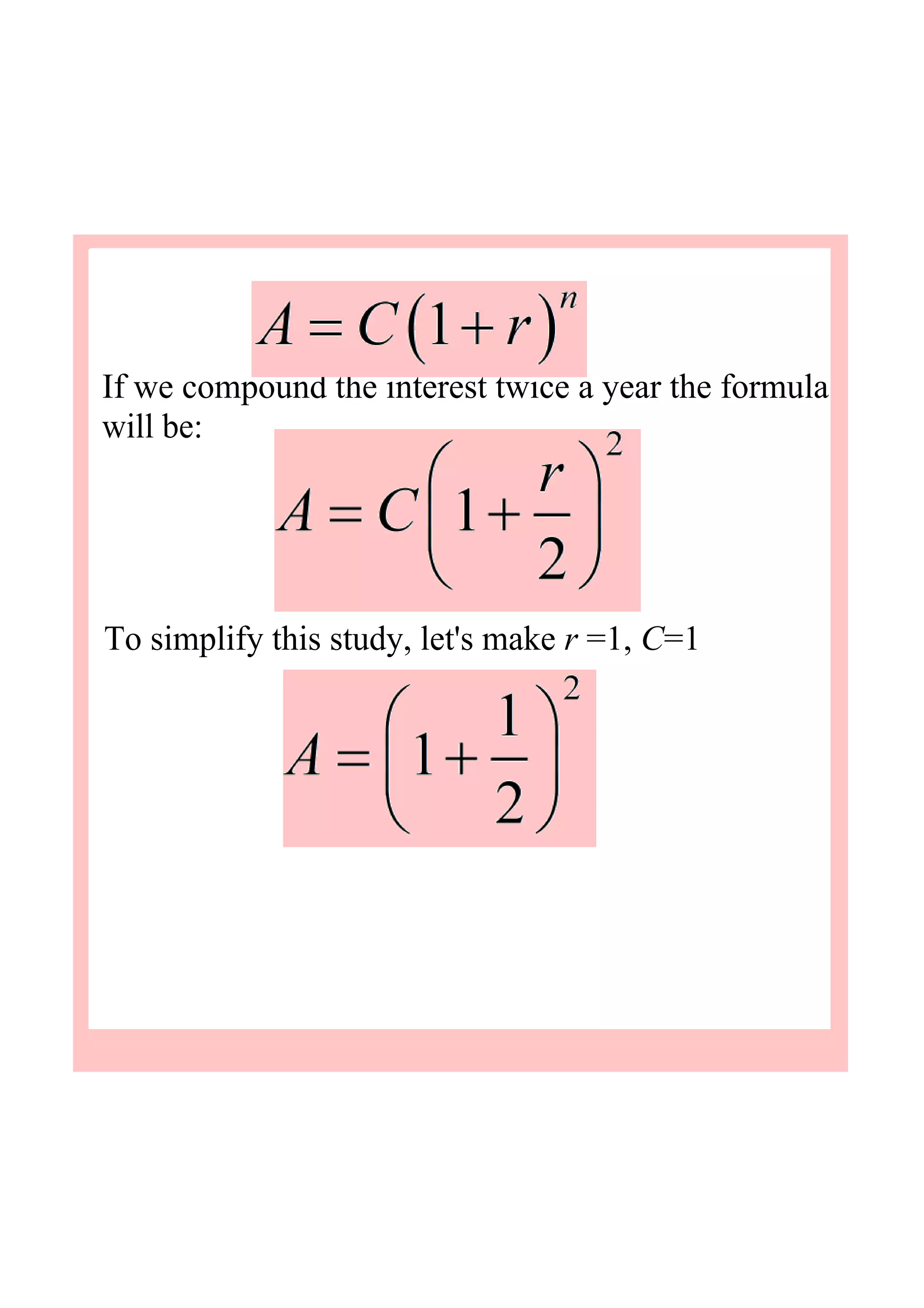
If we compound the interest twice a year the formula 
will be:
To simplify this study, let's make r =1, C=1
If we compound the interest three times a year the 
formula will be:
If we compound the interest twelve times a year the 
formula will be:
we can continue to compound the interest daily, 
minute­ly, second­ly...
Use the menu table in your calculator to 
complete:
compounding n  
annual
semi­annual
quaterly
monthly
daily
hourly
every minute
every second
1
2
4
12
365
8 760
525 600
31 536 000
2
2.25
2.4414...
2.613035...
2.714567...
2.718126...
2.71827921..
2.71828247..
Now move to the graph menu and plot the graph 
of   
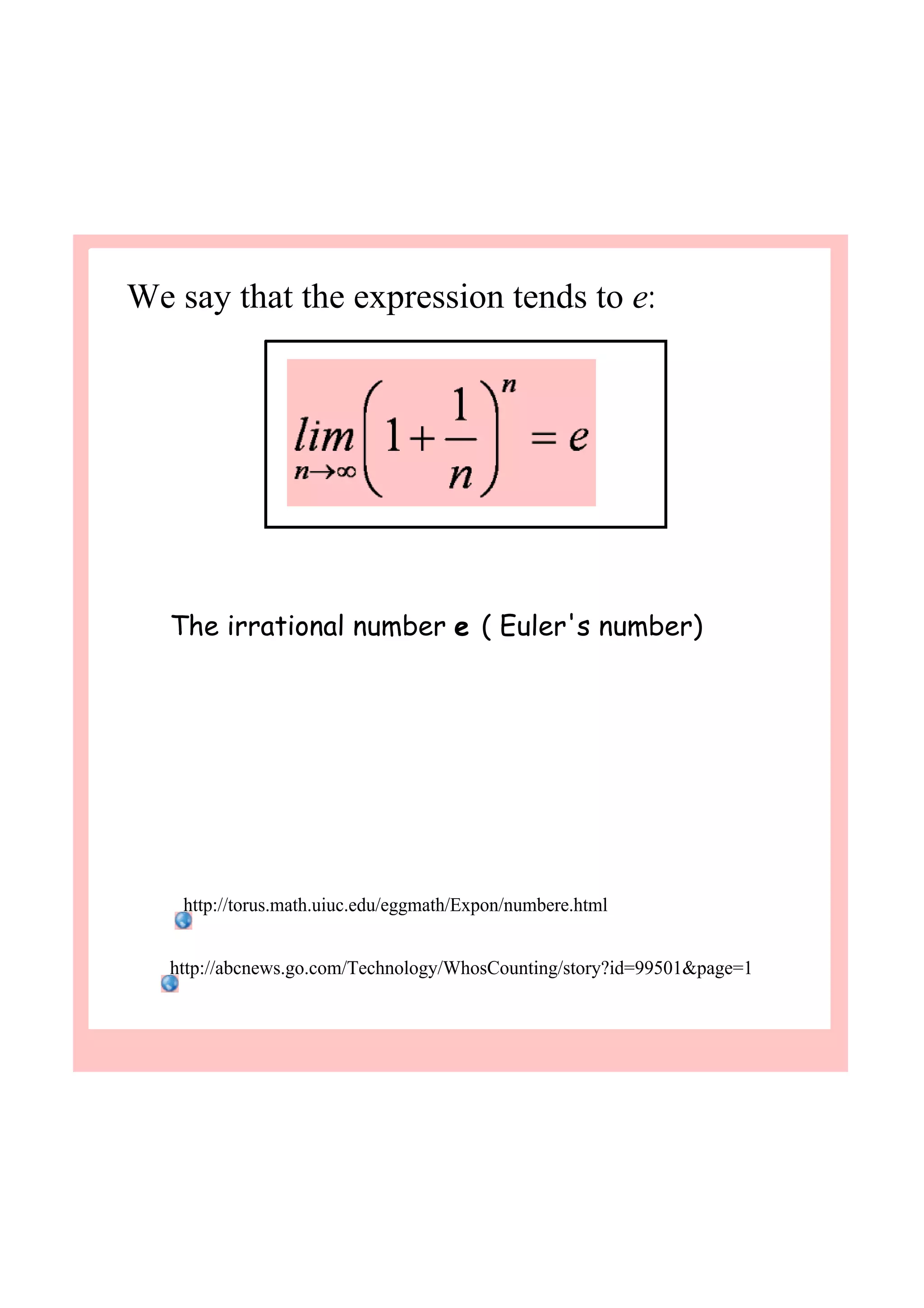
we say that this function tends to number  e
We say that the expression tends to e:
The irrational number e ( Euler's number)
http://torus.math.uiuc.edu/eggmath/Expon/numbere.html
http://abcnews.go.com/Technology/WhosCounting/story?id=99501&page=1
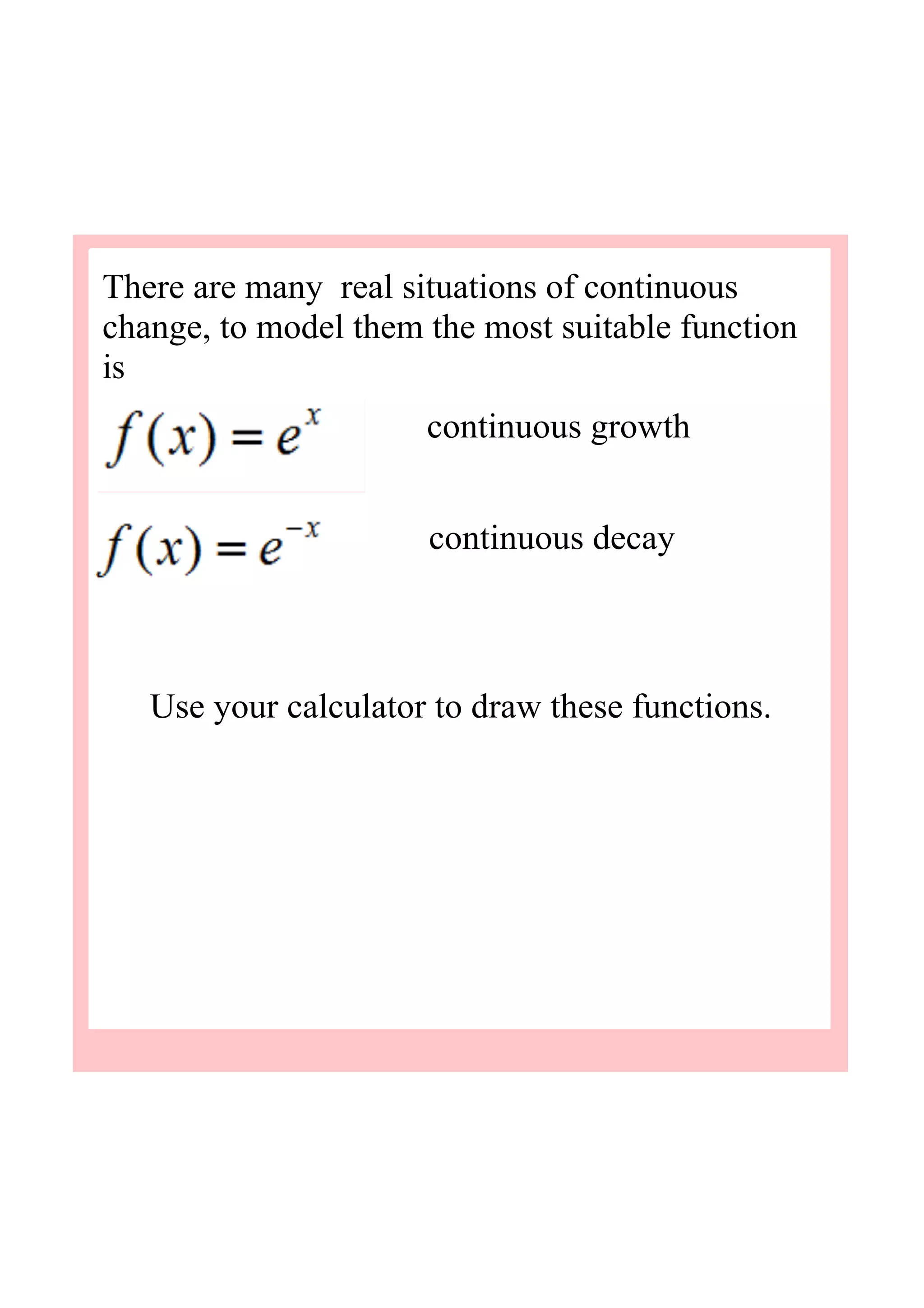
There are many  real situations of continuous 
change, to model them the most suitable function 
is 
Use your calculator to draw these functions.
continuous growth
continuous decay
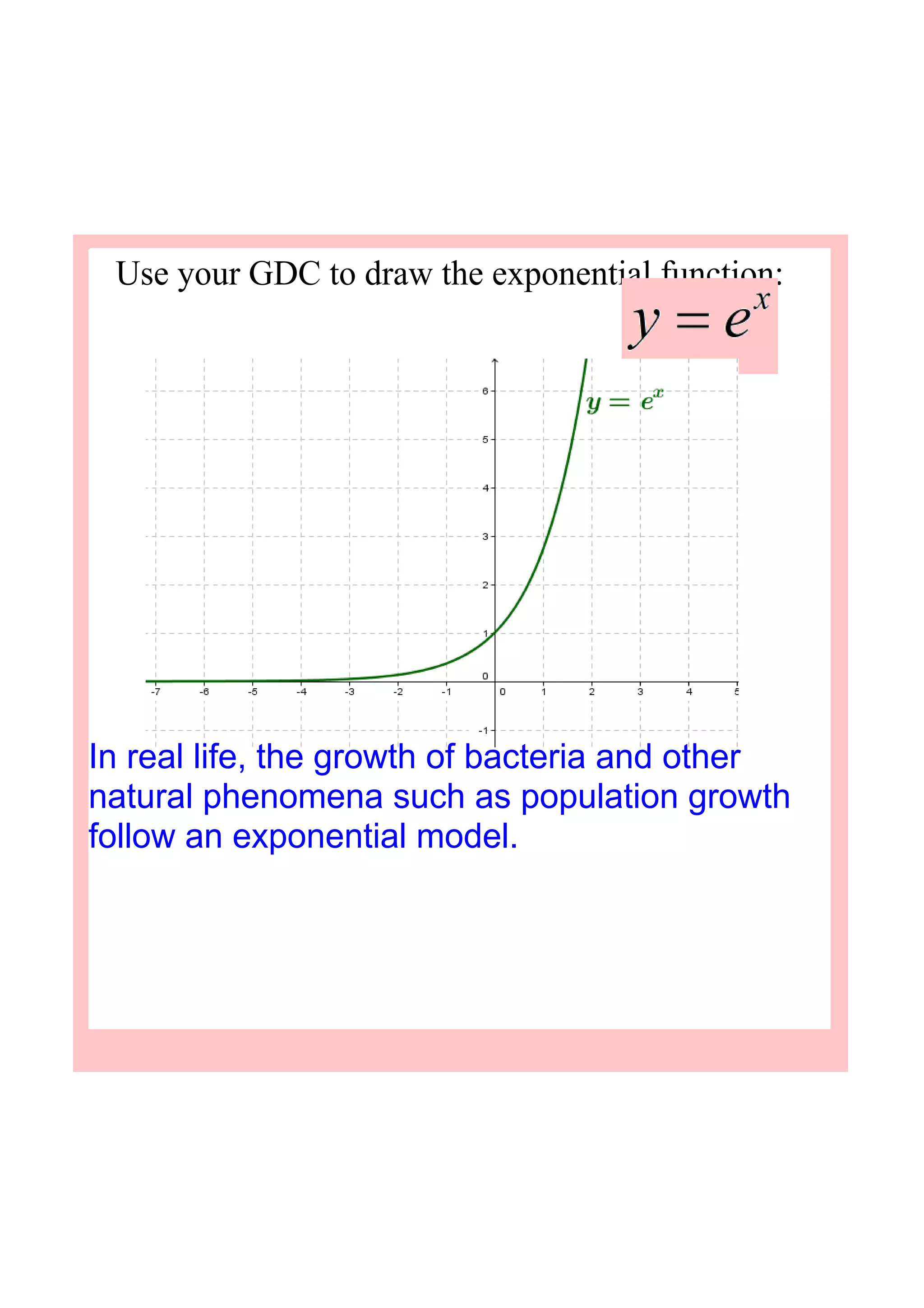
Use your GDC to draw the exponential function:
In real life, the growth of bacteria and other 
natural phenomena such as population growth 
follow an exponential model.
Solve the equation:
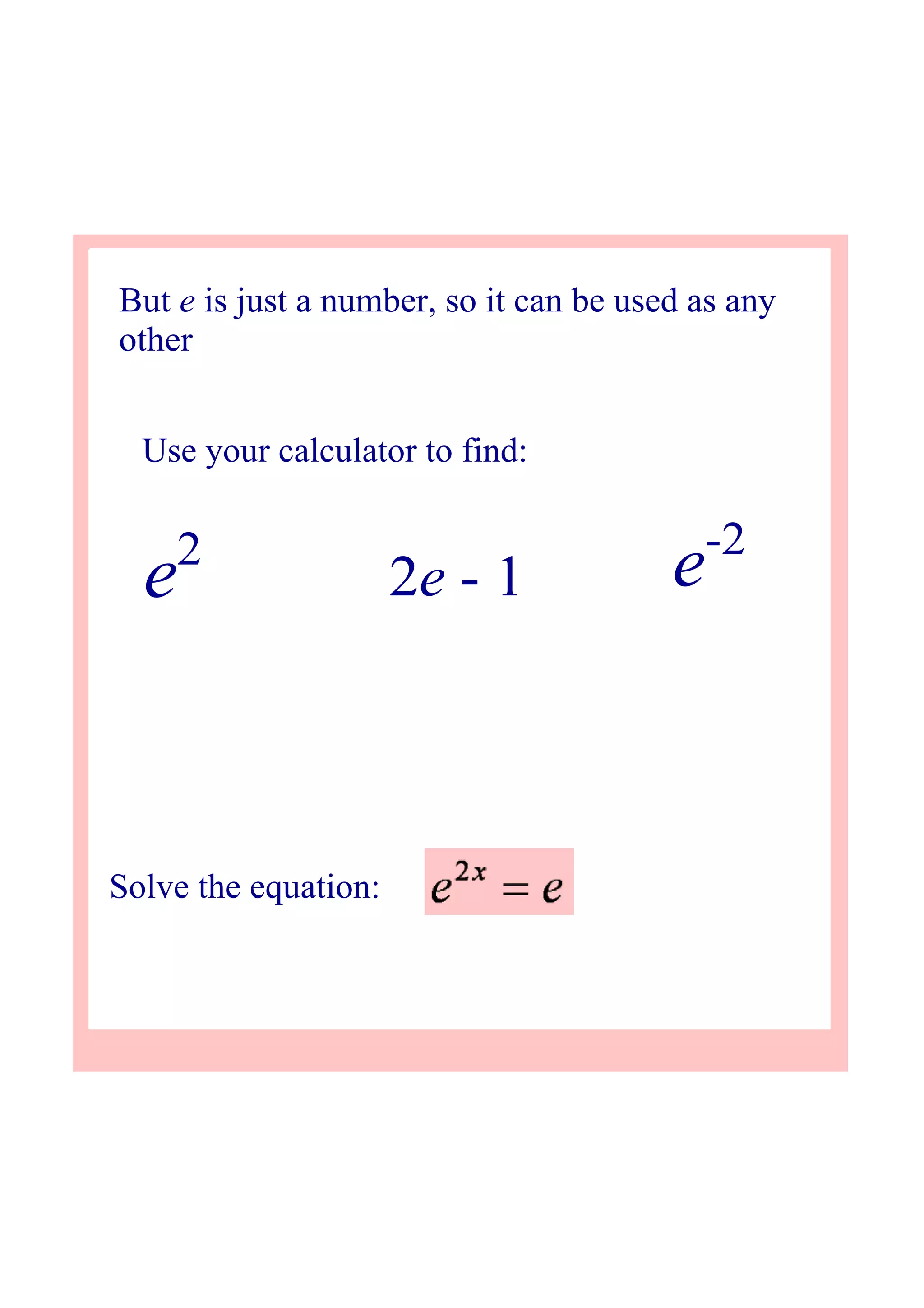
But e is just a number, so it can be used as any 
other
Use your calculator to find:
e2
2e ­ 1 e­2
Solve the equation:
Solve the equation:
Solve worksheet 
exponential equations
 Book page 48, Ex 2B and 
page 51 Ex 2C
Exponential Equations and Functions 2014.docx
Attachments
Exponential Equations and Functions 2014.docx

2) exponential growth and decay