Click to edit Master title style
1
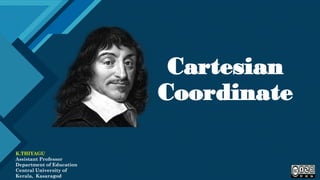
Cartesian
Coordinate
K.THIYAGU
Assistant Professor
Department of Education
Central University of
Kerala, Kasaragod
Click to edit Master title style
2 2
Click to edit Master title style
3
Abscissa Ordinate Cartesian Quadrants Graph
3
Click to edit Master title style
4
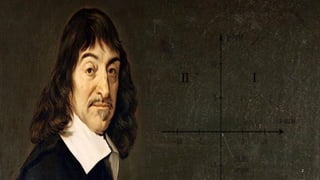
Rene Descartes
4
Click to edit Master title style
5 5
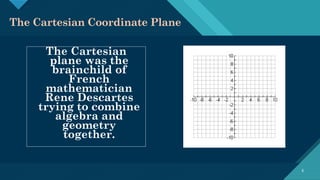
The Cartesian Coordinate Plane
The Cartesian
plane was the
brainchild of
French
mathematician
Rene Descartes
trying to combine
algebra and
geometry
together.
Click to edit Master title style
6
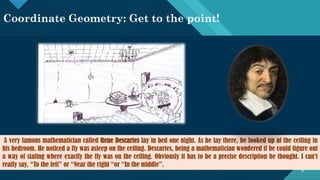
A very famous mathematician called Rene Descartes lay in bed one night. As he lay there, he looked up at the ceiling in
his bedroom. He noticed a fly was asleep on the ceiling. Descartes, being a mathematician wondered if he could figure out
a way of stating where exactly the fly was on the ceiling. Obviously it has to be a precise description he thought. I can’t
really say, “To the left” or “Near the right “or “In the middle”.
Coordinate Geometry: Get to the point!
6
Click to edit Master title style
7
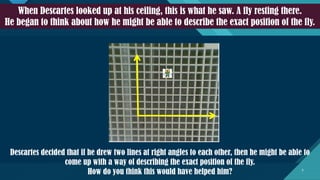
Descartes decided that if he drew two lines at right angles to each other, then he might be able to
come up with a way of describing the exact position of the fly.
How do you think this would have helped him?
When Descartes looked up at his ceiling, this is what he saw. A fly resting there.
He began to think about how he might be able to describe the exact position of the fly.
7
Click to edit Master title style
8
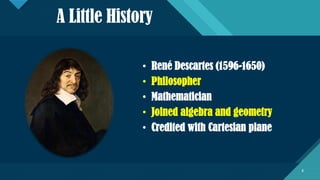
A Little History
• René Descartes (1596-1650)
• Philosopher
• Mathematician
• Joined algebra and geometry
• Credited with Cartesian plane
8
Click to edit Master title style
9
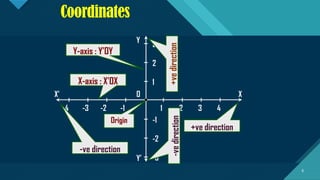
Coordinates
X
X’
Y
Y’
O
Origin
1 2 3 4
+ve direction
-1
-2
-3
-4
-ve direction
-1
-2
-3
-ve
direction
1
2
3
+ve
direction
X-axis : X’OX
Y-axis : Y’OY
9
Click to edit Master title style
10
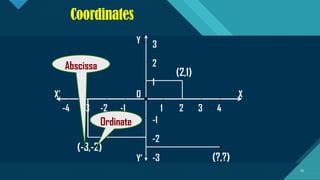
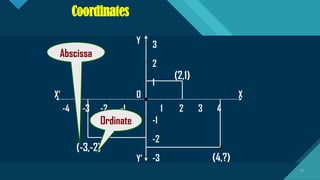
Coordinates
X
X’
Y
Y’
O
1 2 3 4
-1
-2
-3
-4
-1
-2
-3
1
2
3
(2,1)
(-3,-2)
Ordinate
Abscissa
(?,?)
10
Click to edit Master title style
11
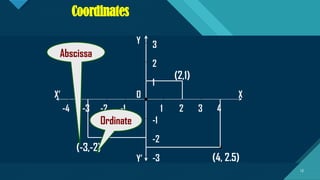
Coordinates
X
X’
Y
Y’
O
1 2 3 4
-1
-2
-3
-4
-1
-2
-3
1
2
3
(2,1)
(-3,-2)
Ordinate
Abscissa
(4,?)
11
Click to edit Master title style
12
Coordinates
X
X’
Y
Y’
O
1 2 3 4
-1
-2
-3
-4
-1
-2
-3
1
2
3
(2,1)
(-3,-2)
Ordinate
Abscissa
(4, 2.5)
12
Click to edit Master title style
13
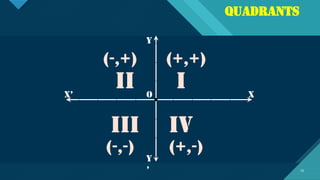
Quadrants
X
X’ O
Y
Y
’
I
II
III IV
(+,+)
(-,+)
(-,-) (+,-)
13
Click to edit Master title style
14
Quadrants
X
X’ O
Y
Y’
I
II
III IV
(+,+)
(-,+)
(-,-) (+,-)
Q : (1,0) lies in which Quadrant?
Ist? IInd?
A : None. Points which lie on the axes do not lie in any quadrant.
14
Click to edit Master title style
15
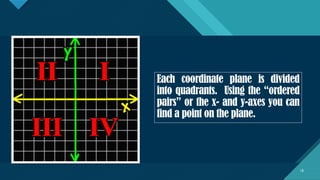
Each coordinate plane is divided
into quadrants. Using the “ordered
pairs” or the x- and y-axes you can
find a point on the plane.
15
Click to edit Master title style
16
To plot an ordered pair,
begin at the origin, the
point (0, 0), which is
the intersection of the
x-axis and y-axis.
The first coordinate tells
how many units to move
left or right; the second
coordinate tells how
many units to move up
and down.
16
Click to edit Master title style
17
x-axis – the horizontal axis on a coordinate plane.
y-axis – the vertical axis on a coordinate plane.
x-coordinate – the first number in an ordered pair; it tells the units to
move right or left from the origin.
y-coordinate – the second number in an ordered pair; it tells the units
to move up or down from the origin.
17
Click to edit Master title style
18
Order pairs – a pair of numbers used to locate a point on a coordinate plane.
Coordinate plane – a plane formed by the intersection of a horizontal number
line called the x-axis and a vertical line called the y-axis.
Origin – the point where the x-axis and the y-axis intersect on the coordinate
plane.
18
Click to edit Master title style
19
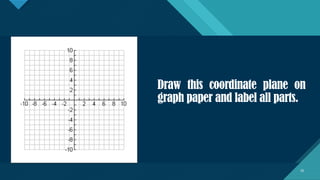
Draw this coordinate plane on
graph paper and label all parts.
19
Click to edit Master title style
20
Co-ordinate Axes
The two lines XOX’ and YOY’ which intersect
each other at right angles and at a point O.
Both the axes should be appropriately labeled
20
Click to edit Master title style
21
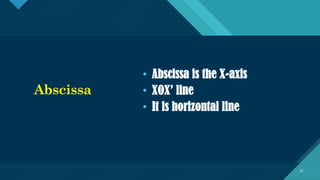
Abscissa
• Abscissa is the X-axis
• XOX’ line
• It is horizontal line
21
Click to edit Master title style
22
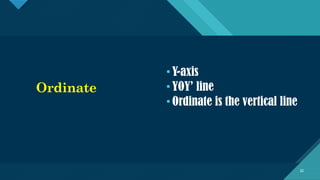
Ordinate
•Y-axis
•YOY’ line
•Ordinate is the vertical line
22
Click to edit Master title style
23
Origin • The point of origin or the zero point
• point of intersection of XOX’ AND YOY’.
23
Click to edit Master title style
24
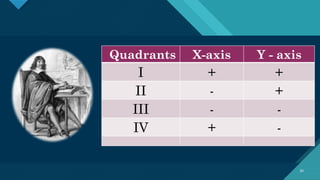
Quadrants X-axis Y - axis
I + +
II - +
III - -
IV + -
24
Click to edit Master title style
25
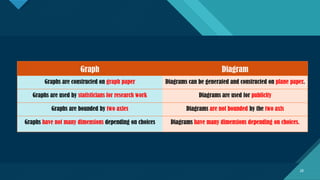
Graph Diagram
Graphs are constructed on graph paper Diagrams can be generated and constructed on plane paper.
Graphs are used by statisticians for research work Diagrams are used for publicity
Graphs are bounded by two axies Diagrams are not bounded by the two axis
Graphs have not many dimensions depending on choices Diagrams have many dimensions depending on choices.
25
Click to edit Master title style
26
Significance of Graphic Presentation
• It gives a bird’s eye view of the entire data. An old saying ‘ A picture is worth 10000 words’ is very true
• The impression on graphs last much longer than figures in a tabular form.
• Graphic presentation looks attractive and fascinating
• It has a delight to the eye and a better visual impact
• It never gives strain to one’s mind
• The basic features of data can be understood
• Data are grasped through graph; at a glance it is understood.
26
Click to edit Master title style
27
Raw Data: Data collected in original form.
Frequency: The number of times a certain value or class of values occurs.
Frequency Distribution (Table): The organization of raw data in table form with classes and frequencies.
Categorical Frequency Distribution: A frequency distribution in which the data is only nominal or ordinal.
Ungrouped Frequency Distribution: A frequency distribution of numerical data. The raw data is not grouped.
Grouped Frequency Distribution: A frequency distribution where several numbers are grouped into one class.
27
Click to edit Master title style
28
Thank You

Cartesian Coordinate (Rene Descartes)

  • 1.
    Click to editMaster title style 1 Cartesian Coordinate K.THIYAGU Assistant Professor Department of Education Central University of Kerala, Kasaragod
  • 2.
    Click to editMaster title style 2 2
  • 3.
    Click to editMaster title style 3 Abscissa Ordinate Cartesian Quadrants Graph 3
  • 4.
    Click to editMaster title style 4 Rene Descartes 4
  • 5.
    Click to editMaster title style 5 5 The Cartesian Coordinate Plane The Cartesian plane was the brainchild of French mathematician Rene Descartes trying to combine algebra and geometry together.
  • 6.
    Click to editMaster title style 6 A very famous mathematician called Rene Descartes lay in bed one night. As he lay there, he looked up at the ceiling in his bedroom. He noticed a fly was asleep on the ceiling. Descartes, being a mathematician wondered if he could figure out a way of stating where exactly the fly was on the ceiling. Obviously it has to be a precise description he thought. I can’t really say, “To the left” or “Near the right “or “In the middle”. Coordinate Geometry: Get to the point! 6
  • 7.
    Click to editMaster title style 7 Descartes decided that if he drew two lines at right angles to each other, then he might be able to come up with a way of describing the exact position of the fly. How do you think this would have helped him? When Descartes looked up at his ceiling, this is what he saw. A fly resting there. He began to think about how he might be able to describe the exact position of the fly. 7
  • 8.
    Click to editMaster title style 8 A Little History • René Descartes (1596-1650) • Philosopher • Mathematician • Joined algebra and geometry • Credited with Cartesian plane 8
  • 9.
    Click to editMaster title style 9 Coordinates X X’ Y Y’ O Origin 1 2 3 4 +ve direction -1 -2 -3 -4 -ve direction -1 -2 -3 -ve direction 1 2 3 +ve direction X-axis : X’OX Y-axis : Y’OY 9
  • 10.
    Click to editMaster title style 10 Coordinates X X’ Y Y’ O 1 2 3 4 -1 -2 -3 -4 -1 -2 -3 1 2 3 (2,1) (-3,-2) Ordinate Abscissa (?,?) 10
  • 11.
    Click to editMaster title style 11 Coordinates X X’ Y Y’ O 1 2 3 4 -1 -2 -3 -4 -1 -2 -3 1 2 3 (2,1) (-3,-2) Ordinate Abscissa (4,?) 11
  • 12.
    Click to editMaster title style 12 Coordinates X X’ Y Y’ O 1 2 3 4 -1 -2 -3 -4 -1 -2 -3 1 2 3 (2,1) (-3,-2) Ordinate Abscissa (4, 2.5) 12
  • 13.
    Click to editMaster title style 13 Quadrants X X’ O Y Y ’ I II III IV (+,+) (-,+) (-,-) (+,-) 13
  • 14.
    Click to editMaster title style 14 Quadrants X X’ O Y Y’ I II III IV (+,+) (-,+) (-,-) (+,-) Q : (1,0) lies in which Quadrant? Ist? IInd? A : None. Points which lie on the axes do not lie in any quadrant. 14
  • 15.
    Click to editMaster title style 15 Each coordinate plane is divided into quadrants. Using the “ordered pairs” or the x- and y-axes you can find a point on the plane. 15
  • 16.
    Click to editMaster title style 16 To plot an ordered pair, begin at the origin, the point (0, 0), which is the intersection of the x-axis and y-axis. The first coordinate tells how many units to move left or right; the second coordinate tells how many units to move up and down. 16
  • 17.
    Click to editMaster title style 17 x-axis – the horizontal axis on a coordinate plane. y-axis – the vertical axis on a coordinate plane. x-coordinate – the first number in an ordered pair; it tells the units to move right or left from the origin. y-coordinate – the second number in an ordered pair; it tells the units to move up or down from the origin. 17
  • 18.
    Click to editMaster title style 18 Order pairs – a pair of numbers used to locate a point on a coordinate plane. Coordinate plane – a plane formed by the intersection of a horizontal number line called the x-axis and a vertical line called the y-axis. Origin – the point where the x-axis and the y-axis intersect on the coordinate plane. 18
  • 19.
    Click to editMaster title style 19 Draw this coordinate plane on graph paper and label all parts. 19
  • 20.
    Click to editMaster title style 20 Co-ordinate Axes The two lines XOX’ and YOY’ which intersect each other at right angles and at a point O. Both the axes should be appropriately labeled 20
  • 21.
    Click to editMaster title style 21 Abscissa • Abscissa is the X-axis • XOX’ line • It is horizontal line 21
  • 22.
    Click to editMaster title style 22 Ordinate •Y-axis •YOY’ line •Ordinate is the vertical line 22
  • 23.
    Click to editMaster title style 23 Origin • The point of origin or the zero point • point of intersection of XOX’ AND YOY’. 23
  • 24.
    Click to editMaster title style 24 Quadrants X-axis Y - axis I + + II - + III - - IV + - 24
  • 25.
    Click to editMaster title style 25 Graph Diagram Graphs are constructed on graph paper Diagrams can be generated and constructed on plane paper. Graphs are used by statisticians for research work Diagrams are used for publicity Graphs are bounded by two axies Diagrams are not bounded by the two axis Graphs have not many dimensions depending on choices Diagrams have many dimensions depending on choices. 25
  • 26.
    Click to editMaster title style 26 Significance of Graphic Presentation • It gives a bird’s eye view of the entire data. An old saying ‘ A picture is worth 10000 words’ is very true • The impression on graphs last much longer than figures in a tabular form. • Graphic presentation looks attractive and fascinating • It has a delight to the eye and a better visual impact • It never gives strain to one’s mind • The basic features of data can be understood • Data are grasped through graph; at a glance it is understood. 26
  • 27.
    Click to editMaster title style 27 Raw Data: Data collected in original form. Frequency: The number of times a certain value or class of values occurs. Frequency Distribution (Table): The organization of raw data in table form with classes and frequencies. Categorical Frequency Distribution: A frequency distribution in which the data is only nominal or ordinal. Ungrouped Frequency Distribution: A frequency distribution of numerical data. The raw data is not grouped. Grouped Frequency Distribution: A frequency distribution where several numbers are grouped into one class. 27
  • 28.
    Click to editMaster title style 28 Thank You