5.6 Simplifying Radicals
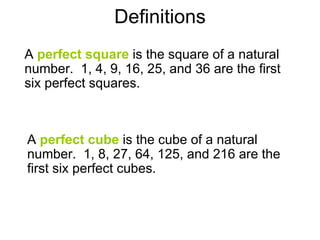
Definitions A   perfect square   is the square of a natural number.  1, 4, 9, 16, 25, and 36 are the first six perfect squares. A   perfect cube   is the cube of a natural number.  1, 8, 27, 64, 125, and 216 are the first six perfect cubes.
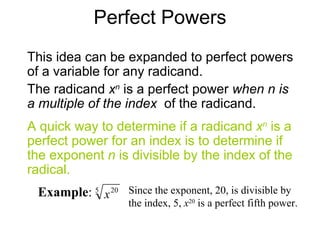
Perfect Powers A quick way to determine if a radicand  x n  is a perfect power for an index is to determine if the exponent  n  is divisible by the index of the radical. Example :  Since the exponent, 20, is divisible by the index, 5,  x 20  is a perfect fifth power. This idea can be expanded to perfect powers of a variable for any radicand. The radicand  x n  is a perfect power  when n is a multiple of the index  of the radicand.
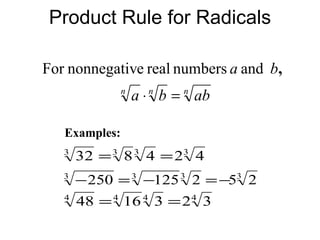
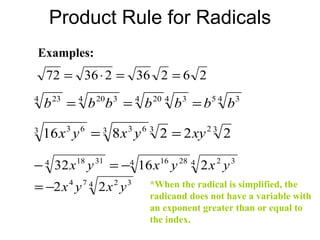
Product Rule for Radicals Examples:
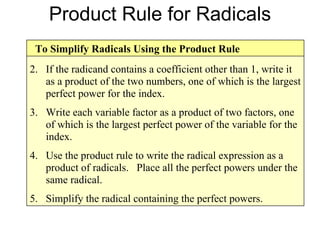
Product Rule for Radicals If the radicand contains a coefficient other than 1, write it as a product of the two numbers, one of which is the largest perfect power for the index. Write each variable factor as a product of two factors, one of which is the largest perfect power of the variable for the index. Use the product rule to write the radical expression as a product of radicals.  Place all the perfect powers under the same radical. Simplify the radical containing the perfect powers. To Simplify Radicals Using the Product Rule
Product Rule for Radicals Examples: *When the radical is simplified, the radicand does not have a variable with an exponent greater than or equal to the index.
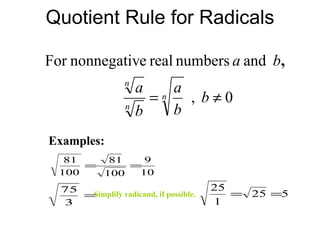
Quotient Rule for Radicals Examples: Simplify radicand, if possible.
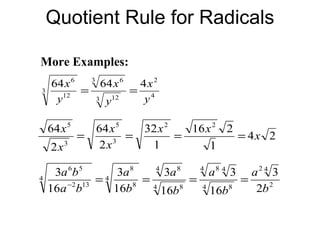
Quotient Rule for Radicals More Examples:
Adding, Subtracting, and Multiplying Radicals
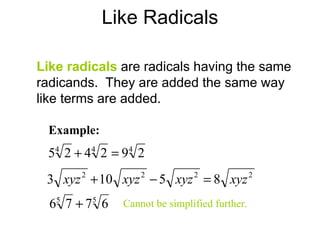
Like Radicals Like radicals   are radicals having the same radicands.  They are added the same way like terms are added. Example: Cannot be simplified further.
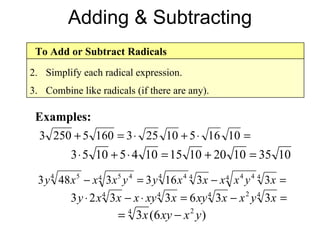
Adding & Subtracting Examples: Simplify each radical expression. Combine like radicals (if there are any). To Add or Subtract Radicals
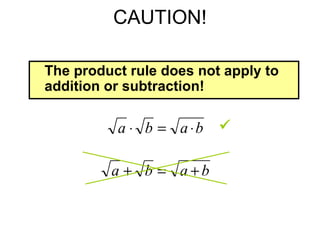
CAUTION! The product rule does not apply to addition or subtraction! 
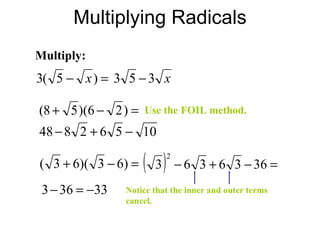
Multiplying Radicals Multiply: Use the FOIL method. Notice that the inner and outer terms cancel.
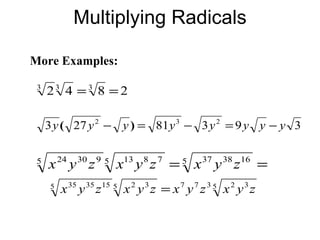
Multiplying Radicals More Examples:
Dividing Radicals
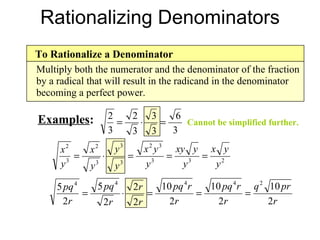
Rationalizing Denominators Examples : To Rationalize a Denominator Multiply both the numerator and the denominator of the fraction by a radical that will result in the radicand in the denominator becoming a perfect power. Cannot be simplified further.
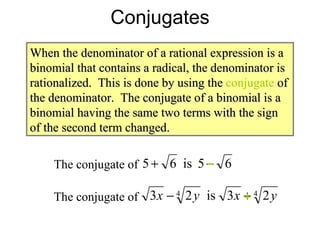
Conjugates When the denominator of a rational expression is a binomial that contains a radical, the denominator is rationalized.  This is done by using the  conjugate   of the denominator.  The conjugate of a binomial is a binomial having the same two terms with the sign of the second term changed. The conjugate of  The conjugate of
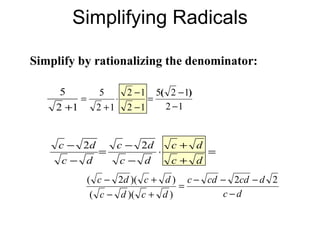
Simplifying Radicals Simplify by rationalizing the denominator:
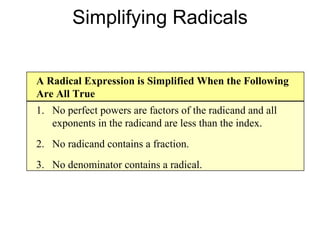
Simplifying Radicals A Radical Expression is Simplified When the Following  Are All True No perfect powers are factors of the radicand and all exponents in the radicand are less than the index. No radicand contains a fraction. No denominator contains a radical.
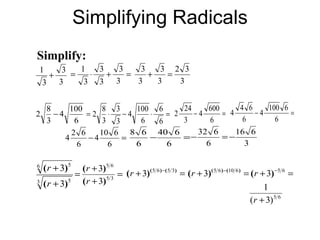
Simplifying Radicals Simplify:
Rational Exponents
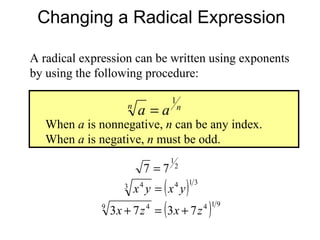
Changing a Radical Expression A radical expression can be written using exponents by using the following procedure: When  a  is nonnegative,  n  can be any index. When  a  is negative,  n  must be odd.
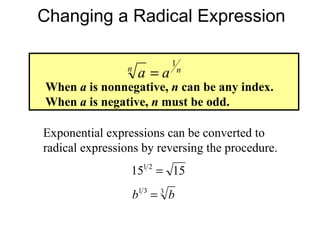
Changing a Radical Expression Exponential expressions can be converted to radical expressions by reversing the procedure. When  a  is nonnegative,  n  can be any index. When  a  is negative,  n  must be odd.
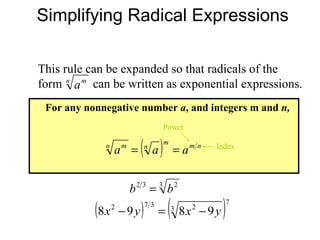
Simplifying Radical Expressions This rule can be expanded so that radicals of the form  can be written as exponential expressions. For any nonnegative number  a , and integers m and  n, Power Index
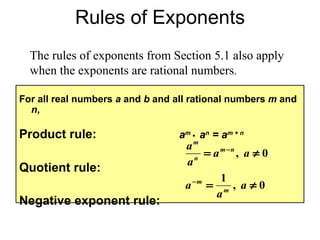
Rules of Exponents The rules of exponents from Section 5.1 also apply when the exponents are rational numbers . For all real numbers  a  and  b  and all rational numbers  m  and  n , Product rule:   a m  •   a n  = a m + n Quotient rule: Negative exponent rule:
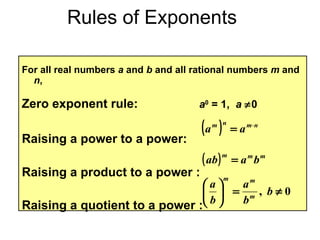
Rules of Exponents For all real numbers  a  and  b  and all rational numbers  m  and  n , Zero exponent rule:   a 0  = 1,  a    0 Raising a power to a power:   Raising a product to a power : Raising a quotient to a power :
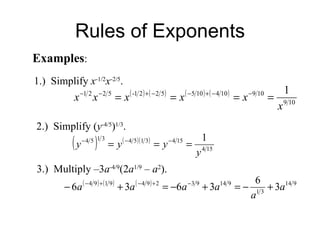
Rules of Exponents Examples : 1.)  Simplify  x -1/2 x -2/5 . 2.)  Simplify ( y -4/5 ) 1/3 . 3.)  Multiply –3 a -4/9 (2 a 1/9  –  a 2 ).
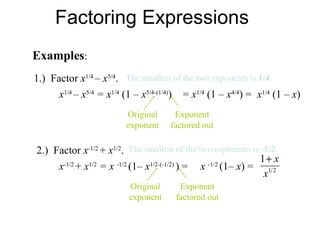
Factoring Expressions Examples : 1.)  Factor  x 1/4  –  x 5/4 . x 1/4  –  x 5/4  = x 1/4  (1 –  x 5/4-(1/4) ) The smallest of the two exponents is  1/4 . Original exponent Exponent factored out =  x 1/4  (1 –  x 4/4 ) = 2.)  Factor  x -1/2  +  x 1/2 . x -1/2  +  x 1/2  = x  -1/2  (1–  x 1/2 - (-1/2)  ) =  x  -1/2  (1–  x ) =  Original exponent Exponent factored out The smallest of the two exponents is - 1/2 . x 1/4  (1 –  x )
Solving Radical Equations
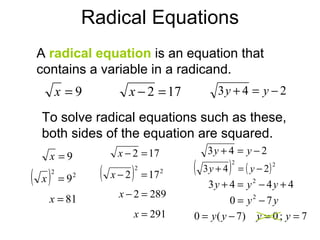
Radical Equations A   radical equation   is an equation that contains a variable in a radicand. To solve radical equations such as these, both sides of the equation are squared.
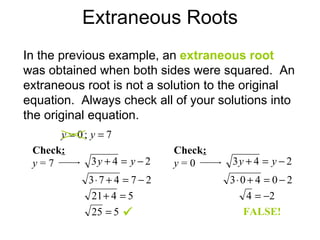
Extraneous Roots In the previous example, an   extraneous root   was obtained when both sides were squared.  An extraneous root is not a solution to the original equation.  Always check all of your solutions into the original equation. Check : y  = 0 FALSE! Check : y  = 7 
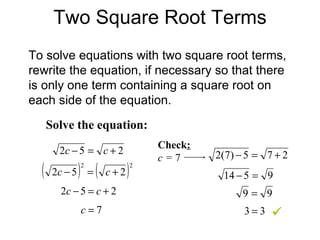
Two Square Root Terms To solve equations with two square root terms, rewrite the equation, if necessary so that there is only one term containing a square root on each side of the equation. Solve the equation: Check : c =  7 
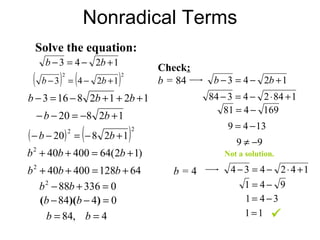
Nonradical Terms Solve the equation: Check : b =  84 Not a solution. b =  4 
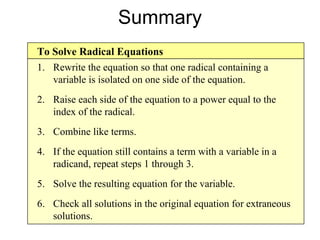
Summary To Solve Radical Equations Rewrite the equation so that one radical containing a variable is isolated on one side of the equation. Raise each side of the equation to a power equal to the index of the radical. Combine like terms. If the equation still contains a term with a variable in a radicand, repeat steps 1 through 3. Solve the resulting equation for the variable. Check all solutions in the original equation for extraneous solutions.

Simplifying radical expressions, rational exponents, radical equations

  • 1.
  • 2.
    Definitions A perfect square is the square of a natural number. 1, 4, 9, 16, 25, and 36 are the first six perfect squares. A perfect cube is the cube of a natural number. 1, 8, 27, 64, 125, and 216 are the first six perfect cubes.
  • 3.
    Perfect Powers Aquick way to determine if a radicand x n is a perfect power for an index is to determine if the exponent n is divisible by the index of the radical. Example : Since the exponent, 20, is divisible by the index, 5, x 20 is a perfect fifth power. This idea can be expanded to perfect powers of a variable for any radicand. The radicand x n is a perfect power when n is a multiple of the index of the radicand.
  • 4.
    Product Rule forRadicals Examples:
  • 5.
    Product Rule forRadicals If the radicand contains a coefficient other than 1, write it as a product of the two numbers, one of which is the largest perfect power for the index. Write each variable factor as a product of two factors, one of which is the largest perfect power of the variable for the index. Use the product rule to write the radical expression as a product of radicals. Place all the perfect powers under the same radical. Simplify the radical containing the perfect powers. To Simplify Radicals Using the Product Rule
  • 6.
    Product Rule forRadicals Examples: *When the radical is simplified, the radicand does not have a variable with an exponent greater than or equal to the index.
  • 7.
    Quotient Rule forRadicals Examples: Simplify radicand, if possible.
  • 8.
    Quotient Rule forRadicals More Examples:
  • 9.
    Adding, Subtracting, andMultiplying Radicals
  • 10.
    Like Radicals Likeradicals are radicals having the same radicands. They are added the same way like terms are added. Example: Cannot be simplified further.
  • 11.
    Adding & SubtractingExamples: Simplify each radical expression. Combine like radicals (if there are any). To Add or Subtract Radicals
  • 12.
    CAUTION! The productrule does not apply to addition or subtraction! 
  • 13.
    Multiplying Radicals Multiply:Use the FOIL method. Notice that the inner and outer terms cancel.
  • 14.
  • 15.
  • 16.
    Rationalizing Denominators Examples: To Rationalize a Denominator Multiply both the numerator and the denominator of the fraction by a radical that will result in the radicand in the denominator becoming a perfect power. Cannot be simplified further.
  • 17.
    Conjugates When thedenominator of a rational expression is a binomial that contains a radical, the denominator is rationalized. This is done by using the conjugate of the denominator. The conjugate of a binomial is a binomial having the same two terms with the sign of the second term changed. The conjugate of The conjugate of
  • 18.
    Simplifying Radicals Simplifyby rationalizing the denominator:
  • 19.
    Simplifying Radicals ARadical Expression is Simplified When the Following Are All True No perfect powers are factors of the radicand and all exponents in the radicand are less than the index. No radicand contains a fraction. No denominator contains a radical.
  • 20.
  • 21.
  • 22.
    Changing a RadicalExpression A radical expression can be written using exponents by using the following procedure: When a is nonnegative, n can be any index. When a is negative, n must be odd.
  • 23.
    Changing a RadicalExpression Exponential expressions can be converted to radical expressions by reversing the procedure. When a is nonnegative, n can be any index. When a is negative, n must be odd.
  • 24.
    Simplifying Radical ExpressionsThis rule can be expanded so that radicals of the form can be written as exponential expressions. For any nonnegative number a , and integers m and n, Power Index
  • 25.
    Rules of ExponentsThe rules of exponents from Section 5.1 also apply when the exponents are rational numbers . For all real numbers a and b and all rational numbers m and n , Product rule: a m • a n = a m + n Quotient rule: Negative exponent rule:
  • 26.
    Rules of ExponentsFor all real numbers a and b and all rational numbers m and n , Zero exponent rule: a 0 = 1, a  0 Raising a power to a power: Raising a product to a power : Raising a quotient to a power :
  • 27.
    Rules of ExponentsExamples : 1.) Simplify x -1/2 x -2/5 . 2.) Simplify ( y -4/5 ) 1/3 . 3.) Multiply –3 a -4/9 (2 a 1/9 – a 2 ).
  • 28.
    Factoring Expressions Examples: 1.) Factor x 1/4 – x 5/4 . x 1/4 – x 5/4 = x 1/4 (1 – x 5/4-(1/4) ) The smallest of the two exponents is 1/4 . Original exponent Exponent factored out = x 1/4 (1 – x 4/4 ) = 2.) Factor x -1/2 + x 1/2 . x -1/2 + x 1/2 = x -1/2 (1– x 1/2 - (-1/2) ) = x -1/2 (1– x ) = Original exponent Exponent factored out The smallest of the two exponents is - 1/2 . x 1/4 (1 – x )
  • 29.
  • 30.
    Radical Equations A radical equation is an equation that contains a variable in a radicand. To solve radical equations such as these, both sides of the equation are squared.
  • 31.
    Extraneous Roots Inthe previous example, an extraneous root was obtained when both sides were squared. An extraneous root is not a solution to the original equation. Always check all of your solutions into the original equation. Check : y = 0 FALSE! Check : y = 7 
  • 32.
    Two Square RootTerms To solve equations with two square root terms, rewrite the equation, if necessary so that there is only one term containing a square root on each side of the equation. Solve the equation: Check : c = 7 
  • 33.
    Nonradical Terms Solvethe equation: Check : b = 84 Not a solution. b = 4 
  • 34.
    Summary To SolveRadical Equations Rewrite the equation so that one radical containing a variable is isolated on one side of the equation. Raise each side of the equation to a power equal to the index of the radical. Combine like terms. If the equation still contains a term with a variable in a radicand, repeat steps 1 through 3. Solve the resulting equation for the variable. Check all solutions in the original equation for extraneous solutions.