Exponential Growth & Decay 06/01/09 Bitsy Griffin  PH 8.2 & 8.3
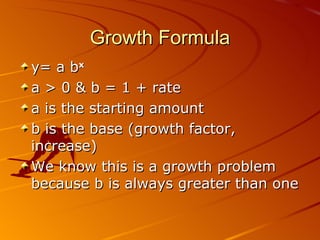
Growth Formula y= a b x a > 0 & b = 1 + rate a is the starting amount b is the base (growth factor, increase) We know this is a growth problem because b is always greater than one 06/01/09 Bitsy Griffin  PH 8.2
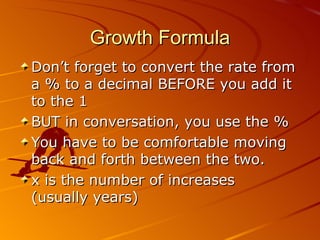
Growth Formula Don’t forget to convert the rate from a % to a decimal BEFORE you add it to the 1 BUT in conversation, you use the % You have to be comfortable moving back and forth between the two. x is the number of increases  (usually years) 06/01/09 Bitsy Griffin  PH 8.2
Examples 1 & 2 Reminders Money has two decimal places. Round people to whole numbers 06/01/09 Bitsy Griffin  PH 8.2
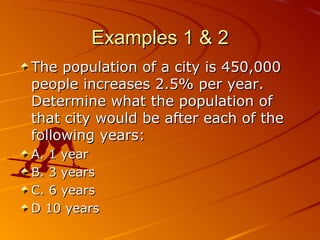
Examples 1 & 2 The population of a city is 450,000 people increases 2.5% per year. Determine what the population of that city would be after each of the following years: A. 1 year B. 3 years C. 6 years D 10 years 06/01/09 Bitsy Griffin  PH 8.2
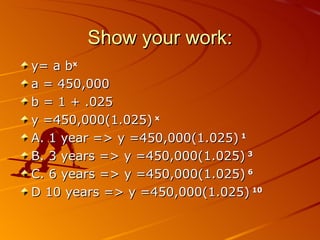
Show your work: y= a b x a = 450,000 b = 1 + .025 y =450,000(1.025)  x A. 1 year => y =450,000(1.025)  1 B. 3 years => y =450,000(1.025)  3 C. 6 years => y =450,000(1.025)  6 D 10 years => y =450,000(1.025)  10 06/01/09 Bitsy Griffin  PH 8.2
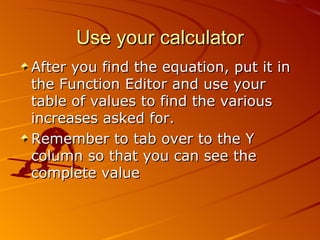
Use your calculator After you find the equation, put it in the Function Editor and use your table of values to find the various increases asked for. Remember to tab over to the Y column so that you can see the complete value 06/01/09 Bitsy Griffin  PH 8.2
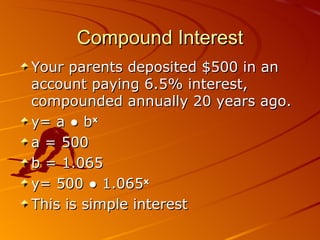
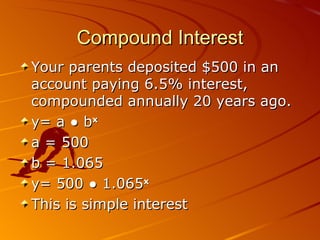
Compound Interest Your parents deposited $500 in an account paying 6.5% interest, compounded annually 20 years ago. y= a ● b x a = 500 b = 1.065 y= 500 ● 1.065 x This is simple interest 06/01/09 Bitsy Griffin  PH 8.2
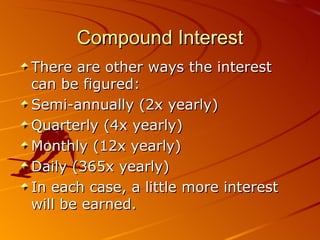
Compound Interest There are other ways the interest can be figured: Semi-annually (2x yearly) Quarterly (4x yearly) Monthly (12x yearly) Daily (365x yearly) In each case, a little more interest will be earned.  06/01/09 Bitsy Griffin  PH 8.2
Compound Interest Your parents deposited $500 in an account paying 6.5% interest, compounded annually 20 years ago. y= a ● b x a = 500 b = 1.065 y= 500 ● 1.065 x This is simple interest 06/01/09 Bitsy Griffin  PH 8.2
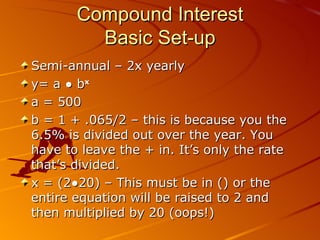
Compound Interest Basic Set-up Semi-annual – 2x yearly y= a ● b x a = 500 b = 1 + .065/2 – this is because you the 6.5% is divided out over the year. You have to leave the + in. It’s only the rate that’s divided.  x = (2●20) – This must be in () or the entire equation will be raised to 2 and then multiplied by 20 (oops!) 06/01/09 Bitsy Griffin  PH 8.2
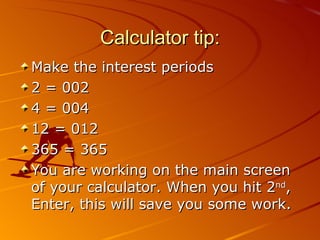
Calculator tip: Make the interest periods  2 = 002 4 = 004 12 = 012 365 = 365 You are working on the main screen of your calculator. When you hit 2 nd , Enter, this will save you some work. 06/01/09 Bitsy Griffin  PH 8.2
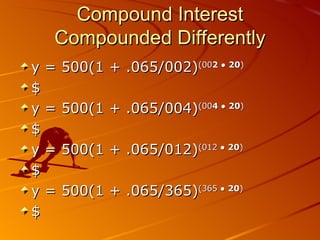
Compound Interest Compounded Differently y = 500(1 + .065/002) (00 2 ● 20 )  $ y = 500(1 + .065/004) (00 4 ● 20 )  $ y = 500(1 + .065/012) (012  ● 20 )  $ y = 500(1 + .065/365) (365  ● 20 )  $ 06/01/09 Bitsy Griffin  PH 8.2
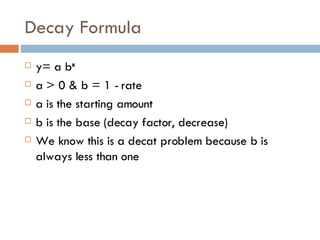
8.3 Decay Formula y= a b x a > 0 & b = 1 - rate a is the starting amount b is the base (decay factor, decrease) We know this is a decay problem because b is always less than one 06/01/09 Bitsy Griffin  PH 8.2
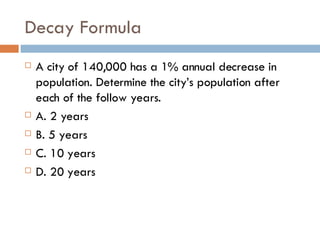
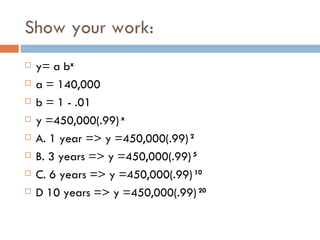
Decay Formula A city of 140,000 has a 1% annual decrease in population. Determine the city’s population after each of the follow years. A. 2 years B. 5 years C. 10 years D. 20 years 06/01/09 Bitsy Griffin  PH 8.2
Show your work: y= a b x a = 140,000 b = 1 - .01 y =450,000(.99)  x A. 1 year => y =450,000(.99)  2 B. 3 years => y =450,000(.99)  5 C. 6 years => y =450,000(.99)  10 D 10 years => y =450,000(.99)  20 06/01/09 Bitsy Griffin  PH 8.2
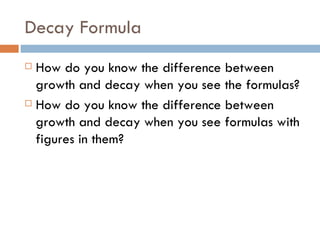
Decay Formula How do you know the difference between growth and decay when you see the formulas? How do you know the difference between growth and decay when you see formulas with figures in them?  06/01/09 Bitsy Griffin  PH 8.2
Growth or Decay? 500(1.035)^x 2502(0.98)^x 850(0.65)^x 200(1.05)^x 06/01/09 Bitsy Griffin  PH 8.2

Exponential Growth & Decay

  • 1.
    Exponential Growth &Decay 06/01/09 Bitsy Griffin PH 8.2 & 8.3
  • 2.
    Growth Formula y=a b x a > 0 & b = 1 + rate a is the starting amount b is the base (growth factor, increase) We know this is a growth problem because b is always greater than one 06/01/09 Bitsy Griffin PH 8.2
  • 3.
    Growth Formula Don’tforget to convert the rate from a % to a decimal BEFORE you add it to the 1 BUT in conversation, you use the % You have to be comfortable moving back and forth between the two. x is the number of increases (usually years) 06/01/09 Bitsy Griffin PH 8.2
  • 4.
    Examples 1 &2 Reminders Money has two decimal places. Round people to whole numbers 06/01/09 Bitsy Griffin PH 8.2
  • 5.
    Examples 1 &2 The population of a city is 450,000 people increases 2.5% per year. Determine what the population of that city would be after each of the following years: A. 1 year B. 3 years C. 6 years D 10 years 06/01/09 Bitsy Griffin PH 8.2
  • 6.
    Show your work:y= a b x a = 450,000 b = 1 + .025 y =450,000(1.025) x A. 1 year => y =450,000(1.025) 1 B. 3 years => y =450,000(1.025) 3 C. 6 years => y =450,000(1.025) 6 D 10 years => y =450,000(1.025) 10 06/01/09 Bitsy Griffin PH 8.2
  • 7.
    Use your calculatorAfter you find the equation, put it in the Function Editor and use your table of values to find the various increases asked for. Remember to tab over to the Y column so that you can see the complete value 06/01/09 Bitsy Griffin PH 8.2
  • 8.
    Compound Interest Yourparents deposited $500 in an account paying 6.5% interest, compounded annually 20 years ago. y= a ● b x a = 500 b = 1.065 y= 500 ● 1.065 x This is simple interest 06/01/09 Bitsy Griffin PH 8.2
  • 9.
    Compound Interest Thereare other ways the interest can be figured: Semi-annually (2x yearly) Quarterly (4x yearly) Monthly (12x yearly) Daily (365x yearly) In each case, a little more interest will be earned. 06/01/09 Bitsy Griffin PH 8.2
  • 10.
    Compound Interest Yourparents deposited $500 in an account paying 6.5% interest, compounded annually 20 years ago. y= a ● b x a = 500 b = 1.065 y= 500 ● 1.065 x This is simple interest 06/01/09 Bitsy Griffin PH 8.2
  • 11.
    Compound Interest BasicSet-up Semi-annual – 2x yearly y= a ● b x a = 500 b = 1 + .065/2 – this is because you the 6.5% is divided out over the year. You have to leave the + in. It’s only the rate that’s divided. x = (2●20) – This must be in () or the entire equation will be raised to 2 and then multiplied by 20 (oops!) 06/01/09 Bitsy Griffin PH 8.2
  • 12.
    Calculator tip: Makethe interest periods 2 = 002 4 = 004 12 = 012 365 = 365 You are working on the main screen of your calculator. When you hit 2 nd , Enter, this will save you some work. 06/01/09 Bitsy Griffin PH 8.2
  • 13.
    Compound Interest CompoundedDifferently y = 500(1 + .065/002) (00 2 ● 20 ) $ y = 500(1 + .065/004) (00 4 ● 20 ) $ y = 500(1 + .065/012) (012 ● 20 ) $ y = 500(1 + .065/365) (365 ● 20 ) $ 06/01/09 Bitsy Griffin PH 8.2
  • 14.
    8.3 Decay Formulay= a b x a > 0 & b = 1 - rate a is the starting amount b is the base (decay factor, decrease) We know this is a decay problem because b is always less than one 06/01/09 Bitsy Griffin PH 8.2
  • 15.
    Decay Formula Acity of 140,000 has a 1% annual decrease in population. Determine the city’s population after each of the follow years. A. 2 years B. 5 years C. 10 years D. 20 years 06/01/09 Bitsy Griffin PH 8.2
  • 16.
    Show your work:y= a b x a = 140,000 b = 1 - .01 y =450,000(.99) x A. 1 year => y =450,000(.99) 2 B. 3 years => y =450,000(.99) 5 C. 6 years => y =450,000(.99) 10 D 10 years => y =450,000(.99) 20 06/01/09 Bitsy Griffin PH 8.2
  • 17.
    Decay Formula Howdo you know the difference between growth and decay when you see the formulas? How do you know the difference between growth and decay when you see formulas with figures in them? 06/01/09 Bitsy Griffin PH 8.2
  • 18.
    Growth or Decay?500(1.035)^x 2502(0.98)^x 850(0.65)^x 200(1.05)^x 06/01/09 Bitsy Griffin PH 8.2