Perpendicular and Angle Bisectors
The student is able to (I can):
• Construct perpendicular and angle bisectors
• Use bisectors to solve problems
• Identify the circumcenter and incenter of a triangle
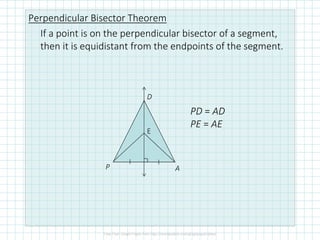
Perpendicular Bisector Theorem
If a point is on the perpendicular bisector of a segment,
then it is equidistant from the endpoints of the segment.
P
D
A
E
PD = AD
PE = AE
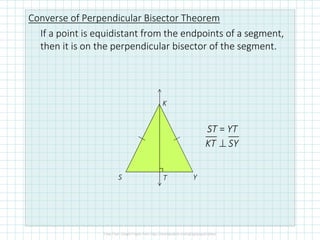
Converse of Perpendicular Bisector Theorem
If a point is equidistant from the endpoints of a segment,
then it is on the perpendicular bisector of the segment.
S
K
YT
ST = YT
KT SY⊥
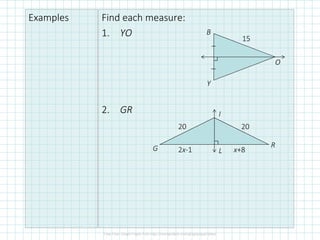
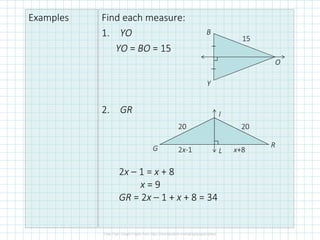
Examples Find each measure:
1. YO
2. GR
B
O
Y
15
G
I
R
L
20 20
2x-1 x+8
Examples Find each measure:
1. YO
YO = BO = 15
2. GR
B
O
Y
15
G
I
R
L
20 20
2x-1 x+8
2x – 1 = x + 8
x = 9
GR = 2x – 1 + x + 8 = 34
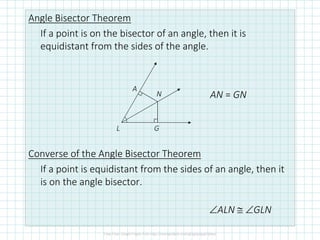
Angle Bisector Theorem
If a point is on the bisector of an angle, then it is
equidistant from the sides of the angle.
Converse of the Angle Bisector Theorem
If a point is equidistant from the sides of an angle, then it
is on the angle bisector.
A
L G
N AN = GN
∠ALN ≅ ∠GLN
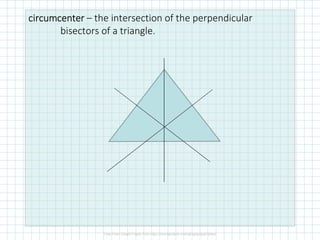
circumcentercircumcentercircumcentercircumcenter – the intersection of the perpendicular
bisectors of a triangle.
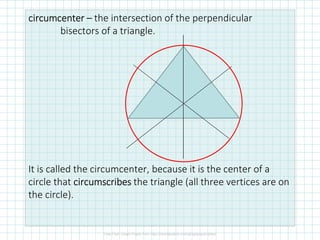
circumcentercircumcentercircumcentercircumcenter –––– the intersection of the perpendicular
bisectors of a triangle.
It is called the circumcenter, because it is the center of a
circle that circumscribescircumscribescircumscribescircumscribes the triangle (all three vertices are on
the circle).
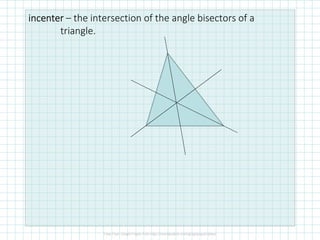
incenterincenterincenterincenter – the intersection of the angle bisectors of a
triangle.
incenterincenterincenterincenter – the intersection of the angle bisectors of a
triangle.
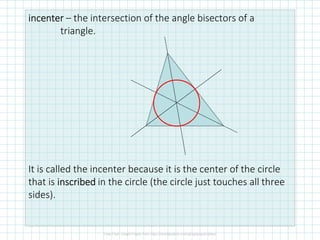
It is called the incenter because it is the center of the circle
that is inscribedinscribedinscribedinscribed in the circle (the circle just touches all three
sides).

2.5.5 Perpendicular and Angle Bisectors

  • 1.
    Perpendicular and AngleBisectors The student is able to (I can): • Construct perpendicular and angle bisectors • Use bisectors to solve problems • Identify the circumcenter and incenter of a triangle
  • 2.
    Perpendicular Bisector Theorem Ifa point is on the perpendicular bisector of a segment, then it is equidistant from the endpoints of the segment. P D A E PD = AD PE = AE
  • 3.
    Converse of PerpendicularBisector Theorem If a point is equidistant from the endpoints of a segment, then it is on the perpendicular bisector of the segment. S K YT ST = YT KT SY⊥
  • 4.
    Examples Find eachmeasure: 1. YO 2. GR B O Y 15 G I R L 20 20 2x-1 x+8
  • 5.
    Examples Find eachmeasure: 1. YO YO = BO = 15 2. GR B O Y 15 G I R L 20 20 2x-1 x+8 2x – 1 = x + 8 x = 9 GR = 2x – 1 + x + 8 = 34
  • 6.
    Angle Bisector Theorem Ifa point is on the bisector of an angle, then it is equidistant from the sides of the angle. Converse of the Angle Bisector Theorem If a point is equidistant from the sides of an angle, then it is on the angle bisector. A L G N AN = GN ∠ALN ≅ ∠GLN
  • 7.
    circumcentercircumcentercircumcentercircumcenter – theintersection of the perpendicular bisectors of a triangle.
  • 8.
    circumcentercircumcentercircumcentercircumcenter –––– theintersection of the perpendicular bisectors of a triangle. It is called the circumcenter, because it is the center of a circle that circumscribescircumscribescircumscribescircumscribes the triangle (all three vertices are on the circle).
  • 9.
    incenterincenterincenterincenter – theintersection of the angle bisectors of a triangle.
  • 10.
    incenterincenterincenterincenter – theintersection of the angle bisectors of a triangle. It is called the incenter because it is the center of the circle that is inscribedinscribedinscribedinscribed in the circle (the circle just touches all three sides).