Coordinate
Grid & Distance Geometry
Formula
T- 1-855-694-8886
Email- info@iTutor.com
By iTutor.com
Grid
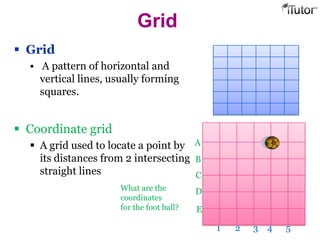
 Grid
 A pattern of horizontal and
vertical lines, usually forming
squares.
 Coordinate grid
 A grid used to locate a point by
its distances from 2 intersecting
straight lines
A
B
C
D
E
1 2 3 4 5
What are the
coordinates
for the foot ball?
The Coordinate Plane
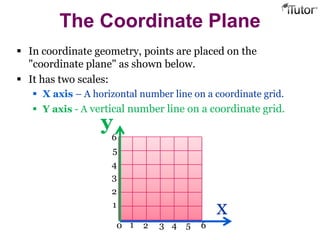
 In coordinate geometry, points are placed on the
"coordinate plane" as shown below.
 It has two scales:
 X axis – A horizontal number line on a coordinate grid.
 Y axis - A vertical number line on a coordinate grid.
1 2 3 4 50 6
x1
2
3
4
5
6
y
Coordinates
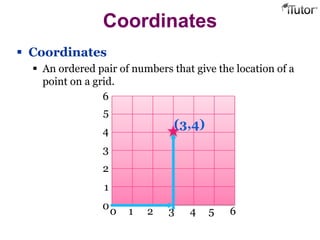
 Coordinates
 An ordered pair of numbers that give the location of a
point on a grid.
1
2
3
4
5
0
6
1 2 3 4 50 6
(3,4)
How to Plot Ordered Pairs
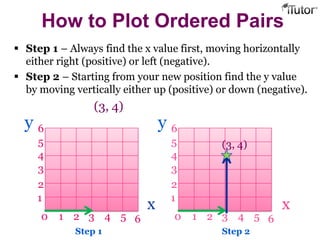
 Step 1 – Always find the x value first, moving horizontally
either right (positive) or left (negative).
 Step 2 – Starting from your new position find the y value
by moving vertically either up (positive) or down (negative).
(3, 4)
1
3
2
4
5
0 1 2 3 4 5 6
y 6
1
3
2
4
5
0 1 2 3 4 5 6
y 6
Step 1 Step 2
x x
(3, 4)
Four Quadrants of Coordinate Grid
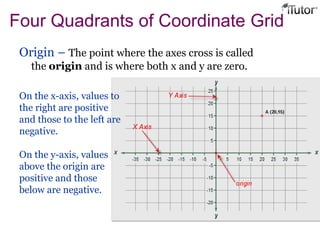
Origin – The point where the axes cross is called
the origin and is where both x and y are zero.
On the x-axis, values to
the right are positive
and those to the left are
negative.
On the y-axis, values
above the origin are
positive and those
below are negative.
Four Quadrants of Coordinate Grid
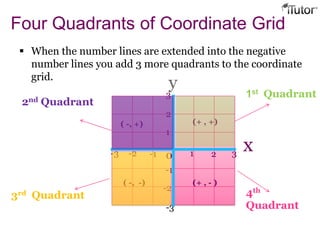
 When the number lines are extended into the negative
number lines you add 3 more quadrants to the coordinate
grid.
-2 -1
1
2
-3
3
-2
-1
0 1 2
-3
3
y
x
(+ , +)( -, +)
( -, -) (+ , - )
1st Quadrant
2nd Quadrant
3rd Quadrant 4th
Quadrant
Four Quadrants
 The following relationship between the signs of the
coordinates of a point and the quadrant of a point in
which it lies.
1) If a point is in the 1st quadrant, then the point will be
in the form (+, +), since the 1st quadrant is enclosed
by the positive x - axis and the positive y- axis.
2) If a point is in the 2nd quadrant, then the point will be
in the form (–, +), since the 2nd quadrant is enclosed
by the negative x - axis and the positive y - axis.
Four Quadrants
3) If a point is in the 3rd quadrant, then the point will be
in the form (–, –), since the 3rd quadrant is enclosed
by the negative x - axis and the negative y – axis.
4) If a point is in the 4th quadrant, then the point will be
in the form (+, –), since the 4th quadrant is enclosed
by the positive x - axis and the negative y - axis
x
y
(+, +)(–, +)
(–, –) (+, –)
III
III IV
Coordinate Geometry
 A system of geometry where the position of points on
the plane is described using an ordered pair of numbers.
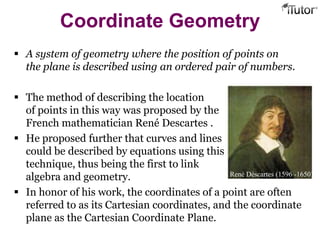
 The method of describing the location
of points in this way was proposed by the
French mathematician René Descartes .
 He proposed further that curves and lines
could be described by equations using this
technique, thus being the first to link
algebra and geometry.
 In honor of his work, the coordinates of a point are often
referred to as its Cartesian coordinates, and the coordinate
plane as the Cartesian Coordinate Plane.
René Déscartes (1596 -1650)
Distance Formula
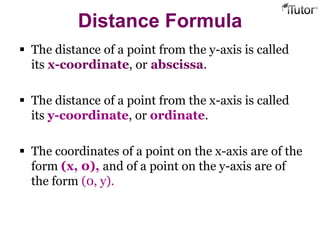
 The distance of a point from the y-axis is called
its x-coordinate, or abscissa.
 The distance of a point from the x-axis is called
its y-coordinate, or ordinate.
 The coordinates of a point on the x-axis are of the
form (x, 0), and of a point on the y-axis are of
the form (0, y).
Distance Formula
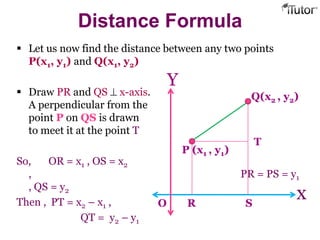
 Let us now find the distance between any two points
P(x1, y1) and Q(x1, y2)
 Draw PR and QS x-axis.
A perpendicular from the
point P on QS is drawn
to meet it at the point T
So, OR = x1 , OS = x2
, PR = PS = y1
, QS = y2
Then , PT = x2 – x1 ,
QT = y2 – y1
x
Y
P (x1 , y1)
Q(x2 , y2)
T
R SO
Distance Formula
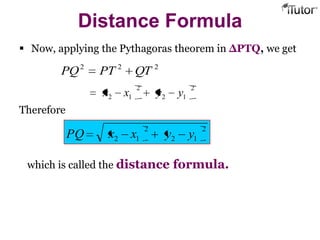
 Now, applying the Pythagoras theorem in ΔPTQ, we get
Therefore
222
QTPTPQ
2
12
2
12 yyxx
2
12
2
12 yyxxPQ
which is called the distance formula.
Section Formula
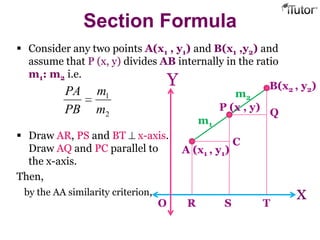
 Consider any two points A(x1 , y1) and B(x1 ,y2) and
assume that P (x, y) divides AB internally in the ratio
m1: m2 i.e.
 Draw AR, PS and BT x-axis.
Draw AQ and PC parallel to
the x-axis.
Then,
by the AA similarity criterion, x
Y
A (x1 , y1)
B(x2 , y2)
P (x , y)
R SO T
2
1
m
m
PB
PA
m1
m2
Q
C
Section Formula
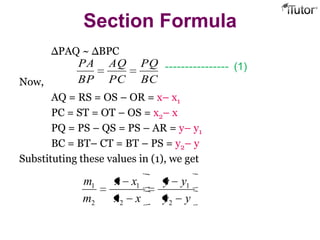
ΔPAQ ~ ΔBPC
---------------- (1)
Now,
AQ = RS = OS – OR = x– x1
PC = ST = OT – OS = x2– x
PQ = PS – QS = PS – AR = y– y1
BC = BT– CT = BT – PS = y2– y
Substituting these values in (1), we get
BC
PQ
PC
AQ
BP
PA
yy
yy
xx
xx
m
m
2
1
2
1
2
1
Section Formula
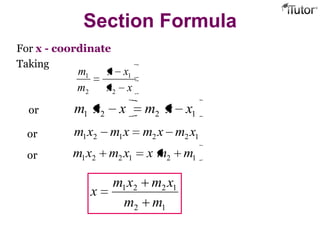
For x - coordinate
Taking
or
xx
xx
m
m
2
1
2
1
1221 xxmxxm
122121 xmxmxmxmor
or 121221 mmxxmxm
12
1221
mm
xmxm
x
Section Formula
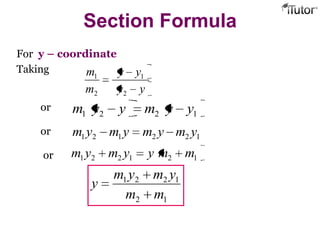
For y – coordinate
Taking
yy
yy
m
m
2
1
2
1
1221 yymyym
122121 ymymymym
121221 mmyymym
12
1221
mm
ymym
y
or
or
or
Section Formula
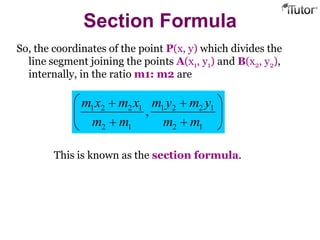
So, the coordinates of the point P(x, y) which divides the
line segment joining the points A(x1, y1) and B(x2, y2),
internally, in the ratio m1: m2 are
12
1221
12
1221
,
mm
ymym
mm
xmxm
This is known as the section formula.
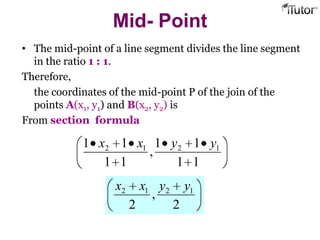
Mid- Point
• The mid-point of a line segment divides the line segment
in the ratio 1 : 1.
Therefore,
the coordinates of the mid-point P of the join of the
points A(x1, y1) and B(x2, y2) is
From section formula
11
11
,
11
11 1212 yyxx
2
,
2
1212 yyxx
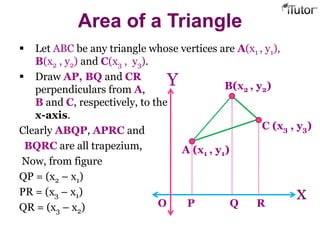
Area of a Triangle
 Let ABC be any triangle whose vertices are A(x1 , y1),
B(x2 , y2) and C(x3 , y3).
 Draw AP, BQ and CR
perpendiculars from A,
B and C, respectively, to the
x-axis.
Clearly ABQP, APRC and
BQRC are all trapezium,
Now, from figure
QP = (x2 – x1)
PR = (x3 – x1)
QR = (x3 – x2)
x
Y
A (x1 , y1)
B(x2 , y2)
C (x3 , y3)
P QO R
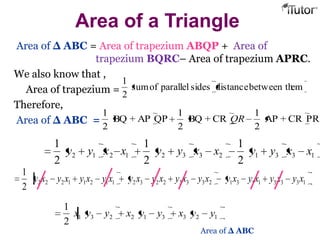
Area of a Triangle
Area of Δ ABC = Area of trapezium ABQP + Area of
trapezium BQRC– Area of trapezium APRC.
We also know that ,
Area of trapezium =
Therefore,
Area of Δ ABC =
embetween thdistancesidesparallelofsum
2
1
PRCR+AP
2
1
CR+BQ
2
1
QPAP+BQ
2
1
QR
133123321212
2
1
2
1
2
1
xxyyxxyyxxyy
133311312333223211211222
2
1
xyxyxyxyxyxyxyxyxyxyxyxy
123312231
2
1
yyxyyxyyx
Area of Δ ABC
The End
Call us for more
information
www.iTutor.com
1-855-694-8886
Visit

Geometry (Grid & section formula)

  • 1.
    Coordinate Grid & DistanceGeometry Formula T- 1-855-694-8886 Email- info@iTutor.com By iTutor.com
  • 2.
    Grid  Grid  Apattern of horizontal and vertical lines, usually forming squares.  Coordinate grid  A grid used to locate a point by its distances from 2 intersecting straight lines A B C D E 1 2 3 4 5 What are the coordinates for the foot ball?
  • 3.
    The Coordinate Plane In coordinate geometry, points are placed on the "coordinate plane" as shown below.  It has two scales:  X axis – A horizontal number line on a coordinate grid.  Y axis - A vertical number line on a coordinate grid. 1 2 3 4 50 6 x1 2 3 4 5 6 y
  • 4.
    Coordinates  Coordinates  Anordered pair of numbers that give the location of a point on a grid. 1 2 3 4 5 0 6 1 2 3 4 50 6 (3,4)
  • 5.
    How to PlotOrdered Pairs  Step 1 – Always find the x value first, moving horizontally either right (positive) or left (negative).  Step 2 – Starting from your new position find the y value by moving vertically either up (positive) or down (negative). (3, 4) 1 3 2 4 5 0 1 2 3 4 5 6 y 6 1 3 2 4 5 0 1 2 3 4 5 6 y 6 Step 1 Step 2 x x (3, 4)
  • 6.
    Four Quadrants ofCoordinate Grid Origin – The point where the axes cross is called the origin and is where both x and y are zero. On the x-axis, values to the right are positive and those to the left are negative. On the y-axis, values above the origin are positive and those below are negative.
  • 7.
    Four Quadrants ofCoordinate Grid  When the number lines are extended into the negative number lines you add 3 more quadrants to the coordinate grid. -2 -1 1 2 -3 3 -2 -1 0 1 2 -3 3 y x (+ , +)( -, +) ( -, -) (+ , - ) 1st Quadrant 2nd Quadrant 3rd Quadrant 4th Quadrant
  • 8.
    Four Quadrants  Thefollowing relationship between the signs of the coordinates of a point and the quadrant of a point in which it lies. 1) If a point is in the 1st quadrant, then the point will be in the form (+, +), since the 1st quadrant is enclosed by the positive x - axis and the positive y- axis. 2) If a point is in the 2nd quadrant, then the point will be in the form (–, +), since the 2nd quadrant is enclosed by the negative x - axis and the positive y - axis.
  • 9.
    Four Quadrants 3) Ifa point is in the 3rd quadrant, then the point will be in the form (–, –), since the 3rd quadrant is enclosed by the negative x - axis and the negative y – axis. 4) If a point is in the 4th quadrant, then the point will be in the form (+, –), since the 4th quadrant is enclosed by the positive x - axis and the negative y - axis x y (+, +)(–, +) (–, –) (+, –) III III IV
  • 10.
    Coordinate Geometry  Asystem of geometry where the position of points on the plane is described using an ordered pair of numbers.  The method of describing the location of points in this way was proposed by the French mathematician René Descartes .  He proposed further that curves and lines could be described by equations using this technique, thus being the first to link algebra and geometry.  In honor of his work, the coordinates of a point are often referred to as its Cartesian coordinates, and the coordinate plane as the Cartesian Coordinate Plane. René Déscartes (1596 -1650)
  • 11.
    Distance Formula  Thedistance of a point from the y-axis is called its x-coordinate, or abscissa.  The distance of a point from the x-axis is called its y-coordinate, or ordinate.  The coordinates of a point on the x-axis are of the form (x, 0), and of a point on the y-axis are of the form (0, y).
  • 12.
    Distance Formula  Letus now find the distance between any two points P(x1, y1) and Q(x1, y2)  Draw PR and QS x-axis. A perpendicular from the point P on QS is drawn to meet it at the point T So, OR = x1 , OS = x2 , PR = PS = y1 , QS = y2 Then , PT = x2 – x1 , QT = y2 – y1 x Y P (x1 , y1) Q(x2 , y2) T R SO
  • 13.
    Distance Formula  Now,applying the Pythagoras theorem in ΔPTQ, we get Therefore 222 QTPTPQ 2 12 2 12 yyxx 2 12 2 12 yyxxPQ which is called the distance formula.
  • 14.
    Section Formula  Considerany two points A(x1 , y1) and B(x1 ,y2) and assume that P (x, y) divides AB internally in the ratio m1: m2 i.e.  Draw AR, PS and BT x-axis. Draw AQ and PC parallel to the x-axis. Then, by the AA similarity criterion, x Y A (x1 , y1) B(x2 , y2) P (x , y) R SO T 2 1 m m PB PA m1 m2 Q C
  • 15.
    Section Formula ΔPAQ ~ΔBPC ---------------- (1) Now, AQ = RS = OS – OR = x– x1 PC = ST = OT – OS = x2– x PQ = PS – QS = PS – AR = y– y1 BC = BT– CT = BT – PS = y2– y Substituting these values in (1), we get BC PQ PC AQ BP PA yy yy xx xx m m 2 1 2 1 2 1
  • 16.
    Section Formula For x- coordinate Taking or xx xx m m 2 1 2 1 1221 xxmxxm 122121 xmxmxmxmor or 121221 mmxxmxm 12 1221 mm xmxm x
  • 17.
    Section Formula For y– coordinate Taking yy yy m m 2 1 2 1 1221 yymyym 122121 ymymymym 121221 mmyymym 12 1221 mm ymym y or or or
  • 18.
    Section Formula So, thecoordinates of the point P(x, y) which divides the line segment joining the points A(x1, y1) and B(x2, y2), internally, in the ratio m1: m2 are 12 1221 12 1221 , mm ymym mm xmxm This is known as the section formula.
  • 19.
    Mid- Point • Themid-point of a line segment divides the line segment in the ratio 1 : 1. Therefore, the coordinates of the mid-point P of the join of the points A(x1, y1) and B(x2, y2) is From section formula 11 11 , 11 11 1212 yyxx 2 , 2 1212 yyxx
  • 20.
    Area of aTriangle  Let ABC be any triangle whose vertices are A(x1 , y1), B(x2 , y2) and C(x3 , y3).  Draw AP, BQ and CR perpendiculars from A, B and C, respectively, to the x-axis. Clearly ABQP, APRC and BQRC are all trapezium, Now, from figure QP = (x2 – x1) PR = (x3 – x1) QR = (x3 – x2) x Y A (x1 , y1) B(x2 , y2) C (x3 , y3) P QO R
  • 21.
    Area of aTriangle Area of Δ ABC = Area of trapezium ABQP + Area of trapezium BQRC– Area of trapezium APRC. We also know that , Area of trapezium = Therefore, Area of Δ ABC = embetween thdistancesidesparallelofsum 2 1 PRCR+AP 2 1 CR+BQ 2 1 QPAP+BQ 2 1 QR 133123321212 2 1 2 1 2 1 xxyyxxyyxxyy 133311312333223211211222 2 1 xyxyxyxyxyxyxyxyxyxyxyxy 123312231 2 1 yyxyyxyyx Area of Δ ABC
  • 22.
    The End Call usfor more information www.iTutor.com 1-855-694-8886 Visit