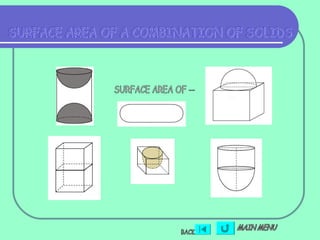
The document provides formulas for calculating the surface area of various 3D geometric shapes like cubes, cuboids, spheres, cylinders, cones, and combinations of shapes. The key information summarized is:
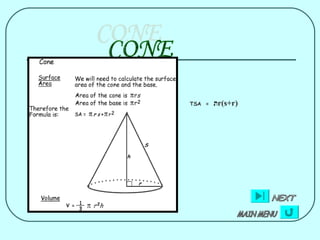
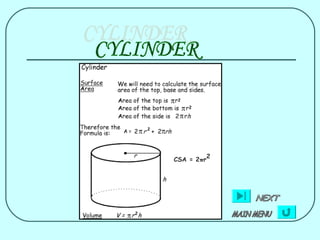
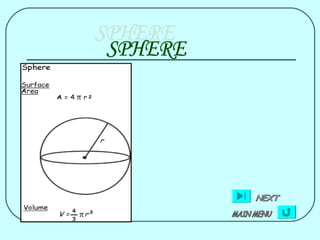
1) Formulas are given for surface area of individual shapes like cubes (6a^2), cuboids (2(lb+lh+bh)), spheres (4πr^2), cylinders (2πrh+2πr^2), and cones (πr(l+2h)).
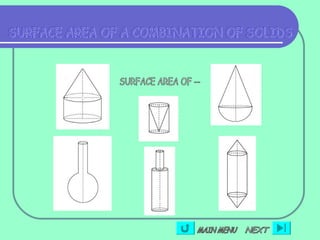
2) Formulas are also provided for combinations of shapes, for example when two cubes are joined to form a cuboid the surface area is 10a^2.
3) In general,
Slides cover surface area and volume calculations for cubes and cuboids, presenting formulas like 6a² for cube and 2(lb+lh+bh) for cuboid.
Slides detail surface area formulas for cylinders and cones, including total and curved surface areas, using constants like π and dimensions of shapes.
Slides illustrate combined surface area models involving cone and hemisphere shapes, providing detailed calculations on total and curved surface areas.
Slides summarize surface area calculations for various models including combinations of cuboids and hemispheres, showcasing intentions for base area adjustments.
Final slide thanks the audience and concludes the presentation by Dhruv Sahdev.
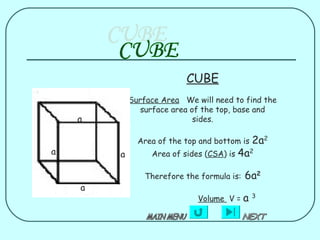
CUBE
Surface Area We will need to find the
surface area of the top, base and
a sides.
Area of the top and bottom is 2a2
a a Area of sides (CSA) is 4a2
Therefore the formula is: 6a2
a
Volume V = a 3
4.
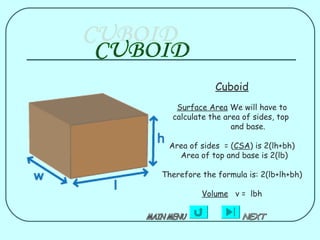
Cuboid
Surface Area We will have to
calculate the area of sides, top
and base.
Area of sides = (CSA) is 2(lh+bh)
Area of top and base is 2(lb)
Therefore the formula is: 2(lb+lh+bh)
Volume v = lbh
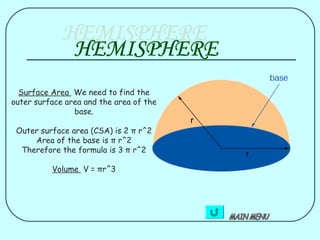
Surface Area Weneed to find the
outer surface area and the area of the
base.
Outer surface area (CSA) is 2 π r^2
Area of the base is π r^2
Therefore the formula is 3 π r^2
Volume V = πr^3
11.
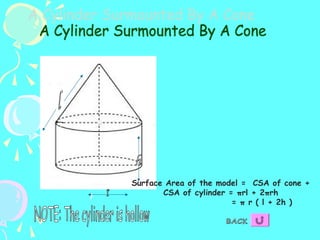
Surface Area ofthe model = CSA of cone +
CSA of cylinder = πrl + 2πrh
= π r ( l + 2h )
12.
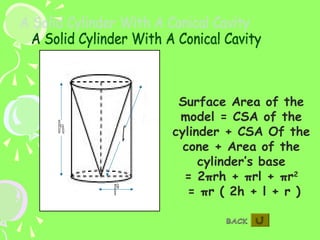
Surface Area ofthe
model = CSA of the
cylinder + CSA Of the
cone + Area of the
cylinder’s base
= 2πrh + πrl + πr2
= πr ( 2h + l + r )
13.
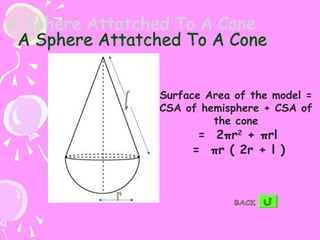
Surface Area ofthe model =
CSA of hemisphere + CSA of
the cone
= 2πr2 + πrl
= πr ( 2r + l )
14.
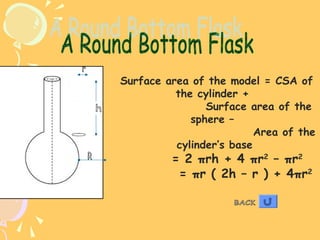
Surface area ofthe model = CSA of
the cylinder +
Surface area of the
sphere –
Area of the
cylinder’s base
= 2 πrh + 4 πr2 – πr2
= πr ( 2h – r ) + 4πr2
15.
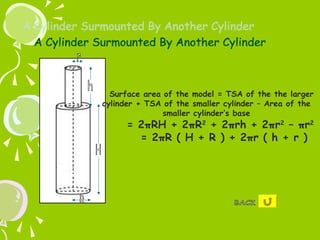
Surface area ofthe model = TSA of the the larger
cylinder + TSA of the smaller cylinder – Area of the
smaller cylinder’s base
= 2πRH + 2πR2 + 2πrh + 2πr2 – πr2
= 2πR ( H + R ) + 2πr ( h + r )
16.
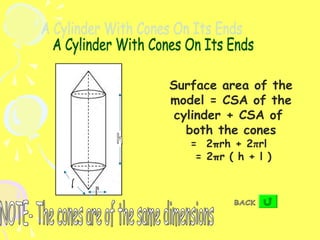
Surface area ofthe
model = CSA of the
cylinder + CSA of
both the cones
= 2πrh + 2πrl
= 2πr ( h + l )
17.
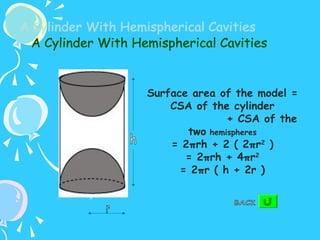
Surface area ofthe model =
CSA of the cylinder
+ CSA of the
two hemispheres
= 2πrh + 2 ( 2πr2 )
= 2πrh + 4πr2
= 2πr ( h + 2r )
18.
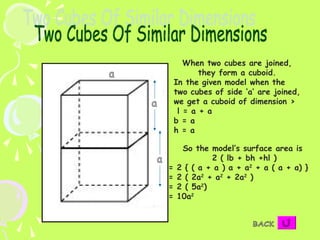
When two cubesare joined,
they form a cuboid.
In the given model when the
two cubes of side ‘a’ are joined,
we get a cuboid of dimension >
l = a + a
b = a
h = a
So the model’s surface area is
2 ( lb + bh +hl )
= 2 { ( a + a ) a + a2 + a ( a + a) }
= 2 ( 2a2 + a2 + 2a2 )
= 2 ( 5a2)
= 10a2
19.
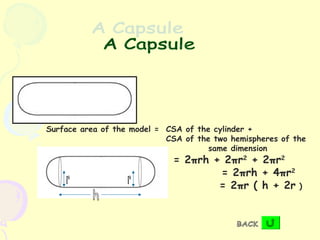
Surface area ofthe model = CSA of the cylinder +
CSA of the two hemispheres of the
same dimension
= 2πrh + 2πr2 + 2πr2
= 2πrh + 4πr2
= 2πr ( h + 2r )
20.
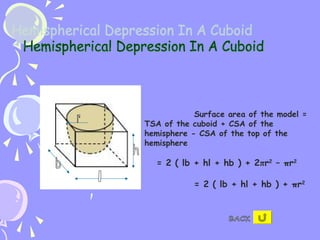
Surface area ofthe model =
TSA of the cuboid + CSA of the
hemisphere - CSA of the top of the
hemisphere
= 2 ( lb + hl + hb ) + 2πr2 – πr2
= 2 ( lb + hl + hb ) + πr2
21.
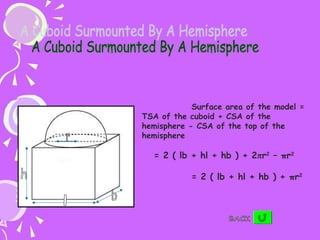
Surface area ofthe model =
TSA of the cuboid + CSA of the
hemisphere - CSA of the top of the
hemisphere
= 2 ( lb + hl + hb ) + 2πr2 – πr2
= 2 ( lb + hl + hb ) + πr2
22.
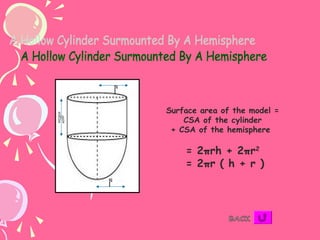
Surface area ofthe model =
CSA of the cylinder
+ CSA of the hemisphere
= 2πrh + 2πr2
= 2πr ( h + r )