Exponential Functions
Objectives
At the end of this lesson, the learner should be able to
• correctly illustrate an exponential function;
• properly differentiates exponential growth and
exponential decay; and
• correctly illustrate word problems using
exponential growth and decay.
Guide Questions
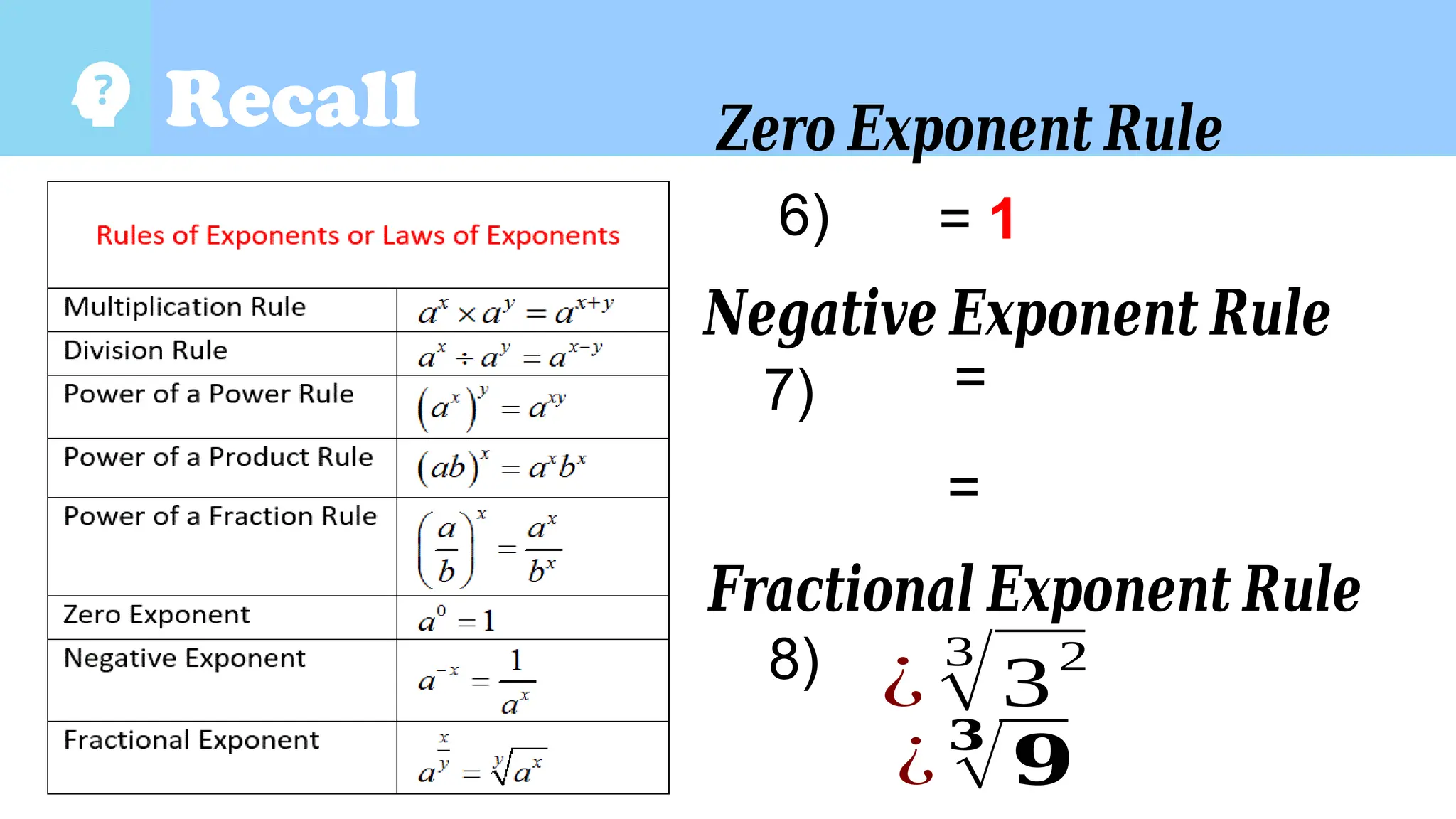
Recall
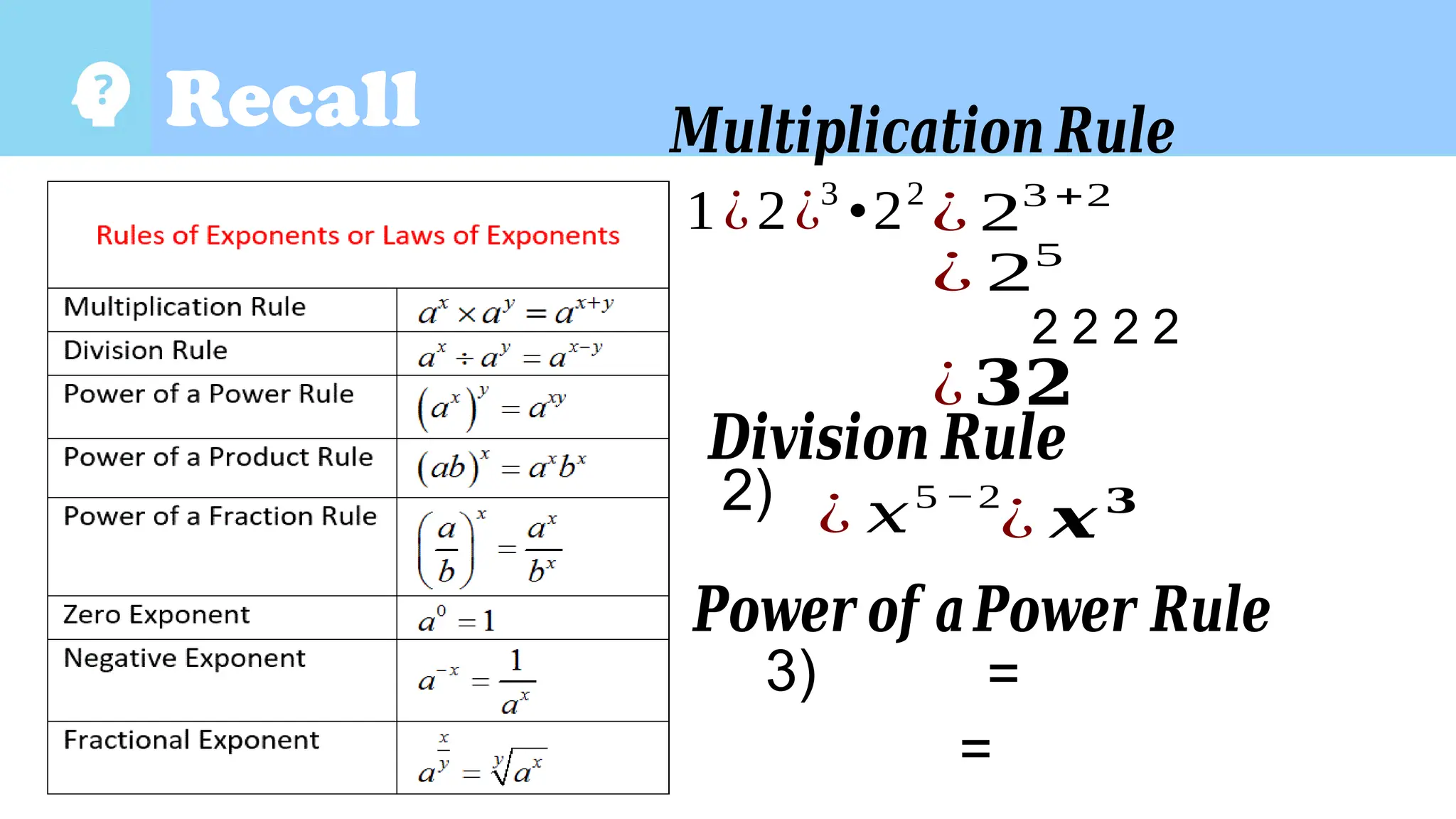
1¿2¿3
•22
¿ 23 +2
¿ 25
2 2 2 2
¿𝟑𝟐
2) ¿ 𝑥5 −2
¿ 𝒙𝟑
3) =
=
𝑴𝒖𝒍𝒕𝒊𝒑𝒍𝒊𝒄𝒂𝒕𝒊𝒐𝒏 𝑹𝒖𝒍𝒆
𝑫𝒊𝒗𝒊𝒔𝒊𝒐𝒏 𝑹𝒖𝒍𝒆
𝑷𝒐𝒘𝒆𝒓 𝒐𝒇 𝒂𝑷𝒐𝒘𝒆𝒓 𝑹𝒖𝒍𝒆
Guide Questions
Recall
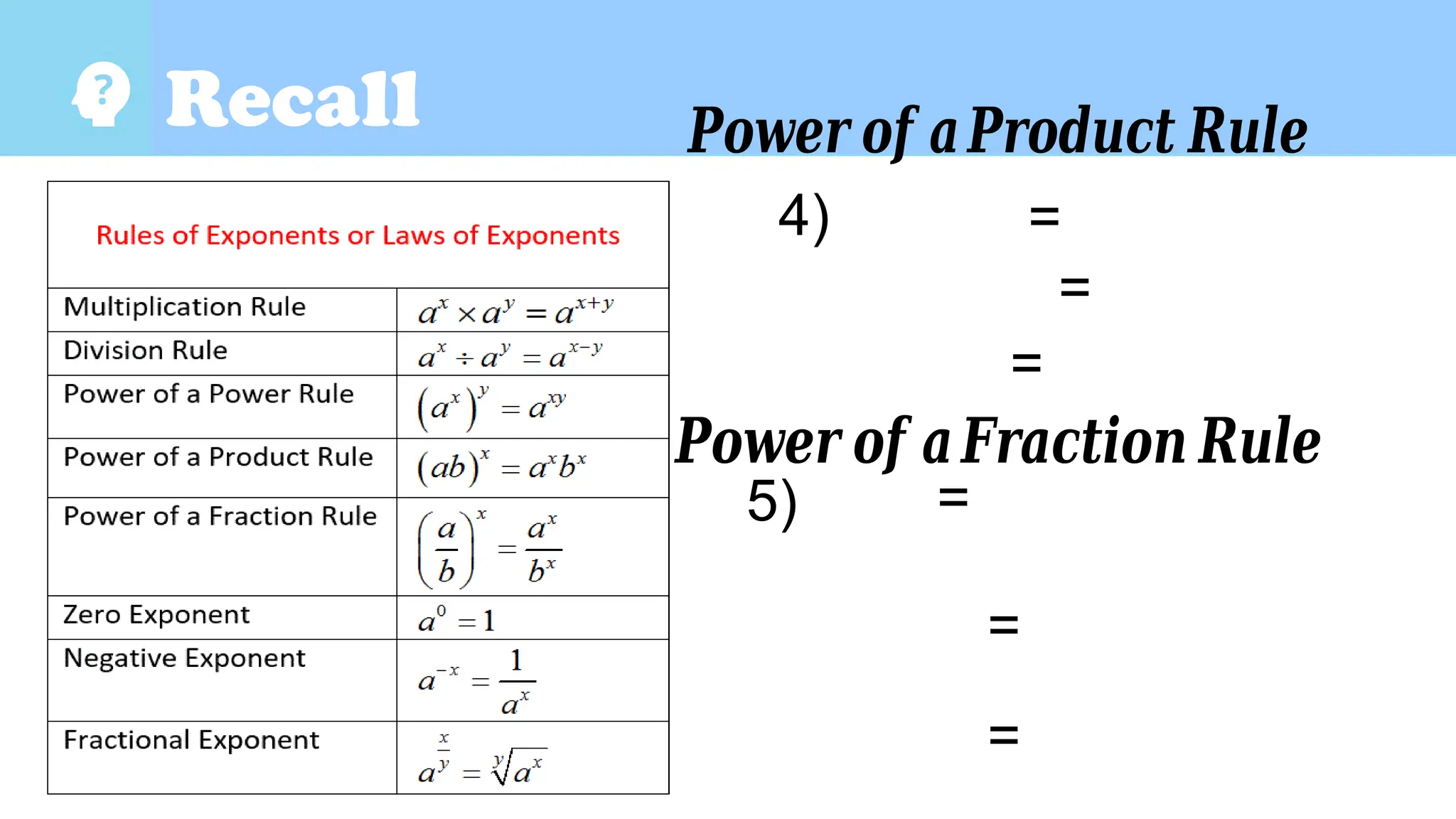
4) =
=
=
𝑷𝒐𝒘𝒆𝒓 𝒐𝒇 𝒂𝑷𝒓𝒐𝒅𝒖𝒄𝒕 𝑹𝒖𝒍𝒆
𝑷𝒐𝒘𝒆𝒓 𝒐𝒇 𝒂𝑭𝒓𝒂𝒄𝒕𝒊𝒐𝒏 𝑹𝒖𝒍𝒆
5) =
=
=
Guide Questions
Recall
6) = 1
𝒁𝒆𝒓𝒐 𝑬𝒙𝒑𝒐𝒏𝒆𝒏𝒕 𝑹𝒖𝒍𝒆
𝑵𝒆𝒈𝒂𝒕𝒊𝒗𝒆 𝑬𝒙𝒑𝒐𝒏𝒆𝒏𝒕 𝑹𝒖𝒍𝒆
7) =
=
𝑭𝒓𝒂𝒄𝒕𝒊𝒐𝒏𝒂𝒍 𝑬𝒙𝒑𝒐𝒏𝒆𝒏𝒕 𝑹𝒖𝒍𝒆
8) ¿
3
√32
¿
𝟑
√𝟗
Learn about It!
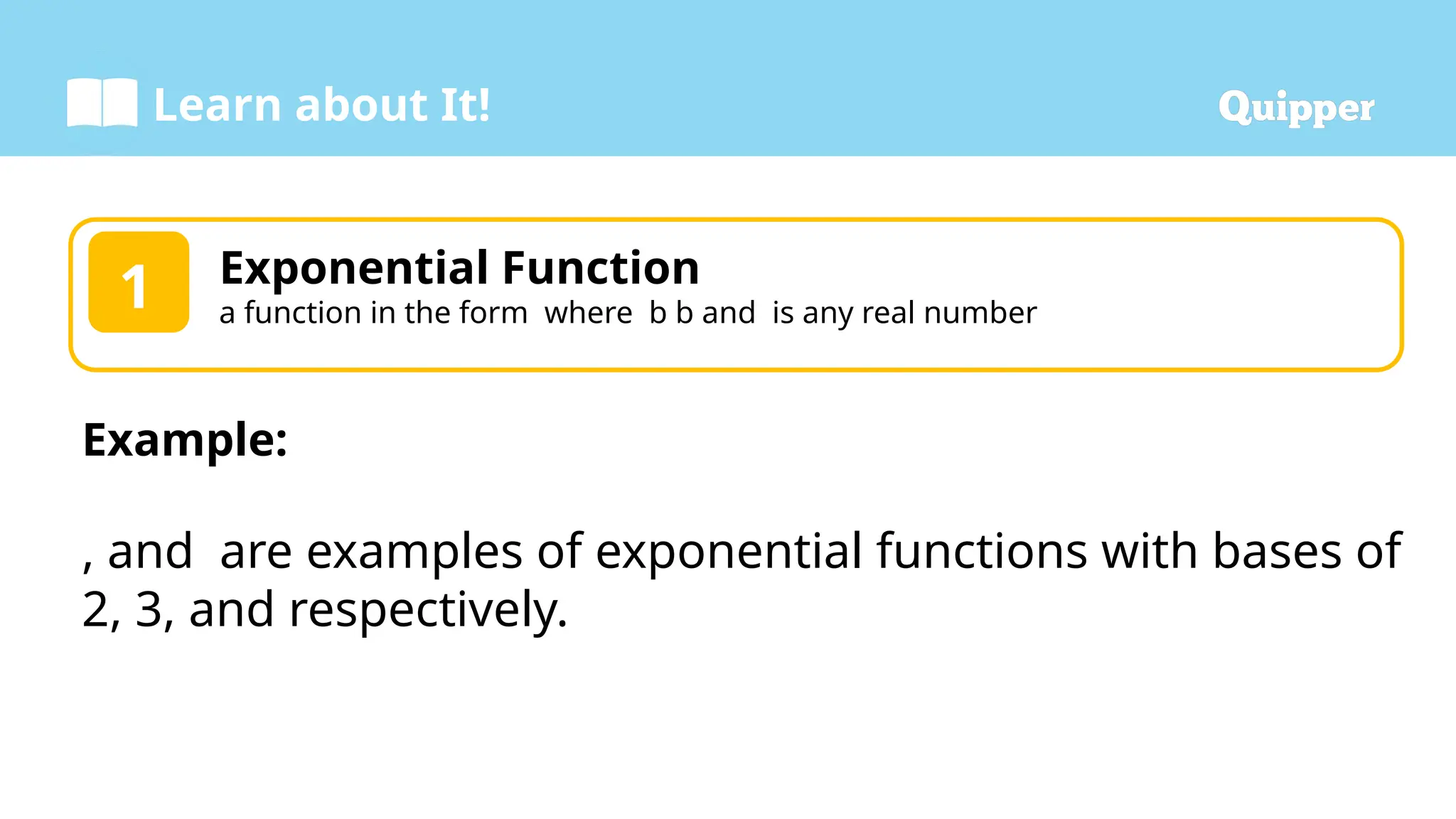
Exponential Function
a function in the form where b b and is any real number
1
Example:
, and are examples of exponential functions with bases of
2, 3, and respectively.
Learn about It!
Exponential Function
a function in the form where b b and is any real number
1
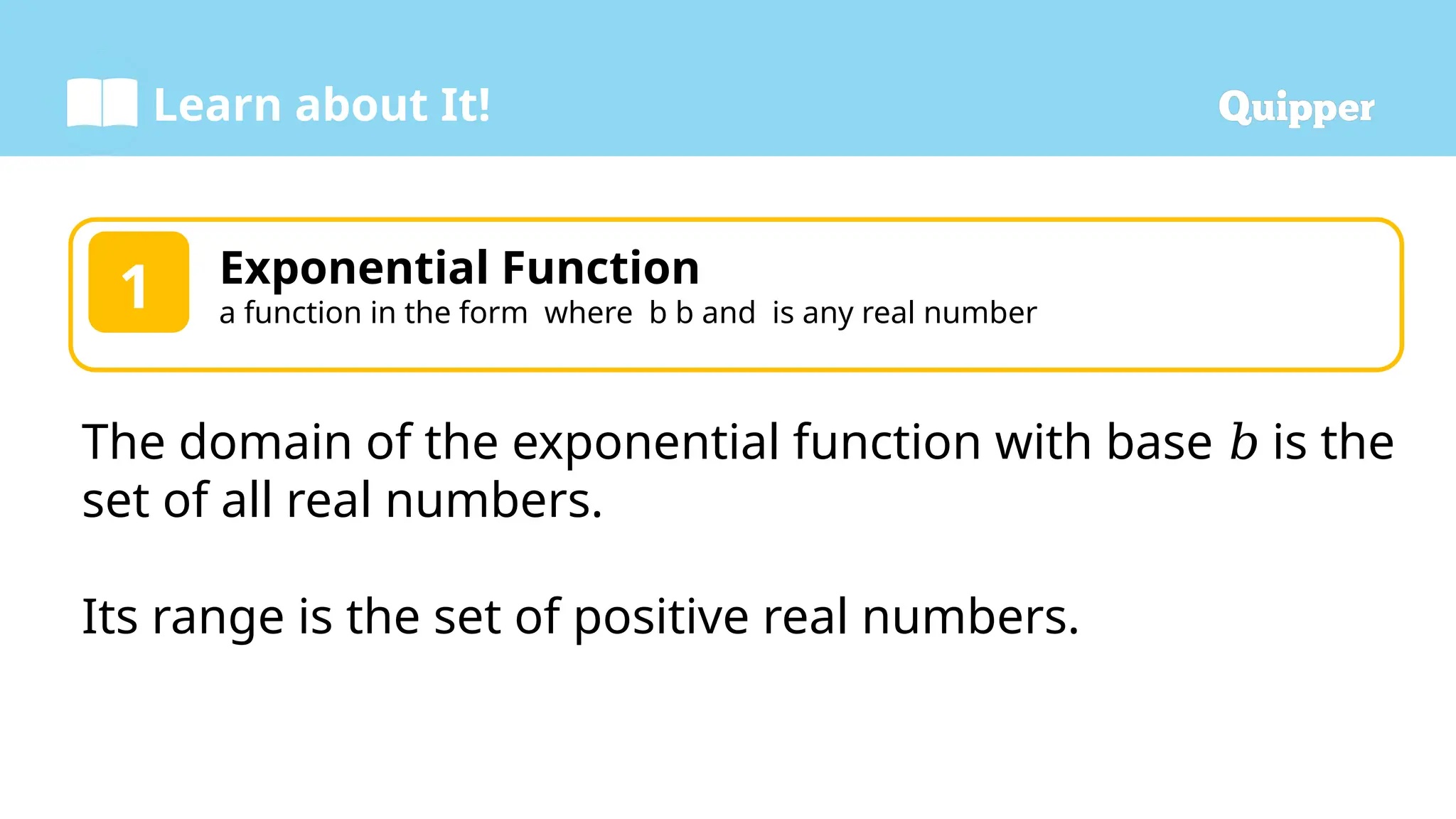
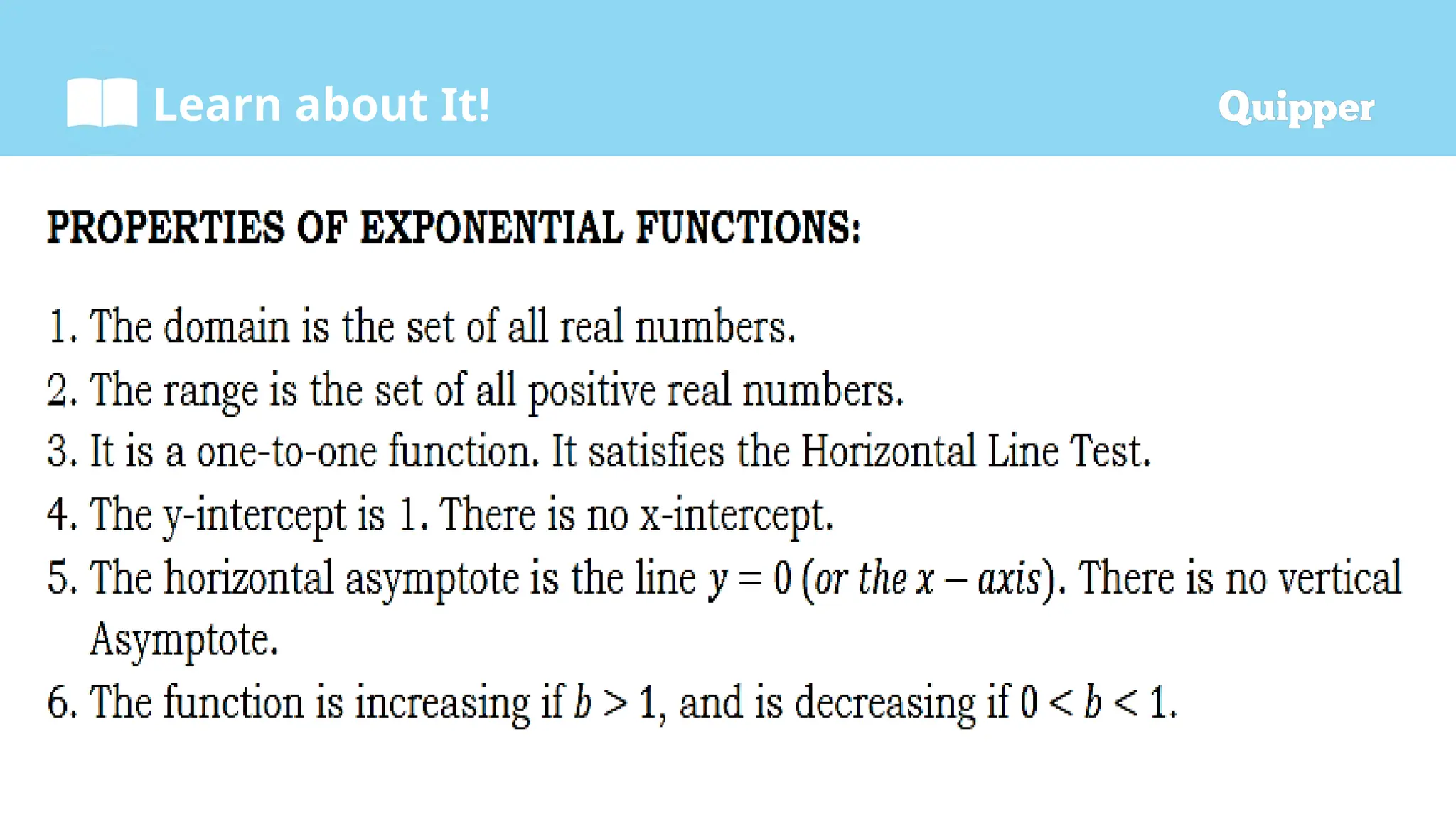
The domain of the exponential function with base is the
𝑏
set of all real numbers.
Its range is the set of positive real numbers.
Learn about It!
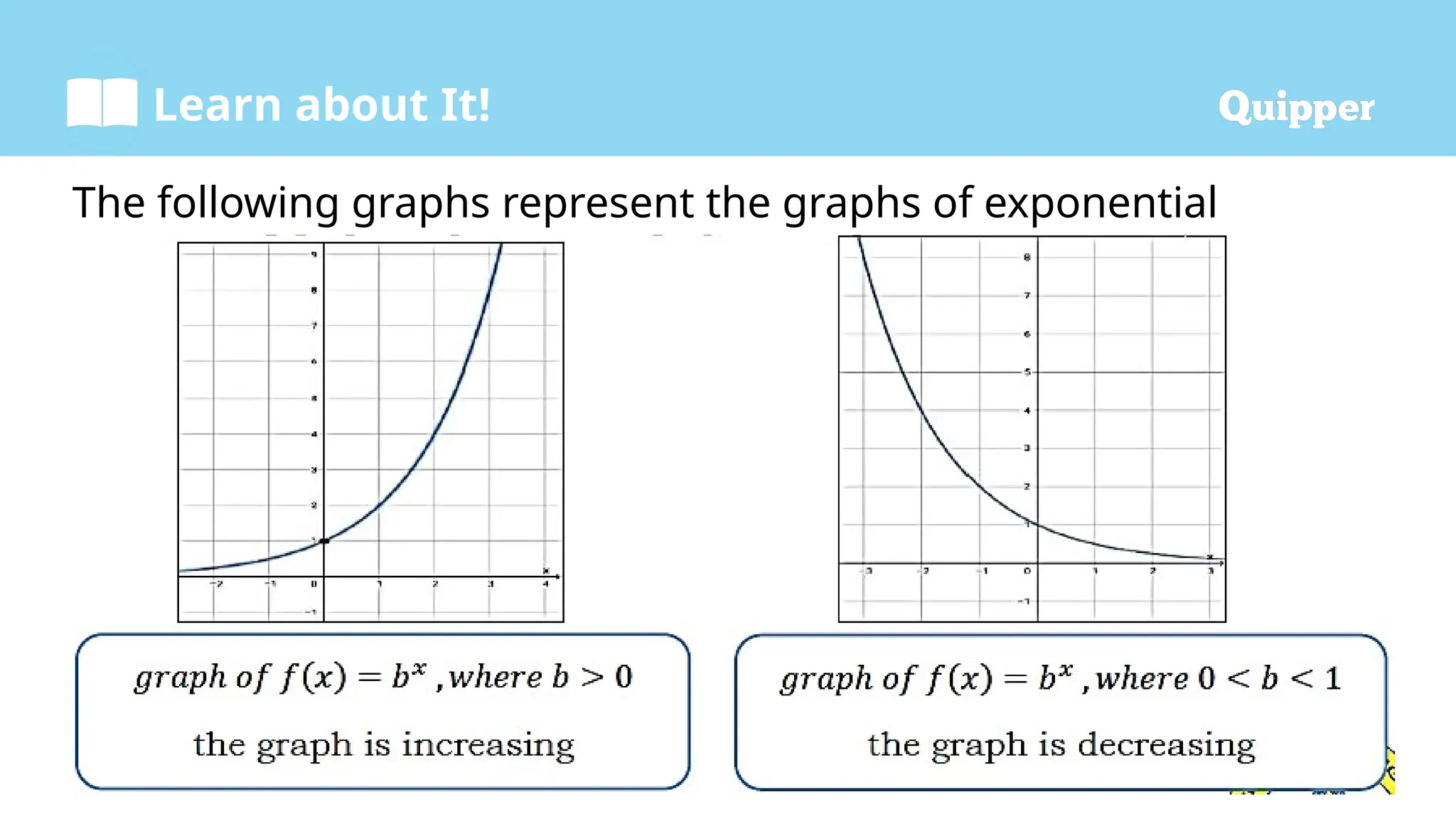
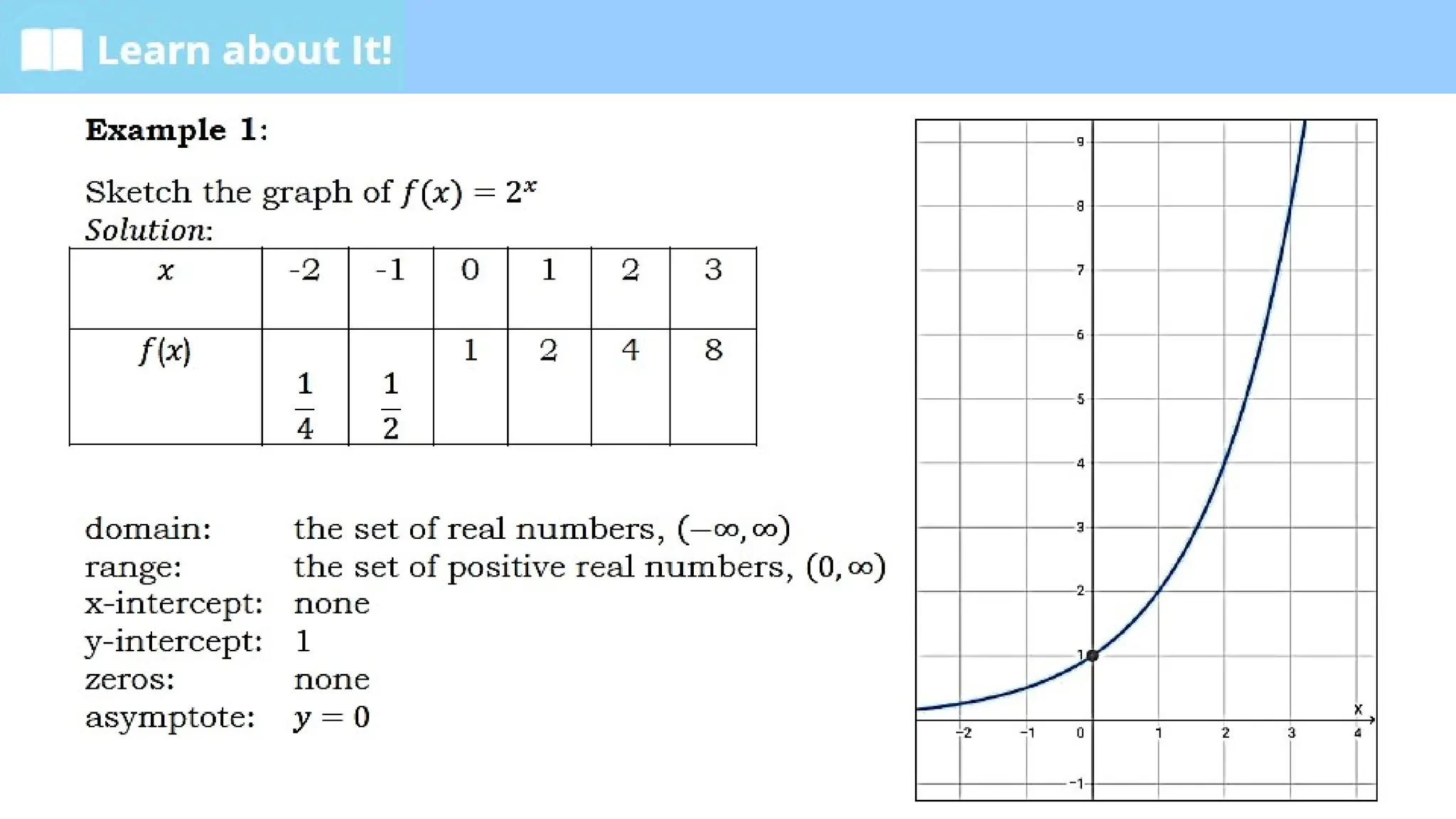
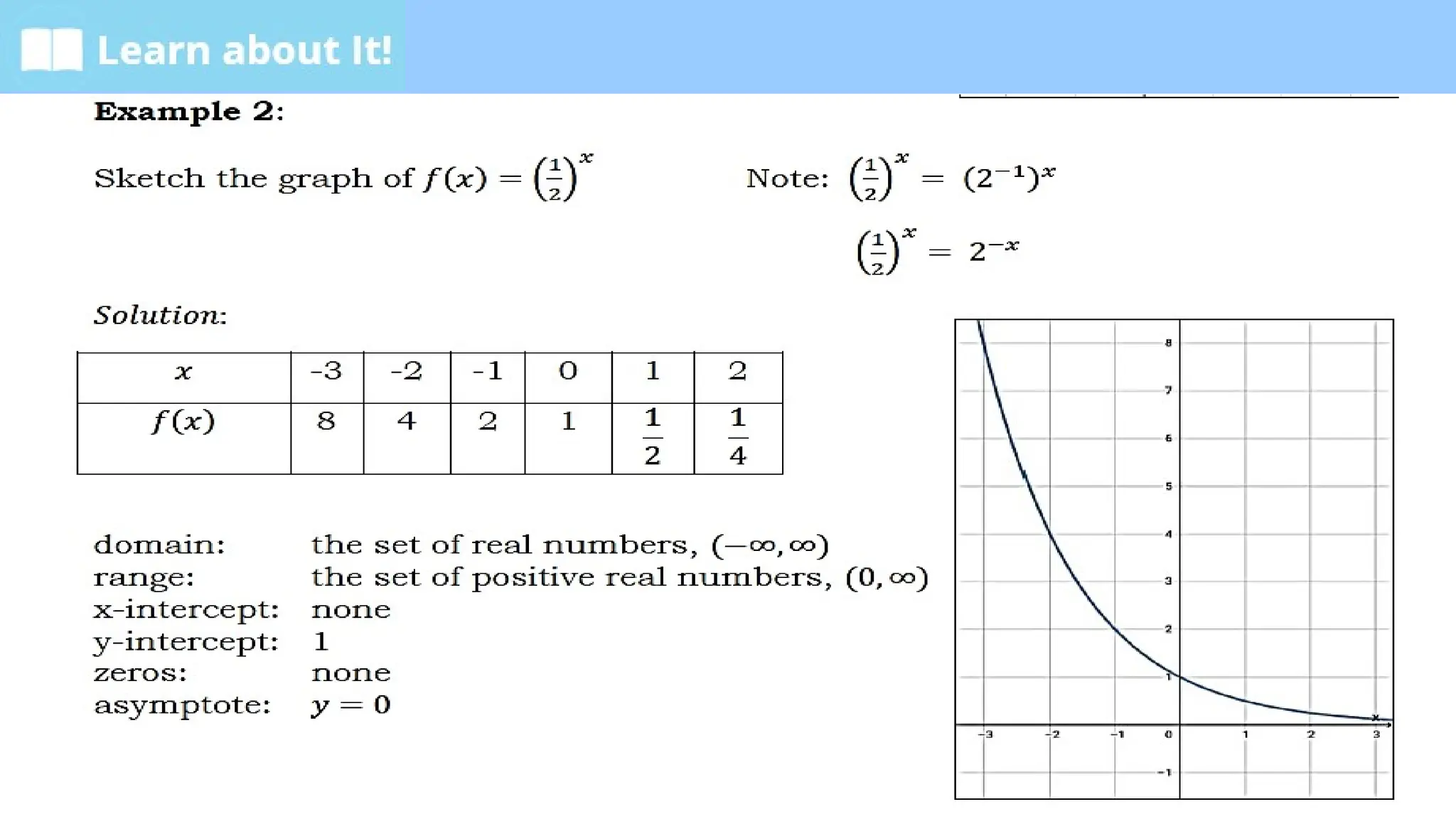
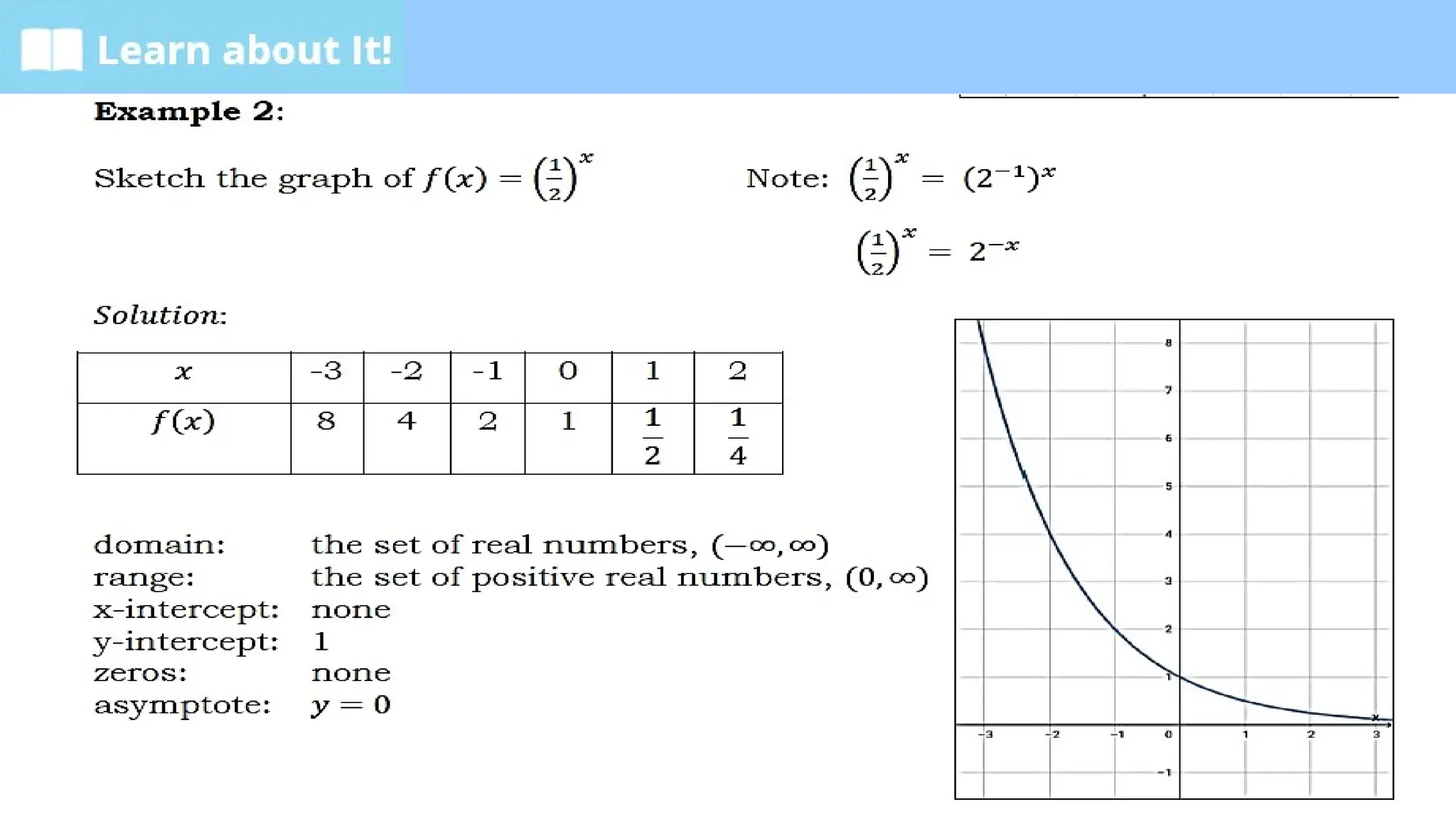
The following graphs represent the graphs of exponential
functions.
Learn about It!
Learn about It!
Learn about It!
Learn about It!
Learn about It!
Exponential Growth
an exponential function of the form where and ; the value of increases without
bound
2
Example:
and are exponential functions which show an
exponential growth given certain values of .
Learn about It!
Exponential Decay
an exponential function of the form where and ; the value of decreases
3
Example:
and are exponential functions which show an
exponential decay given certain values of .
Try It!
Example 1: Which of the following exponential functions
exhibit exponential decay?
Try It!
Example 1: Which of the following exponential functions
exhibit exponential decay?
Solution:
Check the base of a function to determine if it exhibits an
exponential decay. The base of an exponential decay ranges
from 0 to 1 and .
1. The function is an exponential growth since
, which is greater than 1.
Try It!
Example 1: Which of the following exponential functions
exhibit exponential decay?
Solution:
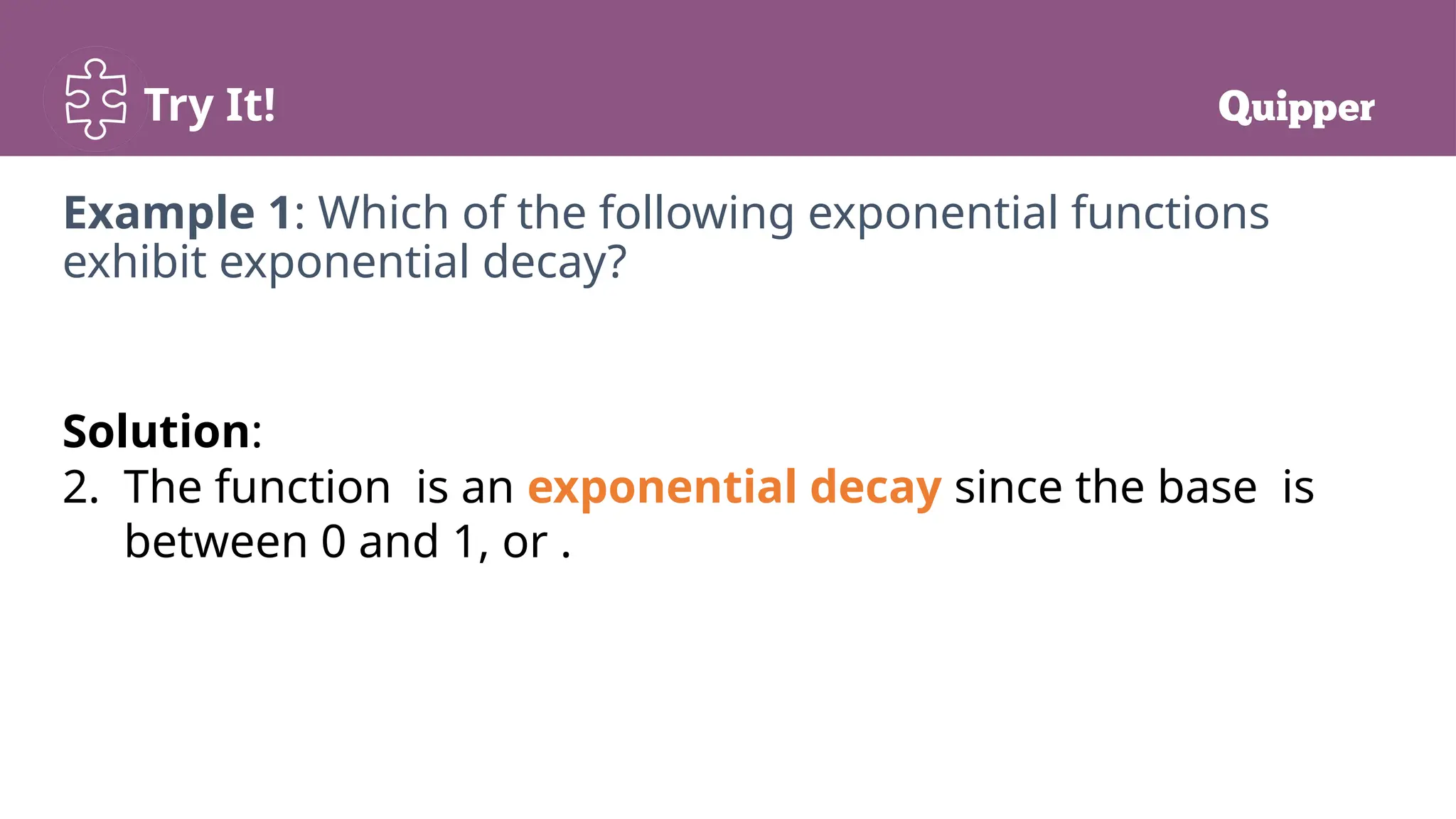
2. The function is an exponential decay since the base is
between 0 and 1, or .
Try It!
Example 1: Which of the following exponential functions
exhibit exponential decay?
Solution:
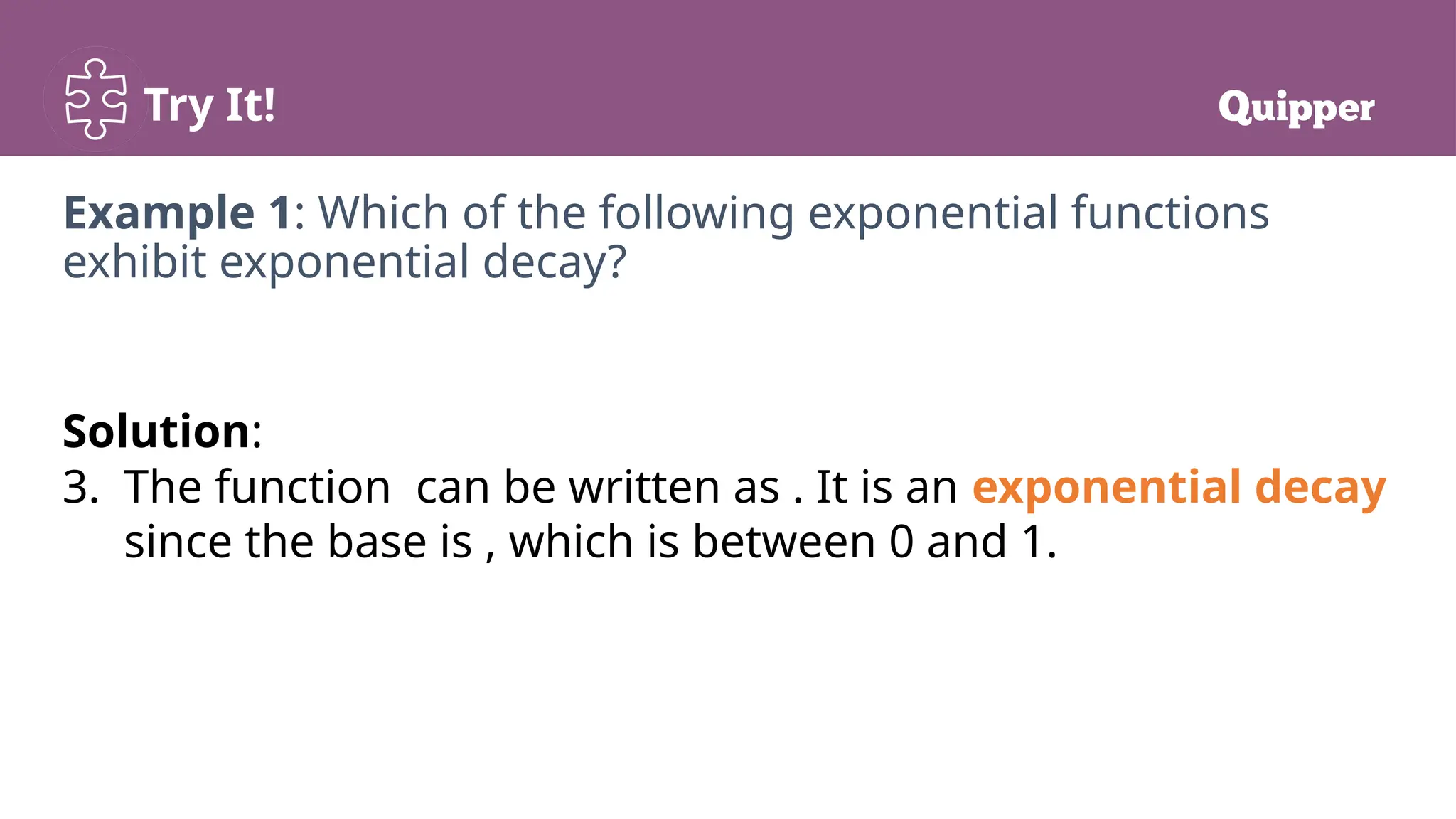
3. The function can be written as . It is an exponential decay
since the base is , which is between 0 and 1.
Try It!
Example 1: Which of the following exponential functions
exhibit exponential decay?
Solution:
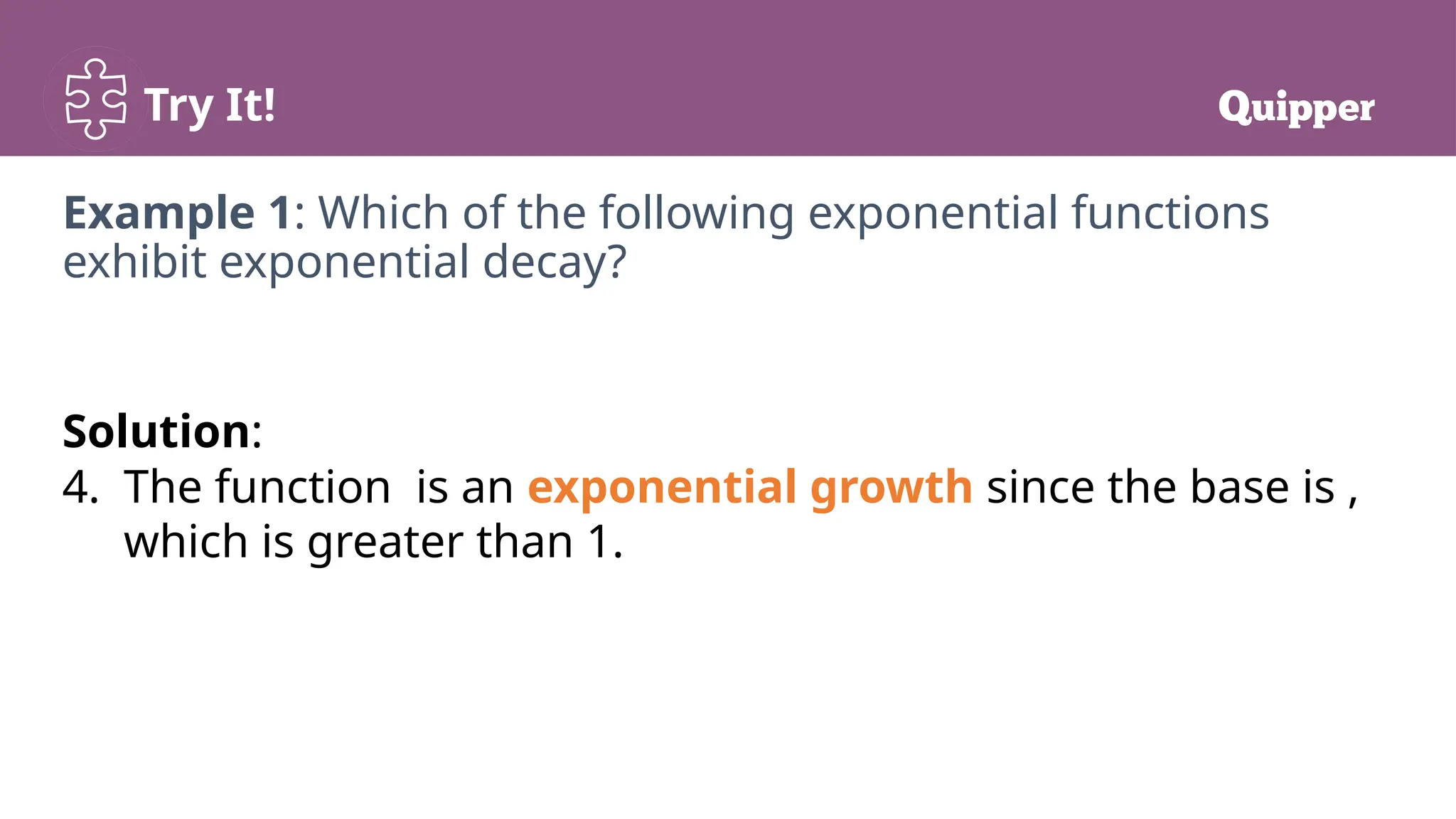
4. The function is an exponential growth since the base is ,
which is greater than 1.
Try It!
Example 1: Which of the following exponential functions
exhibit exponential decay?
Solution:
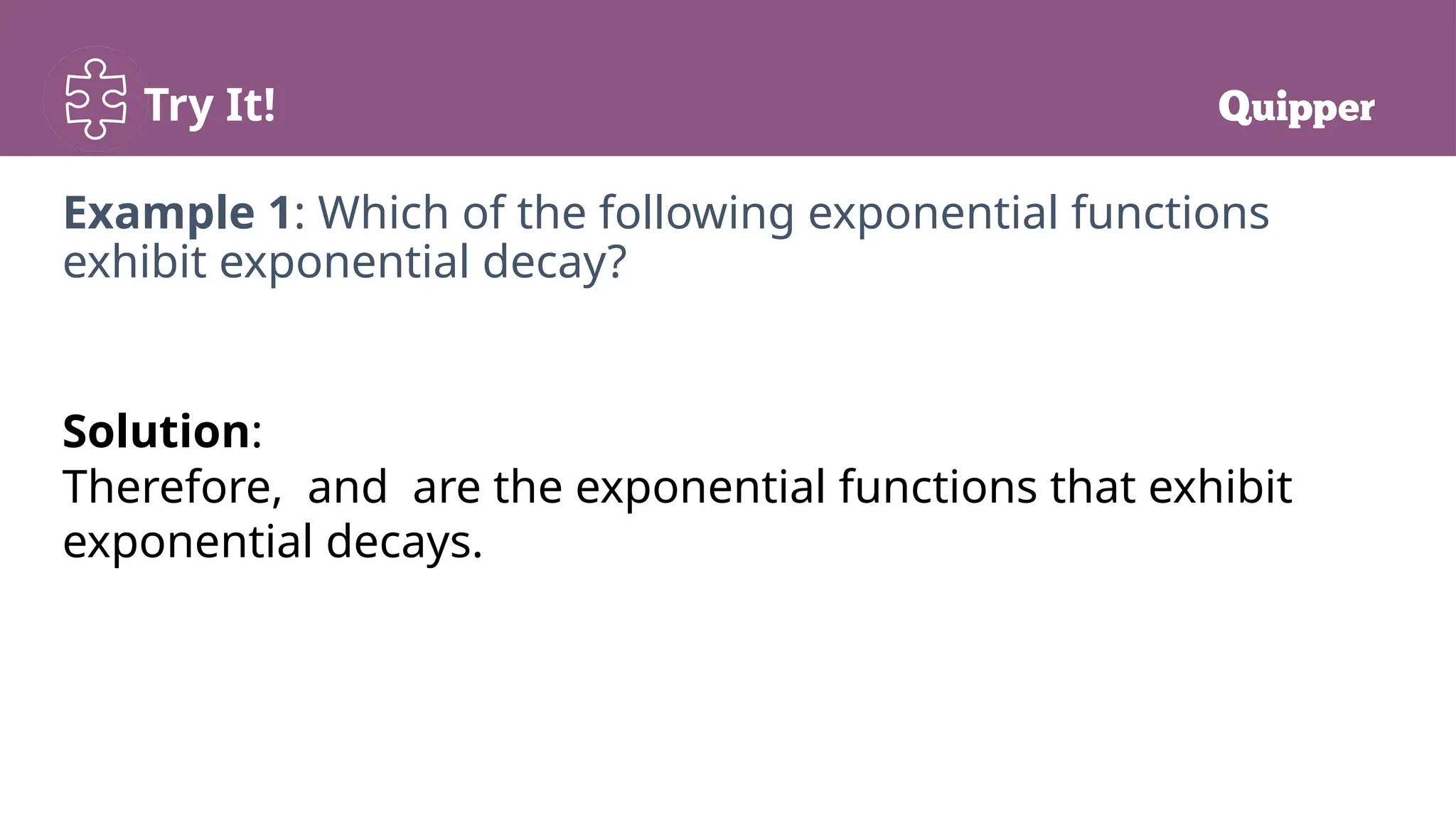
Therefore, and are the exponential functions that exhibit
exponential decays.
Exponential Equations &
Inequalities
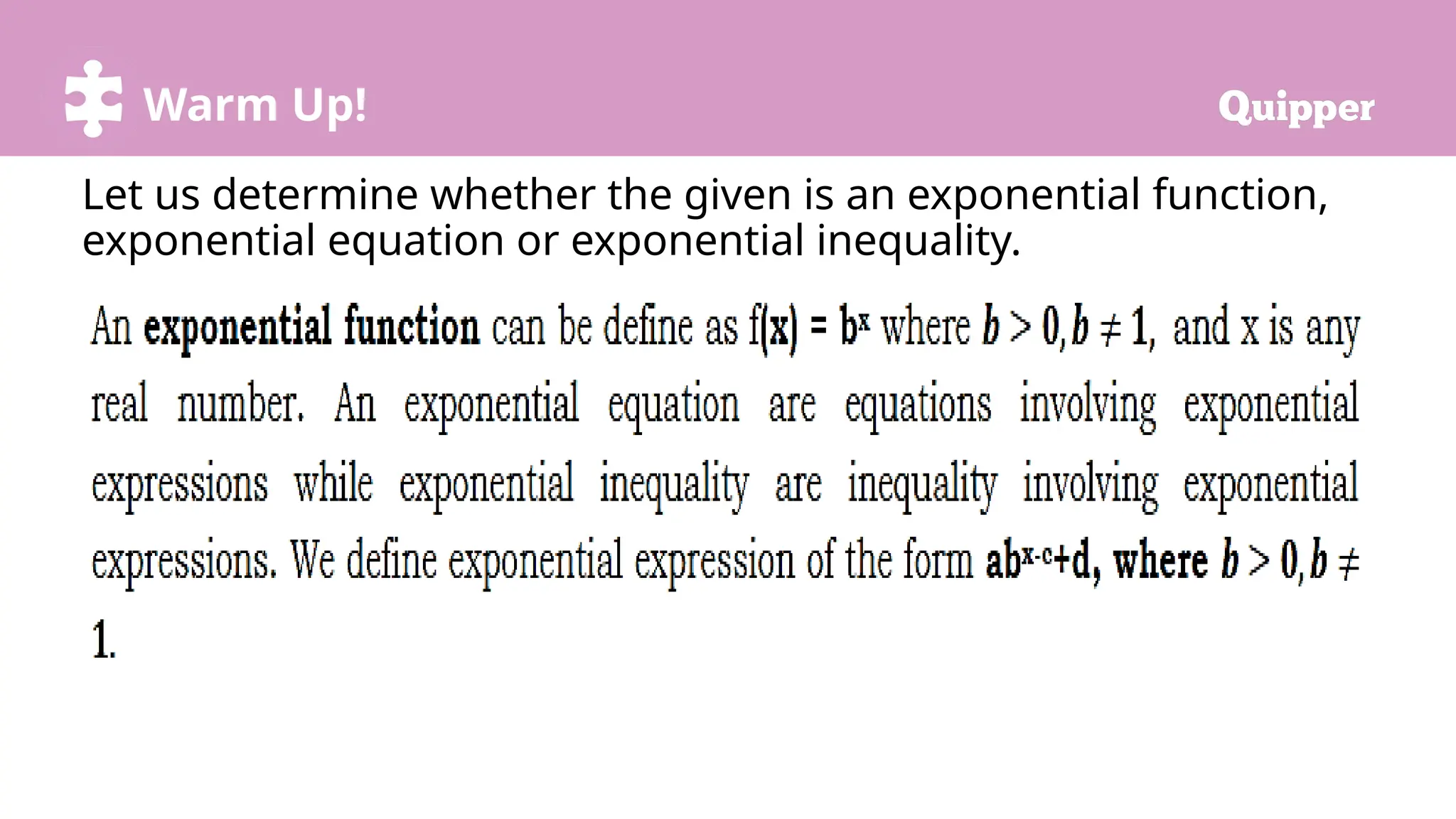
Warm Up!
Let us determine whether the given is an exponential function,
exponential equation or exponential inequality.
Learn about It!
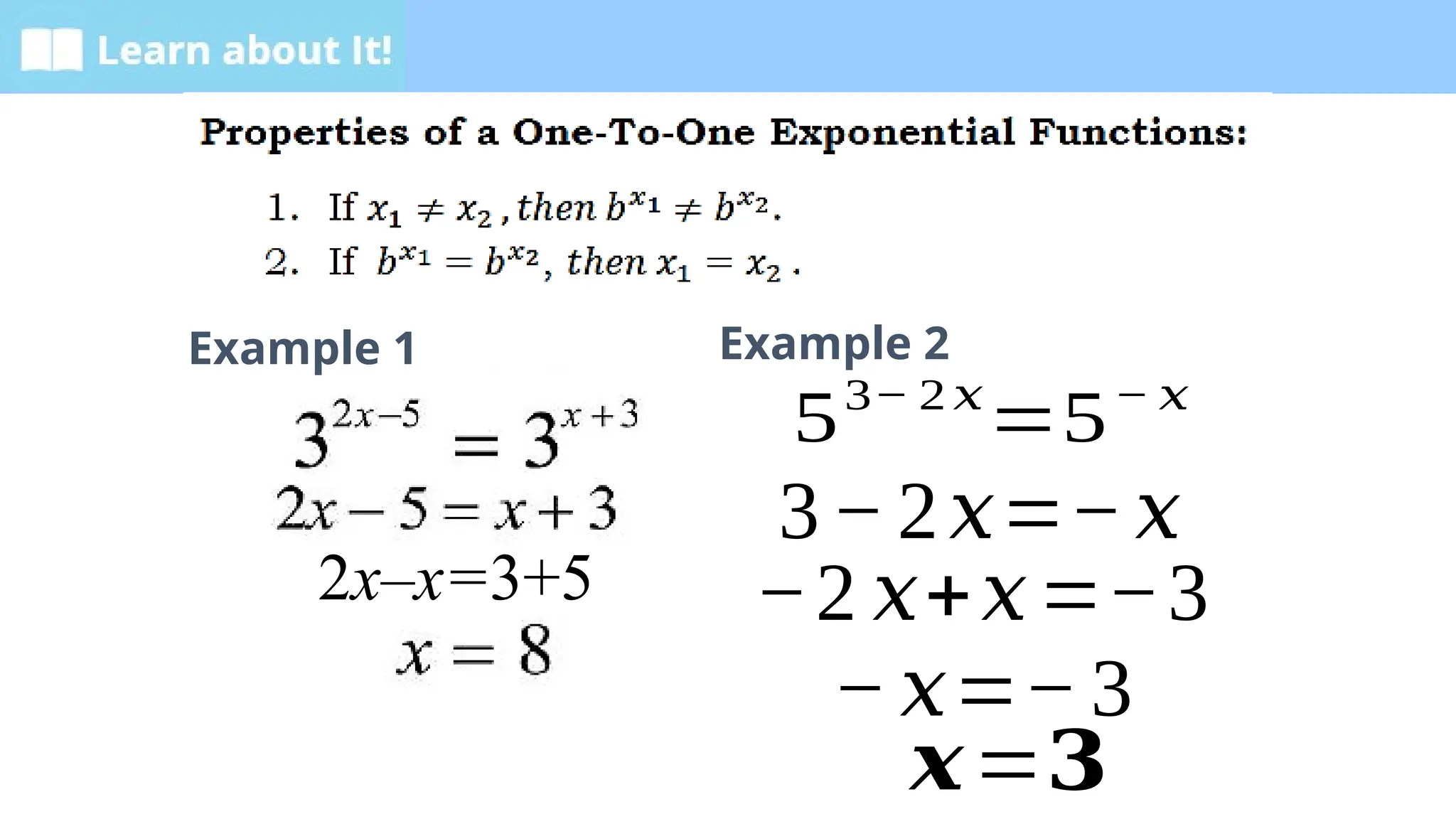
Example 1
2x–x=3+5
Example 2
53− 2 𝑥
=5− 𝑥
3−2𝑥=−𝑥
−2 𝑥+𝑥=−3
−𝑥=−3
𝒙=𝟑
Learn about It!
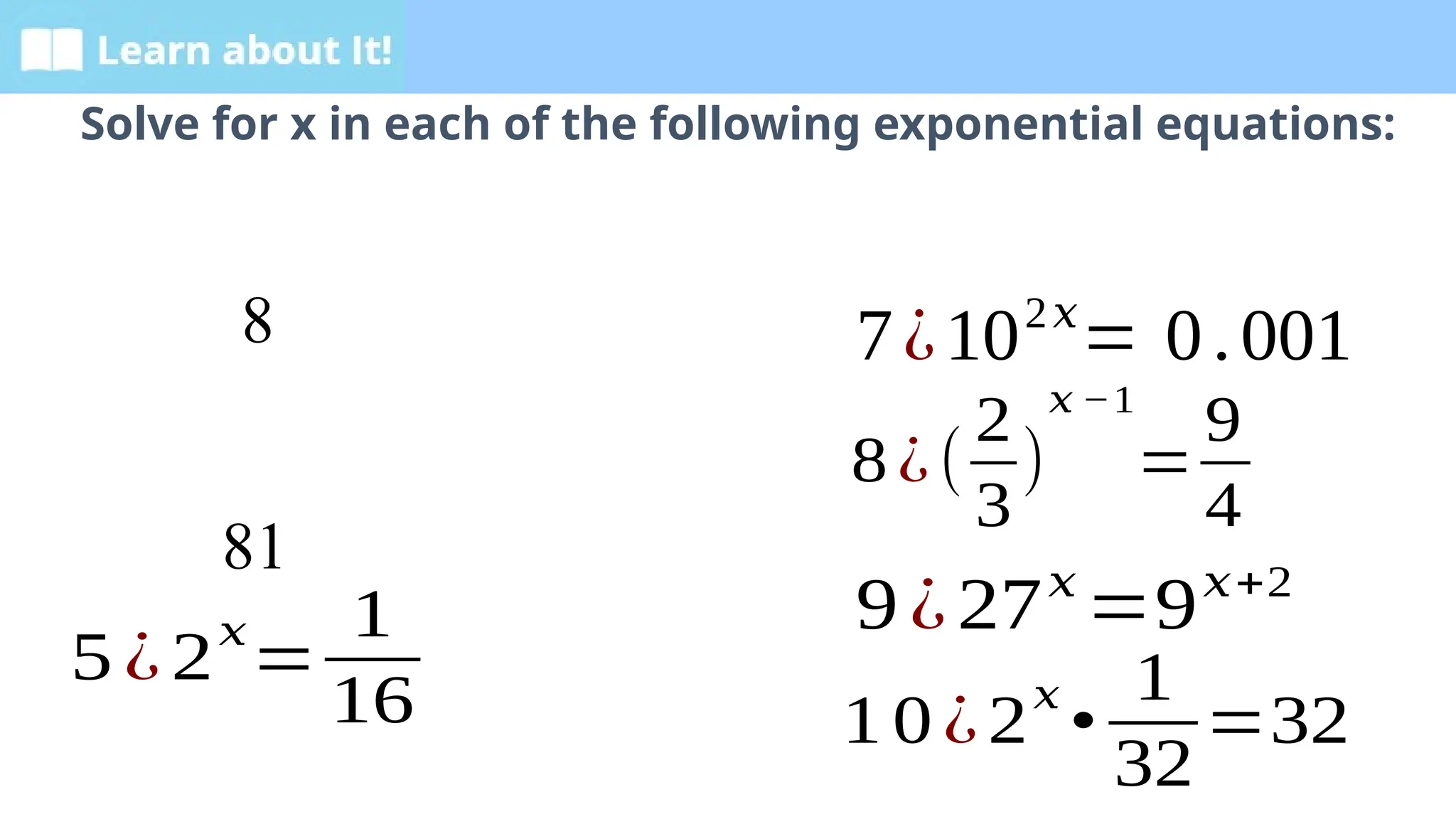
Solve for x in each of the following exponential equations:
8
81
5 ¿2
𝑥
=
1
16
7¿102𝑥
= 0.001
8¿(
2
3
)
𝑥 −1
=
9
4
9¿27𝑥
=9𝑥+2
1 0¿2
𝑥
•
1
32
=32
Learn about It!
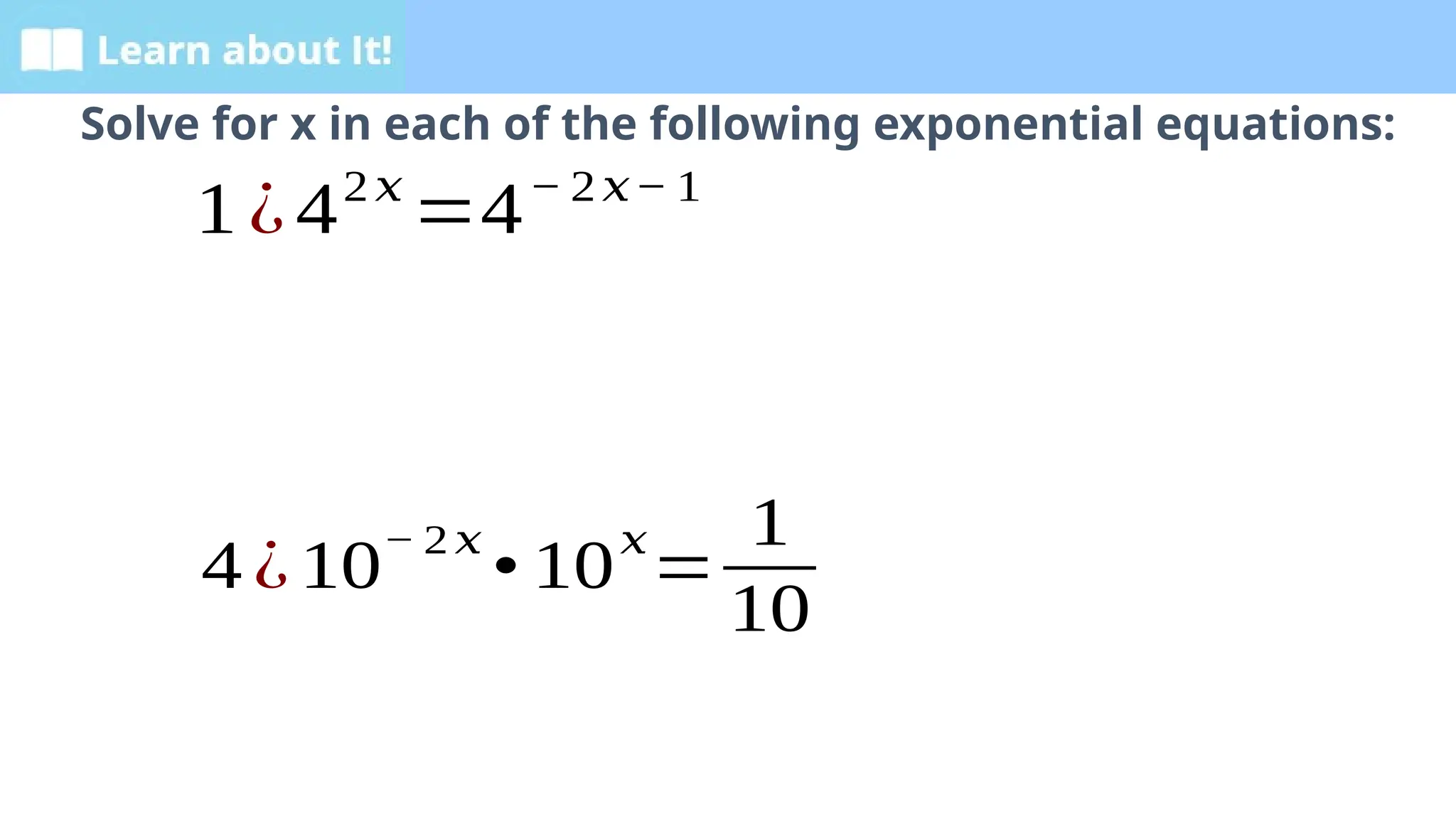
Solve for x in each of the following exponential equations:
1¿42𝑥
=4− 2𝑥− 1
4 ¿10
− 2 𝑥
• 10
𝑥
=
1
10
Learn about It!
Learn about It!
Learn about It!
Try It!
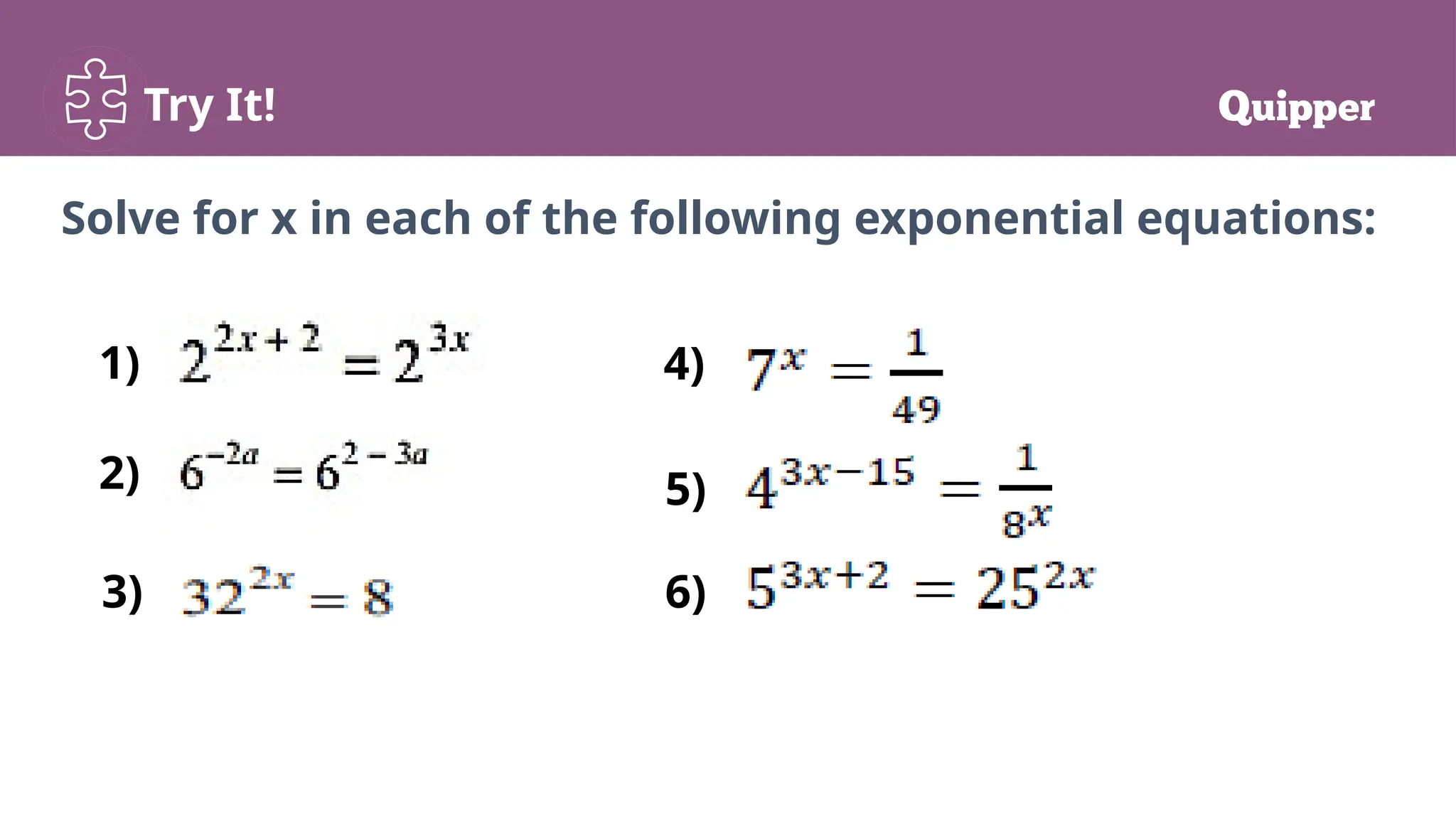
Solve for x in each of the following exponential equations:
1)
2)
3)
4)
5)
6)
Try It!
THANK YOU!
Try It!
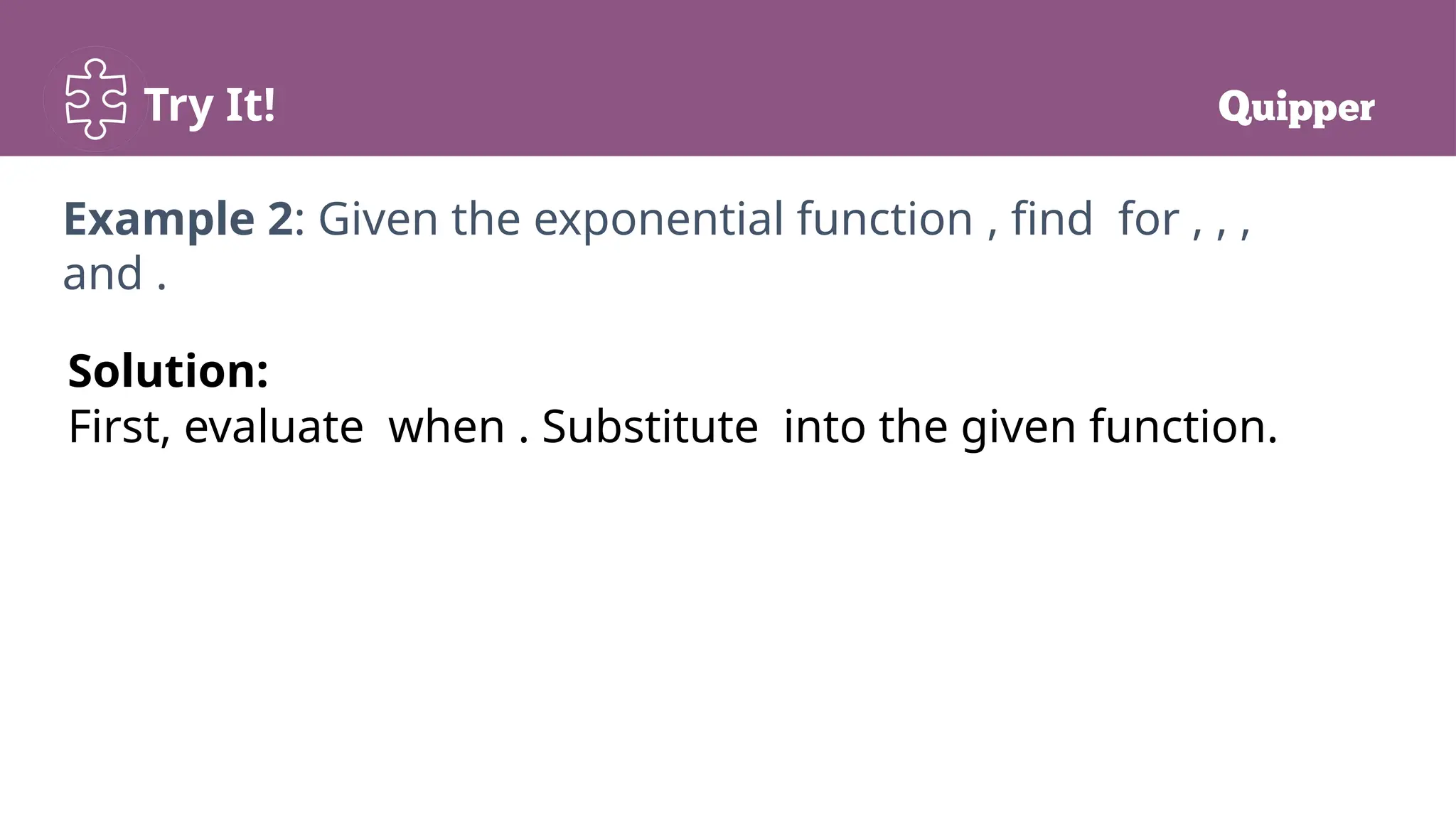
Example 2: Given the exponential function , find for , , ,
and .
Solution:
First, evaluate when . Substitute into the given function.
Try It!
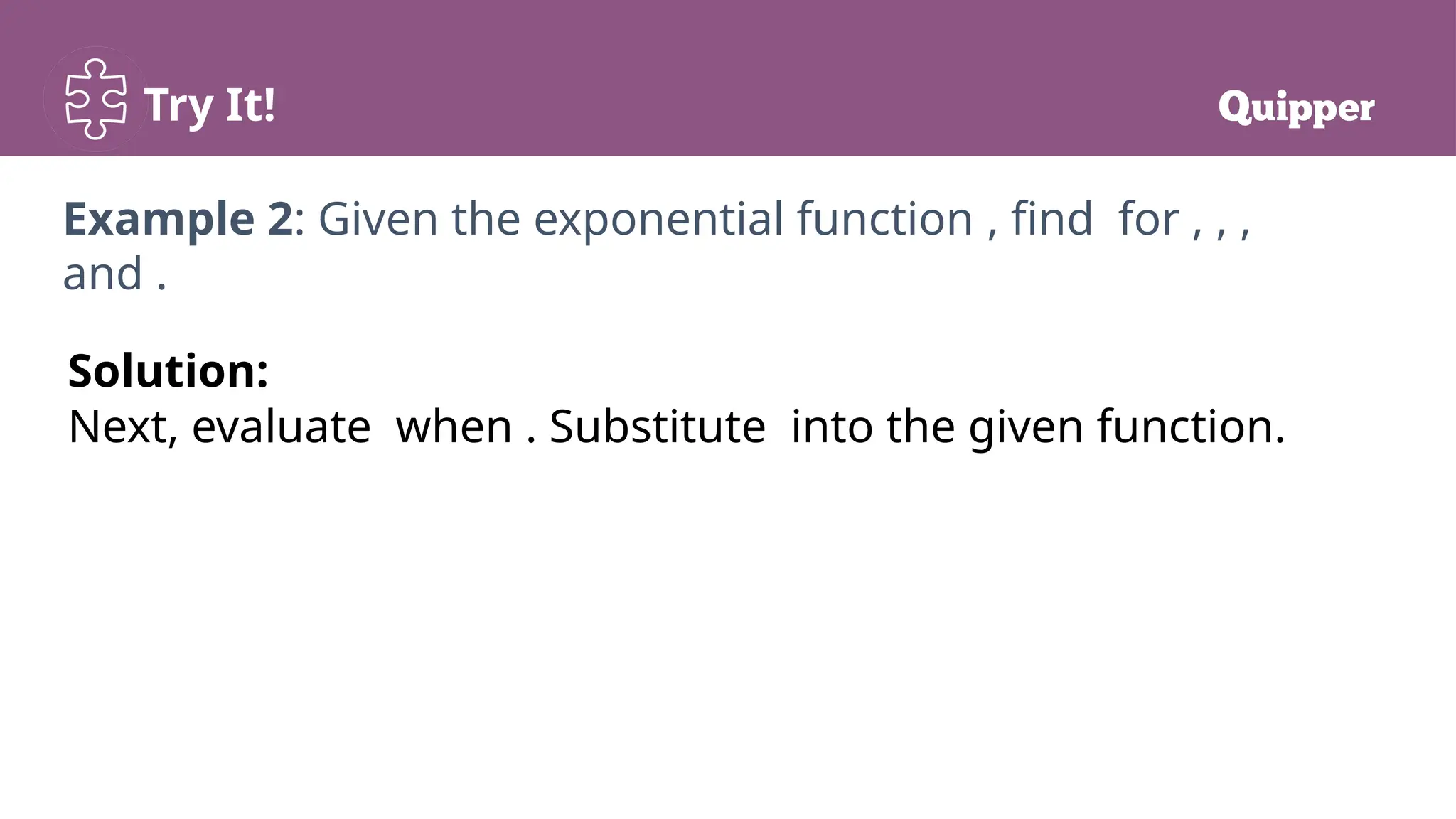
Example 2: Given the exponential function , find for , , ,
and .
Solution:
Next, evaluate when . Substitute into the given function.
Try It!
Example 2: Given the exponential function , find for , , ,
and .
Solution:
Evaluate when . Substitute into the given function.
Try It!
Example 2: Given the exponential function , find for , , ,
and .
Solution:
Evaluate when . Substitute into the given function.
Let’s Practice!
Individual Practice:
1. Which among the following exponential functions exhibit
exponential growth?
2. Consider the exponential function . Evaluate .
Let’s Practice!
Group Practice: To be done in groups of five.
Mr. Cruz invested ₱50 000 in a company that offers 2%
annual interest compounded quarterly. What will be the
amount of his investment after 2 years?
Key Points
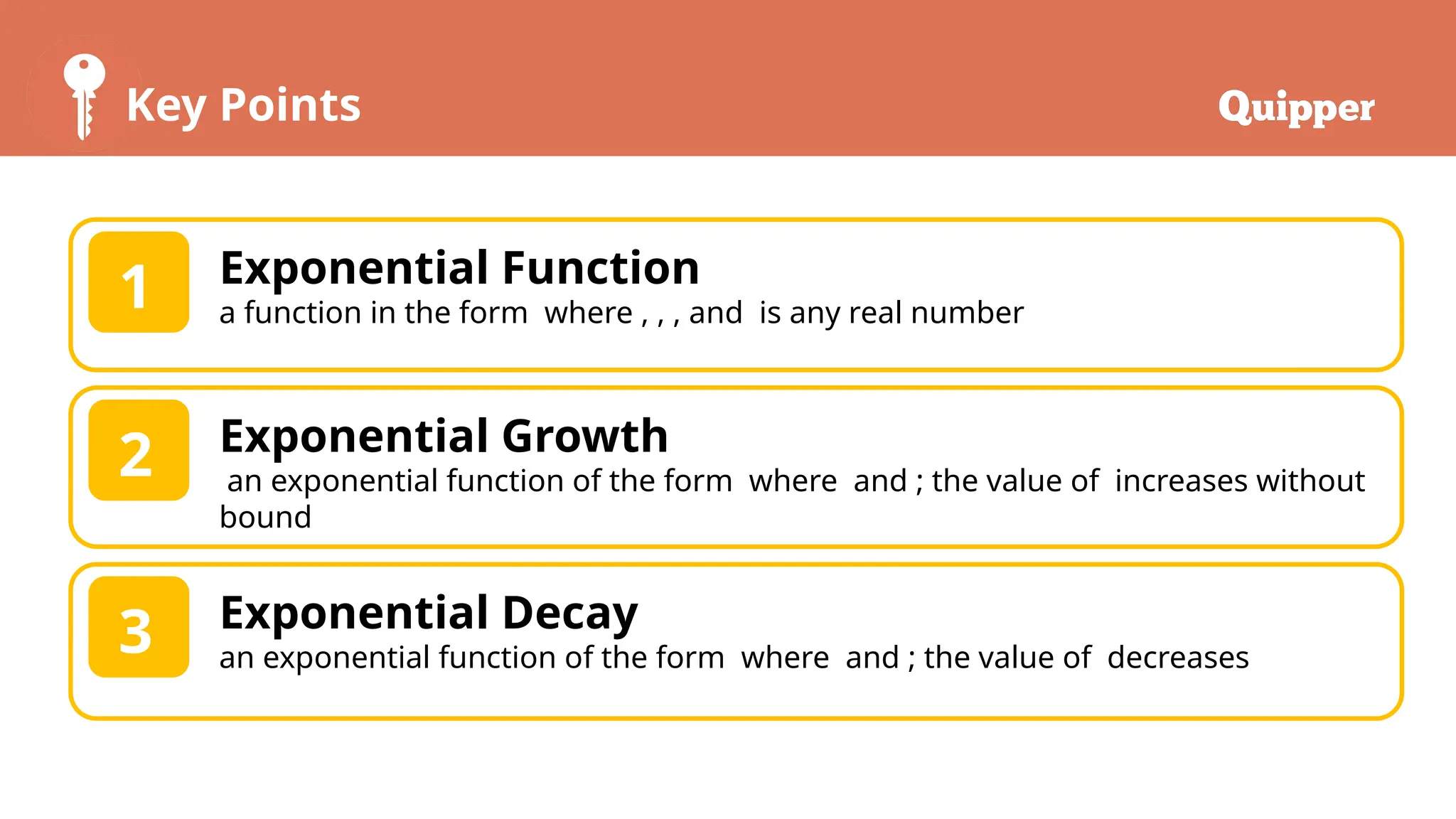
Exponential Function
a function in the form where , , , and is any real number
1
Exponential Growth
an exponential function of the form where and ; the value of increases without
bound
2
Exponential Decay
an exponential function of the form where and ; the value of decreases
3
Key Points
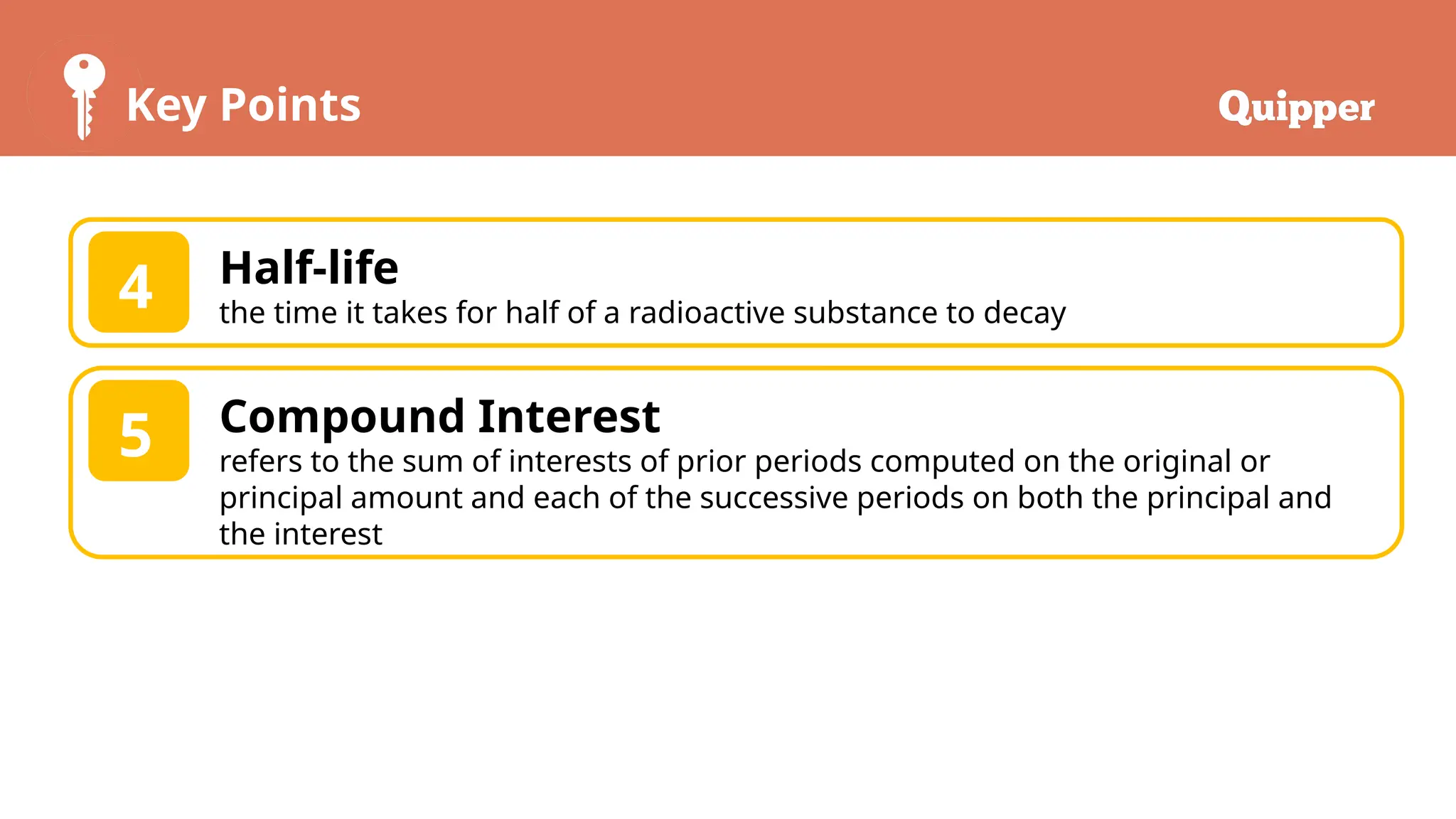
Half-life
the time it takes for half of a radioactive substance to decay
4
Compound Interest
refers to the sum of interests of prior periods computed on the original or
principal amount and each of the successive periods on both the principal and
the interest
5
Synthesis
• How will you differentiate exponential growth from an
exponential decay?
• How would you compare the rate of increase or decrease
in exponential growth and decay as compared to linear
increase or decrease?
• What is the graph of an exponential function?

General Mathematics Exponential Value pptx

  • 1.
  • 2.
    Objectives At the endof this lesson, the learner should be able to • correctly illustrate an exponential function; • properly differentiates exponential growth and exponential decay; and • correctly illustrate word problems using exponential growth and decay.
  • 3.
    Guide Questions Recall 1¿2¿3 •22 ¿ 23+2 ¿ 25 2 2 2 2 ¿𝟑𝟐 2) ¿ 𝑥5 −2 ¿ 𝒙𝟑 3) = = 𝑴𝒖𝒍𝒕𝒊𝒑𝒍𝒊𝒄𝒂𝒕𝒊𝒐𝒏 𝑹𝒖𝒍𝒆 𝑫𝒊𝒗𝒊𝒔𝒊𝒐𝒏 𝑹𝒖𝒍𝒆 𝑷𝒐𝒘𝒆𝒓 𝒐𝒇 𝒂𝑷𝒐𝒘𝒆𝒓 𝑹𝒖𝒍𝒆
  • 4.
    Guide Questions Recall 4) = = = 𝑷𝒐𝒘𝒆𝒓𝒐𝒇 𝒂𝑷𝒓𝒐𝒅𝒖𝒄𝒕 𝑹𝒖𝒍𝒆 𝑷𝒐𝒘𝒆𝒓 𝒐𝒇 𝒂𝑭𝒓𝒂𝒄𝒕𝒊𝒐𝒏 𝑹𝒖𝒍𝒆 5) = = =
  • 5.
    Guide Questions Recall 6) =1 𝒁𝒆𝒓𝒐 𝑬𝒙𝒑𝒐𝒏𝒆𝒏𝒕 𝑹𝒖𝒍𝒆 𝑵𝒆𝒈𝒂𝒕𝒊𝒗𝒆 𝑬𝒙𝒑𝒐𝒏𝒆𝒏𝒕 𝑹𝒖𝒍𝒆 7) = = 𝑭𝒓𝒂𝒄𝒕𝒊𝒐𝒏𝒂𝒍 𝑬𝒙𝒑𝒐𝒏𝒆𝒏𝒕 𝑹𝒖𝒍𝒆 8) ¿ 3 √32 ¿ 𝟑 √𝟗
  • 6.
    Learn about It! ExponentialFunction a function in the form where b b and is any real number 1 Example: , and are examples of exponential functions with bases of 2, 3, and respectively.
  • 7.
    Learn about It! ExponentialFunction a function in the form where b b and is any real number 1 The domain of the exponential function with base is the 𝑏 set of all real numbers. Its range is the set of positive real numbers.
  • 8.
    Learn about It! Thefollowing graphs represent the graphs of exponential functions.
  • 9.
  • 10.
  • 11.
  • 12.
  • 13.
    Learn about It! ExponentialGrowth an exponential function of the form where and ; the value of increases without bound 2 Example: and are exponential functions which show an exponential growth given certain values of .
  • 14.
    Learn about It! ExponentialDecay an exponential function of the form where and ; the value of decreases 3 Example: and are exponential functions which show an exponential decay given certain values of .
  • 15.
    Try It! Example 1:Which of the following exponential functions exhibit exponential decay?
  • 16.
    Try It! Example 1:Which of the following exponential functions exhibit exponential decay? Solution: Check the base of a function to determine if it exhibits an exponential decay. The base of an exponential decay ranges from 0 to 1 and . 1. The function is an exponential growth since , which is greater than 1.
  • 17.
    Try It! Example 1:Which of the following exponential functions exhibit exponential decay? Solution: 2. The function is an exponential decay since the base is between 0 and 1, or .
  • 18.
    Try It! Example 1:Which of the following exponential functions exhibit exponential decay? Solution: 3. The function can be written as . It is an exponential decay since the base is , which is between 0 and 1.
  • 19.
    Try It! Example 1:Which of the following exponential functions exhibit exponential decay? Solution: 4. The function is an exponential growth since the base is , which is greater than 1.
  • 20.
    Try It! Example 1:Which of the following exponential functions exhibit exponential decay? Solution: Therefore, and are the exponential functions that exhibit exponential decays.
  • 21.
  • 22.
    Warm Up! Let usdetermine whether the given is an exponential function, exponential equation or exponential inequality.
  • 23.
    Learn about It! Example1 2x–x=3+5 Example 2 53− 2 𝑥 =5− 𝑥 3−2𝑥=−𝑥 −2 𝑥+𝑥=−3 −𝑥=−3 𝒙=𝟑
  • 24.
    Learn about It! Solvefor x in each of the following exponential equations: 8 81 5 ¿2 𝑥 = 1 16 7¿102𝑥 = 0.001 8¿( 2 3 ) 𝑥 −1 = 9 4 9¿27𝑥 =9𝑥+2 1 0¿2 𝑥 • 1 32 =32
  • 25.
    Learn about It! Solvefor x in each of the following exponential equations: 1¿42𝑥 =4− 2𝑥− 1 4 ¿10 − 2 𝑥 • 10 𝑥 = 1 10
  • 26.
  • 27.
  • 28.
  • 29.
    Try It! Solve forx in each of the following exponential equations: 1) 2) 3) 4) 5) 6)
  • 30.
  • 31.
    Try It! Example 2:Given the exponential function , find for , , , and . Solution: First, evaluate when . Substitute into the given function.
  • 32.
    Try It! Example 2:Given the exponential function , find for , , , and . Solution: Next, evaluate when . Substitute into the given function.
  • 33.
    Try It! Example 2:Given the exponential function , find for , , , and . Solution: Evaluate when . Substitute into the given function.
  • 34.
    Try It! Example 2:Given the exponential function , find for , , , and . Solution: Evaluate when . Substitute into the given function.
  • 35.
    Let’s Practice! Individual Practice: 1.Which among the following exponential functions exhibit exponential growth? 2. Consider the exponential function . Evaluate .
  • 36.
    Let’s Practice! Group Practice:To be done in groups of five. Mr. Cruz invested ₱50 000 in a company that offers 2% annual interest compounded quarterly. What will be the amount of his investment after 2 years?
  • 37.
    Key Points Exponential Function afunction in the form where , , , and is any real number 1 Exponential Growth an exponential function of the form where and ; the value of increases without bound 2 Exponential Decay an exponential function of the form where and ; the value of decreases 3
  • 38.
    Key Points Half-life the timeit takes for half of a radioactive substance to decay 4 Compound Interest refers to the sum of interests of prior periods computed on the original or principal amount and each of the successive periods on both the principal and the interest 5
  • 39.
    Synthesis • How willyou differentiate exponential growth from an exponential decay? • How would you compare the rate of increase or decrease in exponential growth and decay as compared to linear increase or decrease? • What is the graph of an exponential function?