What are Exponential Functions?
 Exponential functions – functions that
  include the expression bx where b is a
  positive # other than 1.
 b is called the base.
What’s the Shape?
 Let’s make a table to find the general shape.
 If we use f(x) = 2x as an example:
   x     f(x) = 2x

   -3

   -2

   -1

   0

   1

   2

   3
Asymptotes
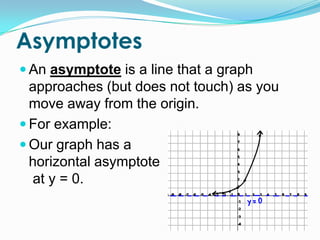
 An asymptote is a line that a graph
  approaches (but does not touch) as you
  move away from the origin.
 For example:
 Our graph has a
  horizontal asymptote
  at y = 0.
Graphing y = abx
 If a > 0 and b > 1, y = abx is an
  exponential growth function.
 For all y = abx , b > 1:
   Graphs pass through (0, a) (a is the y-int)
   x-axis is an asymptote
   Domain: all real #s
   Range: y > 0 if a > 0
           y < 0 if a < 0
To graph:
 Plot 2 points: (0, a) and (1, __)
   Plug in 1 for x to fill the blank
 Connect with a smooth curve that:
   Starts left of the origin, close to the x-axis
   Moves up or down quickly to the right
Examples
 Graph:
Your Turn!
 Graph
General Exponential Functions
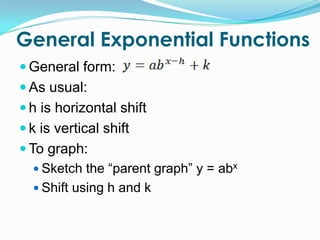
 General form:
 As usual:
 h is horizontal shift
 k is vertical shift
 To graph:
    Sketch the “parent graph” y = abx
    Shift using h and k
Examples
 Graph and state the domain and range:
Your Turn!
 Graph and state the domain and range:
Exponential Growth Models
 When a real-life quantity increases by a
  fixed % each year, the amount of the
  quantity after t years can be modeled by:
                  y = a(1 + r)t
  where a is the initial amount and r is the %
  increase (as a decimal).
 (1 + r) is the growth factor.
Example:
 In January, 1993, there were about 1,313,000
  Internet hosts. During the next five years, the
  number of hosts increased by about 100% per
  year.
 Write a model giving the number h (in millions)
  of hosts t years after 1993.
 How many hosts were there in 1996?
Compound Interest
 Compound interest is interest paid on the
  original principal and on previously earned
  interest.
 Modeled by an exponential function.
 If interest is compounded n times per
  year, the amount A in the account after t
  years is:


 where P is the initial principal and r is the
 annual interest rate.
Example:
 You deposit $1000 in an account that pays
  8% annual interest. Find the balance after 1
  year if interest is compounded:
 A. annually
 B. quarterly
 C. daily


 Which is the best investment?

8.1 exponential growth

  • 2.
    What are ExponentialFunctions?  Exponential functions – functions that include the expression bx where b is a positive # other than 1.  b is called the base.
  • 3.
    What’s the Shape? Let’s make a table to find the general shape.  If we use f(x) = 2x as an example: x f(x) = 2x -3 -2 -1 0 1 2 3
  • 4.
    Asymptotes  An asymptoteis a line that a graph approaches (but does not touch) as you move away from the origin.  For example:  Our graph has a horizontal asymptote at y = 0.
  • 5.
    Graphing y =abx  If a > 0 and b > 1, y = abx is an exponential growth function.  For all y = abx , b > 1:  Graphs pass through (0, a) (a is the y-int)  x-axis is an asymptote  Domain: all real #s  Range: y > 0 if a > 0 y < 0 if a < 0
  • 6.
    To graph:  Plot2 points: (0, a) and (1, __)  Plug in 1 for x to fill the blank  Connect with a smooth curve that:  Starts left of the origin, close to the x-axis  Moves up or down quickly to the right
  • 7.
  • 8.
  • 9.
    General Exponential Functions General form:  As usual:  h is horizontal shift  k is vertical shift  To graph:  Sketch the “parent graph” y = abx  Shift using h and k
  • 10.
    Examples  Graph andstate the domain and range:
  • 11.
    Your Turn!  Graphand state the domain and range:
  • 12.
    Exponential Growth Models When a real-life quantity increases by a fixed % each year, the amount of the quantity after t years can be modeled by: y = a(1 + r)t where a is the initial amount and r is the % increase (as a decimal).  (1 + r) is the growth factor.
  • 13.
    Example:  In January,1993, there were about 1,313,000 Internet hosts. During the next five years, the number of hosts increased by about 100% per year.  Write a model giving the number h (in millions) of hosts t years after 1993.  How many hosts were there in 1996?
  • 14.
    Compound Interest  Compoundinterest is interest paid on the original principal and on previously earned interest.  Modeled by an exponential function.  If interest is compounded n times per year, the amount A in the account after t years is: where P is the initial principal and r is the annual interest rate.
  • 15.
    Example:  You deposit$1000 in an account that pays 8% annual interest. Find the balance after 1 year if interest is compounded:  A. annually  B. quarterly  C. daily  Which is the best investment?