By
Ketul Vaidya(15BEMEG061)
Prashant Ranade(15BEMEG062)
Aakash Singh(15BEMEG063)
Aditya(15BEMEG064)
Swapnil Bodke(15BEMEG065)
F.Y. B.E. Mechanical
M – 1 Batch – C
 The term was originally introduced by
Cauchy’s student Moigno in the middle of the
19th century.
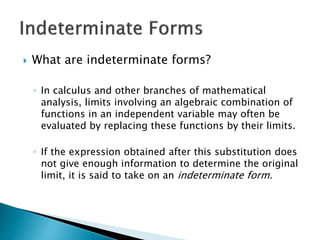
 What are indeterminate forms?
◦ In calculus and other branches of mathematical
analysis, limits involving an algebraic combination of
functions in an independent variable may often be
evaluated by replacing these functions by their limits.
◦ If the expression obtained after this substitution does
not give enough information to determine the original
limit, it is said to take on an indeterminate form.
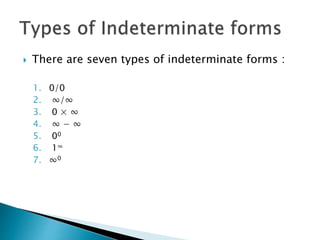
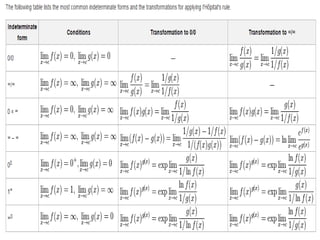
 There are seven types of indeterminate forms :
1. 0/0
2. ∞/∞
3. 0 × ∞
4. ∞ − ∞
5. 00
6. 1∞
7. ∞0
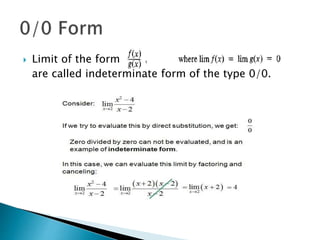
 Limit of the form
are called indeterminate form of the type 0/0.
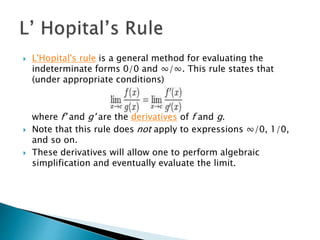
 L'Hopital's rule is a general method for evaluating the
indeterminate forms 0/0 and ∞/∞. This rule states that
(under appropriate conditions)
where f' and g' are the derivatives of f and g.
 Note that this rule does not apply to expressions ∞/0, 1/0,
and so on.
 These derivatives will allow one to perform algebraic
simplification and eventually evaluate the limit.
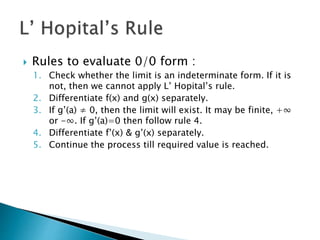
 Rules to evaluate 0/0 form :
1. Check whether the limit is an indeterminate form. If it is
not, then we cannot apply L’ Hopital’s rule.
2. Differentiate f(x) and g(x) separately.
3. If g’(a) ≠ 0, then the limit will exist. It may be finite, +∞
or -∞. If g’(a)=0 then follow rule 4.
4. Differentiate f’(x) & g’(x) separately.
5. Continue the process till required value is reached.
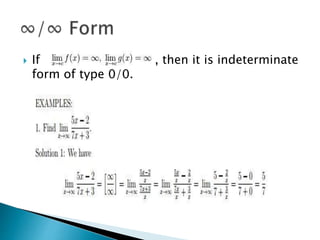
 If , then it is indeterminate
form of type 0/0.
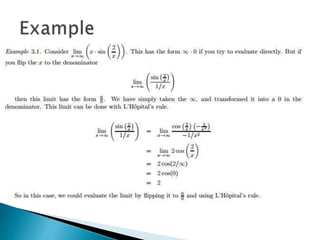
 Limit of the form
are called indeterminate form of the type
0x∞.
 If we write f(x) g(x) = f(x)/[1/g(x)], then the
limit becomes of the form (0/0).
 This can be evaluated by using L’ Hopital’s
rule.
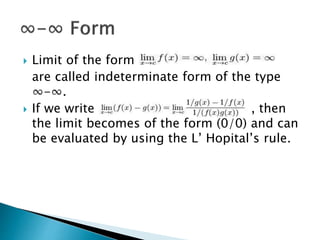
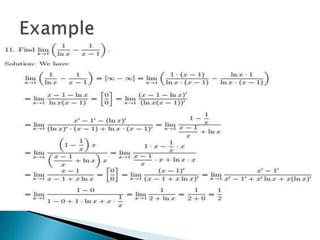
 Limit of the form
are called indeterminate form of the type
∞-∞.
 If we write , then
the limit becomes of the form (0/0) and can
be evaluated by using the L’ Hopital’s rule.
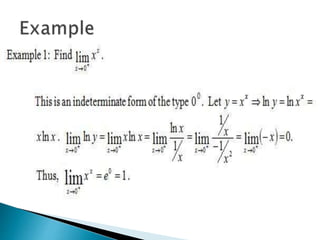
 Limit of the form
are called indeterminate form of the type .
 If we write , then the
limit becomes of the form (0/0) and can be
evaluated by using the L’ Hopital’s rule.
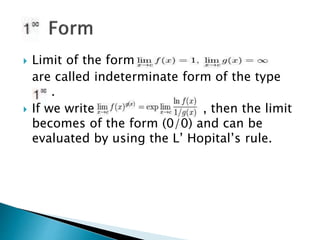
 Limit of the form
are called indeterminate form of the type
.
 If we write , then the limit
becomes of the form (0/0) and can be
evaluated by using the L’ Hopital’s rule.
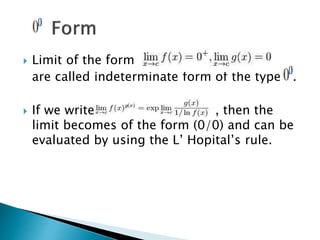
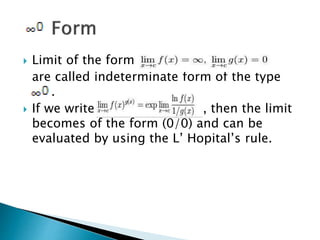
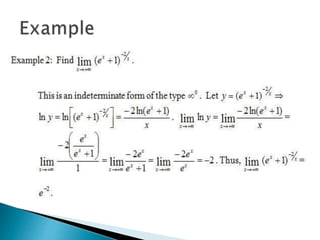
 Limit of the form
are called indeterminate form of the type
.
 If we write , then the limit
becomes of the form (0/0) and can be
evaluated by using the L’ Hopital’s rule.
Indeterminate Forms and L' Hospital Rule

Indeterminate Forms and L' Hospital Rule

  • 2.
    By Ketul Vaidya(15BEMEG061) Prashant Ranade(15BEMEG062) AakashSingh(15BEMEG063) Aditya(15BEMEG064) Swapnil Bodke(15BEMEG065) F.Y. B.E. Mechanical M – 1 Batch – C
  • 3.
     The termwas originally introduced by Cauchy’s student Moigno in the middle of the 19th century.
  • 4.
     What areindeterminate forms? ◦ In calculus and other branches of mathematical analysis, limits involving an algebraic combination of functions in an independent variable may often be evaluated by replacing these functions by their limits. ◦ If the expression obtained after this substitution does not give enough information to determine the original limit, it is said to take on an indeterminate form.
  • 5.
     There areseven types of indeterminate forms : 1. 0/0 2. ∞/∞ 3. 0 × ∞ 4. ∞ − ∞ 5. 00 6. 1∞ 7. ∞0
  • 6.
     Limit ofthe form are called indeterminate form of the type 0/0.
  • 7.
     L'Hopital's ruleis a general method for evaluating the indeterminate forms 0/0 and ∞/∞. This rule states that (under appropriate conditions) where f' and g' are the derivatives of f and g.  Note that this rule does not apply to expressions ∞/0, 1/0, and so on.  These derivatives will allow one to perform algebraic simplification and eventually evaluate the limit.
  • 8.
     Rules toevaluate 0/0 form : 1. Check whether the limit is an indeterminate form. If it is not, then we cannot apply L’ Hopital’s rule. 2. Differentiate f(x) and g(x) separately. 3. If g’(a) ≠ 0, then the limit will exist. It may be finite, +∞ or -∞. If g’(a)=0 then follow rule 4. 4. Differentiate f’(x) & g’(x) separately. 5. Continue the process till required value is reached.
  • 12.
     If ,then it is indeterminate form of type 0/0.
  • 13.
     Limit ofthe form are called indeterminate form of the type 0x∞.  If we write f(x) g(x) = f(x)/[1/g(x)], then the limit becomes of the form (0/0).  This can be evaluated by using L’ Hopital’s rule.
  • 15.
     Limit ofthe form are called indeterminate form of the type ∞-∞.  If we write , then the limit becomes of the form (0/0) and can be evaluated by using the L’ Hopital’s rule.
  • 17.
     Limit ofthe form are called indeterminate form of the type .  If we write , then the limit becomes of the form (0/0) and can be evaluated by using the L’ Hopital’s rule.
  • 19.
     Limit ofthe form are called indeterminate form of the type .  If we write , then the limit becomes of the form (0/0) and can be evaluated by using the L’ Hopital’s rule.
  • 21.
     Limit ofthe form are called indeterminate form of the type .  If we write , then the limit becomes of the form (0/0) and can be evaluated by using the L’ Hopital’s rule.