Exponential Functions
Objectives
To use the properties of exponents to:
 Simplify exponential expressions.
 Solve exponential equations.
To sketch graphs of exponential functions.
Exponential Functions
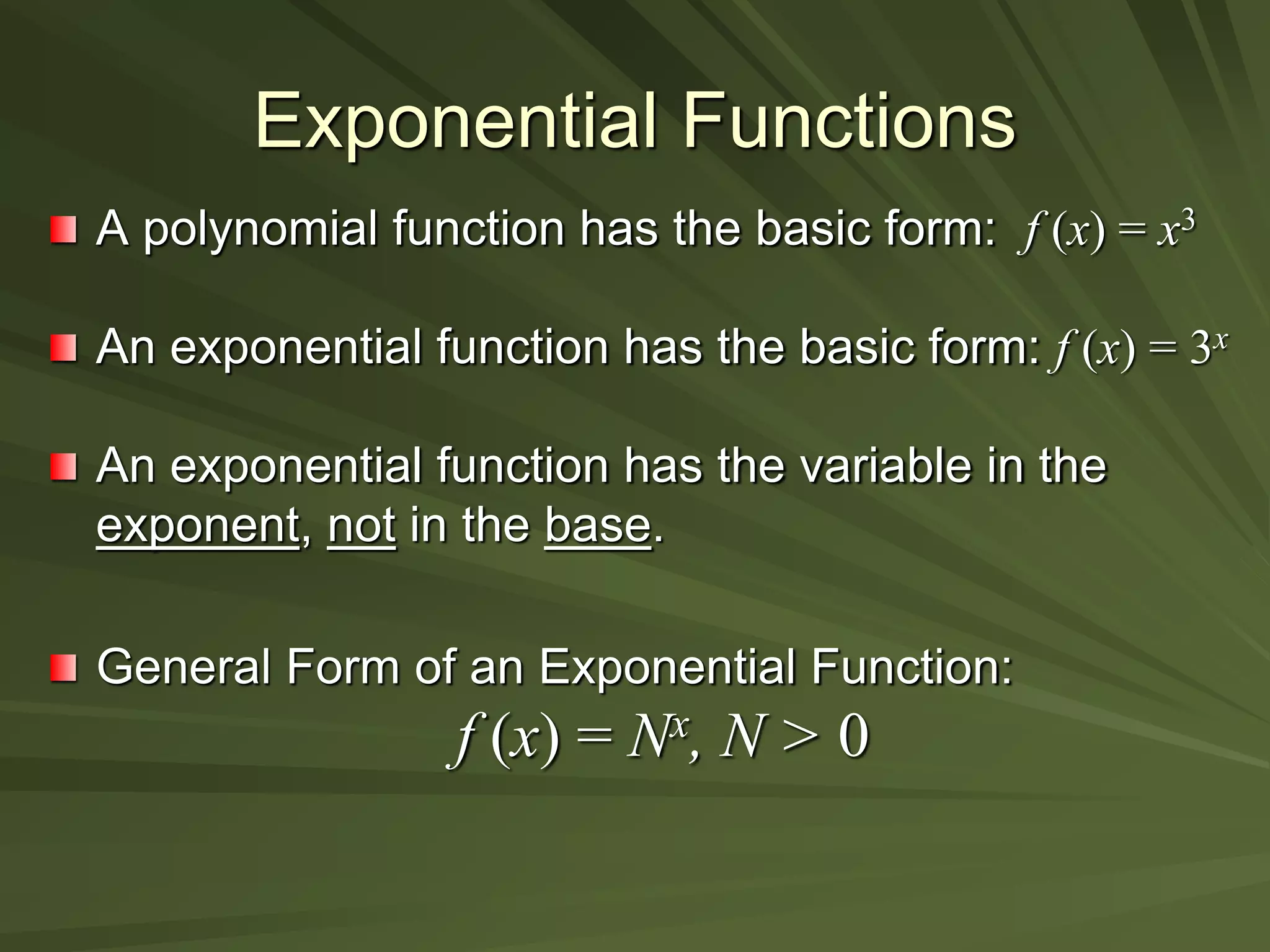
A polynomial function has the basic form: f (x) = x3
An exponential function has the basic form: f (x) = 3x
An exponential function has the variable in the
exponent, not in the base.
General Form of an Exponential Function:
f (x) = Nx, N > 0
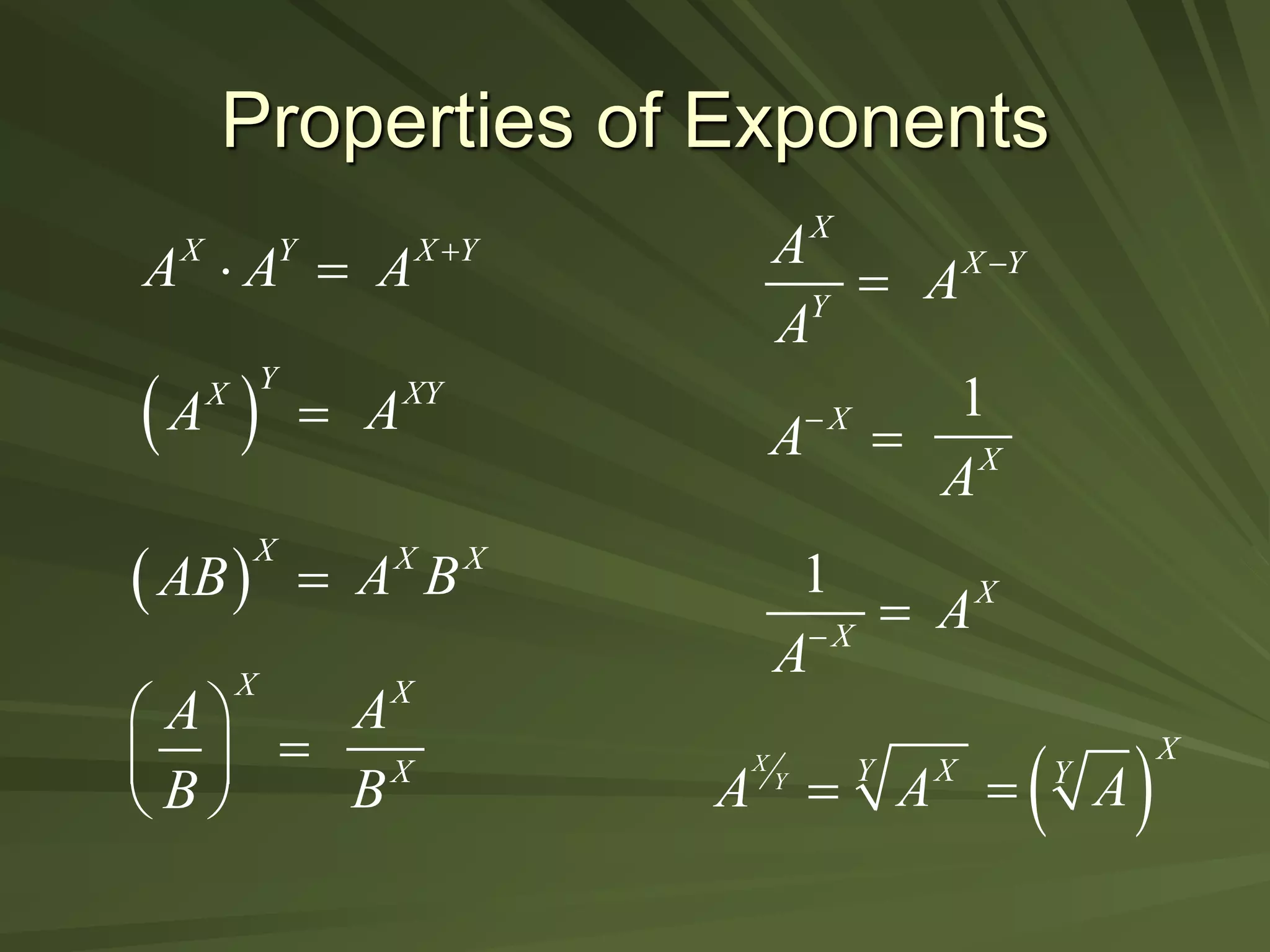
Properties of Exponents
X Y
A A
  X Y
A 
XY
A
X Y
A 
 
Y
X
A 
X
Y
A
A

 
X
AB  X X
A B
X
A
B
 

 
 
X
X
A
B
X
A

1
X
A
1
X
A
 X
A
X
Y
A  Y X
A  
X
Y
A

Properties of Exponents
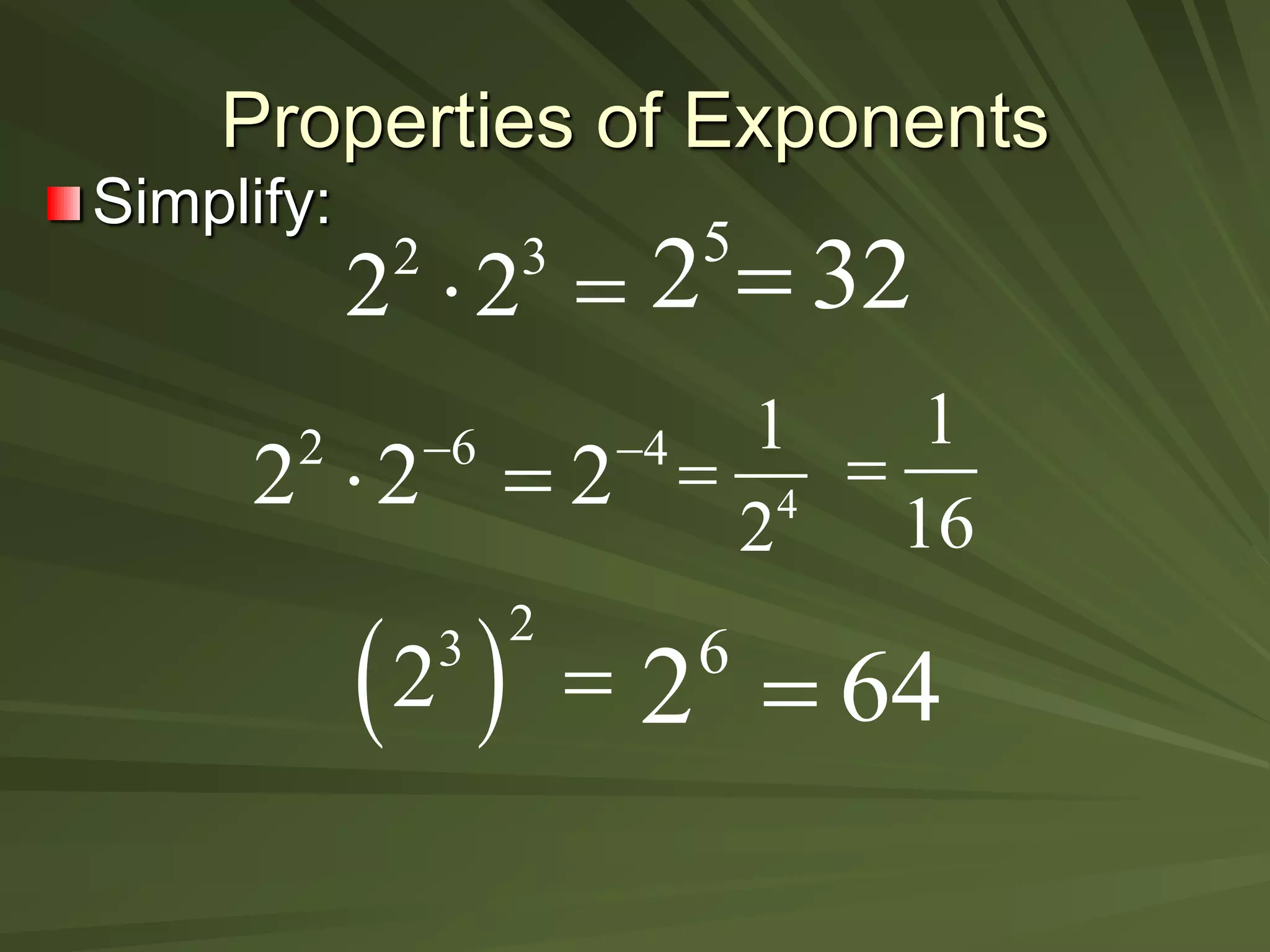
2 3
2 2
 
5
2 32

2 6
2 2
  4
2
4
1
2

1
16

 
2
3
2  6
2 64

Simplify:
Properties of Exponents
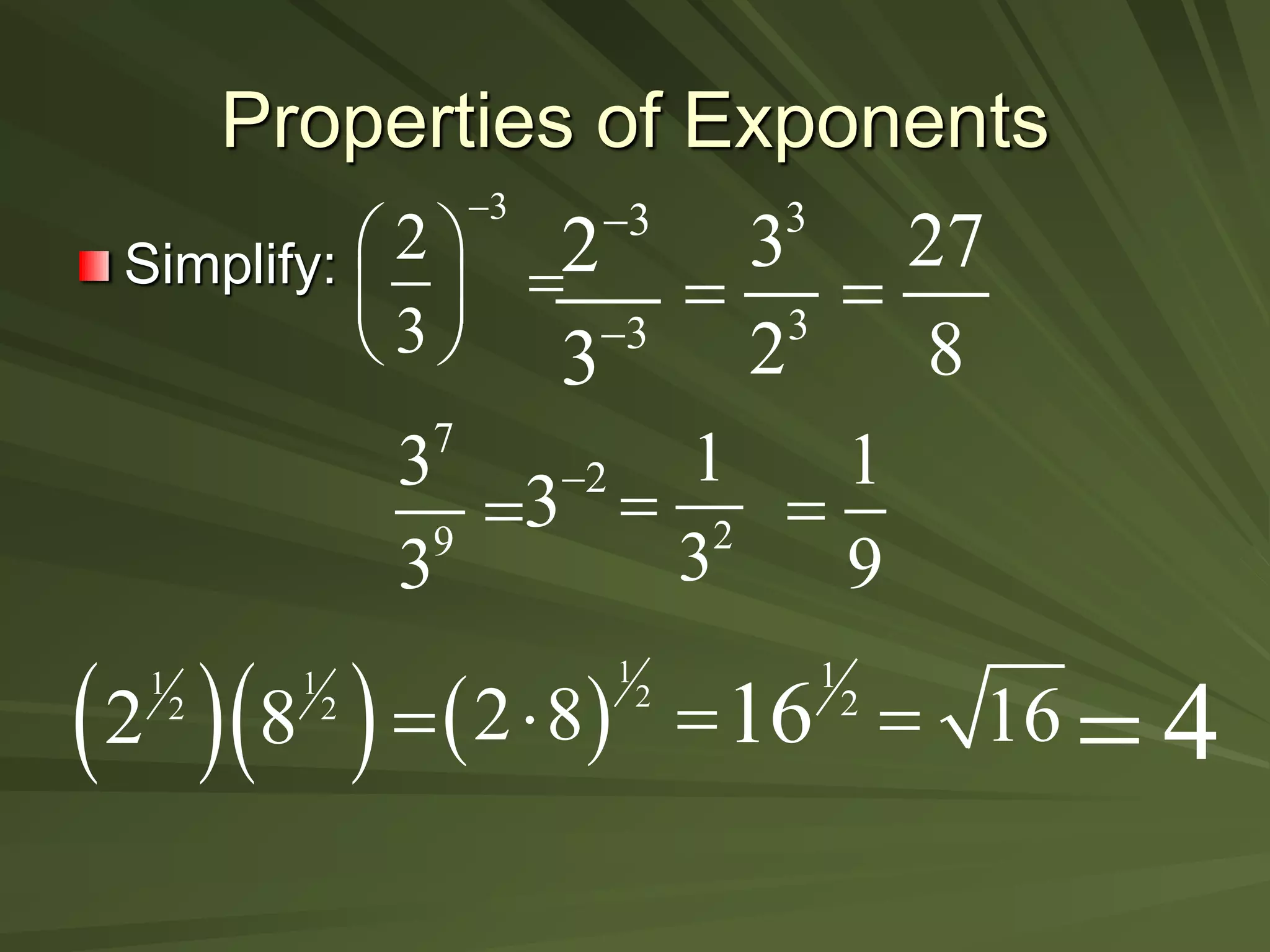
3
2
3

 

 
 
3
3
2
3


3
3
3
2

7
9
3
3

2
3
2
1
3

1
9

  
1 1
2 2
2 8 
1
2
16 16

27
8

4

 
1
2
2 8
 
Simplify:
Exponential Equations
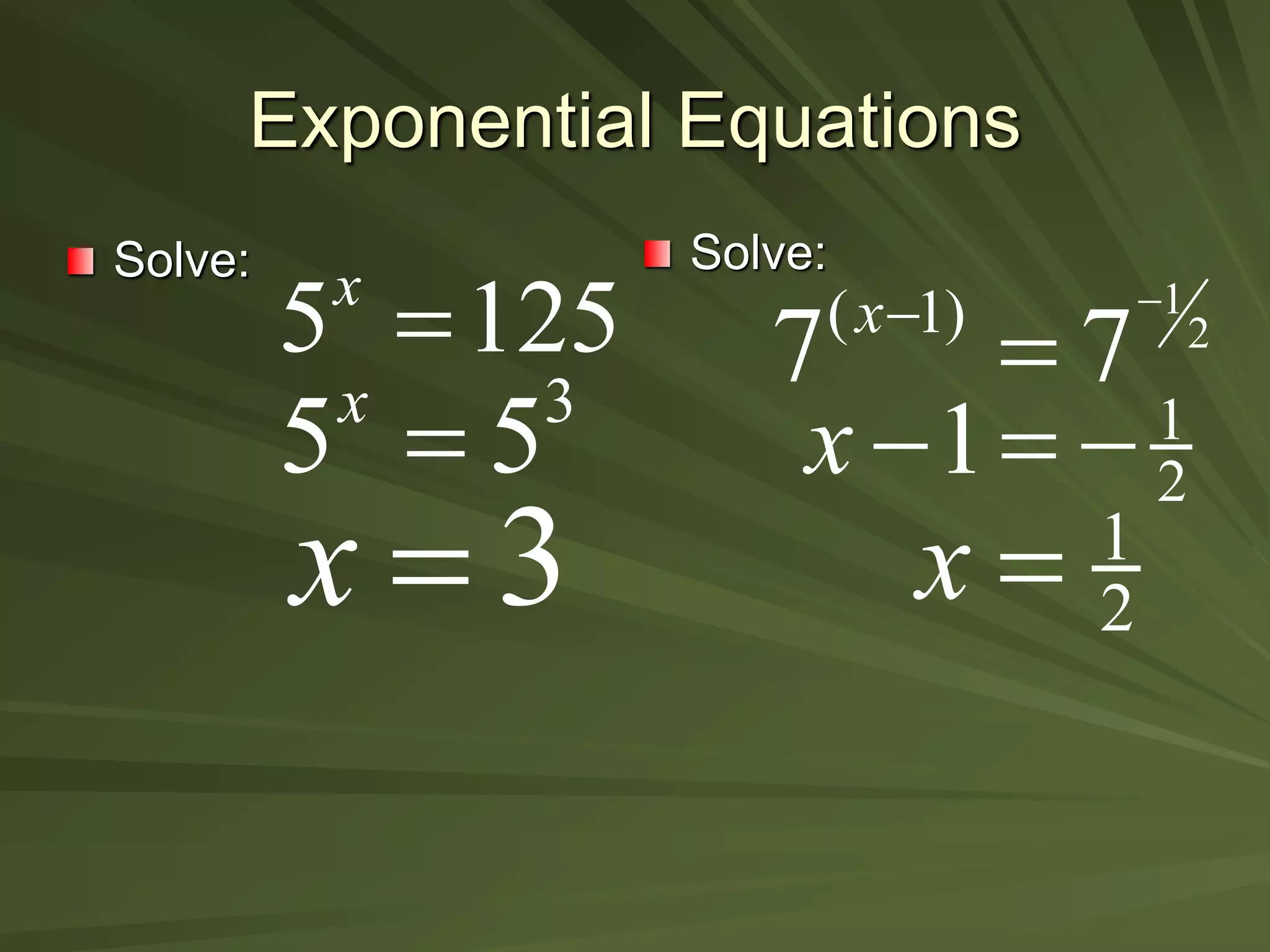
Solve: Solve:
5 125
x

3
5 5
x

3
x 
1
2
( 1)
7 7
x 


1
2
1
x   
1
2
x 
Exponential Equations
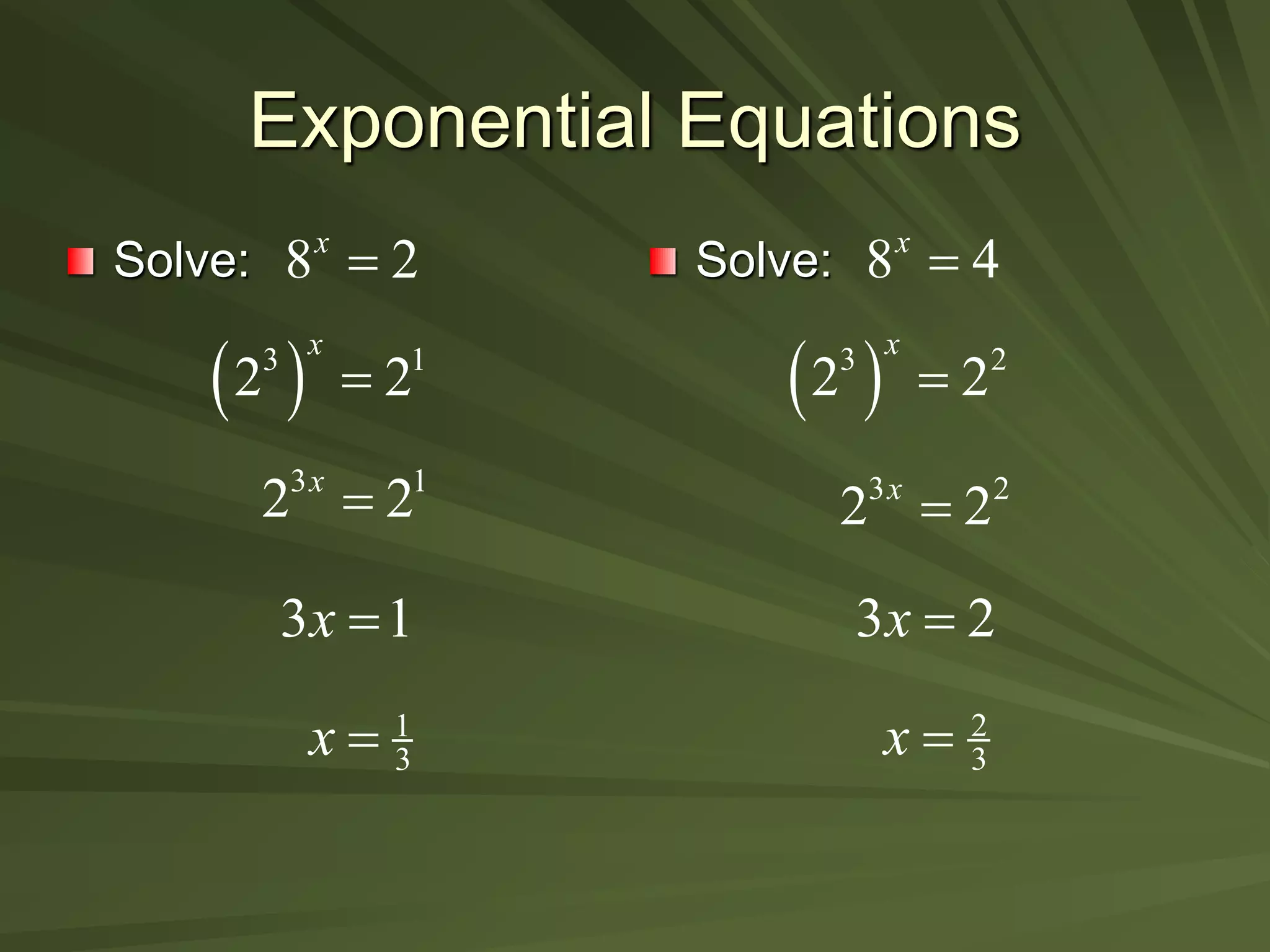
8 4
x

 
3 2
2 2
x

3 2
x 
2
3
x 
3 2
2 2
x

8 2
x

 
3 1
2 2
x

3 1
x 
1
3
x 
3 1
2 2
x

Solve: Solve:
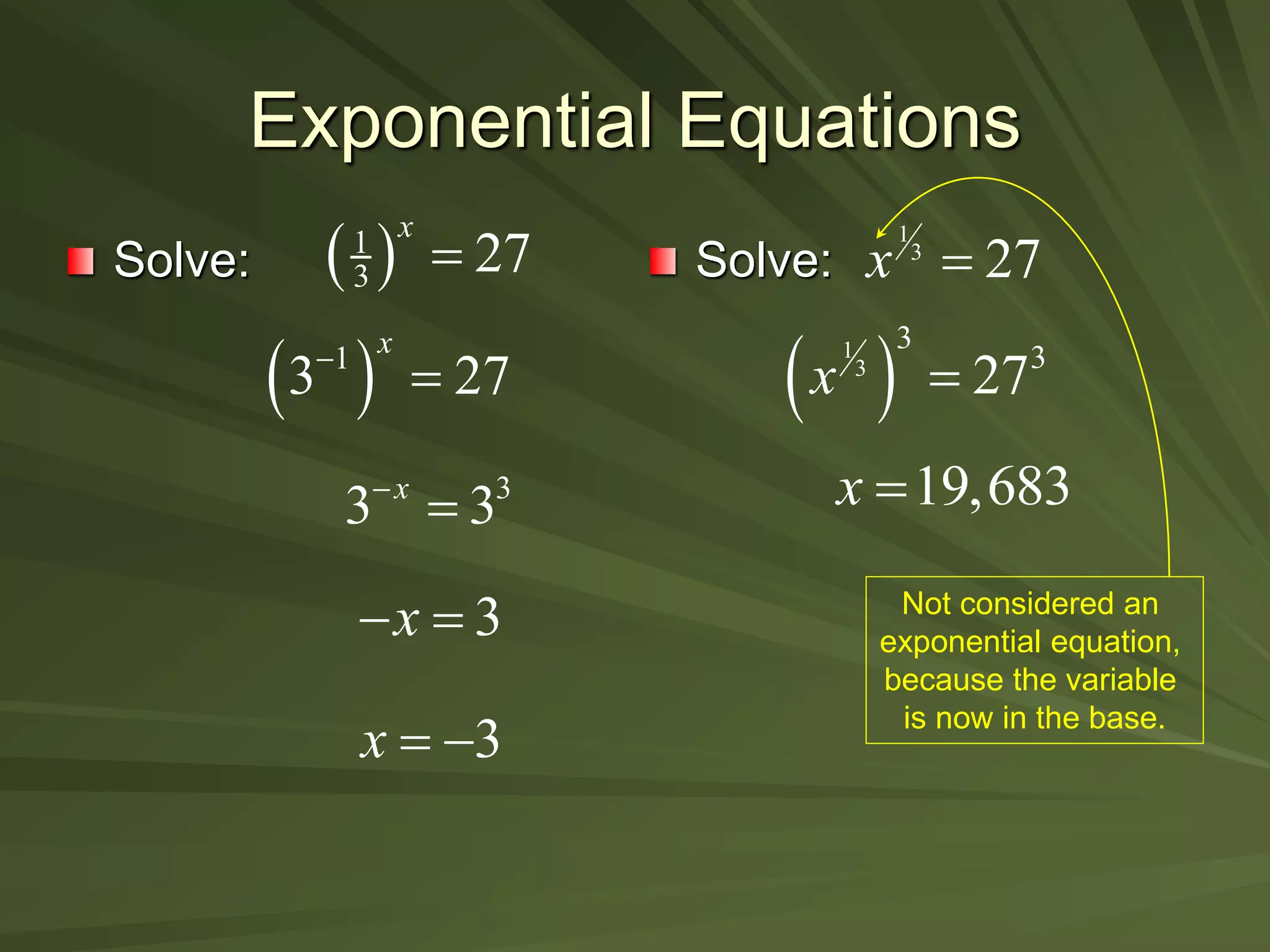
Exponential Equations
1
3
27
x 
 
1
3
3
3
27
x 
19,683
x 
 
1
3 27
x

 
1
3 27
x


3
x
 
3
x  
3
3 3
x


Not considered an
exponential equation,
because the variable
is now in the base.
Solve: Solve:
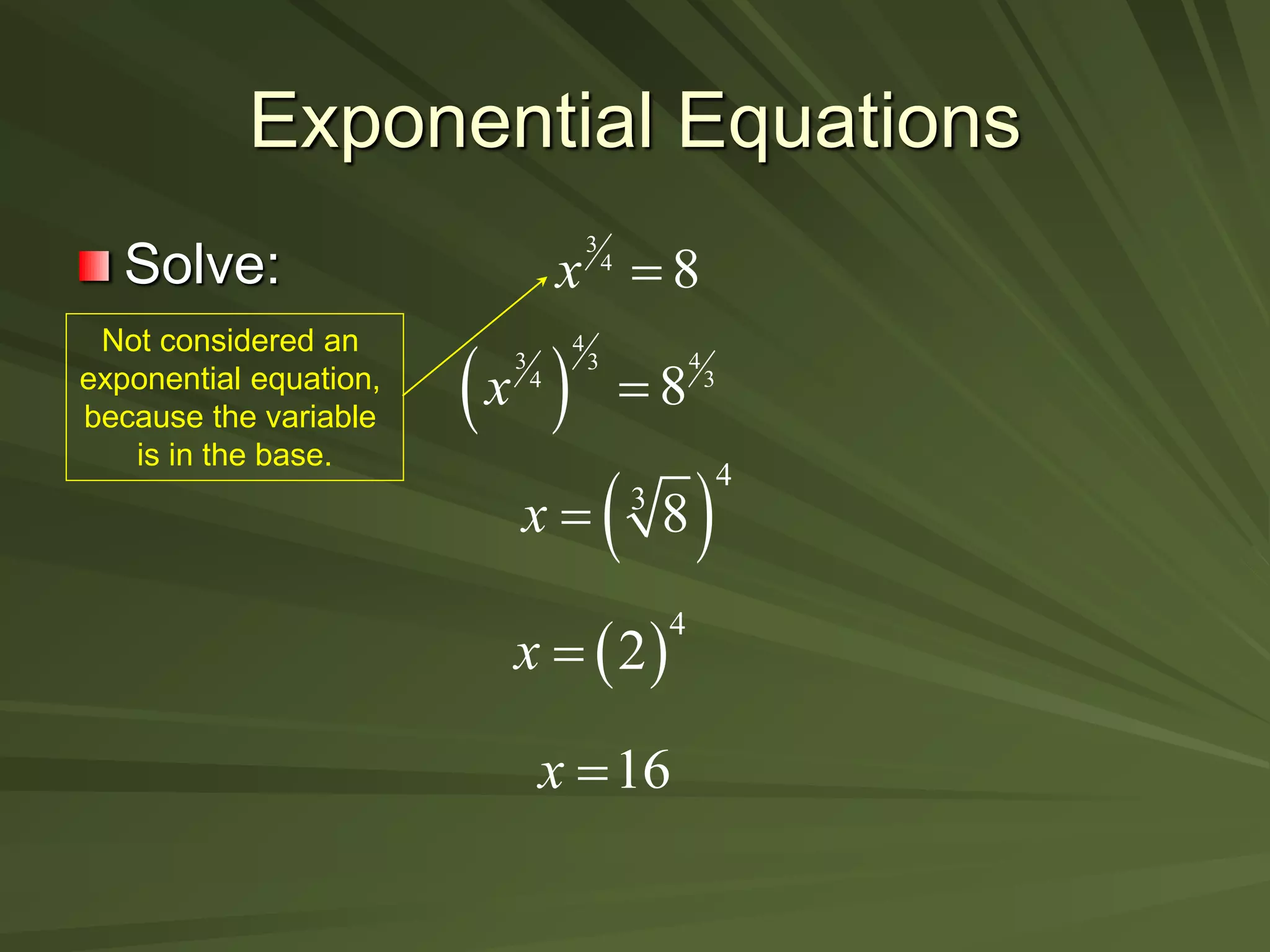
Exponential Equations
3
4
8
x 
 
4
3 4
3
3
4
8
x 
 
4
3
8
x 
 
4
2
x 
16
x 
Not considered an
exponential equation,
because the variable
is in the base.
Solve:
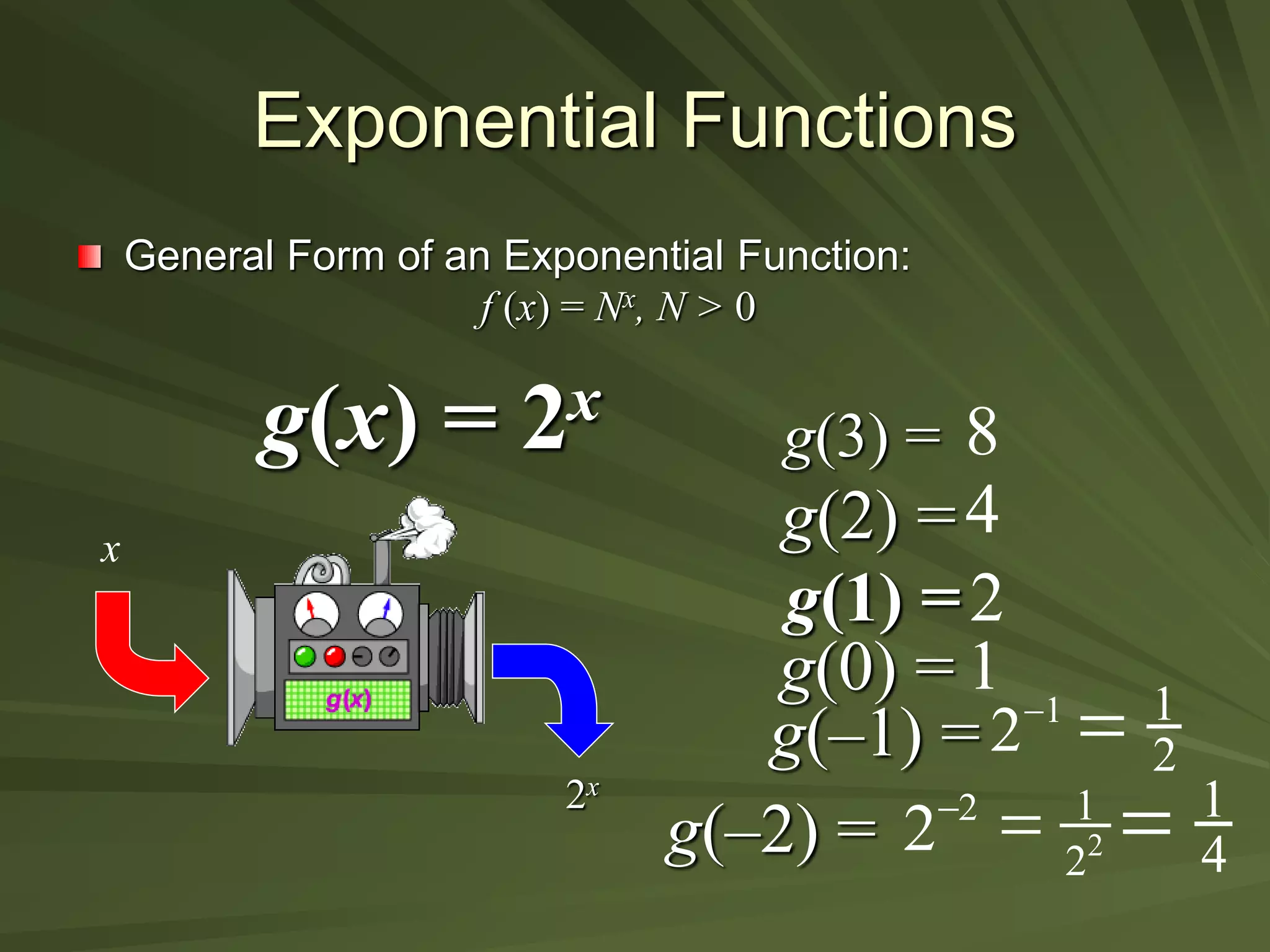
Exponential Functions
General Form of an Exponential Function:
f (x) = Nx, N > 0
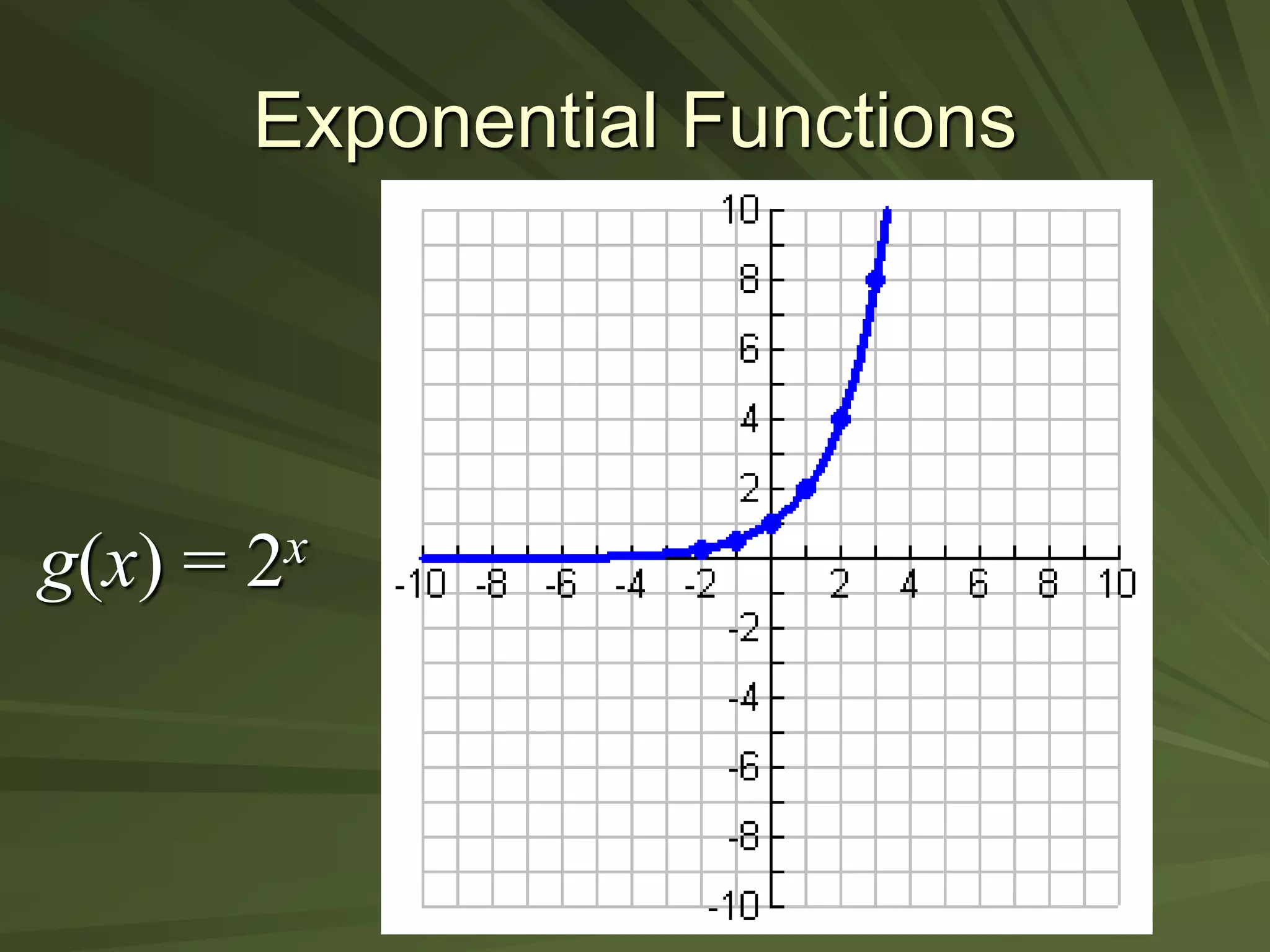
g(x) = 2x
x
2x
g(3) =
g(2) =
g(1) =
g(0) =
g(–1) =
g(–2) =
8
4
2
1 1
2 1
2

2
2
2
1
2
 1
4

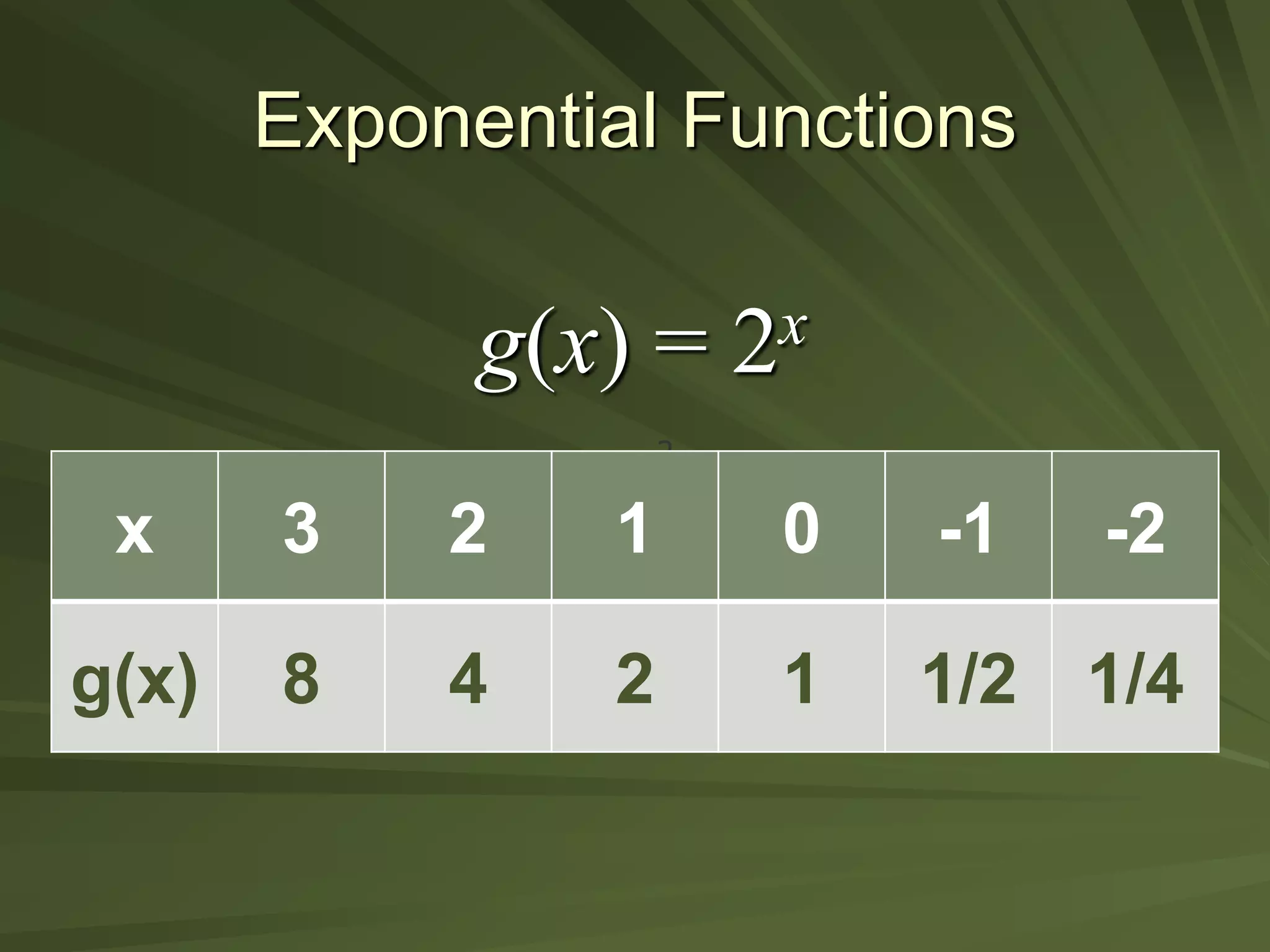
Exponential Functions
g(x) = 2x
2
0
x 3 2 1 0 -1 -2
g(x) 8 4 2 1 1/2 1/4
Exponential Functions
g(x) = 2x
Exponential Functions
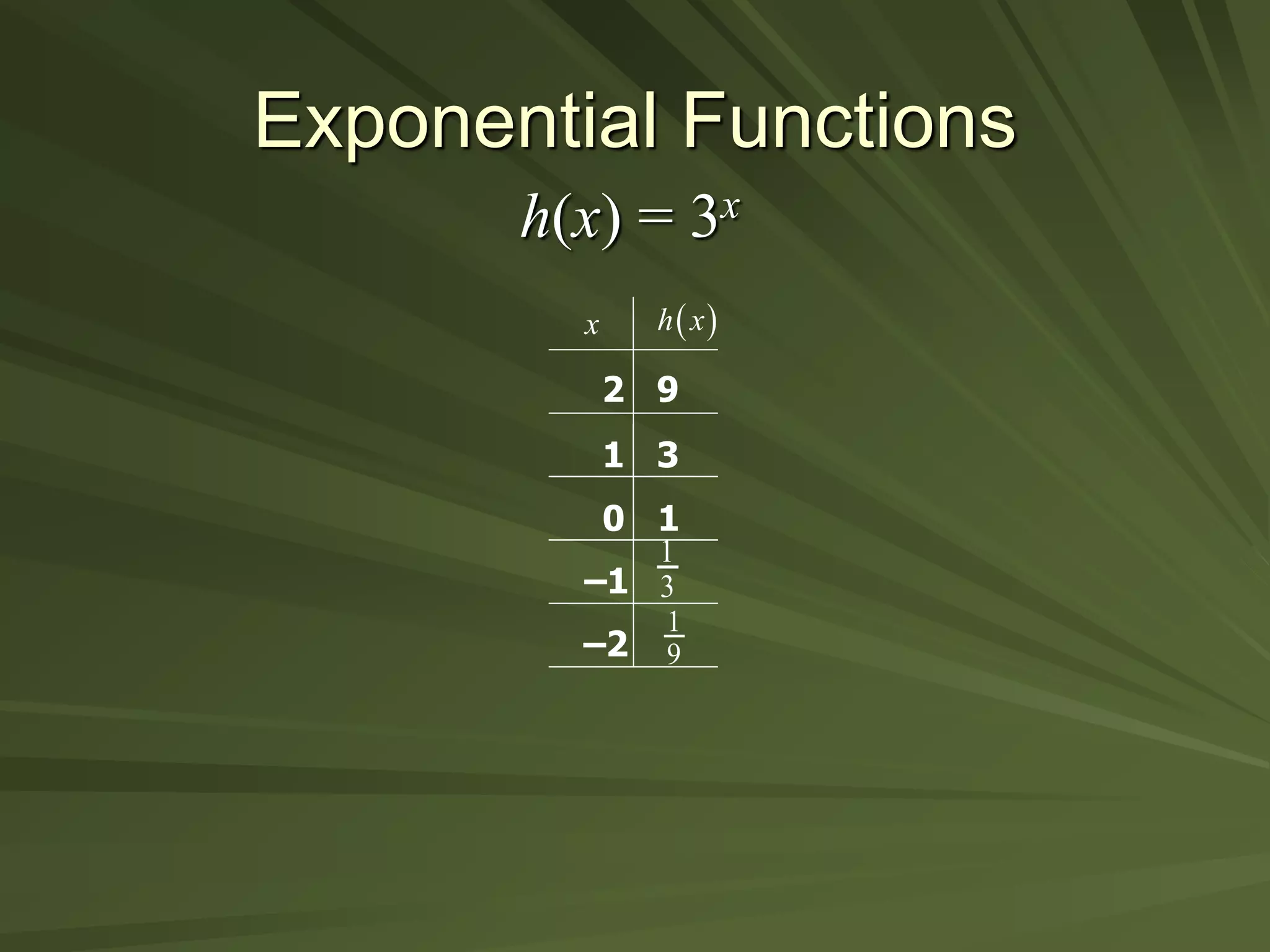
h(x) = 3x
x
2
1
0
9
3
1
 
h x
–1
–2
1
3
1
9
Exponential Functions
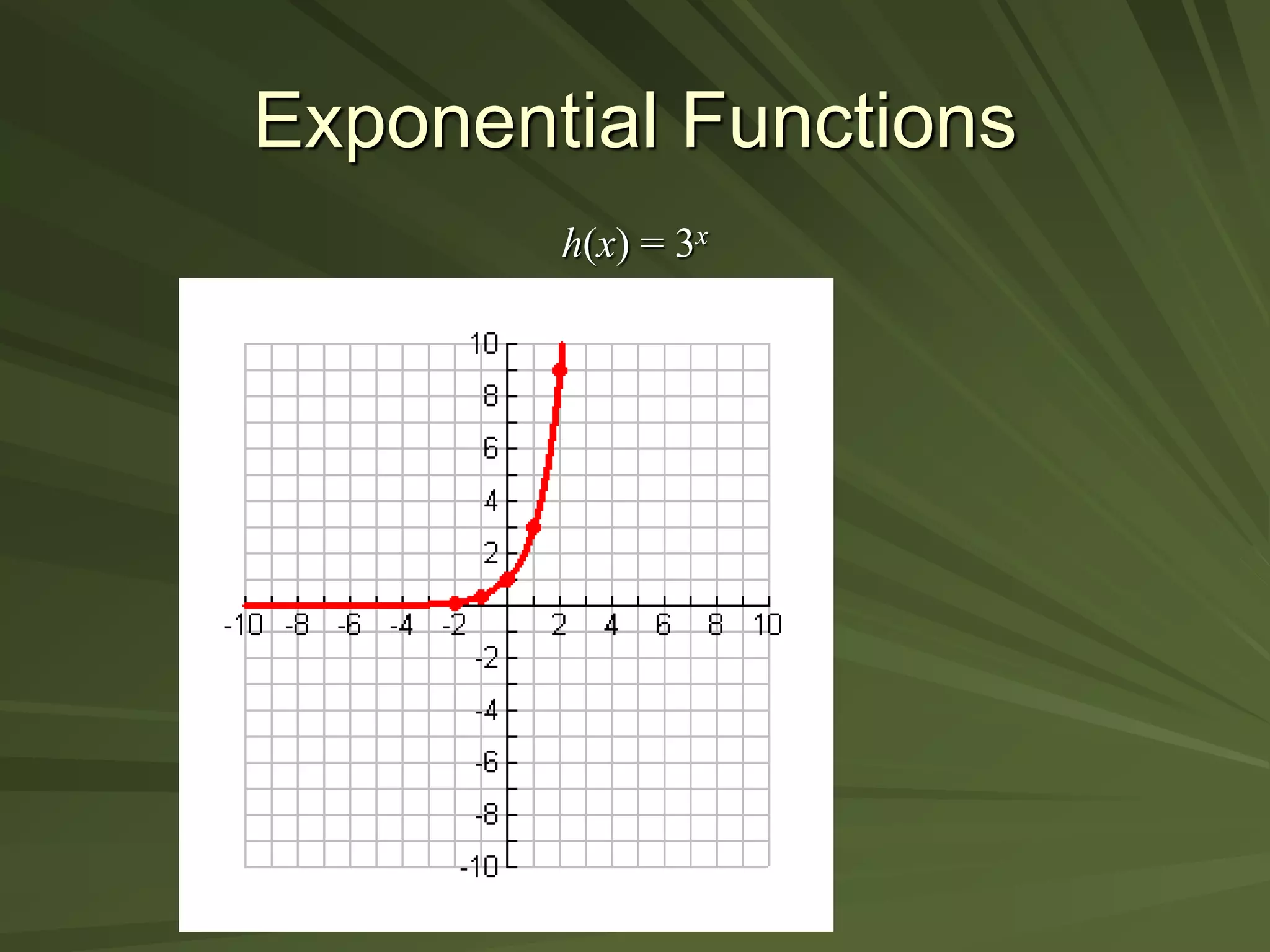
h(x) = 3x
Exponential Functions
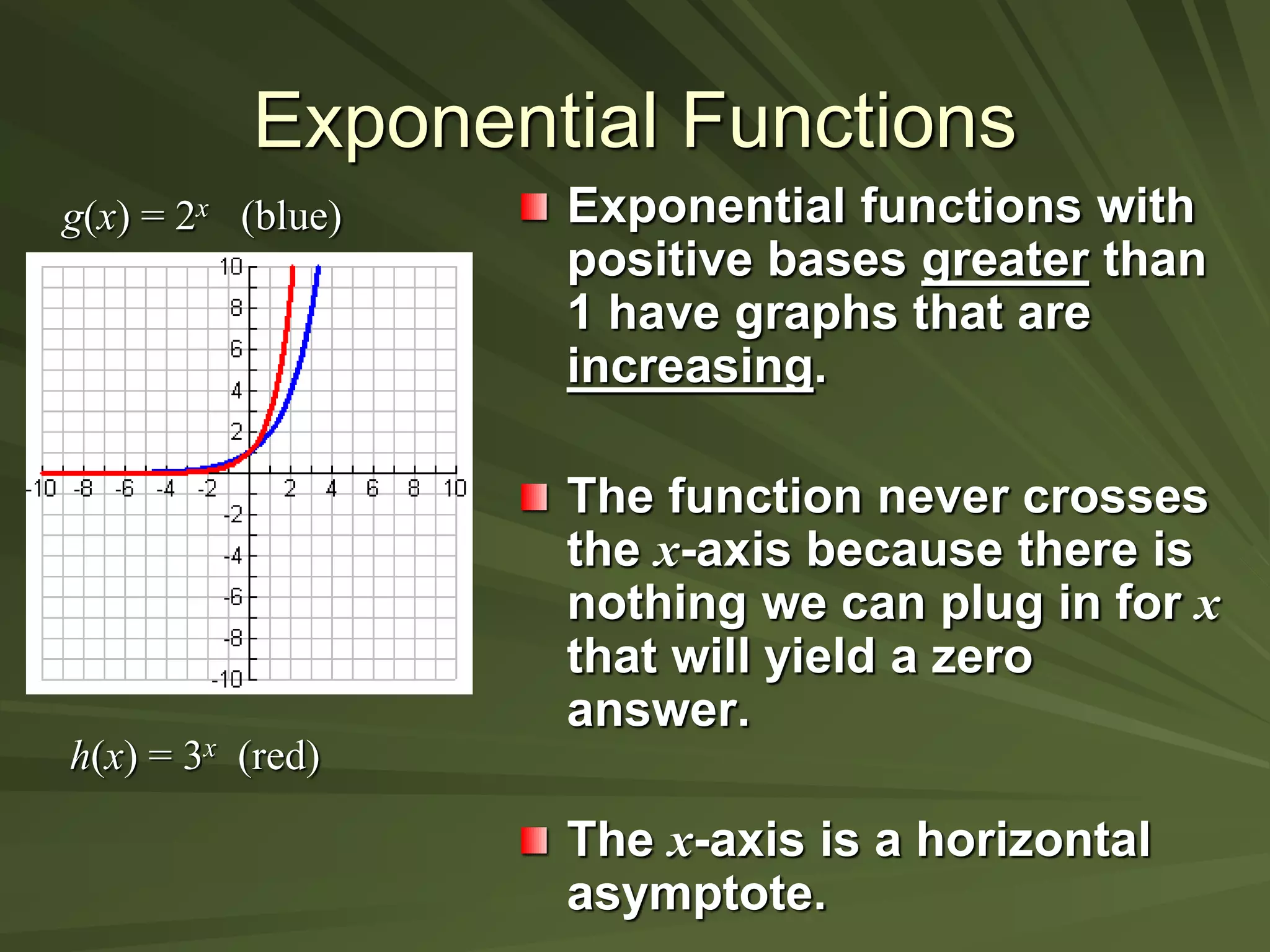
Exponential functions with
positive bases greater than
1 have graphs that are
increasing.
The function never crosses
the x-axis because there is
nothing we can plug in for x
that will yield a zero
answer.
The x-axis is a horizontal
asymptote.
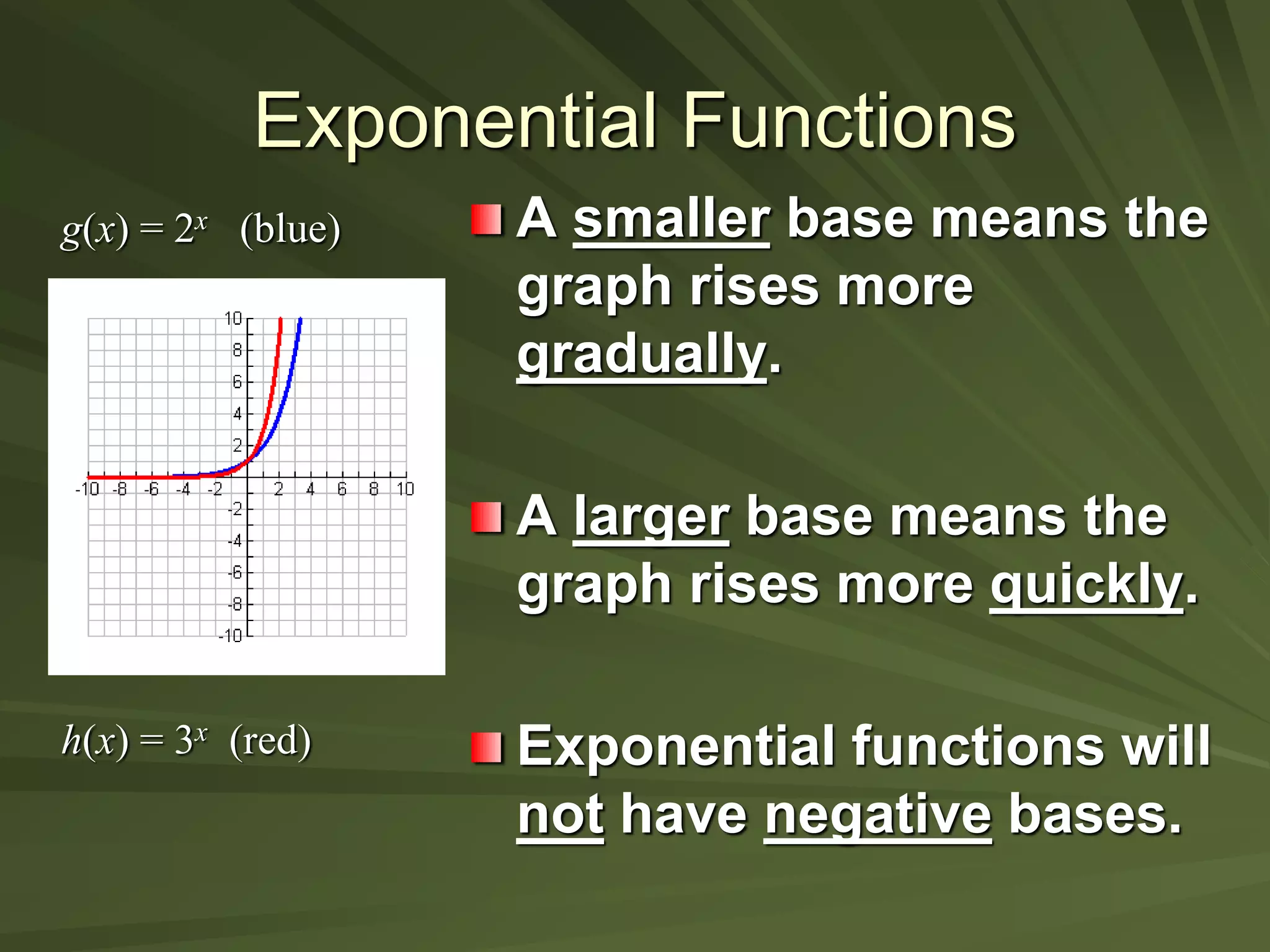
h(x) = 3x (red)
g(x) = 2x (blue)
Exponential Functions
A smaller base means the
graph rises more
gradually.
A larger base means the
graph rises more quickly.
Exponential functions will
not have negative bases.
h(x) = 3x (red)
g(x) = 2x (blue)
Exponential Functions
   
1
2
x
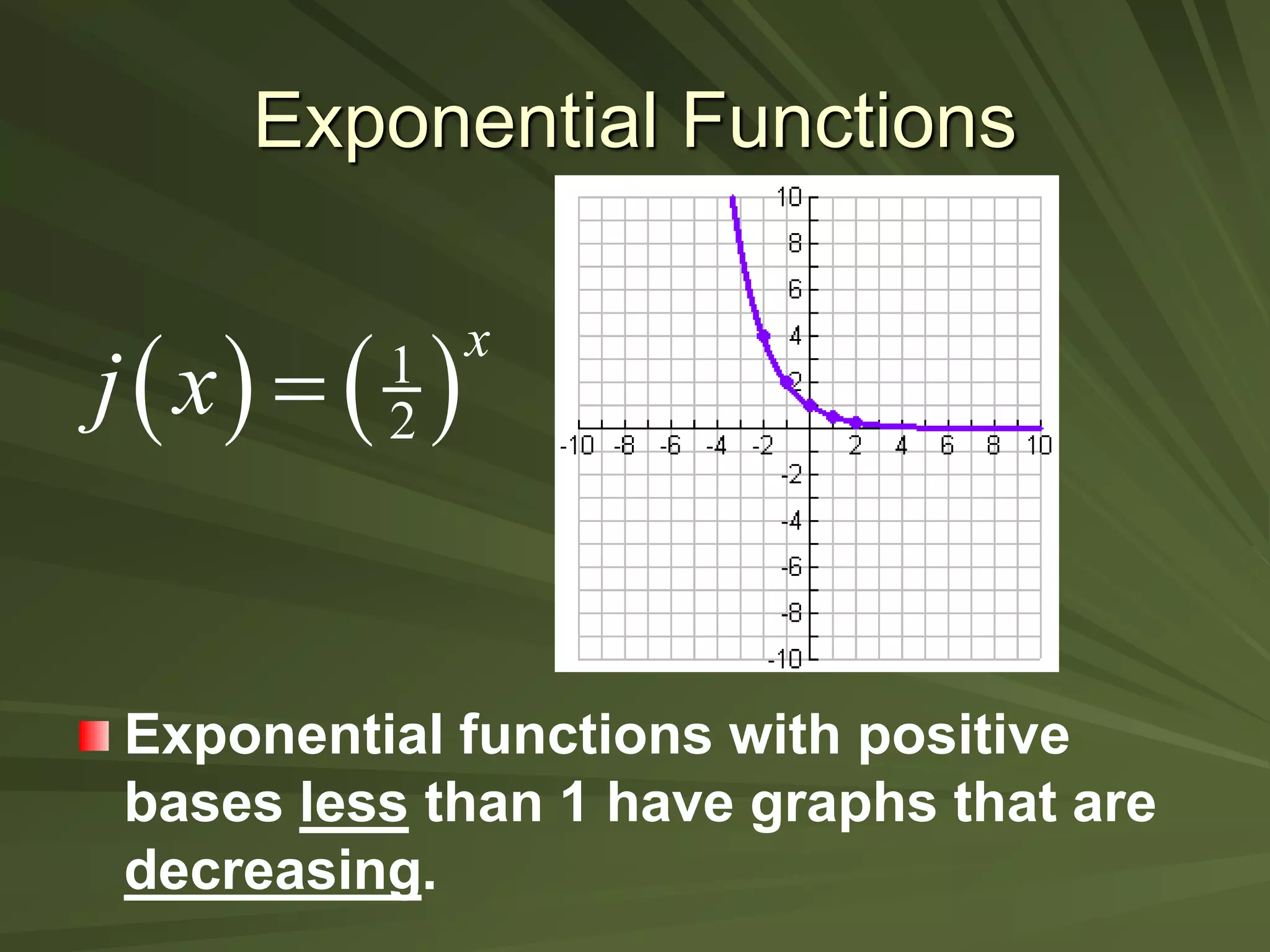
j x 
Exponential functions with positive
bases less than 1 have graphs that are
decreasing.
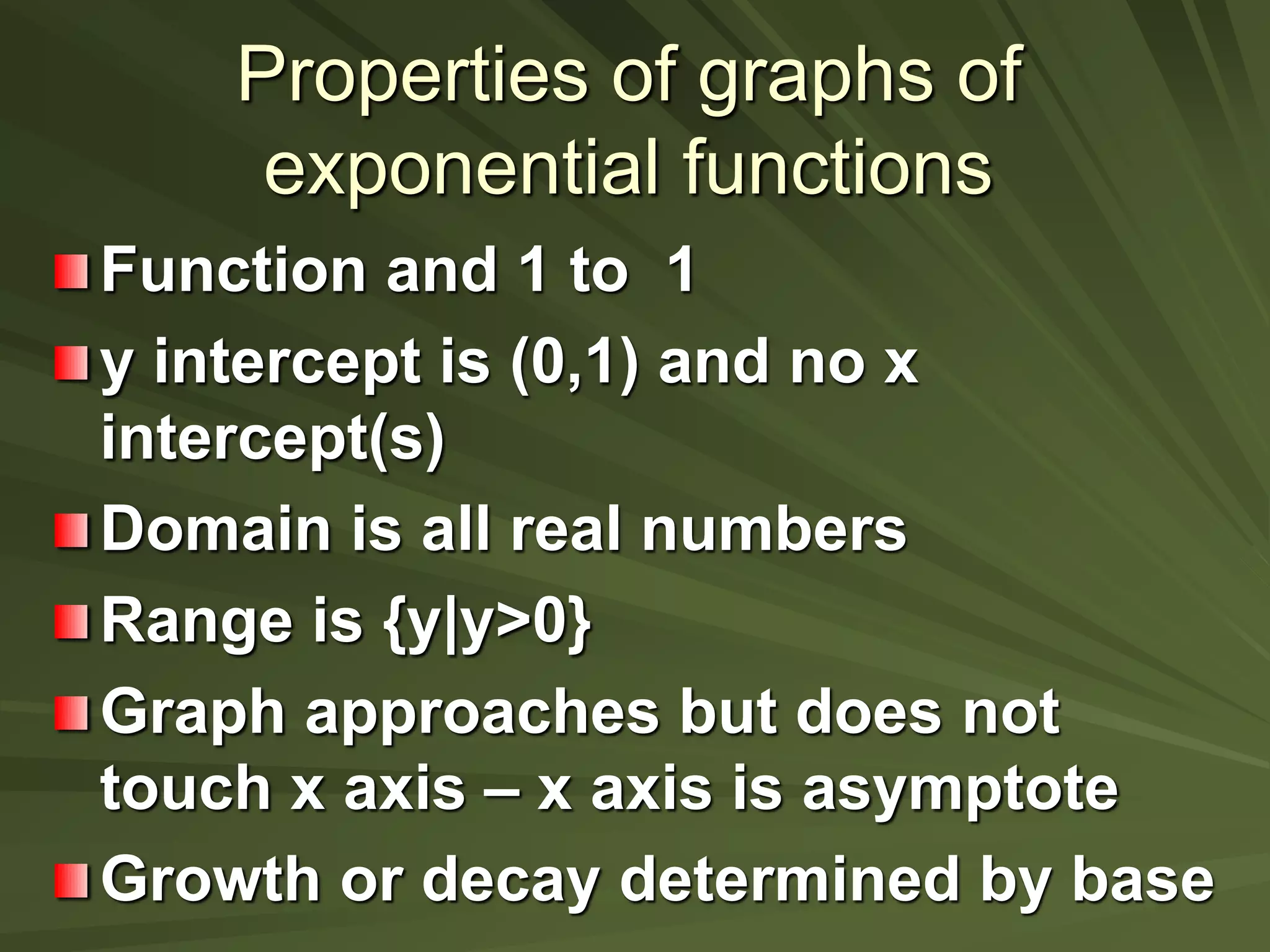
Properties of graphs of
exponential functions
Function and 1 to 1
y intercept is (0,1) and no x
intercept(s)
Domain is all real numbers
Range is {y|y>0}
Graph approaches but does not
touch x axis – x axis is asymptote
Growth or decay determined by base
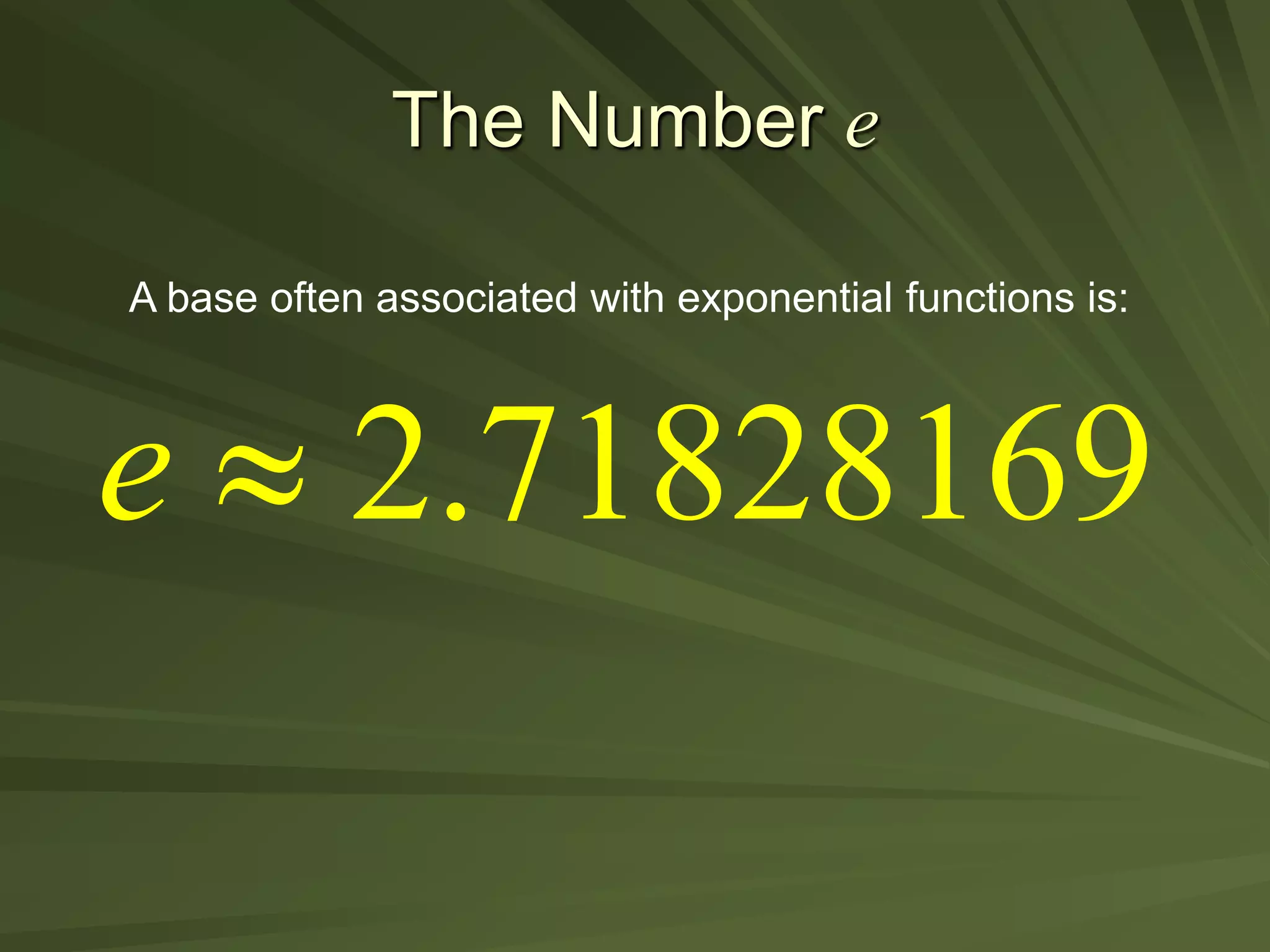
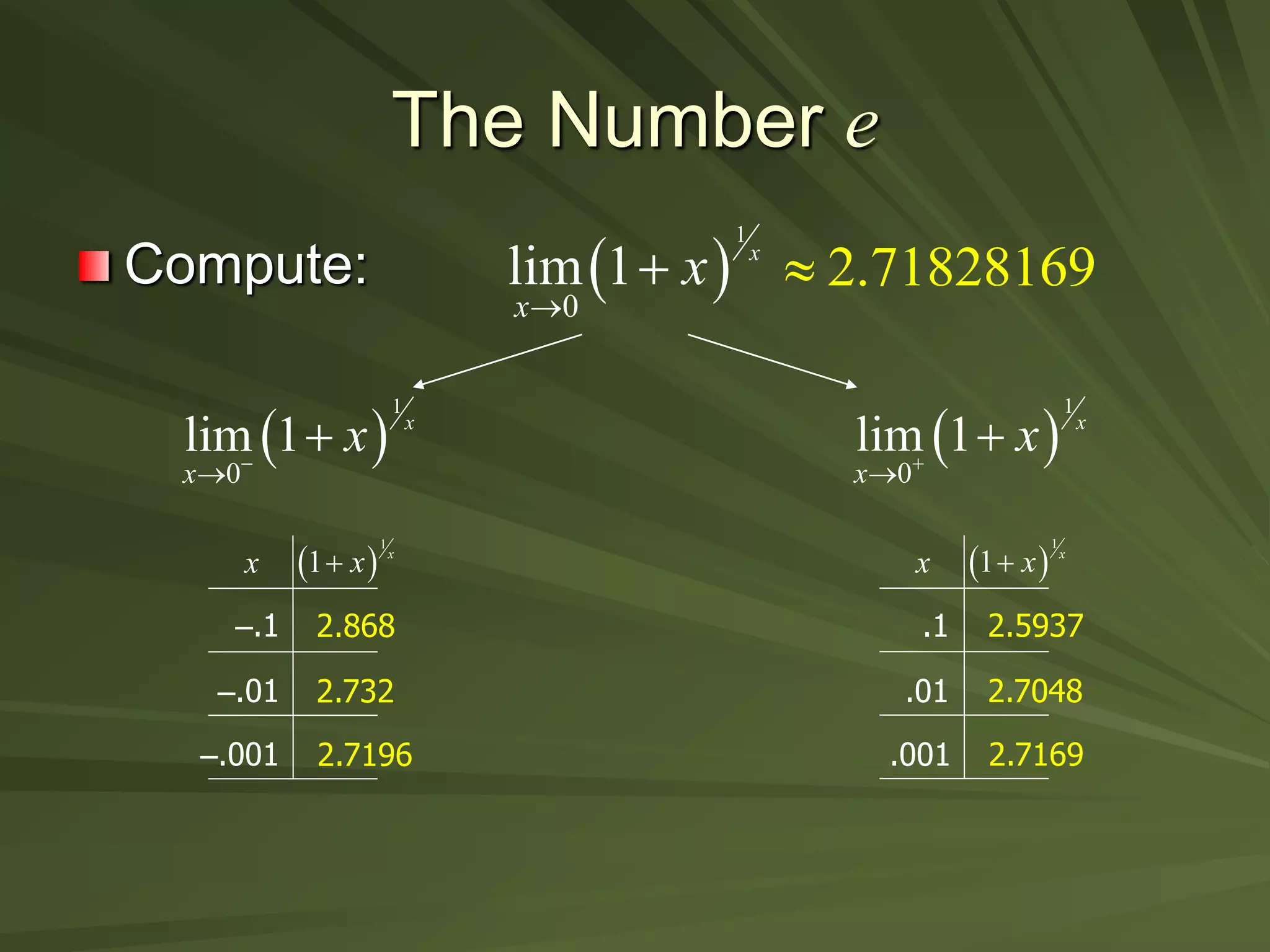
The Number e
e  2.71828169
A base often associated with exponential functions is:
The Number e
Compute:  
1
0
lim 1 x
x
x


x
–.1
–.01
–.001
2.868
2.732
2.7196
 
1
1 x
x

 
1
0
lim 1 x
x
x



x
.1
.01
.001
2.5937
2.7048
2.7169
 
1
1 x
x

 
1
0
lim 1 x
x
x



2.71828169

The Number e
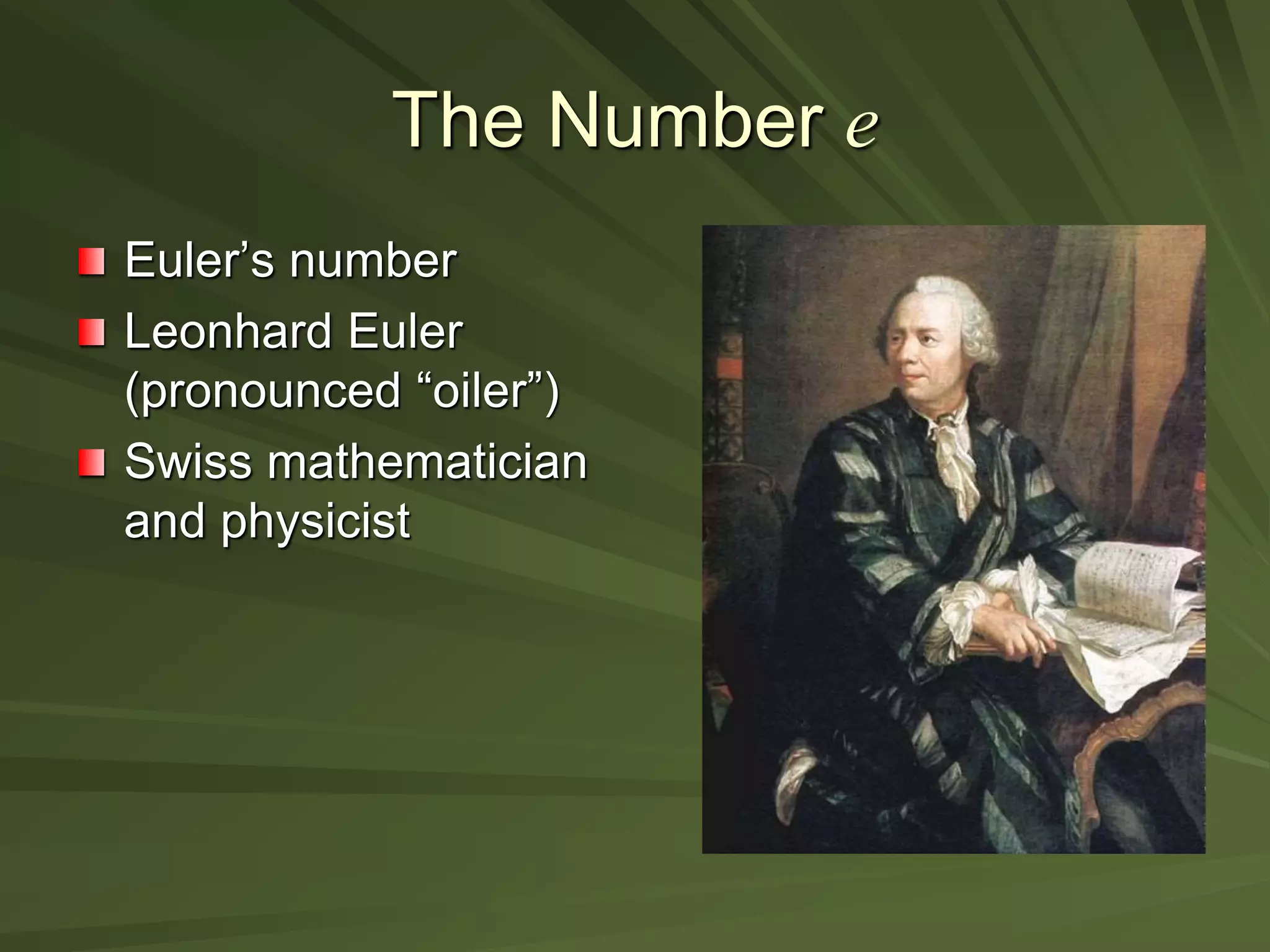
Euler’s number
Leonhard Euler
(pronounced “oiler”)
Swiss mathematician
and physicist
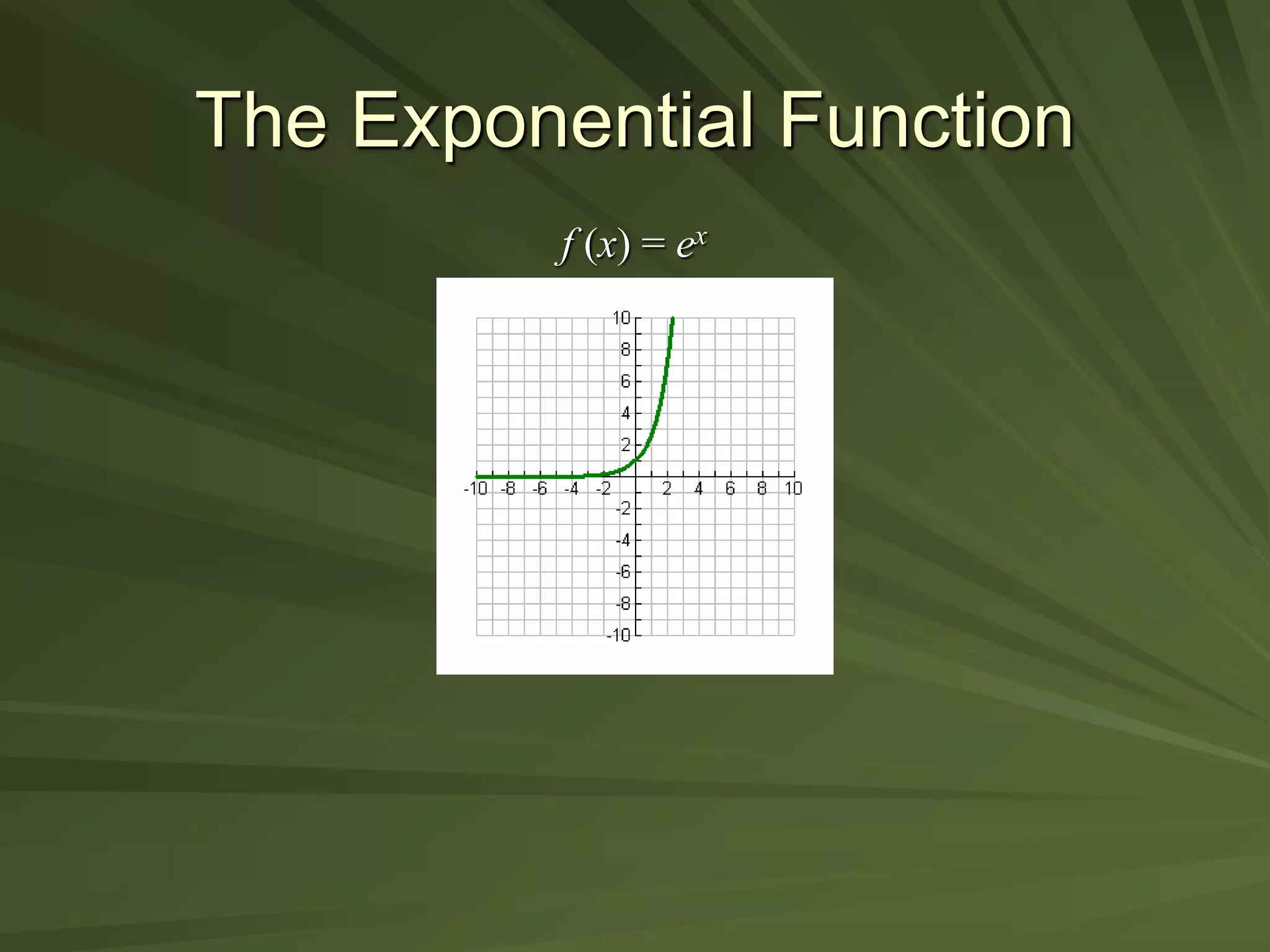
The Exponential Function
f (x) = ex
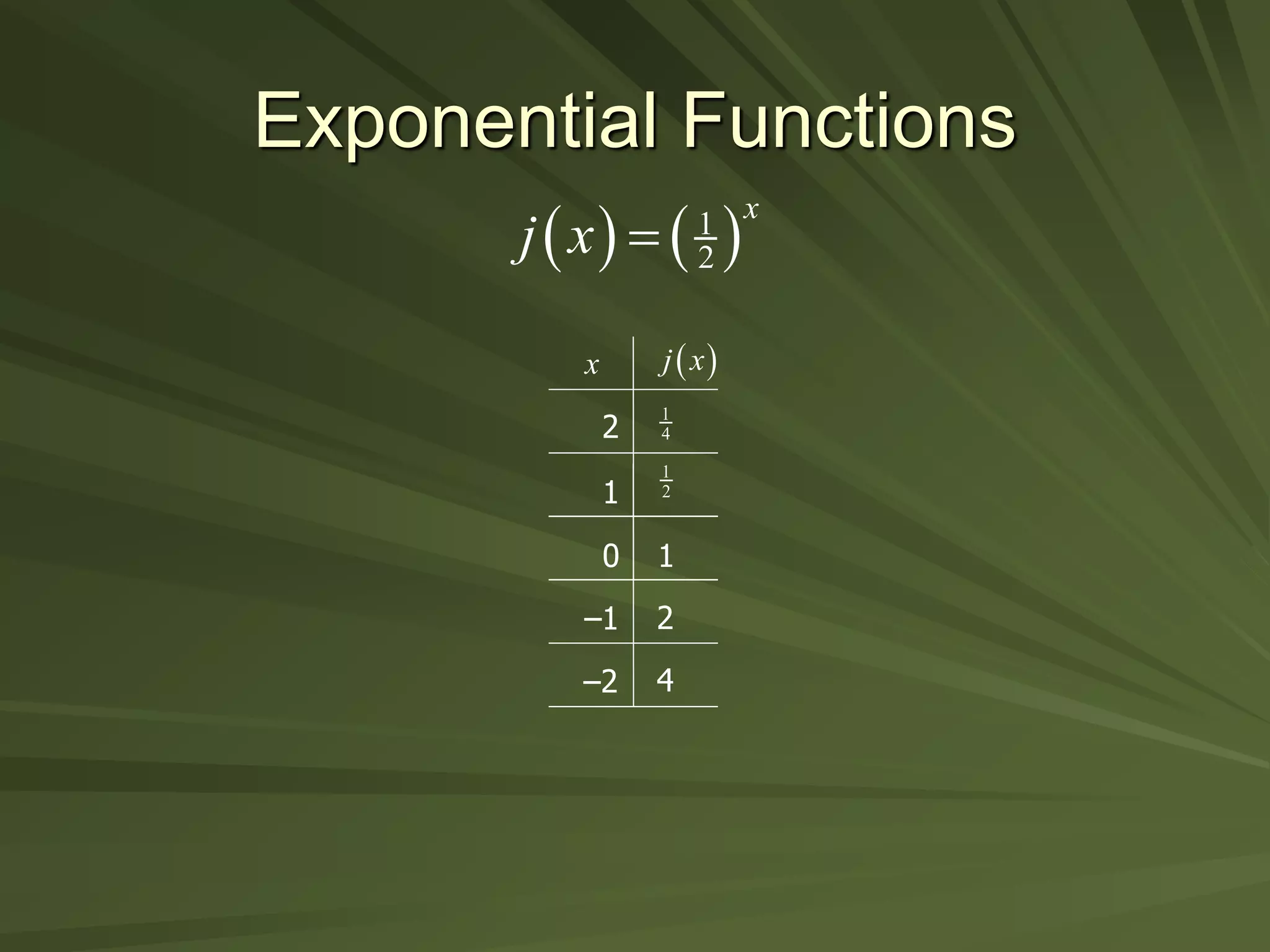
Exponential Functions
x
2
1
0
4
2
1
 
j x
–1
–2
1
2
1
4
   
1
2
x
j x 
Why study exponential functions?
Exponential functions are used in our real world
to measure growth, interest, and decay.
Growth obeys exponential functions.
Ex: rumors, human population, bacteria,
computer technology, nuclear chain reactions,
compound interest
Decay obeys exponential functions.
Ex: Carbon-14 dating, half-life, Newton’s Law of
Cooling

Exponential_Functions.ppt

  • 1.
  • 2.
    Objectives To use theproperties of exponents to:  Simplify exponential expressions.  Solve exponential equations. To sketch graphs of exponential functions.
  • 3.
    Exponential Functions A polynomialfunction has the basic form: f (x) = x3 An exponential function has the basic form: f (x) = 3x An exponential function has the variable in the exponent, not in the base. General Form of an Exponential Function: f (x) = Nx, N > 0
  • 4.
    Properties of Exponents XY A A   X Y A  XY A X Y A    Y X A  X Y A A    X AB  X X A B X A B        X X A B X A  1 X A 1 X A  X A X Y A  Y X A   X Y A 
  • 5.
    Properties of Exponents 23 2 2   5 2 32  2 6 2 2   4 2 4 1 2  1 16    2 3 2  6 2 64  Simplify:
  • 6.
    Properties of Exponents 3 2 3        3 3 2 3   3 3 3 2  7 9 3 3  2 3 2 1 3  1 9     1 1 2 2 2 8  1 2 16 16  27 8  4    1 2 2 8   Simplify:
  • 7.
    Exponential Equations Solve: Solve: 5125 x  3 5 5 x  3 x  1 2 ( 1) 7 7 x    1 2 1 x    1 2 x 
  • 8.
    Exponential Equations 8 4 x   3 2 2 2 x  3 2 x  2 3 x  3 2 2 2 x  8 2 x    3 1 2 2 x  3 1 x  1 3 x  3 1 2 2 x  Solve: Solve:
  • 9.
    Exponential Equations 1 3 27 x   1 3 3 3 27 x  19,683 x    1 3 27 x    1 3 27 x   3 x   3 x   3 3 3 x   Not considered an exponential equation, because the variable is now in the base. Solve: Solve:
  • 10.
    Exponential Equations 3 4 8 x   4 3 4 3 3 4 8 x    4 3 8 x    4 2 x  16 x  Not considered an exponential equation, because the variable is in the base. Solve:
  • 11.
    Exponential Functions General Formof an Exponential Function: f (x) = Nx, N > 0 g(x) = 2x x 2x g(3) = g(2) = g(1) = g(0) = g(–1) = g(–2) = 8 4 2 1 1 2 1 2  2 2 2 1 2  1 4 
  • 12.
    Exponential Functions g(x) =2x 2 0 x 3 2 1 0 -1 -2 g(x) 8 4 2 1 1/2 1/4
  • 13.
  • 14.
    Exponential Functions h(x) =3x x 2 1 0 9 3 1   h x –1 –2 1 3 1 9
  • 15.
  • 16.
    Exponential Functions Exponential functionswith positive bases greater than 1 have graphs that are increasing. The function never crosses the x-axis because there is nothing we can plug in for x that will yield a zero answer. The x-axis is a horizontal asymptote. h(x) = 3x (red) g(x) = 2x (blue)
  • 17.
    Exponential Functions A smallerbase means the graph rises more gradually. A larger base means the graph rises more quickly. Exponential functions will not have negative bases. h(x) = 3x (red) g(x) = 2x (blue)
  • 18.
    Exponential Functions    1 2 x j x  Exponential functions with positive bases less than 1 have graphs that are decreasing.
  • 19.
    Properties of graphsof exponential functions Function and 1 to 1 y intercept is (0,1) and no x intercept(s) Domain is all real numbers Range is {y|y>0} Graph approaches but does not touch x axis – x axis is asymptote Growth or decay determined by base
  • 20.
    The Number e e 2.71828169 A base often associated with exponential functions is:
  • 21.
    The Number e Compute:  1 0 lim 1 x x x   x –.1 –.01 –.001 2.868 2.732 2.7196   1 1 x x    1 0 lim 1 x x x    x .1 .01 .001 2.5937 2.7048 2.7169   1 1 x x    1 0 lim 1 x x x    2.71828169 
  • 22.
    The Number e Euler’snumber Leonhard Euler (pronounced “oiler”) Swiss mathematician and physicist
  • 23.
  • 24.
    Exponential Functions x 2 1 0 4 2 1   jx –1 –2 1 2 1 4     1 2 x j x 
  • 25.
    Why study exponentialfunctions? Exponential functions are used in our real world to measure growth, interest, and decay. Growth obeys exponential functions. Ex: rumors, human population, bacteria, computer technology, nuclear chain reactions, compound interest Decay obeys exponential functions. Ex: Carbon-14 dating, half-life, Newton’s Law of Cooling