Exponential Functions
General Mathematics
O. Oronce
Lesson Objectives
At the end of the lesson, the students must be able
to:
• represent an exponential function through its: (a)
table of values, (b) graph, and (c) equation;
• find the domain and range of an exponential
function;
• find the intercept, zeros, and asymptote of an
exponential function; and
• graph exponential functions.
Zero as an Exponent
• If a ≠ 0, then a⁰ = 1
Illustration:
To evaluate 3⁰ 3², we have
∙
3⁰ 3² = 3⁰⁺² = 3² = 9 or
∙
3⁰ 3² = 1 3² = 1 9 = 9
∙ ∙ ∙
Negative Exponent
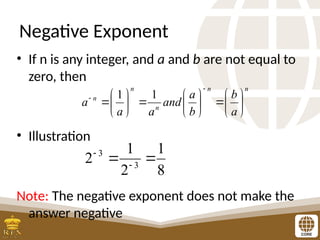
• If n is any integer, and a and b are not equal to
zero, then
• Illustration
Note: The negative exponent does not make the
answer negative
n
n
n
n
n
a
b
b
a
and
a
a
a 





















 1
1
8
1
2
1
2 3
3

 

Definition
Transformation – the process of moving a figure
from the starting position to some ending
position without changing its size and shape.
Reflection – a transformation that produces a
new figure, which is a mirror image of the
original figure.
Definition
Translation – a shift or movement in a figure’s
location without changing its shape.
Glide Reflection – a combination of a reflection
and a translation (glide).
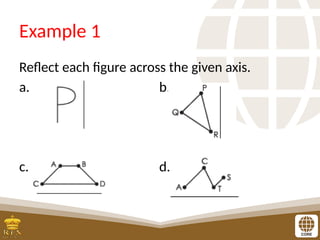
Example 1
Reflect each figure across the given axis.
a. b.
c. d.
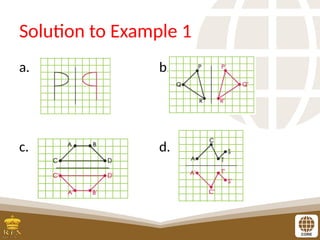
Solution to Example 1
a. b.
c. d.
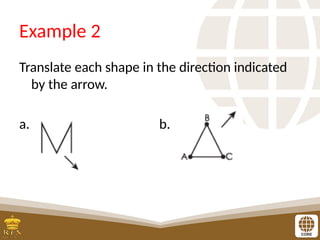
Example 2
Translate each shape in the direction indicated
by the arrow.
a. b.
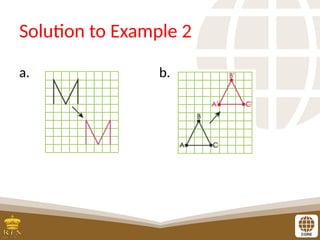
Solution to Example 2
a. b.
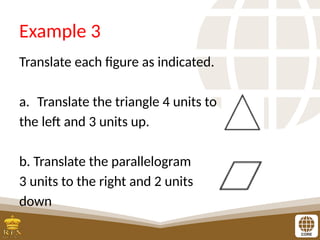
Example 3
Translate each figure as indicated.
a. Translate the triangle 4 units to
the left and 3 units up.
b. Translate the parallelogram
3 units to the right and 2 units
down
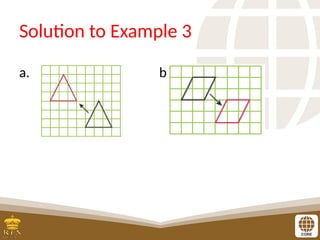
Solution to Example 3
a. b.
Example 4
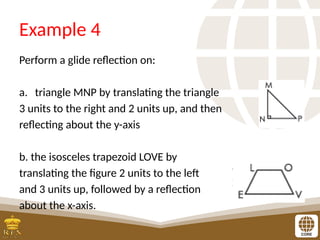
Perform a glide reflection on:
a. triangle MNP by translating the triangle
3 units to the right and 2 units up, and then
reflecting about the y-axis
b. the isosceles trapezoid LOVE by
translating the figure 2 units to the left
and 3 units up, followed by a reflection
about the x-axis.
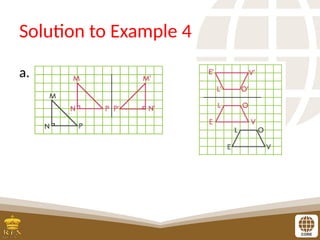
Solution to Example 4
a. b.
Exponential Function
An exponential function can be written as
f (x) = bˣ
where b > 0, b ≠ 1, and x is any real number
In the equation f(x) = bˣ, b is a constant called
the base and x is an independent variable
called the exponent.
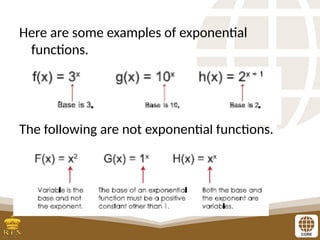
Here are some examples of exponential
functions.
The following are not exponential functions.
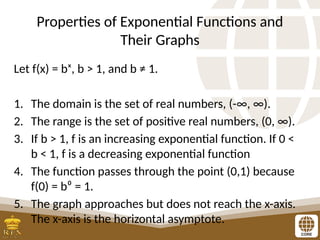
Properties of Exponential Functions and
Their Graphs
Let f(x) = bˣ, b > 1, and b ≠ 1.
1. The domain is the set of real numbers, (-∞, ∞).
2. The range is the set of positive real numbers, (0, ∞).
3. If b > 1, f is an increasing exponential function. If 0 <
b < 1, f is a decreasing exponential function
4. The function passes through the point (0,1) because
f(0) = b⁰ = 1.
5. The graph approaches but does not reach the x-axis.
The x-axis is the horizontal asymptote.
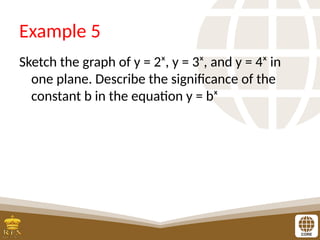
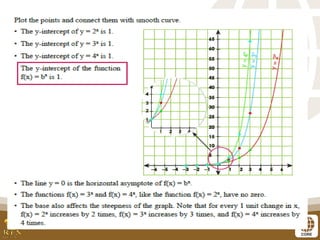
Example 5
Sketch the graph of y = 2ˣ, y = 3ˣ, and y = 4ˣ in
one plane. Describe the significance of the
constant b in the equation y = bˣ
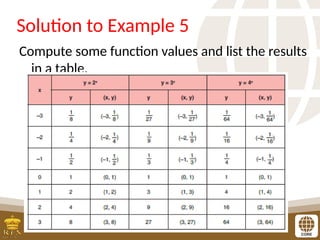
Solution to Example 5
Compute some function values and list the results
in a table.
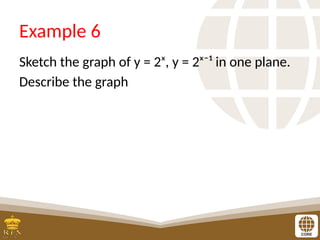
Example 6
Sketch the graph of y = 2ˣ, y = 2ˣ⁻¹ in one plane.
Describe the graph
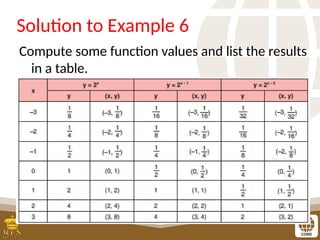
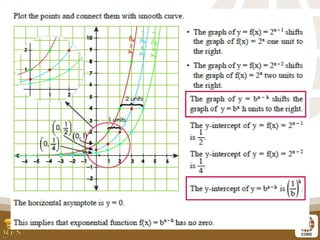
Solution to Example 6
Compute some function values and list the results
in a table.
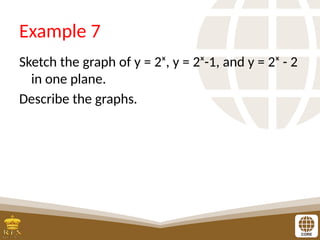
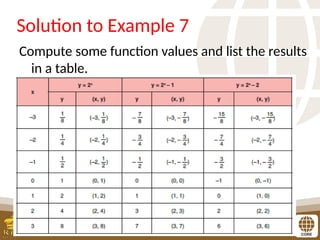
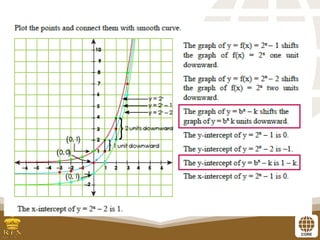
Example 7
Sketch the graph of y = 2ˣ, y = 2ˣ-1, and y = 2ˣ - 2
in one plane.
Describe the graphs.
Solution to Example 7
Compute some function values and list the results
in a table.
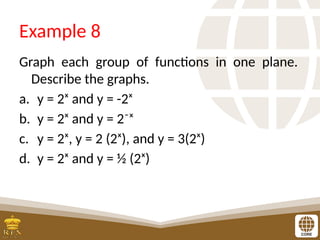
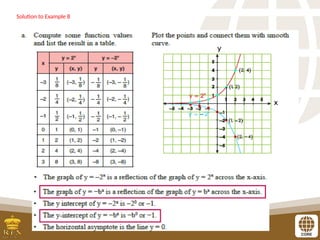
Example 8
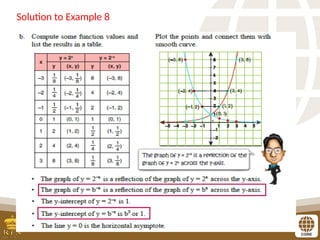
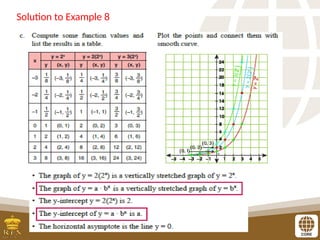
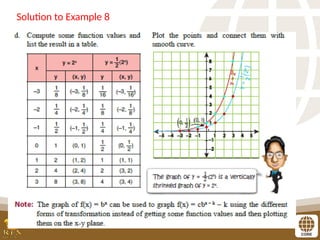
Graph each group of functions in one plane.
Describe the graphs.
a. y = 2ˣ and y = -2ˣ
b. y = 2ˣ and y = 2⁻ˣ
c. y = 2ˣ, y = 2 (2ˣ), and y = 3(2ˣ)
d. y = 2ˣ and y = ½ (2ˣ)
Solution to Example 8
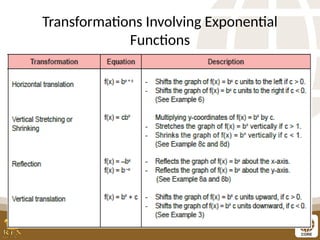
Transformations Involving Exponential
Functions
Reflections in the Coordinate Axes
Reflections in the coordinate axes of the graph y
= f(x) are represented as follows:
1. Reflection in the x-axis: f(x) = -f(x)
2. Reflection in the y-axis: f(x) = f(-x)
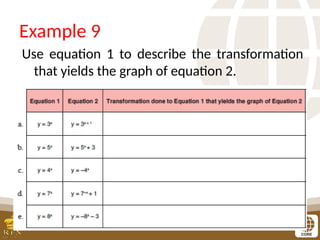
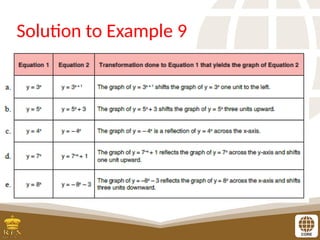
Example 9
Use equation 1 to describe the transformation
that yields the graph of equation 2.
Solution to Example 9
Exercise A
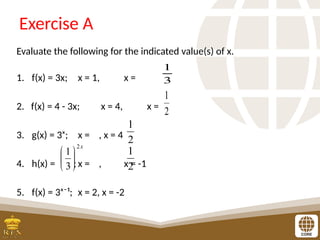
Evaluate the following for the indicated value(s) of x.
1. f(x) = 3x; x = 1, x =
2. f(x) = 4 - 3x; x = 4, x =
3. g(x) = 3ˣ; x = , x = 4
4. h(x) = ; x = , x = -1
5. f(x) = 3ˣ⁻¹; x = 2, x = -2
3
1
2
1
x
2
3
1






2
1
2
1
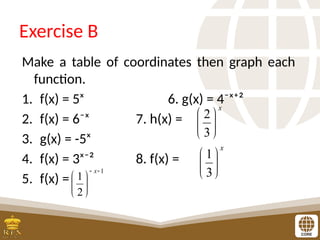
Exercise B
Make a table of coordinates then graph each
function.
1. f(x) = 5ˣ 6. g(x) = 4⁻ˣ⁺²
2. f(x) = 6⁻ˣ 7. h(x) =
3. g(x) = -5ˣ
4. f(x) = 3ˣ⁻² 8. f(x) =
5. f(x) =
1
2
1








x
x






3
2
x






3
1
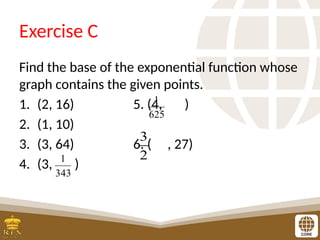
Exercise C
Find the base of the exponential function whose
graph contains the given points.
1. (2, 16) 5. (4, )
2. (1, 10)
3. (3, 64) 6. ( , 27)
4. (3, )
343
1
625
1
2
3

EXPONENTIAL FUNCTION LESSON FIVE GRADE 11

  • 1.
  • 2.
    Lesson Objectives At theend of the lesson, the students must be able to: • represent an exponential function through its: (a) table of values, (b) graph, and (c) equation; • find the domain and range of an exponential function; • find the intercept, zeros, and asymptote of an exponential function; and • graph exponential functions.
  • 3.
    Zero as anExponent • If a ≠ 0, then a⁰ = 1 Illustration: To evaluate 3⁰ 3², we have ∙ 3⁰ 3² = 3⁰⁺² = 3² = 9 or ∙ 3⁰ 3² = 1 3² = 1 9 = 9 ∙ ∙ ∙
  • 4.
    Negative Exponent • Ifn is any integer, and a and b are not equal to zero, then • Illustration Note: The negative exponent does not make the answer negative n n n n n a b b a and a a a                        1 1 8 1 2 1 2 3 3    
  • 5.
    Definition Transformation – theprocess of moving a figure from the starting position to some ending position without changing its size and shape. Reflection – a transformation that produces a new figure, which is a mirror image of the original figure.
  • 6.
    Definition Translation – ashift or movement in a figure’s location without changing its shape. Glide Reflection – a combination of a reflection and a translation (glide).
  • 7.
    Example 1 Reflect eachfigure across the given axis. a. b. c. d.
  • 8.
    Solution to Example1 a. b. c. d.
  • 9.
    Example 2 Translate eachshape in the direction indicated by the arrow. a. b.
  • 10.
  • 11.
    Example 3 Translate eachfigure as indicated. a. Translate the triangle 4 units to the left and 3 units up. b. Translate the parallelogram 3 units to the right and 2 units down
  • 12.
  • 13.
    Example 4 Perform aglide reflection on: a. triangle MNP by translating the triangle 3 units to the right and 2 units up, and then reflecting about the y-axis b. the isosceles trapezoid LOVE by translating the figure 2 units to the left and 3 units up, followed by a reflection about the x-axis.
  • 14.
  • 15.
    Exponential Function An exponentialfunction can be written as f (x) = bˣ where b > 0, b ≠ 1, and x is any real number In the equation f(x) = bˣ, b is a constant called the base and x is an independent variable called the exponent.
  • 16.
    Here are someexamples of exponential functions. The following are not exponential functions.
  • 17.
    Properties of ExponentialFunctions and Their Graphs Let f(x) = bˣ, b > 1, and b ≠ 1. 1. The domain is the set of real numbers, (-∞, ∞). 2. The range is the set of positive real numbers, (0, ∞). 3. If b > 1, f is an increasing exponential function. If 0 < b < 1, f is a decreasing exponential function 4. The function passes through the point (0,1) because f(0) = b⁰ = 1. 5. The graph approaches but does not reach the x-axis. The x-axis is the horizontal asymptote.
  • 18.
    Example 5 Sketch thegraph of y = 2ˣ, y = 3ˣ, and y = 4ˣ in one plane. Describe the significance of the constant b in the equation y = bˣ
  • 19.
    Solution to Example5 Compute some function values and list the results in a table.
  • 21.
    Example 6 Sketch thegraph of y = 2ˣ, y = 2ˣ⁻¹ in one plane. Describe the graph
  • 22.
    Solution to Example6 Compute some function values and list the results in a table.
  • 24.
    Example 7 Sketch thegraph of y = 2ˣ, y = 2ˣ-1, and y = 2ˣ - 2 in one plane. Describe the graphs.
  • 25.
    Solution to Example7 Compute some function values and list the results in a table.
  • 27.
    Example 8 Graph eachgroup of functions in one plane. Describe the graphs. a. y = 2ˣ and y = -2ˣ b. y = 2ˣ and y = 2⁻ˣ c. y = 2ˣ, y = 2 (2ˣ), and y = 3(2ˣ) d. y = 2ˣ and y = ½ (2ˣ)
  • 28.
  • 29.
  • 30.
  • 31.
  • 32.
  • 33.
    Reflections in theCoordinate Axes Reflections in the coordinate axes of the graph y = f(x) are represented as follows: 1. Reflection in the x-axis: f(x) = -f(x) 2. Reflection in the y-axis: f(x) = f(-x)
  • 34.
    Example 9 Use equation1 to describe the transformation that yields the graph of equation 2.
  • 35.
  • 36.
    Exercise A Evaluate thefollowing for the indicated value(s) of x. 1. f(x) = 3x; x = 1, x = 2. f(x) = 4 - 3x; x = 4, x = 3. g(x) = 3ˣ; x = , x = 4 4. h(x) = ; x = , x = -1 5. f(x) = 3ˣ⁻¹; x = 2, x = -2 3 1 2 1 x 2 3 1       2 1 2 1
  • 37.
    Exercise B Make atable of coordinates then graph each function. 1. f(x) = 5ˣ 6. g(x) = 4⁻ˣ⁺² 2. f(x) = 6⁻ˣ 7. h(x) = 3. g(x) = -5ˣ 4. f(x) = 3ˣ⁻² 8. f(x) = 5. f(x) = 1 2 1         x x       3 2 x       3 1
  • 38.
    Exercise C Find thebase of the exponential function whose graph contains the given points. 1. (2, 16) 5. (4, ) 2. (1, 10) 3. (3, 64) 6. ( , 27) 4. (3, ) 343 1 625 1 2 3