To explore the properties of quadratic  functions 
and their graphs.
To investigate  the different forms in which
  quadratic  functions can be expressed.
To express a quadratic function in vertex form.
http://www.youtube.com/watch?v=VSUKNxVXE4E&feature=player_embedded#
http://evmaths.jimdo.com/year­11/functions/?logout=1
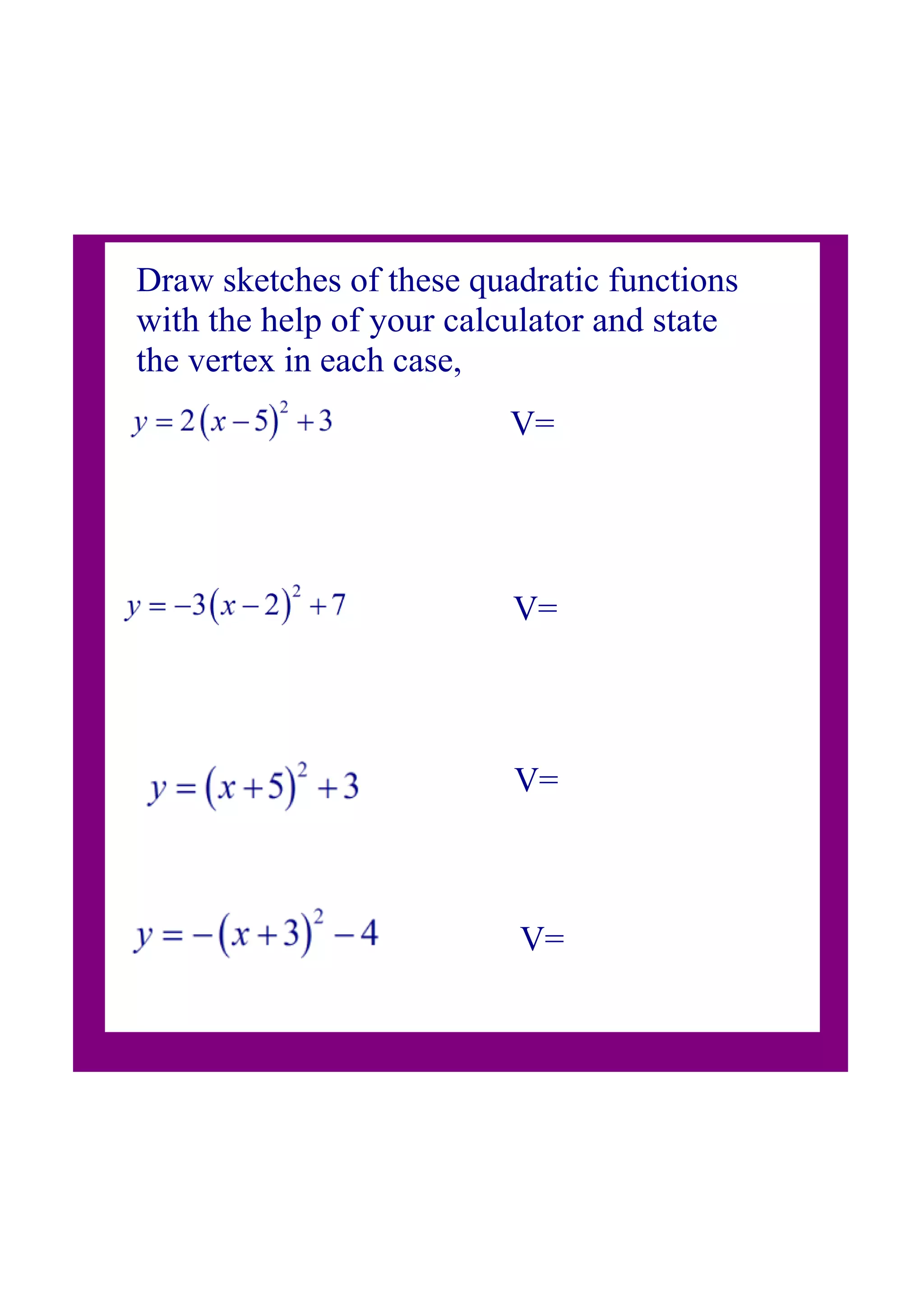
Draw sketches of these quadratic functions 
with the help of your calculator and state 
the vertex in each case,
V=
V=
V=
V=
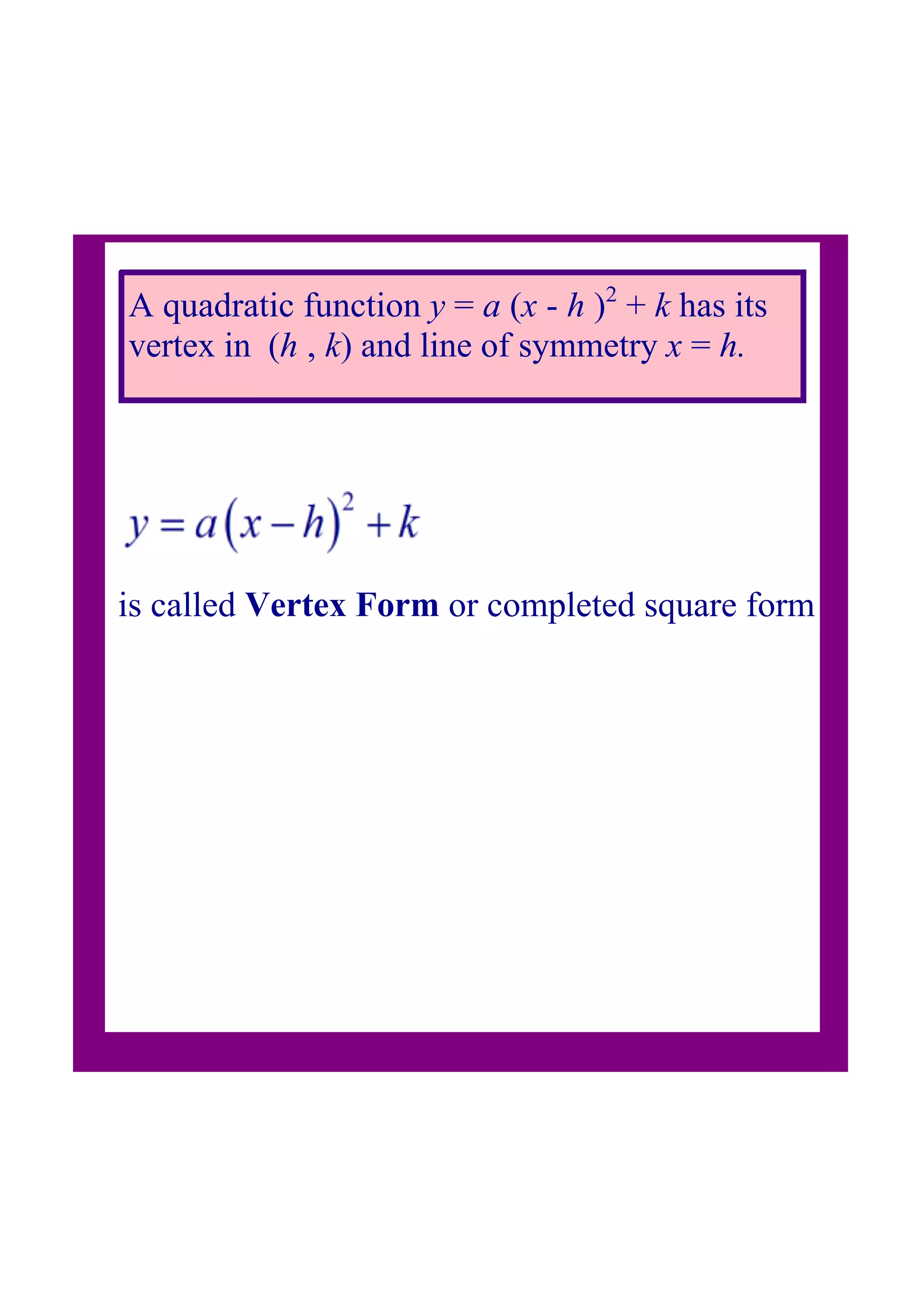
is called Vertex Form or completed square form
A quadratic function y = a (x ­ h )2
 + k has its 
vertex in  (h , k) and line of symmetry x = h.
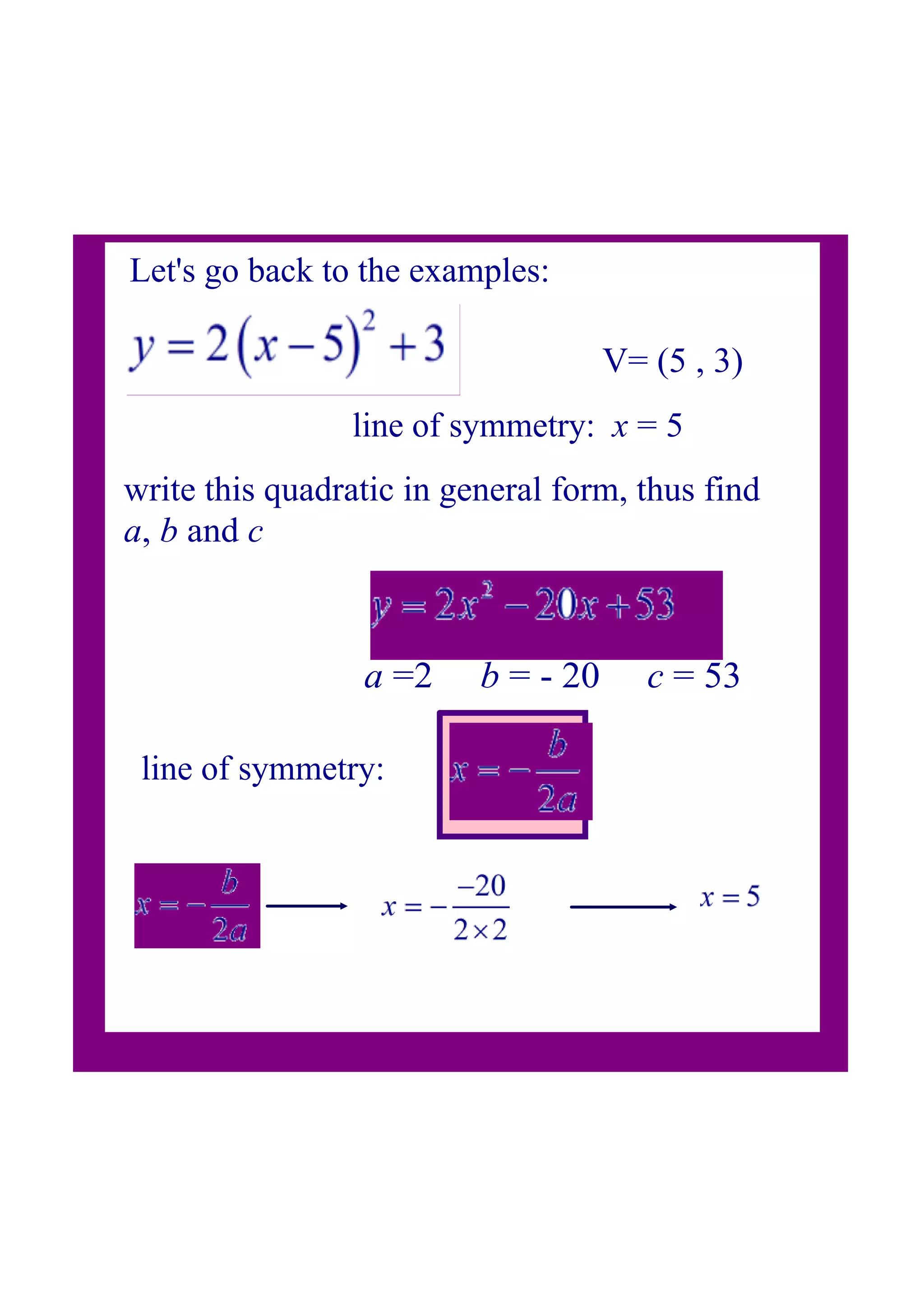
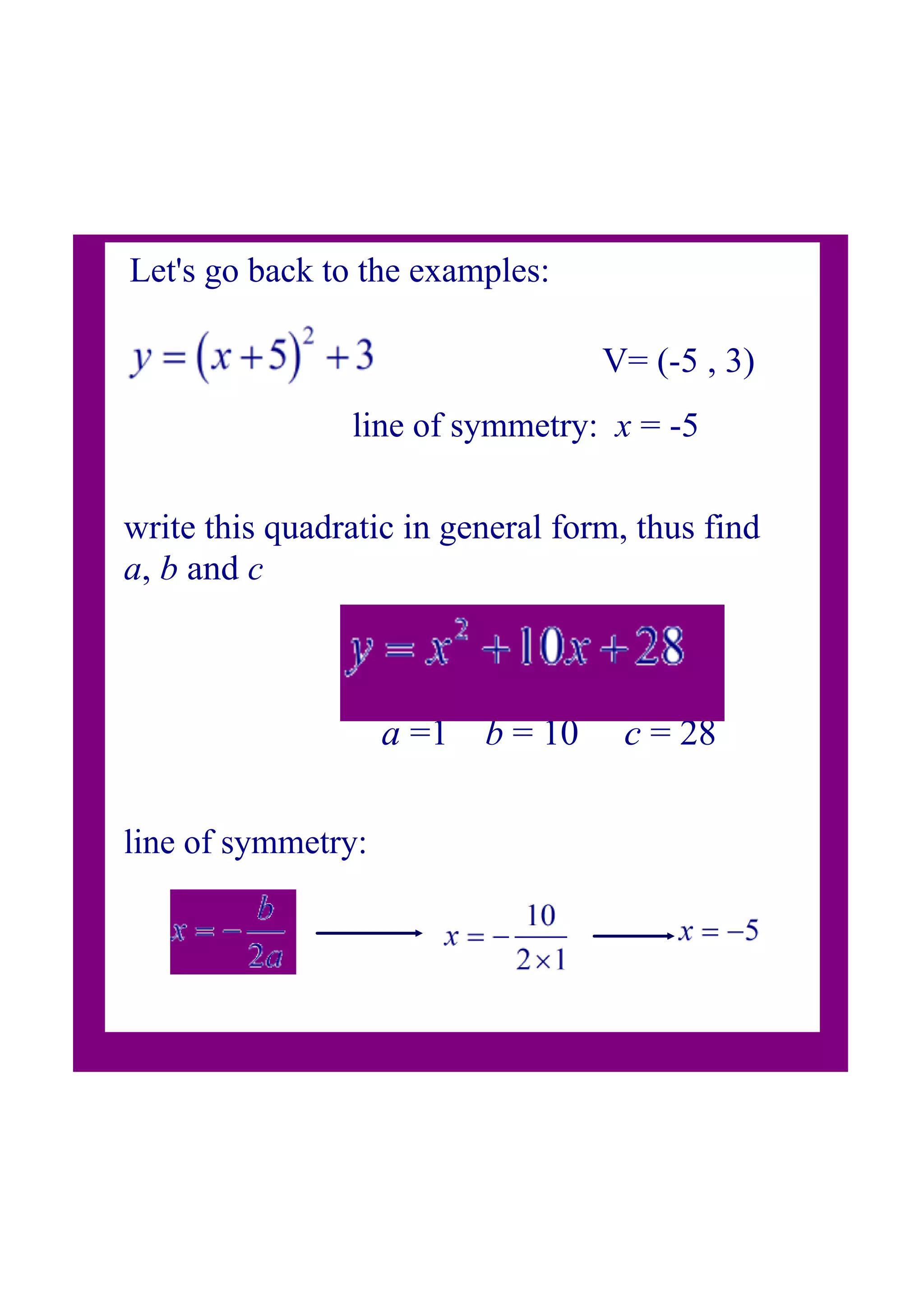
Let's go back to the examples:
V= (5 , 3)
write this quadratic in general form, thus find 
a, b and c
line of symmetry:  x = 5
a =2     b = ­ 20     c = 53
line of symmetry:   
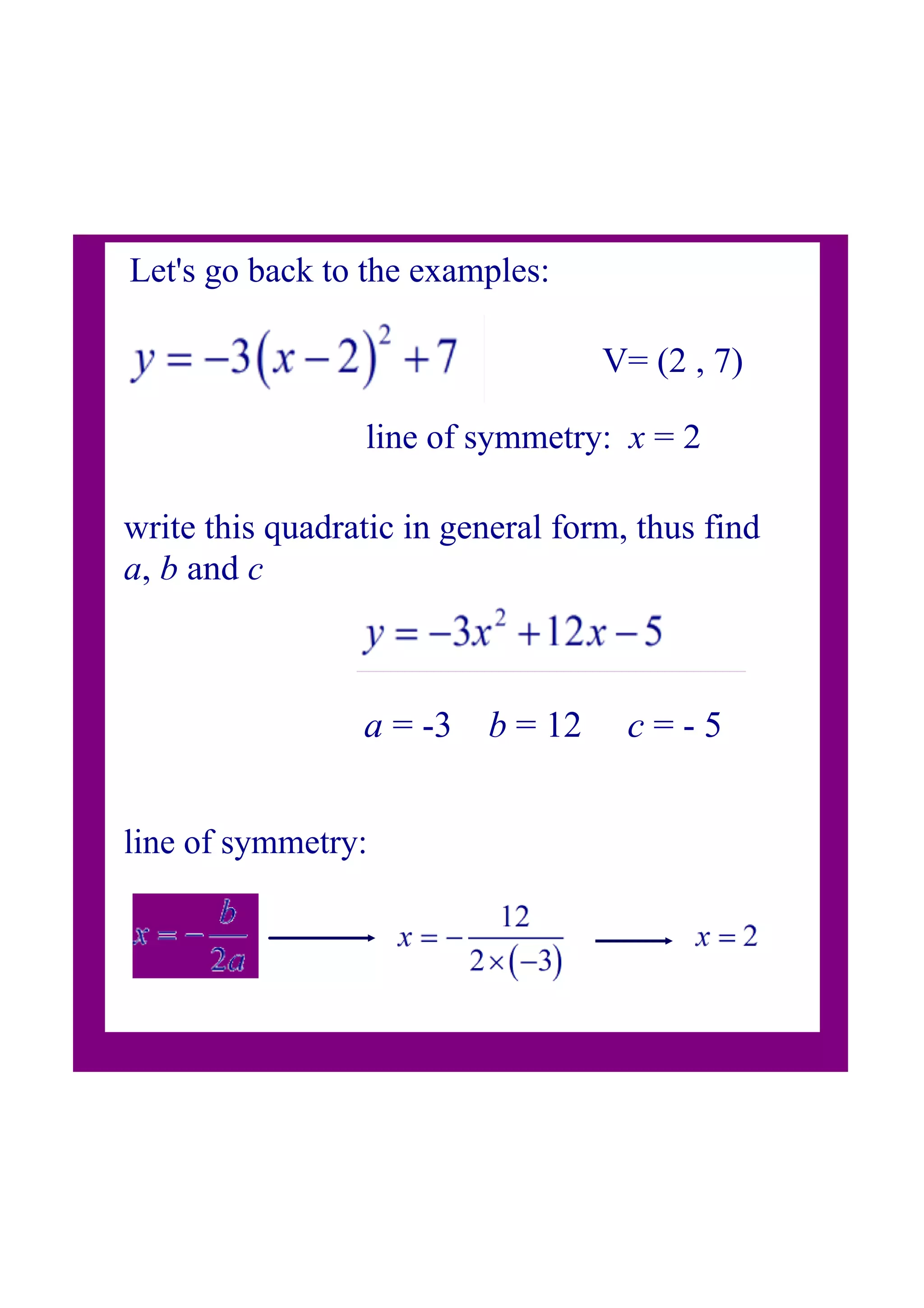
Let's go back to the examples:
V= (­5 , 3)
write this quadratic in general form, thus find 
a, b and c
line of symmetry:  x = ­5
a =1    b = 10     c = 28
line of symmetry:   
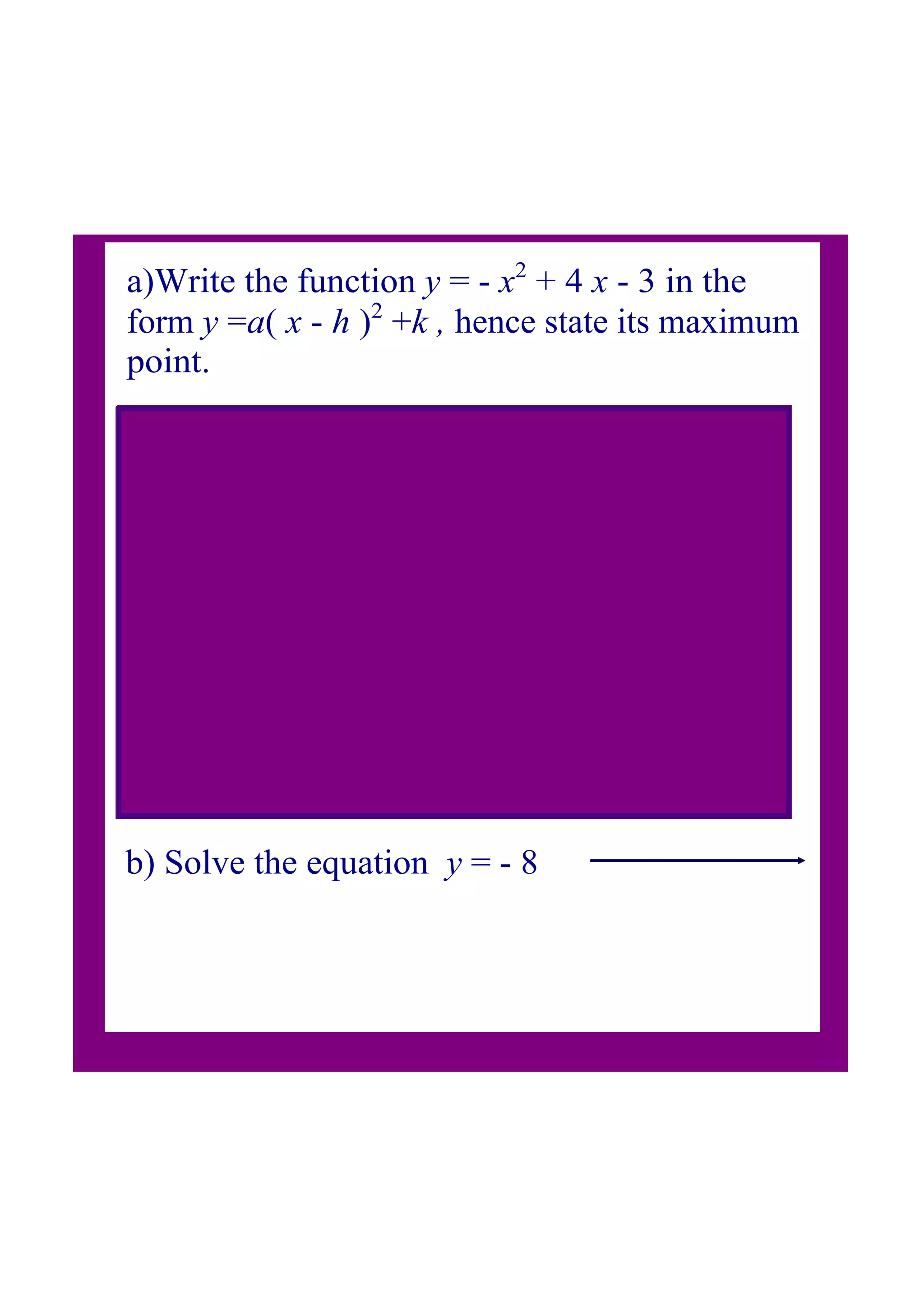
Let's go back to the examples:
V= (2 , 7)
write this quadratic in general form, thus find 
a, b and c
line of symmetry:  x = 2
a = ­3    b = 12     c = ­ 5
line of symmetry:   
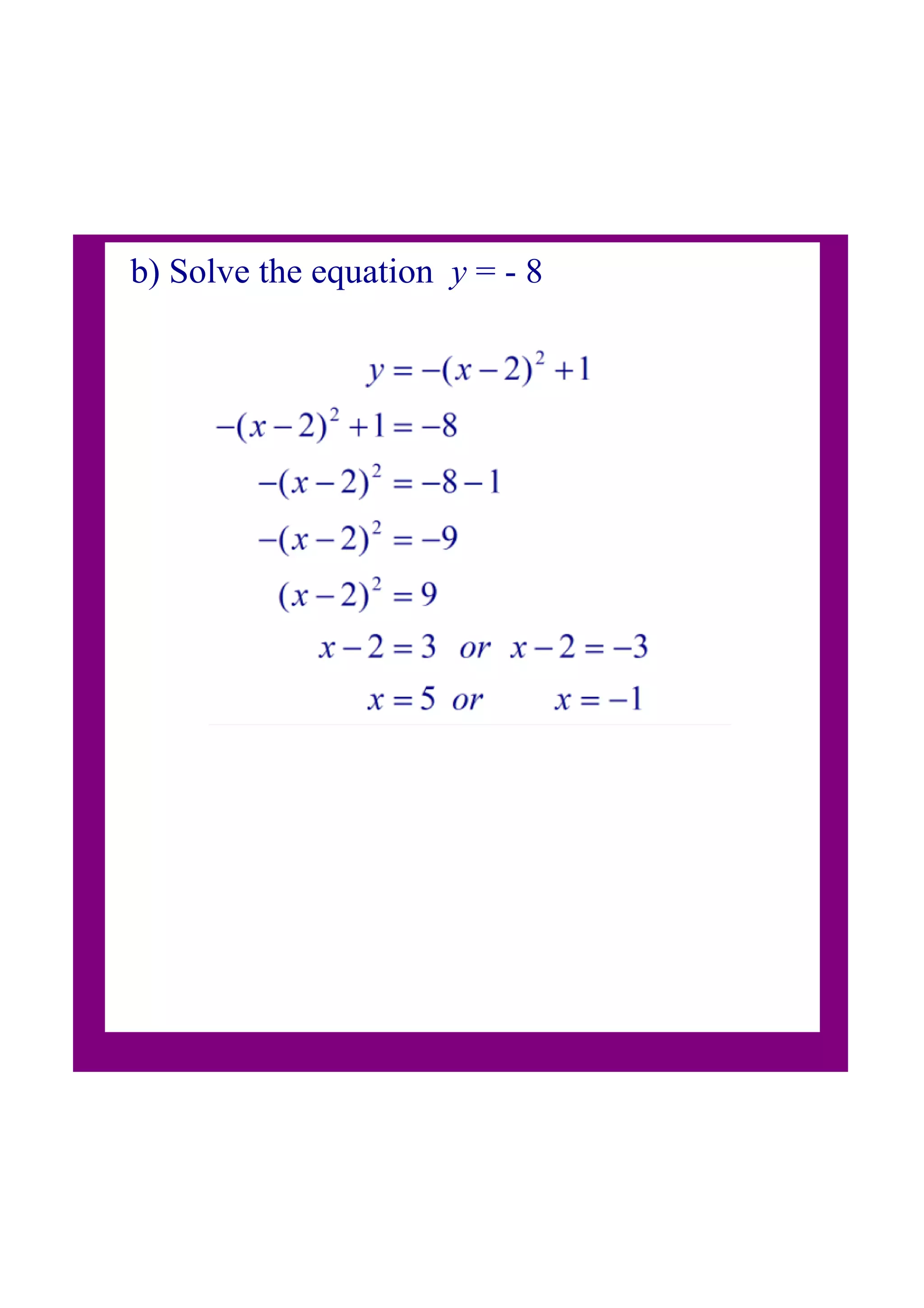
a)Write the function y = ­ x2
 + 4 x ­ 3 in the 
form y =a( x ­ h )2
 +k , hence state its maximum 
point. 
b) Solve the equation  y = ­ 8
a= ­1,   b= 4  , c =­ 3
line of symmetry:  x =2
vertex or maximum point will be when x = 2
when x = 2   then    y  = ­(2)2
+4(2)­3= 1
so  V = ( 2, 1)
b) Solve the equation  y = ­ 8
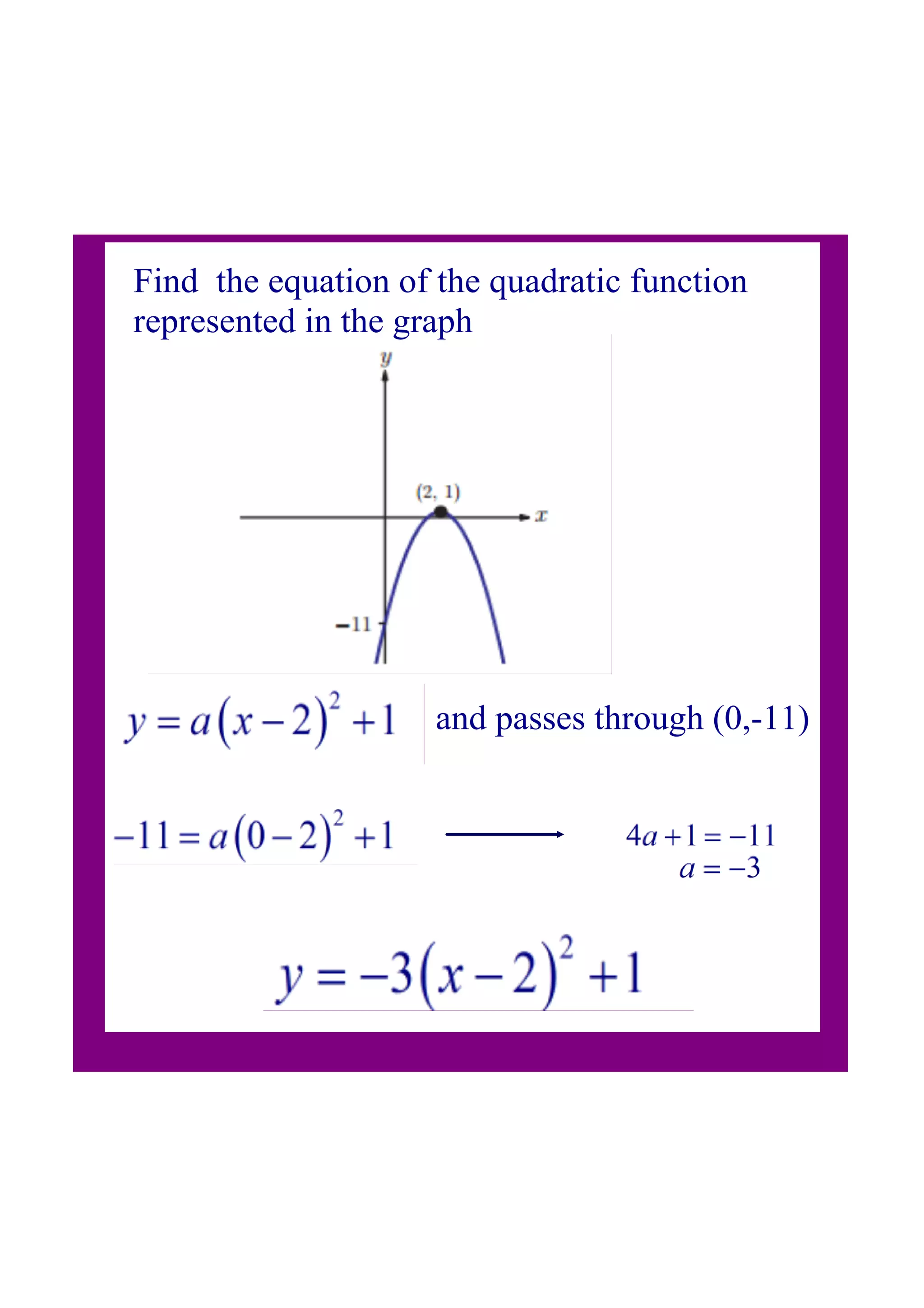
Find  the equation of the quadratic function 
represented in the graph
and passes through (0,­11)
Solve Ex 1 B page 11

3) quadratic vertex form