Exponents and Radicals
Section 1.2
Objectives
Define integer exponents and exponential
notation.
Define zero and negative exponents.
Identify laws of exponents.
Write numbers using scientific notation.
Define nth roots and rational exponents.
Exponential Notation
an
= a * a * a * a…* a (where there are n
factors)
The number a is the base and n is the
exponent.
Zero and Negative Exponents
If a ≠ 0 is any real number and n is a
positive integer, then
 a0
= 1
 a-n
= 1/an
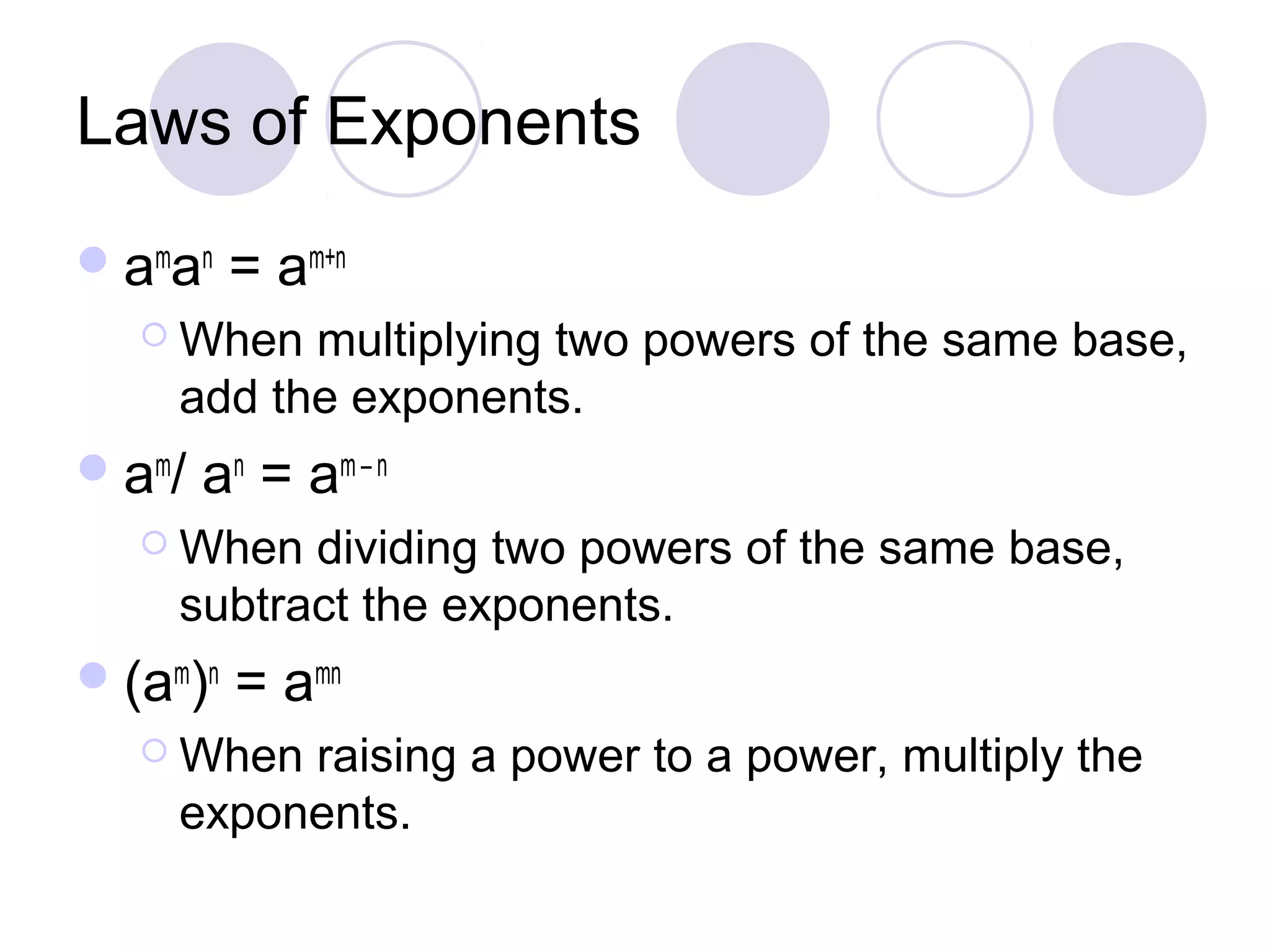
Laws of Exponents
am
an
= am+n
 When multiplying two powers of the same base,
add the exponents.
am
/ an
= am – n
 When dividing two powers of the same base,
subtract the exponents.
(am
)n
= amn
 When raising a power to a power, multiply the
exponents.
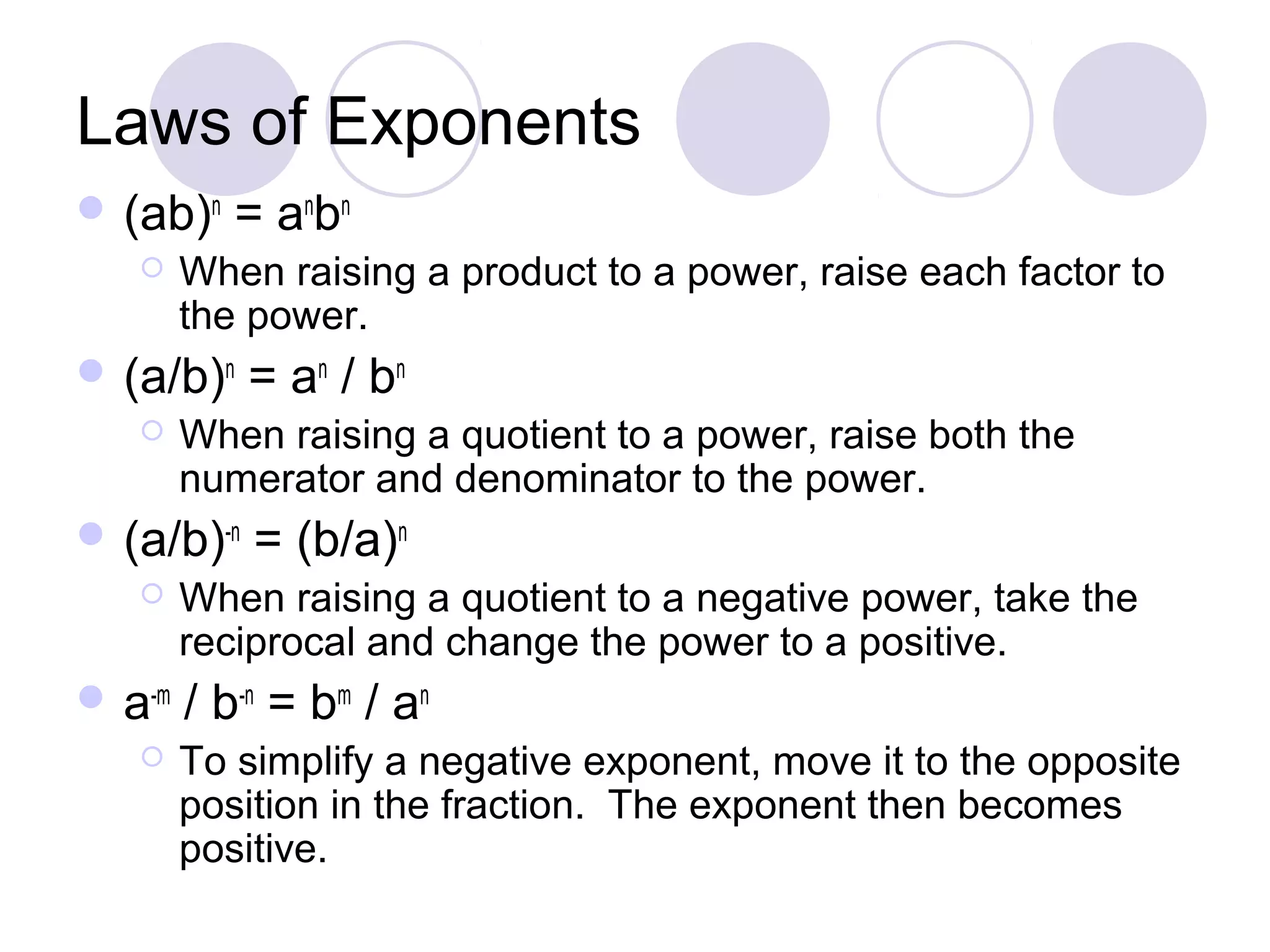
Laws of Exponents
 (ab)n
= an
bn
 When raising a product to a power, raise each factor to
the power.
 (a/b)n
= an
/ bn
 When raising a quotient to a power, raise both the
numerator and denominator to the power.
 (a/b)-n
= (b/a)n
 When raising a quotient to a negative power, take the
reciprocal and change the power to a positive.
 a-m
/ b-n
= bm
/ an
 To simplify a negative exponent, move it to the opposite
position in the fraction. The exponent then becomes
positive.
Scientific Notation
Scientific Notation—shorthand way of
writing very large or very small numbers.
 4 x 10¹³
 4 and 13 zero’s
 1.66 x 10⁻¹²
 0.00000000000166
nth root
If n is any positive integer, then the
principal nth root of a is defined as:

 If n is even, a and b must be positive.
means nn
a b b a= =
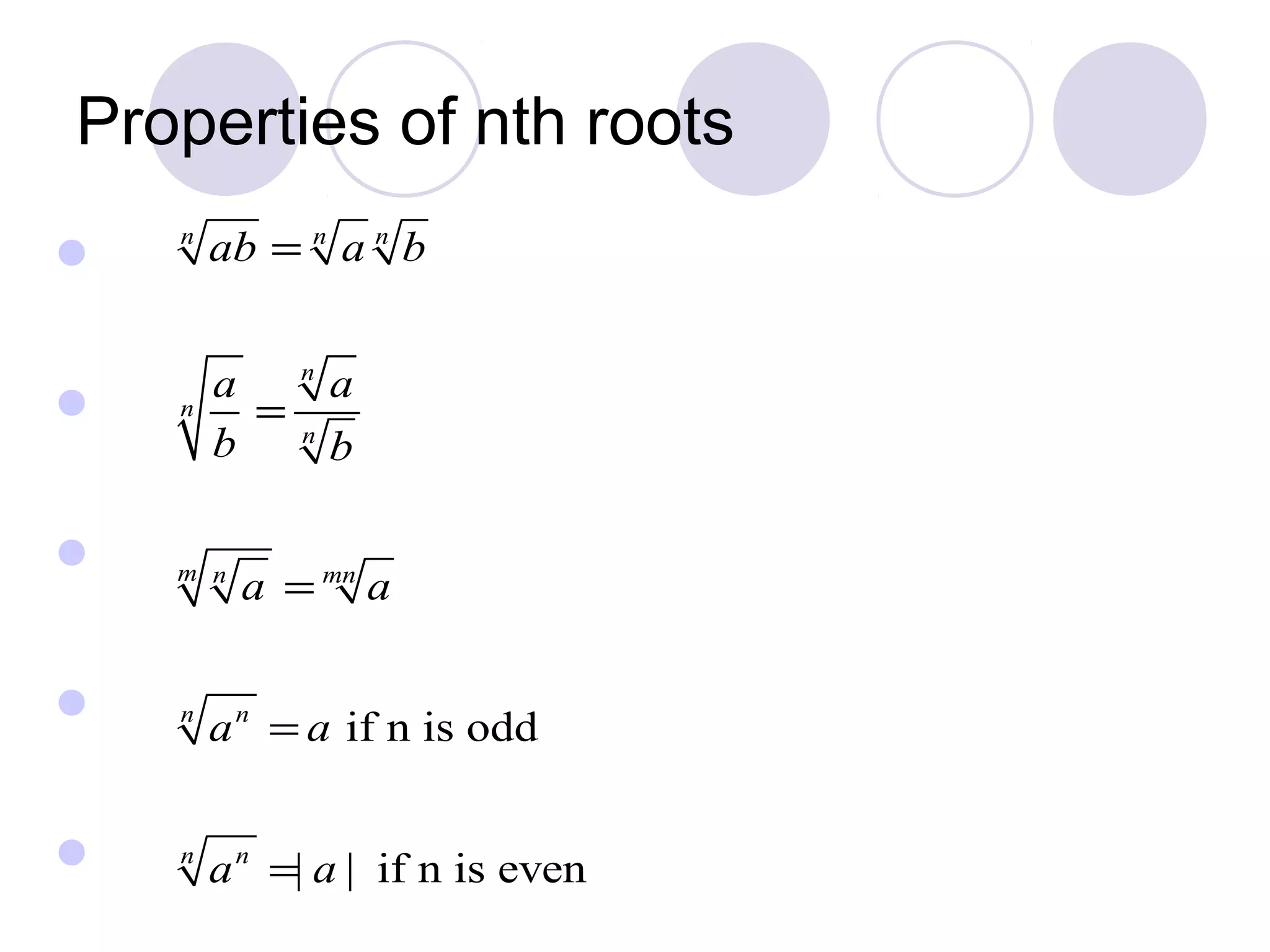
Properties of nth roots





if n is odd
| | if n is even
n n n
n
n
n
m n mn
n n
n n
ab a b
a a
b b
a a
a a
a a
=
=
=
=
=
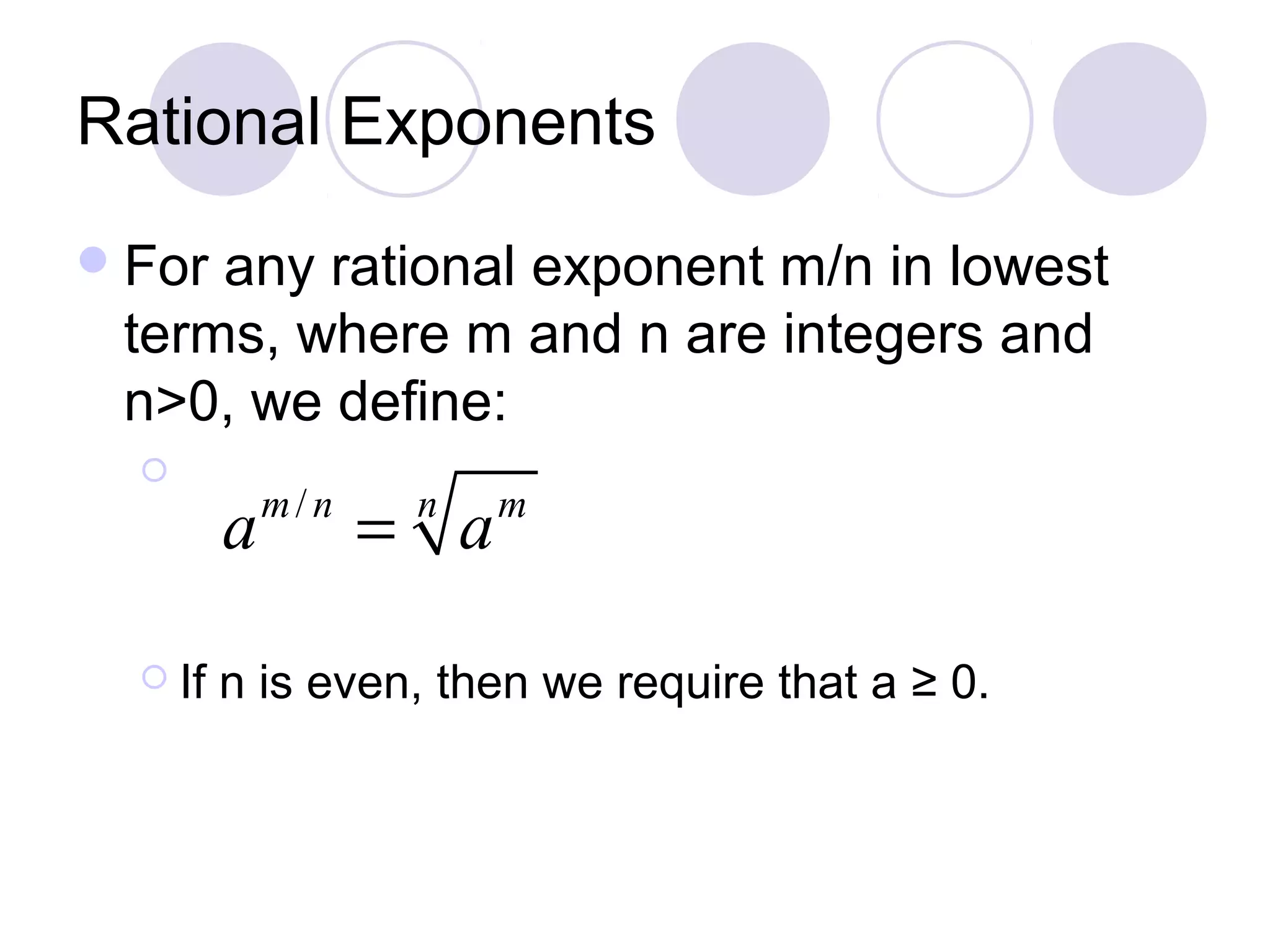
Rational Exponents
For any rational exponent m/n in lowest
terms, where m and n are integers and
n>0, we define:

 If n is even, then we require that a ≥ 0.
/ nm n m
a a=
Rationalizing the Denominator
We don’t like to have radicals in the
denominator, so we must rationalize to get
rid of it.
Rationalizing the denominator is
multiplying the top and bottom of the
expression by the radical you are trying to
eliminate and then simplifying.
Classwork
Homework

EXPONENTS AND RADICALS

  • 1.
  • 2.
    Objectives Define integer exponentsand exponential notation. Define zero and negative exponents. Identify laws of exponents. Write numbers using scientific notation. Define nth roots and rational exponents.
  • 3.
    Exponential Notation an = a* a * a * a…* a (where there are n factors) The number a is the base and n is the exponent.
  • 4.
    Zero and NegativeExponents If a ≠ 0 is any real number and n is a positive integer, then  a0 = 1  a-n = 1/an
  • 5.
    Laws of Exponents am an =am+n  When multiplying two powers of the same base, add the exponents. am / an = am – n  When dividing two powers of the same base, subtract the exponents. (am )n = amn  When raising a power to a power, multiply the exponents.
  • 6.
    Laws of Exponents (ab)n = an bn  When raising a product to a power, raise each factor to the power.  (a/b)n = an / bn  When raising a quotient to a power, raise both the numerator and denominator to the power.  (a/b)-n = (b/a)n  When raising a quotient to a negative power, take the reciprocal and change the power to a positive.  a-m / b-n = bm / an  To simplify a negative exponent, move it to the opposite position in the fraction. The exponent then becomes positive.
  • 7.
    Scientific Notation Scientific Notation—shorthandway of writing very large or very small numbers.  4 x 10¹³  4 and 13 zero’s  1.66 x 10⁻¹²  0.00000000000166
  • 8.
    nth root If nis any positive integer, then the principal nth root of a is defined as:   If n is even, a and b must be positive. means nn a b b a= =
  • 9.
    Properties of nthroots      if n is odd | | if n is even n n n n n n m n mn n n n n ab a b a a b b a a a a a a = = = = =
  • 10.
    Rational Exponents For anyrational exponent m/n in lowest terms, where m and n are integers and n>0, we define:   If n is even, then we require that a ≥ 0. / nm n m a a=
  • 11.
    Rationalizing the Denominator Wedon’t like to have radicals in the denominator, so we must rationalize to get rid of it. Rationalizing the denominator is multiplying the top and bottom of the expression by the radical you are trying to eliminate and then simplifying.
  • 12.
  • 13.