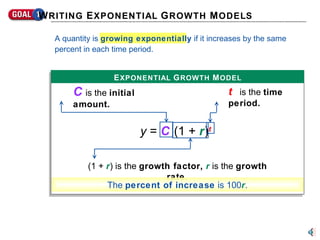
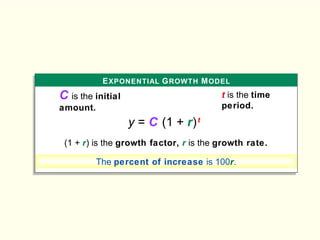
C  is the  initial amount. t   is the  time period. (1 +  r ) is the  growth factor,   r  is the  growth rate. The  percent of increase  is 100 r . y  =  C  (1 +  r ) t E XPONENTIAL  G ROWTH  M ODEL W RITING  E XPONENTIAL  G ROWTH  M ODELS A quantity is  growing exponentially  if it increases by the same percent in each time period.
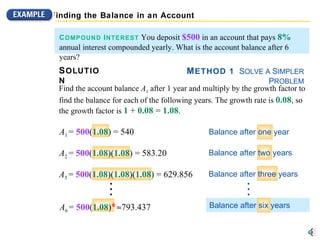
C OMPOUND  I NTEREST  You deposit  $500  in an account that pays  8%  annual interest compounded yearly. What is the account balance after 6 years? S OLUTION M ETHOD 1   S OLVE A  S IMPLER  P ROBLEM Find the account balance  A 1  after 1 year and multiply by the growth factor to find the balance for each of the following years. The growth rate is  0.08 , so the growth factor is  1  +  0.08  =  1.08 . A 1  =  500 ( 1.08 ) = 540 Balance after one year A 2  =  500 ( 1.08 )( 1.08 ) = 583.20 Balance after two years A 3  =  500 ( 1.08 )( 1.08 )( 1.08 ) = 629.856 A 6  =  500 ( 1.08 )   6    793.437 Balance after three years Balance after six years Finding the Balance in an Account • • • • • •
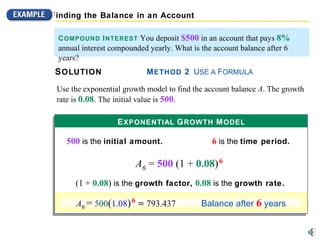
S OLUTION M ETHOD  2   U SE A  F ORMULA C OMPOUND  I NTEREST  You deposit  $500  in an account that pays  8%  annual interest compounded yearly. What is the account balance after 6 years? Use the exponential growth model to find the account balance  A . The growth rate is  0.08 . The initial value is  500 . E XPONENTIAL  G ROWTH  M ODEL C  is the  initial amount. t  is the  time period. (1 +  r ) is the  growth factor,   r  is the  growth rate. The  percent of increase  is 100 r . y  =  C  (1 +  r ) t E XPONENTIAL  G ROWTH  M ODEL 500  is the  initial amount. 6  is the  time period. (1 +  0.08 )  is the  growth factor,   0.08  is the  growth rate. A 6  =  500 ( 1.08 )   6      793.437   Balance after   6   years A 6  =  500  (1 +  0.08 )   6 Finding the Balance in an Account
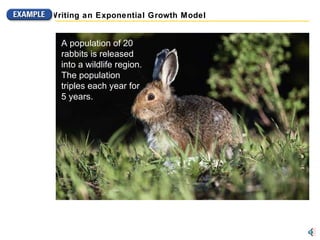
A population of 20 rabbits is released into a wildlife region. The population triples each year for  5 years. Writing an Exponential Growth Model
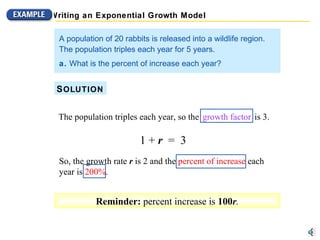
So, the growth rate  r  is 2 and the percent of increase each year is 200%. 1 +  r   =  3 A population of 20 rabbits is released into a wildlife region.  The population triples each year for 5 years. a.  What is the percent of increase each year? S OLUTION The population triples each year, so the   growth factor   is 3. 1 +  r  =  3 Reminder:  percent increase is  100 r . So, the  growth rate  r   is  2  and the percent of increase each year is 200%. So, the growth rate  r  is 2 and the  percent of increase  each year is  200% . 1 +  r   =  3 Writing an Exponential Growth Model The population triples each year, so the   growth factor   is 3.
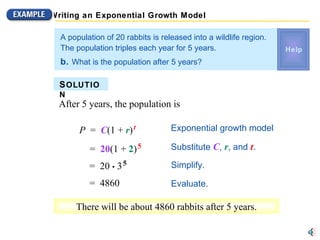
A population of 20 rabbits is released into a wildlife region.  The population triples each year for 5 years. b.   What is the population after 5 years? S OLUTION After 5 years, the population is P   =  C (1 +  r )   t Exponential growth model =  20 (1 +  2 )   5 =  20  •  3   5 =  4860 Help Substitute   C ,   r , and   t . Simplify. Evaluate. There will be about 4860 rabbits after 5 years. Writing an Exponential Growth Model
G RAPHING  E XPONENTIAL  G ROWTH  M ODELS Graph the growth of the rabbit population. S OLUTION Make a table of values, plot the points in a coordinate plane, and draw a smooth curve through the points. P  = 20   (   3   )   t Here, the large growth factor of 3 corresponds to a rapid increase A Model with a Large Growth Factor t P 4860 60 180 540 1620 20 5 1 2 3 4 0 0 1000 2000 3000 4000 5000 6000 1 7 2 3 4 5 6 Time (years) Population
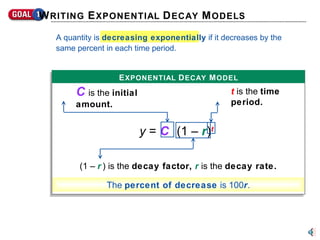
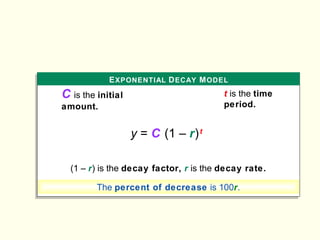
A quantity is  decreasing exponentially  if it decreases by the same percent in each time period. C  is the  initial amount. t  is the  time period. (1 –  r   ) is the  decay factor,   r  is the  decay rate. The  percent of decrease  is 100 r . y  =  C   (1 –  r ) t W RITING  E XPONENTIAL  D ECAY  M ODELS E XPONENTIAL  D ECAY  M ODEL
C OMPOUND  I NTEREST   From 1982 through 1997, the purchasing power of a dollar decreased by about   3.5%  per year. Using 1982 as the base for comparison, what was the purchasing power of a dollar in 1997? S OLUTION Let y represent the purchasing power and let   t = 0  represent the year  1982. The initial amount is $1. Use an exponential decay model. = ( 1 )(1 –  0.035 )   t = 0.965   t y   =  C   (1 –  r )   t y   =  0.965 15 Exponential decay model Substitute   1   for   C ,   0.035   for   r . Simplify. Because 1997 is 15 years after 1982, substitute  15  for  t . Substitute  15   for   t . The purchasing power of a dollar in 1997 compared to 1982 was $0.59.  0.59 Writing an Exponential Decay Model
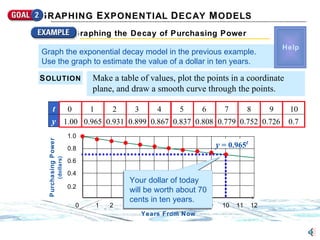
G RAPHING  E XPONENTIAL  D ECAY  M ODELS Graph the exponential decay model in the previous example.  Use the graph to estimate the value of a dollar in ten years. S OLUTION Make a table of values, plot the points in a coordinate plane, and draw a smooth curve through the points. Your dollar of today  will be worth about 70 cents in ten years. y  = 0.965 t Help Graphing the Decay of Purchasing Power 0 0.2 0.4 0.6 0.8 1.0 1 12 3 5 7 9 11 Years From Now Purchasing Power  (dollars)   2 4 6 8 10 t y 0.837 0.965 0.931 0.899 0.867 1.00 5 1 2 3 4 0 0.7 0.808 0.779 0.752 0.726 10 6 7 8 9
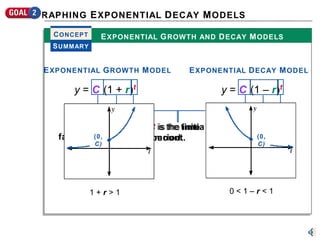
G RAPHING  E XPONENTIAL  D ECAY  M ODELS y  =  C  (1 –  r ) t y  =  C  (1 +  r ) t E XPONENTIAL  G ROWTH  M ODEL E XPONENTIAL  D ECAY  M ODEL 1 +  r  > 1 0 < 1 –  r  < 1 An exponential model  y  =  a   •   b   t   represents exponential  growth  if   b  > 1  and exponential  decay  if  0 <  b  < 1 . C  is the  initial amount. t  is the  time period. E XPONENTIAL  G ROWTH AND  D ECAY  M ODELS C ONCEPT S UMMARY (1 –  r ) is the  decay factor,   r  is the  decay rate. (1 +  r ) is the  growth factor,   r  is the  growth rate. (0,   C) (0,   C)
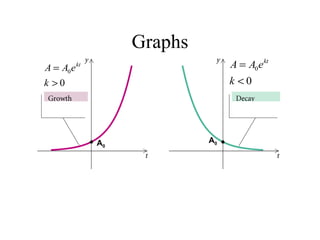
Exponential Growth & Decay Models A 0  is the amount you start with, t is the time, and k=constant of growth (or decay) f k>0, the amount is GROWING (getting larger), as in the money in a savings account that is having interest compounded over time If k<0, the amount is SHRINKING (getting smaller), as in the amount of radioactive substance remaining after the substance decays over time
Graphs A 0 A 0
Example Population Growth of the United States . In 1990 the population in the United States was about 249 million and the exponential growth rate was 8% per decade. ( Source: U.S. Census Bureau ) Find the exponential growth function. What will the population be in 2020? After how long will the population be double what it was in 1990?
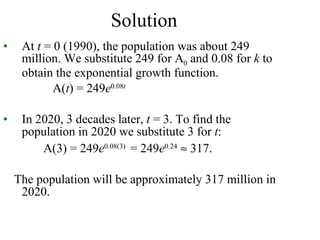
Solution At  t  = 0 (1990), the population was about 249 million. We substitute 249 for A 0  and 0.08 for  k  to obtain the exponential growth function. A( t ) = 249 e 0.08 t In   2020, 3 decades later,  t  = 3. To find the population in 2020 we substitute 3 for  t : A(3) = 249 e 0.08(3)  = 249 e 0.24     317. The population will be approximately 317 million in 2020.
Solution continued We are looking for the doubling time  T. 498 = 249 e 0.08 T 2 = e 0.08 T ln  2 =  ln  e 0.08 T  ln 2 = 0.08 T  (ln  e x  = x ) = T 8.7   T  The population of the U.S. will double in about  8.7 decades or  87 years. This will be approximately in 2077.
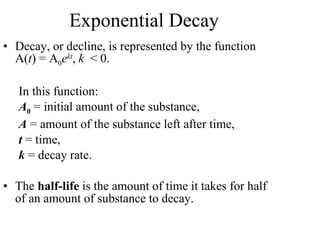
Exponential Decay Decay, or decline, is represented by the function  A( t ) = A 0 e kt ,  k   < 0. In this function: A 0  = initial amount of the substance, A  = amount of the substance left after time, t  = time, k  = decay rate. The  half-life  is the amount of time it takes for half of an amount of substance to decay.
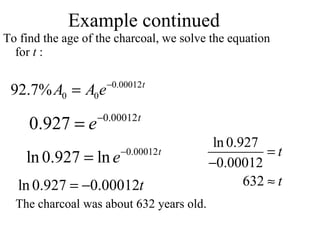
Example Carbon Dating . The radioactive element carbon-14 has a half-life of 5715 years. If a piece of charcoal that had lost 7.3% of its original amount of carbon, was discovered from an ancient campsite, how could the age of the charcoal be determined?  Solution : The function for carbon dating is  A( t ) = A 0 e -0.00012t . If the charcoal has lost 7.3% of its carbon-14 from its initial amount A 0 , then 92.7%A 0  is the amount present.
Example continued To find the age of the charcoal, we solve the equation for  t  : The charcoal was about 632 years old.
E XPONENTIAL  G ROWTH  M ODEL C  is the  initial amount. t  is the  time period. (1 +  r ) is the  growth factor,   r  is the  growth rate. The  percent of increase  is 100 r . y  =  C  (1 +  r )   t
E XPONENTIAL  D ECAY  M ODEL C  is the  initial amount. t  is the  time period. (1 –  r ) is the  decay factor,   r  is the  decay rate. The  percent of decrease  is 100 r . y  =  C  (1 –  r )   t

Exponential growth and decay

  • 1.
    C isthe initial amount. t is the time period. (1 + r ) is the growth factor, r is the growth rate. The percent of increase is 100 r . y = C (1 + r ) t E XPONENTIAL G ROWTH M ODEL W RITING E XPONENTIAL G ROWTH M ODELS A quantity is growing exponentially if it increases by the same percent in each time period.
  • 2.
    C OMPOUND I NTEREST You deposit $500 in an account that pays 8% annual interest compounded yearly. What is the account balance after 6 years? S OLUTION M ETHOD 1 S OLVE A S IMPLER P ROBLEM Find the account balance A 1 after 1 year and multiply by the growth factor to find the balance for each of the following years. The growth rate is 0.08 , so the growth factor is 1 + 0.08 = 1.08 . A 1 = 500 ( 1.08 ) = 540 Balance after one year A 2 = 500 ( 1.08 )( 1.08 ) = 583.20 Balance after two years A 3 = 500 ( 1.08 )( 1.08 )( 1.08 ) = 629.856 A 6 = 500 ( 1.08 ) 6  793.437 Balance after three years Balance after six years Finding the Balance in an Account • • • • • •
  • 3.
    S OLUTION METHOD 2 U SE A F ORMULA C OMPOUND I NTEREST You deposit $500 in an account that pays 8% annual interest compounded yearly. What is the account balance after 6 years? Use the exponential growth model to find the account balance A . The growth rate is 0.08 . The initial value is 500 . E XPONENTIAL G ROWTH M ODEL C is the initial amount. t is the time period. (1 + r ) is the growth factor, r is the growth rate. The percent of increase is 100 r . y = C (1 + r ) t E XPONENTIAL G ROWTH M ODEL 500 is the initial amount. 6 is the time period. (1 + 0.08 ) is the growth factor, 0.08 is the growth rate. A 6 = 500 ( 1.08 ) 6  793.437 Balance after 6 years A 6 = 500 (1 + 0.08 ) 6 Finding the Balance in an Account
  • 4.
    A population of20 rabbits is released into a wildlife region. The population triples each year for 5 years. Writing an Exponential Growth Model
  • 5.
    So, the growthrate r is 2 and the percent of increase each year is 200%. 1 + r = 3 A population of 20 rabbits is released into a wildlife region. The population triples each year for 5 years. a. What is the percent of increase each year? S OLUTION The population triples each year, so the growth factor is 3. 1 + r = 3 Reminder: percent increase is 100 r . So, the growth rate r is 2 and the percent of increase each year is 200%. So, the growth rate r is 2 and the percent of increase each year is 200% . 1 + r = 3 Writing an Exponential Growth Model The population triples each year, so the growth factor is 3.
  • 6.
    A population of20 rabbits is released into a wildlife region. The population triples each year for 5 years. b. What is the population after 5 years? S OLUTION After 5 years, the population is P = C (1 + r ) t Exponential growth model = 20 (1 + 2 ) 5 = 20 • 3 5 = 4860 Help Substitute C , r , and t . Simplify. Evaluate. There will be about 4860 rabbits after 5 years. Writing an Exponential Growth Model
  • 7.
    G RAPHING E XPONENTIAL G ROWTH M ODELS Graph the growth of the rabbit population. S OLUTION Make a table of values, plot the points in a coordinate plane, and draw a smooth curve through the points. P = 20 ( 3 ) t Here, the large growth factor of 3 corresponds to a rapid increase A Model with a Large Growth Factor t P 4860 60 180 540 1620 20 5 1 2 3 4 0 0 1000 2000 3000 4000 5000 6000 1 7 2 3 4 5 6 Time (years) Population
  • 8.
    A quantity is decreasing exponentially if it decreases by the same percent in each time period. C is the initial amount. t is the time period. (1 – r ) is the decay factor, r is the decay rate. The percent of decrease is 100 r . y = C (1 – r ) t W RITING E XPONENTIAL D ECAY M ODELS E XPONENTIAL D ECAY M ODEL
  • 9.
    C OMPOUND I NTEREST From 1982 through 1997, the purchasing power of a dollar decreased by about 3.5% per year. Using 1982 as the base for comparison, what was the purchasing power of a dollar in 1997? S OLUTION Let y represent the purchasing power and let t = 0 represent the year 1982. The initial amount is $1. Use an exponential decay model. = ( 1 )(1 – 0.035 ) t = 0.965 t y = C (1 – r ) t y = 0.965 15 Exponential decay model Substitute 1 for C , 0.035 for r . Simplify. Because 1997 is 15 years after 1982, substitute 15 for t . Substitute 15 for t . The purchasing power of a dollar in 1997 compared to 1982 was $0.59.  0.59 Writing an Exponential Decay Model
  • 10.
    G RAPHING E XPONENTIAL D ECAY M ODELS Graph the exponential decay model in the previous example. Use the graph to estimate the value of a dollar in ten years. S OLUTION Make a table of values, plot the points in a coordinate plane, and draw a smooth curve through the points. Your dollar of today will be worth about 70 cents in ten years. y = 0.965 t Help Graphing the Decay of Purchasing Power 0 0.2 0.4 0.6 0.8 1.0 1 12 3 5 7 9 11 Years From Now Purchasing Power (dollars) 2 4 6 8 10 t y 0.837 0.965 0.931 0.899 0.867 1.00 5 1 2 3 4 0 0.7 0.808 0.779 0.752 0.726 10 6 7 8 9
  • 11.
    G RAPHING E XPONENTIAL D ECAY M ODELS y = C (1 – r ) t y = C (1 + r ) t E XPONENTIAL G ROWTH M ODEL E XPONENTIAL D ECAY M ODEL 1 + r > 1 0 < 1 – r < 1 An exponential model y = a • b t represents exponential growth if b > 1 and exponential decay if 0 < b < 1 . C is the initial amount. t is the time period. E XPONENTIAL G ROWTH AND D ECAY M ODELS C ONCEPT S UMMARY (1 – r ) is the decay factor, r is the decay rate. (1 + r ) is the growth factor, r is the growth rate. (0, C) (0, C)
  • 12.
    Exponential Growth &Decay Models A 0 is the amount you start with, t is the time, and k=constant of growth (or decay) f k>0, the amount is GROWING (getting larger), as in the money in a savings account that is having interest compounded over time If k<0, the amount is SHRINKING (getting smaller), as in the amount of radioactive substance remaining after the substance decays over time
  • 13.
  • 14.
    Example Population Growthof the United States . In 1990 the population in the United States was about 249 million and the exponential growth rate was 8% per decade. ( Source: U.S. Census Bureau ) Find the exponential growth function. What will the population be in 2020? After how long will the population be double what it was in 1990?
  • 15.
    Solution At t = 0 (1990), the population was about 249 million. We substitute 249 for A 0 and 0.08 for k to obtain the exponential growth function. A( t ) = 249 e 0.08 t In 2020, 3 decades later, t = 3. To find the population in 2020 we substitute 3 for t : A(3) = 249 e 0.08(3) = 249 e 0.24  317. The population will be approximately 317 million in 2020.
  • 16.
    Solution continued Weare looking for the doubling time T. 498 = 249 e 0.08 T 2 = e 0.08 T ln 2 = ln e 0.08 T ln 2 = 0.08 T (ln e x = x ) = T 8.7  T The population of the U.S. will double in about 8.7 decades or 87 years. This will be approximately in 2077.
  • 17.
    Exponential Decay Decay,or decline, is represented by the function A( t ) = A 0 e kt , k < 0. In this function: A 0 = initial amount of the substance, A = amount of the substance left after time, t = time, k = decay rate. The half-life is the amount of time it takes for half of an amount of substance to decay.
  • 18.
    Example Carbon Dating. The radioactive element carbon-14 has a half-life of 5715 years. If a piece of charcoal that had lost 7.3% of its original amount of carbon, was discovered from an ancient campsite, how could the age of the charcoal be determined? Solution : The function for carbon dating is A( t ) = A 0 e -0.00012t . If the charcoal has lost 7.3% of its carbon-14 from its initial amount A 0 , then 92.7%A 0 is the amount present.
  • 19.
    Example continued Tofind the age of the charcoal, we solve the equation for t : The charcoal was about 632 years old.
  • 20.
    E XPONENTIAL G ROWTH M ODEL C is the initial amount. t is the time period. (1 + r ) is the growth factor, r is the growth rate. The percent of increase is 100 r . y = C (1 + r ) t
  • 21.
    E XPONENTIAL D ECAY M ODEL C is the initial amount. t is the time period. (1 – r ) is the decay factor, r is the decay rate. The percent of decrease is 100 r . y = C (1 – r ) t