2D-TRANSLATION
&
ROTATION
(W.R.T ORIGIN &PIVOT POINT)
1
TRANSFORMATION
 Transformation means changing some graphics into
something else by applying rules.
 Types
 Translation,
 Scaling
 Rotation,
 Shearing
 Reflection
2
TRANSLATION
 Translation moves an object to a different position
on the screen.
 It can be described as a rigid motion.
 It changes the position of object.
3
TRANSLATION
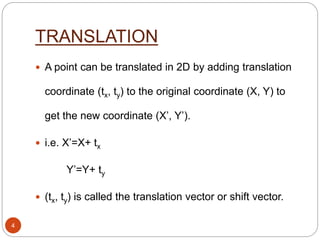
 A point can be translated in 2D by adding translation
coordinate (tx, ty) to the original coordinate (X, Y) to
get the new coordinate (X’, Y’).
 i.e. X’=X+ tx
Y’=Y+ ty
 (tx, ty) is called the translation vector or shift vector.
4
TRANSLATION
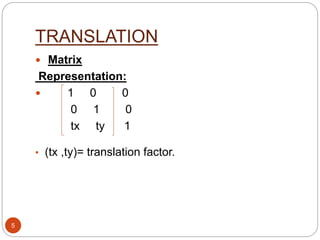
 Matrix
Representation:
 1 0 0
0 1 0
tx ty 1
• (tx ,ty)= translation factor.
5
TRANSLATION
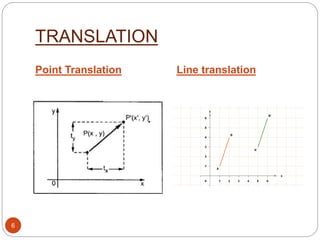
Point Translation Line translation
6
QUESTION
7
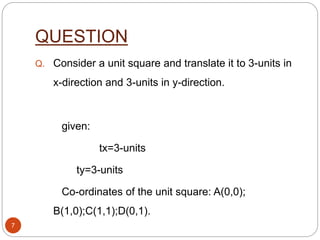
Q. Consider a unit square and translate it to 3-units in
x-direction and 3-units in y-direction.
given:
tx=3-units
ty=3-units
Co-ordinates of the unit square: A(0,0);
B(1,0);C(1,1);D(0,1).
ROTATION
8
 Change in orientation.
 Rigid body transformation.
 Types:
 about origin(0,0)
 about a pivot point
ROTATION
9
 About origin:
 In rotation, we rotate the object at particular angle θ
(theta) from its origin.
 It can be described as rigid body transformation.
 It is change in orientation.
 Convention:
Θ positive: rotation counter clockwise.
Θ negative: rotation clockwise.
ROTATION
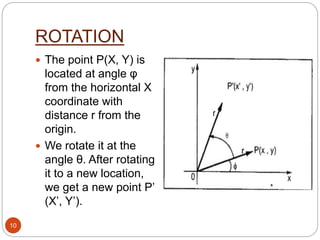
 The point P(X, Y) is
located at angle φ
from the horizontal X
coordinate with
distance r from the
origin.
 We rotate it at the
angle θ. After rotating
it to a new location,
we get a new point P’
(X’, Y’).
10
ROTATION
11
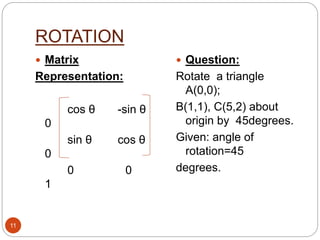
 Matrix
Representation:
cos θ -sin θ
0
sin θ cos θ
0
0 0
1
 Question:
Rotate a triangle
A(0,0);
B(1,1), C(5,2) about
origin by 45degrees.
Given: angle of
rotation=45
degrees.
ROTATION
12
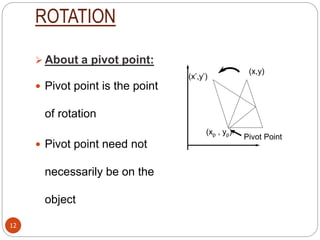
 About a pivot point:
 Pivot point is the point
of rotation
 Pivot point need not
necessarily be on the
object
(xp , yp)
(x,y)
(x’,y’)
Pivot Point
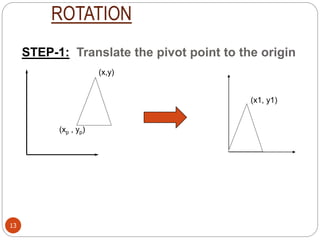
13
(xp , yp)
(x,y)
(x1, y1)
STEP-1: Translate the pivot point to the origin
ROTATION
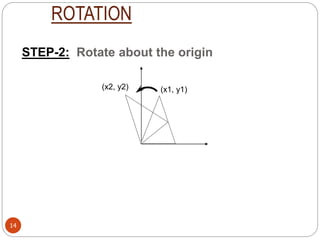
14
(x1, y1)
STEP-2: Rotate about the origin
(x2, y2)
ROTATION
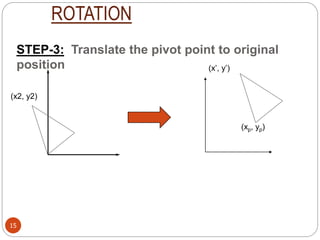
15
STEP-3: Translate the pivot point to original
position
(x2, y2)
(xp, yp)
(x’, y’)
ROTATION
ROTATION
16
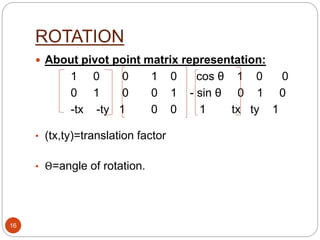
 About pivot point matrix representation:
1 0 0 1 0 cos θ 1 0 0
0 1 0 0 1 - sin θ 0 1 0
-tx -ty 1 0 0 1 tx ty 1
• (tx,ty)=translation factor
• Θ=angle of rotation.
Question
17
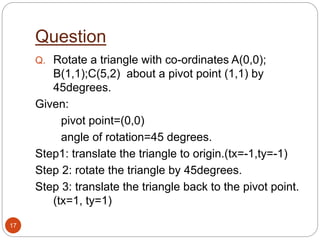
Q. Rotate a triangle with co-ordinates A(0,0);
B(1,1);C(5,2) about a pivot point (1,1) by
45degrees.
Given:
pivot point=(0,0)
angle of rotation=45 degrees.
Step1: translate the triangle to origin.(tx=-1,ty=-1)
Step 2: rotate the triangle by 45degrees.
Step 3: translate the triangle back to the pivot point.
(tx=1, ty=1)
18
THANK YOU

2 d translation

  • 1.
  • 2.
    TRANSFORMATION  Transformation meanschanging some graphics into something else by applying rules.  Types  Translation,  Scaling  Rotation,  Shearing  Reflection 2
  • 3.
    TRANSLATION  Translation movesan object to a different position on the screen.  It can be described as a rigid motion.  It changes the position of object. 3
  • 4.
    TRANSLATION  A pointcan be translated in 2D by adding translation coordinate (tx, ty) to the original coordinate (X, Y) to get the new coordinate (X’, Y’).  i.e. X’=X+ tx Y’=Y+ ty  (tx, ty) is called the translation vector or shift vector. 4
  • 5.
    TRANSLATION  Matrix Representation:  10 0 0 1 0 tx ty 1 • (tx ,ty)= translation factor. 5
  • 6.
  • 7.
    QUESTION 7 Q. Consider aunit square and translate it to 3-units in x-direction and 3-units in y-direction. given: tx=3-units ty=3-units Co-ordinates of the unit square: A(0,0); B(1,0);C(1,1);D(0,1).
  • 8.
    ROTATION 8  Change inorientation.  Rigid body transformation.  Types:  about origin(0,0)  about a pivot point
  • 9.
    ROTATION 9  About origin: In rotation, we rotate the object at particular angle θ (theta) from its origin.  It can be described as rigid body transformation.  It is change in orientation.  Convention: Θ positive: rotation counter clockwise. Θ negative: rotation clockwise.
  • 10.
    ROTATION  The pointP(X, Y) is located at angle φ from the horizontal X coordinate with distance r from the origin.  We rotate it at the angle θ. After rotating it to a new location, we get a new point P’ (X’, Y’). 10
  • 11.
    ROTATION 11  Matrix Representation: cos θ-sin θ 0 sin θ cos θ 0 0 0 1  Question: Rotate a triangle A(0,0); B(1,1), C(5,2) about origin by 45degrees. Given: angle of rotation=45 degrees.
  • 12.
    ROTATION 12  About apivot point:  Pivot point is the point of rotation  Pivot point need not necessarily be on the object (xp , yp) (x,y) (x’,y’) Pivot Point
  • 13.
    13 (xp , yp) (x,y) (x1,y1) STEP-1: Translate the pivot point to the origin ROTATION
  • 14.
    14 (x1, y1) STEP-2: Rotateabout the origin (x2, y2) ROTATION
  • 15.
    15 STEP-3: Translate thepivot point to original position (x2, y2) (xp, yp) (x’, y’) ROTATION
  • 16.
    ROTATION 16  About pivotpoint matrix representation: 1 0 0 1 0 cos θ 1 0 0 0 1 0 0 1 - sin θ 0 1 0 -tx -ty 1 0 0 1 tx ty 1 • (tx,ty)=translation factor • Θ=angle of rotation.
  • 17.
    Question 17 Q. Rotate atriangle with co-ordinates A(0,0); B(1,1);C(5,2) about a pivot point (1,1) by 45degrees. Given: pivot point=(0,0) angle of rotation=45 degrees. Step1: translate the triangle to origin.(tx=-1,ty=-1) Step 2: rotate the triangle by 45degrees. Step 3: translate the triangle back to the pivot point. (tx=1, ty=1)
  • 18.