LIMITS OF FUNCTIONS


1    Introduction

The limits concept is one of the most important ideas in calculus. It is the foundation of almost of
all mathematical analysis.

The limit of a function f (x) as x approaches c is the value that f (x) approaches as x approaches
the number c.


Definition 1 If f (x) get closer and closer to a number L as x gets closer and closer to c from both
sides, then L is the limit of f (x) as x approaches c. Mathematically this is written as

                                            lim f (x) = L
                                            x→c


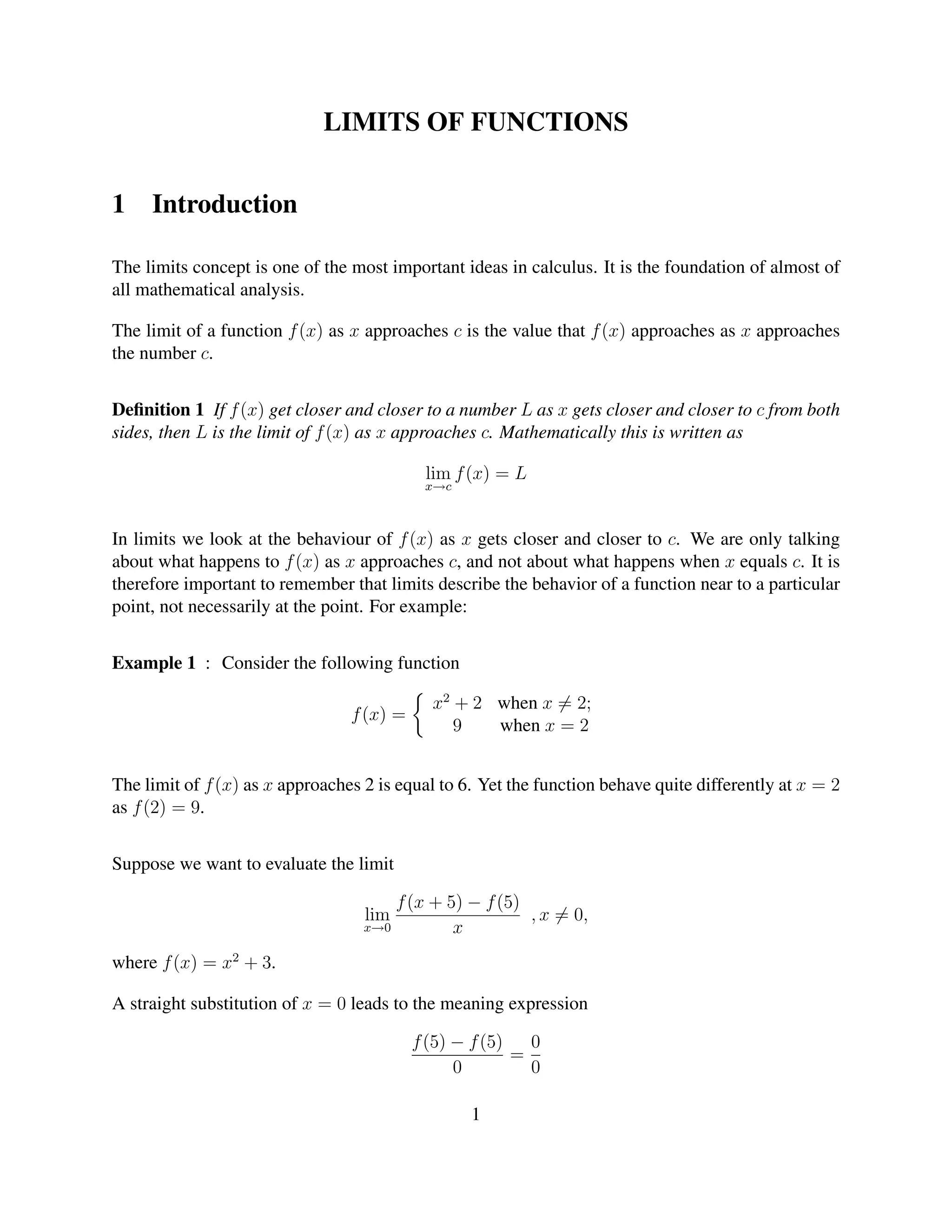
In limits we look at the behaviour of f (x) as x gets closer and closer to c. We are only talking
about what happens to f (x) as x approaches c, and not about what happens when x equals c. It is
therefore important to remember that limits describe the behavior of a function near to a particular
point, not necessarily at the point. For example:


Example 1 : Consider the following function

                                             x2 + 2 when x = 2;
                                 f (x) =
                                                9   when x = 2


The limit of f (x) as x approaches 2 is equal to 6. Yet the function behave quite differently at x = 2
as f (2) = 9.


Suppose we want to evaluate the limit

                                       f (x + 5) − f (5)
                                   lim                   , x = 0,
                                   x→0         x
where f (x) = x2 + 3.

A straight substitution of x = 0 leads to the meaning expression

                                           f (5) − f (5)   0
                                                         =
                                                 0         0

                                                  1
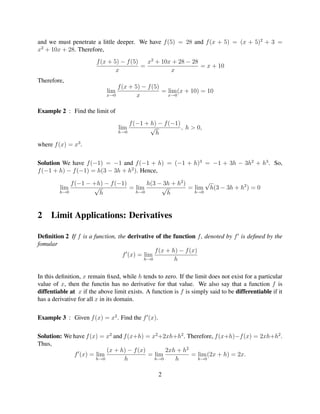
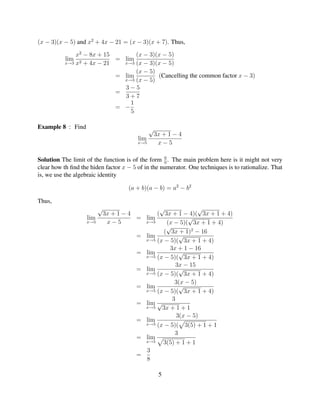
and we must penetrate a little deeper. We have f (5) = 28 and f (x + 5) = (x + 5)2 + 3 =
x2 + 10x + 28. Therefore,
                        f (x + 5) − f (5)   x2 + 10x + 28 − 28
                                          =                    = x + 10
                                x                   x
Therefore,
                                f (x + 5) − f (5)
                            lim                   = lim (x + 10) = 10
                            x→0         x           x→0


Example 2 : Find the limit of
                                      f (−1 + h) − f (−1)
                                  lim         √           , h > 0,
                                  h→0           h
where f (x) = x3 .

Solution We have f (−1) = −1 and f (−1 + h) = (−1 + h)3 = −1 + 3h − 3h2 + h3 . So,
f (−1 + h) − f (−1) = h(3 − 3h + h2 ). Hence,

             f (−1 − +h) − f (−1)       h(3 − 3h + h2 )       √
         lim         √            = lim      √          = lim h(3 − 3h + h2 ) = 0
         h→0           h            h→0        h          h→0


2    Limit Applications: Derivatives

Definition 2 If f is a function, the derivative of the function f , denoted by f is defined by the
fomular
                                              f (x + h) − f (x)
                                  f (x) = lim
                                          h→0         h

In this definition, x remain fixed, while h tends to zero. If the limit does not exist for a particular
value of x, then the functin has no derivative for that value. We also say that a function f is
diffentiable at x if the above limit exists. A function is f is simply said to be differentiable if it
has a derivative for all x in its domain.

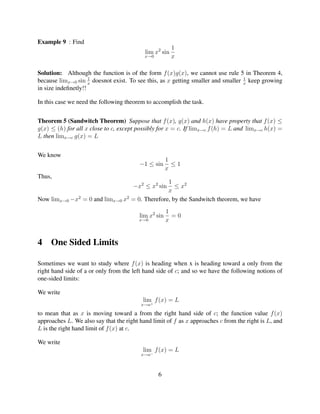
Example 3 : Given f (x) = x2 . Find the f (x).

Solution: We have f (x) = x2 and f (x+h) = x2 +2xh+h2 . Therefore, f (x+h)−f (x) = 2xh+h2 .
Thus,
                          (x + h) − f (x)       2xh + h2
             f (x) = lim                  = lim          = lim (2x + h) = 2x.
                      h→0        h          h→0    h       h→0


                                                  2
1
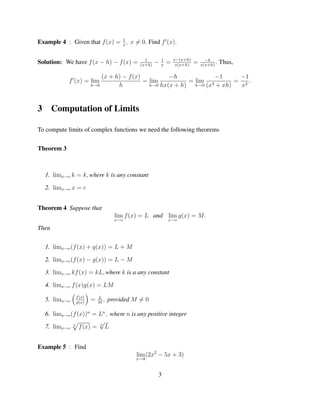
Example 4 : Given that f (x) = x , x = 0. Find f (x).

                                               1         1       x−(x+h)         −h
Solution: We have f (x − h) − f (x) =        (x+h)
                                                     −   x
                                                             =    x(x+h)
                                                                           =   x(x+h)
                                                                                      .   Thus,

                            (x + h) − f (x)          −h              −1     −1
             f (x) = lim                    = lim           = lim 2        = 2.
                        h→0       h           h→0 hx(x + h)   h→0 (x + xh)  x


3      Computation of Limits

To compute limits of complex functions we need the following theorems


Theorem 3


    1. limx→c k = k, where k is any constant

    2. limx→c x = c


Theorem 4 Suppose that
                                    lim f (x) = L and lim g(x) = M.
                                    x→c                      x→c

Then


    1. limx→c (f (x) + g(x)) = L + M

    2. limx→c (f (x) − g(x)) = L − M

    3. limx→c kf (x) = kL, where k is a any constant

    4. limx→c f (x)g(x) = LM
                f (x)       L
    5. limx→c   g(x)
                        =   M
                              ,   provided M = 0

    6. limx→c (f (x))n = Ln , where n is any positive integer
                         √
    7. limx→c n f (x) = n L


Example 5 : Find
                                           lim (2x2 − 5x + 3)
                                           x→8


                                                     3
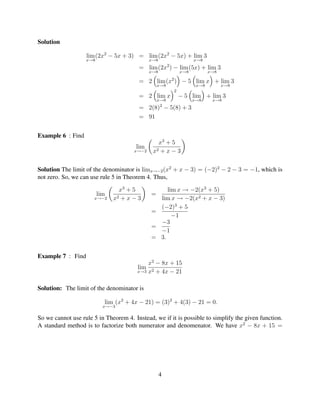
Solution

                   lim (2x2 − 5x + 3) = lim (2x2 − 5x) + lim 3
                   x→8                        x→8                     x→8
                                                        2
                                        = lim (2x ) − lim (5x) + lim 3
                                              x→8               x→8          x→8

                                        = 2 lim (x2 ) − 5 lim x + lim 3
                                                  x→8                  x→8         x→8
                                                            2
                                        = 2 lim x               − 5 lim + lim 3
                                                  x→8                 x→8     x→8
                                                   2
                                        = 2(8) − 5(8) + 3
                                        = 91


Example 6 : Find
                                                 x3 + 5
                                       lim
                                       x→−2    x2 + x − 3

Solution The limit of the denominator is limx→−2 (x2 + x − 3) = (−2)2 − 2 − 3 = −1, which is
not zero. So, we can use rule 5 in Theorem 4. Thus,

                                 x3 + 5            lim x → −2(x3 + 5)
                         lim                  =
                      x→−2     x2 + x − 3       lim x → −2(x2 + x − 3)
                                                (−2)3 + 5
                                              =
                                                     −1
                                                −3
                                              =
                                                −1
                                              = 3.


Example 7 : Find
                                            x2 − 8x + 15
                                        lim
                                        x→3 x2 + 4x − 21


Solution: The limit of the denominator is

                           lim (x2 + 4x − 21) = (3)2 + 4(3) − 21 = 0.
                           x→−3

So we cannot use rule 5 in Theorem 4. Instead, we if it is possible to simplify the given function.
A standard method is to factorize both numerator and denomenator. We have x2 − 8x + 15 =


                                                    4
(x − 3)(x − 5) and x2 + 4x − 21 = (x − 3)(x + 7). Thus,

               x2 − 8x + 15       (x − 3)(x − 5)
           lim              = lim
           x→3 x2 + 4x − 21   x→3 (x − 3)(x − 5)

                                  (x − 5)
                            = lim         (Cancelling the common factor x − 3)
                              x→3 (x − 5)
                              3−5
                            =
                              3+7
                                1
                            = −
                                5

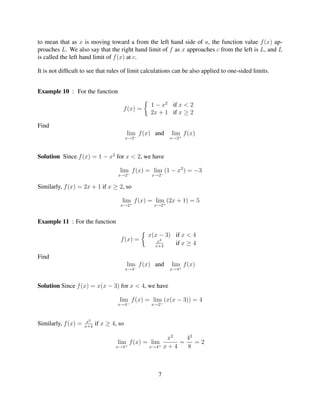
Example 8 : Find                              √
                                                  3x + 1 − 4
                                        lim
                                        x→5        x−5

                                                   0
Solution The limit of the function is of the form 0 . The main problem here is it might not very
clear how th find the hiden factor x − 5 of in the numerator. One techniques is to rationalize. That
is, we use the algebraic identity

                                    (a + b)(a − b) = a2 − b2

Thus,
                       √                  √              √
                        3x + 1 − 4       ( 3x + 1 − 4)( 3x + 1 + 4)
                   lim             = lim             √
                   x→5   x−5         x→5     (x − 5)( 3x + 1 + 4)
                                             √
                                            ( 3x + 1)2 − 16
                                   = lim          √
                                     x→5 (x − 5)( 3x + 1 + 4)

                                              3x + 1 − 16
                                   = lim          √
                                     x→5 (x − 5)( 3x + 1 + 4)

                                                 3x − 15
                                   = lim          √
                                     x→5 (x − 5)( 3x + 1 + 4)

                                                3(x − 5)
                                   = lim          √
                                     x→5 (x − 5)( 3x + 1 + 4)

                                               3
                                   = lim √
                                     x→5   3x + 1 + 1
                                                 3(x − 5)
                                   = lim
                                     x→5 (x − 5)( 3(5) + 1 + 1

                                                3
                                   = lim
                                     x→5   3(5) + 1 + 1
                                     3
                                   =
                                     8

                                                   5
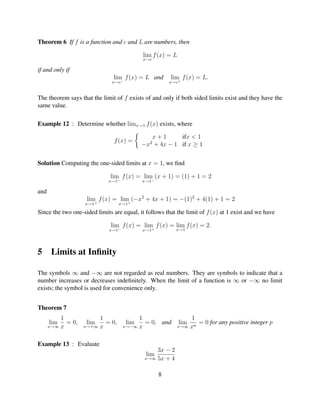
Example 9 : Find
                                                        1
                                           lim x2 sin
                                           x→0          x

Solution: Although the function is of the form f (x)g(x), we cannot use rule 5 in Theorem 4,
                     1                                                            1
because limx→0 sin x doesnot exist. To see this, as x getting smaller and smaller x keep growing
in size indefinetly!!

In this case we need the following theorem to accomplish the task.


Theorem 5 (Sandwitch Theorem) Suppose that f (x), g(x) and h(x) have property that f (x) ≤
g(x) ≤ (h) for all x close to c, except possibly for x = c. If limx→c f (h) = L and limx→c h(x) =
L then limx→c g(x) = L


We know
                                                      1
                                         −1 ≤ sin       ≤1
                                                      x
Thus,
                                               1
                                      −x2 ≤ x2 sin≤ x2
                                               x
Now limx→0 −x2 = 0 and limx→0 x2 = 0. Therefore, by the Sandwitch theorem, we have
                                                      1
                                         lim x2 sin     =0
                                         x→0          x


4    One Sided Limits

Sometimes we want to study where f (x) is heading when x is heading toward a only from the
right hand side of a or only from the left hand side of c; and so we have the following notions of
one-sided limits:

We write
                                          lim f (x) = L
                                         x→a+

to mean that as x is moving toward a from the right hand side of c; the function value f (x)
approaches L. We also say that the right hand limit of f as x approaches c from the right is L, and
L is the right hand limit of f (x) at c.

We write
                                          lim f (x) = L
                                         x→a−


                                                 6
to mean that as x is moving toward a from the left hand side of a, the function value f (x) ap-
proaches L. We also say that the right hand limit of f as x approaches c from the left is L, and L
is called the left hand limit of f (x) at c.

It is not difficult to see that rules of limit calculations can be also applied to one-sided limits.


Example 10 : For the function

                                                  1 − x2 if x < 2
                                      f (x) =
                                                  2x + 1 if x ≥ 2

Find
                                          lim f (x) and      lim f (x)
                                          x→2−              x→2+


Solution Since f (x) = 1 − x2 for x < 2, we have

                                     lim f (x) = lim (1 − x2 ) = −3
                                    x→2−            −
                                                  x→2

Similarly, f (x) = 2x + 1 if x ≥ 2, so

                                      lim f (x) = lim (2x + 1) = 5
                                     x→2+            +
                                                   x→2


Example 11 : For the function

                                                 x(x − 3) if x < 4
                                     f (x) =        x2
                                                   x+4
                                                          if x ≥ 4

Find
                                          lim f (x) and      lim f (x)
                                          x→4−              x→4+


Solution Since f (x) = x(x − 3) for x < 4, we have

                                     lim f (x) = lim (x(x − 3)) = 4
                                    x→4−            −
                                                  x→2


                      x2
Similarly, f (x) =   x+4
                           if x ≥ 4, so

                                                            x2   42
                                    lim f (x) = lim            =    =2
                                   x→4 +           +
                                                 x→4       x+4   8


                                                       7
Theorem 6 If f is a function and c and L are numbers, then

                                            lim f (x) = L
                                           x→c

if and only if
                               lim f (x) = L and       lim f (x) = L.
                              x→c−                     x→c+


The theorem says that the limit of f exists of and only if both sided limits exist and they have the
same value.

Example 12 : Determine whether limx→1 f (x) exists, where

                                              x+1       ifx < 1
                               f (x) =
                                           −x2 + 4x − 1 if x ≥ 1


Solution Computing the one-sided limits at x = 1, we find

                              lim f (x) = lim (x + 1) = (1) + 1 = 2
                             x→1−            −
                                           x→1

and
                    lim f (x) = lim (−x2 + 4x + 1) = −(1)2 + 4(1) + 1 = 2
                       +           +
                   x→1           x→1

Since the two one-sided limits are equal, it follows that the limit of f (x) at 1 exist and we have

                              lim f (x) = lim f (x) = lim f (x) = 2.
                             x→1−            +
                                           x→1           x→1


5      Limits at Infinity

The symbols ∞ and −∞ are not regarded as real numbers. They are symbols to indicate that a
number increases or decreases indefinitely. When the limit of a function is ∞ or −∞ no limit
exists; the symbol is used for convenience only.


Theorem 7
          1             1                1                    1
      lim   = 0,    lim   = 0,       lim   = 0, and         lim  = 0 for any positive integer p
      x→∞ x        x→+∞ x           x→−∞ x                x→∞ xn


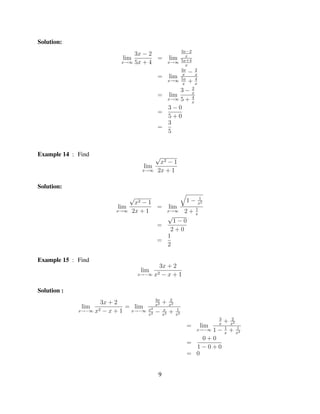
Example 13 : Evaluate
                                                3x − 2
                                             lim
                                            x→∞ 5x + 4


                                                   8
Solution:
                                                       3x−2
                             3x − 2                       x
                         lim        =             lim
                         x→∞ 5x + 4               x→∞ 5x+4
                                                          x
                                                       3x
                                                            −2
                                         =         lim 5x x
                                                        x
                                                               4
                                                  x→∞
                                                        x
                                                            +x
                                                             2
                                                       3− x
                                         =         lim
                                                  x→∞ 5 + 4
                                                             x
                                           3−0
                                         =
                                           5+0
                                           3
                                         =
                                           5


Example 14 : Find                       √
                                          x2 − 1
                                lim
                                x→∞      2x + 1

Solution:
                           √                                1−    1
                            x2 − 1                               x2
                        lim        =       lim                  1
                       x→∞ 2x + 1               2+x→∞
                                                                x
                                           √
                                             1−0
                                         =
                                            2+0
                                           1
                                         =
                                           2

Example 15 : Find
                                         3x + 2
                               lim
                               x→−∞     x2−x+1

Solution :
                                        3x        2
                    3x + 2              x2
                                             +    x2
              lim   2−x+1
                           = lim   x2        x         1
             x→−∞ x         x→−∞        −         +
                                   x2        x2        x2
                                                                         3       2
                                                                         x
                                                                             +   x2
                                                            =      lim       1        1
                                                                  1−
                                                                 x→−∞
                                                                             x
                                                                                 +    x2
                                                                0+0
                                                            =
                                                              1−0+0
                                                            = 0


                                         9

Limits

  • 1.
    LIMITS OF FUNCTIONS 1 Introduction The limits concept is one of the most important ideas in calculus. It is the foundation of almost of all mathematical analysis. The limit of a function f (x) as x approaches c is the value that f (x) approaches as x approaches the number c. Definition 1 If f (x) get closer and closer to a number L as x gets closer and closer to c from both sides, then L is the limit of f (x) as x approaches c. Mathematically this is written as lim f (x) = L x→c In limits we look at the behaviour of f (x) as x gets closer and closer to c. We are only talking about what happens to f (x) as x approaches c, and not about what happens when x equals c. It is therefore important to remember that limits describe the behavior of a function near to a particular point, not necessarily at the point. For example: Example 1 : Consider the following function x2 + 2 when x = 2; f (x) = 9 when x = 2 The limit of f (x) as x approaches 2 is equal to 6. Yet the function behave quite differently at x = 2 as f (2) = 9. Suppose we want to evaluate the limit f (x + 5) − f (5) lim , x = 0, x→0 x where f (x) = x2 + 3. A straight substitution of x = 0 leads to the meaning expression f (5) − f (5) 0 = 0 0 1
  • 2.
    and we mustpenetrate a little deeper. We have f (5) = 28 and f (x + 5) = (x + 5)2 + 3 = x2 + 10x + 28. Therefore, f (x + 5) − f (5) x2 + 10x + 28 − 28 = = x + 10 x x Therefore, f (x + 5) − f (5) lim = lim (x + 10) = 10 x→0 x x→0 Example 2 : Find the limit of f (−1 + h) − f (−1) lim √ , h > 0, h→0 h where f (x) = x3 . Solution We have f (−1) = −1 and f (−1 + h) = (−1 + h)3 = −1 + 3h − 3h2 + h3 . So, f (−1 + h) − f (−1) = h(3 − 3h + h2 ). Hence, f (−1 − +h) − f (−1) h(3 − 3h + h2 ) √ lim √ = lim √ = lim h(3 − 3h + h2 ) = 0 h→0 h h→0 h h→0 2 Limit Applications: Derivatives Definition 2 If f is a function, the derivative of the function f , denoted by f is defined by the fomular f (x + h) − f (x) f (x) = lim h→0 h In this definition, x remain fixed, while h tends to zero. If the limit does not exist for a particular value of x, then the functin has no derivative for that value. We also say that a function f is diffentiable at x if the above limit exists. A function is f is simply said to be differentiable if it has a derivative for all x in its domain. Example 3 : Given f (x) = x2 . Find the f (x). Solution: We have f (x) = x2 and f (x+h) = x2 +2xh+h2 . Therefore, f (x+h)−f (x) = 2xh+h2 . Thus, (x + h) − f (x) 2xh + h2 f (x) = lim = lim = lim (2x + h) = 2x. h→0 h h→0 h h→0 2
  • 3.
    1 Example 4 :Given that f (x) = x , x = 0. Find f (x). 1 1 x−(x+h) −h Solution: We have f (x − h) − f (x) = (x+h) − x = x(x+h) = x(x+h) . Thus, (x + h) − f (x) −h −1 −1 f (x) = lim = lim = lim 2 = 2. h→0 h h→0 hx(x + h) h→0 (x + xh) x 3 Computation of Limits To compute limits of complex functions we need the following theorems Theorem 3 1. limx→c k = k, where k is any constant 2. limx→c x = c Theorem 4 Suppose that lim f (x) = L and lim g(x) = M. x→c x→c Then 1. limx→c (f (x) + g(x)) = L + M 2. limx→c (f (x) − g(x)) = L − M 3. limx→c kf (x) = kL, where k is a any constant 4. limx→c f (x)g(x) = LM f (x) L 5. limx→c g(x) = M , provided M = 0 6. limx→c (f (x))n = Ln , where n is any positive integer √ 7. limx→c n f (x) = n L Example 5 : Find lim (2x2 − 5x + 3) x→8 3
  • 4.
    Solution lim (2x2 − 5x + 3) = lim (2x2 − 5x) + lim 3 x→8 x→8 x→8 2 = lim (2x ) − lim (5x) + lim 3 x→8 x→8 x→8 = 2 lim (x2 ) − 5 lim x + lim 3 x→8 x→8 x→8 2 = 2 lim x − 5 lim + lim 3 x→8 x→8 x→8 2 = 2(8) − 5(8) + 3 = 91 Example 6 : Find x3 + 5 lim x→−2 x2 + x − 3 Solution The limit of the denominator is limx→−2 (x2 + x − 3) = (−2)2 − 2 − 3 = −1, which is not zero. So, we can use rule 5 in Theorem 4. Thus, x3 + 5 lim x → −2(x3 + 5) lim = x→−2 x2 + x − 3 lim x → −2(x2 + x − 3) (−2)3 + 5 = −1 −3 = −1 = 3. Example 7 : Find x2 − 8x + 15 lim x→3 x2 + 4x − 21 Solution: The limit of the denominator is lim (x2 + 4x − 21) = (3)2 + 4(3) − 21 = 0. x→−3 So we cannot use rule 5 in Theorem 4. Instead, we if it is possible to simplify the given function. A standard method is to factorize both numerator and denomenator. We have x2 − 8x + 15 = 4
  • 5.
    (x − 3)(x− 5) and x2 + 4x − 21 = (x − 3)(x + 7). Thus, x2 − 8x + 15 (x − 3)(x − 5) lim = lim x→3 x2 + 4x − 21 x→3 (x − 3)(x − 5) (x − 5) = lim (Cancelling the common factor x − 3) x→3 (x − 5) 3−5 = 3+7 1 = − 5 Example 8 : Find √ 3x + 1 − 4 lim x→5 x−5 0 Solution The limit of the function is of the form 0 . The main problem here is it might not very clear how th find the hiden factor x − 5 of in the numerator. One techniques is to rationalize. That is, we use the algebraic identity (a + b)(a − b) = a2 − b2 Thus, √ √ √ 3x + 1 − 4 ( 3x + 1 − 4)( 3x + 1 + 4) lim = lim √ x→5 x−5 x→5 (x − 5)( 3x + 1 + 4) √ ( 3x + 1)2 − 16 = lim √ x→5 (x − 5)( 3x + 1 + 4) 3x + 1 − 16 = lim √ x→5 (x − 5)( 3x + 1 + 4) 3x − 15 = lim √ x→5 (x − 5)( 3x + 1 + 4) 3(x − 5) = lim √ x→5 (x − 5)( 3x + 1 + 4) 3 = lim √ x→5 3x + 1 + 1 3(x − 5) = lim x→5 (x − 5)( 3(5) + 1 + 1 3 = lim x→5 3(5) + 1 + 1 3 = 8 5
  • 6.
    Example 9 :Find 1 lim x2 sin x→0 x Solution: Although the function is of the form f (x)g(x), we cannot use rule 5 in Theorem 4, 1 1 because limx→0 sin x doesnot exist. To see this, as x getting smaller and smaller x keep growing in size indefinetly!! In this case we need the following theorem to accomplish the task. Theorem 5 (Sandwitch Theorem) Suppose that f (x), g(x) and h(x) have property that f (x) ≤ g(x) ≤ (h) for all x close to c, except possibly for x = c. If limx→c f (h) = L and limx→c h(x) = L then limx→c g(x) = L We know 1 −1 ≤ sin ≤1 x Thus, 1 −x2 ≤ x2 sin≤ x2 x Now limx→0 −x2 = 0 and limx→0 x2 = 0. Therefore, by the Sandwitch theorem, we have 1 lim x2 sin =0 x→0 x 4 One Sided Limits Sometimes we want to study where f (x) is heading when x is heading toward a only from the right hand side of a or only from the left hand side of c; and so we have the following notions of one-sided limits: We write lim f (x) = L x→a+ to mean that as x is moving toward a from the right hand side of c; the function value f (x) approaches L. We also say that the right hand limit of f as x approaches c from the right is L, and L is the right hand limit of f (x) at c. We write lim f (x) = L x→a− 6
  • 7.
    to mean thatas x is moving toward a from the left hand side of a, the function value f (x) ap- proaches L. We also say that the right hand limit of f as x approaches c from the left is L, and L is called the left hand limit of f (x) at c. It is not difficult to see that rules of limit calculations can be also applied to one-sided limits. Example 10 : For the function 1 − x2 if x < 2 f (x) = 2x + 1 if x ≥ 2 Find lim f (x) and lim f (x) x→2− x→2+ Solution Since f (x) = 1 − x2 for x < 2, we have lim f (x) = lim (1 − x2 ) = −3 x→2− − x→2 Similarly, f (x) = 2x + 1 if x ≥ 2, so lim f (x) = lim (2x + 1) = 5 x→2+ + x→2 Example 11 : For the function x(x − 3) if x < 4 f (x) = x2 x+4 if x ≥ 4 Find lim f (x) and lim f (x) x→4− x→4+ Solution Since f (x) = x(x − 3) for x < 4, we have lim f (x) = lim (x(x − 3)) = 4 x→4− − x→2 x2 Similarly, f (x) = x+4 if x ≥ 4, so x2 42 lim f (x) = lim = =2 x→4 + + x→4 x+4 8 7
  • 8.
    Theorem 6 Iff is a function and c and L are numbers, then lim f (x) = L x→c if and only if lim f (x) = L and lim f (x) = L. x→c− x→c+ The theorem says that the limit of f exists of and only if both sided limits exist and they have the same value. Example 12 : Determine whether limx→1 f (x) exists, where x+1 ifx < 1 f (x) = −x2 + 4x − 1 if x ≥ 1 Solution Computing the one-sided limits at x = 1, we find lim f (x) = lim (x + 1) = (1) + 1 = 2 x→1− − x→1 and lim f (x) = lim (−x2 + 4x + 1) = −(1)2 + 4(1) + 1 = 2 + + x→1 x→1 Since the two one-sided limits are equal, it follows that the limit of f (x) at 1 exist and we have lim f (x) = lim f (x) = lim f (x) = 2. x→1− + x→1 x→1 5 Limits at Infinity The symbols ∞ and −∞ are not regarded as real numbers. They are symbols to indicate that a number increases or decreases indefinitely. When the limit of a function is ∞ or −∞ no limit exists; the symbol is used for convenience only. Theorem 7 1 1 1 1 lim = 0, lim = 0, lim = 0, and lim = 0 for any positive integer p x→∞ x x→+∞ x x→−∞ x x→∞ xn Example 13 : Evaluate 3x − 2 lim x→∞ 5x + 4 8
  • 9.
    Solution: 3x−2 3x − 2 x lim = lim x→∞ 5x + 4 x→∞ 5x+4 x 3x −2 = lim 5x x x 4 x→∞ x +x 2 3− x = lim x→∞ 5 + 4 x 3−0 = 5+0 3 = 5 Example 14 : Find √ x2 − 1 lim x→∞ 2x + 1 Solution: √ 1− 1 x2 − 1 x2 lim = lim 1 x→∞ 2x + 1 2+x→∞ x √ 1−0 = 2+0 1 = 2 Example 15 : Find 3x + 2 lim x→−∞ x2−x+1 Solution : 3x 2 3x + 2 x2 + x2 lim 2−x+1 = lim x2 x 1 x→−∞ x x→−∞ − + x2 x2 x2 3 2 x + x2 = lim 1 1 1− x→−∞ x + x2 0+0 = 1−0+0 = 0 9