Instructor’s Manual
with Sample Tests for
Elementary
Linear Algebra
Fifth Edition
Stephen Andrilli
David Hecker
Elementary Linear Algebra 5th Edition Larson Solutions Manual
Full Download: http://alibabadownload.com/product/elementary-linear-algebra-5th-edition-larson-solutions-manual/
This sample only, Download all chapters at: alibabadownload.com
Dedication
To all the instructors who have used the various
editions of our book over the years
ii
Table of Contents
Preface ........................................................................iii
Answers to Exercises………………………………….1
Chapter 1 Answer Key ……………………………….1
Chapter 2 Answer Key ……………………………...19
Chapter 3 Answer Key ……………………………...33
Chapter 4 Answer Key ……………………………...52
Chapter 5 Answer Key ……………………………...87
Chapter 6 Answer Key …………………………….118
Chapter 7 Answer Key …………………………….128
Chapter 8 Answer Key …………………………….145
Chapter 9 Answer Key …………………………….170
Appendix B Answer Key ………………………….185
Appendix C Answer Key ………………………….186
Appendix D Answer Key ………………………….187
Chapter Tests ……..……………………………….190
Chapter 1 – Chapter Tests …………………………191
Chapter 2 – Chapter Tests …………………………194
Chapter 3 – Chapter Tests …………………………197
Chapter 4 – Chapter Tests …………………………201
Chapter 5 – Chapter Tests …………………………204
Chapter 6 – Chapter Tests …………………………210
Chapter 7 – Chapter Tests …………………………213
Answers to Chapter Tests ………………………….219
Chapter 1 – Answers for Chapter Tests …………...219
Chapter 2 – Answers for Chapter Tests …………...222
Chapter 3 – Answers for Chapter Tests …………...225
Chapter 4 – Answers for Chapter Tests …………...228
Chapter 5 – Answers for Chapter Tests …………...234
Chapter 6 – Answers for Chapter Tests …………...240
Chapter 7 – Answers for Chapter Tests …………...245
iii
Preface
This Instructor’s Manual with Sample Tests is designed
to accompany Elementary Linear Algebra, 5th
edition, by
Stephen Andrilli and David Hecker.
This manual contains answers for all the computational
exercises in the textbook and detailed solutions for
virtually all of the problems that ask students for proofs.
The exceptions are typically those exercises that ask
students to verify a particular computation, or that ask for
a proof for which detailed hints have already been
supplied in the textbook. A few proofs that are extremely
trivial in nature have also been omitted.
This manual also contains sample Chapter Tests for the
material in Chapters 1 through 7, as well as answer keys
for these tests.
Additional information regarding the textbook, this
manual, the Student Solutions Manual, and linear algebra
in general can be found at the web site for the textbook,
where you found this manual.
Thank you for using our textbook.
Stephen Andrilli
David Hecker
August 2015
Answers to Exercises Section 1.1
Answers to Exercises
Chapter 1
Section 1.1
(1) (a) [9 −4], distance =
√
97
(b) [−6 1 1], distance =
√
38
(c) [−1 −1 2 −3 −4], distance =
√
31
(2) (a) (3 4 2) (see Figure 1)
(b) (0 5 3) (see Figure 2)
(c) (1 −2 0) (see Figure 3)
(d) (3 0 0) (see Figure 4)
(3) (a) (7 −13) (b) (6 4 −8) (c) (−1 3 −1 4 6)
(4) (a)
¡16
3  −13
3  8
¢
(b) (−20
3  −1 −6 −1)
(5) (a)
h
3√
70
 − 5√
70
 6√
70
i
; shorter, since length of original vector is  1
(b)
£
−6
7  2
7  0 −3
7
¤
; shorter, since length of original vector is  1
(c) [06 −08]; neither, since given vector is a unit vector
(d)
h
1√
11
 − 2√
11
 − 1√
11
 1√
11
 2√
11
i
; longer, since length of original vector =
√
11
5  1
(6) (a) Parallel (b) Parallel (c) Not parallel (d) Not parallel
(7) (a) [−6 12 15]
(b) [10 6 −12]
(c) [−7 1 11]
(d) [−9 −2 4]
(e) [−10 −32 −1]
(f) [−35 3 20]
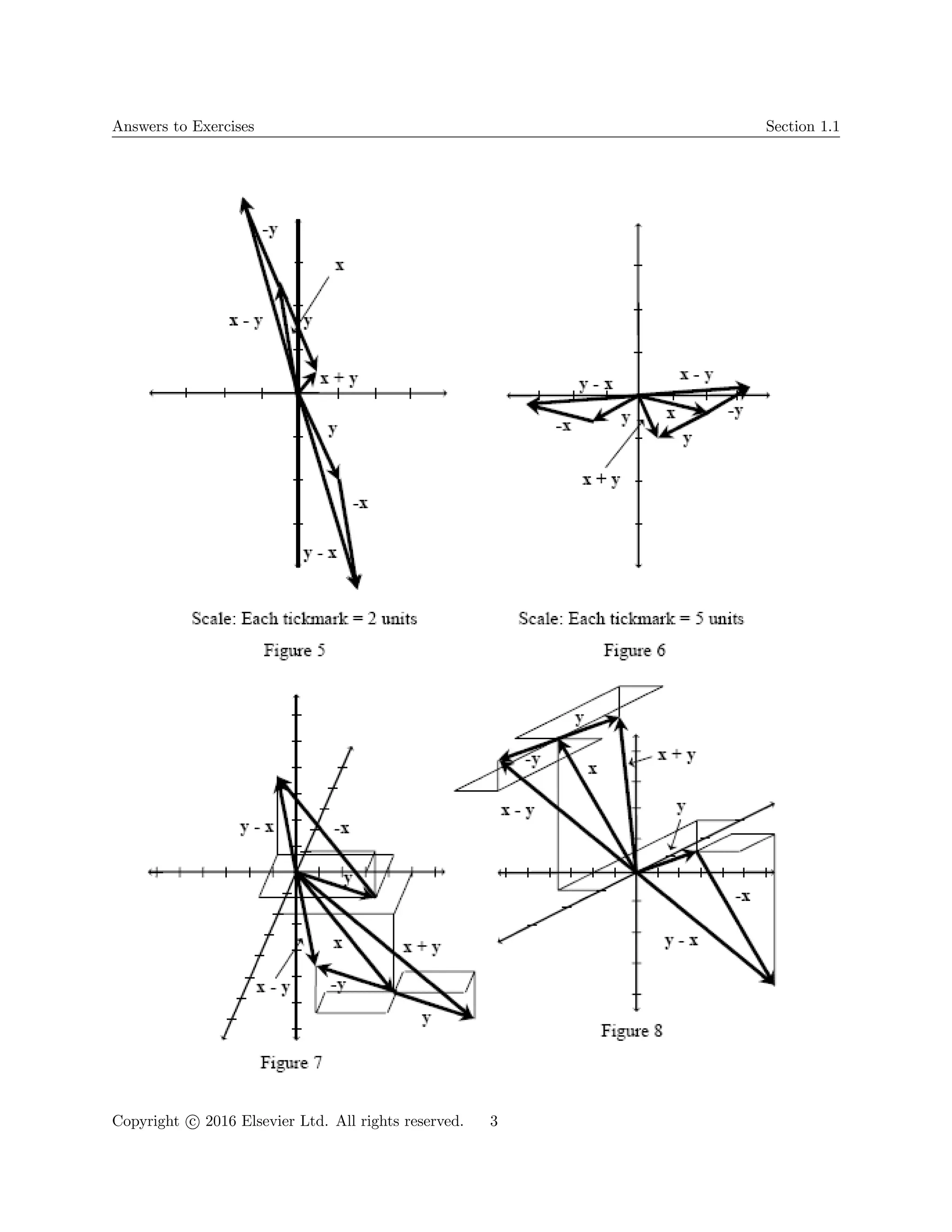
(8) (a) x + y = [1 1], x − y = [−3 9], y − x = [3 −9] (see Figure 5)
(b) x + y = [3 −5], x − y = [17 1], y − x = [−17 −1] (see Figure 6)
(c) x + y = [1 8 −5], x − y = [3 2 −1], y − x = [−3 −2 1] (see Figure 7)
(d) x + y = [−2 −4 4], x − y = [4 0 6], y − x = [−4 0 −6] (see Figure 8)
(9) With  = (7 −3 6),  = (11 −5 3), and  = (10 −7 8), the length of side  = length of side 
=
√
29. The triangle is isosceles, but not equilateral, since the length of side  is
√
30.
(10) (a) [10 −10] (b) [−5
√
3 −15] (c) [0 0] = 0
(11) See Figures 1.7 and 1.8 in Section 1.1 of the textbook.
Copyright c° 2016 Elsevier Ltd. All rights reserved. 1
Answers to Exercises Section 1.1
Copyright c° 2016 Elsevier Ltd. All rights reserved. 2
Answers to Exercises Section 1.1
Copyright c° 2016 Elsevier Ltd. All rights reserved. 3
Answers to Exercises Section 1.1
(12) See Figure 9. Both represent the same diagonal vector by the associative law of addition for vectors.
Figure 9: x + (y + z)
(13) [05 − 06
√
2 −04
√
2] ≈ [−03485 −05657]
(14) Net velocity = [−2
√
2 −3 + 2
√
2], resultant speed ≈ 283 km/hr
(15) Net velocity =
h
−3
√
2
2  8−3
√
2
2
i
; speed ≈ 283 km/hr
(16) [−8 −
√
2 −
√
2]
(17) Acceleration = 1
20 [12
13  −344
65  392
65 ] ≈ [00462 −02646 03015]
(18) Acceleration =
£13
2  0 4
3
¤
(19) 180√
14
[−2 3 1] ≈ [−9622 14432 4811]
(20) a = [ −
1+
√
3
 
1+
√
3
]; b = [ 
1+
√
3
 
√
3
1+
√
3
]
(21) Let a = [1     ].
(a) kak2
= 2
1 + · · · + 2
 is a sum of squares, which must be nonnegative. But then ||a|| ≥ 0 because
the square root of a nonnegative real number is a nonnegative real number.
(b) If ||a|| = 0, then kak2
= 2
1 + · · · + 2
 = 0, which is only possible if every  = 0. Thus, a = 0.
(22) In each part, suppose that x = [1     ], y = [1     ], and z = [1     ].
(a) x + (y + z) = [1     ] + [(1 + 1)     ( + )] = [(1 + (1 + 1))     ( + ( + ))]
= [((1 + 1) + 1)     (( + ) + )] = [(1 + 1)     ( + )] + [1     ] = (x + y) + z
(b) x + (−x) = [1     ] + [−1     −] = [(1 + (−1))     ( + (−))] = [0     0]. Also,
(−x) + x = x + (−x) (by part (1) of Theorem 1.3) = 0, by the above.
(c) (x+y) = ([(1+1)     (+)]) = [(1+1)     (+)] = [(1+1)     (+)] =
[1     ] + [1     ] = x + y
Copyright c° 2016 Elsevier Ltd. All rights reserved. 4
Answers to Exercises Section 1.2
(d) ()x = [(()1)     (())] = [((1))     (())] = [(1)     ()]
= ([1     ]) = (x)
(23) If  = 0, done. Otherwise, (1
 )(x) = 1
 (0) =⇒ (1
 · )x = 0 (by part (7) of Theorem 1.3) =⇒ x = 0
Thus either  = 0 or x = 0.
(24) 1x = 2x =⇒ 1x − 2x = 0 =⇒ (1 − 2)x = 0 =⇒ (1 − 2) = 0 or x = 0 by Theorem 1.4. But
since 1 6= 2 (1 − 2) 6= 0 Hence, x = 0
(25) (a) F (b) T (c) T (d) F (e) T (f) F (g) F (h) F
Section 1.2
(1) (a) arccos(− 27
5
√
37
), or about 1526◦
, or 266 radians
(b) arccos( 46√
74
√
29
), or about 68◦
, or 012 radians
(c) arccos(0), which is 90◦
, or 
2 radians
(d) arccos(− 435√
2175
√
87
) = arccos(−1), which is 180◦
, or  radians (since x = −5y)
(2) The vector from 1 to 2 is [2 −7 −3], and the vector from 1 to 3 is [5 4 −6]. These vectors are
orthogonal.
(3) (a) [ ] · [− ] = (−) +  = 0 Similarly, [ −] · [ ] = 0
(b) A vector in the direction of the line  +  +  = 0 is [ −], while a vector in the direction of
 −  +  = 0 is [ ].
(4) (a) 15 joules (b) 1040
√
5
9 ≈ 2584 joules (c) −189
√
15
5 ≈ −1464 joules
(5) Note that y·z is a scalar, so x·(y·z) is not defined.
(6) In all parts, let x = [1 2     ]  y = [1 2     ]  and z = [1 2     ] 
(a) x · y = [1 2     ] · [1 2     ] = 11 + · · · +  = 11 + · · · + 
= [1 2     ] · [1 2     ] = y · x
(b) x · x = [1 2     ] · [1 2     ] = 11 + · · · +  = 2
1 + · · · + 2
. Now 2
1 + · · · + 2

is a sum of squares, each of which must be nonnegative. Hence, the sum is also nonnegative, and
so its square root is defined. Thus, 0 ≤ x · x = 2
1 + · · · + 2
 =
³p
2
1 + · · · + 2

´2
= kxk2
.
(c) Suppose x · x = 0. From part (b), 0 = x · x = 2
1 + · · · + 2
 ≥ 2
 , for each , since all terms in the
sum are nonnegative. Hence, 0 ≥ 2
 for each . But 2
 ≥ 0, because it is a square. Hence each
 = 0. Therefore, x = 0.
(d) (x · y) =  ([1 2     ] · [1 2     ]) =  (11 + · · · + )
= 11 + · · · +  = [1 2     ] · [1 2     ] = (x) · y.
Next, (x · y) = (y · x) (by part (a)) = (y) · x (from above) = x · (y), by part (a)
Copyright c° 2016 Elsevier Ltd. All rights reserved. 5
Answers to Exercises Section 1.2
(e) (x + y) · z = ([1 2     ] + [1 2     ]) · [1 2     ]
= [1 + 1 2 + 2      + ] · [1 2     ]
= (1 + 1)1 + (2 + 2)2 + · · · + ( + )
= (11 + 22 + · · · + ) + (11 + 22 + · · · + )
Also, (x · z) + (y · z) = ([1 2     ] · [1 2     ]) + ([1 2     ] · [1 2     ])
= (11 + 22 + · · · + ) + (11 + 22 + · · · + ).
Hence, (x + y) · z = (x · z) + (y · z).
(7) No; consider x = [1 0], y = [0 1], and z = [1 1].
(8) A method similar to the first part of the proof of Lemma 1.6 in the textbook yields:
ka − bk
2
≥ 0 =⇒ (a · a) − (b · a) − (a · b) + (b · b) ≥ 0 =⇒ 1 − 2(a · b) + 1 ≥ 0 =⇒ a · b ≤ 1.
(9) Note that (x + y)·(x − y) = (x·x) + (y·x) − (x·y) − (y·y) = kxk2
− kyk2
. Hence, (x + y)·(x − y) = 0
implies kxk2
= kyk2
, which means kxk = kyk (since both are nonnegative)
(10) Note that kx + yk2
= kxk2
+ 2(x·y) + kyk2
, while kx − yk2
= kxk2
− 2(x·y) + kyk2
.
Hence, 1
2 (kx + yk2
+ kx − yk2
) = 1
2 (2kxk2
+ 2kyk2
) = kxk2
+ kyk2

(11) (a) From the first equation in the solution to Exercise 10 above, kx + yk2
= kxk2
+ kyk2
implies
2(x·y) = 0 which means x·y = 0.
(b) From the first equation in the solution to Exercise 10 above, x·y = 0 implies kx+yk2
= kxk2
+kyk2
.
(12) Note that kx + y + zk2
= k(x + y) + zk2
= kx + yk2
+ 2((x + y)·z) + kzk2
= kxk2
+ 2(x·y) + kyk2
+ 2(x·z) + 2(y·z) + kzk2
= kxk2
+ kyk2
+ kzk2
 since x, y, z are mutually orthogonal.
(13) From the first two equations in the solution for Exercise 10 above,
1
4 (kx + yk2
− kx − yk2
) = 1
4 (4(x·y)) = x·y.
(14) Since x is orthogonal to both y and z, we have x·(1y + 2z) = 1(x·y) + 2(x·z) = 1(0) + 2(0) = 0
(15) Suppose y = x, for some  6= 0 Then, x · y = x·(x) =  (x · x) =  kxk2
= kxk ( kxk) = kxk (±|| kxk)
= ± kxk kxk = ± kxk kyk 
(16) (a) Length =
√
3 (b) angle = arccos(
√
3
3 ) ≈ 547◦
, or 0955 radians
(17) (a) projab = [−3
5  − 3
10  −3
2 ]; b − projab = [8
5  43
10  −3
2 ]; (b − projab) · a = 0
(b) projab = [−6
5  1 2
5 ]; b − projab = [−14
5  −4 8
5 ]; (b − projab) · a = 0
(c) projab = [1
6  0 −1
6  1
3 ]; b − projab = [17
6  −1 1
6  −4
3 ]; (b − projab) · a = 0
(d) projab = [−1 3
2  −2 −3
2 ]; b − projab = [6 −1
2  −6 7
2 ]; (b − projab) · a = 0
(18) (a) 0 (zero vector). The dropped perpendicular travels along b to the common initial point of a and
b.
(b) The vector b. The terminal point of b lies on the line through a, so the dropped perpendicular
has length zero.
Copyright c° 2016 Elsevier Ltd. All rights reserved. 6
Answers to Exercises Section 1.2
(19) i, j, k
(20) (a) Parallel: [20
29  −30
29  40
29 ], orthogonal: [−194
29  88
29  163
29 ]
(b) Parallel: [−1
2  1 − 1
2 ], orthogonal: [−11
2  1 15
2 ]
(c) Parallel: [60
49  −40
49  120
49 ], orthogonal: [−354
49  138
49  223
49 ]
(21) From the lower triangle in the figure, we have (projrx) + (projrx − x) = reflection of x (see Figure
10).
Figure 10: Reflection of a vector x through a line.
(22) For the case kxk ≤ kyk: | kxk − kyk | = kyk − kxk = kx + y + (−x)k − kxk ≤ kx + yk + k − xk − kxk
(by the Triangle Inequality) = kx + yk + kxk − kxk = kx + yk.
The case kxk ≥ kyk is done similarly, with the roles of x and y reversed.
(23) (a) Note that projxy = [8
5  −6
5  2] = 2
5 x and y − projxy = [7
5  −24
5  −4] is orthogonal to x.
Let w = y − projxy Then since y = projxy + (y − projxy) we have y = 2
5 x + w where w is
orthogonal to x.
(b) Let  = (x·y)(kxk2
) (so that x = projxy), and let w = y − projxy which is orthogonal to x
by the argument before Theorem 1.11. Then y = x + w, where w is orthogonal to x.
(c) Suppose x+w = x+v. Then (−)x = w−v, and (−)x·(w−v) = (w−v)·(w−v) = kw−vk2
.
But (−)x·(w −v) = (−)(x·w)−(−)(x·v) = 0, since v and w are orthogonal to x. Hence
kw − vk2
= 0 =⇒ w − v = 0 =⇒ w = v. Then, x = x =⇒  = , from Theorem 1.4, since x is
nonzero.
(24) If  is the angle between x and y, and  is the angle between projxy and projyx, then
cos  =
projxy · projyx
kprojxyk
°
°projyx
°
° =
³
x·y
kxk2
´
x ·
³
y·x
kyk2
´
y
°
°
°
³
x·y
kxk2
´
x
°
°
°
°
°
°
³
y·x
kyk2
´
y
°
°
°
=
³
x·y
kxk2
´ ³
y·x
kyk2
´
(x · y)
³
|x·y|
kxk2
´
kxk
³
|y·x|
kyk2
´
kyk
=
³
(x·y)3
kxk2
kyk2
´
³
(x·y)2
kxkkyk
´ =
(x · y)
kxk kyk
= cos 
Hence  = .
Copyright c° 2016 Elsevier Ltd. All rights reserved. 7
Answers to Exercises Section 1.3
(25) (a) T (b) T (c) F (d) F (e) T (f) F
Section 1.3
(1) (a) We have k4x + 7yk ≤ k4xk + k7yk = 4kxk + 7kyk ≤ 7kxk + 7kyk = 7(kxk + kyk).
(b) Let  = max{|| ||}. Then kx ± yk ≤ (kxk + kyk).
(2) (a) Note that 6 − 5 = 3(2( − 1)) + 1. Let  = 2( − 1).
(b) Consider the number 4.
(3) Note that since x 6= 0 and y 6= 0, projxy = 0 iff (x·y)(kxk2
) = 0 iff x·y = 0 iff y·x = 0 iff
(y·x)(kyk2
) = 0 iff projyx = 0.
(4) If y = x (for   0), then kx + yk = kx + xk = (1 + )kxk = kxk + kxk = kxk + kxk = kxk + kyk.
On the other hand, if kx + yk = kxk + kyk, then kx + yk2
= (kxk + kyk)2
. Now kx + yk2
=
(x + y)·(x + y) = kxk2
+ 2(x·y) + kyk2
, while (kxk + kyk)2
= kxk2
+ 2kxkkyk + kyk2
. Hence
x·y = kxkkyk. By Result 4, y = x, for some   0.
(5) (a) Suppose y 6= 0. We must show that x is not orthogonal to y. Now kx + yk2
= kxk2
, so
kxk2
+ 2(x·y) + kyk2
= kxk2
. Hence kyk2
= −2(x·y). Since y 6= 0, we have kyk2
6= 0, and so
x·y 6= 0.
(b) Suppose x is not a unit vector. We must show that x·y 6= 1.
Now projxy = x =⇒ ((x·y)(kxk2
))x = 1x =⇒ (x·y)(kxk2
) = 1 =⇒ x·y = kxk2
.
But then kxk 6= 1 =⇒ kxk2
6= 1 =⇒ x·y 6= 1.
(6) (a) Consider x = [1 0 0] and y = [1 1 0].
(b) If x 6= y, then x · y 6= kxk2
.
(c) Yes
(7) See the answer for Exercise 11(a) in Section 1.2.
(8) If kxk  kyk, then kxk2
 kyk2
, and so kxk2
− kyk2
 0 But then (x + y)·(x−y)  0 and so the
cosine of the angle between (x + y) and (x−y) is positive. Thus the angle between (x + y) and (x−y)
is acute.
(9) (a) Contrapositive: If x = 0, then x is not a unit vector.
Converse: If x is nonzero, then x is a unit vector.
Inverse: If x is not a unit vector, then x = 0.
(b) (Let x and y be nonzero vectors.)
Contrapositive: If y 6= projxy, then x is not parallel to y.
Converse: If y = projxy, then x k y.
Inverse: If x is not parallel to y, then y 6= projxy.
(c) (Let x, y be nonzero vectors.)
Contrapositive: If projyx 6= 0, then projxy 6= 0.
Converse: If projyx = 0, then projxy = 0.
Inverse: If projxy 6= 0, then projyx 6= 0.
(10) (a) Converse: Let x and y be nonzero vectors in R
. If kx + yk  kyk, then x·y ≥ 0.
Copyright c° 2016 Elsevier Ltd. All rights reserved. 8
Answers to Exercises Section 1.3
(b) Let x = [2 −1] and y = [0 2].
(11) (a) Converse: Let x, y, and z be vectors in R
. If y = z, then x·y = x·z. The converse is obviously
true, but the original statement is false in general, with counterexample x = [1 1], y = [1 −1],
and z = [−1 1].
(b) Converse: Let x and y be vectors in R
. If kx + yk ≥ kyk, then x · y = 0. The original
statement is true, but the converse is false in general. Proof of the original statement follows from
kx + yk2
= (x + y) · (x + y) = kxk2
+ 2(x · y) + kyk2
= kxk2
+ kyk2
≥ kyk2
.
Counterexample to converse: let x = [1 0], y = [1 1].
(c) Converse: Let x, y be vectors in R
, with   1. If x = 0 or y = 0, then x·y = 0. The converse
is obviously true, but the original statement is false in general, with counterexample x = [1 −1]
and y = [1 1].
(12) Suppose x ⊥ y and  is odd. Then x · y = 0. Now x · y =
P
=1 . But each product  equals
either 1 or −1. If exactly  of these products equal 1, then x · y =  − ( − ) = − + 2. Hence
− + 2 = 0, and so  = 2, contradicting  odd.
(13) Suppose that [6 5], [−2 3], and [1 2] are mutually orthogonal, with [1 2] 6= [0 0]. Then 61+52 =
0 and −21 + 32 = 0. Multiplying the latter equation by 3, we obtain −61 + 92 = 0 Adding this
to the first equation gives 142 = 0, which means 2 = 0, and hence 1 = 0. Thus, [1 2] = [0 0], a
contradiction.
(14) Assume that ||x|| = 1. We know that ||projxy|| 6= x·y However, projxy =
¡
(x·y)||x||2
¢
x so
||projxy|| = |x·y|||x||2
= |x·y| But x · y  0 because the angle between x and y is acute, so
||projxy|| = x·y, a contradiction. Thus, ||x|| 6= 1
(15) Base Step ( = 1): x1 = x1.
Inductive Step: Assume x1 + x2 + · · · + x−1 + x = x + x−1 + · · · + x2 + x1, for some  ≥ 1
Prove: x1 + x2 + · · · + x−1 + x + x+1 = x+1+ x + x−1 + · · · + x2 + x1
But,
x1 + x2 + · · · + x−1 + x + x+1 = (x1 + x2 + · · · + x−1 + x) + x+1
= x+1 + (x1 + x2 + · · · + x−1 + x)
= x+1 + (x + x−1 + · · · + x2 + x1)
(by the inductive hypothesis)
= x+1 + x + x−1 + · · · + x2 + x1
(16) Base Step ( = 1): kx1k ≤ kx1k.
Inductive Step: Assume kx1 + · · · + xk ≤ kx1k + · · · + kxk, for some  ≥ 1.
Prove: kx1 + · · · + x + x+1k ≤ kx1k + · · · + kxk + kx+1k.
But, by the Triangle Inequality,
k(x1 + · · · + x) + x+1k ≤ kx1 + · · · + xk + kx+1k
≤ kx1k + · · · + kxk + kx+1k
by the inductive hypothesis.
(17) Base Step ( = 1): kx1k2
= kx1k2
.
Inductive Step: Assume kx1 + · · · + xk2
= kx1k2
+ · · · + kxk2
.
Copyright c° 2016 Elsevier Ltd. All rights reserved. 9
Answers to Exercises Section 1.3
Prove: kx1 + · · · + x + x+1k2
= kx1k2
+ · · · + kxk2
+ kx+1k2
.
We have
k(x1 + · · · + x) + x+1k2
= kx1 + · · · + xk2
+ 2((x1 + · · · + x)·x+1) + kx+1k2
= kx1 + · · · + xk2
+ kx+1k2
(since x+1is orthogonal to all of x1     x)
= kx1k2
+ · · · + kxk2
+ kx+1k2

by the inductive hypothesis.
(18) Base Step ( = 1): We must show (1x1)·y ≤ |1| kyk.
But,
(1x1)·y ≤ |(1x1)·y| ≤ k1x1k kyk
(by the Cauchy-Schwarz Inequality)
= |1| kx1k kyk = |1| kyk
since x1 is a unit vector.
Inductive Step: Assume (1x1 + · · · + x)·y ≤ (|1| + · · · + ||)kyk, for some  ≥ 1.
Prove: (1x1 + · · · + x + +1x+1)·y ≤ (|1| + · · · + || + |+1|)kyk.
We have
((1x1 + · · · + x) + +1x+1)·y = (1x1 + · · · + x)·y + (+1x+1)·y
≤ (|1| + · · · + ||)kyk + (+1x+1)·y
(by the inductive hypothesis)
≤ (|1| + · · · + ||)kyk + |+1| ||y||
(by an argument similar to the Base Step)
= (|1| + · · · + || + |+1|)kyk
(19) Step 1 cannot be reversed, because  could equal ±(2
+ 2).
Step 2 cannot be reversed, because 2
could equal 4
+ 42
+ .
Step 4 cannot be reversed, because in general  does not have to equal 2
+ 2.
Step 6 cannot be reversed, since 
 could equal 2 + .
All other steps remain true when reversed.
(20) (a) For every unit vector x in R3
, x · [1 −2 3] 6= 0.
(b) x 6= 0 and x·y ≤ 0, for some vectors x and y in R
.
(c) x = 0 or kx + yk 6= kyk, for all vectors x and y in R
.
(d) There is some vector x ∈ R
for which x·x ≤ 0.
(e) There is an x ∈ R3
such that for every nonzero y ∈ R3
, x · y 6= 0.
(f) For every x ∈ R4
, there is some y ∈ R4
such that x·y 6= 0.
(21) (a) Contrapositive: If x 6= 0 and kx − yk ≤ kyk, then x · y 6= 0.
Converse: If x = 0 or kx − yk  kyk, then x · y = 0.
Inverse: If x · y 6= 0, then x 6= 0 and kx − yk ≤ kyk.
Copyright c° 2016 Elsevier Ltd. All rights reserved. 10
Answers to Exercises Section 1.4
(b) Contrapositive: If kx − yk ≤ kyk, then either x = 0 or x·y 6= 0.
Converse: If kx − yk  kyk, then x 6= 0 and x·y = 0.
Inverse: If x = 0 or x·y 6= 0, then kx − yk ≤ kyk.
(22) Suppose x 6= 0. We must prove x·y 6= 0 for some vector y ∈ R
. Let y = x.
(23) Let x = [1 1], y = [1 −1].
(24) Let y = [1 −2 2]. Then since x·y ≥ 0, Result 3 implies that kx + yk  kyk = 3.
(25) (a) F (b) T (c) T (d) F (e) F (f) F (g) F (h) T (i) F
Section 1.4
(1) (a)
⎡
⎣
2 1 3
2 7 −5
9 0 −1
⎤
⎦
(b) Impossible
(c)
⎡
⎣
−16 8 12
0 20 −4
24 4 −8
⎤
⎦
(d)
⎡
⎣
−32 8 6
−8 2 14
0 6 −8
⎤
⎦
(e) Impossible
(f)
⎡
⎣
−7 0 8
−1 3 1
9 9 −5
⎤
⎦
(g)
⎡
⎣
−23 14 −9
−5 8 8
−9 −18 1
⎤
⎦
(h) Impossible
(i)
⎡
⎣
−1 1 12
−1 5 8
8 −3 −4
⎤
⎦
(j)
⎡
⎣
−1 1 12
−1 5 8
8 −3 −4
⎤
⎦
(k)
∙
−12 8 −6
10 −8 26
¸
(l) Impossible
(m) Impossible
(n)
⎡
⎣
13 −6 2
3 −3 −5
3 5 1
⎤
⎦
(2) Square: B C E F G H J K L M N P Q
Diagonal: B G N
Upper triangular: B G L N
Lower triangular: B G M N Q
Symmetric: B F G J N P
Skew-symmetric: H (but not E C K)
Transposes: A
=
∙
−1 0 6
4 1 0
¸
, B
= B, C
=
∙
−1 −1
1 1
¸
, and so on
(3) (a)
⎡
⎢
⎢
⎣
3 −1
2
5
2
− 1
2 2 1
5
2 1 2
⎤
⎥
⎥
⎦ +
⎡
⎢
⎢
⎣
0 −1
2
3
2
1
2 0 4
− 3
2 −4 0
⎤
⎥
⎥
⎦
(b)
⎡
⎢
⎢
⎣
1 3
2 0
3
2 3 −1
0 −1 0
⎤
⎥
⎥
⎦ +
⎡
⎢
⎢
⎣
0 −3
2 −4
3
2 0 0
4 0 0
⎤
⎥
⎥
⎦
(c)
⎡
⎢
⎢
⎣
2 0 0 0
0 5 0 0
0 0 −2 0
0 0 0 5
⎤
⎥
⎥
⎦ +
⎡
⎢
⎢
⎣
0 3 4 −1
−3 0 −1 2
−4 1 0 0
1 −2 0 0
⎤
⎥
⎥
⎦
Copyright c° 2016 Elsevier Ltd. All rights reserved. 11
Answers to Exercises Section 1.4
(d)
⎡
⎢
⎢
⎣
−3 7 −2 −1
7 4 3 −6
−2 3 5 −8
−1 −6 −8 −5
⎤
⎥
⎥
⎦ +
⎡
⎢
⎢
⎣
0 −4 7 −3
4 0 2 5
−7 −2 0 −6
3 −5 6 0
⎤
⎥
⎥
⎦
(4) If A
= B
, then
¡
A
¢
=
¡
B
¢
, implying A = B, by part (1) of Theorem 1.13.
(5) (a) If A is an  ×  matrix, then A
is  × . If A = A
, then  = .
(b) If A is a diagonal matrix and if  6= , then  = 0 = .
(c) Follows directly from part (b), since I is diagonal.
(d) The matrix must be a square zero matrix; that is, O, for some .
(6) (a) If  6= , then  +  = 0 + 0 = 0.
(b) Use the fact that  +  =  + .
(7) Use induction on . Base Step ( = 1): Obvious. Inductive Step: Assume A1     A+1 and B =
P
=1 A are upper triangular. Prove that D =
P+1
=1 A is upper triangular. Let C = A+1. Then
D = B + C. Hence,  =  +  = 0 + 0 = 0 if    (by the inductive hypothesis). Hence D is
upper triangular.
(8) (a) Let B = A
. Then  =  =  = . Let D = A. Then  =  =  = .
(b) Let B = A
. Then  =  = − = −.
Let D = A. Then  =  = (−) = − = −.
(9) (a) Part (4): Let B = A + (−A) (= (−A) + A, by part (1)). Then  =  + (−) = 0.
(b) Part (5): Let D = (A + B) and let E = A + B. Then,  = ( + ) =  +  = .
(c) Part (7): Let B = ()A and let E = (A). Then  = () = () = .
(10) (a) Part (1): (A
)
and A are both  ×  matrices. The ( ) entry of (A
)
= ( ) entry of A
= ( ) entry of A Thus, (A
)
= A
(b) Part (2), Subtraction Case: (A − B)
and A
− B
are both  ×  matrices. The ( ) entry
of (A − B)
= ( ) entry of A − B = ( ) entry of A − () entry of B = ( ) entry of A
−
() entry of B
= ( ) entry of A
− B
 Thus, (A − B)
= A
− B

(c) Part (3): (A)
and (A
) are both  ×  matrices. The ( ) entry of (A)
= ( ) entry of
A = (( ) entry of A) = (( ) entry of A
) = ( ) entry of (A
) Thus, (A)
= (A
)
(11) Assume  6= 0. We must show A = O. But for all  , 1 ≤  ≤ , 1 ≤  ≤ ,  = 0 with  6= 0.
Hence, all  = 0.
(12) (a) S + V = 1
2 (A + A
) + 1
2 (A − A
) = 1
2 (2A) = A;
S
= (1
2 (A + A
))
= 1
2 (A + A
)
= 1
2 (A
+ (A
)
) = 1
2 (A
+ A) = 1
2 (A + A
) = S;
V
= (1
2 (A − A
))
= 1
2 (A − A
)
= 1
2 (A
− (A
)
) = 1
2 (A
− A) = −1
2 (A − A
) = −V
(b) S1 − V1 = S2 − V2
(c) Follows immediately from part (b).
(d) Part (a) shows A can be decomposed as the sum of a symmetric matrix and a skew-symmetric
matrix, while parts (b) and (c) show that the decomposition for A is unique.
Copyright c° 2016 Elsevier Ltd. All rights reserved. 12
Answers to Exercises Section 1.5
(13) (a) Trace (B) = 1, trace (C) = 0, trace (E) = −6, trace (F) = 2, trace (G) = 18, trace (H) = 0,
trace (J) = 1, trace (K) = 4, trace (L) = 3, trace (M) = 0, trace (N) = 3, trace (P) = 0,
trace (Q) = 1
(b) Part (i): Let D = A+B. Then trace(D) =
P
=1  =
P
=1  +
P
=1  = trace(A)+trace(B).
Part (ii): Let B = A. Then trace(B) =
P
=1  =
P
=1  = 
P
=1  = (trace(A)).
Part (iii): Let B = A
. Then trace(B) =
P
=1  =
P
=1  (since  =  for all ) = trace(A).
(c) Not necessarily: consider the matrices L and N in Exercise 2. (Note: If  = 1, the statement is
true.)
(14) (a) F (b) T (c) F (d) T (e) T
Section 1.5
(1) (a) Impossible
(b)
⎡
⎣
34 −24
42 49
8 −22
⎤
⎦
(c) Impossible
(d)
⎡
⎣
73 −34
77 −25
19 −14
⎤
⎦
(e) [−38]
(f)
⎡
⎣
−24 48 −16
3 −6 2
−12 24 −8
⎤
⎦
(g) Impossible
(h) [56 −8]
(i) Impossible
(j) Impossible
(k)
⎡
⎣
22 9 −6
9 73 18
2 −6 4
⎤
⎦
(l)
⎡
⎢
⎢
⎣
5 3 2 5
4 1 3 1
1 1 0 2
4 1 3 1
⎤
⎥
⎥
⎦
(m) [226981]
(n)
⎡
⎣
146 5 −603
154 27 −560
38 −9 −193
⎤
⎦
(o) Impossible
(2) (a) No (b) Yes (c) No (d) Yes (e) No
(3) (a) [15 −13 −8]
(b)
⎡
⎣
11
6
3
⎤
⎦
(c) [4]
(d) [2 8 −2 12]
(4) (a) Valid, by Theorem 1.16, part (1)
(b) Invalid
(c) Valid, by Theorem 1.16, part (1)
(d) Valid, by Theorem 1.16, part (2)
(e) Valid, by Theorem 1.18
(f) Invalid
(g) Valid, by Theorem 1.16, part (3)
(h) Valid, by Theorem 1.16, part (2)
(i) Invalid
(j) Valid, by Theorem 1.16, part (3),
and Theorem 1.18
(5)
Outlet 1
Outlet 2
Outlet 3
Outlet 4
Salary Fringe Benefits
⎡
⎢
⎢
⎣
$367500 $78000
$225000 $48000
$765000 $162000
$360000 $76500
⎤
⎥
⎥
⎦
Copyright c° 2016 Elsevier Ltd. All rights reserved. 13
Answers to Exercises Section 1.5
(6)
June
July
August
Tickets Food Souvenirs
⎡
⎣
$1151300 $3056900 $2194400
$1300700 $3456700 $2482400
$981100 $2615900 $1905100
⎤
⎦
(7)
Nitrogen
Phosphate
Potash
Field 1 Field 2 Field 3
⎡
⎣
100 045 065
090 035 075
095 035 085
⎤
⎦(in tons)
(8)
Rocket 1
Rocket 2
Rocket 3
Rocket 4
Chip 1 Chip 2 Chip 3 Chip 4
⎡
⎢
⎢
⎣
2131 1569 1839 2750
2122 1559 1811 2694
2842 2102 2428 3618
2456 1821 2097 3124
⎤
⎥
⎥
⎦
(9) (a) One example:
∙
1 1
0 −1
¸
(b) One example:
⎡
⎣
1 1 0
0 −1 0
0 0 1
⎤
⎦
(c) Consider
⎡
⎣
0 0 1
1 0 0
0 1 0
⎤
⎦
(10) (a) Third row, fourth column entry of AB
(b) Fourth row, first column entry of AB
(c) Third row, second column entry of BA
(d) Second row, fifth column entry of BA
(11) (a)
P
=1 32 (b)
P
=1 41
(12) (a) [−27 43 −56]
(b)
⎡
⎣
56
−57
18
⎤
⎦
(13) (a) [−61 15 20 9]
(b)
⎡
⎣
43
−41
−12
⎤
⎦
(14) (a) Let B = Ai. Then B is  × 1 and 1 =
P
=1 1 = (1)(1) + (2)(0) + (3)(0) = 1.
(b) Ae = th column of A.
(c) By part (b), each column of A is easily seen to be the zero vector by letting x equal each of
e1     e in turn.
(15) (a) Proof of Part (2): The ( ) entry of A(B + C)
= (th row of A)·(th column of (B + C))
= (th row of A)·(th column of B + th column of C)
= (th row of A)·(th column of B)
+ (th row of A)·(th column of C)
= (( ) entry of AB) + (( ) entry of AC)
= ( ) entry of (AB + AC).
Copyright c° 2016 Elsevier Ltd. All rights reserved. 14
Answers to Exercises Section 1.5
(b) Proof of Part (3): The ( ) entry of (A + B)C
= (th row of (A + B))·(th column of C)
= (th row of A + th row of B)·(th column of C)
= (th row of A)·(th column of C)
+ (th row of B)·(th column of C)
= (( ) entry of AC) + (( ) entry of BC)
= ( ) entry of (AC + BC).
(c) For the first equation in Part (4), the ( ) entry of (AB)
= ((th row of A)·(th column of B))
= ((th row of A))·(th column of B)
= (th row of A)·(th column of B)
= ( ) entry of (A)B.
For the second equation in Part (4), the ( ) entry of (A)B
= (th row of A)·(th column of B)
= ((th row of A))·(th column of B)
= (th row of A)·((th column of B))
= (th row of A)·(th column of B)
= ( ) entry of A(B).
.
(16) Let B = AO. Clearly B is an  ×  matrix and  =
P
=1 0 = 0.
(17) Proof that AI = A: Let B = AI. Then B is clearly an  ×  matrix and  =
P
=1  = ,
since  = 0 unless  = , in which case  = 1. The proof that IA = A is similar.
(18) (a) We need to show  = 0 if  6= . Now, if  6= , both factors in each term of the formula for 
in the formal definition of matrix multiplication are zero, except possibly for the terms  and
. But since the factors  and  also equal zero, all terms in the formula for  equal zero.
(b) Assume   . Consider the term  in the formula for . If   , then  = 0. If  ≤ ,
then   , so  = 0. Hence all terms in the formula for  equal zero.
(c) Let L1 and L2 be lower triangular matrices. U1 = L
1 and U2 = L
2 are then upper triangular,
and L1L2 = U
1 U
2 = (U2U1)
(by Theorem 1.18). But by part (b), U2U1 is upper triangular.
So L1L2 is lower triangular.
(19) Base Step: Clearly, (A)1
= 1
A1
.
Inductive Step: Assume (A)
= 
A
, and prove (A)+1
= +1
A+1
. Now, (A)+1
= (A)
(A)
= (
A
)(A) (by the inductive hypothesis) = 
A
A (by part (4) of Theorem 1.16) = +1
A+1
.
(20) (a) Proof of Part (1): Base Step: A+0
= A
= A
I = A
A0
.
Inductive Step: Assume A+
= A
A
for some  ≥ 0. We must prove A+(+1)
= A
A+1
. But
A+(+1)
= A(+)+1
= A+
A = (A
A
)A (by the inductive hypothesis) = A
(A
A) = A
A+1
.
(b) Proof of Part (2): (We only need prove (A
)
= A
.) Base Step: (A
)0
= I = A0
= A0
.
Inductive Step: Assume (A
)
= A
for some integer  ≥ 0. We must prove (A
)+1
= A(+1)
.
But (A
)+1
= (A
)
A
= A
A
(by the inductive hypothesis) = A+
(by part (1)) = A(+1)
.
(21) A
A
= A+
(by part (1) of Theorem 1.17) = A+
= A
A
(by part (1) of Theorem 1.17).
(22) (a) A(1B1 + 2B2 + · · · + B) = 1AB1 + 2AB2 + · · · + AB (by parts (2) and (4) of Theorem
1.16) = 1B1A + 2B2A + · · · + BA (since A commutes with B1, B2,   , B) = (1B1 +
2B2 + · · · + B)A (by part (3) of Theorem 1.16).
Copyright c° 2016 Elsevier Ltd. All rights reserved. 15
Answers to Exercises Section 1.5
(b) By Exercise 21, A
commutes with A
, for  = 0 to . Therefore, by part (a), A
commutes with
I + 1A + 2A2
+ · · · + A
.
(c) By part (b), (I +1A+2A2
+· · ·+A
) commutes with A
for every nonnegative integer .
Therefore, by part (a), (I + 1A + 2A2
+ · · · + A
) commutes with (I + 1A + 2A2
+
· · · + A
).
(23) (a) If A is an  ×  matrix, and B is a  ×  matrix, then the fact that AB exists means  = ,
and the fact that BA exists means  = . Then AB is an  ×  matrix, while BA is an  × 
matrix. If AB = BA, then  = .
(b) Note that by the Distributive Law, (A + B)2
= A2
+ AB + BA + B2
.
(24) (AB)C = A(BC) = A(CB) = (AC)B = (CA)B = C(AB).
(25) Use the fact that A
B
= (BA)
, while B
A
= (AB)
.
(26) (AA
)
= (A
)
A
(by Theorem 1.18) = AA
. (Similarly for A
A.)
(27) (a) If A B are both skew-symmetric, then (AB)
= B
A
= (−B)(−A) = (−1)(−1)BA = BA.
The symmetric case is similar.
(b) Use the fact that (AB)
= B
A
= BA, since A B are symmetric.
(28) (a) The ( ) entry of AA
= (th row of A)·(th column of A
) = (th row of A)·(th row of A)
= sum of the squares of the entries in the th row of A. Hence, trace(AA
) is the sum of the
squares of the entries from all rows of A.
(c) Trace(AB) =
P
=1(
P
=1 ) =
P
=1
P
=1  =
P
=1
P
=1 .
Reversing the roles of the dummy variables  and  gives
P
=1
P
=1 , which is equal to
trace(BA).
(29) (a) Consider any matrix of the form
∙
1 0
 0
¸
.
(c) (I − A)2
= I2
 − IA − AI + A2
= I − A − A + A = I − A.
(d)
⎡
⎣
2 −1 −1
1 0 −1
1 −1 0
⎤
⎦
(e) A2
= (A)A = (AB)A = A(BA) = AB = A.
(30) (a) (th row of A) · (th column of B) = ( )th entry of O = 0.
(b) Consider A =
∙
1 2 −1
2 4 −2
¸
and B =
⎡
⎣
1 −2
0 1
1 0
⎤
⎦.
(c) Let C =
⎡
⎣
2 −4
0 2
2 0
⎤
⎦.
(31) A 2 × 2 matrix A =
∙
11 12
21 22
¸
that commutes with every other 2 × 2 matrix must have the form
A = I2. For, if B =
∙
0 1
0 0
¸
, then AB =
∙
0 11
0 21
¸
, which must equal BA =
∙
21 22
0 0
¸
. Hence,
Copyright c° 2016 Elsevier Ltd. All rights reserved. 16
Answers to Exercises Chapter 1 Review
21 = 0 and 11 = 22. Let  = 11 = 22. Then A =
∙
 12
0 
¸
. Also, if D =
∙
0 0
1 0
¸
, then
AD =
∙
12 0
 0
¸
must equal DA =
∙
0 0
 12
¸
, which gives 12 = 0, and so A = I2.
Finally, note that I2 actually does commute with every 2×2 matrix M, since (I2)M = (I2M) =
M = (MI2) = M(I2).
(32) (a) T (b) T (c) T (d) F (e) F (f) F (g) F
Chapter 1 Review Exercises
(1) Yes. Vectors corresponding to adjacent sides are orthogonal. Vectors corresponding to opposite sides
are parallel, with one pair having slope 3
5 and the other pair having slope −5
3 .
(2) u =
h
5√
394
 − 12√
394
 15√
394
i
≈ [02481 −05955 07444]; slightly longer.
(3) Net velocity =
£
4
√
2 − 5 −4
√
2
¤
≈ [06569 −56569]; speed ≈ 56947 mi/hr.
(4) a = [−10 9 10] m/sec2
(5) |x · y| = 74 ≤ kxk kyk ≈ 909
(6)  ≈ 136◦
(7) projab =
£114
25  −38
25  19
25  57
25
¤
= [456 −152 076 228];
b − projab =
£
−14
25  −62
25  56
25  −32
25
¤
= [−056 −248 224 −128];
a · (b − projab) = 0.
(8) −1782 joules
(9) We must prove that (x + y) · (x − y) = 0 =⇒ kxk = kyk  But,
(x + y) · (x − y) = 0 =⇒ x · x − x · y + y · x − y · y = 0
=⇒ kxk2
− kyk2
= 0 =⇒ kxk2
= kyk2
=⇒ kxk = kyk 
(10) First, x 6= 0, or else projxy is not defined. Also, y 6= 0, since that would imply projxy = y. Now,
assume x k y. Then, there is a scalar  6= 0 such that y = x. Hence,
projxy =
Ã
x · y
kxk2
!
x =
Ã
x · x
kxk2
!
x =
Ã
 kxk
2
kxk2
!
x = x = y
contradicting the assumption that y 6= projxy.
(11) (a) 3A − 4C
=
∙
3 2 13
−11 −19 0
¸
; AB =
∙
15 −21 −4
22 −30 11
¸
; BA is not defined;
AC =
∙
23 14
−5 23
¸
; CA =
⎡
⎣
30 −11 17
2 0 18
−11 5 16
⎤
⎦; A3
is not defined;
B3
=
⎡
⎣
97 −128 24
−284 375 −92
268 −354 93
⎤
⎦
Copyright c° 2016 Elsevier Ltd. All rights reserved. 17
Answers to Exercises Chapter 1 Review
(b) Third row of BC = [5 8].
(12) S =
⎡
⎢
⎢
⎣
4 −1
2
11
2
−1
2 7 −1
11
2 −1 −2
⎤
⎥
⎥
⎦; V =
⎡
⎢
⎢
⎣
0 −5
2 −1
2
5
2 0 −2
1
2 2 0
⎤
⎥
⎥
⎦
(13) Now, (3(A − B)
)
= 3
¡
(A − B)
¢
(by part (3) of Theorem 1.13) = 3(A − B) (by part (1) of
Theorem 1.13). Also, −(3(A − B)
) = 3(−1)(A
− B
) (parts (2) and (3) of Theorem 1.13) =
3(−1)((−A)−(−B)) (definition of skew-symmetric) = 3(A−B). Hence, (3(A−B)
)
= −(3(A−B)
),
and so 3(A − B)
is skew-symmetric.
(14) Let C = A + B. Now,  =  + . But for   ,  =  = 0. Hence, for   ,  = 0. Thus, C
is lower triangular.
(15)
Company I
Company II
Company III
Price Shipping Cost
⎡
⎣
$168500 $24200
$202500 $29100
$155000 $22200
⎤
⎦ .
(16) Take the transpose of both sides of A
B
= B
A
to get BA = AB.
Then, (AB)2
= (AB)(AB) = A(BA)B = A(AB)B = A2
B2
.
(17) Negation: For every square matrix A, A2
= A. Counterexample: A = [−1].
(18) If A 6= O22, then some row of A, say the th row, is nonzero. Apply Result 5 in Section 1.3 with
x = (th row of A).
(19) Base Step ( = 2): Suppose A and B are upper triangular  ×  matrices, and let C = AB. Then
 =  = 0, for   . Hence, for   ,
 =
X
=1
 =
−1X
=1
0 ·  +  +
X
=+1
 · 0 = (0) = 0
Thus, C is upper triangular.
Inductive Step: Let A1     A+1 be upper triangular matrices. Then, the product C = A1 · · · A
is upper triangular by the Inductive Hypothesis, and so the product A1 · · · A+1 = CA+1 is upper
triangular by the Base Step.
(20) (a) F
(b) T
(c) F
(d) F
(e) F
(f) T
(g) F
(h) F
(i) F
(j) T
(k) T
(l) T
(m) T
(n) F
(o) F
(p) F
(q) F
(r) T
Copyright c° 2016 Elsevier Ltd. All rights reserved. 18
Answers to Exercises Section 2.1
Chapter 2
Section 2.1
(1) (a) Consistent; {(−2 3 6)}
(b) Consistent; {(5 −4 2)}
(c) Inconsistent; {}
(d) Consistent; {( + 7 2 − 3  6) |  ∈ R}; (7 −3 0 6) (8 −1 1 6) (9 1 2 6)
(e) Consistent; {(2 −  − 4  2 + 5  2) |   ∈ R}; (−4 0 5 0 2) (−2 1 5 0 2) (−5 0 7 1 2)
(f) Consistent; {( + 3 − 2   8) |   ∈ R}; (−2 0 0 8) (−1 1 0 8) (1 0 1 8)
(g) Consistent; {(6 −1 3)}
(h) Inconsistent; {}
(2) (a) {(3 + 13 + 46  +  + 13  −2 + 5 ) |   ∈ R}
(b) {(3 − 12 + 50 − 13  2 − 8 + 3   −2) |    ∈ R}
(c) {(−20 + 9 − 153 − 68 7 − 2 + 37 + 15   4 + 2 ) |    ∈ R}
(d) {}
(3) 52 nickels, 64 dimes, 32 quarters
(4)  = 22
−  + 5
(5)  = −33
+ 42
− 5 + 6
(6) 2
+ 2
− 6 − 8 = 0, or ( − 3)2
+ ( − 4)2
= 25
(7) In each part, (AB) = ((A))B, which equals the given matrix.
(a)
⎡
⎢
⎢
⎣
26 15 −6
6 4 1
0 −6 12
10 4 −14
⎤
⎥
⎥
⎦ (b)
⎡
⎢
⎢
⎣
26 15 −6
10 4 −14
18 6 15
6 4 1
⎤
⎥
⎥
⎦
(8) (a) To save space, we write hCi for the th row of a matrix C.
For the Type (I) operation  : hi ← hi: Now, h(AB)i = hABi = hAiB (by the hint
in the text) = h(A)iB = h(A)Bi. But, if  6= , h(AB)i = hABi = hAiB (by the hint
in the text) = h(A)iB = h(A)Bi.
For the Type (II) operation  : hi ← hi + hi: Now, h(AB)i = hABi + hABi =
hAiB + hAiB (by the hint in the text) = (hAi + hAi)B = h(A)iB = h(A)Bi. But, if
 6= , h(AB)i = hABi = hAiB (by the hint in the text) = h(A)iB = h(A)Bi.
For the Type (III) operation  : hi ←→ hi: Now, h(AB)i = hABi = hAiB (by the
hint in the text) = h(A)iB = h(A)Bi. Similarly, h(AB)i = hABi = hAiB (by the hint
in the text) = h(A)iB = h(A)Bi. And, if  6=  and  6= , h(AB)i = hABi = hAiB
(by the hint in the text) = h(A)iB = h(A)Bi.
Copyright c° 2016 Elsevier Ltd. All rights reserved. 19
Answers to Exercises Section 2.2
(b) Use induction on , the number of row operations used.
Base Step: The case  = 1 is part (1) of Theorem 2.1, and is proven in part (a) of this exercise.
Inductive Step: Assume that
(· · · (2(1(AB))) · · ·) = (· · · (2(1(A))) · · ·)B
and prove that
+1((· · · (2(1(AB))) · · ·)) = +1((· · · (2(1(A))) · · ·))B
Now,
+1((· · · (2(1(AB))) · · ·)) = +1((· · · (2(1(A))) · · ·)B)
(by the inductive hypothesis) = +1((· · · (2(1(A))) · · ·))B (by part (a)).
(9) Multiplying a row by zero changes all of its entries to zero, essentially erasing all of the information in
the row.
(10) Suppose that A, B, X1, and X2 are as given in the problem.
(a) Let  be a scalar. Then,
A(X1 + (X2 − X1)) = AX1 + A(X2 − X1) = B + AX2 − AX1 = B + B − B = B
Hence, X1 + (X2 − X1) is a solution to AX = B.
(b) Suppose X1 + (X2 − X1) = X1 + (X2 − X1). Then,
X1 + (X2 − X1) = X1 + (X2 − X1)
=⇒ (X2 − X1) = (X2 − X1)
=⇒ ( − )(X2 − X1) = 0
=⇒ ( − ) = 0 or (X2 − X1) = 0
However, X2 6= X1, and so  = .
(c) Parts (a) and (b) show that, for each different real number , X1 + (X2 − X1) is a different
solution to AX = B. Therefore, since there are an infinite number of real numbers, AX = B has
an infinite number of solutions.
(11) (a) T (b) F (c) F (d) F (e) T (f) T (g) F
Section 2.2
(1) Matrices in (a), (b), (c), (d), and (f) are not in reduced row echelon form.
Matrix in (a) fails condition 2 of the definition.
Matrix in (b) fails condition 4 of the definition.
Matrix in (c) fails condition 1 of the definition.
Matrix in (d) fails conditions 1, 2, and 3 of the definition.
Matrix in (f) fails condition 3 of the definition.
Copyright c° 2016 Elsevier Ltd. All rights reserved. 20
Answers to Exercises Section 2.2
(2) (a)
⎡
⎣
1 4 0
0 0 1
0 0 0
¯
¯
¯
¯
¯
¯
−13
−3
0
⎤
⎦
(b) I4
(c)
⎡
⎢
⎢
⎣
1 −2 0 11 −23
0 0 1 −2 5
0 0 0 0 0
0 0 0 0 0
⎤
⎥
⎥
⎦
(d)
⎡
⎢
⎢
⎢
⎢
⎣
1 0
0 1
0 0
0 0
0 0
¯
¯
¯
¯
¯
¯
¯
¯
¯
¯
0
0
1
0
0
⎤
⎥
⎥
⎥
⎥
⎦
(e)
∙
1 −2 0 2 −1
0 0 1 −1 3
¯
¯
¯
¯
1
2
¸
(f) I5
(3) (a)
⎡
⎣
1 0 0
0 1 0
0 0 1
¯
¯
¯
¯
¯
¯
−2
3
6
⎤
⎦; (−2 3 6)
(e)
⎡
⎣
1 −2 0 1 0
0 0 1 −2 0
0 0 0 0 1
¯
¯
¯
¯
¯
¯
−4
5
2
⎤
⎦; {(2 −  − 4  2 + 5  2) |   ∈ R}
(g)
⎡
⎢
⎢
⎣
1 0 0
0 1 0
0 0 1
0 0 0
¯
¯
¯
¯
¯
¯
¯
¯
6
−1
3
0
⎤
⎥
⎥
⎦; {(6 −1 3)}
(4) (a) Solution set = {( − 2 −3  ) |   ∈ R}; one particular solution = (−3 −6 1 2)
(b) Solution set = {( −2 −  −3  ) |   ∈ R}; one particular solution = (1 1 3 −1 1)
(c) Solution set = {(−4 + 2 −   −3 + 2  −2 ) |    ∈ R}; one particular solution =
(−3 1 0 2 −6 3)
(5) (a) {(2 −4 ) |  ∈ R} = {(2 −4 1) |  ∈ R}
(b) {(0 0 0)}
(c) {(0 0 0 0)}
(d) {(3 −2  ) |  ∈ R}
= {(3 −2 1 1) |  ∈ R}
(6) (a)  = 2,  = 15,  = 12,  = 6
(b)  = 2,  = 25,  = 16,  = 18
(c)  = 4,  = 2,  = 4,  = 1,  = 4
(d)  = 3,  = 11,  = 2,  = 3,  = 2,  = 6
(7) (a)  = 3,  = 4,  = −2 (b)  = 4,  = −3,  = 1,  = 0
(8) Solution for system AX = B1: (6 −51 21); solution for system AX = B2: (35
3  −98 79
2 ).
(9) Solution for system AX = B1: (−1 −6 14 9); solution for system AX = B2: (−10 56 8 10
3 ).
(10) (a) 1: (III): h1i ↔ h2i
2: (I): h1i ← 1
2 h1i
3: (II): h2i ← 1
3 h2i
4: (II): h1i ← −2 h2i + h1i ;
(b) AB =
∙
57 −21
56 −20
¸
; 4(3(2(1(AB)))) = 4(3(2(1(A))))B =
∙
−10 4
19 −7
¸

(11) (a) A(X1 + X2) = AX1 + AX2 = 0 + 0 = 0; A(X1) = (AX1) = 0 = 0.
Copyright c° 2016 Elsevier Ltd. All rights reserved. 21
Answers to Exercises Section 2.3
(b) Any nonhomogeneous system with two equations and two unknowns that has a unique solution
will serve as a counterexample. For instance, consider
½
 +  = 1
 −  = 1

This system has a unique solution: (1 0). Let (1 2) and (1 2) both equal (1 0). Then the sum
of solutions is not a solution in this case. Also, if  6= 1, then the scalar multiple of a solution by
 is not a solution.
(c) A(X1 + X2) = AX1 + AX2 = B + 0 = B.
(d) Let X1 be the unique solution to AX = B. Suppose AX = 0 has a nontrivial solution X2. Then,
by (c), X1 + X2 is a solution to AX = B, and X1 6= X1 + X2 since X2 6= 0. This contradicts the
uniqueness of X1.
(12) If  6= 0, then pivoting in the first column of
∙
 
 
¯
¯
¯
¯
0
0
¸
yields
"
1 

0  − 
¡ 

¢
¯
¯
¯
¯
¯
0
0
#
. By Theorem
2.2, there is a nontrivial solution if and only if the (2 2) entry of this matrix is zero, which occurs if
and only if  −  = 0.
If  = 0 and  6= 0, then
∙
 
 
¯
¯
¯
¯
0
0
¸
=
∙
0 
 
¯
¯
¯
¯
0
0
¸
 Swapping the first and second rows
and then pivoting in the first column yields
"
1 

0 
¯
¯
¯
¯
¯
0
0
#
. By Theorem 2.2, there is a nontrivial
solution if and only if the (2 2) entry of this matrix (that is, ) equals zero. But  is zero if and only
if  −  = 0 since  = 0 and  6= 0.
Finally, if both  and  equal 0, then  −  = 0 and (1 0) is a nontrivial solution.
(13) (a) The contrapositive is: If AX = 0 has only the trivial solution, then A2
X = 0 has only the trivial
solution.
Let X1 be a solution to A2
X = 0. Then 0 = A2
X1 = A(AX1). Thus AX1 is a solution to
AX = 0. Hence AX1 = 0 by the premise. Thus, X1 = 0, using the premise again.
(b) The contrapositive is: Let  be a positive integer. If AX = 0 has only the trivial solution, then
A
X = 0 has only the trivial solution.
Proceed by induction. The statement is clearly true when  = 1, completing the Base Step.
Inductive Step: Assume that if AX = 0 has only the trivial solution, then A
X = 0 has only the
trivial solution. We must prove that if AX = 0 has only the trivial solution, then A+1
X = 0
has only the trivial solution.
Let X1 be a solution to A+1
X = 0. Then A(A
X1) = 0. Thus A
X1 = 0, since A
X1 is a
solution to AX = 0. But then X1 = 0 by the inductive hypothesis.
(14) (a) T (b) T (c) F (d) T (e) F (f) F
Section 2.3
(1) (a) A row operation of Type (I) converts A to B: h2i ← −5 h2i.
(b) A row operation of Type (III) converts A to B: h1i ↔ h3i.
(c) A row operation of Type (II) converts A to B: h2i ← h3i + h2i.
Copyright c° 2016 Elsevier Ltd. All rights reserved. 22
Answers to Exercises Section 2.3
(2) (a) B = I3. The sequence of row operations converting A to B is:
(I): h1i ← 1
4 h1i
(II): h2i ← 2 h1i + h2i
(II): h3i ← −3 h1i + h3i
(III): h2i ↔ h3i
(II): h1i ← 5 h3i + h1i
(b) The sequence of row operations converting B to A is:
(II): h1i ← −5 h3i + h1i
(III): h2i ↔ h3i
(II): h3i ← 3 h1i + h3i
(II): h2i ← −2 h1i + h2i
(I): h1i ← 4 h1i
(3) (a) Let C be the common reduced row echelon form matrix for A and B. Then, A and B are both
row equivalent to C. Also, by part (1) of Theorem 2.4, C is row equivalent to B. But, since A is
row equivalent to C, and C is row equivalent to B, part (2) of Theorem 2.4 asserts that A is row
equivalent to B.
(b) The common reduced row echelon form is I3.
(c) The sequence of row operations is:
(II): h3i ← 2 h2i + h3i
(I): h3i ← −1 h3i
(II): h1i ← −9 h3i + h1i
(II): h2i ← 3 h3i + h2i
(II): h3i ← −9
5 h2i + h3i
(II): h1i ← −3
5 h2i + h1i
(I): h2i ← −1
5 h2i
(II): h3i ← −3 h1i + h3i
(II): h2i ← −2 h1i + h2i
(I): h1i ← −5 h1i
(4) (a) Assume B is row equivalent to A. Let C be the reduced row echelon form matrix for A. Then A
is row equivalent to C. But, since B is row equivalent to A, and A is row equivalent to C, part
(2) of Theorem 2.4 asserts that A is row equivalent to C. Now, by Theorem 2.6, the reduced row
echelon form matrix for B is unique, so it must be C. Thus A and C have the same reduced row
echelon form matrix.
(b) The reduced row echelon form matrices for A and B are, respectively,
⎡
⎢
⎢
⎣
1 0 0 −2 3
0 1 0 −1 0
0 0 1 1 0
0 0 0 0 0
⎤
⎥
⎥
⎦ and
⎡
⎢
⎢
⎣
1 0 0 −2 0
0 1 0 −1 0
0 0 1 1 0
0 0 0 0 1
⎤
⎥
⎥
⎦ 
Copyright c° 2016 Elsevier Ltd. All rights reserved. 23
Answers to Exercises Section 2.3
(5) (a) 2 (b) 1 (c) 2 (d) 3 (e) 3 (f) 2
(6) (a) Rank = 3. Theorem 2.7 predicts that there is only the trivial solution. Solution set = {(0 0 0)}
(b) Rank = 2. Theorem 2.7 predicts that nontrivial solutions exist.
Solution set = {(3 −4 ) |  ∈ R}
(7) In the following answers, the asterisk represents any real entry:
(a) Smallest rank = 1 Largest rank = 4⎡
⎢
⎢
⎣
1 ∗ ∗
0 0 0
0 0 0
0 0 0
¯
¯
¯
¯
¯
¯
¯
¯
∗
0
0
0
⎤
⎥
⎥
⎦
⎡
⎢
⎢
⎣
1 0 0
0 1 0
0 0 1
0 0 0
¯
¯
¯
¯
¯
¯
¯
¯
0
0
0
1
⎤
⎥
⎥
⎦
(b) Smallest rank = 1 Largest rank = 3⎡
⎣
1 ∗ ∗ ∗
0 0 0 0
0 0 0 0
¯
¯
¯
¯
¯
¯
∗
0
0
⎤
⎦
⎡
⎣
1 0 0 ∗
0 1 0 ∗
0 0 1 ∗
¯
¯
¯
¯
¯
¯
∗
∗
∗
⎤
⎦
(c) Smallest rank = 2 Largest rank = 3⎡
⎣
1 ∗ ∗ ∗
0 0 0 0
0 0 0 0
¯
¯
¯
¯
¯
¯
0
1
0
⎤
⎦
⎡
⎣
1 0 ∗ ∗
0 1 ∗ ∗
0 0 0 0
¯
¯
¯
¯
¯
¯
0
0
1
⎤
⎦
(d) Smallest rank = 1 Largest rank = 3⎡
⎢
⎢
⎢
⎢
⎣
1 ∗ ∗
0 0 0
0 0 0
0 0 0
0 0 0
¯
¯
¯
¯
¯
¯
¯
¯
¯
¯
∗
0
0
0
0
⎤
⎥
⎥
⎥
⎥
⎦
⎡
⎢
⎢
⎢
⎢
⎣
1 0 0
0 1 0
0 0 1
0 0 0
0 0 0
¯
¯
¯
¯
¯
¯
¯
¯
¯
¯
∗
∗
∗
0
0
⎤
⎥
⎥
⎥
⎥
⎦
(8) (a) x = −21
11 a1 + 6
11 a2
(b) x = 3a1 − 4a2 + a3
(c) Not possible
(d) x = 1
2 a1 − 1
2 a2 + 1
2 a3
(e) The answer is not unique; one possible answer is x = −3a1 + 2a2 + 0a3.
(f) Not possible (g) x = 2a1 − a2 − a3 (h) Not possible
(9) (a) Yes: 5(row 1) − 3(row 2) − 1(row 3)
(b) Not in row space
(c) Not in row space
(d) Yes: −3(row 1) + 1(row 2)
(e) Yes, but the linear combination of the rows
is not unique; one possible expression for the
given vector is
−3(row 1) + 1(row 2) + 0(row 3).
(10) (a) [13 −23 60] = −2q1 + q2 + 3q3
(b) q1 = 3r1 − r2 − 2r3; q2 = 2r1 + 2r2 − 5r3; q3 = r1 − 6r2 + 4r3
Copyright c° 2016 Elsevier Ltd. All rights reserved. 24
Answers to Exercises Section 2.3
(c) [13 −23 60] = −r1 − 14r2 + 11r3
(11) (a) (i) B =
⎡
⎣
1 0 −1 2
0 1 3 2
0 0 0 0
⎤
⎦ ;
(ii) [1 0 −1 2] = −7
8 [0 4 12 8] + 1
2 [2 7 19 18] + 0[1 2 5 6];
[0 1 3 2] = 1
4 [0 4 12 8] + 0[2 7 19 18] + 0[1 2 5 6]
(iii) [0 4 12 8] = 0[1 0 −1 2] + 4[0 1 3 2];
[2 17 19 18] = 2[1 0 −1 2] + 7[0 1 3 2];
[1 2 5 6] = 1[1 0 −1 2]+ 2[0 1 3 2]
(b) (i) B =
⎡
⎢
⎢
⎣
1 2 3 0 −1
0 0 0 1 5
0 0 0 0 0
0 0 0 0 0
⎤
⎥
⎥
⎦ ;
(ii) [1 2 3 0 −1] = −5
3 [1 2 3 −4 −21]− 4
3 [−2 −4 −6 5 27]+0[13 26 39 5 12]+0[2 4 6 −1 −7];
[0 0 0 1 5] = −2
3 [1 2 3 −4 −21] − 1
3 [−2 −4 −6 5 27] + 0[13 26 39 5 12] + 0[2 4 6 −1 −7]
(iii) [1 2 3 −4 −21] = 1[1 2 3 0 −1] − 4[0 0 0 1 5];
[−2 −4 −6 5 27] = −2[1 2 3 0 −1] + 5[0 0 0 1 5];
[13 26 39 5 12] = 13[1 2 3 0 −1] + 5[0 0 0 1 5];
[2 4 6 −1 −7] = 2[1 2 3 0 −1] − 1[0 0 0 1 5]
(12) Suppose that all main diagonal entries of A are nonzero. Then, for each , perform the row operation
hi ← (1)hi on the matrix A. This will convert A into I. We prove the converse by contrapositive.
Suppose some diagonal entry  equals 0. Then the th column of A has all zero entries. No step in
the row reduction process will alter this column of zeroes, and so the unique reduced row echelon form
for the matrix must contain at least one column of zeroes, and so cannot equal I.
(13) (a) Suppose we are performing row operations on an ×  matrix A. Throughout this part, we will
write hBi for the th row of a matrix B.
For the Type (I) operation  : hi ← hi: Now −1
is hi ← 1
 hi. Clearly,  and −1
change
only the th row of A. We want to show that −1
 leaves hAi unchanged. But h−1
((A))i
= 1
 h(A)i = 1
 (hAi) = hAi.
For the Type (II) operation  : hi ← hi+hi: Now −1
is hi ← −hi+hi. Again,  and
−1
change only the th row of A, and we need to show that −1
 leaves hAi unchanged. But
h−1
((A))i = −h(A)i + h(A)i = −hAi + h(A)i = −hAi + hAi + hAi = hAi.
For the Type (III) operation  : hi ↔ hi: Now, −1
= . Also,  changes only the th and
th rows of A, and these get swapped. Obviously, a second application of  swaps them back to
where they were, proving that  is indeed its own inverse.
(b) Suppose C is row equivalent to D, and D is row equivalent to E. Then by the definition of
row equivalence, there is a sequence 1 2   of row operations converting C to D, and a
sequence 1 2   of row operations converting D to E. But then the combined sequence
1 2   1 2   of row operations converts C to E, and so C is row equivalent to E.
(c) An approach similar to that used for Type (II) operations in the abridged proof of Theorem 2.5 in
the text works just as easily for Type (I) and Type (III) operations. However, here is a different
approach: Suppose  is a row operation, and let X satisfy AX = B. Multiplying both sides of
this matrix equation by the matrix (I) yields (I)AX = (I)B, implying (IA)X = (IB),
Copyright c° 2016 Elsevier Ltd. All rights reserved. 25
Answers to Exercises Section 2.3
by Theorem 2.1. Thus, (A)X = (B), showing that X is a solution to the new linear system
obtained from AX = B after the row operation  is performed.
(14) The zero vector is a solution to AX = 0, but it is not a solution for AX = B.
(15) Consider the systems
½
 +  = 1
 +  = 0
and
½
 −  = 1
 −  = 2

The reduced row echelon matrices for these inconsistent systems are, respectively,
∙
1 1
0 0
¯
¯
¯
¯
0
1
¸
and
∙
1 −1
0 0
¯
¯
¯
¯
0
1
¸

Thus, the original augmented matrices are not row equivalent, since their reduced row echelon forms
are different.
(16) (a) Plug each of the 5 points in turn into the equation for the conic. This will give a homogeneous
system of 5 equations in the 6 variables , , , , , and . This system has a nontrivial solution,
by Corollary 2.2.
(b) Yes. In this case, there will be even fewer equations, so Corollary 2.3 again applies.
(17) Because A and B are row equivalent, A = (· · · (2(1(B))) · · · ) for some row operations 1     .
Now, if D is the unique reduced row echelon form matrix to which A is row equivalent, then for some
additional row operations +1     +,
D = +(· · · (+2(+1(A))) · · · )
= +(· · · (+2(+1((· · · (2(1(B))) · · · )))) · · · )
showing that B also has D as its reduced echelon form matrix. Therefore, by the definition of rank,
rank(B) = the number of nonzero rows in D = rank(A).
(18) (a) (· · · (1(A)) · · · ) and A are clearly row equivalent. Use Exercise 17.
(b) Since the row reduction process has no effect on rows having all zeroes, at least  of the  rows
in the reduced row echelon form of A are rows of all zeroes. Thus, rank(A) ≤  − 
(c) Since A is in reduced row echelon form and has  rows of zeroes, rank(A) =  − . But AB has
at least  rows of zeroes, so rank(AB) ≤  −  by part (b).
(d) Let A = (· · · (2(1(D))) · · · ), where D is in reduced row echelon form. Then rank(AB) =
rank((· · · (2(1(D))) · · ·)B) = rank((· · · (2(1(DB))) · · ·)) (by part (2) of Theorem 2.1)
= rank(DB) (by part (a)) ≤ rank(D) (by part (c)) = rank(A) (by definition of rank).
(19) As in the abridged proof of Theorem 2.9 in the text, let a1     a represent the rows of A, and let
b1     b represent the rows of B.
For the Type (I) operation  : hi ← hi: Now b = 0a1 + 0a2 + · · · + a + 0a+1 + · · · + 0a,
and, for  6= , b = 0a1 + 0a2 + · · · + 1a + 0a+1 + · · · + 0a. Hence, each row of B is a linear
combination of the rows of A, implying it is in the row space of A.
For the Type (II) operation  : hi ← hi + hi: Now b = 0a1 + 0a2 + · · · + a + 0a+1 + · · · +
a + 0a+1 +    + 0a, where our notation assumes   . (An analogous argument works for   .)
And, for  6= , b = 0a1 + 0a2 + · · · + 1a + 0a+1 + · · · + 0a. Hence, each row of B is a linear
Copyright c° 2016 Elsevier Ltd. All rights reserved. 26
Answers to Exercises Section 2.4
combination of the rows of A, implying it is in the row space of A.
For the Type (III) operation  : hi ↔ hi: Now, b = 0a1+0a2+· · ·+1a +0a+1+· · ·+0a, b =
0a1+0a2+· · ·+1a+0a+1+· · ·+0a, and, for  6= ,  6= , b = 0a1+0a2+· · ·+1a+0a+1+· · ·+0a.
Hence, each row of B is a linear combination of the rows of A, implying it is in the row space of A.
(20) Let  be the number of matrices between A and B when performing row operations to get from A to
B. Use a proof by induction on .
Base Step: If  = 0, then there are no intermediary matrices, and Exercise 19 shows that the row
space of B is contained in the row space of A.
Inductive Step: Given the chain
A → D1 → D2 → · · · → D → D+1 → B
we must show that the row space of B is contained in the row space of A. The inductive hypothesis
shows that the row space of D+1 is in the row space of A, since there are only  matrices between
A and D+1 in the chain. Thus, each row of D+1 can be expressed as a linear combination of the
rows of A. But by Exercise 19, each row of B can be expressed as a linear combination of the rows of
D+1. Hence, by Lemma 2.8, each row of B can be expressed as a linear combination of the rows of
A, and therefore is in the row space of A. By Lemma 2.8 again, the row space of B is contained in
the row space of A.
(21) Let  represent the th coordinate of x. The corresponding homogeneous system in variables
1     +1 is ⎧
⎪⎨
⎪⎩
111 + 221 + · · · + +1+11 = 0
...
...
...
...
...
11 + 22 + · · · + +1+1 = 0

which has a nontrivial solution for 1     +1, by Corollary 2.3.
(22) (a) T (b) T (c) F (d) F (e) F (f) T
Section 2.4
(1) The product of each given pair of matrices equals I.
(2) (a) Rank = 2; nonsingular
(b) Rank = 2; singular
(c) Rank = 3; nonsingular
(d) Rank = 4; nonsingular
(e) Rank = 3; singular
(3) No inverse exists for (b), (e) and (f).
(a)
" 1
10
1
15
3
10 − 2
15
#
(c)
"
− 2
21 − 5
84
1
7 − 1
28
#
(d)
" 3
11
2
11
4
11 − 1
11
#
Copyright c° 2016 Elsevier Ltd. All rights reserved. 27
Answers to Exercises Section 2.4
(4) No inverse exists for (b) and (e).
(a)
⎡
⎣
1 3 2
−1 0 2
2 2 −1
⎤
⎦
(c)
⎡
⎢
⎢
⎣
3
2 0 1
2
− 3 1
2 −1
2
− 8
3
1
3 −2
3
⎤
⎥
⎥
⎦
(d)
⎡
⎢
⎢
⎣
1 −1 1 2
−7 5 −10 −19
−2 1 −2 −4
3 −2 4 8
⎤
⎥
⎥
⎦
(f)
⎡
⎢
⎢
⎣
4 −1 3 −6
−3 1 −5 10
10 −2 0 1
1 0 −3 6
⎤
⎥
⎥
⎦
(5) (a)
∙ 1
11
0
0 1
22
¸
(b)
⎡
⎣
1
11
0 0
0 1
22
0
0 0 1
33
⎤
⎦
(c)
⎡
⎢
⎢
⎢
⎣
1
11
0 · · · 0
0 1
22
· · · 0
...
...
...
...
0 0 · · · 1

⎤
⎥
⎥
⎥
⎦
(6) (a) The general inverse is
∙
cos  sin 
− sin  cos 
¸
. When  = 
6 , the inverse is
" √
3
2
1
2
− 1
2
√
3
2
#
.
When  = 
4 , the inverse is
" √
2
2
√
2
2
−
√
2
2
√
2
2
#
. When  = 
2 , the inverse is
∙
0 1
−1 0
¸
.
(b) The general inverse is
⎡
⎣
cos  sin  0
− sin  cos  0
0 0 1
⎤
⎦. When  = 
6 , the inverse is
⎡
⎢
⎢
⎣
√
3
2
1
2 0
− 1
2
√
3
2 0
0 0 1
⎤
⎥
⎥
⎦.
When  = 
4 , the inverse is
⎡
⎢
⎢
⎣
√
2
2
√
2
2 0
−
√
2
2
√
2
2 0
0 0 1
⎤
⎥
⎥
⎦. When  = 
2 , the inverse is
⎡
⎣
0 1 0
−1 0 0
0 0 1
⎤
⎦.
(7) (a) Inverse =
" 2
3
1
3
7
3
5
3
#
; solution set = {(3 −5)}
(b) Inverse =
⎡
⎢
⎢
⎣
1 0 −3
8
5
2
5 −17
5
1
5 −1
5 −4
5
⎤
⎥
⎥
⎦; solution set = {(−2 4 −3)}
(c) Inverse =
⎡
⎢
⎢
⎣
1 −13 −15 5
−3 3 0 −7
−1 2 1 −3
0 −4 −5 1
⎤
⎥
⎥
⎦; solution set = {(5 −8 2 −1)}
Copyright c° 2016 Elsevier Ltd. All rights reserved. 28
Answers to Exercises Section 2.4
(8) (a) Consider
∙
0 1
1 0
¸
.
(b) Consider
⎡
⎣
0 1 0
1 0 0
0 0 1
⎤
⎦.
(c) A = A−1
if A is involutory.
(9) (a) A = I2, B = −I2, A + B = O2
(b) A =
∙
1 0
0 0
¸
, B =
∙
0 0
0 1
¸
, A + B =
∙
1 0
0 1
¸
(c) If A = B = I2, then A + B = 2I2, A−1
= B−1
= I2, A−1
+ B−1
= 2I2, and (A + B)−1
= 1
2 I2,
so A−1
+ B−1
6= (A + B)−1
.
(10) (a) B must be the zero matrix.
(b) No. AB = I implies A−1
exists (and equals B). Multiply both sides of AC = O on the left
by A−1
.
(11)     A−9
 A−5
 A−1
 A3
 A7
 A11
   
(12) B−1
A is the inverse of A−1
B.
(13) (A−1
)
= (A
)−1
(by Theorem 2.12, part (4)) = A−1
.
(14) (a) Suppose first that the matrix contains a column of zeroes. No row operations can alter a column
of zeroes, so the unique reduced row echelon form for the matrix must also contain a column of
zeroes, and thus cannot equal I. Hence the matrix has rank less than  But by Theorem 2.15,
an × matrix is nonsingular if and only if its rank equals . Thus, the matrix must be singular.
Suppose a matrix contains a row of all zeroes. We assume that it is nonsingular and derive a
contradiction. If the matrix is nonsingular, then part (4) of Theorem 2.12 says that its transpose
is also nonsingular. But the transpose contains a column of all zeroes. This contradicts the result
obtained in the first paragraph.
(b) Such a matrix will contain a column of all zeroes. Use part (a).
(c) When pivoting in the th column of the matrix during row reduction, the ( ) entry will be
nonzero, allowing a pivot in that position. Then, since all entries in that column below the
main diagonal are already zero, none of the rows below the th row are changed in that column.
Hence, none of the entries below the th row are changed when that row is used as the pivot row.
Thus, none of the nonzero entries on the main diagonal are affected by the row reduction steps
on previous columns (and the matrix stays in upper triangular form throughout the process).
Therefore the matrix row reduces to I.
(d) If A is lower triangular with no zeroes on the main diagonal, then A
is upper triangular with no
zeroes on the main diagonal. By part (c), A
is nonsingular. Hence A = (A
)
is nonsingular
by part (4) of Theorem 2.12.
(e) Note that when row reducing the th column of A, all of the following occur:
1. The pivot  is nonzero, so we use a Type (I) operation to change it to a 1. This changes
only row .
2. No nonzero targets appear below row , so all Type (II) row operations only change rows
above row .
3. Because of (2), no entries are changed below the main diagonal, and no main diagonal entries
are changed by Type (II) operations.
Copyright c° 2016 Elsevier Ltd. All rights reserved. 29
Answers to Exercises Section 2.4
When row reducing [A|I], we use the exact same row operations we use to reduce A. Since I
is also upper triangular, fact (3) above shows that all the zeroes below the main diagonal of I
remain zero when the row operations are applied. Thus, the result of the row operations, namely
A−1
, is upper triangular.
(15) (a) Part (1): Since AA−1
= I, we must have (A−1
)−1
= A.
Part (2): For   0, to show (A
)−1
= (A−1
)
, we must show that A
(A−1
)
= I. We proceed
by induction on .
Base Step: For  = 1, clearly AA−1
= I.
Inductive Step: Assume A
(A−1
)
= I. Prove A+1
(A−1
)+1
= I.
Now, A+1
(A−1
)+1
= AA
(A−1
)
A−1
= AInA−1
= AA−1
= I. This concludes the proof
for   0.
We now show A
(A−1
)
= I for  ≤ 0.
For  = 0, clearly A0
(A−1
)0
= II = I. The case  = −1 is covered by part (1) of the theorem.
For  ≤ −2, (A
)−1
= ((A−1
)−
)−1
(by definition) = ((A−
)−1
)−1
(by the   0 case) = A−
(by part (1)).
(b) To show (A1 · · · A)−1
= A−1
 · · · A−1
1 , we must prove that
(A1 · · · A)(A−1
 · · · A−1
1 ) = I. Use induction on .
Base Step: For  = 1, clearly A1A−1
1 = I.
Inductive Step: Assume that (A1 · · · A)(A−1
 · · · A−1
1 ) = I.
Prove that (A1 · · · A+1)(A−1
+1 · · · A−1
1 ) = I.
Now, (A1 · · · A+1)(A−1
+1 · · · A−1
1 ) = (A1 · · · A)A+1A−1
+1(A−1
 · · · A−1
1 )
= (A1 · · · A)I(A−1
 · · · A−1
1 ) = (A1 · · · A)(A−1
 · · · A−1
1 ) = I.
(16) We must prove that (A)(1
 A−1
) = I. But, (A)(1
 A−1
) = 1
 AA−1
= 1I = I.
(17) (a) Let  = −,  = −. Then    0. Now, A+
= A−(+)
= (A−1
)+
= (A−1
)
(A−1
)
(by
Theorem 1.17) = A−
A−
= A
A
.
(b) Let  = −. Then (A
)
= (A
)−
= ((A
)−1
)
= ((A−1
)
)
(by Theorem 2.12, part (2)) =
(A−1
)
(by Theorem 1.17) = A−
(by Theorem 2.12, part (2)) = A(−)
= A
. Similarly,
(A
)
= ((A−1
)
)
(as before) = ((A−1
)
)
(by Theorem 1.17) = (A−
)
= (A
)
.
(18) First assume AB = BA. Then (AB)2
= ABAB = A(BA)B = A(AB)B = A2
B2
.
Conversely, if (AB)2
= A2
B2
, then ABAB = AABB =⇒ A−1
ABABB−1
= A−1
AABBB−1
=⇒
BA = AB.
(19) If (AB)
= A
B
for all  ≥ 2, use  = 2 and the proof in Exercise 18 to show BA = AB.
Conversely, we need to show that BA = AB =⇒ (AB)
= A
B
 for all  ≥ 2.
First, we prove that BA = AB =⇒ AB
= B
A for all  ≥ 2. We use induction on .
Base Step ( = 2): AB2
= A(BB) = (AB)B = (BA)B = B(AB) = B(BA) = (BB)A = B2
A.
Inductive Step: AB+1
= A(B
B) = (AB
)B = (B
A)B (by the inductive hypothesis) = B
(AB)
= B
(BA) = (B
B)A = B+1
A.
Now we use this “lemma” (BA = AB =⇒ AB
= B
A for all  ≥ 2) to prove BA = AB =⇒
(AB)
= A
B
for all  ≥ 2. Again, we proceed by induction on .
Base Step ( = 2): (AB)2
= (AB)(AB) = A(BA)B = A(AB)B = A2
B2
.
Inductive Step: (AB)+1
= (AB)
(AB) = (A
B
)(AB) (by the inductive hypothesis) = A
(B
A)B
= A
(AB
)B (by the lemma) = (A
A)(B
B) = A+1
B+1
.
Copyright c° 2016 Elsevier Ltd. All rights reserved. 30
Answers to Exercises Chapter 2 Review
(20) Base Step ( = 0): I = (A1
− I)(A − I)−1
.
Inductive Step: Assume I + A + A2
+ · · · + A
= (A+1
− I)(A − I)−1
 for some 
Prove I + A + A2
+ · · · + A
+ A+1
= (A+2
− I)(A − I)−1

Now, I + A + A2
+ · · · + A
+ A+1
= (I + A + A2
+ · · · + A
) + A+1
= (A+1
− I)(A − I)−1
+ A+1
(A − I)(A − I)−1
(where the first term is obtained from the
inductive hypothesis) = ((A+1
− I) + A+1
(A − I))(A − I)−1
= (A+2
− I)(A − I)−1

(21) Suppose A is an × matrix and B is a  × matrix. Suppose, further, that AB = I and   . By
Corollary 2.3, the homogeneous system having B as its matrix of coefficients has a nontrivial solution
X. That is, there is a nonzero vector X such that BX = 0. But then X = IX = (AB)X = A(BX)
= A0 = 0, a contradiction.
(22) (a) F (b) T (c) T (d) F (e) F (f) T
Chapter 2 Review Exercises
(1) (a) staircase pattern of pivots after Gauss-Jordan Method:
⎡
⎢
⎢
⎣
1 0 0
0 1 0
0 0 1
0 0 0
¯
¯
¯
¯
¯
¯
¯
¯
−6
8
−5
0
⎤
⎥
⎥
⎦ ;
complete solution set = {(−6, 8, −5)}
(b) staircase pattern of pivots after Gauss-Jordan Method:
⎡
⎢
⎢
⎢
⎢
⎣
1 0 0 19
6
0 1 0 1
6
0 0 1 7
6
0 0 0 0
¯
¯
¯
¯
¯
¯
¯
¯
¯
¯
0
0
0
1
⎤
⎥
⎥
⎥
⎥
⎥
⎦
; no solutions
(c) staircase pattern of pivots after Gauss-Jordan Method:
⎡
⎣
1 0 1 0 −1
0 1 2 0 1
0 0 0 1 −2
¯
¯
¯
¯
¯
¯
−5
1
1
⎤
⎦ ;
complete solution set = {[−5 −  +  1 − 2 −   1 + 2 ] |   ∈ R}
(2)  = −23
+ 52
− 6 + 3
(3) (a) No. Entries above pivots need to be zero. (b) No. Rows 3 and 4 should be switched.
(4)  = 4,  = 7,  = 4,  = 6
(5) (i) 1 = −308, 2 = −18, 3 = −641, 4 = 108 (ii) 1 = −29, 2 = −19, 3 = −88, 4 = 36
(6) Corollary 2.3 applies since there are more variables than equations.
(7) (a) (I): h3i ← −6 h3i (b) (II): h2i ← 3 h4i + h2i (c) (III): h2i ↔ h3i
(8) (a) rank(A) = 2, rank(B) = 4, rank(C) = 3
(b) AX = 0 and CX = 0: infinite number of solutions; BX = 0: one solution
Copyright c° 2016 Elsevier Ltd. All rights reserved. 31
Answers to Exercises Chapter 2 Review
(9) The reduced row echelon form matrices for A and B are both
⎡
⎣
1 0 −3 0 2
0 1 2 0 −4
0 0 0 1 3
⎤
⎦. Therefore, A
and B are row equivalent by an argument similar to that in Exercise 3(b) of Section 2.3.
(10) (a) Yes. [−34 29 −21] = 5[2 −3 −1] + 2[5 −2 1] − 6[9 −8 3]
(b) Yes. [−34 29 −21] is a linear combination of the rows of the matrix.
(11) A−1
=
"
−2
9
1
9
−1
6
1
3
#
(12) (a) Nonsingular. A−1
=
⎡
⎢
⎣
−1
2
5
2 2
−1 6 4
1 −5 −3
⎤
⎥
⎦ (b) Singular
(13) This is true by the Inverse Method, which is justified in Section 2.4.
(14) No, by part (1) of Theorem 2.16.
(15) The inverse of the coefficient matrix is
⎡
⎣
3 −1 −4
2 −1 −3
1 −2 −2
⎤
⎦ 
The solution set is 1 = −27, 2 = −21, 3 = −1
(16) (a) Because B is nonsingular, B is row equivalent to I (see Exercise 13). Thus, there is a sequence
of row operations, 1      such that 1(· · · ((B)) · · · ) = I. Hence, by part (2) of Theorem
2.1,
1(· · · ((BA)) · · · ) = 1(· · · ((B)) · · · )A = IA = A
Therefore, BA is row equivalent to A. Thus, by Exercise 17 in Section 2.3, BA and A have the
same rank.
(b) By part (d) of Exercise 18 in Section 2.3, rank(AC) ≤ rank(A).
Similarly, rank(A) = rank((AC)C−1
) ≤ rank(AC). Hence, rank(AC) = rank(A).
(17) (a) F
(b) F
(c) F
(d) T
(e) F
(f) T
(g) T
(h) T
(i) F
(j) T
(k) F
(l) F
(m) T
(n) T
(o) F
(p) T
(q) T
(r) T
(s) T
Copyright c° 2016 Elsevier Ltd. All rights reserved. 32
Answers to Exercises Section 3.1
Chapter 3
Section 3.1
(1) (a) −17
(b) 6
(c) 0
(d) 1
(e) −108
(f) 156
(g) −40
(h) −60
(i) 0
(j) −3
(2) (a)
¯
¯
¯
¯
4 3
−2 4
¯
¯
¯
¯ = 22
(b)
¯
¯
¯
¯
¯
¯
0 2 −3
1 4 2
4 −1 1
¯
¯
¯
¯
¯
¯
= 65 (c)
¯
¯
¯
¯
¯
¯
−3 0 5
2 −1 4
6 4 0
¯
¯
¯
¯
¯
¯
= 118
(3) (a) (−1)2+2
¯
¯
¯
¯
4 −3
9 −7
¯
¯
¯
¯ = −1
(b) (−1)2+3
¯
¯
¯
¯
−9 6
4 3
¯
¯
¯
¯ = 51
(c) (−1)4+3
¯
¯
¯
¯
¯
¯
−5 2 13
−8 2 22
−6 −3 −16
¯
¯
¯
¯
¯
¯
= 222
(d) (−1)1+2
¯
¯
¯
¯
 − 4  − 3
 − 1  + 2
¯
¯
¯
¯ = −2 + 11
(4) Same answers as Exercise 1.
(5) (a) 0 (b) −251 (c) −60 (d) 352
(6) 11223344 + 11233442 + 11243243 + 12213443 + 12233144 + 12243341
+ 13213244 + 13223441 + 13243142 + 14213342 + 14223143 + 14233241
− 11223443 − 11233244 − 11243342 − 11213344 − 12233441 − 12243143
− 13213442 − 13223144 − 13243241 − 14213243 − 14223341 − 14233142
(7) Let A =
∙
1 1
1 1
¸
, and let B =
∙
1 0
0 1
¸
.
(8) (a) Perform the basketweaving method.
(b) (a × b)·a = (23 − 32)1 + (31 − 13)2 + (12 − 21)3
= 123 − 132 + 231 − 123 + 132 − 231 = 0.
Similarly, (a × b)·b = 0.
(9) (a) 7 (b) 18 (c) 12 (d) 0
(10) Let x = [1 2] and y = [1 2]. Then
projxy =
µ
x·y
kxk2

x =
1
kxk2
[(11 + 22)1 (11 + 22)2]
Hence,
y − projxy =
1
kxk2
(kxk2
y) − projxy
=
1
kxk2
[(2
1 + 2
2)1 (2
1 + 2
2)2] −
1
kxk2
[(11 + 22)1 (11 + 22)2]
=
1
kxk2
[2
11 + 2
21 − 2
11 − 122 2
12 + 2
22 − 121 − 2
22]
Copyright c° 2016 Elsevier Ltd. All rights reserved. 33
Answers to Exercises Section 3.1
=
1
kxk2
[2
21 − 122 2
12 − 121]
=
1
kxk2
[2(21 − 12) 1(12 − 21)]
=
12 − 21
kxk2
[−2 1]
Thus,
kxk ky − projxyk = kxk
|12 − 21|
kxk2
q
2
2 + 2
1 = |12 − 21|
= absolute value of
¯
¯
¯
¯
1 2
1 2
¯
¯
¯
¯ 
(11) (a) 18 (b) 7 (c) 63 (d) 8
(12) First, notice from the definition of x × y in Exercise 8, that
kx × yk =
p
(23 − 32)2 + (13 − 31)2 + (12 − 21)2
We will verify that kx×yk is equal to the area of the parallelogram determined by x and y Now, from
the solution to Exercise 10 above, the area of this parallelogram is equal to kxk ky − projxyk. One
can verify kx × yk = kxk ky − projxyk by a tedious, brute force, argument. (Algebraically expand
and simplify kxk2
ky−projxyk2
to get (23 −32)2
+(13 −31)2
+(12 −21)2
) An alternate
approach is the following: Note that
kx × yk2
= (23 − 32)2
+ (13 − 31)2
+ (12 − 21)2
= 2
22
3 − 22323 + 2
32
2 + 2
12
3 − 21313 + 2
32
1 + 2
12
2 − 21212 + 2
22
1
Using some algebraic manipulation, this can be expressed as
kx × yk2
= (2
1 + 2
2 + 2
3)(2
1 + 2
2 + 2
3) − (11 + 22 + 33)2

Therefore,
kx × yk2
= kxk
2
kyk
2
− (x · y)2
=
kxk2
kxk
2
³
kxk2
kyk2
− (x · y)2
´
= kxk2
Ã
kxk
2
kyk
2
kxk2 −
(x · y)2
kxk2
!
= kxk
2
Ã
kxk2
(y · y)
kxk
2 − 2
Ã
(x · y)2
kxk
2
!
+
(x · y)2
kxk
2
!
= kxk2
⎛
⎝(y · y) − 2
Ã
x · y
kxk2
!
(x · y) +
Ã
x · y
kxk2
!2
(x · x)
⎞
⎠
Copyright c° 2016 Elsevier Ltd. All rights reserved. 34
Answers to Exercises Section 3.1
= kxk2
Ã
y −
(x · y) x
kxk
2
!
·
Ã
y −
(x · y) x
kxk
2
!
= kxk
2
°
°
°
°
°
y −
Ã
x · y
kxk
2
!
x
°
°
°
°
°
2
= kxk2
ky − projxyk2

Hence, kx × yk = kxk ky − projxyk, the area of the parallelogram determined by x and y.
Now, we determine the volume of the parallelepiped. As in the hint, let h = proj(x×y)z, the
perpendicular from z to the parallelogram determined by x and y. Since the area of this parallelogram
equals kx × yk, the volume of the parallelepiped equals
khk kx × yk = kproj(x×y)zk kx × yk =
¯
¯
¯
¯
z · (x × y)
kx × yk
¯
¯
¯
¯ kx × yk = |z · (x × y)| = |(x × y) · z| 
But from the definition in Exercise 8,
|(x × y) · z| = | (23 − 32)1 + (31 − 13)2 + (12 − 21)3 |
= | 123 + 231 + 312 − 321 − 132 − 213 |
= absolute value of
¯
¯
¯
¯
¯
¯
1 2 3
1 2 3
1 2 3
¯
¯
¯
¯
¯
¯

(13) (a) Base Step: If  = 1, then A = [11], so A = [11], and |A| = 11 = |A|.
Inductive Step: Assume that if A is an  ×  matrix and  is a scalar, then |A| = 
|A|. Prove
that if A is an ( + 1) × ( + 1) matrix, and  is a scalar, then |A| = +1
|A|. Let B = A.
Then
|B| = +11B+11 + +12B+12 + · · · + +1B+1 + +1+1B+1+1
Each B+1 = (−1)+1+
|B+1| = 
(−1)+1+
|A+1| (by the inductive hypothesis, since
B+1 is an  ×  matrix) = 
A+1 Thus,
|A| = |B| = +11(
A+11) + +12(
A+12) + · · · + +1(
A+1)
+ +1+1(
A+1+1)
= +1
(+11A+11 + +12A+12 + · · · + +1A+1 + +1+1A+1+1)
= +1
|A|
(b) |2A| = 23
|A| (since A is a 3 × 3 matrix) = 8|A|
(14)
¯
¯
¯
¯
¯
¯
¯
¯
 −1 0 0
0  −1 0
0 0  −1
0 1 2 3 + 
¯
¯
¯
¯
¯
¯
¯
¯
= 0(−1)4+1
¯
¯
¯
¯
¯
¯
−1 0 0
 −1 0
0  −1
¯
¯
¯
¯
¯
¯
+ 1(−1)4+2
¯
¯
¯
¯
¯
¯
 0 0
0 −1 0
0  −1
¯
¯
¯
¯
¯
¯
+ 2(−1)4+3
¯
¯
¯
¯
¯
¯
 −1 0
0  0
0 0 −1
¯
¯
¯
¯
¯
¯
+ 3(−1)4+4
¯
¯
¯
¯
¯
¯
 −1 0
0  −1
0 0 
¯
¯
¯
¯
¯
¯

Copyright c° 2016 Elsevier Ltd. All rights reserved. 35
Answers to Exercises Section 3.2
The four 3 × 3 determinants in the previous equation can be calculated using “basketweaving” as −1,
, −2
, and 3
, respectively. Therefore, the original 4 × 4 determinant equals
(−0)(−1) + (1)() + (−2)(−2
) + (3)(3
) = 0 + 1 + 22
+ 33

(15) (a)  = −5 or  = 2 (b)  = −2 or  = −1 (c)  = 3,  = 1, or  = 2
(16) (a) Use “basketweaving” and factor. (b) 20
(17) (a) Area of  =
√
32
4 
(b) Suppose one side of  extends from ( ) to ( ), where ( ) and ( ) are lattice points. Then
2
= ( − )2
+ ( − )2
 an integer. Hence, 2
4 is rational, and the area of  =
√
32
4 is irrational.
(c) Suppose the vertices of  are lattice points  = ( ),  = ( ),  = ( ). Then side 
is expressed using vector [ −   − ], and side  is expressed using vector [ −   − ].
Hence, the area of  = 1
2 (area of the parallelogram formed by [ −   − ] and [ −   − ])
= 1
2
¯
¯
¯
¯
 −   − 
 −   − 
¯
¯
¯
¯ 
(d) 1
2
¯
¯
¯
¯
 −   − 
 −   − 
¯
¯
¯
¯ = 1
2 (( − )( − ) − ( − )( − )) which is 1
2 times the difference of two
products of integers, and hence, is rational.
(18) (a) F (b) T (c) F (d) F (e) T
Section 3.2
(1) (a) (II): h1i ← −3 h2i + h1i; determinant = 1
(b) (III): h2i ↔ h3i; determinant = −1
(c) (I): h3i ← −4 h3i; determinant = −4
(d) (II): h2i ← 2 h1i + h2i; determinant = 1
(e) (I): h1i ← 1
2 h1i; determinant = 1
2
(f) (III): h1i ↔ h2i; determinant = −1
(2) (a) 30 (b) −3 (c) −4 (d) 3 (e) 35 (f) 20
(3) (a) Determinant = −2; nonsingular
(b) Determinant = 1; nonsingular
(c) Determinant = −79; nonsingular
(d) Determinant = 0; singular
(4) (a) Determinant = −1; the system has only the trivial solution.
(b) Determinant = 0; the system has nontrivial solutions. (One nontrivial solution is (1 7 3)).
(c) Determinant = −42; the system has only the trivial solution.
(5) Use Theorem 3.2.
(6) Use row operations to reverse the order of the rows of A. This can be done using 3 Type (III)
operations, an odd number. (These operations are h1i ↔ h6i, h2i ↔ h5i and h3i ↔ h4i.) Hence, by
part (3) of Theorem 3.3, |A| = −162534435261.
Copyright c° 2016 Elsevier Ltd. All rights reserved. 36
Answers to Exercises Section 3.2
(7) If |A| 6= 0, A−1
exists. Hence AB = AC =⇒ A−1
AB = A−1
AC =⇒ B = C.
(8) (a) Base Step: When  = 1, A = [11]. Then B = (A) (with  = 1) = [11]. Hence, |B| = 11 =
|A|
(b) Inductive Hypothesis: Assume that if A is an  ×  matrix, and  is the row operation
(I): hi ←  hi  and B = (A), then |B| = |A|.
Note: In parts (c) and (d), we must prove that if A is an ( + 1) × ( + 1) matrix and  is the row
operation (I): hi ←  hi  and B = (A), then |B| = |A|.
(c) Inductive Step when  6= :
|B| = +11B+11 + · · · + +1B+1 + +1+1B+1+1
= +11(−1)+1+1
|B+11| + · · · + +1(−1)+1+
|B+1|
+ +1+1(−1)+1++1
|B+1+1|
But since |B+1| is the determinant of the  ×  matrix A+1 after the row operation (I):
hi ←  hi has been performed (since  6= ), the inductive hypothesis shows that each |B+1| =
|A+1| Since each +1 = +1, we have
|B| = +11(−1)+1+1
|A+11| + · · · + +1(−1)+1+
|A+1|
+ +1+1(−1)+1++1
|A+1+1|
= |A|
(d) Inductive Step when  = : Again,
|B| = +11B+11 + · · · + +1B+1 + +1+1B+1+1
Since  = , each +1 = +1, while each B+1 = A+1 (since the first  rows of A are left
unchanged by the row operation in this case). Hence,
|B| = (+11A+11) + · · · + (+1A+1) + (+1+1A+1+1) = |A|
(9) (a) In order to add a multiple of one row to another, we need at least two rows. Hence  = 2 here.
(b) Let A =
∙
11 12
21 22
¸
 Then the row operation (II): h1i ← h2i + h1i produces
B =
∙
21 + 11 22 + 12
21 22
¸

and |B| = (21 + 11)22 − (22 + 12)21 which reduces to 1122 − 1221 = |A|
(c) Let A =
∙
11 12
21 22
¸
 Then the row operation (II): h2i ← h1i + h2i produces
B =
∙
11 12
11 + 21 12 + 22
¸

and |B| = 11(12 + 22) − 12(11 + 21) which reduces to 1122 − 1221 = |A|
Copyright c° 2016 Elsevier Ltd. All rights reserved. 37
Answers to Exercises Section 3.2
(10) (a) Inductive Hypothesis: Assume that if A is an ( − 1) × ( − 1) matrix and  is a Type (II) row
operation, then |(A)| = |A|.
To complete the Inductive Step, we must prove that if A is an  ×  matrix, and  is a Type (II)
row operation, then |(A)| = |A|
In what follows, let  be the Type (II) row operation hi ←  hi + hi (so,  6= ).
(b) Inductive Step when  6=   6= : Let B = (A). Then |B| = 1B1 + · · · + B But since
the th row of A is not affected by , each  =  Also, each B = (−1)+
|B| and |B|
is the determinant of the ( − 1) × ( − 1) matrix (A). But by the inductive hypothesis, each
|B| = |A|. Hence, |B| = |A|.
(c) Since  6= , we can assume  6= . Let  = , and let  6= 
The th row of 1(2(1(A)))
= th row of 2(1(A))
= th row of 1(A) + (th row of 1(A))
= th row of A + (th row of A)
= th row of (A).
The th row of 1(2(1(A)))
= th row of 2(1(A))
= th row of 1(A) (since  6= )
= th row of A = th row of (A).
The th row (where  6=  ) of 1(2(1(A)))
= th row of 2(1(A)) (since  6=  )
= th row of 1(A) (since  6= )
= th row of A (since  6=  )
= th row of (A) (since  6=  = ).
(d) Inductive Step when  = : From part (c), we have:
|(A)| = |1(2(1(A)))| = −|2(1(A))| (by part (3) of Theorem 3.3)
= −|1(A)| (by part (b), since   6=  = )
= −(−|A|) (by part (3) of Theorem 3.3) = |A|
(e) Since  6= , we can assume  6=  Now,
the th row of 1(3(1(A)))
= th row of 3(1(A))
= th row of 1(A) + (th row of 1(A))
= th row of A + (th row of A) (since  6= )
= th row of (A) (since  = ).
The th row of 1(3(1(A)))
= th row of 3(1(A))
= th row of 1(A) (since  6= )
= th row of A = th row of (A) (since  6= ).
The th row of 1(3(1(A)))
= th row of 3(1(A))
= th row of 1(A) (since  6= ) = th row of A
= th row of (A) (since  6= ).
The th row (where  6=   ) of 1(3(1(A)))
= th row of 3(1(A))
= th row of 1(A)
= th row of A
= th row of (A).
Copyright c° 2016 Elsevier Ltd. All rights reserved. 38
Answers to Exercises Section 3.2
(f) Inductive Step when  = :
|(A)| = |1(3(1(A)))| = −|3(1(A))| (by part (3) of Theorem 3.3)
= −|1(A)| (by part (b))
= −(−|A|) (by part (3) of Theorem 3.3) = |A|
(11) (a) Suppose the th row of A is a row of all zeroes. Let  be the row operation (I): hi ← 2 hi. Then
|(A)| = 2|A| by part (1) of Theorem 3.3. But also |(A)| = |A| since  has no effect on A.
Hence, 2|A| = |A|, so |A| = 0.
(b) If A contains a row of zeroes, rank(A)   (since the reduced row echelon form of A also contains
at least one row of zeroes). Hence by Corollary 3.6, |A| = 0.
(12) (a) Let rows   of A be identical. Let  be the row operation (III): hi ↔ hi  Then, (A) = A,
and so |(A)| = |A| But by part (3) of Theorem 3.3, |(A)| = −|A| Hence, |A| = −|A| and
so |A| = 0
(b) If two rows of A are identical, then subtracting one of these rows from the other shows that A is
row equivalent to a matrix with a row of zeroes. Use part (b) of Exercise 11.
(13) (a) Suppose the th row of A = (th row of A). Using the row operation (II): hi ← − hi + hi
shows that A is row equivalent to a matrix with a row of zeroes. Use part (a) of Exercise 11.
(b) Use the given hint, Theorem 2.7 and Corollary 3.6.
(14) (a) We present two different proofs of this result.
First proof: Let A =
∙
B C
O D
¸
. If |B| = 0, then, when row reducing A into upper triangular
form, one of the first  columns will not be a pivot column. Similarly, if |B| 6= 0 and |D| = 0,
one of the last ( − ) columns will not be a pivot column. In either case, some column will not
contain a pivot, and so rank(A)  . Hence, in both cases, |A| = 0 = |B||D|.
Now suppose that both |B| and |D| are nonzero. Then the row operations for the first 
pivots used to put A into upper triangular form will be the same as the row operations for the
first  pivots used to put B into upper triangular form (putting 1’s along the entire main diagonal
of B). These operations convert A into the matrix
∙
U G
O D
¸
, where U is an  ×  upper
triangular matrix with 1’s on the main diagonal, and G is some  × ( − ) matrix. Hence,
at this point in the computation of |B|, the multiplicative factor  that we use to calculate the
determinant (as in Example 5 in the text) equals 1|B|.
The remaining ( − ) pivots to put A into upper triangular form will involve the same
row operations needed to put D into upper triangular form (with 1’s all along the main diagonal).
Clearly, this means that the multiplicative factor  must be multiplied by 1|D|, and so the new
value of  equals 1(|B||D|). Since the final matrix is in upper triangular form with 1’s all along
the main diagonal, its determinant is 1. Multiplying this by the reciprocal of the final value of 
(as in Example 5) yields |A| = |B||D|, completing the first proof.
Second proof: Let A =
∙
B C
O D
¸
, where B is an  ×  submatrix, C is an  × ( − )
submatrix, D is an ( − ) × ( − ) submatrix, and O is an ( − ) ×  zero submatrix. Let
 =  − , so that D is a  ×  matrix. We will prove |A| = |B| |D| by induction on .
Base Step ( = 1):
|A| = 1A1 + · · · + A = 0A1 + · · · + 0A(−1) + 11 |B| = |D| |B| 
Copyright c° 2016 Elsevier Ltd. All rights reserved. 39
Answers to Exercises Section 3.3
Inductive Step: Assume |A| = |B| |D| whenever D is a ( − 1) × ( − 1) matrix. We must
prove |A| = |B| |D| when D is a  ×  matrix. Now, |A| =
1A1+· · ·+A = 0A1+· · ·+0A(−)+1 (−1)2−+1 ¯
¯A(−+1)
¯
¯+· · ·+ (−1)2
|A| 
But A(−+) =
∙
B G
O D
¸
 where G is the matrix C with its th column removed. Hence,
by the inductive hypothesis |A| = 1 (−1)2−+1
|B| |D1|+· · ·+ (−1)2
|B| |D|. Now, +
can be expressed as (2−+)+2(−), and so has the same parity (even or odd) as 2−+, and
hence (−1)2−+
= (−1)+
. Therefore, |A| = 1 (−1)+1
|B| |D1| + · · · +  (−1)2
|B| |D|
= |B|
³
1 (−1)+1
|D1| + · · · +  (−1)2
|D|
´
= |B| |D|, completing the second proof.
(b) (18 − 18)(20 − 3) = 0(17) = 0
(15) Follow the hint in the text. If A is row equivalent to B in reduced row echelon form, follow the method
in Example 5 in the text to find determinants using row reduction by maintaining a multiplicative
factor  throughout the process. But, since the same rules work for  with regard to row operations
as for the determinant, the same factor  will be produced for . If B = I, then (B) = 1 = |B|.
Since the factor  is the same for  and the determinant, (A) = (1)(B) = (1)|B| = |A|. If,
instead, B 6= I, then the th row of B will be all zeroes. Perform the operation (I): hi ← 2hi on
B, which yields B. Then, (B) = 2(B), implying (B) = 0. Hence, (A) = (1)0 = 0.
(16) By Corollary 3.6 and part (1) of Theorem 2.7, the homogeneous system AX = 0 has nontrivial
solutions. Let B be any × matrix such that every column of B is a nontrivial solution for AX = 0.
Then the th column of AB = A(th column of B) = 0 for every . Hence, AB = O.
(17) (a) F (b) T (c) F (d) F (e) F (f) T
Section 3.3
(1) (a) 31(−1)3+1
|A31| + 32(−1)3+2
|A32| + 33(−1)3+3
|A33| + 34(−1)3+4
|A34|
(b) 11(−1)1+1
|A11| + 12(−1)1+2
|A12| + 13(−1)1+3
|A13| + 14(−1)1+4
|A14|
(c) 14(−1)1+4
|A14| + 24(−1)2+4
|A24| + 34(−1)3+4
|A34| + 44(−1)4+4
|A44|
(d) 11(−1)1+1
|A11| + 21(−1)2+1
|A21| + 31(−1)3+1
|A31| + 41(−1)4+1
|A41|
(2) (a) −76 (b) 465 (c) 102 (d) 410
(3) (a) {(−4 3 −7)} (b) {(5 −1 −3)} (c) {(6 4 −5)} (d) {(4 −1 −3 6)}
(4) (a) Suppose  is the Type (I) operation hi ←  hi. Then (I) is the diagonal matrix having 1’s
in every entry on the main diagonal, except for the ( ) entry, which has the value . But, since
(I) is a diagonal matrix, it is symmetric.
(b) Suppose  is the Type (III) operation hi ↔ hi. Then the only nonzero entries off the main
diagonal for (I) are the ( ) entry and the ( ) entry, which are both 1’s. Hence, all entries
across the main diagonal from each other in (I) are equal, and so (I) is symmetric.
Copyright c° 2016 Elsevier Ltd. All rights reserved. 40
Answers to Exercises Section 3.3
(c) Suppose  is the Type (II) operation hi ←  hi + hi and  is the Type (II) operation
hi ←  hi + hi. Then (I) is the  ×  matrix having 1’s on the main diagonal and 0’s
everywhere else, except for the ( ) entry, which has the value . Similarly, (I) has 1’s all
along the main diagonal and 0’s everywhere else, except for the ( ) entry, which has the value
. However, this exactly describes the matrix ((I))

.
(5) (a) If A is nonsingular, (A
)−1
= (A−1
)
by part (4) of Theorem 2.12.
For the converse, A−1
= ((A
)−1
)
.
(b) |AB| = |A||B| = |B||A| = |BA|.
(6) (a) Use the fact that |AB| = |A||B|.
(b) |AB| = | − BA| =⇒ |AB| = (−1)
|BA| (by Corollary 3.4) =⇒ |A||B| = (−1)|B||A| (since  is
odd). Hence, either |A| = 0 or |B| = 0.
(7) (a) |AA
| = |A||A
| = |A||A| = |A|2
≥ 0. (b) |AB
| = |A||B
| = |A
||B|
(8) (a) A
= −A, so |A| = |A
| = | − A| = (−1)
|A| (by Corollary 3.4) = (−1)|A| (since  is odd).
Hence |A| = 0.
(b) Consider A =
∙
0 −1
1 0
¸
.
(9) (a) I
 = I = I−1
 .
(b) Consider
⎡
⎣
0 1 0
1 0 0
0 0 1
⎤
⎦.
(c) |A
| = |A−1
| =⇒ |A| = 1|A|
=⇒ |A|2
= 1 =⇒ |A| = ±1.
(10) Note that
B =
⎡
⎣
9 0 −3
3 2 −1
−6 0 1
⎤
⎦
has a determinant equal to −18. Hence, if B = A2
, then |A|2
is negative, a contradiction.
(11) (a) Base Step:  = 2: |A1A2| = |A1||A2| by Theorem 3.7.
Inductive Step: Assume |A1A2 · · · A| = |A1||A2| · · · |A|, for any × matrices A1 A2     A
Prove |A1A2 · · · AA+1| = |A1||A2| · · · |A||A+1|, for any × matrices A1 A2     A A+1
But, |A1A2 · · · AA+1| = |(A1A2 · · · A)A+1| = |A1A2 · · · A||A+1| (by Theorem 3.7) =
|A1||A2| · · · |A||A+1| by the inductive hypothesis.
(b) Use part (a) with A = A, for 1 ≤  ≤  Or, for an induction proof:
Base Step ( = 1): Obvious.
Inductive Step: |A+1
| = |A
A| = |A
||A| = |A|
|A| = |A|+1

(c) Use part (b): |A|
= |A
| = |O| = 0, and so |A| = 0. Or, for an induction proof:
Base Step ( = 1): Obvious.
Inductive Step: Assume.A+1
= O. If A is singular, then |A| = 0, and we are done. If A is
nonsingular, A+1
= O =⇒ A+1
A−1
= OA−1
=⇒ A
= O =⇒ |A| = 0 by the inductive
hypothesis, which implies A is singular, a contradiction.
Copyright c° 2016 Elsevier Ltd. All rights reserved. 41
Answers to Exercises Section 3.3
(12) (a) |A
| = |A|
. If |A| = 0, then |A|
= 0 is not prime. Similarly, if |A| = ±1, then |A|
= ±1 and
is not prime. Otherwise, letting  = |A|, we have ||  1, and |A|
has || as a positive proper
divisor, for  ≥ 2.
(b) |A|
= |A
| = |I| = 1. Since |A| is an integer, |A| = ±1. If  is odd, then |A| 6= −1, so |A| = 1.
(13) (a) Let P−1
AP = B. Suppose P is an  ×  matrix. Then P−1
is also an  ×  matrix. Hence
P−1
AP is not defined unless A is also an  ×  matrix, and thus, the product B = P−1
AP is
also  × .
(b) For example, consider
B =
∙
2 1
1 1
¸−1
A
∙
2 1
1 1
¸
=
∙
−6 −4
16 11
¸
 and,
B =
∙
2 −5
−1 3
¸−1
A
∙
2 −5
−1 3
¸
=
∙
10 −12
4 −5
¸

(c) A = IAI = I−1
 AI
(d) If P−1
AP = B, then PP−1
APP
−1
= PB P−1
=⇒ A = PBP−1
. Hence (P−1
)−1
BP−1
= A.
(e) A similar to B implies there is a matrix P such that A = P−1
BP. B similar to C implies
there is a matrix Q such that B = Q−1
CQ. Hence, A = P−1
BP = P−1
(Q−1
CQ)P =
(P−1
Q−1
)C(QP) = (QP)−1
C(QP), and so A is similar to C.
(f) A similar to I implies there is a matrix P such that A = P−1
IP. Hence, A = P−1
P = I.
(g) |B| = |P−1
AP| = |P−1
||A||P| = |P−1
||P||A| = (1|P|)|P||A| = |A|.
(14) (a) Let  be the Type (III) row operation hi ↔ h −1i, let A be an × matrix and let B = (A).
Then, by part (3) of Theorem 3.3, |B| = (−1)|A|. Next, notice that the submatrix A(−1) = B
because the (−1)st row of A becomes the th row of B, implying the same row is being eliminated
from both matrices, and since all other rows maintain their original relative positions (notice the
same column is being eliminated in both cases). Hence,
(−1)1A(−1)1 + (−1)2A(−1)2 + · · · + (−1)A(−1)
= 1(−1)(−1)+1
|A(−1)1| + 2(−1)(−1)+2
|A(−1)2| + · · · + (−1)(−1)+
|A(−1)|
(because (−1) =  for 1 ≤  ≤ )
= 1(−1)
|B1| + 2(−1)+1
|B2| + · · · + (−1)+−1
|B|
= (−1)(1(−1)+1
|B1| + 2(−1)+2
|B2| + · · · + (−1)+
|B|)
= (−1)|B| (by applying part (1) of Theorem 3.11 along the th row of B,
since we have assumed this result is valid for  = )
= (−1)|(A)|
= (−1)(−1)|A|
= |A|, finishing the proof.
(b) The definition of the determinant is the Base Step for an induction proof on the row number,
counting down from  to 1. Part (a) is the Inductive Step.
(15) (a) Case 1: Assume 1 ≤    and 1 ≤   . Then the ( ) entry of (A)
= ( ) entry of A = ( ) entry of A = ( ) entry of A
= ( ) entry of (A
).
Case 2: Assume  ≤    and 1 ≤   . Then the ( ) entry of (A)
= ( ) entry of A = ( +1 ) entry of A = (  +1) entry of A
= ( ) entry of (A
).
Case 3: Assume 1 ≤    and  ≤   . Then the ( ) entry of (A)
Copyright c° 2016 Elsevier Ltd. All rights reserved. 42
Answers to Exercises Section 3.3
= ( ) entry of A = ( +1) entry of A = (+1 ) entry of A
= ( ) entry of (A
).
Case 4: Assume  ≤    and  ≤   . Then the ( ) entry of (A)
= ( ) entry of A = ( + 1  + 1) entry of A = ( + 1  + 1) entry of A
= ( ) entry of (A
).
Hence, the corresponding entries of (A)
and (A
) are all equal, proving that the matrices
themselves are equal.
(b) 1A1 + 2A2 + · · · + A = 1 (−1)
1+
|A1| + 2 (−1)
2+
|A2| + · · · +  (−1)
+
|A|
= 1 (−1)
1+
¯
¯
¯(A1)

¯
¯
¯ + 2 (−1)
2+
¯
¯
¯(A2)

¯
¯
¯ + · · · +  (−1)
+
¯
¯
¯(A)

¯
¯
¯ (by Theorem 3.10)
= 1 (−1)+1
¯
¯
¯
¡
A
¢
1
¯
¯
¯ + 2 (−1)+2
¯
¯
¯
¡
A
¢
2
¯
¯
¯ + · · · +  (−1)+
¯
¯
¯
¡
A
¢

¯
¯
¯ (by part (a))
=
¯
¯A
¯
¯ (using part (1) of Theorem 3.11 along the th row of A
) = |A|, (by Theorem 3.10).
(16) Let A,   and B be as given in the exercise and its hint. Then by Exercise 12 in Section 3.2, |B| = 0,
since its th and th rows are the same. Also, since every row of A equals the corresponding row of B,
with the exception of the th row, the submatrices A and B are equal for 1 ≤  ≤ . Hence, A =
B for 1 ≤  ≤ . Now, computing the determinant of B using a cofactor expansion along the th row
(part (1) of Theorem 3.11) yields 0 = |B| = 1B1+2B2+· · ·+B = 1B1+2B2+· · ·+B
(because the th row of B equals the th row of A) = 1A1 + 2A2 + · · · + A, completing the
proof.
(17) For  6= , the ( ) entry of AB
is 1A1 + 2A2 + · · · + A. This equals 0 by Exercise 16. The
( ) entry of AB
is 1A1 + 2A2 + · · · + A, which equals |A|, by part (1) of Theorem 3.11.
Hence, AB
= (|A|) I.
(18) Assume in what follows that A is an  ×  matrix. Let A be the th matrix (as defined in Theorem
3.12) for the matrix A.
(a) Let C = ([A|B]) We must show that for each , 1 ≤  ≤  the matrix C (as defined in Theorem
3.12) for C is identical to (A)
First we consider the columns of C other than the th column. If 1 ≤  ≤  with  6= ,
then the th column of C is the same as the th column of C = ([A|B]). But since the th
column of [A|B] is identical to the th column of A, it follows that the th column of ([A|B])
is identical to the th column of (A). Therefore, for 1 ≤  ≤  with  6= , the th column of
C is the same as the th column of (A).
Finally, we consider the th column of C. Now, the th column of C is identical to the last
column of ([A|B]) = [(A)|(B)], which is (B) But since the th column of A equals B, it
follows that the th column of (A) = (B). Thus, the th column of C is identical to the th
column of (A).
Therefore, since C and (A) agree in every column, we have C = (A)
(b) Consider each type of operation in turn. First, if  is the Type (I) operation hi ←  hi for some
 6= 0, then by part (1) of Theorem 3.3,
|(A)|
|(A)|
=
|A|
|A|
=
|A|
|A|

If  is any Type (II) operation, then by part (2) of Theorem 3.3,
|(A)|
|(A)|
=
|A|
|A|

Copyright c° 2016 Elsevier Ltd. All rights reserved. 43
Answers to Exercises Section 3.3
If  is any Type (III) operation, then
|(A)|
|(A)|
=
(−1)|A|
(−1)|A|
=
|A|
|A|

(c) In the special case when  = 1, we have A = [1]. Let B = []. Hence, A1 (as defined in Theorem
3.12) = B = [] Then the formula in Theorem 3.12 gives
1 =
|A1|
|A|
=

1
= 
which is the correct solution to the equation AX = B in this case. For the remainder of the proof,
we assume   1.
If A = I, then the solution to the system is X = B. Therefore we must show that, for each
, 1 ≤  ≤ , the formula given in Theorem 3.12 yields  =  (the th entry of B). First, note
that |A| = |I| = 1. Now, the th matrix A (as defined in Theorem 3.12) for A is identical to
I except in its th column, which equals B. Therefore, the th row of A has  as its th entry,
and zeroes elsewhere. Thus, a cofactor expansion along the th row of A yields
|A| = (−1)+
|I−1| = 
Hence, for each , the formula in Theorem 3.12 produces
 =
|A|
|A|
=

1
= 
completing the proof.
(d) Because A is nonsingular, [A|B] row reduces to [I|X], where X is the unique solution to the sys-
tem. Let [C|D] represent any intermediate augmented matrix during this row reduction process.
Now, by part (a) and repeated use of part (b), the ratio
|C|
|C|
is identical to the ratio
|A|
|A|
obtained from the original augmented matrix, for each , 1 ≤  ≤ . But part (c) proves that for
the final augmented matrix, [I|X], this common ratio gives the correct solution for , for each
, 1 ≤  ≤ . Since all of the systems corresponding to these intermediate matrices have the same
unique solution, the formula in Theorem 3.12 gives the correct solution for the original system,
[A|B], as well. Thus, Cramer’s Rule is validated.
(19) Suppose A is an  ×  matrix with |A| = 0. Then, by Theorem 3.10,
¯
¯A
¯
¯ = 0. Thus, by Exercise 16
in Section 3.2, there is an  ×  matrix C such that A
C = O. Taking the transpose of both sides
of this equation yields C
A = O
 = O. Letting B = C
completes the proof.
(20) (a) T (b) T (c) F (d) T (e) T (f) T
Copyright c° 2016 Elsevier Ltd. All rights reserved. 44
Answers to Exercises Section 3.4
Section 3.4
(1) (a) 2
− 7 + 14
(b) 3
− 62
+ 3 + 10
(c) 3
− 82
+ 21 − 18
(d) 3
− 82
+ 7 − 5
(e) 4
− 33
− 42
+ 12
(2) (a) 2 = {[1 1]} (b) 2 = {[−1 1 0]} (c) −1 = {[1 2 0]+[0 0 1]}
(3) In the answers for this exercise, , , and  represent arbitrary scalars.
(a)  = 1, 1 = {[1 0]}, algebraic multiplicity of  = 2
(b) 1 = 2, 2 = {[1 0]}, algebraic multiplicity of 1 = 1;
2 = 3, 3 = {[1 −1]}, algebraic multiplicity of 2 = 1
(c) 1 = 1, 1 = {[1 0 0]}, algebraic multiplicity of 1 = 1;
2 = 2, 2 = {[0 1 0]}, algebraic multiplicity of 2 = 1;
3 = −5, −5 = {[−1
6  3
7  1]} = {[−7 18 42]}, algebraic multiplicity of 3 = 1
(d) 1 = 1, 1 = {[3 1]}, algebraic multiplicity of 1 = 1;
2 = −1, −1 = {[7 3]}, algebraic multiplicity of 2 = 1
(e) 1 = 0, 0 = {[1 3 2]}, algebraic multiplicity of 1 = 1;
2 = 2, 2 = {[0 1 0] + [1 0 1]}, algebraic multiplicity of 2 = 2
(f) 1 = 13, 13 = {[4 1 3]}, algebraic multiplicity of 1 = 1;
2 = −13, −13 = {[1 −4 0] + [3 0 −4]}, algebraic multiplicity of 2 = 2
(g) 1 = 1, 1 = {[2 0 1 0]}, algebraic multiplicity of 1 = 1;
2 = −1, −1 = {[0 2 −1 1]}, algebraic multiplicity of 2 = 1
(h) 1 = 0, 0 = {[−1 1 1 0] + [0 −1 0 1]}, algebraic multiplicity of 1 = 2;
2 = −3, −3 = {[−1 0 2 2]}, algebraic multiplicity of 2 = 2
(4) (a) P =
∙
3 2
1 1
¸
 D =
∙
3 0
0 −5
¸
(b) P =
∙
2 5
1 2
¸
, D =
∙
2 0
0 −2
¸
(c) Not diagonalizable
(d) P =
⎡
⎣
6 1 1
2 2 1
5 1 1
⎤
⎦, D =
⎡
⎣
1 0 0
0 −1 0
0 0 2
⎤
⎦
(e) Not diagonalizable
(f) Not diagonalizable
(g) P =
⎡
⎣
2 1 0
3 0 −1
0 3 1
⎤
⎦, D =
⎡
⎣
2 0 0
0 2 0
0 0 3
⎤
⎦
(h) P =
⎡
⎣
6 3 1
2 1 0
−1 0 1
⎤
⎦, D =
⎡
⎣
0 0 0
0 1 0
0 0 1
⎤
⎦
(i) P =
⎡
⎢
⎢
⎣
2 1 1 1
2 0 2 −1
1 0 1 0
0 1 0 1
⎤
⎥
⎥
⎦,
D =
⎡
⎢
⎢
⎣
1 0 0 0
0 1 0 0
0 0 −1 0
0 0 0 0
⎤
⎥
⎥
⎦
(5) (a)
∙
32770 −65538
32769 −65537
¸
(b)
⎡
⎣
−17 6 24
−15 6 20
−9 3 13
⎤
⎦
(c) A49
= A
Copyright c° 2016 Elsevier Ltd. All rights reserved. 45
Answers to Exercises Section 3.4
(d)
⎡
⎣
352246 −4096 354294
−175099 2048 −175099
−175099 4096 −177147
⎤
⎦ (e)
⎡
⎣
4188163 6282243 −9421830
4192254 6288382 −9432060
4190208 6285312 −9426944
⎤
⎦
(6) A similar to B implies there is a nonsingular matrix P such that A = P−1
BP. Hence,
A() = |I − A| = |I − P−1
BP| = |P−1
IP − P−1
BP|
= |P−1
(I − B)P| = |P−1
||(I − B)||P| =
1
|P|
|(I − B)||P|
=
1
|P|
|P||(I − B)| = |(I − B)| = B()
(7) (a) Suppose A = PDP−1
for some diagonal matrix D. Let C be the diagonal matrix with  = ()
1
3 .
Then C3
= D. Clearly then, (PCP−1
)3
= A.
(b) If A has all eigenvalues nonnegative, then A has a square root. Proceed as in part (a), only taking
square roots instead of cube roots.
(8) Let B =
⎡
⎣
15 −14 −14
−13 16 17
20 −22 −23
⎤
⎦. We find a matrix P and a diagonal matrix D such that B = PDP−1
.
If C is the diagonal matrix with  = 3
√
, then C3
= D. So, if A = PCP−1
, then A3
= (PCP−1
)3
=
PC3
P−1
= PDP−1
= B. Hence, to solve this problem, we first need to find P and D. To do this, we
diagonalize B.
Step 1: B() = |I3 − B| = 3
− 82
−  + 8 = ( − 1)( + 1)( − 8).
Step 2: The three eigenvalues of B are 1 = 1, 2 = −1 and 3 = 8.
Step 3: Now we solve for fundamental eigenvectors.
Eigenvalue 1 = 1: [(1I3 −B)|0] reduces to
⎡
⎣
1 0 1
0 1 2
0 0 0
¯
¯
¯
¯
¯
¯
0
0
0
⎤
⎦. This yields the fundamental eigenvector
[−1 −2 1].
Eigenvalue 2 = −1: [((−1)I3 − B)|0] reduces to
⎡
⎣
1 0 0
0 1 1
0 0 0
¯
¯
¯
¯
¯
¯
0
0
0
⎤
⎦. This produces the fundamental
eigenvector [0 −1 1].
Eigenvalue 3 = 8: [(8I3 − B)|0] reduces to
⎡
⎢
⎣
1 0 −1
0 1 1
2
0 0 0
¯
¯
¯
¯
¯
¯
¯
0
0
0
⎤
⎥
⎦. This yields the fundamental eigen-
vector [2 −1 2].
Step 4: Since  = 3, and we have found 3 fundamental eigenvectors, B is diagonalizable.
Step 5: P =
⎡
⎣
−1 0 2
−2 −1 −1
1 1 2
⎤
⎦.
Step 6: D =
⎡
⎣
1 0 0
0 −1 0
0 0 8
⎤
⎦. Also, P−1
=
⎡
⎣
1 −2 −2
−3 4 5
1 −1 −1
⎤
⎦.
The diagonal matrix C whose main diagonal entries are the cube roots of the eigenvalues of B. That is,
Copyright c° 2016 Elsevier Ltd. All rights reserved. 46
Answers to Exercises Section 3.4
C =
⎡
⎣
1 0 0
0 −1 0
0 0 2
⎤
⎦. Finally, A = PCP−1
=
⎡
⎣
3 −2 −2
−7 10 11
8 −10 −11
⎤
⎦  Direct calculation of A3
verifies
that A3
= B.
(9) The characteristic polynomial of the matrix is 2
− ( + ) + ( − ), whose discriminant simplifies
to ( − )2
+ 4.
(10) (a) Let v be an eigenvector for A corresponding to . Then Av = v
A2
v = A(Av) = A(v) = (Av) = (v) = 2
v
and an analogous induction argument shows A
v = 
v, for any integer  ≥ 1.
(b) Consider the matrix A =
∙
0 −1
1 0
¸
. Although A has no eigenvalues, A4
= I2 has 1 as an
eigenvalue.
(11) (−)
|A−1
|A(1
 ) = (−)
|A−1
| |1
 I − A| = (−)
|A−1
(1
 I − A)|
= (−)
|1
 A−1
− I| = |(−)(1
 A−1
− I)| = |I − A−1
| = A−1 ().
(12) Both parts are true, because I − A is also upper triangular, and so
A() = |I − A| = ( − 11)( − 22) · · · ( − ), by Theorem 3.2.
(13) A () = |I − A
| = |I
 − A
| = |(I − A)
| = |I − A| = A()
(14) A
X = X since the entries of each row of A
sum to 1. Hence  = 1 is an eigenvalue for A
, and
hence for A, by Exercise 13.
(15) Base Step:  = 1. Use the argument in the text directly after the definition of similarity.
Inductive Step: Assume that if P−1
AP = D, then for some   0, A
= PD
P−1
. We must prove
that if P−1
AP = D then A+1
= PD+1
P−1
 But A+1
= AA
= (PDP−1
)(PD
P−1
) (by the
inductive hypothesis) = PD+1
P−1

(16) Since A is upper triangular, so is I − A. Thus, by Theorem 3.2, |I − A| equals the product of the
main diagonal entries of I − A, which is ( − 11)( − 22) · · · ( − ). Hence the main diagonal
entries of A are the eigenvalues of A. Thus, A has  distinct eigenvalues. Then, by the Diagonalization
Method given in Section 3.4, the necessary matrix P can be constructed (since only one fundamental
eigenvector for each eigenvalue is needed in this case), and so A is diagonalizable.
(17) Assume A is an  ×  matrix. Then A is singular ⇐⇒ |A| = 0 ⇐⇒ (−1)
|A| = 0 ⇐⇒ | − A| = 0 ⇐⇒
|0I − A| = 0 ⇐⇒ A(0) = 0 ⇐⇒  = 0 is an eigenvalue for A.
(18) Let D = P−1
AP. Then D = D
= (P−1
AP)
= P
A
(P−1
)
= ((P
)−1
)−1
A
(P
)−1
, so A
is
diagonalizable.
(19) D = P−1
AP =⇒ D−1
= (P−1
AP)−1
= P−1
A−1
P. But D−1
is a diagonal matrix whose main
diagonal entries are the reciprocals of the main diagonal entries of D (Since the main diagonal entries
of D are the nonzero eigenvalues of A, their reciprocals exist.) Thus, A−1
is diagonalizable.
(20) (a) The th column of AP = A(th column of P) = AP. Since P is an eigenvector for  we have
AP = P, for each .
(b) P−1
P = (P−1
(th column of P)) = (th column of I) = e
Copyright c° 2016 Elsevier Ltd. All rights reserved. 47
Answers to Exercises Section 3.4
(c) The th column of P−1
AP = P−1
(th column of AP) = P−1
(P) (by part (a)) = (e) (by
part (b)). Hence, P−1
AP is a diagonal matrix with main diagonal entries 1 2     
(21) Since PD = AP, the th column of PD equals the th column of AP. But,
th column of PD
= P(th column of D)
= P(e) = Pe = (P(th column of I))
= (th column of PI)
= (th column of P) = P
Also, the th column of AP = A(th column of P) = AP Thus,  is an eigenvalue for the th column
of P.
(22) Use induction on .
Base Step ( = 1): |C| = 11 + 11, which has degree 1 if  = 1 (implying 11 6= 0), and degree 0 if
 = 0.
Inductive Step: Assume true for ( − 1) × ( − 1) matrices and prove for  ×  matrices. Using a
cofactor expansion along the first row yields
|C| = (11 + 11)(−1)2
|C11| + (12 + 12)(−1)3
|C12| + · · · + (1 + 1)(−1)+1
|C1|
Case 1: Suppose the first row of A is all zeroes (so each 1 = 0). Then, each of the submatrices A1 has
at most  nonzero rows. Hence, by the inductive hypothesis, each |C1| = |A1+ B1| is a polynomial
of degree at most . Therefore,
|C| = 11(−1)2
|C11| + 12(−1)3
|C12| + · · · + 1(−1)+1
|C1|
is a sum of constants multiplied by such polynomials, and hence is a polynomial of degree at most .
Case 2: Suppose some 1 6= 0. Then, at most  − 1 of the rows from 2 through  of A have a
nonzero entry. Hence, each submatrix A1 has at most  − 1 nonzero rows, and, by the inductive
hypothesis, each of |C1| = |A1 + B1| is a polynomial of degree at most  − 1. Therefore, each term
(1 + 1)(−1)+1
|C1| is a polynomial of degree at most . The desired result easily follows.
(23) (a) |I2 − A| =
¯
¯
¯
¯
 − 11 −12
−21  − 22
¯
¯
¯
¯ = ( − 11)( − 22) − 1221
= 2
− (11 + 22) + (1122 − 1221) = 2
− (trace(A)) + |A|
(b) Use induction on .
Base Step ( = 1): Now A() =  − 11, which is a first degree polynomial with the coefficient
of its  term equal to 1.
Inductive Step: Assume that the statement is true for all ( − 1) × ( − 1) matrices, and prove it
is true for an  ×  matrix A. Consider
C = I − A =
⎡
⎢
⎢
⎢
⎣
( − 11) −12 · · · −1
−21 ( − 22) · · · −2
...
...
...
...
−1 −2 · · · ( − )
⎤
⎥
⎥
⎥
⎦
.
Using a cofactor expansion along the first row, A() = |C| =
(−11)(−1)1+1
|C11| + (−12)(−1)1+2
|C12| + (−13)(−1)1+3
|C13| + · · ·+(−1)(−1)1+
|C1|.
Now |C11| = A11 (), and so, by the inductive hypothesis, is an  − 1 degree polynomial with
Copyright c° 2016 Elsevier Ltd. All rights reserved. 48
Answers to Exercises Chapter 3 Review
coefficient of −1
equal to 1. Hence, ( − 11)|C11| is a degree  polynomial having coefficient
1 for its 
term. But, for  ≥ 2, C1 is an ( − 1) × ( − 1) matrix having exactly  − 2 rows
containing entries which are linear polynomials, since the linear polynomials at the (1 1) and ( )
entries of C have been eliminated. Therefore, by Exercise 22, |C1| is a polynomial of degree at
most −2. Summing to get |C| then gives an  degree polynomial with coefficient of the 
term
equal to 1, since only the term ( − 11)|C11| in |C| contributes to the 
term in A().
(c) Note that the constant term of A() is A(0) = |0I − A| = | − A| = (−1)
|A|.
(d) Use induction on .
Base Step ( = 1): Now A() =  − 11. The degree 0 term is −11 = − trace(A).
Inductive Step: Assume that the statement is true for all ( − 1) × ( − 1) matrices, and prove
it is true for an  ×  matrix A. We know that A() is a polynomial of degree  from part (b).
Then, let C = I −A as in part (b). Then, arguing as in part (b), only the term (−11)|C11| in
|C| contributes to the 
and −1
terms in A(), because all of the terms of the form ±1|C1|
are polynomials of degree ≤ ( − 2), for  ≥ 2 (using Exercise 22). Also, since |C11| = A11 (),
the inductive hypothesis and part (b) imply that
|C11| = −1
− trace(A11)−2
+ (terms of degree ≤ ( − 3))
Hence,
( − 11)|C11| = ( − 11)(−1
− trace(A11)−2
+ (terms of degree ≤ ( − 3)))
= 
− 11−1
− trace(A11)−1
+ (terms of degree ≤ ( − 2))
= 
− trace(A)−1
+ (terms of degree ≤ ( − 2))
since 11 + trace(A11) = trace(A). This completes the proof.
(24) (a) T (b) F (c) T (d) T (e) F (f) T (g) T (h) F
Chapter 3 Review Exercises
(1) (a) (3 4) minor = |A34| = −30
(b) (3 4) cofactor = A34 = −|A34| = 30
(c) |A| = −830
(d) |A| = −830
(2) |A| = −262
(3) |A| = −42
(4) Volume = 45
(5) (a) |B| = 60 (b) |B| = −15 (c) |B| = 15
(6) (a) Yes (b) 4 (c) Yes (d) Yes
(7) 378
Copyright c° 2016 Elsevier Ltd. All rights reserved. 49
Answers to Exercises Chapter 3 Review
(8) (a) |A| = 0 (b) No. A nontrivial solution is
∙
1
−8
¸

(9) From Exercise 17 in Section 3.3, AB
= |A| I. Hence, A
³
1
|A| B
´
= I. Therefore, by Theorem
2.10,
³
1
|A| B
´
A = I, and so B
A = |A| I = AB
.
(10) 1 = −4, 2 = −3, 3 = 5
(11) (a) The determinant of the given matrix is −289. Thus, we would need |A|4
= −289. But no real
number raised to the fourth power is negative.
(b) The determinant of the given matrix is zero, making the given matrix singular. Hence it can not
be the inverse of any matrix.
(12) B similar to A implies there is a matrix P such that B = P−1
AP.
(a) We will prove that B
= P−1
A
P by induction on .
Base Step:  = 1. B = P−1
AP is given.
Inductive Step: Assume that B
= P−1
A
P for some . Then
B+1
= BB
= (P−1
AP)(P−1
A
P) = P−1
A(PP−1
)A
P
= P−1
A(I)A
P = P−1
AA
P = P−1
A+1
P
so B+1
is similar to A+1
.
(b) |B
| = |B| = |P−1
AP| = |P−1
||A||P| = 1
|P| |A||P| = |A| = |A
|
(c) If A is nonsingular,
B−1
= (P−1
AP)−1
= P−1
A−1
(P−1
)−1
= P−1
A−1
P
so B is nonsingular.
Note that A = PBP−1
. So, if B is nonsingular,
A−1
= (PBP−1
)−1
= (P−1
)−1
B−1
P−1
= PB−1
P−1

so A is nonsingular.
(d) By part (c), A−1
= (P−1
)−1
B−1
(P−1
), proving that A−1
is similar to B−1
.
(e) B + I = P−1
AP + I = P−1
AP + P−1
IP = P−1
(A + I)P.
(f) Exercise 28(c) in Section 1.5 states that trace(AB) = trace(BA) for any two  ×  matrices A
and B. In this particular case,
trace(B) = trace(P−1
(AP)) = trace((AP)P−1
) = trace(A(PP−1
))
= trace(AI) = trace(A)
(g) If B is diagonalizable, then there is a matrix Q such that D = Q−1
BQ is diagonal. Thus,
D = Q−1
(P−1
AP)Q = (Q−1
P−1
)A(PQ) = (PQ)−1
A(PQ), and so A is diagonalizable. Since
A is similar to B if and only if B is similar to A (see Exercise 13(d) in Section 3.3), an analogous
argument shows that A is diagonalizable =⇒ B is diagonalizable.
Copyright c° 2016 Elsevier Ltd. All rights reserved. 50
Answers to Exercises Chapter 3 Review
(13) A (X + Y) = AX + AY = X + Y =  (X + Y). This, and the given fact that X + Y is
nonzero, prove that X + Y is an eigenvector for A corresponding to the eigenvalue .
(14) (a) A() = 3
− 2
− 10 − 8 = ( + 2)( + 1)( − 4);
Eigenvalues: 1 = −2, 2 = −1, 3 = 4;
Eigenspaces: −2 = {[−1 3 3] |  ∈ R}, −1 = {[−2 7 7] |  ∈ R},
4 = {[−3 10 11] |  ∈ R};
P =
⎡
⎣
−1 −2 −3
3 7 10
3 7 11
⎤
⎦; D =
⎡
⎣
−2 0 0
0 −1 0
0 0 4
⎤
⎦
(b) A() = 3
+ 2
− 21 − 45 = ( + 3)2
( − 5);
Eigenvalues: 1 = 5, 2 = −3;
Eigenspaces: 5 = {[−1 4 4] |  ∈ R}; −3 = {[−2 1 0] + [2 0 1] |   ∈ R};
P =
⎡
⎣
−1 −2 2
4 1 0
4 0 1
⎤
⎦; D =
⎡
⎣
5 0 0
0 −3 0
0 0 −3
⎤
⎦
(15) (a) A() = 3
−1 = (−1)(2
++1).  = 1 is the only eigenvalue, having algebraic multiplicity 1.
Thus, at most 1 fundamental eigenvector will be produced, which is insufficient for diagonalization
by Step 4 of the Diagonalization Method.
(b) A() = 4
+63
+92
= 2
(+3)2
. Even though the eigenvalue  = −3 has algebraic multiplicity
2, only 1 fundamental eigenvector is produced for  because (−3I4 − A) has rank 3. In fact, we
get only 3 fundamental eigenvectors overall, which is insufficient for diagonalization by Step 4 of
the Diagonalization Method.
(16) A13
=
⎡
⎣
−9565941 9565942 4782976
−12754588 12754589 6377300
3188648 −3188648 −1594325
⎤
⎦
(17) (a) 1 = 2, 2 = −1, 3 = 3
(b) 2 = {[1 −2 1 1] |  ∈ R}, −1 = {[1 0 0 1] + [3 7 −3 2] |   ∈ R},
3 = {[2 8 −4 3] |  ∈ R}
(c) |A| = 6
(18) (a) F
(b) F
(c) F
(d) F
(e) T
(f) T
(g) T
(h) T
(i) F
(j) T
(k) F
(l) F
(m) T
(n) F
(o) F
(p) F
(q) F
(r) T
(s) T
(t) F
(u) F
(v) T
(w) T
(x) T
(y) F
(z) F
Copyright c° 2016 Elsevier Ltd. All rights reserved. 51
Answers to Exercises Section 4.1
Chapter 4
Section 4.1
(1) Property (2):  ⊕ ( ⊕ ) = ( ⊕ ) ⊕ 
Property (5):  ¯ ( ⊕ ) = ( ¯ ) ⊕ ( ¯ )
Property (6): ( + ) ¯  = ( ¯ ) ⊕ ( ¯ )
Property (7): () ¯  =  ¯ ( ¯ )
(2) Let W = {[1 3 2] |  ∈ R}. First, W is closed under addition because
[1 3 2] + [1 3 2] = ( + )[1 3 2]
which has the correct form. Similarly, ([1 3 2]) = ()[1 3 2], proving closure under scalar multipli-
cation. Now, Properties (1), (2), (5), (6), (7), and (8) are true for all vectors in R3
by Theorem 1.3,
and hence are true in W. Property (3) is satisfied because [0 0 0] = 0[1 3 2] ∈ W, and
[0 0 0] + [1 3 2] = [1 3 2] + [0 0 0] = [0 0 0]
Finally, Property (4) follows from the equation ([1 3 2]) + ((−)[1 3 2]) = [0 0 0].
(3) Let W = {f ∈ P3 | f(2) = 0}. First, W is closed under addition since the sum of polynomials of degree
≤ 3 has degree ≤ 3, and because if f g ∈ W, then (f + g)(2) = f(2) + g(2) = 0 + 0 = 0, and so
(f + g) ∈ W. Similarly, if f ∈ W and  ∈ R, then f has the proper degree, and (f)(2) = f(2) = 0 =
0, thus establishing closure under scalar multiplication. Now Properties (2), (5), (6), (7), and (8) are
true for all real-valued functions on R, as shown in Example 6 in Section 4.1 of the text. Property (1)
holds because for every  ∈ R, f() and g() are both real numbers, and so f() + g() = g() + f()
by the commutative law of addition for real numbers, which means f + g = g + f. Also, Property
(3) holds because the zero function z is a polynomial of degree 0, and z(2) = 0 so z ∈ W. Finally,
Property (4) is true since −f is the additive inverse of f, −f has the correct degree, and (−f)(2) =
−f(2) = −0 = 0 so −f ∈ W.
(4) Clearly the operation ⊕ is commutative. Also, ⊕ is associative because
(x ⊕ y) ⊕ z = (3
+ 3
)13
⊕ z = (((3
+ 3
)13
)3
+ 3
)13
= ((3
+ 3
) + 3
)13
= (3
+ (3
+ 3
))13
= (3
+ ((3
+ 3
)13
)3
)13
= x ⊕ (3
+ 3
)13
= x ⊕ (y ⊕ z)
Clearly, the real number 0 acts as the additive identity, and, for any real number , the additive inverse
of  is −, because (3
+ (−)3
)13
= 013
= 0, the additive identity.
The first distributive law holds because
 ¯ (x ⊕ y) =  ¯ (3
+ 3
)13
= 13
(3
+ 3
)13
= ((3
+ 3
))13
= (3
+ 3
)13
= ((13
)3
+ (13
)3
)13
= (13
) ⊕ (13
)
= ( ¯ x) ⊕ ( ¯ y)
Similarly, the other distributive law holds because
( + ) ¯ x = ( + )13
 = ( + )13
(3
)13
= (3
+ 3
)13
= ((13
)3
+ (13
)3
)13
= (13
) ⊕ (13
)
= ( ¯ x) ⊕ ( ¯ x)
Copyright c° 2016 Elsevier Ltd. All rights reserved. 52
Answers to Exercises Section 4.1
Associativity of scalar multiplication holds since
() ¯ x = ()13
 = 13
13
 = 13
(13
) =  ¯ (13
) =  ¯ ( ¯ x)
Finally, 1 ¯ x = 113
 = 1 = x.
(5) The set is not closed under addition. For example,
∙
1 1
1 1
¸
+
∙
1 2
2 4
¸
=
∙
2 3
3 5
¸
.
(6) The set does not contain the zero vector.
(7) Property (8) is not satisfied. For example, 1 ¯ 5 = 0 6= 5.
(8) Properties (2), (3), and (6) are not satisfied. Property (4) makes no sense without Property (3). The
following is a counterexample for Property (2):
3 ⊕ (4 ⊕ 5) = 3 ⊕ 18 = 42 but (3 ⊕ 4) ⊕ 5 = 14 ⊕ 5 = 38
(9) Properties (3) and (6) are not satisfied. Property (4) makes no sense without Property (3). The
following is a counterexample for Property (6):
(1 + 2) ¯ [3 4] = 3 ¯ [3 4] = [9 12] but (1 ¯ [3 4]) ⊕ (2 ¯ [3 4]) = [3 4] ⊕ [6 8] = [9 0]
(10) Not a vector space. Property (6) is not satisfied. For example, (1 + 2) ¯ 3 = 3 ¯ 3 = 9, but
(1 ¯ 3) ⊕ (2 ¯ 4) = 3 ⊕ 8 = (35
+ 85
)15
= 3301115
≈ 801183
(11) Suppose 01 and 02 are both zero vectors. Then, 01 = 01 + 02 = 02.
(12) Zero vector = [2 −3]; additive inverse of [ ] = [4 −  −6 − ]
(13) (a) Add −v to both sides.
(b) v = v =⇒ v + (−(v)) = v + (−(v)) =⇒ v + (−1)(v) = 0 (by Theorem 4.1, part (3),
and Property (4)) =⇒ v + (−)v = 0 (by Property (7)) =⇒ ( − )v = 0 (by Property (6))
=⇒  −  = 0 (by Theorem 4.1, part (4)) =⇒  = .
(c) Multiply both sides by the scalar 1
  and use Property (7).
(14) For the Closure Properties, and Properties (2), (5), (6), (7), (8), mimic the steps in Example 6 in
Section 4.1 in the text, restricting the proof to polynomial functions only. For Property (1), mimic
the step for Property (1) in the answer to Exercise 3 above. Also, Property (3) holds because the zero
polynomial z (of degree zero) in P serves as an additive identity since z + p = p + z = p for any
polynomial p. Finally, Property (4) is true since, for any polynomial p, −p is a polynomial that has
the property p + (−p) = (−p) + p = z (the additive identity), and so −p ∈ P serves as the additive
inverse of p.
(15) For the Closure Properties, and Properties (2), (5), (6), (7), (8), mimic the steps in Example 6 in
Section 4.1 in the text, generalizing the proofs to allow the domain of the functions to be the set 
rather than R. For Property (1), mimic the step for Property (1) in the answer to Exercise 3 above.
Also, Property (3) holds because the zero function z with domain  serves as an additive identity
since z + f = f + z = f for any function f ∈ V. Finally, Property (4) is true since, for any function
f ∈ V, −f is a function with domain  that has the property f + (−f) = (−f) + f = z (the additive
identity), and so −f ∈ V serves as the additive inverse of f.
Copyright c° 2016 Elsevier Ltd. All rights reserved. 53
Answers to Exercises Section 4.2
(16) Base Step:  = 1. Then 1v1 ∈ V since V is closed under scalar multiplication.
Inductive Step: Assume 1v1+ · · · + v ∈ V if v1     v ∈ V,
1      ∈ R Prove 1v1+ · · · + v + +1v+1 ∈ V
if v1     v v+1 ∈ V, 1      +1 ∈ R But,
1v1 + · · · + v + +1v+1 = (1v1 + · · · + v) + +1v+1
= w + +1v+1 (by the inductive hypothesis).
Also, +1v+1 ∈ V since V is closed under scalar multiplication. Finally, w + +1v+1 ∈ V since V
is closed under addition.
(17) 0v = 0v + 0 = 0v + (0v + (−(0v))) = (0v + 0v) + (−(0v)) = (0 + 0)v + (−(0v)) = 0v + (−(0v)) = 0.
(18) Let V be a nontrivial vector space, and let v ∈ V with v 6= 0. Then the set  = {v |  ∈ R} is
a subset of V, because V is closed under scalar multiplication. Also, if  6=  then v 6= v, since
v = v ⇒ v − v = 0 ⇒ ( − )v = 0 ⇒  =  (by part (4) of Theorem 4.1). Hence, the elements of
 are distinct, making  an infinite set, since R is infinite. Thus, V has an infinite number of elements
because it has an infinite subset.
(19) (a) F (b) F (c) T (d) T (e) F (f) T (g) T
Section 4.2
(1) In what follows, V represents the given subset.
(a) Not a subspace; no zero vector.
(b) Not a subspace; not closed under either operation.
Counterexample for scalar multiplication: 2[1 1] = [2 2] ∈ V
(c) Subspace. Nonempty: [0 0] ∈ V
The vectors in V are precisely those of the form [1 2], where  is a scalar.
Addition: V is closed under addition because 1[1 2] + 2[1 2] = (1 + 2)[1 2], which has the
required form since 1 + 2 is a scalar.
Scalar multiplication: V is closed under scalar multiplication because ([1 2]) = ()[1 2] which
has the required form since  is a scalar.
(d) Not a subspace; not closed under addition.
Counterexample: [1 0] + [0 1] = [1 1] ∈ V
(e) Not a subspace; no zero vector.
(f) Subspace. Nonempty: [0 0] ∈ V.
The vectors in V are precisely those of the form [ 0] = [1 0]
Addition: V is closed under addition since 1[1 0]+2[1 0] = (1+2)[1 0], which has the required
form since 1 + 2 is a scalar.
Scalar multiplication: V is closed under scalar multiplication since ([1 0]) = ()[1 0], which
has the required form since  is a scalar.
(g) Not a subspace; not closed under addition.
Counterexample: [1 1] + [1 −1] = [2 0] ∈ V.
Copyright c° 2016 Elsevier Ltd. All rights reserved. 54
Answers to Exercises Section 4.2
(h) Subspace. Nonempty: [0 0] ∈ V since 0 = −3(0).
The vectors in V are precisely those of the form [ −3] = [1 −3]
Addition: V is closed under addition since 1[1 −3] + 2[1 −3] = (1 + 2)[1 −3], which has the
required form since 1 + 2 is a scalar.
Scalar multiplication: V is closed under scalar multiplication since ([1 −3]) = ()[1 −3] which
has the required form since  is a scalar.
(i) Not a subspace; no zero vector since 0 6= 7(0) − 5.
(j) Not a subspace; not closed under either operation.
Counterexample for addition: [1 1] + [2 4] = [3 5] ∈ V, since 5 6= 32
.
(k) Not a subspace; not closed under either operation.
Counterexample for scalar multiplication: 2[0 −4] = [0 −8] ∈ V, since −8  2(0) − 5.
(l) Not a subspace; not closed under either operation.
Counterexample for scalar multiplication: 2[075 0] = [15 0] ∈ V.
(2) In what follows, V represents the given subset.
(a) Subspace. Nonempty: O22 ∈ V
The matrices in V are precisely those of the form
∙
 −
 0
¸
= 
∙
1 −1
0 0
¸
+ 
∙
0 0
1 0
¸

Addition: V is closed under matrix addition since
µ
1
∙
1 −1
0 0
¸
+ 1
∙
0 0
1 0
¸
+
µ
2
∙
1 −1
0 0
¸
+ 2
∙
0 0
1 0
¸
= (1 + 2)
∙
1 −1
0 0
¸
+ (1 + 2)
∙
0 0
1 0
¸

which is of the required form since 1 + 2 and 1 + 2 are scalars.
Scalar multiplication: V is closed under scalar multiplication because

µ

∙
1 −1
0 0
¸
+ 
∙
0 0
1 0
¸
= ()
∙
1 −1
0 0
¸
+ ()
∙
0 0
1 0
¸

which is of the required form since  and  are scalars.
(b) Not a subspace; not closed under addition.
Counterexample:
∙
1 1
0 0
¸
+
∙
0 0
1 1
¸
=
∙
1 1
1 1
¸
∈ V.
(c) Subspace. Nonempty: O22 ∈ V.
The matrices in V are precisely those of the form
∙
 
 
¸
= 
∙
1 0
0 0
¸
+ 
∙
0 1
1 0
¸
+ 
∙
0 0
0 1
¸

Addition: V is closed under matrix addition since
µ
1
∙
1 0
0 0
¸
+ 1
∙
0 1
1 0
¸
+ 1
∙
0 0
0 1
¸
+
µ
2
∙
1 0
0 0
¸
+ 2
∙
0 1
1 0
¸
+ 2
∙
0 0
0 1
¸
= (1 + 2)
∙
1 0
0 0
¸
+ (1 + 2)
∙
0 1
1 0
¸
+ (1 + 2)
∙
0 0
0 1
¸

Copyright c° 2016 Elsevier Ltd. All rights reserved. 55
Answers to Exercises Section 4.2
which is of the required form, since 1 + 2 1 + 2 and 1 + 2 are scalars.
Scalar multiplication: V is closed under scalar multiplication because

µ

∙
1 0
0 0
¸
+ 
∙
0 1
1 0
¸
+ 
∙
0 0
0 1
¸
= (1)
∙
1 0
0 0
¸
+ (1)
∙
0 1
1 0
¸
+ (1)
∙
0 0
0 1
¸

which is of the required form, since 1, 1, and 1 are scalars.
(d) Not a subspace; no zero vector since O22 is singular.
(e) Subspace. Nonempty: O22 ∈ V.
A typical element of V has the form
∙
 
 
¸
, where  = −( +  + ). Therefore, the matrices
in V are precisely those of the form
∙
 
 −( +  + )
¸
= 
∙
1 0
0 −1
¸
+ 
∙
0 1
0 −1
¸
+ 
∙
0 0
1 −1
¸

Addition: V is closed under addition because
µ
1
∙
1 0
0 −1
¸
+ 1
∙
0 1
0 −1
¸
+ 1
∙
0 0
1 −1
¸
+
µ
2
∙
1 0
0 −1
¸
+ 2
∙
0 1
0 −1
¸
+ 2
∙
0 0
1 −1
¸
= (1 + 2)
∙
1 0
0 −1
¸
+ (1 + 2)
∙
0 1
0 −1
¸
+ (1 + 2)
∙
0 0
1 −1
¸

which is of the required form, since 1 + 2 1 + 2 and 1 + 2 are scalars.
Scalar multiplication: V is closed under scalar multiplication since

µ

∙
1 0
0 −1
¸
+ 
∙
0 1
0 −1
¸
+ 
∙
0 0
1 −1
¸
= ()
∙
1 0
0 −1
¸
+ ()
∙
0 1
0 −1
¸
+ ()
∙
0 0
1 −1
¸

which is of the required form, since , , and  are scalars.
(f) Subspace. Nonempty: O22 ∈ V.
The matrices in V are precisely those of the form
∙
 
 −
¸
= 
∙
1 0
0 −1
¸
+ 
∙
0 1
0 0
¸
+ 
∙
0 0
1 0
¸

Addition: V is closed under addition since
µ
1
∙
1 0
0 −1
¸
+ 1
∙
0 1
0 0
¸
+ 1
∙
0 0
1 0
¸
+
µ
2
∙
1 0
0 −1
¸
+ 2
∙
0 1
0 0
¸
+ 2
∙
0 0
1 0
¸
= (1 + 2)
∙
1 0
0 −1
¸
+ (1 + 2)
∙
0 1
0 0
¸
+ (1 + 2)
∙
0 0
1 0
¸

Copyright c° 2016 Elsevier Ltd. All rights reserved. 56
Answers to Exercises Section 4.2
which is of the required form, since 1 + 2 1 + 2 and 1 + 2 are scalars.
Scalar multiplication: V is closed under scalar multiplication since

µ

∙
1 0
0 −1
¸
+ 
∙
0 1
0 0
¸
+ 
∙
0 0
1 0
¸
= ()
∙
1 0
0 −1
¸
+ ()
∙
0 1
0 0
¸
+ ()
∙
0 0
1 0
¸

which is of the required form, since , , and  are scalars.
(g) Subspace. Let B =
∙
1 3
−2 −6
¸
. Nonempty: O22 ∈ V because O22B = O22.
Addition: If A C ∈ V, then (A + C)B = AB + CB = O22 + O22 = O22. Hence, (A + C) ∈ V.
Scalar multiplication: If A ∈ V, then (A)B = (AB) = O22 = O22, and so (A) ∈ V.
(h) Not a subspace; not closed under addition.
Counterexample:
∙
1 1
0 0
¸
+
∙
0 0
1 1
¸
=
∙
1 1
1 1
¸
∈ V.
(3) In what follows, V represents the given subset, and z represents the zero polynomial.
(a) Subspace. Nonempty: Clearly, z ∈ V.
Addition:
(5
+ 4
+ 3
+ 2
+  + ) + (5
+ 4
+ 3
+ 2
+  + )
= ( + )5
+ ( + )4
+ ( + )3
+ ( + )2
+ ( + ) + ( + ) ∈ V;
Scalar multiplication:
(5
+ 4
+ 3
+ 2
+  + )
= ()5
+ ()4
+ ()3
+ ()2
+ () + () ∈ V
(b) Subspace. Nonempty: z ∈ V. Suppose p q ∈ V.
Addition: (p + q)(3) = p(3) + q(3) = 0 + 0 = 0. Hence (p + q) ∈ V.
Scalar multiplication: (p)(3) = p(3) = (0) = 0. Thus (p) ∈ V.
(c) Subspace. Nonempty: z ∈ V.
Addition:
(5
+ 4
+ 3
+ 2
+  − ( +  +  +  + ))
+ (5
+ 4
+ 3
+ 2
+  − ( +  +  +  + ))
= ( + )5
+ ( + )4
+ ( + )3
+ ( + )2
+ ( + )
+ (−( +  +  +  + ) − ( +  +  +  + ))
= ( + )5
+ ( + )4
+ ( + )3
+ ( + )2
+ ( + )
+ (−(( + ) + ( + ) + ( + ) + ( + ) + ( + )))
which is in V
Scalar multiplication:
(5
+ 4
+ 3
+ 2
+  − ( +  +  +  + ))
= ()5
+ ()4
+ ()3
+ ()2
+ () − (() + () + () + () + ())
which is in V.
Copyright c° 2016 Elsevier Ltd. All rights reserved. 57
Answers to Exercises Section 4.2
(d) Subspace. Nonempty: z ∈ V. Suppose p q ∈ V.
Addition: (p + q)(3) = p(3) + q(3) = p(5) + q(5) = (p + q)(5). Hence (p + q) ∈ V.
Scalar multiplication: (p)(3) = p(3) = p(5) = (p)(5). Thus (p) ∈ V.
(e) Not a subspace; z ∈ V.
(f) Not a subspace; not closed under scalar multiplication.
Counterexample: −2
has a relative maximum at  = 0, but (−1)(−2
) = 2
does not
(it has a relative minimum instead).
(g) Subspace. Nonempty: z ∈ V. Suppose p q ∈ V.
Addition: (p + q)0
(4) = p0
(4) + q0
(4) = 0 + 0 = 0. Hence (p + q) ∈ V.
Scalar multiplication: (p)0
(4) = p0
(4) = (0) = 0. Thus (p) ∈ V.
(h) Not a subspace; z ∈ V.
(4) Let V be the given set of vectors. Setting  =  =  = 0 shows that 0 ∈ V. Hence V is nonempty. Note
that the vectors in V have the form [  0   − 2 + ] = [1 1 0 0 1] + [0 1 0 0 −2] + [0 0 0 1 1]
For closure under addition, note that
(1[1 1 0 0 1] + 1[0 1 0 0 −2] + 1[0 0 0 1 1])
+ (2[1 1 0 0 1] + 2[0 1 0 0 −2] + 2[0 0 0 1 1])
= (1 + 2)[1 1 0 0 1] + (1 + 2)[0 1 0 0 −2] + (1 + 2)[0 0 0 1 1]
which is clearly another vector of this same form, since 1 +2, 1 +2, and 1 +2 are scalars. Similarly,
for closure under scalar multiplication, note that
([1 1 0 0 1] + [0 1 0 0 −2] + [0 0 0 1 1])
= ()[1 1 0 0 1] + ()[0 1 0 0 −2] + ()[0 0 0 1 1]
which also has the correct form since , , and  are scalars. Thus V is a subspace by Theorem 4.2.
(5) Let V be the given set of vectors. Setting  =  =  = 0 shows that 0 ∈ V. Hence V is nonempty. Note
that the vectors in V have the form [2 − 3  − 5  4 −  ] = [2 1 1 0 1] + [−3 0 0 −1 0] +
[0 −5 0 4 1] For closure under addition, note that
(1[2 1 1 0 1] + 1[−3 0 0 −1 0] + 1[0 −5 0 4 1])
+ (2[2 1 1 0 1] + 2[−3 0 0 −1 0] + 2[0 −5 0 4 1])
= (1 + 2)[2 1 1 0 1] + (1 + 2)[−3 0 0 −1 0] + (1 + 2)[0 −5 0 4 1]
which is clearly another vector of this same form, since 1 +2, 1 +2, and 1 +2 are scalars. Similarly,
for closure under scalar multiplication,
([2 1 1 0 1] + [−3 0 0 −1 0] + [0 −5 0 4 1])
= ()[2 1 1 0 1] + ()[−3 0 0 −1 0] + ()[0 −5 0 4 1]
which also has the correct form since , , and  are scalars. Thus V is a subspace by Theorem 4.2.
(6) (a) Let V = {x ∈ R3
| x · [1 −1 4] = 0}. Clearly [0 0 0] ∈ V since [0 0 0] · [1 −1 4] = 0. Hence V is
nonempty. Next, if x y ∈ V, then
(x + y) · [1 −1 4] = x · [1 −1 4] + y · [1 −1 4] = 0 + 0 = 0
Copyright c° 2016 Elsevier Ltd. All rights reserved. 58
Answers to Exercises Section 4.2
Thus, (x + y) ∈ V, and so V is closed under addition. Also, if x ∈ V and  ∈ R, then
(x) · [1 −1 4] = (x · [1 −1 4]) = (0) = 0
Therefore (x) ∈ V, so V is closed under scalar multiplication. Hence, by Theorem 4.2, V is a
subspace of R3
.
(b) Plane, since it contains the nonparallel vectors [0 4 1] and [1 1 0].
(7) (a) The zero function z() = 0 is continuous, and so the set is nonempty. Also, from calculus, we
know that the sum of continuous functions is continuous, as is any scalar multiple of a continuous
function. Hence, both closure properties hold. Apply Theorem 4.2.
(b) Replace the word “continuous” everywhere in part (a) with the word “differentiable.”
(c) Let V be the given set. The zero function z() = 0 satisfies z(1
2 ) = 0, and so V is nonempty.
Furthermore, if f g ∈ V and  ∈ R, then
(f + g)(
1
2
) = f(
1
2
) + g(
1
2
) = 0 + 0 = 0
and
(f)(
1
2
) = f(
1
2
) = 0 = 0
Hence, both closure properties hold. Now use Theorem 4.2.
(d) Let V be the given set. The zero function z() = 0 is continuous and satisfies
R 1
0
z()  = 0,
and so V is nonempty. Also, from calculus, we know that the sum of continuous functions is
continuous, as is any scalar multiple of a continuous function. Furthermore, if f g ∈ V and  ∈ R,
then
Z 1
0
(f + g)()  =
Z 1
0
(f() + g())  =
Z 1
0
f()  +
Z 1
0
g()  = 0 + 0 = 0
and Z 1
0
(f)()  =
Z 1
0
f()  = 
Z 1
0
f()  = 0 = 0
Hence, both closure properties hold. Finally, apply Theorem 4.2.
(8) The zero function z() = 0 is differentiable and satisfies 3(z) − 2z = 0, and so V is nonempty.
Also, from calculus, we know that the sum of differentiable functions is differentiable, as is any scalar
multiple of a differentiable function. Furthermore, if f g ∈ V and  ∈ R, then
3(f + g)0
− 2(f + g) = (3f0
− 2f) + (3g0
− 2g) = 0 + 0 = 0
and
3(f)0
− 2(f) = 3f0
− 2f = (3f0
− 2f) = 0 = 0
Hence, both closure properties hold. Now use Theorem 4.2.
(9) Let V be the given set. The zero function z() = 0 is twice-differentiable and satisfies z00
+2z0
−9z = 0,
and so V is nonempty. From calculus, sums and scalar multiples of twice-differentiable functions are
twice-differentiable. Furthermore, if f g ∈ V and  ∈ R, then
(f + g)00
+ 2(f + g)0
− 9(f + g) = (f00
+ 2f0
− 9f) + (g00
+ 2g0
− 9g) = 0 + 0 = 0
and
(f)00
+ 2(f)0
− 9(f) = f00
+ 2f0
− 9f = (f00
+ 2f0
− 9f) = 0 = 0
Hence, both closure properties hold. Theorem 4.2 finishes the proof.
Copyright c° 2016 Elsevier Ltd. All rights reserved. 59
Answers to Exercises Section 4.2
(10) The given subset does not contain the zero function.
(11) First note that AO = OA, and so O ∈ W. Thus W is nonempty. Next, let B1 B2 ∈ W. Then
A(B1 + B2) = AB1 + AB2 = B1A + B2A = (B1 + B2)A
and
A(B1) = (AB1) = (B1A) = (B1)A
(12) (a) Closure under addition is a required property of every vector space.
(b) Let A be a singular  ×  matrix. Then |A| = 0. But then |A| = 
|A| = 0, so A is also
singular.
(c) All 8 properties hold.
(d) For  = 2,
∙
1 0
0 0
¸
+
∙
0 0
0 1
¸
=
∙
1 0
0 1
¸
.
(e) No; if |A| 6= 0 and  = 0, then |A| = |O| = 0.
(13) (a) Since the given line goes through the origin, it must have either the form  = , or  = 0. In the
first case, all vectors on the line have the form [ ] = [1 ]. Notice that 1[1 ]+2[1 ] =
(1 +2)[1 ], which also lies on  = , and ([1 ]) = ()[1 ], which also lies on  = .
Thus, both closure properties hold in this case. On the other hand, if the line has the form  = 0,
then all vectors on the line have the form [0 ] and these vectors clearly form a subspace of R2
.
(b) The given subset does not contain the zero vector.
(14) Let A be an × matrix, and let V be the set of solutions of the homogeneous system AX = 0. Now,
V is nonempty since the zero -vector is a solution of AX = 0 For closure under addition, notice that
if X1 and X2 are solutions of AX = 0, then A(X1 + X2) = AX1 + AX2 = 0 + 0 = 0, so X1 + X2 is
also a solution of AX = 0. For closure under scalar multiplication, notice that if X1 is a solution of
AX = 0, then A(X1) = (AX1) = 0 = 0, so X1 is also a solution of AX = 0 Thus, by Theorem
4.2, V is a subspace of R
.
(15)  = {0}, the trivial subspace of R
.
(16) Let a ∈ V with a 6= 0, and let b ∈ R. Then ( 
 )a = b ∈ V. (We have used bold-faced variables when
we are considering objects as vectors rather than scalars. However, a and  have the same value as
real numbers; similarly for b and .)
(17) The given subset does not contain the zero vector.
(18) Note that 0 ∈ W1 and 0 ∈ W2. Hence 0 ∈ W1 ∩W2, and so W1 ∩W2 is nonempty. Let x y ∈ W1 ∩W2.
Then x+y ∈ W1 since W1 is a subspace, and x+y ∈ W2 since W2 is a subspace. Hence, x+y ∈ W1∩W2.
Similarly, if  ∈ R, then x ∈ W1 and x ∈ W2 since W1 and W2 are subspaces. Thus x ∈ W1 ∩ W2.
Now apply Theorem 4.2.
(19) If W is a subspace, then w1 w2 ∈ W by closure under scalar multiplication.
Hence w1 + w2 ∈ W by closure under addition.
Conversely, setting  = 0 shows that w1 ∈ W for all w1 ∈ W. This establishes closure under scalar
multiplication. Use  = 1 and  = 1 to get closure under addition.
Copyright c° 2016 Elsevier Ltd. All rights reserved. 60
Answers to Exercises Section 4.3
(20) (a) Suppose that W is a subspace of a vector space V. We give a proof by induction on .
Base Step: If  = 1, then we must show that if v1 ∈ W and 1 is a scalar, then 1v1 ∈ W
But this is certainly true since the subspace W is closed under scalar multiplication.
Inductive Step: Assume that the theorem is true for any linear combination of  vectors
in W. We must prove the theorem holds for a linear combination of  + 1 vectors. Suppose
v1 v2     v v+1 are vectors in W, and 1 2      +1 are scalars. We must show that
1v1 + 2v2 + · · · + v + +1v+1 ∈ W. However, by the inductive hypothesis, we know that
1v1 +2v2 +· · ·+v ∈ W. Also, +1v+1 ∈ W, since W is closed under scalar multiplication.
But since W is also closed under addition, the sum of any two vectors in W is again in W, so
(1v1 + 2v2 + · · · + v) + (+1v+1) ∈ W.
(b) Suppose w1 w2 ∈ W Then w1 + w2 = 1w1 + 1w2 is a finite linear combination of vectors of W,
so w1 + w2 ∈ W. Also, 1w1 (for 1 ∈ R) is a finite linear combination in W, so 1w1 ∈ W. Now
apply Theorem 4.2.
(21) Apply Theorems 4.4 and 4.3.
(22) (a) F (b) T (c) F (d) T (e) T (f) F (g) T (h) T
Section 4.3
(1) (a) {[  − + ] |   ∈ R}
(b) {[1 1
3  −2
3 ] |  ∈ R}
(c) {[  −] |   ∈ R}
(d) Span() = R3
(e) {[   −2 +  + ] |    ∈ R}
(f) {[  2 +   + ] |   ∈ R}
(2) (a) {3
+ 2
+  − ( +  + ) |    ∈ R}
(b) {3
+ 2
+  |    ∈ R} (c) {3
−  +  |   ∈ R}
(3) (a)
½∙
 
 − −  − 
¸ ¯
¯
¯
¯    ∈ R
¾
(b)
½∙
 
 −  −8 + 3
¸ ¯
¯
¯
¯   ∈ R
¾
(c)
½∙
 
 
¸ ¯
¯
¯
¯     ∈ R
¾
= M22
(4) (a) W = row space of A = row space of
⎡
⎣
1 1 0 0
1 0 1 0
0 1 1 1
⎤
⎦
= {[1 1 0 0] + [1 0 1 0] +[0 1 1 1] |    ∈ R}
(b) B =
⎡
⎢
⎢
⎢
⎣
1 0 0 −1
2
0 1 0 1
2
0 0 1 1
2
⎤
⎥
⎥
⎥
⎦
(c) Row space of B = {[1 0 0 −1
2 ] + [0 1 0 1
2 ] + [0 0 1 1
2 ] |    ∈ R}
= {[   −1
2  + 1
2  + 1
2 ] |    ∈ R}
Copyright c° 2016 Elsevier Ltd. All rights reserved. 61
Answers to Exercises Section 4.3
(5) (a) W = row space of A = row space of
⎡
⎣
2 1 0 3 4
3 1 −1 4 2
−4 −1 7 0 0
⎤
⎦
= {[2 1 0 3 4] + [3 1 −1 4 2] + [−4 −1 7 0 0]}
(b) B =
⎡
⎣
1 0 0 2 −2
0 1 0 −1 8
0 0 1 1 0
⎤
⎦
(c) Row space of B = {[   2 −  +  −2 + 8] |    ∈ R}
(6)  spans R3
by the Simplified Span Method since
⎡
⎣
1 3 −1
2 7 −3
4 8 −7
⎤
⎦ row reduces to
⎡
⎣
1 0 0
0 1 0
0 0 1
⎤
⎦.
(7)  does not span R3
by the Simplified Span Method since
⎡
⎢
⎢
⎣
1 −2 2
3 −4 −1
1 −4 9
0 2 −7
⎤
⎥
⎥
⎦ row reduces to
⎡
⎢
⎢
⎢
⎢
⎢
⎣
1 0 −5
0 1 −7
2
0 0 0
0 0 0
⎤
⎥
⎥
⎥
⎥
⎥
⎦
.
Thus, span() = {[5 7
2  ]} so, for example, [0 0 1] is not in span().
(8) 2
+  +  = (2
+  + 1) + ( − )( + 1) + ( − )1.
(9) The set does not span P2 by the Simplified Span Method since
⎡
⎣
1 4 −3
2 1 5
0 7 −11
⎤
⎦ row reduces to
⎡
⎢
⎢
⎣
1 0 23
7
0 1 −11
7
0 0 0
⎤
⎥
⎥
⎦.
Thus, span() = {−23
7 2
+ 11
7  + } so, for example, 02
+ 0 + 1 is not in the span of the set.
(10) (a) [−4 5 −13] = 5[1 −2 −2] − 3[3 −5 1] + 0[−1 1 −5].
(b)  does not span R3
by the Simplified Span Method since
⎡
⎣
1 −2 −2
3 −5 1
−1 1 −5
⎤
⎦ row reduces to
⎡
⎣
1 0 12
0 1 7
0 0 0
⎤
⎦.
Thus, span() = {[−12 −7 ]}, so, for example, [0 0 1] is not in span().
(11) One answer is
−1(3
− 22
+  − 3) + 2(23
− 32
+ 2 + 5) − 1(42
+  − 3) + 0(43
− 72
+ 4 − 1)
(12) Let 1 = {[1 1 0 0] [1 0 1 0] [1 0 0 1] [0 0 1 1]}. The Simplified Span Method shows that 1 spans
R4
. Thus, since 1 ⊆ ,  also spans R4
.
Copyright c° 2016 Elsevier Ltd. All rights reserved. 62
Answers to Exercises Section 4.3
(13) Let b ∈ R. Then b = ( 
 )a ∈ span({a}). (We have used bold-faced variables when we are considering
objects as vectors rather than scalars. However, a and  have the same value as real numbers; similarly
for b and .)
(14) Apply the Simplified Span Method to . The matrix
⎡
⎣
0 1 0 1
1 0 1 0
−12 3 −2 3
⎤
⎦ represents the vectors in .
Then
⎡
⎣
1 0 0 0
0 1 0 1
0 0 1 0
⎤
⎦ is the corresponding reduced row echelon form matrix, which clearly indicates
the desired result.
(15) (a) {[−3 2 0] [4 0 5]}
(b) 1 = {[−3
2  + 4
5   ]} = {[−3
2  1 0] + [4
5  0 1]} = {
2 [−3 2 0] + 
5 [4 0 5]} so the set in part (a)
spans 1.
(16) Span(1) ⊆ span(2), since 1v1 + · · · + v = (−1)(−v1) + · · · + (−)(−v)
Span(2) ⊆ span(1), since 1(−v1) + · · · + (−v) = (−1)v1 + · · · + (−)v
(17) If u = v, then all vectors in span() are scalar multiples of v 6= 0 Hence, span() is a line through
the origin. If u 6= v then span() is the set of all linear combinations of the vectors u v and since
these vectors point in different directions, span() is a plane through the origin.
(18) First, suppose that span() = R3
. Let x be a solution to Ax = 0. Then u·x = v · x = w ·x = 0, since
these are the three entries of Ax. Because span() = R3
, there exist    such that u+v+w = x.
Hence, x · x = (u + v + w) · x = u · x + v · x + w · x = 0. Therefore, by part (3) of Theorem
1.5, x = 0. Thus, Ax = 0 has only the trivial solution. Theorem 2.7 and Corollary 3.6 then show that
|A| 6= 0.
Next, suppose that |A| 6= 0. Then Corollary 3.6 implies that rank(A) = 3. This means that the
reduced row echelon form for A has three nonzero rows. This can only occur if A row reduces to I3.
Thus, A is row equivalent to I3. By Theorem 2.9, A and I3 have the same row space. Hence, span()
= row space of A = row space of I3 = R3
.
(19) Choose  = max(degree(p1),  , degree(p)).
(20) This follows immediately from Theorem 1.15.
(21) Consider the set {Ψ} of  ×  matrices, where each Ψ has 1 as its ( ) entry, and every remaining
entry equal to 0. Any × matrix A can be expressed as a linear combination of the matrices in {Ψ}
by letting the coefficient of Ψ be , the ( ) entry of A. Therefore, the set {Ψ} spans M But
since each Ψ is upper triangular or lower triangular (or both), M is spanned by U ∪ L
(22) 1 ⊆ 2 ⊆ span(2), by Theorem 4.5, part (1). Then, since span(2) is a subspace of V containing 1
(by Theorem 4.5, part (2)), span(1) ⊆ span(2) (by Theorem 4.5, part (3)).
(23) (a) Suppose  is a subspace. Then  ⊆ span() by Theorem 4.5, part (1). Also,  is a subspace
containing , so span() ⊆  by Theorem 4.5, part (3). Hence,  = span().
Conversely, if span() = , then  is a subspace by Theorem 4.5, part (2).
(b) span({skew-symmetric 3 × 3 matrices}) = {skew-symmetric 3 × 3 matrices}
Copyright c° 2016 Elsevier Ltd. All rights reserved. 63
Answers to Exercises Section 4.3
(24) If span(1) = span(2), then 1 ⊆ span(1) = span(2) and 2 ⊆ span(2) = span(1).
Conversely, since span(1) and span(2) are subspaces, part (3) of Theorem 4.5 shows that
if 1 ⊆ span(2) and 2 ⊆ span(1), then span(1) ⊆ span(2) and span(2) ⊆ span(1), and so
span(1) = span(2).
(25) (a) Clearly 1 ∩ 2 ⊆ 1 and 1 ∩ 2 ⊆ 2. Corollary 4.6 then implies span(1 ∩ 2) ⊆ span(1) and
span(1 ∩ 2) ⊆ span(2). The desired result easily follows.
(b) 1 = {[1 0 0] [0 1 0]}, 2 = {[0 1 0] [0 0 1]}
(c) 1 = {[1 0 0] [0 1 0]}, 2 = {[1 0 0] [1 1 0]}
(26) (a) Clearly 1 ⊆ 1 ∪ 2 and 2 ⊆ 1 ∪ 2. Corollary 4.6 then implies span(1) ⊆ span(1 ∪ 2) and
span(2) ⊆ span(1 ∪ 2). The desired result easily follows.
(b) If 1 ⊆ 2 then span(1) ⊆ span(2), so span(1) ∪ span(2) = span(2). Also 1 ∪ 2 = 2
(c) 1 = {5
}, 2 = {4
}
(27) Step 3 of the Diagonalization Method creates a set  = {X1     X} of fundamental eigenvectors
where each X is the particular solution of I − A = 0 obtained by letting the th independent
variable equal 1 while letting all other independent variables equal 0. Now, let X ∈  Then X is a
solution of I − A = 0 Suppose X is obtained by setting the th independent variable equal to 
for each  with 1 ≤  ≤  Then X = 1X1 +    + X Hence X is a linear combination of the
X’s, and thus  spans 
(28) (a) Let v1 and v2 be two vectors in span(). By the definition of span(), both v1 and v2 can be
expressed as finite linear combinations of vectors from . That is, there are finite subsets 1 =
{w1    w} and 2 = {x1    x} of  such that v1 = 1w1+· · ·+w and v2 = 1x1+· · ·+x
for some real numbers 1     1     
(b) The natural thing to do at this point would be to combine the expressions for v1 and v2 by adding
corresponding coefficients. However, each of the subsets {w1    w} or {x1    x} may contain
elements not found in the other. Therefore, we create a larger set 3 = 1 ∪ 2 containing all of
the vectors in both subsets. We rename the elements of the finite subset 3 as {z1    z}. Then
v1 = 1w1 + · · · + w can be expressed as 1z1 + · · · + z, where  =  if z = w, and
 = 0 if z ∈ {w1    w} Similarly, v2 = 1x1 +· · ·+x can be expressed as 1z1 +· · ·+z,
where  =  if z = x, and  = 0 if z ∈ {x1    x} In this way, both v1 and v2 can be
expressed as linear combinations of the vectors in 3.
(c) From parts (a) and (b), we have
v1 + v2 =
X
=1
z +
X
=1
z =
X
=1
( + ) z
a linear combination of the vectors z in the subset 3 of . Thus, v1 + v2 ∈ span().
(29) If  contains a nonzero vector v, then span() contains v, for every scalar . Now, if  and  are
different scalars, we have v 6= v (or else ( − )v = 0, and then v = 0 by part (4) of Theorem 4.1).
That is, distinct scalar multiples of v form distinct vectors. Because the number of scalars is infinite,
the set of scalar multiples of v forms an infinite set of vectors, and so span() is infinite.
Copyright c° 2016 Elsevier Ltd. All rights reserved. 64
Answers to Exercises Section 4.4
(30) (a) F (b) T (c) F (d) F (e) F (f) T
Section 4.4
(1) (a) Linearly independent ([0 1 1] is not the zero vector)
(b) Linearly independent (neither vector is a multiple of the other)
(c) Linearly dependent (each vector is a multiple of the other)
(d) Linearly dependent (contains [0 0 0])
(e) Linearly dependent (Theorem 4.7)
(2) Linearly independent: (b), (c), (f). The others are linearly dependent, and the appropriate reduced
row echelon form matrix for each is given.
(a)
⎡
⎣
1 0 1
0 1 −1
0 0 0
⎤
⎦ (d)
⎡
⎣
1 0 3
0 1 2
0 0 0
⎤
⎦
(e)
⎡
⎢
⎢
⎢
⎣
1 0 −1
2
0 1 1
2
0 0 0
0 0 0
⎤
⎥
⎥
⎥
⎦
(3) Linearly independent: (a), (b). The others are linearly dependent, and the appropriate reduced row
echelon form matrix for each is given.
(c)
∙
4 60 −24
−2 −25 9
¸
row reduces to
"
1 0 3
0 1 −3
5
#

(d)
⎡
⎣
1 1 1 1
1 1 −1 −1
1 −1 1 −1
⎤
⎦ row reduces to
⎡
⎣
1 0 0 −1
0 1 0 1
0 0 1 1
⎤
⎦ 
(4) (a) Linearly independent:
⎡
⎣
1 1 1
0 0 1
−1 1 0
⎤
⎦ row reduces to I3.
(b) Linearly independent:⎡
⎢
⎢
⎣
−1 0 1
1 0 0
0 2 1
1 −1 0
⎤
⎥
⎥
⎦ row reduces to
⎡
⎢
⎢
⎣
1 0 0
0 1 0
0 0 1
0 0 0
⎤
⎥
⎥
⎦.
(c) Consider the polynomials in P2 as corresponding vectors in R3
. Then, the set is linearly dependent
by Theorem 4.7.
(d) Linearly dependent:
⎡
⎢
⎢
⎣
3 1 0 1
0 0 0 0
2 1 1 1
1 0 −5 −10
⎤
⎥
⎥
⎦ row reduces to
⎡
⎢
⎢
⎢
⎢
⎣
1 0 0 5
2
0 1 0 −13
2
0 0 1 5
2
0 0 0 0
⎤
⎥
⎥
⎥
⎥
⎦
, although row reduction really is not
necessary since the original matrix clearly has rank ≤ 3 due to the row of zeroes.
Copyright c° 2016 Elsevier Ltd. All rights reserved. 65
Answers to Exercises Section 4.4
(e) Linearly independent. See the remarks just before Example 13 in the textbook. No polynomial
in the set can be expressed as a finite linear combination of the others since no single power of 
can be expressed as a combination of other powers of .
(f) Linearly independent. Use an argument similar to that in Example 13 in the textbook.
(5) Solving the appropriate linear system yields
21
∙
1 −2
0 1
¸
+ 15
∙
3 2
−6 1
¸
− 18
∙
4 −1
−5 2
¸
+ 2
∙
3 −3
0 0
¸
=
∙
0 0
0 0
¸
.
(6)
⎡
⎢
⎢
⎢
⎢
⎢
⎢
⎣
1 4 0 0
2 2 1 7
−1 −6 1 5
1 1 −1 2
3 0 2 −1
0 1 2 6
⎤
⎥
⎥
⎥
⎥
⎥
⎥
⎦
row reduces to
⎡
⎢
⎢
⎢
⎢
⎢
⎢
⎣
1 0 0 0
0 1 0 0
0 0 1 0
0 0 0 1
0 0 0 0
0 0 0 0
⎤
⎥
⎥
⎥
⎥
⎥
⎥
⎦
, so the set is linearly independent by the
Independence Test Method.
(7) (a) [−2 0 1] is not a scalar multiple of [1 1 0].
(b) [0 1 0] [0 0 1]
(c) Any nonzero linear combination of [1 1 0] and [−2 0 1], other than [1 1 0] and [−2 0 1] them-
selves, will work. One possibility is u = [1 1 0] + [−2 0 1] = [−1 1 1].
(8) (a) Applying the Independence Test Method, we obtain a pivot in every column.
(b) [−2 0 3 −4] = −1[2 −1 0 5] + 1[1 −1 2 0] + 1[−1 0 1 1].
(c) No, because  is linearly independent (see Theorem 4.9).
(9) (a) 3
− 4 + 8 = 2(23
−  + 3) − (33
+ 2 − 2). (Coefficients were obtained using Independence
Test Method.)
(b) See part (a). Also, solving appropriate systems yields:
43
+ 5 − 7 = −1(23
−  + 3) + 2(33
+ 2 − 2);
23
−  + 3 = 2
3 (3
− 4 + 8) + 1
3 (43
+ 5 − 7);
33
+ 2 − 2 = 1
3 (3
− 4 + 8) + 2
3 (43
+ 5 − 7)
(c) No polynomial in  is a scalar multiple of any other polynomial in .
(10) Following the hint in the textbook, let A be the matrix whose rows are the vectors u, v, and w. By
the Independence Test Method,  is linearly independent iff A
row reduces to a matrix with a pivot
in every column iff A
has rank 3 iff |A
| 6= 0 iff |A| 6= 0.
(11) In each part, there are many different correct answers. Only one possibility is given here.
(a) {e1 e2 e3 e4} (b) {e1 e2 e3 e4} (c) {1  2
 3
}
(d)
½∙
1 0 0
0 0 0
¸

∙
0 1 0
0 0 0
¸

∙
0 0 1
0 0 0
¸

∙
0 0 0
1 0 0
¸¾
(e)
⎧
⎨
⎩
⎡
⎣
1 0 0
0 0 0
0 0 0
⎤
⎦ 
⎡
⎣
0 1 0
1 0 0
0 0 0
⎤
⎦ 
⎡
⎣
0 0 1
0 0 0
1 0 0
⎤
⎦ 
⎡
⎣
0 0 0
0 1 0
0 0 0
⎤
⎦
⎫
⎬
⎭
(Notice that each matrix is symmetric.)
Copyright c° 2016 Elsevier Ltd. All rights reserved. 66
Answers to Exercises Section 4.4
(12) (a) If  is linearly dependent, then 1v1+· · ·+v = 0 for some {v1     v} ⊆  and 1      ∈ R,
with some  6= 0. Then
v = −
1

v1 − · · · −
−1

v−1 −
+1

v+1 − · · · −


v
So, if w ∈ span(), then w = v + 1w1 + · · · + w, for some {w1     w} ⊆  − {v} and
 1      ∈ R. Hence,
w = −
1

v1 − · · · −
−1

v−1 −
+1

v+1 − · · · −


v + 1w1 + · · · + w ∈ span( − {v})
So, span() ⊆ span( − {v}). Also, span( − {v}) ⊆ span() by Corollary 4.6. Thus, we have
span( − {v}) = span()
Conversely, if span(−{v}) = span() for some v ∈ , then by Theorem 4.5, part (1), we have
v ∈ span() = span( − {v}), and so  is linearly dependent by the Alternate Characterization
of linear dependence in Table 4.1.
(b) Suppose v ∈  is redundant. Then, v ∈ span() = span(−{v}), and so v is a linear combination
of vectors in  − {v}.
Conversely, suppose v is a linear combination of vectors in  − {v}. Then v = 1v1 + · · · +
v, for some v1     v ∈  − {v}. We need to show that span() = span( − {v}). Now,
span( − {v}) ⊆ span() by Corollary 4.6. So, we need to show that span() ⊆ span( − {v}).
Suppose w ∈ span(). Then w = v + 1w1 + · · · + w, for some {w1     w} ⊆  − {v} and
 1      ∈ R. Hence,
w = 1v1 + · · · + v + 1w1 + · · · + w ∈ span( − {v})
completing the proof.
(13) In each part, you can prove that the indicated vector is redundant by creating a matrix using the given
vectors as rows, and showing that the Simplified Span Method leads to the same reduced row echelon
form (except, perhaps, with an extra row of zeroes) with or without the indicated vector as one of the
rows.
(a) Let v = [0 0 0 0]. Any linear combination of the other three vectors becomes a linear combination
of all four vectors when 1[0 0 0 0] is added to it.
(b) Let v = [0 0 −6 0] Let  be the given set of three vectors. To prove that v = [0 0 −6 0] is
redundant, we need to show that span(−{v}) = span(). We apply the Simplified Span Method
to both  − {v} and .
For span( − {v}):
∙
1 1 0 0
1 1 1 0
¸
row reduces to
∙
1 1 0 0
0 0 1 0
¸
.
For span():
⎡
⎣
1 1 0 0
1 1 1 0
0 0 −6 0
⎤
⎦ row reduces to
⎡
⎣
1 1 0 0
0 0 1 0
0 0 0 0
⎤
⎦.
Since the reduced row echelon form matrices are the same, except for the extra row of zeroes, the
two spans are equal, and v = [0 0 −6 0] is a redundant vector.
Copyright c° 2016 Elsevier Ltd. All rights reserved. 67
Answers to Exercises Section 4.4
For an alternate approach to proving that span( − {v}) = span(), first note that  − {v} ⊆ ,
and so span( − {v}) ⊆ span() by Corollary 4.6. Next, [1 1 0 0] and [1 1 1 0] are clearly in
span( − {v}) by part (1) of Theorem 4.5. But v ∈ span( − {v}) as well, because
[0 0 −6 0] = (6)[1 1 0 0] + (−6)[1 1 1 0]
Hence,  is a subset of the subspace span( − {v}). Therefore, by part (3) of Theorem 4.5,
span() ⊆ span( − {v})
Thus, since we have proven subset inclusion in both directions, span( − {v}) = span().
(c) Let  be the given set of vectors. Any of the given 16 vectors in  can be considered as the
redundant vector. One clever way to see this is to consider the matrix
A =
⎡
⎢
⎢
⎣
1 1 1 1
1 −1 1 1
1 1 −1 1
1 1 1 −1
⎤
⎥
⎥
⎦ 
whose rows are 4 of the vectors in . Now, A row reduces to I4. Thus, the four rows of A span
R4
, by the Simplified Span Method. Hence, any of the remaining 12 vectors in  are redundant
since they are in the span of these 4 rows. Now, repeat this argument using −A to show that the
four rows in A are also individually redundant. (Note that A and −A are row equivalent, so we
do not have to perform a second row reduction.)
(14) Assume 1 is linearly independent. Suppose 1(v1) + 2(v2) + · · · + (v) = 0 Divide both
sides by  and use the fact that {v1 v2     v} is linearly independent to obtain 1 = 2 = · · · =
 = 0 Thus 2 is linearly independent. Conversely, assume 2 is linearly independent. Suppose
1v1 + 2v2 + · · · + v = 0 Multiply both sides by  and use the fact that {v1 v2     v} is
linearly independent to obtain 1 = 2 = · · · =  = 0 Thus 1 is linearly independent.
(15) Notice that f0
() is not a scalar multiple of f(). For if the terms of f() are written in order
of descending degree, and the first two nonzero terms are, respectively, 
and 
, then the
corresponding terms of f0
() are 
and 
, which are different multiples of 
and 
,
respectively, since  6= .
(16) Theorem 4.5, part (3) shows that span() ⊆ W. Thus v 6∈ span(). Now if  ∪ {v} is linearly
dependent, then there exists {w1     w} ⊆  so that 1w1 + · · · + w + v = 0, with not all of
1       equal to zero. Also,  6= 0 since  is linearly independent. Hence,
v = −
1

w1 − · · · −


w ∈ span()
a contradiction.
(17) (a) Suppose 1v1 + · · · + v = 0. Then 1Av1 + · · · + Av = 0 =⇒ 1 = · · · =  = 0, since 
is linearly independent.
(b) The converse to the statement is: If  = {v1     v} is a linearly independent subset of R
,
then  = {Av1     Av} is a linearly independent subset of R
with Av1     Av distinct.
We can construct specific counterexamples that contradict either (or both) of the conclusions of
the converse. For a specific counterexample in which Av1     Av are distinct but  is linearly
Copyright c° 2016 Elsevier Ltd. All rights reserved. 68
Answers to Exercises Section 4.4
dependent, let A =
∙
1 1
1 1
¸
and  = {[1 0] [1 2]}. Then  = {[1 1] [3 3]}. Note that  is
linearly independent, but the vectors Av1 and Av2 are distinct and  is linearly dependent. For
a specific counterexample in which Av1     Av are not distinct but  is linearly independent,
use A =
∙
1 1
1 1
¸
and  = {[1 2] [2 1]}. Then  = {[3 3]}. Note that Av1 and Av2 both equal
[3 3], and that both  and  are linearly independent. For a final counterexample in which both
parts of the conclusion are false, let A = O22 and  = {e1 e2}. Then Av1 and Av2 both equal
0,  is linearly independent, but  = {0} is linearly dependent.
(c) The converse to the statement is: If  = {v1     v} is a linearly independent subset of R
,
then  = {Av1     Av} is a linearly independent subset of R
with Av1     Av distinct.
To prove that Av1     Av are distinct, we assume Av = Av, with  6= , and then multiply
both sides by A−1
to obtain v = v, a contradiction. To prove {Av1     Av} is linearly
independent, suppose 1Av1 + · · · + Av = 0. Then 1A−1
Av1 + · · · + A−1
Av = 0 =⇒
1v1 + · · · + v = 0 =⇒ 1 = · · · =  = 0, since  is linearly independent.
(18) Case 1:  is empty. This case is obvious, since the empty set is the only subset of .
Case 2: Suppose  = {v1     v} is a finite nonempty linearly independent set in V, and let 1
be a subset of . If 1 is empty, it is linearly independent by definition. Suppose 1 is nonempty.
After renumbering the subscripts if necessary, we can assume 1 = {v1     v}, with  ≤ . If
1v1 + · · · + v = 0, then 1v1 + · · · + v + 0v+1 + · · · 0v = 0, and so 1 = · · · =  = 0, since
 is linearly independent. Hence, 1 is linearly independent.
Case 3: Suppose  is an infinite linearly independent subset of V. Then any finite subset of  is linearly
independent by the definition of linear independence for infinite subsets. If 1 is an infinite subset,
then any finite subset 2 of 1 is also a finite subset of . Hence 2 is linearly independent because 
is. Thus, 1 is linearly independent, by definition.
(19) First, suppose that v1 6= 0 and that for every , with 2 ≤  ≤ , we have v 6∈ span({v1     v−1}). It
is enough to show that  is linearly independent by assuming that  is linearly dependent and showing
that this leads to a contradiction. If  is linearly dependent, then there real numbers 1     , not
all zero, such that
0 = 1v1 + · · · + v + · · · + v
Suppose  is the largest subscript such that  6= 0. Then
0 = 1v1 + · · · + v
If  = 1, then 1v1 = 0 with 1 6= 0. This implies that v1 = 0, a contradiction. If  ≥ 2, then solving
for v yields
v =
µ
−
1


v1 + · · · +
µ
−
−1


v−1
where v is expressed as a linear combination of v1     v−1, contradicting the fact that
v 6∈ span({v1     v−1}).
Conversely, suppose  is linearly independent. Notice that v1 6= 0 since any finite subset of V
containing 0 is linearly dependent. We must prove that for each  with 1 ≤  ≤ ,
v 6∈ span({v1     v−1}). Now, by Corollary 4.6, span({v1     v−1}) ⊆ span( − {v}) since
{v1     v−1} ⊆  −{v}. But, by the first “boxed” alternate characterization of linear independence
following Example 10 in the textbook, v 6∈ span( − {v}). Therefore, v 6∈ span({v1     v−1}).
Copyright c° 2016 Elsevier Ltd. All rights reserved. 69
Answers to Exercises Section 4.4
(20) (a) Reversing the order of the elements gives {72 72 362
−30 123
−152
+4 34
−53
+4−8}.
Each polynomial in the set now has a higher degree than those preceding it, and hence is not
a linear combination of those preceding polynomials. So, by Exercise 19 this set is linearly
independent.
(b) Reversing the order of the elements gives
©
f()
     f(2)
 f(1)
 f
ª
. But each f()
6= +1f(+1)
+
· · · + f()
, for any +1     , because all polynomials on the right side of the equation have
lower degrees than f()
. Thus, by Exercise 19 this set is linearly independent.
(21) (a) If  is linearly independent, then the zero vector has a unique expression by Theorem 4.9.
Conversely, suppose v ∈ span() has a unique expression of the form v = 1v1 +· · ·+v, where
v1     v are in . To show that  is linearly independent, it is enough to show that any finite
subset 1 = {w1     w} of  is linearly independent. Suppose 1w1 + · · · + w = 0. Now
1w1 + · · · + w + 1v1 + · · · + v = 0 + v = v. If w = v for some , then the uniqueness
of the expression for v implies that  +  = , yielding  = 0. If, instead, w does not equal
any v, then  = 0, again by the uniqueness assumption. Thus each  must equal zero. Hence,
1 is linearly independent by the definition of linear independence.
(b)  is linearly dependent iff every vector v in span() can be expressed in more than one way as a
linear combination of vectors in  (ignoring zero coefficients).
(22) Follow the hint in the text. The fundamental eigenvectors are found by solving the homogeneous system
(I − A)v = 0. Each v has a “1” in the position corresponding to the th independent variable for
the system and a “0” in the position corresponding to every other independent variable. Hence, any
linear combination 1v1 + · · · + v is an -vector having the value  in the position corresponding
to the th independent variable for the system, for each . So if this linear combination equals 0, then
each  must equal 0, proving linear independence.
(23) (a) Since  ∪ {v} is linearly dependent, by the definition of linear independence, there is some finite
subset {t1     t} of  such that 1t1 + · · · + t + v = 0 with not all coefficients equal to
zero. But if  = 0, then 1t1 + · · · + t = 0 with not all  = 0, contradicting the fact that  is
linearly independent. Hence,  6= 0 and thus v = (−1
 )t1 + · · · + (−
 )t Hence, v ∈ span().
(b) The statement in part (b) is merely the contrapositive of the statement in part (a).
(24) Suppose that  is linearly independent, and suppose v ∈ span() can be expressed both as
v = 1u1 + · · · + u and v = 1v1 + · · · + v for distinct u1    u ∈  and distinct
v1    v ∈ , where these expressions differ in at least one nonzero term. Since the u’s might not
be distinct from the v’s, we consider the set  = {u1     u} ∪ {v1     v} and label the distinct
vectors in  as {w1    w} Then we can express v = 1u1 + · · · + u as v = 1w1 + · · · + w
and also v = 1v1 + · · · + v as v = 1w1 + · · · + w choosing the scalars   1 ≤  ≤ 
with  =  if w = u,  = 0 otherwise, and  =  if w = v,  = 0 otherwise. Since the
original linear combinations for v are distinct, we know that  6=  for some . Now, v − v =
0 = (1 − 1)w1 + · · · + ( − )w Since {w1    w} ⊆  a linearly independent set, each
 −  = 0 for every  with 1 ≤  ≤ . But this is a contradiction since  6= 
Conversely, assume every vector in span() can be uniquely expressed as a linear combination of
elements of  Since 0 ∈ span(), there is exactly one linear combination of elements of  that equals 0.
Now, if {v1     v} is any finite subset of , we have 0 = 0v1 +· · ·+0v. Because this representation
is unique, it means that in any linear combination of {v1     v} that equals 0, the only possible
coefficients are zeroes. Thus, by definition,  is linearly independent.
Copyright c° 2016 Elsevier Ltd. All rights reserved. 70
Answers to Exercises Section 4.5
(25) (a) F (b) T (c) T (d) F (e) T (f) T (g) F (h) T (i) T
Section 4.5
(1) For each part, row reduce the matrix whose rows are the given vectors. The result will be I4. Hence,
by the Simplified Span Method, the set of vectors spans R4
. Row reducing the matrix whose columns
are the given vectors also results in I4. Therefore, by the Independence Test Method, the set of vectors
is linearly independent. (After the first row reduction, you could just apply part (1) of Theorem 4.12,
and then skip the second row reduction.)
(2) Follow the procedure in the answer to Exercise 1.
(3) Follow the procedure in the answer to Exercise 1, except that row reduction results in I5 instead of I4.
(4) (a) Not a basis: ||  dim(R4
). (linearly independent but does not span)
(b) Not a basis: ||  dim(R4
). (linearly dependent and does not span)
(c) Basis: Follow the procedure in the answer to Exercise 1.
(d) Not a basis:
⎡
⎢
⎢
⎣
1 3 2 −1
−2 0 6 −10
0 6 10 −12
2 10 −3 31
⎤
⎥
⎥
⎦ row reduces to
⎡
⎢
⎢
⎣
1 0 0 −4
0 1 0 3
0 0 1 −3
0 0 0 0
⎤
⎥
⎥
⎦, and so does not span.
⎡
⎢
⎢
⎣
1 −2 0 2
3 0 6 10
2 6 10 −3
−1 −10 −12 31
⎤
⎥
⎥
⎦ row reduces to
⎡
⎢
⎢
⎣
1 0 2 0
0 1 1 0
0 0 0 1
0 0 0 0
⎤
⎥
⎥
⎦, and so is linearly dependent.
(e) Not a basis: ||  dim(R4
). (linearly dependent but spans)
(5) (a) W is nonempty, since 0 ∈ W Let X1 X2 ∈ W  ∈ R Then A(X1 + X2) = AX1 + AX2 =
0 + 0 = 0 Also, A(X1) = (AX1) = 0 = 0 Hence W is closed under addition and scalar
multiplication, and so is a subspace by Theorem 4.2.
(b) A row reduces to
⎡
⎢
⎢
⎢
⎢
⎢
⎣
1 0 1
5
2
5 1
0 1 2
5 −1
5 −1
0 0 0 0 0
0 0 0 0 0
⎤
⎥
⎥
⎥
⎥
⎥
⎦
.
Thus, a basis for W is {[−1 −2 5 0 0] [−2 1 0 5 0] [−1 1 0 0 1]}.
(c) dim(W) = 3; rank(A) = 2; 3 + 2 = 5
(6) (a) W is nonempty, since 0 ∈ W Let X1 X2 ∈ W  ∈ R Then A(X1 + X2) = AX1 + AX2 =
0 + 0 = 0 Also, A(X1) = (AX1) = 0 = 0 Hence W is closed under addition and scalar
multiplication, and so is a subspace by Theorem 4.2.
(b) A row reduces to
⎡
⎢
⎢
⎢
⎢
⎣
1 0 −2 0
0 1 3 0
0 0 0 1
0 0 0 0
0 0 0 0
⎤
⎥
⎥
⎥
⎥
⎦
.
Thus, a basis for W is {[2 −3 1 0]}.
Copyright c° 2016 Elsevier Ltd. All rights reserved. 71
Answers to Exercises Section 4.5
(c) dim(W) = 1; rank(A) = 3; 1 + 3 = 4
(7) These vectors are linearly independent by part (b) of Exercise 20 in Section 4.4. The given set has
 + 1 distinct elements, and dim(P) =  + 1. Hence, by part (2) of Theorem 4.12, the set is a basis
for P.
(8) (a) Let  = {I2 A A2
 A3
 A4
}. If  is linearly independent, then  is a basis for
W = span() ⊆ M22, and since dim(W) = 5 and dim(M22) = 4, this contradicts Theorem 4.13.
Hence  is linearly dependent. Now use the definition of linear dependence.
(b) Generalize the proof in part (a).
(9) (a)  is easily seen to be linearly independent using Exercise 19, Section 4.4. To show  spans V,
note that every f ∈ V can be expressed as f = ( − 2)g, for some g ∈ P4.
(b) 5
(c) {( − 2)( − 3) ( − 2)( − 3) 2
( − 2)( − 3) 3
( − 2)( − 3)}
(d) 4
(10) (a) [−1 1 1 −1] is not a scalar multiple of [2 3 0 −1]. Also,
[1 4 1 −2] = 1[2 3 0 −1] + 1[−1 1 1 −1], and [3 2 −1 0] = 1[2 3 0 −1] − 1[−1 1 1 −1].
(b) We illustrate two approaches:
First approach: We check that  and  both span the same subspace of R4
by using the
Simplified Span Method and showing that both  and  produce the same bases for their spans.
For :
⎡
⎢
⎢
⎣
1 4 1 −2
−1 1 1 −1
3 2 −1 0
2 3 0 −1
⎤
⎥
⎥
⎦ row reduces to
⎡
⎢
⎢
⎢
⎣
1 0 −3
5
2
5
0 1 2
5 −3
5
0 0 0 0
0 0 0 0
⎤
⎥
⎥
⎥
⎦
.
For : ∙
2 3 0 −1
−1 1 1 −1
¸
row reduces to
"
1 0 −3
5
2
5
0 1 2
5 −3
5
#
.
Since both row reduced matrices have identical nonzero rows, span() and span() have identical
bases (the set of nonzero rows of the row reduced matrices). Hence, they must be the same
subspaces. Also, since the basis produced for span() contains two vectors, dim(span()) = 2.
Finally, because  is a linearly independent subset of span() with || = dim(span()), part (2)
of Theorem 4.12 implies that  is a basis for span().
Second approach: In part (a) we showed that no larger subset of  containing  is linearly
independent; that is, each of the remaining vectors in  can be expressed as a linear combination of
the vectors in . Therefore,  ⊆ span(). Then, part (3) of Theorem 4.5 implies that span() ⊆
span(). We also know that  ⊆ , and so Corollary 4.6 implies that span() ⊆ span().
Therefore, span() = span(). Since  was shown to be linearly independent in part (a),  is a
basis for span(). Hence, dim(span()) = || = 2.
(c) No; dim(span()) = 2 6= 4 = dim(R4
)
(11) (a) Solving an appropriate homogeneous system shows that  is linearly independent. Also,
 − 1 = 1
12 (3
− 2
+ 2 + 1) + 1
12 (23
+ 4 − 7) − 1
12 (33
− 2
− 6 + 6)
Copyright c° 2016 Elsevier Ltd. All rights reserved. 72
Answers to Exercises Section 4.5
and
3
− 32
− 22 + 34 = 1(3
− 2
+ 2 + 1) − 3(23
+ 4 − 7) + 2(33
− 2
− 6 + 6)
(b) We illustrate two approaches:
First approach: We check that  and  both span the same subspace of P3 by using the
Simplified Span Method and showing that both  and  produce the same bases for their spans.
For :
⎡
⎢
⎢
⎢
⎢
⎣
1 −1 2 1
0 0 1 −1
2 0 4 −7
1 −3 −22 34
3 −1 −6 6
⎤
⎥
⎥
⎥
⎥
⎦
row reduces to
⎡
⎢
⎢
⎢
⎢
⎢
⎣
1 0 0 −3
2
0 1 0 −9
2
0 0 1 −1
0 0 0 0
0 0 0 0
⎤
⎥
⎥
⎥
⎥
⎥
⎦
.
For :
⎡
⎣
1 −1 2 1
2 0 4 −7
3 −1 −6 6
⎤
⎦ row reduces to
⎡
⎢
⎣
1 0 0 −3
2
0 1 0 −9
2
0 0 1 −1
⎤
⎥
⎦ .
Since both row reduced matrices have identical nonzero rows, span() and span() have identical
bases (the set of nonzero rows of the row reduced matrices). Hence, they must be the same
subspaces. Also, since the basis produced for span() contains three vectors, dim(span()) = 3.
Finally, because  is a linearly independent subset of span() with || = dim(span()), part (2)
of Theorem 4.12 implies that  is a basis for span().
Second approach: In part (a) we showed that no larger subset of  containing  is linearly
independent; that is, each of the remaining vectors in  can be expressed as a linear combination of
the vectors in . Therefore,  ⊆ span(). Then, part (3) of Theorem 4.5 implies that span() ⊆
span(). We also know that  ⊆ , and so Corollary 4.6 implies that span() ⊆ span().
Therefore, span() = span(). Since  was shown to be linearly independent in part (a),  is a
basis for span(). Hence, dim(span()) = || = 3.
(c) No; dim(span()) = 3 6= 4 = dim(P3)
(12) (a) Let V = R3
, and let  = {[1 0 0] [2 0 0] [3 0 0]}.
(b) Let V = R3
, and let  = {[1 0 0] [2 0 0] [3 0 0]}.
(13) If  spans V, then  is a basis by part (1) of Theorem 4.12. If  is linearly independent, then  is a
basis by part (2) of Theorem 4.12.
(14) By part (1) of Theorem 4.12, if  spans V, then  is a basis for V, so  is linearly independent.
Similarly, by part (2) of Theorem 4.12, if  is linearly independent, then  is a basis for V, so  spans
V.
(15) (a) Suppose  = {v1     v}.
Linear independence of 1: 1Av1 + · · · + Av = 0
=⇒ A−1
(1Av1 + · · · + Av) = A−1
0 =⇒ 1v1 + · · · + v = 0
=⇒ 1 = · · · =  = 0, since  is linearly independent.
1 is a basis by part (2) of Theorem 4.12.
Copyright c° 2016 Elsevier Ltd. All rights reserved. 73
Answers to Exercises Section 4.5
(b) Similar to part (a).
(c) Note that Ae = (th column of A).
(d) Note that eA = (th row of A).
(16) The dimension of a proper nontrivial subspace must be 1 or 2, by Theorem 4.13. If the basis for the
subspace contains one [two] element(s), then the subspace is a line [plane] through the origin as in
Exercise 17 of Section 4.3.
(17) (a) If  = {f1     f}, let  = max(degree(f1)   , degree(f)). Then  ⊆ P.
(b) Apply Theorem 4.5, part (3). (c) +1
6∈ span().
(18) (a) Suppose V is finite dimensional. Since V has an infinite linearly independent subset, part (2) of
Theorem 4.12 is contradicted.
(b) {1  2
   } is a linearly independent subset of P, and hence, of any vector space containing P.
Apply part (a).
(19) Suppose  is a basis for V and that  is a subset of V containing  with  6= . Let v ∈  with
v ∈ . Then v ∈ span() because  spans V. Thus, v is a linear combination of vectors in , which
means that v is a linear combination of vectors in  other than v itself. Hence,  is linearly dependent
by Theorem 4.8.
(20) Suppose  is a basis for V. Suppose that  is a subset of  with  6= . Let v ∈  with v ∈ .
Now  is linearly independent, so by the Alternate Characterization of linear independence in Table
4.1, v ∈ span( − {v}). But  ⊆  − {v}, implying span() ⊆ span( − {v}) (Corollary 4.6). Hence
v ∈ span(). Therefore,  does not span V.
(21) Let V be a finite dimensional vector space and let W be a subspace of V. Consider the set  of
nonnegative integers defined by
 = { | a set  exists with  ⊆ W || =  and  linearly independent}
(a) The empty set is linearly independent and is a subset of W. Hence 0 ∈ . Therefore,  is not
the empty set.
(b) Since V and W share the same operations, every linearly independent subset  of W is also a
linearly independent subset of V (by the definition of linear independence). Hence, using part (2)
of Theorem 4.12 on  in V shows that  = || ≤ dim(V). Therefore,  contains no numbers
larger than dim(V), and so has a finite number of elements.
(c) Because  is a finite nonempty set of numbers, it has a largest number . Therefore, because
 ∈ , the definition of the set  implies that there must exist some set  such that  ⊆ W,
|| = , and  is linearly independent. Let  = {v1     v} be such a set.
Now, we are given that  ⊆ W, and so span() ⊆ W by part (3) of Theorem 4.5.
(d) Suppose w ∈ W with w ∈ span(). Then w ∈ , and so  ∪ {w} is a subset of W containing
 + 1 vectors. But since  is the largest element of ,  + 1 is not in . Hence, the set  ∪ {w}
must fail to satisfy at least one of the conditions in the description of . Since  ∪ {w} ⊆ W, we
must have that  ∪ {w} is not linearly independent. Therefore,  ∪ {w} is linearly dependent.
Copyright c° 2016 Elsevier Ltd. All rights reserved. 74
Answers to Exercises Section 4.5
(e) Suppose w ∈ W, but w ∈ span() as in part (d). Because  ∪ {w} = {v1     v w} is linearly
dependent (by part (d)), there exist scalars 1       such that 1v1 + · · · + v + w = 0
with not all coefficients equal to zero. But if  = 0, then 1v1 + · · · + v = 0 with not all
 = 0, contradicting the fact that  is linearly independent. Hence,  6= 0 and thus
w = (−
1

)v1 + · · · + (−


)v
(f) We assumed that w ∈ span(). However, the conclusion of part (e) shows that w ∈ span().
Since both clearly can not be true, we have a contradiction. Hence, our assumption that there is
a w ∈ W with w ∈ span() is false. That is, there are no vectors in W outside of span(). Thus,
W ⊆ span().
(g) From the conclusions of parts (c) and (f), W = span(). Now,  is a basis for W, since it is
linearly independent by assumption (part (c)), and spans W. Hence, W is finite dimensional
because  is a finite basis (containing  elements). Also, using part (b),
dim(W) = || =  ≤ dim(V)
(h) Suppose dim(W) = dim(V), and let  be a basis for W. Then  is a linearly independent subset
of V (see the discussion in part (b)) with || = dim(W) = dim(V). Part (2) of Theorem 4.12
then shows that  is a basis for V. Hence, W = span() = V.
(i) The converse of part (h) is “If W = V, then dim(W) = dim(V).” This is obviously true, since the
dimension of a finite dimensional vector space is unique.
(22) We need to find a finite basis for V. If  itself is linearly independent, then  is a finite basis, and we
are finished. If  is linearly dependent, then part (a) of Exercise 12 in Section 4.4 shows that there is
a redundant vector v ∈  such that span( − {v}) = span() = V. Let 1 =  − {v}.
If 1 is linearly independent, we are finished, since it is a finite basis for V. Otherwise, repeat the
above process, producing a subset 2 of 1 with span(2) = V. Continue in a similar manner until a
linearly independent subset  is produced with span() = V. Then  is a finite basis for V. This
will take a finite number of steps because there are at most || vectors overall that can be removed.
(This solution can be expressed more formally using induction.)
(23) Let  = {v1     v−1} ⊆ R
be a basis for V. Let A be the ( − 1) ×  matrix whose rows are the
vectors in , and consider the homogeneous system AX = 0. Now, by Corollary 2.3, the system has
a nontrivial solution x. Therefore, Ax = 0. That is, x · v = 0 for each 1 ≤  ≤  − 1. Now, suppose
v ∈ V. Then there are 1     −1 ∈ R such that v = 1v1 + · · · + −1v−1. Hence,
x · v = x · 1v1 + · · · + x · −1v−1 = 0 + · · · + 0 = 0
Therefore V ⊆ {v ∈ R
| x · v = 0}. Let W = {v ∈ R
| x · v = 0}. So, V ⊆ W. Now, it is easy to
see that W is a subspace of R
. (Clearly 0 ∈ W since x · 0 = 0. Hence W is nonempty. Next, if
w1 w2 ∈ W, then
x · (w1 + w2) = x · w1 + x · w2 = 0 + 0 = 0
Thus, (w1 + w2) ∈ W, and so W is closed under addition. Also, if w ∈ W and  ∈ R, then
x · (w) = (x · w) = (0) = 0
Therefore (w) ∈ W, and W is closed under scalar multiplication. Hence, by Theorem 4.2, W is a
subspace of R
.) If V = W, we are done. Suppose, then, that V 6= W. Then, by Theorem 4.13,
 − 1 = dim(V)  dim(W) ≤ dim(R
) = 
Hence, dim(W) = , and so W = R
, by Theorem 4.13. But x ∈ W, since x · x 6= 0, because x is
Copyright c° 2016 Elsevier Ltd. All rights reserved. 75
Answers to Exercises Section 4.6
nontrivial. This contradiction completes the proof.
(24) (a) T (b) F (c) F (d) F (e) F (f) T (g) F (h) F (i) T
Section 4.6
Problems 1 through 12 ask you to construct a basis for some vector space. The answers here are those you
will most likely get using the techniques in the textbook. However, other answers are possible.
(1) (a) {[1 0 0 2 −2] [0 1 0 0 1] [0 0 1 −1 0]}
(b) {[1 0 −1
5  6
5  3
5 ] [0 1 −1
5  −9
5  −2
5 ]}
(c) {e1 e2 e3 e4 e5}
(d) {[1 0 0 −2 −13
4 ] [0 1 0 3 9
2 ] [0 0 1 0 −1
4 ]}
(2) {3
− 3 2
−  1}
(3)
⎧
⎨
⎩
⎡
⎣
1 0
4
3
1
3
2 0
⎤
⎦ 
⎡
⎣
0 1
−1
3 −1
3
0 0
⎤
⎦ 
⎡
⎣
0 0
0 0
0 1
⎤
⎦
⎫
⎬
⎭
(4) (a) {[1 3 −2] [2 1 4] [0 1 −1]}
(b) {[1 4 −2] [2 −8 5] [0 −7 2]}
(c) {[3 −2 2] [1 2 −1] [3 −2 7]}
(d) {[3 1 0] [2 −1 7] [1 5 7]}
(5) (a) {3
− 82
+ 1 33
− 22
+  43
+ 2 − 10 3
− 202
−  + 12}
(b) {−23
+  + 2 33
− 2
+ 4 + 6 83
+ 2
+ 6 + 10}
(6) (a) {[3 1 −2] [6 2 −3]}
(b) {[4 7 1] [1 0 0]}
(c) {e1 e3}
(d) {[1 −3 0] [0 1 1]}
(7) (a) {3
 2
 }
(b) {1  2
}
(c) {3
+ 2
  1}
(d) {83
 83
+ 2
 83
+  83
+ 1}
(8) (a) One answer is {Ψ | 1 ≤   ≤ 3}, where Ψ is the 3 × 3 matrix with ( ) entry = 1 and all
other entries 0.
(b)
⎧
⎨
⎩
⎡
⎣
1 1 1
1 1 1
1 1 1
⎤
⎦,
⎡
⎣
−1 1 1
1 1 1
1 1 1
⎤
⎦,
⎡
⎣
1 −1 1
1 1 1
1 1 1
⎤
⎦,
⎡
⎣
1 1 −1
1 1 1
1 1 1
⎤
⎦,
⎡
⎣
1 1 1
−1 1 1
1 1 1
⎤
⎦,
⎡
⎣
1 1 1
1 −1 1
1 1 1
⎤
⎦,
⎡
⎣
1 1 1
1 1 −1
1 1 1
⎤
⎦,
⎡
⎣
1 1 1
1 1 1
−1 1 1
⎤
⎦,
⎡
⎣
1 1 1
1 1 1
1 −1 1
⎤
⎦
⎫
⎬
⎭
(c)
⎧
⎨
⎩
⎡
⎣
1 0 0
0 0 0
0 0 0
⎤
⎦ 
⎡
⎣
0 1 0
1 0 0
0 0 0
⎤
⎦ 
⎡
⎣
0 0 1
0 0 0
1 0 0
⎤
⎦ 
⎡
⎣
0 0 0
0 1 0
0 0 0
⎤
⎦ 
⎡
⎣
0 0 0
0 0 1
0 1 0
⎤
⎦ 
⎡
⎣
0 0 0
0 0 0
0 0 1
⎤
⎦
⎫
⎬
⎭
Copyright c° 2016 Elsevier Ltd. All rights reserved. 76
Answers to Exercises Section 4.6
(d)
⎧
⎨
⎩
⎡
⎣
1 0 0
0 1 0
0 0 1
⎤
⎦,
⎡
⎣
1 1 0
0 1 0
0 0 1
⎤
⎦,
⎡
⎣
1 0 1
0 1 0
0 0 1
⎤
⎦,
⎡
⎣
1 0 0
1 1 0
0 0 1
⎤
⎦,
⎡
⎣
1 0 0
0 1 1
0 0 1
⎤
⎦,
⎡
⎣
1 0 0
0 1 0
1 0 1
⎤
⎦,
⎡
⎣
1 0 0
0 1 0
0 1 1
⎤
⎦,
⎡
⎣
1 0 0
0 2 0
0 0 1
⎤
⎦,
⎡
⎣
1 0 0
0 1 0
0 0 2
⎤
⎦
⎫
⎬
⎭
(9) Let V be the subspace of M22 consisting of all 2×2 symmetric matrices. Let  be the set of nonsingular
matrices in V, and let W = span() = span({nonsingular, symmetric 2 × 2 matrices}). Using the
strategy from Exercise 7, we reduce  to a basis for W using the Independence Test Method, even
though  is infinite.
The strategy is to guess a finite subset  of  that spans W. We then use the Independence Test
Method on  to find the desired basis. We try to pick vectors for  whose forms are as simple as
possible to make computation easier. In this case, we choose the set of all nonsingular symmetric 2× 2
matrices having only zeroes and ones as entries. That is,
 =
½∙
1 0
0 1
¸

∙
1 1
1 0
¸

∙
0 1
1 0
¸

∙
0 1
1 1
¸¾

Now, before continuing, we must ensure that span( ) = W. That is, we must show every nonsin-
gular symmetric 2 × 2 matrix is in span( ). In fact, we will show every symmetric 2 × 2 matrix is in
span( ) by finding real numbers    and  so that
∙
 
 
¸
= 
∙
1 0
0 1
¸
+ 
∙
1 1
1 0
¸
+ 
∙
0 1
1 0
¸
+ 
∙
0 1
1 1
¸

Thus, we must prove that the system
⎧
⎪⎪⎨
⎪⎪⎩
 +  = 
 +  +  = 
 +  +  = 
 +  = 
has solutions for    and  in terms of   and . But  = 0  =   = −−  =  certainly
satisfies the system. Hence, V ⊆ span( ). Since span( ) ⊆ V we have span( ) = V = W
We can now use the Independence Test Method on  . We express the matrices in  as corre-
sponding vectors in R4
and create the matrix with these vectors as columns, as follows:
A =
⎡
⎢
⎢
⎣
1 1 0 0
0 1 1 1
0 1 1 1
1 0 0 1
⎤
⎥
⎥
⎦  which reduces to C =
⎡
⎢
⎢
⎣
1 0 0 1
0 1 0 −1
0 0 1 2
0 0 0 0
⎤
⎥
⎥
⎦ 
Then, the desired basis is
 =
½∙
1 0
0 1
¸

∙
1 1
1 0
¸

∙
0 1
1 0
¸¾

the elements of  corresponding to the pivot columns of .
(10) (a) {[1 −3 0 1 4] [2 2 1 −3 1] [1 0 0 0 0] [0 1 0 0 0] [0 0 1 0 0]}
Copyright c° 2016 Elsevier Ltd. All rights reserved. 77
Answers to Exercises Section 4.6
(b) {[1 1 1 1 1] [0 1 1 1 1] [0 0 1 1 1] [0 0 1 0 0] [0 0 0 1 0]}
(c) {[1 0 −1 0 0] [0 1 −1 1 0] [2 3 −8 −1 0] [1 0 0 0 0] [0 0 0 0 1]}
(11) (a) {3
− 2
 4
− 33
+ 52
−  4
 3
 1}
(b) {3 − 2 3
− 6 + 4 4
 2
 }
(c) {4
− 3
+ 2
−  + 1 3
− 2
+  − 1 2
−  + 1 2
 }
(12) (a)
⎧
⎨
⎩
⎡
⎣
1 −1
−1 1
0 0
⎤
⎦ 
⎡
⎣
0 0
1 −1
−1 1
⎤
⎦ 
⎡
⎣
1 0
0 0
0 0
⎤
⎦,
⎡
⎣
0 1
0 0
0 0
⎤
⎦ 
⎡
⎣
0 0
1 0
0 0
⎤
⎦ 
⎡
⎣
0 0
0 0
1 0
⎤
⎦
⎫
⎬
⎭
(b)
⎧
⎨
⎩
⎡
⎣
0 −2
1 0
−1 2
⎤
⎦ 
⎡
⎣
1 −3
0 1
3 −6
⎤
⎦ 
⎡
⎣
4 −13
2 3
7 −14
⎤
⎦,
⎡
⎣
0 1
0 0
0 0
⎤
⎦ 
⎡
⎣
0 0
1 0
0 0
⎤
⎦ 
⎡
⎣
0 0
0 0
1 0
⎤
⎦
⎫
⎬
⎭
(c)
⎧
⎨
⎩
⎡
⎣
3 −1
2 −6
5 1
⎤
⎦ 
⎡
⎣
−1 2
−4 2
0 0
⎤
⎦ 
⎡
⎣
6 2
−2 −9
10 2
⎤
⎦ 
⎡
⎣
3 −4
8 −9
5 1
⎤
⎦ 
⎡
⎣
0 0
1 0
0 0
⎤
⎦ 
⎡
⎣
0 0
0 0
1 0
⎤
⎦
⎫
⎬
⎭
(13) (a) 2 (b) 8 (c) 4 (d) 3
(14) (a) A basis for U is {Ψ | 1 ≤  ≤  ≤ }, where Ψ is the  ×  matrix having a zero in every
entry, except for the ( )th entry, which equals 1. Since there are  −  + 1 entries in the th row
of an  ×  matrix on or above the main diagonal, this basis contains
X
=1
( −  + 1) =
X
=1
 −
X
=1
 +
X
=1
1 = 2
−
( + 1)
2
+  =
2
+ 
2
elements.
Similarly, a basis for L is {Ψ | 1 ≤  ≤  ≤ }, and a basis for the symmetric ×  matrices
is {Ψ + Ψ
 | 1 ≤  ≤  ≤ }.
(b) (2
− )2
(15) Let B be the reduced row echelon form of A. Each basis element of A is found by setting one
independent variable of the system AX = O equal to 1 and the remaining independent variables equal
to zero. (The values of the dependent variables are then determined from these values.) Since there is
one independent variable for each nonpivot column in B, dim(A) = number of nonpivot columns of
B. But, clearly, rank(A) = number of pivot columns in B.
So, dim(A) + rank(A) = total number of columns in B = .
(16) Let V and  be as given in the statement of the theorem. Let
 = { | a set  exists with  ⊆ , || = , and  linearly independent}.
The empty set is linearly independent and is a subset of . Hence 0 ∈ , and  is nonempty.
Suppose  ∈ . Then, every linearly independent subset  of  is also a linearly independent subset
of V. Hence, using part (2) of Theorem 4.12 on  shows that  = || ≤ dim(V).
Suppose  is the largest number in , which must exist, since  is nonempty and all its elements
are ≤ dim(V). Let  be a linearly independent subset of  with || = , which exists because  ∈ .
We want to show that  is a basis for V = span(). Now,  is given as linearly independent. We must
show that  spans V.
Copyright c° 2016 Elsevier Ltd. All rights reserved. 78
Answers to Exercises Section 4.6
Now,  ⊆ , and so span() ⊆ span() (by Corollary 4.6). We need to show that span() ⊆
span(). To do this, we will prove that  ⊆ span(), for then, parts (2) and (3) of Theorem 4.5 will
give us that span() ⊆ span().
We prove that  ⊆ span(): Suppose  = {v1     v} and v ∈ . If v ∈ , then, clearly
v ∈ span(), and we are finished. So, suppose that v ∈ . Then  ∪ {v} is a subset of  containing
 + 1 elements. Therefore, since  is the largest number in ,  ∪ {v} must be linearly dependent.
Hence, there exist scalars 1       such that 1v1 + · · · + v + v = 0 with not all coefficients
equal to zero. But if  = 0, then 1v1 + · · · + v = 0 with not all  = 0, contradicting the fact that
 is linearly independent. Hence,  6= 0 and thus
v = (−
1

)v1 + · · · + (−


)v
This shows that v ∈ span(), completing the proof that  spans V. Hence, the subset  of  is the
desired basis for V, finishing the proof of Theorem 4.14.
(17) (a) Let 0
be a basis for W. Expand 0
to a basis  for V (using Theorem 4.15).
(b) No; consider the subspace W of R3
given by W = {[ 0 0] |  ∈ R}. No subset of
 = {[1 1 0] [1 −1 0] [0 0 1]} (a basis for R3
) is a basis for W.
(c) Yes; consider Y = span(0
).
(18) (a) Let 1 be a basis for W. Expand 1 to a basis for V (using Theorem 4.15). Let 2 =  − 1,
and let W 0
= span(2). Suppose 1 = {v1    v} and 2 = {u1     u}. Since  is a basis for
V, all v ∈ V can be written as v = w + w0
with w = 1v1 + · · · + v ∈ W and
w0
= 1u1 + · · · + u ∈ W 0
.
For uniqueness, suppose v = w1 + w0
1 = w2 + w0
2, with w1 w2 ∈ W and w0
1 w0
2 ∈ W 0
. Then
w1 − w2 = w0
2 − w0
1 ∈ W ∩ W 0
= {0}. Hence, w1 = w2 and w0
1 = w0
2.
(b) In R3
, consider W = {[  0] |   ∈ R}. We could let
W 0
= {[0 0 ] |  ∈ R} or W 0
= {[0  ] |  ∈ R}.
(19) (a) Let A be the matrix whose rows are the -vectors in . Let C be the reduced row echelon form
matrix for A. If the nonzero rows of C form the standard basis for R
 then
span() = span({e1     e}) = R

Conversely, if span() = R
 then there must be at least  nonzero rows of C by part (1) of
Theorem 4.12. But this means there are at least  rows with pivots, and hence all  columns have
pivots. Thus the nonzero rows of C are e1     e which form the standard basis for R
.
(b) Let A and C be as in the answer to part (a). Note that A and C are  ×  matrices. Now, since
|| = ,  is a basis for R
⇐⇒ span() = R
(by Theorem 4.12) ⇐⇒ the rows of C form the
standard basis for R
(from part (a)) ⇐⇒ C = I ⇐⇒ |A| 6= 0
(20) Let A be an  ×  matrix and let  ⊆ R
be the set of the  rows of A.
(a) Suppose C is the reduced row echelon form of A. Then the Simplified Span Method shows that
the nonzero rows of C form a basis for span(). But the number of such rows is rank(A). Hence,
dim(span()) = rank(A).
(b) Let D be the reduced row echelon form of A
. By the Independence Test Method, the pivot
columns of D correspond to the columns of A
which make up a basis for span(). Hence, the
number of pivot columns of D equals dim(span()). However, the number of pivot columns of D
equals the number of nonzero rows of D (each pivot column shares the single pivot element with
a unique pivot row, and vice-versa), which equals rank(A
).
Copyright c° 2016 Elsevier Ltd. All rights reserved. 79
Answers to Exercises Section 4.7
(c) Both ranks equal dim(span()), and so they must be equal.
(21) Use the fact that sin( + ) = (cos ) sin  + (sin ) cos  Note that the th row of A is then
(cos )x1 + (sin )x2 Hence each row of A is a linear combination of {x1 x2} and so
dim(span({rows of A})) ≤ 2  . Hence, A has less than  pivots when row reduced, and so |A| = 0.
(22) (a) T (b) T (c) F (d) T (e) F (f) F (g) F
Section 4.7
(1) (a) [v] = [7 −1 −5]
(b) [v] = [3 −2 −1 −2]
(c) [v] = [−2 4 −5]
(d) [v] = [10 3 2 −1]
(e) [v] = [4 −5 3]
(f) [v] = [−3 2 3]
(g) [v] = [−1 4 −2]
(h) [v] = [2 −3 1]
(i) [v] = [5 2 −6]
(j) [v] = [5 −2]
(2) (a)
⎡
⎣
−102 20 3
67 −13 −2
36 −7 −1
⎤
⎦
(b)
⎡
⎣
−2 −6 −1
3 6 1
−6 −7 −1
⎤
⎦
(c)
⎡
⎣
20 −30 −69
24 −24 −80
−9 11 31
⎤
⎦
(d)
⎡
⎢
⎢
⎣
−1 −4 2 −9
4 5 1 3
0 2 −3 1
−4 −13 13 −15
⎤
⎥
⎥
⎦
(e)
∙
3 2
−2 −3
¸
(f)
⎡
⎣
6 1 2
1 1 2
−1 −1 −3
⎤
⎦
(g)
⎡
⎣
−3 −2 4
2 3 −5
2 1 3
⎤
⎦
(3) [(2 6)] = (2 2) (see Figure 11)
(4) (a) P =
∙
13 31
−18 −43
¸
, Q =
∙
−11 −8
29 21
¸
, T =
∙
1 3
−1 −4
¸
(b) P =
⎡
⎣
0 1 0
0 0 1
1 0 0
⎤
⎦, Q =
⎡
⎣
0 1 0
1 0 0
0 0 1
⎤
⎦, T =
⎡
⎣
0 0 1
0 1 0
1 0 0
⎤
⎦
(c) P =
⎡
⎣
2 8 13
−6 −25 −43
11 45 76
⎤
⎦, Q =
⎡
⎣
−24 −2 1
30 3 −1
139 13 −5
⎤
⎦, T =
⎡
⎣
−25 −97 −150
31 120 185
145 562 868
⎤
⎦
(d) P =
⎡
⎢
⎢
⎣
−3 −45 −77 −38
−41 −250 −420 −205
19 113 191 93
−4 −22 −37 −18
⎤
⎥
⎥
⎦, Q =
⎡
⎢
⎢
⎣
1 0 1 3
0 1 2 −1
1 2 6 6
3 −1 6 36
⎤
⎥
⎥
⎦, T =
⎡
⎢
⎢
⎣
4 2 3 1
1 −2 −1 −1
5 1 7 2
2 1 3 1
⎤
⎥
⎥
⎦
Copyright c° 2016 Elsevier Ltd. All rights reserved. 80
Answers to Exercises Section 4.7
Figure 11: (2 6) in -coordinates
(5) (a)  = ([1 −4 0 −2 0] [0 0 1 4 0] [0 0 0 0 1]); P =
⎡
⎣
1 6 3
1 5 3
1 3 2
⎤
⎦;
Q = P−1
=
⎡
⎣
1 −3 3
1 −1 0
−2 3 −1
⎤
⎦; [v] = [17 4 −13]; [v] = [2 −2 3]
(b)  = ([1 0 17 0 21] [0 1 3 0 5] [0 0 0 1 2]); P =
⎡
⎣
1 3 1
−5 −14 −4
0 2 3
⎤
⎦;
Q = P−1
=
⎡
⎣
−34 −7 2
15 3 −1
−10 −2 1
⎤
⎦; [v] = [5 −2 3]; [v] = [2 −9 5]
(c)  = ([1 0 0 0] [0 1 0 0] [0 0 1 0] [0 0 0 1]);
Copyright c° 2016 Elsevier Ltd. All rights reserved. 81
Answers to Exercises Section 4.7
P =
⎡
⎢
⎢
⎣
3 6 −4 −2
−1 7 −3 0
4 −3 3 1
6 −2 4 2
⎤
⎥
⎥
⎦; Q = P−1
=
⎡
⎢
⎢
⎢
⎢
⎢
⎣
1 −4 −12 7
− 2 9 27 −31
2
− 5 22 67 −77
2
5 −23 −71 41
⎤
⎥
⎥
⎥
⎥
⎥
⎦
;
[v] = [2 1 −3 7]; [v] = [10 14 3 12]
(6) For each , v = 0v1 + 0v2 + · · · + 1v + · · · + 0v and so [v] = [0 0     1    0] = e
(7) (a) Transition matrices to 1, 2, 3, 4, and 5, respectively:
⎡
⎣
0 1 0
0 0 1
1 0 0
⎤
⎦,
⎡
⎣
0 0 1
1 0 0
0 1 0
⎤
⎦,
⎡
⎣
1 0 0
0 0 1
0 1 0
⎤
⎦,
⎡
⎣
0 1 0
1 0 0
0 0 1
⎤
⎦,
⎡
⎣
0 0 1
0 1 0
1 0 0
⎤
⎦
(b) Let  = (v1     v) and  = (v1      v ), where 1 2 · · ·   is a rearrangement of the
numbers 1 2 · · ·  . Let P be the transition matrix from  to . The goal is to show, for
1 ≤  ≤ , that the th row of P equals e . This is true iff (for 1 ≤  ≤ ) the th column of P
equals e. Now the th column of P is, by definition, [v ]. But since v is the th vector in
, [v ] = e, completing the proof.
(8) (a) Following the Transition Matrix Method, it is necessary to row reduce
⎡
⎢
⎢
⎣
First Second th
vector vector · · · vector
in in in
  
¯
¯
¯
¯
¯
¯
¯
¯
I
⎤
⎥
⎥
⎦ 
The algorithm from Section 2.4 for calculating inverses shows that the result obtained in the last
 columns is the desired inverse.
(b) Following the Transition Matrix Method, it is necessary to row reduce
⎡
⎢
⎢
⎣
I
¯
¯
¯
¯
¯
¯
¯
¯
First Second th
vector vector · · · vector
in in in
  
⎤
⎥
⎥
⎦ 
Clearly this is already in row reduced form, and so the result is as desired.
(9) Let  be the standard basis for R
. Exercise 8(b) shows that P is the transition matrix from  to
, and Exercise 8(a) shows that Q−1
is the transition matrix from  to . Theorem 4.18 finishes the
proof.
(10)  = ([−142 64 167] [−53 24 63] [−246 111 290])
(11) (a) Easily verified with straightforward computations.
(b) [v] = [1 2 −3]; Av = [14 2 5]; D[v] = [Av] = [2 −2 3]
(12) (a) 1 = 2, v1 = [2 1 5]; 2 = −1, v2 = [19 2 31]; 3 = −3, v3 = [6 −2 5]
Copyright c° 2016 Elsevier Ltd. All rights reserved. 82
Answers to Exercises Section 4.7
(b) D =
⎡
⎣
2 0 0
0 −1 0
0 0 −3
⎤
⎦ (c)
⎡
⎣
2 19 6
1 2 −2
5 31 5
⎤
⎦
(13) Let V, , and the ’s and w’s be as given in the statement of the theorem.
Proof of Part (1): Suppose that [w1] = [1     ] and [w2] = [1     ]. Then,
w1 = 1v1 + · · · + v and w2 = 1v1 + · · · + v
Hence,
w1 + w2 = 1v1 + · · · + v + 1v1 + · · · + v = (1 + 1)v1 + · · · + ( + )v
implying
[w1 + w2] = [(1 + 1)     ( + )]
which equals [w1] + [w2].
Proof of Part (2): Suppose that [w1] = [1     ]. Then, w1 = 1v1 + · · · + v. Hence,
1w1 = 1(1v1 + · · · + v) = 11v1 + · · · + 1v
implying [1w1] = [11     1], which equals 1[1     ] = 1[w].
Proof of Part (3): Use induction on .
Base Step ( = 1): This is just part (2).
Inductive Step: Assume true for any linear combination of  vectors, and prove true for a linear
combination of  + 1 vectors. Now,
[1w1 + · · · + w + +1w+1] = [1w1 + · · · + w] + [+1w+1] (by part (1))
= [1w1 + · · · + w] + +1[w+1] (by part (2))
= 1[w1] + · · · + [w] + +1[w+1]
(by the inductive hypothesis).
(14) Let v ∈ V. Then, using Theorem 4.17, (QP)[v] = Q[v] = [v]. Hence, by Theorem 4.17, QP is
the (unique) transition matrix from  to .
(15) Let , , V, and P be as given in the statement of the theorem. Let Q be the transition matrix from
 to . Then, by Theorem 4.18, QP is the transition matrix from  to . But, clearly, since for all
v ∈ V, I[v] = [v], Theorem 4.17 implies that I must be the transition matrix from  to . Hence,
QP = I, finishing the proof of the theorem.
(16) Let , V, and P be as given in the statement of the problem. Let  = (v1     v), where v is the
vector in V such that [v] = th column of P−1
. Then  is a basis for V because it has  linearly
independent vectors, since the columns of P−1
are linearly independent. By definition, P−1
is the
transition matrix from  to . Hence, by Theorem 4.19, P is the transition matrix from  to .
(17) (a) F (b) T (c) T (d) F (e) F (f) T (g) F
Copyright c° 2016 Elsevier Ltd. All rights reserved. 83
Answers to Exercises Chapter 4 Review
Chapter 4 Review Exercises
(1) This is a vector space. To prove this, modify the proof in Example 7 in Section 4.1.
(2) Zero vector = [−4 5]; additive inverse of [ ] is [− − 8 − + 10]
(3) (a), (b), (d), (f) and (g) are not subspaces; (c) and (e) are subspaces
(4) (a) span() = {[   5 − 3 + ] |    ∈ R} 6= R4
(b) Basis = {[1 0 0 5] [0 1 0 −3] [0 0 1 1]}; dim(span()) = 3
(5) (a) span() = {3
+ 2
+ (−3 + 2) +  |    ∈ R} 6= P3
(b) Basis = {3
− 3 2
+ 2 1}; dim(span()) = 3
(6) (a) span() =
½∙
  4 − 3
 −2 +  −  
¸ ¯
¯
¯
¯     ∈ R
¾
6= M23
(b) Basis =
½∙
1 0 4
0 −2 0
¸

∙
0 1 −3
0 1 0
¸

∙
0 0 0
1 −1 0
¸

∙
0 0 0
0 0 1
¸¾
; dim(span()) = 4
(7) (a)  is linearly independent
(b)  itself is a basis for span().  spans R3
.
(c) No, by Theorem 4.9
(8) (a)  is linearly dependent; 3
− 22
−  + 2 = 3(−53
+ 22
+ 5 − 2) + 8(23
− 2
− 2 + 1)
(b) The subset
{−53
+ 22
+ 5 − 2 23
− 2
− 2 + 1 − 23
+ 22
+ 3 − 5}
of  is a basis for span().  does not span P3.
(c) Yes, by part (b) of Exercise 21 in Section 4.4. One such alternate linear combination is
−5
¡
−53
+ 22
+ 5 − 2
¢
−5
¡
23
− 2
− 2 + 1
¢
+1
¡
3
− 22
−  + 2
¢
−1
¡
−23
+ 22
+ 3 − 5
¢

(9) (a) Linearly dependent;
⎡
⎣
4 6
3 4
2 5
⎤
⎦ = −
⎡
⎣
−10 −14
−10 −8
−6 −12
⎤
⎦ − 2
⎡
⎣
7 12
5 7
3 10
⎤
⎦ +
⎡
⎣
8 16
3 10
2 13
⎤
⎦
(b)
⎧
⎨
⎩
⎡
⎣
4 0
11 −2
6 −1
⎤
⎦ 
⎡
⎣
−10 −14
−10 −8
−6 −12
⎤
⎦ 
⎡
⎣
7 12
5 7
3 10
⎤
⎦ 
⎡
⎣
8 16
3 10
2 13
⎤
⎦ 
⎡
⎣
6 11
4 7
3 9
⎤
⎦
⎫
⎬
⎭
;  does not span M32
(c) Yes, by part (b) of Exercise 21 in Section 4.4. One such alternate linear combination is
2
⎡
⎣
4 0
11 −2
6 −1
⎤
⎦ +
⎡
⎣
−10 −14
−10 −8
−6 −12
⎤
⎦ −
⎡
⎣
7 12
5 7
3 10
⎤
⎦ −
⎡
⎣
8 16
3 10
2 13
⎤
⎦ +
⎡
⎣
4 6
3 4
2 5
⎤
⎦ +
⎡
⎣
6 11
4 7
3 9
⎤
⎦ 
(10) v = 1v. Also, since v ∈ span(), v = 1v1 + · · · + v, for some 1     . These are 2 different
ways to express v as a linear combination of vectors in .
(11) Use the same technique as in Example 13 in Section 4.4.
Copyright c° 2016 Elsevier Ltd. All rights reserved. 84
Answers to Exercises Chapter 4 Review
(12) (a) The matrix whose rows are the given vectors row reduces to I4, so the Simplified Span Method
shows that the given set spans R4
. Since the set has 4 vectors and dim(R4
) = 4, part (1) of
Theorem 4.12 shows that the given set is a basis for R4
.
(b) Similar to part (a). The matrix
⎡
⎣
2 2 13
1 0 3
4 1 16
⎤
⎦ row reduces to I3
(c) Similar to part (a). The matrix
⎡
⎢
⎢
⎣
1 5 0 3
6 −1 4 3
7 −4 7 −1
−3 7 −2 4
⎤
⎥
⎥
⎦ row reduces to I4
(13) (a) W nonempty: 0 ∈ W because A0 = O.
Closure under addition: If X1 X2 ∈ W, then A(X1 + X2) = AX1 + AX2 = O + O = O.
Closure under scalar multiplication: If X ∈ W, then A(X) = AX = O = O.
(b) Basis = {[3 1 0 0] [−2 0 1 1]}
(c) dim(W) = 2, rank(A) = 2; 2 + 2 = 4
(14) (a) First, we use direct computation to check that every polynomial in  is in V:
If p() = 3
− 3, then p0
() = 32
− 3, and so p0
(1) = 3 − 3 = 0.
If p() = 2
− 2, then p0
() = 2 − 2, and so p0
(1) = 2 − 2 = 0.
If p() = 1, then p0
() = 0, and so p0
(1) = 0.
Thus, every polynomial in  is actually in V.
Next, we convert the polynomials in  to 4-vectors, and use the Independence Test Method. Now,
⎡
⎢
⎢
⎣
1 0 0
0 1 0
−3 −2 0
0 0 1
⎤
⎥
⎥
⎦ clearly row reduces to
⎡
⎢
⎢
⎣
1 0 0
0 1 0
0 0 1
0 0 0
⎤
⎥
⎥
⎦, so  is linearly independent. Finally, since
the polynomial  ∈ V, dim(V)  dim(P3) = 4 by Theorem 4.13. But, part (2) of Theorem 4.12
shows that || ≤ dim(V). Hence, 3 = || ≤ dim(V)  dim(P3) = 4, and so dim(V) = 3. Part (2)
of Theorem 4.12 then implies that  is a basis for V.
(b)  = {1 3
− 32
+ 3} is a basis for W and dim(W) = 2.
(15)  = {[2 −3 0 1] [4 3 0 4] [1 0 2 1]}
(16)  = {2
− 2 3
−  23
− 22
+ 1}
(17) {[2 1 −1 2] [1 −2 2 −4] [0 1 0 0] [0 0 1 0]}
(18)
⎧
⎨
⎩
⎡
⎣
3 −1
0 2
1 0
⎤
⎦ 
⎡
⎣
−1 2
0 −1
3 0
⎤
⎦ 
⎡
⎣
2 −1
0 1
4 0
⎤
⎦ 
⎡
⎣
1 0
0 0
0 0
⎤
⎦ 
⎡
⎣
0 0
1 0
0 0
⎤
⎦ 
⎡
⎣
0 0
0 0
0 1
⎤
⎦
⎫
⎬
⎭
(19) {4
+ 32
+ 1 3
− 22
− 1  + 3}
Copyright c° 2016 Elsevier Ltd. All rights reserved. 85
Answers to Exercises Chapter 4 Review
(20) (a) [v] = [−3 −1 −2] (b) [v] = [4 2 −3] (c) [v] = [−3 5 −1]
(21) (a) [v] = [27 −62 6]; P =
⎡
⎣
4 2 5
−1 0 1
3 1 −2
⎤
⎦; [v] = [14 −21 7]
(b) [v] = [−4 −1 3]; P =
⎡
⎣
4 1 −2
1 2 0
−1 1 1
⎤
⎦; [v] = [−23 −6 6]
(c) [v] = [4 −2 1 −3]; P =
⎡
⎢
⎢
⎣
6 2 2 −1
5 0 1 −1
−3 1 −1 0
−5 2 0 1
⎤
⎥
⎥
⎦; [v] = [25 24 −15 −27]
(22) (a) P =
⎡
⎢
⎢
⎣
0 0 1 0
1 0 1 1
1 −1 1 1
0 1 0 1
⎤
⎥
⎥
⎦
(b) Q =
⎡
⎢
⎢
⎣
0 1 0 1
1 0 1 1
1 1 0 1
0 0 1 0
⎤
⎥
⎥
⎦
(c) R = QP =
⎡
⎢
⎢
⎣
1 1 1 2
1 0 2 2
1 1 2 2
1 −1 1 1
⎤
⎥
⎥
⎦
(d) R−1
=
⎡
⎢
⎢
⎣
0 −3 2 2
0 −1 1 0
−1 0 1 0
1 2 −2 −1
⎤
⎥
⎥
⎦
(23) (a) 1 = 0, v1 = [4 4 13]; 2 = 2, v2 = [−3 2 0] v3 = [3 0 4]
(b) D =
⎡
⎣
0 0 0
0 2 0
0 0 2
⎤
⎦ (c)
⎡
⎣
4 −3 3
4 2 0
13 0 4
⎤
⎦
(24) (a)  = {[1 0 0 −7] [0 1 0 6] [0 0 1 4]}
(b) P =
⎡
⎣
1 −1 3
−2 −1 −5
1 1 2
⎤
⎦
(c) [v] = [25 −2 −10]; (Note: P−1
=
⎡
⎣
3 5 8
−1 −1 −1
−1 −2 −3
⎤
⎦ )
(d) v = [−3 2 3 45]
(25) By part (b) of Exercise 8 in Section 4.7, the matrix C is the transition matrix from -coordinates to
standard coordinates. Hence, by Theorem 4.18, CP is the transition matrix from -coordinates to
standard coordinates. However, again by part (b) of Exercise 8 in Section 4.7, this transition matrix
is the matrix whose columns are the vectors in .
(26) (a) T
(b) T
(c) F
(d) T
(e) F
(f) T
(g) T
(h) F
(i) F
(j) T
(k) F
(l) F
(m) T
(n) T
(o) F
(p) F
(q) T
(r) F
(s) T
(t) T
(u) T
(v) T
(w) F
(x) T
(y) T
(z) F
Copyright c° 2016 Elsevier Ltd. All rights reserved. 86
Answers to Exercises Section 5.1
Chapter 5
Section 5.1
(1) (a) Linear operator:
([ ] + [ ]) = ([ +   + ])
= [3( + ) − 4( + ) −( + ) + 2( + )]
= [(3 − 4) + (3 − 4) (− + 2) + (− + 2)]
= [3 − 4 − + 2] + [3 − 4 − + 2] = ([ ]) + ([ ])
Also,
([ ]) = ([ ]) = [3() − 4() −() + 2()]
= [(3 − 4) (− + 2)]
= [3 − 4 − + 2] = ([ ])
(b) Not a linear transformation: ([0 0 0 0]) = [2 −1 0 −3] 6= 0.
(c) Linear operator:
([  ] + [  ]) = ([ +   +   + ])
= [ +   +   + ]
= [  ] + [  ] = ([  ]) + ([  ])
Also,
([  ]) = ([  ]) = [  ]
= [  ] = ([  ])
(d) Linear operator:

µ∙
 
 
¸
+
∙
 
 
¸
= 
µ∙
 +   + 
 +   + 
¸
=
∙
( + ) − 2( + ) + ( + ) 3( + )
−4( + ) ( + ) + ( + ) − 3( + )
¸
=
∙
( − 2 + ) + ( − 2 + ) 3 + 3
−4 − 4 ( +  − 3) + ( +  − 3)
¸
=
∙
 − 2 +  3
−4  +  − 3
¸
+
∙
 − 2 +  3
−4  +  − 3
¸
= 
µ∙
 
 
¸
+ 
µ∙
 
 
¸

Copyright c° 2016 Elsevier Ltd. All rights reserved. 87
Answers to Exercises Section 5.1
Also,

µ

∙
 
 
¸
= 
µ∙
 
 
¸
=
∙
() − 2() + () 3()
−4() () + () − 3()
¸
=
∙
( − 2 + ) (3)
(−4) ( +  − 3)
¸
= 
∙
 − 2 +  3
−4  +  − 3
¸
= 
µ∙
 
 
¸

(e) Not a linear transformation: 
µ
2
∙
1 2
0 1
¸
= 
µ∙
2 4
0 2
¸
= 4, but 2
µ∙
1 2
0 1
¸
=
2(1) = 2.
(f) Not a linear transformation: (83
) = 22
, but 8 (3
) = 8(2
).
(g) Not a linear transformation: (0) = [1 0 1] 6= 0.
(h) Linear transformation:

µ
(3
+ 2
+  + )
+ (3
+ 2
+  + )

= (( + )3
+ ( + )2
+ ( + ) + ( + ))
= ( + ) + ( + ) + ( + ) + ( + )
= ( +  +  + ) + ( +  +  + )
= (3
+ 2
+  + ) + (3
+ 2
+  + )
Also,
((3
+ 2
+  + )) = (()3
+ ()2
+ () + ())
= () + () + () + ()
= ( +  +  + )
= (3
+ 2
+  + )
(i) Not a linear transformation: ((−1)[0 1 0 0]) = ([0 −1 0 0]) = 1, but (−1) ([0 1 0 0]) =
(−1)(1) = −1.
(j) Not a linear transformation: (2
+(+1)) = (2
++1) = 1, but (2
)+(+1) = 0+0 = 0.
(k) Linear transformation:

⎛
⎝
⎡
⎣
 
 
 
⎤
⎦ +
⎡
⎣
 
 
 
⎤
⎦
⎞
⎠ = 
⎛
⎝
⎡
⎣
 +   + 
 +   + 
 +   + 
⎤
⎦
⎞
⎠
= ( + )4
− ( + )2
+ ( + )
= (4
− 2
+ ) + (4
− 2
+ )
= 
⎛
⎝
⎡
⎣
 
 
 
⎤
⎦
⎞
⎠ + 
⎛
⎝
⎡
⎣
 
 
 
⎤
⎦
⎞
⎠ 
Copyright c° 2016 Elsevier Ltd. All rights reserved. 88
Answers to Exercises Section 5.1
Also,

⎛
⎝
⎡
⎣
 
 
 
⎤
⎦
⎞
⎠ = 
⎛
⎝
⎡
⎣
 
 
 
⎤
⎦
⎞
⎠
= ()4
− ()2
+ ()
= (4
− 2
+ )
= 
⎛
⎝
⎡
⎣
 
 
 
⎤
⎦
⎞
⎠ 
(l) Not a linear transformation: ([3 0] + [0 4]) = ([3 4]) =
√
32 + 42 = 5, but ([3 0]) + ([0 4])
=
√
32 + 02 +
√
02 + 42 = 3 + 4 = 7.
(2) (a) (v + w) = v + w = (v) + (w); also, (v) = v =  (v).
(b) (v + w) = 0 = 0 + 0 = (v) + (w); also, (v) = 0 = 0 =  (v).
(3) (v + w) = (v + w) = v + w = (v) + (w); (v) = v = (v) = (v).
(4) (a) For addition:
([  ] + [  ]) = ([ +   +   + ])
= [−( + )  +   + ]
= [(−) + (−)  +   + ]
= [−  ] + [−  ] = ([  ]) + ([  ])
For scalar multiplication:
([  ]) = ([  ]) = [−()  ]
= [(−)  ] = [−  ] = ([  ])
(b) ([  ]) = [ − ]. It is a linear operator.
(c) Through the -axis: ([ ]) = [− ]; Through the -axis: ([ ]) = [ −]; both are linear
operators.
(5) First,  is a linear operator because
([1 2 3] + [1 2 3]) = ([1 + 1 2 + 2 3 + 3])
= [1 + 1 2 + 2 0]
= [1 2 0] + [1 2 0] = ([1 2 3]) + ([1 2 3]) and
([1 2 3]) = ([1 2 3]) = [1 2 0] = [1 2 0] = ([1 2 3])
Also,  is a linear operator because
([1 2 3 4] + [1 2 3 4]) = ([1 + 1 2 + 2 3 + 3 4 + 4])
= [0 2 + 2 0 4 + 4]
= [0 2 0 4] + [0 2 0 4]
= ([1 2 3 4]) + ([1 2 3 4]) and
Copyright c° 2016 Elsevier Ltd. All rights reserved. 89
Answers to Exercises Section 5.1
([1 2 3 4]) = ([1 2 3 4]) = [0 2 0 4]
= [0 2 0 4] = ([1 2 3 4])
(6) For addition:

µ
[1 2          ]
+ [1 2          ]

= ([1 + 1 2 + 2      +       + ])
=  + 
= ([1 2          ]) + ([1 2          ])
For scalar multiplication:
([1 2          ]) = ([1 2          ])
=  = ([1 2          ])
(7) For addition:
(y + z) = projx(y + z) =
x·(y + z)
kxk2
x =
(x·y) + (x·z)
kxk2
x
=
(x·y)
kxk2
x +
(x·z)
kxk2
x = (y) + (z)
For scalar multiplication:
(y) =
x·(y)
kxk2
x = 
µ
x·y
kxk2

x = (y)
(8) (y1 + y2) = x · (y1 + y2) = (x · y1) + (x · y2) = (y1) + (y2);
(y1) = x · (y1) = (x · y1) = (y1)
(9) Follow the hint in the text, and use the sum of angle identities for sine and cosine.
(10) (a) Use Example 10.
(b) Use the hint in Exercise 9.
(c)
⎡
⎣
sin  0 cos 
0 1 0
cos  0 − sin 
⎤
⎦
(11) The proofs follow the proof in Example 10, but with the matrix A replaced by the specific matrices of
this exercise.
(12) (A+B) = trace(A+B) =
P
=1(+) =
P
=1 +
P
=1  = trace(A)+trace(B) = (A)+(B);
(A) = trace(A) =
P
=1  = 
P
=1  =  trace(A) = (A).
(13) (A1 + A2) = (A1 + A2) + (A1 + A2)
= (A1 + A
1 ) + (A2 + A
2 ) = (A1) + (A2);
(A) = A + (A)
= (A + A
) = (A) The proof for  is done similarly.
(14) (a) (p1 +p2) =
R
(p1 +p2)  =
R
p1 +
R
p2  = (p1)+(p2) (since the constant of integration
is assumed to be zero for all these indefinite integrals);
(p) =
R
(p)  = 
R
p  = (p) (since the constant of integration is assumed to be zero for
these indefinite integrals).
Copyright c° 2016 Elsevier Ltd. All rights reserved. 90
Answers to Exercises Section 5.1
(b) (p1 + p2) =
R 

(p1 + p2)  =
R 

p1  +
R 

p2  = (p1) + (p2);
(p) =
R 

(p)  = 
R 

p  = (p)
(15) Base Step:  = 1: An argument similar to that in Example 3 in Section 5.1 shows that  : V −→ V
given by () =  0
is a linear operator.
Inductive Step: Assume that  : V −→ V given by () = ()
is a linear operator. We need to
show that +1 : V −→ V given by +1() = (+1)
is a linear operator. But since +1 =  ◦ 
Theorem 5.2 assures us that +1 is a linear operator.
(16) (A1 + A2) = B(A1 + A2) = BA1 + BA2 = (A1) + (A2);
(A) = B(A) = (BA) = (A)
(17) (A1 + A2) = B−1
(A1 + A2)B = B−1
A1B + B−1
A2B = (A1) + (A2);
(A) = B−1
(A)B = (B−1
AB) = (A)
(18) (a) (p + q) = (p + q)() = p() + q() = (p) + (q).
Similarly, (p) = (p)() = (p()) = (p).
(b) For all  ∈ R, ((p + q)()) = (p + q)( + ) = p( + ) + q( + ) = (p()) + (q()).
Also, ((p)()) = (p)( + ) = (p( + )) = (p()).
(19) Let p = 
+ · · · + 1 + 0 and let q = 
+ · · · + 1 + 0. Then
(p + q) = (
+ · · · + 1 + 0 + 
+ · · · + 1 + 0)
= (( + )
+ · · · + (1 + 1) + (0 + 0))
= ( + )A
+ · · · + (1 + 1)A + (0 + 0)I
= (A
+ · · · + 1A + 0I) + (A
+ · · · + 1A + 0I)
= (p) + (q)
Similarly,
(p) = ((
+ · · · + 1 + 0))
= (
+ · · · + 1 + 0)
= A
+ · · · + 1A + 0I
= (A
+ · · · + 1A + 0I)
= (p)
(20) ( ⊕ ) = () = ln() = ln() + ln() = () + ();
( ¯ ) = (
) = ln(
) =  ln() = ()
(21) (0) = 0 + x = x 6= 0, contradicting Theorem 5.1, part (1).
(22) (0) = A0 + y = y 6= 0, contradicting Theorem 5.1, part (1).
(23) 
⎛
⎝
⎡
⎣
1 0 0
0 1 0
0 0 1
⎤
⎦
⎞
⎠ = 1, but 
⎛
⎝
⎡
⎣
1 0 0
0 1 0
0 0 0
⎤
⎦
⎞
⎠ + 
⎛
⎝
⎡
⎣
0 0 0
0 0 0
0 0 1
⎤
⎦
⎞
⎠ = 0 + 0 = 0. (Note: For any
  1, (2I) = 2
, but 2(I) = 2(1) = 2.)
Copyright c° 2016 Elsevier Ltd. All rights reserved. 91
Answers to Exercises Section 5.1
(24) 2(v + w) = 1(2(v + w)) = 21(v + w) = 2(1(v) + 1(w)) = 21(v) + 21(w) = 2(v) + 2(w);
2(v) = 1(2v) = 21(v) = (21(v)) = 2(v).
(25) ([−3 2 4]) = [12 −11 14];

⎛
⎝
⎡
⎣



⎤
⎦
⎞
⎠ =
⎡
⎣
−2 3 0
1 −2 −1
0 1 3
⎤
⎦
⎡
⎣



⎤
⎦ =
⎡
⎣
−2 + 3
 − 2 − 
 + 3
⎤
⎦
(26) (i) = 7
5 i − 11
5 j; (j) = −2
5 i − 4
5 j
(27) (x − y) = (x + (−y)) = (x) + ((−1)y) = (x) + (−1)(y) = (x) − (y).
(28) Follow the hint in the text. Letting  =  = 0 proves property (1) of a linear transformation. Letting
 = 0 proves property (2).
(29) Suppose part (3) of Theorem 5.1 is true for some . We prove it true for  + 1.
(1v1 + · · · + v + +1v+1) = (1v1 + · · · + v) + (+1v+1)
(by property (1) of a linear transformation)
= (1(v1) + · · · + (v)) + (+1v+1)
(by the inductive hypothesis)
= 1(v1) + · · · + (v) + +1(v+1)
(by property (2) of a linear transformation),
and we are done.
(30) (a) 1v1 + · · · + v = 0V =⇒ (1v1 + · · · + v) = (0V)
=⇒ 1(v1) + · · · + (v) = 0W =⇒ 1 = 2 = · · · =  = 0.
(b) Consider the zero linear transformation.
(31) (2 ◦ 1)(v) = 2(1(v)) = 2(1(v)) = 2(1(v)) = (2 ◦ 1)(v).
(32) Let  = (1). Then () = (1) = (1) =  = .
(33) 0W ∈ W 0
, so 0V ∈ −1
({0W}) ⊆ −1
(W 0
). Hence, −1
(W 0
) is nonempty.
Also, x y ∈ −1
(W 0
) =⇒ (x) (y) ∈ W 0
=⇒ (x) + (y) ∈ W 0
=⇒ (x + y) ∈ W 0
=⇒ x + y ∈ −1
(W 0
)
Finally, x ∈ −1
(W 0
) =⇒ (x) ∈ W 0
=⇒ (x) ∈ W 0
(for any  ∈ R)
=⇒ (x) ∈ W 0
=⇒ x ∈ −1
(W 0
).
Hence −1
(W 0
) is a subspace by Theorem 4.2.
(34) (a) For 1 ⊕ 2 :
1 ⊕ 2(x + y) = 1(x + y) + 2(x + y)
= (1(x) + 1(y)) + (2(x) + 2(y))
= (1(x) + 2(x)) + (1(y) + 2(y))
= 1 ⊕ 2(x) + 1 ⊕ 2(y)
Copyright c° 2016 Elsevier Ltd. All rights reserved. 92
Answers to Exercises Section 5.2
Also,
1 ⊕ 2(x) = 1(x) + 2(x)
= 1(x) + 2(x)
= (1(x) + 2(x))
= 1 ⊕ 2(x)
For  ¯ 1:
 ¯ 1(x + y) = (1(x + y))
= (1(x) + 1(y))
= 1(x) + 2(y)
=  ¯ 1(x) +  ¯ 1()
Also,
 ¯ 1(x) = 1(x)
= (1(x))
= (1(x))
= ( ¯ 1(x))
(b) Use Theorem 4.2: the existence of the zero linear transformation shows that the set is nonempty,
while part (a) proves closure under addition and scalar multiplication.
(35) Define a line  parametrically by {x + y |  ∈ R}, for some fixed x y ∈ R2
. Since (x + y) =
(x) + (y),  maps  to the set {(x) + (y) |  ∈ R}. If (x) 6= 0 this set represents a line;
otherwise, it represents a point.
(36) (a) F (b) T (c) F (d) F (e) T (f) F (g) T (h) T
Section 5.2
(1) For each operator, check that the th column of the given matrix (for 1 ≤  ≤ 3) is the image of e.
This is easily done by inspection.
(2) (a)
⎡
⎣
−6 4 −1
−2 3 −5
3 −1 7
⎤
⎦
(b)
∙
3 −5 1 −2
5 1 −2 8
¸
(c)
⎡
⎣
4 −1 3 3
1 3 −1 5
−2 −7 5 −1
⎤
⎦
(d)
⎡
⎢
⎢
⎣
−3 0 −2 0
0 −1 0 4
0 4 −1 3
−6 −1 0 2
⎤
⎥
⎥
⎦
(3) (a)
∙
−47 128 −288
−18 51 −104
¸
(b)
⎡
⎣
−3 5
2 −1
4 −2
⎤
⎦
(c)
⎡
⎣
22 14
62 39
68 43
⎤
⎦
(d)
⎡
⎣
−32 16 24 15
−10 7 12 6
−121 63 96 58
⎤
⎦
(e)
⎡
⎢
⎢
⎢
⎢
⎢
⎢
⎣
5 6 0
−11 −26 −6
−14 −19 −1
6 3 −2
−1 1 1
11 13 0
⎤
⎥
⎥
⎥
⎥
⎥
⎥
⎦
Copyright c° 2016 Elsevier Ltd. All rights reserved. 93
Answers to Exercises Section 5.2
(4) (a)
⎡
⎣
−202 −32 −43
−146 −23 −31
83 14 18
⎤
⎦ (b)
∙
21 7 21 16
−51 −13 −51 −38
¸
(c)
⎡
⎣
98 −91 60 −76
28 −25 17 −21
135 −125 82 −104
⎤
⎦
(5) See the answer for Exercise 3(d).
(6) (a)
∙
67 −123
37 −68
¸
(b)
⎡
⎣
−7 2 10
5 −2 −9
−6 1 8
⎤
⎦
(c)
⎡
⎢
⎢
⎣
8 −9 9 −14
8 −8 5 −7
6 −6 −1 6
1 −1 −2 5
⎤
⎥
⎥
⎦
(7) (a)
⎡
⎣
3 0 0 0
0 2 0 0
0 0 1 0
⎤
⎦; 122
− 10 + 6
(b)
⎡
⎢
⎢
⎢
⎢
⎣
1
3 0 0
0 1
2 0
0 0 1
0 0 0
⎤
⎥
⎥
⎥
⎥
⎦
; 2
3 3
− 1
2 2
+ 5
(8) (a)
" √
3
2 −1
2
1
2
√
3
2
#
(b)
" 1
2
√
3 − 9 −13
2
25
2
1
2
√
3 + 9
#
(9) (a)
⎡
⎢
⎢
⎢
⎢
⎢
⎢
⎣
1 0 0 0 0 0
0 0 0 1 0 0
0 1 0 0 0 0
0 0 0 0 1 0
0 0 1 0 0 0
0 0 0 0 0 1
⎤
⎥
⎥
⎥
⎥
⎥
⎥
⎦
(b) 1
2
⎡
⎢
⎢
⎢
⎢
⎢
⎢
⎣
1 0 0 −1 0 0
1 0 0 1 0 0
0 1 1 0 −1 0
0 1 1 0 1 0
0 −1 0 0 −1 1
0 −1 0 0 1 −1
⎤
⎥
⎥
⎥
⎥
⎥
⎥
⎦
(10)
⎡
⎣
−12 12 −2
−4 6 −2
−10 −3 7
⎤
⎦
(11) (a) Matrix for 1:
⎡
⎢
⎢
⎣
1 −1 −1
0 2 3
1 3 0
−2 0 1
⎤
⎥
⎥
⎦; matrix for 2:
∙
0 2 −2 3
1 0 −1 1
¸
(b) Matrix for 2 ◦ 1:
∙
−8 −2 9
−2 −4 0
¸
(c) Easily verified with straightforward computations.
(12) (a) A2
represents a rotation through the angle  twice, which corresponds to a rotation through the
angle 2.
(b) Generalize the argument in part (a).
(13) (a) I (b) O (c) I
(d) The  ×  matrix whose columns are e2 e3     e e1, respectively
(e) The  ×  matrix whose columns are e, e1, e2,   , e−1, respectively
Copyright c° 2016 Elsevier Ltd. All rights reserved. 94
Answers to Exercises Section 5.2
(14) Let A be the matrix for  (with respect to the standard bases). Then A is a 1× matrix (an -vector).
If we let x = A, then Ay = x · y for all y ∈ R

(15) [(2 ◦ 1)(v)] = [2(1(v))] = A[1(v)] = A(A[v]) = (AA)[v]. Now apply
the uniqueness condition in Theorem 5.5.
(16) (a)
⎡
⎣
0 −4 −13
−6 5 6
2 −2 −3
⎤
⎦ (b)
⎡
⎣
2 0 0
0 −1 0
0 0 1
⎤
⎦
(c) The vectors in  are eigenvectors for the matrix from part (a) corresponding to the eigenvalues,
2, −1, and 1, respectively.
(17) Easily verified with straightforward computations.
(18) (a) A () = ( − 1)2
(b) 1 = {[2 1 0] + [2 0 1]}; basis for 1 = {[2 1 0] [2 0 1]};
0 = {[−1 2 2]}; basis for 0 = {[−1 2 2]};
 = ([2 1 0] [2 0 1] [−1 2 2])
(Note: The remaining answers will vary if the vectors in  are ordered differently.)
(c) Using the basis  ordered as ([2 1 0] [2 0 1] [−1 2 2]), the answer is P =
⎡
⎣
2 2 −1
1 0 2
0 1 2
⎤
⎦, with
P−1
= 1
9
⎡
⎣
2 5 −4
2 −4 5
−1 2 2
⎤
⎦. Another possible answer, using  = ([−1 2 2] [2 1 0] [2 0 1]), is
P =
⎡
⎣
−1 2 2
2 1 0
2 0 1
⎤
⎦, with P−1
= 1
9
⎡
⎣
−1 2 2
2 5 4
2 −4 5
⎤
⎦ 
(d) Using  = ([2 1 0] [2 0 1] [−1 2 2]) produces A =
⎡
⎣
1 0 0
0 1 0
0 0 0
⎤
⎦.
Using  = ([−1 2 2] [2 1 0] [2 0 1]) yields A = P−1
AP =
⎡
⎣
0 0 0
0 1 0
0 0 1
⎤
⎦ instead.
(e)  is a projection onto the plane formed by [2 1 0] and [2 0 1] while [−1 2 2] is orthogonal to
this plane.
(19) [(v)] = 1
 [(v)] = 1
 A[v] = 1
 A([v]) = A[v]. By Theorem 5.5, A = A.
(20) Find the matrix for  with respect to , and then apply Theorem 5.6.
(21) Let A =
∙
1 0
0 −1
¸
and P = 1√
1+2
∙
1 −
 1
¸
. Then A represents a reflection through the -axis,
and P represents a counterclockwise rotation putting the -axis on the line  =  (using Example 9,
Section 5.1). Thus, the desired matrix is PAP−1
.
An alternate solution is obtained by finding the images of the standard basis vectors using Exercise
21 in Section 1.2. A vector in the direction of the line  =  is [1 ]. Then for any vector x,
p = proj[1]x =
[1 ] · x
1 + 2

Copyright c° 2016 Elsevier Ltd. All rights reserved. 95
Answers to Exercises Section 5.3
and so by Exercise 21 in Section 1.2, the reflection of x through  =  is
2p − x = 2
µ
[1 ] · x
1 + 2

[1 ] − x
Therefore,
([1 0]) = 2
µ
[1 ] · [1 0]
1 + 2

[1 ] − [1 0] which simplifies to
∙
1 − 2
1 + 2

2
1 + 2
¸

the first column of the desired matrix Similarly,
([0 1]) = 2
µ
[1 ] · [0 1]
1 + 2

[1 ] − [0 1] which simplifies to
∙
2
1 + 2

2
− 1
1 + 2
¸

the second column of the desired matrix
(22) Let {v1     v} be a basis for Y. Extend this to a basis  = {v1     v} for V. By Theorem 5.4,
there is a unique linear transformation
0
: V −→ W such that 0
(v) =
½
(v) if  ≤ 
0 if   

Clearly, 0
agrees with  on Y.
(23) Let  : V −→ W be a linear transformation such that (v1) = w1 (v2) = w2   , (v) = w with
{v1 v2     v} a basis for V. If v ∈ V, then v = 1v1 +2v2 +· · ·+v for unique 1 2      ∈ R
(by Theorem 4.9). But then
(v) = (1v1 + 2v2 + · · · + v)
= 1(v1) + 2(v2) + · · · + (v)
= 1w1 + 2w2 + · · · + w
Hence (v) is determined uniquely, for each v ∈ V, and so  is uniquely determined.
(24) (a) T (b) T (c) F (d) F (e) T (f) F (g) T (h) T (i) T (j) F
Section 5.3
(1) (a) Yes, because ([1 −2 3]) = [0 0 0]
(b) No, because ([2 −1 4]) = [5 −2 −1]
(c) No; the system
⎧
⎨
⎩
51 + 2 − 3 = 2
−31 + 3 = −1
1 − 2 − 3 = 4
has no solutions.
Note:
⎡
⎣
5 1 −1
−3 0 1
1 −1 −1
¯
¯
¯
¯
¯
¯
2
−1
4
⎤
⎦ row reduces to
⎡
⎢
⎣
1 0 −1
3
0 1 2
3
0 0 0
¯
¯
¯
¯
¯
¯
¯
1
3
1
3
4
⎤
⎥
⎦,
where we have not row reduced beyond the augmentation bar.
Copyright c° 2016 Elsevier Ltd. All rights reserved. 96
Answers to Exercises Section 5.3
(d) Yes, because ([−4 4 0]) = [−16 12 −8]
(2) (a) No, since (3
− 52
+ 3 − 6) = 63
+ 4 − 9 6= 0
(b) Yes, because (43
− 42
) = 0
(c) Yes, because, for example, (3
+ 4 + 3) = 83
−  − 1
(d) No, since every element of range() has a zero coefficient for its 2
term.
(3) In each part, we give the reduced row echelon form for the matrix for the linear transformation as well.
(a)
⎡
⎣
1 0 2
0 1 −3
0 0 0
⎤
⎦; dim(ker()) = 1, basis for ker() = {[−2 3 1]},
dim(range()) = 2, basis for range() = {[1 −2 3] [−1 3 −3]}
(b)
⎡
⎢
⎢
⎣
1 0 1
0 1 −2
0 0 0
0 0 0
⎤
⎥
⎥
⎦; dim(ker()) = 1, basis for ker() = {[−1 2 1]},
dim(range()) = 2, basis for range() = {[4 7 −2 3] [−2 1 −1 −2]}
(c)
∙
1 0 5
0 1 −2
¸
; dim(ker()) = 1, basis for ker() = {[−5 2 1]},
dim(range()) = 2, basis for range() = {[3 2] [2 1]}
(d)
⎡
⎢
⎢
⎢
⎢
⎣
1 0 −1 1
0 1 3 −2
0 0 0 0
0 0 0 0
0 0 0 0
⎤
⎥
⎥
⎥
⎥
⎦
; dim(ker()) = 2, basis for ker() = {[1 −3 1 0] [−1 2 0 1]},
dim(range()) = 2, basis for range() = {[−14 −4 −6 3 4] [−8 −1 2 −7 2]}
(4) Students can generally solve these problems by inspection.
(a) dim(ker()) = 2, basis for ker() = {[1 0 0], [0 0 1]},
dim(range()) = 1, basis for range() = {[0 1]}
(b) dim(ker()) = 0, basis for ker() = {},
dim(range()) = 2, basis for range() = {[1 1 0] [0 1 1]}
(c) dim(ker()) = 2, basis for ker() =
½∙
1 0
0 0
¸

∙
0 0
0 1
¸¾
,
dim(range()) = 2, basis for range() =
⎧
⎨
⎩
⎡
⎣
0 1
0 0
0 0
⎤
⎦ 
⎡
⎣
0 0
1 0
0 0
⎤
⎦
⎫
⎬
⎭
(d) dim(ker()) = 2, basis for ker() = {4
 3
},
dim(range()) = 3, basis for range() = {2
  1}
(e) dim(ker()) = 0, basis for ker() = {},
dim(range()) = 3, basis for range() = {3
 2
 }
Copyright c° 2016 Elsevier Ltd. All rights reserved. 97
Answers to Exercises Section 5.3
(f) dim(ker()) = 1, basis for ker() = {[0 1 1]},
dim(range()) = 2, basis for range() = {[1 0 1] [0 0 −1]}
(A simpler basis for range() = {[1 0 0] [0 0 1]}.)
(g) dim(ker()) = 0, basis for ker() = {} (empty set),
dim(range()) = 4, basis for range() = standard basis for M22
(h) dim(ker()) = 6, basis for ker()
=
⎧
⎨
⎩
⎡
⎣
1 0 0
0 0 0
0 0 0
⎤
⎦ ,
⎡
⎣
0 1 0
1 0 0
0 0 0
⎤
⎦,
⎡
⎣
0 0 1
0 0 0
1 0 0
⎤
⎦,
⎡
⎣
0 0 0
0 1 0
0 0 0
⎤
⎦,
⎡
⎣
0 0 0
0 0 1
0 1 0
⎤
⎦,
⎡
⎣
0 0 0
0 0 0
0 0 1
⎤
⎦
⎫
⎬
⎭
,
dim(range()) = 3, basis for range() =
⎧
⎨
⎩
⎡
⎣
0 1 0
−1 0 0
0 0 0
⎤
⎦,
⎡
⎣
0 0 1
0 0 0
−1 0 0
⎤
⎦,
⎡
⎣
0 0 0
0 0 1
0 −1 0
⎤
⎦
⎫
⎬
⎭
(i) dim(ker()) = 1, basis for ker() = {2
− 2 + 1},
dim(range()) = 2, basis for range() = {[1 2] [1 1]}
(A simpler basis for range() = standard basis for R2
.)
(j) dim(ker()) = 2, basis for ker() = {( + 1)( − 1) 2
( + 1)( − 1)},
dim(range()) = 3, basis for range() = {e1 e2 e3}
(5) (a) ker() = V, range() = {0W} (b) ker() = {0V }, range() = V
(6) (A+B) = trace(A+B) =
P3
=1(+) =
P3
=1 +
P3
=1  = trace(A)+trace(B) = (A)+(B);
(A) = trace(A) =
P3
=1  = 
P3
=1  = (trace(A)) = (A);
ker() =
⎧
⎨
⎩
⎡
⎣
  
  
  − − 
⎤
⎦
¯
¯
¯
¯
¯
¯
        ∈ R
⎫
⎬
⎭
,
dim(ker()) = 8, range() = R, dim(range()) = 1
(7) range() = V, ker() = {0V }
(8) ker() = {0}, range() = {4
+ 3
+ 2
}, dim(ker()) = 0, dim(range()) = 3
(9) ker() = { +  |   ∈ R}, range() = P2, dim(ker()) = 2, dim(range()) = 3
(10) When  ≤ , ker() = all polynomials of degree less than , dim(ker()) = , range() = P−, and
dim(range()) =  −  + 1. When   , ker() = P, dim(ker()) =  + 1, range() = {0}, and
dim(range()) = 0.
(11) Since range() = R, dim(range()) = 1. By the Dimension Theorem, dim(ker()) = . Since the
given set is clearly a linearly independent subset of ker() containing  distinct elements, it must be
a basis for ker() by part (2) of Theorem 4.12.
(12) ker() = {[0 0     0]}, range() = R
(Note: Every vector X is in the range since (A−1
X) = A(A−1
X) = X.)
(13) ker() = {0V } iff dim(ker()) = 0 iff dim(range()) = dim(V) − 0 = dim(V) iff range() = V.
Copyright c° 2016 Elsevier Ltd. All rights reserved. 98
Answers to Exercises Section 5.3
(14) For ker(): 0V ∈ ker(), so ker() 6= {}. If v1 v2 ∈ ker(), then
(v1 + v2) = (v1) + (v2) = 0V + 0V = 0V 
and so v1 + v2 ∈ ker(). Similarly, (v1) = 0V, and so v1 ∈ ker().
For range(): 0W ∈ range() since 0W = (0V ). If w1 w2 ∈ range(), then there exist v1 v2 ∈ V
such that (v1) = w1 and (v2) = w2. Hence,
(v1 + v2) = (v1) + (v2) = w1 + w2
Thus w1 + w2 ∈ range(). Similarly, (v1) = (v1) = w1, so w1 ∈ range().
(15) (a) If v ∈ ker(1), then (2 ◦ 1)(v) = 2(1(v)) = 2(0W) = 0X .
(b) If x ∈ range(2 ◦ 1), then there is a v such that (2 ◦ 1)(v) = x. Hence 2(1(v)) = x, so x
∈ range(2).
(c) dim(range(2 ◦ 1)) = dim(V) − dim(ker(2 ◦ 1)) ≤ dim(V) − dim(ker(1)) (by part (a)) =
dim(range(1))
(16) Consider 
µ∙


¸
=
∙
1 −1
1 −1
¸ ∙


¸
. Then, ker() = range() = {[ ] |  ∈ R}.
(17) (a) Let P be the transition matrix from the standard basis to , and let Q be the transition matrix
from the standard basis to . Note that both P and Q are nonsingular by Theorem 4.19. Then,
by Theorem 5.6, B = QAP−1
. Hence, rank(B) = rank(QAP−1
) = rank(AP−1
) (by part (a) of
Review Exercise 16 in Chapter 2) = rank(A) (by part (b) of Review Exercise 16 in Chapter 2).
(b) The comments prior to Theorem 5.9 in the text show that parts (a) and (b) of the theorem are
true if A is the matrix for  with respect to the standard bases. However, part (a) of this exercise
shows that if B is the matrix for  with respect to any bases, rank(B) = rank(A). Hence, rank(B)
can be substituted for any occurrence of rank(A) in the statement of Theorem 5.9. Thus, parts
(a) and (b) of Theorem 5.9 hold when the matrix for  with respect to any bases is used. Part
(c) of Theorem 5.9 follows immediately from parts (a) and (b).
(18) (a) By Theorem 4.15, there are vectors q1     q in V such that  = {k1     k q1     q} is a
basis for V. Hence, dim(V) =  + .
(b) If v ∈ V then v = 1k1 + · · · + k + 1q1 + · · · + q for some 1      1      ∈ R Hence,
(v) = (1k1 + · · · + k + 1q1 + · · · + q)
= 1(k1) + · · · + (k) + 1(q1) + · · · + (q)
= 10 + · · · + 0 + 1(q1) + · · · + (q)
= 1(q1) + · · · + (q)
(c) By part (b), any element of range() is a linear combination of (q1)     (q), so range() is
spanned by {(q1)     (q)}. Hence, by part (1) of Theorem 4.12, range() is finite dimensional
and dim(range()) ≤ .
(d) Suppose 1(q1) + · · · + (q) = 0W. Then (1q1 + · · · + q) = 0W,
and so 1q1 + · · · + q ∈ ker().
(e) Every element of ker() can be expressed as a linear combination of the basis vectors k1     k
for ker().
Copyright c° 2016 Elsevier Ltd. All rights reserved. 99
Answers to Exercises Section 5.4
(f) The fact that 1q1 + · · · + q = 1k1 + · · · + k implies that
1k1 + · · · + k − 1q1 − · · · − q = 0W
But since  = {k1     k q1     q} is linearly independent,
1 = · · · =  = 1 = · · · =  = 0
by the definition of linear independence.
(g) In part (d) we assumed that 1(q1) + · · · + (q) = 0W. This led to the conclusion in part (f)
that 1 = · · · =  = 0. Hence {(q1)     (q)} is linearly independent by definition.
(h) Part (c) proved that {(q1)     (q)} spans range() and part (g) shows that {(q1)     (q)}
is linearly independent. Hence, {(q1)     (q)} is a basis for range().
(i) We assumed that dim(ker()) = . Part (h) shows that dim(range()) = .
Therefore, dim(ker()) + dim(range()) =  +  = dim(V) (by part (a)).
(19) From Theorem 4.13, we have dim(ker()) ≤ dim(V). The Dimension Theorem states that dim(range())
is finite and dim(ker()) + dim(range()) = dim(V). Since dim(ker()) is nonnegative, it follows that
dim(range()) ≤ dim(V).
(20) (a) F (b) F (c) T (d) F (e) T (f) F (g) F (h) F
Section 5.4
(1) (a) Not one-to-one, because ([1 0 0]) = ([0 0 0]) = [0 0 0 0];
not onto, because [0 0 0 1] is not in range()
(b) Not one-to-one, because ([1 −1 1]) = [0 0]; onto, because ([ 0 ]) = [ ]
(c) One-to-one, because ([  ]) = [0 0 0] implies that [2  +  +  −] = [0 0 0],
which gives  =  =  = 0;
onto, because every vector [  ] can be expressed as [2  +  +  −],
where  = 
2 ,  = −, and  =  − 
2 + 
(d) Not one-to-one, because (1) = 0; onto, because (3
+ 2
+ ) = 2
+  + 
(e) One-to-one, because (2
+  + ) = 0 implies that  +  =  +  =  +  = 0, which gives  = 
and hence  =  =  = 0;
onto, because every polynomial 2
+  +  can be expressed as ( + )2
+ ( + ) + ( + ),
where  = ( −  + )2,  = ( +  − )2, and  = (− +  + )2
(f) One-to-one, because 
µ∙
 
 
¸
=
∙
0 0
0 0
¸
=⇒
∙
  + 
 −  
¸
=
∙
0 0
0 0
¸
=⇒  =  =  +  =  −  = 0 =⇒  =  =  =  = 0;
onto, because 
Ã"
 +
2
−
2 
#!
=
∙
 
 
¸
(g) Not one-to-one, because 
µ∙
0 1 0
1 0 −1
¸
= 
µ∙
0 0 0
0 0 0
¸
=
∙
0 0
0 0
¸
;
onto, because every 2 × 2 matrix
∙
 
 
¸
can be expressed as
∙
 −
2  + 
¸
,
where  = ,  = −,  = 2,  = , and  = 0
Copyright c° 2016 Elsevier Ltd. All rights reserved. 100
Answers to Exercises Section 5.4
(h) One-to-one, because (2
+  + ) =
∙
0 0
0 0
¸
implies that  +  =  −  = −3 = 0, which
gives  =  =  = 0;
not onto, because
∙
0 1
0 0
¸
is not in range()
(2) (a) One-to-one; onto;
the matrix row reduces to I2, which means that dim(ker()) = 0 and dim(range()) = 2.
(b) One-to-one; not onto;
the matrix row reduces to
⎡
⎣
1 0
0 1
0 0
⎤
⎦, which means that dim(ker()) = 0 and dim(range()) = 2.
(c) Not one-to-one; not onto;
the matrix row reduces to
⎡
⎢
⎢
⎣
1 0 −2
5
0 1 −6
5
0 0 0
⎤
⎥
⎥
⎦, which means that dim(ker()) = 1
and dim(range()) = 2.
(d) Not one-to-one; onto;
the matrix row reduces to
⎡
⎣
1 0 0 −2
0 1 0 3
0 0 1 −1
⎤
⎦, which means that dim(ker()) = 1
and dim(range()) = 3.
(3) (a) One-to-one; onto;
the matrix row reduces to I3 which means that dim(ker()) = 0 and dim(range()) = 3.
(b) Not one-to-one; not onto;
the matrix row reduces to
⎡
⎢
⎢
⎣
1 0 0 −2
0 1 0 −2
0 0 1 1
0 0 0 0
⎤
⎥
⎥
⎦, which means that dim(ker()) = 1
and dim(range()) = 3.
(c) Not one-to-one; not onto;
the matrix row reduces to
⎡
⎢
⎢
⎢
⎢
⎢
⎣
1 0 −10
11
19
11
0 1 3
11 − 9
11
0 0 0 0
0 0 0 0
⎤
⎥
⎥
⎥
⎥
⎥
⎦
, which means that dim(ker()) = 2
and dim(range()) = 2.
(4) (a) Let : R
→ R
. Then dim(range()) =  − dim(ker()) ≤   , so  is not onto.
(b) Let : R
→ R
. Then dim(ker()) =  − dim(range()) ≥  −   0, so  is not one-to-one.
Copyright c° 2016 Elsevier Ltd. All rights reserved. 101
Answers to Exercises Section 5.4
(5) (a) (I) = AI − IA = A − A = O. Hence I ∈ ker(), and so  is not one-to-one by part (1)
of Theorem 5.12.
(b) Use part (a) of this exercise, part (2) of Theorem 5.12, and the Dimension Theorem.
(6) If (A) = O3, then A
= −A, so A is skew-symmetric. But since A is also upper triangular, A = O3.
Thus, ker() = {0} and  is one-to-one. By the Dimension Theorem, dim(range()) = dim(U3) = 6
(since dim(ker()) = 0). Hence, range() 6= M33, and  is not onto.
(7) (a) No, by Corollary 5.13, because dim(R6
) = dim(P5).
(b) No, by Corollary 5.13, because dim(M22) = dim(P3).
(8) (a) Clearly, multiplying a nonzero polynomial by  produces another nonzero polynomial. Hence,
ker() = {0P}, and  is one-to-one. But, every nonzero element of range() has degree at least
1, since  multiplies by . Hence, the constant polynomial 1 is not in range(), and  is not onto.
(b) Corollary 5.13 requires that the domain and codomain of the linear transformation be finite
dimensional. However, P is infinite dimensional.
(9) (a) Consider : P2 → R3
given by (p) = [p(1) p(2) p(3)] Now, dim(P2) = dim(R3
) = 3
Hence, by Corollary 5.13, if  is either one-to-one or onto, it has the other property as well.
We will show that  is one-to-one using part (1) of Theorem 5.12. If p ∈ ker(), then (p) = 0,
and so p(1) = p(2) = p(3) = 0. Hence p is a polynomial of degree ≤ 2 touching the -axis at
 = 1,  = 2, and  = 3. Since the graph of p must be either a parabola or a line, it cannot
touch the -axis at three distinct points unless its graph is the line  = 0. That is, p = 0 in P2.
Therefore, ker() = {0}, and  is one-to-one.
Now, by Corollary 5.13,  is onto. Thus, given any 3-vector [  ], there is some p ∈ P2 such
that p(1) = , p(2) = , and p(3) = .
(b) From part (a),  is an isomorphism. Hence, any [  ] ∈ R3
has a unique pre-image under  in
P2.
(c) Generalize parts (a) and (b) using : P → R+1
given by (p) = [p(1)     p() p(+1)]
Note that any polynomial in ker() has +1 distinct roots, and so must be trivial. Hence  is one-
to-one, and therefore by Corollary 5.13,  is onto. Thus, given any (+1)-vector [1      +1],
there is a unique p ∈ P such that p(1) = 1     p() = , and p(+1) = +1.
(10) Suppose  is not one-to-one. Then ker() is nontrivial. Let v ∈ ker() with v 6= 0 Then  = {v} is
linearly independent. But () = {0W}, which is linearly dependent, a contradiction.
(11) (a) Suppose w ∈ (span()). Then there is a vector v ∈ span() such that (v) = w. There are
also vectors v1     v ∈  and scalars 1      such that 1v1 + · · · + v = v. Hence,
w = (v) = (1v1 + · · · + v)
= (1v1) + · · · + (v)
= 1(v1) + · · · + (v)
which shows that w ∈ span(()). Hence, (span()) ⊆ span(()).
Next,  ⊆ span() (by Theorem 4.5)
=⇒ () ⊆ (span())
=⇒ span(()) ⊆ (span()) (by part (3) of Theorem 4.5, since (span()) is a subspace
of W by part (1) of Theorem 5.3). Therefore, (span()) = span(()).
Copyright c° 2016 Elsevier Ltd. All rights reserved. 102
Answers to Exercises Section 5.5
(b) By part (a), () spans (span()) = (V) = range().
(c) W = span(()) = (span()) (by part (a)) ⊆ (V) (because span() ⊆ V) = range(). Thus,
 is onto.
(12) (a) F (b) F (c) T (d) T (e) T (f) T (g) T (h) F (i) F
Section 5.5
(1) In each part, let A represent the given matrix for 1 and let B represent the given matrix for 2. By
Theorem 5.16, 1 is an isomorphism if and only if A is nonsingular, and 2 is an isomorphism if and
only if B is nonsingular. In each part, we will give |A| and |B| to show that A and B are nonsingular.
(a) |A| = 1, |B| = 3, −1
1
⎛
⎝
⎡
⎣
1
2
3
⎤
⎦
⎞
⎠ =
⎡
⎣
0 0 1
0 −1 0
1 −2 0
⎤
⎦
⎡
⎣
1
2
3
⎤
⎦,
−1
2
⎛
⎝
⎡
⎣
1
2
3
⎤
⎦
⎞
⎠ =
⎡
⎣
1 0 0
0 0 −1
3
2 1 0
⎤
⎦
⎡
⎣
1
2
3
⎤
⎦, (2 ◦ 1)
⎛
⎝
⎡
⎣
1
2
3
⎤
⎦
⎞
⎠ =
⎡
⎣
0 −2 1
1 4 −2
0 3 0
⎤
⎦
⎡
⎣
1
2
3
⎤
⎦,
(2 ◦ 1)−1
⎛
⎝
⎡
⎣
1
2
3
⎤
⎦
⎞
⎠ = (−1
1 ◦ −1
2 )
⎛
⎝
⎡
⎣
1
2
3
⎤
⎦
⎞
⎠ =
⎡
⎢
⎢
⎣
2 1 0
0 0 1
3
1 0 2
3
⎤
⎥
⎥
⎦
⎡
⎣
1
2
3
⎤
⎦
(b) |A| = −1, |B| = −1, −1
1
⎛
⎝
⎡
⎣
1
2
3
⎤
⎦
⎞
⎠ =
⎡
⎣
0 −2 1
0 1 0
1 −8 4
⎤
⎦
⎡
⎣
1
2
3
⎤
⎦,
−1
2
⎛
⎝
⎡
⎣
1
2
3
⎤
⎦
⎞
⎠ =
⎡
⎣
0 1 0
1 0 1
2 0 3
⎤
⎦
⎡
⎣
1
2
3
⎤
⎦, (2 ◦ 1)
⎛
⎝
⎡
⎣
1
2
3
⎤
⎦
⎞
⎠ =
⎡
⎣
−1 1 0
−4 0 1
1 0 0
⎤
⎦
⎡
⎣
1
2
3
⎤
⎦,
(2 ◦ 1)−1
⎛
⎝
⎡
⎣
1
2
3
⎤
⎦
⎞
⎠ = (−1
1 ◦ −1
2 )
⎛
⎝
⎡
⎣
1
2
3
⎤
⎦
⎞
⎠ =
⎡
⎣
0 0 1
1 0 1
0 1 4
⎤
⎦
⎡
⎣
1
2
3
⎤
⎦
(c) |A| = −1, |B| = 1, −1
1
⎛
⎝
⎡
⎣
1
2
3
⎤
⎦
⎞
⎠ =
⎡
⎣
2 −4 −1
7 −13 −3
5 −10 −3
⎤
⎦
⎡
⎣
1
2
3
⎤
⎦,
−1
2
⎛
⎝
⎡
⎣
1
2
3
⎤
⎦
⎞
⎠ =
⎡
⎣
1 0 −1
3 1 −3
−1 −2 2
⎤
⎦
⎡
⎣
1
2
3
⎤
⎦,
(2 ◦ 1)
⎛
⎝
⎡
⎣
1
2
3
⎤
⎦
⎞
⎠ =
⎡
⎣
29 −6 −4
21 −5 −2
38 −8 −5
⎤
⎦
⎡
⎣
1
2
3
⎤
⎦,
(2 ◦ 1)−1
⎛
⎝
⎡
⎣
1
2
3
⎤
⎦
⎞
⎠ = (−1
1 ◦ −1
2 )
⎛
⎝
⎡
⎣
1
2
3
⎤
⎦
⎞
⎠ =
⎡
⎣
−9 −2 8
−29 −7 26
−22 −4 19
⎤
⎦
⎡
⎣
1
2
3
⎤
⎦
Copyright c° 2016 Elsevier Ltd. All rights reserved. 103
Answers to Exercises Section 5.5
(2)  is clearly a linear operator, and  is invertible (−1
= ). By Theorem 5.15,  is an isomorphism.
(3) (a) 1 is a linear operator:
1(B + C) = A(B + C) = AB + AC = 1(B) + 1(C);
1(B) = A(B) = (AB) = 1(B)
Note that 1 is invertible (−1
1 (B) = A−1
B). Use Theorem 5.15.
(b) 2 is a linear operator:
2(B + C) = A(B + C)A−1
= (AB + AC)A−1
= ABA−1
+ ACA−1
= 2(B) + 2(C);
2(B) = A(B)A−1
= (ABA−1
) = 2(B)
Note that 2 is invertible (−1
2 (B) = A−1
BA). Use Theorem 5.15.
(4)  is a linear operator:
(p + q) = (p + q) + (p + q)0
= p + q + p0
+ q0
= (p + p0
) + (q + q0
) = (p) + ();
(p) = (p) + (p)0
= p + p0
= (p + p0
) = (p)
Now, if (p) = 0, then p + p0
= 0 =⇒ p = −p0
 But if p is not a constant polynomial, then p and
p0
have different degrees, a contradiction. Hence, p0
= 0 and so p = 0. Thus, ker() = {0} and  is
one-to-one. Then, by Corollary 5.13,  is an isomorphism.
(5) (a)
∙
0 1
1 0
¸
(b) Use Theorem 5.16 (since the matrix in part (a) is nonsingular).
(c) If A is the matrix for  in part (a), then A2
= I2, so  = −1
.
(d) Performing the reflection  twice in succession gives the identity mapping.
(6) The change of basis is performed by multiplying by a nonsingular transition matrix. Use Theorem
5.16. (Note that multiplication by a matrix is a linear transformation.)
(7) ( ◦ 1)(v) = ( ◦ 2)(v) =⇒ (−1
◦  ◦ 1)(v) = (−1
◦  ◦ 2)(v) =⇒ 1(v) = 2(v)
(8) Suppose dim(V) =   0 and dim(W) =   0.
Suppose A is nonsingular, then A is square,  = , A−1
 exists, and A−1
A = AA−1
 =
I. Let  be the linear operator from W to V whose matrix with respect to  and  is A−1
. Then,
for all v ∈ V, [( ◦)(v)] = A−1
A[v] = I[v] = [v]. Therefore, ( ◦)(v) = v for all v ∈ V,
since coordinatizations are unique.
Similarly, for all w ∈ W, [( ◦ )(w)] = AA−1
[w] = I[w] = [w]. Hence ( ◦ )(w) = w
for all w ∈ W. Therefore,  acts as an inverse for . Hence,  is an isomorphism by Theorem 5.15.
(9) In all parts, use Corollary 5.20. In part (c), the answer to the question is yes.
(10) If  is an isomorphism, ( ◦ )−1
= −1
◦ −1
, so  ◦  is an isomorphism by Theorem 5.15.
Conversely, if  ◦  is an isomorphism, it is easy to prove  is one-to-one and onto directly. Or, let
 =  ◦ ( ◦ )−1
and  = ( ◦ )−1
◦ . Then clearly,  ◦  =  (identity operator on V) =  ◦ . But
 =  ◦  =  ◦  ◦  =  ◦  = , and so  =  = −1
. Hence  is an isomorphism by Theorem 5.15.
Copyright c° 2016 Elsevier Ltd. All rights reserved. 104
Answers to Exercises Section 5.5
(11) (a) Let v ∈ V with v 6= 0V . Since ( ◦ )(v) = 0V , either (v) = 0V or ((v)) = 0V , with
(v) 6= 0V. Hence, ker() 6= {0V }, since one of the two vectors v or (v) is nonzero and is in
ker().
(b) Proof by contrapositive: The goal is to prove that if  is an isomorphism, then  ◦  6=  or  is
the identity transformation. Assume  is an isomorphism and  ◦  =  (see “If  Then  or
 Proofs” in Section 1.3). Then  is the identity transformation because
( ◦ )(v) = (v) =⇒ (−1
◦  ◦ )(v) = (−1
◦ )(v) =⇒ (v) = v
(12) Range() = column space of A (see comments just before the Range Method in Section 5.3 of the
textbook).
Now,  is an isomorphism iff  is onto (by Corollary 5.13)
iff range() = R
iff span({columns of A}) = R
iff the  columns of A are linearly independent (by part (2) of Theorem 4.12).
(13) (a) Use Theorem 5.14.
(b) By Exercise 11(c) in Section 5.4,  is onto. Now, if  is not one-to-one, then ker() is nontrivial.
Suppose v ∈ ker() with v 6= 0 If  = {v1     v} then there are 1      ∈ R such that v =
1v1 + · · · + v where not every  = 0 (since v 6= 0). Then
0W = (v) = (1v1 + · · · + v) = 1(v1) + · · · + (v)
But since each (v) is distinct, and some  6= 0 this contradicts the linear independence of
(). Hence  is one-to-one.
(c) (e1) = [3 1] (e2) = [5 2] and (e3) = [3 1] Hence, () = {[3 1] [5 2]} (because identical
elements of a set are not listed more than once). This set is clearly a basis for R2
.  is not an
isomorphism or else we would contradict Theorem 5.18, since dim(R3
) 6= dim(R2
).
(d) Part (c) is not a counterexample to part (b) because in part (c) the images of the vectors in 
are not distinct.
(14) Let  = (v1     v) let v ∈ V, and let 1      ∈ R such that v = 1v1 + · · · + v
Then [v] = [1    ] But
(v) = (1v1 + · · · + v) = 1(v1) + · · · + (v)
From Exercise 13(a), {(v1)     (v)} is a basis for () = W (since  is onto).
Hence, [(v)]() = [1    ] as well.
(15) (Note: This exercise will be used as part of the proof of the Dimension Theorem, so we do not use the
Dimension Theorem in this proof. Notice that we can use both Theorem 5.14 and part (a) of Exercise
11 because they were previously proven without invoking the Dimension Theorem.)
Because Y is a subspace of the finite dimensional vector space V, Y is also finite dimensional (Theo-
rem 4.13). Suppose {y1     y} is a basis for Y. Because  is one-to-one, the vectors (y1)     (y)
are distinct. By part (1) of Theorem 5.14, {(y1)     (y)} = ({y1     y}) is linearly indepen-
dent. Part (a) of Exercise 11 in Section 5.4 shows that
span(({y1     y})) = (span({y1     y})) = (Y)
Therefore, {(y1)     (y)} is a -element basis for (Y). Hence,
dim((Y)) =  = dim(Y)
Copyright c° 2016 Elsevier Ltd. All rights reserved. 105
Answers to Exercises Section 5.5
(16) (a) Let v ∈ ker(). Then
(2 ◦ )(v) = 2((v)) = 2(0W) = 0Y 
and so v ∈ ker(2 ◦ ). Hence, ker() ⊆ ker(2 ◦ ).
Next, suppose v ∈ ker(2 ◦ ). Then
0Y = (2 ◦ )(v) = 2((v))
which implies that (v) ∈ ker(2). But 2 is one-to-one, and so ker(2) = {0W}. Therefore,
(v) = 0W, implying that v ∈ ker(). Hence, ker(2 ◦ ) ⊆ ker().
Therefore, ker() = ker(2 ◦ ).
(b) Suppose w ∈ range( ◦ 1) Then there is some x ∈ X such that ( ◦ 1)(x) = w implying
(1(x)) = w Hence w is the image under  of 1(x) and so w ∈ range(). Thus, range( ◦ 1)
⊆ range(). Similarly, if w ∈ range() there is some v ∈ V such that (v) = w Since −1
1
exists, ( ◦1)(−1
1 (v)) = w and so w ∈ range( ◦1) Thus, range() ⊆ range( ◦1) finishing
the proof.
(c) Let v ∈ 1(ker( ◦ 1)). Thus, there is an x ∈ ker( ◦ 1) such that 1(x) = v. Then,
(v) = (1(x)) = ( ◦ 1)(x) = 0W
Thus, v ∈ ker(). Therefore, 1(ker( ◦ 1)) ⊆ ker().
Now suppose that v ∈ ker(). Then (v) = 0W. Thus, ( ◦ 1)(−1
1 (v)) = 0W as well.
Hence, −1
1 (v) ∈ ker( ◦ 1). Therefore,
v = 1(−1
1 (v)) ∈ 1(ker( ◦ 1))
implying ker() ⊆ 1(ker( ◦ 1)), completing the proof.
(d) From part (c), dim(ker()) = dim(1(ker( ◦ 1))). Apply Exercise 15 using 1 as  and
Y = ker( ◦ 1) to show that
dim(1(ker( ◦ 1))) = dim(ker( ◦ 1))
(e) Suppose y ∈ range(2 ◦ ). Hence, there is a v ∈ V such that (2 ◦ )(v) = y. Thus,
y = 2((v)). Clearly, (v) ∈ range(), and so y ∈ 2(range()). This proves that
range(2 ◦ ) ⊆ 2(range())
Next, suppose that y ∈ 2(range()). Then there is some w ∈ range() such that 2(w) = y.
Since w ∈ range(), there is a v ∈ V such that (v) = w. Therefore,
(2 ◦ )(v) = 2((v)) = 2(w) = y
This establishes that 2(range()) ⊆ range(2 ◦ ), finishing the proof.
(f) From part (e),
dim(range(2 ◦ )) = dim(2(range()))
Apply Exercise 15 using 2 as  and Y = range() to show that
dim(2(range())) = dim(range())
Copyright c° 2016 Elsevier Ltd. All rights reserved. 106
Answers to Exercises Section 5.5
(17) (a) Part (c) of Exercise 16 states that 1 (ker ( ◦ 1)) = ker (). Substituting  = 2 ◦  and
1 = −1
1 yields
−1
1
¡
ker
¡
2 ◦  ◦ −1
1
¢¢
= ker (2 ◦ ) 
Now  = 2 ◦  ◦ −1
1 . Hence, −1
1 (ker ()) = ker (2 ◦ ).
(b) With 2 = 2 and  = , part (a) of Exercise 16 shows that ker (2 ◦ ) = ker (). This,
combined with part (a) of this exercise, shows that −1
1 (ker ()) = ker ().
(c) From part (b),
dim(ker ()) = dim(−1
1 (ker ()))
Apply Exercise 15 with  replaced by −1
1 and Y = ker() to show that
dim(−1
1 (ker ())) = dim(ker())
completing the proof.
(d) Part (e) of Exercise 16 states that range (2 ◦ ) = 2 (range()). Substituting ◦−1
1 for  and
2 for 2 yields
range
¡
2 ◦  ◦ −1
1
¢
= 2
¡
range( ◦ −1
1 )
¢

Apply −1
2 to both sides to produce
−1
2 (range
¡
2 ◦  ◦ −1
1
¢
) = range( ◦ −1
1 )
Using  = 2 ◦  ◦ −1
1 gives −1
2 (range ()) = range( ◦ −1
1 ), the desired result.
(e) Part (b) of Exercise 16 states that range ( ◦ 1) = range (). Substituting  for  and −1
1 for
1 produces range( ◦ −1
1 ) = range (). Combining this with
−1
2 (range ()) = range( ◦ −1
1 )
from part (d) of this exercise yields −1
2 (range()) = range().
(f) From part (e), dim(−1
2 (range())) = dim(range()). Apply Exercise 15 with  replaced by
−1
2 and Y = range() to show that
dim(−1
2 (range())) = dim(range())
completing the proof.
(18) (a) A nonsingular 2 × 2 matrix must have at least one of its first column entries nonzero. Then, use
an appropriate equation from the two given in the problem.
(b)
∙
 0
0 1
¸ ∙


¸
=
∙


¸
, a contraction (if  ≤ 1) or dilation (if  ≥ 1) along the -coordinate.
Similarly,
∙
1 0
0 
¸ ∙


¸
=
∙


¸
, a contraction (if  ≤ 1) or dilation (if  ≥ 1) along the
-coordinate.
(c) By the hint, multiplying by
∙
 0
0 1
¸
first performs a dilation/contraction by part (a) followed by
a reflection about the -axis. Using
∙
1 0
0 
¸
=
∙
1 0
0 −1
¸ ∙
1 0
0 −
¸
shows that multiplying
Copyright c° 2016 Elsevier Ltd. All rights reserved. 107
Answers to Exercises Section 5.6
by
∙
1 0
0 
¸
first performs a dilation/contraction by part (a) followed by a reflection about the
-axis.
(d) These matrices are defined to represent shears in Exercise 11 in Section 5.1.
(e)
∙
0 1
1 0
¸ ∙


¸
=
∙


¸
; that is, this matrix multiplication switches the coordinates of a vector
in R2
. That is precisely the result of a reflection through the line  = .
(f) This is merely a summary of parts (a) through (e).
(19)
" √
2
2 −
√
2
2
√
2
2
√
2
2
#
=
" √
2
2 0
0 1
# "
1 0
√
2
2 1
# ∙
1 0
0
√
2
¸ ∙
1 −1
0 1
¸
,
where the matrices on the right side are, respectively, a contraction along the -coordinate, a shear in
the -direction, a dilation along the -coordinate, and a shear in the -direction.
(20) (a) T (b) T (c) F (d) F (e) F (f) T (g) T (h) T
Section 5.6
(1) (a)
Eigenvalue Basis for  Alg. Mult. Geom. Mult.
1 = 2 {[1 0]} 2 1
(b)
Eigenvalue Basis for  Alg. Mult. Geom. Mult.
1 = 3 {[1 4]} 1 1
2 = 2 {[0 1]} 1 1
(c)
Eigenvalue Basis for  Alg. Mult. Geom. Mult.
1 = 1 {[2 1 1]} 1 1
2 = −1 {[−1 0 1]} 1 1
3 = 2 {[1 1 1]} 1 1
(d)
Eigenvalue Basis for  Alg. Mult. Geom. Mult.
1 = 2 {[5 4 0] [3 0 2]} 2 2
2 = 3 {[0 1 −1]} 1 1
(e)
Eigenvalue Basis for  Alg. Mult. Geom. Mult.
1 = −1 {[−1 2 3]} 2 1
2 = 0 {[−1 1 3]} 1 1
(f)
Eigenvalue Basis for  Alg. Mult. Geom. Mult.
1 = 0 {[6 −1 1 4]} 2 1
2 = 2 {[7 1 0 5]} 2 1
(2) (a)  = (e1 e2 e3 e4);  = ([1 1 0 0] [0 0 1 1] [1 −1 0 0] [0 0 1 −1]);
A =
⎡
⎢
⎢
⎣
0 1 0 0
1 0 0 0
0 0 0 1
0 0 1 0
⎤
⎥
⎥
⎦ ; D =
⎡
⎢
⎢
⎣
1 0 0 0
0 1 0 0
0 0 −1 0
0 0 0 −1
⎤
⎥
⎥
⎦ ; P =
⎡
⎢
⎢
⎣
1 0 1 0
1 0 −1 0
0 1 0 1
0 1 0 −1
⎤
⎥
⎥
⎦
Copyright c° 2016 Elsevier Ltd. All rights reserved. 108
Answers to Exercises Section 5.6
(b)  = (2
  1);  = (2
− 2 + 1 − + 1 1);
A =
⎡
⎣
2 0 0
−2 1 0
0 −1 0
⎤
⎦ ; D =
⎡
⎣
2 0 0
0 1 0
0 0 0
⎤
⎦ ; P =
⎡
⎣
1 0 0
−2 −1 0
1 1 1
⎤
⎦
(c) Not diagonalizable;  = (2
  1); A =
⎡
⎣
−1 0 0
2 −3 0
0 1 −3
⎤
⎦;
Eigenvalue Basis for  Alg. Mult. Geom. Mult.
1 = −1 {22
+ 2 + 1} 1 1
2 = −3 {1} 2 1
(d)  = (2
  1);  = (22
− 8 + 9  1);
A =
⎡
⎣
−1 0 0
−12 −4 0
18 0 −5
⎤
⎦ ; D =
⎡
⎣
−1 0 0
0 −4 0
0 0 −5
⎤
⎦ ; P =
⎡
⎣
2 0 0
−8 1 0
9 0 1
⎤
⎦
(e) Not diagonalizable; no eigenvalues; A =
"
1
2 −
√
3
2√
3
2
1
2
#
(f)  =
µ∙
1 0
0 0
¸

∙
0 1
0 0
¸

∙
0 0
1 0
¸

∙
0 0
0 1
¸
;
 =
µ∙
1 0
0 0
¸

∙
0 0
0 1
¸

∙
0 1
1 0
¸

∙
0 1
−1 0
¸
;
A =
⎡
⎢
⎢
⎣
1 0 0 0
0 0 1 0
0 1 0 0
0 0 0 1
⎤
⎥
⎥
⎦ ; D =
⎡
⎢
⎢
⎣
1 0 0 0
0 1 0 0
0 0 1 0
0 0 0 −1
⎤
⎥
⎥
⎦ ; P =
⎡
⎢
⎢
⎣
1 0 0 0
0 0 1 1
0 0 1 −1
0 1 0 0
⎤
⎥
⎥
⎦
(g)  =
µ∙
1 0
0 0
¸

∙
0 1
0 0
¸

∙
0 0
1 0
¸

∙
0 0
0 1
¸
;
 =
µ∙
1 0
0 0
¸

∙
0 1
1 0
¸

∙
0 0
0 1
¸

∙
0 −1
1 0
¸
;
A =
⎡
⎢
⎢
⎣
0 0 0 0
0 1 −1 0
0 −1 1 0
0 0 0 0
⎤
⎥
⎥
⎦ ; D =
⎡
⎢
⎢
⎣
0 0 0 0
0 0 0 0
0 0 0 0
0 0 0 2
⎤
⎥
⎥
⎦ ; P =
⎡
⎢
⎢
⎣
1 0 0 0
0 1 0 −1
0 1 0 1
0 0 1 0
⎤
⎥
⎥
⎦
(h)  =
µ∙
1 0
0 0
¸

∙
0 1
0 0
¸

∙
0 0
1 0
¸

∙
0 0
0 1
¸
;
 =
µ∙
3 0
5 0
¸

∙
0 3
0 5
¸

∙
1 0
2 0
¸

∙
0 1
0 2
¸
;
A =
⎡
⎢
⎢
⎣
−4 0 3 0
0 −4 0 3
−10 0 7 0
0 −10 0 7
⎤
⎥
⎥
⎦ ; D =
⎡
⎢
⎢
⎣
1 0 0 0
0 1 0 0
0 0 2 0
0 0 0 2
⎤
⎥
⎥
⎦ ; P =
⎡
⎢
⎢
⎣
3 0 1 0
0 3 0 1
5 0 2 0
0 5 0 2
⎤
⎥
⎥
⎦
Copyright c° 2016 Elsevier Ltd. All rights reserved. 109
Answers to Exercises Section 5.6
(3) (a) () =
¯
¯
¯
¯
¯
¯
¯
¯
( − 5) −2 0 −1
2 ( − 1) 0 1
−4 −4 ( − 3) −2
−16 0 8 ( + 5)
¯
¯
¯
¯
¯
¯
¯
¯
= ( − 3)
¯
¯
¯
¯
¯
¯
( − 5) −2 −1
2 ( − 1) 1
−16 0  + 5
¯
¯
¯
¯
¯
¯
− 8
¯
¯
¯
¯
¯
¯
( − 5) −2 −1
2 ( − 1) 1
−4 −4 −2
¯
¯
¯
¯
¯
¯
= ( − 3)
µ
−16
¯
¯
¯
¯
−2 −1
( − 1) 1
¯
¯
¯
¯ + ( + 5)
¯
¯
¯
¯
( − 5) −2
2 ( − 1)
¯
¯
¯
¯

− 8
µ
( − 5)
¯
¯
¯
¯
( − 1) 1
−4 −2
¯
¯
¯
¯ − 2
¯
¯
¯
¯
−2 −1
−4 −2
¯
¯
¯
¯ − 4
¯
¯
¯
¯
−2 −1
( − 1) 1
¯
¯
¯
¯

= ( − 3)(−16( − 3) + ( + 5)(2
− 6 + 9)) − 8(( − 5)(−2 + 6) − 2(0) − 4( − 3))
= ( − 3)(−16( − 3) + ( + 5)( − 3)2
) − 8((−2)( − 5)( − 3) − 4( − 3))
= ( − 3)2
(−16 + ( + 5)( − 3)) +16( − 3)(( − 5) + 2)
= ( − 3)2
(2
+ 2 − 31) + 16( − 3)2
= ( − 3)2
(2
+ 2 − 15) = ( − 3)3
( + 5).
You can check that this polynomial expands as claimed.
(b)
⎡
⎢
⎢
⎣
−10 −2 0 −1
2 −6 0 1
−4 −4 −8 −2
−16 0 8 0
⎤
⎥
⎥
⎦ becomes
⎡
⎢
⎢
⎢
⎢
⎣
1 0 0 1
8
0 1 0 −1
8
0 0 1 1
4
0 0 0 0
⎤
⎥
⎥
⎥
⎥
⎦
when put into reduced row echelon form.
(4) For both parts, the only eigenvalue is  = 1; 1 = {1}.
(5) Since A is upper triangular, so is I − A. Thus, by Theorem 3.2, |I − A| equals the product of the
main diagonal entries of I−A, which is (−)
, since 11 = 22 = · · · =  Thus A has exactly one
eigenvalue  with algebraic multiplicity . Hence A is diagonalizable ⇐⇒  has geometric multiplicity
 ⇐⇒  = R
⇐⇒ Av = v for all v ∈ R
⇐⇒ Av = v for all v ∈ {e1     e} ⇐⇒ A = I
(using Exercise 14(b) in Section 1.5).
(6) In both cases, the given linear operator is diagonalizable, but there are fewer than  distinct eigenvalues.
This occurs because at least one of the eigenvalues has geometric multiplicity greater than 1.
(7) (a)
⎡
⎣
1 1 −1
0 1 0
0 0 1
⎤
⎦ ; eigenvalue  = 1; basis for 1 = {[1 0 0] [0 1 1]};  has algebraic multiplicity 3
and geometric multiplicity 2
(b)
⎡
⎣
1 0 0
0 1 0
0 0 0
⎤
⎦ ; eigenvalues 1 = 1 2 = 0; basis for 1 = {[1 0 0] [0 1 0]}; 1 has algebraic
multiplicity 2 and geometric multiplicity 2
(8) (a) Zero is not an eigenvalue for  iff ker() = {0}. Now apply part (1) of Theorem 5.12 and
Corollary 5.13.
(b) (v) = v =⇒ −1
((v)) = −1
(v) =⇒ v = −1
(v) =⇒ 1
 v = −1
(v) (since  6= 0 by
part (a)).
Copyright c° 2016 Elsevier Ltd. All rights reserved. 110
Answers to Exercises Section 5.6
(9) Let P be such that P−1
AP is diagonal. Let  = (v1     v), where [v] = th column of P. Then,
by definition, P is the transition matrix from  to . Then, for all v ∈ V,
P−1
AP[v] = P−1
A[v] = P−1
[(v)] = [(v)]
Hence, as in part (a), P−1
AP is the matrix for  with respect to . But P−1
AP is diagonal.
(10) If P is the matrix with columns v1     v, then P−1
AP = D is a diagonal matrix with 1      as
the main diagonal entries of D. Clearly |D| = 12 · · · . But
|D| = |P−1
AP| = |P−1
||A||P| = |A||P−1
||P| = |A|
(11) Clearly  ≥
P
=1(algebraic multiplicity of ) ≥
P
=1(geometric multiplicity of ), by Theorem 5.26.
(12) Proof by contrapositive: If () has a nonreal root, then the sum of the algebraic multiplicities of the
eigenvalues of  is less than . Apply Theorem 5.28.
(13) (a) A(Bv) = (AB)v = (BA)v = B(Av) = B(v) = (Bv).
(b) The eigenspaces  for A are one-dimensional. Let v ∈ , with v 6= 0. Then Bv ∈ , by part
(a). Hence Bv = v for some  ∈ R, and so v is an eigenvector for B. Repeating this for each
eigenspace of A shows that B has  linearly independent eigenvectors. Now apply Theorem 5.22.
(14) (a) Suppose v1 and v2 are eigenvectors for A corresponding to 1 and 2, respectively. Let K1 be
the 2 × 2 matrix [v1 0] (where the vectors represent columns). Similarly, let K2 = [0 v1],
K3 = [v2 0], and K4 = [0 v2]. Then a little thought shows that {K1 K2} is a basis for 1 in
M22, and {K3 K4} is a basis for 2 in M22.
(b) Generalize the construction in part (a).
(15) Suppose v ∈ 1 ∩ 2 Then v ∈ 1 =⇒ v ∈ 1
=⇒ (v) = 1v
Similarly, v ∈ 2 =⇒ v ∈ 2 =⇒ (v) = 2v
Hence, 1v = 2v and so (1−2)v = 0 Since 1 6= 2 v = 0
But 0 can not be an element of any basis, and so 1 ∩ 2 is empty.
(16) (a) 
is a subspace, hence closed.
(b) First, substitute u for
P
=1 v in the given double sum equation. This proves
P
=1 u = 0.
Now, the set of all nonzero u’s is linearly independent by Theorem 5.23, since they are eigenvectors
corresponding to distinct eigenvalues. But then, the nonzero terms in
P
=1 u would give a
nontrivial linear combination from a linearly independent set equal to the zero vector. This
contradiction shows that all of the u’s must equal 0.
(c) Using part (b) and the definition of u, 0 =
P
=1 v for each . But {v1     v } is linearly
independent, since it is a basis for  . Hence, for each , 1 = · · · =  = 0.
(d) Apply the definition of linear independence to .
Copyright c° 2016 Elsevier Ltd. All rights reserved. 111
Answers to Exercises Chapter 5 Review
(17) Example 7 states that A() = 3
− 42
+  + 6. So,
A(A) = A3
− 4A2
+ A + 6I3
=
⎡
⎣
−17 22 76
−374 214 1178
54 −27 −163
⎤
⎦ − 4
⎡
⎣
5 2 −4
−106 62 334
18 −9 −53
⎤
⎦
+
⎡
⎣
31 −14 −92
−50 28 158
18 −9 −55
⎤
⎦ + 6
⎡
⎣
1 0 0
0 1 0
0 0 1
⎤
⎦
=
⎡
⎣
0 0 0
0 0 0
0 0 0
⎤
⎦ 
verifying the Cayley-Hamilton Theorem for this matrix.
(18) (a) F (b) T (c) T (d) F (e) T (f) T (g) T (h) F (i) F (j) T
Chapter 5 Review Exercises
(1) (a) Not a linear transformation: ([0 0 0]) 6= [0 0 0]
(b) Linear transformation:
((3
+ 2
+  + ) + (3
+ 2
+  + ))
= (( + )3
+ ( + )2
+ ( + ) + ( + ))
=
⎡
⎣
4( + ) − ( + ) 3( + ) − ( + )
2( + ) + 3( + ) 4( + )
5( + ) + ( + ) + 2( + ) 2( + ) − 3( + )
⎤
⎦
=
⎡
⎣
4 −  3 − 
2 + 3 4
5 +  + 2 2 − 3
⎤
⎦ +
⎡
⎣
4 −  3 − 
2 + 3 4
5 +  + 2 2 − 3
⎤
⎦
= (3
+ 2
+  + ) + (3
+ 2
+  + )
Also,
((3
+ 2
+  + )) = (()3
+ ()2
+ () + ())
=
⎡
⎣
4() − () 3() − ()
2() + 3() 4()
5() + () + 2() 2() − 3()
⎤
⎦
= 
⎡
⎣
4 −  3 − 
2 + 3 4
5 +  + 2 2 − 3
⎤
⎦
= ((3
+ 2
+  + ))
(c) Not a linear transformation: ([1 0] + [0 1]) 6= ([1 0]) + ([0 1]) since ([1 1]) = [2 −3] and
([1 0]) + ([0 1]) = [0 0] + [0 0] = [0 0].
(2) [1598 3232]
Copyright c° 2016 Elsevier Ltd. All rights reserved. 112
Answers to Exercises Chapter 5 Review
(3) (A1) + (A2) = CA1B−1
+ CA2B−1
= C(A1B−1
+ A2B−1
) = C(A1 + A2)B−1
= (A1 + A2);
(A) = C(A)B−1
= CAB−1
= (A).
(4) ([6 2 −7]) = [20 10 44];
([  ]) =
⎡
⎣
−3 5 −4
2 −1 0
4 3 −2
⎤
⎦
⎡
⎣



⎤
⎦ = [−3 + 5 − 4 2 −  4 + 3 − 2]
(5) (a) Use Theorem 5.2 and part (1) of Theorem 5.3.
(b) Use Theorem 5.2 and part (2) of Theorem 5.3.
(6) (a) A =
∙
29 32 −2
43 42 −6
¸
(b) A =
⎡
⎣
113 −58 51 −58
566 −291 255 −283
−1648 847 −742 823
⎤
⎦
(7) (a) A =
⎡
⎣
2 1 −3 0
1 3 0 −4
0 0 1 −2
⎤
⎦; A =
⎡
⎣
−151 99 163 16
171 −113 −186 −17
238 −158 −260 −25
⎤
⎦
(b) A =
⎡
⎢
⎢
⎣
6 −1 −1
0 3 2
2 0 −4
1 −5 1
⎤
⎥
⎥
⎦; A =
⎡
⎢
⎢
⎣
115 −45 59
374 −146 190
−46 15 −25
−271 108 −137
⎤
⎥
⎥
⎦
(8)
⎡
⎣
0 −1 0
0 0 0
0 0 1
⎤
⎦
(9) (a) A () = 3
− 2
−  + 1 = ( + 1)( − 1)2
(b) Fundamental eigenvectors for 1 = 1: {[2 1 0] [2 0 3]}; for 2 = −1: {[3 −6 2]}
(c)  = ([2 1 0] [2 0 3] [3 −6 2])
(d) A =
⎡
⎣
1 0 0
0 1 0
0 0 −1
⎤
⎦. (Note: P =
⎡
⎣
2 2 3
1 0 −6
0 3 2
⎤
⎦ and P−1
= 1
41
⎡
⎣
18 5 −12
−2 4 15
3 −6 −2
⎤
⎦)
(e) This is a reflection through the plane spanned by {[2 1 0] [2 0 3]}. The equation for this plane
is 3 − 6 + 2 = 0.
(10) (a) Basis for ker() = {[2 −3 1 0] [−3 4 0 1]}; basis for range() = {[3 2 2 1] [1 1 3 4]}
(b) 2 + 2 = 4
(c) [−18 26 −4 2] ∈ ker() because ([−18 26 −4 2]) = [−6 −2 10 20] 6= 0;
[−18 26 −6 2] ∈ ker() because ([−18 26 −6 2]) = 0
(d) [8 3 −11 −23] ∈ range(); row reduction shows [8 3 −11 −23] = 5[3 2 2 1] − 7[1 1 3 4], and
so, ([5 −7 0 0]) = [8 3 −11 −23]
Copyright c° 2016 Elsevier Ltd. All rights reserved. 113
Answers to Exercises Chapter 5 Review
(11) Matrix for  with respect to standard bases:
⎡
⎢
⎢
⎣
1 0 0 0 0 −1
0 1 −2 0 0 0
0 0 0 1 0 −3
0 0 0 0 0 0
⎤
⎥
⎥
⎦ ;
basis for ker() =
½∙
0 2 1
0 0 0
¸

∙
0 0 0
0 1 0
¸

∙
1 0 0
3 0 1
¸¾
;
basis for range() = {3
 2
 };
dim(ker()) + dim(range()) = 3 + 3 = 6 = dim(M32)
(12) (a) If v ∈ ker(1), then 1(v) = 0W. Thus, (2 ◦ 1)(v) = 2(1(v)) = 2(0W) = 0X , and so
v ∈ ker(2 ◦ 1). Therefore, ker(1) ⊆ ker(2 ◦ 1). Hence, dim(ker(1)) ≤ dim(ker(2 ◦ 1)).
(b) Let 1 be the projection onto the -axis (1([ ]) = [ 0]) and 2 be the projection onto the
-axis (2([ ]) = [0 ]). A basis for ker(1) is {[0 1]}, while ker(2 ◦ 1) = R2
.
(13) (a) By part (2) of Theorem 5.9 applied to  and ,
dim(ker()) − dim(ker()) = ( − rank(A)) − ( − rank(A
))
= ( − ) − (rank(A) − rank(A
)) =  − 
by Corollary 5.11.
(b) Since  is onto, dim(range()) =  = rank(A) (by part (1) of Theorem 5.9) = rank(A
)
(by Corollary 5.11) = dim(range()). Thus, by part (3) of Theorem 5.9, dim(ker()) +
dim(range()) = , implying dim(ker()) +  = , and so dim(ker()) = 0, and  is
one-to-one (by part (1) of Theorem 5.12).
(c) Converse:  one-to-one =⇒  onto. This is true.
 one-to-one =⇒ dim(ker()) = 0
=⇒ dim(ker()) =  −  (by part (a))
=⇒ ( − ) + dim(range()) =  (by part (3) of Theorem 5.9)
=⇒ dim(range()) = 
=⇒  is onto (by Theorem 4.13, and part (2) of Theorem 5.12).
(14) (a)  is not one-to-one because (3
−  + 1) = O22. Corollary 5.13 then shows that  is not onto.
(b) ker() has {3
−+1} as a basis, so dim(ker()) = 1. Thus, dim(range()) = 3 by the Dimension
Theorem.
(15) In each part, let A represent the given matrix for  with respect to the standard bases.
(a) The reduced row echelon form of A is I3. Therefore, ker() = {0}, and so dim(ker()) = 0 and
 is one-to-one. By Corollary 5.13,  is also onto. Hence dim(range()) = 3.
(b) The reduced row echelon form of A is
⎡
⎣
1 0 4 0
0 1 −1 0
0 0 0 1
⎤
⎦.
dim(ker()) = 4 − rank(A) = 1.  is not one-to-one.
dim(range()) = rank(A) = 3.  is onto.
(16) (a) dim(ker()) = dim(P3) − dim(range()) ≥ 4 − dim(R3
) = 1, so  cannot be one-to-one.
(b) dim(range()) = dim(P2) − dim(ker()) ≤ dim(P2) = 3  dim(M22), so  cannot be onto.
Copyright c° 2016 Elsevier Ltd. All rights reserved. 114
Answers to Exercises Chapter 5 Review
(17) (a) (v1) = (v2) = (v2) =⇒ v1 = v2, because  is one-to-one. In this case, the set
{(v1) (v2)} is linearly dependent, since (v1) is a nonzero multiple of (v2). Part (1) of
Theorem 5.14 then implies that {v1 v2} must be linearly dependent, which is correct, since v1 is
a nonzero multiple of v2.
(b) Consider the contrapositive: For  onto and w ∈ W, if {v1 v2} spans V, then (v1 + v2) = w
for some   ∈ R.
Proof of the contrapositive: Suppose  is onto, w ∈ W, and {v1 v2} spans V. By part (2) of
Theorem 5.14, {(v1) (v2)} spans W, so there exist   ∈ R such that
w = (v1) + (v2) = (v1 + v2)
(18) (a) 1 and 2 are isomorphisms (by Theorem 5.16) because their (given) matrices are nonsingular.
Their inverses are given in part (b).
(b) Matrix for 2 ◦ 1 =
⎡
⎢
⎢
⎣
81 71 −15 18
107 77 −31 19
69 45 −23 11
−29 −36 −1 −9
⎤
⎥
⎥
⎦;
matrix for −1
1 : 1
5
⎡
⎢
⎢
⎣
2 −10 19 11
0 5 −10 −5
3 −15 26 14
−4 15 −23 −17
⎤
⎥
⎥
⎦;
matrix for −1
2 : 1
2
⎡
⎢
⎢
⎣
−8 26 −30 2
10 −35 41 −4
10 −30 34 −2
−14 49 −57 6
⎤
⎥
⎥
⎦ 
(c) Both computations yield 1
10
⎡
⎢
⎢
⎣
−80 371 −451 72
20 −120 150 −30
−110 509 −619 98
190 −772 922 −124
⎤
⎥
⎥
⎦ 
(19) (a) The determinant of the shear matrix given in Table 5.1 is 1, so this matrix is nonsingular. There-
fore, the given mapping is an isomorphism by Theorem 5.16.
(b) The inverse isomorphism is 
⎛
⎝
⎡
⎣
1
2
3
⎤
⎦
⎞
⎠ =
⎡
⎣
1 0 −
0 1 −
0 0 1
⎤
⎦
⎡
⎣
1
2
3
⎤
⎦ =
⎡
⎣
1 − 3
2 − 3
3
⎤
⎦ . This
represents a shear in the -direction with factor −.
(20) (a) (B
AB)
= B
A
(B
)
= B
AB, since A is symmetric.
(b) Suppose A C ∈ W. Note that if B
AB = B
CB, then A = C because B is nonsingular. Thus
 is one-to-one, and so  is onto by Corollary 5.13.
An alternate approach is as follows: Suppose C ∈ W. If A = (B
)−1
CB−1
 then (A) = C
Thus  is onto, and so  is one-to-one by Corollary 5.13.
(21) (a) (4
+ 3
+ 2
) = 43
+ (12 + 3)2
+ (6 + 2) + 2. Clearly ker() = {0}. Apply part
(1) of Theorem 5.12.
(b) No. dim(W) = 3 6= dim(P3)
Copyright c° 2016 Elsevier Ltd. All rights reserved. 115
Answers to Exercises Chapter 5 Review
(c) The polynomial  ∈ range() since it does not have the correct form for an image under  (as
stated in part (a)).
(22) In parts (a), (b), and (c), let A represent the given matrix.
(a) (i) A() = 3
− 32
−  + 3 = ( − 1)( + 1)( − 3);
eigenvalues for : 1 = 1, 2 = −1, and 3 = 3;
basis for 1: {[−1 3 4]}; basis for −1: {[−1 4 5]}; basis for 3: {[−6 20 27]}
(ii) All algebraic and geometric multiplicities equal 1;  is diagonalizable.
(iii)  = {[−1 3 4] [−1 4 5] [−6 20 27]};
D =
⎡
⎣
1 0 0
0 −1 0
0 0 3
⎤
⎦; P =
⎡
⎣
−1 −1 −6
3 4 20
4 5 27
⎤
⎦  (Note that P−1
=
⎡
⎣
−8 3 −4
1 3 −2
1 −1 1
⎤
⎦).
(b) (i) A() = 3
+ 52
+ 20 + 28 = ( + 2)(2
+ 3 + 14);
eigenvalue for :  = −2 since 2
+ 3 + 14 has no real roots; basis for −2: {[0 1 1]}
(ii) For  = −2: algebraic multiplicity = geometric multiplicity = 1;  is not diagonalizable.
(c) (i) A() = 3
− 52
+ 3 + 9 = ( + 1)( − 3)2
;
eigenvalues for : 1 = −1, and 2 = 3;
basis for −1: {[1 3 3]}; basis for 3: {[1 5 0] [3 0 25]}
(ii) For 1 = −1: algebraic multiplicity = geometric multiplicity = 1;
For 2 = 3: algebraic multiplicity = geometric multiplicity = 2;  is diagonalizable.
(iii)  = {[1 3 3] [1 5 0] [3 0 25]};
D =
⎡
⎣
−1 0 0
0 3 0
0 0 3
⎤
⎦; P =
⎡
⎣
1 1 3
3 5 0
3 0 25
⎤
⎦  (Note that P−1
= 1
5
⎡
⎣
125 −25 −15
−75 16 9
−15 3 2
⎤
⎦).
(d) Matrix for  with respect to standard coordinates: A =
⎡
⎢
⎢
⎣
1 0 0 0
−3 0 0 0
0 −2 −1 0
0 0 −1 −2
⎤
⎥
⎥
⎦.
(i) A() = 4
+ 23
− 2
− 2 = ( − 1)( + 1)( + 2);
eigenvalues for : 1 = 1, 2 = 0, 3 = −1, and 4 = −2;
basis for 1: {−3
+ 32
− 3 + 1} ({[−1 3 −3 1]} in standard coordinates);
basis for 0: {2
− 2 + 1} ({[0 1 −2 1]} in standard coordinates);
basis for −1: {− + 1} ({[0 0 −1 1]} in standard coordinates);
basis for −2: {1} ({[0 0 0 1]} in standard coordinates)
(ii) All algebraic and geometric multiplicities equal 1;  is diagonalizable.
(iii)  = {−3
+ 32
− 3 + 1 2
− 2 + 1 − + 1 1}
({[−1 3 −3 1] [0 1 −2 1] [0 0 −1 1] [0 0 0 1]} in standard coordinates);
D =
⎡
⎢
⎢
⎣
1 0 0 0
0 0 0 0
0 0 −1 0
0 0 0 −2
⎤
⎥
⎥
⎦; P =
⎡
⎢
⎢
⎣
−1 0 0 0
3 1 0 0
−3 −2 −1 0
1 1 1 1
⎤
⎥
⎥
⎦  (Note that P−1
= P).
(23) Basis for 1: {[  ] [  ]}; basis for −1: {[ −   −   − ]}.
basis of eigenvectors: {[  ] [  ] [ −   −   − ]};
Copyright c° 2016 Elsevier Ltd. All rights reserved. 116
Answers to Exercises Chapter 5 Review
D =
⎡
⎣
1 0 0
0 1 0
0 0 −1
⎤
⎦
(24) A(A) = A4
− 4A3
− 18A2
+ 108A − 135I4
=
⎡
⎢
⎢
⎣
649 216 −176 −68
−568 −135 176 68
1136 432 −271 −136
−1088 0 544 625
⎤
⎥
⎥
⎦ − 4
⎡
⎢
⎢
⎣
97 54 −8 19
−70 −27 8 −19
140 108 11 38
304 0 −152 −125
⎤
⎥
⎥
⎦
− 18
⎡
⎢
⎢
⎣
37 12 −8 −2
−28 −3 8 2
56 24 −7 −4
−32 0 16 25
⎤
⎥
⎥
⎦ + 108
⎡
⎢
⎢
⎣
5 2 0 1
−2 1 0 −1
4 4 3 2
16 0 −8 −5
⎤
⎥
⎥
⎦ −
⎡
⎢
⎢
⎣
135 0 0 0
0 135 0 0
0 0 135 0
0 0 0 135
⎤
⎥
⎥
⎦
= O44
(25) (a) T
(b) F
(c) T
(d) T
(e) T
(f) F
(g) F
(h) T
(i) T
(j) F
(k) F
(l) T
(m) F
(n) T
(o) T
(p) F
(q) F
(r) T
(s) F
(t) T
(u) T
(v) F
(w) T
(x) T
(y) T
(z) T
Copyright c° 2016 Elsevier Ltd. All rights reserved. 117
Answers to Exercises Section 6.1
Chapter 6
Section 6.1
(1) Orthogonal, not orthonormal: (a), (f);
Orthogonal and orthonormal: (b), (d), (e), (g);
Neither: (c)
(2) Orthogonal: (a), (d), (e);
Not orthogonal, columns not normalized: (b), (c)
(3) (a) [v] =
h
2
√
3+3
2  3
√
3−2
2
i
(b) [v] = [2 −1 4] (c) [v] = [3 13
√
3
3  5
√
6
3  4
√
2]
(4) (a) {[5 −1 2] [5 −3 −14]}
(b) {[2 −1 3 1] [−7 −1 0 13]}
(c) {[2 1 0 −1] [−1 1 3 −1] [5 −7 5 3]}
(d) {[0 1 3 −2] [2 3 −1 0] [−3 2 0 1]}
(e) {[4 −1 −2 2] [2 0 3 −1] [3 8 −4 −6]}
(5) (a) {[2 2 −3] [13 −4 6] [0 3 2]}
(b) {[1 −4 3] [25 4 −3] [0 3 4]}
(c) {[1 −3 1] [2 5 13] [4 1 −1]}
(d) {[3 1 −2] [5 −3 6] [0 2 1]}
(e) {[2 1 −2 1] [3 −1 2 −1] [0 5 2 −1]
[0 0 1 2]}
(f) {[2 1 0 −3] [0 3 2 1] [5 −1 0 3]
[0 3 −5 1]}
(6) Orthogonal basis for W = {[−2 −1 4 −2 1] [4 −3 0 −2 1] [−1 −33 15 38 −19] [3 3 3 −2 −7]}
(7) (a) [−1 3 3] (b) [3 3 1] (c) [5 1 1] (d) [4 3 2]
(8) (a) (v) · (v) = (v · v) = 0 = 0, for  6= .
(b) No
(9) (a) Express v and w as linear combinations of {u1     u} using Theorem 6.3. Then expand and
simplify v · w.
(b) Let w = v in part (a).
(10) Follow the hint. Then use Exercise 9(b). Finally, drop some terms to get the inequality.
(11) (a) (A−1
)
= (A
)−1
= (A−1
)−1
, since A is orthogonal.
(b) AB(AB)
= AB(B
A
) = A(BB
)A
= AIA
= AA
= I. Hence (AB)
= (AB)−1
.
(12) A = A
=⇒ A2
= AA
=⇒ I = AA
=⇒ A
= A−1
.
Conversely, A
= A−1
=⇒ I = AA
=⇒ A = A2
A
=⇒ A = IA
=⇒ A = A
.
(13) Suppose A is both orthogonal and skew-symmetric. Then A2
= A(−A
) = −AA
= −I. Hence
|A|2
= | − I| = (−1)
|I| (by Corollary 3.4) = −1, if  is odd, a contradiction.
(14) A(A + I)
= A(A
+ I) = AA
+ A = I + A (since A is orthogonal). Hence |I + A| =
|A| |(A + I)
| = (−1)|A + I|, implying |A + I| = 0. Thus A + I is singular.
Copyright c° 2016 Elsevier Ltd. All rights reserved. 118
Answers to Exercises Section 6.1
(15) Use part (2) of Theorem 6.7. To be a unit vector, the first column must be [±1 0 0]. To be a unit
vector orthogonal to the first column, the second column must be [0 ±1 0], etc.
(16) (a) By Theorem 6.5, we can expand the orthonormal set {u} to an orthonormal basis for R
. Form
the matrix using these basis vectors as rows. Then use part (1) of Theorem 6.7.
(b)
⎡
⎢
⎢
⎣
√
6
6
√
6
3
√
6
6
√
30
6 −
√
30
15 −
√
30
30
0
√
5
5 −2
√
5
5
⎤
⎥
⎥
⎦ is one possible answer.
(17) Proof of the other half of part (1) of Theorem 6.7: ( ) entry of AA
= (th row of A)·(th row of A)
=
½
1  = 
0  6= 
(since the rows of A form an orthonormal set). Hence AA
= I, and A is orthogonal.
Proof of part (2): A is orthogonal iff A
is orthogonal (by part (2) of Theorem 6.6) iff the rows of
A
form an orthonormal basis for R
(by part (1) of Theorem 6.7) iff the columns of A form an
orthonormal basis for R
.
(18) (a) kvk2
= v · v = Av · Av (by Theorem 6.9) = kAvk2
. Then take square roots.
(b) Using part (a) and Theorem 6.9, we have
v · w
(kvk)(kwk)
=
(Av) · (Aw)
(kAvk)(kAwk)

and so the cosines of the appropriate angles are equal.
(19) A detailed proof of this can be found in the beginning of the proof of Theorem 6.19 in Appendix A.
(That portion of the proof uses no results beyond Section 6.1.)
(20) (a) Let Q1 and Q2 be the matrices whose columns are the vectors in  and , respectively. Then
Q1 is orthogonal by part (2) of Theorem 6.7. Also, Q1 (respectively, Q2) is the transition matrix
from  (respectively, ) to standard coordinates. By Theorem 4.19, Q−1
2 is the transition matrix
from standard coordinates to . Theorem 4.18 then implies P = Q−1
2 Q1 Hence, Q2 = Q1P−1

By parts (2) and (3) of Theorem 6.6, Q2 is orthogonal, since both P and Q1 are orthogonal. Thus
 is an orthonormal basis by part (2) of Theorem 6.7.
(b) Let  = (b1     b) where  = dim(V). Then the th column of the transition matrix from 
to  is [b]. Now, [b] · [b] = b · b (by Exercise 19, since  is an orthonormal basis). This
equals 0 if  6=  and equals 1 if  =  since  is orthonormal. Hence, the columns of the transition
matrix form an orthonormal set of  vectors in R
 and so this matrix is orthogonal by part (2)
of Theorem 6.7.
(c) Let  = (c1     c) where  = dim(V). Then c · c = [c] · [c] (by Exercise 19 since  is
orthonormal) = (P[c]) · (P[c]) (by Theorem 6.9 since P is orthogonal) = [c] · [c] (since
P is the transition matrix from  to ) = e · e which equals 0 if  6=  and equals 1 if  = 
Hence  is orthonormal.
(21) First note that A
A is an  ×  matrix. If  6= , the ( ) entry of A
A equals (th row of A
) · (th
column of A) = (th column of A) · (th column of A) = 0, because the columns of A are orthogonal
to each other. Thus, A
A is a diagonal matrix. Finally, the ( ) entry of A
A equals (th row of
A
) · (th column of A) = (th column of A) · (th column of A) = 1, because the th column of A is
a unit vector.
Copyright c° 2016 Elsevier Ltd. All rights reserved. 119
Answers to Exercises Section 6.2
(22) (a) F (b) T (c) T (d) F (e) T (f) T (g) T (h) F (i) T (j) T
Section 6.2
(1) (a) W⊥
= span({[2 3]})
(b) W⊥
= span({[5 2 −1] [0 1 2]})
(c) W⊥
= span({[2 3 7]})
(d) W⊥
= span({[3 −1 4]})
(e) W⊥
= span({[−2 5 −1]})
(f) W⊥
= span({[7 1 −2 −3] [0 4 −1 2]})
(g) W⊥
= span({[3 −2 4 1]})
(2) (a) w1 = projWv = [−33
35  111
35  12
7 ]; w2 = [− 2
35  − 6
35  2
7 ]
(b) w1 = projWv = [−17
9  −10
9  14
9 ]; w2 = [26
9  −26
9  13
9 ]
(c) w1 = projWv = [1
7  −3
7  −2
7 ]; w2 = [13
7  17
7  −19
7 ]
(d) w1 = projWv = [−54
35  4
35  42
35  92
35 ]; w2 = [19
35  101
35  63
35  −22
35 ]
(3) Use the orthonormal basis {i j} for W.
(4) (a) 3
√
129
43 (b)
√
3806
22 (c) 2
√
247
13 (d) 8
√
17
17
(5) (a) Orthogonal projection onto 3 +  +  = 0
(b) Orthogonal reflection through  − 2 − 2 = 0
(c) Neither. () = ( − 1)( + 1)2
. 1 = span{[−7 9 5]}, −1 = span{[−7 2 0] [11 0 2]}.
Eigenspaces have wrong dimensions.
(d) Neither. () = ( − 1)2
( + 1). 1 = span{[−1 4 0] [−7 0 4]}, −1 = span{[2 1 3]}.
Eigenspaces are not orthogonal.
(6) 1
9
⎡
⎣
5 2 −4
2 8 2
−4 2 5
⎤
⎦
(7) 1
7
⎡
⎣
−2 3 −6
3 6 2
−6 2 3
⎤
⎦
(8) (a)
⎡
⎢
⎣
1
3 −1
3 −1
3
−1
3
5
6 −1
6
−1
3 −1
6
5
6
⎤
⎥
⎦
(b) This is straightforward.
(9) (a) Characteristic polynomial = 3
− 22
+ 
(b) Characteristic polynomial = 3
− 2
(c) Characteristic polynomial = 3
− 2
−  + 1
Copyright c° 2016 Elsevier Ltd. All rights reserved. 120
Answers to Exercises Section 6.2
(10) (a) 1
59
⎡
⎣
50 −21 −3
−21 10 −7
−3 −7 58
⎤
⎦
(b) 1
17
⎡
⎣
8 6 −6
6 13 4
−6 4 13
⎤
⎦
(c) 1
9
⎡
⎢
⎢
⎣
2 2 3 −1
2 8 0 2
3 0 6 −3
−1 2 −3 2
⎤
⎥
⎥
⎦
(d) 1
15
⎡
⎢
⎢
⎣
9 3 −3 −6
3 1 −1 −2
−3 −1 1 2
−6 −2 2 4
⎤
⎥
⎥
⎦
(11) W⊥
1 = W⊥
2 =⇒ (W⊥
1 )⊥
= (W⊥
2 )⊥
=⇒ W1 = W2 (by Corollary 6.14).
(12) Let v ∈ W⊥
2 and let w ∈ W1. Then w ∈ W2, and so v · w = 0, which implies v ∈ W⊥
1 .
(13) Both parts rely on the uniqueness assertion in Corollary 6.16, and the equation v = v + 0.
(14) v ∈ W⊥
=⇒ projWv = 0 (see Exercise 13) =⇒ minimum distance between  and W = kvk (by
Theorem 6.18).
Conversely, suppose kvk is the minimum distance from  to W. Let w1 = projWv and
w2 = v − projWv. Then kvk = kw2k, by Theorem 6.18. Hence
kvk2
= kw1 + w2k2
= (w1 + w2) · (w1 + w2)
= w1 · w1 + 2w1 · w2 + w2 · w2
= kw1k2
+ kw2k2
(since w1 ⊥ w2)
Subtracting kvk2
= kw2k2
from both sides yields 0 = kw1k2
, implying w1 = 0. Hence v = w2 ∈ W⊥
.
(15) Let A ∈ V, B ∈ W. Then
“A · B” =
X
=1
X
=1

=
X
=2
−1X
=1
 +
X
=1
 +
−1X
=1
X
=+1

=
X
=2
−1X
=1
 + 0 +
−1X
=1
X
=+1
(−) (since  = 0)
=
X
=2
−1X
=1
 −
X
=2
−1X
=1
 = 0
Now use Exercise 14(b) in Section 4.6 and follow the hint in the text.
(16) Let u = a
kak . Then {u} is an orthonormal basis for W. Hence projWb = (b · u)u = (b · a
kak ) a
kak =
( b·a
kak2 )a = projab, according to Section 1.2.
(17) Let  be a spanning set for W. Clearly, if v ∈ W⊥
and u ∈  then v · u = 0.
Conversely, suppose v · u = 0 for all u ∈ . Let w ∈ W. Then w = 1u1 + · · · + u for some
u1     u ∈ . Hence, v · w = 1(v · u1) + · · · + (v · u) = 0 + · · · + 0 = 0. Thus v ∈ W⊥
.
Copyright c° 2016 Elsevier Ltd. All rights reserved. 121
Answers to Exercises Section 6.2
(18) First, show W ⊆ (W⊥
)⊥
. Let w ∈ W. We need to show that w ∈ (W⊥
)⊥
. That is, we must prove
that w ⊥ v for all v ∈ W⊥
. But, by the definition of W⊥
, w · v = 0, since w ∈ W, which completes
this half of the proof.
Next, prove W = (W⊥
)⊥
. By Corollary 6.13, dim(W) =  − dim(W⊥
) =  − ( − dim((W⊥
)⊥
)) =
dim((W⊥
)⊥
). Thus, by Theorem 4.13, W = (W⊥
)⊥
.
(19) The proof that  is a linear operator is straightforward.
Suppose {u1     u} is an orthonormal basis for W.
First, we prove that range() = W. Note that if w ∈ W, then w = w + 0, where w ∈ W and
0 ∈ W⊥
. Hence, by the uniqueness statement in Corollary 6.16, (w) = projWw = w. Therefore,
every w in W is in the range of . Similarly, Corollary 6.16 implies that projWv ∈ W for every
v ∈ R
. Hence, range() = W.
To show W⊥
= ker(), we first prove that W⊥
⊆ ker(). If v ∈ W⊥
, then since v · w = 0 for every
w ∈ W, (v) = projW(v) = (v · u1)u1 + · · · + (v · u)u = 0u1 + · · · + 0u = 0. Hence, v ∈ ker().
Finally, by the Dimension Theorem, we have
dim(ker()) =  − dim(range()) =  − dim(W) = dim(W⊥
)
Since W⊥
⊆ ker(), Theorem 4.13 implies that W⊥
= ker().
(20) Since for each v ∈ ker() we have Av = 0, each row of A is orthogonal to v. Hence,
ker() ⊆ (row space of A)⊥
. Also, dim(ker()) =  − rank(A) (by part (2) of Theorem 5.9)
=  − dim(row space of A) = dim((row space of A)⊥
) (by Corollary 6.13). Then apply Theorem 4.13.
(21) Suppose v ∈ (ker())⊥
and (v) = 0. Then (v) = 0, so v ∈ ker(). Apply Theorem 6.11 to show
ker() = {0}.
(22) First, a ∈ W⊥
by Corollary 6.16. Also, since projWv ∈ W and w ∈ W (since  is in W), we have
b = (projWv) − w ∈ W. Finally,
kv − wk
2
= kv − projWv + (projWv) − wk
2
= ka + bk
2
= (a + b) · (a + b)
= kak2
+ kbk2
(since a · b =0)
≥ kak
2
= kv − projWvk
2

(23) (a) Mimic the proof of Theorem 6.11.
(b) Mimic the proofs of Theorem 6.12 and Corollary 6.13.
(24) Note that, for any v ∈ R
, if we consider v to be an  × 1 matrix, then v
v is the 1 × 1 matrix whose
single entry is v · v. Thus, we can equate v · v with v
v.
(a) v · (Aw) = v
(Aw) = (v
A)w = (A
v)
w = (A
v) · w
(b) Let v ∈ ker(2). We must show that v is orthogonal to every vector in range(1). An arbitrary
element of range(1) is of the form 1(w), for some w ∈ R
. Now,
v · 1(w) = 2(v) · w (by part (a))
= 0 · w (because v ∈ ker(2))
= 0
Hence, v ∈ (range(1))⊥
.
Copyright c° 2016 Elsevier Ltd. All rights reserved. 122
Answers to Exercises Section 6.3
(c) By Theorem 5.9, dim(ker(2)) =  − rank(A
) =  − rank(A) (by Corollary 5.11). Also,
dim(range(1)⊥
) =  − dim(range(1)) (by Corollary 6.13) =  − rank(A) (by Theorem 5.9).
Hence, dim(ker(2)) = dim(range(1)⊥
). This, together with part (b) and Theorem 4.13 com-
pletes the proof.
(d) The row space of A = the column space of A
= range(2). Switching the roles of A and A
in
parts (a), (b) and (c), we see that (range(2))⊥
= ker(1). Taking the orthogonal complement
of both sides of this equality and using Corollary 6.14 yields range(2) = (ker(1))⊥
, which
completes the proof.
(25) (a) T
(b) T
(c) F
(d) F
(e) T
(f) F
(g) T
(h) T
(i) T
(j) F
(k) T
(l) T
Section 6.3
(1) Parts (a) and (g) are symmetric, because the matrix for  is symmetric.
Part (b) is not symmetric, because the matrix for  with respect to the standard basis is not symmetric.
Parts (c), (d), and (f) are symmetric, since  is orthogonally diagonalizable.
Part (e) is not symmetric, since  is not diagonalizable, and hence not orthogonally diagonalizable.
(2) (a) 1
25
∙
−7 24
24 7
¸
(b) 1
11
⎡
⎣
11 −6 6
−6 18 0
6 0 4
⎤
⎦
(c) 1
49
⎡
⎣
58 −6 −18
−6 53 12
−18 12 85
⎤
⎦
(d) 1
169
⎡
⎢
⎢
⎣
−119 −72 −96 0
−72 119 0 96
−96 0 119 −72
0 96 −72 −119
⎤
⎥
⎥
⎦
(3) (a)  = ( 1
13 [5 12] 1
13 [−12 5]), P = 1
13
∙
5 −12
12 5
¸
, D =
∙
0 0
0 169
¸
(b)  = (1
5 [4 3] 1
5 [3 −4]), P = 1
5
∙
4 3
3 −4
¸
, D =
∙
3 0
0 −1
¸
(c)  =
³
1√
2
[−1 1 0] 1
3
√
2
[1 1 4] 1
3 [−2 −2 1]
´
(other bases are possible, since 1 is two-dimensional),
P =
⎡
⎢
⎢
⎣
− 1√
2
1
3
√
2
−2
3
1√
2
1
3
√
2
−2
3
0 4
3
√
2
1
3
⎤
⎥
⎥
⎦, D =
⎡
⎣
1 0 0
0 1 0
0 0 3
⎤
⎦.
Another possibility is
 = (1
3 [−1 2 2] 1
3 [2 −1 2] 1
3 [2 2 −1]), P = 1
3
⎡
⎣
−1 2 −2
2 −1 −2
2 2 1
⎤
⎦, D =
⎡
⎣
1 0 0
0 1 0
0 0 3
⎤
⎦ 
(d)  = (1
9 [−8 1 4] 1
9 [4 4 7] 1
9 [1 −8 4]),
P = 1
9
⎡
⎣
−8 4 1
1 4 −8
4 7 4
⎤
⎦, D =
⎡
⎣
0 0 0
0 −3 0
0 0 9
⎤
⎦
Copyright c° 2016 Elsevier Ltd. All rights reserved. 123
Answers to Exercises Section 6.3
(e)  =
³
1√
14
[3 2 1 0] 1√
14
[−2 3 0 1] 1√
14
[1 0 −3 2] 1√
14
[0 −1 2 3]
´
,
P = 1√
14
⎡
⎢
⎢
⎣
3 −2 1 0
2 3 0 −1
1 0 −3 2
0 1 2 3
⎤
⎥
⎥
⎦, D =
⎡
⎢
⎢
⎣
2 0 0 0
0 2 0 0
0 0 −3 0
0 0 0 5
⎤
⎥
⎥
⎦
(f)  = ( 1√
26
[4 1 3] 1
5 [3 0 −4] 1
5
√
26
[4 −25 3])
(other bases are possible, since −13 is two-dimensional),
P =
⎡
⎢
⎢
⎢
⎣
4√
26
3
5
4
5
√
26
1√
26
0 − 25
5
√
26
3√
26
−4
5
3
5
√
26
⎤
⎥
⎥
⎥
⎦
, D =
⎡
⎣
13 0 0
0 −13 0
0 0 −13
⎤
⎦
(g)  =
³
1√
5
[1 2 0] 1√
6
[−2 1 1] 1√
30
[2 −1 5]
´
,
P =
⎡
⎢
⎢
⎢
⎣
1√
5
− 2√
6
2√
30
2√
5
1√
6
− 1√
30
0 1√
6
5√
30
⎤
⎥
⎥
⎥
⎦
, D =
⎡
⎣
15 0 0
0 15 0
0 0 −15
⎤
⎦
(4) (a)  = ( 1
19 [−10 15 6] 1
19 [15 6 10]),  = ( 1
19
√
5
[20 27 26] 1
19
√
5
[35 −24 −2]),
A =
∙
−2 2
2 1
¸
, P = 1√
5
∙
1 −2
2 1
¸
, D =
∙
2 0
0 −3
¸
(b)  = (1
2 [1 −1 1 1] 1
2 [−1 1 1 1] 1
2 [1 1 1 −1]),
 = ( 1
2
√
5
[3 −1 3 1] 1√
30
[−2 4 3 1] 1
6 [−1 −1 0 2])
A =
⎡
⎣
2 −1 2
−1 2 2
2 2 −1
⎤
⎦, P =
⎡
⎢
⎢
⎢
⎣
2√
5
− 1√
30
1√
6
0 5√
30
1√
6
1√
5
2√
30
− 2√
6
⎤
⎥
⎥
⎥
⎦
, D =
⎡
⎣
3 0 0
0 3 0
0 0 −3
⎤
⎦
(5) (a) 1
25
∙
23 −36
−36 2
¸
(b) 1
17
∙
353 −120
−120 514
¸
(c) 1
3
⎡
⎣
11 4 −4
4 17 −8
−4 −8 17
⎤
⎦
(6) For example, the matrix A in Example 7 of Section 5.6 is diagonalizable but not symmetric and hence
not orthogonally diagonalizable.
(7) 1
2
∙
 +  +
p
( − )2 + 42 0
0  +  −
p
( − )2 + 42
¸
(Note: You only need to compute the eigen-
values. You do not need the corresponding eigenvectors.)
(8) (a) Since  is diagonalizable and  = 1 is the only eigenvalue, 1 = R
. Hence, for every v ∈ R
,
(v) = 1v = v. Therefore,  is the identity operator.
Copyright c° 2016 Elsevier Ltd. All rights reserved. 124
Answers to Exercises Section 6.3
(b)  must be the zero linear operator. Since  is diagonalizable, the eigenspace for 0 is all of V.
(9) Let 1 and 2 be symmetric operators on R
. Then, note that for all x y ∈ R
,
(2 ◦ 1)(x) · y = 2(1(x)) · y = 1(x) · 2(y) = x · (1 ◦ 2)(y)
Now 2 ◦ 1 is symmetric iff for all x y ∈ R
, x · (1 ◦ 2)(y) = (2 ◦ 1)(x) · y = x · (2 ◦ 1)(y) iff
for all y ∈ R
, (1 ◦ 2)(y) = (2 ◦ 1)(y) iff (1 ◦ 2) = (2 ◦ 1).
(This argument uses the fact that if for all x ∈ R
, x · y = x · z, then y = z. Proof: Let x = y − z.
Then,
(y − z) · y = (y − z) · z =⇒ ((y − z) · y) − ((y − z) · z) = 0
=⇒ (y − z) · (y − z) = 0
=⇒ ky − zk2
= 0
=⇒ y − z = 0 =⇒ y = z )
(10) (i) =⇒ (ii): This is Exercise 6 in Section 3.4.
(ii) =⇒(iii): Since A and B are symmetric, both are orthogonally similar to diagonal matrices D1
and D2, respectively, by Theorems 6.19 and 6.22. Now, since A and B have the same characteristic
polynomial, and hence the same eigenvalues with the same algebraic multiplicities (and geometric
multiplicities, since A and B are diagonalizable), we can assume D1 = D2 (by listing the eigenvectors
in an appropriate order when diagonalizing). Thus, if D1 = P−1
1 AP1 and D2 = P−1
2 BP2, for some
orthogonal matrices P1 and P2, then (P1P−1
2 )−1
A(P1P−1
2 ) = B. Note that P1P−1
2 is orthogonal by
parts (2) and (3) of Theorem 6.6, so A and B are orthogonally similar.
(iii) =⇒(i): Trivial.
(11) (v1) · v2 = v1 · (v2) =⇒ (1v1) · v2 = v1 · (2v2) =⇒ (2 − 1)(v1 · v2) = 0 =⇒ v1 · v2 = 0, since
2 − 1 6= 0.
(12) Suppose A is orthogonal, and  is an eigenvalue for A with corresponding unit eigenvector u. Then
1 = u · u = Au · Au (by Theorem 6.9) = (u) · (u) = 2
(u · u) = 2
. Hence  = ±1.
Conversely, suppose that A is symmetric with all eigenvalues equal to ±1. Let P be an orthogonal
matrix with P−1
AP = D, a diagonal matrix with all entries equal to ±1 on the main diagonal. Note
that D2
= I. Then, since A = PDP−1
, AA
= AA = PD2
P−1
= PIP−1
= I. Hence A is
orthogonal.
(13) (a) −A(A − I)
= −A(A
− I
 ) = −AA
+ A = −I + A = A − I. Therefore,
|A − I| =
¯
¯−A(A − I)
¯
¯ = |−A|
¯
¯(A − I)
¯
¯ = (−1)
|A| |(A − I)| = − |A − I| 
since  is odd and |A| = 1. This implies that |A − I| = 0, and so A − I is singular.
(b) By part (a), A − I is singular. Hence, there is a nonzero vector v such that (A − I)v = 0.
Thus, Av = Iv = v, an so v is an eigenvector for the eigenvalue  = 1.
(c) Suppose v is a unit eigenvector for A corresponding to  = 1. Expand the set {v} to an
orthonormal basis  = {w x v} for R3
. Notice that we listed the vector v last. Let Q be the
orthogonal matrix whose columns are w x and v, in that order. Let P = Q
AQ. Now, the last
column of P equals Q
Av = Q
v (since Av = v) = e3, since v is a unit vector orthogonal to
the first two rows of Q
. Next, since P is the product of orthogonal matrices, P is orthogonal,
and since |Q
| = |Q| = ±1 we must have |P| = |A| = 1. Also, the first two columns of P are
Copyright c° 2016 Elsevier Ltd. All rights reserved. 125
Answers to Exercises Chapter 6 Review
orthogonal to its last column, e3, making the (3 1) and (3 2) entries of P equal to 0. Since the
first column of P is a unit vector with third coordinate 0, it can be expressed as [cos  sin  0],
for some value of , with 0 ≤   2. The second column of P must be a unit vector with
third coordinate 0, orthogonal to the first column. The only possibilities are ±[− sin  cos  0].
Choosing the minus sign makes |P| = −1, so the second column must be [− sin  cos  0]. Thus,
P = Q
AQ has the desired form.
(d) The matrix for the linear operator  on R3
given by (v) = Av with respect to the standard
basis has a matrix that is orthogonal with determinant 1. But, by part (c), and the Orthogonal
Diagonalization Method, the matrix for  with respect to the ordered orthonormal basis
 = (w x v) is
⎡
⎣
cos  − sin  0
sin  cos  0
0 0 1
⎤
⎦. According to Table 5.1 in Section 5.2, this is a coun-
terclockwise rotation around the -axis through the angle . But since we are working in -
coordinates, the -axis corresponds to the vector v, the third vector in . Because the basis  is
orthonormal, the plane of the rotation is perpendicular to the axis of rotation.
(e) The axis of rotation is in the direction of the vector [−1 3 3] The angle of rotation is  ≈ 278◦
.
This is a counterclockwise rotation about the vector [−1 3 3] as you look down from the point
(−1 3 3) toward the plane through the origin spanned by [6 1 1] and [0 1 −1].
(f) Let G be the matrix with respect to the standard basis for any chosen orthogonal reflection
through a plane in R3
. Then, G is orthogonal, |G| = −1 (since it has eigenvalues −1 1 1), and
G2
= I3 Let C = AG. Then C is orthogonal since it is the product of orthogonal matrices. Since
|A| = −1, it follows that |C| = 1. Thus, A = AG2
= CG, where C represents a rotation about
some axis in R3
by part (d) of this exercise.
(14) (a) T (b) F (c) T (d) T (e) T (f) T
Chapter 6 Review Exercises
(1) (a) [v] = [−1 4 2] (b) [v] = [3 2 3]
(2) (a) {[1 −1 −1 1] [1 1 1 1]}
(b) {[1 3 4 3 1] [−1 −1 0 1 1] [−1 3 −4 3 −1]}
(3) {[6 3 −6] [3 6 6] [2 −2 1]}
(4) (a) {[4 7 0 4] [2 0 1 −2] [29 −28 −18 20] [0 4 −14 −7]}
(b) {1
9 [4 7 0 4] 1
3 [2 0 1 −2] 1
9
√
29
[29 −28 −18 20] 1
3
√
29
[0 4 −14 −7]}
(c)
⎡
⎢
⎢
⎢
⎢
⎢
⎣
4
9
7
9 0 4
9
2
3 0 1
3 −2
3
√
29
9 − 28
9
√
29
− 2√
29
20
9
√
29
0 4
3
√
29
− 14
3
√
29
− 7
3
√
29
⎤
⎥
⎥
⎥
⎥
⎥
⎦
(5) Using the hint, note that v·w = v·(A
Aw). Now, A
Ae is the th column of A
A, so e ·(A
Ae)
is the ( ) entry of A
A. Since this equals e · e, we see that A
A = I. Hence, A
= A−1
, and A
is orthogonal.
Copyright c° 2016 Elsevier Ltd. All rights reserved. 126
Answers to Exercises Chapter 6 Review
(6) (a) w1 = projWv = [0 −9 18]; w2 = projW⊥ v = [2 16 8]
(b) w1 = projWv =
£7
2  23
2  5
2  −3
2
¤
; w2 = projW⊥ v =
£
−3
2  −3
2  9
2  −15
2
¤
(7) (a) Distance ≈ 10141294 (b) Distance ≈ 14248050
(8) {[1 0 −2 −2] [0 1 −2 2]}
(9) 1
3
⎡
⎣
2 −1 1
−1 2 1
1 1 2
⎤
⎦
(10) 1
7
⎡
⎣
3 6 −2
6 −2 3
−2 3 6
⎤
⎦
(11) (a) () = ( − 1)2
= 3
− 22
+  (b) () = 2
( − 1) = 3
− 2
(12) (a) Not a symmetric operator, since the matrix for  with respect to the standard basis is
⎡
⎢
⎢
⎣
0 0 0 0
3 0 0 0
0 2 0 0
0 0 1 0
⎤
⎥
⎥
⎦  which is not symmetric.
(b) Symmetric operator, since the matrix for  is orthogonally diagonalizable.
(c) Symmetric operator, since the matrix for  with respect to the standard basis is symmetric.
(13) (a)  =
³
1√
6
[−1 −2 1] 1√
30
[1 2 5] 1√
5
[−2 1 0]
´
; P =
⎡
⎢
⎢
⎣
− 1√
6
1√
30
− 2√
5
− 2√
6
2√
30
1√
5
1√
6
5√
30
0
⎤
⎥
⎥
⎦; D =
⎡
⎣
1 0 0
0 2 0
0 0 −1
⎤
⎦
(b)  =
³
1√
3
[1 −1 1]  1√
2
[1 1 0]  1√
6
[−1 1 2]
´
; P =
⎡
⎢
⎢
⎢
⎣
1√
3
1√
2
− 1√
6
− 1√
3
1√
2
1√
6
1√
3
0 2√
6
⎤
⎥
⎥
⎥
⎦
; D =
⎡
⎣
0 0 0
0 3 0
0 0 3
⎤
⎦
(14) Any diagonalizable 4 × 4 matrix that is not symmetric works. For example, chose any non-diagonal
upper triangular 4 × 4 matrix with 4 distinct entries on the main diagonal.
(15) Because
¡
A
A
¢
= A
¡
A
¢
= A
A, we see that A
A is symmetric. Therefore A
A is orthogo-
nally diagonalizable by Corollary 6.23.
(16) (a) T
(b) T
(c) T
(d) T
(e) F
(f) F
(g) T
(h) T
(i) T
(j) T
(k) T
(l) T
(m) F
(n) T
(o) T
(p) T
(q) F
(r) F
(s) T
(t) T
(u) F
(v) T
Copyright c° 2016 Elsevier Ltd. All rights reserved. 127
Answers to Exercises Section 7.1
Chapter 7
Section 7.1
(1) (a) [1 + 4 1 +  6 − ]
(b) [−12−32 −7+30 53−29]
(c) [5 +  2 −  3]
(d) [−24 − 12 −28 − 8 −32]
(e) 1 + 28
(f) 3 + 77
(2) Let z1 = [1     ], and let z2 = [1     ].
(a) Part (1): z1 ·z2 =
P
=1  =
P
=1(()) =
P
=1(()) =
P
=1() =
P
=1 () = z2 · z1
Part (2): z1 · z1 =
P
=1  =
P
=1 ||2
≥ 0
Also, z1 · z1 =
P
=1 ||2
=
³pP
=1 ||2
´2
= kz1k2
(b) (z1 · z2) = 
P
=1  =
P
=1  =
P
=1  = z1 · (z2)
(3) (a)
∙
11 + 4 −4 − 2
2 − 4 12
¸
(b)
⎡
⎣
1 −  2 6 − 4
0 3 −  5
10 0 7 + 3
⎤
⎦
(c)
⎡
⎣
1 −  0 10
2 3 −  0
6 − 4 5 7 + 3
⎤
⎦
(d)
∙
−3 − 15 −3 9
9 − 6 0 3 + 12
¸
(e)
∙
−7 + 6 −9 − 
−3 − 3 4 − 6
¸
(f)
∙
1 + 40 −4 − 14
13 − 50 23 + 21
¸
(g)
∙
−12 + 6 −16 − 3 −11 + 41
−15 + 23 −20 + 5 −61 + 15
¸
(h)
∙
86 − 33 6 − 39
61 + 36 13 + 9
¸
(i)
⎡
⎣
4 + 36 −5 + 39
1 − 7 −6 − 4
5 + 40 −7 − 5
⎤
⎦
(j)
⎡
⎣
40 + 58 50 −20 + 80
4 + 8 8 − 6 −20
56 − 10 50 + 10 80 + 102
⎤
⎦
(4) (a) ( ) entry of (Z)∗
= ( ) entry of (Z)

= ( ) entry of (Z) =  = 
= (( ) entry of Z) = (( ) entry of Z

) = (( ) entry of Z∗
)
(b) Let Z be an  ×  complex matrix and let W be an  ×  matrix. Note that (ZW)∗
and W∗
Z∗
are both  ×  matrices. We present two methods of proof that (ZW)∗
= W∗
Z∗

First method: Notice that the rule (AB)
= B
A
holds for complex matrices, since matrix
multiplication for complex matrices is defined in exactly the same manner as for real matrices,
and hence the proof of Theorem 1.18 is valid for complex matrices as well. Thus we have:
(ZW)∗
= (ZW) = W Z = (W )(Z ) (by part (4) of Theorem 7.2) = W∗
Z∗

Second method: We begin by computing the ( ) entry of (ZW)∗
 Now, the ( ) entry of
ZW = 11 + · · · + . Hence,
( ) entry of (ZW)∗
= (( ) entry of ZW)
= (11 + · · · + ) = 11 + · · · + 
Copyright c° 2016 Elsevier Ltd. All rights reserved. 128
Answers to Exercises Section 7.1
Next, we compute the ( ) entry of W∗
Z∗
to show that it equals the ( ) entry of (ZW)∗
. Let
A = Z∗
, an  ×  matrix, and B = W∗
, a  ×  matrix. Then  =  and  = . Hence,
( ) entry of W∗
Z∗
= ( ) entry of BA = 11 + · · · + 
= 11 + · · · +  = 11 + · · · + 
Therefore, (ZW)∗
= W∗
Z∗
.
(5) (a) Skew-Hermitian
(b) Neither
(c) Hermitian
(d) Skew-Hermitian
(e) Hermitian
(6) (a) H∗
= (1
2 (Z + Z∗
))∗
= 1
2 (Z + Z∗
)∗
(by part (3) of Theorem 7.2) = 1
2 (Z∗
+ Z) (by part (2) of
Theorem 7.2) = H. A similar calculation shows that K is skew-Hermitian.
(b) Part (a) proves existence for the decomposition by providing specific matrices H and K. For
uniqueness, suppose Z = H + K, where H is Hermitian and K is skew-Hermitian. Our goal is to
show that H and K must satisfy the formulas from part (a). Now Z∗
= (H + K)∗
= H∗
+ K∗
=
H − K. Hence Z + Z∗
= (H + K) + (H − K) = 2H, which gives H = 1
2 (Z + Z∗
). Similarly,
Z − Z∗
= 2K, so K = 1
2 (Z − Z∗
).
(7) (a) HJ is Hermitian iff (HJ)∗
= HJ iff J∗
H∗
= HJ iff JH = HJ (since H and J are Hermitian).
(b) Use induction on .
Base Step ( = 1): H1
= H is given to be Hermitian.
Inductive Step: Assume H
is Hermitian and prove that H+1
is Hermitian. But H
H = H+1
= H1+
= HH
(by part (1) of Theorem 1.17), and so by part (a), H+1
= H
H is Hermitian.
(c) (P∗
HP)∗
= P∗
H∗
(P∗
)∗
= P∗
HP (since H is Hermitian).
(8) (AA∗
)∗
= (A∗
)∗
A∗
= AA∗
(and A∗
A is handled similarly).
(9) Let Z be Hermitian. Then ZZ∗
= ZZ = Z∗
Z. Similarly, if Z is skew-Hermitian,
ZZ∗
= Z(−Z) = −(ZZ) = (−Z)Z = Z∗
Z
(10) Let Z be normal. Consider H1 = 1
2 (Z + Z∗
) and H2 = 1
2 (Z − Z∗
). Note that H1 is Hermitian and H2
is skew-Hermitian (by Exercise 6(a)). Clearly Z = H1 + H2. Now,
H1H2 = (1
2 )(1
2 )(Z + Z∗
)(Z − Z∗
)
= 1
4 (Z2
+ Z∗
Z − ZZ∗
− (Z∗
)2
)
= 1
4 (Z2
− (Z∗
)2
) (since Z is normal)
A similar computation shows that H2H1 is also equal to 1
4 (Z2
− (Z∗
)2
). Hence H1H2 = H2H1.
Conversely, let H1 be Hermitian and H2 be skew-Hermitian with H1H2 = H2H1. If Z = H1 + H2,
then
ZZ∗
= (H1 + H2)(H1 + H2)∗
= (H1 + H2)(H∗
1 + H∗
2) (by part (2) of Theorem 7.2)
= (H1 + H2)(H1 − H2) (since H1 is Hermitian and H2 is skew-Hermitian)
= H2
1 + H2H1 − H1H2 − H2
2
= H2
1 − H2
2 (since H1H2 = H2H1)
A similar argument shows Z∗
Z = H2
1 − H2
2 also, and so ZZ∗
= Z∗
Z, and Z is normal.
Copyright c° 2016 Elsevier Ltd. All rights reserved. 129
Answers to Exercises Section 7.2
(11) (a) F (b) F (c) T (d) F (e) F (f) T
Section 7.2
(1) (a)  = 1
5 + 13
5 ;  = 28
5 − 3
5 
(b) No solutions: After applying the row reduction method to the first 3 columns, the matrix changes
to:
⎡
⎣
1 1 +  0
0 0 1
0 0 0
1 − 
3 + 4
4 − 2
⎤
⎦
(c) Matrix row reduces to
⎡
⎣
1 0 4 − 3
0 1 −
0 0 0
2 + 5
5 + 2
0
⎤
⎦;
Solution set = {( (2 + 5) − (4 − 3) (5 + 2) +  ) |  ∈ C}
(d)  = 7 + ;  = −6 + 5
(e) No solutions: After applying the row reduction method to the first column, the matrix changes
to:
∙
1 2 + 3
0 0
−1 + 3
3 + 4
¸
(f) Matrix row reduces to
∙
1 0 −3 + 2
0 1 4 + 7
−
2 − 5
¸
;
Solution set = {( (−) + (3 − 2) (2 − 5) − (4 + 7) ) |  ∈ C}
(2) (a) |A| = 0; |A∗
| = 0 = |A|
(b) |A| = −15 − 23; |A∗
| = −15 + 23 = |A|
(c) |A| = 3 − 5; |A∗
| = 3 + 5 = |A|
(3) Your computations may produce complex scalar multiples of the vectors given here, although they
might not be immediately recognized as such.
(a) A() = 2
+ (1 − ) −  = ( − )( + 1); eigenvalues 1 = , 2 = −1;
 = {[1 +  2] |  ∈ C}; −1 = {[7 + 6 17] |  ∈ C}.
(b) A() = 3
− 112
+ 44 − 34; eigenvalues: 1 = 5 + 3, 2 = 5 − 3, 3 = 1;
1
= {[1 − 3 5 1 − 3] |  ∈ C}; 2
= {[1 + 3 5 1 + 3] |  ∈ C}; 3
= {[1 2 2] |  ∈ C}.
(c) A() = 3
+ (2 − 2)2
− (1 + 4) − 2 = ( − )2
( + 2); 1 = , 2 − 2;
 = {[(−3 − 2) 0 2] + [1 1 0] |   ∈ C}; −2 = {[−1  1] |  ∈ C}.
(d) A() = 3
− 22
−  + 2 + (−22
+ 4) = ( − )2
( − 2); eigenvalues: 1 = , 2 = 2;
 = {[1 1 0] |  ∈ C}; 2 = {[ 0 1] |  ∈ C}. (Note that A is not diagonalizable.)
(4) (a) Let A be the matrix from Exercise 3(a). A is diagonalizable since A has 2 distinct eigenvalues.
P =
∙
1 +  7 + 6
2 17
¸
; D =
∙
 0
0 −1
¸

(b) Let A be the matrix from Exercise 3(d). The solution to Exercise 3(d) shows that the Diago-
nalization Method of Section 3.4 only produces two fundamental eigenvectors. Hence, A is not
diagonalizable by Step 4 of that method.
Copyright c° 2016 Elsevier Ltd. All rights reserved. 130
Answers to Exercises Section 7.3
(c) Let A be the matrix in Exercise 3(b). A() = 3
− 112
+ 44 − 34. There are 3 eigenvalues,
5 + 3 5 − 3 and 1, each producing one complex fundamental eigenvector. Thus, there are three
fundamental complex eigenvectors, and so A is diagonalizable as a complex matrix.
On the other hand, A has only one real eigenvalue  = 1, and since  produces only one real
fundamental eigenvector, A is not diagonalizable as a real matrix.
(5) By the Fundamental Theorem of Algebra, the characteristic polynomial A() of a complex  × 
matrix A must factor into  linear factors. Since each root of A() has multiplicity 1, there must be 
distinct roots. Each of these roots is an eigenvalue, and each eigenvalue yields at least one fundamental
eigenvector. Thus, we have a total of  fundamental eigenvectors, showing that A is diagonalizable.
(6) (a) T (b) F (c) F (d) F
Section 7.3
(1) (a) Mimic the proof in Example 6 in Section 4.1 of the textbook, restricting the discussion to poly-
nomial functions of degree ≤ , and using complex-valued functions and complex scalars instead
of their real counterparts.
(b) This is the complex analog of Theorem 1.12. Property (1) is proven for the real case just after
the statement of Theorem 1.12 in Section 1.4 of the textbook. Generalize this proof to complex
matrices. The other properties are similarly proved.
(2) (a) Linearly independent; dim = 2
(b) Not linearly independent; dim = 1. (Note: [−3 + 6 3 9] = 3[2 +  − 3])
(c) Not linearly independent; dim = 2. (Note: Using the given vectors as columns, the matrix row
reduces to
⎡
⎣
1 0 1
0 1 −2
0 0 0
⎤
⎦ )
(d) Not linearly independent, dim = 2. (Note: Using the given vectors as columns, the matrix row
reduces to
⎡
⎣
1 0 
0 1 −2
0 0 0
⎤
⎦ )
(3) (a) Linearly independent; dim = 2. (Note: [− 3 +  −1] is not a scalar multiple of [2 +  − 3])
(b) Linearly independent; dim = 2. (Note: [−3+6 3 9] is not a real scalar multiple of [2+ − 3])
(c) Not linearly independent; dim = 2.
(Note:
⎡
⎢
⎢
⎢
⎢
⎢
⎢
⎣
3 1 1
−1 1 −3
1 −2 5
2 0 2
0 4 −8
−1 1 −3
⎤
⎥
⎥
⎥
⎥
⎥
⎥
⎦
row reduces to
⎡
⎢
⎢
⎢
⎢
⎢
⎢
⎣
1 0 1
0 1 −2
0 0 0
0 0 0
0 0 0
0 0 0
⎤
⎥
⎥
⎥
⎥
⎥
⎥
⎦
)
Copyright c° 2016 Elsevier Ltd. All rights reserved. 131
Answers to Exercises Section 7.4
(d) Linearly independent; dim = 3.
(Note:
⎡
⎢
⎢
⎢
⎢
⎢
⎢
⎣
3 1 3
−1 1 1
1 −2 −2
2 0 5
0 4 3
−1 1 −8
⎤
⎥
⎥
⎥
⎥
⎥
⎥
⎦
row reduces to
⎡
⎢
⎢
⎢
⎢
⎢
⎢
⎣
1 0 0
0 1 0
0 0 1
0 0 0
0 0 0
0 0 0
⎤
⎥
⎥
⎥
⎥
⎥
⎥
⎦
)
(4) (a) The 3 × 3 complex matrix whose columns (or rows) are the given vectors row reduces to I3.
(b) [ 1 +  −1]
(5) Ordered basis = ([1 0] [ 0] [0 1] [0 ]); matrix =
⎡
⎢
⎢
⎣
0 0 1 0
0 0 0 −1
1 0 0 0
0 −1 0 0
⎤
⎥
⎥
⎦
(6) Span: Let v ∈ V. Then there exists 1      ∈ C such that v = 1v1 + · · · + v. Suppose, for each
,  =  + , for some   ∈ R. Then
v = (1 + 1)v1 + · · · + ( + )v = 1v1 + 1(v1) + · · · + v + (v)
which shows that v ∈ span({v1 v1     v v}).
Linear Independence: Suppose 1v1 + 1(v1) + · · · + v + (v) = 0. Then
(1 + 1)v1 + · · · + ( + )v = 0
implying
(1 + 1) = · · · = ( + ) = 0
(since {v1     v} is linearly independent). Hence, 1 = 1 = 2 = 2 = · · · =  =  = 0.
(7) Exercise 6 clearly implies that if V is an -dimensional complex vector space, then it is 2-dimensional
when considered as a real vector space. Hence, the real dimension must be even. Therefore, R3
cannot
be considered as a complex vector space since its real dimension is odd.
(8)
⎡
⎢
⎢
⎣
−3 +  −2
5 − 11
5 
1
2 − 3
2  −
− 1
2 + 7
2  −8
5 − 4
5 
⎤
⎥
⎥
⎦
(9) (a) T (b) F (c) T (d) F
Section 7.4
(1) (a) Not orthogonal; [1 + 2 −3 − ] · [4 − 2 3 + ] = −10 + 10
(b) Not orthogonal; [1 −  −1 +  1 − ] · [ −2 2] = −5 − 5
(c) Orthogonal (d) Orthogonal
Copyright c° 2016 Elsevier Ltd. All rights reserved. 132
Answers to Exercises Section 7.4
(2) (z) · (z) = (z · z) (by parts (4) and (5) of Theorem 7.1) = (0) (since z is orthogonal to
z) = 0 so z is orthogonal to z Also,
||z||2
= (z) · (z) = (z · z) = ||2
||z||2
= 1
since || = 1 and z is a unit vector. Hence, each z is also a unit vector.
(3) (a) {[1 +   1] [2 −1 −  −1 + ] [0 1 ]}
(b)
⎡
⎢
⎢
⎢
⎣
1+
2

2
1
2
2√
8
−1−√
8
−1+√
8
0 1√
2
√
2
⎤
⎥
⎥
⎥
⎦
(4) For any  ×  matrix B, |B| = |B| by part (3) of Theorem 7.5. Therefore,
¯
¯
¯
¯ |A|
¯
¯
¯
¯
2
= |A| |A| = |A| |A| = |A| |(A)
| = |A| |A∗
| = |AA∗
| = |I| = 1
(5) (a) A unitary ⇒ A∗
= A−1
⇒ (A∗
)
−1
= A ⇒ (A∗
)
−1
= (A∗
)
∗
⇒ A∗
is unitary.
(b) (AB)∗
= B∗
A∗
(by part (5) of Theorem 7.2) = B−1
A−1
= (AB)−1
.
(6) (a) A∗
= A−1
iff (A)
= A−1
iff (A) = A−1 iff (A)∗
= (A)−1
(using the fact that A−1 = (A)−1
,
since AA−1
= I =⇒ AA−1
= I = I =⇒ (A)(A−1) = I =⇒ A−1 = (A)−1
).
(b) (A
)∗
= ((A))
= ((A)
)
(by part (4) of Theorem 7.2) = ((A)
)
= (A∗
)
= (A−1
)
=
(A
)−1
.
(c) A2
= I iff A = A−1
iff A = A∗
(since A is unitary) iff A is Hermitian.
(7) (a) A is unitary iff A∗
= A−1
iff A = A−1
iff (A )
= (A−1
)
iff (A
)∗
= (A
)−1
iff A
is
unitary.
(b) Follow the hint in the textbook.
(8) Modify the proof of Theorem 6.8.
(9) Z∗
= 1
3
⎡
⎣
−1 − 3 2 − 2 2
2 − 2 −2 −2
−2 2 1 − 4
⎤
⎦ and ZZ∗
= Z∗
Z = 1
9
⎡
⎣
22 8 10
8 16 2
−10 −2 25
⎤
⎦.
(10) (a) Let A be the given matrix for . A is normal since
A∗
=
∙
1 + 6 2 + 10
−10 + 2 5
¸
and AA∗
= A∗
A =
∙
141 12 − 12
12 + 12 129
¸

Hence A is unitarily diagonalizable by Theorem 7.9.
(b) P =
" −1+√
6
1−√
3
2√
6
1√
3
#
; P−1
AP = P∗
AP =
∙
9 + 6 0
0 −3 − 12
¸
Copyright c° 2016 Elsevier Ltd. All rights reserved. 133
Answers to Exercises Section 7.4
(11) (a) A is normal since A∗
=
⎡
⎣
−4 − 5 2 − 2 4 − 4
2 − 2 −1 − 8 −2 + 2
4 − 4 −2 + 2 −4 − 5
⎤
⎦ and AA∗
= A∗
A = 81I3.
Hence A is unitarily diagonalizable by Theorem 7.9.
(b) P = 1
3
⎡
⎣
−2 1 2
1 −2 2
2 2 
⎤
⎦ and P−1
AP = P∗
AP =
⎡
⎣
−9 0 0
0 9 0
0 0 9
⎤
⎦.
(12) (a) Note that
Az · Az = z · z = (z · z) (by part (5) of Theorem 7.1)
= (z · z) (by part (4) of Theorem 7.1),
while
Az · Az = z · (A∗
(Az)) (by Theorem 7.3)
= z · ((A∗
A)z)
= z · ((A−1
A)z)
= z · z
Thus (z · z) = z · z, and so  = 1, which gives ||2
= 1, and hence || = 1.
(b) Let A be unitary, and let  be an eigenvalue of A. By part (a), || = 1.
Now, suppose A is Hermitian. Then  is real by Theorem 7.11. Hence  = ±1.
Conversely, suppose every eigenvalue of A is ±1. Since A is unitary, A∗
= A−1
, and so AA∗
=
A∗
A = I, which implies that A is normal. Thus A is unitarily diagonalizable (by Theorem 7.9).
Let A = PDP∗
, where P is unitary and D is diagonal. But since the eigenvalues of A are ±1
(real), D∗
= D. Thus A∗
= (PDP∗
)∗
= PDP∗
= A, and A is Hermitian.
(13) The eigenvalues are −4, 2 +
√
6, and 2 −
√
6.
(14) (a) Since A is normal, A is unitarily diagonalizable (by Theorem 7.9). Hence A = PDP∗
for some
diagonal matrix D and some unitary matrix P. Since all eigenvalues of A are real, the main
diagonal elements of D are real, and so D∗
= D. Thus,
A∗
= (PDP∗
)∗
= PD∗
P∗
= PDP∗
= A
and so A is Hermitian.
(b) Since A is normal, A is unitarily diagonalizable (by Theorem 7.9). Hence, A = PDP∗
for some
diagonal matrix D and some unitary matrix P. Thus PP∗
= I. Also note that if
D =
⎡
⎢
⎣
1 · · · 0
...
...
...
0 · · · 
⎤
⎥
⎦  then D∗
=
⎡
⎢
⎣
1 · · · 0
...
...
...
0 · · · 
⎤
⎥
⎦ 
and so DD∗
=
⎡
⎢
⎣
11 · · · 0
...
...
...
0 · · · 
⎤
⎥
⎦ =
⎡
⎢
⎣
|1|2
· · · 0
...
...
...
0 · · · ||2
⎤
⎥
⎦ 
Copyright c° 2016 Elsevier Ltd. All rights reserved. 134
Answers to Exercises Section 7.5
Since the main diagonal elements of D are the (not necessarily distinct) eigenvalues of A, and
these eigenvalues all have absolute value 1, it follows that DD∗
= I. Then,
AA∗
= (PDP∗
)(PDP∗
)∗
= (PDP∗
)(PD∗
P∗
) = P(D(P∗
P)D∗
)P∗
= P(DD∗
)P∗
= PP∗
= I
Hence, A∗
= A−1
, and A is unitary.
(c) Because A is unitary, A−1
= A∗
. Hence, AA∗
= I = A∗
A. Therefore, A is normal.
(15) (a) F (b) T (c) T (d) T (e) F
Section 7.5
(1) (a) Note that hx xi = (Ax) · (Ax) = kAxk2
≥ 0.
However, kAxk2
= 0 ⇐⇒ Ax = 0 ⇐⇒ A−1
Ax = A−1
0 ⇐⇒ x = 0.
Also, hx yi = (Ax) · (Ay) = (Ay) · (Ax) = hy xi  and
hx + y zi = (A(x + y)) · (Az) = (Ax + Ay) · Az
= ((Ax) · (Az)) + ((Ay) · (Az)) = hx zi + hy zi.
Finally, hx yi = (A(x)) · (Ay) = ((Ax)) · (Ay) = ((Ax) · (Ay)) =  hx yi.
(b) hx yi = −183, kxk =
√
314
(2) Note that hp1 p1i = 2
 + · · · + 2
1 + 2
0 ≥ 0.
Clearly, 2
 + · · · + 2
1 + 2
0 = 0 if and only if each  = 0.
Also, hp1 p2i =  + · · · + 11 + 00 =  + · · · + 11 + 00 = hp2 p1i  and
hp1 + p2 p3i = h( + )
+ · · · + (0 + 0) 
+ · · · + 0i
= ( + ) + · · · + (0 + 0)0 = ( + ) + · · · + (00 + 00)
= ( + · · · + 00) + ( + · · · + 00) = hp1 p3i + hp2 p3i.
Finally, hp1 p2i = () + · · · + (1)1 + (0)0 = ( + · · · + 11 + 00) =  hp1 p2i.
(3) (a) Note that hf fi =
R 

(f())2
 ≥ 0. Also, we know from calculus that a nonnegative continuous
function on an interval has integral zero if and only if the function is the zero function.
Also, hf gi =
R 

f()g()  =
R 

g()f()  = hg fi  and
hf + g hi =
R 

(f() + g())h()  =
R 

(f()h() + g()h()) 
=
R 

f()h()  +
R 

g()h()  = hf hi + hg hi.
Finally, hf gi =
R 

(f())g()  = 
R 

f()g()  =  hf gi.
(b) hf gi = 1
2 (
+ 1); kfk =
q
1
2 (2 − 1)
(4) Note that hA Ai = trace(A
A), which by Exercise 28 in Section 1.5 is the sum of the squares of all
the entries of A, and hence is nonnegative. Also, this is clearly equal to zero if and only if A = O.
Next, hA Bi = trace(A
B) = trace((A
B)
) (by Exercise 13 in Section 1.4)
= trace(B
A) = hB Ai.
Also, hA + B Ci = trace((A + B)
C) = trace((A
+ B
)C) = trace(A
C + B
C)
= trace(A
C) + trace(B
C) = hA Ci + hB Ci.
Finally, hA Bi = trace((A)
B) = trace((A
)B) = trace((A
B))
= (trace(A
B)) =  hA Bi.
Copyright c° 2016 Elsevier Ltd. All rights reserved. 135
Answers to Exercises Section 7.5
(5) (a) h0 xi = h0 + 0 xi = h0 xi + h0 xi. Since h0 xi ∈ C, we know that “− h0 xi” exists. Adding
“− h0 xi” to both sides gives 0 = h0 xi. Then, hx 0i = 0, by property (3) in the definition of an
inner product.
(b) For complex inner product spaces, hx yi = hy xi (by property (3) of an inner product space)
=  hy xi (by property (5) of an inner product space) = (hy xi) =  hx yi (by property (3) of
an inner product space).
A similar proof works in real inner product spaces.
(6) kxk =
p
hx xi =
p
 hx xi (by property (5) of an inner product space) =
q
 hx xi (by part
(3) of Theorem 7.12) =
p
||2 hx xi = ||
p
hx xi = || kxk.
(7) (a) We have
kx + yk2
= hx + y x + yi
= hx xi + hx yi + hy xi + hy yi
= kxk2
+ 2 hx yi + kyk2
(by property (3) of an inner product space).
(b) Use part (a) and the fact that x and y are orthogonal iff hx yi = 0.
(c) A proof similar to that in part (a) yields kx − yk2
= kxk2
− 2 hx yi + kyk2
.
Add this to the equation for kx + yk2
in part (a).
(8) (a) Subtract the equation for kx − yk2
in the answer to Exercise 7(c) from the equation for kx + yk2
in Exercise 7(a). Then multiply by 1
4 .
(b) In the complex case,
kx + yk2
= hx + y x + yi
= hx xi + hx yi + hy xi + hy yi
= hx xi + hx yi + hx yi + hy yi 
Similarly, kx − yk2
= hx xi − hx yi − hx yi + hy yi 
kx + yk2
= hx xi −  hx yi + hx yi + hy yi 
and kx − yk2
= hx xi +  hx yi − hx yi + hy yi 
Then, kx + yk2
− kx − yk2
= 2 hx yi + 2hx yi
Also, (kx + yk2
− kx − yk2
) = (−2 hx yi + 2hx yi)
= 2 hx yi − 2hx yi
Adding these and multiplying by 1
4 produces the desired result.
(9) (a)
q
3
3 − 3
2
(b) 0941 radians, or, 539◦
(10) (a)
√
174 (b) 0586 radians, or, 336◦
(11) (a) If either x or y is 0, then the theorem is obviously true. We only need to examine the case when
both kxk and kyk are nonzero. We need to prove −kxk kyk ≤ | hx yi | ≤ kxk kyk. By property
Copyright c° 2016 Elsevier Ltd. All rights reserved. 136
Answers to Exercises Section 7.5
(5) of an inner product space, and part (3) of Theorem 7.12, this is equivalent to proving
¯
¯
¯
¯
¿
x
kxk

y
kyk
À¯
¯
¯
¯ ≤ 1
Hence, it is enough to show | ha bi | ≤ 1 for any unit vectors a and b.
Let ha bi =  ∈ C. We need to show || ≤ 1. If  = 0, we are done. If  6= 0, then let v = ||
 a.
Then
hv bi =
¿
||

a b
À
=
||

ha bi =
||

 = || ∈ R
Also, since
¯
¯
¯
||

¯
¯
¯ = 1, v = ||
 a is a unit vector. Now,
0 ≤ kv − bk2
= hv − b v − bi
= kvk2
− hv bi − hv bi + kbk2
= 1 − || − || + 1
= 2 − 2||
Hence −2 ≤ −2||, or 1 ≥ ||, completing the proof.
(b) Note that
kx + yk2
= hx + y x + yi
= hx xi + hx yi + hy xi + hy yi
= kxk2
+ hx yi + hx yi + kyk2
(by property (3) of an inner product space)
= kxk2
+ 2(real part of hx yi) + kyk2
≤ kxk2
+ 2| hx yi | + kyk2
≤ kxk2
+ 2kxk kyk + kyk2
(by the Cauchy-Schwarz Inequality)
= (kxk + kyk)2

(12) The given inequality follows directly from the Cauchy-Schwarz Inequality.
(13) (i) (x y) = kx − yk = k(−1)(x − y)k (by Theorem 7.13) = ky − xk = (y x).
(ii) (x y) = kx − yk =
p
hx − y x − yi ≥ 0.
Also, (x y) = 0 iff kx − yk = 0 iff hx − y x − yi = 0 iff x − y = 0 (by property (2) of an inner
product space) iff x = y.
(iii) (x y) = kx − yk = k(x − z) + (z − y)k ≤ kx − zk + kz − yk
(by the Triangle Inequality, part (2) of Theorem 7.14) = (x z) + (z y).
(14) (a) Orthogonal (b) Orthogonal (c) Not orthogonal (d) Orthogonal
(15) Suppose x ∈ , where x is a linear combination of {x1     x} ⊆ . Then x = 1x1 + · · · + x.
Consider
hx xi = hx 1x1i + · · · + hx xi (by part (2) of Theorem 7.12)
= 1 hx x1i + · · · +  hx xi (by part (3) of Theorem 7.12)
= 1(0) + · · · + (0) (since vectors in  are orthogonal)
= 0
Copyright c° 2016 Elsevier Ltd. All rights reserved. 137
Answers to Exercises Section 7.5
a contradiction, since x is assumed to be nonzero.
(16) (a) We have
Z 
−
cos   =
1

(sin )|
− =
1

(sin  − sin(−))
=
1

(0) = 0 (since the sine of an integral multiple of  is 0)
Similarly,
Z 
−
sin   = −
1

(cos )|
− = −
1

(cos  − cos(−))
= −
1

(cos  − cos ) (since cos(−) = cos )
= −
1

(0) = 0
(b) Use the trigonometric identities
cos  cos  =
1
2
(cos( − ) + cos( + ))
and sin  sin  =
1
2
(cos( − ) − cos( + ))
Then,
Z 
−
cos  cos   =
1
2
Z 
−
cos( − )  +
1
2
Z 
−
cos( + )  =
1
2
(0) +
1
2
(0) = 0
by part (a), since  ±  is an integer. Also,
Z 
−
sin  sin   =
1
2
Z 
−
cos( − )  −
1
2
Z 
−
cos( + ) 
=
1
2
(0) −
1
2
(0) = 0 by part (a).
(c) Use the trigonometric identity sin  cos  = 1
2 (sin( + ) + sin( − )). Then,
Z 
−
cos  sin   =
1
2
Z 
−
sin( + )  +
1
2
Z 
−
sin( − ) 
=
1
2
(0) +
1
2
(0) = 0
by part (a), since  ±  is an integer.
(d) Obvious from parts (a), (b), and (c) with the real inner product of Example 5 (or Example 8)
with  = −,  = : hf gi =
R 
−
()() .
Copyright c° 2016 Elsevier Ltd. All rights reserved. 138
Answers to Exercises Section 7.5
(17) Let  = (v1     v) be an orthogonal ordered basis for a subspace W of V, and let v ∈ W. Let
[v] = [1     ]. The goal is to show that  = hv vi kvk2
. Now, v = 1v1 + · · · + v. Hence,
hv vi = h1v1 + · · · + v vi
= 1 hv1 vi + · · · +  hv vi + · · · +  hv vi
(by properties (4) and (5) of an inner product)
= 1(0) + · · · + −1(0) + kvk2
+ +1(0) + · · · + (0)
(since  is orthogonal)
= kvk2

Hence,  = hv vi kvk2
. Also, if  is orthonormal, then each kvk = 1, so  = hv vi.
(18) Let v = 1v1 + · · · + v and w = 1v1 + · · · + v, where  = hv vi and  = hw vi (by
Theorem 7.16). Then
hv wi = h1v1 + · · · + v 1v1 + · · · + vi
= 11 hv1 v1i + 22 hv2 v2i + · · · +  hv vi
(by property (5) of an inner product and part (3) of Theorem 7.12,
and since hv vi equals 0 when  and  are distinct)
= 11 + 22 + · · · +  (since kvk = 1 for 1 ≤  ≤ )
= hv v1i hw v1i + hv v2i hw v2i + · · · + hv vi hw vi
(19) Using w1 = 2
−+1, w2 = 1, and w3 =  yields the orthogonal basis {v1 v2 v3}, with v1 = 2
−+1,
v2 = −202
+ 20 + 13, and v3 = 152
+ 4 − 5.
(20) {[−9 −4 8] [27 11 −22] [5 3 −4]}
(21) The proof is totally analogous to the (long) proof of Theorem 6.4 in Section 6.1 of the textbook. Use
Theorem 7.15 in the proof in place of Theorem 6.1.
(22) (a) Follow the proof of Theorem 6.11, using properties (4) and (5) of an inner product. In the last
step, use the fact that hw wi = 0 =⇒ w = 0 (by property (2) of an inner product).
(b) Prove part (4) of Theorem 7.19 first, using a proof similar to the proof of Theorem 6.12. (In
that proof, use Theorem 7.16 in place of Theorem 6.3.) Then prove part (5) of Theorem 7.19 as
follows:
Let W be a subspace of V of dimension . By Theorem 7.17, W has an orthogonal basis
{v1     v}. Expand this basis to an orthogonal basis for all of V. (That is, first expand to
any basis for V by Theorem 4.15, then use the Gram-Schmidt Process. Since the first  vectors
are already orthogonal, this expands {v1     v} to an orthogonal basis {v1     v} for V.)
Then, by part (4) of Theorem 7.19, {v+1     v} is a basis for W⊥
, and so dim(W⊥
) =  − .
Hence dim(W) + dim(W⊥
) = .
(c) Since any vector in W is orthogonal to all vectors in W⊥
, W ⊆ (W⊥
)⊥

(d) By part (3) of Theorem 7.19, W ⊆ (W⊥
)⊥
. Next, by part (5) of Theorem 7.19,
dim(W) =  − dim(W⊥
) =  − ( − dim((W⊥
)⊥
)) = dim((W⊥
)⊥
)
Thus, by Theorem 4.13, or its complex analog, W = (W⊥
)⊥
.
Copyright c° 2016 Elsevier Ltd. All rights reserved. 139
Answers to Exercises Section 7.5
(23) W⊥
= span({3
− 2
  + 1})
(24) Using 1 and  as the vectors in the Gram-Schmidt Process, the basis obtained for W⊥
is
{−52
+ 10 − 2 152
− 14 + 2}.
(25) As in the hint, let {v1     v} be an orthonormal basis for W. Now if v ∈ V, let
w1 = hv v1i v1 + · · · + hv vi v
and w2 = v −w1. Then, w1 ∈ W because w1 is a linear combination of basis vectors for W. We claim
that w2 ∈ W⊥
. To see this, let u ∈ W. Then u = 1v1 + · · · + v for some 1     . Then
hu w2i = hu v − w1i = h1v1 + · · · + v v − (hv v1i v1 + · · · + hv vi v)i
= h1v1 + · · · + v vi − h1v1 + · · · + v hv v1i v1 + · · · + hv vi vi
=
X
=1
 hv vi −
X
=1
X
=1
hv vi hv vi 
But hv vi = 0 when  6=  and hv vi = 1 when  = , since {v1     v} is an orthonormal set.
Hence,
hu w2i =
X
=1
 hv vi −
X
=1
hv vi
=
X
=1
 hv vi −
X
=1
 hv vi = 0
Since this is true for every u ∈ W, we conclude that w2 ∈ W⊥
.
Finally, we want to show uniqueness of decomposition. Suppose that v = w1 +w2 and v = w0
1 +w0
2
where w1 w0
1 ∈ W and w2, w0
2 ∈ W⊥
. We want to show that w1 = w0
1 and w2 = w0
2 Now,
w1 − w0
1 = w0
2 − w2. Also, w1 − w0
1 ∈ W, but w0
2 − w2 ∈ W⊥
 Thus, w1 − w0
1 = w0
2 − w2 ∈ W ∩ W⊥

By part (2) of Theorem 7.19, w1 − w0
1 = w0
2 − w2 = 0 Hence, w1 = w0
1 and w2 = w0
2.
(26) w1 = 1
2 (sin  − cos ), w2 = 1
 
− 1
2 sin  + 1
2 cos 
(27) Orthonormal basis for W =
nq
15
14 (22
− 1)
q
3
322 (102
+ 7 + 2)
o
. Then v = 42
−  + 3 = w1 + w2,
where w1 = 1
23 (322
+ 73 + 57) ∈ W and w2 = 12
23 (52
− 8 + 1) ∈ W⊥
.
(28) Let W = span({v1     v}). Notice that w1 =
P
=1 hv vi v (by Theorem 7.16, since {v1     v}
is an orthonormal basis for W by Theorem 7.15). Then, using the hint in the text yields
kvk2
= hv vi = hw1 + w2 w1 + w2i
= hw1 w1i + hw2 w1i + hw1 w2i + hw2 w2i
= kw1k2
+ kw2k2
(since w1 ∈ W and w2 ∈ W⊥
)
Copyright c° 2016 Elsevier Ltd. All rights reserved. 140
Answers to Exercises Chapter 7 Review
Hence,
kvk2
≥ kw1k2
=
*Ã X
=1
hv vi v
!

⎛
⎝
X
=1
hv vi v
⎞
⎠
+
=
X
=1
*
(hv vi v) 
⎛
⎝
X
=1
hv vi v
⎞
⎠
+
=
X
=1
X
=1
h(hv vi v)  (hv vi v)i
=
X
=1
X
=1
((hv vi hv vi) hv vi)
=
X
=1
(hv vi hv vi) (because {v1     v} is an orthonormal set)
=
X
=1
hv vi
2

(29) (a) Let {v1     v} be an orthonormal basis for W. Let x y ∈ V. Then
projWx = hx v1i v1 + · · · + hx vi v
projWy = hy v1i v1 + · · · + hy vi v
projW(x + y) = hx + y v1i v1 + · · · + hx + y vi v and
projW(x) = hx v1i v1 + · · · + hx vi v
Clearly, by properties (4) and (5) of an inner product, projW(x + y) = projWx + projWy, and
projW(x) = (projWx). Hence  is a linear transformation.
(b) ker() = W⊥
, range() = W
(c) First, we establish that if v ∈ W, then (v) = v. Note that for v ∈ W, v = v + 0, where v ∈ W
and 0 ∈ W⊥
. But by Theorem 7.20, any decomposition v = w1 +w2 with w1 ∈ W and w2 ∈ W⊥
is unique. Hence, w1 = v and w2 = 0. Then, since w1 = projWv, we get (v) = v.
Finally, let v ∈ V and let x = (v) = projWv ∈ W. Then
( ◦ )(v) = ((v)) = (x) = projWx = x (since x ∈ W) = (v)
Hence,  ◦  = .
(30) (a) F (b) F (c) F (d) T (e) F
Chapter 7 Review Exercises
(1) (a) 0
(b) (1 + 2)(v · z) = ((1 + 2)v) · z = − 21 + 43, v · ((1 + 2)z) = 47 − 9
Copyright c° 2016 Elsevier Ltd. All rights reserved. 141
Answers to Exercises Chapter 7 Review
(c) Since (v · z) = (13 + 17),
(1 + 2)(v · z) = ((1 + 2)v) · z =(1 + 2)(13 + 17) = −21 + 43
while
v · ((1 + 2)z) = (1 + 2)(13 + 17) = (1 − 2)(13 + 17) = 47 − 9
(d) w · z = − 35 + 24; w · (v + z) = −35 + 24, since w · v = 0
(2) (a) H =
⎡
⎣
2 1 + 3 7 − 
1 − 3 34 − 10 − 10
7 +  − 10 + 10 30
⎤
⎦
(b) AA∗
=
∙
32 −2 + 14
−2 − 14 34
¸
, which is clearly Hermitian.
(3) (Az) · w = z · (A∗
w) (by Theorem 7.3) = z · (−Aw) (since A is skew-Hermitian) = −z · (Aw) (by
Theorem 7.1, part (5))
(4) (a)  = 4 + 3,  = −2
(b)  = 2 + 7,  = 0,  = 3 − 2
(c) No solutions
(d) {[(2 + ) − (3 − ) (7 + ) −  ] |  ∈ C} = {[(2 − 3) + (1 + ) 7 + (1 − ) ] |  ∈ C}
(5) By part (3) of Theorem 7.5, |A∗
| = |A|. Hence, |A∗
A| = |A∗
| · |A| = |A| · |A| =
¯
¯
¯
¯|A|
¯
¯
¯
¯
2
, which is real
and nonnegative. This equals zero if and only if |A| = 0, which occurs if and only if A is singular (by
part (4) of Theorem 7.5).
(6) (a) A() = 3
− 2
+  − 1 = (2
+ 1)( − 1) = ( − )( + )( − 1);
D =
⎡
⎣
 0 0
0 − 0
0 0 1
⎤
⎦; P =
⎡
⎣
−2 −  −2 +  0
1 −  1 +  2
1 1 1
⎤
⎦
(b) A() = 3
− 22
−  = ( − )2
; not diagonalizable. Eigenspace for  =  is one-dimensional,
with fundamental eigenvector [1 − 3 − 1 1]. Fundamental eigenvector for  = 0 is [− 1 1].
(7) (a) One possibility: Consider : C → C given by (z) = z. Note that (v+w) = (v + w) = v+w =
(v) + (w). But  is not a linear operator on C because () = −, but (1) = (1) = , so the
rule “(v) = (v)” is not satisfied.
(b) The example given in part (a) is a linear operator on C, thought of as a real vector space. In
that case we may use only real scalars, and so, if v = +, then (v) = (+) = − =
( − ) = (v).
Note: for any function  from any vector space to itself (real or complex), the rule “(v+w) =
(v) + (w)” implies that (v) = (v) for any rational scalar . Thus, any example for real
vector spaces for which (v + w) = (v) + (w) is satisfied, but (v) = (v) is not satisfied
for some , must involve an irrational value of .
One possibility: Consider R as a vector space over the rationals (as the scalar field). Choose
an uncountably infinite basis  for R over Q with 1 ∈  and π ∈ . Define : R → R by letting
(1) = 1, but (v) = 0 for every v ∈  with v 6= 1. (Defining  on a basis uniquely determines
Copyright c° 2016 Elsevier Ltd. All rights reserved. 142
Answers to Exercises Chapter 7 Review
.) This  is a linear operator on R over Q, and so (v + w) = (v) + (w) is satisfied. But, by
definition () = 0, but (1) = (1) = . Thus,  is not a linear operator on the real vector
space R.
(8) (a)  = {[1  1 −] [4 + 5 7 − 4  1]  [10 − 2 + 6 − 8 −  − 1 + 8]  [0 0 1 ]}
(b)  = {1
2 [1  1 −] 1
6
√
3
[4 + 5 7 − 4  1]  1
3
√
30
[10 −2 + 6 −8 −  −1 + 8]  1√
2
[0 0 1 ]}
(c)
⎡
⎢
⎢
⎢
⎢
⎣
1
2 −1
2  1
2
1
2 
1
6
√
3
(4 − 5) 1
6
√
3
(7 + 4) − 1
6
√
3
 1
6
√
3
10
3
√
30
1
3
√
30
(−2 − 6) 1
3
√
30
(−8 + ) 1
3
√
30
(−1 − 8)
0 0 1√
2
− 1√
2

⎤
⎥
⎥
⎥
⎥
⎦
(9) (a) A() = 2
− 5 + 4 = ( − 1)( − 4); D =
∙
1 0
0 4
¸
; P =
⎡
⎣
1√
6
(−1 − ) 1√
3
(1 + )
2√
6
1√
3
⎤
⎦
(b) A() = 3
+ (−98 + 98)2
− 4802 = ( − 49 + 49)2
; D =
⎡
⎣
0 0 0
0 49 − 49 0
0 0 49 − 49
⎤
⎦;
P =
⎡
⎢
⎢
⎢
⎣
6
7
1√
5
 −4
7
√
5
3
7  2√
5
−2
7
√
5
2
7 0 15
7
√
5
⎤
⎥
⎥
⎥
⎦
is a probable answer. Another possibility: P = 1
7
⎡
⎣
3 −2 −6
2 6 3
6 3 2
⎤
⎦
(10) Both AA∗
and A∗
A equal
⎡
⎣
80 105 + 45 60
105 − 45 185 60 − 60
60 60 + 60 95
⎤
⎦, and so A is normal. Hence, by
Theorem 7.9, A is unitarily diagonalizable.
(11) Now, A∗
A =
⎡
⎢
⎢
⎢
⎢
⎣
459 −46 + 459 −459 + 46 −11 − 925 −83 + 2227
−46 − 459 473 92 + 445 −918 + 103 2248 − 139
−459 − 46 92 − 445 473 −81 + 932 305 − 2206
−11 + 925 −918 − 103 −81 − 932 1871 −4482 − 218
−83 − 2227 2248 + 139 305 + 2206 −4482 + 218 10843
⎤
⎥
⎥
⎥
⎥
⎦

but AA∗
=
⎡
⎢
⎢
⎢
⎢
⎣
7759 −120 + 2395 3850 − 1881 −1230 − 3862 −95 − 2905
−120 − 2395 769 −648 − 1165 −1188 + 445 −906 + 75
3850 + 1881 −648 + 1165 2371 329 − 2220 660 − 1467
−1230 + 3862 −1188 − 445 329 + 2220 2127 1467 + 415
−95 + 2905 −906 − 75 660 + 1467 1467 − 415 1093
⎤
⎥
⎥
⎥
⎥
⎦

so A is not normal. Hence, A is not unitarily diagonalizable, by Theorem 7.9. (Note: A is diagonal-
izable (with eigenvalues 0, ±1, and ±), but the eigenspaces are not orthogonal to each other.)
(12) If U is a unitary matrix, then U∗
= U−1
. Hence, U∗
U = UU∗
= I.
Copyright c° 2016 Elsevier Ltd. All rights reserved. 143
Answers to Exercises Chapter 7 Review
(13) Distance =
q
8
105 ≈ 0276
(14) {[1 0 0] [4 3 0] [5 4 2]}
(15) Orthogonal basis for W: {sin   cos + 1
2 sin }; w1 = 2 sin − 36
42+3 ( cos + 1
2 sin ); w2 = −w1
(16) (a) T
(b) F
(c) T
(d) F
(e) F
(f) T
(g) F
(h) T
(i) F
(j) T
(k) T
(l) T
(m) F
(n) T
(o) T
(p) T
(q) T
(r) T
(s) T
(t) T
(u) T
(v) T
(w) F
Copyright c° 2016 Elsevier Ltd. All rights reserved. 144
Answers to Exercises Section 8.1
Chapter 8
Section 8.1
(1) Symmetric: (a), (b), (c), (d)
(a) 1:
⎡
⎢
⎢
⎣
0 1 1 1
1 0 1 1
1 1 0 1
1 1 1 0
⎤
⎥
⎥
⎦ (b) 2 :
⎡
⎢
⎢
⎢
⎢
⎣
1 2 0 0 1
2 0 0 1 0
0 0 1 0 1
0 1 0 0 1
1 0 1 1 1
⎤
⎥
⎥
⎥
⎥
⎦
(c) 3:
⎡
⎣
0 0 0
0 0 0
0 0 0
⎤
⎦
(d) 4:
⎡
⎢
⎢
⎢
⎢
⎢
⎢
⎣
0 1 0 1 0 0
1 0 2 1 0 0
0 2 0 0 1 1
1 1 0 0 2 0
0 0 1 2 0 1
0 0 1 0 1 0
⎤
⎥
⎥
⎥
⎥
⎥
⎥
⎦
(e) 1:
⎡
⎢
⎢
⎣
0 1 0 0
0 0 1 0
1 0 0 1
1 1 0 0
⎤
⎥
⎥
⎦ (f) 2:
⎡
⎢
⎢
⎣
0 2 1 0
0 1 1 1
0 1 0 1
0 0 0 1
⎤
⎥
⎥
⎦
(g) 3:
⎡
⎢
⎢
⎢
⎢
⎣
0 2 2 0 0
1 0 0 0 1
1 0 0 2 0
0 0 1 0 1
0 2 0 2 0
⎤
⎥
⎥
⎥
⎥
⎦
(h) 4:
⎡
⎢
⎢
⎢
⎢
⎢
⎢
⎢
⎢
⎢
⎢
⎣
0 2 0 0 0 0 0 0
0 0 1 0 0 0 0 0
0 0 0 1 0 0 0 0
0 0 0 0 1 0 0 0
0 0 0 0 0 2 0 0
0 0 0 0 0 0 1 0
0 0 0 0 0 0 0 1
1 0 0 0 0 0 0 0
⎤
⎥
⎥
⎥
⎥
⎥
⎥
⎥
⎥
⎥
⎥
⎦
(2) All figures for this exercise appear on the next page.
C can be the adjacency matrix for a digraph (only) (see Figure 12).
F can be the adjacency matrix for either a graph or digraph (see Figure 13).
G can be the adjacency matrix for a digraph (only) (see Figure 14).
H can be the adjacency matrix for a digraph (only) (see Figure 15).
I can be the adjacency matrix for a graph or digraph (see Figure 16).
J can be the adjacency matrix for a graph or digraph (see Figure 17).
K can be the adjacency matrix for a graph or digraph (see Figure 18).
(3) The digraph is shown in Figure 19 (see the next page), and the adjacency matrix is
A
B
C
D
E
F
A B C D E F
⎡
⎢
⎢
⎢
⎢
⎢
⎢
⎣
0 0 1 0 0 0
0 0 0 1 1 0
0 1 0 0 1 0
1 0 0 0 0 1
1 1 0 1 0 0
0 0 0 1 0 0
⎤
⎥
⎥
⎥
⎥
⎥
⎥
⎦

The transpose gives no new information. But it does suggest a different interpretation of the
results: namely, the ( ) entry of the transpose equals 1 if author  influences author .
Copyright c° 2016 Elsevier Ltd. All rights reserved. 145
Answers to Exercises Section 8.1
(4) (a) 15
(b) 56
(c) 74 = 1 + 2 + 15 + 56
(d) 89 = 0 + 4 + 10 + 75
(e) Length 2
(f) Length 2
(5) (a) 4
(b) 0
(c) 7 = 1 + 2 + 4
(d) 18 = 2 + 0 + 8 + 8
(e) No such path exists
(f) Length 2
(6) (a) 8 (b) 114 (c) 92 = 0 + 6 + 12 + 74
(7) (a) 3 (b) 10 (c) 19 = 1 + 2 + 4 + 12
(8) (a) If the vertex is the th vertex, then the th row and th column entries of the adjacency matrix
all equal zero, except possibly for the ( ) entry.
(b) If the vertex is the th vertex, then the th row entries of the adjacency matrix all equal zero,
except possibly for the ( ) entry. (Note: The th column entries may be nonzero.)
(9) (a) The trace equals the total number of loops in the graph or digraph.
(b) The trace equals the total number of cycles of length  in the graph or digraph. (See Exercise
6 in the textbook for the definition of a cycle.)
(10) Connected: (b), (c); Disconnected: (a), (d)
(11) (a) Since 2 has the same edges as 1, along with one new loop at each vertex, 2 has the same
number of edges connecting any two distinct vertices as 1. Thus, the entries off the main
diagonal of the adjacency matrices for the two graphs are the same. But 2 has one more
loop at each vertex than 1 has. Hence, the entries on the main diagonal of the adjacency
matrix for 2 are all 1 larger than the entries of A, so the adjacency matrix for 2 is found
by adding I to A. This does not change any entries off the main diagonal, but adds 1 to
every entry on the main diagonal.
(b) Connectivity only involves the existence of a path between distinct vertices. If there is a path
from  to  in 1, for  6= , the same path connects these two vertices in 2. If there is a
path from  to  in 2, then a similar path can be found from  to  in 1 merely by
deleting any loops that might appear in the path from  to  in 2. Thus,  is connected
by a path to  in 1 if and only if  is connected by a path to  in 2. Hence, 1 is
connected if and only if 2 is connected.
(c) Suppose there is a path of length  from  to  in 1, where  ≤ . Then, we can find a
path of length  from  to  in 2 by first following the known path of length  from 
to  that exists in 1 (and hence in 2), and then going ( − ) times around the newly
added loop at .
(d) In the discussion in the text for Theorem 8.3, we saw that a graph is connected if and only if
every pair of distinct vertices are connected by a path of length ≤ ( − 1). However, using an
argument similar to that in part (c), if there is a path of length less than ( − 1) connecting
two vertices in 2, then there is a path of length equal to ( − 1) connecting those same two
vertices. Hence, 2 is connected if and only if each pair of distinct vertices is connected by
a path of length ( − 1). (Note: Because of the newly added loops, there is a path of every
length ≥ 1 connecting each vertex in 2 to itself. Thus, all of the main diagonal entries of
any positive power of (A + I) are nonzero.)
(e) By parts (a) and (d), including the note at the end of the answer for (d) above, and Theorem
8.1, 2 is connected if and only if (A + I)−1
has no zero entries. But, by part (b), 1 is
connected if and only if 2 is connected. Hence, 1 is connected if and only if (A + I)−1
has no zero entries.
Copyright c° 2016 Elsevier Ltd. All rights reserved. 147
Answers to Exercises Section 8.1
(f) Part (a): (A + I4)3
=
⎡
⎢
⎢
⎣
41 0 32 40
0 8 0 0
32 0 25 32
40 0 32 37
⎤
⎥
⎥
⎦; disconnected;
Part (b): (A + I4)3
=
⎡
⎢
⎢
⎣
13 4 9 1
4 7 6 5
9 6 8 3
1 5 3 4
⎤
⎥
⎥
⎦; connected;
Part (c): (A + I5)4
=
⎡
⎢
⎢
⎢
⎢
⎣
9 12 8 12 6
12 93 120 28 120
8 120 252 42 168
12 28 42 21 24
6 120 168 24 172
⎤
⎥
⎥
⎥
⎥
⎦
; connected;
Part (d): (A + I5)4
=
⎡
⎢
⎢
⎢
⎢
⎣
86 0 0 85 85
0 100 78 0 0
0 78 61 0 0
85 0 0 86 85
85 0 0 85 86
⎤
⎥
⎥
⎥
⎥
⎦
; disconnected.
(12) If the graph is connected, then vertex  must have at least one edge connecting it to some other
distinct vertex . (Otherwise there could be no paths at all connecting  to any other vertex.)
But then, the path  →  →  is a path of length 2 connecting  to itself. Hence, the ( )
entry of A2
is at least 1. Since this is true for each , all entries on the main diagonal of A2
are
nonzero.
(13) (a) The digraph 2 in Figure 8.2 is strongly connected since there is a path from any vertex to any
other vertex. (This can be verified by inspection, or by using part (b) of this exercise — that
is, letting A represent the adjacency matrix for this digraph and noting that A + A2
+ A3
has all nonzero entries off the main diagonal.) The digraph in Figure 8.7 is not strongly
connected, since there is no path directed to 5 from any other vertex.
(b) Use the fact that if a path exists between a given pair ,  of vertices, then there must be
a path of length at most  − 1 between  and . (This is because any longer path would
involve returning to a vertex  that was already visited earlier in the path since there are
only  vertices. Hence, any portion of the longer path that involves travelling from  to
itself could be removed from that path to yield a shorter path between  and .) Then use
Corollary 8.2.
(c) Create a new digraph by considering each directed edge of the given digraph and adding
a corresponding directed edge going in the opposite direction. If we include loops in this
process, the adjacency matrix for the new digraph will be (A + A
). Next, convert the new
digraph into a graph by replacing each pair of directed edges (that is, each directed edge
together with its opposite) by a single (undirected) edge. The entries of the adjacency matrix
of this graph that are not on the main diagonal would agree with those of (A + A
), while
the main diagonal entries of the adjacency matrix of this graph would agree with those of A
(These actually represent the number of loops at each vertex in the original digraph.) But
loops are irrelevant in determining connectivity since they do not connect distinct vertices.
Hence, by Theorem 8.3, this new graph is connected if and only if
¡
A + A
¢
+
¡
A + A
¢2
+
¡
A + A
¢3
+ · · · +
¡
A + A
¢−1
has all entries nonzero off the main diagonal.
Copyright c° 2016 Elsevier Ltd. All rights reserved. 148
Answers to Exercises Section 8.2
(d) For the first adjacency matrix, let C = (A + A
)Then
C =
⎡
⎢
⎢
⎢
⎢
⎣
0 0 0 2 0
0 2 0 0 1
0 0 0 3 0
2 0 3 0 0
0 1 0 0 2
⎤
⎥
⎥
⎥
⎥
⎦
, and, C + C2
+ C3
+ C4
=
⎡
⎢
⎢
⎢
⎢
⎣
56 0 84 28 0
0 62 0 0 58
84 0 126 42 0
28 0 42 182 0
0 58 0 0 62
⎤
⎥
⎥
⎥
⎥
⎦

However, some of the entries off the main diagonal of this sum are zero, so the digraph for A
is not weakly connected.
For the second adjacency matrix, let D = (B + B
) Then
D =
⎡
⎢
⎢
⎢
⎢
⎣
0 0 2 2 0
0 0 0 1 0
2 0 0 0 1
2 1 0 0 0
0 1 1 0 2
⎤
⎥
⎥
⎥
⎥
⎦
, and, D + D2
+ D3
+ D4
=
⎡
⎢
⎢
⎢
⎢
⎣
80 20 24 20 32
20 6 4 6 4
24 4 52 44 32
20 6 44 46 12
32 4 32 12 52
⎤
⎥
⎥
⎥
⎥
⎦

Since this sum has no zero entries off the main diagonal, the digraph for B is weakly connected.
(14) (a) Use part (c).
(b) Yes, it is a dominance digraph, because no tie games are possible and because each team
plays every other team. Thus if  and  are two given teams, either  defeats  or vice
versa.
(c) Since the entries of both A and A
are all zeroes and ones, then, with  6= , the ( ) entry
of A + A
=  +  = 1 iff  = 1 or  = 1, but not both. Also, the ( ) entry of
A + A
= 2 = 0 iff  = 0. Hence, A + A
has the desired properties (all main diagonal
entries equal to 0, and all other entries equal to 1) iff there is always exactly one directed edge
between two distinct vertices ( = 1 or  = 1, but not both, for  6= ), and the digraph
has no loops ( = 0). (This is the definition of a dominance digraph.)
(15) We prove Theorem 8.1 by induction on . For the base step,  = 1. This case is true by the
definition of the adjacency matrix. For the inductive step, let B = A
. Then A+1
= BA. Note
that the ( ) entry of A+1
= (th row of B) · (th column of A) =
X
=1

=
X
=1
(number of paths of length  from  to ) · (number of paths of length 1 from  to )
= (number of paths of length  + 1 from  to )
(16) (a) T
(b) F
(c) T
(d) F
(e) T
(f) T
(g) T
(h) F
(i) F
(j) F
(k) F
(l) F
(m) T
Section 8.2
(1) (a) 1 = 8, 2 = 5, 3 = 3
(b) 1 = 10, 2 = 4, 3 = 5, 4 = 1, 5 = 6
(c) 1 = 12, 2 = 5, 3 = 3, 4 = 2, 5 = 2, 6 = 7
(d) 1 = 64, 2 = 48, 3 = 16, 4 = 36, 5 = 12, 6 = 28
Copyright c° 2016 Elsevier Ltd. All rights reserved. 149
Answers to Exercises Section 8.3
(2) (a) T (b) T
Section 8.3
(1) (a)  = −08 − 33;  ≈ −73 when  = 5
(b)  = 112 + 105;  ≈ 665 when  = 5
(c)  = −15 + 38;  ≈ −37 when  = 5
(2) (a)  = 03752
+ 035 + 360
(b)  = −0832
+ 147 − 18
(c)  = −00422
+ 0633 + 0266
(3) (a)  = 1
4 3
+ 25
28 2
+ 25
14  + 37
35 (b)  = −1
6 3
− 1
14 2
− 1
3  + 117
35
(4) (a)  = 442862
− 20571
(b)  = 071162
+ 16858 + 08989
(c)  = −010142
+ 09633 − 08534
(d)  = −014253
+ 09882
(e)  = 03
− 039542
+ 09706
(5) (a)  = 02 + 274; the angle reaches 434◦
in the 8th month.
(b) The angle reaches 514◦
in the 12th month.
(c)  = 00071432
+ 01286 + 28614; the tower will be leaning at 543◦
in the 12th month.
(d) The quadratic approximation will probably be more accurate because the amount of change in
the angle from the vertical is generally increasing with each passing month.
(e) The angle reaches 382◦
after 54 months.
(f) The angle reaches 20◦
after 408 months.
(6) The answers to (a) and (b) assume that the years are renumbered as suggested in the textbook.
(a)  = 2581 + 15097; predicted population in 2005 is 29293 million.
(b) Predicted population in 2030 is 35745 million.
(c)  = 0972
+ 19 + 16005; predicted population in 2030 is 37413 million.
(7) The least-squares polynomial is  = 4
5 2
− 2
5 +2, which is the exact quadratic through the given three
points.
(8) When  = 1, the system in Theorem 8.4 is
∙
1 1 · · · 1
1 2 · · · 
¸
⎡
⎢
⎢
⎢
⎣
1 1
1 2
...
...
1 
⎤
⎥
⎥
⎥
⎦
∙
0
1
¸
=
∙
1 1 · · · 1
1 2 · · · 
¸
⎡
⎢
⎢
⎢
⎣
1
2
...

⎤
⎥
⎥
⎥
⎦

which becomes
"

P
=1 
P
=1 
P
=1 2

# ∙
0
1
¸
=
" P
=1 
P
=1 
#

the desired system.
Copyright c° 2016 Elsevier Ltd. All rights reserved. 150
Answers to Exercises Section 8.4
(9) (a) 1 = 230
39 , 2 = 155
39 ;
⎧
⎪⎨
⎪⎩
41 − 32 = 112
3  which is almost 12
21 + 52 = 312
3  which is almost 32
31 + 2 = 212
3  which is close to 21
(b) 1 = 46
11 , 2 = −12
11 , 3 = 62
33 ;
⎧
⎪⎪⎪⎨
⎪⎪⎪⎩
21 − 2 + 3 = 111
3  which is almost 11
− 1 + 32 − 3 = −91
3  which is almost − 9
1 − 22 + 33 = 12
31 − 42 + 23 = 202
3  which is almost 21
(10) (a) T (b) F (c) F (d) F
Section 8.4
(1) A is not stochastic, since A is not square; A is not regular, since A is not stochastic.
B is not stochastic, since the entries of column 2 do not sum to 1; B is not regular, since B is not
stochastic.
C is stochastic; C is regular, since C is stochastic and has all nonzero entries.
D is stochastic; D is not regular, since every positive power of D is a matrix whose rows are the rows
of D permuted in some order, and hence every such power contains zero entries.
E is not stochastic, since the entries of column 1 do not sum to 1; E is not regular, since E is not
stochastic.
F is stochastic; F is not regular, since every positive power of F has all second row entries zero.
G is not stochastic, since G is not square; G is not regular, since G is not stochastic.
H is stochastic; H is regular, since
H2
=
⎡
⎢
⎢
⎣
1
2
1
4
1
4
1
4
1
2
1
4
1
4
1
4
1
2
⎤
⎥
⎥
⎦ 
which has no zero entries.
(2) (a) p1 = [ 5
18  13
18 ], p2 = [ 67
216  149
216 ]
(b) p1 = [2
9  13
36  5
12 ], p2 = [ 25
108  97
216  23
72 ]
(c) p1 = [17
48  1
3  5
16 ], p2 = [205
576  49
144  175
576 ]
(3) (a) [2
5  3
5 ] (b) [18
59  20
59  21
59 ] (c) [1
4  3
10  3
10  3
20 ]
(4) (a) [04 06] (b) [0305 0339 0356]
(5) (a) [034 0175 034 0145] in the next election;
[03555 01875 02875 01695] in the election after that
(b) The steady-state vector is [036 020 024 020]; in a century, the votes would be 36% for Party
A and 24% for Party C.
Copyright c° 2016 Elsevier Ltd. All rights reserved. 151
Answers to Exercises Section 8.4
(6) (a)
⎡
⎢
⎢
⎢
⎢
⎢
⎢
⎢
⎢
⎢
⎣
1
2
1
6
1
6
1
5 0
1
8
1
2 0 0 1
5
1
8 0 1
2
1
10
1
10
1
4 0 1
6
1
2
1
5
0 1
3
1
6
1
5
1
2
⎤
⎥
⎥
⎥
⎥
⎥
⎥
⎥
⎥
⎥
⎦
(b) If M is the stochastic matrix in part (a), then M2
=
⎡
⎢
⎢
⎢
⎢
⎢
⎢
⎢
⎢
⎢
⎣
41
120
1
6
1
5
13
60
9
100
1
8
27
80
13
240
13
200
1
5
3
20
13
240
73
240
29
200
3
25
13
48
13
120
29
120
107
300
13
60
9
80
1
3
1
5
13
60
28
75
⎤
⎥
⎥
⎥
⎥
⎥
⎥
⎥
⎥
⎥
⎦
 which has
all entries nonzero. Thus, M is regular.
(c) 29
120 , since the probability vector after two time intervals is [1
5  13
240  73
240  29
120  1
5 ]
(d) [1
5  3
20  3
20  1
4  1
4 ]; over time, the rat frequents rooms B and C the least and rooms D and E the
most.
(7) The limit vector for any initial input is [1 0 0]. However, M is not regular, since every positive power
of M is upper triangular, and hence is zero below the main diagonal. The unique fixed point is [1 0 0].
(8) (a) Any steady-state vector is a solution of the system
µ∙
1 −  
 1 − 
¸
−
∙
1 0
0 1
¸¶ ∙
1
2
¸
=
∙
0
0
¸

which simplifies to
∙
− 
 −
¸ ∙
1
2
¸
=
∙
0
0
¸
. Using the fact that 1 + 2 = 1 yields a
larger system whose augmented matrix is
⎡
⎣
− 
 −
1 1
¯
¯
¯
¯
¯
¯
0
0
1
⎤
⎦. This reduces to
⎡
⎢
⎢
⎣
1 0
0 1
0 0
¯
¯
¯
¯
¯
¯
¯
¯

+

+
0
⎤
⎥
⎥
⎦,
assuming  and  are not both zero. (Begin the row reduction with the row operation h1i ↔ h3i
in case  = 0.) Hence, 1 = 
+ , 2 = 
+ is the unique steady-state vector.
(b) Here,  = 1
2 ,  = 1
3 , and so the steady-state vector is 6
5 [1
3  1
2 ] = [2
5  3
5 ], which agrees with the result
from Exercise 3(a).
(9) It is enough to show that the product of any two stochastic matrices is stochastic. Let A and B be
 ×  stochastic matrices. Then the entries of AB are clearly nonnegative, since the entries of both A
Copyright c° 2016 Elsevier Ltd. All rights reserved. 152
Answers to Exercises Section 8.5
and B are nonnegative. Furthermore, the sum of the entries in the th column of AB =
X
=1
(AB) =
X
=1
(th row of A) · (th column of B)
=
X
=1
(11 + 22 + · · · + )
=
à X
=1
1
!
1 +
à X
=1
2
!
2 + · · · +
à X
=1

!

= (1)1 + (1)2 + · · · + (1)
(since A is stochastic, and each of the summations
is a sum of the entries of a column of A)
= 1
since B is stochastic. Hence AB is stochastic.
(10) Suppose M is a  ×  matrix.
Base Step ( = 1): th entry in Mp = (th row of M) · p =
P
=1 
=
X
=1
(probability of moving from state  to )(probability of being in state )
= probability of being in state  after 1 step of the process
= th entry of p1
Inductive Step: Assume p = M
p is the probability vector after  steps of the process. Then, after
an additional step of the process, the probability vector p+1 = Mp = M(M
p) = M+1
p.
(11) (a) F (b) T (c) T (d) T (e) F
Section 8.5
(1) (a) −24 −46 −15 −30 10 16 39 62
26 42 51 84 24 37 −11 −23
(b) 97 177 146 96 169 143 113
201 171 93 168 133 175 311
254 175 312 256 238 (430) (357)
(where “27” was used twice to pad the last vector)
(2) (a) HOMEWORK IS GOOD FOR THE SOUL
(b) WHO IS BURIED IN GRANT(
’)
S TOMB—
(c) DOCTOR, I HAVE A CODE
(d) TO MAKE A SLOW HORSE FAST DON(
’)
T FEED IT— —
Copyright c° 2016 Elsevier Ltd. All rights reserved. 153
Answers to Exercises Section 8.6
(3) (a) T (b) T (c) F
Section 8.6
(1) (a)  = 1
2 arctan(−
√
3
3 ) = − 
12 ; P =
" √
6+
√
2
4
√
6−
√
2
4
√
2−
√
6
4
√
6+
√
2
4
#
;
equation in -coordinates: 2
− 2
= 2 or, 2
2 − 2
2 = 1;
center in -coordinates: (0 0); center in -coordinates: (0 0);
see Figures 20 and 21.
Figure 20: Rotated Hyperbola
Figure 21: Original Hyperbola
Copyright c° 2016 Elsevier Ltd. All rights reserved. 154
Answers to Exercises Section 8.6
(b)  = 
4 , P =
" √
2
2 −
√
2
2
√
2
2
√
2
2
#
;
equation in -coordinates: 42
+ 92
− 8 = 32, or, (−1)2
9 + 2
4 = 1;
center in -coordinates: (1 0); center in -coordinates: (
√
2
2 
√
2
2 );
see Figures 22 and 23.
Figure 22: Rotated Ellipse
Figure 23: Original Ellipse
Copyright c° 2016 Elsevier Ltd. All rights reserved. 155
Answers to Exercises Section 8.6
(c)  = 1
2 arctan(−
√
3) = −
6 ; P =
" √
3
2
1
2
−1
2
√
3
2
#
;
equation in -coordinates:  = 22
− 12 + 13, or ( + 5) = 2( − 3)2
;
vertex in -coordinates: (3 −5); vertex in -coordinates: (00981 −5830);
see Figures 24 and 25.
Figure 24: Rotated Parabola
Figure 25: Original Parabola
Copyright c° 2016 Elsevier Ltd. All rights reserved. 156
Answers to Exercises Section 8.6
(d)  ≈ 06435 radians (about 36◦
520
); P =
" 4
5 −3
5
3
5
4
5
#
;
equation in -coordinates: 42
− 16 + 92
+ 18 = 11 or, (−2)2
9 + (+1)2
4 = 1;
center in -coordinates: (2 −1); center in -coordinates = (11
5  2
5 );
see Figures 26 and 27.
Figure 26: Rotated Ellipse
Figure 27: Original Ellipse
Copyright c° 2016 Elsevier Ltd. All rights reserved. 157
Answers to Exercises Section 8.6
(e)  ≈ −06435 radians (about −36◦
520
); P =
" 4
5
3
5
−3
5
4
5
#
;
equation in -coordinates: 12 = 2
+ 12 or, ( + 3) = 1
12 ( + 6)2
;
vertex in -coordinates: (−6 −3); vertex in -coordinates = (−33
5  6
5 );
see Figures 28 and 29.
Figure 28: Rotated Parabola
Figure 29: Original Parabola
Copyright c° 2016 Elsevier Ltd. All rights reserved. 158
Answers to Exercises Section 8.7
(f) (All answers are rounded to four significant digits.)
 ≈ 04442 radians (about 25◦
270
); P =
∙
09029 −04298
04298 09029
¸
;
equation in -coordinates: 2
(1770)2 − 2
(2050)2 = 1;
center in -coordinates: (0 0); center in -coordinates = (0 0);
see Figures 30 and 31.
Figure 30: Rotated Hyperbola
Figure 31: Original Hyperbola
(2) (a) T (b) F (c) T (d) F
Section 8.7
(1) (a) (9 1) (9 5) (12 1) (12 5) (14 3)
(b) (3 5) (1 9) (5 7) (3 10) (6 9)
(c) (−2 5) (0 9) (−5 7) (−2 10) (−5 10)
(d) (20 6) (20 14) (32 6) (32 14) (40 10)
Copyright c° 2016 Elsevier Ltd. All rights reserved. 159
Answers to Exercises Section 8.7
(2) (a) (3 11) (5 9) (7 11) (11 7) (15 11); see Figure 32
(b) (−8 2) (−7 5) (−10 6) (−9 11) (−14 13); see Figure 33
(c) (8 1) (8 4) (11 4) (10 10) (16 11); see Figure 34
(d) (3 18) (4 12) (5 18) (7 6) (9 18); see Figure 35
Figure 32
Figure 33
Copyright c° 2016 Elsevier Ltd. All rights reserved. 160
Answers to Exercises Section 8.7
Figure 34
Figure 35
(3) (a) (3 −4) (3 −10) (7 −6) (9 −9) (10 −3)
(b) (4 3) (10 3) (6 7) (9 9) (3 10)
(c) (−2 6) (0 8) (−8 17) (−10 22) (−16 25)
(d) (6 4) (11 7) (11 2) (14 1) (10 −3)
(4) (a) (14 9) (10 6) (11 11) (8 9) (6 8) (11 14)
(b) (−2 −3) (−6 −3) (−3 −6) (−6 −6) (−8 −6) (−2 −9)
(c) (2 4) (2 6) (8 5) (8 6) (twice), (14 4)
(5) (a) (4 7) (6 9) (10 8) (9 2) (11 4)
(b) (0 5) (1 7) (0 11) (−5 8) (−4 10)
(c) (7 3) (7 12) (9 18) (10 3) (10 12)
(6) (a) (2 20) (3 17) (5 14) (6 19) (6 16) (9 14); see Figure 36
(b) (17 17) (17 14) (18 10) (20 15) (19 12) (22 10); see Figure 37
Copyright c° 2016 Elsevier Ltd. All rights reserved. 161
Answers to Exercises Section 8.7
(c) (1 18) (−3 13) (−6 8) (−2 17) (−5 12) (−6 10); see Figure 38
(d) (−19 6) (−16 7) (−15 9) (−27 7) (−21 8) (−27 10); see Figure 39
Figure 36
Figure 37
Figure 38
Copyright c° 2016 Elsevier Ltd. All rights reserved. 162
Answers to Exercises Section 8.7
Figure 39
(7) (a) Show that the given matrix is equal to the product
⎡
⎣
1 0 
0 1 
0 0 1
⎤
⎦
⎡
⎣
cos  − sin  0
sin  cos  0
0 0 1
⎤
⎦
⎡
⎣
1 0 −
0 1 −
0 0 1
⎤
⎦ 
(b) Show that the given matrix is equal to the product
⎡
⎣
1 0 0
0 1 
0 0 1
⎤
⎦
µ
1
1 + 2

⎡
⎣
1 − 2
2 0
2 2
− 1 0
0 0 1
⎤
⎦
⎡
⎣
1 0 0
0 1 −
0 0 1
⎤
⎦ 
(c) Show that the given matrix is equal to the product
⎡
⎣
1 0 
0 1 
0 0 1
⎤
⎦
⎡
⎣
 0 0
0  0
0 0 1
⎤
⎦
⎡
⎣
1 0 −
0 1 −
0 0 1
⎤
⎦ 
(8) Show that the given matrix is equal to the product
⎡
⎣
1 0 
0 1 0
0 0 1
⎤
⎦
⎡
⎣
−1 0 0
0 1 0
0 0 1
⎤
⎦
⎡
⎣
1 0 −
0 1 0
0 0 1
⎤
⎦ 
(9) (a) (4 7) (6 9) (10 8) (9 2) (11 4)
(b) (0 5) (1 7) (0 11) (−5 8) (−4 10)
(c) (7 3) (7 12) (9 18) (10 3) (10 12)
(10) (a) Multiplying the two matrices yields I3.
(b) The first matrix represents a translation along the vector [ ], while the second is the inverse
translation along the vector [− −].
(c) See the answer for Exercise 7(a), and substitute  for , and  for , and then use part (a) of this
Exercise.
Copyright c° 2016 Elsevier Ltd. All rights reserved. 163
Answers to Exercises Section 8.7
(11) (a) Show that the matrices in parts (a) and (c) of Exercise 7 commute with each other when  = .
Both products equal
⎡
⎣
(cos ) −(sin ) (1 − (cos )) + (sin )
(sin ) (cos ) (1 − (cos )) − (sin )
0 0 1
⎤
⎦ 
(b) Consider the reflection about the -axis, whose matrix is given in Section 8.7 of the textbook as
A =
⎡
⎣
−1 0 0
0 1 0
0 0 1
⎤
⎦, and a counterclockwise rotation of 90◦
about the origin, whose matrix is
B =
⎡
⎣
0 −1 0
1 0 0
0 0 1
⎤
⎦. Then AB =
⎡
⎣
0 1 0
1 0 0
0 0 1
⎤
⎦, but BA =
⎡
⎣
0 −1 0
−1 0 0
0 0 1
⎤
⎦, and so A and B
do not commute. In particular, starting from the point (1 0), performing the rotation and then
the reflection yields (0 1). However, performing the reflection followed by the rotation produces
(0 −1).
(c) Consider a reflection about  = − and scaling by a factor of  in the -direction and  in the
-direction, with  6=  Now,
(reflection) ◦ (scaling)([1 0]) = (reflection)([ 0]) = [0 −]
But,
(scaling) ◦ (reflection)([1 0]) = (scaling)([0 −1]) = [0 −]
Hence,
(reflection) ◦ (scaling) 6= (scaling) ◦ (reflection)
(12) (a) The matrices are
∙
cos  − sin 
sin  cos 
¸
and
⎡
⎣
cos  − sin  0
sin  cos  0
0 0 1
⎤
⎦. If A represents either matrix, we
can verify A is orthogonal by directly computing AA
.
(b) If A =
⎡
⎣
0 −1 18
1 0 −6
0 0 1
⎤
⎦, then AA
=
⎡
⎣
325 −108 18
−108 37 −6
18 −6 1
⎤
⎦ 6= I3.
(c) Let  be the slope of a nonvertical line. Then, the matrices are, respectively,
⎡
⎣
1−2
1+2
2
1+2
2
1+2
2
−1
1+2
⎤
⎦ and
⎡
⎢
⎢
⎢
⎣
1−2
1+2
2
1+2 0
2
1+2
2
−1
1+2 0
0 0 1
⎤
⎥
⎥
⎥
⎦

For a vertical line, the matrices are
∙
−1 0
0 1
¸
and
⎡
⎣
−1 0 0
0 1 0
0 0 1
⎤
⎦. All of these matrices are
obviously symmetric, and since a reflection is its own inverse, all of these matrices are their own
inverses. Hence, if A is any one of these matrices, then AA
= AA = I, so A is orthogonal.
Copyright c° 2016 Elsevier Ltd. All rights reserved. 164
Answers to Exercises Section 8.8
(13) (a) F (b) F (c) F (d) T (e) T (f) F
Section 8.8
(1) (a) 1
∙
7
3
¸
+ 2−
∙
2
1
¸
(b) 13
∙
1
1
¸
+ 2−2
∙
3
4
¸
(c) 1
⎡
⎣
0
−1
1
⎤
⎦ + 2
⎡
⎣
1
−1
1
⎤
⎦ + 33
⎡
⎣
2
0
1
⎤
⎦
(d) 1
⎡
⎣
−1
1
0
⎤
⎦ + 2
⎡
⎣
5
0
2
⎤
⎦ + 34
⎡
⎣
1
1
1
⎤
⎦
(There are other possible answers. For example, the first two vectors in the sum could be any
basis for the two-dimensional eigenspace corresponding to the eigenvalue 1.)
(e) 1
⎡
⎢
⎢
⎣
−1
−1
1
0
⎤
⎥
⎥
⎦ + 2
⎡
⎢
⎢
⎣
1
3
0
1
⎤
⎥
⎥
⎦ + 3
⎡
⎢
⎢
⎣
2
3
0
1
⎤
⎥
⎥
⎦ + 4−3
⎡
⎢
⎢
⎣
0
1
1
1
⎤
⎥
⎥
⎦
(There are other possible answers. For example, the first two vectors in the sum could be any
basis for the two-dimensional eigenspace corresponding to the eigenvalue 1.)
(2) (a)  = 12
+ 2−3
(b)  = 1
+ 2−
+ 35
(c)  = 12
+ 2−2
+ 3
√
2
+ 4−
√
2
(3) Using the fact that Av = v, it can be easily seen that, with F() = 11
v1 + · · · + 
v, both
sides of F0
() = AF() yield 111
v1 + · · · + 
v.
(4) (a) Suppose (v1     v) is an ordered basis for R
consisting of eigenvectors of A corresponding
to the eigenvalues 1     . Then, by Theorem 8.9, all solutions to F0
() = AF() are of the
form F() = 11
v1 + · · · + 
v. Substituting  = 0 yields v = F(0) = 1v1 + · · · + v.
But since (v1     v) forms a basis for R
, 1      are uniquely determined (by Theorem 4.9).
Thus, F() is uniquely determined.
(b) F() = 25
⎡
⎣
1
0
1
⎤
⎦ − 
⎡
⎣
−1
2
0
⎤
⎦ − 2−
⎡
⎣
1
1
1
⎤
⎦.
(5) (a) The equations 1() = , 2() = 0
     () = (−1)
translate into these ( − 1) equations:
0
1() = 2(), 0
2() = 3()     0
−1() = (). Also, ()
+ −1(−1)
+ · · · + 10
+ 0 = 0
translates into 0
() = −01() − 12() − · · · − −1(). These  equations taken together
are easily seen to be represented by F0
() = AF(), where A and F are as given.
(b) Base Step ( = 1): A = [−0], I1 − A = [ + 0], and so A() =  + 0.
Inductive Step: Assume true for . Prove true for  + 1. For the case  + 1,
A =
⎡
⎢
⎢
⎢
⎢
⎢
⎣
0 1 0 0 · · · 0
0 0 1 0 · · · 0
...
...
...
...
...
...
0 0 0 0 · · · 1
−0 −1 −2 −3 · · · −
⎤
⎥
⎥
⎥
⎥
⎥
⎦

Copyright c° 2016 Elsevier Ltd. All rights reserved. 165
Answers to Exercises Section 8.8
Then
(I+1 − A) =
⎡
⎢
⎢
⎢
⎢
⎢
⎣
 −1 0 0 · · · 0 0
0  −1 0 · · · 0 0
...
...
...
...
...
...
...
0 0 0 0 · · ·  −1
0 1 2 3 · · · −1  + 
⎤
⎥
⎥
⎥
⎥
⎥
⎦

Using a cofactor expansion on the first column yields
|I+1 − A| = 
¯
¯
¯
¯
¯
¯
¯
¯
¯
 −1 0 · · · 0 0
...
...
...
...
...
...
0 0 0 · · ·  −1
1 2 3 · · · −1  + 
¯
¯
¯
¯
¯
¯
¯
¯
¯
+ (−1)(+1)+1
0
¯
¯
¯
¯
¯
¯
¯
¯
¯
−1 0 · · · 0 0
 −1 · · · 0 0
...
...
...
...
...
0 0 · · ·  −1
¯
¯
¯
¯
¯
¯
¯
¯
¯

The first determinant equals |I − B|, where
B =
⎡
⎢
⎢
⎢
⎢
⎢
⎣
0 1 0 · · · 0 0
0 0 1 · · · 0 0
...
...
...
...
...
0 0 0 · · · 0 1
−1 −2 −3 · · · −−1 −
⎤
⎥
⎥
⎥
⎥
⎥
⎦

Now, using the inductive hypothesis on the first determinant, and Theorems 3.2 and 3.10 on the
second determinant (since its corresponding matrix is lower triangular) yields
A() = (
+ −1
+ · · · + 2 + 1) + (−1)+2
0(−1)
= +1
+ 
+ · · · + 1 + 0
(6) (a) [2 3      −01 − 12 − · · · − −1]
(b) Using Theorem 8.10,
0 = A() = 
+ −1−1
+ · · · + 1 + 0
Thus, 
= −0 − 1 − · · · − −1−1
. Letting x = [1  2
     −1
] and substituting x for
[1     ] in part (a) gives
Ax = [ 2
     −1
 −0 − 1 − · · · − −1−1
]
= [ 2
     −1
 
] = x
(c) Let v = [ 2 3     ]. Then v = [ 2     ]. By part (a),
Av = [2 3      −0 − · · · − −1]
Equating the first  − 1 coordinates of Av and v yields
2 =  3 = 2      = −1
Copyright c° 2016 Elsevier Ltd. All rights reserved. 166
Answers to Exercises Section 8.9
Further recursive substitution gives
2 =  3 = 2
      = −1

Hence v = [1      −1
].
(d) By parts (b) and (c), {[1      −1
]} is a basis for .
(7) (a) T (b) T (c) T (d) F
Section 8.9
(1) (a) Unique least-squares solution: v =
£23
30  11
10
¤
; ||Av − b|| =
√
6
6 ≈ 0408; ||Az − b|| = 1
(b) Unique least-squares solution: v =
£229
75  1
3
¤
; ||Av − b|| = 59
√
3
15 ≈ 6813; ||Az − b|| = 7
(c) Infinite number of least-squares solutions, all of the form v =
£
7 + 17
3  −13 − 23
3  
¤
; two par-
ticular least-squares solutions are
£17
3  −23
3  0
¤
and
£
8 −12 1
3
¤
; with v as either of these vectors,
||Av − b|| =
√
6
3 ≈ 0816; ||Az − b|| = 3
(d) Infinite number of least-squares solutions, all of the form v =
£1
2  + 5
4  − 1 −3
2  − 11
4  + 19
3   
¤
;
two particular least-squares solutions are
£
−1
2  29
6  1 0
¤
and
£1
4  43
12  0 1
¤
; with v as either of these
vectors, ||Av − b|| =
√
6
3 ≈ 0816; ||Az − b|| =
√
5 ≈ 2236
(2) (a) Infinite number of least-squares solutions, all of the form v =
£
−4
7  + 19
42  8
7  − 5
21  
¤
 with
5
24 ≤  ≤ 19
24 
(b) Infinite number of least-squares solutions, all of the form v =
£
−6
5  + 19
10  −1
5  + 19
35  
¤
 with
0 ≤  ≤ 19
12 
(3) (a) v ≈ [158 −058]; (0
I − C)v ≈ [0025 −0015] (Actual nearest eigenvalue is 2 +
√
3 ≈ 3732)
(b) v ≈ [046 −036 090]; (0
I − C)v ≈ [003 −004 007] (Actual nearest eigenvalue is
√
2 ≈ 1414)
(c) v ≈ [145 −005 −040]; (0
I − C)v ≈ [−009 −006 −015] (Actual nearest eigenvalue is 3
√
12 ≈
2289)
(4) If AX = b is consistent, then b is in the subspace W of Theorem 8.13. Thus, projWb = b Finally,
the fact that statement (3) of Theorem 8.13 is equivalent to statement (1) of Theorem 8.13 shows that
the actual solutions are the same as the least-squares solutions in this case.
(5) Let b = Av1. Then A
Av1 = A
b. Also, A
Av2 = A
Av1 = A
b. Hence v1 and v2 both satisfy
part (3) of Theorem 8.13. Therefore, by part (1) of Theorem 8.13, if W = {Ax | x ∈ R
}, then
Av1 = projWb = Av2.
(6) Let b = [1  ], let A be as in Theorem 8.4, and let W = {Ax | x ∈ R
} Since projWb ∈ W
exists, there must be some v ∈ R
such that Av = projWb. Hence, v satisfies part (1) of Theorem
8.13, so (A
A)v = A
b by part (3) of Theorem 8.13. This shows that the system (A
A)X = A
b
is consistent, which proves part (2) of Theorem 8.4.
Next, let () = 0 + 1 + · · · + 
and z = [0 1     ] A short computation shows that
||Az − b||2
=   the sum of the squares of the vertical distances illustrated in Figure 8.10, just before
the definition of a least-squares polynomial in Section 8.3 of the textbook. Hence, minimizing ||Az−b||
over all possible ( + 1)-vectors z gives the coefficients of a degree  least-squares polynomial for the
given points (1 1)     ( ) However, parts (2) and (3) of Theorem 8.13 show that such a minimal
Copyright c° 2016 Elsevier Ltd. All rights reserved. 167
Answers to Exercises Section 8.10
solution is found by solving (A
A)v = A
b thus proving part (1) of Theorem 8.4.
Finally, when A
A is row equivalent to I+1, the uniqueness condition holds by Theorems 2.15
and 2.16, which proves part (3) of Theorem 8.4.
(7) (a) F (b) T (c) T (d) T (e) T
Section 8.10
(1) (a) C =
∙
8 12
0 −9
¸
, A =
∙
8 6
6 −9
¸
(b) C =
∙
7 −17
0 11
¸
, A =
"
7 −17
2
− 17
2 11
#
(c) C =
⎡
⎣
5 4 −3
0 −2 5
0 0 0
⎤
⎦, A =
⎡
⎢
⎢
⎣
5 2 −3
2
2 −2 5
2
− 3
2
5
2 0
⎤
⎥
⎥
⎦
(2) (a) A =
∙
43 −24
−24 57
¸
, P =1
5
∙
−3 4
4 3
¸
, D =
∙
75 0
0 25
¸
,
 =
¡1
5 [−3 4] 1
5 [4 3]
¢
, [x] = [−7 −4], (x) = 4075
(b) A =
⎡
⎣
−5 16 40
16 37 16
40 16 49
⎤
⎦, P = 1
9
⎡
⎣
1 −8 4
−8 1 4
4 4 7
⎤
⎦, D =
⎡
⎣
27 0 0
0 −27 0
0 0 81
⎤
⎦,
 =
¡1
9 [1 −8 4] 1
9 [−8 1 4] 1
9 [4 4 7]
¢
, [x] = [3 −6 3], (x) = 0
(c) A =
⎡
⎣
18 48 −30
48 −68 18
−30 18 1
⎤
⎦, P = 1
7
⎡
⎣
2 −6 3
3 −2 −6
6 3 2
⎤
⎦, D =
⎡
⎣
0 0 0
0 49 0
0 0 −98
⎤
⎦,
 =
¡1
7 [2 3 6] 1
7 [−6 −2 3] 1
7 [3 −6 2]
¢
, [x] = [5 0 6], (x) = −3528
(d) A =
⎡
⎢
⎢
⎣
1 0 −12 12
0 5 60 60
−12 60 864 576
12 60 576 864
⎤
⎥
⎥
⎦, P = 1
17
⎡
⎢
⎢
⎣
1 0 12 −12
0 1 −12 −12
−12 12 1 0
12 12 0 1
⎤
⎥
⎥
⎦, D =
⎡
⎢
⎢
⎣
289 0 0 0
0 1445 0 0
0 0 0 0
0 0 0 0
⎤
⎥
⎥
⎦,
 =
¡ 1
17 [1 0 −12 12] 1
17 [0 1 12 12] 1
17 [12 −12 1 0] 1
17 [−12 −12 0 1]
¢
,
[x] = [1 −3 −3 −10], (x) = 13294
(3) First,  = e
 Ae = e
 Be = . Also, for  6= , let x = e + e. Then
 +  +  +  = x
Ax = x
Bx =  +  +  + 
Using  =  and  = , we get  +  =  + . Hence, since A and B are symmetric,
2 = 2, and so  = .
(4) Yes; if (x) = Σ, 1 ≤  ≤  ≤ , then x
C1x and C1 upper triangular imply that the ( )
entry for C1 is zero if    and  if  ≤ . A similar argument describes C2. Thus, C1 = C2.
Copyright c° 2016 Elsevier Ltd. All rights reserved. 168
Answers to Exercises Section 8.10
(5) (a) Consider the expression (x) = 112
1 + · · · + 2
 in Step 3 of the Quadratic Form Method,
where 11      are the eigenvalues of A, and [x] = [1     ]. Clearly, if all of 11     
are positive and x 6= 0, then (x) must be positive. (Obviously, (0) = 0.)
Conversely, if (x) is positive for all x 6= 0, then choose x so that [x] = e to yield (x) = ,
thus proving that the eigenvalue  is positive.
(b) Replace “positive” with “nonnegative” throughout the solution to part (a).
(6) (a) T (b) F (c) F (d) T (e) T
Copyright c° 2016 Elsevier Ltd. All rights reserved. 169
Answers to Exercises Section 9.1
Chapter 9
Section 9.1
(1) (a) Solution to first system: (602 1500); solution to second system: (302 750). The systems are
ill-conditioned, because a very small change in the coefficient of  leads to a very large change in
the solution.
(b) Solution to first system: (400 800 2000); solution to second system: (336 6662
3  1600). Systems
are ill-conditioned.
(2) Answers to this problem may differ significantly from the following, depending on where the rounding
is performed in the algorithm:
(a) Without partial pivoting: (3210 0765); with partial pivoting: (3230 0767). Actual solution is
(3214 0765).
(b) Without partial pivoting: (3040 107 −521); with partial pivoting: (3010 101 −503). (Actual
solution is (3000 10 −5).)
(c) Without partial pivoting: (226 101 −211); with partial pivoting: (277 −327 595). Actual
solution is (267 −315 573).
(3) Answers to this problem may differ significantly from the following, depending on where the rounding
is performed in the algorithm:
(a) Without partial pivoting: (3214 07651); with partial pivoting: (3213 07648). Actual solution is
(3214 0765).
(b) Without partial pivoting: (3001 10 −5); with partial pivoting: (3000 9995 −4999). (Actual
solution is (3000 10 −5).)
(c) Without partial pivoting: (−2380 8801 −1630); with partial pivoting: (2678 −3159 5746).
Actual solution is (267 −315 573).
(4) (a)
1 2
Initial Values 0000 0000
After 1 Step 5200 −6000
After 2 Steps 6400 −8229
After 3 Steps 6846 −8743
After 4 Steps 6949 −8934
After 5 Steps 6987 −8978
After 6 Steps 6996 −8994
After 7 Steps 6999 −8998
After 8 Steps 7000 −9000
After 9 Steps 7000 −9000
Copyright c° 2016 Elsevier Ltd. All rights reserved. 170
Answers to Exercises Section 9.1
(b)
1 2 3
Initial Values 0000 0000 0000
After 1 Step −0778 −4375 2000
After 2 Steps −1042 −4819 2866
After 3 Steps −0995 −4994 2971
After 4 Steps −1003 −4995 2998
After 5 Steps −1000 −5000 2999
After 6 Steps −1000 −5000 3000
After 7 Steps −1000 −5000 3000
(c)
1 2 3
Initial Values 0000 0000 0000
After 1 Step −8857 4500 −4333
After 2 Steps −10738 3746 −8036
After 3 Steps −11688 4050 −8537
After 4 Steps −11875 3975 −8904
After 5 Steps −11969 4005 −8954
After 6 Steps −11988 3998 −8991
After 7 Steps −11997 4001 −8996
After 8 Steps −11999 4000 −8999
After 9 Steps −12000 4000 −9000
After 10 Steps −12000 4000 −9000
(d)
1 2 3 4
Initial Values 0000 0000 0000 0000
After 1 Step 0900 −1667 3000 −2077
After 2 Steps 1874 −0972 3792 −2044
After 3 Steps 1960 −0999 3966 −2004
After 4 Steps 1993 −0998 3989 −1999
After 5 Steps 1997 −1001 3998 −2000
After 6 Steps 2000 −1000 3999 −2000
After 7 Steps 2000 −1000 4000 −2000
After 8 Steps 2000 −1000 4000 −2000
(5) (a)
1 2
Initial Values 0000 0000
After 1 Step 5200 −8229
After 2 Steps 6846 −8934
After 3 Steps 6987 −8994
After 4 Steps 6999 −9000
After 5 Steps 7000 −9000
After 6 Steps 7000 −9000
Copyright c° 2016 Elsevier Ltd. All rights reserved. 171
Answers to Exercises Section 9.1
(b)
1 2 3
Initial Values 0000 0000 0000
After 1 Step −0778 −4569 2901
After 2 Steps −0963 −4978 2993
After 3 Steps −0998 −4999 3000
After 4 Steps −1000 −5000 3000
After 5 Steps −1000 −5000 3000
(c)
1 2 3
Initial Values 0000 0000 0000
After 1 Step −8857 3024 −7790
After 2 Steps −11515 3879 −8818
After 3 Steps −11931 3981 −8974
After 4 Steps −11990 3997 −8996
After 5 Steps −11998 4000 −8999
After 6 Steps −12000 4000 −9000
After 7 Steps −12000 4000 −9000
(d)
1 2 3 4
Initial Values 0000 0000 0000 0000
After 1 Step 0900 −1767 3510 −2012
After 2 Steps 1980 −1050 4003 −2002
After 3 Steps 2006 −1000 4002 −2000
After 4 Steps 2000 −1000 4000 −2000
After 5 Steps 2000 −1000 4000 −2000
(6) Strictly diagonally dominant: (a), (c)
(7) (a) Put the third equation first, and move the other two down to get the following:
1 2 3
Initial Values 0000 0000 0000
After 1 Step 3125 −0481 1461
After 2 Steps 2517 −0500 1499
After 3 Steps 2500 −0500 1500
After 4 Steps 2500 −0500 1500
(b) Put the first equation last (and leave the other two alone) to get:
1 2 3
Initial Values 0000 0000 0000
After 1 Step 3700 −6856 4965
After 2 Steps 3889 −7980 5045
After 3 Steps 3993 −8009 5004
After 4 Steps 4000 −8001 5000
After 5 Steps 4000 −8000 5000
After 6 Steps 4000 −8000 5000
(c) Put the second equation first, the fourth equation second, the first equation third, and the third
equation fourth to get the following:
Copyright c° 2016 Elsevier Ltd. All rights reserved. 172
Answers to Exercises Section 9.1
1 2 3 4
Initial Values 0000 0000 0000 0000
After 1 Step 5444 −5379 9226 −10447
After 2 Steps 8826 −8435 10808 −11698
After 3 Steps 9820 −8920 10961 −11954
After 4 Steps 9973 −8986 10994 −11993
After 5 Steps 9995 −8998 10999 −11999
After 6 Steps 9999 −9000 11000 −12000
After 7 Steps 10000 −9000 11000 −12000
After 8 Steps 10000 −9000 11000 −12000
(8) The Jacobi Method yields the following:
1 2 3
Initial Values 00 00 00
After 1 Step 160 −130 120
After 2 Steps −370 590 −870
After 3 Steps 2240 −610 2120
After 4 Steps −770 9070 −14950
After 5 Steps 30560 25150 −3560
After 6 Steps 122350 190350 −238950
The Gauss-Seidel Method yields the following:
1 2 3
Initial Values 00 00 00
After 1 Step 160 830 −1830
After 2 Steps 2480 18410 −35650
After 3 Steps 56560 410530 −806330
After 4 Steps 1246480 9091410 −17816650
The actual solution is (2 −3 1).
(9) (a)
1 2 3
Initial Values 0000 0000 0000
After 1 Step 3500 2250 1625
After 2 Steps 1563 2406 2516
After 3 Steps 1039 2223 2869
After 4 Steps 0954 2089 2979
After 5 Steps 0966 2028 3003
After 6 Steps 0985 2006 3005
After 7 Steps 0995 2000 3003
After 8 Steps 0999 1999 3001
After 9 Steps 1000 2000 3000
After 10 Steps 1000 2000 3000
Copyright c° 2016 Elsevier Ltd. All rights reserved. 173
Answers to Exercises Section 9.2
(b)
1 2 3
Initial Values 0000 0000 0000
After 1 Step 3500 4000 4500
After 2 Steps −0750 0000 0750
After 3 Steps 3125 4000 4875
After 4 Steps −0938 0000 0938
After 5 Steps 3031 4000 4969
After 6 Steps −0984 0000 0985
After 7 Steps 3008 4000 4992
After 8 Steps −0996 0000 0996
(10) (a) T (b) F (c) F (d) T (e) F (f) F
Section 9.2
(1) (a) LDU =
∙
1 0
−3 1
¸ ∙
2 0
0 5
¸ ∙
1 −2
0 1
¸
(b) LDU =
∙
1 0
1
2 1
¸ ∙
3 0
0 −2
¸ ∙
1 1
3
0 1
¸
(c) LDU =
⎡
⎣
1 0 0
−2 1 0
−2 4 1
⎤
⎦
⎡
⎣
−1 0 0
0 2 0
0 0 3
⎤
⎦
⎡
⎣
1 −4 2
0 1 −4
0 0 1
⎤
⎦
(d) LDU =
⎡
⎢
⎣
1 0 0
5
2 1 0
1
2 −3
2 1
⎤
⎥
⎦
⎡
⎣
2 0 0
0 −4 0
0 0 3
⎤
⎦
⎡
⎣
1 3 −2
0 1 −5
0 0 1
⎤
⎦
(e) LDU =
⎡
⎢
⎢
⎢
⎣
1 0 0 0
− 4
3 1 0 0
−2 −3
2 1 0
2
3 −2 0 1
⎤
⎥
⎥
⎥
⎦
⎡
⎢
⎢
⎢
⎣
−3 0 0 0
0 −2
3 0 0
0 0 1
2 0
0 0 0 1
⎤
⎥
⎥
⎥
⎦
⎡
⎢
⎢
⎢
⎣
1 −1
3 −1
3
1
3
0 1 5
2 −11
2
0 0 1 3
0 0 0 1
⎤
⎥
⎥
⎥
⎦
(f) LDU =
⎡
⎢
⎢
⎣
1 0 0 0
2 1 0 0
−3 −3 1 0
−1 2 −2 1
⎤
⎥
⎥
⎦
⎡
⎢
⎢
⎣
−3 0 0 0
0 −2 0 0
0 0 1 0
0 0 0 −3
⎤
⎥
⎥
⎦
⎡
⎢
⎢
⎣
1 4 −2 −3
0 1 0 −1
0 0 1 5
0 0 0 1
⎤
⎥
⎥
⎦
(2) (a) With the given values of L, D, and U, LDU =
∙
 
  + 
¸
. The first row of LDU cannot
equal [0 1], since this would give  = 0, forcing  = 0 6= 1.
(b) The matrix
∙
0 1
1 0
¸
cannot be reduced to row echelon form using only Type (I) and lower Type
(II) row operations.
(3) (a) KU =
∙
−1 0
2 −3
¸ ∙
1 −5
0 1
¸
; solution = {(4 −1)}.
Copyright c° 2016 Elsevier Ltd. All rights reserved. 174
Answers to Exercises Section 9.3
(b) KU =
⎡
⎣
2 0 0
2 −1 0
1 −3 3
⎤
⎦
⎡
⎣
1 −2 5
0 1 3
0 0 1
⎤
⎦; solution = {(5 −1 2)}.
(c) KU =
⎡
⎣
−1 0 0
4 3 0
−2 5 −2
⎤
⎦
⎡
⎣
1 −3 2
0 1 −5
0 0 1
⎤
⎦; solution = {(2 −3 1)}.
(d) KU =
⎡
⎢
⎢
⎣
3 0 0 0
1 −2 0 0
−5 −1 4 0
1 3 0 −3
⎤
⎥
⎥
⎦
⎡
⎢
⎢
⎣
1 −5 2 2
0 1 −3 0
0 0 1 −2
0 0 0 1
⎤
⎥
⎥
⎦; solution = {(2 −2 1 3)}.
(4) (a) F (b) T (c) F (d) F
Section 9.3
(1) (a) After nine iterations, eigenvector = [060 080] and eigenvalue = 50.
(b) After five iterations, eigenvector = [091 042] and eigenvalue = 531.
(c) After seven iterations, eigenvector = [041 041 082] and eigenvalue = 30.
(d) After five iterations, eigenvector = [058 058 000 058] and eigenvalue = 600.
(e) After fifteen iterations, eigenvector = [0346 0852 0185 0346] and eigenvalue = 5405
(f) After six iterations, eigenvector = [04455 −05649 −06842 −01193] and eigenvalue = 57323.
(2) For the matrices in both parts, the Power Method fails to converge, even after many iterations. The
matrix in part (a) is not diagonalizable, with 1 as its only eigenvalue and dim(1) = 1. The matrix in
part (b) has eigenvalues 1, 3, and −3, none of which are strictly dominant.
(3) (a) u is derived from u−1 as u = Au−1, where  is a normalizing constant. A proof by induction
shows that u = A
u0 for some nonzero constant . If u0 = 0v1 + 0v2, then
u = 0A
v1 + 0A
v2 = 0
1v1 + 0
2v2
Hence  = 0
1 and  = 0
2. Thus,
||
||
=
¯
¯
¯
¯
¯
0
1
0
2
¯
¯
¯
¯
¯
=
¯
¯
¯
¯
1
2
¯
¯
¯
¯

|0|
|0|

(b) Let 1     be the eigenvalues of A with |1|  ||, for 2 ≤  ≤ . Let {v1     v} be as given
in the exercise. Suppose the initial vector in the Power Method is u0 = 01v1 + · · · + 0v and
the th iteration yields u = 1v1 + · · · + v. As in part (a), a proof by induction shows that
u = A
u0 for some nonzero constant . Therefore,
u = 01A
v1 + 02A
v2 + · · · + 0A
v
= 01
1v1 + 02
2v2 + · · · + 0
v
Hence,  = 0
. Thus, for 2 ≤  ≤ ,  6= 0, and 0 6= 0, we have
|1|
||
=
¯
¯01
1
¯
¯
¯
¯0

¯
¯
=
¯
¯
¯
¯
1

¯
¯
¯
¯

|01|
|0|

Copyright c° 2016 Elsevier Ltd. All rights reserved. 175
Answers to Exercises Section 9.4
(4) (a) F (b) T (c) T (d) F
Section 9.4
(1) (a) Q = 1
3
⎡
⎣
2 1 −2
−2 2 −1
1 2 2
⎤
⎦; R =
⎡
⎣
3 6 3
0 6 −9
0 0 3
⎤
⎦
(b) Q = 1
11
⎡
⎣
6 −2 −9
7 −6 6
6 9 2
⎤
⎦; R =
⎡
⎣
11 22 11
0 11 22
0 0 11
⎤
⎦
(c) Q =
⎡
⎢
⎢
⎣
√
6
6
√
3
3
√
2
2
−
√
6
3
√
3
3 0
√
6
6
√
3
3 −
√
2
2
⎤
⎥
⎥
⎦; R =
⎡
⎢
⎢
⎣
√
6 3
√
6 −2
√
6
3
0 2
√
3 −10
√
3
3
0 0
√
2
⎤
⎥
⎥
⎦
(d) Q = 1
3
⎡
⎢
⎢
⎣
2 2 0
2 −2 1
0 −1 −2
1 0 −2
⎤
⎥
⎥
⎦; R =
⎡
⎣
6 −3 9
0 9 12
0 0 15
⎤
⎦
(e) Q = 1
105
⎡
⎢
⎢
⎣
14 99 −2 32
70 0 −70 −35
77 −18 64 26
0 30 45 −90
⎤
⎥
⎥
⎦; R =
⎡
⎢
⎢
⎣
105 105 −105 210
0 210 105 315
0 0 105 420
0 0 0 210
⎤
⎥
⎥
⎦
(2) (a) Q = 1
13
⎡
⎣
3 4
4 −12
12 3
⎤
⎦; R =
∙
13 26
0 13
¸
;
∙


¸
= 1
169
∙
940
−362
¸
≈
∙
5562
−2142
¸
(b) Q = 1
3
⎡
⎢
⎢
⎣
2 −2 1
1 0 −2
0 −1 −2
2 2 0
⎤
⎥
⎥
⎦; R =
⎡
⎣
3 9 6
0 6 9
0 0 12
⎤
⎦;
⎡
⎣



⎤
⎦ = 5
72
⎡
⎣
43
3
62
⎤
⎦ ≈
⎡
⎣
2986
0208
4306
⎤
⎦
(c) Q = 1
9
⎡
⎢
⎢
⎢
⎢
⎢
⎣
1 8 2
√
2
4 0 7
2
√
2
0 4 −9
2
√
2
−8 1 2
√
2
⎤
⎥
⎥
⎥
⎥
⎥
⎦
; R =
⎡
⎣
9 −9 9
0 18 −9
0 0 18
√
2
⎤
⎦;
⎡
⎣



⎤
⎦ = 1
108
⎡
⎣
−61
65
66
⎤
⎦ ≈
⎡
⎣
−0565
0602
0611
⎤
⎦
(d) Q =
⎡
⎢
⎢
⎢
⎢
⎢
⎢
⎢
⎢
⎣
1
3
2
3
2
19
√
19
2
9
4
9 − 1
19
√
19
4
9
2
9 − 3
19
√
19
4
9 −4
9 − 1
19
√
19
2
3 −1
3
2
19
√
19
⎤
⎥
⎥
⎥
⎥
⎥
⎥
⎥
⎥
⎦
; R =
⎡
⎣
9 −18 18
0 9 9
0 0 2
√
19
⎤
⎦;
⎡
⎣



⎤
⎦ = 1
1026
⎡
⎣
2968
6651
3267
⎤
⎦ ≈
⎡
⎣
2893
6482
3184
⎤
⎦
(3) We will show that the entries of Q and R are uniquely determined by the given requirements. We will
proceed column by column, using a proof by induction on the column number .
Copyright c° 2016 Elsevier Ltd. All rights reserved. 176
Answers to Exercises Section 9.4
Base Step:  = 1. Here,
[1st column of A] = Q · [1st column of R] = [1st column of Q](11)
because R is upper triangular. But, since the 1st column of Q is a unit vector and 11 is positive,
11 = k[1st column of A]k  and [1st column of Q] =
1
11
[1st column of A]
Hence, the first column in each of Q and R is uniquely determined.
Inductive Step: Assume   1 and that columns 1     ( − 1) of both Q and R are uniquely
determined. We will show that the th column in each of Q and R is uniquely determined. Now,
[th column of A] = Q · [th column of R] =
X
=1
[th column of Q] ()
Let v =
P−1
=1 [th column of Q] (). By the Inductive Hypothesis, v is uniquely determined. Now,
[th column of Q] () = [th column of A] − v
But since the th column of Q is a unit vector and  is positive,
 = k[th column of A] − vk  and [th column of Q] =
1

([th column of A] − v) 
Hence, the th column in each of Q and R is uniquely determined.
(4) (a) If A is square, then A = QR, where Q is an orthogonal matrix and R has nonnegative entries
along its main diagonal. Setting U = R, we see that
A
A = U
Q
QU = U
(I)U = U
U
(b) Suppose A = QR (where this is a QR factorization of A) and A
A = U
U. Then R and R
must be nonsingular. Also, P = Q(R
)−1
U
is an orthogonal matrix, because
PP
= Q(R
)−1
U
¡
Q(R
)−1
U
¢
= Q(R
)−1
U
UR−1
Q
= Q(R
)−1
A
AR−1
Q
= Q(R
)−1
(R
Q
)(QR)R−1
Q
= Q((R
)−1
R
)(Q
Q)(RR−1
)Q
= QIIIQ
= QQ
= I
Finally,
PU = Q(R
)−1
U
U = (Q
)−1
(R
)−1
A
A
= (R
Q
)−1
A
A = (A

)−1
A
A = IA = A
and so PU is a QR factorization of A, which is unique by Exercise 3. Hence, U is uniquely
determined.
Copyright c° 2016 Elsevier Ltd. All rights reserved. 177
Answers to Exercises Section 9.5
(5) (a) T (b) T (c) T (d) F (e) T
Section 9.5
(1) For each part, one possibility is given.
(a) U = 1√
2
∙
1 1
1 −1
¸
, Σ =
∙
2
√
10 0
0
√
10
¸
, V = 1√
5
∙
2 −1
1 2
¸
(b) U = 1
5
∙
−3 −4
−4 3
¸
, Σ =
∙
15
√
2 0
0 10
√
2
¸
, V = 1√
2
∙
−1 1
1 1
¸
(c) U = 1√
10
∙
−3 1
1 3
¸
, Σ =
∙
9
√
10 0 0
0 3
√
10 0
¸
, V = 1
3
⎡
⎣
−1 −2 2
−2 2 1
2 1 2
⎤
⎦
(d) U = 1√
5
∙
−1 −2
−2 1
¸
, Σ =
∙
5
√
5 0 0
0 5
√
5 0
¸
, V = 1
5
⎡
⎣
−3 0 4
4 0 3
0 5 0
⎤
⎦
(e) U =
⎡
⎢
⎢
⎢
⎣
2√
13
18
7
√
13
−3
7
3√
13
−12
7
√
13
2
7
0 13
7
√
13
6
7
⎤
⎥
⎥
⎥
⎦
, Σ =
⎡
⎣
1 0 0
0 1 0
0 0 0
⎤
⎦, V = U
(Note: A represents the orthogonal projection onto the plane − 3 + 2 + 6 = 0.)
(f) U = 1
7
⎡
⎣
6 2 3
3 −6 −2
2 3 −6
⎤
⎦, Σ =
⎡
⎣
2
√
2 0
0
√
2
0 0
⎤
⎦, V = 1√
2
∙
1 −1
1 1
¸
(g) U = 1
11
⎡
⎣
2 6 9
−9 6 −2
6 7 −6
⎤
⎦, Σ =
⎡
⎣
3 0
0 2
0 0
⎤
⎦, V =
∙
0 1
1 0
¸
(h) U =
⎡
⎢
⎢
⎣
−2
5
√
2 − 8
15
√
2 1
3
1
2
√
2 −1
6
√
2 2
3
3
10
√
2 −13
30
√
2 −2
3
⎤
⎥
⎥
⎦, Σ =
⎡
⎣
2 0 0 0
0 2 0 0
0 0 0 0
⎤
⎦, V = 1√
2
⎡
⎢
⎢
⎣
0 −1 0 1
−1 0 1 0
1 0 1 0
0 1 0 1
⎤
⎥
⎥
⎦
(2) (a) A+
= 1
2250
∙
104 70 122
−158 110 31
¸
, v = 1
2250
∙
5618
3364
¸
, A
Av = A
b = 1
15
∙
6823
3874
¸
(b) A+
= 1
450
∙
8 43 −11
−6 24 −48
¸
, v = 1
90
∙
173
264
¸
, A
Av = A
b =
∙
65
170
¸
(c) A+
= 1
84
⎡
⎣
36 24 12 0
12 36 −24 0
−31 −23 41 49
⎤
⎦, v = 1
14
⎡
⎣
44
−18
71
⎤
⎦, A
Av = A
b = 1
7
⎡
⎣
127
−30
60
⎤
⎦
(d) A+
= 1
54
⎡
⎣
2 0 4 4
8 6 4 1
4 6 −4 −7
⎤
⎦, v = 1
54
⎡
⎣
26
59
7
⎤
⎦, A
Av = A
b =
⎡
⎣
13
24
−2
⎤
⎦
Copyright c° 2016 Elsevier Ltd. All rights reserved. 178
Answers to Exercises Section 9.5
(3) (a) A = 2
√
10
µ
1√
2
∙
1
1
¸¶ ³
1√
5
£
2 1
¤´
+
√
10
µ
1√
2
∙
1
−1
¸¶ ³
1√
5
£
−1 2
¤´
(b) A = 9
√
10
µ
1√
10
∙
−3
1
¸
¡1
3
£
−1 −2 2
¤¢
+ 3
√
10
µ
1√
10
∙
1
3
¸
¡1
3
£
−2 2 1
¤¢
(c) A = 2
√
2
⎛
⎝1
7
⎡
⎣
6
3
2
⎤
⎦
⎞
⎠
³
1√
2
£
1 1
¤´
+
√
2
⎛
⎝1
7
⎡
⎣
2
−6
3
⎤
⎦
⎞
⎠
³
1√
2
£
−1 1
¤´
(d) A = 3
⎛
⎝ 1
11
⎡
⎣
2
−9
6
⎤
⎦
⎞
⎠
£
0 1
¤
+ 2
⎛
⎝ 1
11
⎡
⎣
6
6
7
⎤
⎦
⎞
⎠
£
1 0
¤
(e) A = 2
⎡
⎢
⎣
−2
5
√
2
1
2
√
2
3
10
√
2
⎤
⎥
⎦
³
1√
2
£
0 −1 1 0
¤´
+ 2
⎡
⎢
⎣
− 8
15
√
2
−1
6
√
2
−13
30
√
2
⎤
⎥
⎦
³
1√
2
£
−1 0 0 1
¤´
(4) If A is orthogonal, then A
A = I. Therefore,  = 1 is the only eigenvalue for A
A, and the
eigenspace is all of R
. Therefore, {v1     v} can be any orthonormal basis for R
. If we take
{v1     v} to be the standard basis for R
, then the corresponding Singular Value Decomposition for
A is AII. If, instead, we use the rows of A, which form an orthonormal basis for R
, to represent
{v1     v}, then the corresponding Singular Value Decomposition for A is IIA.
(5) If A = UΣV
, then A
A = VΣ
U
UΣV
= VΣ
ΣV
. For  ≤ , let  be the ( ) entry of Σ.
Thus, for  ≤ , A
Av = VΣ
ΣV
v = VΣ
Σe = VΣ
(e) = V(2
 e) = 2
 v. (Note that in
this proof, “e” has been used to represent both a vector in R
and a vector in R
.) If   , then
A
Av = VΣ
ΣV
v = VΣ
Σe = VΣ
(0) = 0. This proves the claims made in the exercise.
(6) Because A is symmetric, it is orthogonally diagonalizable. Let D = P
AP be an orthogonal diago-
nalization for A, with the eigenvalues of A along the main diagonal of D. Thus, A = PDP
. By
Exercise 5, the columns of P form an orthonormal basis of eigenvectors for A
A, and the correspond-
ing eigenvalues are the squares of the diagonal entries in D. Hence, the singular values of A are the
square roots of these eigenvalues, which are the absolute values of the diagonal entries of D. Since the
diagonal entries of D are the eigenvalues of A, this completes the proof.
(7) Express v ∈ R
as v = 1v1 + · · · + v, where {v1     v} are right singular vectors for A. Since
{v1     v} is an orthonormal basis for R
, kvk =
p
2
1 + · · · + 2
. Thus,
kAvk
2
= (Av) · (Av)
= (1Av1 + · · · + Av) · (1Av1 + · · · + Av)
= 2
12
1 + · · · + 2
2
 (by parts (2) and (3) of Lemma 9.4)
≤ 2
12
1 + 2
22
1 + · · · + 2
2
1
= 2
1
¡
2
1 + 2
2 + · · · + 2

¢
= 2
1 kvk
2

Therefore, kAvk ≤ 1 kvk.
(8) In all parts, assume  represents the number of nonzero singular values.
(a) The th column of V is the right singular vector v, which is a unit eigenvector corresponding to
the eigenvalue  of A
A. But −v is also a unit eigenvector corresponding to the eigenvalue 
Copyright c° 2016 Elsevier Ltd. All rights reserved. 179
Answers to Exercises Section 9.5
of A
A. Thus, if any vector v is replaced with its opposite vector, the set {v1     v} is still
an orthonormal basis for R
consisting of eigenvectors for A
A. Since the vectors are kept in the
same order, the  do not increase, and thus {v1     v} fulfills all the necessary conditions to be
a set of right singular vectors for A. For  ≤ , the left singular vector u = 1

Av, so when we
change the sign of v, we must adjust U by changing the sign of u as well. For   , changing
the sign of v has no effect on U, but still produces a valid Singular Value Decomposition.
(b) If the eigenspace  for A
A has dimension higher than 1, then the corresponding right singular
vectors can be replaced by any orthonormal basis for , for which there is an infinite number of
choices. Then the associated left singular vectors u1     u must be adjusted accordingly.
(c) Let {v1     v} be a set of right singular vectors for A. By Exercise 5, the th diagonal entry of
Σ must be the square root of an eigenvalue of A
A corresponding to the eigenvector v. Since
{v1     v} is an orthonormal basis of eigenvectors, it must correspond to a complete set of
eigenvalues for A
A. Also by Exercise 5, all of the vectors v, for   , correspond to the
eigenvalue 0. Hence, all of the square roots of the nonzero eigenvalues of A
A must lie on the
diagonal of Σ. Thus, the values that appear on the diagonal of Σ are uniquely determined. Finally,
the order in which these numbers appear is determined by the requirement for the Singular Value
Decomposition that they appear in non-increasing order.
(d) By definition, for 1 ≤  ≤ , u = 1

Av, and so these left singular vectors are completely
determined by the choices made for v1     v, the first  columns of V.
(e) Columns  + 1 through  of U are the left singular vectors u+1     u, which can be any
orthonormal basis for the orthogonal complement of the column space of A (by parts (2) and (3)
of Theorem 9.5). If  = +1, this orthogonal complement to the column space is one-dimensional,
and so there are only two choices for u+1, which are opposites of each other, because u+1 must
be a unit vector. If    + 1, the orthogonal complement to the column space has dimension
greater than 1, and there is an infinite number of choices for its orthonormal basis.
(9) (a) Each right singular vector v, for 1 ≤  ≤ , must be an eigenvector for A
A. Performing the
Gram-Schmidt Process on the rows of A, eliminating zero vectors, and normalizing will produce
an orthonormal basis for the row space of A, but there is no guarantee that it will consist of
eigenvectors for A
A. For example, if A =
∙
1 1
0 1
¸
, performing the Gram-Schmidt Process on
the rows of A produces the two vectors [1 1] and
£
−1
2  1
2
¤
, neither of which is an eigenvector for
A
A =
∙
1 1
1 2
¸
.
(b) The right singular vectors v+1     v form an orthonormal basis for the eigenspace 0 of A
A.
Any orthonormal basis for 0 will do. By part (5) of Theorem 9.5, 0 equals the kernel of the
linear transformation  whose matrix with respect to the standard bases is A. A basis for ker()
can be found by using the Kernel Method. That basis can be turned into an orthonormal basis
for ker() by applying the Gram-Schmidt Process and normalizing.
(10) If A = UΣV
, as given in the exercise, then A+
= VΣ+
U
, and so
A+
A = VΣ+
U
UΣV
= VΣ+
ΣV

Note that Σ+
Σ is an  ×  diagonal matrix whose first  diagonal entries equal 1, with the remaining
diagonal entries equal to 0. Note also that since the columns v1     v of V are orthonormal,
V
v = e, for 1 ≤  ≤ .
Copyright c° 2016 Elsevier Ltd. All rights reserved. 180
Answers to Exercises Section 9.5
(a) If 1 ≤  ≤ , then A+
Av = VΣ+
ΣV
v = VΣ+
Σe = Ve = v.
(b) If   , then A+
Av = VΣ+
ΣV
v = VΣ+
Σe = V (0) = 0.
(c) By parts (4) and (5) of Theorem 9.5, {v1     v} is an orthonormal basis for (ker())
⊥
, and
{v+1     v} is an orthonormal basis for ker(). The orthogonal projection onto (ker())⊥
sends every vector in (ker())⊥
to itself, and every vector orthogonal to (ker())⊥
(that is, every
vector in ker()) to 0. Parts (a) and (b) prove that this is precisely the result obtained by
multiplying A+
A by the bases for (ker())⊥
and ker().
(d) Using part (a), if 1 ≤  ≤ , then
AA+
Av = A
¡
A+
Av
¢
= Av
By part (b), if   ,
AA+
Av = A
¡
A+
Av
¢
= A(0) = 0
But, if   , v ∈ ker(), and so Av = 0 as well. Hence, AA+
A and A represent linear
transformations from R
to R
that agree on a basis for R
. Therefore, they are equal as
matrices.
(e) By part (d), AA+
A = A. If A is nonsingular, we can multiply both sides by A−1
(on the left)
to obtain A+
A = I. Multiplying by A−1
again (on the right) yields A+
= A−1
.
(11) If A = UΣV
, as given in the exercise, then A+
= VΣ+
U
. Note that since the columns u1     u
of U are orthonormal, U
u = e, for 1 ≤  ≤ .
(a) If 1 ≤  ≤ , then
A+
u = VΣ+
U
u = VΣ+
e = V
µ
1

e

=
1

v
Thus,
AA+
u = A
¡
A+
u
¢
= A
µ
1

v

=
1

Av = u
(b) If   , then
A+
u = VΣ+
U
u = VΣ+
e = V (0) = 0
Thus,
AA+
u = A
¡
A+
u
¢
= A (0) = 0
(c) By Theorem 9.5, {u1     u} is an orthonormal basis for range(), and {u+1     u} is an
orthonormal basis for (range())⊥
. The orthogonal projection onto range() sends every vector
in range() to itself, and every vector in (range())⊥
to 0. Parts (a) and (b) prove that this is
precisely the action of multiplying by AA+
by showing how it acts on bases for range() and
(range())
⊥
.
(d) Using part (a), if 1 ≤  ≤ , then
A+
AA+
u = A+
¡
AA+
u
¢
= A+
u
By part (b), if   ,
A+
AA+
u = A+
¡
AA+
u
¢
= A+
(0) = 0
But, if   , A+
u = 0 as well. Hence, A+
AA+
and A+
represent linear transformations from
R
to R
that agree on a basis for R
. Therefore, they are equal as matrices.
Copyright c° 2016 Elsevier Ltd. All rights reserved. 181
Answers to Exercises Section 9.5
(e) Let 1: (ker())⊥
→ range() be given by 1(v) = Av. Parts (2) and (3) of Theorem 9.5 shows
that dim((ker())⊥
) =  = dim(range()). Part (a) of this exercise and part (2) of Theorem 9.5
shows that
: range() → range() given by (u) = 1(A+
u)
is the identity linear transformation. Hence, 1 must be onto, and so by Corollary 5.13, 1 is an
isomorphism. Because  is the identity transformation, the inverse of 1 has A+
as its matrix
with respect to the standard basis. This shows that A+
u is uniquely determined for u ∈ range().
Thus, since the subspace range() depends only on A, not on the Singular Value Decomposition
of A, A+
u is uniquely determined on the subspace range(), independently from which Singular
Value Decomposition is used for A to compute A+
. Similarly, part (3) of Theorem 9.5 and part
(b) of this exercise shows that A+
u = 0 on a basis for (range())
⊥
, and so A+
u = 0 for all
vectors in (range())
⊥
– again, independent of which Singular Value Decomposition of A is
used. Thus, A+
u is uniquely determined for u ∈ range() and u ∈ (range())⊥
, and thus, on a
basis for R
which can be chosen from these two subspaces. Thus, A+
is uniquely determined.
(12) By part (a) of Exercise 28 in Section 1.5, trace
³
AA
´
equals the sum of the squares of the entries of
A. If A = UΣV
is a Singular Value Decomposition of A, then
AA
= UΣV
VΣ
U
= UΣΣ
U

Using part (c) of Exercise 28 in Section 1.5, we see that
trace
³
AA
´
= trace
³
UΣΣ
U
´
= trace
³
UU
ΣΣ
´
= trace
³
ΣΣ
´
= 2
1 + · · · + 2

(13) Let V1 be the  ×  matrix whose columns are
v     v v1     v−1 v+1     v
in that order. Let U1 be the  ×  matrix whose columns are
u     u u1     u−1 u+1     u
in that order. (The notation used here assumes that   1   , and   , but the construction
of V1 and U1 can be adjusted in an obvious way if  = 1,  = , or  = .) Let Σ1 be the diagonal
 ×  matrix with       in the first  −  + 1 diagonal entries and zero on the remaining diagonal
entries. We claim that U1Σ1V
1 is a Singular Value Decomposition for A. To show this, because
U1, Σ1, and V1 are of the proper form, it is enough to show that A = U1Σ1V
1 .
If  ≤  ≤ , then
Av =
¡
uv
 + · · · + uv

¢
v = u
and ¡
U1Σ1V
1
¢
v = U1Σ1e−+1 = U1e−+1 = u
If    or   , then
Av =
¡
uv
 + · · · + uv

¢
v = 0
If   , ¡
U1Σ1V
1
¢
v = U1Σ1e+−+1 = U10 = 0
and if   , ¡
U1Σ1V
1
¢
v = U1Σ1e = U10 = 0
Copyright c° 2016 Elsevier Ltd. All rights reserved. 182
Answers to Exercises Section 9.5
Hence, Av =
¡
U1Σ1V
1
¢
v for every , and so A = U1Σ1V
1 .
Finally, since we know a Singular Value Decomposition for A, we know that       are the
singular values for A, and by part (1) of Theorem 9.5, rank(A) =  −  + 1.
(14) (a) A =
⎡
⎢
⎢
⎢
⎢
⎣
40 −5 15 −15 5 −30
18 3 12 12 −06 18
50 5 45 −45 −5 −60
−24 −15 09 09 33 −24
425 −25 60 −60 25 −375
⎤
⎥
⎥
⎥
⎥
⎦
(b) A1 =
⎡
⎢
⎢
⎢
⎢
⎣
25 0 25 −25 0 −25
0 0 0 0 0 0
50 0 50 −50 0 −50
0 0 0 0 0 0
50 0 50 −50 0 −50
⎤
⎥
⎥
⎥
⎥
⎦
 A2 =
⎡
⎢
⎢
⎢
⎢
⎣
35 0 15 −15 0 −35
0 0 0 0 0 0
55 0 45 −45 0 −55
0 0 0 0 0 0
40 0 60 −60 0 −40
⎤
⎥
⎥
⎥
⎥
⎦

A3 =
⎡
⎢
⎢
⎢
⎢
⎣
40 −5 15 −15 5 −30
0 0 0 0 0 0
50 5 45 −45 −5 −60
0 0 0 0 0 0
425 −25 60 −60 25 −375
⎤
⎥
⎥
⎥
⎥
⎦
 A4 =
⎡
⎢
⎢
⎢
⎢
⎣
40 −5 15 −15 5 −30
18 18 0 0 −18 18
50 5 45 −45 −5 −60
−24 −24 0 0 24 −24
425 −25 60 −60 25 −375
⎤
⎥
⎥
⎥
⎥
⎦
(c) (A) ≈ 15385; (A − A1)(A) ≈ 02223; (A − A2)(A) ≈ 01068; (A − A3)(A) ≈
00436; (A − A4)(A) ≈ 00195
(d) The method described in the text for the compression of digital images takes the matrix describing
the image and alters it by zeroing out some of the lower singular values. This exercise illustrates
how the matrices A that use only the first  singular values for a matrix A get closer to approx-
imating A as  increases. The matrix for a digital image is, of course, much larger than the 5 × 6
matrix considered in this exercise. Also, you can frequently get a very good approximation of the
image using a small enough number of singular values so that less data needs to be saved. Using
the outer product form of the Singular Value Decomposition, only the singular values and the
relevant singular vectors are needed to construct each A, so not all  entries of A need to be
kept in storage.
(15) These are the steps to process a digital image in MATLAB, as described in the textbook:
— Enter the command: edit
— Use the text editor to enter the following MATLAB program:
function totalmat = RevisedPic(U, S, V, k)
T = V’
totalmat = 0;
for i = 1:k
totalmat = totalmat + U(:,i)*T(i,:)*S(i,i);
end
— Save this program under the name RevisedPic.m
— Enter the command: A = imread(’picturefilename’)
where “picturefilename” is the name of the file containing the picture, including its file
extension (preferably .tif or .jpg).
— Enter the command: ndims(A)
Copyright c° 2016 Elsevier Ltd. All rights reserved. 183
Answers to Exercises Section 9.5
— If the response is “3”, then MATLAB is treating your picture as if it is in color, even if it appears
to be black-and-white.
If this is the case, enter the command: B = A(:,:,1);
(to use only the first color of the three used for color pictures)
followed by the command: C = double(B);
(to convert the integer format to decimal)
Otherwise, just enter: C = double(A);
— Enter the command: [U,S,V] = svd(C);
(This computes the Singular Value Decomposition of C.)
— Enter the command: W = RevisedPic(U,S,V,100);
(Here, the number “100” represents the number of singular values you are using.
You may change this to any value you like.)
— Enter the command: R = uint8(round(W));
(This converts the decimal output to the correct integer format.)
— Enter the command: imwrite(R,’Revised100.tif’,’tif’)
(This will write the revised picture out to a file named “Revised100.tif”.
Of course, you can use any file name you would like, or use the .jpg extension instead of .tif.)
— You may repeat the steps:
W=RevisedPic(U,S,V,k);
R = uint8(round(W));
imwrite(R,’Revisedk.tif’,’tif’)
with different values for k to see how the picture gets more refined as more singular values
are used.
— Output can be viewed using any appropriate software you may have on your computer for viewing
such files.
(16) (a) F
(b) T
(c) F
(d) F
(e) F
(f) T
(g) F
(h) T
(i) F
(j) T
(k) T
Copyright c° 2016 Elsevier Ltd. All rights reserved. 184
Answers to Exercises Appendix B
Appendices
Appendix B
(1) (a) Not a function; undefined for   1
(b) Function; range = { ∈ R |  ≥ 0}; image of 2 = 1; pre-images of 2 = {−3 5}
(c) Not a function; two values are assigned to each  6= 1
(d) Function; range = {−4 −2 0 2 4   }; image of 2 = −2; pre-images of 2 = {6 7}
(e) Not a function ( undefined at  = 
2 )
(f) Function; range = all prime numbers; image of 2 = 2; pre-image of 2 = {0 1 2}
(g) Not a function; 2 is assigned to two different values (−1 and 6)
(2) (a) {−15 −10 −5 5 10 15}
(b) {−9 −8 −7 −6 −5 5 6 7 8 9}
(c) {    −8 −6 −4 −2 0 2 4 6 8   }
(3) ( ◦ )() = 1
4
√
752 − 30 + 35; ( ◦ )() = 1
4 (5
√
32 + 2 − 1)
(4) ( ◦ )
µ∙


¸
=
∙
−8 24
2 8
¸ ∙


¸
; ( ◦ )
µ∙


¸
=
∙
−12 8
−4 12
¸ ∙


¸
(5) (a) Let :  →  be given by (1) = 4, (2) = 5, (3) = 6 and :  →  be given by (4) =
(7) = 8, (5) = 9, (6) = 10. Then  ◦  is onto, but −1
({7}) is empty, so  is not onto.
(b) Use the example from part (a). Note that  ◦  is one-to-one, but (4) = (7), so  is not
one-to-one.
(6) The function  is onto because, given any real number , the  ×  diagonal matrix A with 11 = 
and  = 1 for 2 ≤  ≤  has determinant . Also,  is not one-to-one because for every  6= 0, any
other matrix obtained by performing a Type (II) operation on A (for example,
 1  ←  2  +  1 ) also has determinant .
(7) The function  is not onto because only symmetric 3 × 3 matrices are in the range of  ((A) =
A + A
= (A
+ A)
= ((A))
). Also,  is not one-to-one because if A is any nonsymmetric 3 × 3
matrix, then (A) = A + A
= A
+ (A
)
= (A
), but A 6= A
.
(8)  is not one-to-one, because ( + 1) = ( + 3) = 1;  is not onto, because there is no pre-image for

. For  ≥ 3 the pre-image of P2 is P3.
(9) If (1) = (2), then 33
1 −5 = 33
2 −5 =⇒ 33
1 = 33
2 =⇒ 3
1 = 3
2 =⇒ 1 = 2. So  is one-to-one.
Also, if  ∈ R, then 
³¡+5
3
¢1
3
´
= , so  is onto. Inverse of  = −1
() =
¡+5
3
¢1
3
.
(10) The function  is one-to-one, because
(A1) = (A2)
=⇒ B−1
A1B = B−1
A2B
=⇒ B(B−1
A1B)B−1
= B(B−1
A2B)B−1
=⇒ (BB−1
)A1(BB−1
) = (BB−1
)A2(BB−1
)
Copyright c° 2016 Elsevier Ltd. All rights reserved. 185
Answers to Exercises Appendix C
=⇒ IA1I = IA2I
=⇒ A1 = A2.
The function  is onto, because for any C ∈ M, (BCB−1
) = B−1
(BCB−1
)B = C. Also, −1
(A)
= BAB−1
.
(11) (a) Let  ∈ . Since  ◦  is onto, there is some  ∈  such that ( ◦ )() = . Then (()) = .
Let () = . Then () = , so  is onto. (Exercise 5(a) shows that  is not necessarily onto.)
(b) Let 1 2 ∈  such that (1) = (2). Then ((1)) = ((2)), implying ( ◦ )(1) =
( ◦ )(2). But since  ◦  is one-to-one, 1 = 2. Hence,  is one-to-one. (Exercise 5(b) shows
that  is not necessarily one-to-one.)
(12) (a) F (b) T (c) F (d) F (e) F (f) F (g) F (h) F
Appendix C
(1) (a) 11 − 
(b) 24 − 32
(c) 20 − 12
(d) 18 − 9
(e) 9 + 19
(f) 2 + 42
(g) −17 − 19
(h) 5 − 4
(i) 9 + 2
(j) −6
(k) 16 + 22
(l)
√
73
(m)
√
53
(n) 5
(2) (a) 3
20 + 1
20  (b) 3
25 − 4
25  (c) − 4
17 − 1
17  (d) − 5
34 + 3
34 
(3) In all parts, let 1 = 1 + 1 and 2 = 2 + 2.
(a) Part (1):
1 + 2 = (1 + 1) + (2 + 2)
= (1 + 2) + (1 + 2)
= (1 + 2) − (1 + 2)
= (1 − 1) + (2 − 2)
= 1 + 2
Part (2):
(12) = (1 + 1)(2 + 2)
= (12 − 12) + (12 + 21)
= (12 − 12) − (12 + 21)
= (12 − (−1)(−2)) + (1(−2) + 2(−1))
= (1 − 1)(2 − 2)
= 1 2
(b) If 1 6= 0, then 1
1
exists. Hence, 1
1
(12) = 1
1
(0), implying 2 = 0.
(c) Part (4): 1 = 1 ⇐⇒ 1 + 1 = 1 − 1 ⇐⇒ 1 = −1 ⇐⇒ 21 = 0 ⇐⇒ 1 = 0 ⇐⇒ 1 is
real.
Part (5): 1 = −1 ⇐⇒ 1 + 1 = −(1 − 1) ⇐⇒ 1 + 1 = −1 + 1 ⇐⇒ 1 = −1 ⇐⇒
21 = 0 ⇐⇒ 1 = 0 ⇐⇒ 1 is pure imaginary.
Copyright c° 2016 Elsevier Ltd. All rights reserved. 186
Answers to Exercises Appendix D
(4) In all parts, let 1 = 1 + 1 and 2 = 2 + 2. Also note that 11 = |1|2
because
11 = (1 + 1)(1 − 1) = 2
1 + 2
1.
(a) |12|
2
= (12)(12) (by the above) = (12) (1 2) (by part (2) of Theorem C.1)
= (11) (22) = |1|2
|2|2
= (|1| |2|)2
. Now take square roots.
(b) We have
¯
¯
¯
¯
1
1
¯
¯
¯
¯ =
¯
¯
¯
¯
1
|1|2
¯
¯
¯
¯
(by the boxed equation just before Theorem C.1 in Appendix C)
=
¯
¯
¯
¯
1
2
1 + 2
1
−
1
2
1 + 2
1

¯
¯
¯
¯
=
sµ
1
2
1 + 2
1
¶2
+
µ
1
2
1 + 2
1
¶2
=
sµ
1
2
1 + 2
1
¶2
(2
1 + 2
1)
=
1
p
2
1 + 2
1
=
1
|1|

(c) We have
µ
1
2

=
µ
12
22

=
µ
12
|2|2

=
µ
(1 + 1)(2 − 2)
2
2 + 2
2

=
(12 − 12)
2
2 + 2
2
+
(12 − 12)
2
2 + 2
2
 =
(12 − 12)
2
2 + 2
2
−
(12 − 12)
2
2 + 2
2

=
(12 − 12)
2
2 + 2
2
+
(−12 + 12)
2
2 + 2
2
 =
(1 − 1)(2 + 2)
2
2 + 2
2
=
12
22
=
1
2

(5) (a) F (b) F (c) T (d) T (e) F
Appendix D
(1) (a) (III): h2i ↔ h3i; inverse operation is (III): h2i ↔ h3i.
The matrix is its own inverse.
(b) (I): h2i ← −2 h2i; inverse operation is (I): h2i ← −1
2 h2i.
The inverse matrix is
⎡
⎣
1 0 0
0 −1
2 0
0 0 1
⎤
⎦.
(c) (II): h3i ← −4 h1i + h3i; inverse operation is (II): h3i ← 4 h1i + h3i.
The inverse matrix is
⎡
⎣
1 0 0
0 1 0
4 0 1
⎤
⎦.
Copyright c° 2016 Elsevier Ltd. All rights reserved. 187
Answers to Exercises Appendix D
(d) (I): h2i ← 6 h2i; inverse operation is (I): h2i ← 1
6 h2i.
The inverse matrix is
⎡
⎢
⎢
⎢
⎢
⎣
1 0 0 0
0 1
6 0 0
0 0 1 0
0 0 0 1
⎤
⎥
⎥
⎥
⎥
⎦
.
(e) (II): h3i ← −2 h4i + h3i; inverse operation is (II): h3i ← 2 h4i + h3i.
The inverse matrix is
⎡
⎢
⎢
⎣
1 0 0 0
0 1 0 0
0 0 1 2
0 0 0 1
⎤
⎥
⎥
⎦.
(f) (III): h1i ↔ h4i; inverse operation is (III): h1i ↔ h4i.
The matrix is its own inverse.
(2) (a)
∙
4 9
3 7
¸
=
∙
4 0
0 1
¸ ∙
1 0
3 1
¸ ∙
1 0
0 1
4
¸ ∙
1 9
4
0 1
¸ ∙
1 0
0 1
¸
(b) Not possible, since the matrix is singular.
(c) The product of the following matrices in the order listed:⎡
⎢
⎢
⎣
0 1 0 0
1 0 0 0
0 0 1 0
0 0 0 1
⎤
⎥
⎥
⎦,
⎡
⎢
⎢
⎣
−3 0 0 0
0 1 0 0
0 0 1 0
0 0 0 1
⎤
⎥
⎥
⎦,
⎡
⎢
⎢
⎣
1 0 0 0
0 1 0 0
0 0 1 0
3 0 0 1
⎤
⎥
⎥
⎦,
⎡
⎢
⎢
⎣
1 0 0 0
0 0 1 0
0 1 0 0
0 0 0 1
⎤
⎥
⎥
⎦,
⎡
⎢
⎢
⎣
1 0 0 0
0 6 0 0
0 0 1 0
0 0 0 1
⎤
⎥
⎥
⎦,
⎡
⎢
⎢
⎣
1 0 0 0
0 1 0 0
0 0 5 0
0 0 0 1
⎤
⎥
⎥
⎦,
⎡
⎢
⎢
⎢
⎢
⎢
⎣
1 0 0 0
0 1 −5
3 0
0 0 1 0
0 0 0 1
⎤
⎥
⎥
⎥
⎥
⎥
⎦
,
⎡
⎢
⎢
⎢
⎢
⎢
⎣
1 0 0 2
3
0 1 0 0
0 0 1 0
0 0 0 1
⎤
⎥
⎥
⎥
⎥
⎥
⎦
,
⎡
⎢
⎢
⎢
⎢
⎢
⎣
1 0 0 0
0 1 0 −1
6
0 0 1 0
0 0 0 1
⎤
⎥
⎥
⎥
⎥
⎥
⎦
(3) If A and B are row equivalent, then B = E · · · E2E1A for some elementary matrices E1     E, by
Theorem D.3. Hence B = PA, with P = E · · · E1. By Corollary D.4, P is nonsingular.
Conversely, if B = PA for a nonsingular matrix P, then by Corollary D.4, P = E · · · E1 for some
elementary matrices E1     E. Hence A and B are row equivalent by Theorem D.3.
(4) Follow the hint in the textbook. Because U is upper triangular with all nonzero diagonal entries, when
row reducing U to I, no Type (III) row operations are needed, and all Type (II) row operations used
will be of the form hi ← hi+hi, where    (the pivots are all below the targets). Thus, none of the
Type (II) row operations change a diagonal entry, since  = 0 when   . Hence, only Type (I) row
operations make changes on the main diagonal, and no main diagonal entry will be made zero. Also,
the elementary matrices for the Type (II) row operations mentioned are upper triangular: nonzero
on the main diagonal, and perhaps in the ( ) entry, with   . Since the elementary matrices for
Type (I) row operations are also upper triangular, we see that U−1
, which is the product of all these
elementary matrices, is the product of upper triangular matrices. Therefore, it is also upper triangular.
(5) For Type (I) and (III) operations, E = E
. If E corresponds to a Type (II) operation hi ←  hi+hi,
then E
corresponds to hi ←  hi + hi, so E
is also an elementary matrix.
Copyright c° 2016 Elsevier Ltd. All rights reserved. 188
Answers to Exercises Appendix D
(6) Note that (AF
)
= FA
. Now, multiplying by F on the left performs a row operation on A
. Taking
the transpose again shows that this is a corresponding column operation on A. The first equation show
that this is the same as multiplying by F
on the right side of A.
(7) A is nonsingular iff rank(A) =  (by Theorem 2.15) iff A is row equivalent to I (by the definition of
rank) iff A = E · · · E1I = E · · · E1 for some elementary matrices E1     E (by Theorem D.3).
(8) AX = O has a nontrivial solution iff rank(A)   (by Theorem 2.7) iff A is singular (by Theorem
2.15) iff A cannot be expressed as a product of elementary matrices (by Corollary D.4).
(9) (a) By Theorem D.3, E · · · E2E1A is row equivalent to A, so both have the same reduced row echelon
form, and thus have the same rank (by definition of rank).
(b) The reduced row echelon form of A cannot have more nonzero rows than A.
(c) If A has  rows of zeroes, then rank(A) =  − . But AB has at least  rows of zeroes, so
rank(AB) ≤  − .
(d) Let A = E · · · E1D, where D is in reduced row echelon form. Then
rank(AB) = rank(E · · · E1DB)
= rank(DB) (by repeated use of part (a))
≤ rank(D) (by part (c))
= rank(A) (by definition of rank)
(e) Exercise 18 in Section 2.3 proves the same results as those in parts (a) through (d), except that it
is phrased in terms of the underlying row operations rather than in terms of elementary matrices.
(10) (a) T (b) F (c) F (d) T (e) T
Copyright c° 2016 Elsevier Ltd. All rights reserved. 189
190
Chapter Tests
We include here three sample tests for each of
Chapters 1 through 7. Answer keys for all tests follow
the test collection itself. The answer keys also include
optional hints that an instructor might want to divulge for
some of the more complicated or time-consuming
problems.
Instructors who are supervising independent study
students can use these tests to measure their students’
progress at regular intervals. However, in a typical
classroom situation, we do not expect instructors to give
a test immediately after every chapter is covered, since
that would amount to six or seven tests throughout the
semester. Rather, we envision these tests as being used
as a test bank; that is, a supply of questions, or ideas for
questions, to assist instructors in composing their own
tests.
Note that most of the tests, as printed here, would
take a student much more than an hour to complete, even
with the use of software on a computer and/or calculator.
Hence, we expect instructors to choose appropriate
subsets of these tests to fulfill their classroom needs.
Andrilli/Hecker - Chapter Tests Chapter 1 - Version A
Test for Chapter 1 – Version A
(1) A rower can propel a boat 5 km/hr on a calm river. If the rower rows southeastward against a current
of 2 km/hr northward, what is the net velocity of the boat? Also, what is the net speed of the boat?
(2) Use a calculator to find the angle  (to the nearest degree) between the vectors x = [3 −2 5] and
y = [−4 1 −1].
(3) Prove that, for any vectors x y ∈ R
,
kx + yk2
+ kx − yk2
= 2(kxk2
+ kyk2
)
(4) Let x = [−3 4 2] represent the force on an object in a three-dimensional coordinate system, and let
a = [5 −1 3] be a given vector. Use projax to decompose x into two component forces in directions
parallel and orthogonal to a. Verify that your answer is correct.
(5) State the contrapositive, converse, and inverse of the following statement:
If kx + yk 6= kxk + kyk, then x is not parallel to y.
Which one of these is logically equivalent to the original statement?
(6) Give the negation of the following statement:
kxk = kyk or (x − y) · (x + y) 6= 0.
(7) Use a proof by induction to show that if the  ×  matrices A1     A are diagonal, then
P
=1 A is
diagonal.
(8) Decompose A =
⎡
⎣
−4 3 −2
6 −1 7
2 4 −3
⎤
⎦ into the sum of S and V, where S is a symmetric matrix and V
is a skew-symmetric matrix.
(9) Given the following information about the employees of a certain TV network, calculate the total
amount of salaries and perks paid out by the network for each TV show:
TV Show 1
TV Show 2
TV Show 3
TV Show 4
Actors Writers Directors
⎡
⎢
⎢
⎣
12 4 2
10 2 3
6 3 5
9 4 1
⎤
⎥
⎥
⎦
Actor
Writer
Director
Salary Perks
⎡
⎣
$50000 $40000
$60000 $30000
$80000 $25000
⎤
⎦
(10) Let A and B be symmetric  ×  matrices. Prove that AB is symmetric if and only if A and B
commute.
Copyright c° 2016 Elsevier Ltd. All rights reserved. 191
Andrilli/Hecker - Chapter Tests Chapter 1 - Version B
Test for Chapter 1 – Version B
(1) Three people are competing in a three-way tug-of-war, using three ropes all attached to a brass ring.
Player A is pulling due north with a force of 100 lbs. Player B is pulling due east, and Player C is
pulling at an angle of 30 degrees off due south, toward the west side. The ring is not moving. At what
magnitude of force are Players B and C pulling?
(2) Use a calculator to find the angle  (to the nearest degree) between the vectors x = [2 −5] and
y = [−6 5].
(3) Prove that, for any vectors a and b in R
with a 6= 0, the vector b − projab is orthogonal to a.
(4) Let x = [5 −2 −4] represent the force on an object in a three-dimensional coordinate system, and let
a = [−2 3 −3] be a given vector. Use projax to decompose x into two component forces in directions
parallel and orthogonal to a. Verify that your answer is correct.
(5) State the contrapositive, converse, and inverse of the following statement:
If kxk2
+ 2(x · y)  0, then kx + yk  kyk.
Which one of these is logically equivalent to the original statement?
(6) Give the negation of the following statement:
There is a unit vector x in R3
such that x is parallel to [−2 3 1].
(7) Use a proof by induction to show that if the  ×  matrices A1     A are lower triangular, then
P
=1 A is lower triangular.
(8) Decompose A =
⎡
⎣
5 8 −2
−6 3 −3
9 4 1
⎤
⎦ into the sum of S and V, where S is a symmetric matrix and V is
a skew-symmetric matrix.
(9) Given the following information about the amount of foods (in ounces) eaten by three cats each week,
and the percentage of certain nutrients in each food type, find the total intake of each type of nutrient
for each cat each week:
Cat 1
Cat 2
Cat 3
Food A Food B Food C Food D
⎡
⎣
9 4 7 8
6 3 10 4
4 6 9 7
⎤
⎦
Food A
Food B
Food C
Food D
Nutrient 1 Nutrient 2 Nutrient 3
⎡
⎢
⎢
⎣
5% 4% 8%
2% 3% 2%
9% 2% 6%
6% 0% 8%
⎤
⎥
⎥
⎦
(10) Prove that if A and B are both  ×  skew-symmetric matrices, then (AB)
= BA.
Copyright c° 2016 Elsevier Ltd. All rights reserved. 192
Andrilli/Hecker - Chapter Tests Chapter 1 - Version C
Test for Chapter 1 – Version C
(1) Using Newton’s Second Law of Motion, find the acceleration vector on a 10 kg object in a three-
dimensional coordinate system when the following forces are simultaneously applied:
• a force of 6 newtons in the direction of the vector [−4 0 5],
• a force of 4 newtons in the direction of the vector [2 3 −6], and
• a force of 8 newtons in the direction of the vector [−1 4 −2].
(2) Use a calculator to find the angle  (to the nearest degree) between the vectors x = [−2 4 −3] and
y = [8 −3 −2].
(3) Without using the Triangle Inequality, prove that, for any vectors x y ∈ R
,
kx + yk2
≤ (kxk + kyk)2
.
(Hint: Use the Cauchy-Schwarz Inequality.)
(4) Let x = [−4 2 −7] represent the force on an object in a three-dimensional coordinate system, and let
a = [6 −5 1] be a given vector. Use projax to decompose x into two component forces in directions
parallel and orthogonal to a. Verify that your answer is correct.
(5) Use a proof by contrapositive to prove the following statement:
If y 6= projxy, then y 6= x for all  ∈ R.
(6) Give the negation of the following statement:
For every vector x ∈ R
, there is some y ∈ R
such that kyk  kxk.
(7) Decompose A =
⎡
⎣
−3 6 3
7 5 2
−2 4 −4
⎤
⎦ into the sum of S and V, where S is a symmetric matrix and V is
a skew-symmetric matrix.
(8) Given A =
⎡
⎣
−4 3 1 5
6 −9 2 −4
8 7 −1 2
⎤
⎦ and B =
⎡
⎢
⎢
⎣
6 4 −2
−1 −3 4
2 3 9
−2 5 −8
⎤
⎥
⎥
⎦, calculate, if possible, the third row
of AB and the second column of BA.
(9) Use a proof by induction to show that if the  ×  matrices A1     A are diagonal, then the product
A1 · · · A is diagonal.
(10) Prove that if A is a skew-symmetric matrix, then A3
is also skew-symmetric.
Copyright c° 2016 Elsevier Ltd. All rights reserved. 193
Andrilli/Hecker - Chapter Tests Chapter 2 - Version A
Test for Chapter 2 – Version A
(1) Use Gaussian Elimination to find the quadratic equation  = 2
++ that goes through the points
(3 7), (−2 12), and (−4 56).
(2) Use Gaussian Elimination or the Gauss-Jordan Method to solve the following linear system. Give the
full solution set.
⎧
⎨
⎩
51 + 102 + 23 + 144 + 25 = −13
−71 − 142 − 23 − 224 + 45 = 47
31 + 62 + 3 + 94 = −13
(3) Solve the following homogeneous system using the Gauss-Jordan Method. Give the full solution set,
expressing the vectors in it as linear combinations of particular solutions.
⎧
⎨
⎩
21 + 52 − 163 − 94 = 0
1 + 2 − 23 − 24 = 0
−31 + 22 − 143 − 24 = 0
(4) Find the rank of A =
⎡
⎣
2 −1 8
−2 2 −10
−5 3 −21
⎤
⎦. Is A row equivalent to I3?
(5) Solve the following two systems simultaneously:
⎧
⎨
⎩
21 + 52 + 113 = 8
21 + 72 + 143 = 6
31 + 112 + 223 = 9
and
⎧
⎨
⎩
21 + 52 + 113 = 25
21 + 72 + 143 = 30
31 + 112 + 223 = 47

(6) Let A be a × matrix, B be an × matrix, and let  be the Type (I) row operation  : hi ← hi,
for some scalar  and some  with 1 ≤  ≤ . Prove that (AB) = (A)B. (Since you are proving
part of Theorem 2.1 in the textbook, you may not use that theorem in your proof. However, you may
use the fact from Chapter 1 that (th row of (AB)) = (th row of A)B.)
(7) Determine whether or not [−15 10 −23] is in the row space of
A =
⎡
⎣
5 −4 8
2 1 2
−1 −5 1
⎤
⎦ 
(8) Find the inverse of A =
⎡
⎣
3 −1 2
8 −9 3
4 −3 2
⎤
⎦.
(9) Without using row reduction, find the inverse of the matrix A =
∙
6 −8
5 −9
¸
.
(10) Let A and B be nonsingular  ×  matrices. Prove that A and B commute if and only if (AB)2
=
A2
B2
.
Copyright c° 2016 Elsevier Ltd. All rights reserved. 194
Andrilli/Hecker - Chapter Tests Chapter 2 - Version B
Test for Chapter 2 – Version B
(1) Use Gaussian Elimination to find the circle 2
+ 2
+  +  +  = 0 that goes through the points
(5 −1), (6 −2), and (1 −7).
(2) Use Gaussian Elimination or the Gauss-Jordan Method to solve the following linear system. Give the
full solution set.
⎧
⎨
⎩
31 − 22 + 193 + 114 + 95 − 276 = 31
−21 + 2 − 123 − 74 − 85 + 216 = −22
21 − 22 + 143 + 84 + 35 − 146 = 19
(3) Solve the following homogeneous system using the Gauss-Jordan Method. Give the full solution set,
expressing the vectors in it as linear combinations of particular solutions.
⎧
⎨
⎩
−31 + 92 + 83 + 44 = 0
51 − 152 + 3 + 224 = 0
41 − 122 + 33 + 224 = 0
(4) Find the rank of A =
⎡
⎣
3 −9 7
1 −2 2
−15 41 −34
⎤
⎦. Is A row equivalent to I3?
(5) Solve the following two systems simultaneously:
⎧
⎨
⎩
41 − 32 − 3 = −13
−41 − 22 − 33 = 14
51 − 2 + 3 = −17
and
⎧
⎨
⎩
41 − 32 − 3 = 13
−41 − 22 − 33 = −16
51 − 2 + 3 = 18

(6) Let A be a  ×  matrix, B be an  ×  matrix, and let  be the Type (II) row operation
 : hi ← hi + hi, for some scalar  and some   with 1 ≤   ≤ . Prove that (AB) = (A)B.
(Since you are proving part of Theorem 2.1 in the textbook, you may not use that theorem in your
proof. However, you may use the fact from Chapter 1 that (th row of (AB)) = (th row of A)B.)
(7) Determine whether [−2 3 1] is in the row space of A =
⎡
⎣
2 −1 −5
−4 1 9
−1 1 3
⎤
⎦.
(8) Find the inverse of A =
⎡
⎣
3 3 1
2 1 0
10 3 −1
⎤
⎦.
(9) Without using row reduction, solve the linear system
⎧
⎨
⎩
−51 + 92 + 43 = −91
71 − 142 − 103 = 146
−71 + 122 + 43 = −120
 where
⎡
⎣
32 6 −17
21 4 −11
−7 −3
2
7
2
⎤
⎦
is the inverse of the coefficient matrix
(10) (a) Prove that if A is a nonsingular matrix and  6= 0, then (A)−1
= (1
 )A−1
.
(b) Use the result from part (a) to prove that if A is a nonsingular skew-symmetric matrix, then A−1
is also skew-symmetric.
Copyright c° 2016 Elsevier Ltd. All rights reserved. 195
Andrilli/Hecker - Chapter Tests Chapter 2 - Version C
Test for Chapter 2 – Version C
(1) Use Gaussian Elimination to find the values of , , , and  that solve the following partial fractions
problem:
52
− 18 + 1
( − 2)2( + 3)
=

 − 2
+
 + 
( − 2)2
+

 + 3

(2) Use Gaussian Elimination or the Gauss-Jordan Method to solve the following linear system. Give the
full solution set.
⎧
⎪⎪⎨
⎪⎪⎩
91 + 362 − 113 + 34 + 345 − 156 = −6
−101 − 402 + 93 − 24 − 385 − 96 = −89
41 + 162 − 43 + 4 + 155 = 22
111 + 442 − 123 + 24 + 475 + 36 = 77
(3) Solve the following homogeneous system using the Gauss-Jordan Method. Give the full solution set,
expressing the vectors in it as linear combinations of particular solutions.
⎧
⎨
⎩
−21 − 22 + 143 + 4 − 75 = 0
61 + 92 − 273 − 24 + 215 = 0
−31 − 42 + 163 + 4 − 105 = 0
(4) Find the rank of A =
⎡
⎢
⎢
⎣
5 6 −2 23
2 4 −1 13
−6 −9 1 −27
4 6 −1 19
⎤
⎥
⎥
⎦. Is A row equivalent to I4?
(5) Find the reduced row echelon form matrix B for the matrix
A =
⎡
⎣
2 2 3
−3 2 1
5 1 3
⎤
⎦ 
and list a series of row operations that converts B to A.
(6) Determine whether [25 12 −19] is a linear combination of a = [7 3 5], b = [3 3 4], and c = [3 2 3].
(7) Find the inverse of A =
⎡
⎢
⎢
⎣
−2 0 1 −1
4 −1 −1 3
3 1 −1 −2
3 7 −2 −16
⎤
⎥
⎥
⎦.
(8) Without using row reduction, solve the linear system
⎧
⎨
⎩
−41 + 22 − 53 = −3
−41 + 2 − 33 = −7
61 + 32 − 43 = 26
 where
⎡
⎣
5
2 −7
2 −1
2
−17 23 4
−9 12 2
⎤
⎦
is the inverse of the coefficient matrix.
(9) Prove by induction that if A1     A are nonsingular  ×  matrices, then
(A1 · · · A)−1
= (A)−1
· · · (A1)−1
.
(10) Suppose that A and B are  ×  matrices, and that 1      are row operations such that
1(2(· · · ((AB)) · · · )) = I. Prove that 1(2(· · · ((A)) · · · )) = B−1
.
Copyright c° 2016 Elsevier Ltd. All rights reserved. 196
Andrilli/Hecker - Chapter Tests Chapter 3 - Version A
Test for Chapter 3 – Version A
(1) Calculate the area of the parallelogram determined by the vectors x = [−2 5] and y = [6 −3].
(2) If A is a 5 × 5 matrix with determinant 4, what is |6A| ? Why?
(3) Calculate the determinant of A =
⎡
⎣
5 −6 −3
4 6 1
5 10 2
⎤
⎦ by row reducing A to upper triangular form.
(4) Prove that if A and B are  ×  matrices, then |AB
| = |A
B|.
(5) Use cofactor expansion along any row or column to find the determinant of
A =
⎡
⎢
⎢
⎣
3 0 −4 6
4 −2 5 2
−3 3 0 −5
7 0 0 −8
⎤
⎥
⎥
⎦ 
Be sure to use cofactor expansion to find any 3 × 3 determinants needed as well.
(6) Prove that if A and B−1
are similar  ×  matrices, then |A||B| = 1.
(7) Use Cramer’s Rule to solve the following system:
⎧
⎨
⎩
51 + 2 + 23 = 3
−81 + 22 − 3 = 17
61 − 2 + 3 = −10

(8) Let A =
⎡
⎣
0 1 −1
1 0 1
−1 −1 0
⎤
⎦  Find a nonsingular matrix P having all integer entries, and a diagonal
matrix D such that D = P−1
AP.
(9) Prove that an  ×  matrix A is singular if and only if  = 0 is an eigenvalue for A.
(10) Suppose that 1 = 2 is an eigenvalue for an  ×  matrix A. Prove that 2 = 8 is an eigenvalue for
A3
.
Copyright c° 2016 Elsevier Ltd. All rights reserved. 197
Andrilli/Hecker - Chapter Tests Chapter 3 - Version B
Test for Chapter 3 – Version B
(1) Calculate the volume of the parallelepiped determined by the vectors x = [2 7 −1], y = [4 2 −3], and
z = [−5 6 2].
(2) If A is a 4 × 4 matrix with determinant 7, what is |5A| ? Why?
(3) Calculate the determinant of
A =
⎡
⎢
⎢
⎣
2 −4 −12 15
6 11 25 −32
4 13 32 −41
3 −16 −45 57
⎤
⎥
⎥
⎦
by row reducing A to upper triangular form.
(4) Prove that if A and B are  ×  matrices with AB = −BA, and  is odd, then either A or B is
singular.
(5) Use cofactor expansion along any row or column to find the determinant of
A =
⎡
⎢
⎢
⎣
2 1 5 2
4 3 −1 0
−6 8 0 0
1 7 0 −3
⎤
⎥
⎥
⎦ 
Be sure to use cofactor expansion to find any 3 × 3 determinants needed as well.
(6) Suppose A is an  ×  matrix,  is the Type (II) row operation hi ←  hi + hi, and  is the Type
(II) column operation hcol. i ←  hcol. i + hcol. i. Prove that ( (A))
= 
¡
A
¢
by showing that
the th row of ( (A))

= th row of 
¡
A
¢
, first when  6= , and then when  = .
(7) Use Cramer’s Rule to solve the following system:
⎧
⎨
⎩
41 − 42 − 33 = −10
61 − 52 − 103 = −28
−21 + 22 + 23 = 6

(8) Let A =
⎡
⎣
2 1 −3
1 2 −3
1 1 −2
⎤
⎦  Find a nonsingular matrix P having all integer entries, and a diagonal
matrix D such that D = P−1
AP.
(9) Consider the matrix A =
⎡
⎢
⎢
⎣
2 1 0 0
0 2 1 0
0 0 2 1
0 0 0 2
⎤
⎥
⎥
⎦.
(a) Show that A has only one eigenvalue. What is it?
(b) Show that Step 3 of the Diagonalization Method of Section 3.4 produces only one fundamental
eigenvector for A.
Copyright c° 2016 Elsevier Ltd. All rights reserved. 198
Andrilli/Hecker - Chapter Tests Chapter 3 - Version B
(10) Consider the matrix A =
" 3
5 −4
5
4
5
3
5
#
. It can be shown that, for every nonzero vector X, the vectors
X and (AX) form an angle with each other measuring  = arccos(3
5 ) ≈ 53◦
. (You may assume this
fact.) Show why A is not diagonalizable, first from an algebraic perspective, and then from a geometric
perspective.
Copyright c° 2016 Elsevier Ltd. All rights reserved. 199
Andrilli/Hecker - Chapter Tests Chapter 3 - Version C
Test for Chapter 3 – Version C
(1) Calculate the volume of the parallelepiped determined by the vectors x = [5 −2 3], y = [−3 1 −2],
and z = [4 −5 1].
(2) Calculate the determinant of
A =
⎡
⎢
⎢
⎣
4 3 1 2
1 9 0 2
8 3 2 −2
4 3 1 1
⎤
⎥
⎥
⎦
by row reducing A to upper triangular form.
(3) Use a cofactor expansion along any row or column to find the determinant of
A =
⎡
⎢
⎢
⎢
⎢
⎣
0 0 0 0 5
0 12 0 9 4
0 0 0 8 3
0 14 11 7 2
15 13 10 6 1
⎤
⎥
⎥
⎥
⎥
⎦

Be sure to use cofactor expansion on each 4 × 4, 3 × 3, and 2 × 2 determinant you need to calculate as
well.
(4) Prove that if A is an orthogonal matrix (that is, A
= A−1
), then |A| = ±1.
(5) Suppose that A is an  ×  matrix, B is an  ×  matrix, and  is a Type (I), (II), or (III) column
operation. Prove that (AB) = A((B)). (Hint: You can assume the fact that if  is the row
operation corresponding to the column operation , then, for any matrix D, ((D)) =
¡

¡
D
¢¢
.)
(6) Perform (only) the Base Step in the proof by induction of the following statement, which is part of
Theorem 3.3: Let A be an  ×  matrix, with  ≥ 2, and let  be the Type (II) row operation
hi ← hi + hi. Then |A| = |(A)|.
(7) Use Cramer’s Rule to solve the following system:
⎧
⎨
⎩
−91 + 62 + 23 = −41
51 − 32 − 3 = 22
−81 + 62 + 3 = −40

(8) Use diagonalization to calculate A9
if A =
∙
5 −6
3 −4
¸
.
(9) Let A =
⎡
⎣
−4 6 −6
0 2 0
3 −3 5
⎤
⎦  Find a nonsingular matrix P having all integer entries, and a diagonal
matrix D such that D = P−1
AP.
(10) Let  be an eigenvalue for an  ×  matrix A having algebraic multiplicity . Prove that  is also an
eigenvalue with algebraic multiplicity  for A
.
Copyright c° 2016 Elsevier Ltd. All rights reserved. 200
Andrilli/Hecker - Chapter Tests Chapter 4 - Version A
Test for Chapter 4 – Version A
(1) Prove that R is a vector space using the operations ⊕ and ¯ given by x ⊕ y = (5
+ 5
)15
and  ¯ x = 15
.
(2) Prove that the set of  ×  skew-symmetric matrices is a subspace of M.
(3) Prove that the set {[5 −2 −1] [2 −1 −1] [8 −2 1]} spans R3
.
(4) Find a simplified general form for all the vectors in span() in P3 if
 = {43
− 202
−  − 11 63
− 302
− 2 − 18 −53
+ 252
+ 2 + 16}
(5) Prove that the set {[2 −1 −11 −4] [9 −1 2 2] [4 0 21 8] [−2 1 8 3]} in R4
is linearly independent.
(6) Determine whether
½∙
4 13
−19 1
¸

∙
3 −15
19 −1
¸

∙
2 −12
15 −1
¸

∙
−4 7
−5 2
¸¾
is a basis for M22.
(7) Find a subset of
 = {33
− 22
+ 3 − 1 −63
+ 42
− 6 + 2 3
− 32
+ 2 − 1
73
+ 5 − 1 113
− 122
+ 13 + 3}
in P3 that is a basis for span(). What is dim(span())?
(8) Prove that the columns of a nonsingular  ×  matrix A span R
.
(9) Consider the matrix A =
⎡
⎣
5 −6 5
1 0 0
−2 4 −3
⎤
⎦, which has  = 2 as an eigenvalue. Find a basis  for R3
that contains a basis for the eigenspace 2 for A.
(10) (a) Find the transition matrix from -coordinates to -coordinates if
 = ([−11 −19 12] [7 16 −2] [−8 − 12 11]) and
 = ([2 4 −1] [−1 −2 1] [1 1 −2])
are ordered bases for R3
.
(b) Given v = [−63 −113 62] ∈ R3
, find [v], and use your answer to part (a) to find [v].
Copyright c° 2016 Elsevier Ltd. All rights reserved. 201
Andrilli/Hecker - Chapter Tests Chapter 4 - Version B
Test for Chapter 4 – Version B
(1) Prove that R with the usual scalar multiplication, but with addition given by x ⊕ y = 3( + ) is not
a vector space.
(2) Prove that the set of all polynomials p in P4 for which the coefficient of the second-degree term equals
the coefficient of the fourth-degree term is a subspace of P4.
(3) Let V be a vector space with subspaces W1 and W2. Prove that the intersection of W1 and W2 is a
subspace of V.
(4) Let  = {[5 −15 −4] [−2 6 1] [−9 27 7]}. Determine whether [2 −4 3] is in span().
(5) Find a simplified general form for all the vectors in span() in M22 if
 =
½∙
2 −6
−1 −1
¸

∙
5 −15
−1 1
¸

∙
8 −24
−2 1
¸

∙
3 −9
1 2
¸¾

(6) Let  be the set
{23
− 112
− 12 − 1 73
+ 352
+ 16 − 7
− 53
+ 292
+ 33 + 2 −53
− 262
− 12 + 5}
in P3 and let p() ∈ P3. Prove that there is exactly one way to express p() as a linear combination
of the elements of .
(7) Find a subset of
 = {[2 −3 4 −1] [−6 9 −12 3] [3 1 −2 2] [2 8 −12 3] [7 6 −10 4]}
that is a basis for span() in R4
. Does  span R4
?
(8) Let A be a nonsingular  ×  matrix. Prove that the rows of A are linearly independent.
(9) Consider the matrix A =
⎡
⎢
⎢
⎣
−1 −2 3 1
2 −6 6 7
0 0 −2 0
2 −4 6 5
⎤
⎥
⎥
⎦, which has  = −2 as an eigenvalue. Find a basis 
for R4
that contains a basis for the eigenspace −2 for A.
(10) (a) Find the transition matrix from -coordinates to -coordinates if
 = (−212
+ 14 − 38 172
− 10 + 32 −102
+ 4 − 23) and
 = (−72
+ 4 − 14 22
−  + 4 2
−  + 1)
are ordered bases for P2.
(b) Given v = −1002
+ 64 − 181 ∈ P3, find [v], and use your answer to part (a) to find [v].
Copyright c° 2016 Elsevier Ltd. All rights reserved. 202
Andrilli/Hecker - Chapter Tests Chapter 4 - Version C
Test for Chapter 4 – Version C
(1) The set R2
with operations [ ]⊕[ ] = [++3 +−4], and ¯[ ] = [+3−3 −4+4]
is a vector space. Find the zero vector 0 and the additive inverse of v = [ ] for this vector space.
(2) Prove that the set of all 3-vectors orthogonal to [2 −3 1] forms a subspace of R3
.
(3) Determine whether [−3 6 5] is in span() in R3
, if
 = {[3 −6 −1] [4 −8 −3] [5 −10 −1]}
(4) Find a simplified form for all the vectors in span() in P3 if
 = {43
− 2
− 11 + 18 −33
+ 2
+ 9 − 14 53
− 2
− 13 + 22}
(5) Prove that the set
½∙
−3 63
9 −46
¸

∙
−5 56
14 −41
¸

∙
−4 44
13 −32
¸

∙
5 14
−13 −10
¸¾
in M22 is linearly independent.
(6) Find a subset of
 =
½∙
3 −1
−2 4
¸

∙
−6 2
4 −8
¸

∙
2 1
−2 0
¸

∙
−1 −3
2 4
¸

∙
4 −3
−2 2
¸¾
in M22 that is a basis for span(). What is dim(span())?
(7) Let A be an × singular matrix and let  be the set of columns of A. Prove that dim(span())  .
(8) Enlarge the linearly independent set
 = {23
− 32
+ 3 + 1 −3
+ 42
− 6 − 2}
of P3 to a basis for P3.
(9) Let A 6= I be an  ×  matrix having eigenvalue  = 1. Prove that dim(1)  .
(10) (a) Find the transition matrix from -coordinates to -coordinates if
 = ([10 −17 8] [−4 10 −5] [29 −36 16]) and
 = ([12 −12 5] [−5 3 −1] [1 −2 1])
are ordered bases for R3
.
(b) Given v = [−109 155 −71] ∈ R3
, find [v], and use your answer to part (a) to find [v].
Copyright c° 2016 Elsevier Ltd. All rights reserved. 203
Andrilli/Hecker - Chapter Tests Chapter 5 - Version A
Test for Chapter 5 – Version A
(1) Prove that the mapping : M → M given by (A) = BAB−1
, where B is some fixed nonsingular
 ×  matrix, is a linear operator.
(2) Suppose : R3
→ R3
is a linear transformation, and ([−2 5 2]) = [2 1 −1], ([0 1 1]) = [1 −1 0],
and ([1 −2 −1]) = [0 3 −1]. Find ([2 −3 1]).
(3) Find the matrix A for : R2
→ P2 given by
([ ]) = (−2 + )2
− (2) + ( + 2)
for the ordered bases  = ([3 −7] [2 −5]) for R2
,
and  = (92
+ 20 − 21 42
+ 9 − 9 102
+ 22 − 23) for P2.
(4) For the linear transformation : R4
→ R3
given by

⎛
⎜
⎜
⎝
⎡
⎢
⎢
⎣
1
2
3
4
⎤
⎥
⎥
⎦
⎞
⎟
⎟
⎠ =
⎡
⎣
4 −8 −1 −7
−3 6 1 6
−4 8 2 10
⎤
⎦
⎡
⎢
⎢
⎣
1
2
3
4
⎤
⎥
⎥
⎦ 
find a basis for ker(), a basis for range(), and verify that the Dimension Theorem holds for .
(5) (a) Consider the linear transformation : P3 → R3
given by
(p()) =
∙
p(3) p0
(1)
Z 1
0
p() 
¸

Prove that ker() is nontrivial.
(b) Use part (a) to prove that there is a nonzero polynomial p ∈ P3 such that p(3) = 0, p0
(1) = 0,
and
R 1
0
p()  = 0.
(6) Prove that the mapping : R3
→ R3
given by
([  ]) =
⎡
⎣
−5 2 1
6 −3 −2
10 −3 −1
⎤
⎦
⎡
⎣



⎤
⎦
is one-to-one. Is  an isomorphism?
(7) Show that : P → P given by (p) = p − p0
is an isomorphism.
(8) Consider the diagonalizable operator : M22 → M22 given by (K) = K−K
. Let A be the matrix
representation of  with respect to the standard basis  for M22.
(a) Find an ordered basis  of M22 consisting of fundamental eigenvectors for , and the diagonal
matrix D that is the matrix representation of  with respect to .
(b) Calculate the transition matrix P from  to , and verify that D = P−1
AP.
Copyright c° 2016 Elsevier Ltd. All rights reserved. 204
Andrilli/Hecker - Chapter Tests Chapter 5 - Version A
(9) Indicate whether each given statement is true or false.
(a) If  is a linear operator on a nontrivial finite dimensional vector space for which every root of
() is real, then  is diagonalizable.
(b) Let : V → V be an isomorphism with eigenvalue . Then  6= 0 and 1 is an eigenvalue for
−1
.
(10) Prove that the linear operator on P3 given by (p()) = p( + 1) is not diagonalizable.
Copyright c° 2016 Elsevier Ltd. All rights reserved. 205
Andrilli/Hecker - Chapter Tests Chapter 5 - Version B
Test for Chapter 5 – Version B
(1) Prove that the mapping : M → M given by (A) = A + A
is a linear operator.
(2) Suppose : R3
−→ P3 is a linear transformation, and ([1 −1 1]) = 23
− 2
+ 3,
([2 5 6]) = −113
+ 2
+ 4 − 2, and ([1 4 4]) = −3
− 32
+ 2 + 10. Find ([6 −4 7]).
(3) Find the matrix A for : M22 → R3
given by

µ∙
 
 
¸
= [−2 +  −   − 2 +  2 −  + ]
for the ordered bases
 =
µ∙
1 −2
−4 −1
¸

∙
−4 6
11 3
¸

∙
−2 1
3 1
¸

∙
1 4
5 1
¸
for M22 and  = ([−1 0 2] [2 2 −1] [1 3 2]) for R3
.
(4) For the linear transformation : R4
−→ R4
given by

⎛
⎜
⎜
⎝
⎡
⎢
⎢
⎣
1
2
3
4
⎤
⎥
⎥
⎦
⎞
⎟
⎟
⎠ =
⎡
⎢
⎢
⎣
2 5 4 8
1 −1 −5 −1
−4 2 16 1
4 1 −10 2
⎤
⎥
⎥
⎦
⎡
⎢
⎢
⎣
1
2
3
4
⎤
⎥
⎥
⎦ 
find a basis for ker(), a basis for range(), and verify that the Dimension Theorem holds for .
(5) Let A be a fixed  ×  matrix, with  6= . Let 1: R
→ R
be given by 1(x) = Ax, and let
2: R
→ R
be given by 2(y) = A
y.
(a) Prove or disprove: dim(range(1)) = dim(range(2))
(b) Prove or disprove: dim(ker(1)) = dim(ker(2))
(6) Prove that the mapping : M22 → M22 given by

µ∙
 
 
¸
=
∙
3 − 2 − 3 − 4 − −  − 
− −  3 −  −  − 
¸
is one-to-one. Is  an isomorphism?
(7) Let A be a fixed nonsingular  ×  matrix. Show that : M → M given by (B) = BA−1
is
an isomorphism.
Copyright c° 2016 Elsevier Ltd. All rights reserved. 206
Andrilli/Hecker - Chapter Tests Chapter 5 - Version B
(8) Consider the diagonalizable operator : M22 → M22 given by

µ∙
 
 
¸
=
∙
−7 12
−4 7
¸ ∙
 
 
¸

Let A be the matrix representation of  with respect to the standard basis  for M22.
(a) Find an ordered basis  of M22 consisting of fundamental eigenvectors for , and the diagonal
matrix D that is the matrix representation of  with respect to .
(b) Calculate the transition matrix P from  to , and verify that
D = P−1
AP.
(9) Indicate whether each given statement is true or false.
(a) If : V → V is an isomorphism on a nontrivial finite dimensional vector space V and  is an
eigenvalue for , then  = ±1.
(b) A linear operator  on an -dimensional vector space is diagonalizable if and only if  has 
distinct eigenvalues.
(10) Let  be the linear operator on R3
representing a counterclockwise rotation through an angle of 6
radians around an axis through the origin that is parallel to [4 −2 3]. Explain in words why  is not
diagonalizable.
Copyright c° 2016 Elsevier Ltd. All rights reserved. 207
Andrilli/Hecker - Chapter Tests Chapter 5 - Version C
Test for Chapter 5 – Version C
(1) Let A be a fixed  ×  matrix. Prove that the function : P → M given by
(
+ −1−1
+ · · · + 1 + 0)
= A
+ −1A−1
+ · · · + 1A + 0I
is a linear transformation.
(2) Suppose : R3
→ M22 is a linear transformation such that ([6 −1 1]) =
∙
35 −24
17 9
¸

([4 −2 −1]) =
∙
21 −18
5 11
¸
 and ([−7 3 1]) =
∙
−38 31
−11 −17
¸
 Find ([−3 1 −4])
(3) Find the matrix A for : R3
−→ R4
given by
([  ]) = [3 −   −  2 + 2 −  −  − 2]
for the ordered bases
 = ([−5 1 −2] [10 −1 3] [41 −12 20]) for R3
 and
 = ([1 0 −1 −1] [0 1 −2 1] [−1 0 2 1] [0 −1 2 0]) for R4

(4) Consider : M22 → P2 given by

µ∙
11 12
21 22
¸
= (11 + 22)2
+ (11 − 21) + 12
What is ker()? What is range()? Verify that the Dimension Theorem holds for .
(5) Suppose that 1: V → W and 2: W → Y are linear transformations, where V W, and Y are finite
dimensional vector spaces.
(a) Prove that ker(1) ⊆ ker(2 ◦ 1).
(b) Prove that dim(range(1)) ≥ dim(range(2 ◦ 1)).
(6) Prove that the mapping : P2 → R4
given by
(2
+  + ) = [−5 +  −  − 7 −  2 −  −  − 2 + 5 + ]
is one-to-one. Is  an isomorphism?
(7) Let  = (v1     v) be an ordered basis for an -dimensional vector space V. Define : R
→ V by
([1     ]) = 1v1 + · · · + v. Prove that  is an isomorphism.
Copyright c° 2016 Elsevier Ltd. All rights reserved. 208
Andrilli/Hecker - Chapter Tests Chapter 5 - Version C
(8) Consider the diagonalizable operator : P2 → P2 given by
(2
+  + ) = (3 +  − )2
+ (−2 + ) + (4 + 2 − )
Let A be the matrix representation of  with respect to the standard basis  for P2.
(a) Find an ordered basis  of P2 consisting of fundamental eigenvectors for , and the diagonal
matrix D that is the matrix representation of  with respect to .
(b) Calculate the transition matrix P from  to , and verify that
D = P−1
AP.
(9) Indicate whether each given statement is true or false.
(a) If  is a diagonalizable linear operator on a nontrivial finite dimensional vector space, then the
algebraic multiplicity of  equals the geometric multiplicity of  for every eigenvalue  of .
(b) A linear operator  on a nontrivial finite dimensional vector space V is one-to-one if and only if
0 is not an eigenvalue for .
(10) Prove that the linear operator on P, for   0, defined by (p) = p0
is not diagonalizable.
Copyright c° 2016 Elsevier Ltd. All rights reserved. 209
Andrilli/Hecker - Chapter Tests Chapter 6 - Version A
Test for Chapter 6 – Version A
(1) Use the Gram-Schmidt Process to enlarge the following set to an orthogonal basis for R3
: {[4 −3 2]}.
(2) Let : R3
→ R3
be the orthogonal reflection through the plane  − 2 + 2 = 0. Use eigenvalues and
eigenvectors to find the matrix representation of  with respect to the standard basis for R3
. (Hint:
[1 −2 2] is orthogonal to the given plane.)
(3) For the subspace W = span({[2 −3 1] [−3 2 2]}) of R3
, find a basis for W⊥
. What is dim(W⊥
)?
(Hint: The two given vectors are not orthogonal.)
(4) Suppose A is an  ×  orthogonal matrix. Prove that for every x ∈ R
, kAxk = kxk.
(5) Prove the following part of Corollary 6.14: Let W be a subspace of R
. Then W ⊆ (W⊥
)⊥
.
(6) Let : R4
−→ R4
be the orthogonal projection onto the subspace
W = span({[2 1 −3 −1] [5 2 3 3]}) of R4
. Find the characteristic polynomial of .
(7) Explain why : R3
→ R3
given by the orthogonal projection onto the plane 3 + 5 − 6 = 0 is
orthogonally diagonalizable.
(8) Consider : R3
→ R3
given by

⎛
⎝
⎡
⎣
1
2
3
⎤
⎦
⎞
⎠ =
⎡
⎣
5 4 −2
4 5 2
−2 2 8
⎤
⎦
⎡
⎣
1
2
3
⎤
⎦ 
Find an ordered orthonormal basis  of fundamental eigenvectors for , and the diagonal matrix D
that is the matrix for  with respect to .
(9) Use orthogonal diagonalization to find a symmetric matrix A such that
A3
=
1
5
∙
31 18
18 4
¸

(10) Let  be a symmetric operator on R
and let 1 and 2 be distinct eigenvalues for  with corresponding
eigenvectors v1 and v2. Prove that v1 ⊥ v2.
Copyright c° 2016 Elsevier Ltd. All rights reserved. 210
Andrilli/Hecker - Chapter Tests Chapter 6 - Version B
Test for Chapter 6 – Version B
(1) Use the Gram-Schmidt Process to find an orthogonal basis for R3
, starting with the linearly independent
set {[2 −3 1] [4 −2 −1]}. (Hint: The two given vectors are not orthogonal.)
(2) Let : R3
→ R3
be the orthogonal projection onto the plane 3 + 4 = 0. Use eigenvalues and
eigenvectors to find the matrix representation of  with respect to the standard basis for R3
. (Hint:
[3 0 4] is orthogonal to the given plane.)
(3) Let W = span({[2 2 −3] [3 0 −1]}) in R3
. Decompose v = [−12 −36 −43] into w1 + w2, where
w1 ∈ W and w2 ∈ W⊥
. (Hint: The two given vectors spanning W are not orthogonal.)
(4) Suppose that A and B are  ×  orthogonal matrices. Prove that AB is an orthogonal matrix.
(5) Prove the following part of Corollary 6.14: Let W be a subspace of R
. Assuming W ⊆ (W⊥
)⊥
has
already been shown, prove that W = (W⊥
)⊥
.
(6) Let v = [−3 5 1 0], and let W be the subspace of R4
spanned by  = {[0 3 6 −2] [−6 2 0 3]}. Find
projW⊥ v.
(7) Is : R2
→ R2
given by

µ∙
1
2
¸
=
∙
3 7
7 −5
¸ ∙
1
2
¸
orthogonally diagonalizable? Explain.
(8) Consider : R3
→ R3
given by

⎛
⎝
⎡
⎣
1
2
3
⎤
⎦
⎞
⎠ =
⎡
⎣
40 18 6
18 13 −12
6 −12 45
⎤
⎦
⎡
⎣
1
2
3
⎤
⎦ 
Find an ordered orthonormal basis  of fundamental eigenvectors for , and the diagonal matrix D
that is the matrix for  with respect to .
(9) Use orthogonal diagonalization to find a symmetric matrix A such that
A2
=
∙
10 −6
−6 10
¸

(10) Let A be an  ×  symmetric matrix. Prove that if all eigenvalues for A are ±1, then A is orthogonal.
Copyright c° 2016 Elsevier Ltd. All rights reserved. 211
Andrilli/Hecker - Chapter Tests Chapter 6 - Version C
Test for Chapter 6 – Version C
(1) Use the Gram-Schmidt Process to enlarge the following set to an orthogonal basis for R4
:
{[−3 1 −1 2] [2 4 0 1]}.
(2) Let : R3
→ R3
be the orthogonal projection onto the plane 2 − 2 −  = 0. Use eigenvalues and
eigenvectors to find the matrix representation of  with respect to the standard basis for R3
. (Hint:
[2 −2 −1] is orthogonal to the given plane.)
(3) For the subspace W = span({[5 1 −2] [−8 −2 9]}) of R3
, find a basis for W⊥
. What is dim(W⊥
)?
(Hint: The two given vectors are not orthogonal.)
(4) Let A be an  ×  orthogonal skew-symmetric matrix. Show that  is even. (Hint: Assume  is odd
and calculate |A2
| to reach a contradiction.)
(5) Prove that if W1 and W2 are two subspaces of R
such that W1 ⊆ W2, then W⊥
2 ⊆ W⊥
1 .
(6) Let  = (5 1 0 −4), and let
W = span({[2 1 0 2] [−2 0 1 2] [0 2 2 −1]})
Find the minimum distance from  to W.
(7) Explain why the matrix for : R3
→ R3
given by the orthogonal reflection through the plane 4 −
3 −  = 0 with respect to the standard basis for R3
is symmetric.
(8) Consider : R3
→ R3
given by

⎛
⎝
⎡
⎣
1
2
3
⎤
⎦
⎞
⎠ =
⎡
⎣
49 −84 −72
−84 23 −84
−72 −84 49
⎤
⎦
⎡
⎣
1
2
3
⎤
⎦ 
Find an ordered orthonormal basis  of fundamental eigenvectors for , and the diagonal matrix D
that is the matrix for  with respect to .
(9) Use orthogonal diagonalization to find a symmetric matrix A such that
A2
=
∙
10 30
30 90
¸

(10) Let A and B be × symmetric matrices such that A() = B(). Prove that there is an orthogonal
matrix P such that A = PBP−1
.
Copyright c° 2016 Elsevier Ltd. All rights reserved. 212
Andrilli/Hecker - Chapter Tests Chapter 7 - Version A
Test for Chapter 7 – Version A
Note that there are more than 10 problems in this test, with at least three problems from
each section of Chapter 7.
(1) (Section 7.1) Verify that a · b = b · a for the complex vectors a = [2  2 + ] and b = [1 + 1 −  2 + ].
(2) (Section 7.1) Suppose H and P are  ×  complex matrices and that H is Hermitian. Prove that
P∗
HP is Hermitian.
(3) (Section 7.1) Indicate whether each given statement is true or false.
(a) If Z and W are  ×  complex matrices, then ZW = (WZ).
(b) If an  ×  complex matrix is normal, then it is either Hermitian or skew-Hermitian.
(4) (Section 7.2) Use Gaussian Elimination to solve the following system of linear equations:
½
1 + (1 + 3)2 = 6 + 2
(2 + 3)1 + (7 + 7)2 = 20 − 2

(5) (Section 7.2) Give an example of a matrix having all real entries that is not diagonalizable when
thought of as a real matrix, but is diagonalizable when thought of as a complex matrix. Prove that
your example works.
(6) (Section 7.2) Find all eigenvalues and a basis of fundamental eigenvectors for each eigenspace for
: C3
→ C3
given by

⎛
⎝
⎡
⎣
1
2
3
⎤
⎦
⎞
⎠ =
⎡
⎣
1 0 −1 − 
−1  
− 0 −1 + 
⎤
⎦
⎡
⎣
1
2
3
⎤
⎦ 
Is  diagonalizable?
(7) (Section 7.3) Prove or disprove: For  ≥ 1, the set of polynomials in PC
 with real coefficients is a
complex subspace of PC
 .
(8) (Section 7.3) Find a basis  for span() that is a subset of
 = {[1 + 3 2 +  1 − 2] [−2 + 4 1 + 3 3 − ] [1 2 3 + ] [5 + 6 3 −1 − 2]}
(9) (Section 7.3) Find the matrix with respect to the standard bases for the complex linear transformation
: MC
22 → C2
given by

µ∙
 
 
¸
= [ +   + ] 
Also, find the matrix for  with respect to the standard bases when thought of as a linear transformation
between real vector spaces.
(10) (Section 7.4) Use the Gram-Schmidt Process to find an orthogonal basis for the complex vector space
C3
starting with the linearly independent set {[1  1 + ] [3 − −1 − ]}.
Copyright c° 2016 Elsevier Ltd. All rights reserved. 213
Andrilli/Hecker - Chapter Tests Chapter 7 - Version A
(11) (Section 7.4) Find a unitary matrix P such that
P∗
∙
0 
 0
¸
P
is diagonal.
(12) (Section 7.4) Show that if A and B are  ×  unitary matrices, then AB is unitary and
¯
¯
¯|A|
¯
¯
¯ = 1.
(13) (Section 7.5) Prove that
hf gi = f(0)g(0) + f(1)g(1) + f(2)g(2)
is a real inner product on P2. For f() = 2 + 1 and g() = 2
− 1, calculate hf gi and kfk.
(14) (Section 7.5) Find the distance between x = [4 1 2] and y = [3 3 5] in the real inner product space
consisting of R3
with inner product
hx yi = Ax · Ay where A =
⎡
⎣
4 0 −1
3 3 1
1 2 1
⎤
⎦ 
(15) (Section 7.5) Prove that in a real inner product space, for any vectors x and y,
kxk = kyk if and only if hx + y x − yi = 0
(16) (Section 7.5) Use the Generalized Gram-Schmidt Process to find an orthogonal basis for P2 starting
with the linearly independent set {2
 } using the real inner product given by
hf gi =
Z 1
−1
()() 
(17) (Section 7.5) Decompose v = [0 1 −3] in R3
as w1 + w2, where
w1 ∈ W = span({[2 1 −4] [4 3 −8]}) and w2 ∈ W⊥
, using the real inner product on R3
given by
hx yi = Ax · Ay, with
A =
⎡
⎣
3 −1 1
0 3 1
1 2 1
⎤
⎦ 
Copyright c° 2016 Elsevier Ltd. All rights reserved. 214
Andrilli/Hecker - Chapter Tests Chapter 7 - Version B
Test for Chapter 7 – Version B
Note that there are more than 10 problems in this test, with at least three problems from
each section of Chapter 7.
(1) (Section 7.1) Calculate A∗
B for the complex matrices
A =
∙
 3 + 2
5 −2
¸
and B =
∙
1 −  3 − 2
3 7
¸

(2) (Section 7.1) Prove that if H is a Hermitian matrix, then H is a skew-Hermitian matrix.
(3) (Section 7.1) Indicate whether each given statement is true or false.
(a) Every skew-Hermitian matrix must have all zeroes on its main diagonal.
(b) If x, y ∈ C
, but each entry of x and y is real, then x · y produces the same answer if the dot
product is thought of as taking place in C
as it would if the dot product were considered to be
taking place in R
.
(4) (Section 7.2) Use the an inverse matrix to solve the given linear system:
½
(4 + )1 + (2 + 14)2 = 21 + 4
(2 − )1 + (6 + 5)2 = 10 − 6

(5) (Section 7.2) Explain why the sum of the algebraic multiplicities of a complex  ×  matrix must
equal .
(6) (Section 7.2) Find all eigenvalues and a basis of fundamental eigenvectors for each eigenspace for
: C2
→ C2
given by

µ∙
1
2
¸
=
∙
− 1
4 3
¸ ∙
1
2
¸

Is  diagonalizable?
(7) (Section 7.3) Prove or disprove: The set of  ×  Hermitian matrices is a complex subspace of MC
.
If it is a subspace, compute its dimension.
(8) (Section 7.3) If
 = {[ −1 −2 + ] [2 −  2 + 2 5 + 2] [0 2 2 − 2] [1 + 3 −2 + 2 −3 + 5]}
find a basis  for span() that uses vectors having a simpler form than those in .
(9) (Section 7.3) Show that : MC
22 → MC
22 given by (Z) = Z∗
is not a complex linear transformation.
(10) (Section 7.4) Use the Gram-Schmidt Process to find an orthogonal basis for the complex vector space
C3
containing {[1 +  1 −  2]}.
(11) (Section 7.4) Prove that Z =
∙
1 +  −1 + 
1 −  1 + 
¸
is unitarily diagonalizable.
(12) (Section 7.4) Let A be an  ×  unitary matrix. Prove that A2
= I if and only if A is Hermitian.
Copyright c° 2016 Elsevier Ltd. All rights reserved. 215
Andrilli/Hecker - Chapter Tests Chapter 7 - Version B
(13) (Section 7.5) Let A be the 3 × 3 nonsingular matrix
⎡
⎣
4 3 1
−1 4 3
−1 1 1
⎤
⎦ 
Prove that hx yi = Ax·Ay is a real inner product on R3
. For x = [2 −1 1] and y = [1 4 2], calculate
hx yi and kxk for this inner product.
(14) (Section 7.5) Find the distance between w = [4 +  5 4 +  2 + 2] and z = [1 +  2 −2 2 + 3] in the
complex inner product space C3
using the usual complex dot product as an inner product.
(15) (Section 7.5) Prove that in a real inner product space, for any vectors x and y,
hx yi = 1
4 (kx + yk2
− kx − yk2
)
(16) (Section 7.5) Use the Generalized Gram-Schmidt Process to find an orthogonal basis for P2 containing
2
using the real inner product given by
hf gi = f(0)g(0) + f(1)g(1) + f(2)g(2)
(17) (Section 7.5) Decompose v =  + 3 in P2 as w1 + w2, where w1 ∈ W = span({2
}) and w2 ∈ W⊥
,
using the real inner product on P2 given by
hf gi =
Z 1
0
()() 
Copyright c° 2016 Elsevier Ltd. All rights reserved. 216
Andrilli/Hecker - Chapter Tests Chapter 7 - Version C
Test for Chapter 7 – Version C
Note that there are more than 10 problems in this test, with at least three problems from
each section of Chapter 7.
(1) (Section 7.1) Calculate A
B∗
for the complex matrices
A =
∙
2 3 − 
1 + 2 −
¸
and B =
∙
4 +  3
2 1 − 2
¸

(2) (Section 7.1) Let H and J be × Hermitian matrices. Prove that if HJ is Hermitian, then HJ = JH.
(3) (Section 7.1) Indicate whether each given statement is true or false.
(a) If x, y ∈ C
with x · y ∈ R, then x · y = y · x.
(b) If A is an  ×  Hermitian matrix, and x y ∈ C
, then Ax · y = x · Ay.
(4) (Section 7.2) Use Cramer’s Rule to solve the following system of linear equations:
½
−1 + (1 − )2 = −3 − 2
(1 − 2)1 + (4 − )2 = −5 − 6

(5) (Section 7.2) Show that a complex  ×  matrix that is not diagonalizable must have an eigenvalue 
whose algebraic multiplicity is strictly greater than its geometric multiplicity.
(6) (Section 7.2) Find all eigenvalues and a basis of fundamental eigenvectors for each eigenspace for
: C2
−→ C2
given by

µ∙
1
2
¸
=
∙
0 2
−2 2 + 2
¸ ∙
1
2
¸

Is  diagonalizable?
(7) (Section 7.3) Prove that the set of normal 2×2 matrices is not a complex subspace of MC
22 by showing
that it is not closed under matrix addition.
(8) (Section 7.3) Find a basis  for C4
that contains
{[1 3 +   1 − ] [1 +  3 + 4 −1 +  2]}
(9) (Section 7.3) Let w ∈ C
be a fixed nonzero vector. Show that : C
→ C given by (z) = w · z is
not a complex linear transformation.
(10) (Section 7.4) Use the Gram-Schmidt Process to find an orthogonal basis for the complex vector space
C3
, starting with the basis {[2 −  1 + 2 1] [0 1 0] [−1 0 2 + ]}.
(11) (Section 7.4) Let Z be an  ×  complex matrix whose rows form an orthonormal basis for C
. Prove
that the columns of Z also form an orthonormal basis for C

Copyright c° 2016 Elsevier Ltd. All rights reserved. 217
Andrilli/Hecker - Chapter Tests Chapter 7 - Version C
(12) (Section 7.4)
(a) Show that A =
∙
−23 36
−36 −2
¸
is normal, and hence unitarily diagonalizable.
(b) Find a unitary matrix P such that P−1
AP is diagonal.
(13) (Section 7.5) For x = [1 2] and y = [1 2] in R2
, prove that hx yi = 211 − 12 − 21 + 22
is a real inner product on R2
. For x = [2 3] and y = [4 −4], calculate hx yi and kxk for this inner
product.
(14) (Section 7.5) Find the distance between f() = sin2
 and g() = − cos2
 in the real inner product
space consisting of the set of all real-valued continuous functions defined on the interval [0 ] with
inner product
hf gi =
Z 
0
()() 
(15) (Section 7.5) Prove that in a real inner product space, vectors x and y are orthogonal if and only if
kx + yk2
= kxk2
+ kyk2
.
(16) (Section 7.5) Use the Generalized Gram-Schmidt Process to find an orthogonal basis for R3
, starting
with the linearly independent set {[−1 1 1] [3 −4 −1]} using the real inner product given by
hx yi = Ax · Ay where A =
⎡
⎣
3 2 1
2 1 2
2 1 1
⎤
⎦ 
(17) (Section 7.5) Decompose v = 2
in P2 as w1 + w2, where w1 ∈ W = span({ − 5 6 − 5}) and
w2 ∈ W⊥
, using the real inner product on P2 given by
hf gi = f(0)g(0) + f(1)g(1) + f(2)g(2)
Copyright c° 2016 Elsevier Ltd. All rights reserved. 218
Andrilli/Hecker - Answers to Chapter Tests Chapter 1 - Version A
Answers to Test for Chapter 1 – Version A
(1) The net velocity vector is [5
√
2
2  2 − 5
√
2
2 ] ≈ [354 −154] km/hr. The net speed is approximately 385
km/hr.
(2) The angle (to the nearest degree) is 137◦
.
(3) kx + yk2
+ kx − yk2
= (x + y) · (x + y) + (x − y) · (x − y)
= x · (x + y) + y · (x + y) + x · (x − y) − y · (x − y)
= x · x + x · y + y · x + y · y + x · x − x · y − y · x + y · y
= 2(x · x) + 2(y · y) = 2
³
kxk
2
+ kyk
2
´
(4) The vector x = [−3 4 2] can be expressed as [−65
35  13
35  −39
35 ] + [−40
35  127
35  109
35 ], where the first vector
(projax) of the sum is parallel to a (since it equals − 13
35 a), and the second vector (x − projax) of the
sum is easily seen to be orthogonal to a.
(5) Contrapositive: If x is parallel to y, then kx + yk = kxk + kyk.
Converse: If x is not parallel to y, then kx + yk 6= kxk + kyk.
Inverse: If kx + yk = kxk + kyk, then x is parallel to y.
Only the contrapositive is logically equivalent to the original statement.
(6) The negation is: kxk 6= kyk and (x − y) · (x + y) = 0.
(7) Base Step: Assume A and B are any two diagonal  ×  matrices. Then, C = A + B is also diagonal
because for  6= ,  =  +  = 0 + 0 = 0, since A and B are both diagonal.
Inductive Step: Assume that the sum of any  diagonal × matrices is diagonal. We must show for any
diagonal × matrices A1     A+1 that
P+1
=1 A is diagonal. Now,
P+1
=1 A = (
P
=1 A)+A+1.
Let B =
P
=1 A. Then B is diagonal by the inductive hypothesis. Hence,
P+1
=1 A = B + A+1 is
the sum of two diagonal matrices, and so is diagonal by the Base Step.
(8) A = S + V, where S =
⎡
⎢
⎢
⎣
−4 9
2 0
9
2 −1 11
2
0 11
2 −3
⎤
⎥
⎥
⎦, V =
⎡
⎢
⎢
⎣
0 −3
2 −2
3
2 0 3
2
2 −3
2 0
⎤
⎥
⎥
⎦, S is symmetric, and V is skew-
symmetric.
(9)
TV Show 1
TV Show 2
TV Show 3
TV Show 4
Salary Perks
⎡
⎢
⎢
⎣
$1000000 $650000
$860000 $535000
$880000 $455000
$770000 $505000
⎤
⎥
⎥
⎦
(10) Assume A and B are both × symmetric matrices. Then AB is symmetric if and only if (AB)
= AB
if and only if B
A
= AB (by Theorem 1.18) if and only if BA = AB (since A and B are symmetric)
if and only if A and B commute.
Copyright c° 2016 Elsevier Ltd. All rights reserved. 219
Andrilli/Hecker - Answers to Chapter Tests Chapter 1 - Version B
Answers to Test for Chapter 1 – Version B
(1) Player B is pulling with a force of 100
√
3 lbs, or about 57735 lbs. Player C is pulling with a force of
200
√
3 lbs, or about 11547 lbs.
(2) The angle (to the nearest degree) is 152◦
.
(3) See the proof in the textbook directly before Theorem 1.11 in Section 1.2.
(4) The vector x = [5 −2 −4] can be expressed as [ 8
22  −12
22  12
22 ] + [102
22  −32
22  −100
22 ], where the first vector
(projax) of the sum is parallel to a (since it equals − 4
22 a), and the second vector (x − projax)
of the sum is easily seen to be orthogonal to a.
(5) Contrapositive: If kx + yk ≤ kyk, then kxk2
+ 2(x · y) ≤ 0.
Converse: If kx + yk  kyk, then kxk2
+ 2(x · y)  0.
Inverse: If kxk2
+ 2(x · y) ≤ 0, then kx + yk ≤ kyk.
Only the contrapositive is logically equivalent to the original statement.
(6) The negation is: No unit vector x ∈ R3
is parallel to [−2 3 1].
(7) Base Step: Assume A and B are any two lower triangular  ×  matrices. Then, C = A + B is also
lower triangular because for   ,  =  + = 0+0 = 0, since A and B are both lower triangular.
Inductive Step: Assume that the sum of any  lower triangular  ×  matrices is lower triangular. We
must show for any lower triangular  ×  matrices A1     A+1 that
P+1
=1 A is lower triangular.
Now,
P+1
=1 A = (
P
=1 A) + A+1. Let B =
P
=1 A. Then B is lower triangular by the inductive
hypothesis. Hence,
P+1
=1 A = B + A+1 is the sum of two lower triangular matrices, and so is lower
triangular by the Base Step.
(8) A = S + V, where S =
⎡
⎢
⎢
⎣
5 1 7
2
1 3 1
2
7
2
1
2 1
⎤
⎥
⎥
⎦  V =
⎡
⎢
⎢
⎣
0 7 −11
2
− 7 0 −7
2
11
2
7
2 0
⎤
⎥
⎥
⎦  S is symmetric, and V is skew-
symmetric.
(9)
Cat 1
Cat 2
Cat 3
Nutrient 1 Nutrient 2 Nutrient 3
⎡
⎣
164 062 186
150 053 146
155 052 154
⎤
⎦ (All figures are in ounces.)
(10) Assume A and B are both  ×  skew-symmetric matrices. Then (AB)
= B
A
(by Theorem 1.18)
= (−B)(−A) (since A, B are skew-symmetric) = BA (by part (4) of Theorem 1.16).
Copyright c° 2016 Elsevier Ltd. All rights reserved. 220
Andrilli/Hecker - Answers to Chapter Tests Chapter 1 - Version C
Answers to Test for Chapter 1 – Version C
(1) The acceleration vector is approximately [−0435 0870 −0223] m/sec2
. This can also be expressed
as 1202[−0362 0724 −0186] m/sec2
, where the latter vector is a unit vector.
(2) The angle (to the nearest degree) is 118◦
.
(3) See the proof of Theorem 1.8 in Section 1.2 of the textbook.
(4) The vector x = [−4 2 −7] can be expressed as
£
−246
62  205
62  −41
62
¤
+
£
− 2
62  −81
62  −393
62
¤
 where the first
vector (projax) of the sum is parallel to a (since it equals − 41
62 a ) and the second vector (x−projax)
of the sum is easily seen to be orthogonal to a.
(5) Assume y = x, for some  ∈ R. We must prove that y = projxy. Now, if y = x, then
projxy =
³
x·y
kxk2
´
x =
³
x·(x)
kxk2
´
x =
³
(x·x)
kxk2
´
x (by part (4) of Theorem 1.5) = x (by part (2) of
Theorem 1.5) = y.
(6) The negation is: For some vector x ∈ R
, there is no vector y ∈ R
such that kyk  kxk.
(7) A = S + V, where S =
⎡
⎢
⎢
⎣
−3 13
2
1
2
13
2 5 3
1
2 3 −4
⎤
⎥
⎥
⎦  V =
⎡
⎢
⎢
⎣
0 −1
2
5
2
1
2 0 −1
− 5
2 1 0
⎤
⎥
⎥
⎦  S is symmetric, and V is
skew-symmetric.
(8) The third row of AB is [35 18 −13], and the second column of BA is [−32 52 42 −107].
(9) Base Step: Suppose A and B are two × diagonal matrices. Let C = AB. Then,  =
P
=1 .
But if  6= , then  = 0. Thus,  = . Then, if  6= ,  = 0, hence  = 0 = 0. Hence C is
diagonal.
Inductive Step: Assume that the product of any  diagonal  ×  matrices is diagonal. We must show
that for any diagonal  ×  matrices A1     A+1 that the product A1 · · · A+1 is diagonal. Now,
A1 · · · A+1 = (A1 · · · A)A+1. Let B = A1 · · · A. Then B is diagonal by the inductive hypothesis.
Hence, A1 · · · AA+1 = BA+1 is the product of two diagonal matrices, and so is diagonal by the
Base Step.
(10) Assume that A is skew-symmetric. Then (A3
)
= (A2
A)
= A
(A2
)
(by Theorem 1.18) =
A
(AA)
= A
A
A
(again by Theorem 1.18) = (−A)(−A)(−A) (since A is skew-symmetric)
= −(A3
) (by part (4) of Theorem 1.16). Hence, A3
is skew-symmetric.
Copyright c° 2016 Elsevier Ltd. All rights reserved. 221
Andrilli/Hecker - Answers to Chapter Tests Chapter 2 - Version A
Answers to Test for Chapter 2 – Version A
(1) The quadratic equation is  = 32
− 4 − 8.
(2) The solution set is {(−2 − 4 − 5  3 + 2  4) |   ∈ R}.
(3) The solution set is {(−2 4 1 0) |  ∈ R}.
(4) The rank of A is 2, and so A is not row equivalent to I3.
(5) The solution sets are, respectively, {(3 −4 2)} and {(1 −2 3)}.
(6) First, th row of (AB)
= (th row of (AB))
= (th row of A)B (by the hint)
= (th row of (A))B
= th row of ((A)B) (by the hint).
Now, if  6= , th row of (AB)
= th row of (AB)
= (th row of A)B (by the hint)
= (th row of (A))B
= th row of ((A)B) (by the hint).
Hence, (AB) = (A)B, since they are equal on each row.
(7) Yes: [−15 10 −23] = (−2) (row 1) + (−3) (row 2) + (−1) (row 3).
(8) The inverse of A is
⎡
⎣
−9 −4 15
−4 −2 7
12 5 −19
⎤
⎦.
(9) The inverse of A is − 1
14
∙
−9 8
−5 6
¸
=
" 9
14 −4
7
5
14 −3
7
#
.
(10) Suppose A and B are nonsingular  ×  matrices. If A and B commute, then AB = BA. Hence,
A(AB)B = A(BA)B, and so A2
B2
= (AB)2
.
Conversely, suppose A2
B2
= (AB)2
. Since both A and B are nonsingular, we know that A−1
and
B−1
exist. Multiply both sides of A2
B2
= ABAB by A−1
on the left and by B−1
on the right to
obtain AB = BA. Hence, A and B commute.
Copyright c° 2016 Elsevier Ltd. All rights reserved. 222
Andrilli/Hecker - Answers to Chapter Tests Chapter 2 - Version B
Answers to Test for Chapter 2 – Version B
(1) The equation of the circle is 2
+ 2
− 6 + 8 + 12 = 0, or, ( − 3)2
+ ( + 4)2
= 13.
(2) The solution set is {(−5 − 3 +  + 6 2 +  − 3 − 2   2 + 1 ) |    ∈ R}.
(3) The solution set is {(3 1 0 0) + (−4 0 −2 1) |   ∈ R}.
(4) The rank of A is 3, and so A is row equivalent to I3.
(5) The solution sets are, respectively, {(−2 3 −4)} and {(3 −1 2)}.
(6) First, th row of (AB)
= (th row of (AB)) + (th row of (AB))
= (th row of A)B + (th row of A)B (by the hint)
= ((th row of A) + (th row of A))B
= (th row of (A))B
= th row of ((A)B) (by the hint).
Now, if  6= , th row of (AB)
= th row of (AB)
= (th row of A)B (by the hint)
= (th row of (A))B
= th row of ((A)B) (by the hint).
Hence, (AB) = (A)B, since they are equal on each row.
(7) The vector [−2 3 1] is not in the row space of A.
(8) The inverse of A is
⎡
⎣
1 −6 1
−2 13 −2
4 −21 3
⎤
⎦.
(9) The solution set is {(4 −7 −2)}.
(10) (a) To prove that the inverse of (A) is (1
 )A−1
, simply note that the product (A) times (1
 )A−1
equals I (by part (4) of Theorem 1.16).
(b) Now, assume A is a nonsingular skew-symmetric matrix. Then,
(A−1
)
= (A
)−1
by part (4) of Theorem 2.12
= (−1A)−1
since A is skew-symmetric
= ( 1
−1 )A−1
by part (a)
= −(A−1
)
Hence, A−1
is skew-symmetric.
Copyright c° 2016 Elsevier Ltd. All rights reserved. 223
Andrilli/Hecker - Answers to Chapter Tests Chapter 2 - Version C
Answers to Test for Chapter 2 – Version C
(1)  = 3,  = −2,  = 1, and  = 4.
(2) The solution set is {(−4 − 3 + 3  2 − 3 5 − 2  4) |   ∈ R}.
(3) The solution set is {(12 −5 1 0 0) + (−1 −1 0 3 1) |   ∈ R}.
(4) The rank of A is 3, and so A is not row equivalent to I4.
(5) The reduced row echelon form matrix for A is B = I3. One possible sequence of row operations
converting B to A is:
(II):  2  ← 11
10  3  +  2 
(II):  1  ← 2
5  3  +  1 
(I):  3  ← − 1
10  3 
(II):  3  ← −4  2  +  3 
(II):  1  ← 1  2  +  1 
(I):  2  ← 5  2 
(II):  3  ← 5  1  +  3 
(II):  2  ← −3  1  +  2 
(I):  1  ← 2  1 
(6) Yes: [25 12 −19] = 4[7 3 5] + 2[3 3 4] − 3[3 2 3].
(7) The inverse of A is
⎡
⎢
⎢
⎣
1 3 −4 1
3 21 −34 8
4 14 −21 5
1 8 −13 3
⎤
⎥
⎥
⎦.
(8) The solution set is {(4 −6 −5)}.
(9) Base Step: Assume A and B are two  ×  nonsingular matrices. Then (AB)−1
= B−1
A−1
, by part
(3) of Theorem 2.12.
Inductive Step: Assume that for any set of  nonsingular × matrices, the inverse of their product is
found by multiplying the inverses of the matrices in reverse order. We must show that if A1     A+1
are nonsingular  ×  matrices, then
(A1 · · · A+1)−1
= (A+1)−1
· · · (A1)−1

Now, let B = A1 · · · A. Then by the Base Step, or by part (3) of Theorem 2.12,
(A1 · · · A+1)−1
= (BA+1)−1
= (A+1)−1
B−1
= (A+1)−1
(A1 · · · A)−1
= (A+1)−1
(A)−1
· · · (A1)−1
by the inductive hypothesis.
(10) Now, (1(2(· · · ((A)) · · · )))B = 1(2(· · · ((AB)) · · · )) (by part (2) of Theorem 2.1) = I
(given). Hence 1(2(· · · ((A)) · · · )) = B−1
.
Copyright c° 2016 Elsevier Ltd. All rights reserved. 224
Andrilli/Hecker - Answers to Chapter Tests Chapter 3 - Version A
Answers for Test for Chapter 3 – Version A
(1) The area of the parallelogram is 24 square units.
(2) The determinant of 6A is 65
(4) = 31104.
(3) The determinant of A is −2.
(4) Note that |AB
| = |A||B
| (by Theorem 3.7) = |A
||B| (by Theorem 3.10) = |A
B| (again by
Theorem 3.7).
(5) The determinant of A is 1070.
(6) If A and B−1
are similar square matrices, there is some nonsingular matrix P such that B−1
= P−1
AP.
Then, |B−1
| = |P−1
AP|. Since
|B−1
| =
1
|B|

by Corollary 3.8, and since
|P−1
AP| =|P−1
||A||P| (by Theorem 3.7) =
1
|P|
|A||P| = (
1
|P|
|P|)|A| = |A|
we have
1
|B|
= |A|
which means |A||B| = 1
(7) The solution set is {(−2 3 5)}.
(8) (Optional hint: A() = 3
− .) Answer: P =
⎡
⎣
−1 −1 −1
0 1 1
1 0 1
⎤
⎦  D =
⎡
⎣
1 0 0
0 −1 0
0 0 0
⎤
⎦
(9)  = 0 is an eigenvalue for A ⇐⇒ A(0) = 0 ⇐⇒ |0I − A| = 0 ⇐⇒ | − A| = 0 ⇐⇒ (−1)
|A| = 0 ⇐⇒
|A| = 0 ⇐⇒ A is singular.
(10) Let X be an eigenvector for A corresponding to the eigenvalue 1 = 2. Hence, AX = 2X. Therefore,
A3
X = A2
(AX) = A2
(2X) = 2(A2
X) = 2A(AX) = 2A(2X) = 4AX = 4(2X) = 8X
This shows that X is an eigenvector corresponding to the eigenvalue 2 = 8 for A3
.
Copyright c° 2016 Elsevier Ltd. All rights reserved. 225
Andrilli/Hecker - Answers to Chapter Tests Chapter 3 - Version B
Answers for Test for Chapter 3 – Version B
(1) The volume of the parallelepiped is 59 cubic units.
(2) The determinant of 5A is 54
(7) = 4375.
(3) The determinant of A is −1.
(4) Assume A and B are  ×  matrices and that AB = −BA, with  odd. Then, |AB| = | − BA|.
Now, | − BA| = (−1)
|BA| (by Corollary 3.4) = −|BA|, since  is odd. Hence, |AB| = −|BA|. By
Theorem 3.7, this means that |A| · |B| = −|B| · |A|. Since |A| and |B| are real numbers, this can only
be true if either |A| or |B| equals zero. Hence, either A or B is singular (by Theorem 3.5).
(5) The determinant of A is −916.
(6) Case 1: Suppose  6= . Then, the (th row of ((A))
) = th column of (A) = th column of A
(since  6= , C does not affect the th column of any matrix) = th row of A
= th row of 
¡
A
¢
(since  6= ,  does not affect the th row of any matrix).
Case 2: Consider the th row of ( (A))

. The th row of ( (A))

= th column of  (A)
= (th column of A)+(th column of A) = (th row of A
)+(th row of A
) = th row of 
¡
A
¢
.
Hence, every row of ( (A))

equals the corresponding row of 
¡
A
¢
, and so the matrices are equal.
(7) The solution set is {(−3 −2 2)}.
(8) Optional hint: A() = 3
− 22
+ . Answer: P =
⎡
⎣
−1 3 1
1 0 1
0 1 1
⎤
⎦  D =
⎡
⎣
1 0 0
0 1 0
0 0 0
⎤
⎦
(9) (a) Because A is upper triangular, we can easily see that
A() = ( − 2)4
. Hence  = 2 is the only eigenvalue for A.
(b) The reduced row echelon form for 2I4 − A is
⎡
⎢
⎢
⎣
0 1 0 0
0 0 1 0
0 0 0 1
0 0 0 0
⎤
⎥
⎥
⎦. There is only 1 non-pivot
column (column 1), and so Step 3 of the Diagonalization Method will produce only 1 fundamental
eigenvector. That fundamental eigenvector is [1 0 0 0].
(10) From the algebraic perspective, A() = 2
− 6
5 +1, which has no roots, since its discriminant is −64
25 .
Hence, A has no eigenvalues, and so A can not be diagonalized. From the geometric perspective, for
any nonzero vector X, AX will be rotated away from X through an angle . Hence, X and AX can
not be parallel. Thus, A can not have any eigenvectors. This makes A nondiagonalizable.
Copyright c° 2016 Elsevier Ltd. All rights reserved. 226
Andrilli/Hecker - Answers to Chapter Tests Chapter 3 - Version C
Answers for Test for Chapter 3 – Version C
(1) The volume of the parallelepiped is 2 cubic units.
(2) The determinant of A is 3.
(3) One possibility: |A| = 5
¯
¯
¯
¯
¯
¯
¯
¯
0 12 0 9
0 0 0 8
0 14 11 7
15 13 10 6
¯
¯
¯
¯
¯
¯
¯
¯
= 5(8)
¯
¯
¯
¯
¯
¯
0 12 0
0 14 11
15 13 10
¯
¯
¯
¯
¯
¯
= 5(8)(−12)
¯
¯
¯
¯
0 11
15 10
¯
¯
¯
¯
= 5(8)(−12)(−11) |15| = 79200. Cofactor expansions were used along the first row in each case, except
for the 4 × 4 matrix, where the cofactor expansion was along the second row.
(4) Assume that A
= A−1
. Then |A
| = |A−1
|. By Corollary 3.8 and Theorem 3.10, we have |A| =
1|A|. Hence, |A|2
= 1, and so |A| = ±1.
(5) By the hint,  (AB) =
³

³
(AB)

´´
=
¡

¡
B
A
¢¢
(by Theorem 1.18) =
¡

¡
B
¢
A
¢
(by
part (1) of Theorem 2.1) = A
¡

¡
B
¢¢
(by Theorem 1.18) = A ((B)) (by the hint).
(6) Base Step ( = 2): Let A =
∙
11 12
21 22
¸
 Note that |A| = 1122 − 1221. Since A has only two
rows, there are only two possible forms for the row operation .
Case 1:  = h1i ← h2i + h1i. Then (A) =
∙
11 + 21 12 + 22
21 22
¸
 Hence |(A)| =
(11 + 21)22 − (12 + 22)21 = 1122 + 2122 − 1221 − 2221 = 1122 − 1221 = |A|.
Case 2:  = h2i ← h1i + h2i. Then (A) =
∙
11 12
21 + 11 22 + 12
¸
 Hence |(A)| =
11(22 + 12) − 12(21 + 11) = 1122 + 1112 − 1221 − 1211 = 1122 − 1221 = |A|.
Therefore |A| = |(A)| in all possible cases when  = 2, thus completing the Base Step.
(7) The solution set is {(3 −3 2)}.
(8) If P =
∙
1 2
1 1
¸
, then A = P
∙
−1 0
0 2
¸
P−1
. Thus,
A9
= P
∙
−1 0
0 2
¸9
P−1
= P
∙
−1 0
0 512
¸
P−1
=
∙
1025 −1026
513 −514
¸

(9) (Optional hint: A() = ( + 1)( − 2)2
.) Answer: P =
⎡
⎣
−2 1 −1
0 1 0
1 0 1
⎤
⎦  D =
⎡
⎣
−1 0 0
0 2 0
0 0 2
⎤
⎦
(10) We will show that A() = A (). (Then the linear factor ( − ) will appear exactly  times in
A () since it appears exactly  times in A().) Now, A () = |I − A
| = |(I)
− A
| (since
(I) is diagonal, hence symmetric) = |(I − A)
| (by part (2) of Theorem 1.13) = |I − A| (by
Theorem 3.10) = A().
Copyright c° 2016 Elsevier Ltd. All rights reserved. 227
Andrilli/Hecker - Answers to Chapter Tests Chapter 4 - Version A
Answers for Test for Chapter 4 – Version A
(1) Clearly the operation ⊕ is commutative. Also, ⊕ is associative because
(x ⊕ y) ⊕ z = (5
+ 5
)15
⊕ z = (((5
+ 5
)15
)5
+ 5
)15
= ((5
+ 5
) + 5
)15
= (5
+ (5
+ 5
))15
= (5
+ ((5
+ 5
)15
)5
)15
= x ⊕ (5
+ 5
)15
= x ⊕ (y ⊕ z)
Clearly, the real number 0 acts as the additive identity, and, for any real number , the additive inverse
of  is −, because (5
+ (−)5
)15
= 015
= 0, the additive identity.
Also, the first distributive law holds because
 ¯ (x ⊕ y) =  ¯ (5
+ 5
)15
= 15
(5
+ 5
)15
= ((5
+ 5
))15
= (5
+ 5
)15
= ((15
)5
+ (15
)5
)15
= (15
) ⊕ (15
)
= ( ¯ x) ⊕ ( ¯ y)
Similarly, the other distributive law holds because
( + ) ¯ x = ( + )15
 = ( + )15
(5
)15
= (5
+ 5
)15
= ((15
)5
+ (15
)5
)15
= (15
) ⊕ (15
) = ( ¯ x) ⊕ ( ¯ x)
Associativity of scalar multiplication holds because
() ¯ x = ()15
 = 15
15
 = 15
(15
) =  ¯ (15
) =  ¯ ( ¯ x)
Finally, 1 ¯ x = 115
 = 1 = x.
(2) Since the set of  ×  skew-symmetric matrices is nonempty, for any  ≥ 1, it is enough to prove
closure under addition and scalar multiplication. That is, we must show that if A and B are any
two  ×  skew-symmetric matrices, and if  is any real number, then A + B is skew-symmetric, and
A is skew-symmetric. However, A + B is skew-symmetric since (A + B)
= A
+ B
(by part (2)
of Theorem 1.13) = −A − B (since A and B are skew-symmetric) = −(A + B). Similarly, A is
skew-symmetric because (A)
= A
(by part (3) of Theorem 1.13) = (−A) = −A.
(3) Form the matrix A whose rows are the given vectors:
⎡
⎣
5 −2 −1
2 −1 −1
8 −2 1
⎤
⎦. It is easily shown that A
row reduces to I3. Hence, the given vectors span R3
. (Alternatively, the vectors span R3
since |A| is
nonzero.)
(4) A simplified form for the vectors in span() is:
{(3
− 52
− 2) + ( + 3) |   ∈ R} = {3
− 52
+  + (−2 + 3) |   ∈ R}
Copyright c° 2016 Elsevier Ltd. All rights reserved. 228
Andrilli/Hecker - Answers to Chapter Tests Chapter 4 - Version A
(5) Use the Independence Test Method (in Section 4.4). Note that the matrix whose columns are the
given vectors row reduces to I4. Thus, there is a pivot in every column, and the vectors are linearly
independent.
(6) The given set is a basis for M22. Since the set contains four vectors, it is only necessary to check
either that it spans M22 or that it is linearly independent (see Theorem 4.12). To check for linear
independence, form the matrix whose columns are the entries of the given matrices. (Be sure to take
the entries from each matrix in the same order.) Since this matrix row reduces to I4, the set of vectors
is linearly independent, hence a basis for M22.
(7) Using the Independence Test Method, as explained in Section 4.6, produces the basis
 = {33
− 22
+ 3 − 1 3
− 32
+ 2 − 1 113
− 122
+ 13 + 3}
for span(). Since  has 3 elements, dim(span()) = 3.
(8) Let  be the set of columns of A. Because A is nonsingular, it row reduces to I. Hence, the Inde-
pendence Test Method applied to  shows that  is linearly independent. Thus,  itself is a basis for
span(). Since  has  elements, dim(span()) = , and so span() = R
, by Theorem 4.13. Hence 
spans R
.
(9) One possibility is  = {[2 1 0] [1 0 0] [0 0 1]}.
(10) (a) The transition matrix from  to  is
⎡
⎣
−2 3 −1
4 −3 2
−3 −2 −4
⎤
⎦.
(b) For v = [−63 −113 62], [v] = [3 −2 2], and [v] = [−14 22 −13].
Copyright c° 2016 Elsevier Ltd. All rights reserved. 229
Andrilli/Hecker - Answers to Chapter Tests Chapter 4 - Version B
Answers for Test for Chapter 4 – Version B
(1) The operation ⊕ is not associative in general because
(x ⊕ y) ⊕ z = (3( + )) ⊕ z = 3(3( + )) + ) = 9 + 9 + 3
while
x ⊕ (y ⊕ z) = x ⊕ (3( + )) = 3( + 3( + )) = 3 + 9 + 9
instead. For a particular counterexample, (1 ⊕ 2) ⊕ 3 = 9 ⊕ 3 = 30, but 1 ⊕ (2 ⊕ 3) = 1 ⊕ 15 = 48.
(2) The set of all polynomials in P4 for which the coefficient of the second-degree term equals the coefficient
of the fourth-degree term has the form {4
+ 3
+ 2
+  + }. To show this set is a subspace
of P4, it is enough to show that it is closed under addition and scalar multiplication, as it is clearly
nonempty. Clearly, this set is closed under addition because
(4
+ 3
+ 2
+  + ) + (4
+ 3
+ 2
+  + )
= ( + )4
+ ( + )3
+ ( + )2
+ ( + ) + ( + )
which has the correct form because this latter polynomial has the coefficients of its second-degree and
fourth-degree terms equal. Similarly,
(4
+ 3
+ 2
+  + ) = ()4
+ ()3
+ ()2
+ () + ()
which also has the coefficients of its second-degree and fourth-degree terms equal.
(3) Let V be a vector space with subspaces W1 and W2. Let W = W1 ∩ W2. First, W is clearly nonempty
because 0 ∈ W since 0 must be in both W1 and W2 due to the fact that they are subspaces Thus,
to show that W is a subspace of V, it is enough to show that W is closed under addition and scalar
multiplication. Let x and y be elements of W, and let  be any real number. Then, x and y are
elements of both W1 and W2, and since W1 and W2 are both subspaces of V, hence closed under
addition, we know that x + y is in both W1 and W2. Thus x + y is in W. Similarly, since W1 and W2
are both subspaces of V, then x is in both W1 and W2, and hence x is in W.
(4) The vector [2 −4 3] is not in span(). Note that
⎡
⎣
5 −2 −9
−15 6 27
−4 1 7
¯
¯
¯
¯
¯
¯
2
−4
3
⎤
⎦ row reduces to
⎡
⎢
⎣
1 0 −5
3
0 1 1
3
0 0 0
¯
¯
¯
¯
¯
¯
¯
−8
3
−23
3
2
⎤
⎥
⎦ .
(5) A simplified form for the vectors in span() is:
½

∙
1 −3
0 0
¸
+ 
∙
0 0
1 0
¸
+ 
∙
0 0
0 1
¸ ¯
¯
¯
¯    ∈ R
¾
=
½∙
 −3
 
¸ ¯
¯
¯
¯    ∈ R
¾

(6) Form the matrix A whose columns are the coefficients of the polynomials in . Row reducing A shows
that there is a pivot in every column. Hence  is linearly independent by the Independence Test
Method in Section 4.4. Hence, since  has four elements and dim(P3) = 4, Theorem 4.12 shows that 
is a basis for P3. Therefore,  spans P3, showing that p() can be expressed as a linear combination of
the elements in . Finally, since  is linearly independent, the uniqueness assertion is true by Theorem
4.9.
Copyright c° 2016 Elsevier Ltd. All rights reserved. 230
Andrilli/Hecker - Answers to Chapter Tests Chapter 4 - Version B
(7) A basis for span() is
{[2 −3 4 −1] [3 1 −2 2] [2 8 −12 3]}
Hence, dim(span()) = 3. Since dim(R4
) = 4,  does not span R4
.
(8) Since A is nonsingular, A
is also nonsingular (by part (4) of Theorem 2.12). Therefore A
row
reduces to I, giving a pivot in every column. The Independence Test Method from Section 4.4 now
shows the columns of A
, and hence the rows of A, are linearly independent.
(9) One possible answer:  = {[2 1 0 0] [−3 0 1 0] [1 0 0 0], [0 0 0 1]}
(10) (a) The transition matrix from  to  is
⎡
⎣
3 −1 1
2 4 −3
−4 2 3
⎤
⎦.
(b) For v = −1002
+ 64 − 181, [v] = [2 −4 −1], and [v] = [9 −9 −19].
Copyright c° 2016 Elsevier Ltd. All rights reserved. 231
Andrilli/Hecker - Answers to Chapter Tests Chapter 4 - Version C
Answers for Test for Chapter 4 – Version C
(1) From part (2) of Theorem 4.1, we know 0v = 0 in any general vector space. Thus,
0 ¯ [ ] = [0 + 3(0) − 3 0 − 4(0) + 4] = [−3 4]
is the additive identity 0 in this given vector space. Similarly, by part (3) of Theorem 4.1, (−1)v is
the additive inverse of v. Hence, the additive inverse of [ ] is
(−1) ¯ [ ] = [− − 3 − 3 − + 4 + 4] = [− − 6 − + 8]
(2) Let W be the set of all 3-vectors orthogonal to [2 −3 1]. First, [0 0 0] ∈ W because
[0 0 0] · [2 −3 1] = 0
Hence W is nonempty. Thus, to show that W is a subspace of R3
, it is enough to show that W is
closed under addition and scalar multiplication. Let x y ∈ W; that is, let x and y both be orthogonal
to [2 −3 1]. Then, x + y is also orthogonal to [2 −3 1], because
(x + y) · [2 −3 1] = (x · [2 −3 1]) + (y · [2 −3 1]) = 0 + 0 = 0
Similarly, if  is any real number, and x is in W, then x is also in W because
(x) · [2 −3 1] = (x · [2 −3 1]) (by part (4) of Theorem 1.5)
= (0) = 0
(3) The vector [−3 6 5] is in span() since it equals
11
5 [3 −6 −1] − 12
5 [4 −8 −3] + 0[5 −10 −1]
(4) A simplified form for the vectors in span() is:
{(3
− 2 + 4) + (2
+ 3 − 2) |   ∈ R} = {3
+ 2
+ (−2 + 3) + (4 − 2) |   ∈ R}
(5) Form the matrix A whose columns are the entries of each given matrix (taking the entries in the same
order each time). Noting that every column in the reduced row echelon form for A contains a pivot,
the Independence Test Method from Section 4.4 shows that the given set is linearly independent.
(6) Using the Independence Test Method, as explained in Section 4.6, produces the basis
 =
½∙
3 −1
−2 4
¸

∙
2 1
−2 0
¸

∙
4 −3
−2 2
¸¾

for span(). Since  has 3 elements, dim(span()) = 3.
(7) Note that span() is the row space of A
. Now A
is also singular (use Theorem 2.12), and so
rank(A
)   by Theorem 2.15. Hence, the Simplified Span Method as explained in Section 4.6 for
finding a basis for span() will produce fewer than  basis elements (the nonzero rows of the reduced
row echelon form of A
), showing that dim(span())  .
(8) One possible answer is {23
− 32
+ 3 + 1 −3
+ 42
− 6 − 2 3
 }. (This is obtained by enlarging
 with the standard basis for P3 and then eliminating 2
and 1 for redundancy.)
Copyright c° 2016 Elsevier Ltd. All rights reserved. 232
Andrilli/Hecker - Answers to Chapter Tests Chapter 4 - Version C
(9) First, by Theorem 4.4, 1 is a subspace of R
, and so by Theorem 4.13, dim(1) ≤ dim(R
) = . But,
if dim(1) = , then Theorem 4.13 shows that 1 = R
. Hence, for every vector X ∈ R
, AX = X.
In particular, this is true for each vector e1     e. Using these vectors as columns forms the matrix
I. Thus we see that AI = I. implying A = I. This contradicts the given condition A 6= I. Hence
dim(1) 6= , and so dim(1)  .
(10) (a) The transition matrix from  to  is
⎡
⎣
2 −1 3
3 −2 2
1 −2 3
⎤
⎦.
(b) For v = [−109 155 −71], [v] = [−1 3 −3], and [v] = [−14 −15 −16].
Copyright c° 2016 Elsevier Ltd. All rights reserved. 233
Andrilli/Hecker - Answers to Chapter Tests Chapter 5 - Version A
Answers to Test for Chapter 5 – Version A
(1) To show  is a linear operator, we must show that (A1 +A2) = (A1)+(A2), for all A1 A2 ∈ M,
and that (A) = (A), for all  ∈ R and all A ∈ M. However, the first equation holds since
B(A1 + A2)B−1
= BA1B−1
+ BA2B−1
by the distributive laws of matrix multiplication over addition. Similarly, the second equation holds
true since
B(A)B−1
= BAB−1
by part (4) of Theorem 1.16.
(2) ([2 −3 1]) = [−1 −11 4].
(3) The matrix A =
⎡
⎣
167 117
46 32
−170 −119
⎤
⎦.
(4) The kernel of  = {[2 +   −3 ] |   ∈ R}. Hence, a basis for ker() = {[2 1 0 0] [1 0 −3 1]}.
A basis for range() is the set {[4 −3 4] [−1 1 2]}, the first and third columns of the original matrix.
Thus, dim(ker()) + dim(range()) = 2 + 2 = 4 = dim(R4
), and the Dimension Theorem is verified.
(5) (a) Now, dim(range()) ≤ dim(R3
) = 3. Hence dim(ker()) = dim(P3) − dim(range()) (by the
Dimension Theorem) = 4 − dim(range()) ≥ 4 − 3 = 1. Thus, ker() is nontrivial.
(b) Any nonzero polynomial p in ker() satisfies the given conditions.
(6) The 3 × 3 matrix given in the definition of  is clearly the matrix for  with respect to the standard
basis for R3
. Since the determinant of this matrix is −1, it is nonsingular. Theorem 5.16 thus shows
that  is an isomorphism, implying also that it is one-to-one.
(7) First,  is a linear operator, because
(p1 + p2) = (p1 + p2) − (p1 − p2)0
= (p1 − p1
0
) + (p2 − p2
0
) = (p1) + (p2)
and because
(p) = p − (p)0
= p − p0
= (p − p0
) = (p)
Since the domain and codomain of  have the same dimension, in order to show  is an isomorphism,
it is only necessary to show either  is one-to-one, or  is onto (by Corollary 5.13). We show  is
one-to-one. Suppose (p) = 0 (the zero polynomial). Then, p − p0
= 0, and so p = p0
. But these
polynomials have different degrees unless p is constant, in which case p0
= 0. Therefore, p = p0
= 0.
Hence, ker() = {0}, and  is one-to-one.
(8)  =
µ∙
1 0
0 0
¸

∙
0 1
1 0
¸

∙
0 0
0 1
¸

∙
0 −1
1 0
¸
, P =
⎡
⎢
⎢
⎣
1 0 0 0
0 1 0 −1
0 1 0 1
0 0 1 0
⎤
⎥
⎥
⎦, D =
⎡
⎢
⎢
⎣
0 0 0 0
0 0 0 0
0 0 0 0
0 0 0 2
⎤
⎥
⎥
⎦
Other answers for  and P are possible since the eigenspace 0 is three-dimensional.
(9) (a) False
(b) True
Copyright c° 2016 Elsevier Ltd. All rights reserved. 234
Andrilli/Hecker - Answers to Chapter Tests Chapter 5 - Version A
(10) The matrix for  with respect to the standard basis for P3 is lower triangular with all 1’s on the main
diagonal. (The th column of this matrix consists of the coefficients of (+1)4−
in order of descending
degree.) Thus, () = (−1)4
, and  = 1 is the only eigenvalue for . Now, if  were diagonalizable,
the geometric multiplicity of  = 1 would have to be 4, and we would have 1 = P3. This would imply
that (p) = p for all p ∈ P3. But this is clearly false since the image of the polynomial  is  + 1.
Copyright c° 2016 Elsevier Ltd. All rights reserved. 235
Andrilli/Hecker - Answers to Chapter Tests Chapter 5 - Version B
Answers to Test for Chapter 5 – Version B
(1) To show  is a linear operator, we must show that (A1 +A2) = (A1)+(A2), for all A1 A2 ∈ M,
and that (A) = (A), for all  ∈ R and all A ∈ M. However, the first equation holds since
(A1 + A2) + (A1 + A2)
= A1 + A2 + A1

+ A2

(by part (2) of Theorem 1.13)
= (A1 + A2) + (A1 + A2)
= A1 + A2 + A1

+ A2

= (A1 + A1

) + (A2 + A2

) (by commutativity of matrix addition).
Similarly,
(A) = (A) + (A)
= A + A
= (A + A
) = (A)
(2) ([6 −4 7]) = −2
+ 2 + 3
(3) The matrix A =
⎡
⎣
−55 165 49 56
−46 139 42 45
32 −97 −29 −32
⎤
⎦.
(4) The kernel of  = {[3 −2  0] |  ∈ R}. Hence, a basis for ker() = {[3 −2 1 0]}. The range of  is
spanned by columns 1, 2, and 4 of the original matrix. Since these columns are linearly independent, a
basis for range() = {[2 1 −4 4] [5 −1 2 1] [8−1 1 2]}. The Dimension Theorem is verified because
dim(ker()) = 1, dim(range()) = 3, and the sum of these dimensions equals the dimension of R4
 the
domain of .
(5) (a) This statement is true. For, dim(range(1)) = rank(A) (by part (1) of Theorem 5.9) = rank(A
)
(by Corollary 5.11) = dim(range(2)) (by part (1) of Theorem 5.9).
(b) This statement is false. For a particular counterexample, use A = O, in which case
dim(ker(1)) =  6=  = dim(ker(2))
In general, using the Dimension Theorem,
dim(ker(1)) =  − dim(range(1))
and
dim(ker(2)) =  − dim(range(1))
But, by part (a),
dim(range(1)) = dim(range(2))
and since  6= , dim(ker(1)) can never equal dim(ker(2)).
(6) Solving the appropriate homogeneous system to find the kernel of  gives ker() =
½∙
0 0
0 0
¸¾
.
Hence,  is one-to-one by part (1) of Theorem 5.12. Since the domain and codomain of  have the
same dimension,  is also an isomorphism by Corollary 5.13.
(7) First,  is a linear operator, since
(B1 + B2) = (B1 + B2)A−1
= B1A−1
+ B2A−1
= (B1) + (B2)
and since
(B) = (B)A−1
= (BA−1
) = (B)
Copyright c° 2016 Elsevier Ltd. All rights reserved. 236
Andrilli/Hecker - Answers to Chapter Tests Chapter 5 - Version B
Since the domain and codomain of  have the same dimension, in order to show that  is an isomor-
phism, by Corollary 5.13 it is enough to show either that  is one-to-one, or that  is onto. We show 
is one-to-one. Suppose (B1) = (B2). Then B1A−1
= B2A−1
. Multiplying both sides on the right
by A gives B1 = B2. Hence,  is one-to-one.
(8) (Optional Hint: () = 4
− 22
+ 1 = ( − 1)2
( + 1)2
.)
Answer:
 =
µ∙
3 0
2 0
¸

∙
0 3
0 2
¸

∙
2 0
1 0
¸

∙
0 2
0 1
¸

A =
⎡
⎢
⎢
⎣
−7 0 12 0
0 −7 0 12
−4 0 7 0
0 −4 0 7
⎤
⎥
⎥
⎦, P =
⎡
⎢
⎢
⎣
3 0 2 0
0 3 0 2
2 0 1 0
0 2 0 1
⎤
⎥
⎥
⎦, D =
⎡
⎢
⎢
⎣
1 0 0 0
0 1 0 0
0 0 −1 0
0 0 0 −1
⎤
⎥
⎥
⎦
Other answers for  and P are possible since the eigenspaces 1 and −1 are both two-dimensional.
(9) (a) False
(b) False
(10) All vectors parallel to [4 −2 3] are mapped to themselves under , and so  = 1 is an eigenvalue for
. Now, all other nonzero vectors in R3
are rotated around the axis through the origin parallel to
[4 −2 3], and so their images under  are not parallel to themselves. Hence 1 is the one-dimensional
subspace spanned by [4 −2 3], and there are no other eigenvalues. Therefore, the sum of the geometric
multiplicities of all eigenvalues is 1, which is less than 3, the dimension of R3
. Thus Theorem 5.28
shows that  is not diagonalizable.
Copyright c° 2016 Elsevier Ltd. All rights reserved. 237
Andrilli/Hecker - Answers to Chapter Tests Chapter 5 - Version C
Answers to Test for Chapter 5 – Version C
(1) To show that  is a linear transformation, we must prove that (p+q) = (p)+(q) and that (p) =
(p) for all p q ∈ P and all  ∈ R. Let p = 
+ · · · + 1 + 0 and let q = 
+ · · · + 1 + 0.
Then
(p + q) = (
+ · · · + 1 + 0 + 
+ · · · + 1 + 0)
= (( + )
+ · · · + (1 + 1) + (0 + 0))
= ( + )A
+ · · · + (1 + 1)A + (0 + 0)I
= A
+ · · · + 1A + 0I + A
+ · · · + 1A + 0I
= (p) + (q)
Similarly,
(p) = ((
+ · · · + 1 + 0))
= (
+ · · · + 1 + 0)
= A
+ · · · + 1A + 0I
= (A
+ · · · + 1A + 0I)
= (p)
(2) ([−3 1 −4]) =
∙
−29 21
−2 6
¸
.
(3) The matrix A =
⎡
⎢
⎢
⎣
−44 91 350
−13 23 118
−28 60 215
−10 16 97
⎤
⎥
⎥
⎦.
(4) The matrix for  with respect to the standard bases for M22 and P2 is A =
⎡
⎣
1 0 0 1
1 0 −1 0
0 1 0 0
⎤
⎦, which
row reduces to
⎡
⎣
1 0 0 1
0 1 0 0
0 0 1 1
⎤
⎦. Hence ker() =
½

∙
−1 0
−1 1
¸ ¯
¯
¯
¯  ∈ R
¾
, which has dimension 1. A
basis for range() consists of the first three “columns” of A, and hence dim(range()) = 3, implying
range() = P2. Note that dim(ker()) + dim(range()) = 1 + 3 = 4 = dim(M22), thus verifying the
Dimension Theorem.
(5) (a) v ∈ ker(1) =⇒ 1(v) = 0W =⇒ 2(1(v)) = 2(0W) =⇒ (2 ◦ 1)(v) = 0Y
=⇒ v ∈ ker(2 ◦ 1). Hence, ker(1) ⊆ ker(2 ◦ 1).
(b) By part (a) and Theorem 4.13, dim(ker(1)) ≤ dim(ker(2 ◦ 1)). Hence, by the Dimension
Theorem, dim(range(1)) = dim(V) − dim(ker(1)) ≥ dim(V) − dim(ker(2 ◦ 1))
= dim(range(2 ◦ 1)).
(6) Solving the appropriate homogeneous system to find the kernel of  shows that ker() consists only
of the zero polynomial. Hence,  is one-to-one by part (1) of Theorem 5.12. Also, dim(ker()) = 0.
However,  is not an isomorphism, because by the Dimension Theorem, dim(range()) = 3, which is
less than the dimension of the codomain R4
.
Copyright c° 2016 Elsevier Ltd. All rights reserved. 238
Andrilli/Hecker - Answers to Chapter Tests Chapter 5 - Version C
(7) First, we must show that  is a linear transformation. Now
([1     ] + [1     ]) = ([1 + 1      + ])
= (1 + 1)v1 + · · · + ( + )v
= 1v1 + 1v1 + · · · + v + v
= 1v1 + · · · + v + 1v1 + · · · + v
= ([1     ]) + ([1     ])
Also,
([1     ]) = ([1     ])
= 1v1 + · · · + v
= (1v1 + · · · + v)
= ([1     ])
In order to prove that  is an isomorphism, it is enough to show that  is one-to-one or that  is onto
(by Corollary 5.13), since the dimensions of the domain and the codomain are the same. We show
that  is one-to-one. Suppose ([1     ]) = 0V . Then 1v1 + 2v2 + · · · + v = 0V , implying
1 = 2 = · · · =  = 0 because  is a linearly independent set (since  is a basis for V). Hence
[1     ] = [0     0]. Therefore, ker() = {[0     0]}, and  is one-to-one by part (1) of Theorem
5.12.
(8)  = (2
−  + 2 2
− 2 2
+ 2), P =
⎡
⎣
1 1 1
−1 −2 0
2 0 2
⎤
⎦, D =
⎡
⎣
0 0 0
0 1 0
0 0 1
⎤
⎦
Other answers for  and P are possible since the eigenspace 1 is two-dimensional.
(9) (a) True
(b) True
(10) If p is a nonconstant polynomial, then p0
is nonzero and has a degree lower than that of p. Hence
p0
6= p, for any  ∈ R. Hence, nonconstant polynomials can not be eigenvectors. All constant
polynomials, however, are in the eigenspace 0 of  = 0. Thus, 0 is one-dimensional. Therefore, the
sum of the geometric multiplicities of all eigenvalues is 1, which is less than dim(P) =  + 1, since
  0. Hence  is not diagonalizable by Theorem 5.28.
Copyright c° 2016 Elsevier Ltd. All rights reserved. 239
Andrilli/Hecker - Answers to Chapter Tests Chapter 6 - Version A
Answers for Test for Chapter 6 – Version A
(1) Performing the Gram-Schmidt Process as outlined in the text and using appropriate multiples to avoid
fractions leads to the following basis: {[4 −3 2] [13 12 −8] [0 2 3]}.
(2) Matrix for  = 1
9
⎡
⎣
7 4 −4
4 1 8
−4 8 1
⎤
⎦.
(3) Performing the Gram-Schmidt Process as outlined in the text and using appropriate multiples to avoid
fractions leads to the following basis for W: {[2 −3 1] [−11 −1 19]}. Continuing the process leads to
the following basis for W⊥
: {[8 7 5]}. Also, dim(W⊥
) = 1.
(4) kAxk2
= Ax · Ax = x · x (by Theorem 6.9) = kxk2
. Taking square roots yields kAxk = kxk.
(5) Let w ∈ W. We need to show that w ∈ (W⊥
)⊥
. To do this, we need only prove that w ⊥ v for all
v ∈ W⊥
. But, by the definition of W⊥
, w · v = 0, since w ∈ W, which completes the proof.
(6) The characteristic polynomial is () = 2
( − 1)2
= 4
− 23
+ 2
. (This is the characteristic
polynomial for every orthogonal projection onto a 2-dimensional subspace of R4
.)
(7) If v1 and v2 are unit vectors in the given plane with v1 ⊥ v2, then the matrix for  with respect to
the ordered orthonormal basis
µ
1
√
70
[3 5 −6] v1 v2

is
⎡
⎣
0 0 0
0 1 0
0 0 1
⎤
⎦ 
(8) (Optional Hint: () = 3
− 182
+ 81.)
Answer:  = (1
3 [2 −2 1] 1
3 [1 2 2] 1
3 [2 1 −2]), D =
⎡
⎣
0 0 0
0 9 0
0 0 9
⎤
⎦ 
Other answers for  are possible since the eigenspace 9 is two-dimensional. Another likely answer
for  is (1
3 [2 −2 1] 1√
2
[1 1 0] 1√
18
[−1 1 4]).
(9) A3
=
µ
1√
5
∙
−1 2
2 1
¸¶ ∙
−1 0
0 8
¸ µ
1√
5
∙
−1 2
2 1
¸
.
Hence, one possible answer is
A =
µ
1√
5
∙
−1 2
2 1
¸¶ ∙
−1 0
0 2
¸ µ
1√
5
∙
−1 2
2 1
¸
= 1
5
∙
7 6
6 −2
¸

(10) (Optional Hint: Use the definition of a symmetric operator to show that (2 − 1)(v1 · v2) = 0.)
Answer:  symmetric =⇒ v1·(v2) = (v1)·v2 =⇒ v1·(2v2) = (1v1)·v2 =⇒ 2(v1·v2) = 1(v1·v2)
=⇒ (2 − 1)(v1 · v2) = 0 =⇒ (v1 · v2) = 0 (since 2 6= 1) =⇒ v1⊥v2.
Copyright c° 2016 Elsevier Ltd. All rights reserved. 240
Andrilli/Hecker - Answers to Chapter Tests Chapter 6 - Version B
Answers for Test for Chapter 6 – Version B
(1) Performing the Gram-Schmidt Process as outlined in the text and using appropriate multiples to avoid
fractions leads to the following basis: {[2 −3 1] [30 11 −27] [5 6 8]}.
(2) Matrix for  = 1
25
⎡
⎣
16 0 −12
0 25 0
−12 0 9
⎤
⎦.
(3) Performing the Gram-Schmidt Process as outlined in the text and using appropriate multiples to avoid
fractions leads to the following basis for W: {[2 2 −3] [33 −18 10]}. Continuing the process leads to
the following basis for W⊥
: {[2 7 6]}. Using this information, we can show that [−12 −36 −43] =
[0 6 7] + [−12 −42 −36], where the first vector of this sum is in W, and the second is in W⊥
.
(4) Because A and B are orthogonal, AA
= BB
= I. Hence,
(AB)(AB)
= (AB)(B
A
)
= A(BB
)A
= AIA
= AA
= I
Thus, AB is orthogonal.
(5) By Corollary 6.13, dim(W) =  − dim(W⊥
) =  − ( − dim((W⊥
)⊥
)) = dim((W⊥
)⊥
). Thus, by
Theorem 4.13, W = (W⊥
)⊥
.
(6) Now  is an orthogonal basis for W, and so
projWv =
v · [0 3 6 −2]
[0 3 6 −2] · [0 3 6 −2]
[0 3 6 −2] +
v · [−6 2 0 3]
[−6 2 0 3] · [−6 2 0 3]
[−6 2 0 3] = 1
7 [−24 17 18 6]
Thus, projW⊥ v = v − projWv = 1
7 [3 18 −11 −6].
(7) Yes, by Theorems 6.19 and 6.22, because the matrix for  with respect to the standard basis is
symmetric.
(8) (Optional Hint: 1 = 0, 2 = 49)
Answer:  = (1
7 [−3 6 2] 1
7 [6 2 3] 1
7 [2 3 −6]), D =
⎡
⎣
0 0 0
0 49 0
0 0 49
⎤
⎦ 
Other answers for  are possible since the eigenspace 49 is two-dimensional. Another likely answer
for  is (1
7 [−3 6 2] 1√
5
[2 1 0] 1√
245
[2 −4 15]).
(9) A2
=
µ
1√
2
∙
1 −1
1 1
¸¶ ∙
4 0
0 16
¸ µ
1√
2
∙
1 1
−1 1
¸
.
Hence, one possible answer is
A =
µ
1√
2
∙
1 −1
1 1
¸¶ ∙
2 0
0 4
¸ µ
1√
2
∙
1 1
−1 1
¸
=
∙
3 −1
−1 3
¸

Copyright c° 2016 Elsevier Ltd. All rights reserved. 241
Andrilli/Hecker - Answers to Chapter Tests Chapter 6 - Version B
(10) (Optional Hint: Consider the orthogonal diagonalization of A and the fact that A2
= AA
.)
Answer: Since A is symmetric, it is orthogonally diagonalizable. So there is an orthogonal matrix P
and a diagonal matrix D such that D = P−1
AP, or equivalently,
A = PDP−1
= PDP

Since all eigenvalues of A are ±1, D has only these values on its main diagonal, and hence D2
= I.
Therefore,
AA
= PDP
(PDP
)
= PDP
((P
)
D
P
)
= PDP
(PDP
)
= PD(P
P)DP
= PDIDP
= PD2
P
= PIP
= PP
= I
Thus, A
= A−1
, and A is orthogonal.
Copyright c° 2016 Elsevier Ltd. All rights reserved. 242
Andrilli/Hecker - Answers to Chapter Tests Chapter 6 - Version C
Answers for Test for Chapter 6 – Version C
(1) (Optional Hint: The two given vectors are orthogonal. Therefore, only two additional vectors need
to be found.) Performing the Gram-Schmidt Process as outlined in the text and using appropriate
multiples to avoid fractions leads to the following basis:
{[−3 1 −1 2] [2 4 0 1] [22 −19 −21 32] [0 1 −7 −4]}
(2) Matrix for  = 1
9
⎡
⎣
5 −4 2
−4 5 2
2 2 8
⎤
⎦.
(3) Performing the Gram-Schmidt Process as outlined in the text and using appropriate multiples to avoid
fractions leads to the following basis for W: {[5 1 −2] [2 0 5]}. Continuing the process leads to the
following basis for W⊥
: {[5 −29 −2]}. Also, dim(W⊥
) = 1.
(4) Suppose  is odd. Then
|A|2
= |A2
| = |AA| = |A(−A
)| = | − AA
| = (−1)
|AA
| = (−1)|I| = −1
But |A|2
can not be negative. This contradiction shows that  is even.
(5) Let w2 ∈ W⊥
2 . We must show that w2 ∈ W⊥
1 . To do this, we show that w2 · w1 = 0 for all w1 ∈ W1.
So, let w1 ∈ W1 ⊆ W2. Thus, w1 ∈ W2. Hence, w1 · w2 = 0, because w2 ∈ W⊥
2 . This completes the
proof.
(6) Let v = [5 1 0 −4]. Then, projWv = 1
3 [14 5 −2 −12]; projW⊥ v = 1
3 [1 −2 2 0]; minimum distance
=
°
°1
3 [1 −2 2 0]
°
° = 1.
(7) If v1 and v2 are unit vectors in the given plane with v1 ⊥ v2, then the matrix for  with respect to
the ordered orthonormal basis
µ
1
√
26
[4 −3 −1] v1 v2

is
⎡
⎣
−1 0 0
0 1 0
0 0 1
⎤
⎦ 
Hence,  is orthogonally diagonalizable. Therefore,  is a symmetric operator, and so its matrix with
respect to any orthonormal basis is symmetric. In particular, this is true of the matrix for  with
respect to the standard basis.
(8) (Optional Hint: 1 = 121, 2 = −121) Answer:
 =
¡ 1
11 [2 6 −9] 1
11 [−9 6 2] 1
11 [6 7 6]
¢
; D =
⎡
⎣
121 0 0
0 121 0
0 0 −121
⎤
⎦ 
Other answers for  are possible since the eigenspace 121 is two-dimensional. Another likely answer
for  is µ
1
√
85
[−7 6 0]
1
11
√
85
[−36 −42 85] 1
11 [6 7 6]


Copyright c° 2016 Elsevier Ltd. All rights reserved. 243
Andrilli/Hecker - Answers to Chapter Tests Chapter 6 - Version C
(9) A2
=
µ
1√
10
∙
3 1
−1 3
¸¶ ∙
0 0
0 100
¸ µ
1√
10
∙
3 −1
1 3
¸
.
Hence, one possible answer is
A =
µ
1√
10
∙
3 1
−1 3
¸¶ ∙
0 0
0 10
¸ µ
1√
10
∙
3 −1
1 3
¸
=
∙
1 3
3 9
¸

(10) (Optional Hint: First show that A and B orthogonally diagonalize to the same matrix.)
Answer: First, because A and B are symmetric, they are orthogonally diagonalizable by Corollary
6.23. But, since the characteristic polynomials of A and B are equal, these matrices have the same
eigenvalues with the same algebraic multiplicities. Thus, there is a single diagonal matrix D having
these eigenvalues on its main diagonal, such that D = P−1
1 AP1 and D = P−1
2 BP2, for some orthogonal
matrices P1 and P2. Hence P−1
1 AP1 = P−1
2 BP2, or A = P1P−1
2 BP2P−1
1 . Let P = P1P−1
2  Then
A = PBP−1
, where P is orthogonal by parts (2) and (3) of Theorem 6.6.
Copyright c° 2016 Elsevier Ltd. All rights reserved. 244
Andrilli/Hecker - Answers to Chapter Tests Chapter 7 - Version A
Answers to Test for Chapter 7 – Version A
(1) a · b = b · a = [2 − 2 −1 +  5]
(2) (P∗
HP)∗
= P∗
H∗
(P∗
)∗
(by part (5) of Theorem 7.2) = P∗
H∗
P (by part (1) of Theorem 7.2) =
P∗
HP (since H is Hermitian). Hence P∗
HP is Hermitian.
(3) (a) False
(b) False
(4) 1 = 1 + , 2 = 1 − 2
(5) Let A =
∙
0 1
1 0
¸
. Then A() = 2
+ 1, which has no real roots. Hence A has no real eigenvalues,
and so is not diagonalizable as a real matrix. However, A() has complex roots  and −. Thus, this
2 × 2 matrix has two complex distinct eigenvalues, and thus must be diagonalizable.
(6) (Optional Hint: () = 3
− 22
− .)
Answer: 1 = 0, 2 = ; basis for 0 = {[1 +  − 1]}, basis for  = {[ 0 1] [0 1 0]}.
 is diagonalizable.
(7) The statement is false. The polynomial  is in the given subset, but  is not. Hence, the subset is not
closed under scalar multiplication.
(8)  = {[1 + 3 2 +  1 − 2] [1 2 3 + ]}
(9)
As a complex linear
transformation:
As a real linear transformation:
∙
1  0 0
0 0 1 
¸
⎡
⎢
⎢
⎣
1 0 0 −1 0 0 0 0
0 1 1 0 0 0 0 0
0 0 0 0 1 0 0 −1
0 0 0 0 0 1 1 0
⎤
⎥
⎥
⎦
(10) (Optional Hint: The two given vectors are already orthogonal.)
Answer: {[1  1 + ] [3 − −1 − ] [0 2 −1 + ]}
(11) P =
√
2
2
∙
1 1
1 −1
¸
(12) (AB)∗
= B∗
A∗
= B−1
A−1
= (AB)−1
, and so AB is unitary. Also,
¯
¯
¯|A|
¯
¯
¯
2
= |A| |A| = |A| |A∗
| (by
part (3) of Theorem 7.5) = |AA∗
| = |I| = 1.
(13) Proofs for the five properties of an inner product:
(1) hf fi = f2
(0) + f2
(1) + f2
(2) ≥ 0, since the sum of squares is always nonnegative.
(2) Suppose f() = 2
+  + . Then hf fi = 0
=⇒ f(0) = 0 f(1) = 0 f(2) = 0 (since a sum of squares of real numbers can only be zero if
each number is zero)
=⇒ (  ) satisfies ⎧
⎨
⎩
 = 0
 +  +  = 0
4 + 2 +  = 0
Copyright c° 2016 Elsevier Ltd. All rights reserved. 245
Andrilli/Hecker - Answers to Chapter Tests Chapter 7 - Version A
=⇒  =  =  = 0 (since the coefficient matrix of the homogeneous system has determinant −2 ).
Conversely, it is clear that h0 0i = 0.
(3) hf gi = f(0)g(0) + f(1)g(1) + f(2)g(2)
= g(0)f(0) + g(1)f(1) + g(2)f(2) = hg fi
(4) hf + g hi = (f(0) + g(0))h(0) + (f(1) + g(1))h(1) + (f(2) + g(2))h(2)
= f(0)h(0) + g(0)h(0) + f(1)h(1) + g(1)h(1) + f(2)h(2) + g(2)h(2)
= f(0)h(0) + f(1)h(1) + f(2)h(2) + g(0)h(0) + g(1)h(1) + g(2)h(2)
= hf hi + hg hi
(5) hf gi = (f)(0)g(0) + (f)(1)g(1) + (f)(2)g(2)
= f(0)g(0) + f(1)g(1) + f(2)g(2)
= (f(0)g(0) + f(1)g(1) + f(2)g(2))
= hf gi
Also, hf gi = 14 and kfk =
√
35.
(14) The distance between x and y is 11.
(15) Note that hx + y x − yi = hx xi + hx −yi + hy xi + hy −yi = kxk2
− kyk2
. So, if kxk = kyk, then
hx + y x − yi = kxk2
− kyk2
= 0.
Conversely, hx + y x − yi = 0 =⇒ kxk2
− kyk2
= 0 =⇒ kxk2
= kyk2
=⇒ kxk = kyk.
(16) {2
  3 − 52
}
(17) w1 = [−8 −5 16], w2 = [8 6 −19]
Copyright c° 2016 Elsevier Ltd. All rights reserved. 246
Andrilli/Hecker - Answers to Chapter Tests Chapter 7 - Version B
Answers to Test for Chapter 7 – Version B
(1) A∗
B =
∙
−1 + 14 33 − 3
−5 − 5 5 + 2
¸
(2) (H)∗
= H∗
(by part (3) of Theorem 7.2) = (−)H∗
= (−)H (since H is Hermitian) = −(H). Hence,
H is skew-Hermitian.
(3) (a) False
(b) True
(4) The determinant of the matrix of coefficients is 1, and so the inverse matrix is
∙
6 + 5 −2 − 14
−2 +  4 + 
¸
.
Using this gives 1 = 2 +  and 2 = −.
(5) Let A be an  ×  complex matrix. By the Fundamental Theorem of Algebra, A() factors into 
linear factors. Hence, A() = ( − 1)1
· · · ( − )
, where 1      are the eigenvalues of A,
and 1      are their corresponding algebraic multiplicities. But, since the degree of A() is ,P
=1  = .
(6)  = ; basis for  = {[1 2]}.  is not diagonalizable.
(7) The set of Hermitian  ×  matrices is not closed under scalar multiplication, and so is not a subspace
of MC
. To see this, note that 
∙
1 0
0 0
¸
=
∙
 0
0 0
¸
. However,
∙
1 0
0 0
¸
is Hermitian and
∙
 0
0 0
¸
is not. Since the set of Hermitian  ×  matrices is not a vector space, it does not have a dimension.
(8)  = {[1 0 ] [0 1 1 − ]}
(9) Note that 
µ

∙
1 0
0 0
¸
= 
µ∙
 0
0 0
¸
=
∙
 0
0 0
¸∗
=
∙
− 0
0 0
¸
, but 
µ∙
1 0
0 0
¸
=

∙
1 0
0 0
¸∗
= 
∙
1 0
0 0
¸
=
∙
 0
0 0
¸
.
(10) {[1 +  1 −  2] [3  −1 + ] [0 2 −1 − ]}
(11) Now, Z∗
=
∙
1 −  1 + 
−1 −  1 − 
¸
and ZZ∗
=
∙
4 4
−4 4
¸
= Z∗
Z. Hence, Z is normal. Thus, by Theorem
7.9, Z is unitarily diagonalizable.
(12) Now, A unitary implies AA∗
= I. Suppose A2
= I. Hence AA∗
= AA. Multiplying both sides
by A−1
(= A∗
) on the left yields A∗
= A, and A is Hermitian. Conversely, if A is Hermitian, then
A = A∗
. Hence AA∗
= I yields A2
= I.
(13) Proofs for the five properties of an inner product:
(1) hx xi = Ax · Ax ≥ 0, since · is an inner product.
(2) hx xi = 0 =⇒ Ax · Ax = 0 =⇒ Ax = 0 (since · is an inner product)
=⇒ x = 0 (since A is nonsingular)
Conversely, h0 0i = A0 · A0 = 0 · 0 = 0.
(3) hx yi = Ax · Ay = Ay · Ax = hy xi
Copyright c° 2016 Elsevier Ltd. All rights reserved. 247
Andrilli/Hecker - Answers to Chapter Tests Chapter 7 - Version B
(4) hx + y zi = A(x + y) · Az = (Ax + Ay) · Az = Ax · Az + Ay · Az = hx zi + hy zi
(5) hx yi = A(x) · Ay = (Ax) · (Ay) = ((Ax) · (Ay)) = hx yi
Also, hx yi = 35 and kxk = 7.
(14) The distance between w and z is 8.
(15) 1
4 (kx + yk
2
− kx − yk
2
) = 1
4 (hx + y x + yi − hx − y x − yi)
= 1
4 (hx + y xi + hx + y yi − hx − y xi + hx − y yi)
= 1
4 (hx xi + hy xi + hx yi + hy yi − hx xi + hy xi + hx yi − hy yi)
= 1
4 (4hx yi) = hx yi.
(16) {2
 17 − 92
 2 − 3 + 2
}
(17) w1 = 25
4 2
, w2 =  + 3 − 25
4 2
Copyright c° 2016 Elsevier Ltd. All rights reserved. 248
Andrilli/Hecker - Answers to Chapter Tests Chapter 7 - Version C
Answers to Test for Chapter 7 – Version C
(1) A
B∗
=
∙
14 − 5 1 + 4
8 − 7 8 − 3
¸
(2) HJ = (HJ)∗
= J∗
H∗
= JH, because H, J, and HJ are all Hermitian.
(3) (a) True
(b) True
(4) 1 = 4 − 3, 2 = −1 + 
(5) Let A be an × complex matrix that is not diagonalizable. By the Fundamental Theorem of Algebra,
A() factors into  linear factors. Hence, A() = ( − 1)1
· · · ( − )
, where 1      are
the eigenvalues of A, and 1      are their corresponding algebraic multiplicities. Now, since the
degree of A() is ,
P
=1  = . Hence, if each geometric multiplicity actually equaled each algebraic
multiplicity for each eigenvalue, then the sum of the geometric multiplicities would also be , implying
that A is diagonalizable. However, since A is not diagonalizable, some geometric multiplicity must be
less than its corresponding algebraic multiplicity.
(6) 1 = 2, 2 = 2; basis for 2 = {[1 1]}, basis for 2 = {[1 ]}.  is diagonalizable.
(7) We need to find normal matrices Z and W such that (Z + W) is not normal. Note that Z =
∙
1 1
1 0
¸
and W =
∙
0 
 0
¸
are normal matrices (Z is Hermitian and W is skew-Hermitian). Let Y =
Z + W =
∙
1 1 + 
1 +  0
¸
. Then YY∗
=
∙
1 1 + 
1 +  0
¸ ∙
1 1 − 
1 −  0
¸
=
∙
2 1 − 
1 +  2
¸
, while
Y∗
Y =
∙
1 1 − 
1 −  0
¸ ∙
1 1 + 
1 +  0
¸
=
∙
2 1 + 
1 −  2
¸
, and so Y is not normal.
(8) One possibility:  = {[1 3 +   1 − ] [1 +  3 + 4 −1 +  2] [1 0 0 0] [0 0 1 0]}
(9) Let  be such that , the th entry of w, does not equal zero. Then, (e) = () = 1(−).
However, (e) = ()(1). Setting these equal gives − = , which implies 0 = 2, and thus
 = 0. But this contradicts the assumption that  6= 0.
(10) (Optional Hint: The last vector in the given basis is already orthogonal to the first two.)
Answer: {[2 −  1 + 2 1] [5 6 −1 + 2] [−1 0 2 + ]}
(11) Because the rows of Z form an orthonormal basis for C
, by part (1) of Theorem 7.7, Z is a unitary
matrix. Hence, by part (2) of Theorem 7.7, the columns of Z form an orthonormal basis for C
.
(12) (a) Note that AA∗
= A∗
A =
∙
1825 900
−900 1300
¸
.
(b) (Optional Hint: A() = 2
− 25 + 1250, or, 1 = 25 and 2 = −50.)
Answer: P = 1
5
∙
3 4
4 −3
¸
Copyright c° 2016 Elsevier Ltd. All rights reserved. 249
Andrilli/Hecker - Answers to Chapter Tests Chapter 7 - Version C
(13) Proofs for the five properties of an inner product:
Property 1: hx xi = 211 − 12 − 21 + 22 = 2
1 + 2
1 − 212 + 2
2 = 2
1 + (1 − 2)2
≥ 0.
Property 2: hx xi = 0 precisely when 1 = 0 and 1 − 2 = 0, which is when 1 = 2 = 0.
Property 3: hy xi = 211 − 12 − 21 + 22 = 211 − 12 − 21 + 22 = hx yi
Property 4: Let z = [1 2]. Then, hx + y zi
= 2(1 + 1)1 − (1 + 1)2 − (2 + 2)1 + (2 + 2)2
= 211 + 211 − 12 − 12 − 21 − 21 + 22 + 21
= 211 − 12 − 21 + 22 + 211 − 12 − 21 + 21
= hx zi + hy zi
Property 5: hx yi = 2(1)1 − (1)2 − (2)1 + (2)2
= (211 − 12 − 21 + 22) = hx yi
Also, hx yi = 0 and kxk =
√
5.
(14) Distance between f and g is
√
.
(15) x ⊥ y ⇐⇒ hx yi = 0 ⇐⇒ 2hx yi = 0 ⇐⇒ kxk2
+ 2hx yi + kyk2
= kxk2
+ kyk2
⇐⇒ hx xi + hx yi + hy xi + hy yi = kxk
2
+ kyk
2
⇐⇒ hx x + yi + hy x + yi = kxk
2
+ kyk
2
⇐⇒ hx + y x + yi = kxk2
+ kyk2
⇐⇒ kx + yk2
= kxk2
+ kyk2
(16) (Optional Hint: h[−1 1 1] [3 −4 −1]i = 0) Answer: {[−1 1 1] [3 −4 −1] [−1 2 0]}
(17) w1 = 2 − 1
3 , w2 = 2
− 2 + 1
3
Copyright c° 2016 Elsevier Ltd. All rights reserved. 250
Elementary Linear Algebra 5th Edition Larson Solutions Manual
Full Download: http://alibabadownload.com/product/elementary-linear-algebra-5th-edition-larson-solutions-manual/
This sample only, Download all chapters at: alibabadownload.com

Elementary Linear Algebra 5th Edition Larson Solutions Manual

  • 1.
    Instructor’s Manual with SampleTests for Elementary Linear Algebra Fifth Edition Stephen Andrilli David Hecker Elementary Linear Algebra 5th Edition Larson Solutions Manual Full Download: http://alibabadownload.com/product/elementary-linear-algebra-5th-edition-larson-solutions-manual/ This sample only, Download all chapters at: alibabadownload.com
  • 2.
    Dedication To all theinstructors who have used the various editions of our book over the years
  • 3.
    ii Table of Contents Preface........................................................................iii Answers to Exercises………………………………….1 Chapter 1 Answer Key ……………………………….1 Chapter 2 Answer Key ……………………………...19 Chapter 3 Answer Key ……………………………...33 Chapter 4 Answer Key ……………………………...52 Chapter 5 Answer Key ……………………………...87 Chapter 6 Answer Key …………………………….118 Chapter 7 Answer Key …………………………….128 Chapter 8 Answer Key …………………………….145 Chapter 9 Answer Key …………………………….170 Appendix B Answer Key ………………………….185 Appendix C Answer Key ………………………….186 Appendix D Answer Key ………………………….187 Chapter Tests ……..……………………………….190 Chapter 1 – Chapter Tests …………………………191 Chapter 2 – Chapter Tests …………………………194 Chapter 3 – Chapter Tests …………………………197 Chapter 4 – Chapter Tests …………………………201 Chapter 5 – Chapter Tests …………………………204 Chapter 6 – Chapter Tests …………………………210 Chapter 7 – Chapter Tests …………………………213 Answers to Chapter Tests ………………………….219 Chapter 1 – Answers for Chapter Tests …………...219 Chapter 2 – Answers for Chapter Tests …………...222 Chapter 3 – Answers for Chapter Tests …………...225 Chapter 4 – Answers for Chapter Tests …………...228 Chapter 5 – Answers for Chapter Tests …………...234 Chapter 6 – Answers for Chapter Tests …………...240 Chapter 7 – Answers for Chapter Tests …………...245
  • 4.
    iii Preface This Instructor’s Manualwith Sample Tests is designed to accompany Elementary Linear Algebra, 5th edition, by Stephen Andrilli and David Hecker. This manual contains answers for all the computational exercises in the textbook and detailed solutions for virtually all of the problems that ask students for proofs. The exceptions are typically those exercises that ask students to verify a particular computation, or that ask for a proof for which detailed hints have already been supplied in the textbook. A few proofs that are extremely trivial in nature have also been omitted. This manual also contains sample Chapter Tests for the material in Chapters 1 through 7, as well as answer keys for these tests. Additional information regarding the textbook, this manual, the Student Solutions Manual, and linear algebra in general can be found at the web site for the textbook, where you found this manual. Thank you for using our textbook. Stephen Andrilli David Hecker August 2015
  • 5.
    Answers to ExercisesSection 1.1 Answers to Exercises Chapter 1 Section 1.1 (1) (a) [9 −4], distance = √ 97 (b) [−6 1 1], distance = √ 38 (c) [−1 −1 2 −3 −4], distance = √ 31 (2) (a) (3 4 2) (see Figure 1) (b) (0 5 3) (see Figure 2) (c) (1 −2 0) (see Figure 3) (d) (3 0 0) (see Figure 4) (3) (a) (7 −13) (b) (6 4 −8) (c) (−1 3 −1 4 6) (4) (a) ¡16 3  −13 3  8 ¢ (b) (−20 3  −1 −6 −1) (5) (a) h 3√ 70  − 5√ 70  6√ 70 i ; shorter, since length of original vector is  1 (b) £ −6 7  2 7  0 −3 7 ¤ ; shorter, since length of original vector is  1 (c) [06 −08]; neither, since given vector is a unit vector (d) h 1√ 11  − 2√ 11  − 1√ 11  1√ 11  2√ 11 i ; longer, since length of original vector = √ 11 5  1 (6) (a) Parallel (b) Parallel (c) Not parallel (d) Not parallel (7) (a) [−6 12 15] (b) [10 6 −12] (c) [−7 1 11] (d) [−9 −2 4] (e) [−10 −32 −1] (f) [−35 3 20] (8) (a) x + y = [1 1], x − y = [−3 9], y − x = [3 −9] (see Figure 5) (b) x + y = [3 −5], x − y = [17 1], y − x = [−17 −1] (see Figure 6) (c) x + y = [1 8 −5], x − y = [3 2 −1], y − x = [−3 −2 1] (see Figure 7) (d) x + y = [−2 −4 4], x − y = [4 0 6], y − x = [−4 0 −6] (see Figure 8) (9) With  = (7 −3 6),  = (11 −5 3), and  = (10 −7 8), the length of side  = length of side  = √ 29. The triangle is isosceles, but not equilateral, since the length of side  is √ 30. (10) (a) [10 −10] (b) [−5 √ 3 −15] (c) [0 0] = 0 (11) See Figures 1.7 and 1.8 in Section 1.1 of the textbook. Copyright c° 2016 Elsevier Ltd. All rights reserved. 1
  • 6.
    Answers to ExercisesSection 1.1 Copyright c° 2016 Elsevier Ltd. All rights reserved. 2
  • 7.
    Answers to ExercisesSection 1.1 Copyright c° 2016 Elsevier Ltd. All rights reserved. 3
  • 8.
    Answers to ExercisesSection 1.1 (12) See Figure 9. Both represent the same diagonal vector by the associative law of addition for vectors. Figure 9: x + (y + z) (13) [05 − 06 √ 2 −04 √ 2] ≈ [−03485 −05657] (14) Net velocity = [−2 √ 2 −3 + 2 √ 2], resultant speed ≈ 283 km/hr (15) Net velocity = h −3 √ 2 2  8−3 √ 2 2 i ; speed ≈ 283 km/hr (16) [−8 − √ 2 − √ 2] (17) Acceleration = 1 20 [12 13  −344 65  392 65 ] ≈ [00462 −02646 03015] (18) Acceleration = £13 2  0 4 3 ¤ (19) 180√ 14 [−2 3 1] ≈ [−9622 14432 4811] (20) a = [ − 1+ √ 3   1+ √ 3 ]; b = [  1+ √ 3   √ 3 1+ √ 3 ] (21) Let a = [1     ]. (a) kak2 = 2 1 + · · · + 2  is a sum of squares, which must be nonnegative. But then ||a|| ≥ 0 because the square root of a nonnegative real number is a nonnegative real number. (b) If ||a|| = 0, then kak2 = 2 1 + · · · + 2  = 0, which is only possible if every  = 0. Thus, a = 0. (22) In each part, suppose that x = [1     ], y = [1     ], and z = [1     ]. (a) x + (y + z) = [1     ] + [(1 + 1)     ( + )] = [(1 + (1 + 1))     ( + ( + ))] = [((1 + 1) + 1)     (( + ) + )] = [(1 + 1)     ( + )] + [1     ] = (x + y) + z (b) x + (−x) = [1     ] + [−1     −] = [(1 + (−1))     ( + (−))] = [0     0]. Also, (−x) + x = x + (−x) (by part (1) of Theorem 1.3) = 0, by the above. (c) (x+y) = ([(1+1)     (+)]) = [(1+1)     (+)] = [(1+1)     (+)] = [1     ] + [1     ] = x + y Copyright c° 2016 Elsevier Ltd. All rights reserved. 4
  • 9.
    Answers to ExercisesSection 1.2 (d) ()x = [(()1)     (())] = [((1))     (())] = [(1)     ()] = ([1     ]) = (x) (23) If  = 0, done. Otherwise, (1  )(x) = 1  (0) =⇒ (1  · )x = 0 (by part (7) of Theorem 1.3) =⇒ x = 0 Thus either  = 0 or x = 0. (24) 1x = 2x =⇒ 1x − 2x = 0 =⇒ (1 − 2)x = 0 =⇒ (1 − 2) = 0 or x = 0 by Theorem 1.4. But since 1 6= 2 (1 − 2) 6= 0 Hence, x = 0 (25) (a) F (b) T (c) T (d) F (e) T (f) F (g) F (h) F Section 1.2 (1) (a) arccos(− 27 5 √ 37 ), or about 1526◦ , or 266 radians (b) arccos( 46√ 74 √ 29 ), or about 68◦ , or 012 radians (c) arccos(0), which is 90◦ , or  2 radians (d) arccos(− 435√ 2175 √ 87 ) = arccos(−1), which is 180◦ , or  radians (since x = −5y) (2) The vector from 1 to 2 is [2 −7 −3], and the vector from 1 to 3 is [5 4 −6]. These vectors are orthogonal. (3) (a) [ ] · [− ] = (−) +  = 0 Similarly, [ −] · [ ] = 0 (b) A vector in the direction of the line  +  +  = 0 is [ −], while a vector in the direction of  −  +  = 0 is [ ]. (4) (a) 15 joules (b) 1040 √ 5 9 ≈ 2584 joules (c) −189 √ 15 5 ≈ −1464 joules (5) Note that y·z is a scalar, so x·(y·z) is not defined. (6) In all parts, let x = [1 2     ]  y = [1 2     ]  and z = [1 2     ]  (a) x · y = [1 2     ] · [1 2     ] = 11 + · · · +  = 11 + · · · +  = [1 2     ] · [1 2     ] = y · x (b) x · x = [1 2     ] · [1 2     ] = 11 + · · · +  = 2 1 + · · · + 2 . Now 2 1 + · · · + 2  is a sum of squares, each of which must be nonnegative. Hence, the sum is also nonnegative, and so its square root is defined. Thus, 0 ≤ x · x = 2 1 + · · · + 2  = ³p 2 1 + · · · + 2  ´2 = kxk2 . (c) Suppose x · x = 0. From part (b), 0 = x · x = 2 1 + · · · + 2  ≥ 2  , for each , since all terms in the sum are nonnegative. Hence, 0 ≥ 2  for each . But 2  ≥ 0, because it is a square. Hence each  = 0. Therefore, x = 0. (d) (x · y) =  ([1 2     ] · [1 2     ]) =  (11 + · · · + ) = 11 + · · · +  = [1 2     ] · [1 2     ] = (x) · y. Next, (x · y) = (y · x) (by part (a)) = (y) · x (from above) = x · (y), by part (a) Copyright c° 2016 Elsevier Ltd. All rights reserved. 5
  • 10.
    Answers to ExercisesSection 1.2 (e) (x + y) · z = ([1 2     ] + [1 2     ]) · [1 2     ] = [1 + 1 2 + 2      + ] · [1 2     ] = (1 + 1)1 + (2 + 2)2 + · · · + ( + ) = (11 + 22 + · · · + ) + (11 + 22 + · · · + ) Also, (x · z) + (y · z) = ([1 2     ] · [1 2     ]) + ([1 2     ] · [1 2     ]) = (11 + 22 + · · · + ) + (11 + 22 + · · · + ). Hence, (x + y) · z = (x · z) + (y · z). (7) No; consider x = [1 0], y = [0 1], and z = [1 1]. (8) A method similar to the first part of the proof of Lemma 1.6 in the textbook yields: ka − bk 2 ≥ 0 =⇒ (a · a) − (b · a) − (a · b) + (b · b) ≥ 0 =⇒ 1 − 2(a · b) + 1 ≥ 0 =⇒ a · b ≤ 1. (9) Note that (x + y)·(x − y) = (x·x) + (y·x) − (x·y) − (y·y) = kxk2 − kyk2 . Hence, (x + y)·(x − y) = 0 implies kxk2 = kyk2 , which means kxk = kyk (since both are nonnegative) (10) Note that kx + yk2 = kxk2 + 2(x·y) + kyk2 , while kx − yk2 = kxk2 − 2(x·y) + kyk2 . Hence, 1 2 (kx + yk2 + kx − yk2 ) = 1 2 (2kxk2 + 2kyk2 ) = kxk2 + kyk2  (11) (a) From the first equation in the solution to Exercise 10 above, kx + yk2 = kxk2 + kyk2 implies 2(x·y) = 0 which means x·y = 0. (b) From the first equation in the solution to Exercise 10 above, x·y = 0 implies kx+yk2 = kxk2 +kyk2 . (12) Note that kx + y + zk2 = k(x + y) + zk2 = kx + yk2 + 2((x + y)·z) + kzk2 = kxk2 + 2(x·y) + kyk2 + 2(x·z) + 2(y·z) + kzk2 = kxk2 + kyk2 + kzk2  since x, y, z are mutually orthogonal. (13) From the first two equations in the solution for Exercise 10 above, 1 4 (kx + yk2 − kx − yk2 ) = 1 4 (4(x·y)) = x·y. (14) Since x is orthogonal to both y and z, we have x·(1y + 2z) = 1(x·y) + 2(x·z) = 1(0) + 2(0) = 0 (15) Suppose y = x, for some  6= 0 Then, x · y = x·(x) =  (x · x) =  kxk2 = kxk ( kxk) = kxk (±|| kxk) = ± kxk kxk = ± kxk kyk  (16) (a) Length = √ 3 (b) angle = arccos( √ 3 3 ) ≈ 547◦ , or 0955 radians (17) (a) projab = [−3 5  − 3 10  −3 2 ]; b − projab = [8 5  43 10  −3 2 ]; (b − projab) · a = 0 (b) projab = [−6 5  1 2 5 ]; b − projab = [−14 5  −4 8 5 ]; (b − projab) · a = 0 (c) projab = [1 6  0 −1 6  1 3 ]; b − projab = [17 6  −1 1 6  −4 3 ]; (b − projab) · a = 0 (d) projab = [−1 3 2  −2 −3 2 ]; b − projab = [6 −1 2  −6 7 2 ]; (b − projab) · a = 0 (18) (a) 0 (zero vector). The dropped perpendicular travels along b to the common initial point of a and b. (b) The vector b. The terminal point of b lies on the line through a, so the dropped perpendicular has length zero. Copyright c° 2016 Elsevier Ltd. All rights reserved. 6
  • 11.
    Answers to ExercisesSection 1.2 (19) i, j, k (20) (a) Parallel: [20 29  −30 29  40 29 ], orthogonal: [−194 29  88 29  163 29 ] (b) Parallel: [−1 2  1 − 1 2 ], orthogonal: [−11 2  1 15 2 ] (c) Parallel: [60 49  −40 49  120 49 ], orthogonal: [−354 49  138 49  223 49 ] (21) From the lower triangle in the figure, we have (projrx) + (projrx − x) = reflection of x (see Figure 10). Figure 10: Reflection of a vector x through a line. (22) For the case kxk ≤ kyk: | kxk − kyk | = kyk − kxk = kx + y + (−x)k − kxk ≤ kx + yk + k − xk − kxk (by the Triangle Inequality) = kx + yk + kxk − kxk = kx + yk. The case kxk ≥ kyk is done similarly, with the roles of x and y reversed. (23) (a) Note that projxy = [8 5  −6 5  2] = 2 5 x and y − projxy = [7 5  −24 5  −4] is orthogonal to x. Let w = y − projxy Then since y = projxy + (y − projxy) we have y = 2 5 x + w where w is orthogonal to x. (b) Let  = (x·y)(kxk2 ) (so that x = projxy), and let w = y − projxy which is orthogonal to x by the argument before Theorem 1.11. Then y = x + w, where w is orthogonal to x. (c) Suppose x+w = x+v. Then (−)x = w−v, and (−)x·(w−v) = (w−v)·(w−v) = kw−vk2 . But (−)x·(w −v) = (−)(x·w)−(−)(x·v) = 0, since v and w are orthogonal to x. Hence kw − vk2 = 0 =⇒ w − v = 0 =⇒ w = v. Then, x = x =⇒  = , from Theorem 1.4, since x is nonzero. (24) If  is the angle between x and y, and  is the angle between projxy and projyx, then cos  = projxy · projyx kprojxyk ° °projyx ° ° = ³ x·y kxk2 ´ x · ³ y·x kyk2 ´ y ° ° ° ³ x·y kxk2 ´ x ° ° ° ° ° ° ³ y·x kyk2 ´ y ° ° ° = ³ x·y kxk2 ´ ³ y·x kyk2 ´ (x · y) ³ |x·y| kxk2 ´ kxk ³ |y·x| kyk2 ´ kyk = ³ (x·y)3 kxk2 kyk2 ´ ³ (x·y)2 kxkkyk ´ = (x · y) kxk kyk = cos  Hence  = . Copyright c° 2016 Elsevier Ltd. All rights reserved. 7
  • 12.
    Answers to ExercisesSection 1.3 (25) (a) T (b) T (c) F (d) F (e) T (f) F Section 1.3 (1) (a) We have k4x + 7yk ≤ k4xk + k7yk = 4kxk + 7kyk ≤ 7kxk + 7kyk = 7(kxk + kyk). (b) Let  = max{|| ||}. Then kx ± yk ≤ (kxk + kyk). (2) (a) Note that 6 − 5 = 3(2( − 1)) + 1. Let  = 2( − 1). (b) Consider the number 4. (3) Note that since x 6= 0 and y 6= 0, projxy = 0 iff (x·y)(kxk2 ) = 0 iff x·y = 0 iff y·x = 0 iff (y·x)(kyk2 ) = 0 iff projyx = 0. (4) If y = x (for   0), then kx + yk = kx + xk = (1 + )kxk = kxk + kxk = kxk + kxk = kxk + kyk. On the other hand, if kx + yk = kxk + kyk, then kx + yk2 = (kxk + kyk)2 . Now kx + yk2 = (x + y)·(x + y) = kxk2 + 2(x·y) + kyk2 , while (kxk + kyk)2 = kxk2 + 2kxkkyk + kyk2 . Hence x·y = kxkkyk. By Result 4, y = x, for some   0. (5) (a) Suppose y 6= 0. We must show that x is not orthogonal to y. Now kx + yk2 = kxk2 , so kxk2 + 2(x·y) + kyk2 = kxk2 . Hence kyk2 = −2(x·y). Since y 6= 0, we have kyk2 6= 0, and so x·y 6= 0. (b) Suppose x is not a unit vector. We must show that x·y 6= 1. Now projxy = x =⇒ ((x·y)(kxk2 ))x = 1x =⇒ (x·y)(kxk2 ) = 1 =⇒ x·y = kxk2 . But then kxk 6= 1 =⇒ kxk2 6= 1 =⇒ x·y 6= 1. (6) (a) Consider x = [1 0 0] and y = [1 1 0]. (b) If x 6= y, then x · y 6= kxk2 . (c) Yes (7) See the answer for Exercise 11(a) in Section 1.2. (8) If kxk  kyk, then kxk2  kyk2 , and so kxk2 − kyk2  0 But then (x + y)·(x−y)  0 and so the cosine of the angle between (x + y) and (x−y) is positive. Thus the angle between (x + y) and (x−y) is acute. (9) (a) Contrapositive: If x = 0, then x is not a unit vector. Converse: If x is nonzero, then x is a unit vector. Inverse: If x is not a unit vector, then x = 0. (b) (Let x and y be nonzero vectors.) Contrapositive: If y 6= projxy, then x is not parallel to y. Converse: If y = projxy, then x k y. Inverse: If x is not parallel to y, then y 6= projxy. (c) (Let x, y be nonzero vectors.) Contrapositive: If projyx 6= 0, then projxy 6= 0. Converse: If projyx = 0, then projxy = 0. Inverse: If projxy 6= 0, then projyx 6= 0. (10) (a) Converse: Let x and y be nonzero vectors in R . If kx + yk  kyk, then x·y ≥ 0. Copyright c° 2016 Elsevier Ltd. All rights reserved. 8
  • 13.
    Answers to ExercisesSection 1.3 (b) Let x = [2 −1] and y = [0 2]. (11) (a) Converse: Let x, y, and z be vectors in R . If y = z, then x·y = x·z. The converse is obviously true, but the original statement is false in general, with counterexample x = [1 1], y = [1 −1], and z = [−1 1]. (b) Converse: Let x and y be vectors in R . If kx + yk ≥ kyk, then x · y = 0. The original statement is true, but the converse is false in general. Proof of the original statement follows from kx + yk2 = (x + y) · (x + y) = kxk2 + 2(x · y) + kyk2 = kxk2 + kyk2 ≥ kyk2 . Counterexample to converse: let x = [1 0], y = [1 1]. (c) Converse: Let x, y be vectors in R , with   1. If x = 0 or y = 0, then x·y = 0. The converse is obviously true, but the original statement is false in general, with counterexample x = [1 −1] and y = [1 1]. (12) Suppose x ⊥ y and  is odd. Then x · y = 0. Now x · y = P =1 . But each product  equals either 1 or −1. If exactly  of these products equal 1, then x · y =  − ( − ) = − + 2. Hence − + 2 = 0, and so  = 2, contradicting  odd. (13) Suppose that [6 5], [−2 3], and [1 2] are mutually orthogonal, with [1 2] 6= [0 0]. Then 61+52 = 0 and −21 + 32 = 0. Multiplying the latter equation by 3, we obtain −61 + 92 = 0 Adding this to the first equation gives 142 = 0, which means 2 = 0, and hence 1 = 0. Thus, [1 2] = [0 0], a contradiction. (14) Assume that ||x|| = 1. We know that ||projxy|| 6= x·y However, projxy = ¡ (x·y)||x||2 ¢ x so ||projxy|| = |x·y|||x||2 = |x·y| But x · y  0 because the angle between x and y is acute, so ||projxy|| = x·y, a contradiction. Thus, ||x|| 6= 1 (15) Base Step ( = 1): x1 = x1. Inductive Step: Assume x1 + x2 + · · · + x−1 + x = x + x−1 + · · · + x2 + x1, for some  ≥ 1 Prove: x1 + x2 + · · · + x−1 + x + x+1 = x+1+ x + x−1 + · · · + x2 + x1 But, x1 + x2 + · · · + x−1 + x + x+1 = (x1 + x2 + · · · + x−1 + x) + x+1 = x+1 + (x1 + x2 + · · · + x−1 + x) = x+1 + (x + x−1 + · · · + x2 + x1) (by the inductive hypothesis) = x+1 + x + x−1 + · · · + x2 + x1 (16) Base Step ( = 1): kx1k ≤ kx1k. Inductive Step: Assume kx1 + · · · + xk ≤ kx1k + · · · + kxk, for some  ≥ 1. Prove: kx1 + · · · + x + x+1k ≤ kx1k + · · · + kxk + kx+1k. But, by the Triangle Inequality, k(x1 + · · · + x) + x+1k ≤ kx1 + · · · + xk + kx+1k ≤ kx1k + · · · + kxk + kx+1k by the inductive hypothesis. (17) Base Step ( = 1): kx1k2 = kx1k2 . Inductive Step: Assume kx1 + · · · + xk2 = kx1k2 + · · · + kxk2 . Copyright c° 2016 Elsevier Ltd. All rights reserved. 9
  • 14.
    Answers to ExercisesSection 1.3 Prove: kx1 + · · · + x + x+1k2 = kx1k2 + · · · + kxk2 + kx+1k2 . We have k(x1 + · · · + x) + x+1k2 = kx1 + · · · + xk2 + 2((x1 + · · · + x)·x+1) + kx+1k2 = kx1 + · · · + xk2 + kx+1k2 (since x+1is orthogonal to all of x1     x) = kx1k2 + · · · + kxk2 + kx+1k2  by the inductive hypothesis. (18) Base Step ( = 1): We must show (1x1)·y ≤ |1| kyk. But, (1x1)·y ≤ |(1x1)·y| ≤ k1x1k kyk (by the Cauchy-Schwarz Inequality) = |1| kx1k kyk = |1| kyk since x1 is a unit vector. Inductive Step: Assume (1x1 + · · · + x)·y ≤ (|1| + · · · + ||)kyk, for some  ≥ 1. Prove: (1x1 + · · · + x + +1x+1)·y ≤ (|1| + · · · + || + |+1|)kyk. We have ((1x1 + · · · + x) + +1x+1)·y = (1x1 + · · · + x)·y + (+1x+1)·y ≤ (|1| + · · · + ||)kyk + (+1x+1)·y (by the inductive hypothesis) ≤ (|1| + · · · + ||)kyk + |+1| ||y|| (by an argument similar to the Base Step) = (|1| + · · · + || + |+1|)kyk (19) Step 1 cannot be reversed, because  could equal ±(2 + 2). Step 2 cannot be reversed, because 2 could equal 4 + 42 + . Step 4 cannot be reversed, because in general  does not have to equal 2 + 2. Step 6 cannot be reversed, since   could equal 2 + . All other steps remain true when reversed. (20) (a) For every unit vector x in R3 , x · [1 −2 3] 6= 0. (b) x 6= 0 and x·y ≤ 0, for some vectors x and y in R . (c) x = 0 or kx + yk 6= kyk, for all vectors x and y in R . (d) There is some vector x ∈ R for which x·x ≤ 0. (e) There is an x ∈ R3 such that for every nonzero y ∈ R3 , x · y 6= 0. (f) For every x ∈ R4 , there is some y ∈ R4 such that x·y 6= 0. (21) (a) Contrapositive: If x 6= 0 and kx − yk ≤ kyk, then x · y 6= 0. Converse: If x = 0 or kx − yk  kyk, then x · y = 0. Inverse: If x · y 6= 0, then x 6= 0 and kx − yk ≤ kyk. Copyright c° 2016 Elsevier Ltd. All rights reserved. 10
  • 15.
    Answers to ExercisesSection 1.4 (b) Contrapositive: If kx − yk ≤ kyk, then either x = 0 or x·y 6= 0. Converse: If kx − yk  kyk, then x 6= 0 and x·y = 0. Inverse: If x = 0 or x·y 6= 0, then kx − yk ≤ kyk. (22) Suppose x 6= 0. We must prove x·y 6= 0 for some vector y ∈ R . Let y = x. (23) Let x = [1 1], y = [1 −1]. (24) Let y = [1 −2 2]. Then since x·y ≥ 0, Result 3 implies that kx + yk  kyk = 3. (25) (a) F (b) T (c) T (d) F (e) F (f) F (g) F (h) T (i) F Section 1.4 (1) (a) ⎡ ⎣ 2 1 3 2 7 −5 9 0 −1 ⎤ ⎦ (b) Impossible (c) ⎡ ⎣ −16 8 12 0 20 −4 24 4 −8 ⎤ ⎦ (d) ⎡ ⎣ −32 8 6 −8 2 14 0 6 −8 ⎤ ⎦ (e) Impossible (f) ⎡ ⎣ −7 0 8 −1 3 1 9 9 −5 ⎤ ⎦ (g) ⎡ ⎣ −23 14 −9 −5 8 8 −9 −18 1 ⎤ ⎦ (h) Impossible (i) ⎡ ⎣ −1 1 12 −1 5 8 8 −3 −4 ⎤ ⎦ (j) ⎡ ⎣ −1 1 12 −1 5 8 8 −3 −4 ⎤ ⎦ (k) ∙ −12 8 −6 10 −8 26 ¸ (l) Impossible (m) Impossible (n) ⎡ ⎣ 13 −6 2 3 −3 −5 3 5 1 ⎤ ⎦ (2) Square: B C E F G H J K L M N P Q Diagonal: B G N Upper triangular: B G L N Lower triangular: B G M N Q Symmetric: B F G J N P Skew-symmetric: H (but not E C K) Transposes: A = ∙ −1 0 6 4 1 0 ¸ , B = B, C = ∙ −1 −1 1 1 ¸ , and so on (3) (a) ⎡ ⎢ ⎢ ⎣ 3 −1 2 5 2 − 1 2 2 1 5 2 1 2 ⎤ ⎥ ⎥ ⎦ + ⎡ ⎢ ⎢ ⎣ 0 −1 2 3 2 1 2 0 4 − 3 2 −4 0 ⎤ ⎥ ⎥ ⎦ (b) ⎡ ⎢ ⎢ ⎣ 1 3 2 0 3 2 3 −1 0 −1 0 ⎤ ⎥ ⎥ ⎦ + ⎡ ⎢ ⎢ ⎣ 0 −3 2 −4 3 2 0 0 4 0 0 ⎤ ⎥ ⎥ ⎦ (c) ⎡ ⎢ ⎢ ⎣ 2 0 0 0 0 5 0 0 0 0 −2 0 0 0 0 5 ⎤ ⎥ ⎥ ⎦ + ⎡ ⎢ ⎢ ⎣ 0 3 4 −1 −3 0 −1 2 −4 1 0 0 1 −2 0 0 ⎤ ⎥ ⎥ ⎦ Copyright c° 2016 Elsevier Ltd. All rights reserved. 11
  • 16.
    Answers to ExercisesSection 1.4 (d) ⎡ ⎢ ⎢ ⎣ −3 7 −2 −1 7 4 3 −6 −2 3 5 −8 −1 −6 −8 −5 ⎤ ⎥ ⎥ ⎦ + ⎡ ⎢ ⎢ ⎣ 0 −4 7 −3 4 0 2 5 −7 −2 0 −6 3 −5 6 0 ⎤ ⎥ ⎥ ⎦ (4) If A = B , then ¡ A ¢ = ¡ B ¢ , implying A = B, by part (1) of Theorem 1.13. (5) (a) If A is an  ×  matrix, then A is  × . If A = A , then  = . (b) If A is a diagonal matrix and if  6= , then  = 0 = . (c) Follows directly from part (b), since I is diagonal. (d) The matrix must be a square zero matrix; that is, O, for some . (6) (a) If  6= , then  +  = 0 + 0 = 0. (b) Use the fact that  +  =  + . (7) Use induction on . Base Step ( = 1): Obvious. Inductive Step: Assume A1     A+1 and B = P =1 A are upper triangular. Prove that D = P+1 =1 A is upper triangular. Let C = A+1. Then D = B + C. Hence,  =  +  = 0 + 0 = 0 if    (by the inductive hypothesis). Hence D is upper triangular. (8) (a) Let B = A . Then  =  =  = . Let D = A. Then  =  =  = . (b) Let B = A . Then  =  = − = −. Let D = A. Then  =  = (−) = − = −. (9) (a) Part (4): Let B = A + (−A) (= (−A) + A, by part (1)). Then  =  + (−) = 0. (b) Part (5): Let D = (A + B) and let E = A + B. Then,  = ( + ) =  +  = . (c) Part (7): Let B = ()A and let E = (A). Then  = () = () = . (10) (a) Part (1): (A ) and A are both  ×  matrices. The ( ) entry of (A ) = ( ) entry of A = ( ) entry of A Thus, (A ) = A (b) Part (2), Subtraction Case: (A − B) and A − B are both  ×  matrices. The ( ) entry of (A − B) = ( ) entry of A − B = ( ) entry of A − () entry of B = ( ) entry of A − () entry of B = ( ) entry of A − B  Thus, (A − B) = A − B  (c) Part (3): (A) and (A ) are both  ×  matrices. The ( ) entry of (A) = ( ) entry of A = (( ) entry of A) = (( ) entry of A ) = ( ) entry of (A ) Thus, (A) = (A ) (11) Assume  6= 0. We must show A = O. But for all  , 1 ≤  ≤ , 1 ≤  ≤ ,  = 0 with  6= 0. Hence, all  = 0. (12) (a) S + V = 1 2 (A + A ) + 1 2 (A − A ) = 1 2 (2A) = A; S = (1 2 (A + A )) = 1 2 (A + A ) = 1 2 (A + (A ) ) = 1 2 (A + A) = 1 2 (A + A ) = S; V = (1 2 (A − A )) = 1 2 (A − A ) = 1 2 (A − (A ) ) = 1 2 (A − A) = −1 2 (A − A ) = −V (b) S1 − V1 = S2 − V2 (c) Follows immediately from part (b). (d) Part (a) shows A can be decomposed as the sum of a symmetric matrix and a skew-symmetric matrix, while parts (b) and (c) show that the decomposition for A is unique. Copyright c° 2016 Elsevier Ltd. All rights reserved. 12
  • 17.
    Answers to ExercisesSection 1.5 (13) (a) Trace (B) = 1, trace (C) = 0, trace (E) = −6, trace (F) = 2, trace (G) = 18, trace (H) = 0, trace (J) = 1, trace (K) = 4, trace (L) = 3, trace (M) = 0, trace (N) = 3, trace (P) = 0, trace (Q) = 1 (b) Part (i): Let D = A+B. Then trace(D) = P =1  = P =1  + P =1  = trace(A)+trace(B). Part (ii): Let B = A. Then trace(B) = P =1  = P =1  =  P =1  = (trace(A)). Part (iii): Let B = A . Then trace(B) = P =1  = P =1  (since  =  for all ) = trace(A). (c) Not necessarily: consider the matrices L and N in Exercise 2. (Note: If  = 1, the statement is true.) (14) (a) F (b) T (c) F (d) T (e) T Section 1.5 (1) (a) Impossible (b) ⎡ ⎣ 34 −24 42 49 8 −22 ⎤ ⎦ (c) Impossible (d) ⎡ ⎣ 73 −34 77 −25 19 −14 ⎤ ⎦ (e) [−38] (f) ⎡ ⎣ −24 48 −16 3 −6 2 −12 24 −8 ⎤ ⎦ (g) Impossible (h) [56 −8] (i) Impossible (j) Impossible (k) ⎡ ⎣ 22 9 −6 9 73 18 2 −6 4 ⎤ ⎦ (l) ⎡ ⎢ ⎢ ⎣ 5 3 2 5 4 1 3 1 1 1 0 2 4 1 3 1 ⎤ ⎥ ⎥ ⎦ (m) [226981] (n) ⎡ ⎣ 146 5 −603 154 27 −560 38 −9 −193 ⎤ ⎦ (o) Impossible (2) (a) No (b) Yes (c) No (d) Yes (e) No (3) (a) [15 −13 −8] (b) ⎡ ⎣ 11 6 3 ⎤ ⎦ (c) [4] (d) [2 8 −2 12] (4) (a) Valid, by Theorem 1.16, part (1) (b) Invalid (c) Valid, by Theorem 1.16, part (1) (d) Valid, by Theorem 1.16, part (2) (e) Valid, by Theorem 1.18 (f) Invalid (g) Valid, by Theorem 1.16, part (3) (h) Valid, by Theorem 1.16, part (2) (i) Invalid (j) Valid, by Theorem 1.16, part (3), and Theorem 1.18 (5) Outlet 1 Outlet 2 Outlet 3 Outlet 4 Salary Fringe Benefits ⎡ ⎢ ⎢ ⎣ $367500 $78000 $225000 $48000 $765000 $162000 $360000 $76500 ⎤ ⎥ ⎥ ⎦ Copyright c° 2016 Elsevier Ltd. All rights reserved. 13
  • 18.
    Answers to ExercisesSection 1.5 (6) June July August Tickets Food Souvenirs ⎡ ⎣ $1151300 $3056900 $2194400 $1300700 $3456700 $2482400 $981100 $2615900 $1905100 ⎤ ⎦ (7) Nitrogen Phosphate Potash Field 1 Field 2 Field 3 ⎡ ⎣ 100 045 065 090 035 075 095 035 085 ⎤ ⎦(in tons) (8) Rocket 1 Rocket 2 Rocket 3 Rocket 4 Chip 1 Chip 2 Chip 3 Chip 4 ⎡ ⎢ ⎢ ⎣ 2131 1569 1839 2750 2122 1559 1811 2694 2842 2102 2428 3618 2456 1821 2097 3124 ⎤ ⎥ ⎥ ⎦ (9) (a) One example: ∙ 1 1 0 −1 ¸ (b) One example: ⎡ ⎣ 1 1 0 0 −1 0 0 0 1 ⎤ ⎦ (c) Consider ⎡ ⎣ 0 0 1 1 0 0 0 1 0 ⎤ ⎦ (10) (a) Third row, fourth column entry of AB (b) Fourth row, first column entry of AB (c) Third row, second column entry of BA (d) Second row, fifth column entry of BA (11) (a) P =1 32 (b) P =1 41 (12) (a) [−27 43 −56] (b) ⎡ ⎣ 56 −57 18 ⎤ ⎦ (13) (a) [−61 15 20 9] (b) ⎡ ⎣ 43 −41 −12 ⎤ ⎦ (14) (a) Let B = Ai. Then B is  × 1 and 1 = P =1 1 = (1)(1) + (2)(0) + (3)(0) = 1. (b) Ae = th column of A. (c) By part (b), each column of A is easily seen to be the zero vector by letting x equal each of e1     e in turn. (15) (a) Proof of Part (2): The ( ) entry of A(B + C) = (th row of A)·(th column of (B + C)) = (th row of A)·(th column of B + th column of C) = (th row of A)·(th column of B) + (th row of A)·(th column of C) = (( ) entry of AB) + (( ) entry of AC) = ( ) entry of (AB + AC). Copyright c° 2016 Elsevier Ltd. All rights reserved. 14
  • 19.
    Answers to ExercisesSection 1.5 (b) Proof of Part (3): The ( ) entry of (A + B)C = (th row of (A + B))·(th column of C) = (th row of A + th row of B)·(th column of C) = (th row of A)·(th column of C) + (th row of B)·(th column of C) = (( ) entry of AC) + (( ) entry of BC) = ( ) entry of (AC + BC). (c) For the first equation in Part (4), the ( ) entry of (AB) = ((th row of A)·(th column of B)) = ((th row of A))·(th column of B) = (th row of A)·(th column of B) = ( ) entry of (A)B. For the second equation in Part (4), the ( ) entry of (A)B = (th row of A)·(th column of B) = ((th row of A))·(th column of B) = (th row of A)·((th column of B)) = (th row of A)·(th column of B) = ( ) entry of A(B). . (16) Let B = AO. Clearly B is an  ×  matrix and  = P =1 0 = 0. (17) Proof that AI = A: Let B = AI. Then B is clearly an  ×  matrix and  = P =1  = , since  = 0 unless  = , in which case  = 1. The proof that IA = A is similar. (18) (a) We need to show  = 0 if  6= . Now, if  6= , both factors in each term of the formula for  in the formal definition of matrix multiplication are zero, except possibly for the terms  and . But since the factors  and  also equal zero, all terms in the formula for  equal zero. (b) Assume   . Consider the term  in the formula for . If   , then  = 0. If  ≤ , then   , so  = 0. Hence all terms in the formula for  equal zero. (c) Let L1 and L2 be lower triangular matrices. U1 = L 1 and U2 = L 2 are then upper triangular, and L1L2 = U 1 U 2 = (U2U1) (by Theorem 1.18). But by part (b), U2U1 is upper triangular. So L1L2 is lower triangular. (19) Base Step: Clearly, (A)1 = 1 A1 . Inductive Step: Assume (A) =  A , and prove (A)+1 = +1 A+1 . Now, (A)+1 = (A) (A) = ( A )(A) (by the inductive hypothesis) =  A A (by part (4) of Theorem 1.16) = +1 A+1 . (20) (a) Proof of Part (1): Base Step: A+0 = A = A I = A A0 . Inductive Step: Assume A+ = A A for some  ≥ 0. We must prove A+(+1) = A A+1 . But A+(+1) = A(+)+1 = A+ A = (A A )A (by the inductive hypothesis) = A (A A) = A A+1 . (b) Proof of Part (2): (We only need prove (A ) = A .) Base Step: (A )0 = I = A0 = A0 . Inductive Step: Assume (A ) = A for some integer  ≥ 0. We must prove (A )+1 = A(+1) . But (A )+1 = (A ) A = A A (by the inductive hypothesis) = A+ (by part (1)) = A(+1) . (21) A A = A+ (by part (1) of Theorem 1.17) = A+ = A A (by part (1) of Theorem 1.17). (22) (a) A(1B1 + 2B2 + · · · + B) = 1AB1 + 2AB2 + · · · + AB (by parts (2) and (4) of Theorem 1.16) = 1B1A + 2B2A + · · · + BA (since A commutes with B1, B2,   , B) = (1B1 + 2B2 + · · · + B)A (by part (3) of Theorem 1.16). Copyright c° 2016 Elsevier Ltd. All rights reserved. 15
  • 20.
    Answers to ExercisesSection 1.5 (b) By Exercise 21, A commutes with A , for  = 0 to . Therefore, by part (a), A commutes with I + 1A + 2A2 + · · · + A . (c) By part (b), (I +1A+2A2 +· · ·+A ) commutes with A for every nonnegative integer . Therefore, by part (a), (I + 1A + 2A2 + · · · + A ) commutes with (I + 1A + 2A2 + · · · + A ). (23) (a) If A is an  ×  matrix, and B is a  ×  matrix, then the fact that AB exists means  = , and the fact that BA exists means  = . Then AB is an  ×  matrix, while BA is an  ×  matrix. If AB = BA, then  = . (b) Note that by the Distributive Law, (A + B)2 = A2 + AB + BA + B2 . (24) (AB)C = A(BC) = A(CB) = (AC)B = (CA)B = C(AB). (25) Use the fact that A B = (BA) , while B A = (AB) . (26) (AA ) = (A ) A (by Theorem 1.18) = AA . (Similarly for A A.) (27) (a) If A B are both skew-symmetric, then (AB) = B A = (−B)(−A) = (−1)(−1)BA = BA. The symmetric case is similar. (b) Use the fact that (AB) = B A = BA, since A B are symmetric. (28) (a) The ( ) entry of AA = (th row of A)·(th column of A ) = (th row of A)·(th row of A) = sum of the squares of the entries in the th row of A. Hence, trace(AA ) is the sum of the squares of the entries from all rows of A. (c) Trace(AB) = P =1( P =1 ) = P =1 P =1  = P =1 P =1 . Reversing the roles of the dummy variables  and  gives P =1 P =1 , which is equal to trace(BA). (29) (a) Consider any matrix of the form ∙ 1 0  0 ¸ . (c) (I − A)2 = I2  − IA − AI + A2 = I − A − A + A = I − A. (d) ⎡ ⎣ 2 −1 −1 1 0 −1 1 −1 0 ⎤ ⎦ (e) A2 = (A)A = (AB)A = A(BA) = AB = A. (30) (a) (th row of A) · (th column of B) = ( )th entry of O = 0. (b) Consider A = ∙ 1 2 −1 2 4 −2 ¸ and B = ⎡ ⎣ 1 −2 0 1 1 0 ⎤ ⎦. (c) Let C = ⎡ ⎣ 2 −4 0 2 2 0 ⎤ ⎦. (31) A 2 × 2 matrix A = ∙ 11 12 21 22 ¸ that commutes with every other 2 × 2 matrix must have the form A = I2. For, if B = ∙ 0 1 0 0 ¸ , then AB = ∙ 0 11 0 21 ¸ , which must equal BA = ∙ 21 22 0 0 ¸ . Hence, Copyright c° 2016 Elsevier Ltd. All rights reserved. 16
  • 21.
    Answers to ExercisesChapter 1 Review 21 = 0 and 11 = 22. Let  = 11 = 22. Then A = ∙  12 0  ¸ . Also, if D = ∙ 0 0 1 0 ¸ , then AD = ∙ 12 0  0 ¸ must equal DA = ∙ 0 0  12 ¸ , which gives 12 = 0, and so A = I2. Finally, note that I2 actually does commute with every 2×2 matrix M, since (I2)M = (I2M) = M = (MI2) = M(I2). (32) (a) T (b) T (c) T (d) F (e) F (f) F (g) F Chapter 1 Review Exercises (1) Yes. Vectors corresponding to adjacent sides are orthogonal. Vectors corresponding to opposite sides are parallel, with one pair having slope 3 5 and the other pair having slope −5 3 . (2) u = h 5√ 394  − 12√ 394  15√ 394 i ≈ [02481 −05955 07444]; slightly longer. (3) Net velocity = £ 4 √ 2 − 5 −4 √ 2 ¤ ≈ [06569 −56569]; speed ≈ 56947 mi/hr. (4) a = [−10 9 10] m/sec2 (5) |x · y| = 74 ≤ kxk kyk ≈ 909 (6)  ≈ 136◦ (7) projab = £114 25  −38 25  19 25  57 25 ¤ = [456 −152 076 228]; b − projab = £ −14 25  −62 25  56 25  −32 25 ¤ = [−056 −248 224 −128]; a · (b − projab) = 0. (8) −1782 joules (9) We must prove that (x + y) · (x − y) = 0 =⇒ kxk = kyk  But, (x + y) · (x − y) = 0 =⇒ x · x − x · y + y · x − y · y = 0 =⇒ kxk2 − kyk2 = 0 =⇒ kxk2 = kyk2 =⇒ kxk = kyk  (10) First, x 6= 0, or else projxy is not defined. Also, y 6= 0, since that would imply projxy = y. Now, assume x k y. Then, there is a scalar  6= 0 such that y = x. Hence, projxy = Ã x · y kxk2 ! x = Ã x · x kxk2 ! x = Ã  kxk 2 kxk2 ! x = x = y contradicting the assumption that y 6= projxy. (11) (a) 3A − 4C = ∙ 3 2 13 −11 −19 0 ¸ ; AB = ∙ 15 −21 −4 22 −30 11 ¸ ; BA is not defined; AC = ∙ 23 14 −5 23 ¸ ; CA = ⎡ ⎣ 30 −11 17 2 0 18 −11 5 16 ⎤ ⎦; A3 is not defined; B3 = ⎡ ⎣ 97 −128 24 −284 375 −92 268 −354 93 ⎤ ⎦ Copyright c° 2016 Elsevier Ltd. All rights reserved. 17
  • 22.
    Answers to ExercisesChapter 1 Review (b) Third row of BC = [5 8]. (12) S = ⎡ ⎢ ⎢ ⎣ 4 −1 2 11 2 −1 2 7 −1 11 2 −1 −2 ⎤ ⎥ ⎥ ⎦; V = ⎡ ⎢ ⎢ ⎣ 0 −5 2 −1 2 5 2 0 −2 1 2 2 0 ⎤ ⎥ ⎥ ⎦ (13) Now, (3(A − B) ) = 3 ¡ (A − B) ¢ (by part (3) of Theorem 1.13) = 3(A − B) (by part (1) of Theorem 1.13). Also, −(3(A − B) ) = 3(−1)(A − B ) (parts (2) and (3) of Theorem 1.13) = 3(−1)((−A)−(−B)) (definition of skew-symmetric) = 3(A−B). Hence, (3(A−B) ) = −(3(A−B) ), and so 3(A − B) is skew-symmetric. (14) Let C = A + B. Now,  =  + . But for   ,  =  = 0. Hence, for   ,  = 0. Thus, C is lower triangular. (15) Company I Company II Company III Price Shipping Cost ⎡ ⎣ $168500 $24200 $202500 $29100 $155000 $22200 ⎤ ⎦ . (16) Take the transpose of both sides of A B = B A to get BA = AB. Then, (AB)2 = (AB)(AB) = A(BA)B = A(AB)B = A2 B2 . (17) Negation: For every square matrix A, A2 = A. Counterexample: A = [−1]. (18) If A 6= O22, then some row of A, say the th row, is nonzero. Apply Result 5 in Section 1.3 with x = (th row of A). (19) Base Step ( = 2): Suppose A and B are upper triangular  ×  matrices, and let C = AB. Then  =  = 0, for   . Hence, for   ,  = X =1  = −1X =1 0 ·  +  + X =+1  · 0 = (0) = 0 Thus, C is upper triangular. Inductive Step: Let A1     A+1 be upper triangular matrices. Then, the product C = A1 · · · A is upper triangular by the Inductive Hypothesis, and so the product A1 · · · A+1 = CA+1 is upper triangular by the Base Step. (20) (a) F (b) T (c) F (d) F (e) F (f) T (g) F (h) F (i) F (j) T (k) T (l) T (m) T (n) F (o) F (p) F (q) F (r) T Copyright c° 2016 Elsevier Ltd. All rights reserved. 18
  • 23.
    Answers to ExercisesSection 2.1 Chapter 2 Section 2.1 (1) (a) Consistent; {(−2 3 6)} (b) Consistent; {(5 −4 2)} (c) Inconsistent; {} (d) Consistent; {( + 7 2 − 3  6) |  ∈ R}; (7 −3 0 6) (8 −1 1 6) (9 1 2 6) (e) Consistent; {(2 −  − 4  2 + 5  2) |   ∈ R}; (−4 0 5 0 2) (−2 1 5 0 2) (−5 0 7 1 2) (f) Consistent; {( + 3 − 2   8) |   ∈ R}; (−2 0 0 8) (−1 1 0 8) (1 0 1 8) (g) Consistent; {(6 −1 3)} (h) Inconsistent; {} (2) (a) {(3 + 13 + 46  +  + 13  −2 + 5 ) |   ∈ R} (b) {(3 − 12 + 50 − 13  2 − 8 + 3   −2) |    ∈ R} (c) {(−20 + 9 − 153 − 68 7 − 2 + 37 + 15   4 + 2 ) |    ∈ R} (d) {} (3) 52 nickels, 64 dimes, 32 quarters (4)  = 22 −  + 5 (5)  = −33 + 42 − 5 + 6 (6) 2 + 2 − 6 − 8 = 0, or ( − 3)2 + ( − 4)2 = 25 (7) In each part, (AB) = ((A))B, which equals the given matrix. (a) ⎡ ⎢ ⎢ ⎣ 26 15 −6 6 4 1 0 −6 12 10 4 −14 ⎤ ⎥ ⎥ ⎦ (b) ⎡ ⎢ ⎢ ⎣ 26 15 −6 10 4 −14 18 6 15 6 4 1 ⎤ ⎥ ⎥ ⎦ (8) (a) To save space, we write hCi for the th row of a matrix C. For the Type (I) operation  : hi ← hi: Now, h(AB)i = hABi = hAiB (by the hint in the text) = h(A)iB = h(A)Bi. But, if  6= , h(AB)i = hABi = hAiB (by the hint in the text) = h(A)iB = h(A)Bi. For the Type (II) operation  : hi ← hi + hi: Now, h(AB)i = hABi + hABi = hAiB + hAiB (by the hint in the text) = (hAi + hAi)B = h(A)iB = h(A)Bi. But, if  6= , h(AB)i = hABi = hAiB (by the hint in the text) = h(A)iB = h(A)Bi. For the Type (III) operation  : hi ←→ hi: Now, h(AB)i = hABi = hAiB (by the hint in the text) = h(A)iB = h(A)Bi. Similarly, h(AB)i = hABi = hAiB (by the hint in the text) = h(A)iB = h(A)Bi. And, if  6=  and  6= , h(AB)i = hABi = hAiB (by the hint in the text) = h(A)iB = h(A)Bi. Copyright c° 2016 Elsevier Ltd. All rights reserved. 19
  • 24.
    Answers to ExercisesSection 2.2 (b) Use induction on , the number of row operations used. Base Step: The case  = 1 is part (1) of Theorem 2.1, and is proven in part (a) of this exercise. Inductive Step: Assume that (· · · (2(1(AB))) · · ·) = (· · · (2(1(A))) · · ·)B and prove that +1((· · · (2(1(AB))) · · ·)) = +1((· · · (2(1(A))) · · ·))B Now, +1((· · · (2(1(AB))) · · ·)) = +1((· · · (2(1(A))) · · ·)B) (by the inductive hypothesis) = +1((· · · (2(1(A))) · · ·))B (by part (a)). (9) Multiplying a row by zero changes all of its entries to zero, essentially erasing all of the information in the row. (10) Suppose that A, B, X1, and X2 are as given in the problem. (a) Let  be a scalar. Then, A(X1 + (X2 − X1)) = AX1 + A(X2 − X1) = B + AX2 − AX1 = B + B − B = B Hence, X1 + (X2 − X1) is a solution to AX = B. (b) Suppose X1 + (X2 − X1) = X1 + (X2 − X1). Then, X1 + (X2 − X1) = X1 + (X2 − X1) =⇒ (X2 − X1) = (X2 − X1) =⇒ ( − )(X2 − X1) = 0 =⇒ ( − ) = 0 or (X2 − X1) = 0 However, X2 6= X1, and so  = . (c) Parts (a) and (b) show that, for each different real number , X1 + (X2 − X1) is a different solution to AX = B. Therefore, since there are an infinite number of real numbers, AX = B has an infinite number of solutions. (11) (a) T (b) F (c) F (d) F (e) T (f) T (g) F Section 2.2 (1) Matrices in (a), (b), (c), (d), and (f) are not in reduced row echelon form. Matrix in (a) fails condition 2 of the definition. Matrix in (b) fails condition 4 of the definition. Matrix in (c) fails condition 1 of the definition. Matrix in (d) fails conditions 1, 2, and 3 of the definition. Matrix in (f) fails condition 3 of the definition. Copyright c° 2016 Elsevier Ltd. All rights reserved. 20
  • 25.
    Answers to ExercisesSection 2.2 (2) (a) ⎡ ⎣ 1 4 0 0 0 1 0 0 0 ¯ ¯ ¯ ¯ ¯ ¯ −13 −3 0 ⎤ ⎦ (b) I4 (c) ⎡ ⎢ ⎢ ⎣ 1 −2 0 11 −23 0 0 1 −2 5 0 0 0 0 0 0 0 0 0 0 ⎤ ⎥ ⎥ ⎦ (d) ⎡ ⎢ ⎢ ⎢ ⎢ ⎣ 1 0 0 1 0 0 0 0 0 0 ¯ ¯ ¯ ¯ ¯ ¯ ¯ ¯ ¯ ¯ 0 0 1 0 0 ⎤ ⎥ ⎥ ⎥ ⎥ ⎦ (e) ∙ 1 −2 0 2 −1 0 0 1 −1 3 ¯ ¯ ¯ ¯ 1 2 ¸ (f) I5 (3) (a) ⎡ ⎣ 1 0 0 0 1 0 0 0 1 ¯ ¯ ¯ ¯ ¯ ¯ −2 3 6 ⎤ ⎦; (−2 3 6) (e) ⎡ ⎣ 1 −2 0 1 0 0 0 1 −2 0 0 0 0 0 1 ¯ ¯ ¯ ¯ ¯ ¯ −4 5 2 ⎤ ⎦; {(2 −  − 4  2 + 5  2) |   ∈ R} (g) ⎡ ⎢ ⎢ ⎣ 1 0 0 0 1 0 0 0 1 0 0 0 ¯ ¯ ¯ ¯ ¯ ¯ ¯ ¯ 6 −1 3 0 ⎤ ⎥ ⎥ ⎦; {(6 −1 3)} (4) (a) Solution set = {( − 2 −3  ) |   ∈ R}; one particular solution = (−3 −6 1 2) (b) Solution set = {( −2 −  −3  ) |   ∈ R}; one particular solution = (1 1 3 −1 1) (c) Solution set = {(−4 + 2 −   −3 + 2  −2 ) |    ∈ R}; one particular solution = (−3 1 0 2 −6 3) (5) (a) {(2 −4 ) |  ∈ R} = {(2 −4 1) |  ∈ R} (b) {(0 0 0)} (c) {(0 0 0 0)} (d) {(3 −2  ) |  ∈ R} = {(3 −2 1 1) |  ∈ R} (6) (a)  = 2,  = 15,  = 12,  = 6 (b)  = 2,  = 25,  = 16,  = 18 (c)  = 4,  = 2,  = 4,  = 1,  = 4 (d)  = 3,  = 11,  = 2,  = 3,  = 2,  = 6 (7) (a)  = 3,  = 4,  = −2 (b)  = 4,  = −3,  = 1,  = 0 (8) Solution for system AX = B1: (6 −51 21); solution for system AX = B2: (35 3  −98 79 2 ). (9) Solution for system AX = B1: (−1 −6 14 9); solution for system AX = B2: (−10 56 8 10 3 ). (10) (a) 1: (III): h1i ↔ h2i 2: (I): h1i ← 1 2 h1i 3: (II): h2i ← 1 3 h2i 4: (II): h1i ← −2 h2i + h1i ; (b) AB = ∙ 57 −21 56 −20 ¸ ; 4(3(2(1(AB)))) = 4(3(2(1(A))))B = ∙ −10 4 19 −7 ¸  (11) (a) A(X1 + X2) = AX1 + AX2 = 0 + 0 = 0; A(X1) = (AX1) = 0 = 0. Copyright c° 2016 Elsevier Ltd. All rights reserved. 21
  • 26.
    Answers to ExercisesSection 2.3 (b) Any nonhomogeneous system with two equations and two unknowns that has a unique solution will serve as a counterexample. For instance, consider ½  +  = 1  −  = 1  This system has a unique solution: (1 0). Let (1 2) and (1 2) both equal (1 0). Then the sum of solutions is not a solution in this case. Also, if  6= 1, then the scalar multiple of a solution by  is not a solution. (c) A(X1 + X2) = AX1 + AX2 = B + 0 = B. (d) Let X1 be the unique solution to AX = B. Suppose AX = 0 has a nontrivial solution X2. Then, by (c), X1 + X2 is a solution to AX = B, and X1 6= X1 + X2 since X2 6= 0. This contradicts the uniqueness of X1. (12) If  6= 0, then pivoting in the first column of ∙     ¯ ¯ ¯ ¯ 0 0 ¸ yields " 1   0  −  ¡   ¢ ¯ ¯ ¯ ¯ ¯ 0 0 # . By Theorem 2.2, there is a nontrivial solution if and only if the (2 2) entry of this matrix is zero, which occurs if and only if  −  = 0. If  = 0 and  6= 0, then ∙     ¯ ¯ ¯ ¯ 0 0 ¸ = ∙ 0    ¯ ¯ ¯ ¯ 0 0 ¸  Swapping the first and second rows and then pivoting in the first column yields " 1   0  ¯ ¯ ¯ ¯ ¯ 0 0 # . By Theorem 2.2, there is a nontrivial solution if and only if the (2 2) entry of this matrix (that is, ) equals zero. But  is zero if and only if  −  = 0 since  = 0 and  6= 0. Finally, if both  and  equal 0, then  −  = 0 and (1 0) is a nontrivial solution. (13) (a) The contrapositive is: If AX = 0 has only the trivial solution, then A2 X = 0 has only the trivial solution. Let X1 be a solution to A2 X = 0. Then 0 = A2 X1 = A(AX1). Thus AX1 is a solution to AX = 0. Hence AX1 = 0 by the premise. Thus, X1 = 0, using the premise again. (b) The contrapositive is: Let  be a positive integer. If AX = 0 has only the trivial solution, then A X = 0 has only the trivial solution. Proceed by induction. The statement is clearly true when  = 1, completing the Base Step. Inductive Step: Assume that if AX = 0 has only the trivial solution, then A X = 0 has only the trivial solution. We must prove that if AX = 0 has only the trivial solution, then A+1 X = 0 has only the trivial solution. Let X1 be a solution to A+1 X = 0. Then A(A X1) = 0. Thus A X1 = 0, since A X1 is a solution to AX = 0. But then X1 = 0 by the inductive hypothesis. (14) (a) T (b) T (c) F (d) T (e) F (f) F Section 2.3 (1) (a) A row operation of Type (I) converts A to B: h2i ← −5 h2i. (b) A row operation of Type (III) converts A to B: h1i ↔ h3i. (c) A row operation of Type (II) converts A to B: h2i ← h3i + h2i. Copyright c° 2016 Elsevier Ltd. All rights reserved. 22
  • 27.
    Answers to ExercisesSection 2.3 (2) (a) B = I3. The sequence of row operations converting A to B is: (I): h1i ← 1 4 h1i (II): h2i ← 2 h1i + h2i (II): h3i ← −3 h1i + h3i (III): h2i ↔ h3i (II): h1i ← 5 h3i + h1i (b) The sequence of row operations converting B to A is: (II): h1i ← −5 h3i + h1i (III): h2i ↔ h3i (II): h3i ← 3 h1i + h3i (II): h2i ← −2 h1i + h2i (I): h1i ← 4 h1i (3) (a) Let C be the common reduced row echelon form matrix for A and B. Then, A and B are both row equivalent to C. Also, by part (1) of Theorem 2.4, C is row equivalent to B. But, since A is row equivalent to C, and C is row equivalent to B, part (2) of Theorem 2.4 asserts that A is row equivalent to B. (b) The common reduced row echelon form is I3. (c) The sequence of row operations is: (II): h3i ← 2 h2i + h3i (I): h3i ← −1 h3i (II): h1i ← −9 h3i + h1i (II): h2i ← 3 h3i + h2i (II): h3i ← −9 5 h2i + h3i (II): h1i ← −3 5 h2i + h1i (I): h2i ← −1 5 h2i (II): h3i ← −3 h1i + h3i (II): h2i ← −2 h1i + h2i (I): h1i ← −5 h1i (4) (a) Assume B is row equivalent to A. Let C be the reduced row echelon form matrix for A. Then A is row equivalent to C. But, since B is row equivalent to A, and A is row equivalent to C, part (2) of Theorem 2.4 asserts that A is row equivalent to C. Now, by Theorem 2.6, the reduced row echelon form matrix for B is unique, so it must be C. Thus A and C have the same reduced row echelon form matrix. (b) The reduced row echelon form matrices for A and B are, respectively, ⎡ ⎢ ⎢ ⎣ 1 0 0 −2 3 0 1 0 −1 0 0 0 1 1 0 0 0 0 0 0 ⎤ ⎥ ⎥ ⎦ and ⎡ ⎢ ⎢ ⎣ 1 0 0 −2 0 0 1 0 −1 0 0 0 1 1 0 0 0 0 0 1 ⎤ ⎥ ⎥ ⎦  Copyright c° 2016 Elsevier Ltd. All rights reserved. 23
  • 28.
    Answers to ExercisesSection 2.3 (5) (a) 2 (b) 1 (c) 2 (d) 3 (e) 3 (f) 2 (6) (a) Rank = 3. Theorem 2.7 predicts that there is only the trivial solution. Solution set = {(0 0 0)} (b) Rank = 2. Theorem 2.7 predicts that nontrivial solutions exist. Solution set = {(3 −4 ) |  ∈ R} (7) In the following answers, the asterisk represents any real entry: (a) Smallest rank = 1 Largest rank = 4⎡ ⎢ ⎢ ⎣ 1 ∗ ∗ 0 0 0 0 0 0 0 0 0 ¯ ¯ ¯ ¯ ¯ ¯ ¯ ¯ ∗ 0 0 0 ⎤ ⎥ ⎥ ⎦ ⎡ ⎢ ⎢ ⎣ 1 0 0 0 1 0 0 0 1 0 0 0 ¯ ¯ ¯ ¯ ¯ ¯ ¯ ¯ 0 0 0 1 ⎤ ⎥ ⎥ ⎦ (b) Smallest rank = 1 Largest rank = 3⎡ ⎣ 1 ∗ ∗ ∗ 0 0 0 0 0 0 0 0 ¯ ¯ ¯ ¯ ¯ ¯ ∗ 0 0 ⎤ ⎦ ⎡ ⎣ 1 0 0 ∗ 0 1 0 ∗ 0 0 1 ∗ ¯ ¯ ¯ ¯ ¯ ¯ ∗ ∗ ∗ ⎤ ⎦ (c) Smallest rank = 2 Largest rank = 3⎡ ⎣ 1 ∗ ∗ ∗ 0 0 0 0 0 0 0 0 ¯ ¯ ¯ ¯ ¯ ¯ 0 1 0 ⎤ ⎦ ⎡ ⎣ 1 0 ∗ ∗ 0 1 ∗ ∗ 0 0 0 0 ¯ ¯ ¯ ¯ ¯ ¯ 0 0 1 ⎤ ⎦ (d) Smallest rank = 1 Largest rank = 3⎡ ⎢ ⎢ ⎢ ⎢ ⎣ 1 ∗ ∗ 0 0 0 0 0 0 0 0 0 0 0 0 ¯ ¯ ¯ ¯ ¯ ¯ ¯ ¯ ¯ ¯ ∗ 0 0 0 0 ⎤ ⎥ ⎥ ⎥ ⎥ ⎦ ⎡ ⎢ ⎢ ⎢ ⎢ ⎣ 1 0 0 0 1 0 0 0 1 0 0 0 0 0 0 ¯ ¯ ¯ ¯ ¯ ¯ ¯ ¯ ¯ ¯ ∗ ∗ ∗ 0 0 ⎤ ⎥ ⎥ ⎥ ⎥ ⎦ (8) (a) x = −21 11 a1 + 6 11 a2 (b) x = 3a1 − 4a2 + a3 (c) Not possible (d) x = 1 2 a1 − 1 2 a2 + 1 2 a3 (e) The answer is not unique; one possible answer is x = −3a1 + 2a2 + 0a3. (f) Not possible (g) x = 2a1 − a2 − a3 (h) Not possible (9) (a) Yes: 5(row 1) − 3(row 2) − 1(row 3) (b) Not in row space (c) Not in row space (d) Yes: −3(row 1) + 1(row 2) (e) Yes, but the linear combination of the rows is not unique; one possible expression for the given vector is −3(row 1) + 1(row 2) + 0(row 3). (10) (a) [13 −23 60] = −2q1 + q2 + 3q3 (b) q1 = 3r1 − r2 − 2r3; q2 = 2r1 + 2r2 − 5r3; q3 = r1 − 6r2 + 4r3 Copyright c° 2016 Elsevier Ltd. All rights reserved. 24
  • 29.
    Answers to ExercisesSection 2.3 (c) [13 −23 60] = −r1 − 14r2 + 11r3 (11) (a) (i) B = ⎡ ⎣ 1 0 −1 2 0 1 3 2 0 0 0 0 ⎤ ⎦ ; (ii) [1 0 −1 2] = −7 8 [0 4 12 8] + 1 2 [2 7 19 18] + 0[1 2 5 6]; [0 1 3 2] = 1 4 [0 4 12 8] + 0[2 7 19 18] + 0[1 2 5 6] (iii) [0 4 12 8] = 0[1 0 −1 2] + 4[0 1 3 2]; [2 17 19 18] = 2[1 0 −1 2] + 7[0 1 3 2]; [1 2 5 6] = 1[1 0 −1 2]+ 2[0 1 3 2] (b) (i) B = ⎡ ⎢ ⎢ ⎣ 1 2 3 0 −1 0 0 0 1 5 0 0 0 0 0 0 0 0 0 0 ⎤ ⎥ ⎥ ⎦ ; (ii) [1 2 3 0 −1] = −5 3 [1 2 3 −4 −21]− 4 3 [−2 −4 −6 5 27]+0[13 26 39 5 12]+0[2 4 6 −1 −7]; [0 0 0 1 5] = −2 3 [1 2 3 −4 −21] − 1 3 [−2 −4 −6 5 27] + 0[13 26 39 5 12] + 0[2 4 6 −1 −7] (iii) [1 2 3 −4 −21] = 1[1 2 3 0 −1] − 4[0 0 0 1 5]; [−2 −4 −6 5 27] = −2[1 2 3 0 −1] + 5[0 0 0 1 5]; [13 26 39 5 12] = 13[1 2 3 0 −1] + 5[0 0 0 1 5]; [2 4 6 −1 −7] = 2[1 2 3 0 −1] − 1[0 0 0 1 5] (12) Suppose that all main diagonal entries of A are nonzero. Then, for each , perform the row operation hi ← (1)hi on the matrix A. This will convert A into I. We prove the converse by contrapositive. Suppose some diagonal entry  equals 0. Then the th column of A has all zero entries. No step in the row reduction process will alter this column of zeroes, and so the unique reduced row echelon form for the matrix must contain at least one column of zeroes, and so cannot equal I. (13) (a) Suppose we are performing row operations on an ×  matrix A. Throughout this part, we will write hBi for the th row of a matrix B. For the Type (I) operation  : hi ← hi: Now −1 is hi ← 1  hi. Clearly,  and −1 change only the th row of A. We want to show that −1  leaves hAi unchanged. But h−1 ((A))i = 1  h(A)i = 1  (hAi) = hAi. For the Type (II) operation  : hi ← hi+hi: Now −1 is hi ← −hi+hi. Again,  and −1 change only the th row of A, and we need to show that −1  leaves hAi unchanged. But h−1 ((A))i = −h(A)i + h(A)i = −hAi + h(A)i = −hAi + hAi + hAi = hAi. For the Type (III) operation  : hi ↔ hi: Now, −1 = . Also,  changes only the th and th rows of A, and these get swapped. Obviously, a second application of  swaps them back to where they were, proving that  is indeed its own inverse. (b) Suppose C is row equivalent to D, and D is row equivalent to E. Then by the definition of row equivalence, there is a sequence 1 2   of row operations converting C to D, and a sequence 1 2   of row operations converting D to E. But then the combined sequence 1 2   1 2   of row operations converts C to E, and so C is row equivalent to E. (c) An approach similar to that used for Type (II) operations in the abridged proof of Theorem 2.5 in the text works just as easily for Type (I) and Type (III) operations. However, here is a different approach: Suppose  is a row operation, and let X satisfy AX = B. Multiplying both sides of this matrix equation by the matrix (I) yields (I)AX = (I)B, implying (IA)X = (IB), Copyright c° 2016 Elsevier Ltd. All rights reserved. 25
  • 30.
    Answers to ExercisesSection 2.3 by Theorem 2.1. Thus, (A)X = (B), showing that X is a solution to the new linear system obtained from AX = B after the row operation  is performed. (14) The zero vector is a solution to AX = 0, but it is not a solution for AX = B. (15) Consider the systems ½  +  = 1  +  = 0 and ½  −  = 1  −  = 2  The reduced row echelon matrices for these inconsistent systems are, respectively, ∙ 1 1 0 0 ¯ ¯ ¯ ¯ 0 1 ¸ and ∙ 1 −1 0 0 ¯ ¯ ¯ ¯ 0 1 ¸  Thus, the original augmented matrices are not row equivalent, since their reduced row echelon forms are different. (16) (a) Plug each of the 5 points in turn into the equation for the conic. This will give a homogeneous system of 5 equations in the 6 variables , , , , , and . This system has a nontrivial solution, by Corollary 2.2. (b) Yes. In this case, there will be even fewer equations, so Corollary 2.3 again applies. (17) Because A and B are row equivalent, A = (· · · (2(1(B))) · · · ) for some row operations 1     . Now, if D is the unique reduced row echelon form matrix to which A is row equivalent, then for some additional row operations +1     +, D = +(· · · (+2(+1(A))) · · · ) = +(· · · (+2(+1((· · · (2(1(B))) · · · )))) · · · ) showing that B also has D as its reduced echelon form matrix. Therefore, by the definition of rank, rank(B) = the number of nonzero rows in D = rank(A). (18) (a) (· · · (1(A)) · · · ) and A are clearly row equivalent. Use Exercise 17. (b) Since the row reduction process has no effect on rows having all zeroes, at least  of the  rows in the reduced row echelon form of A are rows of all zeroes. Thus, rank(A) ≤  −  (c) Since A is in reduced row echelon form and has  rows of zeroes, rank(A) =  − . But AB has at least  rows of zeroes, so rank(AB) ≤  −  by part (b). (d) Let A = (· · · (2(1(D))) · · · ), where D is in reduced row echelon form. Then rank(AB) = rank((· · · (2(1(D))) · · ·)B) = rank((· · · (2(1(DB))) · · ·)) (by part (2) of Theorem 2.1) = rank(DB) (by part (a)) ≤ rank(D) (by part (c)) = rank(A) (by definition of rank). (19) As in the abridged proof of Theorem 2.9 in the text, let a1     a represent the rows of A, and let b1     b represent the rows of B. For the Type (I) operation  : hi ← hi: Now b = 0a1 + 0a2 + · · · + a + 0a+1 + · · · + 0a, and, for  6= , b = 0a1 + 0a2 + · · · + 1a + 0a+1 + · · · + 0a. Hence, each row of B is a linear combination of the rows of A, implying it is in the row space of A. For the Type (II) operation  : hi ← hi + hi: Now b = 0a1 + 0a2 + · · · + a + 0a+1 + · · · + a + 0a+1 +    + 0a, where our notation assumes   . (An analogous argument works for   .) And, for  6= , b = 0a1 + 0a2 + · · · + 1a + 0a+1 + · · · + 0a. Hence, each row of B is a linear Copyright c° 2016 Elsevier Ltd. All rights reserved. 26
  • 31.
    Answers to ExercisesSection 2.4 combination of the rows of A, implying it is in the row space of A. For the Type (III) operation  : hi ↔ hi: Now, b = 0a1+0a2+· · ·+1a +0a+1+· · ·+0a, b = 0a1+0a2+· · ·+1a+0a+1+· · ·+0a, and, for  6= ,  6= , b = 0a1+0a2+· · ·+1a+0a+1+· · ·+0a. Hence, each row of B is a linear combination of the rows of A, implying it is in the row space of A. (20) Let  be the number of matrices between A and B when performing row operations to get from A to B. Use a proof by induction on . Base Step: If  = 0, then there are no intermediary matrices, and Exercise 19 shows that the row space of B is contained in the row space of A. Inductive Step: Given the chain A → D1 → D2 → · · · → D → D+1 → B we must show that the row space of B is contained in the row space of A. The inductive hypothesis shows that the row space of D+1 is in the row space of A, since there are only  matrices between A and D+1 in the chain. Thus, each row of D+1 can be expressed as a linear combination of the rows of A. But by Exercise 19, each row of B can be expressed as a linear combination of the rows of D+1. Hence, by Lemma 2.8, each row of B can be expressed as a linear combination of the rows of A, and therefore is in the row space of A. By Lemma 2.8 again, the row space of B is contained in the row space of A. (21) Let  represent the th coordinate of x. The corresponding homogeneous system in variables 1     +1 is ⎧ ⎪⎨ ⎪⎩ 111 + 221 + · · · + +1+11 = 0 ... ... ... ... ... 11 + 22 + · · · + +1+1 = 0  which has a nontrivial solution for 1     +1, by Corollary 2.3. (22) (a) T (b) T (c) F (d) F (e) F (f) T Section 2.4 (1) The product of each given pair of matrices equals I. (2) (a) Rank = 2; nonsingular (b) Rank = 2; singular (c) Rank = 3; nonsingular (d) Rank = 4; nonsingular (e) Rank = 3; singular (3) No inverse exists for (b), (e) and (f). (a) " 1 10 1 15 3 10 − 2 15 # (c) " − 2 21 − 5 84 1 7 − 1 28 # (d) " 3 11 2 11 4 11 − 1 11 # Copyright c° 2016 Elsevier Ltd. All rights reserved. 27
  • 32.
    Answers to ExercisesSection 2.4 (4) No inverse exists for (b) and (e). (a) ⎡ ⎣ 1 3 2 −1 0 2 2 2 −1 ⎤ ⎦ (c) ⎡ ⎢ ⎢ ⎣ 3 2 0 1 2 − 3 1 2 −1 2 − 8 3 1 3 −2 3 ⎤ ⎥ ⎥ ⎦ (d) ⎡ ⎢ ⎢ ⎣ 1 −1 1 2 −7 5 −10 −19 −2 1 −2 −4 3 −2 4 8 ⎤ ⎥ ⎥ ⎦ (f) ⎡ ⎢ ⎢ ⎣ 4 −1 3 −6 −3 1 −5 10 10 −2 0 1 1 0 −3 6 ⎤ ⎥ ⎥ ⎦ (5) (a) ∙ 1 11 0 0 1 22 ¸ (b) ⎡ ⎣ 1 11 0 0 0 1 22 0 0 0 1 33 ⎤ ⎦ (c) ⎡ ⎢ ⎢ ⎢ ⎣ 1 11 0 · · · 0 0 1 22 · · · 0 ... ... ... ... 0 0 · · · 1  ⎤ ⎥ ⎥ ⎥ ⎦ (6) (a) The general inverse is ∙ cos  sin  − sin  cos  ¸ . When  =  6 , the inverse is " √ 3 2 1 2 − 1 2 √ 3 2 # . When  =  4 , the inverse is " √ 2 2 √ 2 2 − √ 2 2 √ 2 2 # . When  =  2 , the inverse is ∙ 0 1 −1 0 ¸ . (b) The general inverse is ⎡ ⎣ cos  sin  0 − sin  cos  0 0 0 1 ⎤ ⎦. When  =  6 , the inverse is ⎡ ⎢ ⎢ ⎣ √ 3 2 1 2 0 − 1 2 √ 3 2 0 0 0 1 ⎤ ⎥ ⎥ ⎦. When  =  4 , the inverse is ⎡ ⎢ ⎢ ⎣ √ 2 2 √ 2 2 0 − √ 2 2 √ 2 2 0 0 0 1 ⎤ ⎥ ⎥ ⎦. When  =  2 , the inverse is ⎡ ⎣ 0 1 0 −1 0 0 0 0 1 ⎤ ⎦. (7) (a) Inverse = " 2 3 1 3 7 3 5 3 # ; solution set = {(3 −5)} (b) Inverse = ⎡ ⎢ ⎢ ⎣ 1 0 −3 8 5 2 5 −17 5 1 5 −1 5 −4 5 ⎤ ⎥ ⎥ ⎦; solution set = {(−2 4 −3)} (c) Inverse = ⎡ ⎢ ⎢ ⎣ 1 −13 −15 5 −3 3 0 −7 −1 2 1 −3 0 −4 −5 1 ⎤ ⎥ ⎥ ⎦; solution set = {(5 −8 2 −1)} Copyright c° 2016 Elsevier Ltd. All rights reserved. 28
  • 33.
    Answers to ExercisesSection 2.4 (8) (a) Consider ∙ 0 1 1 0 ¸ . (b) Consider ⎡ ⎣ 0 1 0 1 0 0 0 0 1 ⎤ ⎦. (c) A = A−1 if A is involutory. (9) (a) A = I2, B = −I2, A + B = O2 (b) A = ∙ 1 0 0 0 ¸ , B = ∙ 0 0 0 1 ¸ , A + B = ∙ 1 0 0 1 ¸ (c) If A = B = I2, then A + B = 2I2, A−1 = B−1 = I2, A−1 + B−1 = 2I2, and (A + B)−1 = 1 2 I2, so A−1 + B−1 6= (A + B)−1 . (10) (a) B must be the zero matrix. (b) No. AB = I implies A−1 exists (and equals B). Multiply both sides of AC = O on the left by A−1 . (11)     A−9  A−5  A−1  A3  A7  A11     (12) B−1 A is the inverse of A−1 B. (13) (A−1 ) = (A )−1 (by Theorem 2.12, part (4)) = A−1 . (14) (a) Suppose first that the matrix contains a column of zeroes. No row operations can alter a column of zeroes, so the unique reduced row echelon form for the matrix must also contain a column of zeroes, and thus cannot equal I. Hence the matrix has rank less than  But by Theorem 2.15, an × matrix is nonsingular if and only if its rank equals . Thus, the matrix must be singular. Suppose a matrix contains a row of all zeroes. We assume that it is nonsingular and derive a contradiction. If the matrix is nonsingular, then part (4) of Theorem 2.12 says that its transpose is also nonsingular. But the transpose contains a column of all zeroes. This contradicts the result obtained in the first paragraph. (b) Such a matrix will contain a column of all zeroes. Use part (a). (c) When pivoting in the th column of the matrix during row reduction, the ( ) entry will be nonzero, allowing a pivot in that position. Then, since all entries in that column below the main diagonal are already zero, none of the rows below the th row are changed in that column. Hence, none of the entries below the th row are changed when that row is used as the pivot row. Thus, none of the nonzero entries on the main diagonal are affected by the row reduction steps on previous columns (and the matrix stays in upper triangular form throughout the process). Therefore the matrix row reduces to I. (d) If A is lower triangular with no zeroes on the main diagonal, then A is upper triangular with no zeroes on the main diagonal. By part (c), A is nonsingular. Hence A = (A ) is nonsingular by part (4) of Theorem 2.12. (e) Note that when row reducing the th column of A, all of the following occur: 1. The pivot  is nonzero, so we use a Type (I) operation to change it to a 1. This changes only row . 2. No nonzero targets appear below row , so all Type (II) row operations only change rows above row . 3. Because of (2), no entries are changed below the main diagonal, and no main diagonal entries are changed by Type (II) operations. Copyright c° 2016 Elsevier Ltd. All rights reserved. 29
  • 34.
    Answers to ExercisesSection 2.4 When row reducing [A|I], we use the exact same row operations we use to reduce A. Since I is also upper triangular, fact (3) above shows that all the zeroes below the main diagonal of I remain zero when the row operations are applied. Thus, the result of the row operations, namely A−1 , is upper triangular. (15) (a) Part (1): Since AA−1 = I, we must have (A−1 )−1 = A. Part (2): For   0, to show (A )−1 = (A−1 ) , we must show that A (A−1 ) = I. We proceed by induction on . Base Step: For  = 1, clearly AA−1 = I. Inductive Step: Assume A (A−1 ) = I. Prove A+1 (A−1 )+1 = I. Now, A+1 (A−1 )+1 = AA (A−1 ) A−1 = AInA−1 = AA−1 = I. This concludes the proof for   0. We now show A (A−1 ) = I for  ≤ 0. For  = 0, clearly A0 (A−1 )0 = II = I. The case  = −1 is covered by part (1) of the theorem. For  ≤ −2, (A )−1 = ((A−1 )− )−1 (by definition) = ((A− )−1 )−1 (by the   0 case) = A− (by part (1)). (b) To show (A1 · · · A)−1 = A−1  · · · A−1 1 , we must prove that (A1 · · · A)(A−1  · · · A−1 1 ) = I. Use induction on . Base Step: For  = 1, clearly A1A−1 1 = I. Inductive Step: Assume that (A1 · · · A)(A−1  · · · A−1 1 ) = I. Prove that (A1 · · · A+1)(A−1 +1 · · · A−1 1 ) = I. Now, (A1 · · · A+1)(A−1 +1 · · · A−1 1 ) = (A1 · · · A)A+1A−1 +1(A−1  · · · A−1 1 ) = (A1 · · · A)I(A−1  · · · A−1 1 ) = (A1 · · · A)(A−1  · · · A−1 1 ) = I. (16) We must prove that (A)(1  A−1 ) = I. But, (A)(1  A−1 ) = 1  AA−1 = 1I = I. (17) (a) Let  = −,  = −. Then    0. Now, A+ = A−(+) = (A−1 )+ = (A−1 ) (A−1 ) (by Theorem 1.17) = A− A− = A A . (b) Let  = −. Then (A ) = (A )− = ((A )−1 ) = ((A−1 ) ) (by Theorem 2.12, part (2)) = (A−1 ) (by Theorem 1.17) = A− (by Theorem 2.12, part (2)) = A(−) = A . Similarly, (A ) = ((A−1 ) ) (as before) = ((A−1 ) ) (by Theorem 1.17) = (A− ) = (A ) . (18) First assume AB = BA. Then (AB)2 = ABAB = A(BA)B = A(AB)B = A2 B2 . Conversely, if (AB)2 = A2 B2 , then ABAB = AABB =⇒ A−1 ABABB−1 = A−1 AABBB−1 =⇒ BA = AB. (19) If (AB) = A B for all  ≥ 2, use  = 2 and the proof in Exercise 18 to show BA = AB. Conversely, we need to show that BA = AB =⇒ (AB) = A B  for all  ≥ 2. First, we prove that BA = AB =⇒ AB = B A for all  ≥ 2. We use induction on . Base Step ( = 2): AB2 = A(BB) = (AB)B = (BA)B = B(AB) = B(BA) = (BB)A = B2 A. Inductive Step: AB+1 = A(B B) = (AB )B = (B A)B (by the inductive hypothesis) = B (AB) = B (BA) = (B B)A = B+1 A. Now we use this “lemma” (BA = AB =⇒ AB = B A for all  ≥ 2) to prove BA = AB =⇒ (AB) = A B for all  ≥ 2. Again, we proceed by induction on . Base Step ( = 2): (AB)2 = (AB)(AB) = A(BA)B = A(AB)B = A2 B2 . Inductive Step: (AB)+1 = (AB) (AB) = (A B )(AB) (by the inductive hypothesis) = A (B A)B = A (AB )B (by the lemma) = (A A)(B B) = A+1 B+1 . Copyright c° 2016 Elsevier Ltd. All rights reserved. 30
  • 35.
    Answers to ExercisesChapter 2 Review (20) Base Step ( = 0): I = (A1 − I)(A − I)−1 . Inductive Step: Assume I + A + A2 + · · · + A = (A+1 − I)(A − I)−1  for some  Prove I + A + A2 + · · · + A + A+1 = (A+2 − I)(A − I)−1  Now, I + A + A2 + · · · + A + A+1 = (I + A + A2 + · · · + A ) + A+1 = (A+1 − I)(A − I)−1 + A+1 (A − I)(A − I)−1 (where the first term is obtained from the inductive hypothesis) = ((A+1 − I) + A+1 (A − I))(A − I)−1 = (A+2 − I)(A − I)−1  (21) Suppose A is an × matrix and B is a  × matrix. Suppose, further, that AB = I and   . By Corollary 2.3, the homogeneous system having B as its matrix of coefficients has a nontrivial solution X. That is, there is a nonzero vector X such that BX = 0. But then X = IX = (AB)X = A(BX) = A0 = 0, a contradiction. (22) (a) F (b) T (c) T (d) F (e) F (f) T Chapter 2 Review Exercises (1) (a) staircase pattern of pivots after Gauss-Jordan Method: ⎡ ⎢ ⎢ ⎣ 1 0 0 0 1 0 0 0 1 0 0 0 ¯ ¯ ¯ ¯ ¯ ¯ ¯ ¯ −6 8 −5 0 ⎤ ⎥ ⎥ ⎦ ; complete solution set = {(−6, 8, −5)} (b) staircase pattern of pivots after Gauss-Jordan Method: ⎡ ⎢ ⎢ ⎢ ⎢ ⎣ 1 0 0 19 6 0 1 0 1 6 0 0 1 7 6 0 0 0 0 ¯ ¯ ¯ ¯ ¯ ¯ ¯ ¯ ¯ ¯ 0 0 0 1 ⎤ ⎥ ⎥ ⎥ ⎥ ⎥ ⎦ ; no solutions (c) staircase pattern of pivots after Gauss-Jordan Method: ⎡ ⎣ 1 0 1 0 −1 0 1 2 0 1 0 0 0 1 −2 ¯ ¯ ¯ ¯ ¯ ¯ −5 1 1 ⎤ ⎦ ; complete solution set = {[−5 −  +  1 − 2 −   1 + 2 ] |   ∈ R} (2)  = −23 + 52 − 6 + 3 (3) (a) No. Entries above pivots need to be zero. (b) No. Rows 3 and 4 should be switched. (4)  = 4,  = 7,  = 4,  = 6 (5) (i) 1 = −308, 2 = −18, 3 = −641, 4 = 108 (ii) 1 = −29, 2 = −19, 3 = −88, 4 = 36 (6) Corollary 2.3 applies since there are more variables than equations. (7) (a) (I): h3i ← −6 h3i (b) (II): h2i ← 3 h4i + h2i (c) (III): h2i ↔ h3i (8) (a) rank(A) = 2, rank(B) = 4, rank(C) = 3 (b) AX = 0 and CX = 0: infinite number of solutions; BX = 0: one solution Copyright c° 2016 Elsevier Ltd. All rights reserved. 31
  • 36.
    Answers to ExercisesChapter 2 Review (9) The reduced row echelon form matrices for A and B are both ⎡ ⎣ 1 0 −3 0 2 0 1 2 0 −4 0 0 0 1 3 ⎤ ⎦. Therefore, A and B are row equivalent by an argument similar to that in Exercise 3(b) of Section 2.3. (10) (a) Yes. [−34 29 −21] = 5[2 −3 −1] + 2[5 −2 1] − 6[9 −8 3] (b) Yes. [−34 29 −21] is a linear combination of the rows of the matrix. (11) A−1 = " −2 9 1 9 −1 6 1 3 # (12) (a) Nonsingular. A−1 = ⎡ ⎢ ⎣ −1 2 5 2 2 −1 6 4 1 −5 −3 ⎤ ⎥ ⎦ (b) Singular (13) This is true by the Inverse Method, which is justified in Section 2.4. (14) No, by part (1) of Theorem 2.16. (15) The inverse of the coefficient matrix is ⎡ ⎣ 3 −1 −4 2 −1 −3 1 −2 −2 ⎤ ⎦  The solution set is 1 = −27, 2 = −21, 3 = −1 (16) (a) Because B is nonsingular, B is row equivalent to I (see Exercise 13). Thus, there is a sequence of row operations, 1      such that 1(· · · ((B)) · · · ) = I. Hence, by part (2) of Theorem 2.1, 1(· · · ((BA)) · · · ) = 1(· · · ((B)) · · · )A = IA = A Therefore, BA is row equivalent to A. Thus, by Exercise 17 in Section 2.3, BA and A have the same rank. (b) By part (d) of Exercise 18 in Section 2.3, rank(AC) ≤ rank(A). Similarly, rank(A) = rank((AC)C−1 ) ≤ rank(AC). Hence, rank(AC) = rank(A). (17) (a) F (b) F (c) F (d) T (e) F (f) T (g) T (h) T (i) F (j) T (k) F (l) F (m) T (n) T (o) F (p) T (q) T (r) T (s) T Copyright c° 2016 Elsevier Ltd. All rights reserved. 32
  • 37.
    Answers to ExercisesSection 3.1 Chapter 3 Section 3.1 (1) (a) −17 (b) 6 (c) 0 (d) 1 (e) −108 (f) 156 (g) −40 (h) −60 (i) 0 (j) −3 (2) (a) ¯ ¯ ¯ ¯ 4 3 −2 4 ¯ ¯ ¯ ¯ = 22 (b) ¯ ¯ ¯ ¯ ¯ ¯ 0 2 −3 1 4 2 4 −1 1 ¯ ¯ ¯ ¯ ¯ ¯ = 65 (c) ¯ ¯ ¯ ¯ ¯ ¯ −3 0 5 2 −1 4 6 4 0 ¯ ¯ ¯ ¯ ¯ ¯ = 118 (3) (a) (−1)2+2 ¯ ¯ ¯ ¯ 4 −3 9 −7 ¯ ¯ ¯ ¯ = −1 (b) (−1)2+3 ¯ ¯ ¯ ¯ −9 6 4 3 ¯ ¯ ¯ ¯ = 51 (c) (−1)4+3 ¯ ¯ ¯ ¯ ¯ ¯ −5 2 13 −8 2 22 −6 −3 −16 ¯ ¯ ¯ ¯ ¯ ¯ = 222 (d) (−1)1+2 ¯ ¯ ¯ ¯  − 4  − 3  − 1  + 2 ¯ ¯ ¯ ¯ = −2 + 11 (4) Same answers as Exercise 1. (5) (a) 0 (b) −251 (c) −60 (d) 352 (6) 11223344 + 11233442 + 11243243 + 12213443 + 12233144 + 12243341 + 13213244 + 13223441 + 13243142 + 14213342 + 14223143 + 14233241 − 11223443 − 11233244 − 11243342 − 11213344 − 12233441 − 12243143 − 13213442 − 13223144 − 13243241 − 14213243 − 14223341 − 14233142 (7) Let A = ∙ 1 1 1 1 ¸ , and let B = ∙ 1 0 0 1 ¸ . (8) (a) Perform the basketweaving method. (b) (a × b)·a = (23 − 32)1 + (31 − 13)2 + (12 − 21)3 = 123 − 132 + 231 − 123 + 132 − 231 = 0. Similarly, (a × b)·b = 0. (9) (a) 7 (b) 18 (c) 12 (d) 0 (10) Let x = [1 2] and y = [1 2]. Then projxy = µ x·y kxk2 ¶ x = 1 kxk2 [(11 + 22)1 (11 + 22)2] Hence, y − projxy = 1 kxk2 (kxk2 y) − projxy = 1 kxk2 [(2 1 + 2 2)1 (2 1 + 2 2)2] − 1 kxk2 [(11 + 22)1 (11 + 22)2] = 1 kxk2 [2 11 + 2 21 − 2 11 − 122 2 12 + 2 22 − 121 − 2 22] Copyright c° 2016 Elsevier Ltd. All rights reserved. 33
  • 38.
    Answers to ExercisesSection 3.1 = 1 kxk2 [2 21 − 122 2 12 − 121] = 1 kxk2 [2(21 − 12) 1(12 − 21)] = 12 − 21 kxk2 [−2 1] Thus, kxk ky − projxyk = kxk |12 − 21| kxk2 q 2 2 + 2 1 = |12 − 21| = absolute value of ¯ ¯ ¯ ¯ 1 2 1 2 ¯ ¯ ¯ ¯  (11) (a) 18 (b) 7 (c) 63 (d) 8 (12) First, notice from the definition of x × y in Exercise 8, that kx × yk = p (23 − 32)2 + (13 − 31)2 + (12 − 21)2 We will verify that kx×yk is equal to the area of the parallelogram determined by x and y Now, from the solution to Exercise 10 above, the area of this parallelogram is equal to kxk ky − projxyk. One can verify kx × yk = kxk ky − projxyk by a tedious, brute force, argument. (Algebraically expand and simplify kxk2 ky−projxyk2 to get (23 −32)2 +(13 −31)2 +(12 −21)2 ) An alternate approach is the following: Note that kx × yk2 = (23 − 32)2 + (13 − 31)2 + (12 − 21)2 = 2 22 3 − 22323 + 2 32 2 + 2 12 3 − 21313 + 2 32 1 + 2 12 2 − 21212 + 2 22 1 Using some algebraic manipulation, this can be expressed as kx × yk2 = (2 1 + 2 2 + 2 3)(2 1 + 2 2 + 2 3) − (11 + 22 + 33)2  Therefore, kx × yk2 = kxk 2 kyk 2 − (x · y)2 = kxk2 kxk 2 ³ kxk2 kyk2 − (x · y)2 ´ = kxk2 Ã kxk 2 kyk 2 kxk2 − (x · y)2 kxk2 ! = kxk 2 Ã kxk2 (y · y) kxk 2 − 2 Ã (x · y)2 kxk 2 ! + (x · y)2 kxk 2 ! = kxk2 ⎛ ⎝(y · y) − 2 Ã x · y kxk2 ! (x · y) + Ã x · y kxk2 !2 (x · x) ⎞ ⎠ Copyright c° 2016 Elsevier Ltd. All rights reserved. 34
  • 39.
    Answers to ExercisesSection 3.1 = kxk2 Ã y − (x · y) x kxk 2 ! · Ã y − (x · y) x kxk 2 ! = kxk 2 ° ° ° ° ° y − Ã x · y kxk 2 ! x ° ° ° ° ° 2 = kxk2 ky − projxyk2  Hence, kx × yk = kxk ky − projxyk, the area of the parallelogram determined by x and y. Now, we determine the volume of the parallelepiped. As in the hint, let h = proj(x×y)z, the perpendicular from z to the parallelogram determined by x and y. Since the area of this parallelogram equals kx × yk, the volume of the parallelepiped equals khk kx × yk = kproj(x×y)zk kx × yk = ¯ ¯ ¯ ¯ z · (x × y) kx × yk ¯ ¯ ¯ ¯ kx × yk = |z · (x × y)| = |(x × y) · z|  But from the definition in Exercise 8, |(x × y) · z| = | (23 − 32)1 + (31 − 13)2 + (12 − 21)3 | = | 123 + 231 + 312 − 321 − 132 − 213 | = absolute value of ¯ ¯ ¯ ¯ ¯ ¯ 1 2 3 1 2 3 1 2 3 ¯ ¯ ¯ ¯ ¯ ¯  (13) (a) Base Step: If  = 1, then A = [11], so A = [11], and |A| = 11 = |A|. Inductive Step: Assume that if A is an  ×  matrix and  is a scalar, then |A| =  |A|. Prove that if A is an ( + 1) × ( + 1) matrix, and  is a scalar, then |A| = +1 |A|. Let B = A. Then |B| = +11B+11 + +12B+12 + · · · + +1B+1 + +1+1B+1+1 Each B+1 = (−1)+1+ |B+1| =  (−1)+1+ |A+1| (by the inductive hypothesis, since B+1 is an  ×  matrix) =  A+1 Thus, |A| = |B| = +11( A+11) + +12( A+12) + · · · + +1( A+1) + +1+1( A+1+1) = +1 (+11A+11 + +12A+12 + · · · + +1A+1 + +1+1A+1+1) = +1 |A| (b) |2A| = 23 |A| (since A is a 3 × 3 matrix) = 8|A| (14) ¯ ¯ ¯ ¯ ¯ ¯ ¯ ¯  −1 0 0 0  −1 0 0 0  −1 0 1 2 3 +  ¯ ¯ ¯ ¯ ¯ ¯ ¯ ¯ = 0(−1)4+1 ¯ ¯ ¯ ¯ ¯ ¯ −1 0 0  −1 0 0  −1 ¯ ¯ ¯ ¯ ¯ ¯ + 1(−1)4+2 ¯ ¯ ¯ ¯ ¯ ¯  0 0 0 −1 0 0  −1 ¯ ¯ ¯ ¯ ¯ ¯ + 2(−1)4+3 ¯ ¯ ¯ ¯ ¯ ¯  −1 0 0  0 0 0 −1 ¯ ¯ ¯ ¯ ¯ ¯ + 3(−1)4+4 ¯ ¯ ¯ ¯ ¯ ¯  −1 0 0  −1 0 0  ¯ ¯ ¯ ¯ ¯ ¯  Copyright c° 2016 Elsevier Ltd. All rights reserved. 35
  • 40.
    Answers to ExercisesSection 3.2 The four 3 × 3 determinants in the previous equation can be calculated using “basketweaving” as −1, , −2 , and 3 , respectively. Therefore, the original 4 × 4 determinant equals (−0)(−1) + (1)() + (−2)(−2 ) + (3)(3 ) = 0 + 1 + 22 + 33  (15) (a)  = −5 or  = 2 (b)  = −2 or  = −1 (c)  = 3,  = 1, or  = 2 (16) (a) Use “basketweaving” and factor. (b) 20 (17) (a) Area of  = √ 32 4  (b) Suppose one side of  extends from ( ) to ( ), where ( ) and ( ) are lattice points. Then 2 = ( − )2 + ( − )2  an integer. Hence, 2 4 is rational, and the area of  = √ 32 4 is irrational. (c) Suppose the vertices of  are lattice points  = ( ),  = ( ),  = ( ). Then side  is expressed using vector [ −   − ], and side  is expressed using vector [ −   − ]. Hence, the area of  = 1 2 (area of the parallelogram formed by [ −   − ] and [ −   − ]) = 1 2 ¯ ¯ ¯ ¯  −   −   −   −  ¯ ¯ ¯ ¯  (d) 1 2 ¯ ¯ ¯ ¯  −   −   −   −  ¯ ¯ ¯ ¯ = 1 2 (( − )( − ) − ( − )( − )) which is 1 2 times the difference of two products of integers, and hence, is rational. (18) (a) F (b) T (c) F (d) F (e) T Section 3.2 (1) (a) (II): h1i ← −3 h2i + h1i; determinant = 1 (b) (III): h2i ↔ h3i; determinant = −1 (c) (I): h3i ← −4 h3i; determinant = −4 (d) (II): h2i ← 2 h1i + h2i; determinant = 1 (e) (I): h1i ← 1 2 h1i; determinant = 1 2 (f) (III): h1i ↔ h2i; determinant = −1 (2) (a) 30 (b) −3 (c) −4 (d) 3 (e) 35 (f) 20 (3) (a) Determinant = −2; nonsingular (b) Determinant = 1; nonsingular (c) Determinant = −79; nonsingular (d) Determinant = 0; singular (4) (a) Determinant = −1; the system has only the trivial solution. (b) Determinant = 0; the system has nontrivial solutions. (One nontrivial solution is (1 7 3)). (c) Determinant = −42; the system has only the trivial solution. (5) Use Theorem 3.2. (6) Use row operations to reverse the order of the rows of A. This can be done using 3 Type (III) operations, an odd number. (These operations are h1i ↔ h6i, h2i ↔ h5i and h3i ↔ h4i.) Hence, by part (3) of Theorem 3.3, |A| = −162534435261. Copyright c° 2016 Elsevier Ltd. All rights reserved. 36
  • 41.
    Answers to ExercisesSection 3.2 (7) If |A| 6= 0, A−1 exists. Hence AB = AC =⇒ A−1 AB = A−1 AC =⇒ B = C. (8) (a) Base Step: When  = 1, A = [11]. Then B = (A) (with  = 1) = [11]. Hence, |B| = 11 = |A| (b) Inductive Hypothesis: Assume that if A is an  ×  matrix, and  is the row operation (I): hi ←  hi  and B = (A), then |B| = |A|. Note: In parts (c) and (d), we must prove that if A is an ( + 1) × ( + 1) matrix and  is the row operation (I): hi ←  hi  and B = (A), then |B| = |A|. (c) Inductive Step when  6= : |B| = +11B+11 + · · · + +1B+1 + +1+1B+1+1 = +11(−1)+1+1 |B+11| + · · · + +1(−1)+1+ |B+1| + +1+1(−1)+1++1 |B+1+1| But since |B+1| is the determinant of the  ×  matrix A+1 after the row operation (I): hi ←  hi has been performed (since  6= ), the inductive hypothesis shows that each |B+1| = |A+1| Since each +1 = +1, we have |B| = +11(−1)+1+1 |A+11| + · · · + +1(−1)+1+ |A+1| + +1+1(−1)+1++1 |A+1+1| = |A| (d) Inductive Step when  = : Again, |B| = +11B+11 + · · · + +1B+1 + +1+1B+1+1 Since  = , each +1 = +1, while each B+1 = A+1 (since the first  rows of A are left unchanged by the row operation in this case). Hence, |B| = (+11A+11) + · · · + (+1A+1) + (+1+1A+1+1) = |A| (9) (a) In order to add a multiple of one row to another, we need at least two rows. Hence  = 2 here. (b) Let A = ∙ 11 12 21 22 ¸  Then the row operation (II): h1i ← h2i + h1i produces B = ∙ 21 + 11 22 + 12 21 22 ¸  and |B| = (21 + 11)22 − (22 + 12)21 which reduces to 1122 − 1221 = |A| (c) Let A = ∙ 11 12 21 22 ¸  Then the row operation (II): h2i ← h1i + h2i produces B = ∙ 11 12 11 + 21 12 + 22 ¸  and |B| = 11(12 + 22) − 12(11 + 21) which reduces to 1122 − 1221 = |A| Copyright c° 2016 Elsevier Ltd. All rights reserved. 37
  • 42.
    Answers to ExercisesSection 3.2 (10) (a) Inductive Hypothesis: Assume that if A is an ( − 1) × ( − 1) matrix and  is a Type (II) row operation, then |(A)| = |A|. To complete the Inductive Step, we must prove that if A is an  ×  matrix, and  is a Type (II) row operation, then |(A)| = |A| In what follows, let  be the Type (II) row operation hi ←  hi + hi (so,  6= ). (b) Inductive Step when  6=   6= : Let B = (A). Then |B| = 1B1 + · · · + B But since the th row of A is not affected by , each  =  Also, each B = (−1)+ |B| and |B| is the determinant of the ( − 1) × ( − 1) matrix (A). But by the inductive hypothesis, each |B| = |A|. Hence, |B| = |A|. (c) Since  6= , we can assume  6= . Let  = , and let  6=  The th row of 1(2(1(A))) = th row of 2(1(A)) = th row of 1(A) + (th row of 1(A)) = th row of A + (th row of A) = th row of (A). The th row of 1(2(1(A))) = th row of 2(1(A)) = th row of 1(A) (since  6= ) = th row of A = th row of (A). The th row (where  6=  ) of 1(2(1(A))) = th row of 2(1(A)) (since  6=  ) = th row of 1(A) (since  6= ) = th row of A (since  6=  ) = th row of (A) (since  6=  = ). (d) Inductive Step when  = : From part (c), we have: |(A)| = |1(2(1(A)))| = −|2(1(A))| (by part (3) of Theorem 3.3) = −|1(A)| (by part (b), since   6=  = ) = −(−|A|) (by part (3) of Theorem 3.3) = |A| (e) Since  6= , we can assume  6=  Now, the th row of 1(3(1(A))) = th row of 3(1(A)) = th row of 1(A) + (th row of 1(A)) = th row of A + (th row of A) (since  6= ) = th row of (A) (since  = ). The th row of 1(3(1(A))) = th row of 3(1(A)) = th row of 1(A) (since  6= ) = th row of A = th row of (A) (since  6= ). The th row of 1(3(1(A))) = th row of 3(1(A)) = th row of 1(A) (since  6= ) = th row of A = th row of (A) (since  6= ). The th row (where  6=   ) of 1(3(1(A))) = th row of 3(1(A)) = th row of 1(A) = th row of A = th row of (A). Copyright c° 2016 Elsevier Ltd. All rights reserved. 38
  • 43.
    Answers to ExercisesSection 3.2 (f) Inductive Step when  = : |(A)| = |1(3(1(A)))| = −|3(1(A))| (by part (3) of Theorem 3.3) = −|1(A)| (by part (b)) = −(−|A|) (by part (3) of Theorem 3.3) = |A| (11) (a) Suppose the th row of A is a row of all zeroes. Let  be the row operation (I): hi ← 2 hi. Then |(A)| = 2|A| by part (1) of Theorem 3.3. But also |(A)| = |A| since  has no effect on A. Hence, 2|A| = |A|, so |A| = 0. (b) If A contains a row of zeroes, rank(A)   (since the reduced row echelon form of A also contains at least one row of zeroes). Hence by Corollary 3.6, |A| = 0. (12) (a) Let rows   of A be identical. Let  be the row operation (III): hi ↔ hi  Then, (A) = A, and so |(A)| = |A| But by part (3) of Theorem 3.3, |(A)| = −|A| Hence, |A| = −|A| and so |A| = 0 (b) If two rows of A are identical, then subtracting one of these rows from the other shows that A is row equivalent to a matrix with a row of zeroes. Use part (b) of Exercise 11. (13) (a) Suppose the th row of A = (th row of A). Using the row operation (II): hi ← − hi + hi shows that A is row equivalent to a matrix with a row of zeroes. Use part (a) of Exercise 11. (b) Use the given hint, Theorem 2.7 and Corollary 3.6. (14) (a) We present two different proofs of this result. First proof: Let A = ∙ B C O D ¸ . If |B| = 0, then, when row reducing A into upper triangular form, one of the first  columns will not be a pivot column. Similarly, if |B| 6= 0 and |D| = 0, one of the last ( − ) columns will not be a pivot column. In either case, some column will not contain a pivot, and so rank(A)  . Hence, in both cases, |A| = 0 = |B||D|. Now suppose that both |B| and |D| are nonzero. Then the row operations for the first  pivots used to put A into upper triangular form will be the same as the row operations for the first  pivots used to put B into upper triangular form (putting 1’s along the entire main diagonal of B). These operations convert A into the matrix ∙ U G O D ¸ , where U is an  ×  upper triangular matrix with 1’s on the main diagonal, and G is some  × ( − ) matrix. Hence, at this point in the computation of |B|, the multiplicative factor  that we use to calculate the determinant (as in Example 5 in the text) equals 1|B|. The remaining ( − ) pivots to put A into upper triangular form will involve the same row operations needed to put D into upper triangular form (with 1’s all along the main diagonal). Clearly, this means that the multiplicative factor  must be multiplied by 1|D|, and so the new value of  equals 1(|B||D|). Since the final matrix is in upper triangular form with 1’s all along the main diagonal, its determinant is 1. Multiplying this by the reciprocal of the final value of  (as in Example 5) yields |A| = |B||D|, completing the first proof. Second proof: Let A = ∙ B C O D ¸ , where B is an  ×  submatrix, C is an  × ( − ) submatrix, D is an ( − ) × ( − ) submatrix, and O is an ( − ) ×  zero submatrix. Let  =  − , so that D is a  ×  matrix. We will prove |A| = |B| |D| by induction on . Base Step ( = 1): |A| = 1A1 + · · · + A = 0A1 + · · · + 0A(−1) + 11 |B| = |D| |B|  Copyright c° 2016 Elsevier Ltd. All rights reserved. 39
  • 44.
    Answers to ExercisesSection 3.3 Inductive Step: Assume |A| = |B| |D| whenever D is a ( − 1) × ( − 1) matrix. We must prove |A| = |B| |D| when D is a  ×  matrix. Now, |A| = 1A1+· · ·+A = 0A1+· · ·+0A(−)+1 (−1)2−+1 ¯ ¯A(−+1) ¯ ¯+· · ·+ (−1)2 |A|  But A(−+) = ∙ B G O D ¸  where G is the matrix C with its th column removed. Hence, by the inductive hypothesis |A| = 1 (−1)2−+1 |B| |D1|+· · ·+ (−1)2 |B| |D|. Now, + can be expressed as (2−+)+2(−), and so has the same parity (even or odd) as 2−+, and hence (−1)2−+ = (−1)+ . Therefore, |A| = 1 (−1)+1 |B| |D1| + · · · +  (−1)2 |B| |D| = |B| ³ 1 (−1)+1 |D1| + · · · +  (−1)2 |D| ´ = |B| |D|, completing the second proof. (b) (18 − 18)(20 − 3) = 0(17) = 0 (15) Follow the hint in the text. If A is row equivalent to B in reduced row echelon form, follow the method in Example 5 in the text to find determinants using row reduction by maintaining a multiplicative factor  throughout the process. But, since the same rules work for  with regard to row operations as for the determinant, the same factor  will be produced for . If B = I, then (B) = 1 = |B|. Since the factor  is the same for  and the determinant, (A) = (1)(B) = (1)|B| = |A|. If, instead, B 6= I, then the th row of B will be all zeroes. Perform the operation (I): hi ← 2hi on B, which yields B. Then, (B) = 2(B), implying (B) = 0. Hence, (A) = (1)0 = 0. (16) By Corollary 3.6 and part (1) of Theorem 2.7, the homogeneous system AX = 0 has nontrivial solutions. Let B be any × matrix such that every column of B is a nontrivial solution for AX = 0. Then the th column of AB = A(th column of B) = 0 for every . Hence, AB = O. (17) (a) F (b) T (c) F (d) F (e) F (f) T Section 3.3 (1) (a) 31(−1)3+1 |A31| + 32(−1)3+2 |A32| + 33(−1)3+3 |A33| + 34(−1)3+4 |A34| (b) 11(−1)1+1 |A11| + 12(−1)1+2 |A12| + 13(−1)1+3 |A13| + 14(−1)1+4 |A14| (c) 14(−1)1+4 |A14| + 24(−1)2+4 |A24| + 34(−1)3+4 |A34| + 44(−1)4+4 |A44| (d) 11(−1)1+1 |A11| + 21(−1)2+1 |A21| + 31(−1)3+1 |A31| + 41(−1)4+1 |A41| (2) (a) −76 (b) 465 (c) 102 (d) 410 (3) (a) {(−4 3 −7)} (b) {(5 −1 −3)} (c) {(6 4 −5)} (d) {(4 −1 −3 6)} (4) (a) Suppose  is the Type (I) operation hi ←  hi. Then (I) is the diagonal matrix having 1’s in every entry on the main diagonal, except for the ( ) entry, which has the value . But, since (I) is a diagonal matrix, it is symmetric. (b) Suppose  is the Type (III) operation hi ↔ hi. Then the only nonzero entries off the main diagonal for (I) are the ( ) entry and the ( ) entry, which are both 1’s. Hence, all entries across the main diagonal from each other in (I) are equal, and so (I) is symmetric. Copyright c° 2016 Elsevier Ltd. All rights reserved. 40
  • 45.
    Answers to ExercisesSection 3.3 (c) Suppose  is the Type (II) operation hi ←  hi + hi and  is the Type (II) operation hi ←  hi + hi. Then (I) is the  ×  matrix having 1’s on the main diagonal and 0’s everywhere else, except for the ( ) entry, which has the value . Similarly, (I) has 1’s all along the main diagonal and 0’s everywhere else, except for the ( ) entry, which has the value . However, this exactly describes the matrix ((I))  . (5) (a) If A is nonsingular, (A )−1 = (A−1 ) by part (4) of Theorem 2.12. For the converse, A−1 = ((A )−1 ) . (b) |AB| = |A||B| = |B||A| = |BA|. (6) (a) Use the fact that |AB| = |A||B|. (b) |AB| = | − BA| =⇒ |AB| = (−1) |BA| (by Corollary 3.4) =⇒ |A||B| = (−1)|B||A| (since  is odd). Hence, either |A| = 0 or |B| = 0. (7) (a) |AA | = |A||A | = |A||A| = |A|2 ≥ 0. (b) |AB | = |A||B | = |A ||B| (8) (a) A = −A, so |A| = |A | = | − A| = (−1) |A| (by Corollary 3.4) = (−1)|A| (since  is odd). Hence |A| = 0. (b) Consider A = ∙ 0 −1 1 0 ¸ . (9) (a) I  = I = I−1  . (b) Consider ⎡ ⎣ 0 1 0 1 0 0 0 0 1 ⎤ ⎦. (c) |A | = |A−1 | =⇒ |A| = 1|A| =⇒ |A|2 = 1 =⇒ |A| = ±1. (10) Note that B = ⎡ ⎣ 9 0 −3 3 2 −1 −6 0 1 ⎤ ⎦ has a determinant equal to −18. Hence, if B = A2 , then |A|2 is negative, a contradiction. (11) (a) Base Step:  = 2: |A1A2| = |A1||A2| by Theorem 3.7. Inductive Step: Assume |A1A2 · · · A| = |A1||A2| · · · |A|, for any × matrices A1 A2     A Prove |A1A2 · · · AA+1| = |A1||A2| · · · |A||A+1|, for any × matrices A1 A2     A A+1 But, |A1A2 · · · AA+1| = |(A1A2 · · · A)A+1| = |A1A2 · · · A||A+1| (by Theorem 3.7) = |A1||A2| · · · |A||A+1| by the inductive hypothesis. (b) Use part (a) with A = A, for 1 ≤  ≤  Or, for an induction proof: Base Step ( = 1): Obvious. Inductive Step: |A+1 | = |A A| = |A ||A| = |A| |A| = |A|+1  (c) Use part (b): |A| = |A | = |O| = 0, and so |A| = 0. Or, for an induction proof: Base Step ( = 1): Obvious. Inductive Step: Assume.A+1 = O. If A is singular, then |A| = 0, and we are done. If A is nonsingular, A+1 = O =⇒ A+1 A−1 = OA−1 =⇒ A = O =⇒ |A| = 0 by the inductive hypothesis, which implies A is singular, a contradiction. Copyright c° 2016 Elsevier Ltd. All rights reserved. 41
  • 46.
    Answers to ExercisesSection 3.3 (12) (a) |A | = |A| . If |A| = 0, then |A| = 0 is not prime. Similarly, if |A| = ±1, then |A| = ±1 and is not prime. Otherwise, letting  = |A|, we have ||  1, and |A| has || as a positive proper divisor, for  ≥ 2. (b) |A| = |A | = |I| = 1. Since |A| is an integer, |A| = ±1. If  is odd, then |A| 6= −1, so |A| = 1. (13) (a) Let P−1 AP = B. Suppose P is an  ×  matrix. Then P−1 is also an  ×  matrix. Hence P−1 AP is not defined unless A is also an  ×  matrix, and thus, the product B = P−1 AP is also  × . (b) For example, consider B = ∙ 2 1 1 1 ¸−1 A ∙ 2 1 1 1 ¸ = ∙ −6 −4 16 11 ¸  and, B = ∙ 2 −5 −1 3 ¸−1 A ∙ 2 −5 −1 3 ¸ = ∙ 10 −12 4 −5 ¸  (c) A = IAI = I−1  AI (d) If P−1 AP = B, then PP−1 APP −1 = PB P−1 =⇒ A = PBP−1 . Hence (P−1 )−1 BP−1 = A. (e) A similar to B implies there is a matrix P such that A = P−1 BP. B similar to C implies there is a matrix Q such that B = Q−1 CQ. Hence, A = P−1 BP = P−1 (Q−1 CQ)P = (P−1 Q−1 )C(QP) = (QP)−1 C(QP), and so A is similar to C. (f) A similar to I implies there is a matrix P such that A = P−1 IP. Hence, A = P−1 P = I. (g) |B| = |P−1 AP| = |P−1 ||A||P| = |P−1 ||P||A| = (1|P|)|P||A| = |A|. (14) (a) Let  be the Type (III) row operation hi ↔ h −1i, let A be an × matrix and let B = (A). Then, by part (3) of Theorem 3.3, |B| = (−1)|A|. Next, notice that the submatrix A(−1) = B because the (−1)st row of A becomes the th row of B, implying the same row is being eliminated from both matrices, and since all other rows maintain their original relative positions (notice the same column is being eliminated in both cases). Hence, (−1)1A(−1)1 + (−1)2A(−1)2 + · · · + (−1)A(−1) = 1(−1)(−1)+1 |A(−1)1| + 2(−1)(−1)+2 |A(−1)2| + · · · + (−1)(−1)+ |A(−1)| (because (−1) =  for 1 ≤  ≤ ) = 1(−1) |B1| + 2(−1)+1 |B2| + · · · + (−1)+−1 |B| = (−1)(1(−1)+1 |B1| + 2(−1)+2 |B2| + · · · + (−1)+ |B|) = (−1)|B| (by applying part (1) of Theorem 3.11 along the th row of B, since we have assumed this result is valid for  = ) = (−1)|(A)| = (−1)(−1)|A| = |A|, finishing the proof. (b) The definition of the determinant is the Base Step for an induction proof on the row number, counting down from  to 1. Part (a) is the Inductive Step. (15) (a) Case 1: Assume 1 ≤    and 1 ≤   . Then the ( ) entry of (A) = ( ) entry of A = ( ) entry of A = ( ) entry of A = ( ) entry of (A ). Case 2: Assume  ≤    and 1 ≤   . Then the ( ) entry of (A) = ( ) entry of A = ( +1 ) entry of A = (  +1) entry of A = ( ) entry of (A ). Case 3: Assume 1 ≤    and  ≤   . Then the ( ) entry of (A) Copyright c° 2016 Elsevier Ltd. All rights reserved. 42
  • 47.
    Answers to ExercisesSection 3.3 = ( ) entry of A = ( +1) entry of A = (+1 ) entry of A = ( ) entry of (A ). Case 4: Assume  ≤    and  ≤   . Then the ( ) entry of (A) = ( ) entry of A = ( + 1  + 1) entry of A = ( + 1  + 1) entry of A = ( ) entry of (A ). Hence, the corresponding entries of (A) and (A ) are all equal, proving that the matrices themselves are equal. (b) 1A1 + 2A2 + · · · + A = 1 (−1) 1+ |A1| + 2 (−1) 2+ |A2| + · · · +  (−1) + |A| = 1 (−1) 1+ ¯ ¯ ¯(A1)  ¯ ¯ ¯ + 2 (−1) 2+ ¯ ¯ ¯(A2)  ¯ ¯ ¯ + · · · +  (−1) + ¯ ¯ ¯(A)  ¯ ¯ ¯ (by Theorem 3.10) = 1 (−1)+1 ¯ ¯ ¯ ¡ A ¢ 1 ¯ ¯ ¯ + 2 (−1)+2 ¯ ¯ ¯ ¡ A ¢ 2 ¯ ¯ ¯ + · · · +  (−1)+ ¯ ¯ ¯ ¡ A ¢  ¯ ¯ ¯ (by part (a)) = ¯ ¯A ¯ ¯ (using part (1) of Theorem 3.11 along the th row of A ) = |A|, (by Theorem 3.10). (16) Let A,   and B be as given in the exercise and its hint. Then by Exercise 12 in Section 3.2, |B| = 0, since its th and th rows are the same. Also, since every row of A equals the corresponding row of B, with the exception of the th row, the submatrices A and B are equal for 1 ≤  ≤ . Hence, A = B for 1 ≤  ≤ . Now, computing the determinant of B using a cofactor expansion along the th row (part (1) of Theorem 3.11) yields 0 = |B| = 1B1+2B2+· · ·+B = 1B1+2B2+· · ·+B (because the th row of B equals the th row of A) = 1A1 + 2A2 + · · · + A, completing the proof. (17) For  6= , the ( ) entry of AB is 1A1 + 2A2 + · · · + A. This equals 0 by Exercise 16. The ( ) entry of AB is 1A1 + 2A2 + · · · + A, which equals |A|, by part (1) of Theorem 3.11. Hence, AB = (|A|) I. (18) Assume in what follows that A is an  ×  matrix. Let A be the th matrix (as defined in Theorem 3.12) for the matrix A. (a) Let C = ([A|B]) We must show that for each , 1 ≤  ≤  the matrix C (as defined in Theorem 3.12) for C is identical to (A) First we consider the columns of C other than the th column. If 1 ≤  ≤  with  6= , then the th column of C is the same as the th column of C = ([A|B]). But since the th column of [A|B] is identical to the th column of A, it follows that the th column of ([A|B]) is identical to the th column of (A). Therefore, for 1 ≤  ≤  with  6= , the th column of C is the same as the th column of (A). Finally, we consider the th column of C. Now, the th column of C is identical to the last column of ([A|B]) = [(A)|(B)], which is (B) But since the th column of A equals B, it follows that the th column of (A) = (B). Thus, the th column of C is identical to the th column of (A). Therefore, since C and (A) agree in every column, we have C = (A) (b) Consider each type of operation in turn. First, if  is the Type (I) operation hi ←  hi for some  6= 0, then by part (1) of Theorem 3.3, |(A)| |(A)| = |A| |A| = |A| |A|  If  is any Type (II) operation, then by part (2) of Theorem 3.3, |(A)| |(A)| = |A| |A|  Copyright c° 2016 Elsevier Ltd. All rights reserved. 43
  • 48.
    Answers to ExercisesSection 3.3 If  is any Type (III) operation, then |(A)| |(A)| = (−1)|A| (−1)|A| = |A| |A|  (c) In the special case when  = 1, we have A = [1]. Let B = []. Hence, A1 (as defined in Theorem 3.12) = B = [] Then the formula in Theorem 3.12 gives 1 = |A1| |A| =  1 =  which is the correct solution to the equation AX = B in this case. For the remainder of the proof, we assume   1. If A = I, then the solution to the system is X = B. Therefore we must show that, for each , 1 ≤  ≤ , the formula given in Theorem 3.12 yields  =  (the th entry of B). First, note that |A| = |I| = 1. Now, the th matrix A (as defined in Theorem 3.12) for A is identical to I except in its th column, which equals B. Therefore, the th row of A has  as its th entry, and zeroes elsewhere. Thus, a cofactor expansion along the th row of A yields |A| = (−1)+ |I−1| =  Hence, for each , the formula in Theorem 3.12 produces  = |A| |A| =  1 =  completing the proof. (d) Because A is nonsingular, [A|B] row reduces to [I|X], where X is the unique solution to the sys- tem. Let [C|D] represent any intermediate augmented matrix during this row reduction process. Now, by part (a) and repeated use of part (b), the ratio |C| |C| is identical to the ratio |A| |A| obtained from the original augmented matrix, for each , 1 ≤  ≤ . But part (c) proves that for the final augmented matrix, [I|X], this common ratio gives the correct solution for , for each , 1 ≤  ≤ . Since all of the systems corresponding to these intermediate matrices have the same unique solution, the formula in Theorem 3.12 gives the correct solution for the original system, [A|B], as well. Thus, Cramer’s Rule is validated. (19) Suppose A is an  ×  matrix with |A| = 0. Then, by Theorem 3.10, ¯ ¯A ¯ ¯ = 0. Thus, by Exercise 16 in Section 3.2, there is an  ×  matrix C such that A C = O. Taking the transpose of both sides of this equation yields C A = O  = O. Letting B = C completes the proof. (20) (a) T (b) T (c) F (d) T (e) T (f) T Copyright c° 2016 Elsevier Ltd. All rights reserved. 44
  • 49.
    Answers to ExercisesSection 3.4 Section 3.4 (1) (a) 2 − 7 + 14 (b) 3 − 62 + 3 + 10 (c) 3 − 82 + 21 − 18 (d) 3 − 82 + 7 − 5 (e) 4 − 33 − 42 + 12 (2) (a) 2 = {[1 1]} (b) 2 = {[−1 1 0]} (c) −1 = {[1 2 0]+[0 0 1]} (3) In the answers for this exercise, , , and  represent arbitrary scalars. (a)  = 1, 1 = {[1 0]}, algebraic multiplicity of  = 2 (b) 1 = 2, 2 = {[1 0]}, algebraic multiplicity of 1 = 1; 2 = 3, 3 = {[1 −1]}, algebraic multiplicity of 2 = 1 (c) 1 = 1, 1 = {[1 0 0]}, algebraic multiplicity of 1 = 1; 2 = 2, 2 = {[0 1 0]}, algebraic multiplicity of 2 = 1; 3 = −5, −5 = {[−1 6  3 7  1]} = {[−7 18 42]}, algebraic multiplicity of 3 = 1 (d) 1 = 1, 1 = {[3 1]}, algebraic multiplicity of 1 = 1; 2 = −1, −1 = {[7 3]}, algebraic multiplicity of 2 = 1 (e) 1 = 0, 0 = {[1 3 2]}, algebraic multiplicity of 1 = 1; 2 = 2, 2 = {[0 1 0] + [1 0 1]}, algebraic multiplicity of 2 = 2 (f) 1 = 13, 13 = {[4 1 3]}, algebraic multiplicity of 1 = 1; 2 = −13, −13 = {[1 −4 0] + [3 0 −4]}, algebraic multiplicity of 2 = 2 (g) 1 = 1, 1 = {[2 0 1 0]}, algebraic multiplicity of 1 = 1; 2 = −1, −1 = {[0 2 −1 1]}, algebraic multiplicity of 2 = 1 (h) 1 = 0, 0 = {[−1 1 1 0] + [0 −1 0 1]}, algebraic multiplicity of 1 = 2; 2 = −3, −3 = {[−1 0 2 2]}, algebraic multiplicity of 2 = 2 (4) (a) P = ∙ 3 2 1 1 ¸  D = ∙ 3 0 0 −5 ¸ (b) P = ∙ 2 5 1 2 ¸ , D = ∙ 2 0 0 −2 ¸ (c) Not diagonalizable (d) P = ⎡ ⎣ 6 1 1 2 2 1 5 1 1 ⎤ ⎦, D = ⎡ ⎣ 1 0 0 0 −1 0 0 0 2 ⎤ ⎦ (e) Not diagonalizable (f) Not diagonalizable (g) P = ⎡ ⎣ 2 1 0 3 0 −1 0 3 1 ⎤ ⎦, D = ⎡ ⎣ 2 0 0 0 2 0 0 0 3 ⎤ ⎦ (h) P = ⎡ ⎣ 6 3 1 2 1 0 −1 0 1 ⎤ ⎦, D = ⎡ ⎣ 0 0 0 0 1 0 0 0 1 ⎤ ⎦ (i) P = ⎡ ⎢ ⎢ ⎣ 2 1 1 1 2 0 2 −1 1 0 1 0 0 1 0 1 ⎤ ⎥ ⎥ ⎦, D = ⎡ ⎢ ⎢ ⎣ 1 0 0 0 0 1 0 0 0 0 −1 0 0 0 0 0 ⎤ ⎥ ⎥ ⎦ (5) (a) ∙ 32770 −65538 32769 −65537 ¸ (b) ⎡ ⎣ −17 6 24 −15 6 20 −9 3 13 ⎤ ⎦ (c) A49 = A Copyright c° 2016 Elsevier Ltd. All rights reserved. 45
  • 50.
    Answers to ExercisesSection 3.4 (d) ⎡ ⎣ 352246 −4096 354294 −175099 2048 −175099 −175099 4096 −177147 ⎤ ⎦ (e) ⎡ ⎣ 4188163 6282243 −9421830 4192254 6288382 −9432060 4190208 6285312 −9426944 ⎤ ⎦ (6) A similar to B implies there is a nonsingular matrix P such that A = P−1 BP. Hence, A() = |I − A| = |I − P−1 BP| = |P−1 IP − P−1 BP| = |P−1 (I − B)P| = |P−1 ||(I − B)||P| = 1 |P| |(I − B)||P| = 1 |P| |P||(I − B)| = |(I − B)| = B() (7) (a) Suppose A = PDP−1 for some diagonal matrix D. Let C be the diagonal matrix with  = () 1 3 . Then C3 = D. Clearly then, (PCP−1 )3 = A. (b) If A has all eigenvalues nonnegative, then A has a square root. Proceed as in part (a), only taking square roots instead of cube roots. (8) Let B = ⎡ ⎣ 15 −14 −14 −13 16 17 20 −22 −23 ⎤ ⎦. We find a matrix P and a diagonal matrix D such that B = PDP−1 . If C is the diagonal matrix with  = 3 √ , then C3 = D. So, if A = PCP−1 , then A3 = (PCP−1 )3 = PC3 P−1 = PDP−1 = B. Hence, to solve this problem, we first need to find P and D. To do this, we diagonalize B. Step 1: B() = |I3 − B| = 3 − 82 −  + 8 = ( − 1)( + 1)( − 8). Step 2: The three eigenvalues of B are 1 = 1, 2 = −1 and 3 = 8. Step 3: Now we solve for fundamental eigenvectors. Eigenvalue 1 = 1: [(1I3 −B)|0] reduces to ⎡ ⎣ 1 0 1 0 1 2 0 0 0 ¯ ¯ ¯ ¯ ¯ ¯ 0 0 0 ⎤ ⎦. This yields the fundamental eigenvector [−1 −2 1]. Eigenvalue 2 = −1: [((−1)I3 − B)|0] reduces to ⎡ ⎣ 1 0 0 0 1 1 0 0 0 ¯ ¯ ¯ ¯ ¯ ¯ 0 0 0 ⎤ ⎦. This produces the fundamental eigenvector [0 −1 1]. Eigenvalue 3 = 8: [(8I3 − B)|0] reduces to ⎡ ⎢ ⎣ 1 0 −1 0 1 1 2 0 0 0 ¯ ¯ ¯ ¯ ¯ ¯ ¯ 0 0 0 ⎤ ⎥ ⎦. This yields the fundamental eigen- vector [2 −1 2]. Step 4: Since  = 3, and we have found 3 fundamental eigenvectors, B is diagonalizable. Step 5: P = ⎡ ⎣ −1 0 2 −2 −1 −1 1 1 2 ⎤ ⎦. Step 6: D = ⎡ ⎣ 1 0 0 0 −1 0 0 0 8 ⎤ ⎦. Also, P−1 = ⎡ ⎣ 1 −2 −2 −3 4 5 1 −1 −1 ⎤ ⎦. The diagonal matrix C whose main diagonal entries are the cube roots of the eigenvalues of B. That is, Copyright c° 2016 Elsevier Ltd. All rights reserved. 46
  • 51.
    Answers to ExercisesSection 3.4 C = ⎡ ⎣ 1 0 0 0 −1 0 0 0 2 ⎤ ⎦. Finally, A = PCP−1 = ⎡ ⎣ 3 −2 −2 −7 10 11 8 −10 −11 ⎤ ⎦  Direct calculation of A3 verifies that A3 = B. (9) The characteristic polynomial of the matrix is 2 − ( + ) + ( − ), whose discriminant simplifies to ( − )2 + 4. (10) (a) Let v be an eigenvector for A corresponding to . Then Av = v A2 v = A(Av) = A(v) = (Av) = (v) = 2 v and an analogous induction argument shows A v =  v, for any integer  ≥ 1. (b) Consider the matrix A = ∙ 0 −1 1 0 ¸ . Although A has no eigenvalues, A4 = I2 has 1 as an eigenvalue. (11) (−) |A−1 |A(1  ) = (−) |A−1 | |1  I − A| = (−) |A−1 (1  I − A)| = (−) |1  A−1 − I| = |(−)(1  A−1 − I)| = |I − A−1 | = A−1 (). (12) Both parts are true, because I − A is also upper triangular, and so A() = |I − A| = ( − 11)( − 22) · · · ( − ), by Theorem 3.2. (13) A () = |I − A | = |I  − A | = |(I − A) | = |I − A| = A() (14) A X = X since the entries of each row of A sum to 1. Hence  = 1 is an eigenvalue for A , and hence for A, by Exercise 13. (15) Base Step:  = 1. Use the argument in the text directly after the definition of similarity. Inductive Step: Assume that if P−1 AP = D, then for some   0, A = PD P−1 . We must prove that if P−1 AP = D then A+1 = PD+1 P−1  But A+1 = AA = (PDP−1 )(PD P−1 ) (by the inductive hypothesis) = PD+1 P−1  (16) Since A is upper triangular, so is I − A. Thus, by Theorem 3.2, |I − A| equals the product of the main diagonal entries of I − A, which is ( − 11)( − 22) · · · ( − ). Hence the main diagonal entries of A are the eigenvalues of A. Thus, A has  distinct eigenvalues. Then, by the Diagonalization Method given in Section 3.4, the necessary matrix P can be constructed (since only one fundamental eigenvector for each eigenvalue is needed in this case), and so A is diagonalizable. (17) Assume A is an  ×  matrix. Then A is singular ⇐⇒ |A| = 0 ⇐⇒ (−1) |A| = 0 ⇐⇒ | − A| = 0 ⇐⇒ |0I − A| = 0 ⇐⇒ A(0) = 0 ⇐⇒  = 0 is an eigenvalue for A. (18) Let D = P−1 AP. Then D = D = (P−1 AP) = P A (P−1 ) = ((P )−1 )−1 A (P )−1 , so A is diagonalizable. (19) D = P−1 AP =⇒ D−1 = (P−1 AP)−1 = P−1 A−1 P. But D−1 is a diagonal matrix whose main diagonal entries are the reciprocals of the main diagonal entries of D (Since the main diagonal entries of D are the nonzero eigenvalues of A, their reciprocals exist.) Thus, A−1 is diagonalizable. (20) (a) The th column of AP = A(th column of P) = AP. Since P is an eigenvector for  we have AP = P, for each . (b) P−1 P = (P−1 (th column of P)) = (th column of I) = e Copyright c° 2016 Elsevier Ltd. All rights reserved. 47
  • 52.
    Answers to ExercisesSection 3.4 (c) The th column of P−1 AP = P−1 (th column of AP) = P−1 (P) (by part (a)) = (e) (by part (b)). Hence, P−1 AP is a diagonal matrix with main diagonal entries 1 2      (21) Since PD = AP, the th column of PD equals the th column of AP. But, th column of PD = P(th column of D) = P(e) = Pe = (P(th column of I)) = (th column of PI) = (th column of P) = P Also, the th column of AP = A(th column of P) = AP Thus,  is an eigenvalue for the th column of P. (22) Use induction on . Base Step ( = 1): |C| = 11 + 11, which has degree 1 if  = 1 (implying 11 6= 0), and degree 0 if  = 0. Inductive Step: Assume true for ( − 1) × ( − 1) matrices and prove for  ×  matrices. Using a cofactor expansion along the first row yields |C| = (11 + 11)(−1)2 |C11| + (12 + 12)(−1)3 |C12| + · · · + (1 + 1)(−1)+1 |C1| Case 1: Suppose the first row of A is all zeroes (so each 1 = 0). Then, each of the submatrices A1 has at most  nonzero rows. Hence, by the inductive hypothesis, each |C1| = |A1+ B1| is a polynomial of degree at most . Therefore, |C| = 11(−1)2 |C11| + 12(−1)3 |C12| + · · · + 1(−1)+1 |C1| is a sum of constants multiplied by such polynomials, and hence is a polynomial of degree at most . Case 2: Suppose some 1 6= 0. Then, at most  − 1 of the rows from 2 through  of A have a nonzero entry. Hence, each submatrix A1 has at most  − 1 nonzero rows, and, by the inductive hypothesis, each of |C1| = |A1 + B1| is a polynomial of degree at most  − 1. Therefore, each term (1 + 1)(−1)+1 |C1| is a polynomial of degree at most . The desired result easily follows. (23) (a) |I2 − A| = ¯ ¯ ¯ ¯  − 11 −12 −21  − 22 ¯ ¯ ¯ ¯ = ( − 11)( − 22) − 1221 = 2 − (11 + 22) + (1122 − 1221) = 2 − (trace(A)) + |A| (b) Use induction on . Base Step ( = 1): Now A() =  − 11, which is a first degree polynomial with the coefficient of its  term equal to 1. Inductive Step: Assume that the statement is true for all ( − 1) × ( − 1) matrices, and prove it is true for an  ×  matrix A. Consider C = I − A = ⎡ ⎢ ⎢ ⎢ ⎣ ( − 11) −12 · · · −1 −21 ( − 22) · · · −2 ... ... ... ... −1 −2 · · · ( − ) ⎤ ⎥ ⎥ ⎥ ⎦ . Using a cofactor expansion along the first row, A() = |C| = (−11)(−1)1+1 |C11| + (−12)(−1)1+2 |C12| + (−13)(−1)1+3 |C13| + · · ·+(−1)(−1)1+ |C1|. Now |C11| = A11 (), and so, by the inductive hypothesis, is an  − 1 degree polynomial with Copyright c° 2016 Elsevier Ltd. All rights reserved. 48
  • 53.
    Answers to ExercisesChapter 3 Review coefficient of −1 equal to 1. Hence, ( − 11)|C11| is a degree  polynomial having coefficient 1 for its  term. But, for  ≥ 2, C1 is an ( − 1) × ( − 1) matrix having exactly  − 2 rows containing entries which are linear polynomials, since the linear polynomials at the (1 1) and ( ) entries of C have been eliminated. Therefore, by Exercise 22, |C1| is a polynomial of degree at most −2. Summing to get |C| then gives an  degree polynomial with coefficient of the  term equal to 1, since only the term ( − 11)|C11| in |C| contributes to the  term in A(). (c) Note that the constant term of A() is A(0) = |0I − A| = | − A| = (−1) |A|. (d) Use induction on . Base Step ( = 1): Now A() =  − 11. The degree 0 term is −11 = − trace(A). Inductive Step: Assume that the statement is true for all ( − 1) × ( − 1) matrices, and prove it is true for an  ×  matrix A. We know that A() is a polynomial of degree  from part (b). Then, let C = I −A as in part (b). Then, arguing as in part (b), only the term (−11)|C11| in |C| contributes to the  and −1 terms in A(), because all of the terms of the form ±1|C1| are polynomials of degree ≤ ( − 2), for  ≥ 2 (using Exercise 22). Also, since |C11| = A11 (), the inductive hypothesis and part (b) imply that |C11| = −1 − trace(A11)−2 + (terms of degree ≤ ( − 3)) Hence, ( − 11)|C11| = ( − 11)(−1 − trace(A11)−2 + (terms of degree ≤ ( − 3))) =  − 11−1 − trace(A11)−1 + (terms of degree ≤ ( − 2)) =  − trace(A)−1 + (terms of degree ≤ ( − 2)) since 11 + trace(A11) = trace(A). This completes the proof. (24) (a) T (b) F (c) T (d) T (e) F (f) T (g) T (h) F Chapter 3 Review Exercises (1) (a) (3 4) minor = |A34| = −30 (b) (3 4) cofactor = A34 = −|A34| = 30 (c) |A| = −830 (d) |A| = −830 (2) |A| = −262 (3) |A| = −42 (4) Volume = 45 (5) (a) |B| = 60 (b) |B| = −15 (c) |B| = 15 (6) (a) Yes (b) 4 (c) Yes (d) Yes (7) 378 Copyright c° 2016 Elsevier Ltd. All rights reserved. 49
  • 54.
    Answers to ExercisesChapter 3 Review (8) (a) |A| = 0 (b) No. A nontrivial solution is ∙ 1 −8 ¸  (9) From Exercise 17 in Section 3.3, AB = |A| I. Hence, A ³ 1 |A| B ´ = I. Therefore, by Theorem 2.10, ³ 1 |A| B ´ A = I, and so B A = |A| I = AB . (10) 1 = −4, 2 = −3, 3 = 5 (11) (a) The determinant of the given matrix is −289. Thus, we would need |A|4 = −289. But no real number raised to the fourth power is negative. (b) The determinant of the given matrix is zero, making the given matrix singular. Hence it can not be the inverse of any matrix. (12) B similar to A implies there is a matrix P such that B = P−1 AP. (a) We will prove that B = P−1 A P by induction on . Base Step:  = 1. B = P−1 AP is given. Inductive Step: Assume that B = P−1 A P for some . Then B+1 = BB = (P−1 AP)(P−1 A P) = P−1 A(PP−1 )A P = P−1 A(I)A P = P−1 AA P = P−1 A+1 P so B+1 is similar to A+1 . (b) |B | = |B| = |P−1 AP| = |P−1 ||A||P| = 1 |P| |A||P| = |A| = |A | (c) If A is nonsingular, B−1 = (P−1 AP)−1 = P−1 A−1 (P−1 )−1 = P−1 A−1 P so B is nonsingular. Note that A = PBP−1 . So, if B is nonsingular, A−1 = (PBP−1 )−1 = (P−1 )−1 B−1 P−1 = PB−1 P−1  so A is nonsingular. (d) By part (c), A−1 = (P−1 )−1 B−1 (P−1 ), proving that A−1 is similar to B−1 . (e) B + I = P−1 AP + I = P−1 AP + P−1 IP = P−1 (A + I)P. (f) Exercise 28(c) in Section 1.5 states that trace(AB) = trace(BA) for any two  ×  matrices A and B. In this particular case, trace(B) = trace(P−1 (AP)) = trace((AP)P−1 ) = trace(A(PP−1 )) = trace(AI) = trace(A) (g) If B is diagonalizable, then there is a matrix Q such that D = Q−1 BQ is diagonal. Thus, D = Q−1 (P−1 AP)Q = (Q−1 P−1 )A(PQ) = (PQ)−1 A(PQ), and so A is diagonalizable. Since A is similar to B if and only if B is similar to A (see Exercise 13(d) in Section 3.3), an analogous argument shows that A is diagonalizable =⇒ B is diagonalizable. Copyright c° 2016 Elsevier Ltd. All rights reserved. 50
  • 55.
    Answers to ExercisesChapter 3 Review (13) A (X + Y) = AX + AY = X + Y =  (X + Y). This, and the given fact that X + Y is nonzero, prove that X + Y is an eigenvector for A corresponding to the eigenvalue . (14) (a) A() = 3 − 2 − 10 − 8 = ( + 2)( + 1)( − 4); Eigenvalues: 1 = −2, 2 = −1, 3 = 4; Eigenspaces: −2 = {[−1 3 3] |  ∈ R}, −1 = {[−2 7 7] |  ∈ R}, 4 = {[−3 10 11] |  ∈ R}; P = ⎡ ⎣ −1 −2 −3 3 7 10 3 7 11 ⎤ ⎦; D = ⎡ ⎣ −2 0 0 0 −1 0 0 0 4 ⎤ ⎦ (b) A() = 3 + 2 − 21 − 45 = ( + 3)2 ( − 5); Eigenvalues: 1 = 5, 2 = −3; Eigenspaces: 5 = {[−1 4 4] |  ∈ R}; −3 = {[−2 1 0] + [2 0 1] |   ∈ R}; P = ⎡ ⎣ −1 −2 2 4 1 0 4 0 1 ⎤ ⎦; D = ⎡ ⎣ 5 0 0 0 −3 0 0 0 −3 ⎤ ⎦ (15) (a) A() = 3 −1 = (−1)(2 ++1).  = 1 is the only eigenvalue, having algebraic multiplicity 1. Thus, at most 1 fundamental eigenvector will be produced, which is insufficient for diagonalization by Step 4 of the Diagonalization Method. (b) A() = 4 +63 +92 = 2 (+3)2 . Even though the eigenvalue  = −3 has algebraic multiplicity 2, only 1 fundamental eigenvector is produced for  because (−3I4 − A) has rank 3. In fact, we get only 3 fundamental eigenvectors overall, which is insufficient for diagonalization by Step 4 of the Diagonalization Method. (16) A13 = ⎡ ⎣ −9565941 9565942 4782976 −12754588 12754589 6377300 3188648 −3188648 −1594325 ⎤ ⎦ (17) (a) 1 = 2, 2 = −1, 3 = 3 (b) 2 = {[1 −2 1 1] |  ∈ R}, −1 = {[1 0 0 1] + [3 7 −3 2] |   ∈ R}, 3 = {[2 8 −4 3] |  ∈ R} (c) |A| = 6 (18) (a) F (b) F (c) F (d) F (e) T (f) T (g) T (h) T (i) F (j) T (k) F (l) F (m) T (n) F (o) F (p) F (q) F (r) T (s) T (t) F (u) F (v) T (w) T (x) T (y) F (z) F Copyright c° 2016 Elsevier Ltd. All rights reserved. 51
  • 56.
    Answers to ExercisesSection 4.1 Chapter 4 Section 4.1 (1) Property (2):  ⊕ ( ⊕ ) = ( ⊕ ) ⊕  Property (5):  ¯ ( ⊕ ) = ( ¯ ) ⊕ ( ¯ ) Property (6): ( + ) ¯  = ( ¯ ) ⊕ ( ¯ ) Property (7): () ¯  =  ¯ ( ¯ ) (2) Let W = {[1 3 2] |  ∈ R}. First, W is closed under addition because [1 3 2] + [1 3 2] = ( + )[1 3 2] which has the correct form. Similarly, ([1 3 2]) = ()[1 3 2], proving closure under scalar multipli- cation. Now, Properties (1), (2), (5), (6), (7), and (8) are true for all vectors in R3 by Theorem 1.3, and hence are true in W. Property (3) is satisfied because [0 0 0] = 0[1 3 2] ∈ W, and [0 0 0] + [1 3 2] = [1 3 2] + [0 0 0] = [0 0 0] Finally, Property (4) follows from the equation ([1 3 2]) + ((−)[1 3 2]) = [0 0 0]. (3) Let W = {f ∈ P3 | f(2) = 0}. First, W is closed under addition since the sum of polynomials of degree ≤ 3 has degree ≤ 3, and because if f g ∈ W, then (f + g)(2) = f(2) + g(2) = 0 + 0 = 0, and so (f + g) ∈ W. Similarly, if f ∈ W and  ∈ R, then f has the proper degree, and (f)(2) = f(2) = 0 = 0, thus establishing closure under scalar multiplication. Now Properties (2), (5), (6), (7), and (8) are true for all real-valued functions on R, as shown in Example 6 in Section 4.1 of the text. Property (1) holds because for every  ∈ R, f() and g() are both real numbers, and so f() + g() = g() + f() by the commutative law of addition for real numbers, which means f + g = g + f. Also, Property (3) holds because the zero function z is a polynomial of degree 0, and z(2) = 0 so z ∈ W. Finally, Property (4) is true since −f is the additive inverse of f, −f has the correct degree, and (−f)(2) = −f(2) = −0 = 0 so −f ∈ W. (4) Clearly the operation ⊕ is commutative. Also, ⊕ is associative because (x ⊕ y) ⊕ z = (3 + 3 )13 ⊕ z = (((3 + 3 )13 )3 + 3 )13 = ((3 + 3 ) + 3 )13 = (3 + (3 + 3 ))13 = (3 + ((3 + 3 )13 )3 )13 = x ⊕ (3 + 3 )13 = x ⊕ (y ⊕ z) Clearly, the real number 0 acts as the additive identity, and, for any real number , the additive inverse of  is −, because (3 + (−)3 )13 = 013 = 0, the additive identity. The first distributive law holds because  ¯ (x ⊕ y) =  ¯ (3 + 3 )13 = 13 (3 + 3 )13 = ((3 + 3 ))13 = (3 + 3 )13 = ((13 )3 + (13 )3 )13 = (13 ) ⊕ (13 ) = ( ¯ x) ⊕ ( ¯ y) Similarly, the other distributive law holds because ( + ) ¯ x = ( + )13  = ( + )13 (3 )13 = (3 + 3 )13 = ((13 )3 + (13 )3 )13 = (13 ) ⊕ (13 ) = ( ¯ x) ⊕ ( ¯ x) Copyright c° 2016 Elsevier Ltd. All rights reserved. 52
  • 57.
    Answers to ExercisesSection 4.1 Associativity of scalar multiplication holds since () ¯ x = ()13  = 13 13  = 13 (13 ) =  ¯ (13 ) =  ¯ ( ¯ x) Finally, 1 ¯ x = 113  = 1 = x. (5) The set is not closed under addition. For example, ∙ 1 1 1 1 ¸ + ∙ 1 2 2 4 ¸ = ∙ 2 3 3 5 ¸ . (6) The set does not contain the zero vector. (7) Property (8) is not satisfied. For example, 1 ¯ 5 = 0 6= 5. (8) Properties (2), (3), and (6) are not satisfied. Property (4) makes no sense without Property (3). The following is a counterexample for Property (2): 3 ⊕ (4 ⊕ 5) = 3 ⊕ 18 = 42 but (3 ⊕ 4) ⊕ 5 = 14 ⊕ 5 = 38 (9) Properties (3) and (6) are not satisfied. Property (4) makes no sense without Property (3). The following is a counterexample for Property (6): (1 + 2) ¯ [3 4] = 3 ¯ [3 4] = [9 12] but (1 ¯ [3 4]) ⊕ (2 ¯ [3 4]) = [3 4] ⊕ [6 8] = [9 0] (10) Not a vector space. Property (6) is not satisfied. For example, (1 + 2) ¯ 3 = 3 ¯ 3 = 9, but (1 ¯ 3) ⊕ (2 ¯ 4) = 3 ⊕ 8 = (35 + 85 )15 = 3301115 ≈ 801183 (11) Suppose 01 and 02 are both zero vectors. Then, 01 = 01 + 02 = 02. (12) Zero vector = [2 −3]; additive inverse of [ ] = [4 −  −6 − ] (13) (a) Add −v to both sides. (b) v = v =⇒ v + (−(v)) = v + (−(v)) =⇒ v + (−1)(v) = 0 (by Theorem 4.1, part (3), and Property (4)) =⇒ v + (−)v = 0 (by Property (7)) =⇒ ( − )v = 0 (by Property (6)) =⇒  −  = 0 (by Theorem 4.1, part (4)) =⇒  = . (c) Multiply both sides by the scalar 1   and use Property (7). (14) For the Closure Properties, and Properties (2), (5), (6), (7), (8), mimic the steps in Example 6 in Section 4.1 in the text, restricting the proof to polynomial functions only. For Property (1), mimic the step for Property (1) in the answer to Exercise 3 above. Also, Property (3) holds because the zero polynomial z (of degree zero) in P serves as an additive identity since z + p = p + z = p for any polynomial p. Finally, Property (4) is true since, for any polynomial p, −p is a polynomial that has the property p + (−p) = (−p) + p = z (the additive identity), and so −p ∈ P serves as the additive inverse of p. (15) For the Closure Properties, and Properties (2), (5), (6), (7), (8), mimic the steps in Example 6 in Section 4.1 in the text, generalizing the proofs to allow the domain of the functions to be the set  rather than R. For Property (1), mimic the step for Property (1) in the answer to Exercise 3 above. Also, Property (3) holds because the zero function z with domain  serves as an additive identity since z + f = f + z = f for any function f ∈ V. Finally, Property (4) is true since, for any function f ∈ V, −f is a function with domain  that has the property f + (−f) = (−f) + f = z (the additive identity), and so −f ∈ V serves as the additive inverse of f. Copyright c° 2016 Elsevier Ltd. All rights reserved. 53
  • 58.
    Answers to ExercisesSection 4.2 (16) Base Step:  = 1. Then 1v1 ∈ V since V is closed under scalar multiplication. Inductive Step: Assume 1v1+ · · · + v ∈ V if v1     v ∈ V, 1      ∈ R Prove 1v1+ · · · + v + +1v+1 ∈ V if v1     v v+1 ∈ V, 1      +1 ∈ R But, 1v1 + · · · + v + +1v+1 = (1v1 + · · · + v) + +1v+1 = w + +1v+1 (by the inductive hypothesis). Also, +1v+1 ∈ V since V is closed under scalar multiplication. Finally, w + +1v+1 ∈ V since V is closed under addition. (17) 0v = 0v + 0 = 0v + (0v + (−(0v))) = (0v + 0v) + (−(0v)) = (0 + 0)v + (−(0v)) = 0v + (−(0v)) = 0. (18) Let V be a nontrivial vector space, and let v ∈ V with v 6= 0. Then the set  = {v |  ∈ R} is a subset of V, because V is closed under scalar multiplication. Also, if  6=  then v 6= v, since v = v ⇒ v − v = 0 ⇒ ( − )v = 0 ⇒  =  (by part (4) of Theorem 4.1). Hence, the elements of  are distinct, making  an infinite set, since R is infinite. Thus, V has an infinite number of elements because it has an infinite subset. (19) (a) F (b) F (c) T (d) T (e) F (f) T (g) T Section 4.2 (1) In what follows, V represents the given subset. (a) Not a subspace; no zero vector. (b) Not a subspace; not closed under either operation. Counterexample for scalar multiplication: 2[1 1] = [2 2] ∈ V (c) Subspace. Nonempty: [0 0] ∈ V The vectors in V are precisely those of the form [1 2], where  is a scalar. Addition: V is closed under addition because 1[1 2] + 2[1 2] = (1 + 2)[1 2], which has the required form since 1 + 2 is a scalar. Scalar multiplication: V is closed under scalar multiplication because ([1 2]) = ()[1 2] which has the required form since  is a scalar. (d) Not a subspace; not closed under addition. Counterexample: [1 0] + [0 1] = [1 1] ∈ V (e) Not a subspace; no zero vector. (f) Subspace. Nonempty: [0 0] ∈ V. The vectors in V are precisely those of the form [ 0] = [1 0] Addition: V is closed under addition since 1[1 0]+2[1 0] = (1+2)[1 0], which has the required form since 1 + 2 is a scalar. Scalar multiplication: V is closed under scalar multiplication since ([1 0]) = ()[1 0], which has the required form since  is a scalar. (g) Not a subspace; not closed under addition. Counterexample: [1 1] + [1 −1] = [2 0] ∈ V. Copyright c° 2016 Elsevier Ltd. All rights reserved. 54
  • 59.
    Answers to ExercisesSection 4.2 (h) Subspace. Nonempty: [0 0] ∈ V since 0 = −3(0). The vectors in V are precisely those of the form [ −3] = [1 −3] Addition: V is closed under addition since 1[1 −3] + 2[1 −3] = (1 + 2)[1 −3], which has the required form since 1 + 2 is a scalar. Scalar multiplication: V is closed under scalar multiplication since ([1 −3]) = ()[1 −3] which has the required form since  is a scalar. (i) Not a subspace; no zero vector since 0 6= 7(0) − 5. (j) Not a subspace; not closed under either operation. Counterexample for addition: [1 1] + [2 4] = [3 5] ∈ V, since 5 6= 32 . (k) Not a subspace; not closed under either operation. Counterexample for scalar multiplication: 2[0 −4] = [0 −8] ∈ V, since −8  2(0) − 5. (l) Not a subspace; not closed under either operation. Counterexample for scalar multiplication: 2[075 0] = [15 0] ∈ V. (2) In what follows, V represents the given subset. (a) Subspace. Nonempty: O22 ∈ V The matrices in V are precisely those of the form ∙  −  0 ¸ =  ∙ 1 −1 0 0 ¸ +  ∙ 0 0 1 0 ¸  Addition: V is closed under matrix addition since µ 1 ∙ 1 −1 0 0 ¸ + 1 ∙ 0 0 1 0 ¸¶ + µ 2 ∙ 1 −1 0 0 ¸ + 2 ∙ 0 0 1 0 ¸¶ = (1 + 2) ∙ 1 −1 0 0 ¸ + (1 + 2) ∙ 0 0 1 0 ¸  which is of the required form since 1 + 2 and 1 + 2 are scalars. Scalar multiplication: V is closed under scalar multiplication because  µ  ∙ 1 −1 0 0 ¸ +  ∙ 0 0 1 0 ¸¶ = () ∙ 1 −1 0 0 ¸ + () ∙ 0 0 1 0 ¸  which is of the required form since  and  are scalars. (b) Not a subspace; not closed under addition. Counterexample: ∙ 1 1 0 0 ¸ + ∙ 0 0 1 1 ¸ = ∙ 1 1 1 1 ¸ ∈ V. (c) Subspace. Nonempty: O22 ∈ V. The matrices in V are precisely those of the form ∙     ¸ =  ∙ 1 0 0 0 ¸ +  ∙ 0 1 1 0 ¸ +  ∙ 0 0 0 1 ¸  Addition: V is closed under matrix addition since µ 1 ∙ 1 0 0 0 ¸ + 1 ∙ 0 1 1 0 ¸ + 1 ∙ 0 0 0 1 ¸¶ + µ 2 ∙ 1 0 0 0 ¸ + 2 ∙ 0 1 1 0 ¸ + 2 ∙ 0 0 0 1 ¸¶ = (1 + 2) ∙ 1 0 0 0 ¸ + (1 + 2) ∙ 0 1 1 0 ¸ + (1 + 2) ∙ 0 0 0 1 ¸  Copyright c° 2016 Elsevier Ltd. All rights reserved. 55
  • 60.
    Answers to ExercisesSection 4.2 which is of the required form, since 1 + 2 1 + 2 and 1 + 2 are scalars. Scalar multiplication: V is closed under scalar multiplication because  µ  ∙ 1 0 0 0 ¸ +  ∙ 0 1 1 0 ¸ +  ∙ 0 0 0 1 ¸¶ = (1) ∙ 1 0 0 0 ¸ + (1) ∙ 0 1 1 0 ¸ + (1) ∙ 0 0 0 1 ¸  which is of the required form, since 1, 1, and 1 are scalars. (d) Not a subspace; no zero vector since O22 is singular. (e) Subspace. Nonempty: O22 ∈ V. A typical element of V has the form ∙     ¸ , where  = −( +  + ). Therefore, the matrices in V are precisely those of the form ∙    −( +  + ) ¸ =  ∙ 1 0 0 −1 ¸ +  ∙ 0 1 0 −1 ¸ +  ∙ 0 0 1 −1 ¸  Addition: V is closed under addition because µ 1 ∙ 1 0 0 −1 ¸ + 1 ∙ 0 1 0 −1 ¸ + 1 ∙ 0 0 1 −1 ¸¶ + µ 2 ∙ 1 0 0 −1 ¸ + 2 ∙ 0 1 0 −1 ¸ + 2 ∙ 0 0 1 −1 ¸¶ = (1 + 2) ∙ 1 0 0 −1 ¸ + (1 + 2) ∙ 0 1 0 −1 ¸ + (1 + 2) ∙ 0 0 1 −1 ¸  which is of the required form, since 1 + 2 1 + 2 and 1 + 2 are scalars. Scalar multiplication: V is closed under scalar multiplication since  µ  ∙ 1 0 0 −1 ¸ +  ∙ 0 1 0 −1 ¸ +  ∙ 0 0 1 −1 ¸¶ = () ∙ 1 0 0 −1 ¸ + () ∙ 0 1 0 −1 ¸ + () ∙ 0 0 1 −1 ¸  which is of the required form, since , , and  are scalars. (f) Subspace. Nonempty: O22 ∈ V. The matrices in V are precisely those of the form ∙    − ¸ =  ∙ 1 0 0 −1 ¸ +  ∙ 0 1 0 0 ¸ +  ∙ 0 0 1 0 ¸  Addition: V is closed under addition since µ 1 ∙ 1 0 0 −1 ¸ + 1 ∙ 0 1 0 0 ¸ + 1 ∙ 0 0 1 0 ¸¶ + µ 2 ∙ 1 0 0 −1 ¸ + 2 ∙ 0 1 0 0 ¸ + 2 ∙ 0 0 1 0 ¸¶ = (1 + 2) ∙ 1 0 0 −1 ¸ + (1 + 2) ∙ 0 1 0 0 ¸ + (1 + 2) ∙ 0 0 1 0 ¸  Copyright c° 2016 Elsevier Ltd. All rights reserved. 56
  • 61.
    Answers to ExercisesSection 4.2 which is of the required form, since 1 + 2 1 + 2 and 1 + 2 are scalars. Scalar multiplication: V is closed under scalar multiplication since  µ  ∙ 1 0 0 −1 ¸ +  ∙ 0 1 0 0 ¸ +  ∙ 0 0 1 0 ¸¶ = () ∙ 1 0 0 −1 ¸ + () ∙ 0 1 0 0 ¸ + () ∙ 0 0 1 0 ¸  which is of the required form, since , , and  are scalars. (g) Subspace. Let B = ∙ 1 3 −2 −6 ¸ . Nonempty: O22 ∈ V because O22B = O22. Addition: If A C ∈ V, then (A + C)B = AB + CB = O22 + O22 = O22. Hence, (A + C) ∈ V. Scalar multiplication: If A ∈ V, then (A)B = (AB) = O22 = O22, and so (A) ∈ V. (h) Not a subspace; not closed under addition. Counterexample: ∙ 1 1 0 0 ¸ + ∙ 0 0 1 1 ¸ = ∙ 1 1 1 1 ¸ ∈ V. (3) In what follows, V represents the given subset, and z represents the zero polynomial. (a) Subspace. Nonempty: Clearly, z ∈ V. Addition: (5 + 4 + 3 + 2 +  + ) + (5 + 4 + 3 + 2 +  + ) = ( + )5 + ( + )4 + ( + )3 + ( + )2 + ( + ) + ( + ) ∈ V; Scalar multiplication: (5 + 4 + 3 + 2 +  + ) = ()5 + ()4 + ()3 + ()2 + () + () ∈ V (b) Subspace. Nonempty: z ∈ V. Suppose p q ∈ V. Addition: (p + q)(3) = p(3) + q(3) = 0 + 0 = 0. Hence (p + q) ∈ V. Scalar multiplication: (p)(3) = p(3) = (0) = 0. Thus (p) ∈ V. (c) Subspace. Nonempty: z ∈ V. Addition: (5 + 4 + 3 + 2 +  − ( +  +  +  + )) + (5 + 4 + 3 + 2 +  − ( +  +  +  + )) = ( + )5 + ( + )4 + ( + )3 + ( + )2 + ( + ) + (−( +  +  +  + ) − ( +  +  +  + )) = ( + )5 + ( + )4 + ( + )3 + ( + )2 + ( + ) + (−(( + ) + ( + ) + ( + ) + ( + ) + ( + ))) which is in V Scalar multiplication: (5 + 4 + 3 + 2 +  − ( +  +  +  + )) = ()5 + ()4 + ()3 + ()2 + () − (() + () + () + () + ()) which is in V. Copyright c° 2016 Elsevier Ltd. All rights reserved. 57
  • 62.
    Answers to ExercisesSection 4.2 (d) Subspace. Nonempty: z ∈ V. Suppose p q ∈ V. Addition: (p + q)(3) = p(3) + q(3) = p(5) + q(5) = (p + q)(5). Hence (p + q) ∈ V. Scalar multiplication: (p)(3) = p(3) = p(5) = (p)(5). Thus (p) ∈ V. (e) Not a subspace; z ∈ V. (f) Not a subspace; not closed under scalar multiplication. Counterexample: −2 has a relative maximum at  = 0, but (−1)(−2 ) = 2 does not (it has a relative minimum instead). (g) Subspace. Nonempty: z ∈ V. Suppose p q ∈ V. Addition: (p + q)0 (4) = p0 (4) + q0 (4) = 0 + 0 = 0. Hence (p + q) ∈ V. Scalar multiplication: (p)0 (4) = p0 (4) = (0) = 0. Thus (p) ∈ V. (h) Not a subspace; z ∈ V. (4) Let V be the given set of vectors. Setting  =  =  = 0 shows that 0 ∈ V. Hence V is nonempty. Note that the vectors in V have the form [  0   − 2 + ] = [1 1 0 0 1] + [0 1 0 0 −2] + [0 0 0 1 1] For closure under addition, note that (1[1 1 0 0 1] + 1[0 1 0 0 −2] + 1[0 0 0 1 1]) + (2[1 1 0 0 1] + 2[0 1 0 0 −2] + 2[0 0 0 1 1]) = (1 + 2)[1 1 0 0 1] + (1 + 2)[0 1 0 0 −2] + (1 + 2)[0 0 0 1 1] which is clearly another vector of this same form, since 1 +2, 1 +2, and 1 +2 are scalars. Similarly, for closure under scalar multiplication, note that ([1 1 0 0 1] + [0 1 0 0 −2] + [0 0 0 1 1]) = ()[1 1 0 0 1] + ()[0 1 0 0 −2] + ()[0 0 0 1 1] which also has the correct form since , , and  are scalars. Thus V is a subspace by Theorem 4.2. (5) Let V be the given set of vectors. Setting  =  =  = 0 shows that 0 ∈ V. Hence V is nonempty. Note that the vectors in V have the form [2 − 3  − 5  4 −  ] = [2 1 1 0 1] + [−3 0 0 −1 0] + [0 −5 0 4 1] For closure under addition, note that (1[2 1 1 0 1] + 1[−3 0 0 −1 0] + 1[0 −5 0 4 1]) + (2[2 1 1 0 1] + 2[−3 0 0 −1 0] + 2[0 −5 0 4 1]) = (1 + 2)[2 1 1 0 1] + (1 + 2)[−3 0 0 −1 0] + (1 + 2)[0 −5 0 4 1] which is clearly another vector of this same form, since 1 +2, 1 +2, and 1 +2 are scalars. Similarly, for closure under scalar multiplication, ([2 1 1 0 1] + [−3 0 0 −1 0] + [0 −5 0 4 1]) = ()[2 1 1 0 1] + ()[−3 0 0 −1 0] + ()[0 −5 0 4 1] which also has the correct form since , , and  are scalars. Thus V is a subspace by Theorem 4.2. (6) (a) Let V = {x ∈ R3 | x · [1 −1 4] = 0}. Clearly [0 0 0] ∈ V since [0 0 0] · [1 −1 4] = 0. Hence V is nonempty. Next, if x y ∈ V, then (x + y) · [1 −1 4] = x · [1 −1 4] + y · [1 −1 4] = 0 + 0 = 0 Copyright c° 2016 Elsevier Ltd. All rights reserved. 58
  • 63.
    Answers to ExercisesSection 4.2 Thus, (x + y) ∈ V, and so V is closed under addition. Also, if x ∈ V and  ∈ R, then (x) · [1 −1 4] = (x · [1 −1 4]) = (0) = 0 Therefore (x) ∈ V, so V is closed under scalar multiplication. Hence, by Theorem 4.2, V is a subspace of R3 . (b) Plane, since it contains the nonparallel vectors [0 4 1] and [1 1 0]. (7) (a) The zero function z() = 0 is continuous, and so the set is nonempty. Also, from calculus, we know that the sum of continuous functions is continuous, as is any scalar multiple of a continuous function. Hence, both closure properties hold. Apply Theorem 4.2. (b) Replace the word “continuous” everywhere in part (a) with the word “differentiable.” (c) Let V be the given set. The zero function z() = 0 satisfies z(1 2 ) = 0, and so V is nonempty. Furthermore, if f g ∈ V and  ∈ R, then (f + g)( 1 2 ) = f( 1 2 ) + g( 1 2 ) = 0 + 0 = 0 and (f)( 1 2 ) = f( 1 2 ) = 0 = 0 Hence, both closure properties hold. Now use Theorem 4.2. (d) Let V be the given set. The zero function z() = 0 is continuous and satisfies R 1 0 z()  = 0, and so V is nonempty. Also, from calculus, we know that the sum of continuous functions is continuous, as is any scalar multiple of a continuous function. Furthermore, if f g ∈ V and  ∈ R, then Z 1 0 (f + g)()  = Z 1 0 (f() + g())  = Z 1 0 f()  + Z 1 0 g()  = 0 + 0 = 0 and Z 1 0 (f)()  = Z 1 0 f()  =  Z 1 0 f()  = 0 = 0 Hence, both closure properties hold. Finally, apply Theorem 4.2. (8) The zero function z() = 0 is differentiable and satisfies 3(z) − 2z = 0, and so V is nonempty. Also, from calculus, we know that the sum of differentiable functions is differentiable, as is any scalar multiple of a differentiable function. Furthermore, if f g ∈ V and  ∈ R, then 3(f + g)0 − 2(f + g) = (3f0 − 2f) + (3g0 − 2g) = 0 + 0 = 0 and 3(f)0 − 2(f) = 3f0 − 2f = (3f0 − 2f) = 0 = 0 Hence, both closure properties hold. Now use Theorem 4.2. (9) Let V be the given set. The zero function z() = 0 is twice-differentiable and satisfies z00 +2z0 −9z = 0, and so V is nonempty. From calculus, sums and scalar multiples of twice-differentiable functions are twice-differentiable. Furthermore, if f g ∈ V and  ∈ R, then (f + g)00 + 2(f + g)0 − 9(f + g) = (f00 + 2f0 − 9f) + (g00 + 2g0 − 9g) = 0 + 0 = 0 and (f)00 + 2(f)0 − 9(f) = f00 + 2f0 − 9f = (f00 + 2f0 − 9f) = 0 = 0 Hence, both closure properties hold. Theorem 4.2 finishes the proof. Copyright c° 2016 Elsevier Ltd. All rights reserved. 59
  • 64.
    Answers to ExercisesSection 4.2 (10) The given subset does not contain the zero function. (11) First note that AO = OA, and so O ∈ W. Thus W is nonempty. Next, let B1 B2 ∈ W. Then A(B1 + B2) = AB1 + AB2 = B1A + B2A = (B1 + B2)A and A(B1) = (AB1) = (B1A) = (B1)A (12) (a) Closure under addition is a required property of every vector space. (b) Let A be a singular  ×  matrix. Then |A| = 0. But then |A| =  |A| = 0, so A is also singular. (c) All 8 properties hold. (d) For  = 2, ∙ 1 0 0 0 ¸ + ∙ 0 0 0 1 ¸ = ∙ 1 0 0 1 ¸ . (e) No; if |A| 6= 0 and  = 0, then |A| = |O| = 0. (13) (a) Since the given line goes through the origin, it must have either the form  = , or  = 0. In the first case, all vectors on the line have the form [ ] = [1 ]. Notice that 1[1 ]+2[1 ] = (1 +2)[1 ], which also lies on  = , and ([1 ]) = ()[1 ], which also lies on  = . Thus, both closure properties hold in this case. On the other hand, if the line has the form  = 0, then all vectors on the line have the form [0 ] and these vectors clearly form a subspace of R2 . (b) The given subset does not contain the zero vector. (14) Let A be an × matrix, and let V be the set of solutions of the homogeneous system AX = 0. Now, V is nonempty since the zero -vector is a solution of AX = 0 For closure under addition, notice that if X1 and X2 are solutions of AX = 0, then A(X1 + X2) = AX1 + AX2 = 0 + 0 = 0, so X1 + X2 is also a solution of AX = 0. For closure under scalar multiplication, notice that if X1 is a solution of AX = 0, then A(X1) = (AX1) = 0 = 0, so X1 is also a solution of AX = 0 Thus, by Theorem 4.2, V is a subspace of R . (15)  = {0}, the trivial subspace of R . (16) Let a ∈ V with a 6= 0, and let b ∈ R. Then (   )a = b ∈ V. (We have used bold-faced variables when we are considering objects as vectors rather than scalars. However, a and  have the same value as real numbers; similarly for b and .) (17) The given subset does not contain the zero vector. (18) Note that 0 ∈ W1 and 0 ∈ W2. Hence 0 ∈ W1 ∩W2, and so W1 ∩W2 is nonempty. Let x y ∈ W1 ∩W2. Then x+y ∈ W1 since W1 is a subspace, and x+y ∈ W2 since W2 is a subspace. Hence, x+y ∈ W1∩W2. Similarly, if  ∈ R, then x ∈ W1 and x ∈ W2 since W1 and W2 are subspaces. Thus x ∈ W1 ∩ W2. Now apply Theorem 4.2. (19) If W is a subspace, then w1 w2 ∈ W by closure under scalar multiplication. Hence w1 + w2 ∈ W by closure under addition. Conversely, setting  = 0 shows that w1 ∈ W for all w1 ∈ W. This establishes closure under scalar multiplication. Use  = 1 and  = 1 to get closure under addition. Copyright c° 2016 Elsevier Ltd. All rights reserved. 60
  • 65.
    Answers to ExercisesSection 4.3 (20) (a) Suppose that W is a subspace of a vector space V. We give a proof by induction on . Base Step: If  = 1, then we must show that if v1 ∈ W and 1 is a scalar, then 1v1 ∈ W But this is certainly true since the subspace W is closed under scalar multiplication. Inductive Step: Assume that the theorem is true for any linear combination of  vectors in W. We must prove the theorem holds for a linear combination of  + 1 vectors. Suppose v1 v2     v v+1 are vectors in W, and 1 2      +1 are scalars. We must show that 1v1 + 2v2 + · · · + v + +1v+1 ∈ W. However, by the inductive hypothesis, we know that 1v1 +2v2 +· · ·+v ∈ W. Also, +1v+1 ∈ W, since W is closed under scalar multiplication. But since W is also closed under addition, the sum of any two vectors in W is again in W, so (1v1 + 2v2 + · · · + v) + (+1v+1) ∈ W. (b) Suppose w1 w2 ∈ W Then w1 + w2 = 1w1 + 1w2 is a finite linear combination of vectors of W, so w1 + w2 ∈ W. Also, 1w1 (for 1 ∈ R) is a finite linear combination in W, so 1w1 ∈ W. Now apply Theorem 4.2. (21) Apply Theorems 4.4 and 4.3. (22) (a) F (b) T (c) F (d) T (e) T (f) F (g) T (h) T Section 4.3 (1) (a) {[  − + ] |   ∈ R} (b) {[1 1 3  −2 3 ] |  ∈ R} (c) {[  −] |   ∈ R} (d) Span() = R3 (e) {[   −2 +  + ] |    ∈ R} (f) {[  2 +   + ] |   ∈ R} (2) (a) {3 + 2 +  − ( +  + ) |    ∈ R} (b) {3 + 2 +  |    ∈ R} (c) {3 −  +  |   ∈ R} (3) (a) ½∙    − −  −  ¸ ¯ ¯ ¯ ¯    ∈ R ¾ (b) ½∙    −  −8 + 3 ¸ ¯ ¯ ¯ ¯   ∈ R ¾ (c) ½∙     ¸ ¯ ¯ ¯ ¯     ∈ R ¾ = M22 (4) (a) W = row space of A = row space of ⎡ ⎣ 1 1 0 0 1 0 1 0 0 1 1 1 ⎤ ⎦ = {[1 1 0 0] + [1 0 1 0] +[0 1 1 1] |    ∈ R} (b) B = ⎡ ⎢ ⎢ ⎢ ⎣ 1 0 0 −1 2 0 1 0 1 2 0 0 1 1 2 ⎤ ⎥ ⎥ ⎥ ⎦ (c) Row space of B = {[1 0 0 −1 2 ] + [0 1 0 1 2 ] + [0 0 1 1 2 ] |    ∈ R} = {[   −1 2  + 1 2  + 1 2 ] |    ∈ R} Copyright c° 2016 Elsevier Ltd. All rights reserved. 61
  • 66.
    Answers to ExercisesSection 4.3 (5) (a) W = row space of A = row space of ⎡ ⎣ 2 1 0 3 4 3 1 −1 4 2 −4 −1 7 0 0 ⎤ ⎦ = {[2 1 0 3 4] + [3 1 −1 4 2] + [−4 −1 7 0 0]} (b) B = ⎡ ⎣ 1 0 0 2 −2 0 1 0 −1 8 0 0 1 1 0 ⎤ ⎦ (c) Row space of B = {[   2 −  +  −2 + 8] |    ∈ R} (6)  spans R3 by the Simplified Span Method since ⎡ ⎣ 1 3 −1 2 7 −3 4 8 −7 ⎤ ⎦ row reduces to ⎡ ⎣ 1 0 0 0 1 0 0 0 1 ⎤ ⎦. (7)  does not span R3 by the Simplified Span Method since ⎡ ⎢ ⎢ ⎣ 1 −2 2 3 −4 −1 1 −4 9 0 2 −7 ⎤ ⎥ ⎥ ⎦ row reduces to ⎡ ⎢ ⎢ ⎢ ⎢ ⎢ ⎣ 1 0 −5 0 1 −7 2 0 0 0 0 0 0 ⎤ ⎥ ⎥ ⎥ ⎥ ⎥ ⎦ . Thus, span() = {[5 7 2  ]} so, for example, [0 0 1] is not in span(). (8) 2 +  +  = (2 +  + 1) + ( − )( + 1) + ( − )1. (9) The set does not span P2 by the Simplified Span Method since ⎡ ⎣ 1 4 −3 2 1 5 0 7 −11 ⎤ ⎦ row reduces to ⎡ ⎢ ⎢ ⎣ 1 0 23 7 0 1 −11 7 0 0 0 ⎤ ⎥ ⎥ ⎦. Thus, span() = {−23 7 2 + 11 7  + } so, for example, 02 + 0 + 1 is not in the span of the set. (10) (a) [−4 5 −13] = 5[1 −2 −2] − 3[3 −5 1] + 0[−1 1 −5]. (b)  does not span R3 by the Simplified Span Method since ⎡ ⎣ 1 −2 −2 3 −5 1 −1 1 −5 ⎤ ⎦ row reduces to ⎡ ⎣ 1 0 12 0 1 7 0 0 0 ⎤ ⎦. Thus, span() = {[−12 −7 ]}, so, for example, [0 0 1] is not in span(). (11) One answer is −1(3 − 22 +  − 3) + 2(23 − 32 + 2 + 5) − 1(42 +  − 3) + 0(43 − 72 + 4 − 1) (12) Let 1 = {[1 1 0 0] [1 0 1 0] [1 0 0 1] [0 0 1 1]}. The Simplified Span Method shows that 1 spans R4 . Thus, since 1 ⊆ ,  also spans R4 . Copyright c° 2016 Elsevier Ltd. All rights reserved. 62
  • 67.
    Answers to ExercisesSection 4.3 (13) Let b ∈ R. Then b = (   )a ∈ span({a}). (We have used bold-faced variables when we are considering objects as vectors rather than scalars. However, a and  have the same value as real numbers; similarly for b and .) (14) Apply the Simplified Span Method to . The matrix ⎡ ⎣ 0 1 0 1 1 0 1 0 −12 3 −2 3 ⎤ ⎦ represents the vectors in . Then ⎡ ⎣ 1 0 0 0 0 1 0 1 0 0 1 0 ⎤ ⎦ is the corresponding reduced row echelon form matrix, which clearly indicates the desired result. (15) (a) {[−3 2 0] [4 0 5]} (b) 1 = {[−3 2  + 4 5   ]} = {[−3 2  1 0] + [4 5  0 1]} = { 2 [−3 2 0] +  5 [4 0 5]} so the set in part (a) spans 1. (16) Span(1) ⊆ span(2), since 1v1 + · · · + v = (−1)(−v1) + · · · + (−)(−v) Span(2) ⊆ span(1), since 1(−v1) + · · · + (−v) = (−1)v1 + · · · + (−)v (17) If u = v, then all vectors in span() are scalar multiples of v 6= 0 Hence, span() is a line through the origin. If u 6= v then span() is the set of all linear combinations of the vectors u v and since these vectors point in different directions, span() is a plane through the origin. (18) First, suppose that span() = R3 . Let x be a solution to Ax = 0. Then u·x = v · x = w ·x = 0, since these are the three entries of Ax. Because span() = R3 , there exist    such that u+v+w = x. Hence, x · x = (u + v + w) · x = u · x + v · x + w · x = 0. Therefore, by part (3) of Theorem 1.5, x = 0. Thus, Ax = 0 has only the trivial solution. Theorem 2.7 and Corollary 3.6 then show that |A| 6= 0. Next, suppose that |A| 6= 0. Then Corollary 3.6 implies that rank(A) = 3. This means that the reduced row echelon form for A has three nonzero rows. This can only occur if A row reduces to I3. Thus, A is row equivalent to I3. By Theorem 2.9, A and I3 have the same row space. Hence, span() = row space of A = row space of I3 = R3 . (19) Choose  = max(degree(p1),  , degree(p)). (20) This follows immediately from Theorem 1.15. (21) Consider the set {Ψ} of  ×  matrices, where each Ψ has 1 as its ( ) entry, and every remaining entry equal to 0. Any × matrix A can be expressed as a linear combination of the matrices in {Ψ} by letting the coefficient of Ψ be , the ( ) entry of A. Therefore, the set {Ψ} spans M But since each Ψ is upper triangular or lower triangular (or both), M is spanned by U ∪ L (22) 1 ⊆ 2 ⊆ span(2), by Theorem 4.5, part (1). Then, since span(2) is a subspace of V containing 1 (by Theorem 4.5, part (2)), span(1) ⊆ span(2) (by Theorem 4.5, part (3)). (23) (a) Suppose  is a subspace. Then  ⊆ span() by Theorem 4.5, part (1). Also,  is a subspace containing , so span() ⊆  by Theorem 4.5, part (3). Hence,  = span(). Conversely, if span() = , then  is a subspace by Theorem 4.5, part (2). (b) span({skew-symmetric 3 × 3 matrices}) = {skew-symmetric 3 × 3 matrices} Copyright c° 2016 Elsevier Ltd. All rights reserved. 63
  • 68.
    Answers to ExercisesSection 4.3 (24) If span(1) = span(2), then 1 ⊆ span(1) = span(2) and 2 ⊆ span(2) = span(1). Conversely, since span(1) and span(2) are subspaces, part (3) of Theorem 4.5 shows that if 1 ⊆ span(2) and 2 ⊆ span(1), then span(1) ⊆ span(2) and span(2) ⊆ span(1), and so span(1) = span(2). (25) (a) Clearly 1 ∩ 2 ⊆ 1 and 1 ∩ 2 ⊆ 2. Corollary 4.6 then implies span(1 ∩ 2) ⊆ span(1) and span(1 ∩ 2) ⊆ span(2). The desired result easily follows. (b) 1 = {[1 0 0] [0 1 0]}, 2 = {[0 1 0] [0 0 1]} (c) 1 = {[1 0 0] [0 1 0]}, 2 = {[1 0 0] [1 1 0]} (26) (a) Clearly 1 ⊆ 1 ∪ 2 and 2 ⊆ 1 ∪ 2. Corollary 4.6 then implies span(1) ⊆ span(1 ∪ 2) and span(2) ⊆ span(1 ∪ 2). The desired result easily follows. (b) If 1 ⊆ 2 then span(1) ⊆ span(2), so span(1) ∪ span(2) = span(2). Also 1 ∪ 2 = 2 (c) 1 = {5 }, 2 = {4 } (27) Step 3 of the Diagonalization Method creates a set  = {X1     X} of fundamental eigenvectors where each X is the particular solution of I − A = 0 obtained by letting the th independent variable equal 1 while letting all other independent variables equal 0. Now, let X ∈  Then X is a solution of I − A = 0 Suppose X is obtained by setting the th independent variable equal to  for each  with 1 ≤  ≤  Then X = 1X1 +    + X Hence X is a linear combination of the X’s, and thus  spans  (28) (a) Let v1 and v2 be two vectors in span(). By the definition of span(), both v1 and v2 can be expressed as finite linear combinations of vectors from . That is, there are finite subsets 1 = {w1    w} and 2 = {x1    x} of  such that v1 = 1w1+· · ·+w and v2 = 1x1+· · ·+x for some real numbers 1     1      (b) The natural thing to do at this point would be to combine the expressions for v1 and v2 by adding corresponding coefficients. However, each of the subsets {w1    w} or {x1    x} may contain elements not found in the other. Therefore, we create a larger set 3 = 1 ∪ 2 containing all of the vectors in both subsets. We rename the elements of the finite subset 3 as {z1    z}. Then v1 = 1w1 + · · · + w can be expressed as 1z1 + · · · + z, where  =  if z = w, and  = 0 if z ∈ {w1    w} Similarly, v2 = 1x1 +· · ·+x can be expressed as 1z1 +· · ·+z, where  =  if z = x, and  = 0 if z ∈ {x1    x} In this way, both v1 and v2 can be expressed as linear combinations of the vectors in 3. (c) From parts (a) and (b), we have v1 + v2 = X =1 z + X =1 z = X =1 ( + ) z a linear combination of the vectors z in the subset 3 of . Thus, v1 + v2 ∈ span(). (29) If  contains a nonzero vector v, then span() contains v, for every scalar . Now, if  and  are different scalars, we have v 6= v (or else ( − )v = 0, and then v = 0 by part (4) of Theorem 4.1). That is, distinct scalar multiples of v form distinct vectors. Because the number of scalars is infinite, the set of scalar multiples of v forms an infinite set of vectors, and so span() is infinite. Copyright c° 2016 Elsevier Ltd. All rights reserved. 64
  • 69.
    Answers to ExercisesSection 4.4 (30) (a) F (b) T (c) F (d) F (e) F (f) T Section 4.4 (1) (a) Linearly independent ([0 1 1] is not the zero vector) (b) Linearly independent (neither vector is a multiple of the other) (c) Linearly dependent (each vector is a multiple of the other) (d) Linearly dependent (contains [0 0 0]) (e) Linearly dependent (Theorem 4.7) (2) Linearly independent: (b), (c), (f). The others are linearly dependent, and the appropriate reduced row echelon form matrix for each is given. (a) ⎡ ⎣ 1 0 1 0 1 −1 0 0 0 ⎤ ⎦ (d) ⎡ ⎣ 1 0 3 0 1 2 0 0 0 ⎤ ⎦ (e) ⎡ ⎢ ⎢ ⎢ ⎣ 1 0 −1 2 0 1 1 2 0 0 0 0 0 0 ⎤ ⎥ ⎥ ⎥ ⎦ (3) Linearly independent: (a), (b). The others are linearly dependent, and the appropriate reduced row echelon form matrix for each is given. (c) ∙ 4 60 −24 −2 −25 9 ¸ row reduces to " 1 0 3 0 1 −3 5 #  (d) ⎡ ⎣ 1 1 1 1 1 1 −1 −1 1 −1 1 −1 ⎤ ⎦ row reduces to ⎡ ⎣ 1 0 0 −1 0 1 0 1 0 0 1 1 ⎤ ⎦  (4) (a) Linearly independent: ⎡ ⎣ 1 1 1 0 0 1 −1 1 0 ⎤ ⎦ row reduces to I3. (b) Linearly independent:⎡ ⎢ ⎢ ⎣ −1 0 1 1 0 0 0 2 1 1 −1 0 ⎤ ⎥ ⎥ ⎦ row reduces to ⎡ ⎢ ⎢ ⎣ 1 0 0 0 1 0 0 0 1 0 0 0 ⎤ ⎥ ⎥ ⎦. (c) Consider the polynomials in P2 as corresponding vectors in R3 . Then, the set is linearly dependent by Theorem 4.7. (d) Linearly dependent: ⎡ ⎢ ⎢ ⎣ 3 1 0 1 0 0 0 0 2 1 1 1 1 0 −5 −10 ⎤ ⎥ ⎥ ⎦ row reduces to ⎡ ⎢ ⎢ ⎢ ⎢ ⎣ 1 0 0 5 2 0 1 0 −13 2 0 0 1 5 2 0 0 0 0 ⎤ ⎥ ⎥ ⎥ ⎥ ⎦ , although row reduction really is not necessary since the original matrix clearly has rank ≤ 3 due to the row of zeroes. Copyright c° 2016 Elsevier Ltd. All rights reserved. 65
  • 70.
    Answers to ExercisesSection 4.4 (e) Linearly independent. See the remarks just before Example 13 in the textbook. No polynomial in the set can be expressed as a finite linear combination of the others since no single power of  can be expressed as a combination of other powers of . (f) Linearly independent. Use an argument similar to that in Example 13 in the textbook. (5) Solving the appropriate linear system yields 21 ∙ 1 −2 0 1 ¸ + 15 ∙ 3 2 −6 1 ¸ − 18 ∙ 4 −1 −5 2 ¸ + 2 ∙ 3 −3 0 0 ¸ = ∙ 0 0 0 0 ¸ . (6) ⎡ ⎢ ⎢ ⎢ ⎢ ⎢ ⎢ ⎣ 1 4 0 0 2 2 1 7 −1 −6 1 5 1 1 −1 2 3 0 2 −1 0 1 2 6 ⎤ ⎥ ⎥ ⎥ ⎥ ⎥ ⎥ ⎦ row reduces to ⎡ ⎢ ⎢ ⎢ ⎢ ⎢ ⎢ ⎣ 1 0 0 0 0 1 0 0 0 0 1 0 0 0 0 1 0 0 0 0 0 0 0 0 ⎤ ⎥ ⎥ ⎥ ⎥ ⎥ ⎥ ⎦ , so the set is linearly independent by the Independence Test Method. (7) (a) [−2 0 1] is not a scalar multiple of [1 1 0]. (b) [0 1 0] [0 0 1] (c) Any nonzero linear combination of [1 1 0] and [−2 0 1], other than [1 1 0] and [−2 0 1] them- selves, will work. One possibility is u = [1 1 0] + [−2 0 1] = [−1 1 1]. (8) (a) Applying the Independence Test Method, we obtain a pivot in every column. (b) [−2 0 3 −4] = −1[2 −1 0 5] + 1[1 −1 2 0] + 1[−1 0 1 1]. (c) No, because  is linearly independent (see Theorem 4.9). (9) (a) 3 − 4 + 8 = 2(23 −  + 3) − (33 + 2 − 2). (Coefficients were obtained using Independence Test Method.) (b) See part (a). Also, solving appropriate systems yields: 43 + 5 − 7 = −1(23 −  + 3) + 2(33 + 2 − 2); 23 −  + 3 = 2 3 (3 − 4 + 8) + 1 3 (43 + 5 − 7); 33 + 2 − 2 = 1 3 (3 − 4 + 8) + 2 3 (43 + 5 − 7) (c) No polynomial in  is a scalar multiple of any other polynomial in . (10) Following the hint in the textbook, let A be the matrix whose rows are the vectors u, v, and w. By the Independence Test Method,  is linearly independent iff A row reduces to a matrix with a pivot in every column iff A has rank 3 iff |A | 6= 0 iff |A| 6= 0. (11) In each part, there are many different correct answers. Only one possibility is given here. (a) {e1 e2 e3 e4} (b) {e1 e2 e3 e4} (c) {1  2  3 } (d) ½∙ 1 0 0 0 0 0 ¸  ∙ 0 1 0 0 0 0 ¸  ∙ 0 0 1 0 0 0 ¸  ∙ 0 0 0 1 0 0 ¸¾ (e) ⎧ ⎨ ⎩ ⎡ ⎣ 1 0 0 0 0 0 0 0 0 ⎤ ⎦  ⎡ ⎣ 0 1 0 1 0 0 0 0 0 ⎤ ⎦  ⎡ ⎣ 0 0 1 0 0 0 1 0 0 ⎤ ⎦  ⎡ ⎣ 0 0 0 0 1 0 0 0 0 ⎤ ⎦ ⎫ ⎬ ⎭ (Notice that each matrix is symmetric.) Copyright c° 2016 Elsevier Ltd. All rights reserved. 66
  • 71.
    Answers to ExercisesSection 4.4 (12) (a) If  is linearly dependent, then 1v1+· · ·+v = 0 for some {v1     v} ⊆  and 1      ∈ R, with some  6= 0. Then v = − 1  v1 − · · · − −1  v−1 − +1  v+1 − · · · −   v So, if w ∈ span(), then w = v + 1w1 + · · · + w, for some {w1     w} ⊆  − {v} and  1      ∈ R. Hence, w = − 1  v1 − · · · − −1  v−1 − +1  v+1 − · · · −   v + 1w1 + · · · + w ∈ span( − {v}) So, span() ⊆ span( − {v}). Also, span( − {v}) ⊆ span() by Corollary 4.6. Thus, we have span( − {v}) = span() Conversely, if span(−{v}) = span() for some v ∈ , then by Theorem 4.5, part (1), we have v ∈ span() = span( − {v}), and so  is linearly dependent by the Alternate Characterization of linear dependence in Table 4.1. (b) Suppose v ∈  is redundant. Then, v ∈ span() = span(−{v}), and so v is a linear combination of vectors in  − {v}. Conversely, suppose v is a linear combination of vectors in  − {v}. Then v = 1v1 + · · · + v, for some v1     v ∈  − {v}. We need to show that span() = span( − {v}). Now, span( − {v}) ⊆ span() by Corollary 4.6. So, we need to show that span() ⊆ span( − {v}). Suppose w ∈ span(). Then w = v + 1w1 + · · · + w, for some {w1     w} ⊆  − {v} and  1      ∈ R. Hence, w = 1v1 + · · · + v + 1w1 + · · · + w ∈ span( − {v}) completing the proof. (13) In each part, you can prove that the indicated vector is redundant by creating a matrix using the given vectors as rows, and showing that the Simplified Span Method leads to the same reduced row echelon form (except, perhaps, with an extra row of zeroes) with or without the indicated vector as one of the rows. (a) Let v = [0 0 0 0]. Any linear combination of the other three vectors becomes a linear combination of all four vectors when 1[0 0 0 0] is added to it. (b) Let v = [0 0 −6 0] Let  be the given set of three vectors. To prove that v = [0 0 −6 0] is redundant, we need to show that span(−{v}) = span(). We apply the Simplified Span Method to both  − {v} and . For span( − {v}): ∙ 1 1 0 0 1 1 1 0 ¸ row reduces to ∙ 1 1 0 0 0 0 1 0 ¸ . For span(): ⎡ ⎣ 1 1 0 0 1 1 1 0 0 0 −6 0 ⎤ ⎦ row reduces to ⎡ ⎣ 1 1 0 0 0 0 1 0 0 0 0 0 ⎤ ⎦. Since the reduced row echelon form matrices are the same, except for the extra row of zeroes, the two spans are equal, and v = [0 0 −6 0] is a redundant vector. Copyright c° 2016 Elsevier Ltd. All rights reserved. 67
  • 72.
    Answers to ExercisesSection 4.4 For an alternate approach to proving that span( − {v}) = span(), first note that  − {v} ⊆ , and so span( − {v}) ⊆ span() by Corollary 4.6. Next, [1 1 0 0] and [1 1 1 0] are clearly in span( − {v}) by part (1) of Theorem 4.5. But v ∈ span( − {v}) as well, because [0 0 −6 0] = (6)[1 1 0 0] + (−6)[1 1 1 0] Hence,  is a subset of the subspace span( − {v}). Therefore, by part (3) of Theorem 4.5, span() ⊆ span( − {v}) Thus, since we have proven subset inclusion in both directions, span( − {v}) = span(). (c) Let  be the given set of vectors. Any of the given 16 vectors in  can be considered as the redundant vector. One clever way to see this is to consider the matrix A = ⎡ ⎢ ⎢ ⎣ 1 1 1 1 1 −1 1 1 1 1 −1 1 1 1 1 −1 ⎤ ⎥ ⎥ ⎦  whose rows are 4 of the vectors in . Now, A row reduces to I4. Thus, the four rows of A span R4 , by the Simplified Span Method. Hence, any of the remaining 12 vectors in  are redundant since they are in the span of these 4 rows. Now, repeat this argument using −A to show that the four rows in A are also individually redundant. (Note that A and −A are row equivalent, so we do not have to perform a second row reduction.) (14) Assume 1 is linearly independent. Suppose 1(v1) + 2(v2) + · · · + (v) = 0 Divide both sides by  and use the fact that {v1 v2     v} is linearly independent to obtain 1 = 2 = · · · =  = 0 Thus 2 is linearly independent. Conversely, assume 2 is linearly independent. Suppose 1v1 + 2v2 + · · · + v = 0 Multiply both sides by  and use the fact that {v1 v2     v} is linearly independent to obtain 1 = 2 = · · · =  = 0 Thus 1 is linearly independent. (15) Notice that f0 () is not a scalar multiple of f(). For if the terms of f() are written in order of descending degree, and the first two nonzero terms are, respectively,  and  , then the corresponding terms of f0 () are  and  , which are different multiples of  and  , respectively, since  6= . (16) Theorem 4.5, part (3) shows that span() ⊆ W. Thus v 6∈ span(). Now if  ∪ {v} is linearly dependent, then there exists {w1     w} ⊆  so that 1w1 + · · · + w + v = 0, with not all of 1       equal to zero. Also,  6= 0 since  is linearly independent. Hence, v = − 1  w1 − · · · −   w ∈ span() a contradiction. (17) (a) Suppose 1v1 + · · · + v = 0. Then 1Av1 + · · · + Av = 0 =⇒ 1 = · · · =  = 0, since  is linearly independent. (b) The converse to the statement is: If  = {v1     v} is a linearly independent subset of R , then  = {Av1     Av} is a linearly independent subset of R with Av1     Av distinct. We can construct specific counterexamples that contradict either (or both) of the conclusions of the converse. For a specific counterexample in which Av1     Av are distinct but  is linearly Copyright c° 2016 Elsevier Ltd. All rights reserved. 68
  • 73.
    Answers to ExercisesSection 4.4 dependent, let A = ∙ 1 1 1 1 ¸ and  = {[1 0] [1 2]}. Then  = {[1 1] [3 3]}. Note that  is linearly independent, but the vectors Av1 and Av2 are distinct and  is linearly dependent. For a specific counterexample in which Av1     Av are not distinct but  is linearly independent, use A = ∙ 1 1 1 1 ¸ and  = {[1 2] [2 1]}. Then  = {[3 3]}. Note that Av1 and Av2 both equal [3 3], and that both  and  are linearly independent. For a final counterexample in which both parts of the conclusion are false, let A = O22 and  = {e1 e2}. Then Av1 and Av2 both equal 0,  is linearly independent, but  = {0} is linearly dependent. (c) The converse to the statement is: If  = {v1     v} is a linearly independent subset of R , then  = {Av1     Av} is a linearly independent subset of R with Av1     Av distinct. To prove that Av1     Av are distinct, we assume Av = Av, with  6= , and then multiply both sides by A−1 to obtain v = v, a contradiction. To prove {Av1     Av} is linearly independent, suppose 1Av1 + · · · + Av = 0. Then 1A−1 Av1 + · · · + A−1 Av = 0 =⇒ 1v1 + · · · + v = 0 =⇒ 1 = · · · =  = 0, since  is linearly independent. (18) Case 1:  is empty. This case is obvious, since the empty set is the only subset of . Case 2: Suppose  = {v1     v} is a finite nonempty linearly independent set in V, and let 1 be a subset of . If 1 is empty, it is linearly independent by definition. Suppose 1 is nonempty. After renumbering the subscripts if necessary, we can assume 1 = {v1     v}, with  ≤ . If 1v1 + · · · + v = 0, then 1v1 + · · · + v + 0v+1 + · · · 0v = 0, and so 1 = · · · =  = 0, since  is linearly independent. Hence, 1 is linearly independent. Case 3: Suppose  is an infinite linearly independent subset of V. Then any finite subset of  is linearly independent by the definition of linear independence for infinite subsets. If 1 is an infinite subset, then any finite subset 2 of 1 is also a finite subset of . Hence 2 is linearly independent because  is. Thus, 1 is linearly independent, by definition. (19) First, suppose that v1 6= 0 and that for every , with 2 ≤  ≤ , we have v 6∈ span({v1     v−1}). It is enough to show that  is linearly independent by assuming that  is linearly dependent and showing that this leads to a contradiction. If  is linearly dependent, then there real numbers 1     , not all zero, such that 0 = 1v1 + · · · + v + · · · + v Suppose  is the largest subscript such that  6= 0. Then 0 = 1v1 + · · · + v If  = 1, then 1v1 = 0 with 1 6= 0. This implies that v1 = 0, a contradiction. If  ≥ 2, then solving for v yields v = µ − 1  ¶ v1 + · · · + µ − −1  ¶ v−1 where v is expressed as a linear combination of v1     v−1, contradicting the fact that v 6∈ span({v1     v−1}). Conversely, suppose  is linearly independent. Notice that v1 6= 0 since any finite subset of V containing 0 is linearly dependent. We must prove that for each  with 1 ≤  ≤ , v 6∈ span({v1     v−1}). Now, by Corollary 4.6, span({v1     v−1}) ⊆ span( − {v}) since {v1     v−1} ⊆  −{v}. But, by the first “boxed” alternate characterization of linear independence following Example 10 in the textbook, v 6∈ span( − {v}). Therefore, v 6∈ span({v1     v−1}). Copyright c° 2016 Elsevier Ltd. All rights reserved. 69
  • 74.
    Answers to ExercisesSection 4.4 (20) (a) Reversing the order of the elements gives {72 72 362 −30 123 −152 +4 34 −53 +4−8}. Each polynomial in the set now has a higher degree than those preceding it, and hence is not a linear combination of those preceding polynomials. So, by Exercise 19 this set is linearly independent. (b) Reversing the order of the elements gives © f()      f(2)  f(1)  f ª . But each f() 6= +1f(+1) + · · · + f() , for any +1     , because all polynomials on the right side of the equation have lower degrees than f() . Thus, by Exercise 19 this set is linearly independent. (21) (a) If  is linearly independent, then the zero vector has a unique expression by Theorem 4.9. Conversely, suppose v ∈ span() has a unique expression of the form v = 1v1 +· · ·+v, where v1     v are in . To show that  is linearly independent, it is enough to show that any finite subset 1 = {w1     w} of  is linearly independent. Suppose 1w1 + · · · + w = 0. Now 1w1 + · · · + w + 1v1 + · · · + v = 0 + v = v. If w = v for some , then the uniqueness of the expression for v implies that  +  = , yielding  = 0. If, instead, w does not equal any v, then  = 0, again by the uniqueness assumption. Thus each  must equal zero. Hence, 1 is linearly independent by the definition of linear independence. (b)  is linearly dependent iff every vector v in span() can be expressed in more than one way as a linear combination of vectors in  (ignoring zero coefficients). (22) Follow the hint in the text. The fundamental eigenvectors are found by solving the homogeneous system (I − A)v = 0. Each v has a “1” in the position corresponding to the th independent variable for the system and a “0” in the position corresponding to every other independent variable. Hence, any linear combination 1v1 + · · · + v is an -vector having the value  in the position corresponding to the th independent variable for the system, for each . So if this linear combination equals 0, then each  must equal 0, proving linear independence. (23) (a) Since  ∪ {v} is linearly dependent, by the definition of linear independence, there is some finite subset {t1     t} of  such that 1t1 + · · · + t + v = 0 with not all coefficients equal to zero. But if  = 0, then 1t1 + · · · + t = 0 with not all  = 0, contradicting the fact that  is linearly independent. Hence,  6= 0 and thus v = (−1  )t1 + · · · + (−  )t Hence, v ∈ span(). (b) The statement in part (b) is merely the contrapositive of the statement in part (a). (24) Suppose that  is linearly independent, and suppose v ∈ span() can be expressed both as v = 1u1 + · · · + u and v = 1v1 + · · · + v for distinct u1    u ∈  and distinct v1    v ∈ , where these expressions differ in at least one nonzero term. Since the u’s might not be distinct from the v’s, we consider the set  = {u1     u} ∪ {v1     v} and label the distinct vectors in  as {w1    w} Then we can express v = 1u1 + · · · + u as v = 1w1 + · · · + w and also v = 1v1 + · · · + v as v = 1w1 + · · · + w choosing the scalars   1 ≤  ≤  with  =  if w = u,  = 0 otherwise, and  =  if w = v,  = 0 otherwise. Since the original linear combinations for v are distinct, we know that  6=  for some . Now, v − v = 0 = (1 − 1)w1 + · · · + ( − )w Since {w1    w} ⊆  a linearly independent set, each  −  = 0 for every  with 1 ≤  ≤ . But this is a contradiction since  6=  Conversely, assume every vector in span() can be uniquely expressed as a linear combination of elements of  Since 0 ∈ span(), there is exactly one linear combination of elements of  that equals 0. Now, if {v1     v} is any finite subset of , we have 0 = 0v1 +· · ·+0v. Because this representation is unique, it means that in any linear combination of {v1     v} that equals 0, the only possible coefficients are zeroes. Thus, by definition,  is linearly independent. Copyright c° 2016 Elsevier Ltd. All rights reserved. 70
  • 75.
    Answers to ExercisesSection 4.5 (25) (a) F (b) T (c) T (d) F (e) T (f) T (g) F (h) T (i) T Section 4.5 (1) For each part, row reduce the matrix whose rows are the given vectors. The result will be I4. Hence, by the Simplified Span Method, the set of vectors spans R4 . Row reducing the matrix whose columns are the given vectors also results in I4. Therefore, by the Independence Test Method, the set of vectors is linearly independent. (After the first row reduction, you could just apply part (1) of Theorem 4.12, and then skip the second row reduction.) (2) Follow the procedure in the answer to Exercise 1. (3) Follow the procedure in the answer to Exercise 1, except that row reduction results in I5 instead of I4. (4) (a) Not a basis: ||  dim(R4 ). (linearly independent but does not span) (b) Not a basis: ||  dim(R4 ). (linearly dependent and does not span) (c) Basis: Follow the procedure in the answer to Exercise 1. (d) Not a basis: ⎡ ⎢ ⎢ ⎣ 1 3 2 −1 −2 0 6 −10 0 6 10 −12 2 10 −3 31 ⎤ ⎥ ⎥ ⎦ row reduces to ⎡ ⎢ ⎢ ⎣ 1 0 0 −4 0 1 0 3 0 0 1 −3 0 0 0 0 ⎤ ⎥ ⎥ ⎦, and so does not span. ⎡ ⎢ ⎢ ⎣ 1 −2 0 2 3 0 6 10 2 6 10 −3 −1 −10 −12 31 ⎤ ⎥ ⎥ ⎦ row reduces to ⎡ ⎢ ⎢ ⎣ 1 0 2 0 0 1 1 0 0 0 0 1 0 0 0 0 ⎤ ⎥ ⎥ ⎦, and so is linearly dependent. (e) Not a basis: ||  dim(R4 ). (linearly dependent but spans) (5) (a) W is nonempty, since 0 ∈ W Let X1 X2 ∈ W  ∈ R Then A(X1 + X2) = AX1 + AX2 = 0 + 0 = 0 Also, A(X1) = (AX1) = 0 = 0 Hence W is closed under addition and scalar multiplication, and so is a subspace by Theorem 4.2. (b) A row reduces to ⎡ ⎢ ⎢ ⎢ ⎢ ⎢ ⎣ 1 0 1 5 2 5 1 0 1 2 5 −1 5 −1 0 0 0 0 0 0 0 0 0 0 ⎤ ⎥ ⎥ ⎥ ⎥ ⎥ ⎦ . Thus, a basis for W is {[−1 −2 5 0 0] [−2 1 0 5 0] [−1 1 0 0 1]}. (c) dim(W) = 3; rank(A) = 2; 3 + 2 = 5 (6) (a) W is nonempty, since 0 ∈ W Let X1 X2 ∈ W  ∈ R Then A(X1 + X2) = AX1 + AX2 = 0 + 0 = 0 Also, A(X1) = (AX1) = 0 = 0 Hence W is closed under addition and scalar multiplication, and so is a subspace by Theorem 4.2. (b) A row reduces to ⎡ ⎢ ⎢ ⎢ ⎢ ⎣ 1 0 −2 0 0 1 3 0 0 0 0 1 0 0 0 0 0 0 0 0 ⎤ ⎥ ⎥ ⎥ ⎥ ⎦ . Thus, a basis for W is {[2 −3 1 0]}. Copyright c° 2016 Elsevier Ltd. All rights reserved. 71
  • 76.
    Answers to ExercisesSection 4.5 (c) dim(W) = 1; rank(A) = 3; 1 + 3 = 4 (7) These vectors are linearly independent by part (b) of Exercise 20 in Section 4.4. The given set has  + 1 distinct elements, and dim(P) =  + 1. Hence, by part (2) of Theorem 4.12, the set is a basis for P. (8) (a) Let  = {I2 A A2  A3  A4 }. If  is linearly independent, then  is a basis for W = span() ⊆ M22, and since dim(W) = 5 and dim(M22) = 4, this contradicts Theorem 4.13. Hence  is linearly dependent. Now use the definition of linear dependence. (b) Generalize the proof in part (a). (9) (a)  is easily seen to be linearly independent using Exercise 19, Section 4.4. To show  spans V, note that every f ∈ V can be expressed as f = ( − 2)g, for some g ∈ P4. (b) 5 (c) {( − 2)( − 3) ( − 2)( − 3) 2 ( − 2)( − 3) 3 ( − 2)( − 3)} (d) 4 (10) (a) [−1 1 1 −1] is not a scalar multiple of [2 3 0 −1]. Also, [1 4 1 −2] = 1[2 3 0 −1] + 1[−1 1 1 −1], and [3 2 −1 0] = 1[2 3 0 −1] − 1[−1 1 1 −1]. (b) We illustrate two approaches: First approach: We check that  and  both span the same subspace of R4 by using the Simplified Span Method and showing that both  and  produce the same bases for their spans. For : ⎡ ⎢ ⎢ ⎣ 1 4 1 −2 −1 1 1 −1 3 2 −1 0 2 3 0 −1 ⎤ ⎥ ⎥ ⎦ row reduces to ⎡ ⎢ ⎢ ⎢ ⎣ 1 0 −3 5 2 5 0 1 2 5 −3 5 0 0 0 0 0 0 0 0 ⎤ ⎥ ⎥ ⎥ ⎦ . For : ∙ 2 3 0 −1 −1 1 1 −1 ¸ row reduces to " 1 0 −3 5 2 5 0 1 2 5 −3 5 # . Since both row reduced matrices have identical nonzero rows, span() and span() have identical bases (the set of nonzero rows of the row reduced matrices). Hence, they must be the same subspaces. Also, since the basis produced for span() contains two vectors, dim(span()) = 2. Finally, because  is a linearly independent subset of span() with || = dim(span()), part (2) of Theorem 4.12 implies that  is a basis for span(). Second approach: In part (a) we showed that no larger subset of  containing  is linearly independent; that is, each of the remaining vectors in  can be expressed as a linear combination of the vectors in . Therefore,  ⊆ span(). Then, part (3) of Theorem 4.5 implies that span() ⊆ span(). We also know that  ⊆ , and so Corollary 4.6 implies that span() ⊆ span(). Therefore, span() = span(). Since  was shown to be linearly independent in part (a),  is a basis for span(). Hence, dim(span()) = || = 2. (c) No; dim(span()) = 2 6= 4 = dim(R4 ) (11) (a) Solving an appropriate homogeneous system shows that  is linearly independent. Also,  − 1 = 1 12 (3 − 2 + 2 + 1) + 1 12 (23 + 4 − 7) − 1 12 (33 − 2 − 6 + 6) Copyright c° 2016 Elsevier Ltd. All rights reserved. 72
  • 77.
    Answers to ExercisesSection 4.5 and 3 − 32 − 22 + 34 = 1(3 − 2 + 2 + 1) − 3(23 + 4 − 7) + 2(33 − 2 − 6 + 6) (b) We illustrate two approaches: First approach: We check that  and  both span the same subspace of P3 by using the Simplified Span Method and showing that both  and  produce the same bases for their spans. For : ⎡ ⎢ ⎢ ⎢ ⎢ ⎣ 1 −1 2 1 0 0 1 −1 2 0 4 −7 1 −3 −22 34 3 −1 −6 6 ⎤ ⎥ ⎥ ⎥ ⎥ ⎦ row reduces to ⎡ ⎢ ⎢ ⎢ ⎢ ⎢ ⎣ 1 0 0 −3 2 0 1 0 −9 2 0 0 1 −1 0 0 0 0 0 0 0 0 ⎤ ⎥ ⎥ ⎥ ⎥ ⎥ ⎦ . For : ⎡ ⎣ 1 −1 2 1 2 0 4 −7 3 −1 −6 6 ⎤ ⎦ row reduces to ⎡ ⎢ ⎣ 1 0 0 −3 2 0 1 0 −9 2 0 0 1 −1 ⎤ ⎥ ⎦ . Since both row reduced matrices have identical nonzero rows, span() and span() have identical bases (the set of nonzero rows of the row reduced matrices). Hence, they must be the same subspaces. Also, since the basis produced for span() contains three vectors, dim(span()) = 3. Finally, because  is a linearly independent subset of span() with || = dim(span()), part (2) of Theorem 4.12 implies that  is a basis for span(). Second approach: In part (a) we showed that no larger subset of  containing  is linearly independent; that is, each of the remaining vectors in  can be expressed as a linear combination of the vectors in . Therefore,  ⊆ span(). Then, part (3) of Theorem 4.5 implies that span() ⊆ span(). We also know that  ⊆ , and so Corollary 4.6 implies that span() ⊆ span(). Therefore, span() = span(). Since  was shown to be linearly independent in part (a),  is a basis for span(). Hence, dim(span()) = || = 3. (c) No; dim(span()) = 3 6= 4 = dim(P3) (12) (a) Let V = R3 , and let  = {[1 0 0] [2 0 0] [3 0 0]}. (b) Let V = R3 , and let  = {[1 0 0] [2 0 0] [3 0 0]}. (13) If  spans V, then  is a basis by part (1) of Theorem 4.12. If  is linearly independent, then  is a basis by part (2) of Theorem 4.12. (14) By part (1) of Theorem 4.12, if  spans V, then  is a basis for V, so  is linearly independent. Similarly, by part (2) of Theorem 4.12, if  is linearly independent, then  is a basis for V, so  spans V. (15) (a) Suppose  = {v1     v}. Linear independence of 1: 1Av1 + · · · + Av = 0 =⇒ A−1 (1Av1 + · · · + Av) = A−1 0 =⇒ 1v1 + · · · + v = 0 =⇒ 1 = · · · =  = 0, since  is linearly independent. 1 is a basis by part (2) of Theorem 4.12. Copyright c° 2016 Elsevier Ltd. All rights reserved. 73
  • 78.
    Answers to ExercisesSection 4.5 (b) Similar to part (a). (c) Note that Ae = (th column of A). (d) Note that eA = (th row of A). (16) The dimension of a proper nontrivial subspace must be 1 or 2, by Theorem 4.13. If the basis for the subspace contains one [two] element(s), then the subspace is a line [plane] through the origin as in Exercise 17 of Section 4.3. (17) (a) If  = {f1     f}, let  = max(degree(f1)   , degree(f)). Then  ⊆ P. (b) Apply Theorem 4.5, part (3). (c) +1 6∈ span(). (18) (a) Suppose V is finite dimensional. Since V has an infinite linearly independent subset, part (2) of Theorem 4.12 is contradicted. (b) {1  2    } is a linearly independent subset of P, and hence, of any vector space containing P. Apply part (a). (19) Suppose  is a basis for V and that  is a subset of V containing  with  6= . Let v ∈  with v ∈ . Then v ∈ span() because  spans V. Thus, v is a linear combination of vectors in , which means that v is a linear combination of vectors in  other than v itself. Hence,  is linearly dependent by Theorem 4.8. (20) Suppose  is a basis for V. Suppose that  is a subset of  with  6= . Let v ∈  with v ∈ . Now  is linearly independent, so by the Alternate Characterization of linear independence in Table 4.1, v ∈ span( − {v}). But  ⊆  − {v}, implying span() ⊆ span( − {v}) (Corollary 4.6). Hence v ∈ span(). Therefore,  does not span V. (21) Let V be a finite dimensional vector space and let W be a subspace of V. Consider the set  of nonnegative integers defined by  = { | a set  exists with  ⊆ W || =  and  linearly independent} (a) The empty set is linearly independent and is a subset of W. Hence 0 ∈ . Therefore,  is not the empty set. (b) Since V and W share the same operations, every linearly independent subset  of W is also a linearly independent subset of V (by the definition of linear independence). Hence, using part (2) of Theorem 4.12 on  in V shows that  = || ≤ dim(V). Therefore,  contains no numbers larger than dim(V), and so has a finite number of elements. (c) Because  is a finite nonempty set of numbers, it has a largest number . Therefore, because  ∈ , the definition of the set  implies that there must exist some set  such that  ⊆ W, || = , and  is linearly independent. Let  = {v1     v} be such a set. Now, we are given that  ⊆ W, and so span() ⊆ W by part (3) of Theorem 4.5. (d) Suppose w ∈ W with w ∈ span(). Then w ∈ , and so  ∪ {w} is a subset of W containing  + 1 vectors. But since  is the largest element of ,  + 1 is not in . Hence, the set  ∪ {w} must fail to satisfy at least one of the conditions in the description of . Since  ∪ {w} ⊆ W, we must have that  ∪ {w} is not linearly independent. Therefore,  ∪ {w} is linearly dependent. Copyright c° 2016 Elsevier Ltd. All rights reserved. 74
  • 79.
    Answers to ExercisesSection 4.5 (e) Suppose w ∈ W, but w ∈ span() as in part (d). Because  ∪ {w} = {v1     v w} is linearly dependent (by part (d)), there exist scalars 1       such that 1v1 + · · · + v + w = 0 with not all coefficients equal to zero. But if  = 0, then 1v1 + · · · + v = 0 with not all  = 0, contradicting the fact that  is linearly independent. Hence,  6= 0 and thus w = (− 1  )v1 + · · · + (−   )v (f) We assumed that w ∈ span(). However, the conclusion of part (e) shows that w ∈ span(). Since both clearly can not be true, we have a contradiction. Hence, our assumption that there is a w ∈ W with w ∈ span() is false. That is, there are no vectors in W outside of span(). Thus, W ⊆ span(). (g) From the conclusions of parts (c) and (f), W = span(). Now,  is a basis for W, since it is linearly independent by assumption (part (c)), and spans W. Hence, W is finite dimensional because  is a finite basis (containing  elements). Also, using part (b), dim(W) = || =  ≤ dim(V) (h) Suppose dim(W) = dim(V), and let  be a basis for W. Then  is a linearly independent subset of V (see the discussion in part (b)) with || = dim(W) = dim(V). Part (2) of Theorem 4.12 then shows that  is a basis for V. Hence, W = span() = V. (i) The converse of part (h) is “If W = V, then dim(W) = dim(V).” This is obviously true, since the dimension of a finite dimensional vector space is unique. (22) We need to find a finite basis for V. If  itself is linearly independent, then  is a finite basis, and we are finished. If  is linearly dependent, then part (a) of Exercise 12 in Section 4.4 shows that there is a redundant vector v ∈  such that span( − {v}) = span() = V. Let 1 =  − {v}. If 1 is linearly independent, we are finished, since it is a finite basis for V. Otherwise, repeat the above process, producing a subset 2 of 1 with span(2) = V. Continue in a similar manner until a linearly independent subset  is produced with span() = V. Then  is a finite basis for V. This will take a finite number of steps because there are at most || vectors overall that can be removed. (This solution can be expressed more formally using induction.) (23) Let  = {v1     v−1} ⊆ R be a basis for V. Let A be the ( − 1) ×  matrix whose rows are the vectors in , and consider the homogeneous system AX = 0. Now, by Corollary 2.3, the system has a nontrivial solution x. Therefore, Ax = 0. That is, x · v = 0 for each 1 ≤  ≤  − 1. Now, suppose v ∈ V. Then there are 1     −1 ∈ R such that v = 1v1 + · · · + −1v−1. Hence, x · v = x · 1v1 + · · · + x · −1v−1 = 0 + · · · + 0 = 0 Therefore V ⊆ {v ∈ R | x · v = 0}. Let W = {v ∈ R | x · v = 0}. So, V ⊆ W. Now, it is easy to see that W is a subspace of R . (Clearly 0 ∈ W since x · 0 = 0. Hence W is nonempty. Next, if w1 w2 ∈ W, then x · (w1 + w2) = x · w1 + x · w2 = 0 + 0 = 0 Thus, (w1 + w2) ∈ W, and so W is closed under addition. Also, if w ∈ W and  ∈ R, then x · (w) = (x · w) = (0) = 0 Therefore (w) ∈ W, and W is closed under scalar multiplication. Hence, by Theorem 4.2, W is a subspace of R .) If V = W, we are done. Suppose, then, that V 6= W. Then, by Theorem 4.13,  − 1 = dim(V)  dim(W) ≤ dim(R ) =  Hence, dim(W) = , and so W = R , by Theorem 4.13. But x ∈ W, since x · x 6= 0, because x is Copyright c° 2016 Elsevier Ltd. All rights reserved. 75
  • 80.
    Answers to ExercisesSection 4.6 nontrivial. This contradiction completes the proof. (24) (a) T (b) F (c) F (d) F (e) F (f) T (g) F (h) F (i) T Section 4.6 Problems 1 through 12 ask you to construct a basis for some vector space. The answers here are those you will most likely get using the techniques in the textbook. However, other answers are possible. (1) (a) {[1 0 0 2 −2] [0 1 0 0 1] [0 0 1 −1 0]} (b) {[1 0 −1 5  6 5  3 5 ] [0 1 −1 5  −9 5  −2 5 ]} (c) {e1 e2 e3 e4 e5} (d) {[1 0 0 −2 −13 4 ] [0 1 0 3 9 2 ] [0 0 1 0 −1 4 ]} (2) {3 − 3 2 −  1} (3) ⎧ ⎨ ⎩ ⎡ ⎣ 1 0 4 3 1 3 2 0 ⎤ ⎦  ⎡ ⎣ 0 1 −1 3 −1 3 0 0 ⎤ ⎦  ⎡ ⎣ 0 0 0 0 0 1 ⎤ ⎦ ⎫ ⎬ ⎭ (4) (a) {[1 3 −2] [2 1 4] [0 1 −1]} (b) {[1 4 −2] [2 −8 5] [0 −7 2]} (c) {[3 −2 2] [1 2 −1] [3 −2 7]} (d) {[3 1 0] [2 −1 7] [1 5 7]} (5) (a) {3 − 82 + 1 33 − 22 +  43 + 2 − 10 3 − 202 −  + 12} (b) {−23 +  + 2 33 − 2 + 4 + 6 83 + 2 + 6 + 10} (6) (a) {[3 1 −2] [6 2 −3]} (b) {[4 7 1] [1 0 0]} (c) {e1 e3} (d) {[1 −3 0] [0 1 1]} (7) (a) {3  2  } (b) {1  2 } (c) {3 + 2   1} (d) {83  83 + 2  83 +  83 + 1} (8) (a) One answer is {Ψ | 1 ≤   ≤ 3}, where Ψ is the 3 × 3 matrix with ( ) entry = 1 and all other entries 0. (b) ⎧ ⎨ ⎩ ⎡ ⎣ 1 1 1 1 1 1 1 1 1 ⎤ ⎦, ⎡ ⎣ −1 1 1 1 1 1 1 1 1 ⎤ ⎦, ⎡ ⎣ 1 −1 1 1 1 1 1 1 1 ⎤ ⎦, ⎡ ⎣ 1 1 −1 1 1 1 1 1 1 ⎤ ⎦, ⎡ ⎣ 1 1 1 −1 1 1 1 1 1 ⎤ ⎦, ⎡ ⎣ 1 1 1 1 −1 1 1 1 1 ⎤ ⎦, ⎡ ⎣ 1 1 1 1 1 −1 1 1 1 ⎤ ⎦, ⎡ ⎣ 1 1 1 1 1 1 −1 1 1 ⎤ ⎦, ⎡ ⎣ 1 1 1 1 1 1 1 −1 1 ⎤ ⎦ ⎫ ⎬ ⎭ (c) ⎧ ⎨ ⎩ ⎡ ⎣ 1 0 0 0 0 0 0 0 0 ⎤ ⎦  ⎡ ⎣ 0 1 0 1 0 0 0 0 0 ⎤ ⎦  ⎡ ⎣ 0 0 1 0 0 0 1 0 0 ⎤ ⎦  ⎡ ⎣ 0 0 0 0 1 0 0 0 0 ⎤ ⎦  ⎡ ⎣ 0 0 0 0 0 1 0 1 0 ⎤ ⎦  ⎡ ⎣ 0 0 0 0 0 0 0 0 1 ⎤ ⎦ ⎫ ⎬ ⎭ Copyright c° 2016 Elsevier Ltd. All rights reserved. 76
  • 81.
    Answers to ExercisesSection 4.6 (d) ⎧ ⎨ ⎩ ⎡ ⎣ 1 0 0 0 1 0 0 0 1 ⎤ ⎦, ⎡ ⎣ 1 1 0 0 1 0 0 0 1 ⎤ ⎦, ⎡ ⎣ 1 0 1 0 1 0 0 0 1 ⎤ ⎦, ⎡ ⎣ 1 0 0 1 1 0 0 0 1 ⎤ ⎦, ⎡ ⎣ 1 0 0 0 1 1 0 0 1 ⎤ ⎦, ⎡ ⎣ 1 0 0 0 1 0 1 0 1 ⎤ ⎦, ⎡ ⎣ 1 0 0 0 1 0 0 1 1 ⎤ ⎦, ⎡ ⎣ 1 0 0 0 2 0 0 0 1 ⎤ ⎦, ⎡ ⎣ 1 0 0 0 1 0 0 0 2 ⎤ ⎦ ⎫ ⎬ ⎭ (9) Let V be the subspace of M22 consisting of all 2×2 symmetric matrices. Let  be the set of nonsingular matrices in V, and let W = span() = span({nonsingular, symmetric 2 × 2 matrices}). Using the strategy from Exercise 7, we reduce  to a basis for W using the Independence Test Method, even though  is infinite. The strategy is to guess a finite subset  of  that spans W. We then use the Independence Test Method on  to find the desired basis. We try to pick vectors for  whose forms are as simple as possible to make computation easier. In this case, we choose the set of all nonsingular symmetric 2× 2 matrices having only zeroes and ones as entries. That is,  = ½∙ 1 0 0 1 ¸  ∙ 1 1 1 0 ¸  ∙ 0 1 1 0 ¸  ∙ 0 1 1 1 ¸¾  Now, before continuing, we must ensure that span( ) = W. That is, we must show every nonsin- gular symmetric 2 × 2 matrix is in span( ). In fact, we will show every symmetric 2 × 2 matrix is in span( ) by finding real numbers    and  so that ∙     ¸ =  ∙ 1 0 0 1 ¸ +  ∙ 1 1 1 0 ¸ +  ∙ 0 1 1 0 ¸ +  ∙ 0 1 1 1 ¸  Thus, we must prove that the system ⎧ ⎪⎪⎨ ⎪⎪⎩  +  =   +  +  =   +  +  =   +  =  has solutions for    and  in terms of   and . But  = 0  =   = −−  =  certainly satisfies the system. Hence, V ⊆ span( ). Since span( ) ⊆ V we have span( ) = V = W We can now use the Independence Test Method on  . We express the matrices in  as corre- sponding vectors in R4 and create the matrix with these vectors as columns, as follows: A = ⎡ ⎢ ⎢ ⎣ 1 1 0 0 0 1 1 1 0 1 1 1 1 0 0 1 ⎤ ⎥ ⎥ ⎦  which reduces to C = ⎡ ⎢ ⎢ ⎣ 1 0 0 1 0 1 0 −1 0 0 1 2 0 0 0 0 ⎤ ⎥ ⎥ ⎦  Then, the desired basis is  = ½∙ 1 0 0 1 ¸  ∙ 1 1 1 0 ¸  ∙ 0 1 1 0 ¸¾  the elements of  corresponding to the pivot columns of . (10) (a) {[1 −3 0 1 4] [2 2 1 −3 1] [1 0 0 0 0] [0 1 0 0 0] [0 0 1 0 0]} Copyright c° 2016 Elsevier Ltd. All rights reserved. 77
  • 82.
    Answers to ExercisesSection 4.6 (b) {[1 1 1 1 1] [0 1 1 1 1] [0 0 1 1 1] [0 0 1 0 0] [0 0 0 1 0]} (c) {[1 0 −1 0 0] [0 1 −1 1 0] [2 3 −8 −1 0] [1 0 0 0 0] [0 0 0 0 1]} (11) (a) {3 − 2  4 − 33 + 52 −  4  3  1} (b) {3 − 2 3 − 6 + 4 4  2  } (c) {4 − 3 + 2 −  + 1 3 − 2 +  − 1 2 −  + 1 2  } (12) (a) ⎧ ⎨ ⎩ ⎡ ⎣ 1 −1 −1 1 0 0 ⎤ ⎦  ⎡ ⎣ 0 0 1 −1 −1 1 ⎤ ⎦  ⎡ ⎣ 1 0 0 0 0 0 ⎤ ⎦, ⎡ ⎣ 0 1 0 0 0 0 ⎤ ⎦  ⎡ ⎣ 0 0 1 0 0 0 ⎤ ⎦  ⎡ ⎣ 0 0 0 0 1 0 ⎤ ⎦ ⎫ ⎬ ⎭ (b) ⎧ ⎨ ⎩ ⎡ ⎣ 0 −2 1 0 −1 2 ⎤ ⎦  ⎡ ⎣ 1 −3 0 1 3 −6 ⎤ ⎦  ⎡ ⎣ 4 −13 2 3 7 −14 ⎤ ⎦, ⎡ ⎣ 0 1 0 0 0 0 ⎤ ⎦  ⎡ ⎣ 0 0 1 0 0 0 ⎤ ⎦  ⎡ ⎣ 0 0 0 0 1 0 ⎤ ⎦ ⎫ ⎬ ⎭ (c) ⎧ ⎨ ⎩ ⎡ ⎣ 3 −1 2 −6 5 1 ⎤ ⎦  ⎡ ⎣ −1 2 −4 2 0 0 ⎤ ⎦  ⎡ ⎣ 6 2 −2 −9 10 2 ⎤ ⎦  ⎡ ⎣ 3 −4 8 −9 5 1 ⎤ ⎦  ⎡ ⎣ 0 0 1 0 0 0 ⎤ ⎦  ⎡ ⎣ 0 0 0 0 1 0 ⎤ ⎦ ⎫ ⎬ ⎭ (13) (a) 2 (b) 8 (c) 4 (d) 3 (14) (a) A basis for U is {Ψ | 1 ≤  ≤  ≤ }, where Ψ is the  ×  matrix having a zero in every entry, except for the ( )th entry, which equals 1. Since there are  −  + 1 entries in the th row of an  ×  matrix on or above the main diagonal, this basis contains X =1 ( −  + 1) = X =1  − X =1  + X =1 1 = 2 − ( + 1) 2 +  = 2 +  2 elements. Similarly, a basis for L is {Ψ | 1 ≤  ≤  ≤ }, and a basis for the symmetric ×  matrices is {Ψ + Ψ  | 1 ≤  ≤  ≤ }. (b) (2 − )2 (15) Let B be the reduced row echelon form of A. Each basis element of A is found by setting one independent variable of the system AX = O equal to 1 and the remaining independent variables equal to zero. (The values of the dependent variables are then determined from these values.) Since there is one independent variable for each nonpivot column in B, dim(A) = number of nonpivot columns of B. But, clearly, rank(A) = number of pivot columns in B. So, dim(A) + rank(A) = total number of columns in B = . (16) Let V and  be as given in the statement of the theorem. Let  = { | a set  exists with  ⊆ , || = , and  linearly independent}. The empty set is linearly independent and is a subset of . Hence 0 ∈ , and  is nonempty. Suppose  ∈ . Then, every linearly independent subset  of  is also a linearly independent subset of V. Hence, using part (2) of Theorem 4.12 on  shows that  = || ≤ dim(V). Suppose  is the largest number in , which must exist, since  is nonempty and all its elements are ≤ dim(V). Let  be a linearly independent subset of  with || = , which exists because  ∈ . We want to show that  is a basis for V = span(). Now,  is given as linearly independent. We must show that  spans V. Copyright c° 2016 Elsevier Ltd. All rights reserved. 78
  • 83.
    Answers to ExercisesSection 4.6 Now,  ⊆ , and so span() ⊆ span() (by Corollary 4.6). We need to show that span() ⊆ span(). To do this, we will prove that  ⊆ span(), for then, parts (2) and (3) of Theorem 4.5 will give us that span() ⊆ span(). We prove that  ⊆ span(): Suppose  = {v1     v} and v ∈ . If v ∈ , then, clearly v ∈ span(), and we are finished. So, suppose that v ∈ . Then  ∪ {v} is a subset of  containing  + 1 elements. Therefore, since  is the largest number in ,  ∪ {v} must be linearly dependent. Hence, there exist scalars 1       such that 1v1 + · · · + v + v = 0 with not all coefficients equal to zero. But if  = 0, then 1v1 + · · · + v = 0 with not all  = 0, contradicting the fact that  is linearly independent. Hence,  6= 0 and thus v = (− 1  )v1 + · · · + (−   )v This shows that v ∈ span(), completing the proof that  spans V. Hence, the subset  of  is the desired basis for V, finishing the proof of Theorem 4.14. (17) (a) Let 0 be a basis for W. Expand 0 to a basis  for V (using Theorem 4.15). (b) No; consider the subspace W of R3 given by W = {[ 0 0] |  ∈ R}. No subset of  = {[1 1 0] [1 −1 0] [0 0 1]} (a basis for R3 ) is a basis for W. (c) Yes; consider Y = span(0 ). (18) (a) Let 1 be a basis for W. Expand 1 to a basis for V (using Theorem 4.15). Let 2 =  − 1, and let W 0 = span(2). Suppose 1 = {v1    v} and 2 = {u1     u}. Since  is a basis for V, all v ∈ V can be written as v = w + w0 with w = 1v1 + · · · + v ∈ W and w0 = 1u1 + · · · + u ∈ W 0 . For uniqueness, suppose v = w1 + w0 1 = w2 + w0 2, with w1 w2 ∈ W and w0 1 w0 2 ∈ W 0 . Then w1 − w2 = w0 2 − w0 1 ∈ W ∩ W 0 = {0}. Hence, w1 = w2 and w0 1 = w0 2. (b) In R3 , consider W = {[  0] |   ∈ R}. We could let W 0 = {[0 0 ] |  ∈ R} or W 0 = {[0  ] |  ∈ R}. (19) (a) Let A be the matrix whose rows are the -vectors in . Let C be the reduced row echelon form matrix for A. If the nonzero rows of C form the standard basis for R  then span() = span({e1     e}) = R  Conversely, if span() = R  then there must be at least  nonzero rows of C by part (1) of Theorem 4.12. But this means there are at least  rows with pivots, and hence all  columns have pivots. Thus the nonzero rows of C are e1     e which form the standard basis for R . (b) Let A and C be as in the answer to part (a). Note that A and C are  ×  matrices. Now, since || = ,  is a basis for R ⇐⇒ span() = R (by Theorem 4.12) ⇐⇒ the rows of C form the standard basis for R (from part (a)) ⇐⇒ C = I ⇐⇒ |A| 6= 0 (20) Let A be an  ×  matrix and let  ⊆ R be the set of the  rows of A. (a) Suppose C is the reduced row echelon form of A. Then the Simplified Span Method shows that the nonzero rows of C form a basis for span(). But the number of such rows is rank(A). Hence, dim(span()) = rank(A). (b) Let D be the reduced row echelon form of A . By the Independence Test Method, the pivot columns of D correspond to the columns of A which make up a basis for span(). Hence, the number of pivot columns of D equals dim(span()). However, the number of pivot columns of D equals the number of nonzero rows of D (each pivot column shares the single pivot element with a unique pivot row, and vice-versa), which equals rank(A ). Copyright c° 2016 Elsevier Ltd. All rights reserved. 79
  • 84.
    Answers to ExercisesSection 4.7 (c) Both ranks equal dim(span()), and so they must be equal. (21) Use the fact that sin( + ) = (cos ) sin  + (sin ) cos  Note that the th row of A is then (cos )x1 + (sin )x2 Hence each row of A is a linear combination of {x1 x2} and so dim(span({rows of A})) ≤ 2  . Hence, A has less than  pivots when row reduced, and so |A| = 0. (22) (a) T (b) T (c) F (d) T (e) F (f) F (g) F Section 4.7 (1) (a) [v] = [7 −1 −5] (b) [v] = [3 −2 −1 −2] (c) [v] = [−2 4 −5] (d) [v] = [10 3 2 −1] (e) [v] = [4 −5 3] (f) [v] = [−3 2 3] (g) [v] = [−1 4 −2] (h) [v] = [2 −3 1] (i) [v] = [5 2 −6] (j) [v] = [5 −2] (2) (a) ⎡ ⎣ −102 20 3 67 −13 −2 36 −7 −1 ⎤ ⎦ (b) ⎡ ⎣ −2 −6 −1 3 6 1 −6 −7 −1 ⎤ ⎦ (c) ⎡ ⎣ 20 −30 −69 24 −24 −80 −9 11 31 ⎤ ⎦ (d) ⎡ ⎢ ⎢ ⎣ −1 −4 2 −9 4 5 1 3 0 2 −3 1 −4 −13 13 −15 ⎤ ⎥ ⎥ ⎦ (e) ∙ 3 2 −2 −3 ¸ (f) ⎡ ⎣ 6 1 2 1 1 2 −1 −1 −3 ⎤ ⎦ (g) ⎡ ⎣ −3 −2 4 2 3 −5 2 1 3 ⎤ ⎦ (3) [(2 6)] = (2 2) (see Figure 11) (4) (a) P = ∙ 13 31 −18 −43 ¸ , Q = ∙ −11 −8 29 21 ¸ , T = ∙ 1 3 −1 −4 ¸ (b) P = ⎡ ⎣ 0 1 0 0 0 1 1 0 0 ⎤ ⎦, Q = ⎡ ⎣ 0 1 0 1 0 0 0 0 1 ⎤ ⎦, T = ⎡ ⎣ 0 0 1 0 1 0 1 0 0 ⎤ ⎦ (c) P = ⎡ ⎣ 2 8 13 −6 −25 −43 11 45 76 ⎤ ⎦, Q = ⎡ ⎣ −24 −2 1 30 3 −1 139 13 −5 ⎤ ⎦, T = ⎡ ⎣ −25 −97 −150 31 120 185 145 562 868 ⎤ ⎦ (d) P = ⎡ ⎢ ⎢ ⎣ −3 −45 −77 −38 −41 −250 −420 −205 19 113 191 93 −4 −22 −37 −18 ⎤ ⎥ ⎥ ⎦, Q = ⎡ ⎢ ⎢ ⎣ 1 0 1 3 0 1 2 −1 1 2 6 6 3 −1 6 36 ⎤ ⎥ ⎥ ⎦, T = ⎡ ⎢ ⎢ ⎣ 4 2 3 1 1 −2 −1 −1 5 1 7 2 2 1 3 1 ⎤ ⎥ ⎥ ⎦ Copyright c° 2016 Elsevier Ltd. All rights reserved. 80
  • 85.
    Answers to ExercisesSection 4.7 Figure 11: (2 6) in -coordinates (5) (a)  = ([1 −4 0 −2 0] [0 0 1 4 0] [0 0 0 0 1]); P = ⎡ ⎣ 1 6 3 1 5 3 1 3 2 ⎤ ⎦; Q = P−1 = ⎡ ⎣ 1 −3 3 1 −1 0 −2 3 −1 ⎤ ⎦; [v] = [17 4 −13]; [v] = [2 −2 3] (b)  = ([1 0 17 0 21] [0 1 3 0 5] [0 0 0 1 2]); P = ⎡ ⎣ 1 3 1 −5 −14 −4 0 2 3 ⎤ ⎦; Q = P−1 = ⎡ ⎣ −34 −7 2 15 3 −1 −10 −2 1 ⎤ ⎦; [v] = [5 −2 3]; [v] = [2 −9 5] (c)  = ([1 0 0 0] [0 1 0 0] [0 0 1 0] [0 0 0 1]); Copyright c° 2016 Elsevier Ltd. All rights reserved. 81
  • 86.
    Answers to ExercisesSection 4.7 P = ⎡ ⎢ ⎢ ⎣ 3 6 −4 −2 −1 7 −3 0 4 −3 3 1 6 −2 4 2 ⎤ ⎥ ⎥ ⎦; Q = P−1 = ⎡ ⎢ ⎢ ⎢ ⎢ ⎢ ⎣ 1 −4 −12 7 − 2 9 27 −31 2 − 5 22 67 −77 2 5 −23 −71 41 ⎤ ⎥ ⎥ ⎥ ⎥ ⎥ ⎦ ; [v] = [2 1 −3 7]; [v] = [10 14 3 12] (6) For each , v = 0v1 + 0v2 + · · · + 1v + · · · + 0v and so [v] = [0 0     1    0] = e (7) (a) Transition matrices to 1, 2, 3, 4, and 5, respectively: ⎡ ⎣ 0 1 0 0 0 1 1 0 0 ⎤ ⎦, ⎡ ⎣ 0 0 1 1 0 0 0 1 0 ⎤ ⎦, ⎡ ⎣ 1 0 0 0 0 1 0 1 0 ⎤ ⎦, ⎡ ⎣ 0 1 0 1 0 0 0 0 1 ⎤ ⎦, ⎡ ⎣ 0 0 1 0 1 0 1 0 0 ⎤ ⎦ (b) Let  = (v1     v) and  = (v1      v ), where 1 2 · · ·   is a rearrangement of the numbers 1 2 · · ·  . Let P be the transition matrix from  to . The goal is to show, for 1 ≤  ≤ , that the th row of P equals e . This is true iff (for 1 ≤  ≤ ) the th column of P equals e. Now the th column of P is, by definition, [v ]. But since v is the th vector in , [v ] = e, completing the proof. (8) (a) Following the Transition Matrix Method, it is necessary to row reduce ⎡ ⎢ ⎢ ⎣ First Second th vector vector · · · vector in in in    ¯ ¯ ¯ ¯ ¯ ¯ ¯ ¯ I ⎤ ⎥ ⎥ ⎦  The algorithm from Section 2.4 for calculating inverses shows that the result obtained in the last  columns is the desired inverse. (b) Following the Transition Matrix Method, it is necessary to row reduce ⎡ ⎢ ⎢ ⎣ I ¯ ¯ ¯ ¯ ¯ ¯ ¯ ¯ First Second th vector vector · · · vector in in in    ⎤ ⎥ ⎥ ⎦  Clearly this is already in row reduced form, and so the result is as desired. (9) Let  be the standard basis for R . Exercise 8(b) shows that P is the transition matrix from  to , and Exercise 8(a) shows that Q−1 is the transition matrix from  to . Theorem 4.18 finishes the proof. (10)  = ([−142 64 167] [−53 24 63] [−246 111 290]) (11) (a) Easily verified with straightforward computations. (b) [v] = [1 2 −3]; Av = [14 2 5]; D[v] = [Av] = [2 −2 3] (12) (a) 1 = 2, v1 = [2 1 5]; 2 = −1, v2 = [19 2 31]; 3 = −3, v3 = [6 −2 5] Copyright c° 2016 Elsevier Ltd. All rights reserved. 82
  • 87.
    Answers to ExercisesSection 4.7 (b) D = ⎡ ⎣ 2 0 0 0 −1 0 0 0 −3 ⎤ ⎦ (c) ⎡ ⎣ 2 19 6 1 2 −2 5 31 5 ⎤ ⎦ (13) Let V, , and the ’s and w’s be as given in the statement of the theorem. Proof of Part (1): Suppose that [w1] = [1     ] and [w2] = [1     ]. Then, w1 = 1v1 + · · · + v and w2 = 1v1 + · · · + v Hence, w1 + w2 = 1v1 + · · · + v + 1v1 + · · · + v = (1 + 1)v1 + · · · + ( + )v implying [w1 + w2] = [(1 + 1)     ( + )] which equals [w1] + [w2]. Proof of Part (2): Suppose that [w1] = [1     ]. Then, w1 = 1v1 + · · · + v. Hence, 1w1 = 1(1v1 + · · · + v) = 11v1 + · · · + 1v implying [1w1] = [11     1], which equals 1[1     ] = 1[w]. Proof of Part (3): Use induction on . Base Step ( = 1): This is just part (2). Inductive Step: Assume true for any linear combination of  vectors, and prove true for a linear combination of  + 1 vectors. Now, [1w1 + · · · + w + +1w+1] = [1w1 + · · · + w] + [+1w+1] (by part (1)) = [1w1 + · · · + w] + +1[w+1] (by part (2)) = 1[w1] + · · · + [w] + +1[w+1] (by the inductive hypothesis). (14) Let v ∈ V. Then, using Theorem 4.17, (QP)[v] = Q[v] = [v]. Hence, by Theorem 4.17, QP is the (unique) transition matrix from  to . (15) Let , , V, and P be as given in the statement of the theorem. Let Q be the transition matrix from  to . Then, by Theorem 4.18, QP is the transition matrix from  to . But, clearly, since for all v ∈ V, I[v] = [v], Theorem 4.17 implies that I must be the transition matrix from  to . Hence, QP = I, finishing the proof of the theorem. (16) Let , V, and P be as given in the statement of the problem. Let  = (v1     v), where v is the vector in V such that [v] = th column of P−1 . Then  is a basis for V because it has  linearly independent vectors, since the columns of P−1 are linearly independent. By definition, P−1 is the transition matrix from  to . Hence, by Theorem 4.19, P is the transition matrix from  to . (17) (a) F (b) T (c) T (d) F (e) F (f) T (g) F Copyright c° 2016 Elsevier Ltd. All rights reserved. 83
  • 88.
    Answers to ExercisesChapter 4 Review Chapter 4 Review Exercises (1) This is a vector space. To prove this, modify the proof in Example 7 in Section 4.1. (2) Zero vector = [−4 5]; additive inverse of [ ] is [− − 8 − + 10] (3) (a), (b), (d), (f) and (g) are not subspaces; (c) and (e) are subspaces (4) (a) span() = {[   5 − 3 + ] |    ∈ R} 6= R4 (b) Basis = {[1 0 0 5] [0 1 0 −3] [0 0 1 1]}; dim(span()) = 3 (5) (a) span() = {3 + 2 + (−3 + 2) +  |    ∈ R} 6= P3 (b) Basis = {3 − 3 2 + 2 1}; dim(span()) = 3 (6) (a) span() = ½∙   4 − 3  −2 +  −   ¸ ¯ ¯ ¯ ¯     ∈ R ¾ 6= M23 (b) Basis = ½∙ 1 0 4 0 −2 0 ¸  ∙ 0 1 −3 0 1 0 ¸  ∙ 0 0 0 1 −1 0 ¸  ∙ 0 0 0 0 0 1 ¸¾ ; dim(span()) = 4 (7) (a)  is linearly independent (b)  itself is a basis for span().  spans R3 . (c) No, by Theorem 4.9 (8) (a)  is linearly dependent; 3 − 22 −  + 2 = 3(−53 + 22 + 5 − 2) + 8(23 − 2 − 2 + 1) (b) The subset {−53 + 22 + 5 − 2 23 − 2 − 2 + 1 − 23 + 22 + 3 − 5} of  is a basis for span().  does not span P3. (c) Yes, by part (b) of Exercise 21 in Section 4.4. One such alternate linear combination is −5 ¡ −53 + 22 + 5 − 2 ¢ −5 ¡ 23 − 2 − 2 + 1 ¢ +1 ¡ 3 − 22 −  + 2 ¢ −1 ¡ −23 + 22 + 3 − 5 ¢  (9) (a) Linearly dependent; ⎡ ⎣ 4 6 3 4 2 5 ⎤ ⎦ = − ⎡ ⎣ −10 −14 −10 −8 −6 −12 ⎤ ⎦ − 2 ⎡ ⎣ 7 12 5 7 3 10 ⎤ ⎦ + ⎡ ⎣ 8 16 3 10 2 13 ⎤ ⎦ (b) ⎧ ⎨ ⎩ ⎡ ⎣ 4 0 11 −2 6 −1 ⎤ ⎦  ⎡ ⎣ −10 −14 −10 −8 −6 −12 ⎤ ⎦  ⎡ ⎣ 7 12 5 7 3 10 ⎤ ⎦  ⎡ ⎣ 8 16 3 10 2 13 ⎤ ⎦  ⎡ ⎣ 6 11 4 7 3 9 ⎤ ⎦ ⎫ ⎬ ⎭ ;  does not span M32 (c) Yes, by part (b) of Exercise 21 in Section 4.4. One such alternate linear combination is 2 ⎡ ⎣ 4 0 11 −2 6 −1 ⎤ ⎦ + ⎡ ⎣ −10 −14 −10 −8 −6 −12 ⎤ ⎦ − ⎡ ⎣ 7 12 5 7 3 10 ⎤ ⎦ − ⎡ ⎣ 8 16 3 10 2 13 ⎤ ⎦ + ⎡ ⎣ 4 6 3 4 2 5 ⎤ ⎦ + ⎡ ⎣ 6 11 4 7 3 9 ⎤ ⎦  (10) v = 1v. Also, since v ∈ span(), v = 1v1 + · · · + v, for some 1     . These are 2 different ways to express v as a linear combination of vectors in . (11) Use the same technique as in Example 13 in Section 4.4. Copyright c° 2016 Elsevier Ltd. All rights reserved. 84
  • 89.
    Answers to ExercisesChapter 4 Review (12) (a) The matrix whose rows are the given vectors row reduces to I4, so the Simplified Span Method shows that the given set spans R4 . Since the set has 4 vectors and dim(R4 ) = 4, part (1) of Theorem 4.12 shows that the given set is a basis for R4 . (b) Similar to part (a). The matrix ⎡ ⎣ 2 2 13 1 0 3 4 1 16 ⎤ ⎦ row reduces to I3 (c) Similar to part (a). The matrix ⎡ ⎢ ⎢ ⎣ 1 5 0 3 6 −1 4 3 7 −4 7 −1 −3 7 −2 4 ⎤ ⎥ ⎥ ⎦ row reduces to I4 (13) (a) W nonempty: 0 ∈ W because A0 = O. Closure under addition: If X1 X2 ∈ W, then A(X1 + X2) = AX1 + AX2 = O + O = O. Closure under scalar multiplication: If X ∈ W, then A(X) = AX = O = O. (b) Basis = {[3 1 0 0] [−2 0 1 1]} (c) dim(W) = 2, rank(A) = 2; 2 + 2 = 4 (14) (a) First, we use direct computation to check that every polynomial in  is in V: If p() = 3 − 3, then p0 () = 32 − 3, and so p0 (1) = 3 − 3 = 0. If p() = 2 − 2, then p0 () = 2 − 2, and so p0 (1) = 2 − 2 = 0. If p() = 1, then p0 () = 0, and so p0 (1) = 0. Thus, every polynomial in  is actually in V. Next, we convert the polynomials in  to 4-vectors, and use the Independence Test Method. Now, ⎡ ⎢ ⎢ ⎣ 1 0 0 0 1 0 −3 −2 0 0 0 1 ⎤ ⎥ ⎥ ⎦ clearly row reduces to ⎡ ⎢ ⎢ ⎣ 1 0 0 0 1 0 0 0 1 0 0 0 ⎤ ⎥ ⎥ ⎦, so  is linearly independent. Finally, since the polynomial  ∈ V, dim(V)  dim(P3) = 4 by Theorem 4.13. But, part (2) of Theorem 4.12 shows that || ≤ dim(V). Hence, 3 = || ≤ dim(V)  dim(P3) = 4, and so dim(V) = 3. Part (2) of Theorem 4.12 then implies that  is a basis for V. (b)  = {1 3 − 32 + 3} is a basis for W and dim(W) = 2. (15)  = {[2 −3 0 1] [4 3 0 4] [1 0 2 1]} (16)  = {2 − 2 3 −  23 − 22 + 1} (17) {[2 1 −1 2] [1 −2 2 −4] [0 1 0 0] [0 0 1 0]} (18) ⎧ ⎨ ⎩ ⎡ ⎣ 3 −1 0 2 1 0 ⎤ ⎦  ⎡ ⎣ −1 2 0 −1 3 0 ⎤ ⎦  ⎡ ⎣ 2 −1 0 1 4 0 ⎤ ⎦  ⎡ ⎣ 1 0 0 0 0 0 ⎤ ⎦  ⎡ ⎣ 0 0 1 0 0 0 ⎤ ⎦  ⎡ ⎣ 0 0 0 0 0 1 ⎤ ⎦ ⎫ ⎬ ⎭ (19) {4 + 32 + 1 3 − 22 − 1  + 3} Copyright c° 2016 Elsevier Ltd. All rights reserved. 85
  • 90.
    Answers to ExercisesChapter 4 Review (20) (a) [v] = [−3 −1 −2] (b) [v] = [4 2 −3] (c) [v] = [−3 5 −1] (21) (a) [v] = [27 −62 6]; P = ⎡ ⎣ 4 2 5 −1 0 1 3 1 −2 ⎤ ⎦; [v] = [14 −21 7] (b) [v] = [−4 −1 3]; P = ⎡ ⎣ 4 1 −2 1 2 0 −1 1 1 ⎤ ⎦; [v] = [−23 −6 6] (c) [v] = [4 −2 1 −3]; P = ⎡ ⎢ ⎢ ⎣ 6 2 2 −1 5 0 1 −1 −3 1 −1 0 −5 2 0 1 ⎤ ⎥ ⎥ ⎦; [v] = [25 24 −15 −27] (22) (a) P = ⎡ ⎢ ⎢ ⎣ 0 0 1 0 1 0 1 1 1 −1 1 1 0 1 0 1 ⎤ ⎥ ⎥ ⎦ (b) Q = ⎡ ⎢ ⎢ ⎣ 0 1 0 1 1 0 1 1 1 1 0 1 0 0 1 0 ⎤ ⎥ ⎥ ⎦ (c) R = QP = ⎡ ⎢ ⎢ ⎣ 1 1 1 2 1 0 2 2 1 1 2 2 1 −1 1 1 ⎤ ⎥ ⎥ ⎦ (d) R−1 = ⎡ ⎢ ⎢ ⎣ 0 −3 2 2 0 −1 1 0 −1 0 1 0 1 2 −2 −1 ⎤ ⎥ ⎥ ⎦ (23) (a) 1 = 0, v1 = [4 4 13]; 2 = 2, v2 = [−3 2 0] v3 = [3 0 4] (b) D = ⎡ ⎣ 0 0 0 0 2 0 0 0 2 ⎤ ⎦ (c) ⎡ ⎣ 4 −3 3 4 2 0 13 0 4 ⎤ ⎦ (24) (a)  = {[1 0 0 −7] [0 1 0 6] [0 0 1 4]} (b) P = ⎡ ⎣ 1 −1 3 −2 −1 −5 1 1 2 ⎤ ⎦ (c) [v] = [25 −2 −10]; (Note: P−1 = ⎡ ⎣ 3 5 8 −1 −1 −1 −1 −2 −3 ⎤ ⎦ ) (d) v = [−3 2 3 45] (25) By part (b) of Exercise 8 in Section 4.7, the matrix C is the transition matrix from -coordinates to standard coordinates. Hence, by Theorem 4.18, CP is the transition matrix from -coordinates to standard coordinates. However, again by part (b) of Exercise 8 in Section 4.7, this transition matrix is the matrix whose columns are the vectors in . (26) (a) T (b) T (c) F (d) T (e) F (f) T (g) T (h) F (i) F (j) T (k) F (l) F (m) T (n) T (o) F (p) F (q) T (r) F (s) T (t) T (u) T (v) T (w) F (x) T (y) T (z) F Copyright c° 2016 Elsevier Ltd. All rights reserved. 86
  • 91.
    Answers to ExercisesSection 5.1 Chapter 5 Section 5.1 (1) (a) Linear operator: ([ ] + [ ]) = ([ +   + ]) = [3( + ) − 4( + ) −( + ) + 2( + )] = [(3 − 4) + (3 − 4) (− + 2) + (− + 2)] = [3 − 4 − + 2] + [3 − 4 − + 2] = ([ ]) + ([ ]) Also, ([ ]) = ([ ]) = [3() − 4() −() + 2()] = [(3 − 4) (− + 2)] = [3 − 4 − + 2] = ([ ]) (b) Not a linear transformation: ([0 0 0 0]) = [2 −1 0 −3] 6= 0. (c) Linear operator: ([  ] + [  ]) = ([ +   +   + ]) = [ +   +   + ] = [  ] + [  ] = ([  ]) + ([  ]) Also, ([  ]) = ([  ]) = [  ] = [  ] = ([  ]) (d) Linear operator:  µ∙     ¸ + ∙     ¸¶ =  µ∙  +   +   +   +  ¸¶ = ∙ ( + ) − 2( + ) + ( + ) 3( + ) −4( + ) ( + ) + ( + ) − 3( + ) ¸ = ∙ ( − 2 + ) + ( − 2 + ) 3 + 3 −4 − 4 ( +  − 3) + ( +  − 3) ¸ = ∙  − 2 +  3 −4  +  − 3 ¸ + ∙  − 2 +  3 −4  +  − 3 ¸ =  µ∙     ¸¶ +  µ∙     ¸¶  Copyright c° 2016 Elsevier Ltd. All rights reserved. 87
  • 92.
    Answers to ExercisesSection 5.1 Also,  µ  ∙     ¸¶ =  µ∙     ¸¶ = ∙ () − 2() + () 3() −4() () + () − 3() ¸ = ∙ ( − 2 + ) (3) (−4) ( +  − 3) ¸ =  ∙  − 2 +  3 −4  +  − 3 ¸ =  µ∙     ¸¶  (e) Not a linear transformation:  µ 2 ∙ 1 2 0 1 ¸¶ =  µ∙ 2 4 0 2 ¸¶ = 4, but 2 µ∙ 1 2 0 1 ¸¶ = 2(1) = 2. (f) Not a linear transformation: (83 ) = 22 , but 8 (3 ) = 8(2 ). (g) Not a linear transformation: (0) = [1 0 1] 6= 0. (h) Linear transformation:  µ (3 + 2 +  + ) + (3 + 2 +  + ) ¶ = (( + )3 + ( + )2 + ( + ) + ( + )) = ( + ) + ( + ) + ( + ) + ( + ) = ( +  +  + ) + ( +  +  + ) = (3 + 2 +  + ) + (3 + 2 +  + ) Also, ((3 + 2 +  + )) = (()3 + ()2 + () + ()) = () + () + () + () = ( +  +  + ) = (3 + 2 +  + ) (i) Not a linear transformation: ((−1)[0 1 0 0]) = ([0 −1 0 0]) = 1, but (−1) ([0 1 0 0]) = (−1)(1) = −1. (j) Not a linear transformation: (2 +(+1)) = (2 ++1) = 1, but (2 )+(+1) = 0+0 = 0. (k) Linear transformation:  ⎛ ⎝ ⎡ ⎣       ⎤ ⎦ + ⎡ ⎣       ⎤ ⎦ ⎞ ⎠ =  ⎛ ⎝ ⎡ ⎣  +   +   +   +   +   +  ⎤ ⎦ ⎞ ⎠ = ( + )4 − ( + )2 + ( + ) = (4 − 2 + ) + (4 − 2 + ) =  ⎛ ⎝ ⎡ ⎣       ⎤ ⎦ ⎞ ⎠ +  ⎛ ⎝ ⎡ ⎣       ⎤ ⎦ ⎞ ⎠  Copyright c° 2016 Elsevier Ltd. All rights reserved. 88
  • 93.
    Answers to ExercisesSection 5.1 Also,  ⎛ ⎝ ⎡ ⎣       ⎤ ⎦ ⎞ ⎠ =  ⎛ ⎝ ⎡ ⎣       ⎤ ⎦ ⎞ ⎠ = ()4 − ()2 + () = (4 − 2 + ) =  ⎛ ⎝ ⎡ ⎣       ⎤ ⎦ ⎞ ⎠  (l) Not a linear transformation: ([3 0] + [0 4]) = ([3 4]) = √ 32 + 42 = 5, but ([3 0]) + ([0 4]) = √ 32 + 02 + √ 02 + 42 = 3 + 4 = 7. (2) (a) (v + w) = v + w = (v) + (w); also, (v) = v =  (v). (b) (v + w) = 0 = 0 + 0 = (v) + (w); also, (v) = 0 = 0 =  (v). (3) (v + w) = (v + w) = v + w = (v) + (w); (v) = v = (v) = (v). (4) (a) For addition: ([  ] + [  ]) = ([ +   +   + ]) = [−( + )  +   + ] = [(−) + (−)  +   + ] = [−  ] + [−  ] = ([  ]) + ([  ]) For scalar multiplication: ([  ]) = ([  ]) = [−()  ] = [(−)  ] = [−  ] = ([  ]) (b) ([  ]) = [ − ]. It is a linear operator. (c) Through the -axis: ([ ]) = [− ]; Through the -axis: ([ ]) = [ −]; both are linear operators. (5) First,  is a linear operator because ([1 2 3] + [1 2 3]) = ([1 + 1 2 + 2 3 + 3]) = [1 + 1 2 + 2 0] = [1 2 0] + [1 2 0] = ([1 2 3]) + ([1 2 3]) and ([1 2 3]) = ([1 2 3]) = [1 2 0] = [1 2 0] = ([1 2 3]) Also,  is a linear operator because ([1 2 3 4] + [1 2 3 4]) = ([1 + 1 2 + 2 3 + 3 4 + 4]) = [0 2 + 2 0 4 + 4] = [0 2 0 4] + [0 2 0 4] = ([1 2 3 4]) + ([1 2 3 4]) and Copyright c° 2016 Elsevier Ltd. All rights reserved. 89
  • 94.
    Answers to ExercisesSection 5.1 ([1 2 3 4]) = ([1 2 3 4]) = [0 2 0 4] = [0 2 0 4] = ([1 2 3 4]) (6) For addition:  µ [1 2          ] + [1 2          ] ¶ = ([1 + 1 2 + 2      +       + ]) =  +  = ([1 2          ]) + ([1 2          ]) For scalar multiplication: ([1 2          ]) = ([1 2          ]) =  = ([1 2          ]) (7) For addition: (y + z) = projx(y + z) = x·(y + z) kxk2 x = (x·y) + (x·z) kxk2 x = (x·y) kxk2 x + (x·z) kxk2 x = (y) + (z) For scalar multiplication: (y) = x·(y) kxk2 x =  µ x·y kxk2 ¶ x = (y) (8) (y1 + y2) = x · (y1 + y2) = (x · y1) + (x · y2) = (y1) + (y2); (y1) = x · (y1) = (x · y1) = (y1) (9) Follow the hint in the text, and use the sum of angle identities for sine and cosine. (10) (a) Use Example 10. (b) Use the hint in Exercise 9. (c) ⎡ ⎣ sin  0 cos  0 1 0 cos  0 − sin  ⎤ ⎦ (11) The proofs follow the proof in Example 10, but with the matrix A replaced by the specific matrices of this exercise. (12) (A+B) = trace(A+B) = P =1(+) = P =1 + P =1  = trace(A)+trace(B) = (A)+(B); (A) = trace(A) = P =1  =  P =1  =  trace(A) = (A). (13) (A1 + A2) = (A1 + A2) + (A1 + A2) = (A1 + A 1 ) + (A2 + A 2 ) = (A1) + (A2); (A) = A + (A) = (A + A ) = (A) The proof for  is done similarly. (14) (a) (p1 +p2) = R (p1 +p2)  = R p1 + R p2  = (p1)+(p2) (since the constant of integration is assumed to be zero for all these indefinite integrals); (p) = R (p)  =  R p  = (p) (since the constant of integration is assumed to be zero for these indefinite integrals). Copyright c° 2016 Elsevier Ltd. All rights reserved. 90
  • 95.
    Answers to ExercisesSection 5.1 (b) (p1 + p2) = R   (p1 + p2)  = R   p1  + R   p2  = (p1) + (p2); (p) = R   (p)  =  R   p  = (p) (15) Base Step:  = 1: An argument similar to that in Example 3 in Section 5.1 shows that  : V −→ V given by () =  0 is a linear operator. Inductive Step: Assume that  : V −→ V given by () = () is a linear operator. We need to show that +1 : V −→ V given by +1() = (+1) is a linear operator. But since +1 =  ◦  Theorem 5.2 assures us that +1 is a linear operator. (16) (A1 + A2) = B(A1 + A2) = BA1 + BA2 = (A1) + (A2); (A) = B(A) = (BA) = (A) (17) (A1 + A2) = B−1 (A1 + A2)B = B−1 A1B + B−1 A2B = (A1) + (A2); (A) = B−1 (A)B = (B−1 AB) = (A) (18) (a) (p + q) = (p + q)() = p() + q() = (p) + (q). Similarly, (p) = (p)() = (p()) = (p). (b) For all  ∈ R, ((p + q)()) = (p + q)( + ) = p( + ) + q( + ) = (p()) + (q()). Also, ((p)()) = (p)( + ) = (p( + )) = (p()). (19) Let p =  + · · · + 1 + 0 and let q =  + · · · + 1 + 0. Then (p + q) = ( + · · · + 1 + 0 +  + · · · + 1 + 0) = (( + ) + · · · + (1 + 1) + (0 + 0)) = ( + )A + · · · + (1 + 1)A + (0 + 0)I = (A + · · · + 1A + 0I) + (A + · · · + 1A + 0I) = (p) + (q) Similarly, (p) = (( + · · · + 1 + 0)) = ( + · · · + 1 + 0) = A + · · · + 1A + 0I = (A + · · · + 1A + 0I) = (p) (20) ( ⊕ ) = () = ln() = ln() + ln() = () + (); ( ¯ ) = ( ) = ln( ) =  ln() = () (21) (0) = 0 + x = x 6= 0, contradicting Theorem 5.1, part (1). (22) (0) = A0 + y = y 6= 0, contradicting Theorem 5.1, part (1). (23)  ⎛ ⎝ ⎡ ⎣ 1 0 0 0 1 0 0 0 1 ⎤ ⎦ ⎞ ⎠ = 1, but  ⎛ ⎝ ⎡ ⎣ 1 0 0 0 1 0 0 0 0 ⎤ ⎦ ⎞ ⎠ +  ⎛ ⎝ ⎡ ⎣ 0 0 0 0 0 0 0 0 1 ⎤ ⎦ ⎞ ⎠ = 0 + 0 = 0. (Note: For any   1, (2I) = 2 , but 2(I) = 2(1) = 2.) Copyright c° 2016 Elsevier Ltd. All rights reserved. 91
  • 96.
    Answers to ExercisesSection 5.1 (24) 2(v + w) = 1(2(v + w)) = 21(v + w) = 2(1(v) + 1(w)) = 21(v) + 21(w) = 2(v) + 2(w); 2(v) = 1(2v) = 21(v) = (21(v)) = 2(v). (25) ([−3 2 4]) = [12 −11 14];  ⎛ ⎝ ⎡ ⎣    ⎤ ⎦ ⎞ ⎠ = ⎡ ⎣ −2 3 0 1 −2 −1 0 1 3 ⎤ ⎦ ⎡ ⎣    ⎤ ⎦ = ⎡ ⎣ −2 + 3  − 2 −   + 3 ⎤ ⎦ (26) (i) = 7 5 i − 11 5 j; (j) = −2 5 i − 4 5 j (27) (x − y) = (x + (−y)) = (x) + ((−1)y) = (x) + (−1)(y) = (x) − (y). (28) Follow the hint in the text. Letting  =  = 0 proves property (1) of a linear transformation. Letting  = 0 proves property (2). (29) Suppose part (3) of Theorem 5.1 is true for some . We prove it true for  + 1. (1v1 + · · · + v + +1v+1) = (1v1 + · · · + v) + (+1v+1) (by property (1) of a linear transformation) = (1(v1) + · · · + (v)) + (+1v+1) (by the inductive hypothesis) = 1(v1) + · · · + (v) + +1(v+1) (by property (2) of a linear transformation), and we are done. (30) (a) 1v1 + · · · + v = 0V =⇒ (1v1 + · · · + v) = (0V) =⇒ 1(v1) + · · · + (v) = 0W =⇒ 1 = 2 = · · · =  = 0. (b) Consider the zero linear transformation. (31) (2 ◦ 1)(v) = 2(1(v)) = 2(1(v)) = 2(1(v)) = (2 ◦ 1)(v). (32) Let  = (1). Then () = (1) = (1) =  = . (33) 0W ∈ W 0 , so 0V ∈ −1 ({0W}) ⊆ −1 (W 0 ). Hence, −1 (W 0 ) is nonempty. Also, x y ∈ −1 (W 0 ) =⇒ (x) (y) ∈ W 0 =⇒ (x) + (y) ∈ W 0 =⇒ (x + y) ∈ W 0 =⇒ x + y ∈ −1 (W 0 ) Finally, x ∈ −1 (W 0 ) =⇒ (x) ∈ W 0 =⇒ (x) ∈ W 0 (for any  ∈ R) =⇒ (x) ∈ W 0 =⇒ x ∈ −1 (W 0 ). Hence −1 (W 0 ) is a subspace by Theorem 4.2. (34) (a) For 1 ⊕ 2 : 1 ⊕ 2(x + y) = 1(x + y) + 2(x + y) = (1(x) + 1(y)) + (2(x) + 2(y)) = (1(x) + 2(x)) + (1(y) + 2(y)) = 1 ⊕ 2(x) + 1 ⊕ 2(y) Copyright c° 2016 Elsevier Ltd. All rights reserved. 92
  • 97.
    Answers to ExercisesSection 5.2 Also, 1 ⊕ 2(x) = 1(x) + 2(x) = 1(x) + 2(x) = (1(x) + 2(x)) = 1 ⊕ 2(x) For  ¯ 1:  ¯ 1(x + y) = (1(x + y)) = (1(x) + 1(y)) = 1(x) + 2(y) =  ¯ 1(x) +  ¯ 1() Also,  ¯ 1(x) = 1(x) = (1(x)) = (1(x)) = ( ¯ 1(x)) (b) Use Theorem 4.2: the existence of the zero linear transformation shows that the set is nonempty, while part (a) proves closure under addition and scalar multiplication. (35) Define a line  parametrically by {x + y |  ∈ R}, for some fixed x y ∈ R2 . Since (x + y) = (x) + (y),  maps  to the set {(x) + (y) |  ∈ R}. If (x) 6= 0 this set represents a line; otherwise, it represents a point. (36) (a) F (b) T (c) F (d) F (e) T (f) F (g) T (h) T Section 5.2 (1) For each operator, check that the th column of the given matrix (for 1 ≤  ≤ 3) is the image of e. This is easily done by inspection. (2) (a) ⎡ ⎣ −6 4 −1 −2 3 −5 3 −1 7 ⎤ ⎦ (b) ∙ 3 −5 1 −2 5 1 −2 8 ¸ (c) ⎡ ⎣ 4 −1 3 3 1 3 −1 5 −2 −7 5 −1 ⎤ ⎦ (d) ⎡ ⎢ ⎢ ⎣ −3 0 −2 0 0 −1 0 4 0 4 −1 3 −6 −1 0 2 ⎤ ⎥ ⎥ ⎦ (3) (a) ∙ −47 128 −288 −18 51 −104 ¸ (b) ⎡ ⎣ −3 5 2 −1 4 −2 ⎤ ⎦ (c) ⎡ ⎣ 22 14 62 39 68 43 ⎤ ⎦ (d) ⎡ ⎣ −32 16 24 15 −10 7 12 6 −121 63 96 58 ⎤ ⎦ (e) ⎡ ⎢ ⎢ ⎢ ⎢ ⎢ ⎢ ⎣ 5 6 0 −11 −26 −6 −14 −19 −1 6 3 −2 −1 1 1 11 13 0 ⎤ ⎥ ⎥ ⎥ ⎥ ⎥ ⎥ ⎦ Copyright c° 2016 Elsevier Ltd. All rights reserved. 93
  • 98.
    Answers to ExercisesSection 5.2 (4) (a) ⎡ ⎣ −202 −32 −43 −146 −23 −31 83 14 18 ⎤ ⎦ (b) ∙ 21 7 21 16 −51 −13 −51 −38 ¸ (c) ⎡ ⎣ 98 −91 60 −76 28 −25 17 −21 135 −125 82 −104 ⎤ ⎦ (5) See the answer for Exercise 3(d). (6) (a) ∙ 67 −123 37 −68 ¸ (b) ⎡ ⎣ −7 2 10 5 −2 −9 −6 1 8 ⎤ ⎦ (c) ⎡ ⎢ ⎢ ⎣ 8 −9 9 −14 8 −8 5 −7 6 −6 −1 6 1 −1 −2 5 ⎤ ⎥ ⎥ ⎦ (7) (a) ⎡ ⎣ 3 0 0 0 0 2 0 0 0 0 1 0 ⎤ ⎦; 122 − 10 + 6 (b) ⎡ ⎢ ⎢ ⎢ ⎢ ⎣ 1 3 0 0 0 1 2 0 0 0 1 0 0 0 ⎤ ⎥ ⎥ ⎥ ⎥ ⎦ ; 2 3 3 − 1 2 2 + 5 (8) (a) " √ 3 2 −1 2 1 2 √ 3 2 # (b) " 1 2 √ 3 − 9 −13 2 25 2 1 2 √ 3 + 9 # (9) (a) ⎡ ⎢ ⎢ ⎢ ⎢ ⎢ ⎢ ⎣ 1 0 0 0 0 0 0 0 0 1 0 0 0 1 0 0 0 0 0 0 0 0 1 0 0 0 1 0 0 0 0 0 0 0 0 1 ⎤ ⎥ ⎥ ⎥ ⎥ ⎥ ⎥ ⎦ (b) 1 2 ⎡ ⎢ ⎢ ⎢ ⎢ ⎢ ⎢ ⎣ 1 0 0 −1 0 0 1 0 0 1 0 0 0 1 1 0 −1 0 0 1 1 0 1 0 0 −1 0 0 −1 1 0 −1 0 0 1 −1 ⎤ ⎥ ⎥ ⎥ ⎥ ⎥ ⎥ ⎦ (10) ⎡ ⎣ −12 12 −2 −4 6 −2 −10 −3 7 ⎤ ⎦ (11) (a) Matrix for 1: ⎡ ⎢ ⎢ ⎣ 1 −1 −1 0 2 3 1 3 0 −2 0 1 ⎤ ⎥ ⎥ ⎦; matrix for 2: ∙ 0 2 −2 3 1 0 −1 1 ¸ (b) Matrix for 2 ◦ 1: ∙ −8 −2 9 −2 −4 0 ¸ (c) Easily verified with straightforward computations. (12) (a) A2 represents a rotation through the angle  twice, which corresponds to a rotation through the angle 2. (b) Generalize the argument in part (a). (13) (a) I (b) O (c) I (d) The  ×  matrix whose columns are e2 e3     e e1, respectively (e) The  ×  matrix whose columns are e, e1, e2,   , e−1, respectively Copyright c° 2016 Elsevier Ltd. All rights reserved. 94
  • 99.
    Answers to ExercisesSection 5.2 (14) Let A be the matrix for  (with respect to the standard bases). Then A is a 1× matrix (an -vector). If we let x = A, then Ay = x · y for all y ∈ R  (15) [(2 ◦ 1)(v)] = [2(1(v))] = A[1(v)] = A(A[v]) = (AA)[v]. Now apply the uniqueness condition in Theorem 5.5. (16) (a) ⎡ ⎣ 0 −4 −13 −6 5 6 2 −2 −3 ⎤ ⎦ (b) ⎡ ⎣ 2 0 0 0 −1 0 0 0 1 ⎤ ⎦ (c) The vectors in  are eigenvectors for the matrix from part (a) corresponding to the eigenvalues, 2, −1, and 1, respectively. (17) Easily verified with straightforward computations. (18) (a) A () = ( − 1)2 (b) 1 = {[2 1 0] + [2 0 1]}; basis for 1 = {[2 1 0] [2 0 1]}; 0 = {[−1 2 2]}; basis for 0 = {[−1 2 2]};  = ([2 1 0] [2 0 1] [−1 2 2]) (Note: The remaining answers will vary if the vectors in  are ordered differently.) (c) Using the basis  ordered as ([2 1 0] [2 0 1] [−1 2 2]), the answer is P = ⎡ ⎣ 2 2 −1 1 0 2 0 1 2 ⎤ ⎦, with P−1 = 1 9 ⎡ ⎣ 2 5 −4 2 −4 5 −1 2 2 ⎤ ⎦. Another possible answer, using  = ([−1 2 2] [2 1 0] [2 0 1]), is P = ⎡ ⎣ −1 2 2 2 1 0 2 0 1 ⎤ ⎦, with P−1 = 1 9 ⎡ ⎣ −1 2 2 2 5 4 2 −4 5 ⎤ ⎦  (d) Using  = ([2 1 0] [2 0 1] [−1 2 2]) produces A = ⎡ ⎣ 1 0 0 0 1 0 0 0 0 ⎤ ⎦. Using  = ([−1 2 2] [2 1 0] [2 0 1]) yields A = P−1 AP = ⎡ ⎣ 0 0 0 0 1 0 0 0 1 ⎤ ⎦ instead. (e)  is a projection onto the plane formed by [2 1 0] and [2 0 1] while [−1 2 2] is orthogonal to this plane. (19) [(v)] = 1  [(v)] = 1  A[v] = 1  A([v]) = A[v]. By Theorem 5.5, A = A. (20) Find the matrix for  with respect to , and then apply Theorem 5.6. (21) Let A = ∙ 1 0 0 −1 ¸ and P = 1√ 1+2 ∙ 1 −  1 ¸ . Then A represents a reflection through the -axis, and P represents a counterclockwise rotation putting the -axis on the line  =  (using Example 9, Section 5.1). Thus, the desired matrix is PAP−1 . An alternate solution is obtained by finding the images of the standard basis vectors using Exercise 21 in Section 1.2. A vector in the direction of the line  =  is [1 ]. Then for any vector x, p = proj[1]x = [1 ] · x 1 + 2  Copyright c° 2016 Elsevier Ltd. All rights reserved. 95
  • 100.
    Answers to ExercisesSection 5.3 and so by Exercise 21 in Section 1.2, the reflection of x through  =  is 2p − x = 2 µ [1 ] · x 1 + 2 ¶ [1 ] − x Therefore, ([1 0]) = 2 µ [1 ] · [1 0] 1 + 2 ¶ [1 ] − [1 0] which simplifies to ∙ 1 − 2 1 + 2  2 1 + 2 ¸  the first column of the desired matrix Similarly, ([0 1]) = 2 µ [1 ] · [0 1] 1 + 2 ¶ [1 ] − [0 1] which simplifies to ∙ 2 1 + 2  2 − 1 1 + 2 ¸  the second column of the desired matrix (22) Let {v1     v} be a basis for Y. Extend this to a basis  = {v1     v} for V. By Theorem 5.4, there is a unique linear transformation 0 : V −→ W such that 0 (v) = ½ (v) if  ≤  0 if     Clearly, 0 agrees with  on Y. (23) Let  : V −→ W be a linear transformation such that (v1) = w1 (v2) = w2   , (v) = w with {v1 v2     v} a basis for V. If v ∈ V, then v = 1v1 +2v2 +· · ·+v for unique 1 2      ∈ R (by Theorem 4.9). But then (v) = (1v1 + 2v2 + · · · + v) = 1(v1) + 2(v2) + · · · + (v) = 1w1 + 2w2 + · · · + w Hence (v) is determined uniquely, for each v ∈ V, and so  is uniquely determined. (24) (a) T (b) T (c) F (d) F (e) T (f) F (g) T (h) T (i) T (j) F Section 5.3 (1) (a) Yes, because ([1 −2 3]) = [0 0 0] (b) No, because ([2 −1 4]) = [5 −2 −1] (c) No; the system ⎧ ⎨ ⎩ 51 + 2 − 3 = 2 −31 + 3 = −1 1 − 2 − 3 = 4 has no solutions. Note: ⎡ ⎣ 5 1 −1 −3 0 1 1 −1 −1 ¯ ¯ ¯ ¯ ¯ ¯ 2 −1 4 ⎤ ⎦ row reduces to ⎡ ⎢ ⎣ 1 0 −1 3 0 1 2 3 0 0 0 ¯ ¯ ¯ ¯ ¯ ¯ ¯ 1 3 1 3 4 ⎤ ⎥ ⎦, where we have not row reduced beyond the augmentation bar. Copyright c° 2016 Elsevier Ltd. All rights reserved. 96
  • 101.
    Answers to ExercisesSection 5.3 (d) Yes, because ([−4 4 0]) = [−16 12 −8] (2) (a) No, since (3 − 52 + 3 − 6) = 63 + 4 − 9 6= 0 (b) Yes, because (43 − 42 ) = 0 (c) Yes, because, for example, (3 + 4 + 3) = 83 −  − 1 (d) No, since every element of range() has a zero coefficient for its 2 term. (3) In each part, we give the reduced row echelon form for the matrix for the linear transformation as well. (a) ⎡ ⎣ 1 0 2 0 1 −3 0 0 0 ⎤ ⎦; dim(ker()) = 1, basis for ker() = {[−2 3 1]}, dim(range()) = 2, basis for range() = {[1 −2 3] [−1 3 −3]} (b) ⎡ ⎢ ⎢ ⎣ 1 0 1 0 1 −2 0 0 0 0 0 0 ⎤ ⎥ ⎥ ⎦; dim(ker()) = 1, basis for ker() = {[−1 2 1]}, dim(range()) = 2, basis for range() = {[4 7 −2 3] [−2 1 −1 −2]} (c) ∙ 1 0 5 0 1 −2 ¸ ; dim(ker()) = 1, basis for ker() = {[−5 2 1]}, dim(range()) = 2, basis for range() = {[3 2] [2 1]} (d) ⎡ ⎢ ⎢ ⎢ ⎢ ⎣ 1 0 −1 1 0 1 3 −2 0 0 0 0 0 0 0 0 0 0 0 0 ⎤ ⎥ ⎥ ⎥ ⎥ ⎦ ; dim(ker()) = 2, basis for ker() = {[1 −3 1 0] [−1 2 0 1]}, dim(range()) = 2, basis for range() = {[−14 −4 −6 3 4] [−8 −1 2 −7 2]} (4) Students can generally solve these problems by inspection. (a) dim(ker()) = 2, basis for ker() = {[1 0 0], [0 0 1]}, dim(range()) = 1, basis for range() = {[0 1]} (b) dim(ker()) = 0, basis for ker() = {}, dim(range()) = 2, basis for range() = {[1 1 0] [0 1 1]} (c) dim(ker()) = 2, basis for ker() = ½∙ 1 0 0 0 ¸  ∙ 0 0 0 1 ¸¾ , dim(range()) = 2, basis for range() = ⎧ ⎨ ⎩ ⎡ ⎣ 0 1 0 0 0 0 ⎤ ⎦  ⎡ ⎣ 0 0 1 0 0 0 ⎤ ⎦ ⎫ ⎬ ⎭ (d) dim(ker()) = 2, basis for ker() = {4  3 }, dim(range()) = 3, basis for range() = {2   1} (e) dim(ker()) = 0, basis for ker() = {}, dim(range()) = 3, basis for range() = {3  2  } Copyright c° 2016 Elsevier Ltd. All rights reserved. 97
  • 102.
    Answers to ExercisesSection 5.3 (f) dim(ker()) = 1, basis for ker() = {[0 1 1]}, dim(range()) = 2, basis for range() = {[1 0 1] [0 0 −1]} (A simpler basis for range() = {[1 0 0] [0 0 1]}.) (g) dim(ker()) = 0, basis for ker() = {} (empty set), dim(range()) = 4, basis for range() = standard basis for M22 (h) dim(ker()) = 6, basis for ker() = ⎧ ⎨ ⎩ ⎡ ⎣ 1 0 0 0 0 0 0 0 0 ⎤ ⎦ , ⎡ ⎣ 0 1 0 1 0 0 0 0 0 ⎤ ⎦, ⎡ ⎣ 0 0 1 0 0 0 1 0 0 ⎤ ⎦, ⎡ ⎣ 0 0 0 0 1 0 0 0 0 ⎤ ⎦, ⎡ ⎣ 0 0 0 0 0 1 0 1 0 ⎤ ⎦, ⎡ ⎣ 0 0 0 0 0 0 0 0 1 ⎤ ⎦ ⎫ ⎬ ⎭ , dim(range()) = 3, basis for range() = ⎧ ⎨ ⎩ ⎡ ⎣ 0 1 0 −1 0 0 0 0 0 ⎤ ⎦, ⎡ ⎣ 0 0 1 0 0 0 −1 0 0 ⎤ ⎦, ⎡ ⎣ 0 0 0 0 0 1 0 −1 0 ⎤ ⎦ ⎫ ⎬ ⎭ (i) dim(ker()) = 1, basis for ker() = {2 − 2 + 1}, dim(range()) = 2, basis for range() = {[1 2] [1 1]} (A simpler basis for range() = standard basis for R2 .) (j) dim(ker()) = 2, basis for ker() = {( + 1)( − 1) 2 ( + 1)( − 1)}, dim(range()) = 3, basis for range() = {e1 e2 e3} (5) (a) ker() = V, range() = {0W} (b) ker() = {0V }, range() = V (6) (A+B) = trace(A+B) = P3 =1(+) = P3 =1 + P3 =1  = trace(A)+trace(B) = (A)+(B); (A) = trace(A) = P3 =1  =  P3 =1  = (trace(A)) = (A); ker() = ⎧ ⎨ ⎩ ⎡ ⎣         − −  ⎤ ⎦ ¯ ¯ ¯ ¯ ¯ ¯         ∈ R ⎫ ⎬ ⎭ , dim(ker()) = 8, range() = R, dim(range()) = 1 (7) range() = V, ker() = {0V } (8) ker() = {0}, range() = {4 + 3 + 2 }, dim(ker()) = 0, dim(range()) = 3 (9) ker() = { +  |   ∈ R}, range() = P2, dim(ker()) = 2, dim(range()) = 3 (10) When  ≤ , ker() = all polynomials of degree less than , dim(ker()) = , range() = P−, and dim(range()) =  −  + 1. When   , ker() = P, dim(ker()) =  + 1, range() = {0}, and dim(range()) = 0. (11) Since range() = R, dim(range()) = 1. By the Dimension Theorem, dim(ker()) = . Since the given set is clearly a linearly independent subset of ker() containing  distinct elements, it must be a basis for ker() by part (2) of Theorem 4.12. (12) ker() = {[0 0     0]}, range() = R (Note: Every vector X is in the range since (A−1 X) = A(A−1 X) = X.) (13) ker() = {0V } iff dim(ker()) = 0 iff dim(range()) = dim(V) − 0 = dim(V) iff range() = V. Copyright c° 2016 Elsevier Ltd. All rights reserved. 98
  • 103.
    Answers to ExercisesSection 5.3 (14) For ker(): 0V ∈ ker(), so ker() 6= {}. If v1 v2 ∈ ker(), then (v1 + v2) = (v1) + (v2) = 0V + 0V = 0V  and so v1 + v2 ∈ ker(). Similarly, (v1) = 0V, and so v1 ∈ ker(). For range(): 0W ∈ range() since 0W = (0V ). If w1 w2 ∈ range(), then there exist v1 v2 ∈ V such that (v1) = w1 and (v2) = w2. Hence, (v1 + v2) = (v1) + (v2) = w1 + w2 Thus w1 + w2 ∈ range(). Similarly, (v1) = (v1) = w1, so w1 ∈ range(). (15) (a) If v ∈ ker(1), then (2 ◦ 1)(v) = 2(1(v)) = 2(0W) = 0X . (b) If x ∈ range(2 ◦ 1), then there is a v such that (2 ◦ 1)(v) = x. Hence 2(1(v)) = x, so x ∈ range(2). (c) dim(range(2 ◦ 1)) = dim(V) − dim(ker(2 ◦ 1)) ≤ dim(V) − dim(ker(1)) (by part (a)) = dim(range(1)) (16) Consider  µ∙   ¸¶ = ∙ 1 −1 1 −1 ¸ ∙   ¸ . Then, ker() = range() = {[ ] |  ∈ R}. (17) (a) Let P be the transition matrix from the standard basis to , and let Q be the transition matrix from the standard basis to . Note that both P and Q are nonsingular by Theorem 4.19. Then, by Theorem 5.6, B = QAP−1 . Hence, rank(B) = rank(QAP−1 ) = rank(AP−1 ) (by part (a) of Review Exercise 16 in Chapter 2) = rank(A) (by part (b) of Review Exercise 16 in Chapter 2). (b) The comments prior to Theorem 5.9 in the text show that parts (a) and (b) of the theorem are true if A is the matrix for  with respect to the standard bases. However, part (a) of this exercise shows that if B is the matrix for  with respect to any bases, rank(B) = rank(A). Hence, rank(B) can be substituted for any occurrence of rank(A) in the statement of Theorem 5.9. Thus, parts (a) and (b) of Theorem 5.9 hold when the matrix for  with respect to any bases is used. Part (c) of Theorem 5.9 follows immediately from parts (a) and (b). (18) (a) By Theorem 4.15, there are vectors q1     q in V such that  = {k1     k q1     q} is a basis for V. Hence, dim(V) =  + . (b) If v ∈ V then v = 1k1 + · · · + k + 1q1 + · · · + q for some 1      1      ∈ R Hence, (v) = (1k1 + · · · + k + 1q1 + · · · + q) = 1(k1) + · · · + (k) + 1(q1) + · · · + (q) = 10 + · · · + 0 + 1(q1) + · · · + (q) = 1(q1) + · · · + (q) (c) By part (b), any element of range() is a linear combination of (q1)     (q), so range() is spanned by {(q1)     (q)}. Hence, by part (1) of Theorem 4.12, range() is finite dimensional and dim(range()) ≤ . (d) Suppose 1(q1) + · · · + (q) = 0W. Then (1q1 + · · · + q) = 0W, and so 1q1 + · · · + q ∈ ker(). (e) Every element of ker() can be expressed as a linear combination of the basis vectors k1     k for ker(). Copyright c° 2016 Elsevier Ltd. All rights reserved. 99
  • 104.
    Answers to ExercisesSection 5.4 (f) The fact that 1q1 + · · · + q = 1k1 + · · · + k implies that 1k1 + · · · + k − 1q1 − · · · − q = 0W But since  = {k1     k q1     q} is linearly independent, 1 = · · · =  = 1 = · · · =  = 0 by the definition of linear independence. (g) In part (d) we assumed that 1(q1) + · · · + (q) = 0W. This led to the conclusion in part (f) that 1 = · · · =  = 0. Hence {(q1)     (q)} is linearly independent by definition. (h) Part (c) proved that {(q1)     (q)} spans range() and part (g) shows that {(q1)     (q)} is linearly independent. Hence, {(q1)     (q)} is a basis for range(). (i) We assumed that dim(ker()) = . Part (h) shows that dim(range()) = . Therefore, dim(ker()) + dim(range()) =  +  = dim(V) (by part (a)). (19) From Theorem 4.13, we have dim(ker()) ≤ dim(V). The Dimension Theorem states that dim(range()) is finite and dim(ker()) + dim(range()) = dim(V). Since dim(ker()) is nonnegative, it follows that dim(range()) ≤ dim(V). (20) (a) F (b) F (c) T (d) F (e) T (f) F (g) F (h) F Section 5.4 (1) (a) Not one-to-one, because ([1 0 0]) = ([0 0 0]) = [0 0 0 0]; not onto, because [0 0 0 1] is not in range() (b) Not one-to-one, because ([1 −1 1]) = [0 0]; onto, because ([ 0 ]) = [ ] (c) One-to-one, because ([  ]) = [0 0 0] implies that [2  +  +  −] = [0 0 0], which gives  =  =  = 0; onto, because every vector [  ] can be expressed as [2  +  +  −], where  =  2 ,  = −, and  =  −  2 +  (d) Not one-to-one, because (1) = 0; onto, because (3 + 2 + ) = 2 +  +  (e) One-to-one, because (2 +  + ) = 0 implies that  +  =  +  =  +  = 0, which gives  =  and hence  =  =  = 0; onto, because every polynomial 2 +  +  can be expressed as ( + )2 + ( + ) + ( + ), where  = ( −  + )2,  = ( +  − )2, and  = (− +  + )2 (f) One-to-one, because  µ∙     ¸¶ = ∙ 0 0 0 0 ¸ =⇒ ∙   +   −   ¸ = ∙ 0 0 0 0 ¸ =⇒  =  =  +  =  −  = 0 =⇒  =  =  =  = 0; onto, because  Ã"  + 2 − 2  #! = ∙     ¸ (g) Not one-to-one, because  µ∙ 0 1 0 1 0 −1 ¸¶ =  µ∙ 0 0 0 0 0 0 ¸¶ = ∙ 0 0 0 0 ¸ ; onto, because every 2 × 2 matrix ∙     ¸ can be expressed as ∙  − 2  +  ¸ , where  = ,  = −,  = 2,  = , and  = 0 Copyright c° 2016 Elsevier Ltd. All rights reserved. 100
  • 105.
    Answers to ExercisesSection 5.4 (h) One-to-one, because (2 +  + ) = ∙ 0 0 0 0 ¸ implies that  +  =  −  = −3 = 0, which gives  =  =  = 0; not onto, because ∙ 0 1 0 0 ¸ is not in range() (2) (a) One-to-one; onto; the matrix row reduces to I2, which means that dim(ker()) = 0 and dim(range()) = 2. (b) One-to-one; not onto; the matrix row reduces to ⎡ ⎣ 1 0 0 1 0 0 ⎤ ⎦, which means that dim(ker()) = 0 and dim(range()) = 2. (c) Not one-to-one; not onto; the matrix row reduces to ⎡ ⎢ ⎢ ⎣ 1 0 −2 5 0 1 −6 5 0 0 0 ⎤ ⎥ ⎥ ⎦, which means that dim(ker()) = 1 and dim(range()) = 2. (d) Not one-to-one; onto; the matrix row reduces to ⎡ ⎣ 1 0 0 −2 0 1 0 3 0 0 1 −1 ⎤ ⎦, which means that dim(ker()) = 1 and dim(range()) = 3. (3) (a) One-to-one; onto; the matrix row reduces to I3 which means that dim(ker()) = 0 and dim(range()) = 3. (b) Not one-to-one; not onto; the matrix row reduces to ⎡ ⎢ ⎢ ⎣ 1 0 0 −2 0 1 0 −2 0 0 1 1 0 0 0 0 ⎤ ⎥ ⎥ ⎦, which means that dim(ker()) = 1 and dim(range()) = 3. (c) Not one-to-one; not onto; the matrix row reduces to ⎡ ⎢ ⎢ ⎢ ⎢ ⎢ ⎣ 1 0 −10 11 19 11 0 1 3 11 − 9 11 0 0 0 0 0 0 0 0 ⎤ ⎥ ⎥ ⎥ ⎥ ⎥ ⎦ , which means that dim(ker()) = 2 and dim(range()) = 2. (4) (a) Let : R → R . Then dim(range()) =  − dim(ker()) ≤   , so  is not onto. (b) Let : R → R . Then dim(ker()) =  − dim(range()) ≥  −   0, so  is not one-to-one. Copyright c° 2016 Elsevier Ltd. All rights reserved. 101
  • 106.
    Answers to ExercisesSection 5.4 (5) (a) (I) = AI − IA = A − A = O. Hence I ∈ ker(), and so  is not one-to-one by part (1) of Theorem 5.12. (b) Use part (a) of this exercise, part (2) of Theorem 5.12, and the Dimension Theorem. (6) If (A) = O3, then A = −A, so A is skew-symmetric. But since A is also upper triangular, A = O3. Thus, ker() = {0} and  is one-to-one. By the Dimension Theorem, dim(range()) = dim(U3) = 6 (since dim(ker()) = 0). Hence, range() 6= M33, and  is not onto. (7) (a) No, by Corollary 5.13, because dim(R6 ) = dim(P5). (b) No, by Corollary 5.13, because dim(M22) = dim(P3). (8) (a) Clearly, multiplying a nonzero polynomial by  produces another nonzero polynomial. Hence, ker() = {0P}, and  is one-to-one. But, every nonzero element of range() has degree at least 1, since  multiplies by . Hence, the constant polynomial 1 is not in range(), and  is not onto. (b) Corollary 5.13 requires that the domain and codomain of the linear transformation be finite dimensional. However, P is infinite dimensional. (9) (a) Consider : P2 → R3 given by (p) = [p(1) p(2) p(3)] Now, dim(P2) = dim(R3 ) = 3 Hence, by Corollary 5.13, if  is either one-to-one or onto, it has the other property as well. We will show that  is one-to-one using part (1) of Theorem 5.12. If p ∈ ker(), then (p) = 0, and so p(1) = p(2) = p(3) = 0. Hence p is a polynomial of degree ≤ 2 touching the -axis at  = 1,  = 2, and  = 3. Since the graph of p must be either a parabola or a line, it cannot touch the -axis at three distinct points unless its graph is the line  = 0. That is, p = 0 in P2. Therefore, ker() = {0}, and  is one-to-one. Now, by Corollary 5.13,  is onto. Thus, given any 3-vector [  ], there is some p ∈ P2 such that p(1) = , p(2) = , and p(3) = . (b) From part (a),  is an isomorphism. Hence, any [  ] ∈ R3 has a unique pre-image under  in P2. (c) Generalize parts (a) and (b) using : P → R+1 given by (p) = [p(1)     p() p(+1)] Note that any polynomial in ker() has +1 distinct roots, and so must be trivial. Hence  is one- to-one, and therefore by Corollary 5.13,  is onto. Thus, given any (+1)-vector [1      +1], there is a unique p ∈ P such that p(1) = 1     p() = , and p(+1) = +1. (10) Suppose  is not one-to-one. Then ker() is nontrivial. Let v ∈ ker() with v 6= 0 Then  = {v} is linearly independent. But () = {0W}, which is linearly dependent, a contradiction. (11) (a) Suppose w ∈ (span()). Then there is a vector v ∈ span() such that (v) = w. There are also vectors v1     v ∈  and scalars 1      such that 1v1 + · · · + v = v. Hence, w = (v) = (1v1 + · · · + v) = (1v1) + · · · + (v) = 1(v1) + · · · + (v) which shows that w ∈ span(()). Hence, (span()) ⊆ span(()). Next,  ⊆ span() (by Theorem 4.5) =⇒ () ⊆ (span()) =⇒ span(()) ⊆ (span()) (by part (3) of Theorem 4.5, since (span()) is a subspace of W by part (1) of Theorem 5.3). Therefore, (span()) = span(()). Copyright c° 2016 Elsevier Ltd. All rights reserved. 102
  • 107.
    Answers to ExercisesSection 5.5 (b) By part (a), () spans (span()) = (V) = range(). (c) W = span(()) = (span()) (by part (a)) ⊆ (V) (because span() ⊆ V) = range(). Thus,  is onto. (12) (a) F (b) F (c) T (d) T (e) T (f) T (g) T (h) F (i) F Section 5.5 (1) In each part, let A represent the given matrix for 1 and let B represent the given matrix for 2. By Theorem 5.16, 1 is an isomorphism if and only if A is nonsingular, and 2 is an isomorphism if and only if B is nonsingular. In each part, we will give |A| and |B| to show that A and B are nonsingular. (a) |A| = 1, |B| = 3, −1 1 ⎛ ⎝ ⎡ ⎣ 1 2 3 ⎤ ⎦ ⎞ ⎠ = ⎡ ⎣ 0 0 1 0 −1 0 1 −2 0 ⎤ ⎦ ⎡ ⎣ 1 2 3 ⎤ ⎦, −1 2 ⎛ ⎝ ⎡ ⎣ 1 2 3 ⎤ ⎦ ⎞ ⎠ = ⎡ ⎣ 1 0 0 0 0 −1 3 2 1 0 ⎤ ⎦ ⎡ ⎣ 1 2 3 ⎤ ⎦, (2 ◦ 1) ⎛ ⎝ ⎡ ⎣ 1 2 3 ⎤ ⎦ ⎞ ⎠ = ⎡ ⎣ 0 −2 1 1 4 −2 0 3 0 ⎤ ⎦ ⎡ ⎣ 1 2 3 ⎤ ⎦, (2 ◦ 1)−1 ⎛ ⎝ ⎡ ⎣ 1 2 3 ⎤ ⎦ ⎞ ⎠ = (−1 1 ◦ −1 2 ) ⎛ ⎝ ⎡ ⎣ 1 2 3 ⎤ ⎦ ⎞ ⎠ = ⎡ ⎢ ⎢ ⎣ 2 1 0 0 0 1 3 1 0 2 3 ⎤ ⎥ ⎥ ⎦ ⎡ ⎣ 1 2 3 ⎤ ⎦ (b) |A| = −1, |B| = −1, −1 1 ⎛ ⎝ ⎡ ⎣ 1 2 3 ⎤ ⎦ ⎞ ⎠ = ⎡ ⎣ 0 −2 1 0 1 0 1 −8 4 ⎤ ⎦ ⎡ ⎣ 1 2 3 ⎤ ⎦, −1 2 ⎛ ⎝ ⎡ ⎣ 1 2 3 ⎤ ⎦ ⎞ ⎠ = ⎡ ⎣ 0 1 0 1 0 1 2 0 3 ⎤ ⎦ ⎡ ⎣ 1 2 3 ⎤ ⎦, (2 ◦ 1) ⎛ ⎝ ⎡ ⎣ 1 2 3 ⎤ ⎦ ⎞ ⎠ = ⎡ ⎣ −1 1 0 −4 0 1 1 0 0 ⎤ ⎦ ⎡ ⎣ 1 2 3 ⎤ ⎦, (2 ◦ 1)−1 ⎛ ⎝ ⎡ ⎣ 1 2 3 ⎤ ⎦ ⎞ ⎠ = (−1 1 ◦ −1 2 ) ⎛ ⎝ ⎡ ⎣ 1 2 3 ⎤ ⎦ ⎞ ⎠ = ⎡ ⎣ 0 0 1 1 0 1 0 1 4 ⎤ ⎦ ⎡ ⎣ 1 2 3 ⎤ ⎦ (c) |A| = −1, |B| = 1, −1 1 ⎛ ⎝ ⎡ ⎣ 1 2 3 ⎤ ⎦ ⎞ ⎠ = ⎡ ⎣ 2 −4 −1 7 −13 −3 5 −10 −3 ⎤ ⎦ ⎡ ⎣ 1 2 3 ⎤ ⎦, −1 2 ⎛ ⎝ ⎡ ⎣ 1 2 3 ⎤ ⎦ ⎞ ⎠ = ⎡ ⎣ 1 0 −1 3 1 −3 −1 −2 2 ⎤ ⎦ ⎡ ⎣ 1 2 3 ⎤ ⎦, (2 ◦ 1) ⎛ ⎝ ⎡ ⎣ 1 2 3 ⎤ ⎦ ⎞ ⎠ = ⎡ ⎣ 29 −6 −4 21 −5 −2 38 −8 −5 ⎤ ⎦ ⎡ ⎣ 1 2 3 ⎤ ⎦, (2 ◦ 1)−1 ⎛ ⎝ ⎡ ⎣ 1 2 3 ⎤ ⎦ ⎞ ⎠ = (−1 1 ◦ −1 2 ) ⎛ ⎝ ⎡ ⎣ 1 2 3 ⎤ ⎦ ⎞ ⎠ = ⎡ ⎣ −9 −2 8 −29 −7 26 −22 −4 19 ⎤ ⎦ ⎡ ⎣ 1 2 3 ⎤ ⎦ Copyright c° 2016 Elsevier Ltd. All rights reserved. 103
  • 108.
    Answers to ExercisesSection 5.5 (2)  is clearly a linear operator, and  is invertible (−1 = ). By Theorem 5.15,  is an isomorphism. (3) (a) 1 is a linear operator: 1(B + C) = A(B + C) = AB + AC = 1(B) + 1(C); 1(B) = A(B) = (AB) = 1(B) Note that 1 is invertible (−1 1 (B) = A−1 B). Use Theorem 5.15. (b) 2 is a linear operator: 2(B + C) = A(B + C)A−1 = (AB + AC)A−1 = ABA−1 + ACA−1 = 2(B) + 2(C); 2(B) = A(B)A−1 = (ABA−1 ) = 2(B) Note that 2 is invertible (−1 2 (B) = A−1 BA). Use Theorem 5.15. (4)  is a linear operator: (p + q) = (p + q) + (p + q)0 = p + q + p0 + q0 = (p + p0 ) + (q + q0 ) = (p) + (); (p) = (p) + (p)0 = p + p0 = (p + p0 ) = (p) Now, if (p) = 0, then p + p0 = 0 =⇒ p = −p0  But if p is not a constant polynomial, then p and p0 have different degrees, a contradiction. Hence, p0 = 0 and so p = 0. Thus, ker() = {0} and  is one-to-one. Then, by Corollary 5.13,  is an isomorphism. (5) (a) ∙ 0 1 1 0 ¸ (b) Use Theorem 5.16 (since the matrix in part (a) is nonsingular). (c) If A is the matrix for  in part (a), then A2 = I2, so  = −1 . (d) Performing the reflection  twice in succession gives the identity mapping. (6) The change of basis is performed by multiplying by a nonsingular transition matrix. Use Theorem 5.16. (Note that multiplication by a matrix is a linear transformation.) (7) ( ◦ 1)(v) = ( ◦ 2)(v) =⇒ (−1 ◦  ◦ 1)(v) = (−1 ◦  ◦ 2)(v) =⇒ 1(v) = 2(v) (8) Suppose dim(V) =   0 and dim(W) =   0. Suppose A is nonsingular, then A is square,  = , A−1  exists, and A−1 A = AA−1  = I. Let  be the linear operator from W to V whose matrix with respect to  and  is A−1 . Then, for all v ∈ V, [( ◦)(v)] = A−1 A[v] = I[v] = [v]. Therefore, ( ◦)(v) = v for all v ∈ V, since coordinatizations are unique. Similarly, for all w ∈ W, [( ◦ )(w)] = AA−1 [w] = I[w] = [w]. Hence ( ◦ )(w) = w for all w ∈ W. Therefore,  acts as an inverse for . Hence,  is an isomorphism by Theorem 5.15. (9) In all parts, use Corollary 5.20. In part (c), the answer to the question is yes. (10) If  is an isomorphism, ( ◦ )−1 = −1 ◦ −1 , so  ◦  is an isomorphism by Theorem 5.15. Conversely, if  ◦  is an isomorphism, it is easy to prove  is one-to-one and onto directly. Or, let  =  ◦ ( ◦ )−1 and  = ( ◦ )−1 ◦ . Then clearly,  ◦  =  (identity operator on V) =  ◦ . But  =  ◦  =  ◦  ◦  =  ◦  = , and so  =  = −1 . Hence  is an isomorphism by Theorem 5.15. Copyright c° 2016 Elsevier Ltd. All rights reserved. 104
  • 109.
    Answers to ExercisesSection 5.5 (11) (a) Let v ∈ V with v 6= 0V . Since ( ◦ )(v) = 0V , either (v) = 0V or ((v)) = 0V , with (v) 6= 0V. Hence, ker() 6= {0V }, since one of the two vectors v or (v) is nonzero and is in ker(). (b) Proof by contrapositive: The goal is to prove that if  is an isomorphism, then  ◦  6=  or  is the identity transformation. Assume  is an isomorphism and  ◦  =  (see “If  Then  or  Proofs” in Section 1.3). Then  is the identity transformation because ( ◦ )(v) = (v) =⇒ (−1 ◦  ◦ )(v) = (−1 ◦ )(v) =⇒ (v) = v (12) Range() = column space of A (see comments just before the Range Method in Section 5.3 of the textbook). Now,  is an isomorphism iff  is onto (by Corollary 5.13) iff range() = R iff span({columns of A}) = R iff the  columns of A are linearly independent (by part (2) of Theorem 4.12). (13) (a) Use Theorem 5.14. (b) By Exercise 11(c) in Section 5.4,  is onto. Now, if  is not one-to-one, then ker() is nontrivial. Suppose v ∈ ker() with v 6= 0 If  = {v1     v} then there are 1      ∈ R such that v = 1v1 + · · · + v where not every  = 0 (since v 6= 0). Then 0W = (v) = (1v1 + · · · + v) = 1(v1) + · · · + (v) But since each (v) is distinct, and some  6= 0 this contradicts the linear independence of (). Hence  is one-to-one. (c) (e1) = [3 1] (e2) = [5 2] and (e3) = [3 1] Hence, () = {[3 1] [5 2]} (because identical elements of a set are not listed more than once). This set is clearly a basis for R2 .  is not an isomorphism or else we would contradict Theorem 5.18, since dim(R3 ) 6= dim(R2 ). (d) Part (c) is not a counterexample to part (b) because in part (c) the images of the vectors in  are not distinct. (14) Let  = (v1     v) let v ∈ V, and let 1      ∈ R such that v = 1v1 + · · · + v Then [v] = [1    ] But (v) = (1v1 + · · · + v) = 1(v1) + · · · + (v) From Exercise 13(a), {(v1)     (v)} is a basis for () = W (since  is onto). Hence, [(v)]() = [1    ] as well. (15) (Note: This exercise will be used as part of the proof of the Dimension Theorem, so we do not use the Dimension Theorem in this proof. Notice that we can use both Theorem 5.14 and part (a) of Exercise 11 because they were previously proven without invoking the Dimension Theorem.) Because Y is a subspace of the finite dimensional vector space V, Y is also finite dimensional (Theo- rem 4.13). Suppose {y1     y} is a basis for Y. Because  is one-to-one, the vectors (y1)     (y) are distinct. By part (1) of Theorem 5.14, {(y1)     (y)} = ({y1     y}) is linearly indepen- dent. Part (a) of Exercise 11 in Section 5.4 shows that span(({y1     y})) = (span({y1     y})) = (Y) Therefore, {(y1)     (y)} is a -element basis for (Y). Hence, dim((Y)) =  = dim(Y) Copyright c° 2016 Elsevier Ltd. All rights reserved. 105
  • 110.
    Answers to ExercisesSection 5.5 (16) (a) Let v ∈ ker(). Then (2 ◦ )(v) = 2((v)) = 2(0W) = 0Y  and so v ∈ ker(2 ◦ ). Hence, ker() ⊆ ker(2 ◦ ). Next, suppose v ∈ ker(2 ◦ ). Then 0Y = (2 ◦ )(v) = 2((v)) which implies that (v) ∈ ker(2). But 2 is one-to-one, and so ker(2) = {0W}. Therefore, (v) = 0W, implying that v ∈ ker(). Hence, ker(2 ◦ ) ⊆ ker(). Therefore, ker() = ker(2 ◦ ). (b) Suppose w ∈ range( ◦ 1) Then there is some x ∈ X such that ( ◦ 1)(x) = w implying (1(x)) = w Hence w is the image under  of 1(x) and so w ∈ range(). Thus, range( ◦ 1) ⊆ range(). Similarly, if w ∈ range() there is some v ∈ V such that (v) = w Since −1 1 exists, ( ◦1)(−1 1 (v)) = w and so w ∈ range( ◦1) Thus, range() ⊆ range( ◦1) finishing the proof. (c) Let v ∈ 1(ker( ◦ 1)). Thus, there is an x ∈ ker( ◦ 1) such that 1(x) = v. Then, (v) = (1(x)) = ( ◦ 1)(x) = 0W Thus, v ∈ ker(). Therefore, 1(ker( ◦ 1)) ⊆ ker(). Now suppose that v ∈ ker(). Then (v) = 0W. Thus, ( ◦ 1)(−1 1 (v)) = 0W as well. Hence, −1 1 (v) ∈ ker( ◦ 1). Therefore, v = 1(−1 1 (v)) ∈ 1(ker( ◦ 1)) implying ker() ⊆ 1(ker( ◦ 1)), completing the proof. (d) From part (c), dim(ker()) = dim(1(ker( ◦ 1))). Apply Exercise 15 using 1 as  and Y = ker( ◦ 1) to show that dim(1(ker( ◦ 1))) = dim(ker( ◦ 1)) (e) Suppose y ∈ range(2 ◦ ). Hence, there is a v ∈ V such that (2 ◦ )(v) = y. Thus, y = 2((v)). Clearly, (v) ∈ range(), and so y ∈ 2(range()). This proves that range(2 ◦ ) ⊆ 2(range()) Next, suppose that y ∈ 2(range()). Then there is some w ∈ range() such that 2(w) = y. Since w ∈ range(), there is a v ∈ V such that (v) = w. Therefore, (2 ◦ )(v) = 2((v)) = 2(w) = y This establishes that 2(range()) ⊆ range(2 ◦ ), finishing the proof. (f) From part (e), dim(range(2 ◦ )) = dim(2(range())) Apply Exercise 15 using 2 as  and Y = range() to show that dim(2(range())) = dim(range()) Copyright c° 2016 Elsevier Ltd. All rights reserved. 106
  • 111.
    Answers to ExercisesSection 5.5 (17) (a) Part (c) of Exercise 16 states that 1 (ker ( ◦ 1)) = ker (). Substituting  = 2 ◦  and 1 = −1 1 yields −1 1 ¡ ker ¡ 2 ◦  ◦ −1 1 ¢¢ = ker (2 ◦ )  Now  = 2 ◦  ◦ −1 1 . Hence, −1 1 (ker ()) = ker (2 ◦ ). (b) With 2 = 2 and  = , part (a) of Exercise 16 shows that ker (2 ◦ ) = ker (). This, combined with part (a) of this exercise, shows that −1 1 (ker ()) = ker (). (c) From part (b), dim(ker ()) = dim(−1 1 (ker ())) Apply Exercise 15 with  replaced by −1 1 and Y = ker() to show that dim(−1 1 (ker ())) = dim(ker()) completing the proof. (d) Part (e) of Exercise 16 states that range (2 ◦ ) = 2 (range()). Substituting ◦−1 1 for  and 2 for 2 yields range ¡ 2 ◦  ◦ −1 1 ¢ = 2 ¡ range( ◦ −1 1 ) ¢  Apply −1 2 to both sides to produce −1 2 (range ¡ 2 ◦  ◦ −1 1 ¢ ) = range( ◦ −1 1 ) Using  = 2 ◦  ◦ −1 1 gives −1 2 (range ()) = range( ◦ −1 1 ), the desired result. (e) Part (b) of Exercise 16 states that range ( ◦ 1) = range (). Substituting  for  and −1 1 for 1 produces range( ◦ −1 1 ) = range (). Combining this with −1 2 (range ()) = range( ◦ −1 1 ) from part (d) of this exercise yields −1 2 (range()) = range(). (f) From part (e), dim(−1 2 (range())) = dim(range()). Apply Exercise 15 with  replaced by −1 2 and Y = range() to show that dim(−1 2 (range())) = dim(range()) completing the proof. (18) (a) A nonsingular 2 × 2 matrix must have at least one of its first column entries nonzero. Then, use an appropriate equation from the two given in the problem. (b) ∙  0 0 1 ¸ ∙   ¸ = ∙   ¸ , a contraction (if  ≤ 1) or dilation (if  ≥ 1) along the -coordinate. Similarly, ∙ 1 0 0  ¸ ∙   ¸ = ∙   ¸ , a contraction (if  ≤ 1) or dilation (if  ≥ 1) along the -coordinate. (c) By the hint, multiplying by ∙  0 0 1 ¸ first performs a dilation/contraction by part (a) followed by a reflection about the -axis. Using ∙ 1 0 0  ¸ = ∙ 1 0 0 −1 ¸ ∙ 1 0 0 − ¸ shows that multiplying Copyright c° 2016 Elsevier Ltd. All rights reserved. 107
  • 112.
    Answers to ExercisesSection 5.6 by ∙ 1 0 0  ¸ first performs a dilation/contraction by part (a) followed by a reflection about the -axis. (d) These matrices are defined to represent shears in Exercise 11 in Section 5.1. (e) ∙ 0 1 1 0 ¸ ∙   ¸ = ∙   ¸ ; that is, this matrix multiplication switches the coordinates of a vector in R2 . That is precisely the result of a reflection through the line  = . (f) This is merely a summary of parts (a) through (e). (19) " √ 2 2 − √ 2 2 √ 2 2 √ 2 2 # = " √ 2 2 0 0 1 # " 1 0 √ 2 2 1 # ∙ 1 0 0 √ 2 ¸ ∙ 1 −1 0 1 ¸ , where the matrices on the right side are, respectively, a contraction along the -coordinate, a shear in the -direction, a dilation along the -coordinate, and a shear in the -direction. (20) (a) T (b) T (c) F (d) F (e) F (f) T (g) T (h) T Section 5.6 (1) (a) Eigenvalue Basis for  Alg. Mult. Geom. Mult. 1 = 2 {[1 0]} 2 1 (b) Eigenvalue Basis for  Alg. Mult. Geom. Mult. 1 = 3 {[1 4]} 1 1 2 = 2 {[0 1]} 1 1 (c) Eigenvalue Basis for  Alg. Mult. Geom. Mult. 1 = 1 {[2 1 1]} 1 1 2 = −1 {[−1 0 1]} 1 1 3 = 2 {[1 1 1]} 1 1 (d) Eigenvalue Basis for  Alg. Mult. Geom. Mult. 1 = 2 {[5 4 0] [3 0 2]} 2 2 2 = 3 {[0 1 −1]} 1 1 (e) Eigenvalue Basis for  Alg. Mult. Geom. Mult. 1 = −1 {[−1 2 3]} 2 1 2 = 0 {[−1 1 3]} 1 1 (f) Eigenvalue Basis for  Alg. Mult. Geom. Mult. 1 = 0 {[6 −1 1 4]} 2 1 2 = 2 {[7 1 0 5]} 2 1 (2) (a)  = (e1 e2 e3 e4);  = ([1 1 0 0] [0 0 1 1] [1 −1 0 0] [0 0 1 −1]); A = ⎡ ⎢ ⎢ ⎣ 0 1 0 0 1 0 0 0 0 0 0 1 0 0 1 0 ⎤ ⎥ ⎥ ⎦ ; D = ⎡ ⎢ ⎢ ⎣ 1 0 0 0 0 1 0 0 0 0 −1 0 0 0 0 −1 ⎤ ⎥ ⎥ ⎦ ; P = ⎡ ⎢ ⎢ ⎣ 1 0 1 0 1 0 −1 0 0 1 0 1 0 1 0 −1 ⎤ ⎥ ⎥ ⎦ Copyright c° 2016 Elsevier Ltd. All rights reserved. 108
  • 113.
    Answers to ExercisesSection 5.6 (b)  = (2   1);  = (2 − 2 + 1 − + 1 1); A = ⎡ ⎣ 2 0 0 −2 1 0 0 −1 0 ⎤ ⎦ ; D = ⎡ ⎣ 2 0 0 0 1 0 0 0 0 ⎤ ⎦ ; P = ⎡ ⎣ 1 0 0 −2 −1 0 1 1 1 ⎤ ⎦ (c) Not diagonalizable;  = (2   1); A = ⎡ ⎣ −1 0 0 2 −3 0 0 1 −3 ⎤ ⎦; Eigenvalue Basis for  Alg. Mult. Geom. Mult. 1 = −1 {22 + 2 + 1} 1 1 2 = −3 {1} 2 1 (d)  = (2   1);  = (22 − 8 + 9  1); A = ⎡ ⎣ −1 0 0 −12 −4 0 18 0 −5 ⎤ ⎦ ; D = ⎡ ⎣ −1 0 0 0 −4 0 0 0 −5 ⎤ ⎦ ; P = ⎡ ⎣ 2 0 0 −8 1 0 9 0 1 ⎤ ⎦ (e) Not diagonalizable; no eigenvalues; A = " 1 2 − √ 3 2√ 3 2 1 2 # (f)  = µ∙ 1 0 0 0 ¸  ∙ 0 1 0 0 ¸  ∙ 0 0 1 0 ¸  ∙ 0 0 0 1 ¸¶ ;  = µ∙ 1 0 0 0 ¸  ∙ 0 0 0 1 ¸  ∙ 0 1 1 0 ¸  ∙ 0 1 −1 0 ¸¶ ; A = ⎡ ⎢ ⎢ ⎣ 1 0 0 0 0 0 1 0 0 1 0 0 0 0 0 1 ⎤ ⎥ ⎥ ⎦ ; D = ⎡ ⎢ ⎢ ⎣ 1 0 0 0 0 1 0 0 0 0 1 0 0 0 0 −1 ⎤ ⎥ ⎥ ⎦ ; P = ⎡ ⎢ ⎢ ⎣ 1 0 0 0 0 0 1 1 0 0 1 −1 0 1 0 0 ⎤ ⎥ ⎥ ⎦ (g)  = µ∙ 1 0 0 0 ¸  ∙ 0 1 0 0 ¸  ∙ 0 0 1 0 ¸  ∙ 0 0 0 1 ¸¶ ;  = µ∙ 1 0 0 0 ¸  ∙ 0 1 1 0 ¸  ∙ 0 0 0 1 ¸  ∙ 0 −1 1 0 ¸¶ ; A = ⎡ ⎢ ⎢ ⎣ 0 0 0 0 0 1 −1 0 0 −1 1 0 0 0 0 0 ⎤ ⎥ ⎥ ⎦ ; D = ⎡ ⎢ ⎢ ⎣ 0 0 0 0 0 0 0 0 0 0 0 0 0 0 0 2 ⎤ ⎥ ⎥ ⎦ ; P = ⎡ ⎢ ⎢ ⎣ 1 0 0 0 0 1 0 −1 0 1 0 1 0 0 1 0 ⎤ ⎥ ⎥ ⎦ (h)  = µ∙ 1 0 0 0 ¸  ∙ 0 1 0 0 ¸  ∙ 0 0 1 0 ¸  ∙ 0 0 0 1 ¸¶ ;  = µ∙ 3 0 5 0 ¸  ∙ 0 3 0 5 ¸  ∙ 1 0 2 0 ¸  ∙ 0 1 0 2 ¸¶ ; A = ⎡ ⎢ ⎢ ⎣ −4 0 3 0 0 −4 0 3 −10 0 7 0 0 −10 0 7 ⎤ ⎥ ⎥ ⎦ ; D = ⎡ ⎢ ⎢ ⎣ 1 0 0 0 0 1 0 0 0 0 2 0 0 0 0 2 ⎤ ⎥ ⎥ ⎦ ; P = ⎡ ⎢ ⎢ ⎣ 3 0 1 0 0 3 0 1 5 0 2 0 0 5 0 2 ⎤ ⎥ ⎥ ⎦ Copyright c° 2016 Elsevier Ltd. All rights reserved. 109
  • 114.
    Answers to ExercisesSection 5.6 (3) (a) () = ¯ ¯ ¯ ¯ ¯ ¯ ¯ ¯ ( − 5) −2 0 −1 2 ( − 1) 0 1 −4 −4 ( − 3) −2 −16 0 8 ( + 5) ¯ ¯ ¯ ¯ ¯ ¯ ¯ ¯ = ( − 3) ¯ ¯ ¯ ¯ ¯ ¯ ( − 5) −2 −1 2 ( − 1) 1 −16 0  + 5 ¯ ¯ ¯ ¯ ¯ ¯ − 8 ¯ ¯ ¯ ¯ ¯ ¯ ( − 5) −2 −1 2 ( − 1) 1 −4 −4 −2 ¯ ¯ ¯ ¯ ¯ ¯ = ( − 3) µ −16 ¯ ¯ ¯ ¯ −2 −1 ( − 1) 1 ¯ ¯ ¯ ¯ + ( + 5) ¯ ¯ ¯ ¯ ( − 5) −2 2 ( − 1) ¯ ¯ ¯ ¯ ¶ − 8 µ ( − 5) ¯ ¯ ¯ ¯ ( − 1) 1 −4 −2 ¯ ¯ ¯ ¯ − 2 ¯ ¯ ¯ ¯ −2 −1 −4 −2 ¯ ¯ ¯ ¯ − 4 ¯ ¯ ¯ ¯ −2 −1 ( − 1) 1 ¯ ¯ ¯ ¯ ¶ = ( − 3)(−16( − 3) + ( + 5)(2 − 6 + 9)) − 8(( − 5)(−2 + 6) − 2(0) − 4( − 3)) = ( − 3)(−16( − 3) + ( + 5)( − 3)2 ) − 8((−2)( − 5)( − 3) − 4( − 3)) = ( − 3)2 (−16 + ( + 5)( − 3)) +16( − 3)(( − 5) + 2) = ( − 3)2 (2 + 2 − 31) + 16( − 3)2 = ( − 3)2 (2 + 2 − 15) = ( − 3)3 ( + 5). You can check that this polynomial expands as claimed. (b) ⎡ ⎢ ⎢ ⎣ −10 −2 0 −1 2 −6 0 1 −4 −4 −8 −2 −16 0 8 0 ⎤ ⎥ ⎥ ⎦ becomes ⎡ ⎢ ⎢ ⎢ ⎢ ⎣ 1 0 0 1 8 0 1 0 −1 8 0 0 1 1 4 0 0 0 0 ⎤ ⎥ ⎥ ⎥ ⎥ ⎦ when put into reduced row echelon form. (4) For both parts, the only eigenvalue is  = 1; 1 = {1}. (5) Since A is upper triangular, so is I − A. Thus, by Theorem 3.2, |I − A| equals the product of the main diagonal entries of I−A, which is (−) , since 11 = 22 = · · · =  Thus A has exactly one eigenvalue  with algebraic multiplicity . Hence A is diagonalizable ⇐⇒  has geometric multiplicity  ⇐⇒  = R ⇐⇒ Av = v for all v ∈ R ⇐⇒ Av = v for all v ∈ {e1     e} ⇐⇒ A = I (using Exercise 14(b) in Section 1.5). (6) In both cases, the given linear operator is diagonalizable, but there are fewer than  distinct eigenvalues. This occurs because at least one of the eigenvalues has geometric multiplicity greater than 1. (7) (a) ⎡ ⎣ 1 1 −1 0 1 0 0 0 1 ⎤ ⎦ ; eigenvalue  = 1; basis for 1 = {[1 0 0] [0 1 1]};  has algebraic multiplicity 3 and geometric multiplicity 2 (b) ⎡ ⎣ 1 0 0 0 1 0 0 0 0 ⎤ ⎦ ; eigenvalues 1 = 1 2 = 0; basis for 1 = {[1 0 0] [0 1 0]}; 1 has algebraic multiplicity 2 and geometric multiplicity 2 (8) (a) Zero is not an eigenvalue for  iff ker() = {0}. Now apply part (1) of Theorem 5.12 and Corollary 5.13. (b) (v) = v =⇒ −1 ((v)) = −1 (v) =⇒ v = −1 (v) =⇒ 1  v = −1 (v) (since  6= 0 by part (a)). Copyright c° 2016 Elsevier Ltd. All rights reserved. 110
  • 115.
    Answers to ExercisesSection 5.6 (9) Let P be such that P−1 AP is diagonal. Let  = (v1     v), where [v] = th column of P. Then, by definition, P is the transition matrix from  to . Then, for all v ∈ V, P−1 AP[v] = P−1 A[v] = P−1 [(v)] = [(v)] Hence, as in part (a), P−1 AP is the matrix for  with respect to . But P−1 AP is diagonal. (10) If P is the matrix with columns v1     v, then P−1 AP = D is a diagonal matrix with 1      as the main diagonal entries of D. Clearly |D| = 12 · · · . But |D| = |P−1 AP| = |P−1 ||A||P| = |A||P−1 ||P| = |A| (11) Clearly  ≥ P =1(algebraic multiplicity of ) ≥ P =1(geometric multiplicity of ), by Theorem 5.26. (12) Proof by contrapositive: If () has a nonreal root, then the sum of the algebraic multiplicities of the eigenvalues of  is less than . Apply Theorem 5.28. (13) (a) A(Bv) = (AB)v = (BA)v = B(Av) = B(v) = (Bv). (b) The eigenspaces  for A are one-dimensional. Let v ∈ , with v 6= 0. Then Bv ∈ , by part (a). Hence Bv = v for some  ∈ R, and so v is an eigenvector for B. Repeating this for each eigenspace of A shows that B has  linearly independent eigenvectors. Now apply Theorem 5.22. (14) (a) Suppose v1 and v2 are eigenvectors for A corresponding to 1 and 2, respectively. Let K1 be the 2 × 2 matrix [v1 0] (where the vectors represent columns). Similarly, let K2 = [0 v1], K3 = [v2 0], and K4 = [0 v2]. Then a little thought shows that {K1 K2} is a basis for 1 in M22, and {K3 K4} is a basis for 2 in M22. (b) Generalize the construction in part (a). (15) Suppose v ∈ 1 ∩ 2 Then v ∈ 1 =⇒ v ∈ 1 =⇒ (v) = 1v Similarly, v ∈ 2 =⇒ v ∈ 2 =⇒ (v) = 2v Hence, 1v = 2v and so (1−2)v = 0 Since 1 6= 2 v = 0 But 0 can not be an element of any basis, and so 1 ∩ 2 is empty. (16) (a)  is a subspace, hence closed. (b) First, substitute u for P =1 v in the given double sum equation. This proves P =1 u = 0. Now, the set of all nonzero u’s is linearly independent by Theorem 5.23, since they are eigenvectors corresponding to distinct eigenvalues. But then, the nonzero terms in P =1 u would give a nontrivial linear combination from a linearly independent set equal to the zero vector. This contradiction shows that all of the u’s must equal 0. (c) Using part (b) and the definition of u, 0 = P =1 v for each . But {v1     v } is linearly independent, since it is a basis for  . Hence, for each , 1 = · · · =  = 0. (d) Apply the definition of linear independence to . Copyright c° 2016 Elsevier Ltd. All rights reserved. 111
  • 116.
    Answers to ExercisesChapter 5 Review (17) Example 7 states that A() = 3 − 42 +  + 6. So, A(A) = A3 − 4A2 + A + 6I3 = ⎡ ⎣ −17 22 76 −374 214 1178 54 −27 −163 ⎤ ⎦ − 4 ⎡ ⎣ 5 2 −4 −106 62 334 18 −9 −53 ⎤ ⎦ + ⎡ ⎣ 31 −14 −92 −50 28 158 18 −9 −55 ⎤ ⎦ + 6 ⎡ ⎣ 1 0 0 0 1 0 0 0 1 ⎤ ⎦ = ⎡ ⎣ 0 0 0 0 0 0 0 0 0 ⎤ ⎦  verifying the Cayley-Hamilton Theorem for this matrix. (18) (a) F (b) T (c) T (d) F (e) T (f) T (g) T (h) F (i) F (j) T Chapter 5 Review Exercises (1) (a) Not a linear transformation: ([0 0 0]) 6= [0 0 0] (b) Linear transformation: ((3 + 2 +  + ) + (3 + 2 +  + )) = (( + )3 + ( + )2 + ( + ) + ( + )) = ⎡ ⎣ 4( + ) − ( + ) 3( + ) − ( + ) 2( + ) + 3( + ) 4( + ) 5( + ) + ( + ) + 2( + ) 2( + ) − 3( + ) ⎤ ⎦ = ⎡ ⎣ 4 −  3 −  2 + 3 4 5 +  + 2 2 − 3 ⎤ ⎦ + ⎡ ⎣ 4 −  3 −  2 + 3 4 5 +  + 2 2 − 3 ⎤ ⎦ = (3 + 2 +  + ) + (3 + 2 +  + ) Also, ((3 + 2 +  + )) = (()3 + ()2 + () + ()) = ⎡ ⎣ 4() − () 3() − () 2() + 3() 4() 5() + () + 2() 2() − 3() ⎤ ⎦ =  ⎡ ⎣ 4 −  3 −  2 + 3 4 5 +  + 2 2 − 3 ⎤ ⎦ = ((3 + 2 +  + )) (c) Not a linear transformation: ([1 0] + [0 1]) 6= ([1 0]) + ([0 1]) since ([1 1]) = [2 −3] and ([1 0]) + ([0 1]) = [0 0] + [0 0] = [0 0]. (2) [1598 3232] Copyright c° 2016 Elsevier Ltd. All rights reserved. 112
  • 117.
    Answers to ExercisesChapter 5 Review (3) (A1) + (A2) = CA1B−1 + CA2B−1 = C(A1B−1 + A2B−1 ) = C(A1 + A2)B−1 = (A1 + A2); (A) = C(A)B−1 = CAB−1 = (A). (4) ([6 2 −7]) = [20 10 44]; ([  ]) = ⎡ ⎣ −3 5 −4 2 −1 0 4 3 −2 ⎤ ⎦ ⎡ ⎣    ⎤ ⎦ = [−3 + 5 − 4 2 −  4 + 3 − 2] (5) (a) Use Theorem 5.2 and part (1) of Theorem 5.3. (b) Use Theorem 5.2 and part (2) of Theorem 5.3. (6) (a) A = ∙ 29 32 −2 43 42 −6 ¸ (b) A = ⎡ ⎣ 113 −58 51 −58 566 −291 255 −283 −1648 847 −742 823 ⎤ ⎦ (7) (a) A = ⎡ ⎣ 2 1 −3 0 1 3 0 −4 0 0 1 −2 ⎤ ⎦; A = ⎡ ⎣ −151 99 163 16 171 −113 −186 −17 238 −158 −260 −25 ⎤ ⎦ (b) A = ⎡ ⎢ ⎢ ⎣ 6 −1 −1 0 3 2 2 0 −4 1 −5 1 ⎤ ⎥ ⎥ ⎦; A = ⎡ ⎢ ⎢ ⎣ 115 −45 59 374 −146 190 −46 15 −25 −271 108 −137 ⎤ ⎥ ⎥ ⎦ (8) ⎡ ⎣ 0 −1 0 0 0 0 0 0 1 ⎤ ⎦ (9) (a) A () = 3 − 2 −  + 1 = ( + 1)( − 1)2 (b) Fundamental eigenvectors for 1 = 1: {[2 1 0] [2 0 3]}; for 2 = −1: {[3 −6 2]} (c)  = ([2 1 0] [2 0 3] [3 −6 2]) (d) A = ⎡ ⎣ 1 0 0 0 1 0 0 0 −1 ⎤ ⎦. (Note: P = ⎡ ⎣ 2 2 3 1 0 −6 0 3 2 ⎤ ⎦ and P−1 = 1 41 ⎡ ⎣ 18 5 −12 −2 4 15 3 −6 −2 ⎤ ⎦) (e) This is a reflection through the plane spanned by {[2 1 0] [2 0 3]}. The equation for this plane is 3 − 6 + 2 = 0. (10) (a) Basis for ker() = {[2 −3 1 0] [−3 4 0 1]}; basis for range() = {[3 2 2 1] [1 1 3 4]} (b) 2 + 2 = 4 (c) [−18 26 −4 2] ∈ ker() because ([−18 26 −4 2]) = [−6 −2 10 20] 6= 0; [−18 26 −6 2] ∈ ker() because ([−18 26 −6 2]) = 0 (d) [8 3 −11 −23] ∈ range(); row reduction shows [8 3 −11 −23] = 5[3 2 2 1] − 7[1 1 3 4], and so, ([5 −7 0 0]) = [8 3 −11 −23] Copyright c° 2016 Elsevier Ltd. All rights reserved. 113
  • 118.
    Answers to ExercisesChapter 5 Review (11) Matrix for  with respect to standard bases: ⎡ ⎢ ⎢ ⎣ 1 0 0 0 0 −1 0 1 −2 0 0 0 0 0 0 1 0 −3 0 0 0 0 0 0 ⎤ ⎥ ⎥ ⎦ ; basis for ker() = ½∙ 0 2 1 0 0 0 ¸  ∙ 0 0 0 0 1 0 ¸  ∙ 1 0 0 3 0 1 ¸¾ ; basis for range() = {3  2  }; dim(ker()) + dim(range()) = 3 + 3 = 6 = dim(M32) (12) (a) If v ∈ ker(1), then 1(v) = 0W. Thus, (2 ◦ 1)(v) = 2(1(v)) = 2(0W) = 0X , and so v ∈ ker(2 ◦ 1). Therefore, ker(1) ⊆ ker(2 ◦ 1). Hence, dim(ker(1)) ≤ dim(ker(2 ◦ 1)). (b) Let 1 be the projection onto the -axis (1([ ]) = [ 0]) and 2 be the projection onto the -axis (2([ ]) = [0 ]). A basis for ker(1) is {[0 1]}, while ker(2 ◦ 1) = R2 . (13) (a) By part (2) of Theorem 5.9 applied to  and , dim(ker()) − dim(ker()) = ( − rank(A)) − ( − rank(A )) = ( − ) − (rank(A) − rank(A )) =  −  by Corollary 5.11. (b) Since  is onto, dim(range()) =  = rank(A) (by part (1) of Theorem 5.9) = rank(A ) (by Corollary 5.11) = dim(range()). Thus, by part (3) of Theorem 5.9, dim(ker()) + dim(range()) = , implying dim(ker()) +  = , and so dim(ker()) = 0, and  is one-to-one (by part (1) of Theorem 5.12). (c) Converse:  one-to-one =⇒  onto. This is true.  one-to-one =⇒ dim(ker()) = 0 =⇒ dim(ker()) =  −  (by part (a)) =⇒ ( − ) + dim(range()) =  (by part (3) of Theorem 5.9) =⇒ dim(range()) =  =⇒  is onto (by Theorem 4.13, and part (2) of Theorem 5.12). (14) (a)  is not one-to-one because (3 −  + 1) = O22. Corollary 5.13 then shows that  is not onto. (b) ker() has {3 −+1} as a basis, so dim(ker()) = 1. Thus, dim(range()) = 3 by the Dimension Theorem. (15) In each part, let A represent the given matrix for  with respect to the standard bases. (a) The reduced row echelon form of A is I3. Therefore, ker() = {0}, and so dim(ker()) = 0 and  is one-to-one. By Corollary 5.13,  is also onto. Hence dim(range()) = 3. (b) The reduced row echelon form of A is ⎡ ⎣ 1 0 4 0 0 1 −1 0 0 0 0 1 ⎤ ⎦. dim(ker()) = 4 − rank(A) = 1.  is not one-to-one. dim(range()) = rank(A) = 3.  is onto. (16) (a) dim(ker()) = dim(P3) − dim(range()) ≥ 4 − dim(R3 ) = 1, so  cannot be one-to-one. (b) dim(range()) = dim(P2) − dim(ker()) ≤ dim(P2) = 3  dim(M22), so  cannot be onto. Copyright c° 2016 Elsevier Ltd. All rights reserved. 114
  • 119.
    Answers to ExercisesChapter 5 Review (17) (a) (v1) = (v2) = (v2) =⇒ v1 = v2, because  is one-to-one. In this case, the set {(v1) (v2)} is linearly dependent, since (v1) is a nonzero multiple of (v2). Part (1) of Theorem 5.14 then implies that {v1 v2} must be linearly dependent, which is correct, since v1 is a nonzero multiple of v2. (b) Consider the contrapositive: For  onto and w ∈ W, if {v1 v2} spans V, then (v1 + v2) = w for some   ∈ R. Proof of the contrapositive: Suppose  is onto, w ∈ W, and {v1 v2} spans V. By part (2) of Theorem 5.14, {(v1) (v2)} spans W, so there exist   ∈ R such that w = (v1) + (v2) = (v1 + v2) (18) (a) 1 and 2 are isomorphisms (by Theorem 5.16) because their (given) matrices are nonsingular. Their inverses are given in part (b). (b) Matrix for 2 ◦ 1 = ⎡ ⎢ ⎢ ⎣ 81 71 −15 18 107 77 −31 19 69 45 −23 11 −29 −36 −1 −9 ⎤ ⎥ ⎥ ⎦; matrix for −1 1 : 1 5 ⎡ ⎢ ⎢ ⎣ 2 −10 19 11 0 5 −10 −5 3 −15 26 14 −4 15 −23 −17 ⎤ ⎥ ⎥ ⎦; matrix for −1 2 : 1 2 ⎡ ⎢ ⎢ ⎣ −8 26 −30 2 10 −35 41 −4 10 −30 34 −2 −14 49 −57 6 ⎤ ⎥ ⎥ ⎦  (c) Both computations yield 1 10 ⎡ ⎢ ⎢ ⎣ −80 371 −451 72 20 −120 150 −30 −110 509 −619 98 190 −772 922 −124 ⎤ ⎥ ⎥ ⎦  (19) (a) The determinant of the shear matrix given in Table 5.1 is 1, so this matrix is nonsingular. There- fore, the given mapping is an isomorphism by Theorem 5.16. (b) The inverse isomorphism is  ⎛ ⎝ ⎡ ⎣ 1 2 3 ⎤ ⎦ ⎞ ⎠ = ⎡ ⎣ 1 0 − 0 1 − 0 0 1 ⎤ ⎦ ⎡ ⎣ 1 2 3 ⎤ ⎦ = ⎡ ⎣ 1 − 3 2 − 3 3 ⎤ ⎦ . This represents a shear in the -direction with factor −. (20) (a) (B AB) = B A (B ) = B AB, since A is symmetric. (b) Suppose A C ∈ W. Note that if B AB = B CB, then A = C because B is nonsingular. Thus  is one-to-one, and so  is onto by Corollary 5.13. An alternate approach is as follows: Suppose C ∈ W. If A = (B )−1 CB−1  then (A) = C Thus  is onto, and so  is one-to-one by Corollary 5.13. (21) (a) (4 + 3 + 2 ) = 43 + (12 + 3)2 + (6 + 2) + 2. Clearly ker() = {0}. Apply part (1) of Theorem 5.12. (b) No. dim(W) = 3 6= dim(P3) Copyright c° 2016 Elsevier Ltd. All rights reserved. 115
  • 120.
    Answers to ExercisesChapter 5 Review (c) The polynomial  ∈ range() since it does not have the correct form for an image under  (as stated in part (a)). (22) In parts (a), (b), and (c), let A represent the given matrix. (a) (i) A() = 3 − 32 −  + 3 = ( − 1)( + 1)( − 3); eigenvalues for : 1 = 1, 2 = −1, and 3 = 3; basis for 1: {[−1 3 4]}; basis for −1: {[−1 4 5]}; basis for 3: {[−6 20 27]} (ii) All algebraic and geometric multiplicities equal 1;  is diagonalizable. (iii)  = {[−1 3 4] [−1 4 5] [−6 20 27]}; D = ⎡ ⎣ 1 0 0 0 −1 0 0 0 3 ⎤ ⎦; P = ⎡ ⎣ −1 −1 −6 3 4 20 4 5 27 ⎤ ⎦  (Note that P−1 = ⎡ ⎣ −8 3 −4 1 3 −2 1 −1 1 ⎤ ⎦). (b) (i) A() = 3 + 52 + 20 + 28 = ( + 2)(2 + 3 + 14); eigenvalue for :  = −2 since 2 + 3 + 14 has no real roots; basis for −2: {[0 1 1]} (ii) For  = −2: algebraic multiplicity = geometric multiplicity = 1;  is not diagonalizable. (c) (i) A() = 3 − 52 + 3 + 9 = ( + 1)( − 3)2 ; eigenvalues for : 1 = −1, and 2 = 3; basis for −1: {[1 3 3]}; basis for 3: {[1 5 0] [3 0 25]} (ii) For 1 = −1: algebraic multiplicity = geometric multiplicity = 1; For 2 = 3: algebraic multiplicity = geometric multiplicity = 2;  is diagonalizable. (iii)  = {[1 3 3] [1 5 0] [3 0 25]}; D = ⎡ ⎣ −1 0 0 0 3 0 0 0 3 ⎤ ⎦; P = ⎡ ⎣ 1 1 3 3 5 0 3 0 25 ⎤ ⎦  (Note that P−1 = 1 5 ⎡ ⎣ 125 −25 −15 −75 16 9 −15 3 2 ⎤ ⎦). (d) Matrix for  with respect to standard coordinates: A = ⎡ ⎢ ⎢ ⎣ 1 0 0 0 −3 0 0 0 0 −2 −1 0 0 0 −1 −2 ⎤ ⎥ ⎥ ⎦. (i) A() = 4 + 23 − 2 − 2 = ( − 1)( + 1)( + 2); eigenvalues for : 1 = 1, 2 = 0, 3 = −1, and 4 = −2; basis for 1: {−3 + 32 − 3 + 1} ({[−1 3 −3 1]} in standard coordinates); basis for 0: {2 − 2 + 1} ({[0 1 −2 1]} in standard coordinates); basis for −1: {− + 1} ({[0 0 −1 1]} in standard coordinates); basis for −2: {1} ({[0 0 0 1]} in standard coordinates) (ii) All algebraic and geometric multiplicities equal 1;  is diagonalizable. (iii)  = {−3 + 32 − 3 + 1 2 − 2 + 1 − + 1 1} ({[−1 3 −3 1] [0 1 −2 1] [0 0 −1 1] [0 0 0 1]} in standard coordinates); D = ⎡ ⎢ ⎢ ⎣ 1 0 0 0 0 0 0 0 0 0 −1 0 0 0 0 −2 ⎤ ⎥ ⎥ ⎦; P = ⎡ ⎢ ⎢ ⎣ −1 0 0 0 3 1 0 0 −3 −2 −1 0 1 1 1 1 ⎤ ⎥ ⎥ ⎦  (Note that P−1 = P). (23) Basis for 1: {[  ] [  ]}; basis for −1: {[ −   −   − ]}. basis of eigenvectors: {[  ] [  ] [ −   −   − ]}; Copyright c° 2016 Elsevier Ltd. All rights reserved. 116
  • 121.
    Answers to ExercisesChapter 5 Review D = ⎡ ⎣ 1 0 0 0 1 0 0 0 −1 ⎤ ⎦ (24) A(A) = A4 − 4A3 − 18A2 + 108A − 135I4 = ⎡ ⎢ ⎢ ⎣ 649 216 −176 −68 −568 −135 176 68 1136 432 −271 −136 −1088 0 544 625 ⎤ ⎥ ⎥ ⎦ − 4 ⎡ ⎢ ⎢ ⎣ 97 54 −8 19 −70 −27 8 −19 140 108 11 38 304 0 −152 −125 ⎤ ⎥ ⎥ ⎦ − 18 ⎡ ⎢ ⎢ ⎣ 37 12 −8 −2 −28 −3 8 2 56 24 −7 −4 −32 0 16 25 ⎤ ⎥ ⎥ ⎦ + 108 ⎡ ⎢ ⎢ ⎣ 5 2 0 1 −2 1 0 −1 4 4 3 2 16 0 −8 −5 ⎤ ⎥ ⎥ ⎦ − ⎡ ⎢ ⎢ ⎣ 135 0 0 0 0 135 0 0 0 0 135 0 0 0 0 135 ⎤ ⎥ ⎥ ⎦ = O44 (25) (a) T (b) F (c) T (d) T (e) T (f) F (g) F (h) T (i) T (j) F (k) F (l) T (m) F (n) T (o) T (p) F (q) F (r) T (s) F (t) T (u) T (v) F (w) T (x) T (y) T (z) T Copyright c° 2016 Elsevier Ltd. All rights reserved. 117
  • 122.
    Answers to ExercisesSection 6.1 Chapter 6 Section 6.1 (1) Orthogonal, not orthonormal: (a), (f); Orthogonal and orthonormal: (b), (d), (e), (g); Neither: (c) (2) Orthogonal: (a), (d), (e); Not orthogonal, columns not normalized: (b), (c) (3) (a) [v] = h 2 √ 3+3 2  3 √ 3−2 2 i (b) [v] = [2 −1 4] (c) [v] = [3 13 √ 3 3  5 √ 6 3  4 √ 2] (4) (a) {[5 −1 2] [5 −3 −14]} (b) {[2 −1 3 1] [−7 −1 0 13]} (c) {[2 1 0 −1] [−1 1 3 −1] [5 −7 5 3]} (d) {[0 1 3 −2] [2 3 −1 0] [−3 2 0 1]} (e) {[4 −1 −2 2] [2 0 3 −1] [3 8 −4 −6]} (5) (a) {[2 2 −3] [13 −4 6] [0 3 2]} (b) {[1 −4 3] [25 4 −3] [0 3 4]} (c) {[1 −3 1] [2 5 13] [4 1 −1]} (d) {[3 1 −2] [5 −3 6] [0 2 1]} (e) {[2 1 −2 1] [3 −1 2 −1] [0 5 2 −1] [0 0 1 2]} (f) {[2 1 0 −3] [0 3 2 1] [5 −1 0 3] [0 3 −5 1]} (6) Orthogonal basis for W = {[−2 −1 4 −2 1] [4 −3 0 −2 1] [−1 −33 15 38 −19] [3 3 3 −2 −7]} (7) (a) [−1 3 3] (b) [3 3 1] (c) [5 1 1] (d) [4 3 2] (8) (a) (v) · (v) = (v · v) = 0 = 0, for  6= . (b) No (9) (a) Express v and w as linear combinations of {u1     u} using Theorem 6.3. Then expand and simplify v · w. (b) Let w = v in part (a). (10) Follow the hint. Then use Exercise 9(b). Finally, drop some terms to get the inequality. (11) (a) (A−1 ) = (A )−1 = (A−1 )−1 , since A is orthogonal. (b) AB(AB) = AB(B A ) = A(BB )A = AIA = AA = I. Hence (AB) = (AB)−1 . (12) A = A =⇒ A2 = AA =⇒ I = AA =⇒ A = A−1 . Conversely, A = A−1 =⇒ I = AA =⇒ A = A2 A =⇒ A = IA =⇒ A = A . (13) Suppose A is both orthogonal and skew-symmetric. Then A2 = A(−A ) = −AA = −I. Hence |A|2 = | − I| = (−1) |I| (by Corollary 3.4) = −1, if  is odd, a contradiction. (14) A(A + I) = A(A + I) = AA + A = I + A (since A is orthogonal). Hence |I + A| = |A| |(A + I) | = (−1)|A + I|, implying |A + I| = 0. Thus A + I is singular. Copyright c° 2016 Elsevier Ltd. All rights reserved. 118
  • 123.
    Answers to ExercisesSection 6.1 (15) Use part (2) of Theorem 6.7. To be a unit vector, the first column must be [±1 0 0]. To be a unit vector orthogonal to the first column, the second column must be [0 ±1 0], etc. (16) (a) By Theorem 6.5, we can expand the orthonormal set {u} to an orthonormal basis for R . Form the matrix using these basis vectors as rows. Then use part (1) of Theorem 6.7. (b) ⎡ ⎢ ⎢ ⎣ √ 6 6 √ 6 3 √ 6 6 √ 30 6 − √ 30 15 − √ 30 30 0 √ 5 5 −2 √ 5 5 ⎤ ⎥ ⎥ ⎦ is one possible answer. (17) Proof of the other half of part (1) of Theorem 6.7: ( ) entry of AA = (th row of A)·(th row of A) = ½ 1  =  0  6=  (since the rows of A form an orthonormal set). Hence AA = I, and A is orthogonal. Proof of part (2): A is orthogonal iff A is orthogonal (by part (2) of Theorem 6.6) iff the rows of A form an orthonormal basis for R (by part (1) of Theorem 6.7) iff the columns of A form an orthonormal basis for R . (18) (a) kvk2 = v · v = Av · Av (by Theorem 6.9) = kAvk2 . Then take square roots. (b) Using part (a) and Theorem 6.9, we have v · w (kvk)(kwk) = (Av) · (Aw) (kAvk)(kAwk)  and so the cosines of the appropriate angles are equal. (19) A detailed proof of this can be found in the beginning of the proof of Theorem 6.19 in Appendix A. (That portion of the proof uses no results beyond Section 6.1.) (20) (a) Let Q1 and Q2 be the matrices whose columns are the vectors in  and , respectively. Then Q1 is orthogonal by part (2) of Theorem 6.7. Also, Q1 (respectively, Q2) is the transition matrix from  (respectively, ) to standard coordinates. By Theorem 4.19, Q−1 2 is the transition matrix from standard coordinates to . Theorem 4.18 then implies P = Q−1 2 Q1 Hence, Q2 = Q1P−1  By parts (2) and (3) of Theorem 6.6, Q2 is orthogonal, since both P and Q1 are orthogonal. Thus  is an orthonormal basis by part (2) of Theorem 6.7. (b) Let  = (b1     b) where  = dim(V). Then the th column of the transition matrix from  to  is [b]. Now, [b] · [b] = b · b (by Exercise 19, since  is an orthonormal basis). This equals 0 if  6=  and equals 1 if  =  since  is orthonormal. Hence, the columns of the transition matrix form an orthonormal set of  vectors in R  and so this matrix is orthogonal by part (2) of Theorem 6.7. (c) Let  = (c1     c) where  = dim(V). Then c · c = [c] · [c] (by Exercise 19 since  is orthonormal) = (P[c]) · (P[c]) (by Theorem 6.9 since P is orthogonal) = [c] · [c] (since P is the transition matrix from  to ) = e · e which equals 0 if  6=  and equals 1 if  =  Hence  is orthonormal. (21) First note that A A is an  ×  matrix. If  6= , the ( ) entry of A A equals (th row of A ) · (th column of A) = (th column of A) · (th column of A) = 0, because the columns of A are orthogonal to each other. Thus, A A is a diagonal matrix. Finally, the ( ) entry of A A equals (th row of A ) · (th column of A) = (th column of A) · (th column of A) = 1, because the th column of A is a unit vector. Copyright c° 2016 Elsevier Ltd. All rights reserved. 119
  • 124.
    Answers to ExercisesSection 6.2 (22) (a) F (b) T (c) T (d) F (e) T (f) T (g) T (h) F (i) T (j) T Section 6.2 (1) (a) W⊥ = span({[2 3]}) (b) W⊥ = span({[5 2 −1] [0 1 2]}) (c) W⊥ = span({[2 3 7]}) (d) W⊥ = span({[3 −1 4]}) (e) W⊥ = span({[−2 5 −1]}) (f) W⊥ = span({[7 1 −2 −3] [0 4 −1 2]}) (g) W⊥ = span({[3 −2 4 1]}) (2) (a) w1 = projWv = [−33 35  111 35  12 7 ]; w2 = [− 2 35  − 6 35  2 7 ] (b) w1 = projWv = [−17 9  −10 9  14 9 ]; w2 = [26 9  −26 9  13 9 ] (c) w1 = projWv = [1 7  −3 7  −2 7 ]; w2 = [13 7  17 7  −19 7 ] (d) w1 = projWv = [−54 35  4 35  42 35  92 35 ]; w2 = [19 35  101 35  63 35  −22 35 ] (3) Use the orthonormal basis {i j} for W. (4) (a) 3 √ 129 43 (b) √ 3806 22 (c) 2 √ 247 13 (d) 8 √ 17 17 (5) (a) Orthogonal projection onto 3 +  +  = 0 (b) Orthogonal reflection through  − 2 − 2 = 0 (c) Neither. () = ( − 1)( + 1)2 . 1 = span{[−7 9 5]}, −1 = span{[−7 2 0] [11 0 2]}. Eigenspaces have wrong dimensions. (d) Neither. () = ( − 1)2 ( + 1). 1 = span{[−1 4 0] [−7 0 4]}, −1 = span{[2 1 3]}. Eigenspaces are not orthogonal. (6) 1 9 ⎡ ⎣ 5 2 −4 2 8 2 −4 2 5 ⎤ ⎦ (7) 1 7 ⎡ ⎣ −2 3 −6 3 6 2 −6 2 3 ⎤ ⎦ (8) (a) ⎡ ⎢ ⎣ 1 3 −1 3 −1 3 −1 3 5 6 −1 6 −1 3 −1 6 5 6 ⎤ ⎥ ⎦ (b) This is straightforward. (9) (a) Characteristic polynomial = 3 − 22 +  (b) Characteristic polynomial = 3 − 2 (c) Characteristic polynomial = 3 − 2 −  + 1 Copyright c° 2016 Elsevier Ltd. All rights reserved. 120
  • 125.
    Answers to ExercisesSection 6.2 (10) (a) 1 59 ⎡ ⎣ 50 −21 −3 −21 10 −7 −3 −7 58 ⎤ ⎦ (b) 1 17 ⎡ ⎣ 8 6 −6 6 13 4 −6 4 13 ⎤ ⎦ (c) 1 9 ⎡ ⎢ ⎢ ⎣ 2 2 3 −1 2 8 0 2 3 0 6 −3 −1 2 −3 2 ⎤ ⎥ ⎥ ⎦ (d) 1 15 ⎡ ⎢ ⎢ ⎣ 9 3 −3 −6 3 1 −1 −2 −3 −1 1 2 −6 −2 2 4 ⎤ ⎥ ⎥ ⎦ (11) W⊥ 1 = W⊥ 2 =⇒ (W⊥ 1 )⊥ = (W⊥ 2 )⊥ =⇒ W1 = W2 (by Corollary 6.14). (12) Let v ∈ W⊥ 2 and let w ∈ W1. Then w ∈ W2, and so v · w = 0, which implies v ∈ W⊥ 1 . (13) Both parts rely on the uniqueness assertion in Corollary 6.16, and the equation v = v + 0. (14) v ∈ W⊥ =⇒ projWv = 0 (see Exercise 13) =⇒ minimum distance between  and W = kvk (by Theorem 6.18). Conversely, suppose kvk is the minimum distance from  to W. Let w1 = projWv and w2 = v − projWv. Then kvk = kw2k, by Theorem 6.18. Hence kvk2 = kw1 + w2k2 = (w1 + w2) · (w1 + w2) = w1 · w1 + 2w1 · w2 + w2 · w2 = kw1k2 + kw2k2 (since w1 ⊥ w2) Subtracting kvk2 = kw2k2 from both sides yields 0 = kw1k2 , implying w1 = 0. Hence v = w2 ∈ W⊥ . (15) Let A ∈ V, B ∈ W. Then “A · B” = X =1 X =1  = X =2 −1X =1  + X =1  + −1X =1 X =+1  = X =2 −1X =1  + 0 + −1X =1 X =+1 (−) (since  = 0) = X =2 −1X =1  − X =2 −1X =1  = 0 Now use Exercise 14(b) in Section 4.6 and follow the hint in the text. (16) Let u = a kak . Then {u} is an orthonormal basis for W. Hence projWb = (b · u)u = (b · a kak ) a kak = ( b·a kak2 )a = projab, according to Section 1.2. (17) Let  be a spanning set for W. Clearly, if v ∈ W⊥ and u ∈  then v · u = 0. Conversely, suppose v · u = 0 for all u ∈ . Let w ∈ W. Then w = 1u1 + · · · + u for some u1     u ∈ . Hence, v · w = 1(v · u1) + · · · + (v · u) = 0 + · · · + 0 = 0. Thus v ∈ W⊥ . Copyright c° 2016 Elsevier Ltd. All rights reserved. 121
  • 126.
    Answers to ExercisesSection 6.2 (18) First, show W ⊆ (W⊥ )⊥ . Let w ∈ W. We need to show that w ∈ (W⊥ )⊥ . That is, we must prove that w ⊥ v for all v ∈ W⊥ . But, by the definition of W⊥ , w · v = 0, since w ∈ W, which completes this half of the proof. Next, prove W = (W⊥ )⊥ . By Corollary 6.13, dim(W) =  − dim(W⊥ ) =  − ( − dim((W⊥ )⊥ )) = dim((W⊥ )⊥ ). Thus, by Theorem 4.13, W = (W⊥ )⊥ . (19) The proof that  is a linear operator is straightforward. Suppose {u1     u} is an orthonormal basis for W. First, we prove that range() = W. Note that if w ∈ W, then w = w + 0, where w ∈ W and 0 ∈ W⊥ . Hence, by the uniqueness statement in Corollary 6.16, (w) = projWw = w. Therefore, every w in W is in the range of . Similarly, Corollary 6.16 implies that projWv ∈ W for every v ∈ R . Hence, range() = W. To show W⊥ = ker(), we first prove that W⊥ ⊆ ker(). If v ∈ W⊥ , then since v · w = 0 for every w ∈ W, (v) = projW(v) = (v · u1)u1 + · · · + (v · u)u = 0u1 + · · · + 0u = 0. Hence, v ∈ ker(). Finally, by the Dimension Theorem, we have dim(ker()) =  − dim(range()) =  − dim(W) = dim(W⊥ ) Since W⊥ ⊆ ker(), Theorem 4.13 implies that W⊥ = ker(). (20) Since for each v ∈ ker() we have Av = 0, each row of A is orthogonal to v. Hence, ker() ⊆ (row space of A)⊥ . Also, dim(ker()) =  − rank(A) (by part (2) of Theorem 5.9) =  − dim(row space of A) = dim((row space of A)⊥ ) (by Corollary 6.13). Then apply Theorem 4.13. (21) Suppose v ∈ (ker())⊥ and (v) = 0. Then (v) = 0, so v ∈ ker(). Apply Theorem 6.11 to show ker() = {0}. (22) First, a ∈ W⊥ by Corollary 6.16. Also, since projWv ∈ W and w ∈ W (since  is in W), we have b = (projWv) − w ∈ W. Finally, kv − wk 2 = kv − projWv + (projWv) − wk 2 = ka + bk 2 = (a + b) · (a + b) = kak2 + kbk2 (since a · b =0) ≥ kak 2 = kv − projWvk 2  (23) (a) Mimic the proof of Theorem 6.11. (b) Mimic the proofs of Theorem 6.12 and Corollary 6.13. (24) Note that, for any v ∈ R , if we consider v to be an  × 1 matrix, then v v is the 1 × 1 matrix whose single entry is v · v. Thus, we can equate v · v with v v. (a) v · (Aw) = v (Aw) = (v A)w = (A v) w = (A v) · w (b) Let v ∈ ker(2). We must show that v is orthogonal to every vector in range(1). An arbitrary element of range(1) is of the form 1(w), for some w ∈ R . Now, v · 1(w) = 2(v) · w (by part (a)) = 0 · w (because v ∈ ker(2)) = 0 Hence, v ∈ (range(1))⊥ . Copyright c° 2016 Elsevier Ltd. All rights reserved. 122
  • 127.
    Answers to ExercisesSection 6.3 (c) By Theorem 5.9, dim(ker(2)) =  − rank(A ) =  − rank(A) (by Corollary 5.11). Also, dim(range(1)⊥ ) =  − dim(range(1)) (by Corollary 6.13) =  − rank(A) (by Theorem 5.9). Hence, dim(ker(2)) = dim(range(1)⊥ ). This, together with part (b) and Theorem 4.13 com- pletes the proof. (d) The row space of A = the column space of A = range(2). Switching the roles of A and A in parts (a), (b) and (c), we see that (range(2))⊥ = ker(1). Taking the orthogonal complement of both sides of this equality and using Corollary 6.14 yields range(2) = (ker(1))⊥ , which completes the proof. (25) (a) T (b) T (c) F (d) F (e) T (f) F (g) T (h) T (i) T (j) F (k) T (l) T Section 6.3 (1) Parts (a) and (g) are symmetric, because the matrix for  is symmetric. Part (b) is not symmetric, because the matrix for  with respect to the standard basis is not symmetric. Parts (c), (d), and (f) are symmetric, since  is orthogonally diagonalizable. Part (e) is not symmetric, since  is not diagonalizable, and hence not orthogonally diagonalizable. (2) (a) 1 25 ∙ −7 24 24 7 ¸ (b) 1 11 ⎡ ⎣ 11 −6 6 −6 18 0 6 0 4 ⎤ ⎦ (c) 1 49 ⎡ ⎣ 58 −6 −18 −6 53 12 −18 12 85 ⎤ ⎦ (d) 1 169 ⎡ ⎢ ⎢ ⎣ −119 −72 −96 0 −72 119 0 96 −96 0 119 −72 0 96 −72 −119 ⎤ ⎥ ⎥ ⎦ (3) (a)  = ( 1 13 [5 12] 1 13 [−12 5]), P = 1 13 ∙ 5 −12 12 5 ¸ , D = ∙ 0 0 0 169 ¸ (b)  = (1 5 [4 3] 1 5 [3 −4]), P = 1 5 ∙ 4 3 3 −4 ¸ , D = ∙ 3 0 0 −1 ¸ (c)  = ³ 1√ 2 [−1 1 0] 1 3 √ 2 [1 1 4] 1 3 [−2 −2 1] ´ (other bases are possible, since 1 is two-dimensional), P = ⎡ ⎢ ⎢ ⎣ − 1√ 2 1 3 √ 2 −2 3 1√ 2 1 3 √ 2 −2 3 0 4 3 √ 2 1 3 ⎤ ⎥ ⎥ ⎦, D = ⎡ ⎣ 1 0 0 0 1 0 0 0 3 ⎤ ⎦. Another possibility is  = (1 3 [−1 2 2] 1 3 [2 −1 2] 1 3 [2 2 −1]), P = 1 3 ⎡ ⎣ −1 2 −2 2 −1 −2 2 2 1 ⎤ ⎦, D = ⎡ ⎣ 1 0 0 0 1 0 0 0 3 ⎤ ⎦  (d)  = (1 9 [−8 1 4] 1 9 [4 4 7] 1 9 [1 −8 4]), P = 1 9 ⎡ ⎣ −8 4 1 1 4 −8 4 7 4 ⎤ ⎦, D = ⎡ ⎣ 0 0 0 0 −3 0 0 0 9 ⎤ ⎦ Copyright c° 2016 Elsevier Ltd. All rights reserved. 123
  • 128.
    Answers to ExercisesSection 6.3 (e)  = ³ 1√ 14 [3 2 1 0] 1√ 14 [−2 3 0 1] 1√ 14 [1 0 −3 2] 1√ 14 [0 −1 2 3] ´ , P = 1√ 14 ⎡ ⎢ ⎢ ⎣ 3 −2 1 0 2 3 0 −1 1 0 −3 2 0 1 2 3 ⎤ ⎥ ⎥ ⎦, D = ⎡ ⎢ ⎢ ⎣ 2 0 0 0 0 2 0 0 0 0 −3 0 0 0 0 5 ⎤ ⎥ ⎥ ⎦ (f)  = ( 1√ 26 [4 1 3] 1 5 [3 0 −4] 1 5 √ 26 [4 −25 3]) (other bases are possible, since −13 is two-dimensional), P = ⎡ ⎢ ⎢ ⎢ ⎣ 4√ 26 3 5 4 5 √ 26 1√ 26 0 − 25 5 √ 26 3√ 26 −4 5 3 5 √ 26 ⎤ ⎥ ⎥ ⎥ ⎦ , D = ⎡ ⎣ 13 0 0 0 −13 0 0 0 −13 ⎤ ⎦ (g)  = ³ 1√ 5 [1 2 0] 1√ 6 [−2 1 1] 1√ 30 [2 −1 5] ´ , P = ⎡ ⎢ ⎢ ⎢ ⎣ 1√ 5 − 2√ 6 2√ 30 2√ 5 1√ 6 − 1√ 30 0 1√ 6 5√ 30 ⎤ ⎥ ⎥ ⎥ ⎦ , D = ⎡ ⎣ 15 0 0 0 15 0 0 0 −15 ⎤ ⎦ (4) (a)  = ( 1 19 [−10 15 6] 1 19 [15 6 10]),  = ( 1 19 √ 5 [20 27 26] 1 19 √ 5 [35 −24 −2]), A = ∙ −2 2 2 1 ¸ , P = 1√ 5 ∙ 1 −2 2 1 ¸ , D = ∙ 2 0 0 −3 ¸ (b)  = (1 2 [1 −1 1 1] 1 2 [−1 1 1 1] 1 2 [1 1 1 −1]),  = ( 1 2 √ 5 [3 −1 3 1] 1√ 30 [−2 4 3 1] 1 6 [−1 −1 0 2]) A = ⎡ ⎣ 2 −1 2 −1 2 2 2 2 −1 ⎤ ⎦, P = ⎡ ⎢ ⎢ ⎢ ⎣ 2√ 5 − 1√ 30 1√ 6 0 5√ 30 1√ 6 1√ 5 2√ 30 − 2√ 6 ⎤ ⎥ ⎥ ⎥ ⎦ , D = ⎡ ⎣ 3 0 0 0 3 0 0 0 −3 ⎤ ⎦ (5) (a) 1 25 ∙ 23 −36 −36 2 ¸ (b) 1 17 ∙ 353 −120 −120 514 ¸ (c) 1 3 ⎡ ⎣ 11 4 −4 4 17 −8 −4 −8 17 ⎤ ⎦ (6) For example, the matrix A in Example 7 of Section 5.6 is diagonalizable but not symmetric and hence not orthogonally diagonalizable. (7) 1 2 ∙  +  + p ( − )2 + 42 0 0  +  − p ( − )2 + 42 ¸ (Note: You only need to compute the eigen- values. You do not need the corresponding eigenvectors.) (8) (a) Since  is diagonalizable and  = 1 is the only eigenvalue, 1 = R . Hence, for every v ∈ R , (v) = 1v = v. Therefore,  is the identity operator. Copyright c° 2016 Elsevier Ltd. All rights reserved. 124
  • 129.
    Answers to ExercisesSection 6.3 (b)  must be the zero linear operator. Since  is diagonalizable, the eigenspace for 0 is all of V. (9) Let 1 and 2 be symmetric operators on R . Then, note that for all x y ∈ R , (2 ◦ 1)(x) · y = 2(1(x)) · y = 1(x) · 2(y) = x · (1 ◦ 2)(y) Now 2 ◦ 1 is symmetric iff for all x y ∈ R , x · (1 ◦ 2)(y) = (2 ◦ 1)(x) · y = x · (2 ◦ 1)(y) iff for all y ∈ R , (1 ◦ 2)(y) = (2 ◦ 1)(y) iff (1 ◦ 2) = (2 ◦ 1). (This argument uses the fact that if for all x ∈ R , x · y = x · z, then y = z. Proof: Let x = y − z. Then, (y − z) · y = (y − z) · z =⇒ ((y − z) · y) − ((y − z) · z) = 0 =⇒ (y − z) · (y − z) = 0 =⇒ ky − zk2 = 0 =⇒ y − z = 0 =⇒ y = z ) (10) (i) =⇒ (ii): This is Exercise 6 in Section 3.4. (ii) =⇒(iii): Since A and B are symmetric, both are orthogonally similar to diagonal matrices D1 and D2, respectively, by Theorems 6.19 and 6.22. Now, since A and B have the same characteristic polynomial, and hence the same eigenvalues with the same algebraic multiplicities (and geometric multiplicities, since A and B are diagonalizable), we can assume D1 = D2 (by listing the eigenvectors in an appropriate order when diagonalizing). Thus, if D1 = P−1 1 AP1 and D2 = P−1 2 BP2, for some orthogonal matrices P1 and P2, then (P1P−1 2 )−1 A(P1P−1 2 ) = B. Note that P1P−1 2 is orthogonal by parts (2) and (3) of Theorem 6.6, so A and B are orthogonally similar. (iii) =⇒(i): Trivial. (11) (v1) · v2 = v1 · (v2) =⇒ (1v1) · v2 = v1 · (2v2) =⇒ (2 − 1)(v1 · v2) = 0 =⇒ v1 · v2 = 0, since 2 − 1 6= 0. (12) Suppose A is orthogonal, and  is an eigenvalue for A with corresponding unit eigenvector u. Then 1 = u · u = Au · Au (by Theorem 6.9) = (u) · (u) = 2 (u · u) = 2 . Hence  = ±1. Conversely, suppose that A is symmetric with all eigenvalues equal to ±1. Let P be an orthogonal matrix with P−1 AP = D, a diagonal matrix with all entries equal to ±1 on the main diagonal. Note that D2 = I. Then, since A = PDP−1 , AA = AA = PD2 P−1 = PIP−1 = I. Hence A is orthogonal. (13) (a) −A(A − I) = −A(A − I  ) = −AA + A = −I + A = A − I. Therefore, |A − I| = ¯ ¯−A(A − I) ¯ ¯ = |−A| ¯ ¯(A − I) ¯ ¯ = (−1) |A| |(A − I)| = − |A − I|  since  is odd and |A| = 1. This implies that |A − I| = 0, and so A − I is singular. (b) By part (a), A − I is singular. Hence, there is a nonzero vector v such that (A − I)v = 0. Thus, Av = Iv = v, an so v is an eigenvector for the eigenvalue  = 1. (c) Suppose v is a unit eigenvector for A corresponding to  = 1. Expand the set {v} to an orthonormal basis  = {w x v} for R3 . Notice that we listed the vector v last. Let Q be the orthogonal matrix whose columns are w x and v, in that order. Let P = Q AQ. Now, the last column of P equals Q Av = Q v (since Av = v) = e3, since v is a unit vector orthogonal to the first two rows of Q . Next, since P is the product of orthogonal matrices, P is orthogonal, and since |Q | = |Q| = ±1 we must have |P| = |A| = 1. Also, the first two columns of P are Copyright c° 2016 Elsevier Ltd. All rights reserved. 125
  • 130.
    Answers to ExercisesChapter 6 Review orthogonal to its last column, e3, making the (3 1) and (3 2) entries of P equal to 0. Since the first column of P is a unit vector with third coordinate 0, it can be expressed as [cos  sin  0], for some value of , with 0 ≤   2. The second column of P must be a unit vector with third coordinate 0, orthogonal to the first column. The only possibilities are ±[− sin  cos  0]. Choosing the minus sign makes |P| = −1, so the second column must be [− sin  cos  0]. Thus, P = Q AQ has the desired form. (d) The matrix for the linear operator  on R3 given by (v) = Av with respect to the standard basis has a matrix that is orthogonal with determinant 1. But, by part (c), and the Orthogonal Diagonalization Method, the matrix for  with respect to the ordered orthonormal basis  = (w x v) is ⎡ ⎣ cos  − sin  0 sin  cos  0 0 0 1 ⎤ ⎦. According to Table 5.1 in Section 5.2, this is a coun- terclockwise rotation around the -axis through the angle . But since we are working in - coordinates, the -axis corresponds to the vector v, the third vector in . Because the basis  is orthonormal, the plane of the rotation is perpendicular to the axis of rotation. (e) The axis of rotation is in the direction of the vector [−1 3 3] The angle of rotation is  ≈ 278◦ . This is a counterclockwise rotation about the vector [−1 3 3] as you look down from the point (−1 3 3) toward the plane through the origin spanned by [6 1 1] and [0 1 −1]. (f) Let G be the matrix with respect to the standard basis for any chosen orthogonal reflection through a plane in R3 . Then, G is orthogonal, |G| = −1 (since it has eigenvalues −1 1 1), and G2 = I3 Let C = AG. Then C is orthogonal since it is the product of orthogonal matrices. Since |A| = −1, it follows that |C| = 1. Thus, A = AG2 = CG, where C represents a rotation about some axis in R3 by part (d) of this exercise. (14) (a) T (b) F (c) T (d) T (e) T (f) T Chapter 6 Review Exercises (1) (a) [v] = [−1 4 2] (b) [v] = [3 2 3] (2) (a) {[1 −1 −1 1] [1 1 1 1]} (b) {[1 3 4 3 1] [−1 −1 0 1 1] [−1 3 −4 3 −1]} (3) {[6 3 −6] [3 6 6] [2 −2 1]} (4) (a) {[4 7 0 4] [2 0 1 −2] [29 −28 −18 20] [0 4 −14 −7]} (b) {1 9 [4 7 0 4] 1 3 [2 0 1 −2] 1 9 √ 29 [29 −28 −18 20] 1 3 √ 29 [0 4 −14 −7]} (c) ⎡ ⎢ ⎢ ⎢ ⎢ ⎢ ⎣ 4 9 7 9 0 4 9 2 3 0 1 3 −2 3 √ 29 9 − 28 9 √ 29 − 2√ 29 20 9 √ 29 0 4 3 √ 29 − 14 3 √ 29 − 7 3 √ 29 ⎤ ⎥ ⎥ ⎥ ⎥ ⎥ ⎦ (5) Using the hint, note that v·w = v·(A Aw). Now, A Ae is the th column of A A, so e ·(A Ae) is the ( ) entry of A A. Since this equals e · e, we see that A A = I. Hence, A = A−1 , and A is orthogonal. Copyright c° 2016 Elsevier Ltd. All rights reserved. 126
  • 131.
    Answers to ExercisesChapter 6 Review (6) (a) w1 = projWv = [0 −9 18]; w2 = projW⊥ v = [2 16 8] (b) w1 = projWv = £7 2  23 2  5 2  −3 2 ¤ ; w2 = projW⊥ v = £ −3 2  −3 2  9 2  −15 2 ¤ (7) (a) Distance ≈ 10141294 (b) Distance ≈ 14248050 (8) {[1 0 −2 −2] [0 1 −2 2]} (9) 1 3 ⎡ ⎣ 2 −1 1 −1 2 1 1 1 2 ⎤ ⎦ (10) 1 7 ⎡ ⎣ 3 6 −2 6 −2 3 −2 3 6 ⎤ ⎦ (11) (a) () = ( − 1)2 = 3 − 22 +  (b) () = 2 ( − 1) = 3 − 2 (12) (a) Not a symmetric operator, since the matrix for  with respect to the standard basis is ⎡ ⎢ ⎢ ⎣ 0 0 0 0 3 0 0 0 0 2 0 0 0 0 1 0 ⎤ ⎥ ⎥ ⎦  which is not symmetric. (b) Symmetric operator, since the matrix for  is orthogonally diagonalizable. (c) Symmetric operator, since the matrix for  with respect to the standard basis is symmetric. (13) (a)  = ³ 1√ 6 [−1 −2 1] 1√ 30 [1 2 5] 1√ 5 [−2 1 0] ´ ; P = ⎡ ⎢ ⎢ ⎣ − 1√ 6 1√ 30 − 2√ 5 − 2√ 6 2√ 30 1√ 5 1√ 6 5√ 30 0 ⎤ ⎥ ⎥ ⎦; D = ⎡ ⎣ 1 0 0 0 2 0 0 0 −1 ⎤ ⎦ (b)  = ³ 1√ 3 [1 −1 1]  1√ 2 [1 1 0]  1√ 6 [−1 1 2] ´ ; P = ⎡ ⎢ ⎢ ⎢ ⎣ 1√ 3 1√ 2 − 1√ 6 − 1√ 3 1√ 2 1√ 6 1√ 3 0 2√ 6 ⎤ ⎥ ⎥ ⎥ ⎦ ; D = ⎡ ⎣ 0 0 0 0 3 0 0 0 3 ⎤ ⎦ (14) Any diagonalizable 4 × 4 matrix that is not symmetric works. For example, chose any non-diagonal upper triangular 4 × 4 matrix with 4 distinct entries on the main diagonal. (15) Because ¡ A A ¢ = A ¡ A ¢ = A A, we see that A A is symmetric. Therefore A A is orthogo- nally diagonalizable by Corollary 6.23. (16) (a) T (b) T (c) T (d) T (e) F (f) F (g) T (h) T (i) T (j) T (k) T (l) T (m) F (n) T (o) T (p) T (q) F (r) F (s) T (t) T (u) F (v) T Copyright c° 2016 Elsevier Ltd. All rights reserved. 127
  • 132.
    Answers to ExercisesSection 7.1 Chapter 7 Section 7.1 (1) (a) [1 + 4 1 +  6 − ] (b) [−12−32 −7+30 53−29] (c) [5 +  2 −  3] (d) [−24 − 12 −28 − 8 −32] (e) 1 + 28 (f) 3 + 77 (2) Let z1 = [1     ], and let z2 = [1     ]. (a) Part (1): z1 ·z2 = P =1  = P =1(()) = P =1(()) = P =1() = P =1 () = z2 · z1 Part (2): z1 · z1 = P =1  = P =1 ||2 ≥ 0 Also, z1 · z1 = P =1 ||2 = ³pP =1 ||2 ´2 = kz1k2 (b) (z1 · z2) =  P =1  = P =1  = P =1  = z1 · (z2) (3) (a) ∙ 11 + 4 −4 − 2 2 − 4 12 ¸ (b) ⎡ ⎣ 1 −  2 6 − 4 0 3 −  5 10 0 7 + 3 ⎤ ⎦ (c) ⎡ ⎣ 1 −  0 10 2 3 −  0 6 − 4 5 7 + 3 ⎤ ⎦ (d) ∙ −3 − 15 −3 9 9 − 6 0 3 + 12 ¸ (e) ∙ −7 + 6 −9 −  −3 − 3 4 − 6 ¸ (f) ∙ 1 + 40 −4 − 14 13 − 50 23 + 21 ¸ (g) ∙ −12 + 6 −16 − 3 −11 + 41 −15 + 23 −20 + 5 −61 + 15 ¸ (h) ∙ 86 − 33 6 − 39 61 + 36 13 + 9 ¸ (i) ⎡ ⎣ 4 + 36 −5 + 39 1 − 7 −6 − 4 5 + 40 −7 − 5 ⎤ ⎦ (j) ⎡ ⎣ 40 + 58 50 −20 + 80 4 + 8 8 − 6 −20 56 − 10 50 + 10 80 + 102 ⎤ ⎦ (4) (a) ( ) entry of (Z)∗ = ( ) entry of (Z)  = ( ) entry of (Z) =  =  = (( ) entry of Z) = (( ) entry of Z  ) = (( ) entry of Z∗ ) (b) Let Z be an  ×  complex matrix and let W be an  ×  matrix. Note that (ZW)∗ and W∗ Z∗ are both  ×  matrices. We present two methods of proof that (ZW)∗ = W∗ Z∗  First method: Notice that the rule (AB) = B A holds for complex matrices, since matrix multiplication for complex matrices is defined in exactly the same manner as for real matrices, and hence the proof of Theorem 1.18 is valid for complex matrices as well. Thus we have: (ZW)∗ = (ZW) = W Z = (W )(Z ) (by part (4) of Theorem 7.2) = W∗ Z∗  Second method: We begin by computing the ( ) entry of (ZW)∗  Now, the ( ) entry of ZW = 11 + · · · + . Hence, ( ) entry of (ZW)∗ = (( ) entry of ZW) = (11 + · · · + ) = 11 + · · · +  Copyright c° 2016 Elsevier Ltd. All rights reserved. 128
  • 133.
    Answers to ExercisesSection 7.1 Next, we compute the ( ) entry of W∗ Z∗ to show that it equals the ( ) entry of (ZW)∗ . Let A = Z∗ , an  ×  matrix, and B = W∗ , a  ×  matrix. Then  =  and  = . Hence, ( ) entry of W∗ Z∗ = ( ) entry of BA = 11 + · · · +  = 11 + · · · +  = 11 + · · · +  Therefore, (ZW)∗ = W∗ Z∗ . (5) (a) Skew-Hermitian (b) Neither (c) Hermitian (d) Skew-Hermitian (e) Hermitian (6) (a) H∗ = (1 2 (Z + Z∗ ))∗ = 1 2 (Z + Z∗ )∗ (by part (3) of Theorem 7.2) = 1 2 (Z∗ + Z) (by part (2) of Theorem 7.2) = H. A similar calculation shows that K is skew-Hermitian. (b) Part (a) proves existence for the decomposition by providing specific matrices H and K. For uniqueness, suppose Z = H + K, where H is Hermitian and K is skew-Hermitian. Our goal is to show that H and K must satisfy the formulas from part (a). Now Z∗ = (H + K)∗ = H∗ + K∗ = H − K. Hence Z + Z∗ = (H + K) + (H − K) = 2H, which gives H = 1 2 (Z + Z∗ ). Similarly, Z − Z∗ = 2K, so K = 1 2 (Z − Z∗ ). (7) (a) HJ is Hermitian iff (HJ)∗ = HJ iff J∗ H∗ = HJ iff JH = HJ (since H and J are Hermitian). (b) Use induction on . Base Step ( = 1): H1 = H is given to be Hermitian. Inductive Step: Assume H is Hermitian and prove that H+1 is Hermitian. But H H = H+1 = H1+ = HH (by part (1) of Theorem 1.17), and so by part (a), H+1 = H H is Hermitian. (c) (P∗ HP)∗ = P∗ H∗ (P∗ )∗ = P∗ HP (since H is Hermitian). (8) (AA∗ )∗ = (A∗ )∗ A∗ = AA∗ (and A∗ A is handled similarly). (9) Let Z be Hermitian. Then ZZ∗ = ZZ = Z∗ Z. Similarly, if Z is skew-Hermitian, ZZ∗ = Z(−Z) = −(ZZ) = (−Z)Z = Z∗ Z (10) Let Z be normal. Consider H1 = 1 2 (Z + Z∗ ) and H2 = 1 2 (Z − Z∗ ). Note that H1 is Hermitian and H2 is skew-Hermitian (by Exercise 6(a)). Clearly Z = H1 + H2. Now, H1H2 = (1 2 )(1 2 )(Z + Z∗ )(Z − Z∗ ) = 1 4 (Z2 + Z∗ Z − ZZ∗ − (Z∗ )2 ) = 1 4 (Z2 − (Z∗ )2 ) (since Z is normal) A similar computation shows that H2H1 is also equal to 1 4 (Z2 − (Z∗ )2 ). Hence H1H2 = H2H1. Conversely, let H1 be Hermitian and H2 be skew-Hermitian with H1H2 = H2H1. If Z = H1 + H2, then ZZ∗ = (H1 + H2)(H1 + H2)∗ = (H1 + H2)(H∗ 1 + H∗ 2) (by part (2) of Theorem 7.2) = (H1 + H2)(H1 − H2) (since H1 is Hermitian and H2 is skew-Hermitian) = H2 1 + H2H1 − H1H2 − H2 2 = H2 1 − H2 2 (since H1H2 = H2H1) A similar argument shows Z∗ Z = H2 1 − H2 2 also, and so ZZ∗ = Z∗ Z, and Z is normal. Copyright c° 2016 Elsevier Ltd. All rights reserved. 129
  • 134.
    Answers to ExercisesSection 7.2 (11) (a) F (b) F (c) T (d) F (e) F (f) T Section 7.2 (1) (a)  = 1 5 + 13 5 ;  = 28 5 − 3 5  (b) No solutions: After applying the row reduction method to the first 3 columns, the matrix changes to: ⎡ ⎣ 1 1 +  0 0 0 1 0 0 0 1 −  3 + 4 4 − 2 ⎤ ⎦ (c) Matrix row reduces to ⎡ ⎣ 1 0 4 − 3 0 1 − 0 0 0 2 + 5 5 + 2 0 ⎤ ⎦; Solution set = {( (2 + 5) − (4 − 3) (5 + 2) +  ) |  ∈ C} (d)  = 7 + ;  = −6 + 5 (e) No solutions: After applying the row reduction method to the first column, the matrix changes to: ∙ 1 2 + 3 0 0 −1 + 3 3 + 4 ¸ (f) Matrix row reduces to ∙ 1 0 −3 + 2 0 1 4 + 7 − 2 − 5 ¸ ; Solution set = {( (−) + (3 − 2) (2 − 5) − (4 + 7) ) |  ∈ C} (2) (a) |A| = 0; |A∗ | = 0 = |A| (b) |A| = −15 − 23; |A∗ | = −15 + 23 = |A| (c) |A| = 3 − 5; |A∗ | = 3 + 5 = |A| (3) Your computations may produce complex scalar multiples of the vectors given here, although they might not be immediately recognized as such. (a) A() = 2 + (1 − ) −  = ( − )( + 1); eigenvalues 1 = , 2 = −1;  = {[1 +  2] |  ∈ C}; −1 = {[7 + 6 17] |  ∈ C}. (b) A() = 3 − 112 + 44 − 34; eigenvalues: 1 = 5 + 3, 2 = 5 − 3, 3 = 1; 1 = {[1 − 3 5 1 − 3] |  ∈ C}; 2 = {[1 + 3 5 1 + 3] |  ∈ C}; 3 = {[1 2 2] |  ∈ C}. (c) A() = 3 + (2 − 2)2 − (1 + 4) − 2 = ( − )2 ( + 2); 1 = , 2 − 2;  = {[(−3 − 2) 0 2] + [1 1 0] |   ∈ C}; −2 = {[−1  1] |  ∈ C}. (d) A() = 3 − 22 −  + 2 + (−22 + 4) = ( − )2 ( − 2); eigenvalues: 1 = , 2 = 2;  = {[1 1 0] |  ∈ C}; 2 = {[ 0 1] |  ∈ C}. (Note that A is not diagonalizable.) (4) (a) Let A be the matrix from Exercise 3(a). A is diagonalizable since A has 2 distinct eigenvalues. P = ∙ 1 +  7 + 6 2 17 ¸ ; D = ∙  0 0 −1 ¸  (b) Let A be the matrix from Exercise 3(d). The solution to Exercise 3(d) shows that the Diago- nalization Method of Section 3.4 only produces two fundamental eigenvectors. Hence, A is not diagonalizable by Step 4 of that method. Copyright c° 2016 Elsevier Ltd. All rights reserved. 130
  • 135.
    Answers to ExercisesSection 7.3 (c) Let A be the matrix in Exercise 3(b). A() = 3 − 112 + 44 − 34. There are 3 eigenvalues, 5 + 3 5 − 3 and 1, each producing one complex fundamental eigenvector. Thus, there are three fundamental complex eigenvectors, and so A is diagonalizable as a complex matrix. On the other hand, A has only one real eigenvalue  = 1, and since  produces only one real fundamental eigenvector, A is not diagonalizable as a real matrix. (5) By the Fundamental Theorem of Algebra, the characteristic polynomial A() of a complex  ×  matrix A must factor into  linear factors. Since each root of A() has multiplicity 1, there must be  distinct roots. Each of these roots is an eigenvalue, and each eigenvalue yields at least one fundamental eigenvector. Thus, we have a total of  fundamental eigenvectors, showing that A is diagonalizable. (6) (a) T (b) F (c) F (d) F Section 7.3 (1) (a) Mimic the proof in Example 6 in Section 4.1 of the textbook, restricting the discussion to poly- nomial functions of degree ≤ , and using complex-valued functions and complex scalars instead of their real counterparts. (b) This is the complex analog of Theorem 1.12. Property (1) is proven for the real case just after the statement of Theorem 1.12 in Section 1.4 of the textbook. Generalize this proof to complex matrices. The other properties are similarly proved. (2) (a) Linearly independent; dim = 2 (b) Not linearly independent; dim = 1. (Note: [−3 + 6 3 9] = 3[2 +  − 3]) (c) Not linearly independent; dim = 2. (Note: Using the given vectors as columns, the matrix row reduces to ⎡ ⎣ 1 0 1 0 1 −2 0 0 0 ⎤ ⎦ ) (d) Not linearly independent, dim = 2. (Note: Using the given vectors as columns, the matrix row reduces to ⎡ ⎣ 1 0  0 1 −2 0 0 0 ⎤ ⎦ ) (3) (a) Linearly independent; dim = 2. (Note: [− 3 +  −1] is not a scalar multiple of [2 +  − 3]) (b) Linearly independent; dim = 2. (Note: [−3+6 3 9] is not a real scalar multiple of [2+ − 3]) (c) Not linearly independent; dim = 2. (Note: ⎡ ⎢ ⎢ ⎢ ⎢ ⎢ ⎢ ⎣ 3 1 1 −1 1 −3 1 −2 5 2 0 2 0 4 −8 −1 1 −3 ⎤ ⎥ ⎥ ⎥ ⎥ ⎥ ⎥ ⎦ row reduces to ⎡ ⎢ ⎢ ⎢ ⎢ ⎢ ⎢ ⎣ 1 0 1 0 1 −2 0 0 0 0 0 0 0 0 0 0 0 0 ⎤ ⎥ ⎥ ⎥ ⎥ ⎥ ⎥ ⎦ ) Copyright c° 2016 Elsevier Ltd. All rights reserved. 131
  • 136.
    Answers to ExercisesSection 7.4 (d) Linearly independent; dim = 3. (Note: ⎡ ⎢ ⎢ ⎢ ⎢ ⎢ ⎢ ⎣ 3 1 3 −1 1 1 1 −2 −2 2 0 5 0 4 3 −1 1 −8 ⎤ ⎥ ⎥ ⎥ ⎥ ⎥ ⎥ ⎦ row reduces to ⎡ ⎢ ⎢ ⎢ ⎢ ⎢ ⎢ ⎣ 1 0 0 0 1 0 0 0 1 0 0 0 0 0 0 0 0 0 ⎤ ⎥ ⎥ ⎥ ⎥ ⎥ ⎥ ⎦ ) (4) (a) The 3 × 3 complex matrix whose columns (or rows) are the given vectors row reduces to I3. (b) [ 1 +  −1] (5) Ordered basis = ([1 0] [ 0] [0 1] [0 ]); matrix = ⎡ ⎢ ⎢ ⎣ 0 0 1 0 0 0 0 −1 1 0 0 0 0 −1 0 0 ⎤ ⎥ ⎥ ⎦ (6) Span: Let v ∈ V. Then there exists 1      ∈ C such that v = 1v1 + · · · + v. Suppose, for each ,  =  + , for some   ∈ R. Then v = (1 + 1)v1 + · · · + ( + )v = 1v1 + 1(v1) + · · · + v + (v) which shows that v ∈ span({v1 v1     v v}). Linear Independence: Suppose 1v1 + 1(v1) + · · · + v + (v) = 0. Then (1 + 1)v1 + · · · + ( + )v = 0 implying (1 + 1) = · · · = ( + ) = 0 (since {v1     v} is linearly independent). Hence, 1 = 1 = 2 = 2 = · · · =  =  = 0. (7) Exercise 6 clearly implies that if V is an -dimensional complex vector space, then it is 2-dimensional when considered as a real vector space. Hence, the real dimension must be even. Therefore, R3 cannot be considered as a complex vector space since its real dimension is odd. (8) ⎡ ⎢ ⎢ ⎣ −3 +  −2 5 − 11 5  1 2 − 3 2  − − 1 2 + 7 2  −8 5 − 4 5  ⎤ ⎥ ⎥ ⎦ (9) (a) T (b) F (c) T (d) F Section 7.4 (1) (a) Not orthogonal; [1 + 2 −3 − ] · [4 − 2 3 + ] = −10 + 10 (b) Not orthogonal; [1 −  −1 +  1 − ] · [ −2 2] = −5 − 5 (c) Orthogonal (d) Orthogonal Copyright c° 2016 Elsevier Ltd. All rights reserved. 132
  • 137.
    Answers to ExercisesSection 7.4 (2) (z) · (z) = (z · z) (by parts (4) and (5) of Theorem 7.1) = (0) (since z is orthogonal to z) = 0 so z is orthogonal to z Also, ||z||2 = (z) · (z) = (z · z) = ||2 ||z||2 = 1 since || = 1 and z is a unit vector. Hence, each z is also a unit vector. (3) (a) {[1 +   1] [2 −1 −  −1 + ] [0 1 ]} (b) ⎡ ⎢ ⎢ ⎢ ⎣ 1+ 2  2 1 2 2√ 8 −1−√ 8 −1+√ 8 0 1√ 2 √ 2 ⎤ ⎥ ⎥ ⎥ ⎦ (4) For any  ×  matrix B, |B| = |B| by part (3) of Theorem 7.5. Therefore, ¯ ¯ ¯ ¯ |A| ¯ ¯ ¯ ¯ 2 = |A| |A| = |A| |A| = |A| |(A) | = |A| |A∗ | = |AA∗ | = |I| = 1 (5) (a) A unitary ⇒ A∗ = A−1 ⇒ (A∗ ) −1 = A ⇒ (A∗ ) −1 = (A∗ ) ∗ ⇒ A∗ is unitary. (b) (AB)∗ = B∗ A∗ (by part (5) of Theorem 7.2) = B−1 A−1 = (AB)−1 . (6) (a) A∗ = A−1 iff (A) = A−1 iff (A) = A−1 iff (A)∗ = (A)−1 (using the fact that A−1 = (A)−1 , since AA−1 = I =⇒ AA−1 = I = I =⇒ (A)(A−1) = I =⇒ A−1 = (A)−1 ). (b) (A )∗ = ((A)) = ((A) ) (by part (4) of Theorem 7.2) = ((A) ) = (A∗ ) = (A−1 ) = (A )−1 . (c) A2 = I iff A = A−1 iff A = A∗ (since A is unitary) iff A is Hermitian. (7) (a) A is unitary iff A∗ = A−1 iff A = A−1 iff (A ) = (A−1 ) iff (A )∗ = (A )−1 iff A is unitary. (b) Follow the hint in the textbook. (8) Modify the proof of Theorem 6.8. (9) Z∗ = 1 3 ⎡ ⎣ −1 − 3 2 − 2 2 2 − 2 −2 −2 −2 2 1 − 4 ⎤ ⎦ and ZZ∗ = Z∗ Z = 1 9 ⎡ ⎣ 22 8 10 8 16 2 −10 −2 25 ⎤ ⎦. (10) (a) Let A be the given matrix for . A is normal since A∗ = ∙ 1 + 6 2 + 10 −10 + 2 5 ¸ and AA∗ = A∗ A = ∙ 141 12 − 12 12 + 12 129 ¸  Hence A is unitarily diagonalizable by Theorem 7.9. (b) P = " −1+√ 6 1−√ 3 2√ 6 1√ 3 # ; P−1 AP = P∗ AP = ∙ 9 + 6 0 0 −3 − 12 ¸ Copyright c° 2016 Elsevier Ltd. All rights reserved. 133
  • 138.
    Answers to ExercisesSection 7.4 (11) (a) A is normal since A∗ = ⎡ ⎣ −4 − 5 2 − 2 4 − 4 2 − 2 −1 − 8 −2 + 2 4 − 4 −2 + 2 −4 − 5 ⎤ ⎦ and AA∗ = A∗ A = 81I3. Hence A is unitarily diagonalizable by Theorem 7.9. (b) P = 1 3 ⎡ ⎣ −2 1 2 1 −2 2 2 2  ⎤ ⎦ and P−1 AP = P∗ AP = ⎡ ⎣ −9 0 0 0 9 0 0 0 9 ⎤ ⎦. (12) (a) Note that Az · Az = z · z = (z · z) (by part (5) of Theorem 7.1) = (z · z) (by part (4) of Theorem 7.1), while Az · Az = z · (A∗ (Az)) (by Theorem 7.3) = z · ((A∗ A)z) = z · ((A−1 A)z) = z · z Thus (z · z) = z · z, and so  = 1, which gives ||2 = 1, and hence || = 1. (b) Let A be unitary, and let  be an eigenvalue of A. By part (a), || = 1. Now, suppose A is Hermitian. Then  is real by Theorem 7.11. Hence  = ±1. Conversely, suppose every eigenvalue of A is ±1. Since A is unitary, A∗ = A−1 , and so AA∗ = A∗ A = I, which implies that A is normal. Thus A is unitarily diagonalizable (by Theorem 7.9). Let A = PDP∗ , where P is unitary and D is diagonal. But since the eigenvalues of A are ±1 (real), D∗ = D. Thus A∗ = (PDP∗ )∗ = PDP∗ = A, and A is Hermitian. (13) The eigenvalues are −4, 2 + √ 6, and 2 − √ 6. (14) (a) Since A is normal, A is unitarily diagonalizable (by Theorem 7.9). Hence A = PDP∗ for some diagonal matrix D and some unitary matrix P. Since all eigenvalues of A are real, the main diagonal elements of D are real, and so D∗ = D. Thus, A∗ = (PDP∗ )∗ = PD∗ P∗ = PDP∗ = A and so A is Hermitian. (b) Since A is normal, A is unitarily diagonalizable (by Theorem 7.9). Hence, A = PDP∗ for some diagonal matrix D and some unitary matrix P. Thus PP∗ = I. Also note that if D = ⎡ ⎢ ⎣ 1 · · · 0 ... ... ... 0 · · ·  ⎤ ⎥ ⎦  then D∗ = ⎡ ⎢ ⎣ 1 · · · 0 ... ... ... 0 · · ·  ⎤ ⎥ ⎦  and so DD∗ = ⎡ ⎢ ⎣ 11 · · · 0 ... ... ... 0 · · ·  ⎤ ⎥ ⎦ = ⎡ ⎢ ⎣ |1|2 · · · 0 ... ... ... 0 · · · ||2 ⎤ ⎥ ⎦  Copyright c° 2016 Elsevier Ltd. All rights reserved. 134
  • 139.
    Answers to ExercisesSection 7.5 Since the main diagonal elements of D are the (not necessarily distinct) eigenvalues of A, and these eigenvalues all have absolute value 1, it follows that DD∗ = I. Then, AA∗ = (PDP∗ )(PDP∗ )∗ = (PDP∗ )(PD∗ P∗ ) = P(D(P∗ P)D∗ )P∗ = P(DD∗ )P∗ = PP∗ = I Hence, A∗ = A−1 , and A is unitary. (c) Because A is unitary, A−1 = A∗ . Hence, AA∗ = I = A∗ A. Therefore, A is normal. (15) (a) F (b) T (c) T (d) T (e) F Section 7.5 (1) (a) Note that hx xi = (Ax) · (Ax) = kAxk2 ≥ 0. However, kAxk2 = 0 ⇐⇒ Ax = 0 ⇐⇒ A−1 Ax = A−1 0 ⇐⇒ x = 0. Also, hx yi = (Ax) · (Ay) = (Ay) · (Ax) = hy xi  and hx + y zi = (A(x + y)) · (Az) = (Ax + Ay) · Az = ((Ax) · (Az)) + ((Ay) · (Az)) = hx zi + hy zi. Finally, hx yi = (A(x)) · (Ay) = ((Ax)) · (Ay) = ((Ax) · (Ay)) =  hx yi. (b) hx yi = −183, kxk = √ 314 (2) Note that hp1 p1i = 2  + · · · + 2 1 + 2 0 ≥ 0. Clearly, 2  + · · · + 2 1 + 2 0 = 0 if and only if each  = 0. Also, hp1 p2i =  + · · · + 11 + 00 =  + · · · + 11 + 00 = hp2 p1i  and hp1 + p2 p3i = h( + ) + · · · + (0 + 0)  + · · · + 0i = ( + ) + · · · + (0 + 0)0 = ( + ) + · · · + (00 + 00) = ( + · · · + 00) + ( + · · · + 00) = hp1 p3i + hp2 p3i. Finally, hp1 p2i = () + · · · + (1)1 + (0)0 = ( + · · · + 11 + 00) =  hp1 p2i. (3) (a) Note that hf fi = R   (f())2  ≥ 0. Also, we know from calculus that a nonnegative continuous function on an interval has integral zero if and only if the function is the zero function. Also, hf gi = R   f()g()  = R   g()f()  = hg fi  and hf + g hi = R   (f() + g())h()  = R   (f()h() + g()h())  = R   f()h()  + R   g()h()  = hf hi + hg hi. Finally, hf gi = R   (f())g()  =  R   f()g()  =  hf gi. (b) hf gi = 1 2 ( + 1); kfk = q 1 2 (2 − 1) (4) Note that hA Ai = trace(A A), which by Exercise 28 in Section 1.5 is the sum of the squares of all the entries of A, and hence is nonnegative. Also, this is clearly equal to zero if and only if A = O. Next, hA Bi = trace(A B) = trace((A B) ) (by Exercise 13 in Section 1.4) = trace(B A) = hB Ai. Also, hA + B Ci = trace((A + B) C) = trace((A + B )C) = trace(A C + B C) = trace(A C) + trace(B C) = hA Ci + hB Ci. Finally, hA Bi = trace((A) B) = trace((A )B) = trace((A B)) = (trace(A B)) =  hA Bi. Copyright c° 2016 Elsevier Ltd. All rights reserved. 135
  • 140.
    Answers to ExercisesSection 7.5 (5) (a) h0 xi = h0 + 0 xi = h0 xi + h0 xi. Since h0 xi ∈ C, we know that “− h0 xi” exists. Adding “− h0 xi” to both sides gives 0 = h0 xi. Then, hx 0i = 0, by property (3) in the definition of an inner product. (b) For complex inner product spaces, hx yi = hy xi (by property (3) of an inner product space) =  hy xi (by property (5) of an inner product space) = (hy xi) =  hx yi (by property (3) of an inner product space). A similar proof works in real inner product spaces. (6) kxk = p hx xi = p  hx xi (by property (5) of an inner product space) = q  hx xi (by part (3) of Theorem 7.12) = p ||2 hx xi = || p hx xi = || kxk. (7) (a) We have kx + yk2 = hx + y x + yi = hx xi + hx yi + hy xi + hy yi = kxk2 + 2 hx yi + kyk2 (by property (3) of an inner product space). (b) Use part (a) and the fact that x and y are orthogonal iff hx yi = 0. (c) A proof similar to that in part (a) yields kx − yk2 = kxk2 − 2 hx yi + kyk2 . Add this to the equation for kx + yk2 in part (a). (8) (a) Subtract the equation for kx − yk2 in the answer to Exercise 7(c) from the equation for kx + yk2 in Exercise 7(a). Then multiply by 1 4 . (b) In the complex case, kx + yk2 = hx + y x + yi = hx xi + hx yi + hy xi + hy yi = hx xi + hx yi + hx yi + hy yi  Similarly, kx − yk2 = hx xi − hx yi − hx yi + hy yi  kx + yk2 = hx xi −  hx yi + hx yi + hy yi  and kx − yk2 = hx xi +  hx yi − hx yi + hy yi  Then, kx + yk2 − kx − yk2 = 2 hx yi + 2hx yi Also, (kx + yk2 − kx − yk2 ) = (−2 hx yi + 2hx yi) = 2 hx yi − 2hx yi Adding these and multiplying by 1 4 produces the desired result. (9) (a) q 3 3 − 3 2 (b) 0941 radians, or, 539◦ (10) (a) √ 174 (b) 0586 radians, or, 336◦ (11) (a) If either x or y is 0, then the theorem is obviously true. We only need to examine the case when both kxk and kyk are nonzero. We need to prove −kxk kyk ≤ | hx yi | ≤ kxk kyk. By property Copyright c° 2016 Elsevier Ltd. All rights reserved. 136
  • 141.
    Answers to ExercisesSection 7.5 (5) of an inner product space, and part (3) of Theorem 7.12, this is equivalent to proving ¯ ¯ ¯ ¯ ¿ x kxk  y kyk À¯ ¯ ¯ ¯ ≤ 1 Hence, it is enough to show | ha bi | ≤ 1 for any unit vectors a and b. Let ha bi =  ∈ C. We need to show || ≤ 1. If  = 0, we are done. If  6= 0, then let v = ||  a. Then hv bi = ¿ ||  a b À = ||  ha bi = ||   = || ∈ R Also, since ¯ ¯ ¯ ||  ¯ ¯ ¯ = 1, v = ||  a is a unit vector. Now, 0 ≤ kv − bk2 = hv − b v − bi = kvk2 − hv bi − hv bi + kbk2 = 1 − || − || + 1 = 2 − 2|| Hence −2 ≤ −2||, or 1 ≥ ||, completing the proof. (b) Note that kx + yk2 = hx + y x + yi = hx xi + hx yi + hy xi + hy yi = kxk2 + hx yi + hx yi + kyk2 (by property (3) of an inner product space) = kxk2 + 2(real part of hx yi) + kyk2 ≤ kxk2 + 2| hx yi | + kyk2 ≤ kxk2 + 2kxk kyk + kyk2 (by the Cauchy-Schwarz Inequality) = (kxk + kyk)2  (12) The given inequality follows directly from the Cauchy-Schwarz Inequality. (13) (i) (x y) = kx − yk = k(−1)(x − y)k (by Theorem 7.13) = ky − xk = (y x). (ii) (x y) = kx − yk = p hx − y x − yi ≥ 0. Also, (x y) = 0 iff kx − yk = 0 iff hx − y x − yi = 0 iff x − y = 0 (by property (2) of an inner product space) iff x = y. (iii) (x y) = kx − yk = k(x − z) + (z − y)k ≤ kx − zk + kz − yk (by the Triangle Inequality, part (2) of Theorem 7.14) = (x z) + (z y). (14) (a) Orthogonal (b) Orthogonal (c) Not orthogonal (d) Orthogonal (15) Suppose x ∈ , where x is a linear combination of {x1     x} ⊆ . Then x = 1x1 + · · · + x. Consider hx xi = hx 1x1i + · · · + hx xi (by part (2) of Theorem 7.12) = 1 hx x1i + · · · +  hx xi (by part (3) of Theorem 7.12) = 1(0) + · · · + (0) (since vectors in  are orthogonal) = 0 Copyright c° 2016 Elsevier Ltd. All rights reserved. 137
  • 142.
    Answers to ExercisesSection 7.5 a contradiction, since x is assumed to be nonzero. (16) (a) We have Z  − cos   = 1  (sin )| − = 1  (sin  − sin(−)) = 1  (0) = 0 (since the sine of an integral multiple of  is 0) Similarly, Z  − sin   = − 1  (cos )| − = − 1  (cos  − cos(−)) = − 1  (cos  − cos ) (since cos(−) = cos ) = − 1  (0) = 0 (b) Use the trigonometric identities cos  cos  = 1 2 (cos( − ) + cos( + )) and sin  sin  = 1 2 (cos( − ) − cos( + )) Then, Z  − cos  cos   = 1 2 Z  − cos( − )  + 1 2 Z  − cos( + )  = 1 2 (0) + 1 2 (0) = 0 by part (a), since  ±  is an integer. Also, Z  − sin  sin   = 1 2 Z  − cos( − )  − 1 2 Z  − cos( + )  = 1 2 (0) − 1 2 (0) = 0 by part (a). (c) Use the trigonometric identity sin  cos  = 1 2 (sin( + ) + sin( − )). Then, Z  − cos  sin   = 1 2 Z  − sin( + )  + 1 2 Z  − sin( − )  = 1 2 (0) + 1 2 (0) = 0 by part (a), since  ±  is an integer. (d) Obvious from parts (a), (b), and (c) with the real inner product of Example 5 (or Example 8) with  = −,  = : hf gi = R  − ()() . Copyright c° 2016 Elsevier Ltd. All rights reserved. 138
  • 143.
    Answers to ExercisesSection 7.5 (17) Let  = (v1     v) be an orthogonal ordered basis for a subspace W of V, and let v ∈ W. Let [v] = [1     ]. The goal is to show that  = hv vi kvk2 . Now, v = 1v1 + · · · + v. Hence, hv vi = h1v1 + · · · + v vi = 1 hv1 vi + · · · +  hv vi + · · · +  hv vi (by properties (4) and (5) of an inner product) = 1(0) + · · · + −1(0) + kvk2 + +1(0) + · · · + (0) (since  is orthogonal) = kvk2  Hence,  = hv vi kvk2 . Also, if  is orthonormal, then each kvk = 1, so  = hv vi. (18) Let v = 1v1 + · · · + v and w = 1v1 + · · · + v, where  = hv vi and  = hw vi (by Theorem 7.16). Then hv wi = h1v1 + · · · + v 1v1 + · · · + vi = 11 hv1 v1i + 22 hv2 v2i + · · · +  hv vi (by property (5) of an inner product and part (3) of Theorem 7.12, and since hv vi equals 0 when  and  are distinct) = 11 + 22 + · · · +  (since kvk = 1 for 1 ≤  ≤ ) = hv v1i hw v1i + hv v2i hw v2i + · · · + hv vi hw vi (19) Using w1 = 2 −+1, w2 = 1, and w3 =  yields the orthogonal basis {v1 v2 v3}, with v1 = 2 −+1, v2 = −202 + 20 + 13, and v3 = 152 + 4 − 5. (20) {[−9 −4 8] [27 11 −22] [5 3 −4]} (21) The proof is totally analogous to the (long) proof of Theorem 6.4 in Section 6.1 of the textbook. Use Theorem 7.15 in the proof in place of Theorem 6.1. (22) (a) Follow the proof of Theorem 6.11, using properties (4) and (5) of an inner product. In the last step, use the fact that hw wi = 0 =⇒ w = 0 (by property (2) of an inner product). (b) Prove part (4) of Theorem 7.19 first, using a proof similar to the proof of Theorem 6.12. (In that proof, use Theorem 7.16 in place of Theorem 6.3.) Then prove part (5) of Theorem 7.19 as follows: Let W be a subspace of V of dimension . By Theorem 7.17, W has an orthogonal basis {v1     v}. Expand this basis to an orthogonal basis for all of V. (That is, first expand to any basis for V by Theorem 4.15, then use the Gram-Schmidt Process. Since the first  vectors are already orthogonal, this expands {v1     v} to an orthogonal basis {v1     v} for V.) Then, by part (4) of Theorem 7.19, {v+1     v} is a basis for W⊥ , and so dim(W⊥ ) =  − . Hence dim(W) + dim(W⊥ ) = . (c) Since any vector in W is orthogonal to all vectors in W⊥ , W ⊆ (W⊥ )⊥  (d) By part (3) of Theorem 7.19, W ⊆ (W⊥ )⊥ . Next, by part (5) of Theorem 7.19, dim(W) =  − dim(W⊥ ) =  − ( − dim((W⊥ )⊥ )) = dim((W⊥ )⊥ ) Thus, by Theorem 4.13, or its complex analog, W = (W⊥ )⊥ . Copyright c° 2016 Elsevier Ltd. All rights reserved. 139
  • 144.
    Answers to ExercisesSection 7.5 (23) W⊥ = span({3 − 2   + 1}) (24) Using 1 and  as the vectors in the Gram-Schmidt Process, the basis obtained for W⊥ is {−52 + 10 − 2 152 − 14 + 2}. (25) As in the hint, let {v1     v} be an orthonormal basis for W. Now if v ∈ V, let w1 = hv v1i v1 + · · · + hv vi v and w2 = v −w1. Then, w1 ∈ W because w1 is a linear combination of basis vectors for W. We claim that w2 ∈ W⊥ . To see this, let u ∈ W. Then u = 1v1 + · · · + v for some 1     . Then hu w2i = hu v − w1i = h1v1 + · · · + v v − (hv v1i v1 + · · · + hv vi v)i = h1v1 + · · · + v vi − h1v1 + · · · + v hv v1i v1 + · · · + hv vi vi = X =1  hv vi − X =1 X =1 hv vi hv vi  But hv vi = 0 when  6=  and hv vi = 1 when  = , since {v1     v} is an orthonormal set. Hence, hu w2i = X =1  hv vi − X =1 hv vi = X =1  hv vi − X =1  hv vi = 0 Since this is true for every u ∈ W, we conclude that w2 ∈ W⊥ . Finally, we want to show uniqueness of decomposition. Suppose that v = w1 +w2 and v = w0 1 +w0 2 where w1 w0 1 ∈ W and w2, w0 2 ∈ W⊥ . We want to show that w1 = w0 1 and w2 = w0 2 Now, w1 − w0 1 = w0 2 − w2. Also, w1 − w0 1 ∈ W, but w0 2 − w2 ∈ W⊥  Thus, w1 − w0 1 = w0 2 − w2 ∈ W ∩ W⊥  By part (2) of Theorem 7.19, w1 − w0 1 = w0 2 − w2 = 0 Hence, w1 = w0 1 and w2 = w0 2. (26) w1 = 1 2 (sin  − cos ), w2 = 1   − 1 2 sin  + 1 2 cos  (27) Orthonormal basis for W = nq 15 14 (22 − 1) q 3 322 (102 + 7 + 2) o . Then v = 42 −  + 3 = w1 + w2, where w1 = 1 23 (322 + 73 + 57) ∈ W and w2 = 12 23 (52 − 8 + 1) ∈ W⊥ . (28) Let W = span({v1     v}). Notice that w1 = P =1 hv vi v (by Theorem 7.16, since {v1     v} is an orthonormal basis for W by Theorem 7.15). Then, using the hint in the text yields kvk2 = hv vi = hw1 + w2 w1 + w2i = hw1 w1i + hw2 w1i + hw1 w2i + hw2 w2i = kw1k2 + kw2k2 (since w1 ∈ W and w2 ∈ W⊥ ) Copyright c° 2016 Elsevier Ltd. All rights reserved. 140
  • 145.
    Answers to ExercisesChapter 7 Review Hence, kvk2 ≥ kw1k2 = *Ã X =1 hv vi v !  ⎛ ⎝ X =1 hv vi v ⎞ ⎠ + = X =1 * (hv vi v)  ⎛ ⎝ X =1 hv vi v ⎞ ⎠ + = X =1 X =1 h(hv vi v)  (hv vi v)i = X =1 X =1 ((hv vi hv vi) hv vi) = X =1 (hv vi hv vi) (because {v1     v} is an orthonormal set) = X =1 hv vi 2  (29) (a) Let {v1     v} be an orthonormal basis for W. Let x y ∈ V. Then projWx = hx v1i v1 + · · · + hx vi v projWy = hy v1i v1 + · · · + hy vi v projW(x + y) = hx + y v1i v1 + · · · + hx + y vi v and projW(x) = hx v1i v1 + · · · + hx vi v Clearly, by properties (4) and (5) of an inner product, projW(x + y) = projWx + projWy, and projW(x) = (projWx). Hence  is a linear transformation. (b) ker() = W⊥ , range() = W (c) First, we establish that if v ∈ W, then (v) = v. Note that for v ∈ W, v = v + 0, where v ∈ W and 0 ∈ W⊥ . But by Theorem 7.20, any decomposition v = w1 +w2 with w1 ∈ W and w2 ∈ W⊥ is unique. Hence, w1 = v and w2 = 0. Then, since w1 = projWv, we get (v) = v. Finally, let v ∈ V and let x = (v) = projWv ∈ W. Then ( ◦ )(v) = ((v)) = (x) = projWx = x (since x ∈ W) = (v) Hence,  ◦  = . (30) (a) F (b) F (c) F (d) T (e) F Chapter 7 Review Exercises (1) (a) 0 (b) (1 + 2)(v · z) = ((1 + 2)v) · z = − 21 + 43, v · ((1 + 2)z) = 47 − 9 Copyright c° 2016 Elsevier Ltd. All rights reserved. 141
  • 146.
    Answers to ExercisesChapter 7 Review (c) Since (v · z) = (13 + 17), (1 + 2)(v · z) = ((1 + 2)v) · z =(1 + 2)(13 + 17) = −21 + 43 while v · ((1 + 2)z) = (1 + 2)(13 + 17) = (1 − 2)(13 + 17) = 47 − 9 (d) w · z = − 35 + 24; w · (v + z) = −35 + 24, since w · v = 0 (2) (a) H = ⎡ ⎣ 2 1 + 3 7 −  1 − 3 34 − 10 − 10 7 +  − 10 + 10 30 ⎤ ⎦ (b) AA∗ = ∙ 32 −2 + 14 −2 − 14 34 ¸ , which is clearly Hermitian. (3) (Az) · w = z · (A∗ w) (by Theorem 7.3) = z · (−Aw) (since A is skew-Hermitian) = −z · (Aw) (by Theorem 7.1, part (5)) (4) (a)  = 4 + 3,  = −2 (b)  = 2 + 7,  = 0,  = 3 − 2 (c) No solutions (d) {[(2 + ) − (3 − ) (7 + ) −  ] |  ∈ C} = {[(2 − 3) + (1 + ) 7 + (1 − ) ] |  ∈ C} (5) By part (3) of Theorem 7.5, |A∗ | = |A|. Hence, |A∗ A| = |A∗ | · |A| = |A| · |A| = ¯ ¯ ¯ ¯|A| ¯ ¯ ¯ ¯ 2 , which is real and nonnegative. This equals zero if and only if |A| = 0, which occurs if and only if A is singular (by part (4) of Theorem 7.5). (6) (a) A() = 3 − 2 +  − 1 = (2 + 1)( − 1) = ( − )( + )( − 1); D = ⎡ ⎣  0 0 0 − 0 0 0 1 ⎤ ⎦; P = ⎡ ⎣ −2 −  −2 +  0 1 −  1 +  2 1 1 1 ⎤ ⎦ (b) A() = 3 − 22 −  = ( − )2 ; not diagonalizable. Eigenspace for  =  is one-dimensional, with fundamental eigenvector [1 − 3 − 1 1]. Fundamental eigenvector for  = 0 is [− 1 1]. (7) (a) One possibility: Consider : C → C given by (z) = z. Note that (v+w) = (v + w) = v+w = (v) + (w). But  is not a linear operator on C because () = −, but (1) = (1) = , so the rule “(v) = (v)” is not satisfied. (b) The example given in part (a) is a linear operator on C, thought of as a real vector space. In that case we may use only real scalars, and so, if v = +, then (v) = (+) = − = ( − ) = (v). Note: for any function  from any vector space to itself (real or complex), the rule “(v+w) = (v) + (w)” implies that (v) = (v) for any rational scalar . Thus, any example for real vector spaces for which (v + w) = (v) + (w) is satisfied, but (v) = (v) is not satisfied for some , must involve an irrational value of . One possibility: Consider R as a vector space over the rationals (as the scalar field). Choose an uncountably infinite basis  for R over Q with 1 ∈  and π ∈ . Define : R → R by letting (1) = 1, but (v) = 0 for every v ∈  with v 6= 1. (Defining  on a basis uniquely determines Copyright c° 2016 Elsevier Ltd. All rights reserved. 142
  • 147.
    Answers to ExercisesChapter 7 Review .) This  is a linear operator on R over Q, and so (v + w) = (v) + (w) is satisfied. But, by definition () = 0, but (1) = (1) = . Thus,  is not a linear operator on the real vector space R. (8) (a)  = {[1  1 −] [4 + 5 7 − 4  1]  [10 − 2 + 6 − 8 −  − 1 + 8]  [0 0 1 ]} (b)  = {1 2 [1  1 −] 1 6 √ 3 [4 + 5 7 − 4  1]  1 3 √ 30 [10 −2 + 6 −8 −  −1 + 8]  1√ 2 [0 0 1 ]} (c) ⎡ ⎢ ⎢ ⎢ ⎢ ⎣ 1 2 −1 2  1 2 1 2  1 6 √ 3 (4 − 5) 1 6 √ 3 (7 + 4) − 1 6 √ 3  1 6 √ 3 10 3 √ 30 1 3 √ 30 (−2 − 6) 1 3 √ 30 (−8 + ) 1 3 √ 30 (−1 − 8) 0 0 1√ 2 − 1√ 2  ⎤ ⎥ ⎥ ⎥ ⎥ ⎦ (9) (a) A() = 2 − 5 + 4 = ( − 1)( − 4); D = ∙ 1 0 0 4 ¸ ; P = ⎡ ⎣ 1√ 6 (−1 − ) 1√ 3 (1 + ) 2√ 6 1√ 3 ⎤ ⎦ (b) A() = 3 + (−98 + 98)2 − 4802 = ( − 49 + 49)2 ; D = ⎡ ⎣ 0 0 0 0 49 − 49 0 0 0 49 − 49 ⎤ ⎦; P = ⎡ ⎢ ⎢ ⎢ ⎣ 6 7 1√ 5  −4 7 √ 5 3 7  2√ 5 −2 7 √ 5 2 7 0 15 7 √ 5 ⎤ ⎥ ⎥ ⎥ ⎦ is a probable answer. Another possibility: P = 1 7 ⎡ ⎣ 3 −2 −6 2 6 3 6 3 2 ⎤ ⎦ (10) Both AA∗ and A∗ A equal ⎡ ⎣ 80 105 + 45 60 105 − 45 185 60 − 60 60 60 + 60 95 ⎤ ⎦, and so A is normal. Hence, by Theorem 7.9, A is unitarily diagonalizable. (11) Now, A∗ A = ⎡ ⎢ ⎢ ⎢ ⎢ ⎣ 459 −46 + 459 −459 + 46 −11 − 925 −83 + 2227 −46 − 459 473 92 + 445 −918 + 103 2248 − 139 −459 − 46 92 − 445 473 −81 + 932 305 − 2206 −11 + 925 −918 − 103 −81 − 932 1871 −4482 − 218 −83 − 2227 2248 + 139 305 + 2206 −4482 + 218 10843 ⎤ ⎥ ⎥ ⎥ ⎥ ⎦  but AA∗ = ⎡ ⎢ ⎢ ⎢ ⎢ ⎣ 7759 −120 + 2395 3850 − 1881 −1230 − 3862 −95 − 2905 −120 − 2395 769 −648 − 1165 −1188 + 445 −906 + 75 3850 + 1881 −648 + 1165 2371 329 − 2220 660 − 1467 −1230 + 3862 −1188 − 445 329 + 2220 2127 1467 + 415 −95 + 2905 −906 − 75 660 + 1467 1467 − 415 1093 ⎤ ⎥ ⎥ ⎥ ⎥ ⎦  so A is not normal. Hence, A is not unitarily diagonalizable, by Theorem 7.9. (Note: A is diagonal- izable (with eigenvalues 0, ±1, and ±), but the eigenspaces are not orthogonal to each other.) (12) If U is a unitary matrix, then U∗ = U−1 . Hence, U∗ U = UU∗ = I. Copyright c° 2016 Elsevier Ltd. All rights reserved. 143
  • 148.
    Answers to ExercisesChapter 7 Review (13) Distance = q 8 105 ≈ 0276 (14) {[1 0 0] [4 3 0] [5 4 2]} (15) Orthogonal basis for W: {sin   cos + 1 2 sin }; w1 = 2 sin − 36 42+3 ( cos + 1 2 sin ); w2 = −w1 (16) (a) T (b) F (c) T (d) F (e) F (f) T (g) F (h) T (i) F (j) T (k) T (l) T (m) F (n) T (o) T (p) T (q) T (r) T (s) T (t) T (u) T (v) T (w) F Copyright c° 2016 Elsevier Ltd. All rights reserved. 144
  • 149.
    Answers to ExercisesSection 8.1 Chapter 8 Section 8.1 (1) Symmetric: (a), (b), (c), (d) (a) 1: ⎡ ⎢ ⎢ ⎣ 0 1 1 1 1 0 1 1 1 1 0 1 1 1 1 0 ⎤ ⎥ ⎥ ⎦ (b) 2 : ⎡ ⎢ ⎢ ⎢ ⎢ ⎣ 1 2 0 0 1 2 0 0 1 0 0 0 1 0 1 0 1 0 0 1 1 0 1 1 1 ⎤ ⎥ ⎥ ⎥ ⎥ ⎦ (c) 3: ⎡ ⎣ 0 0 0 0 0 0 0 0 0 ⎤ ⎦ (d) 4: ⎡ ⎢ ⎢ ⎢ ⎢ ⎢ ⎢ ⎣ 0 1 0 1 0 0 1 0 2 1 0 0 0 2 0 0 1 1 1 1 0 0 2 0 0 0 1 2 0 1 0 0 1 0 1 0 ⎤ ⎥ ⎥ ⎥ ⎥ ⎥ ⎥ ⎦ (e) 1: ⎡ ⎢ ⎢ ⎣ 0 1 0 0 0 0 1 0 1 0 0 1 1 1 0 0 ⎤ ⎥ ⎥ ⎦ (f) 2: ⎡ ⎢ ⎢ ⎣ 0 2 1 0 0 1 1 1 0 1 0 1 0 0 0 1 ⎤ ⎥ ⎥ ⎦ (g) 3: ⎡ ⎢ ⎢ ⎢ ⎢ ⎣ 0 2 2 0 0 1 0 0 0 1 1 0 0 2 0 0 0 1 0 1 0 2 0 2 0 ⎤ ⎥ ⎥ ⎥ ⎥ ⎦ (h) 4: ⎡ ⎢ ⎢ ⎢ ⎢ ⎢ ⎢ ⎢ ⎢ ⎢ ⎢ ⎣ 0 2 0 0 0 0 0 0 0 0 1 0 0 0 0 0 0 0 0 1 0 0 0 0 0 0 0 0 1 0 0 0 0 0 0 0 0 2 0 0 0 0 0 0 0 0 1 0 0 0 0 0 0 0 0 1 1 0 0 0 0 0 0 0 ⎤ ⎥ ⎥ ⎥ ⎥ ⎥ ⎥ ⎥ ⎥ ⎥ ⎥ ⎦ (2) All figures for this exercise appear on the next page. C can be the adjacency matrix for a digraph (only) (see Figure 12). F can be the adjacency matrix for either a graph or digraph (see Figure 13). G can be the adjacency matrix for a digraph (only) (see Figure 14). H can be the adjacency matrix for a digraph (only) (see Figure 15). I can be the adjacency matrix for a graph or digraph (see Figure 16). J can be the adjacency matrix for a graph or digraph (see Figure 17). K can be the adjacency matrix for a graph or digraph (see Figure 18). (3) The digraph is shown in Figure 19 (see the next page), and the adjacency matrix is A B C D E F A B C D E F ⎡ ⎢ ⎢ ⎢ ⎢ ⎢ ⎢ ⎣ 0 0 1 0 0 0 0 0 0 1 1 0 0 1 0 0 1 0 1 0 0 0 0 1 1 1 0 1 0 0 0 0 0 1 0 0 ⎤ ⎥ ⎥ ⎥ ⎥ ⎥ ⎥ ⎦  The transpose gives no new information. But it does suggest a different interpretation of the results: namely, the ( ) entry of the transpose equals 1 if author  influences author . Copyright c° 2016 Elsevier Ltd. All rights reserved. 145
  • 151.
    Answers to ExercisesSection 8.1 (4) (a) 15 (b) 56 (c) 74 = 1 + 2 + 15 + 56 (d) 89 = 0 + 4 + 10 + 75 (e) Length 2 (f) Length 2 (5) (a) 4 (b) 0 (c) 7 = 1 + 2 + 4 (d) 18 = 2 + 0 + 8 + 8 (e) No such path exists (f) Length 2 (6) (a) 8 (b) 114 (c) 92 = 0 + 6 + 12 + 74 (7) (a) 3 (b) 10 (c) 19 = 1 + 2 + 4 + 12 (8) (a) If the vertex is the th vertex, then the th row and th column entries of the adjacency matrix all equal zero, except possibly for the ( ) entry. (b) If the vertex is the th vertex, then the th row entries of the adjacency matrix all equal zero, except possibly for the ( ) entry. (Note: The th column entries may be nonzero.) (9) (a) The trace equals the total number of loops in the graph or digraph. (b) The trace equals the total number of cycles of length  in the graph or digraph. (See Exercise 6 in the textbook for the definition of a cycle.) (10) Connected: (b), (c); Disconnected: (a), (d) (11) (a) Since 2 has the same edges as 1, along with one new loop at each vertex, 2 has the same number of edges connecting any two distinct vertices as 1. Thus, the entries off the main diagonal of the adjacency matrices for the two graphs are the same. But 2 has one more loop at each vertex than 1 has. Hence, the entries on the main diagonal of the adjacency matrix for 2 are all 1 larger than the entries of A, so the adjacency matrix for 2 is found by adding I to A. This does not change any entries off the main diagonal, but adds 1 to every entry on the main diagonal. (b) Connectivity only involves the existence of a path between distinct vertices. If there is a path from  to  in 1, for  6= , the same path connects these two vertices in 2. If there is a path from  to  in 2, then a similar path can be found from  to  in 1 merely by deleting any loops that might appear in the path from  to  in 2. Thus,  is connected by a path to  in 1 if and only if  is connected by a path to  in 2. Hence, 1 is connected if and only if 2 is connected. (c) Suppose there is a path of length  from  to  in 1, where  ≤ . Then, we can find a path of length  from  to  in 2 by first following the known path of length  from  to  that exists in 1 (and hence in 2), and then going ( − ) times around the newly added loop at . (d) In the discussion in the text for Theorem 8.3, we saw that a graph is connected if and only if every pair of distinct vertices are connected by a path of length ≤ ( − 1). However, using an argument similar to that in part (c), if there is a path of length less than ( − 1) connecting two vertices in 2, then there is a path of length equal to ( − 1) connecting those same two vertices. Hence, 2 is connected if and only if each pair of distinct vertices is connected by a path of length ( − 1). (Note: Because of the newly added loops, there is a path of every length ≥ 1 connecting each vertex in 2 to itself. Thus, all of the main diagonal entries of any positive power of (A + I) are nonzero.) (e) By parts (a) and (d), including the note at the end of the answer for (d) above, and Theorem 8.1, 2 is connected if and only if (A + I)−1 has no zero entries. But, by part (b), 1 is connected if and only if 2 is connected. Hence, 1 is connected if and only if (A + I)−1 has no zero entries. Copyright c° 2016 Elsevier Ltd. All rights reserved. 147
  • 152.
    Answers to ExercisesSection 8.1 (f) Part (a): (A + I4)3 = ⎡ ⎢ ⎢ ⎣ 41 0 32 40 0 8 0 0 32 0 25 32 40 0 32 37 ⎤ ⎥ ⎥ ⎦; disconnected; Part (b): (A + I4)3 = ⎡ ⎢ ⎢ ⎣ 13 4 9 1 4 7 6 5 9 6 8 3 1 5 3 4 ⎤ ⎥ ⎥ ⎦; connected; Part (c): (A + I5)4 = ⎡ ⎢ ⎢ ⎢ ⎢ ⎣ 9 12 8 12 6 12 93 120 28 120 8 120 252 42 168 12 28 42 21 24 6 120 168 24 172 ⎤ ⎥ ⎥ ⎥ ⎥ ⎦ ; connected; Part (d): (A + I5)4 = ⎡ ⎢ ⎢ ⎢ ⎢ ⎣ 86 0 0 85 85 0 100 78 0 0 0 78 61 0 0 85 0 0 86 85 85 0 0 85 86 ⎤ ⎥ ⎥ ⎥ ⎥ ⎦ ; disconnected. (12) If the graph is connected, then vertex  must have at least one edge connecting it to some other distinct vertex . (Otherwise there could be no paths at all connecting  to any other vertex.) But then, the path  →  →  is a path of length 2 connecting  to itself. Hence, the ( ) entry of A2 is at least 1. Since this is true for each , all entries on the main diagonal of A2 are nonzero. (13) (a) The digraph 2 in Figure 8.2 is strongly connected since there is a path from any vertex to any other vertex. (This can be verified by inspection, or by using part (b) of this exercise — that is, letting A represent the adjacency matrix for this digraph and noting that A + A2 + A3 has all nonzero entries off the main diagonal.) The digraph in Figure 8.7 is not strongly connected, since there is no path directed to 5 from any other vertex. (b) Use the fact that if a path exists between a given pair ,  of vertices, then there must be a path of length at most  − 1 between  and . (This is because any longer path would involve returning to a vertex  that was already visited earlier in the path since there are only  vertices. Hence, any portion of the longer path that involves travelling from  to itself could be removed from that path to yield a shorter path between  and .) Then use Corollary 8.2. (c) Create a new digraph by considering each directed edge of the given digraph and adding a corresponding directed edge going in the opposite direction. If we include loops in this process, the adjacency matrix for the new digraph will be (A + A ). Next, convert the new digraph into a graph by replacing each pair of directed edges (that is, each directed edge together with its opposite) by a single (undirected) edge. The entries of the adjacency matrix of this graph that are not on the main diagonal would agree with those of (A + A ), while the main diagonal entries of the adjacency matrix of this graph would agree with those of A (These actually represent the number of loops at each vertex in the original digraph.) But loops are irrelevant in determining connectivity since they do not connect distinct vertices. Hence, by Theorem 8.3, this new graph is connected if and only if ¡ A + A ¢ + ¡ A + A ¢2 + ¡ A + A ¢3 + · · · + ¡ A + A ¢−1 has all entries nonzero off the main diagonal. Copyright c° 2016 Elsevier Ltd. All rights reserved. 148
  • 153.
    Answers to ExercisesSection 8.2 (d) For the first adjacency matrix, let C = (A + A )Then C = ⎡ ⎢ ⎢ ⎢ ⎢ ⎣ 0 0 0 2 0 0 2 0 0 1 0 0 0 3 0 2 0 3 0 0 0 1 0 0 2 ⎤ ⎥ ⎥ ⎥ ⎥ ⎦ , and, C + C2 + C3 + C4 = ⎡ ⎢ ⎢ ⎢ ⎢ ⎣ 56 0 84 28 0 0 62 0 0 58 84 0 126 42 0 28 0 42 182 0 0 58 0 0 62 ⎤ ⎥ ⎥ ⎥ ⎥ ⎦  However, some of the entries off the main diagonal of this sum are zero, so the digraph for A is not weakly connected. For the second adjacency matrix, let D = (B + B ) Then D = ⎡ ⎢ ⎢ ⎢ ⎢ ⎣ 0 0 2 2 0 0 0 0 1 0 2 0 0 0 1 2 1 0 0 0 0 1 1 0 2 ⎤ ⎥ ⎥ ⎥ ⎥ ⎦ , and, D + D2 + D3 + D4 = ⎡ ⎢ ⎢ ⎢ ⎢ ⎣ 80 20 24 20 32 20 6 4 6 4 24 4 52 44 32 20 6 44 46 12 32 4 32 12 52 ⎤ ⎥ ⎥ ⎥ ⎥ ⎦  Since this sum has no zero entries off the main diagonal, the digraph for B is weakly connected. (14) (a) Use part (c). (b) Yes, it is a dominance digraph, because no tie games are possible and because each team plays every other team. Thus if  and  are two given teams, either  defeats  or vice versa. (c) Since the entries of both A and A are all zeroes and ones, then, with  6= , the ( ) entry of A + A =  +  = 1 iff  = 1 or  = 1, but not both. Also, the ( ) entry of A + A = 2 = 0 iff  = 0. Hence, A + A has the desired properties (all main diagonal entries equal to 0, and all other entries equal to 1) iff there is always exactly one directed edge between two distinct vertices ( = 1 or  = 1, but not both, for  6= ), and the digraph has no loops ( = 0). (This is the definition of a dominance digraph.) (15) We prove Theorem 8.1 by induction on . For the base step,  = 1. This case is true by the definition of the adjacency matrix. For the inductive step, let B = A . Then A+1 = BA. Note that the ( ) entry of A+1 = (th row of B) · (th column of A) = X =1  = X =1 (number of paths of length  from  to ) · (number of paths of length 1 from  to ) = (number of paths of length  + 1 from  to ) (16) (a) T (b) F (c) T (d) F (e) T (f) T (g) T (h) F (i) F (j) F (k) F (l) F (m) T Section 8.2 (1) (a) 1 = 8, 2 = 5, 3 = 3 (b) 1 = 10, 2 = 4, 3 = 5, 4 = 1, 5 = 6 (c) 1 = 12, 2 = 5, 3 = 3, 4 = 2, 5 = 2, 6 = 7 (d) 1 = 64, 2 = 48, 3 = 16, 4 = 36, 5 = 12, 6 = 28 Copyright c° 2016 Elsevier Ltd. All rights reserved. 149
  • 154.
    Answers to ExercisesSection 8.3 (2) (a) T (b) T Section 8.3 (1) (a)  = −08 − 33;  ≈ −73 when  = 5 (b)  = 112 + 105;  ≈ 665 when  = 5 (c)  = −15 + 38;  ≈ −37 when  = 5 (2) (a)  = 03752 + 035 + 360 (b)  = −0832 + 147 − 18 (c)  = −00422 + 0633 + 0266 (3) (a)  = 1 4 3 + 25 28 2 + 25 14  + 37 35 (b)  = −1 6 3 − 1 14 2 − 1 3  + 117 35 (4) (a)  = 442862 − 20571 (b)  = 071162 + 16858 + 08989 (c)  = −010142 + 09633 − 08534 (d)  = −014253 + 09882 (e)  = 03 − 039542 + 09706 (5) (a)  = 02 + 274; the angle reaches 434◦ in the 8th month. (b) The angle reaches 514◦ in the 12th month. (c)  = 00071432 + 01286 + 28614; the tower will be leaning at 543◦ in the 12th month. (d) The quadratic approximation will probably be more accurate because the amount of change in the angle from the vertical is generally increasing with each passing month. (e) The angle reaches 382◦ after 54 months. (f) The angle reaches 20◦ after 408 months. (6) The answers to (a) and (b) assume that the years are renumbered as suggested in the textbook. (a)  = 2581 + 15097; predicted population in 2005 is 29293 million. (b) Predicted population in 2030 is 35745 million. (c)  = 0972 + 19 + 16005; predicted population in 2030 is 37413 million. (7) The least-squares polynomial is  = 4 5 2 − 2 5 +2, which is the exact quadratic through the given three points. (8) When  = 1, the system in Theorem 8.4 is ∙ 1 1 · · · 1 1 2 · · ·  ¸ ⎡ ⎢ ⎢ ⎢ ⎣ 1 1 1 2 ... ... 1  ⎤ ⎥ ⎥ ⎥ ⎦ ∙ 0 1 ¸ = ∙ 1 1 · · · 1 1 2 · · ·  ¸ ⎡ ⎢ ⎢ ⎢ ⎣ 1 2 ...  ⎤ ⎥ ⎥ ⎥ ⎦  which becomes "  P =1  P =1  P =1 2  # ∙ 0 1 ¸ = " P =1  P =1  #  the desired system. Copyright c° 2016 Elsevier Ltd. All rights reserved. 150
  • 155.
    Answers to ExercisesSection 8.4 (9) (a) 1 = 230 39 , 2 = 155 39 ; ⎧ ⎪⎨ ⎪⎩ 41 − 32 = 112 3  which is almost 12 21 + 52 = 312 3  which is almost 32 31 + 2 = 212 3  which is close to 21 (b) 1 = 46 11 , 2 = −12 11 , 3 = 62 33 ; ⎧ ⎪⎪⎪⎨ ⎪⎪⎪⎩ 21 − 2 + 3 = 111 3  which is almost 11 − 1 + 32 − 3 = −91 3  which is almost − 9 1 − 22 + 33 = 12 31 − 42 + 23 = 202 3  which is almost 21 (10) (a) T (b) F (c) F (d) F Section 8.4 (1) A is not stochastic, since A is not square; A is not regular, since A is not stochastic. B is not stochastic, since the entries of column 2 do not sum to 1; B is not regular, since B is not stochastic. C is stochastic; C is regular, since C is stochastic and has all nonzero entries. D is stochastic; D is not regular, since every positive power of D is a matrix whose rows are the rows of D permuted in some order, and hence every such power contains zero entries. E is not stochastic, since the entries of column 1 do not sum to 1; E is not regular, since E is not stochastic. F is stochastic; F is not regular, since every positive power of F has all second row entries zero. G is not stochastic, since G is not square; G is not regular, since G is not stochastic. H is stochastic; H is regular, since H2 = ⎡ ⎢ ⎢ ⎣ 1 2 1 4 1 4 1 4 1 2 1 4 1 4 1 4 1 2 ⎤ ⎥ ⎥ ⎦  which has no zero entries. (2) (a) p1 = [ 5 18  13 18 ], p2 = [ 67 216  149 216 ] (b) p1 = [2 9  13 36  5 12 ], p2 = [ 25 108  97 216  23 72 ] (c) p1 = [17 48  1 3  5 16 ], p2 = [205 576  49 144  175 576 ] (3) (a) [2 5  3 5 ] (b) [18 59  20 59  21 59 ] (c) [1 4  3 10  3 10  3 20 ] (4) (a) [04 06] (b) [0305 0339 0356] (5) (a) [034 0175 034 0145] in the next election; [03555 01875 02875 01695] in the election after that (b) The steady-state vector is [036 020 024 020]; in a century, the votes would be 36% for Party A and 24% for Party C. Copyright c° 2016 Elsevier Ltd. All rights reserved. 151
  • 156.
    Answers to ExercisesSection 8.4 (6) (a) ⎡ ⎢ ⎢ ⎢ ⎢ ⎢ ⎢ ⎢ ⎢ ⎢ ⎣ 1 2 1 6 1 6 1 5 0 1 8 1 2 0 0 1 5 1 8 0 1 2 1 10 1 10 1 4 0 1 6 1 2 1 5 0 1 3 1 6 1 5 1 2 ⎤ ⎥ ⎥ ⎥ ⎥ ⎥ ⎥ ⎥ ⎥ ⎥ ⎦ (b) If M is the stochastic matrix in part (a), then M2 = ⎡ ⎢ ⎢ ⎢ ⎢ ⎢ ⎢ ⎢ ⎢ ⎢ ⎣ 41 120 1 6 1 5 13 60 9 100 1 8 27 80 13 240 13 200 1 5 3 20 13 240 73 240 29 200 3 25 13 48 13 120 29 120 107 300 13 60 9 80 1 3 1 5 13 60 28 75 ⎤ ⎥ ⎥ ⎥ ⎥ ⎥ ⎥ ⎥ ⎥ ⎥ ⎦  which has all entries nonzero. Thus, M is regular. (c) 29 120 , since the probability vector after two time intervals is [1 5  13 240  73 240  29 120  1 5 ] (d) [1 5  3 20  3 20  1 4  1 4 ]; over time, the rat frequents rooms B and C the least and rooms D and E the most. (7) The limit vector for any initial input is [1 0 0]. However, M is not regular, since every positive power of M is upper triangular, and hence is zero below the main diagonal. The unique fixed point is [1 0 0]. (8) (a) Any steady-state vector is a solution of the system µ∙ 1 −    1 −  ¸ − ∙ 1 0 0 1 ¸¶ ∙ 1 2 ¸ = ∙ 0 0 ¸  which simplifies to ∙ −   − ¸ ∙ 1 2 ¸ = ∙ 0 0 ¸ . Using the fact that 1 + 2 = 1 yields a larger system whose augmented matrix is ⎡ ⎣ −   − 1 1 ¯ ¯ ¯ ¯ ¯ ¯ 0 0 1 ⎤ ⎦. This reduces to ⎡ ⎢ ⎢ ⎣ 1 0 0 1 0 0 ¯ ¯ ¯ ¯ ¯ ¯ ¯ ¯  +  + 0 ⎤ ⎥ ⎥ ⎦, assuming  and  are not both zero. (Begin the row reduction with the row operation h1i ↔ h3i in case  = 0.) Hence, 1 =  + , 2 =  + is the unique steady-state vector. (b) Here,  = 1 2 ,  = 1 3 , and so the steady-state vector is 6 5 [1 3  1 2 ] = [2 5  3 5 ], which agrees with the result from Exercise 3(a). (9) It is enough to show that the product of any two stochastic matrices is stochastic. Let A and B be  ×  stochastic matrices. Then the entries of AB are clearly nonnegative, since the entries of both A Copyright c° 2016 Elsevier Ltd. All rights reserved. 152
  • 157.
    Answers to ExercisesSection 8.5 and B are nonnegative. Furthermore, the sum of the entries in the th column of AB = X =1 (AB) = X =1 (th row of A) · (th column of B) = X =1 (11 + 22 + · · · + ) = Ã X =1 1 ! 1 + Ã X =1 2 ! 2 + · · · + Ã X =1  !  = (1)1 + (1)2 + · · · + (1) (since A is stochastic, and each of the summations is a sum of the entries of a column of A) = 1 since B is stochastic. Hence AB is stochastic. (10) Suppose M is a  ×  matrix. Base Step ( = 1): th entry in Mp = (th row of M) · p = P =1  = X =1 (probability of moving from state  to )(probability of being in state ) = probability of being in state  after 1 step of the process = th entry of p1 Inductive Step: Assume p = M p is the probability vector after  steps of the process. Then, after an additional step of the process, the probability vector p+1 = Mp = M(M p) = M+1 p. (11) (a) F (b) T (c) T (d) T (e) F Section 8.5 (1) (a) −24 −46 −15 −30 10 16 39 62 26 42 51 84 24 37 −11 −23 (b) 97 177 146 96 169 143 113 201 171 93 168 133 175 311 254 175 312 256 238 (430) (357) (where “27” was used twice to pad the last vector) (2) (a) HOMEWORK IS GOOD FOR THE SOUL (b) WHO IS BURIED IN GRANT( ’) S TOMB— (c) DOCTOR, I HAVE A CODE (d) TO MAKE A SLOW HORSE FAST DON( ’) T FEED IT— — Copyright c° 2016 Elsevier Ltd. All rights reserved. 153
  • 158.
    Answers to ExercisesSection 8.6 (3) (a) T (b) T (c) F Section 8.6 (1) (a)  = 1 2 arctan(− √ 3 3 ) = −  12 ; P = " √ 6+ √ 2 4 √ 6− √ 2 4 √ 2− √ 6 4 √ 6+ √ 2 4 # ; equation in -coordinates: 2 − 2 = 2 or, 2 2 − 2 2 = 1; center in -coordinates: (0 0); center in -coordinates: (0 0); see Figures 20 and 21. Figure 20: Rotated Hyperbola Figure 21: Original Hyperbola Copyright c° 2016 Elsevier Ltd. All rights reserved. 154
  • 159.
    Answers to ExercisesSection 8.6 (b)  =  4 , P = " √ 2 2 − √ 2 2 √ 2 2 √ 2 2 # ; equation in -coordinates: 42 + 92 − 8 = 32, or, (−1)2 9 + 2 4 = 1; center in -coordinates: (1 0); center in -coordinates: ( √ 2 2  √ 2 2 ); see Figures 22 and 23. Figure 22: Rotated Ellipse Figure 23: Original Ellipse Copyright c° 2016 Elsevier Ltd. All rights reserved. 155
  • 160.
    Answers to ExercisesSection 8.6 (c)  = 1 2 arctan(− √ 3) = − 6 ; P = " √ 3 2 1 2 −1 2 √ 3 2 # ; equation in -coordinates:  = 22 − 12 + 13, or ( + 5) = 2( − 3)2 ; vertex in -coordinates: (3 −5); vertex in -coordinates: (00981 −5830); see Figures 24 and 25. Figure 24: Rotated Parabola Figure 25: Original Parabola Copyright c° 2016 Elsevier Ltd. All rights reserved. 156
  • 161.
    Answers to ExercisesSection 8.6 (d)  ≈ 06435 radians (about 36◦ 520 ); P = " 4 5 −3 5 3 5 4 5 # ; equation in -coordinates: 42 − 16 + 92 + 18 = 11 or, (−2)2 9 + (+1)2 4 = 1; center in -coordinates: (2 −1); center in -coordinates = (11 5  2 5 ); see Figures 26 and 27. Figure 26: Rotated Ellipse Figure 27: Original Ellipse Copyright c° 2016 Elsevier Ltd. All rights reserved. 157
  • 162.
    Answers to ExercisesSection 8.6 (e)  ≈ −06435 radians (about −36◦ 520 ); P = " 4 5 3 5 −3 5 4 5 # ; equation in -coordinates: 12 = 2 + 12 or, ( + 3) = 1 12 ( + 6)2 ; vertex in -coordinates: (−6 −3); vertex in -coordinates = (−33 5  6 5 ); see Figures 28 and 29. Figure 28: Rotated Parabola Figure 29: Original Parabola Copyright c° 2016 Elsevier Ltd. All rights reserved. 158
  • 163.
    Answers to ExercisesSection 8.7 (f) (All answers are rounded to four significant digits.)  ≈ 04442 radians (about 25◦ 270 ); P = ∙ 09029 −04298 04298 09029 ¸ ; equation in -coordinates: 2 (1770)2 − 2 (2050)2 = 1; center in -coordinates: (0 0); center in -coordinates = (0 0); see Figures 30 and 31. Figure 30: Rotated Hyperbola Figure 31: Original Hyperbola (2) (a) T (b) F (c) T (d) F Section 8.7 (1) (a) (9 1) (9 5) (12 1) (12 5) (14 3) (b) (3 5) (1 9) (5 7) (3 10) (6 9) (c) (−2 5) (0 9) (−5 7) (−2 10) (−5 10) (d) (20 6) (20 14) (32 6) (32 14) (40 10) Copyright c° 2016 Elsevier Ltd. All rights reserved. 159
  • 164.
    Answers to ExercisesSection 8.7 (2) (a) (3 11) (5 9) (7 11) (11 7) (15 11); see Figure 32 (b) (−8 2) (−7 5) (−10 6) (−9 11) (−14 13); see Figure 33 (c) (8 1) (8 4) (11 4) (10 10) (16 11); see Figure 34 (d) (3 18) (4 12) (5 18) (7 6) (9 18); see Figure 35 Figure 32 Figure 33 Copyright c° 2016 Elsevier Ltd. All rights reserved. 160
  • 165.
    Answers to ExercisesSection 8.7 Figure 34 Figure 35 (3) (a) (3 −4) (3 −10) (7 −6) (9 −9) (10 −3) (b) (4 3) (10 3) (6 7) (9 9) (3 10) (c) (−2 6) (0 8) (−8 17) (−10 22) (−16 25) (d) (6 4) (11 7) (11 2) (14 1) (10 −3) (4) (a) (14 9) (10 6) (11 11) (8 9) (6 8) (11 14) (b) (−2 −3) (−6 −3) (−3 −6) (−6 −6) (−8 −6) (−2 −9) (c) (2 4) (2 6) (8 5) (8 6) (twice), (14 4) (5) (a) (4 7) (6 9) (10 8) (9 2) (11 4) (b) (0 5) (1 7) (0 11) (−5 8) (−4 10) (c) (7 3) (7 12) (9 18) (10 3) (10 12) (6) (a) (2 20) (3 17) (5 14) (6 19) (6 16) (9 14); see Figure 36 (b) (17 17) (17 14) (18 10) (20 15) (19 12) (22 10); see Figure 37 Copyright c° 2016 Elsevier Ltd. All rights reserved. 161
  • 166.
    Answers to ExercisesSection 8.7 (c) (1 18) (−3 13) (−6 8) (−2 17) (−5 12) (−6 10); see Figure 38 (d) (−19 6) (−16 7) (−15 9) (−27 7) (−21 8) (−27 10); see Figure 39 Figure 36 Figure 37 Figure 38 Copyright c° 2016 Elsevier Ltd. All rights reserved. 162
  • 167.
    Answers to ExercisesSection 8.7 Figure 39 (7) (a) Show that the given matrix is equal to the product ⎡ ⎣ 1 0  0 1  0 0 1 ⎤ ⎦ ⎡ ⎣ cos  − sin  0 sin  cos  0 0 0 1 ⎤ ⎦ ⎡ ⎣ 1 0 − 0 1 − 0 0 1 ⎤ ⎦  (b) Show that the given matrix is equal to the product ⎡ ⎣ 1 0 0 0 1  0 0 1 ⎤ ⎦ µ 1 1 + 2 ¶ ⎡ ⎣ 1 − 2 2 0 2 2 − 1 0 0 0 1 ⎤ ⎦ ⎡ ⎣ 1 0 0 0 1 − 0 0 1 ⎤ ⎦  (c) Show that the given matrix is equal to the product ⎡ ⎣ 1 0  0 1  0 0 1 ⎤ ⎦ ⎡ ⎣  0 0 0  0 0 0 1 ⎤ ⎦ ⎡ ⎣ 1 0 − 0 1 − 0 0 1 ⎤ ⎦  (8) Show that the given matrix is equal to the product ⎡ ⎣ 1 0  0 1 0 0 0 1 ⎤ ⎦ ⎡ ⎣ −1 0 0 0 1 0 0 0 1 ⎤ ⎦ ⎡ ⎣ 1 0 − 0 1 0 0 0 1 ⎤ ⎦  (9) (a) (4 7) (6 9) (10 8) (9 2) (11 4) (b) (0 5) (1 7) (0 11) (−5 8) (−4 10) (c) (7 3) (7 12) (9 18) (10 3) (10 12) (10) (a) Multiplying the two matrices yields I3. (b) The first matrix represents a translation along the vector [ ], while the second is the inverse translation along the vector [− −]. (c) See the answer for Exercise 7(a), and substitute  for , and  for , and then use part (a) of this Exercise. Copyright c° 2016 Elsevier Ltd. All rights reserved. 163
  • 168.
    Answers to ExercisesSection 8.7 (11) (a) Show that the matrices in parts (a) and (c) of Exercise 7 commute with each other when  = . Both products equal ⎡ ⎣ (cos ) −(sin ) (1 − (cos )) + (sin ) (sin ) (cos ) (1 − (cos )) − (sin ) 0 0 1 ⎤ ⎦  (b) Consider the reflection about the -axis, whose matrix is given in Section 8.7 of the textbook as A = ⎡ ⎣ −1 0 0 0 1 0 0 0 1 ⎤ ⎦, and a counterclockwise rotation of 90◦ about the origin, whose matrix is B = ⎡ ⎣ 0 −1 0 1 0 0 0 0 1 ⎤ ⎦. Then AB = ⎡ ⎣ 0 1 0 1 0 0 0 0 1 ⎤ ⎦, but BA = ⎡ ⎣ 0 −1 0 −1 0 0 0 0 1 ⎤ ⎦, and so A and B do not commute. In particular, starting from the point (1 0), performing the rotation and then the reflection yields (0 1). However, performing the reflection followed by the rotation produces (0 −1). (c) Consider a reflection about  = − and scaling by a factor of  in the -direction and  in the -direction, with  6=  Now, (reflection) ◦ (scaling)([1 0]) = (reflection)([ 0]) = [0 −] But, (scaling) ◦ (reflection)([1 0]) = (scaling)([0 −1]) = [0 −] Hence, (reflection) ◦ (scaling) 6= (scaling) ◦ (reflection) (12) (a) The matrices are ∙ cos  − sin  sin  cos  ¸ and ⎡ ⎣ cos  − sin  0 sin  cos  0 0 0 1 ⎤ ⎦. If A represents either matrix, we can verify A is orthogonal by directly computing AA . (b) If A = ⎡ ⎣ 0 −1 18 1 0 −6 0 0 1 ⎤ ⎦, then AA = ⎡ ⎣ 325 −108 18 −108 37 −6 18 −6 1 ⎤ ⎦ 6= I3. (c) Let  be the slope of a nonvertical line. Then, the matrices are, respectively, ⎡ ⎣ 1−2 1+2 2 1+2 2 1+2 2 −1 1+2 ⎤ ⎦ and ⎡ ⎢ ⎢ ⎢ ⎣ 1−2 1+2 2 1+2 0 2 1+2 2 −1 1+2 0 0 0 1 ⎤ ⎥ ⎥ ⎥ ⎦  For a vertical line, the matrices are ∙ −1 0 0 1 ¸ and ⎡ ⎣ −1 0 0 0 1 0 0 0 1 ⎤ ⎦. All of these matrices are obviously symmetric, and since a reflection is its own inverse, all of these matrices are their own inverses. Hence, if A is any one of these matrices, then AA = AA = I, so A is orthogonal. Copyright c° 2016 Elsevier Ltd. All rights reserved. 164
  • 169.
    Answers to ExercisesSection 8.8 (13) (a) F (b) F (c) F (d) T (e) T (f) F Section 8.8 (1) (a) 1 ∙ 7 3 ¸ + 2− ∙ 2 1 ¸ (b) 13 ∙ 1 1 ¸ + 2−2 ∙ 3 4 ¸ (c) 1 ⎡ ⎣ 0 −1 1 ⎤ ⎦ + 2 ⎡ ⎣ 1 −1 1 ⎤ ⎦ + 33 ⎡ ⎣ 2 0 1 ⎤ ⎦ (d) 1 ⎡ ⎣ −1 1 0 ⎤ ⎦ + 2 ⎡ ⎣ 5 0 2 ⎤ ⎦ + 34 ⎡ ⎣ 1 1 1 ⎤ ⎦ (There are other possible answers. For example, the first two vectors in the sum could be any basis for the two-dimensional eigenspace corresponding to the eigenvalue 1.) (e) 1 ⎡ ⎢ ⎢ ⎣ −1 −1 1 0 ⎤ ⎥ ⎥ ⎦ + 2 ⎡ ⎢ ⎢ ⎣ 1 3 0 1 ⎤ ⎥ ⎥ ⎦ + 3 ⎡ ⎢ ⎢ ⎣ 2 3 0 1 ⎤ ⎥ ⎥ ⎦ + 4−3 ⎡ ⎢ ⎢ ⎣ 0 1 1 1 ⎤ ⎥ ⎥ ⎦ (There are other possible answers. For example, the first two vectors in the sum could be any basis for the two-dimensional eigenspace corresponding to the eigenvalue 1.) (2) (a)  = 12 + 2−3 (b)  = 1 + 2− + 35 (c)  = 12 + 2−2 + 3 √ 2 + 4− √ 2 (3) Using the fact that Av = v, it can be easily seen that, with F() = 11 v1 + · · · +  v, both sides of F0 () = AF() yield 111 v1 + · · · +  v. (4) (a) Suppose (v1     v) is an ordered basis for R consisting of eigenvectors of A corresponding to the eigenvalues 1     . Then, by Theorem 8.9, all solutions to F0 () = AF() are of the form F() = 11 v1 + · · · +  v. Substituting  = 0 yields v = F(0) = 1v1 + · · · + v. But since (v1     v) forms a basis for R , 1      are uniquely determined (by Theorem 4.9). Thus, F() is uniquely determined. (b) F() = 25 ⎡ ⎣ 1 0 1 ⎤ ⎦ −  ⎡ ⎣ −1 2 0 ⎤ ⎦ − 2− ⎡ ⎣ 1 1 1 ⎤ ⎦. (5) (a) The equations 1() = , 2() = 0      () = (−1) translate into these ( − 1) equations: 0 1() = 2(), 0 2() = 3()     0 −1() = (). Also, () + −1(−1) + · · · + 10 + 0 = 0 translates into 0 () = −01() − 12() − · · · − −1(). These  equations taken together are easily seen to be represented by F0 () = AF(), where A and F are as given. (b) Base Step ( = 1): A = [−0], I1 − A = [ + 0], and so A() =  + 0. Inductive Step: Assume true for . Prove true for  + 1. For the case  + 1, A = ⎡ ⎢ ⎢ ⎢ ⎢ ⎢ ⎣ 0 1 0 0 · · · 0 0 0 1 0 · · · 0 ... ... ... ... ... ... 0 0 0 0 · · · 1 −0 −1 −2 −3 · · · − ⎤ ⎥ ⎥ ⎥ ⎥ ⎥ ⎦  Copyright c° 2016 Elsevier Ltd. All rights reserved. 165
  • 170.
    Answers to ExercisesSection 8.8 Then (I+1 − A) = ⎡ ⎢ ⎢ ⎢ ⎢ ⎢ ⎣  −1 0 0 · · · 0 0 0  −1 0 · · · 0 0 ... ... ... ... ... ... ... 0 0 0 0 · · ·  −1 0 1 2 3 · · · −1  +  ⎤ ⎥ ⎥ ⎥ ⎥ ⎥ ⎦  Using a cofactor expansion on the first column yields |I+1 − A| =  ¯ ¯ ¯ ¯ ¯ ¯ ¯ ¯ ¯  −1 0 · · · 0 0 ... ... ... ... ... ... 0 0 0 · · ·  −1 1 2 3 · · · −1  +  ¯ ¯ ¯ ¯ ¯ ¯ ¯ ¯ ¯ + (−1)(+1)+1 0 ¯ ¯ ¯ ¯ ¯ ¯ ¯ ¯ ¯ −1 0 · · · 0 0  −1 · · · 0 0 ... ... ... ... ... 0 0 · · ·  −1 ¯ ¯ ¯ ¯ ¯ ¯ ¯ ¯ ¯  The first determinant equals |I − B|, where B = ⎡ ⎢ ⎢ ⎢ ⎢ ⎢ ⎣ 0 1 0 · · · 0 0 0 0 1 · · · 0 0 ... ... ... ... ... 0 0 0 · · · 0 1 −1 −2 −3 · · · −−1 − ⎤ ⎥ ⎥ ⎥ ⎥ ⎥ ⎦  Now, using the inductive hypothesis on the first determinant, and Theorems 3.2 and 3.10 on the second determinant (since its corresponding matrix is lower triangular) yields A() = ( + −1 + · · · + 2 + 1) + (−1)+2 0(−1) = +1 +  + · · · + 1 + 0 (6) (a) [2 3      −01 − 12 − · · · − −1] (b) Using Theorem 8.10, 0 = A() =  + −1−1 + · · · + 1 + 0 Thus,  = −0 − 1 − · · · − −1−1 . Letting x = [1  2      −1 ] and substituting x for [1     ] in part (a) gives Ax = [ 2      −1  −0 − 1 − · · · − −1−1 ] = [ 2      −1   ] = x (c) Let v = [ 2 3     ]. Then v = [ 2     ]. By part (a), Av = [2 3      −0 − · · · − −1] Equating the first  − 1 coordinates of Av and v yields 2 =  3 = 2      = −1 Copyright c° 2016 Elsevier Ltd. All rights reserved. 166
  • 171.
    Answers to ExercisesSection 8.9 Further recursive substitution gives 2 =  3 = 2       = −1  Hence v = [1      −1 ]. (d) By parts (b) and (c), {[1      −1 ]} is a basis for . (7) (a) T (b) T (c) T (d) F Section 8.9 (1) (a) Unique least-squares solution: v = £23 30  11 10 ¤ ; ||Av − b|| = √ 6 6 ≈ 0408; ||Az − b|| = 1 (b) Unique least-squares solution: v = £229 75  1 3 ¤ ; ||Av − b|| = 59 √ 3 15 ≈ 6813; ||Az − b|| = 7 (c) Infinite number of least-squares solutions, all of the form v = £ 7 + 17 3  −13 − 23 3   ¤ ; two par- ticular least-squares solutions are £17 3  −23 3  0 ¤ and £ 8 −12 1 3 ¤ ; with v as either of these vectors, ||Av − b|| = √ 6 3 ≈ 0816; ||Az − b|| = 3 (d) Infinite number of least-squares solutions, all of the form v = £1 2  + 5 4  − 1 −3 2  − 11 4  + 19 3    ¤ ; two particular least-squares solutions are £ −1 2  29 6  1 0 ¤ and £1 4  43 12  0 1 ¤ ; with v as either of these vectors, ||Av − b|| = √ 6 3 ≈ 0816; ||Az − b|| = √ 5 ≈ 2236 (2) (a) Infinite number of least-squares solutions, all of the form v = £ −4 7  + 19 42  8 7  − 5 21   ¤  with 5 24 ≤  ≤ 19 24  (b) Infinite number of least-squares solutions, all of the form v = £ −6 5  + 19 10  −1 5  + 19 35   ¤  with 0 ≤  ≤ 19 12  (3) (a) v ≈ [158 −058]; (0 I − C)v ≈ [0025 −0015] (Actual nearest eigenvalue is 2 + √ 3 ≈ 3732) (b) v ≈ [046 −036 090]; (0 I − C)v ≈ [003 −004 007] (Actual nearest eigenvalue is √ 2 ≈ 1414) (c) v ≈ [145 −005 −040]; (0 I − C)v ≈ [−009 −006 −015] (Actual nearest eigenvalue is 3 √ 12 ≈ 2289) (4) If AX = b is consistent, then b is in the subspace W of Theorem 8.13. Thus, projWb = b Finally, the fact that statement (3) of Theorem 8.13 is equivalent to statement (1) of Theorem 8.13 shows that the actual solutions are the same as the least-squares solutions in this case. (5) Let b = Av1. Then A Av1 = A b. Also, A Av2 = A Av1 = A b. Hence v1 and v2 both satisfy part (3) of Theorem 8.13. Therefore, by part (1) of Theorem 8.13, if W = {Ax | x ∈ R }, then Av1 = projWb = Av2. (6) Let b = [1  ], let A be as in Theorem 8.4, and let W = {Ax | x ∈ R } Since projWb ∈ W exists, there must be some v ∈ R such that Av = projWb. Hence, v satisfies part (1) of Theorem 8.13, so (A A)v = A b by part (3) of Theorem 8.13. This shows that the system (A A)X = A b is consistent, which proves part (2) of Theorem 8.4. Next, let () = 0 + 1 + · · · +  and z = [0 1     ] A short computation shows that ||Az − b||2 =   the sum of the squares of the vertical distances illustrated in Figure 8.10, just before the definition of a least-squares polynomial in Section 8.3 of the textbook. Hence, minimizing ||Az−b|| over all possible ( + 1)-vectors z gives the coefficients of a degree  least-squares polynomial for the given points (1 1)     ( ) However, parts (2) and (3) of Theorem 8.13 show that such a minimal Copyright c° 2016 Elsevier Ltd. All rights reserved. 167
  • 172.
    Answers to ExercisesSection 8.10 solution is found by solving (A A)v = A b thus proving part (1) of Theorem 8.4. Finally, when A A is row equivalent to I+1, the uniqueness condition holds by Theorems 2.15 and 2.16, which proves part (3) of Theorem 8.4. (7) (a) F (b) T (c) T (d) T (e) T Section 8.10 (1) (a) C = ∙ 8 12 0 −9 ¸ , A = ∙ 8 6 6 −9 ¸ (b) C = ∙ 7 −17 0 11 ¸ , A = " 7 −17 2 − 17 2 11 # (c) C = ⎡ ⎣ 5 4 −3 0 −2 5 0 0 0 ⎤ ⎦, A = ⎡ ⎢ ⎢ ⎣ 5 2 −3 2 2 −2 5 2 − 3 2 5 2 0 ⎤ ⎥ ⎥ ⎦ (2) (a) A = ∙ 43 −24 −24 57 ¸ , P =1 5 ∙ −3 4 4 3 ¸ , D = ∙ 75 0 0 25 ¸ ,  = ¡1 5 [−3 4] 1 5 [4 3] ¢ , [x] = [−7 −4], (x) = 4075 (b) A = ⎡ ⎣ −5 16 40 16 37 16 40 16 49 ⎤ ⎦, P = 1 9 ⎡ ⎣ 1 −8 4 −8 1 4 4 4 7 ⎤ ⎦, D = ⎡ ⎣ 27 0 0 0 −27 0 0 0 81 ⎤ ⎦,  = ¡1 9 [1 −8 4] 1 9 [−8 1 4] 1 9 [4 4 7] ¢ , [x] = [3 −6 3], (x) = 0 (c) A = ⎡ ⎣ 18 48 −30 48 −68 18 −30 18 1 ⎤ ⎦, P = 1 7 ⎡ ⎣ 2 −6 3 3 −2 −6 6 3 2 ⎤ ⎦, D = ⎡ ⎣ 0 0 0 0 49 0 0 0 −98 ⎤ ⎦,  = ¡1 7 [2 3 6] 1 7 [−6 −2 3] 1 7 [3 −6 2] ¢ , [x] = [5 0 6], (x) = −3528 (d) A = ⎡ ⎢ ⎢ ⎣ 1 0 −12 12 0 5 60 60 −12 60 864 576 12 60 576 864 ⎤ ⎥ ⎥ ⎦, P = 1 17 ⎡ ⎢ ⎢ ⎣ 1 0 12 −12 0 1 −12 −12 −12 12 1 0 12 12 0 1 ⎤ ⎥ ⎥ ⎦, D = ⎡ ⎢ ⎢ ⎣ 289 0 0 0 0 1445 0 0 0 0 0 0 0 0 0 0 ⎤ ⎥ ⎥ ⎦,  = ¡ 1 17 [1 0 −12 12] 1 17 [0 1 12 12] 1 17 [12 −12 1 0] 1 17 [−12 −12 0 1] ¢ , [x] = [1 −3 −3 −10], (x) = 13294 (3) First,  = e  Ae = e  Be = . Also, for  6= , let x = e + e. Then  +  +  +  = x Ax = x Bx =  +  +  +  Using  =  and  = , we get  +  =  + . Hence, since A and B are symmetric, 2 = 2, and so  = . (4) Yes; if (x) = Σ, 1 ≤  ≤  ≤ , then x C1x and C1 upper triangular imply that the ( ) entry for C1 is zero if    and  if  ≤ . A similar argument describes C2. Thus, C1 = C2. Copyright c° 2016 Elsevier Ltd. All rights reserved. 168
  • 173.
    Answers to ExercisesSection 8.10 (5) (a) Consider the expression (x) = 112 1 + · · · + 2  in Step 3 of the Quadratic Form Method, where 11      are the eigenvalues of A, and [x] = [1     ]. Clearly, if all of 11      are positive and x 6= 0, then (x) must be positive. (Obviously, (0) = 0.) Conversely, if (x) is positive for all x 6= 0, then choose x so that [x] = e to yield (x) = , thus proving that the eigenvalue  is positive. (b) Replace “positive” with “nonnegative” throughout the solution to part (a). (6) (a) T (b) F (c) F (d) T (e) T Copyright c° 2016 Elsevier Ltd. All rights reserved. 169
  • 174.
    Answers to ExercisesSection 9.1 Chapter 9 Section 9.1 (1) (a) Solution to first system: (602 1500); solution to second system: (302 750). The systems are ill-conditioned, because a very small change in the coefficient of  leads to a very large change in the solution. (b) Solution to first system: (400 800 2000); solution to second system: (336 6662 3  1600). Systems are ill-conditioned. (2) Answers to this problem may differ significantly from the following, depending on where the rounding is performed in the algorithm: (a) Without partial pivoting: (3210 0765); with partial pivoting: (3230 0767). Actual solution is (3214 0765). (b) Without partial pivoting: (3040 107 −521); with partial pivoting: (3010 101 −503). (Actual solution is (3000 10 −5).) (c) Without partial pivoting: (226 101 −211); with partial pivoting: (277 −327 595). Actual solution is (267 −315 573). (3) Answers to this problem may differ significantly from the following, depending on where the rounding is performed in the algorithm: (a) Without partial pivoting: (3214 07651); with partial pivoting: (3213 07648). Actual solution is (3214 0765). (b) Without partial pivoting: (3001 10 −5); with partial pivoting: (3000 9995 −4999). (Actual solution is (3000 10 −5).) (c) Without partial pivoting: (−2380 8801 −1630); with partial pivoting: (2678 −3159 5746). Actual solution is (267 −315 573). (4) (a) 1 2 Initial Values 0000 0000 After 1 Step 5200 −6000 After 2 Steps 6400 −8229 After 3 Steps 6846 −8743 After 4 Steps 6949 −8934 After 5 Steps 6987 −8978 After 6 Steps 6996 −8994 After 7 Steps 6999 −8998 After 8 Steps 7000 −9000 After 9 Steps 7000 −9000 Copyright c° 2016 Elsevier Ltd. All rights reserved. 170
  • 175.
    Answers to ExercisesSection 9.1 (b) 1 2 3 Initial Values 0000 0000 0000 After 1 Step −0778 −4375 2000 After 2 Steps −1042 −4819 2866 After 3 Steps −0995 −4994 2971 After 4 Steps −1003 −4995 2998 After 5 Steps −1000 −5000 2999 After 6 Steps −1000 −5000 3000 After 7 Steps −1000 −5000 3000 (c) 1 2 3 Initial Values 0000 0000 0000 After 1 Step −8857 4500 −4333 After 2 Steps −10738 3746 −8036 After 3 Steps −11688 4050 −8537 After 4 Steps −11875 3975 −8904 After 5 Steps −11969 4005 −8954 After 6 Steps −11988 3998 −8991 After 7 Steps −11997 4001 −8996 After 8 Steps −11999 4000 −8999 After 9 Steps −12000 4000 −9000 After 10 Steps −12000 4000 −9000 (d) 1 2 3 4 Initial Values 0000 0000 0000 0000 After 1 Step 0900 −1667 3000 −2077 After 2 Steps 1874 −0972 3792 −2044 After 3 Steps 1960 −0999 3966 −2004 After 4 Steps 1993 −0998 3989 −1999 After 5 Steps 1997 −1001 3998 −2000 After 6 Steps 2000 −1000 3999 −2000 After 7 Steps 2000 −1000 4000 −2000 After 8 Steps 2000 −1000 4000 −2000 (5) (a) 1 2 Initial Values 0000 0000 After 1 Step 5200 −8229 After 2 Steps 6846 −8934 After 3 Steps 6987 −8994 After 4 Steps 6999 −9000 After 5 Steps 7000 −9000 After 6 Steps 7000 −9000 Copyright c° 2016 Elsevier Ltd. All rights reserved. 171
  • 176.
    Answers to ExercisesSection 9.1 (b) 1 2 3 Initial Values 0000 0000 0000 After 1 Step −0778 −4569 2901 After 2 Steps −0963 −4978 2993 After 3 Steps −0998 −4999 3000 After 4 Steps −1000 −5000 3000 After 5 Steps −1000 −5000 3000 (c) 1 2 3 Initial Values 0000 0000 0000 After 1 Step −8857 3024 −7790 After 2 Steps −11515 3879 −8818 After 3 Steps −11931 3981 −8974 After 4 Steps −11990 3997 −8996 After 5 Steps −11998 4000 −8999 After 6 Steps −12000 4000 −9000 After 7 Steps −12000 4000 −9000 (d) 1 2 3 4 Initial Values 0000 0000 0000 0000 After 1 Step 0900 −1767 3510 −2012 After 2 Steps 1980 −1050 4003 −2002 After 3 Steps 2006 −1000 4002 −2000 After 4 Steps 2000 −1000 4000 −2000 After 5 Steps 2000 −1000 4000 −2000 (6) Strictly diagonally dominant: (a), (c) (7) (a) Put the third equation first, and move the other two down to get the following: 1 2 3 Initial Values 0000 0000 0000 After 1 Step 3125 −0481 1461 After 2 Steps 2517 −0500 1499 After 3 Steps 2500 −0500 1500 After 4 Steps 2500 −0500 1500 (b) Put the first equation last (and leave the other two alone) to get: 1 2 3 Initial Values 0000 0000 0000 After 1 Step 3700 −6856 4965 After 2 Steps 3889 −7980 5045 After 3 Steps 3993 −8009 5004 After 4 Steps 4000 −8001 5000 After 5 Steps 4000 −8000 5000 After 6 Steps 4000 −8000 5000 (c) Put the second equation first, the fourth equation second, the first equation third, and the third equation fourth to get the following: Copyright c° 2016 Elsevier Ltd. All rights reserved. 172
  • 177.
    Answers to ExercisesSection 9.1 1 2 3 4 Initial Values 0000 0000 0000 0000 After 1 Step 5444 −5379 9226 −10447 After 2 Steps 8826 −8435 10808 −11698 After 3 Steps 9820 −8920 10961 −11954 After 4 Steps 9973 −8986 10994 −11993 After 5 Steps 9995 −8998 10999 −11999 After 6 Steps 9999 −9000 11000 −12000 After 7 Steps 10000 −9000 11000 −12000 After 8 Steps 10000 −9000 11000 −12000 (8) The Jacobi Method yields the following: 1 2 3 Initial Values 00 00 00 After 1 Step 160 −130 120 After 2 Steps −370 590 −870 After 3 Steps 2240 −610 2120 After 4 Steps −770 9070 −14950 After 5 Steps 30560 25150 −3560 After 6 Steps 122350 190350 −238950 The Gauss-Seidel Method yields the following: 1 2 3 Initial Values 00 00 00 After 1 Step 160 830 −1830 After 2 Steps 2480 18410 −35650 After 3 Steps 56560 410530 −806330 After 4 Steps 1246480 9091410 −17816650 The actual solution is (2 −3 1). (9) (a) 1 2 3 Initial Values 0000 0000 0000 After 1 Step 3500 2250 1625 After 2 Steps 1563 2406 2516 After 3 Steps 1039 2223 2869 After 4 Steps 0954 2089 2979 After 5 Steps 0966 2028 3003 After 6 Steps 0985 2006 3005 After 7 Steps 0995 2000 3003 After 8 Steps 0999 1999 3001 After 9 Steps 1000 2000 3000 After 10 Steps 1000 2000 3000 Copyright c° 2016 Elsevier Ltd. All rights reserved. 173
  • 178.
    Answers to ExercisesSection 9.2 (b) 1 2 3 Initial Values 0000 0000 0000 After 1 Step 3500 4000 4500 After 2 Steps −0750 0000 0750 After 3 Steps 3125 4000 4875 After 4 Steps −0938 0000 0938 After 5 Steps 3031 4000 4969 After 6 Steps −0984 0000 0985 After 7 Steps 3008 4000 4992 After 8 Steps −0996 0000 0996 (10) (a) T (b) F (c) F (d) T (e) F (f) F Section 9.2 (1) (a) LDU = ∙ 1 0 −3 1 ¸ ∙ 2 0 0 5 ¸ ∙ 1 −2 0 1 ¸ (b) LDU = ∙ 1 0 1 2 1 ¸ ∙ 3 0 0 −2 ¸ ∙ 1 1 3 0 1 ¸ (c) LDU = ⎡ ⎣ 1 0 0 −2 1 0 −2 4 1 ⎤ ⎦ ⎡ ⎣ −1 0 0 0 2 0 0 0 3 ⎤ ⎦ ⎡ ⎣ 1 −4 2 0 1 −4 0 0 1 ⎤ ⎦ (d) LDU = ⎡ ⎢ ⎣ 1 0 0 5 2 1 0 1 2 −3 2 1 ⎤ ⎥ ⎦ ⎡ ⎣ 2 0 0 0 −4 0 0 0 3 ⎤ ⎦ ⎡ ⎣ 1 3 −2 0 1 −5 0 0 1 ⎤ ⎦ (e) LDU = ⎡ ⎢ ⎢ ⎢ ⎣ 1 0 0 0 − 4 3 1 0 0 −2 −3 2 1 0 2 3 −2 0 1 ⎤ ⎥ ⎥ ⎥ ⎦ ⎡ ⎢ ⎢ ⎢ ⎣ −3 0 0 0 0 −2 3 0 0 0 0 1 2 0 0 0 0 1 ⎤ ⎥ ⎥ ⎥ ⎦ ⎡ ⎢ ⎢ ⎢ ⎣ 1 −1 3 −1 3 1 3 0 1 5 2 −11 2 0 0 1 3 0 0 0 1 ⎤ ⎥ ⎥ ⎥ ⎦ (f) LDU = ⎡ ⎢ ⎢ ⎣ 1 0 0 0 2 1 0 0 −3 −3 1 0 −1 2 −2 1 ⎤ ⎥ ⎥ ⎦ ⎡ ⎢ ⎢ ⎣ −3 0 0 0 0 −2 0 0 0 0 1 0 0 0 0 −3 ⎤ ⎥ ⎥ ⎦ ⎡ ⎢ ⎢ ⎣ 1 4 −2 −3 0 1 0 −1 0 0 1 5 0 0 0 1 ⎤ ⎥ ⎥ ⎦ (2) (a) With the given values of L, D, and U, LDU = ∙     +  ¸ . The first row of LDU cannot equal [0 1], since this would give  = 0, forcing  = 0 6= 1. (b) The matrix ∙ 0 1 1 0 ¸ cannot be reduced to row echelon form using only Type (I) and lower Type (II) row operations. (3) (a) KU = ∙ −1 0 2 −3 ¸ ∙ 1 −5 0 1 ¸ ; solution = {(4 −1)}. Copyright c° 2016 Elsevier Ltd. All rights reserved. 174
  • 179.
    Answers to ExercisesSection 9.3 (b) KU = ⎡ ⎣ 2 0 0 2 −1 0 1 −3 3 ⎤ ⎦ ⎡ ⎣ 1 −2 5 0 1 3 0 0 1 ⎤ ⎦; solution = {(5 −1 2)}. (c) KU = ⎡ ⎣ −1 0 0 4 3 0 −2 5 −2 ⎤ ⎦ ⎡ ⎣ 1 −3 2 0 1 −5 0 0 1 ⎤ ⎦; solution = {(2 −3 1)}. (d) KU = ⎡ ⎢ ⎢ ⎣ 3 0 0 0 1 −2 0 0 −5 −1 4 0 1 3 0 −3 ⎤ ⎥ ⎥ ⎦ ⎡ ⎢ ⎢ ⎣ 1 −5 2 2 0 1 −3 0 0 0 1 −2 0 0 0 1 ⎤ ⎥ ⎥ ⎦; solution = {(2 −2 1 3)}. (4) (a) F (b) T (c) F (d) F Section 9.3 (1) (a) After nine iterations, eigenvector = [060 080] and eigenvalue = 50. (b) After five iterations, eigenvector = [091 042] and eigenvalue = 531. (c) After seven iterations, eigenvector = [041 041 082] and eigenvalue = 30. (d) After five iterations, eigenvector = [058 058 000 058] and eigenvalue = 600. (e) After fifteen iterations, eigenvector = [0346 0852 0185 0346] and eigenvalue = 5405 (f) After six iterations, eigenvector = [04455 −05649 −06842 −01193] and eigenvalue = 57323. (2) For the matrices in both parts, the Power Method fails to converge, even after many iterations. The matrix in part (a) is not diagonalizable, with 1 as its only eigenvalue and dim(1) = 1. The matrix in part (b) has eigenvalues 1, 3, and −3, none of which are strictly dominant. (3) (a) u is derived from u−1 as u = Au−1, where  is a normalizing constant. A proof by induction shows that u = A u0 for some nonzero constant . If u0 = 0v1 + 0v2, then u = 0A v1 + 0A v2 = 0 1v1 + 0 2v2 Hence  = 0 1 and  = 0 2. Thus, || || = ¯ ¯ ¯ ¯ ¯ 0 1 0 2 ¯ ¯ ¯ ¯ ¯ = ¯ ¯ ¯ ¯ 1 2 ¯ ¯ ¯ ¯  |0| |0|  (b) Let 1     be the eigenvalues of A with |1|  ||, for 2 ≤  ≤ . Let {v1     v} be as given in the exercise. Suppose the initial vector in the Power Method is u0 = 01v1 + · · · + 0v and the th iteration yields u = 1v1 + · · · + v. As in part (a), a proof by induction shows that u = A u0 for some nonzero constant . Therefore, u = 01A v1 + 02A v2 + · · · + 0A v = 01 1v1 + 02 2v2 + · · · + 0 v Hence,  = 0 . Thus, for 2 ≤  ≤ ,  6= 0, and 0 6= 0, we have |1| || = ¯ ¯01 1 ¯ ¯ ¯ ¯0  ¯ ¯ = ¯ ¯ ¯ ¯ 1  ¯ ¯ ¯ ¯  |01| |0|  Copyright c° 2016 Elsevier Ltd. All rights reserved. 175
  • 180.
    Answers to ExercisesSection 9.4 (4) (a) F (b) T (c) T (d) F Section 9.4 (1) (a) Q = 1 3 ⎡ ⎣ 2 1 −2 −2 2 −1 1 2 2 ⎤ ⎦; R = ⎡ ⎣ 3 6 3 0 6 −9 0 0 3 ⎤ ⎦ (b) Q = 1 11 ⎡ ⎣ 6 −2 −9 7 −6 6 6 9 2 ⎤ ⎦; R = ⎡ ⎣ 11 22 11 0 11 22 0 0 11 ⎤ ⎦ (c) Q = ⎡ ⎢ ⎢ ⎣ √ 6 6 √ 3 3 √ 2 2 − √ 6 3 √ 3 3 0 √ 6 6 √ 3 3 − √ 2 2 ⎤ ⎥ ⎥ ⎦; R = ⎡ ⎢ ⎢ ⎣ √ 6 3 √ 6 −2 √ 6 3 0 2 √ 3 −10 √ 3 3 0 0 √ 2 ⎤ ⎥ ⎥ ⎦ (d) Q = 1 3 ⎡ ⎢ ⎢ ⎣ 2 2 0 2 −2 1 0 −1 −2 1 0 −2 ⎤ ⎥ ⎥ ⎦; R = ⎡ ⎣ 6 −3 9 0 9 12 0 0 15 ⎤ ⎦ (e) Q = 1 105 ⎡ ⎢ ⎢ ⎣ 14 99 −2 32 70 0 −70 −35 77 −18 64 26 0 30 45 −90 ⎤ ⎥ ⎥ ⎦; R = ⎡ ⎢ ⎢ ⎣ 105 105 −105 210 0 210 105 315 0 0 105 420 0 0 0 210 ⎤ ⎥ ⎥ ⎦ (2) (a) Q = 1 13 ⎡ ⎣ 3 4 4 −12 12 3 ⎤ ⎦; R = ∙ 13 26 0 13 ¸ ; ∙   ¸ = 1 169 ∙ 940 −362 ¸ ≈ ∙ 5562 −2142 ¸ (b) Q = 1 3 ⎡ ⎢ ⎢ ⎣ 2 −2 1 1 0 −2 0 −1 −2 2 2 0 ⎤ ⎥ ⎥ ⎦; R = ⎡ ⎣ 3 9 6 0 6 9 0 0 12 ⎤ ⎦; ⎡ ⎣    ⎤ ⎦ = 5 72 ⎡ ⎣ 43 3 62 ⎤ ⎦ ≈ ⎡ ⎣ 2986 0208 4306 ⎤ ⎦ (c) Q = 1 9 ⎡ ⎢ ⎢ ⎢ ⎢ ⎢ ⎣ 1 8 2 √ 2 4 0 7 2 √ 2 0 4 −9 2 √ 2 −8 1 2 √ 2 ⎤ ⎥ ⎥ ⎥ ⎥ ⎥ ⎦ ; R = ⎡ ⎣ 9 −9 9 0 18 −9 0 0 18 √ 2 ⎤ ⎦; ⎡ ⎣    ⎤ ⎦ = 1 108 ⎡ ⎣ −61 65 66 ⎤ ⎦ ≈ ⎡ ⎣ −0565 0602 0611 ⎤ ⎦ (d) Q = ⎡ ⎢ ⎢ ⎢ ⎢ ⎢ ⎢ ⎢ ⎢ ⎣ 1 3 2 3 2 19 √ 19 2 9 4 9 − 1 19 √ 19 4 9 2 9 − 3 19 √ 19 4 9 −4 9 − 1 19 √ 19 2 3 −1 3 2 19 √ 19 ⎤ ⎥ ⎥ ⎥ ⎥ ⎥ ⎥ ⎥ ⎥ ⎦ ; R = ⎡ ⎣ 9 −18 18 0 9 9 0 0 2 √ 19 ⎤ ⎦; ⎡ ⎣    ⎤ ⎦ = 1 1026 ⎡ ⎣ 2968 6651 3267 ⎤ ⎦ ≈ ⎡ ⎣ 2893 6482 3184 ⎤ ⎦ (3) We will show that the entries of Q and R are uniquely determined by the given requirements. We will proceed column by column, using a proof by induction on the column number . Copyright c° 2016 Elsevier Ltd. All rights reserved. 176
  • 181.
    Answers to ExercisesSection 9.4 Base Step:  = 1. Here, [1st column of A] = Q · [1st column of R] = [1st column of Q](11) because R is upper triangular. But, since the 1st column of Q is a unit vector and 11 is positive, 11 = k[1st column of A]k  and [1st column of Q] = 1 11 [1st column of A] Hence, the first column in each of Q and R is uniquely determined. Inductive Step: Assume   1 and that columns 1     ( − 1) of both Q and R are uniquely determined. We will show that the th column in each of Q and R is uniquely determined. Now, [th column of A] = Q · [th column of R] = X =1 [th column of Q] () Let v = P−1 =1 [th column of Q] (). By the Inductive Hypothesis, v is uniquely determined. Now, [th column of Q] () = [th column of A] − v But since the th column of Q is a unit vector and  is positive,  = k[th column of A] − vk  and [th column of Q] = 1  ([th column of A] − v)  Hence, the th column in each of Q and R is uniquely determined. (4) (a) If A is square, then A = QR, where Q is an orthogonal matrix and R has nonnegative entries along its main diagonal. Setting U = R, we see that A A = U Q QU = U (I)U = U U (b) Suppose A = QR (where this is a QR factorization of A) and A A = U U. Then R and R must be nonsingular. Also, P = Q(R )−1 U is an orthogonal matrix, because PP = Q(R )−1 U ¡ Q(R )−1 U ¢ = Q(R )−1 U UR−1 Q = Q(R )−1 A AR−1 Q = Q(R )−1 (R Q )(QR)R−1 Q = Q((R )−1 R )(Q Q)(RR−1 )Q = QIIIQ = QQ = I Finally, PU = Q(R )−1 U U = (Q )−1 (R )−1 A A = (R Q )−1 A A = (A  )−1 A A = IA = A and so PU is a QR factorization of A, which is unique by Exercise 3. Hence, U is uniquely determined. Copyright c° 2016 Elsevier Ltd. All rights reserved. 177
  • 182.
    Answers to ExercisesSection 9.5 (5) (a) T (b) T (c) T (d) F (e) T Section 9.5 (1) For each part, one possibility is given. (a) U = 1√ 2 ∙ 1 1 1 −1 ¸ , Σ = ∙ 2 √ 10 0 0 √ 10 ¸ , V = 1√ 5 ∙ 2 −1 1 2 ¸ (b) U = 1 5 ∙ −3 −4 −4 3 ¸ , Σ = ∙ 15 √ 2 0 0 10 √ 2 ¸ , V = 1√ 2 ∙ −1 1 1 1 ¸ (c) U = 1√ 10 ∙ −3 1 1 3 ¸ , Σ = ∙ 9 √ 10 0 0 0 3 √ 10 0 ¸ , V = 1 3 ⎡ ⎣ −1 −2 2 −2 2 1 2 1 2 ⎤ ⎦ (d) U = 1√ 5 ∙ −1 −2 −2 1 ¸ , Σ = ∙ 5 √ 5 0 0 0 5 √ 5 0 ¸ , V = 1 5 ⎡ ⎣ −3 0 4 4 0 3 0 5 0 ⎤ ⎦ (e) U = ⎡ ⎢ ⎢ ⎢ ⎣ 2√ 13 18 7 √ 13 −3 7 3√ 13 −12 7 √ 13 2 7 0 13 7 √ 13 6 7 ⎤ ⎥ ⎥ ⎥ ⎦ , Σ = ⎡ ⎣ 1 0 0 0 1 0 0 0 0 ⎤ ⎦, V = U (Note: A represents the orthogonal projection onto the plane − 3 + 2 + 6 = 0.) (f) U = 1 7 ⎡ ⎣ 6 2 3 3 −6 −2 2 3 −6 ⎤ ⎦, Σ = ⎡ ⎣ 2 √ 2 0 0 √ 2 0 0 ⎤ ⎦, V = 1√ 2 ∙ 1 −1 1 1 ¸ (g) U = 1 11 ⎡ ⎣ 2 6 9 −9 6 −2 6 7 −6 ⎤ ⎦, Σ = ⎡ ⎣ 3 0 0 2 0 0 ⎤ ⎦, V = ∙ 0 1 1 0 ¸ (h) U = ⎡ ⎢ ⎢ ⎣ −2 5 √ 2 − 8 15 √ 2 1 3 1 2 √ 2 −1 6 √ 2 2 3 3 10 √ 2 −13 30 √ 2 −2 3 ⎤ ⎥ ⎥ ⎦, Σ = ⎡ ⎣ 2 0 0 0 0 2 0 0 0 0 0 0 ⎤ ⎦, V = 1√ 2 ⎡ ⎢ ⎢ ⎣ 0 −1 0 1 −1 0 1 0 1 0 1 0 0 1 0 1 ⎤ ⎥ ⎥ ⎦ (2) (a) A+ = 1 2250 ∙ 104 70 122 −158 110 31 ¸ , v = 1 2250 ∙ 5618 3364 ¸ , A Av = A b = 1 15 ∙ 6823 3874 ¸ (b) A+ = 1 450 ∙ 8 43 −11 −6 24 −48 ¸ , v = 1 90 ∙ 173 264 ¸ , A Av = A b = ∙ 65 170 ¸ (c) A+ = 1 84 ⎡ ⎣ 36 24 12 0 12 36 −24 0 −31 −23 41 49 ⎤ ⎦, v = 1 14 ⎡ ⎣ 44 −18 71 ⎤ ⎦, A Av = A b = 1 7 ⎡ ⎣ 127 −30 60 ⎤ ⎦ (d) A+ = 1 54 ⎡ ⎣ 2 0 4 4 8 6 4 1 4 6 −4 −7 ⎤ ⎦, v = 1 54 ⎡ ⎣ 26 59 7 ⎤ ⎦, A Av = A b = ⎡ ⎣ 13 24 −2 ⎤ ⎦ Copyright c° 2016 Elsevier Ltd. All rights reserved. 178
  • 183.
    Answers to ExercisesSection 9.5 (3) (a) A = 2 √ 10 µ 1√ 2 ∙ 1 1 ¸¶ ³ 1√ 5 £ 2 1 ¤´ + √ 10 µ 1√ 2 ∙ 1 −1 ¸¶ ³ 1√ 5 £ −1 2 ¤´ (b) A = 9 √ 10 µ 1√ 10 ∙ −3 1 ¸¶ ¡1 3 £ −1 −2 2 ¤¢ + 3 √ 10 µ 1√ 10 ∙ 1 3 ¸¶ ¡1 3 £ −2 2 1 ¤¢ (c) A = 2 √ 2 ⎛ ⎝1 7 ⎡ ⎣ 6 3 2 ⎤ ⎦ ⎞ ⎠ ³ 1√ 2 £ 1 1 ¤´ + √ 2 ⎛ ⎝1 7 ⎡ ⎣ 2 −6 3 ⎤ ⎦ ⎞ ⎠ ³ 1√ 2 £ −1 1 ¤´ (d) A = 3 ⎛ ⎝ 1 11 ⎡ ⎣ 2 −9 6 ⎤ ⎦ ⎞ ⎠ £ 0 1 ¤ + 2 ⎛ ⎝ 1 11 ⎡ ⎣ 6 6 7 ⎤ ⎦ ⎞ ⎠ £ 1 0 ¤ (e) A = 2 ⎡ ⎢ ⎣ −2 5 √ 2 1 2 √ 2 3 10 √ 2 ⎤ ⎥ ⎦ ³ 1√ 2 £ 0 −1 1 0 ¤´ + 2 ⎡ ⎢ ⎣ − 8 15 √ 2 −1 6 √ 2 −13 30 √ 2 ⎤ ⎥ ⎦ ³ 1√ 2 £ −1 0 0 1 ¤´ (4) If A is orthogonal, then A A = I. Therefore,  = 1 is the only eigenvalue for A A, and the eigenspace is all of R . Therefore, {v1     v} can be any orthonormal basis for R . If we take {v1     v} to be the standard basis for R , then the corresponding Singular Value Decomposition for A is AII. If, instead, we use the rows of A, which form an orthonormal basis for R , to represent {v1     v}, then the corresponding Singular Value Decomposition for A is IIA. (5) If A = UΣV , then A A = VΣ U UΣV = VΣ ΣV . For  ≤ , let  be the ( ) entry of Σ. Thus, for  ≤ , A Av = VΣ ΣV v = VΣ Σe = VΣ (e) = V(2  e) = 2  v. (Note that in this proof, “e” has been used to represent both a vector in R and a vector in R .) If   , then A Av = VΣ ΣV v = VΣ Σe = VΣ (0) = 0. This proves the claims made in the exercise. (6) Because A is symmetric, it is orthogonally diagonalizable. Let D = P AP be an orthogonal diago- nalization for A, with the eigenvalues of A along the main diagonal of D. Thus, A = PDP . By Exercise 5, the columns of P form an orthonormal basis of eigenvectors for A A, and the correspond- ing eigenvalues are the squares of the diagonal entries in D. Hence, the singular values of A are the square roots of these eigenvalues, which are the absolute values of the diagonal entries of D. Since the diagonal entries of D are the eigenvalues of A, this completes the proof. (7) Express v ∈ R as v = 1v1 + · · · + v, where {v1     v} are right singular vectors for A. Since {v1     v} is an orthonormal basis for R , kvk = p 2 1 + · · · + 2 . Thus, kAvk 2 = (Av) · (Av) = (1Av1 + · · · + Av) · (1Av1 + · · · + Av) = 2 12 1 + · · · + 2 2  (by parts (2) and (3) of Lemma 9.4) ≤ 2 12 1 + 2 22 1 + · · · + 2 2 1 = 2 1 ¡ 2 1 + 2 2 + · · · + 2  ¢ = 2 1 kvk 2  Therefore, kAvk ≤ 1 kvk. (8) In all parts, assume  represents the number of nonzero singular values. (a) The th column of V is the right singular vector v, which is a unit eigenvector corresponding to the eigenvalue  of A A. But −v is also a unit eigenvector corresponding to the eigenvalue  Copyright c° 2016 Elsevier Ltd. All rights reserved. 179
  • 184.
    Answers to ExercisesSection 9.5 of A A. Thus, if any vector v is replaced with its opposite vector, the set {v1     v} is still an orthonormal basis for R consisting of eigenvectors for A A. Since the vectors are kept in the same order, the  do not increase, and thus {v1     v} fulfills all the necessary conditions to be a set of right singular vectors for A. For  ≤ , the left singular vector u = 1  Av, so when we change the sign of v, we must adjust U by changing the sign of u as well. For   , changing the sign of v has no effect on U, but still produces a valid Singular Value Decomposition. (b) If the eigenspace  for A A has dimension higher than 1, then the corresponding right singular vectors can be replaced by any orthonormal basis for , for which there is an infinite number of choices. Then the associated left singular vectors u1     u must be adjusted accordingly. (c) Let {v1     v} be a set of right singular vectors for A. By Exercise 5, the th diagonal entry of Σ must be the square root of an eigenvalue of A A corresponding to the eigenvector v. Since {v1     v} is an orthonormal basis of eigenvectors, it must correspond to a complete set of eigenvalues for A A. Also by Exercise 5, all of the vectors v, for   , correspond to the eigenvalue 0. Hence, all of the square roots of the nonzero eigenvalues of A A must lie on the diagonal of Σ. Thus, the values that appear on the diagonal of Σ are uniquely determined. Finally, the order in which these numbers appear is determined by the requirement for the Singular Value Decomposition that they appear in non-increasing order. (d) By definition, for 1 ≤  ≤ , u = 1  Av, and so these left singular vectors are completely determined by the choices made for v1     v, the first  columns of V. (e) Columns  + 1 through  of U are the left singular vectors u+1     u, which can be any orthonormal basis for the orthogonal complement of the column space of A (by parts (2) and (3) of Theorem 9.5). If  = +1, this orthogonal complement to the column space is one-dimensional, and so there are only two choices for u+1, which are opposites of each other, because u+1 must be a unit vector. If    + 1, the orthogonal complement to the column space has dimension greater than 1, and there is an infinite number of choices for its orthonormal basis. (9) (a) Each right singular vector v, for 1 ≤  ≤ , must be an eigenvector for A A. Performing the Gram-Schmidt Process on the rows of A, eliminating zero vectors, and normalizing will produce an orthonormal basis for the row space of A, but there is no guarantee that it will consist of eigenvectors for A A. For example, if A = ∙ 1 1 0 1 ¸ , performing the Gram-Schmidt Process on the rows of A produces the two vectors [1 1] and £ −1 2  1 2 ¤ , neither of which is an eigenvector for A A = ∙ 1 1 1 2 ¸ . (b) The right singular vectors v+1     v form an orthonormal basis for the eigenspace 0 of A A. Any orthonormal basis for 0 will do. By part (5) of Theorem 9.5, 0 equals the kernel of the linear transformation  whose matrix with respect to the standard bases is A. A basis for ker() can be found by using the Kernel Method. That basis can be turned into an orthonormal basis for ker() by applying the Gram-Schmidt Process and normalizing. (10) If A = UΣV , as given in the exercise, then A+ = VΣ+ U , and so A+ A = VΣ+ U UΣV = VΣ+ ΣV  Note that Σ+ Σ is an  ×  diagonal matrix whose first  diagonal entries equal 1, with the remaining diagonal entries equal to 0. Note also that since the columns v1     v of V are orthonormal, V v = e, for 1 ≤  ≤ . Copyright c° 2016 Elsevier Ltd. All rights reserved. 180
  • 185.
    Answers to ExercisesSection 9.5 (a) If 1 ≤  ≤ , then A+ Av = VΣ+ ΣV v = VΣ+ Σe = Ve = v. (b) If   , then A+ Av = VΣ+ ΣV v = VΣ+ Σe = V (0) = 0. (c) By parts (4) and (5) of Theorem 9.5, {v1     v} is an orthonormal basis for (ker()) ⊥ , and {v+1     v} is an orthonormal basis for ker(). The orthogonal projection onto (ker())⊥ sends every vector in (ker())⊥ to itself, and every vector orthogonal to (ker())⊥ (that is, every vector in ker()) to 0. Parts (a) and (b) prove that this is precisely the result obtained by multiplying A+ A by the bases for (ker())⊥ and ker(). (d) Using part (a), if 1 ≤  ≤ , then AA+ Av = A ¡ A+ Av ¢ = Av By part (b), if   , AA+ Av = A ¡ A+ Av ¢ = A(0) = 0 But, if   , v ∈ ker(), and so Av = 0 as well. Hence, AA+ A and A represent linear transformations from R to R that agree on a basis for R . Therefore, they are equal as matrices. (e) By part (d), AA+ A = A. If A is nonsingular, we can multiply both sides by A−1 (on the left) to obtain A+ A = I. Multiplying by A−1 again (on the right) yields A+ = A−1 . (11) If A = UΣV , as given in the exercise, then A+ = VΣ+ U . Note that since the columns u1     u of U are orthonormal, U u = e, for 1 ≤  ≤ . (a) If 1 ≤  ≤ , then A+ u = VΣ+ U u = VΣ+ e = V µ 1  e ¶ = 1  v Thus, AA+ u = A ¡ A+ u ¢ = A µ 1  v ¶ = 1  Av = u (b) If   , then A+ u = VΣ+ U u = VΣ+ e = V (0) = 0 Thus, AA+ u = A ¡ A+ u ¢ = A (0) = 0 (c) By Theorem 9.5, {u1     u} is an orthonormal basis for range(), and {u+1     u} is an orthonormal basis for (range())⊥ . The orthogonal projection onto range() sends every vector in range() to itself, and every vector in (range())⊥ to 0. Parts (a) and (b) prove that this is precisely the action of multiplying by AA+ by showing how it acts on bases for range() and (range()) ⊥ . (d) Using part (a), if 1 ≤  ≤ , then A+ AA+ u = A+ ¡ AA+ u ¢ = A+ u By part (b), if   , A+ AA+ u = A+ ¡ AA+ u ¢ = A+ (0) = 0 But, if   , A+ u = 0 as well. Hence, A+ AA+ and A+ represent linear transformations from R to R that agree on a basis for R . Therefore, they are equal as matrices. Copyright c° 2016 Elsevier Ltd. All rights reserved. 181
  • 186.
    Answers to ExercisesSection 9.5 (e) Let 1: (ker())⊥ → range() be given by 1(v) = Av. Parts (2) and (3) of Theorem 9.5 shows that dim((ker())⊥ ) =  = dim(range()). Part (a) of this exercise and part (2) of Theorem 9.5 shows that : range() → range() given by (u) = 1(A+ u) is the identity linear transformation. Hence, 1 must be onto, and so by Corollary 5.13, 1 is an isomorphism. Because  is the identity transformation, the inverse of 1 has A+ as its matrix with respect to the standard basis. This shows that A+ u is uniquely determined for u ∈ range(). Thus, since the subspace range() depends only on A, not on the Singular Value Decomposition of A, A+ u is uniquely determined on the subspace range(), independently from which Singular Value Decomposition is used for A to compute A+ . Similarly, part (3) of Theorem 9.5 and part (b) of this exercise shows that A+ u = 0 on a basis for (range()) ⊥ , and so A+ u = 0 for all vectors in (range()) ⊥ – again, independent of which Singular Value Decomposition of A is used. Thus, A+ u is uniquely determined for u ∈ range() and u ∈ (range())⊥ , and thus, on a basis for R which can be chosen from these two subspaces. Thus, A+ is uniquely determined. (12) By part (a) of Exercise 28 in Section 1.5, trace ³ AA ´ equals the sum of the squares of the entries of A. If A = UΣV is a Singular Value Decomposition of A, then AA = UΣV VΣ U = UΣΣ U  Using part (c) of Exercise 28 in Section 1.5, we see that trace ³ AA ´ = trace ³ UΣΣ U ´ = trace ³ UU ΣΣ ´ = trace ³ ΣΣ ´ = 2 1 + · · · + 2  (13) Let V1 be the  ×  matrix whose columns are v     v v1     v−1 v+1     v in that order. Let U1 be the  ×  matrix whose columns are u     u u1     u−1 u+1     u in that order. (The notation used here assumes that   1   , and   , but the construction of V1 and U1 can be adjusted in an obvious way if  = 1,  = , or  = .) Let Σ1 be the diagonal  ×  matrix with       in the first  −  + 1 diagonal entries and zero on the remaining diagonal entries. We claim that U1Σ1V 1 is a Singular Value Decomposition for A. To show this, because U1, Σ1, and V1 are of the proper form, it is enough to show that A = U1Σ1V 1 . If  ≤  ≤ , then Av = ¡ uv  + · · · + uv  ¢ v = u and ¡ U1Σ1V 1 ¢ v = U1Σ1e−+1 = U1e−+1 = u If    or   , then Av = ¡ uv  + · · · + uv  ¢ v = 0 If   , ¡ U1Σ1V 1 ¢ v = U1Σ1e+−+1 = U10 = 0 and if   , ¡ U1Σ1V 1 ¢ v = U1Σ1e = U10 = 0 Copyright c° 2016 Elsevier Ltd. All rights reserved. 182
  • 187.
    Answers to ExercisesSection 9.5 Hence, Av = ¡ U1Σ1V 1 ¢ v for every , and so A = U1Σ1V 1 . Finally, since we know a Singular Value Decomposition for A, we know that       are the singular values for A, and by part (1) of Theorem 9.5, rank(A) =  −  + 1. (14) (a) A = ⎡ ⎢ ⎢ ⎢ ⎢ ⎣ 40 −5 15 −15 5 −30 18 3 12 12 −06 18 50 5 45 −45 −5 −60 −24 −15 09 09 33 −24 425 −25 60 −60 25 −375 ⎤ ⎥ ⎥ ⎥ ⎥ ⎦ (b) A1 = ⎡ ⎢ ⎢ ⎢ ⎢ ⎣ 25 0 25 −25 0 −25 0 0 0 0 0 0 50 0 50 −50 0 −50 0 0 0 0 0 0 50 0 50 −50 0 −50 ⎤ ⎥ ⎥ ⎥ ⎥ ⎦  A2 = ⎡ ⎢ ⎢ ⎢ ⎢ ⎣ 35 0 15 −15 0 −35 0 0 0 0 0 0 55 0 45 −45 0 −55 0 0 0 0 0 0 40 0 60 −60 0 −40 ⎤ ⎥ ⎥ ⎥ ⎥ ⎦  A3 = ⎡ ⎢ ⎢ ⎢ ⎢ ⎣ 40 −5 15 −15 5 −30 0 0 0 0 0 0 50 5 45 −45 −5 −60 0 0 0 0 0 0 425 −25 60 −60 25 −375 ⎤ ⎥ ⎥ ⎥ ⎥ ⎦  A4 = ⎡ ⎢ ⎢ ⎢ ⎢ ⎣ 40 −5 15 −15 5 −30 18 18 0 0 −18 18 50 5 45 −45 −5 −60 −24 −24 0 0 24 −24 425 −25 60 −60 25 −375 ⎤ ⎥ ⎥ ⎥ ⎥ ⎦ (c) (A) ≈ 15385; (A − A1)(A) ≈ 02223; (A − A2)(A) ≈ 01068; (A − A3)(A) ≈ 00436; (A − A4)(A) ≈ 00195 (d) The method described in the text for the compression of digital images takes the matrix describing the image and alters it by zeroing out some of the lower singular values. This exercise illustrates how the matrices A that use only the first  singular values for a matrix A get closer to approx- imating A as  increases. The matrix for a digital image is, of course, much larger than the 5 × 6 matrix considered in this exercise. Also, you can frequently get a very good approximation of the image using a small enough number of singular values so that less data needs to be saved. Using the outer product form of the Singular Value Decomposition, only the singular values and the relevant singular vectors are needed to construct each A, so not all  entries of A need to be kept in storage. (15) These are the steps to process a digital image in MATLAB, as described in the textbook: — Enter the command: edit — Use the text editor to enter the following MATLAB program: function totalmat = RevisedPic(U, S, V, k) T = V’ totalmat = 0; for i = 1:k totalmat = totalmat + U(:,i)*T(i,:)*S(i,i); end — Save this program under the name RevisedPic.m — Enter the command: A = imread(’picturefilename’) where “picturefilename” is the name of the file containing the picture, including its file extension (preferably .tif or .jpg). — Enter the command: ndims(A) Copyright c° 2016 Elsevier Ltd. All rights reserved. 183
  • 188.
    Answers to ExercisesSection 9.5 — If the response is “3”, then MATLAB is treating your picture as if it is in color, even if it appears to be black-and-white. If this is the case, enter the command: B = A(:,:,1); (to use only the first color of the three used for color pictures) followed by the command: C = double(B); (to convert the integer format to decimal) Otherwise, just enter: C = double(A); — Enter the command: [U,S,V] = svd(C); (This computes the Singular Value Decomposition of C.) — Enter the command: W = RevisedPic(U,S,V,100); (Here, the number “100” represents the number of singular values you are using. You may change this to any value you like.) — Enter the command: R = uint8(round(W)); (This converts the decimal output to the correct integer format.) — Enter the command: imwrite(R,’Revised100.tif’,’tif’) (This will write the revised picture out to a file named “Revised100.tif”. Of course, you can use any file name you would like, or use the .jpg extension instead of .tif.) — You may repeat the steps: W=RevisedPic(U,S,V,k); R = uint8(round(W)); imwrite(R,’Revisedk.tif’,’tif’) with different values for k to see how the picture gets more refined as more singular values are used. — Output can be viewed using any appropriate software you may have on your computer for viewing such files. (16) (a) F (b) T (c) F (d) F (e) F (f) T (g) F (h) T (i) F (j) T (k) T Copyright c° 2016 Elsevier Ltd. All rights reserved. 184
  • 189.
    Answers to ExercisesAppendix B Appendices Appendix B (1) (a) Not a function; undefined for   1 (b) Function; range = { ∈ R |  ≥ 0}; image of 2 = 1; pre-images of 2 = {−3 5} (c) Not a function; two values are assigned to each  6= 1 (d) Function; range = {−4 −2 0 2 4   }; image of 2 = −2; pre-images of 2 = {6 7} (e) Not a function ( undefined at  =  2 ) (f) Function; range = all prime numbers; image of 2 = 2; pre-image of 2 = {0 1 2} (g) Not a function; 2 is assigned to two different values (−1 and 6) (2) (a) {−15 −10 −5 5 10 15} (b) {−9 −8 −7 −6 −5 5 6 7 8 9} (c) {    −8 −6 −4 −2 0 2 4 6 8   } (3) ( ◦ )() = 1 4 √ 752 − 30 + 35; ( ◦ )() = 1 4 (5 √ 32 + 2 − 1) (4) ( ◦ ) µ∙   ¸¶ = ∙ −8 24 2 8 ¸ ∙   ¸ ; ( ◦ ) µ∙   ¸¶ = ∙ −12 8 −4 12 ¸ ∙   ¸ (5) (a) Let :  →  be given by (1) = 4, (2) = 5, (3) = 6 and :  →  be given by (4) = (7) = 8, (5) = 9, (6) = 10. Then  ◦  is onto, but −1 ({7}) is empty, so  is not onto. (b) Use the example from part (a). Note that  ◦  is one-to-one, but (4) = (7), so  is not one-to-one. (6) The function  is onto because, given any real number , the  ×  diagonal matrix A with 11 =  and  = 1 for 2 ≤  ≤  has determinant . Also,  is not one-to-one because for every  6= 0, any other matrix obtained by performing a Type (II) operation on A (for example,  1  ←  2  +  1 ) also has determinant . (7) The function  is not onto because only symmetric 3 × 3 matrices are in the range of  ((A) = A + A = (A + A) = ((A)) ). Also,  is not one-to-one because if A is any nonsymmetric 3 × 3 matrix, then (A) = A + A = A + (A ) = (A ), but A 6= A . (8)  is not one-to-one, because ( + 1) = ( + 3) = 1;  is not onto, because there is no pre-image for  . For  ≥ 3 the pre-image of P2 is P3. (9) If (1) = (2), then 33 1 −5 = 33 2 −5 =⇒ 33 1 = 33 2 =⇒ 3 1 = 3 2 =⇒ 1 = 2. So  is one-to-one. Also, if  ∈ R, then  ³¡+5 3 ¢1 3 ´ = , so  is onto. Inverse of  = −1 () = ¡+5 3 ¢1 3 . (10) The function  is one-to-one, because (A1) = (A2) =⇒ B−1 A1B = B−1 A2B =⇒ B(B−1 A1B)B−1 = B(B−1 A2B)B−1 =⇒ (BB−1 )A1(BB−1 ) = (BB−1 )A2(BB−1 ) Copyright c° 2016 Elsevier Ltd. All rights reserved. 185
  • 190.
    Answers to ExercisesAppendix C =⇒ IA1I = IA2I =⇒ A1 = A2. The function  is onto, because for any C ∈ M, (BCB−1 ) = B−1 (BCB−1 )B = C. Also, −1 (A) = BAB−1 . (11) (a) Let  ∈ . Since  ◦  is onto, there is some  ∈  such that ( ◦ )() = . Then (()) = . Let () = . Then () = , so  is onto. (Exercise 5(a) shows that  is not necessarily onto.) (b) Let 1 2 ∈  such that (1) = (2). Then ((1)) = ((2)), implying ( ◦ )(1) = ( ◦ )(2). But since  ◦  is one-to-one, 1 = 2. Hence,  is one-to-one. (Exercise 5(b) shows that  is not necessarily one-to-one.) (12) (a) F (b) T (c) F (d) F (e) F (f) F (g) F (h) F Appendix C (1) (a) 11 −  (b) 24 − 32 (c) 20 − 12 (d) 18 − 9 (e) 9 + 19 (f) 2 + 42 (g) −17 − 19 (h) 5 − 4 (i) 9 + 2 (j) −6 (k) 16 + 22 (l) √ 73 (m) √ 53 (n) 5 (2) (a) 3 20 + 1 20  (b) 3 25 − 4 25  (c) − 4 17 − 1 17  (d) − 5 34 + 3 34  (3) In all parts, let 1 = 1 + 1 and 2 = 2 + 2. (a) Part (1): 1 + 2 = (1 + 1) + (2 + 2) = (1 + 2) + (1 + 2) = (1 + 2) − (1 + 2) = (1 − 1) + (2 − 2) = 1 + 2 Part (2): (12) = (1 + 1)(2 + 2) = (12 − 12) + (12 + 21) = (12 − 12) − (12 + 21) = (12 − (−1)(−2)) + (1(−2) + 2(−1)) = (1 − 1)(2 − 2) = 1 2 (b) If 1 6= 0, then 1 1 exists. Hence, 1 1 (12) = 1 1 (0), implying 2 = 0. (c) Part (4): 1 = 1 ⇐⇒ 1 + 1 = 1 − 1 ⇐⇒ 1 = −1 ⇐⇒ 21 = 0 ⇐⇒ 1 = 0 ⇐⇒ 1 is real. Part (5): 1 = −1 ⇐⇒ 1 + 1 = −(1 − 1) ⇐⇒ 1 + 1 = −1 + 1 ⇐⇒ 1 = −1 ⇐⇒ 21 = 0 ⇐⇒ 1 = 0 ⇐⇒ 1 is pure imaginary. Copyright c° 2016 Elsevier Ltd. All rights reserved. 186
  • 191.
    Answers to ExercisesAppendix D (4) In all parts, let 1 = 1 + 1 and 2 = 2 + 2. Also note that 11 = |1|2 because 11 = (1 + 1)(1 − 1) = 2 1 + 2 1. (a) |12| 2 = (12)(12) (by the above) = (12) (1 2) (by part (2) of Theorem C.1) = (11) (22) = |1|2 |2|2 = (|1| |2|)2 . Now take square roots. (b) We have ¯ ¯ ¯ ¯ 1 1 ¯ ¯ ¯ ¯ = ¯ ¯ ¯ ¯ 1 |1|2 ¯ ¯ ¯ ¯ (by the boxed equation just before Theorem C.1 in Appendix C) = ¯ ¯ ¯ ¯ 1 2 1 + 2 1 − 1 2 1 + 2 1  ¯ ¯ ¯ ¯ = sµ 1 2 1 + 2 1 ¶2 + µ 1 2 1 + 2 1 ¶2 = sµ 1 2 1 + 2 1 ¶2 (2 1 + 2 1) = 1 p 2 1 + 2 1 = 1 |1|  (c) We have µ 1 2 ¶ = µ 12 22 ¶ = µ 12 |2|2 ¶ = µ (1 + 1)(2 − 2) 2 2 + 2 2 ¶ = (12 − 12) 2 2 + 2 2 + (12 − 12) 2 2 + 2 2  = (12 − 12) 2 2 + 2 2 − (12 − 12) 2 2 + 2 2  = (12 − 12) 2 2 + 2 2 + (−12 + 12) 2 2 + 2 2  = (1 − 1)(2 + 2) 2 2 + 2 2 = 12 22 = 1 2  (5) (a) F (b) F (c) T (d) T (e) F Appendix D (1) (a) (III): h2i ↔ h3i; inverse operation is (III): h2i ↔ h3i. The matrix is its own inverse. (b) (I): h2i ← −2 h2i; inverse operation is (I): h2i ← −1 2 h2i. The inverse matrix is ⎡ ⎣ 1 0 0 0 −1 2 0 0 0 1 ⎤ ⎦. (c) (II): h3i ← −4 h1i + h3i; inverse operation is (II): h3i ← 4 h1i + h3i. The inverse matrix is ⎡ ⎣ 1 0 0 0 1 0 4 0 1 ⎤ ⎦. Copyright c° 2016 Elsevier Ltd. All rights reserved. 187
  • 192.
    Answers to ExercisesAppendix D (d) (I): h2i ← 6 h2i; inverse operation is (I): h2i ← 1 6 h2i. The inverse matrix is ⎡ ⎢ ⎢ ⎢ ⎢ ⎣ 1 0 0 0 0 1 6 0 0 0 0 1 0 0 0 0 1 ⎤ ⎥ ⎥ ⎥ ⎥ ⎦ . (e) (II): h3i ← −2 h4i + h3i; inverse operation is (II): h3i ← 2 h4i + h3i. The inverse matrix is ⎡ ⎢ ⎢ ⎣ 1 0 0 0 0 1 0 0 0 0 1 2 0 0 0 1 ⎤ ⎥ ⎥ ⎦. (f) (III): h1i ↔ h4i; inverse operation is (III): h1i ↔ h4i. The matrix is its own inverse. (2) (a) ∙ 4 9 3 7 ¸ = ∙ 4 0 0 1 ¸ ∙ 1 0 3 1 ¸ ∙ 1 0 0 1 4 ¸ ∙ 1 9 4 0 1 ¸ ∙ 1 0 0 1 ¸ (b) Not possible, since the matrix is singular. (c) The product of the following matrices in the order listed:⎡ ⎢ ⎢ ⎣ 0 1 0 0 1 0 0 0 0 0 1 0 0 0 0 1 ⎤ ⎥ ⎥ ⎦, ⎡ ⎢ ⎢ ⎣ −3 0 0 0 0 1 0 0 0 0 1 0 0 0 0 1 ⎤ ⎥ ⎥ ⎦, ⎡ ⎢ ⎢ ⎣ 1 0 0 0 0 1 0 0 0 0 1 0 3 0 0 1 ⎤ ⎥ ⎥ ⎦, ⎡ ⎢ ⎢ ⎣ 1 0 0 0 0 0 1 0 0 1 0 0 0 0 0 1 ⎤ ⎥ ⎥ ⎦, ⎡ ⎢ ⎢ ⎣ 1 0 0 0 0 6 0 0 0 0 1 0 0 0 0 1 ⎤ ⎥ ⎥ ⎦, ⎡ ⎢ ⎢ ⎣ 1 0 0 0 0 1 0 0 0 0 5 0 0 0 0 1 ⎤ ⎥ ⎥ ⎦, ⎡ ⎢ ⎢ ⎢ ⎢ ⎢ ⎣ 1 0 0 0 0 1 −5 3 0 0 0 1 0 0 0 0 1 ⎤ ⎥ ⎥ ⎥ ⎥ ⎥ ⎦ , ⎡ ⎢ ⎢ ⎢ ⎢ ⎢ ⎣ 1 0 0 2 3 0 1 0 0 0 0 1 0 0 0 0 1 ⎤ ⎥ ⎥ ⎥ ⎥ ⎥ ⎦ , ⎡ ⎢ ⎢ ⎢ ⎢ ⎢ ⎣ 1 0 0 0 0 1 0 −1 6 0 0 1 0 0 0 0 1 ⎤ ⎥ ⎥ ⎥ ⎥ ⎥ ⎦ (3) If A and B are row equivalent, then B = E · · · E2E1A for some elementary matrices E1     E, by Theorem D.3. Hence B = PA, with P = E · · · E1. By Corollary D.4, P is nonsingular. Conversely, if B = PA for a nonsingular matrix P, then by Corollary D.4, P = E · · · E1 for some elementary matrices E1     E. Hence A and B are row equivalent by Theorem D.3. (4) Follow the hint in the textbook. Because U is upper triangular with all nonzero diagonal entries, when row reducing U to I, no Type (III) row operations are needed, and all Type (II) row operations used will be of the form hi ← hi+hi, where    (the pivots are all below the targets). Thus, none of the Type (II) row operations change a diagonal entry, since  = 0 when   . Hence, only Type (I) row operations make changes on the main diagonal, and no main diagonal entry will be made zero. Also, the elementary matrices for the Type (II) row operations mentioned are upper triangular: nonzero on the main diagonal, and perhaps in the ( ) entry, with   . Since the elementary matrices for Type (I) row operations are also upper triangular, we see that U−1 , which is the product of all these elementary matrices, is the product of upper triangular matrices. Therefore, it is also upper triangular. (5) For Type (I) and (III) operations, E = E . If E corresponds to a Type (II) operation hi ←  hi+hi, then E corresponds to hi ←  hi + hi, so E is also an elementary matrix. Copyright c° 2016 Elsevier Ltd. All rights reserved. 188
  • 193.
    Answers to ExercisesAppendix D (6) Note that (AF ) = FA . Now, multiplying by F on the left performs a row operation on A . Taking the transpose again shows that this is a corresponding column operation on A. The first equation show that this is the same as multiplying by F on the right side of A. (7) A is nonsingular iff rank(A) =  (by Theorem 2.15) iff A is row equivalent to I (by the definition of rank) iff A = E · · · E1I = E · · · E1 for some elementary matrices E1     E (by Theorem D.3). (8) AX = O has a nontrivial solution iff rank(A)   (by Theorem 2.7) iff A is singular (by Theorem 2.15) iff A cannot be expressed as a product of elementary matrices (by Corollary D.4). (9) (a) By Theorem D.3, E · · · E2E1A is row equivalent to A, so both have the same reduced row echelon form, and thus have the same rank (by definition of rank). (b) The reduced row echelon form of A cannot have more nonzero rows than A. (c) If A has  rows of zeroes, then rank(A) =  − . But AB has at least  rows of zeroes, so rank(AB) ≤  − . (d) Let A = E · · · E1D, where D is in reduced row echelon form. Then rank(AB) = rank(E · · · E1DB) = rank(DB) (by repeated use of part (a)) ≤ rank(D) (by part (c)) = rank(A) (by definition of rank) (e) Exercise 18 in Section 2.3 proves the same results as those in parts (a) through (d), except that it is phrased in terms of the underlying row operations rather than in terms of elementary matrices. (10) (a) T (b) F (c) F (d) T (e) T Copyright c° 2016 Elsevier Ltd. All rights reserved. 189
  • 194.
    190 Chapter Tests We includehere three sample tests for each of Chapters 1 through 7. Answer keys for all tests follow the test collection itself. The answer keys also include optional hints that an instructor might want to divulge for some of the more complicated or time-consuming problems. Instructors who are supervising independent study students can use these tests to measure their students’ progress at regular intervals. However, in a typical classroom situation, we do not expect instructors to give a test immediately after every chapter is covered, since that would amount to six or seven tests throughout the semester. Rather, we envision these tests as being used as a test bank; that is, a supply of questions, or ideas for questions, to assist instructors in composing their own tests. Note that most of the tests, as printed here, would take a student much more than an hour to complete, even with the use of software on a computer and/or calculator. Hence, we expect instructors to choose appropriate subsets of these tests to fulfill their classroom needs.
  • 195.
    Andrilli/Hecker - ChapterTests Chapter 1 - Version A Test for Chapter 1 – Version A (1) A rower can propel a boat 5 km/hr on a calm river. If the rower rows southeastward against a current of 2 km/hr northward, what is the net velocity of the boat? Also, what is the net speed of the boat? (2) Use a calculator to find the angle  (to the nearest degree) between the vectors x = [3 −2 5] and y = [−4 1 −1]. (3) Prove that, for any vectors x y ∈ R , kx + yk2 + kx − yk2 = 2(kxk2 + kyk2 ) (4) Let x = [−3 4 2] represent the force on an object in a three-dimensional coordinate system, and let a = [5 −1 3] be a given vector. Use projax to decompose x into two component forces in directions parallel and orthogonal to a. Verify that your answer is correct. (5) State the contrapositive, converse, and inverse of the following statement: If kx + yk 6= kxk + kyk, then x is not parallel to y. Which one of these is logically equivalent to the original statement? (6) Give the negation of the following statement: kxk = kyk or (x − y) · (x + y) 6= 0. (7) Use a proof by induction to show that if the  ×  matrices A1     A are diagonal, then P =1 A is diagonal. (8) Decompose A = ⎡ ⎣ −4 3 −2 6 −1 7 2 4 −3 ⎤ ⎦ into the sum of S and V, where S is a symmetric matrix and V is a skew-symmetric matrix. (9) Given the following information about the employees of a certain TV network, calculate the total amount of salaries and perks paid out by the network for each TV show: TV Show 1 TV Show 2 TV Show 3 TV Show 4 Actors Writers Directors ⎡ ⎢ ⎢ ⎣ 12 4 2 10 2 3 6 3 5 9 4 1 ⎤ ⎥ ⎥ ⎦ Actor Writer Director Salary Perks ⎡ ⎣ $50000 $40000 $60000 $30000 $80000 $25000 ⎤ ⎦ (10) Let A and B be symmetric  ×  matrices. Prove that AB is symmetric if and only if A and B commute. Copyright c° 2016 Elsevier Ltd. All rights reserved. 191
  • 196.
    Andrilli/Hecker - ChapterTests Chapter 1 - Version B Test for Chapter 1 – Version B (1) Three people are competing in a three-way tug-of-war, using three ropes all attached to a brass ring. Player A is pulling due north with a force of 100 lbs. Player B is pulling due east, and Player C is pulling at an angle of 30 degrees off due south, toward the west side. The ring is not moving. At what magnitude of force are Players B and C pulling? (2) Use a calculator to find the angle  (to the nearest degree) between the vectors x = [2 −5] and y = [−6 5]. (3) Prove that, for any vectors a and b in R with a 6= 0, the vector b − projab is orthogonal to a. (4) Let x = [5 −2 −4] represent the force on an object in a three-dimensional coordinate system, and let a = [−2 3 −3] be a given vector. Use projax to decompose x into two component forces in directions parallel and orthogonal to a. Verify that your answer is correct. (5) State the contrapositive, converse, and inverse of the following statement: If kxk2 + 2(x · y)  0, then kx + yk  kyk. Which one of these is logically equivalent to the original statement? (6) Give the negation of the following statement: There is a unit vector x in R3 such that x is parallel to [−2 3 1]. (7) Use a proof by induction to show that if the  ×  matrices A1     A are lower triangular, then P =1 A is lower triangular. (8) Decompose A = ⎡ ⎣ 5 8 −2 −6 3 −3 9 4 1 ⎤ ⎦ into the sum of S and V, where S is a symmetric matrix and V is a skew-symmetric matrix. (9) Given the following information about the amount of foods (in ounces) eaten by three cats each week, and the percentage of certain nutrients in each food type, find the total intake of each type of nutrient for each cat each week: Cat 1 Cat 2 Cat 3 Food A Food B Food C Food D ⎡ ⎣ 9 4 7 8 6 3 10 4 4 6 9 7 ⎤ ⎦ Food A Food B Food C Food D Nutrient 1 Nutrient 2 Nutrient 3 ⎡ ⎢ ⎢ ⎣ 5% 4% 8% 2% 3% 2% 9% 2% 6% 6% 0% 8% ⎤ ⎥ ⎥ ⎦ (10) Prove that if A and B are both  ×  skew-symmetric matrices, then (AB) = BA. Copyright c° 2016 Elsevier Ltd. All rights reserved. 192
  • 197.
    Andrilli/Hecker - ChapterTests Chapter 1 - Version C Test for Chapter 1 – Version C (1) Using Newton’s Second Law of Motion, find the acceleration vector on a 10 kg object in a three- dimensional coordinate system when the following forces are simultaneously applied: • a force of 6 newtons in the direction of the vector [−4 0 5], • a force of 4 newtons in the direction of the vector [2 3 −6], and • a force of 8 newtons in the direction of the vector [−1 4 −2]. (2) Use a calculator to find the angle  (to the nearest degree) between the vectors x = [−2 4 −3] and y = [8 −3 −2]. (3) Without using the Triangle Inequality, prove that, for any vectors x y ∈ R , kx + yk2 ≤ (kxk + kyk)2 . (Hint: Use the Cauchy-Schwarz Inequality.) (4) Let x = [−4 2 −7] represent the force on an object in a three-dimensional coordinate system, and let a = [6 −5 1] be a given vector. Use projax to decompose x into two component forces in directions parallel and orthogonal to a. Verify that your answer is correct. (5) Use a proof by contrapositive to prove the following statement: If y 6= projxy, then y 6= x for all  ∈ R. (6) Give the negation of the following statement: For every vector x ∈ R , there is some y ∈ R such that kyk  kxk. (7) Decompose A = ⎡ ⎣ −3 6 3 7 5 2 −2 4 −4 ⎤ ⎦ into the sum of S and V, where S is a symmetric matrix and V is a skew-symmetric matrix. (8) Given A = ⎡ ⎣ −4 3 1 5 6 −9 2 −4 8 7 −1 2 ⎤ ⎦ and B = ⎡ ⎢ ⎢ ⎣ 6 4 −2 −1 −3 4 2 3 9 −2 5 −8 ⎤ ⎥ ⎥ ⎦, calculate, if possible, the third row of AB and the second column of BA. (9) Use a proof by induction to show that if the  ×  matrices A1     A are diagonal, then the product A1 · · · A is diagonal. (10) Prove that if A is a skew-symmetric matrix, then A3 is also skew-symmetric. Copyright c° 2016 Elsevier Ltd. All rights reserved. 193
  • 198.
    Andrilli/Hecker - ChapterTests Chapter 2 - Version A Test for Chapter 2 – Version A (1) Use Gaussian Elimination to find the quadratic equation  = 2 ++ that goes through the points (3 7), (−2 12), and (−4 56). (2) Use Gaussian Elimination or the Gauss-Jordan Method to solve the following linear system. Give the full solution set. ⎧ ⎨ ⎩ 51 + 102 + 23 + 144 + 25 = −13 −71 − 142 − 23 − 224 + 45 = 47 31 + 62 + 3 + 94 = −13 (3) Solve the following homogeneous system using the Gauss-Jordan Method. Give the full solution set, expressing the vectors in it as linear combinations of particular solutions. ⎧ ⎨ ⎩ 21 + 52 − 163 − 94 = 0 1 + 2 − 23 − 24 = 0 −31 + 22 − 143 − 24 = 0 (4) Find the rank of A = ⎡ ⎣ 2 −1 8 −2 2 −10 −5 3 −21 ⎤ ⎦. Is A row equivalent to I3? (5) Solve the following two systems simultaneously: ⎧ ⎨ ⎩ 21 + 52 + 113 = 8 21 + 72 + 143 = 6 31 + 112 + 223 = 9 and ⎧ ⎨ ⎩ 21 + 52 + 113 = 25 21 + 72 + 143 = 30 31 + 112 + 223 = 47  (6) Let A be a × matrix, B be an × matrix, and let  be the Type (I) row operation  : hi ← hi, for some scalar  and some  with 1 ≤  ≤ . Prove that (AB) = (A)B. (Since you are proving part of Theorem 2.1 in the textbook, you may not use that theorem in your proof. However, you may use the fact from Chapter 1 that (th row of (AB)) = (th row of A)B.) (7) Determine whether or not [−15 10 −23] is in the row space of A = ⎡ ⎣ 5 −4 8 2 1 2 −1 −5 1 ⎤ ⎦  (8) Find the inverse of A = ⎡ ⎣ 3 −1 2 8 −9 3 4 −3 2 ⎤ ⎦. (9) Without using row reduction, find the inverse of the matrix A = ∙ 6 −8 5 −9 ¸ . (10) Let A and B be nonsingular  ×  matrices. Prove that A and B commute if and only if (AB)2 = A2 B2 . Copyright c° 2016 Elsevier Ltd. All rights reserved. 194
  • 199.
    Andrilli/Hecker - ChapterTests Chapter 2 - Version B Test for Chapter 2 – Version B (1) Use Gaussian Elimination to find the circle 2 + 2 +  +  +  = 0 that goes through the points (5 −1), (6 −2), and (1 −7). (2) Use Gaussian Elimination or the Gauss-Jordan Method to solve the following linear system. Give the full solution set. ⎧ ⎨ ⎩ 31 − 22 + 193 + 114 + 95 − 276 = 31 −21 + 2 − 123 − 74 − 85 + 216 = −22 21 − 22 + 143 + 84 + 35 − 146 = 19 (3) Solve the following homogeneous system using the Gauss-Jordan Method. Give the full solution set, expressing the vectors in it as linear combinations of particular solutions. ⎧ ⎨ ⎩ −31 + 92 + 83 + 44 = 0 51 − 152 + 3 + 224 = 0 41 − 122 + 33 + 224 = 0 (4) Find the rank of A = ⎡ ⎣ 3 −9 7 1 −2 2 −15 41 −34 ⎤ ⎦. Is A row equivalent to I3? (5) Solve the following two systems simultaneously: ⎧ ⎨ ⎩ 41 − 32 − 3 = −13 −41 − 22 − 33 = 14 51 − 2 + 3 = −17 and ⎧ ⎨ ⎩ 41 − 32 − 3 = 13 −41 − 22 − 33 = −16 51 − 2 + 3 = 18  (6) Let A be a  ×  matrix, B be an  ×  matrix, and let  be the Type (II) row operation  : hi ← hi + hi, for some scalar  and some   with 1 ≤   ≤ . Prove that (AB) = (A)B. (Since you are proving part of Theorem 2.1 in the textbook, you may not use that theorem in your proof. However, you may use the fact from Chapter 1 that (th row of (AB)) = (th row of A)B.) (7) Determine whether [−2 3 1] is in the row space of A = ⎡ ⎣ 2 −1 −5 −4 1 9 −1 1 3 ⎤ ⎦. (8) Find the inverse of A = ⎡ ⎣ 3 3 1 2 1 0 10 3 −1 ⎤ ⎦. (9) Without using row reduction, solve the linear system ⎧ ⎨ ⎩ −51 + 92 + 43 = −91 71 − 142 − 103 = 146 −71 + 122 + 43 = −120  where ⎡ ⎣ 32 6 −17 21 4 −11 −7 −3 2 7 2 ⎤ ⎦ is the inverse of the coefficient matrix (10) (a) Prove that if A is a nonsingular matrix and  6= 0, then (A)−1 = (1  )A−1 . (b) Use the result from part (a) to prove that if A is a nonsingular skew-symmetric matrix, then A−1 is also skew-symmetric. Copyright c° 2016 Elsevier Ltd. All rights reserved. 195
  • 200.
    Andrilli/Hecker - ChapterTests Chapter 2 - Version C Test for Chapter 2 – Version C (1) Use Gaussian Elimination to find the values of , , , and  that solve the following partial fractions problem: 52 − 18 + 1 ( − 2)2( + 3) =   − 2 +  +  ( − 2)2 +   + 3  (2) Use Gaussian Elimination or the Gauss-Jordan Method to solve the following linear system. Give the full solution set. ⎧ ⎪⎪⎨ ⎪⎪⎩ 91 + 362 − 113 + 34 + 345 − 156 = −6 −101 − 402 + 93 − 24 − 385 − 96 = −89 41 + 162 − 43 + 4 + 155 = 22 111 + 442 − 123 + 24 + 475 + 36 = 77 (3) Solve the following homogeneous system using the Gauss-Jordan Method. Give the full solution set, expressing the vectors in it as linear combinations of particular solutions. ⎧ ⎨ ⎩ −21 − 22 + 143 + 4 − 75 = 0 61 + 92 − 273 − 24 + 215 = 0 −31 − 42 + 163 + 4 − 105 = 0 (4) Find the rank of A = ⎡ ⎢ ⎢ ⎣ 5 6 −2 23 2 4 −1 13 −6 −9 1 −27 4 6 −1 19 ⎤ ⎥ ⎥ ⎦. Is A row equivalent to I4? (5) Find the reduced row echelon form matrix B for the matrix A = ⎡ ⎣ 2 2 3 −3 2 1 5 1 3 ⎤ ⎦  and list a series of row operations that converts B to A. (6) Determine whether [25 12 −19] is a linear combination of a = [7 3 5], b = [3 3 4], and c = [3 2 3]. (7) Find the inverse of A = ⎡ ⎢ ⎢ ⎣ −2 0 1 −1 4 −1 −1 3 3 1 −1 −2 3 7 −2 −16 ⎤ ⎥ ⎥ ⎦. (8) Without using row reduction, solve the linear system ⎧ ⎨ ⎩ −41 + 22 − 53 = −3 −41 + 2 − 33 = −7 61 + 32 − 43 = 26  where ⎡ ⎣ 5 2 −7 2 −1 2 −17 23 4 −9 12 2 ⎤ ⎦ is the inverse of the coefficient matrix. (9) Prove by induction that if A1     A are nonsingular  ×  matrices, then (A1 · · · A)−1 = (A)−1 · · · (A1)−1 . (10) Suppose that A and B are  ×  matrices, and that 1      are row operations such that 1(2(· · · ((AB)) · · · )) = I. Prove that 1(2(· · · ((A)) · · · )) = B−1 . Copyright c° 2016 Elsevier Ltd. All rights reserved. 196
  • 201.
    Andrilli/Hecker - ChapterTests Chapter 3 - Version A Test for Chapter 3 – Version A (1) Calculate the area of the parallelogram determined by the vectors x = [−2 5] and y = [6 −3]. (2) If A is a 5 × 5 matrix with determinant 4, what is |6A| ? Why? (3) Calculate the determinant of A = ⎡ ⎣ 5 −6 −3 4 6 1 5 10 2 ⎤ ⎦ by row reducing A to upper triangular form. (4) Prove that if A and B are  ×  matrices, then |AB | = |A B|. (5) Use cofactor expansion along any row or column to find the determinant of A = ⎡ ⎢ ⎢ ⎣ 3 0 −4 6 4 −2 5 2 −3 3 0 −5 7 0 0 −8 ⎤ ⎥ ⎥ ⎦  Be sure to use cofactor expansion to find any 3 × 3 determinants needed as well. (6) Prove that if A and B−1 are similar  ×  matrices, then |A||B| = 1. (7) Use Cramer’s Rule to solve the following system: ⎧ ⎨ ⎩ 51 + 2 + 23 = 3 −81 + 22 − 3 = 17 61 − 2 + 3 = −10  (8) Let A = ⎡ ⎣ 0 1 −1 1 0 1 −1 −1 0 ⎤ ⎦  Find a nonsingular matrix P having all integer entries, and a diagonal matrix D such that D = P−1 AP. (9) Prove that an  ×  matrix A is singular if and only if  = 0 is an eigenvalue for A. (10) Suppose that 1 = 2 is an eigenvalue for an  ×  matrix A. Prove that 2 = 8 is an eigenvalue for A3 . Copyright c° 2016 Elsevier Ltd. All rights reserved. 197
  • 202.
    Andrilli/Hecker - ChapterTests Chapter 3 - Version B Test for Chapter 3 – Version B (1) Calculate the volume of the parallelepiped determined by the vectors x = [2 7 −1], y = [4 2 −3], and z = [−5 6 2]. (2) If A is a 4 × 4 matrix with determinant 7, what is |5A| ? Why? (3) Calculate the determinant of A = ⎡ ⎢ ⎢ ⎣ 2 −4 −12 15 6 11 25 −32 4 13 32 −41 3 −16 −45 57 ⎤ ⎥ ⎥ ⎦ by row reducing A to upper triangular form. (4) Prove that if A and B are  ×  matrices with AB = −BA, and  is odd, then either A or B is singular. (5) Use cofactor expansion along any row or column to find the determinant of A = ⎡ ⎢ ⎢ ⎣ 2 1 5 2 4 3 −1 0 −6 8 0 0 1 7 0 −3 ⎤ ⎥ ⎥ ⎦  Be sure to use cofactor expansion to find any 3 × 3 determinants needed as well. (6) Suppose A is an  ×  matrix,  is the Type (II) row operation hi ←  hi + hi, and  is the Type (II) column operation hcol. i ←  hcol. i + hcol. i. Prove that ( (A)) =  ¡ A ¢ by showing that the th row of ( (A))  = th row of  ¡ A ¢ , first when  6= , and then when  = . (7) Use Cramer’s Rule to solve the following system: ⎧ ⎨ ⎩ 41 − 42 − 33 = −10 61 − 52 − 103 = −28 −21 + 22 + 23 = 6  (8) Let A = ⎡ ⎣ 2 1 −3 1 2 −3 1 1 −2 ⎤ ⎦  Find a nonsingular matrix P having all integer entries, and a diagonal matrix D such that D = P−1 AP. (9) Consider the matrix A = ⎡ ⎢ ⎢ ⎣ 2 1 0 0 0 2 1 0 0 0 2 1 0 0 0 2 ⎤ ⎥ ⎥ ⎦. (a) Show that A has only one eigenvalue. What is it? (b) Show that Step 3 of the Diagonalization Method of Section 3.4 produces only one fundamental eigenvector for A. Copyright c° 2016 Elsevier Ltd. All rights reserved. 198
  • 203.
    Andrilli/Hecker - ChapterTests Chapter 3 - Version B (10) Consider the matrix A = " 3 5 −4 5 4 5 3 5 # . It can be shown that, for every nonzero vector X, the vectors X and (AX) form an angle with each other measuring  = arccos(3 5 ) ≈ 53◦ . (You may assume this fact.) Show why A is not diagonalizable, first from an algebraic perspective, and then from a geometric perspective. Copyright c° 2016 Elsevier Ltd. All rights reserved. 199
  • 204.
    Andrilli/Hecker - ChapterTests Chapter 3 - Version C Test for Chapter 3 – Version C (1) Calculate the volume of the parallelepiped determined by the vectors x = [5 −2 3], y = [−3 1 −2], and z = [4 −5 1]. (2) Calculate the determinant of A = ⎡ ⎢ ⎢ ⎣ 4 3 1 2 1 9 0 2 8 3 2 −2 4 3 1 1 ⎤ ⎥ ⎥ ⎦ by row reducing A to upper triangular form. (3) Use a cofactor expansion along any row or column to find the determinant of A = ⎡ ⎢ ⎢ ⎢ ⎢ ⎣ 0 0 0 0 5 0 12 0 9 4 0 0 0 8 3 0 14 11 7 2 15 13 10 6 1 ⎤ ⎥ ⎥ ⎥ ⎥ ⎦  Be sure to use cofactor expansion on each 4 × 4, 3 × 3, and 2 × 2 determinant you need to calculate as well. (4) Prove that if A is an orthogonal matrix (that is, A = A−1 ), then |A| = ±1. (5) Suppose that A is an  ×  matrix, B is an  ×  matrix, and  is a Type (I), (II), or (III) column operation. Prove that (AB) = A((B)). (Hint: You can assume the fact that if  is the row operation corresponding to the column operation , then, for any matrix D, ((D)) = ¡  ¡ D ¢¢ .) (6) Perform (only) the Base Step in the proof by induction of the following statement, which is part of Theorem 3.3: Let A be an  ×  matrix, with  ≥ 2, and let  be the Type (II) row operation hi ← hi + hi. Then |A| = |(A)|. (7) Use Cramer’s Rule to solve the following system: ⎧ ⎨ ⎩ −91 + 62 + 23 = −41 51 − 32 − 3 = 22 −81 + 62 + 3 = −40  (8) Use diagonalization to calculate A9 if A = ∙ 5 −6 3 −4 ¸ . (9) Let A = ⎡ ⎣ −4 6 −6 0 2 0 3 −3 5 ⎤ ⎦  Find a nonsingular matrix P having all integer entries, and a diagonal matrix D such that D = P−1 AP. (10) Let  be an eigenvalue for an  ×  matrix A having algebraic multiplicity . Prove that  is also an eigenvalue with algebraic multiplicity  for A . Copyright c° 2016 Elsevier Ltd. All rights reserved. 200
  • 205.
    Andrilli/Hecker - ChapterTests Chapter 4 - Version A Test for Chapter 4 – Version A (1) Prove that R is a vector space using the operations ⊕ and ¯ given by x ⊕ y = (5 + 5 )15 and  ¯ x = 15 . (2) Prove that the set of  ×  skew-symmetric matrices is a subspace of M. (3) Prove that the set {[5 −2 −1] [2 −1 −1] [8 −2 1]} spans R3 . (4) Find a simplified general form for all the vectors in span() in P3 if  = {43 − 202 −  − 11 63 − 302 − 2 − 18 −53 + 252 + 2 + 16} (5) Prove that the set {[2 −1 −11 −4] [9 −1 2 2] [4 0 21 8] [−2 1 8 3]} in R4 is linearly independent. (6) Determine whether ½∙ 4 13 −19 1 ¸  ∙ 3 −15 19 −1 ¸  ∙ 2 −12 15 −1 ¸  ∙ −4 7 −5 2 ¸¾ is a basis for M22. (7) Find a subset of  = {33 − 22 + 3 − 1 −63 + 42 − 6 + 2 3 − 32 + 2 − 1 73 + 5 − 1 113 − 122 + 13 + 3} in P3 that is a basis for span(). What is dim(span())? (8) Prove that the columns of a nonsingular  ×  matrix A span R . (9) Consider the matrix A = ⎡ ⎣ 5 −6 5 1 0 0 −2 4 −3 ⎤ ⎦, which has  = 2 as an eigenvalue. Find a basis  for R3 that contains a basis for the eigenspace 2 for A. (10) (a) Find the transition matrix from -coordinates to -coordinates if  = ([−11 −19 12] [7 16 −2] [−8 − 12 11]) and  = ([2 4 −1] [−1 −2 1] [1 1 −2]) are ordered bases for R3 . (b) Given v = [−63 −113 62] ∈ R3 , find [v], and use your answer to part (a) to find [v]. Copyright c° 2016 Elsevier Ltd. All rights reserved. 201
  • 206.
    Andrilli/Hecker - ChapterTests Chapter 4 - Version B Test for Chapter 4 – Version B (1) Prove that R with the usual scalar multiplication, but with addition given by x ⊕ y = 3( + ) is not a vector space. (2) Prove that the set of all polynomials p in P4 for which the coefficient of the second-degree term equals the coefficient of the fourth-degree term is a subspace of P4. (3) Let V be a vector space with subspaces W1 and W2. Prove that the intersection of W1 and W2 is a subspace of V. (4) Let  = {[5 −15 −4] [−2 6 1] [−9 27 7]}. Determine whether [2 −4 3] is in span(). (5) Find a simplified general form for all the vectors in span() in M22 if  = ½∙ 2 −6 −1 −1 ¸  ∙ 5 −15 −1 1 ¸  ∙ 8 −24 −2 1 ¸  ∙ 3 −9 1 2 ¸¾  (6) Let  be the set {23 − 112 − 12 − 1 73 + 352 + 16 − 7 − 53 + 292 + 33 + 2 −53 − 262 − 12 + 5} in P3 and let p() ∈ P3. Prove that there is exactly one way to express p() as a linear combination of the elements of . (7) Find a subset of  = {[2 −3 4 −1] [−6 9 −12 3] [3 1 −2 2] [2 8 −12 3] [7 6 −10 4]} that is a basis for span() in R4 . Does  span R4 ? (8) Let A be a nonsingular  ×  matrix. Prove that the rows of A are linearly independent. (9) Consider the matrix A = ⎡ ⎢ ⎢ ⎣ −1 −2 3 1 2 −6 6 7 0 0 −2 0 2 −4 6 5 ⎤ ⎥ ⎥ ⎦, which has  = −2 as an eigenvalue. Find a basis  for R4 that contains a basis for the eigenspace −2 for A. (10) (a) Find the transition matrix from -coordinates to -coordinates if  = (−212 + 14 − 38 172 − 10 + 32 −102 + 4 − 23) and  = (−72 + 4 − 14 22 −  + 4 2 −  + 1) are ordered bases for P2. (b) Given v = −1002 + 64 − 181 ∈ P3, find [v], and use your answer to part (a) to find [v]. Copyright c° 2016 Elsevier Ltd. All rights reserved. 202
  • 207.
    Andrilli/Hecker - ChapterTests Chapter 4 - Version C Test for Chapter 4 – Version C (1) The set R2 with operations [ ]⊕[ ] = [++3 +−4], and ¯[ ] = [+3−3 −4+4] is a vector space. Find the zero vector 0 and the additive inverse of v = [ ] for this vector space. (2) Prove that the set of all 3-vectors orthogonal to [2 −3 1] forms a subspace of R3 . (3) Determine whether [−3 6 5] is in span() in R3 , if  = {[3 −6 −1] [4 −8 −3] [5 −10 −1]} (4) Find a simplified form for all the vectors in span() in P3 if  = {43 − 2 − 11 + 18 −33 + 2 + 9 − 14 53 − 2 − 13 + 22} (5) Prove that the set ½∙ −3 63 9 −46 ¸  ∙ −5 56 14 −41 ¸  ∙ −4 44 13 −32 ¸  ∙ 5 14 −13 −10 ¸¾ in M22 is linearly independent. (6) Find a subset of  = ½∙ 3 −1 −2 4 ¸  ∙ −6 2 4 −8 ¸  ∙ 2 1 −2 0 ¸  ∙ −1 −3 2 4 ¸  ∙ 4 −3 −2 2 ¸¾ in M22 that is a basis for span(). What is dim(span())? (7) Let A be an × singular matrix and let  be the set of columns of A. Prove that dim(span())  . (8) Enlarge the linearly independent set  = {23 − 32 + 3 + 1 −3 + 42 − 6 − 2} of P3 to a basis for P3. (9) Let A 6= I be an  ×  matrix having eigenvalue  = 1. Prove that dim(1)  . (10) (a) Find the transition matrix from -coordinates to -coordinates if  = ([10 −17 8] [−4 10 −5] [29 −36 16]) and  = ([12 −12 5] [−5 3 −1] [1 −2 1]) are ordered bases for R3 . (b) Given v = [−109 155 −71] ∈ R3 , find [v], and use your answer to part (a) to find [v]. Copyright c° 2016 Elsevier Ltd. All rights reserved. 203
  • 208.
    Andrilli/Hecker - ChapterTests Chapter 5 - Version A Test for Chapter 5 – Version A (1) Prove that the mapping : M → M given by (A) = BAB−1 , where B is some fixed nonsingular  ×  matrix, is a linear operator. (2) Suppose : R3 → R3 is a linear transformation, and ([−2 5 2]) = [2 1 −1], ([0 1 1]) = [1 −1 0], and ([1 −2 −1]) = [0 3 −1]. Find ([2 −3 1]). (3) Find the matrix A for : R2 → P2 given by ([ ]) = (−2 + )2 − (2) + ( + 2) for the ordered bases  = ([3 −7] [2 −5]) for R2 , and  = (92 + 20 − 21 42 + 9 − 9 102 + 22 − 23) for P2. (4) For the linear transformation : R4 → R3 given by  ⎛ ⎜ ⎜ ⎝ ⎡ ⎢ ⎢ ⎣ 1 2 3 4 ⎤ ⎥ ⎥ ⎦ ⎞ ⎟ ⎟ ⎠ = ⎡ ⎣ 4 −8 −1 −7 −3 6 1 6 −4 8 2 10 ⎤ ⎦ ⎡ ⎢ ⎢ ⎣ 1 2 3 4 ⎤ ⎥ ⎥ ⎦  find a basis for ker(), a basis for range(), and verify that the Dimension Theorem holds for . (5) (a) Consider the linear transformation : P3 → R3 given by (p()) = ∙ p(3) p0 (1) Z 1 0 p()  ¸  Prove that ker() is nontrivial. (b) Use part (a) to prove that there is a nonzero polynomial p ∈ P3 such that p(3) = 0, p0 (1) = 0, and R 1 0 p()  = 0. (6) Prove that the mapping : R3 → R3 given by ([  ]) = ⎡ ⎣ −5 2 1 6 −3 −2 10 −3 −1 ⎤ ⎦ ⎡ ⎣    ⎤ ⎦ is one-to-one. Is  an isomorphism? (7) Show that : P → P given by (p) = p − p0 is an isomorphism. (8) Consider the diagonalizable operator : M22 → M22 given by (K) = K−K . Let A be the matrix representation of  with respect to the standard basis  for M22. (a) Find an ordered basis  of M22 consisting of fundamental eigenvectors for , and the diagonal matrix D that is the matrix representation of  with respect to . (b) Calculate the transition matrix P from  to , and verify that D = P−1 AP. Copyright c° 2016 Elsevier Ltd. All rights reserved. 204
  • 209.
    Andrilli/Hecker - ChapterTests Chapter 5 - Version A (9) Indicate whether each given statement is true or false. (a) If  is a linear operator on a nontrivial finite dimensional vector space for which every root of () is real, then  is diagonalizable. (b) Let : V → V be an isomorphism with eigenvalue . Then  6= 0 and 1 is an eigenvalue for −1 . (10) Prove that the linear operator on P3 given by (p()) = p( + 1) is not diagonalizable. Copyright c° 2016 Elsevier Ltd. All rights reserved. 205
  • 210.
    Andrilli/Hecker - ChapterTests Chapter 5 - Version B Test for Chapter 5 – Version B (1) Prove that the mapping : M → M given by (A) = A + A is a linear operator. (2) Suppose : R3 −→ P3 is a linear transformation, and ([1 −1 1]) = 23 − 2 + 3, ([2 5 6]) = −113 + 2 + 4 − 2, and ([1 4 4]) = −3 − 32 + 2 + 10. Find ([6 −4 7]). (3) Find the matrix A for : M22 → R3 given by  µ∙     ¸¶ = [−2 +  −   − 2 +  2 −  + ] for the ordered bases  = µ∙ 1 −2 −4 −1 ¸  ∙ −4 6 11 3 ¸  ∙ −2 1 3 1 ¸  ∙ 1 4 5 1 ¸¶ for M22 and  = ([−1 0 2] [2 2 −1] [1 3 2]) for R3 . (4) For the linear transformation : R4 −→ R4 given by  ⎛ ⎜ ⎜ ⎝ ⎡ ⎢ ⎢ ⎣ 1 2 3 4 ⎤ ⎥ ⎥ ⎦ ⎞ ⎟ ⎟ ⎠ = ⎡ ⎢ ⎢ ⎣ 2 5 4 8 1 −1 −5 −1 −4 2 16 1 4 1 −10 2 ⎤ ⎥ ⎥ ⎦ ⎡ ⎢ ⎢ ⎣ 1 2 3 4 ⎤ ⎥ ⎥ ⎦  find a basis for ker(), a basis for range(), and verify that the Dimension Theorem holds for . (5) Let A be a fixed  ×  matrix, with  6= . Let 1: R → R be given by 1(x) = Ax, and let 2: R → R be given by 2(y) = A y. (a) Prove or disprove: dim(range(1)) = dim(range(2)) (b) Prove or disprove: dim(ker(1)) = dim(ker(2)) (6) Prove that the mapping : M22 → M22 given by  µ∙     ¸¶ = ∙ 3 − 2 − 3 − 4 − −  −  − −  3 −  −  −  ¸ is one-to-one. Is  an isomorphism? (7) Let A be a fixed nonsingular  ×  matrix. Show that : M → M given by (B) = BA−1 is an isomorphism. Copyright c° 2016 Elsevier Ltd. All rights reserved. 206
  • 211.
    Andrilli/Hecker - ChapterTests Chapter 5 - Version B (8) Consider the diagonalizable operator : M22 → M22 given by  µ∙     ¸¶ = ∙ −7 12 −4 7 ¸ ∙     ¸  Let A be the matrix representation of  with respect to the standard basis  for M22. (a) Find an ordered basis  of M22 consisting of fundamental eigenvectors for , and the diagonal matrix D that is the matrix representation of  with respect to . (b) Calculate the transition matrix P from  to , and verify that D = P−1 AP. (9) Indicate whether each given statement is true or false. (a) If : V → V is an isomorphism on a nontrivial finite dimensional vector space V and  is an eigenvalue for , then  = ±1. (b) A linear operator  on an -dimensional vector space is diagonalizable if and only if  has  distinct eigenvalues. (10) Let  be the linear operator on R3 representing a counterclockwise rotation through an angle of 6 radians around an axis through the origin that is parallel to [4 −2 3]. Explain in words why  is not diagonalizable. Copyright c° 2016 Elsevier Ltd. All rights reserved. 207
  • 212.
    Andrilli/Hecker - ChapterTests Chapter 5 - Version C Test for Chapter 5 – Version C (1) Let A be a fixed  ×  matrix. Prove that the function : P → M given by ( + −1−1 + · · · + 1 + 0) = A + −1A−1 + · · · + 1A + 0I is a linear transformation. (2) Suppose : R3 → M22 is a linear transformation such that ([6 −1 1]) = ∙ 35 −24 17 9 ¸  ([4 −2 −1]) = ∙ 21 −18 5 11 ¸  and ([−7 3 1]) = ∙ −38 31 −11 −17 ¸  Find ([−3 1 −4]) (3) Find the matrix A for : R3 −→ R4 given by ([  ]) = [3 −   −  2 + 2 −  −  − 2] for the ordered bases  = ([−5 1 −2] [10 −1 3] [41 −12 20]) for R3  and  = ([1 0 −1 −1] [0 1 −2 1] [−1 0 2 1] [0 −1 2 0]) for R4  (4) Consider : M22 → P2 given by  µ∙ 11 12 21 22 ¸¶ = (11 + 22)2 + (11 − 21) + 12 What is ker()? What is range()? Verify that the Dimension Theorem holds for . (5) Suppose that 1: V → W and 2: W → Y are linear transformations, where V W, and Y are finite dimensional vector spaces. (a) Prove that ker(1) ⊆ ker(2 ◦ 1). (b) Prove that dim(range(1)) ≥ dim(range(2 ◦ 1)). (6) Prove that the mapping : P2 → R4 given by (2 +  + ) = [−5 +  −  − 7 −  2 −  −  − 2 + 5 + ] is one-to-one. Is  an isomorphism? (7) Let  = (v1     v) be an ordered basis for an -dimensional vector space V. Define : R → V by ([1     ]) = 1v1 + · · · + v. Prove that  is an isomorphism. Copyright c° 2016 Elsevier Ltd. All rights reserved. 208
  • 213.
    Andrilli/Hecker - ChapterTests Chapter 5 - Version C (8) Consider the diagonalizable operator : P2 → P2 given by (2 +  + ) = (3 +  − )2 + (−2 + ) + (4 + 2 − ) Let A be the matrix representation of  with respect to the standard basis  for P2. (a) Find an ordered basis  of P2 consisting of fundamental eigenvectors for , and the diagonal matrix D that is the matrix representation of  with respect to . (b) Calculate the transition matrix P from  to , and verify that D = P−1 AP. (9) Indicate whether each given statement is true or false. (a) If  is a diagonalizable linear operator on a nontrivial finite dimensional vector space, then the algebraic multiplicity of  equals the geometric multiplicity of  for every eigenvalue  of . (b) A linear operator  on a nontrivial finite dimensional vector space V is one-to-one if and only if 0 is not an eigenvalue for . (10) Prove that the linear operator on P, for   0, defined by (p) = p0 is not diagonalizable. Copyright c° 2016 Elsevier Ltd. All rights reserved. 209
  • 214.
    Andrilli/Hecker - ChapterTests Chapter 6 - Version A Test for Chapter 6 – Version A (1) Use the Gram-Schmidt Process to enlarge the following set to an orthogonal basis for R3 : {[4 −3 2]}. (2) Let : R3 → R3 be the orthogonal reflection through the plane  − 2 + 2 = 0. Use eigenvalues and eigenvectors to find the matrix representation of  with respect to the standard basis for R3 . (Hint: [1 −2 2] is orthogonal to the given plane.) (3) For the subspace W = span({[2 −3 1] [−3 2 2]}) of R3 , find a basis for W⊥ . What is dim(W⊥ )? (Hint: The two given vectors are not orthogonal.) (4) Suppose A is an  ×  orthogonal matrix. Prove that for every x ∈ R , kAxk = kxk. (5) Prove the following part of Corollary 6.14: Let W be a subspace of R . Then W ⊆ (W⊥ )⊥ . (6) Let : R4 −→ R4 be the orthogonal projection onto the subspace W = span({[2 1 −3 −1] [5 2 3 3]}) of R4 . Find the characteristic polynomial of . (7) Explain why : R3 → R3 given by the orthogonal projection onto the plane 3 + 5 − 6 = 0 is orthogonally diagonalizable. (8) Consider : R3 → R3 given by  ⎛ ⎝ ⎡ ⎣ 1 2 3 ⎤ ⎦ ⎞ ⎠ = ⎡ ⎣ 5 4 −2 4 5 2 −2 2 8 ⎤ ⎦ ⎡ ⎣ 1 2 3 ⎤ ⎦  Find an ordered orthonormal basis  of fundamental eigenvectors for , and the diagonal matrix D that is the matrix for  with respect to . (9) Use orthogonal diagonalization to find a symmetric matrix A such that A3 = 1 5 ∙ 31 18 18 4 ¸  (10) Let  be a symmetric operator on R and let 1 and 2 be distinct eigenvalues for  with corresponding eigenvectors v1 and v2. Prove that v1 ⊥ v2. Copyright c° 2016 Elsevier Ltd. All rights reserved. 210
  • 215.
    Andrilli/Hecker - ChapterTests Chapter 6 - Version B Test for Chapter 6 – Version B (1) Use the Gram-Schmidt Process to find an orthogonal basis for R3 , starting with the linearly independent set {[2 −3 1] [4 −2 −1]}. (Hint: The two given vectors are not orthogonal.) (2) Let : R3 → R3 be the orthogonal projection onto the plane 3 + 4 = 0. Use eigenvalues and eigenvectors to find the matrix representation of  with respect to the standard basis for R3 . (Hint: [3 0 4] is orthogonal to the given plane.) (3) Let W = span({[2 2 −3] [3 0 −1]}) in R3 . Decompose v = [−12 −36 −43] into w1 + w2, where w1 ∈ W and w2 ∈ W⊥ . (Hint: The two given vectors spanning W are not orthogonal.) (4) Suppose that A and B are  ×  orthogonal matrices. Prove that AB is an orthogonal matrix. (5) Prove the following part of Corollary 6.14: Let W be a subspace of R . Assuming W ⊆ (W⊥ )⊥ has already been shown, prove that W = (W⊥ )⊥ . (6) Let v = [−3 5 1 0], and let W be the subspace of R4 spanned by  = {[0 3 6 −2] [−6 2 0 3]}. Find projW⊥ v. (7) Is : R2 → R2 given by  µ∙ 1 2 ¸¶ = ∙ 3 7 7 −5 ¸ ∙ 1 2 ¸ orthogonally diagonalizable? Explain. (8) Consider : R3 → R3 given by  ⎛ ⎝ ⎡ ⎣ 1 2 3 ⎤ ⎦ ⎞ ⎠ = ⎡ ⎣ 40 18 6 18 13 −12 6 −12 45 ⎤ ⎦ ⎡ ⎣ 1 2 3 ⎤ ⎦  Find an ordered orthonormal basis  of fundamental eigenvectors for , and the diagonal matrix D that is the matrix for  with respect to . (9) Use orthogonal diagonalization to find a symmetric matrix A such that A2 = ∙ 10 −6 −6 10 ¸  (10) Let A be an  ×  symmetric matrix. Prove that if all eigenvalues for A are ±1, then A is orthogonal. Copyright c° 2016 Elsevier Ltd. All rights reserved. 211
  • 216.
    Andrilli/Hecker - ChapterTests Chapter 6 - Version C Test for Chapter 6 – Version C (1) Use the Gram-Schmidt Process to enlarge the following set to an orthogonal basis for R4 : {[−3 1 −1 2] [2 4 0 1]}. (2) Let : R3 → R3 be the orthogonal projection onto the plane 2 − 2 −  = 0. Use eigenvalues and eigenvectors to find the matrix representation of  with respect to the standard basis for R3 . (Hint: [2 −2 −1] is orthogonal to the given plane.) (3) For the subspace W = span({[5 1 −2] [−8 −2 9]}) of R3 , find a basis for W⊥ . What is dim(W⊥ )? (Hint: The two given vectors are not orthogonal.) (4) Let A be an  ×  orthogonal skew-symmetric matrix. Show that  is even. (Hint: Assume  is odd and calculate |A2 | to reach a contradiction.) (5) Prove that if W1 and W2 are two subspaces of R such that W1 ⊆ W2, then W⊥ 2 ⊆ W⊥ 1 . (6) Let  = (5 1 0 −4), and let W = span({[2 1 0 2] [−2 0 1 2] [0 2 2 −1]}) Find the minimum distance from  to W. (7) Explain why the matrix for : R3 → R3 given by the orthogonal reflection through the plane 4 − 3 −  = 0 with respect to the standard basis for R3 is symmetric. (8) Consider : R3 → R3 given by  ⎛ ⎝ ⎡ ⎣ 1 2 3 ⎤ ⎦ ⎞ ⎠ = ⎡ ⎣ 49 −84 −72 −84 23 −84 −72 −84 49 ⎤ ⎦ ⎡ ⎣ 1 2 3 ⎤ ⎦  Find an ordered orthonormal basis  of fundamental eigenvectors for , and the diagonal matrix D that is the matrix for  with respect to . (9) Use orthogonal diagonalization to find a symmetric matrix A such that A2 = ∙ 10 30 30 90 ¸  (10) Let A and B be × symmetric matrices such that A() = B(). Prove that there is an orthogonal matrix P such that A = PBP−1 . Copyright c° 2016 Elsevier Ltd. All rights reserved. 212
  • 217.
    Andrilli/Hecker - ChapterTests Chapter 7 - Version A Test for Chapter 7 – Version A Note that there are more than 10 problems in this test, with at least three problems from each section of Chapter 7. (1) (Section 7.1) Verify that a · b = b · a for the complex vectors a = [2  2 + ] and b = [1 + 1 −  2 + ]. (2) (Section 7.1) Suppose H and P are  ×  complex matrices and that H is Hermitian. Prove that P∗ HP is Hermitian. (3) (Section 7.1) Indicate whether each given statement is true or false. (a) If Z and W are  ×  complex matrices, then ZW = (WZ). (b) If an  ×  complex matrix is normal, then it is either Hermitian or skew-Hermitian. (4) (Section 7.2) Use Gaussian Elimination to solve the following system of linear equations: ½ 1 + (1 + 3)2 = 6 + 2 (2 + 3)1 + (7 + 7)2 = 20 − 2  (5) (Section 7.2) Give an example of a matrix having all real entries that is not diagonalizable when thought of as a real matrix, but is diagonalizable when thought of as a complex matrix. Prove that your example works. (6) (Section 7.2) Find all eigenvalues and a basis of fundamental eigenvectors for each eigenspace for : C3 → C3 given by  ⎛ ⎝ ⎡ ⎣ 1 2 3 ⎤ ⎦ ⎞ ⎠ = ⎡ ⎣ 1 0 −1 −  −1   − 0 −1 +  ⎤ ⎦ ⎡ ⎣ 1 2 3 ⎤ ⎦  Is  diagonalizable? (7) (Section 7.3) Prove or disprove: For  ≥ 1, the set of polynomials in PC  with real coefficients is a complex subspace of PC  . (8) (Section 7.3) Find a basis  for span() that is a subset of  = {[1 + 3 2 +  1 − 2] [−2 + 4 1 + 3 3 − ] [1 2 3 + ] [5 + 6 3 −1 − 2]} (9) (Section 7.3) Find the matrix with respect to the standard bases for the complex linear transformation : MC 22 → C2 given by  µ∙     ¸¶ = [ +   + ]  Also, find the matrix for  with respect to the standard bases when thought of as a linear transformation between real vector spaces. (10) (Section 7.4) Use the Gram-Schmidt Process to find an orthogonal basis for the complex vector space C3 starting with the linearly independent set {[1  1 + ] [3 − −1 − ]}. Copyright c° 2016 Elsevier Ltd. All rights reserved. 213
  • 218.
    Andrilli/Hecker - ChapterTests Chapter 7 - Version A (11) (Section 7.4) Find a unitary matrix P such that P∗ ∙ 0   0 ¸ P is diagonal. (12) (Section 7.4) Show that if A and B are  ×  unitary matrices, then AB is unitary and ¯ ¯ ¯|A| ¯ ¯ ¯ = 1. (13) (Section 7.5) Prove that hf gi = f(0)g(0) + f(1)g(1) + f(2)g(2) is a real inner product on P2. For f() = 2 + 1 and g() = 2 − 1, calculate hf gi and kfk. (14) (Section 7.5) Find the distance between x = [4 1 2] and y = [3 3 5] in the real inner product space consisting of R3 with inner product hx yi = Ax · Ay where A = ⎡ ⎣ 4 0 −1 3 3 1 1 2 1 ⎤ ⎦  (15) (Section 7.5) Prove that in a real inner product space, for any vectors x and y, kxk = kyk if and only if hx + y x − yi = 0 (16) (Section 7.5) Use the Generalized Gram-Schmidt Process to find an orthogonal basis for P2 starting with the linearly independent set {2  } using the real inner product given by hf gi = Z 1 −1 ()()  (17) (Section 7.5) Decompose v = [0 1 −3] in R3 as w1 + w2, where w1 ∈ W = span({[2 1 −4] [4 3 −8]}) and w2 ∈ W⊥ , using the real inner product on R3 given by hx yi = Ax · Ay, with A = ⎡ ⎣ 3 −1 1 0 3 1 1 2 1 ⎤ ⎦  Copyright c° 2016 Elsevier Ltd. All rights reserved. 214
  • 219.
    Andrilli/Hecker - ChapterTests Chapter 7 - Version B Test for Chapter 7 – Version B Note that there are more than 10 problems in this test, with at least three problems from each section of Chapter 7. (1) (Section 7.1) Calculate A∗ B for the complex matrices A = ∙  3 + 2 5 −2 ¸ and B = ∙ 1 −  3 − 2 3 7 ¸  (2) (Section 7.1) Prove that if H is a Hermitian matrix, then H is a skew-Hermitian matrix. (3) (Section 7.1) Indicate whether each given statement is true or false. (a) Every skew-Hermitian matrix must have all zeroes on its main diagonal. (b) If x, y ∈ C , but each entry of x and y is real, then x · y produces the same answer if the dot product is thought of as taking place in C as it would if the dot product were considered to be taking place in R . (4) (Section 7.2) Use the an inverse matrix to solve the given linear system: ½ (4 + )1 + (2 + 14)2 = 21 + 4 (2 − )1 + (6 + 5)2 = 10 − 6  (5) (Section 7.2) Explain why the sum of the algebraic multiplicities of a complex  ×  matrix must equal . (6) (Section 7.2) Find all eigenvalues and a basis of fundamental eigenvectors for each eigenspace for : C2 → C2 given by  µ∙ 1 2 ¸¶ = ∙ − 1 4 3 ¸ ∙ 1 2 ¸  Is  diagonalizable? (7) (Section 7.3) Prove or disprove: The set of  ×  Hermitian matrices is a complex subspace of MC . If it is a subspace, compute its dimension. (8) (Section 7.3) If  = {[ −1 −2 + ] [2 −  2 + 2 5 + 2] [0 2 2 − 2] [1 + 3 −2 + 2 −3 + 5]} find a basis  for span() that uses vectors having a simpler form than those in . (9) (Section 7.3) Show that : MC 22 → MC 22 given by (Z) = Z∗ is not a complex linear transformation. (10) (Section 7.4) Use the Gram-Schmidt Process to find an orthogonal basis for the complex vector space C3 containing {[1 +  1 −  2]}. (11) (Section 7.4) Prove that Z = ∙ 1 +  −1 +  1 −  1 +  ¸ is unitarily diagonalizable. (12) (Section 7.4) Let A be an  ×  unitary matrix. Prove that A2 = I if and only if A is Hermitian. Copyright c° 2016 Elsevier Ltd. All rights reserved. 215
  • 220.
    Andrilli/Hecker - ChapterTests Chapter 7 - Version B (13) (Section 7.5) Let A be the 3 × 3 nonsingular matrix ⎡ ⎣ 4 3 1 −1 4 3 −1 1 1 ⎤ ⎦  Prove that hx yi = Ax·Ay is a real inner product on R3 . For x = [2 −1 1] and y = [1 4 2], calculate hx yi and kxk for this inner product. (14) (Section 7.5) Find the distance between w = [4 +  5 4 +  2 + 2] and z = [1 +  2 −2 2 + 3] in the complex inner product space C3 using the usual complex dot product as an inner product. (15) (Section 7.5) Prove that in a real inner product space, for any vectors x and y, hx yi = 1 4 (kx + yk2 − kx − yk2 ) (16) (Section 7.5) Use the Generalized Gram-Schmidt Process to find an orthogonal basis for P2 containing 2 using the real inner product given by hf gi = f(0)g(0) + f(1)g(1) + f(2)g(2) (17) (Section 7.5) Decompose v =  + 3 in P2 as w1 + w2, where w1 ∈ W = span({2 }) and w2 ∈ W⊥ , using the real inner product on P2 given by hf gi = Z 1 0 ()()  Copyright c° 2016 Elsevier Ltd. All rights reserved. 216
  • 221.
    Andrilli/Hecker - ChapterTests Chapter 7 - Version C Test for Chapter 7 – Version C Note that there are more than 10 problems in this test, with at least three problems from each section of Chapter 7. (1) (Section 7.1) Calculate A B∗ for the complex matrices A = ∙ 2 3 −  1 + 2 − ¸ and B = ∙ 4 +  3 2 1 − 2 ¸  (2) (Section 7.1) Let H and J be × Hermitian matrices. Prove that if HJ is Hermitian, then HJ = JH. (3) (Section 7.1) Indicate whether each given statement is true or false. (a) If x, y ∈ C with x · y ∈ R, then x · y = y · x. (b) If A is an  ×  Hermitian matrix, and x y ∈ C , then Ax · y = x · Ay. (4) (Section 7.2) Use Cramer’s Rule to solve the following system of linear equations: ½ −1 + (1 − )2 = −3 − 2 (1 − 2)1 + (4 − )2 = −5 − 6  (5) (Section 7.2) Show that a complex  ×  matrix that is not diagonalizable must have an eigenvalue  whose algebraic multiplicity is strictly greater than its geometric multiplicity. (6) (Section 7.2) Find all eigenvalues and a basis of fundamental eigenvectors for each eigenspace for : C2 −→ C2 given by  µ∙ 1 2 ¸¶ = ∙ 0 2 −2 2 + 2 ¸ ∙ 1 2 ¸  Is  diagonalizable? (7) (Section 7.3) Prove that the set of normal 2×2 matrices is not a complex subspace of MC 22 by showing that it is not closed under matrix addition. (8) (Section 7.3) Find a basis  for C4 that contains {[1 3 +   1 − ] [1 +  3 + 4 −1 +  2]} (9) (Section 7.3) Let w ∈ C be a fixed nonzero vector. Show that : C → C given by (z) = w · z is not a complex linear transformation. (10) (Section 7.4) Use the Gram-Schmidt Process to find an orthogonal basis for the complex vector space C3 , starting with the basis {[2 −  1 + 2 1] [0 1 0] [−1 0 2 + ]}. (11) (Section 7.4) Let Z be an  ×  complex matrix whose rows form an orthonormal basis for C . Prove that the columns of Z also form an orthonormal basis for C  Copyright c° 2016 Elsevier Ltd. All rights reserved. 217
  • 222.
    Andrilli/Hecker - ChapterTests Chapter 7 - Version C (12) (Section 7.4) (a) Show that A = ∙ −23 36 −36 −2 ¸ is normal, and hence unitarily diagonalizable. (b) Find a unitary matrix P such that P−1 AP is diagonal. (13) (Section 7.5) For x = [1 2] and y = [1 2] in R2 , prove that hx yi = 211 − 12 − 21 + 22 is a real inner product on R2 . For x = [2 3] and y = [4 −4], calculate hx yi and kxk for this inner product. (14) (Section 7.5) Find the distance between f() = sin2  and g() = − cos2  in the real inner product space consisting of the set of all real-valued continuous functions defined on the interval [0 ] with inner product hf gi = Z  0 ()()  (15) (Section 7.5) Prove that in a real inner product space, vectors x and y are orthogonal if and only if kx + yk2 = kxk2 + kyk2 . (16) (Section 7.5) Use the Generalized Gram-Schmidt Process to find an orthogonal basis for R3 , starting with the linearly independent set {[−1 1 1] [3 −4 −1]} using the real inner product given by hx yi = Ax · Ay where A = ⎡ ⎣ 3 2 1 2 1 2 2 1 1 ⎤ ⎦  (17) (Section 7.5) Decompose v = 2 in P2 as w1 + w2, where w1 ∈ W = span({ − 5 6 − 5}) and w2 ∈ W⊥ , using the real inner product on P2 given by hf gi = f(0)g(0) + f(1)g(1) + f(2)g(2) Copyright c° 2016 Elsevier Ltd. All rights reserved. 218
  • 223.
    Andrilli/Hecker - Answersto Chapter Tests Chapter 1 - Version A Answers to Test for Chapter 1 – Version A (1) The net velocity vector is [5 √ 2 2  2 − 5 √ 2 2 ] ≈ [354 −154] km/hr. The net speed is approximately 385 km/hr. (2) The angle (to the nearest degree) is 137◦ . (3) kx + yk2 + kx − yk2 = (x + y) · (x + y) + (x − y) · (x − y) = x · (x + y) + y · (x + y) + x · (x − y) − y · (x − y) = x · x + x · y + y · x + y · y + x · x − x · y − y · x + y · y = 2(x · x) + 2(y · y) = 2 ³ kxk 2 + kyk 2 ´ (4) The vector x = [−3 4 2] can be expressed as [−65 35  13 35  −39 35 ] + [−40 35  127 35  109 35 ], where the first vector (projax) of the sum is parallel to a (since it equals − 13 35 a), and the second vector (x − projax) of the sum is easily seen to be orthogonal to a. (5) Contrapositive: If x is parallel to y, then kx + yk = kxk + kyk. Converse: If x is not parallel to y, then kx + yk 6= kxk + kyk. Inverse: If kx + yk = kxk + kyk, then x is parallel to y. Only the contrapositive is logically equivalent to the original statement. (6) The negation is: kxk 6= kyk and (x − y) · (x + y) = 0. (7) Base Step: Assume A and B are any two diagonal  ×  matrices. Then, C = A + B is also diagonal because for  6= ,  =  +  = 0 + 0 = 0, since A and B are both diagonal. Inductive Step: Assume that the sum of any  diagonal × matrices is diagonal. We must show for any diagonal × matrices A1     A+1 that P+1 =1 A is diagonal. Now, P+1 =1 A = ( P =1 A)+A+1. Let B = P =1 A. Then B is diagonal by the inductive hypothesis. Hence, P+1 =1 A = B + A+1 is the sum of two diagonal matrices, and so is diagonal by the Base Step. (8) A = S + V, where S = ⎡ ⎢ ⎢ ⎣ −4 9 2 0 9 2 −1 11 2 0 11 2 −3 ⎤ ⎥ ⎥ ⎦, V = ⎡ ⎢ ⎢ ⎣ 0 −3 2 −2 3 2 0 3 2 2 −3 2 0 ⎤ ⎥ ⎥ ⎦, S is symmetric, and V is skew- symmetric. (9) TV Show 1 TV Show 2 TV Show 3 TV Show 4 Salary Perks ⎡ ⎢ ⎢ ⎣ $1000000 $650000 $860000 $535000 $880000 $455000 $770000 $505000 ⎤ ⎥ ⎥ ⎦ (10) Assume A and B are both × symmetric matrices. Then AB is symmetric if and only if (AB) = AB if and only if B A = AB (by Theorem 1.18) if and only if BA = AB (since A and B are symmetric) if and only if A and B commute. Copyright c° 2016 Elsevier Ltd. All rights reserved. 219
  • 224.
    Andrilli/Hecker - Answersto Chapter Tests Chapter 1 - Version B Answers to Test for Chapter 1 – Version B (1) Player B is pulling with a force of 100 √ 3 lbs, or about 57735 lbs. Player C is pulling with a force of 200 √ 3 lbs, or about 11547 lbs. (2) The angle (to the nearest degree) is 152◦ . (3) See the proof in the textbook directly before Theorem 1.11 in Section 1.2. (4) The vector x = [5 −2 −4] can be expressed as [ 8 22  −12 22  12 22 ] + [102 22  −32 22  −100 22 ], where the first vector (projax) of the sum is parallel to a (since it equals − 4 22 a), and the second vector (x − projax) of the sum is easily seen to be orthogonal to a. (5) Contrapositive: If kx + yk ≤ kyk, then kxk2 + 2(x · y) ≤ 0. Converse: If kx + yk  kyk, then kxk2 + 2(x · y)  0. Inverse: If kxk2 + 2(x · y) ≤ 0, then kx + yk ≤ kyk. Only the contrapositive is logically equivalent to the original statement. (6) The negation is: No unit vector x ∈ R3 is parallel to [−2 3 1]. (7) Base Step: Assume A and B are any two lower triangular  ×  matrices. Then, C = A + B is also lower triangular because for   ,  =  + = 0+0 = 0, since A and B are both lower triangular. Inductive Step: Assume that the sum of any  lower triangular  ×  matrices is lower triangular. We must show for any lower triangular  ×  matrices A1     A+1 that P+1 =1 A is lower triangular. Now, P+1 =1 A = ( P =1 A) + A+1. Let B = P =1 A. Then B is lower triangular by the inductive hypothesis. Hence, P+1 =1 A = B + A+1 is the sum of two lower triangular matrices, and so is lower triangular by the Base Step. (8) A = S + V, where S = ⎡ ⎢ ⎢ ⎣ 5 1 7 2 1 3 1 2 7 2 1 2 1 ⎤ ⎥ ⎥ ⎦  V = ⎡ ⎢ ⎢ ⎣ 0 7 −11 2 − 7 0 −7 2 11 2 7 2 0 ⎤ ⎥ ⎥ ⎦  S is symmetric, and V is skew- symmetric. (9) Cat 1 Cat 2 Cat 3 Nutrient 1 Nutrient 2 Nutrient 3 ⎡ ⎣ 164 062 186 150 053 146 155 052 154 ⎤ ⎦ (All figures are in ounces.) (10) Assume A and B are both  ×  skew-symmetric matrices. Then (AB) = B A (by Theorem 1.18) = (−B)(−A) (since A, B are skew-symmetric) = BA (by part (4) of Theorem 1.16). Copyright c° 2016 Elsevier Ltd. All rights reserved. 220
  • 225.
    Andrilli/Hecker - Answersto Chapter Tests Chapter 1 - Version C Answers to Test for Chapter 1 – Version C (1) The acceleration vector is approximately [−0435 0870 −0223] m/sec2 . This can also be expressed as 1202[−0362 0724 −0186] m/sec2 , where the latter vector is a unit vector. (2) The angle (to the nearest degree) is 118◦ . (3) See the proof of Theorem 1.8 in Section 1.2 of the textbook. (4) The vector x = [−4 2 −7] can be expressed as £ −246 62  205 62  −41 62 ¤ + £ − 2 62  −81 62  −393 62 ¤  where the first vector (projax) of the sum is parallel to a (since it equals − 41 62 a ) and the second vector (x−projax) of the sum is easily seen to be orthogonal to a. (5) Assume y = x, for some  ∈ R. We must prove that y = projxy. Now, if y = x, then projxy = ³ x·y kxk2 ´ x = ³ x·(x) kxk2 ´ x = ³ (x·x) kxk2 ´ x (by part (4) of Theorem 1.5) = x (by part (2) of Theorem 1.5) = y. (6) The negation is: For some vector x ∈ R , there is no vector y ∈ R such that kyk  kxk. (7) A = S + V, where S = ⎡ ⎢ ⎢ ⎣ −3 13 2 1 2 13 2 5 3 1 2 3 −4 ⎤ ⎥ ⎥ ⎦  V = ⎡ ⎢ ⎢ ⎣ 0 −1 2 5 2 1 2 0 −1 − 5 2 1 0 ⎤ ⎥ ⎥ ⎦  S is symmetric, and V is skew-symmetric. (8) The third row of AB is [35 18 −13], and the second column of BA is [−32 52 42 −107]. (9) Base Step: Suppose A and B are two × diagonal matrices. Let C = AB. Then,  = P =1 . But if  6= , then  = 0. Thus,  = . Then, if  6= ,  = 0, hence  = 0 = 0. Hence C is diagonal. Inductive Step: Assume that the product of any  diagonal  ×  matrices is diagonal. We must show that for any diagonal  ×  matrices A1     A+1 that the product A1 · · · A+1 is diagonal. Now, A1 · · · A+1 = (A1 · · · A)A+1. Let B = A1 · · · A. Then B is diagonal by the inductive hypothesis. Hence, A1 · · · AA+1 = BA+1 is the product of two diagonal matrices, and so is diagonal by the Base Step. (10) Assume that A is skew-symmetric. Then (A3 ) = (A2 A) = A (A2 ) (by Theorem 1.18) = A (AA) = A A A (again by Theorem 1.18) = (−A)(−A)(−A) (since A is skew-symmetric) = −(A3 ) (by part (4) of Theorem 1.16). Hence, A3 is skew-symmetric. Copyright c° 2016 Elsevier Ltd. All rights reserved. 221
  • 226.
    Andrilli/Hecker - Answersto Chapter Tests Chapter 2 - Version A Answers to Test for Chapter 2 – Version A (1) The quadratic equation is  = 32 − 4 − 8. (2) The solution set is {(−2 − 4 − 5  3 + 2  4) |   ∈ R}. (3) The solution set is {(−2 4 1 0) |  ∈ R}. (4) The rank of A is 2, and so A is not row equivalent to I3. (5) The solution sets are, respectively, {(3 −4 2)} and {(1 −2 3)}. (6) First, th row of (AB) = (th row of (AB)) = (th row of A)B (by the hint) = (th row of (A))B = th row of ((A)B) (by the hint). Now, if  6= , th row of (AB) = th row of (AB) = (th row of A)B (by the hint) = (th row of (A))B = th row of ((A)B) (by the hint). Hence, (AB) = (A)B, since they are equal on each row. (7) Yes: [−15 10 −23] = (−2) (row 1) + (−3) (row 2) + (−1) (row 3). (8) The inverse of A is ⎡ ⎣ −9 −4 15 −4 −2 7 12 5 −19 ⎤ ⎦. (9) The inverse of A is − 1 14 ∙ −9 8 −5 6 ¸ = " 9 14 −4 7 5 14 −3 7 # . (10) Suppose A and B are nonsingular  ×  matrices. If A and B commute, then AB = BA. Hence, A(AB)B = A(BA)B, and so A2 B2 = (AB)2 . Conversely, suppose A2 B2 = (AB)2 . Since both A and B are nonsingular, we know that A−1 and B−1 exist. Multiply both sides of A2 B2 = ABAB by A−1 on the left and by B−1 on the right to obtain AB = BA. Hence, A and B commute. Copyright c° 2016 Elsevier Ltd. All rights reserved. 222
  • 227.
    Andrilli/Hecker - Answersto Chapter Tests Chapter 2 - Version B Answers to Test for Chapter 2 – Version B (1) The equation of the circle is 2 + 2 − 6 + 8 + 12 = 0, or, ( − 3)2 + ( + 4)2 = 13. (2) The solution set is {(−5 − 3 +  + 6 2 +  − 3 − 2   2 + 1 ) |    ∈ R}. (3) The solution set is {(3 1 0 0) + (−4 0 −2 1) |   ∈ R}. (4) The rank of A is 3, and so A is row equivalent to I3. (5) The solution sets are, respectively, {(−2 3 −4)} and {(3 −1 2)}. (6) First, th row of (AB) = (th row of (AB)) + (th row of (AB)) = (th row of A)B + (th row of A)B (by the hint) = ((th row of A) + (th row of A))B = (th row of (A))B = th row of ((A)B) (by the hint). Now, if  6= , th row of (AB) = th row of (AB) = (th row of A)B (by the hint) = (th row of (A))B = th row of ((A)B) (by the hint). Hence, (AB) = (A)B, since they are equal on each row. (7) The vector [−2 3 1] is not in the row space of A. (8) The inverse of A is ⎡ ⎣ 1 −6 1 −2 13 −2 4 −21 3 ⎤ ⎦. (9) The solution set is {(4 −7 −2)}. (10) (a) To prove that the inverse of (A) is (1  )A−1 , simply note that the product (A) times (1  )A−1 equals I (by part (4) of Theorem 1.16). (b) Now, assume A is a nonsingular skew-symmetric matrix. Then, (A−1 ) = (A )−1 by part (4) of Theorem 2.12 = (−1A)−1 since A is skew-symmetric = ( 1 −1 )A−1 by part (a) = −(A−1 ) Hence, A−1 is skew-symmetric. Copyright c° 2016 Elsevier Ltd. All rights reserved. 223
  • 228.
    Andrilli/Hecker - Answersto Chapter Tests Chapter 2 - Version C Answers to Test for Chapter 2 – Version C (1)  = 3,  = −2,  = 1, and  = 4. (2) The solution set is {(−4 − 3 + 3  2 − 3 5 − 2  4) |   ∈ R}. (3) The solution set is {(12 −5 1 0 0) + (−1 −1 0 3 1) |   ∈ R}. (4) The rank of A is 3, and so A is not row equivalent to I4. (5) The reduced row echelon form matrix for A is B = I3. One possible sequence of row operations converting B to A is: (II):  2  ← 11 10  3  +  2  (II):  1  ← 2 5  3  +  1  (I):  3  ← − 1 10  3  (II):  3  ← −4  2  +  3  (II):  1  ← 1  2  +  1  (I):  2  ← 5  2  (II):  3  ← 5  1  +  3  (II):  2  ← −3  1  +  2  (I):  1  ← 2  1  (6) Yes: [25 12 −19] = 4[7 3 5] + 2[3 3 4] − 3[3 2 3]. (7) The inverse of A is ⎡ ⎢ ⎢ ⎣ 1 3 −4 1 3 21 −34 8 4 14 −21 5 1 8 −13 3 ⎤ ⎥ ⎥ ⎦. (8) The solution set is {(4 −6 −5)}. (9) Base Step: Assume A and B are two  ×  nonsingular matrices. Then (AB)−1 = B−1 A−1 , by part (3) of Theorem 2.12. Inductive Step: Assume that for any set of  nonsingular × matrices, the inverse of their product is found by multiplying the inverses of the matrices in reverse order. We must show that if A1     A+1 are nonsingular  ×  matrices, then (A1 · · · A+1)−1 = (A+1)−1 · · · (A1)−1  Now, let B = A1 · · · A. Then by the Base Step, or by part (3) of Theorem 2.12, (A1 · · · A+1)−1 = (BA+1)−1 = (A+1)−1 B−1 = (A+1)−1 (A1 · · · A)−1 = (A+1)−1 (A)−1 · · · (A1)−1 by the inductive hypothesis. (10) Now, (1(2(· · · ((A)) · · · )))B = 1(2(· · · ((AB)) · · · )) (by part (2) of Theorem 2.1) = I (given). Hence 1(2(· · · ((A)) · · · )) = B−1 . Copyright c° 2016 Elsevier Ltd. All rights reserved. 224
  • 229.
    Andrilli/Hecker - Answersto Chapter Tests Chapter 3 - Version A Answers for Test for Chapter 3 – Version A (1) The area of the parallelogram is 24 square units. (2) The determinant of 6A is 65 (4) = 31104. (3) The determinant of A is −2. (4) Note that |AB | = |A||B | (by Theorem 3.7) = |A ||B| (by Theorem 3.10) = |A B| (again by Theorem 3.7). (5) The determinant of A is 1070. (6) If A and B−1 are similar square matrices, there is some nonsingular matrix P such that B−1 = P−1 AP. Then, |B−1 | = |P−1 AP|. Since |B−1 | = 1 |B|  by Corollary 3.8, and since |P−1 AP| =|P−1 ||A||P| (by Theorem 3.7) = 1 |P| |A||P| = ( 1 |P| |P|)|A| = |A| we have 1 |B| = |A| which means |A||B| = 1 (7) The solution set is {(−2 3 5)}. (8) (Optional hint: A() = 3 − .) Answer: P = ⎡ ⎣ −1 −1 −1 0 1 1 1 0 1 ⎤ ⎦  D = ⎡ ⎣ 1 0 0 0 −1 0 0 0 0 ⎤ ⎦ (9)  = 0 is an eigenvalue for A ⇐⇒ A(0) = 0 ⇐⇒ |0I − A| = 0 ⇐⇒ | − A| = 0 ⇐⇒ (−1) |A| = 0 ⇐⇒ |A| = 0 ⇐⇒ A is singular. (10) Let X be an eigenvector for A corresponding to the eigenvalue 1 = 2. Hence, AX = 2X. Therefore, A3 X = A2 (AX) = A2 (2X) = 2(A2 X) = 2A(AX) = 2A(2X) = 4AX = 4(2X) = 8X This shows that X is an eigenvector corresponding to the eigenvalue 2 = 8 for A3 . Copyright c° 2016 Elsevier Ltd. All rights reserved. 225
  • 230.
    Andrilli/Hecker - Answersto Chapter Tests Chapter 3 - Version B Answers for Test for Chapter 3 – Version B (1) The volume of the parallelepiped is 59 cubic units. (2) The determinant of 5A is 54 (7) = 4375. (3) The determinant of A is −1. (4) Assume A and B are  ×  matrices and that AB = −BA, with  odd. Then, |AB| = | − BA|. Now, | − BA| = (−1) |BA| (by Corollary 3.4) = −|BA|, since  is odd. Hence, |AB| = −|BA|. By Theorem 3.7, this means that |A| · |B| = −|B| · |A|. Since |A| and |B| are real numbers, this can only be true if either |A| or |B| equals zero. Hence, either A or B is singular (by Theorem 3.5). (5) The determinant of A is −916. (6) Case 1: Suppose  6= . Then, the (th row of ((A)) ) = th column of (A) = th column of A (since  6= , C does not affect the th column of any matrix) = th row of A = th row of  ¡ A ¢ (since  6= ,  does not affect the th row of any matrix). Case 2: Consider the th row of ( (A))  . The th row of ( (A))  = th column of  (A) = (th column of A)+(th column of A) = (th row of A )+(th row of A ) = th row of  ¡ A ¢ . Hence, every row of ( (A))  equals the corresponding row of  ¡ A ¢ , and so the matrices are equal. (7) The solution set is {(−3 −2 2)}. (8) Optional hint: A() = 3 − 22 + . Answer: P = ⎡ ⎣ −1 3 1 1 0 1 0 1 1 ⎤ ⎦  D = ⎡ ⎣ 1 0 0 0 1 0 0 0 0 ⎤ ⎦ (9) (a) Because A is upper triangular, we can easily see that A() = ( − 2)4 . Hence  = 2 is the only eigenvalue for A. (b) The reduced row echelon form for 2I4 − A is ⎡ ⎢ ⎢ ⎣ 0 1 0 0 0 0 1 0 0 0 0 1 0 0 0 0 ⎤ ⎥ ⎥ ⎦. There is only 1 non-pivot column (column 1), and so Step 3 of the Diagonalization Method will produce only 1 fundamental eigenvector. That fundamental eigenvector is [1 0 0 0]. (10) From the algebraic perspective, A() = 2 − 6 5 +1, which has no roots, since its discriminant is −64 25 . Hence, A has no eigenvalues, and so A can not be diagonalized. From the geometric perspective, for any nonzero vector X, AX will be rotated away from X through an angle . Hence, X and AX can not be parallel. Thus, A can not have any eigenvectors. This makes A nondiagonalizable. Copyright c° 2016 Elsevier Ltd. All rights reserved. 226
  • 231.
    Andrilli/Hecker - Answersto Chapter Tests Chapter 3 - Version C Answers for Test for Chapter 3 – Version C (1) The volume of the parallelepiped is 2 cubic units. (2) The determinant of A is 3. (3) One possibility: |A| = 5 ¯ ¯ ¯ ¯ ¯ ¯ ¯ ¯ 0 12 0 9 0 0 0 8 0 14 11 7 15 13 10 6 ¯ ¯ ¯ ¯ ¯ ¯ ¯ ¯ = 5(8) ¯ ¯ ¯ ¯ ¯ ¯ 0 12 0 0 14 11 15 13 10 ¯ ¯ ¯ ¯ ¯ ¯ = 5(8)(−12) ¯ ¯ ¯ ¯ 0 11 15 10 ¯ ¯ ¯ ¯ = 5(8)(−12)(−11) |15| = 79200. Cofactor expansions were used along the first row in each case, except for the 4 × 4 matrix, where the cofactor expansion was along the second row. (4) Assume that A = A−1 . Then |A | = |A−1 |. By Corollary 3.8 and Theorem 3.10, we have |A| = 1|A|. Hence, |A|2 = 1, and so |A| = ±1. (5) By the hint,  (AB) = ³  ³ (AB)  ´´ = ¡  ¡ B A ¢¢ (by Theorem 1.18) = ¡  ¡ B ¢ A ¢ (by part (1) of Theorem 2.1) = A ¡  ¡ B ¢¢ (by Theorem 1.18) = A ((B)) (by the hint). (6) Base Step ( = 2): Let A = ∙ 11 12 21 22 ¸  Note that |A| = 1122 − 1221. Since A has only two rows, there are only two possible forms for the row operation . Case 1:  = h1i ← h2i + h1i. Then (A) = ∙ 11 + 21 12 + 22 21 22 ¸  Hence |(A)| = (11 + 21)22 − (12 + 22)21 = 1122 + 2122 − 1221 − 2221 = 1122 − 1221 = |A|. Case 2:  = h2i ← h1i + h2i. Then (A) = ∙ 11 12 21 + 11 22 + 12 ¸  Hence |(A)| = 11(22 + 12) − 12(21 + 11) = 1122 + 1112 − 1221 − 1211 = 1122 − 1221 = |A|. Therefore |A| = |(A)| in all possible cases when  = 2, thus completing the Base Step. (7) The solution set is {(3 −3 2)}. (8) If P = ∙ 1 2 1 1 ¸ , then A = P ∙ −1 0 0 2 ¸ P−1 . Thus, A9 = P ∙ −1 0 0 2 ¸9 P−1 = P ∙ −1 0 0 512 ¸ P−1 = ∙ 1025 −1026 513 −514 ¸  (9) (Optional hint: A() = ( + 1)( − 2)2 .) Answer: P = ⎡ ⎣ −2 1 −1 0 1 0 1 0 1 ⎤ ⎦  D = ⎡ ⎣ −1 0 0 0 2 0 0 0 2 ⎤ ⎦ (10) We will show that A() = A (). (Then the linear factor ( − ) will appear exactly  times in A () since it appears exactly  times in A().) Now, A () = |I − A | = |(I) − A | (since (I) is diagonal, hence symmetric) = |(I − A) | (by part (2) of Theorem 1.13) = |I − A| (by Theorem 3.10) = A(). Copyright c° 2016 Elsevier Ltd. All rights reserved. 227
  • 232.
    Andrilli/Hecker - Answersto Chapter Tests Chapter 4 - Version A Answers for Test for Chapter 4 – Version A (1) Clearly the operation ⊕ is commutative. Also, ⊕ is associative because (x ⊕ y) ⊕ z = (5 + 5 )15 ⊕ z = (((5 + 5 )15 )5 + 5 )15 = ((5 + 5 ) + 5 )15 = (5 + (5 + 5 ))15 = (5 + ((5 + 5 )15 )5 )15 = x ⊕ (5 + 5 )15 = x ⊕ (y ⊕ z) Clearly, the real number 0 acts as the additive identity, and, for any real number , the additive inverse of  is −, because (5 + (−)5 )15 = 015 = 0, the additive identity. Also, the first distributive law holds because  ¯ (x ⊕ y) =  ¯ (5 + 5 )15 = 15 (5 + 5 )15 = ((5 + 5 ))15 = (5 + 5 )15 = ((15 )5 + (15 )5 )15 = (15 ) ⊕ (15 ) = ( ¯ x) ⊕ ( ¯ y) Similarly, the other distributive law holds because ( + ) ¯ x = ( + )15  = ( + )15 (5 )15 = (5 + 5 )15 = ((15 )5 + (15 )5 )15 = (15 ) ⊕ (15 ) = ( ¯ x) ⊕ ( ¯ x) Associativity of scalar multiplication holds because () ¯ x = ()15  = 15 15  = 15 (15 ) =  ¯ (15 ) =  ¯ ( ¯ x) Finally, 1 ¯ x = 115  = 1 = x. (2) Since the set of  ×  skew-symmetric matrices is nonempty, for any  ≥ 1, it is enough to prove closure under addition and scalar multiplication. That is, we must show that if A and B are any two  ×  skew-symmetric matrices, and if  is any real number, then A + B is skew-symmetric, and A is skew-symmetric. However, A + B is skew-symmetric since (A + B) = A + B (by part (2) of Theorem 1.13) = −A − B (since A and B are skew-symmetric) = −(A + B). Similarly, A is skew-symmetric because (A) = A (by part (3) of Theorem 1.13) = (−A) = −A. (3) Form the matrix A whose rows are the given vectors: ⎡ ⎣ 5 −2 −1 2 −1 −1 8 −2 1 ⎤ ⎦. It is easily shown that A row reduces to I3. Hence, the given vectors span R3 . (Alternatively, the vectors span R3 since |A| is nonzero.) (4) A simplified form for the vectors in span() is: {(3 − 52 − 2) + ( + 3) |   ∈ R} = {3 − 52 +  + (−2 + 3) |   ∈ R} Copyright c° 2016 Elsevier Ltd. All rights reserved. 228
  • 233.
    Andrilli/Hecker - Answersto Chapter Tests Chapter 4 - Version A (5) Use the Independence Test Method (in Section 4.4). Note that the matrix whose columns are the given vectors row reduces to I4. Thus, there is a pivot in every column, and the vectors are linearly independent. (6) The given set is a basis for M22. Since the set contains four vectors, it is only necessary to check either that it spans M22 or that it is linearly independent (see Theorem 4.12). To check for linear independence, form the matrix whose columns are the entries of the given matrices. (Be sure to take the entries from each matrix in the same order.) Since this matrix row reduces to I4, the set of vectors is linearly independent, hence a basis for M22. (7) Using the Independence Test Method, as explained in Section 4.6, produces the basis  = {33 − 22 + 3 − 1 3 − 32 + 2 − 1 113 − 122 + 13 + 3} for span(). Since  has 3 elements, dim(span()) = 3. (8) Let  be the set of columns of A. Because A is nonsingular, it row reduces to I. Hence, the Inde- pendence Test Method applied to  shows that  is linearly independent. Thus,  itself is a basis for span(). Since  has  elements, dim(span()) = , and so span() = R , by Theorem 4.13. Hence  spans R . (9) One possibility is  = {[2 1 0] [1 0 0] [0 0 1]}. (10) (a) The transition matrix from  to  is ⎡ ⎣ −2 3 −1 4 −3 2 −3 −2 −4 ⎤ ⎦. (b) For v = [−63 −113 62], [v] = [3 −2 2], and [v] = [−14 22 −13]. Copyright c° 2016 Elsevier Ltd. All rights reserved. 229
  • 234.
    Andrilli/Hecker - Answersto Chapter Tests Chapter 4 - Version B Answers for Test for Chapter 4 – Version B (1) The operation ⊕ is not associative in general because (x ⊕ y) ⊕ z = (3( + )) ⊕ z = 3(3( + )) + ) = 9 + 9 + 3 while x ⊕ (y ⊕ z) = x ⊕ (3( + )) = 3( + 3( + )) = 3 + 9 + 9 instead. For a particular counterexample, (1 ⊕ 2) ⊕ 3 = 9 ⊕ 3 = 30, but 1 ⊕ (2 ⊕ 3) = 1 ⊕ 15 = 48. (2) The set of all polynomials in P4 for which the coefficient of the second-degree term equals the coefficient of the fourth-degree term has the form {4 + 3 + 2 +  + }. To show this set is a subspace of P4, it is enough to show that it is closed under addition and scalar multiplication, as it is clearly nonempty. Clearly, this set is closed under addition because (4 + 3 + 2 +  + ) + (4 + 3 + 2 +  + ) = ( + )4 + ( + )3 + ( + )2 + ( + ) + ( + ) which has the correct form because this latter polynomial has the coefficients of its second-degree and fourth-degree terms equal. Similarly, (4 + 3 + 2 +  + ) = ()4 + ()3 + ()2 + () + () which also has the coefficients of its second-degree and fourth-degree terms equal. (3) Let V be a vector space with subspaces W1 and W2. Let W = W1 ∩ W2. First, W is clearly nonempty because 0 ∈ W since 0 must be in both W1 and W2 due to the fact that they are subspaces Thus, to show that W is a subspace of V, it is enough to show that W is closed under addition and scalar multiplication. Let x and y be elements of W, and let  be any real number. Then, x and y are elements of both W1 and W2, and since W1 and W2 are both subspaces of V, hence closed under addition, we know that x + y is in both W1 and W2. Thus x + y is in W. Similarly, since W1 and W2 are both subspaces of V, then x is in both W1 and W2, and hence x is in W. (4) The vector [2 −4 3] is not in span(). Note that ⎡ ⎣ 5 −2 −9 −15 6 27 −4 1 7 ¯ ¯ ¯ ¯ ¯ ¯ 2 −4 3 ⎤ ⎦ row reduces to ⎡ ⎢ ⎣ 1 0 −5 3 0 1 1 3 0 0 0 ¯ ¯ ¯ ¯ ¯ ¯ ¯ −8 3 −23 3 2 ⎤ ⎥ ⎦ . (5) A simplified form for the vectors in span() is: ½  ∙ 1 −3 0 0 ¸ +  ∙ 0 0 1 0 ¸ +  ∙ 0 0 0 1 ¸ ¯ ¯ ¯ ¯    ∈ R ¾ = ½∙  −3   ¸ ¯ ¯ ¯ ¯    ∈ R ¾  (6) Form the matrix A whose columns are the coefficients of the polynomials in . Row reducing A shows that there is a pivot in every column. Hence  is linearly independent by the Independence Test Method in Section 4.4. Hence, since  has four elements and dim(P3) = 4, Theorem 4.12 shows that  is a basis for P3. Therefore,  spans P3, showing that p() can be expressed as a linear combination of the elements in . Finally, since  is linearly independent, the uniqueness assertion is true by Theorem 4.9. Copyright c° 2016 Elsevier Ltd. All rights reserved. 230
  • 235.
    Andrilli/Hecker - Answersto Chapter Tests Chapter 4 - Version B (7) A basis for span() is {[2 −3 4 −1] [3 1 −2 2] [2 8 −12 3]} Hence, dim(span()) = 3. Since dim(R4 ) = 4,  does not span R4 . (8) Since A is nonsingular, A is also nonsingular (by part (4) of Theorem 2.12). Therefore A row reduces to I, giving a pivot in every column. The Independence Test Method from Section 4.4 now shows the columns of A , and hence the rows of A, are linearly independent. (9) One possible answer:  = {[2 1 0 0] [−3 0 1 0] [1 0 0 0], [0 0 0 1]} (10) (a) The transition matrix from  to  is ⎡ ⎣ 3 −1 1 2 4 −3 −4 2 3 ⎤ ⎦. (b) For v = −1002 + 64 − 181, [v] = [2 −4 −1], and [v] = [9 −9 −19]. Copyright c° 2016 Elsevier Ltd. All rights reserved. 231
  • 236.
    Andrilli/Hecker - Answersto Chapter Tests Chapter 4 - Version C Answers for Test for Chapter 4 – Version C (1) From part (2) of Theorem 4.1, we know 0v = 0 in any general vector space. Thus, 0 ¯ [ ] = [0 + 3(0) − 3 0 − 4(0) + 4] = [−3 4] is the additive identity 0 in this given vector space. Similarly, by part (3) of Theorem 4.1, (−1)v is the additive inverse of v. Hence, the additive inverse of [ ] is (−1) ¯ [ ] = [− − 3 − 3 − + 4 + 4] = [− − 6 − + 8] (2) Let W be the set of all 3-vectors orthogonal to [2 −3 1]. First, [0 0 0] ∈ W because [0 0 0] · [2 −3 1] = 0 Hence W is nonempty. Thus, to show that W is a subspace of R3 , it is enough to show that W is closed under addition and scalar multiplication. Let x y ∈ W; that is, let x and y both be orthogonal to [2 −3 1]. Then, x + y is also orthogonal to [2 −3 1], because (x + y) · [2 −3 1] = (x · [2 −3 1]) + (y · [2 −3 1]) = 0 + 0 = 0 Similarly, if  is any real number, and x is in W, then x is also in W because (x) · [2 −3 1] = (x · [2 −3 1]) (by part (4) of Theorem 1.5) = (0) = 0 (3) The vector [−3 6 5] is in span() since it equals 11 5 [3 −6 −1] − 12 5 [4 −8 −3] + 0[5 −10 −1] (4) A simplified form for the vectors in span() is: {(3 − 2 + 4) + (2 + 3 − 2) |   ∈ R} = {3 + 2 + (−2 + 3) + (4 − 2) |   ∈ R} (5) Form the matrix A whose columns are the entries of each given matrix (taking the entries in the same order each time). Noting that every column in the reduced row echelon form for A contains a pivot, the Independence Test Method from Section 4.4 shows that the given set is linearly independent. (6) Using the Independence Test Method, as explained in Section 4.6, produces the basis  = ½∙ 3 −1 −2 4 ¸  ∙ 2 1 −2 0 ¸  ∙ 4 −3 −2 2 ¸¾  for span(). Since  has 3 elements, dim(span()) = 3. (7) Note that span() is the row space of A . Now A is also singular (use Theorem 2.12), and so rank(A )   by Theorem 2.15. Hence, the Simplified Span Method as explained in Section 4.6 for finding a basis for span() will produce fewer than  basis elements (the nonzero rows of the reduced row echelon form of A ), showing that dim(span())  . (8) One possible answer is {23 − 32 + 3 + 1 −3 + 42 − 6 − 2 3  }. (This is obtained by enlarging  with the standard basis for P3 and then eliminating 2 and 1 for redundancy.) Copyright c° 2016 Elsevier Ltd. All rights reserved. 232
  • 237.
    Andrilli/Hecker - Answersto Chapter Tests Chapter 4 - Version C (9) First, by Theorem 4.4, 1 is a subspace of R , and so by Theorem 4.13, dim(1) ≤ dim(R ) = . But, if dim(1) = , then Theorem 4.13 shows that 1 = R . Hence, for every vector X ∈ R , AX = X. In particular, this is true for each vector e1     e. Using these vectors as columns forms the matrix I. Thus we see that AI = I. implying A = I. This contradicts the given condition A 6= I. Hence dim(1) 6= , and so dim(1)  . (10) (a) The transition matrix from  to  is ⎡ ⎣ 2 −1 3 3 −2 2 1 −2 3 ⎤ ⎦. (b) For v = [−109 155 −71], [v] = [−1 3 −3], and [v] = [−14 −15 −16]. Copyright c° 2016 Elsevier Ltd. All rights reserved. 233
  • 238.
    Andrilli/Hecker - Answersto Chapter Tests Chapter 5 - Version A Answers to Test for Chapter 5 – Version A (1) To show  is a linear operator, we must show that (A1 +A2) = (A1)+(A2), for all A1 A2 ∈ M, and that (A) = (A), for all  ∈ R and all A ∈ M. However, the first equation holds since B(A1 + A2)B−1 = BA1B−1 + BA2B−1 by the distributive laws of matrix multiplication over addition. Similarly, the second equation holds true since B(A)B−1 = BAB−1 by part (4) of Theorem 1.16. (2) ([2 −3 1]) = [−1 −11 4]. (3) The matrix A = ⎡ ⎣ 167 117 46 32 −170 −119 ⎤ ⎦. (4) The kernel of  = {[2 +   −3 ] |   ∈ R}. Hence, a basis for ker() = {[2 1 0 0] [1 0 −3 1]}. A basis for range() is the set {[4 −3 4] [−1 1 2]}, the first and third columns of the original matrix. Thus, dim(ker()) + dim(range()) = 2 + 2 = 4 = dim(R4 ), and the Dimension Theorem is verified. (5) (a) Now, dim(range()) ≤ dim(R3 ) = 3. Hence dim(ker()) = dim(P3) − dim(range()) (by the Dimension Theorem) = 4 − dim(range()) ≥ 4 − 3 = 1. Thus, ker() is nontrivial. (b) Any nonzero polynomial p in ker() satisfies the given conditions. (6) The 3 × 3 matrix given in the definition of  is clearly the matrix for  with respect to the standard basis for R3 . Since the determinant of this matrix is −1, it is nonsingular. Theorem 5.16 thus shows that  is an isomorphism, implying also that it is one-to-one. (7) First,  is a linear operator, because (p1 + p2) = (p1 + p2) − (p1 − p2)0 = (p1 − p1 0 ) + (p2 − p2 0 ) = (p1) + (p2) and because (p) = p − (p)0 = p − p0 = (p − p0 ) = (p) Since the domain and codomain of  have the same dimension, in order to show  is an isomorphism, it is only necessary to show either  is one-to-one, or  is onto (by Corollary 5.13). We show  is one-to-one. Suppose (p) = 0 (the zero polynomial). Then, p − p0 = 0, and so p = p0 . But these polynomials have different degrees unless p is constant, in which case p0 = 0. Therefore, p = p0 = 0. Hence, ker() = {0}, and  is one-to-one. (8)  = µ∙ 1 0 0 0 ¸  ∙ 0 1 1 0 ¸  ∙ 0 0 0 1 ¸  ∙ 0 −1 1 0 ¸¶ , P = ⎡ ⎢ ⎢ ⎣ 1 0 0 0 0 1 0 −1 0 1 0 1 0 0 1 0 ⎤ ⎥ ⎥ ⎦, D = ⎡ ⎢ ⎢ ⎣ 0 0 0 0 0 0 0 0 0 0 0 0 0 0 0 2 ⎤ ⎥ ⎥ ⎦ Other answers for  and P are possible since the eigenspace 0 is three-dimensional. (9) (a) False (b) True Copyright c° 2016 Elsevier Ltd. All rights reserved. 234
  • 239.
    Andrilli/Hecker - Answersto Chapter Tests Chapter 5 - Version A (10) The matrix for  with respect to the standard basis for P3 is lower triangular with all 1’s on the main diagonal. (The th column of this matrix consists of the coefficients of (+1)4− in order of descending degree.) Thus, () = (−1)4 , and  = 1 is the only eigenvalue for . Now, if  were diagonalizable, the geometric multiplicity of  = 1 would have to be 4, and we would have 1 = P3. This would imply that (p) = p for all p ∈ P3. But this is clearly false since the image of the polynomial  is  + 1. Copyright c° 2016 Elsevier Ltd. All rights reserved. 235
  • 240.
    Andrilli/Hecker - Answersto Chapter Tests Chapter 5 - Version B Answers to Test for Chapter 5 – Version B (1) To show  is a linear operator, we must show that (A1 +A2) = (A1)+(A2), for all A1 A2 ∈ M, and that (A) = (A), for all  ∈ R and all A ∈ M. However, the first equation holds since (A1 + A2) + (A1 + A2) = A1 + A2 + A1  + A2  (by part (2) of Theorem 1.13) = (A1 + A2) + (A1 + A2) = A1 + A2 + A1  + A2  = (A1 + A1  ) + (A2 + A2  ) (by commutativity of matrix addition). Similarly, (A) = (A) + (A) = A + A = (A + A ) = (A) (2) ([6 −4 7]) = −2 + 2 + 3 (3) The matrix A = ⎡ ⎣ −55 165 49 56 −46 139 42 45 32 −97 −29 −32 ⎤ ⎦. (4) The kernel of  = {[3 −2  0] |  ∈ R}. Hence, a basis for ker() = {[3 −2 1 0]}. The range of  is spanned by columns 1, 2, and 4 of the original matrix. Since these columns are linearly independent, a basis for range() = {[2 1 −4 4] [5 −1 2 1] [8−1 1 2]}. The Dimension Theorem is verified because dim(ker()) = 1, dim(range()) = 3, and the sum of these dimensions equals the dimension of R4  the domain of . (5) (a) This statement is true. For, dim(range(1)) = rank(A) (by part (1) of Theorem 5.9) = rank(A ) (by Corollary 5.11) = dim(range(2)) (by part (1) of Theorem 5.9). (b) This statement is false. For a particular counterexample, use A = O, in which case dim(ker(1)) =  6=  = dim(ker(2)) In general, using the Dimension Theorem, dim(ker(1)) =  − dim(range(1)) and dim(ker(2)) =  − dim(range(1)) But, by part (a), dim(range(1)) = dim(range(2)) and since  6= , dim(ker(1)) can never equal dim(ker(2)). (6) Solving the appropriate homogeneous system to find the kernel of  gives ker() = ½∙ 0 0 0 0 ¸¾ . Hence,  is one-to-one by part (1) of Theorem 5.12. Since the domain and codomain of  have the same dimension,  is also an isomorphism by Corollary 5.13. (7) First,  is a linear operator, since (B1 + B2) = (B1 + B2)A−1 = B1A−1 + B2A−1 = (B1) + (B2) and since (B) = (B)A−1 = (BA−1 ) = (B) Copyright c° 2016 Elsevier Ltd. All rights reserved. 236
  • 241.
    Andrilli/Hecker - Answersto Chapter Tests Chapter 5 - Version B Since the domain and codomain of  have the same dimension, in order to show that  is an isomor- phism, by Corollary 5.13 it is enough to show either that  is one-to-one, or that  is onto. We show  is one-to-one. Suppose (B1) = (B2). Then B1A−1 = B2A−1 . Multiplying both sides on the right by A gives B1 = B2. Hence,  is one-to-one. (8) (Optional Hint: () = 4 − 22 + 1 = ( − 1)2 ( + 1)2 .) Answer:  = µ∙ 3 0 2 0 ¸  ∙ 0 3 0 2 ¸  ∙ 2 0 1 0 ¸  ∙ 0 2 0 1 ¸¶  A = ⎡ ⎢ ⎢ ⎣ −7 0 12 0 0 −7 0 12 −4 0 7 0 0 −4 0 7 ⎤ ⎥ ⎥ ⎦, P = ⎡ ⎢ ⎢ ⎣ 3 0 2 0 0 3 0 2 2 0 1 0 0 2 0 1 ⎤ ⎥ ⎥ ⎦, D = ⎡ ⎢ ⎢ ⎣ 1 0 0 0 0 1 0 0 0 0 −1 0 0 0 0 −1 ⎤ ⎥ ⎥ ⎦ Other answers for  and P are possible since the eigenspaces 1 and −1 are both two-dimensional. (9) (a) False (b) False (10) All vectors parallel to [4 −2 3] are mapped to themselves under , and so  = 1 is an eigenvalue for . Now, all other nonzero vectors in R3 are rotated around the axis through the origin parallel to [4 −2 3], and so their images under  are not parallel to themselves. Hence 1 is the one-dimensional subspace spanned by [4 −2 3], and there are no other eigenvalues. Therefore, the sum of the geometric multiplicities of all eigenvalues is 1, which is less than 3, the dimension of R3 . Thus Theorem 5.28 shows that  is not diagonalizable. Copyright c° 2016 Elsevier Ltd. All rights reserved. 237
  • 242.
    Andrilli/Hecker - Answersto Chapter Tests Chapter 5 - Version C Answers to Test for Chapter 5 – Version C (1) To show that  is a linear transformation, we must prove that (p+q) = (p)+(q) and that (p) = (p) for all p q ∈ P and all  ∈ R. Let p =  + · · · + 1 + 0 and let q =  + · · · + 1 + 0. Then (p + q) = ( + · · · + 1 + 0 +  + · · · + 1 + 0) = (( + ) + · · · + (1 + 1) + (0 + 0)) = ( + )A + · · · + (1 + 1)A + (0 + 0)I = A + · · · + 1A + 0I + A + · · · + 1A + 0I = (p) + (q) Similarly, (p) = (( + · · · + 1 + 0)) = ( + · · · + 1 + 0) = A + · · · + 1A + 0I = (A + · · · + 1A + 0I) = (p) (2) ([−3 1 −4]) = ∙ −29 21 −2 6 ¸ . (3) The matrix A = ⎡ ⎢ ⎢ ⎣ −44 91 350 −13 23 118 −28 60 215 −10 16 97 ⎤ ⎥ ⎥ ⎦. (4) The matrix for  with respect to the standard bases for M22 and P2 is A = ⎡ ⎣ 1 0 0 1 1 0 −1 0 0 1 0 0 ⎤ ⎦, which row reduces to ⎡ ⎣ 1 0 0 1 0 1 0 0 0 0 1 1 ⎤ ⎦. Hence ker() = ½  ∙ −1 0 −1 1 ¸ ¯ ¯ ¯ ¯  ∈ R ¾ , which has dimension 1. A basis for range() consists of the first three “columns” of A, and hence dim(range()) = 3, implying range() = P2. Note that dim(ker()) + dim(range()) = 1 + 3 = 4 = dim(M22), thus verifying the Dimension Theorem. (5) (a) v ∈ ker(1) =⇒ 1(v) = 0W =⇒ 2(1(v)) = 2(0W) =⇒ (2 ◦ 1)(v) = 0Y =⇒ v ∈ ker(2 ◦ 1). Hence, ker(1) ⊆ ker(2 ◦ 1). (b) By part (a) and Theorem 4.13, dim(ker(1)) ≤ dim(ker(2 ◦ 1)). Hence, by the Dimension Theorem, dim(range(1)) = dim(V) − dim(ker(1)) ≥ dim(V) − dim(ker(2 ◦ 1)) = dim(range(2 ◦ 1)). (6) Solving the appropriate homogeneous system to find the kernel of  shows that ker() consists only of the zero polynomial. Hence,  is one-to-one by part (1) of Theorem 5.12. Also, dim(ker()) = 0. However,  is not an isomorphism, because by the Dimension Theorem, dim(range()) = 3, which is less than the dimension of the codomain R4 . Copyright c° 2016 Elsevier Ltd. All rights reserved. 238
  • 243.
    Andrilli/Hecker - Answersto Chapter Tests Chapter 5 - Version C (7) First, we must show that  is a linear transformation. Now ([1     ] + [1     ]) = ([1 + 1      + ]) = (1 + 1)v1 + · · · + ( + )v = 1v1 + 1v1 + · · · + v + v = 1v1 + · · · + v + 1v1 + · · · + v = ([1     ]) + ([1     ]) Also, ([1     ]) = ([1     ]) = 1v1 + · · · + v = (1v1 + · · · + v) = ([1     ]) In order to prove that  is an isomorphism, it is enough to show that  is one-to-one or that  is onto (by Corollary 5.13), since the dimensions of the domain and the codomain are the same. We show that  is one-to-one. Suppose ([1     ]) = 0V . Then 1v1 + 2v2 + · · · + v = 0V , implying 1 = 2 = · · · =  = 0 because  is a linearly independent set (since  is a basis for V). Hence [1     ] = [0     0]. Therefore, ker() = {[0     0]}, and  is one-to-one by part (1) of Theorem 5.12. (8)  = (2 −  + 2 2 − 2 2 + 2), P = ⎡ ⎣ 1 1 1 −1 −2 0 2 0 2 ⎤ ⎦, D = ⎡ ⎣ 0 0 0 0 1 0 0 0 1 ⎤ ⎦ Other answers for  and P are possible since the eigenspace 1 is two-dimensional. (9) (a) True (b) True (10) If p is a nonconstant polynomial, then p0 is nonzero and has a degree lower than that of p. Hence p0 6= p, for any  ∈ R. Hence, nonconstant polynomials can not be eigenvectors. All constant polynomials, however, are in the eigenspace 0 of  = 0. Thus, 0 is one-dimensional. Therefore, the sum of the geometric multiplicities of all eigenvalues is 1, which is less than dim(P) =  + 1, since   0. Hence  is not diagonalizable by Theorem 5.28. Copyright c° 2016 Elsevier Ltd. All rights reserved. 239
  • 244.
    Andrilli/Hecker - Answersto Chapter Tests Chapter 6 - Version A Answers for Test for Chapter 6 – Version A (1) Performing the Gram-Schmidt Process as outlined in the text and using appropriate multiples to avoid fractions leads to the following basis: {[4 −3 2] [13 12 −8] [0 2 3]}. (2) Matrix for  = 1 9 ⎡ ⎣ 7 4 −4 4 1 8 −4 8 1 ⎤ ⎦. (3) Performing the Gram-Schmidt Process as outlined in the text and using appropriate multiples to avoid fractions leads to the following basis for W: {[2 −3 1] [−11 −1 19]}. Continuing the process leads to the following basis for W⊥ : {[8 7 5]}. Also, dim(W⊥ ) = 1. (4) kAxk2 = Ax · Ax = x · x (by Theorem 6.9) = kxk2 . Taking square roots yields kAxk = kxk. (5) Let w ∈ W. We need to show that w ∈ (W⊥ )⊥ . To do this, we need only prove that w ⊥ v for all v ∈ W⊥ . But, by the definition of W⊥ , w · v = 0, since w ∈ W, which completes the proof. (6) The characteristic polynomial is () = 2 ( − 1)2 = 4 − 23 + 2 . (This is the characteristic polynomial for every orthogonal projection onto a 2-dimensional subspace of R4 .) (7) If v1 and v2 are unit vectors in the given plane with v1 ⊥ v2, then the matrix for  with respect to the ordered orthonormal basis µ 1 √ 70 [3 5 −6] v1 v2 ¶ is ⎡ ⎣ 0 0 0 0 1 0 0 0 1 ⎤ ⎦  (8) (Optional Hint: () = 3 − 182 + 81.) Answer:  = (1 3 [2 −2 1] 1 3 [1 2 2] 1 3 [2 1 −2]), D = ⎡ ⎣ 0 0 0 0 9 0 0 0 9 ⎤ ⎦  Other answers for  are possible since the eigenspace 9 is two-dimensional. Another likely answer for  is (1 3 [2 −2 1] 1√ 2 [1 1 0] 1√ 18 [−1 1 4]). (9) A3 = µ 1√ 5 ∙ −1 2 2 1 ¸¶ ∙ −1 0 0 8 ¸ µ 1√ 5 ∙ −1 2 2 1 ¸¶ . Hence, one possible answer is A = µ 1√ 5 ∙ −1 2 2 1 ¸¶ ∙ −1 0 0 2 ¸ µ 1√ 5 ∙ −1 2 2 1 ¸¶ = 1 5 ∙ 7 6 6 −2 ¸  (10) (Optional Hint: Use the definition of a symmetric operator to show that (2 − 1)(v1 · v2) = 0.) Answer:  symmetric =⇒ v1·(v2) = (v1)·v2 =⇒ v1·(2v2) = (1v1)·v2 =⇒ 2(v1·v2) = 1(v1·v2) =⇒ (2 − 1)(v1 · v2) = 0 =⇒ (v1 · v2) = 0 (since 2 6= 1) =⇒ v1⊥v2. Copyright c° 2016 Elsevier Ltd. All rights reserved. 240
  • 245.
    Andrilli/Hecker - Answersto Chapter Tests Chapter 6 - Version B Answers for Test for Chapter 6 – Version B (1) Performing the Gram-Schmidt Process as outlined in the text and using appropriate multiples to avoid fractions leads to the following basis: {[2 −3 1] [30 11 −27] [5 6 8]}. (2) Matrix for  = 1 25 ⎡ ⎣ 16 0 −12 0 25 0 −12 0 9 ⎤ ⎦. (3) Performing the Gram-Schmidt Process as outlined in the text and using appropriate multiples to avoid fractions leads to the following basis for W: {[2 2 −3] [33 −18 10]}. Continuing the process leads to the following basis for W⊥ : {[2 7 6]}. Using this information, we can show that [−12 −36 −43] = [0 6 7] + [−12 −42 −36], where the first vector of this sum is in W, and the second is in W⊥ . (4) Because A and B are orthogonal, AA = BB = I. Hence, (AB)(AB) = (AB)(B A ) = A(BB )A = AIA = AA = I Thus, AB is orthogonal. (5) By Corollary 6.13, dim(W) =  − dim(W⊥ ) =  − ( − dim((W⊥ )⊥ )) = dim((W⊥ )⊥ ). Thus, by Theorem 4.13, W = (W⊥ )⊥ . (6) Now  is an orthogonal basis for W, and so projWv = v · [0 3 6 −2] [0 3 6 −2] · [0 3 6 −2] [0 3 6 −2] + v · [−6 2 0 3] [−6 2 0 3] · [−6 2 0 3] [−6 2 0 3] = 1 7 [−24 17 18 6] Thus, projW⊥ v = v − projWv = 1 7 [3 18 −11 −6]. (7) Yes, by Theorems 6.19 and 6.22, because the matrix for  with respect to the standard basis is symmetric. (8) (Optional Hint: 1 = 0, 2 = 49) Answer:  = (1 7 [−3 6 2] 1 7 [6 2 3] 1 7 [2 3 −6]), D = ⎡ ⎣ 0 0 0 0 49 0 0 0 49 ⎤ ⎦  Other answers for  are possible since the eigenspace 49 is two-dimensional. Another likely answer for  is (1 7 [−3 6 2] 1√ 5 [2 1 0] 1√ 245 [2 −4 15]). (9) A2 = µ 1√ 2 ∙ 1 −1 1 1 ¸¶ ∙ 4 0 0 16 ¸ µ 1√ 2 ∙ 1 1 −1 1 ¸¶ . Hence, one possible answer is A = µ 1√ 2 ∙ 1 −1 1 1 ¸¶ ∙ 2 0 0 4 ¸ µ 1√ 2 ∙ 1 1 −1 1 ¸¶ = ∙ 3 −1 −1 3 ¸  Copyright c° 2016 Elsevier Ltd. All rights reserved. 241
  • 246.
    Andrilli/Hecker - Answersto Chapter Tests Chapter 6 - Version B (10) (Optional Hint: Consider the orthogonal diagonalization of A and the fact that A2 = AA .) Answer: Since A is symmetric, it is orthogonally diagonalizable. So there is an orthogonal matrix P and a diagonal matrix D such that D = P−1 AP, or equivalently, A = PDP−1 = PDP  Since all eigenvalues of A are ±1, D has only these values on its main diagonal, and hence D2 = I. Therefore, AA = PDP (PDP ) = PDP ((P ) D P ) = PDP (PDP ) = PD(P P)DP = PDIDP = PD2 P = PIP = PP = I Thus, A = A−1 , and A is orthogonal. Copyright c° 2016 Elsevier Ltd. All rights reserved. 242
  • 247.
    Andrilli/Hecker - Answersto Chapter Tests Chapter 6 - Version C Answers for Test for Chapter 6 – Version C (1) (Optional Hint: The two given vectors are orthogonal. Therefore, only two additional vectors need to be found.) Performing the Gram-Schmidt Process as outlined in the text and using appropriate multiples to avoid fractions leads to the following basis: {[−3 1 −1 2] [2 4 0 1] [22 −19 −21 32] [0 1 −7 −4]} (2) Matrix for  = 1 9 ⎡ ⎣ 5 −4 2 −4 5 2 2 2 8 ⎤ ⎦. (3) Performing the Gram-Schmidt Process as outlined in the text and using appropriate multiples to avoid fractions leads to the following basis for W: {[5 1 −2] [2 0 5]}. Continuing the process leads to the following basis for W⊥ : {[5 −29 −2]}. Also, dim(W⊥ ) = 1. (4) Suppose  is odd. Then |A|2 = |A2 | = |AA| = |A(−A )| = | − AA | = (−1) |AA | = (−1)|I| = −1 But |A|2 can not be negative. This contradiction shows that  is even. (5) Let w2 ∈ W⊥ 2 . We must show that w2 ∈ W⊥ 1 . To do this, we show that w2 · w1 = 0 for all w1 ∈ W1. So, let w1 ∈ W1 ⊆ W2. Thus, w1 ∈ W2. Hence, w1 · w2 = 0, because w2 ∈ W⊥ 2 . This completes the proof. (6) Let v = [5 1 0 −4]. Then, projWv = 1 3 [14 5 −2 −12]; projW⊥ v = 1 3 [1 −2 2 0]; minimum distance = ° °1 3 [1 −2 2 0] ° ° = 1. (7) If v1 and v2 are unit vectors in the given plane with v1 ⊥ v2, then the matrix for  with respect to the ordered orthonormal basis µ 1 √ 26 [4 −3 −1] v1 v2 ¶ is ⎡ ⎣ −1 0 0 0 1 0 0 0 1 ⎤ ⎦  Hence,  is orthogonally diagonalizable. Therefore,  is a symmetric operator, and so its matrix with respect to any orthonormal basis is symmetric. In particular, this is true of the matrix for  with respect to the standard basis. (8) (Optional Hint: 1 = 121, 2 = −121) Answer:  = ¡ 1 11 [2 6 −9] 1 11 [−9 6 2] 1 11 [6 7 6] ¢ ; D = ⎡ ⎣ 121 0 0 0 121 0 0 0 −121 ⎤ ⎦  Other answers for  are possible since the eigenspace 121 is two-dimensional. Another likely answer for  is µ 1 √ 85 [−7 6 0] 1 11 √ 85 [−36 −42 85] 1 11 [6 7 6] ¶  Copyright c° 2016 Elsevier Ltd. All rights reserved. 243
  • 248.
    Andrilli/Hecker - Answersto Chapter Tests Chapter 6 - Version C (9) A2 = µ 1√ 10 ∙ 3 1 −1 3 ¸¶ ∙ 0 0 0 100 ¸ µ 1√ 10 ∙ 3 −1 1 3 ¸¶ . Hence, one possible answer is A = µ 1√ 10 ∙ 3 1 −1 3 ¸¶ ∙ 0 0 0 10 ¸ µ 1√ 10 ∙ 3 −1 1 3 ¸¶ = ∙ 1 3 3 9 ¸  (10) (Optional Hint: First show that A and B orthogonally diagonalize to the same matrix.) Answer: First, because A and B are symmetric, they are orthogonally diagonalizable by Corollary 6.23. But, since the characteristic polynomials of A and B are equal, these matrices have the same eigenvalues with the same algebraic multiplicities. Thus, there is a single diagonal matrix D having these eigenvalues on its main diagonal, such that D = P−1 1 AP1 and D = P−1 2 BP2, for some orthogonal matrices P1 and P2. Hence P−1 1 AP1 = P−1 2 BP2, or A = P1P−1 2 BP2P−1 1 . Let P = P1P−1 2  Then A = PBP−1 , where P is orthogonal by parts (2) and (3) of Theorem 6.6. Copyright c° 2016 Elsevier Ltd. All rights reserved. 244
  • 249.
    Andrilli/Hecker - Answersto Chapter Tests Chapter 7 - Version A Answers to Test for Chapter 7 – Version A (1) a · b = b · a = [2 − 2 −1 +  5] (2) (P∗ HP)∗ = P∗ H∗ (P∗ )∗ (by part (5) of Theorem 7.2) = P∗ H∗ P (by part (1) of Theorem 7.2) = P∗ HP (since H is Hermitian). Hence P∗ HP is Hermitian. (3) (a) False (b) False (4) 1 = 1 + , 2 = 1 − 2 (5) Let A = ∙ 0 1 1 0 ¸ . Then A() = 2 + 1, which has no real roots. Hence A has no real eigenvalues, and so is not diagonalizable as a real matrix. However, A() has complex roots  and −. Thus, this 2 × 2 matrix has two complex distinct eigenvalues, and thus must be diagonalizable. (6) (Optional Hint: () = 3 − 22 − .) Answer: 1 = 0, 2 = ; basis for 0 = {[1 +  − 1]}, basis for  = {[ 0 1] [0 1 0]}.  is diagonalizable. (7) The statement is false. The polynomial  is in the given subset, but  is not. Hence, the subset is not closed under scalar multiplication. (8)  = {[1 + 3 2 +  1 − 2] [1 2 3 + ]} (9) As a complex linear transformation: As a real linear transformation: ∙ 1  0 0 0 0 1  ¸ ⎡ ⎢ ⎢ ⎣ 1 0 0 −1 0 0 0 0 0 1 1 0 0 0 0 0 0 0 0 0 1 0 0 −1 0 0 0 0 0 1 1 0 ⎤ ⎥ ⎥ ⎦ (10) (Optional Hint: The two given vectors are already orthogonal.) Answer: {[1  1 + ] [3 − −1 − ] [0 2 −1 + ]} (11) P = √ 2 2 ∙ 1 1 1 −1 ¸ (12) (AB)∗ = B∗ A∗ = B−1 A−1 = (AB)−1 , and so AB is unitary. Also, ¯ ¯ ¯|A| ¯ ¯ ¯ 2 = |A| |A| = |A| |A∗ | (by part (3) of Theorem 7.5) = |AA∗ | = |I| = 1. (13) Proofs for the five properties of an inner product: (1) hf fi = f2 (0) + f2 (1) + f2 (2) ≥ 0, since the sum of squares is always nonnegative. (2) Suppose f() = 2 +  + . Then hf fi = 0 =⇒ f(0) = 0 f(1) = 0 f(2) = 0 (since a sum of squares of real numbers can only be zero if each number is zero) =⇒ (  ) satisfies ⎧ ⎨ ⎩  = 0  +  +  = 0 4 + 2 +  = 0 Copyright c° 2016 Elsevier Ltd. All rights reserved. 245
  • 250.
    Andrilli/Hecker - Answersto Chapter Tests Chapter 7 - Version A =⇒  =  =  = 0 (since the coefficient matrix of the homogeneous system has determinant −2 ). Conversely, it is clear that h0 0i = 0. (3) hf gi = f(0)g(0) + f(1)g(1) + f(2)g(2) = g(0)f(0) + g(1)f(1) + g(2)f(2) = hg fi (4) hf + g hi = (f(0) + g(0))h(0) + (f(1) + g(1))h(1) + (f(2) + g(2))h(2) = f(0)h(0) + g(0)h(0) + f(1)h(1) + g(1)h(1) + f(2)h(2) + g(2)h(2) = f(0)h(0) + f(1)h(1) + f(2)h(2) + g(0)h(0) + g(1)h(1) + g(2)h(2) = hf hi + hg hi (5) hf gi = (f)(0)g(0) + (f)(1)g(1) + (f)(2)g(2) = f(0)g(0) + f(1)g(1) + f(2)g(2) = (f(0)g(0) + f(1)g(1) + f(2)g(2)) = hf gi Also, hf gi = 14 and kfk = √ 35. (14) The distance between x and y is 11. (15) Note that hx + y x − yi = hx xi + hx −yi + hy xi + hy −yi = kxk2 − kyk2 . So, if kxk = kyk, then hx + y x − yi = kxk2 − kyk2 = 0. Conversely, hx + y x − yi = 0 =⇒ kxk2 − kyk2 = 0 =⇒ kxk2 = kyk2 =⇒ kxk = kyk. (16) {2   3 − 52 } (17) w1 = [−8 −5 16], w2 = [8 6 −19] Copyright c° 2016 Elsevier Ltd. All rights reserved. 246
  • 251.
    Andrilli/Hecker - Answersto Chapter Tests Chapter 7 - Version B Answers to Test for Chapter 7 – Version B (1) A∗ B = ∙ −1 + 14 33 − 3 −5 − 5 5 + 2 ¸ (2) (H)∗ = H∗ (by part (3) of Theorem 7.2) = (−)H∗ = (−)H (since H is Hermitian) = −(H). Hence, H is skew-Hermitian. (3) (a) False (b) True (4) The determinant of the matrix of coefficients is 1, and so the inverse matrix is ∙ 6 + 5 −2 − 14 −2 +  4 +  ¸ . Using this gives 1 = 2 +  and 2 = −. (5) Let A be an  ×  complex matrix. By the Fundamental Theorem of Algebra, A() factors into  linear factors. Hence, A() = ( − 1)1 · · · ( − ) , where 1      are the eigenvalues of A, and 1      are their corresponding algebraic multiplicities. But, since the degree of A() is ,P =1  = . (6)  = ; basis for  = {[1 2]}.  is not diagonalizable. (7) The set of Hermitian  ×  matrices is not closed under scalar multiplication, and so is not a subspace of MC . To see this, note that  ∙ 1 0 0 0 ¸ = ∙  0 0 0 ¸ . However, ∙ 1 0 0 0 ¸ is Hermitian and ∙  0 0 0 ¸ is not. Since the set of Hermitian  ×  matrices is not a vector space, it does not have a dimension. (8)  = {[1 0 ] [0 1 1 − ]} (9) Note that  µ  ∙ 1 0 0 0 ¸¶ =  µ∙  0 0 0 ¸¶ = ∙  0 0 0 ¸∗ = ∙ − 0 0 0 ¸ , but  µ∙ 1 0 0 0 ¸¶ =  ∙ 1 0 0 0 ¸∗ =  ∙ 1 0 0 0 ¸ = ∙  0 0 0 ¸ . (10) {[1 +  1 −  2] [3  −1 + ] [0 2 −1 − ]} (11) Now, Z∗ = ∙ 1 −  1 +  −1 −  1 −  ¸ and ZZ∗ = ∙ 4 4 −4 4 ¸ = Z∗ Z. Hence, Z is normal. Thus, by Theorem 7.9, Z is unitarily diagonalizable. (12) Now, A unitary implies AA∗ = I. Suppose A2 = I. Hence AA∗ = AA. Multiplying both sides by A−1 (= A∗ ) on the left yields A∗ = A, and A is Hermitian. Conversely, if A is Hermitian, then A = A∗ . Hence AA∗ = I yields A2 = I. (13) Proofs for the five properties of an inner product: (1) hx xi = Ax · Ax ≥ 0, since · is an inner product. (2) hx xi = 0 =⇒ Ax · Ax = 0 =⇒ Ax = 0 (since · is an inner product) =⇒ x = 0 (since A is nonsingular) Conversely, h0 0i = A0 · A0 = 0 · 0 = 0. (3) hx yi = Ax · Ay = Ay · Ax = hy xi Copyright c° 2016 Elsevier Ltd. All rights reserved. 247
  • 252.
    Andrilli/Hecker - Answersto Chapter Tests Chapter 7 - Version B (4) hx + y zi = A(x + y) · Az = (Ax + Ay) · Az = Ax · Az + Ay · Az = hx zi + hy zi (5) hx yi = A(x) · Ay = (Ax) · (Ay) = ((Ax) · (Ay)) = hx yi Also, hx yi = 35 and kxk = 7. (14) The distance between w and z is 8. (15) 1 4 (kx + yk 2 − kx − yk 2 ) = 1 4 (hx + y x + yi − hx − y x − yi) = 1 4 (hx + y xi + hx + y yi − hx − y xi + hx − y yi) = 1 4 (hx xi + hy xi + hx yi + hy yi − hx xi + hy xi + hx yi − hy yi) = 1 4 (4hx yi) = hx yi. (16) {2  17 − 92  2 − 3 + 2 } (17) w1 = 25 4 2 , w2 =  + 3 − 25 4 2 Copyright c° 2016 Elsevier Ltd. All rights reserved. 248
  • 253.
    Andrilli/Hecker - Answersto Chapter Tests Chapter 7 - Version C Answers to Test for Chapter 7 – Version C (1) A B∗ = ∙ 14 − 5 1 + 4 8 − 7 8 − 3 ¸ (2) HJ = (HJ)∗ = J∗ H∗ = JH, because H, J, and HJ are all Hermitian. (3) (a) True (b) True (4) 1 = 4 − 3, 2 = −1 +  (5) Let A be an × complex matrix that is not diagonalizable. By the Fundamental Theorem of Algebra, A() factors into  linear factors. Hence, A() = ( − 1)1 · · · ( − ) , where 1      are the eigenvalues of A, and 1      are their corresponding algebraic multiplicities. Now, since the degree of A() is , P =1  = . Hence, if each geometric multiplicity actually equaled each algebraic multiplicity for each eigenvalue, then the sum of the geometric multiplicities would also be , implying that A is diagonalizable. However, since A is not diagonalizable, some geometric multiplicity must be less than its corresponding algebraic multiplicity. (6) 1 = 2, 2 = 2; basis for 2 = {[1 1]}, basis for 2 = {[1 ]}.  is diagonalizable. (7) We need to find normal matrices Z and W such that (Z + W) is not normal. Note that Z = ∙ 1 1 1 0 ¸ and W = ∙ 0   0 ¸ are normal matrices (Z is Hermitian and W is skew-Hermitian). Let Y = Z + W = ∙ 1 1 +  1 +  0 ¸ . Then YY∗ = ∙ 1 1 +  1 +  0 ¸ ∙ 1 1 −  1 −  0 ¸ = ∙ 2 1 −  1 +  2 ¸ , while Y∗ Y = ∙ 1 1 −  1 −  0 ¸ ∙ 1 1 +  1 +  0 ¸ = ∙ 2 1 +  1 −  2 ¸ , and so Y is not normal. (8) One possibility:  = {[1 3 +   1 − ] [1 +  3 + 4 −1 +  2] [1 0 0 0] [0 0 1 0]} (9) Let  be such that , the th entry of w, does not equal zero. Then, (e) = () = 1(−). However, (e) = ()(1). Setting these equal gives − = , which implies 0 = 2, and thus  = 0. But this contradicts the assumption that  6= 0. (10) (Optional Hint: The last vector in the given basis is already orthogonal to the first two.) Answer: {[2 −  1 + 2 1] [5 6 −1 + 2] [−1 0 2 + ]} (11) Because the rows of Z form an orthonormal basis for C , by part (1) of Theorem 7.7, Z is a unitary matrix. Hence, by part (2) of Theorem 7.7, the columns of Z form an orthonormal basis for C . (12) (a) Note that AA∗ = A∗ A = ∙ 1825 900 −900 1300 ¸ . (b) (Optional Hint: A() = 2 − 25 + 1250, or, 1 = 25 and 2 = −50.) Answer: P = 1 5 ∙ 3 4 4 −3 ¸ Copyright c° 2016 Elsevier Ltd. All rights reserved. 249
  • 254.
    Andrilli/Hecker - Answersto Chapter Tests Chapter 7 - Version C (13) Proofs for the five properties of an inner product: Property 1: hx xi = 211 − 12 − 21 + 22 = 2 1 + 2 1 − 212 + 2 2 = 2 1 + (1 − 2)2 ≥ 0. Property 2: hx xi = 0 precisely when 1 = 0 and 1 − 2 = 0, which is when 1 = 2 = 0. Property 3: hy xi = 211 − 12 − 21 + 22 = 211 − 12 − 21 + 22 = hx yi Property 4: Let z = [1 2]. Then, hx + y zi = 2(1 + 1)1 − (1 + 1)2 − (2 + 2)1 + (2 + 2)2 = 211 + 211 − 12 − 12 − 21 − 21 + 22 + 21 = 211 − 12 − 21 + 22 + 211 − 12 − 21 + 21 = hx zi + hy zi Property 5: hx yi = 2(1)1 − (1)2 − (2)1 + (2)2 = (211 − 12 − 21 + 22) = hx yi Also, hx yi = 0 and kxk = √ 5. (14) Distance between f and g is √ . (15) x ⊥ y ⇐⇒ hx yi = 0 ⇐⇒ 2hx yi = 0 ⇐⇒ kxk2 + 2hx yi + kyk2 = kxk2 + kyk2 ⇐⇒ hx xi + hx yi + hy xi + hy yi = kxk 2 + kyk 2 ⇐⇒ hx x + yi + hy x + yi = kxk 2 + kyk 2 ⇐⇒ hx + y x + yi = kxk2 + kyk2 ⇐⇒ kx + yk2 = kxk2 + kyk2 (16) (Optional Hint: h[−1 1 1] [3 −4 −1]i = 0) Answer: {[−1 1 1] [3 −4 −1] [−1 2 0]} (17) w1 = 2 − 1 3 , w2 = 2 − 2 + 1 3 Copyright c° 2016 Elsevier Ltd. All rights reserved. 250 Elementary Linear Algebra 5th Edition Larson Solutions Manual Full Download: http://alibabadownload.com/product/elementary-linear-algebra-5th-edition-larson-solutions-manual/ This sample only, Download all chapters at: alibabadownload.com