DIFFERENTIATION
DERIVATIVES
Slope of a curve
A curve has different slopes at each point. Let A, B, and C be different points of a curve f
(x)
Where ðxis the small increase inx
ðy is the small increase iny
The slope of chordAC =
If C moves right up to A the chord AC becomes the tangent to the curve at A and the slope at
A is the limiting value of
Therefore
=
The gradient at A is
=
or
This is known as differentiatingby first principle
From the first principle
i) f(x)= x
ii) f(x)= x2
=
∴
iii) f(x) =x3
iv) f(x)= xn
By binomial series
In general
If
Example
Differentiatethe followingwith respect to x
i)y = x2+3x
Solution
y =x2+3x
ii) 2x4+5
iii)
=
Differentiationofproducts functions [ product rule]
Let y =uv
Where u and v are functions of x
If x → x+ðx
u → u +ðu
v → v+ðv
y → ðy+y
y= uv ……i)
Therefore
y+ðy = [ u+ðu][v+ðv]
y+ðy = uv +uðv+vðu +ðuðv….ii
Subtract (i) from (ii)
δy =uðv+vðu +ðuðv
Therefore
Therefore
Therefore
If y= uv
It is the product rule
Examples
Differentiatethe followingwith respect to x
i) y = [ x2+3x] [4x+3]
ii) y = [ +2] [x2+2]
Solution
Y = [x2+3x] [4x+3]
Let u = x2+3x
= 2x+3
V = 4x+3
Therefore
=4x2+12x+8x2+12x+6x+9
=12x2+30x+9
ii)Let u = +2 →
v = x2+2 =2x
Therefore
DIFFERENTIATION OF A QUOTIENT [QUOTIENT RULE]
Let y = where u and v are functions of x
As
Exercise
Differentiatethe followingwith respect to x
I.
II.
DIFFERENTIATION OF A FUNCTION [CHAIN RULE]
If y = f(u), where u = f(x)
Then
Therefore
PARAMETRIC EQUATIONS
Let y = f(t) , and x = g (t)
Example
I. Find if y = at2 and x = 2at
Solution
2at
IMPLICIT FUNCTION
Implicit functionis the one which is neither x nor y a subject e.g.
1) x2+y2 = 25
2) x2+y2+2xy=5
One thing to remember is that y is the functionof x
Then
1.
∴
2. x2 +y2 + 2xy = 5
Exercise
Find when x3 + y3 – 3xy2 = 8
Differentiationoftrigonometricfunctions
1) Let y = sin x….. i
…(ii
,
Providedthat x is measuredin radian [small angle]
2. Let y = cos x …… (i)
3. Let
From the quotient rule
4. Let y = cot x
∴
5. y =
∴
Let y =cosecx
Therefore
Differentiationofinverses
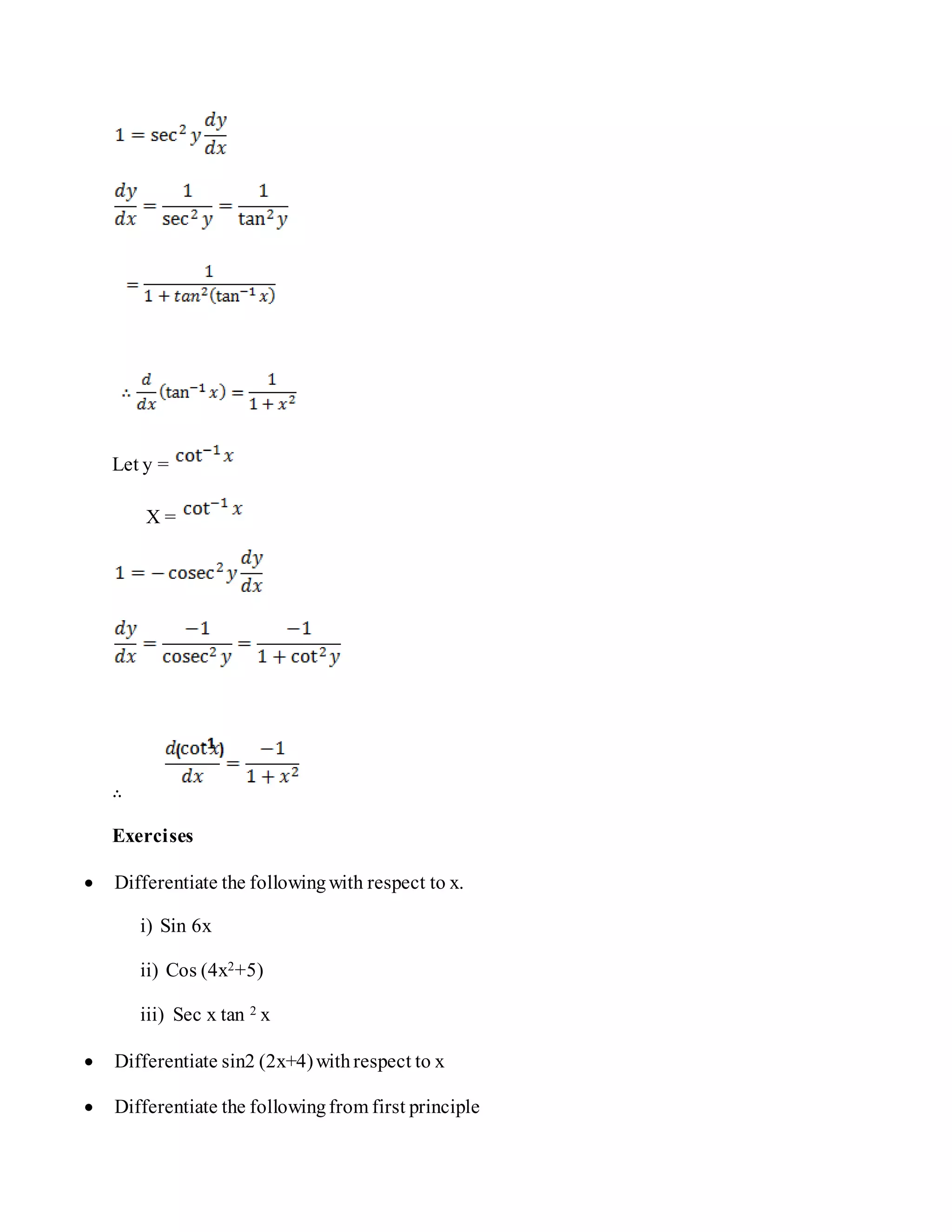
1) Let y = sin-1x
x = sin y
2) Let y = cos-1 x
x= cos y
3) Let y = tan -1 x
x = tan y
Let y =
X =
∴
Exercises
 Differentiate the followingwith respect to x.
i) Sin 6x
ii) Cos (4x2+5)
iii) Sec x tan 2 x
 Differentiate sin2 (2x+4)withrespect to x
 Differentiate the followingfrom first principle
i) Tan x
ii)
Differentiationoflogarithmicandexponential functions
1- Let y = ln x
Example
Find the derivative of
Solution
By quotient rule
2- Let y =
DifferentiationofExponents
1) Let y = ax
If a functionis in exponential form apply natural logarithms on bothsides
i.e. ln y = ln ax
ln y =x ln a
2) Let
Since â„®x does not depend on h,then
Therefore
Example
Find the derivative of y = 105x
Solution
Y = 105x
Iny = In105x
Therefore
Exercise
Find the derivatives of the followingfunctions
a) a) Y =
b) b) Y =
c) c)Y=
APPLICATION OF DIFFERENTIATION
Differentiation is applied when finding the rates of change, tangent of a curve, maximum and
minimum etc
i) The rate of change
Example
The side of a cube is increasing at the rate of 6cm/s. find the rate of increase of the volume
when the length of a side is 9cm
Solution
A hollow right circular cone is held vertex down wards beneath a tap leaking at the rate of
2cm3/s. find the rate of rise of the water level when the depth is 6cm given that the height of
the cone is 18cm and its radius is 12cm.
Solution
Volume of the cone
V
The ratio of correspondingsides
Given = 20cm3/s
V=
So ,
Then,
A horse trough has triangular cross section of height 25cm and base 30cm and is 2m long.
A horse is drinking steadily and when the water level is 5cm below the top is being lowered
at the rate of 1cm/minfindthe rate of consumptionin litres per minute
Solution
Volume of horse trough
From the ratio of the correspondingsides
A rectangle is twice as long as it is broad find the rate change of the perimeter when the
width of the rectangle is 1m and its area is changing at the rate of 18cm2/s assuming the
expansion is uniform
Solution
TANGENTS AND NORMALS
From a curve we can find the equations of the tangent and the normal
Example
i. Find the equations of the tangents to the curve y =2x2 +x-6 when x=3
Solution
(x. y)= (3, 5) is the point of contact of the curve with the tangent
But
Gradient of the tangent at the curve is
Example
ii. Find the equation of the tangent and normal to the curve y = x2 – 3x + 2 at the point where it
cuts y axis
Solution
The curve cuts y – axis when x = 0
Slope of the tangent [m] = -3
Equation of the tangent at (0, 2) is
Slope of the normal
From; m1m2 = -1,Given m1=-3
Equation of the normal is
Exercise
 Find the equation of the tangent to 2x2 – 3x which has a gradient of 1
 Find the equations of the normal to the curve y = x2-5x +6 at the points where the curve cuts
the x axis
Stationarypoints [turning points]
A stationarypoint is the one where by = 0 it involves:
 Minimum turning point
 Maximum turning point
 Point of inflection
Nature of the curve of the function
At point A, a maximum value of a functionoccurs
At point B, a minimum value of a functionoccurs
At point C, a point of inflectionoccurs
At the point of inflectionis a form of S bend
Note that
Points A, B and C are calledturning points on the graph or stationaryvalues of the function
Investigating the nature of the turning point
Minimum points
At turning points the gradient changes from beingnegative to positive i.e.
Increasing as x- increases
Is positive at the minimum point
Is positive for minimum value of the functionof (y)
Maximum points
At maximum periodthe gradient changes from positive to negative
i.e.
Decreasesas x- increases
Is negative at the maximum value of the function(y)
Point ofinflection
This is the changes of the gradient from positive to positive
Is positive just to the left and just to the left
This is changes of the gradient from negative to negative.
Is negative just to the left and just to the right
Is zero for a point of inflectioni.e
Is zero for point of inflection
Examples
Find the stationary points of the and state the nature of these points of the following
functions
Y = x4 +4x3-6
Solution
At stationarypoints
Therefore,
Then the value of a function
At x = 0, y = -6
X= -3, y =-33
Stationary point at (0,-6) and (-3,-33)
At (0,-6)
Point (0,-6) is apoint of inflection
 At (-3,-33)
At (-3, -33) is aminimum point
Alternatively,
You test by taking values of x just to the right and left of the turning point
Exercise
1) 1. Find and classifythe stationarypoints of the followingcurves
a) (i) y = 2x-x2
b) (ii) y = +x
c) (iii) y= x2(x2- 8x)
2) 2. Determine the smallest positive value of x at which a point of inflection occurs on the
graph of y = 3â„®2x cos (2x-3)
3) 3. If 4x2 + 8xy +9y2 8x – 24y+4 =0 show that when = 0,
x + y = 1. Hence find the maximum and minimum values of y
Example
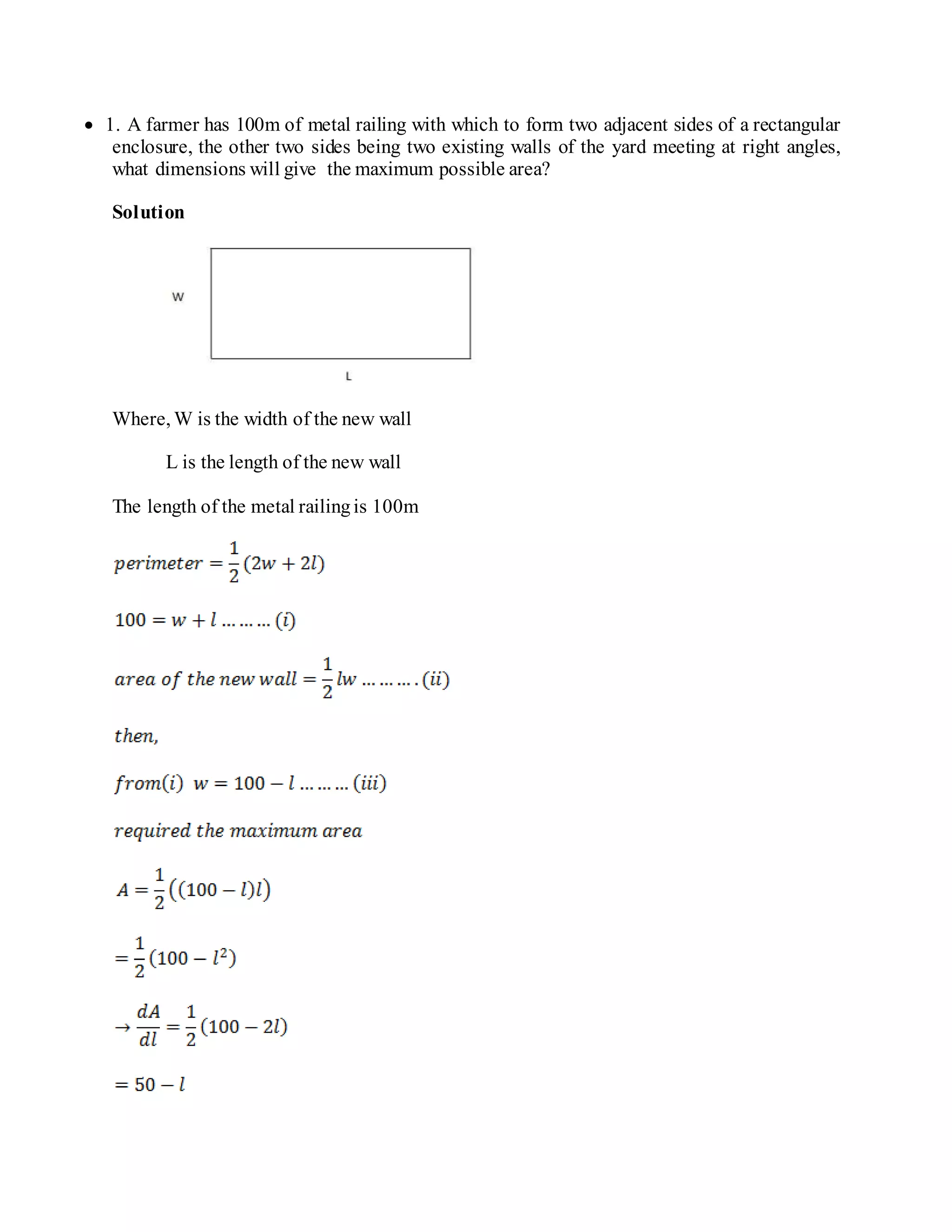
 1. A farmer has 100m of metal railing with which to form two adjacent sides of a rectangular
enclosure, the other two sides being two existing walls of the yard meeting at right angles,
what dimensions will give the maximum possible area?
Solution
Where, W is the width of the new wall
L is the length of the new wall
The length of the metal railingis 100m
 2. An open card board box width a square base is required to hold 108cm3 what should be
the dimensions if the areaof cardboardused is as small as possible
Solution
Exercise
The gradient function of y = ax2 +bx +c is 4x+2. The function has a maximum value of 1,
find the values of a, b, and c
MACLAURIN’S SERIES [from power series ]
Let f(x) = a1 +a2x+a3x2 +a4x3 +a5x4+ a6x5…….i
In order to establish the series we have to find the values of the constant co efficient a1, a2, a3,
a4, a5, a6 etc
Put x = 0 in …i
Puttingthe expressionsa1,a2,a3,a4,a5,.........backtothe original seriesandget
whichisthe maclaurinseries.
Examples
Expand the following
i) â„®x
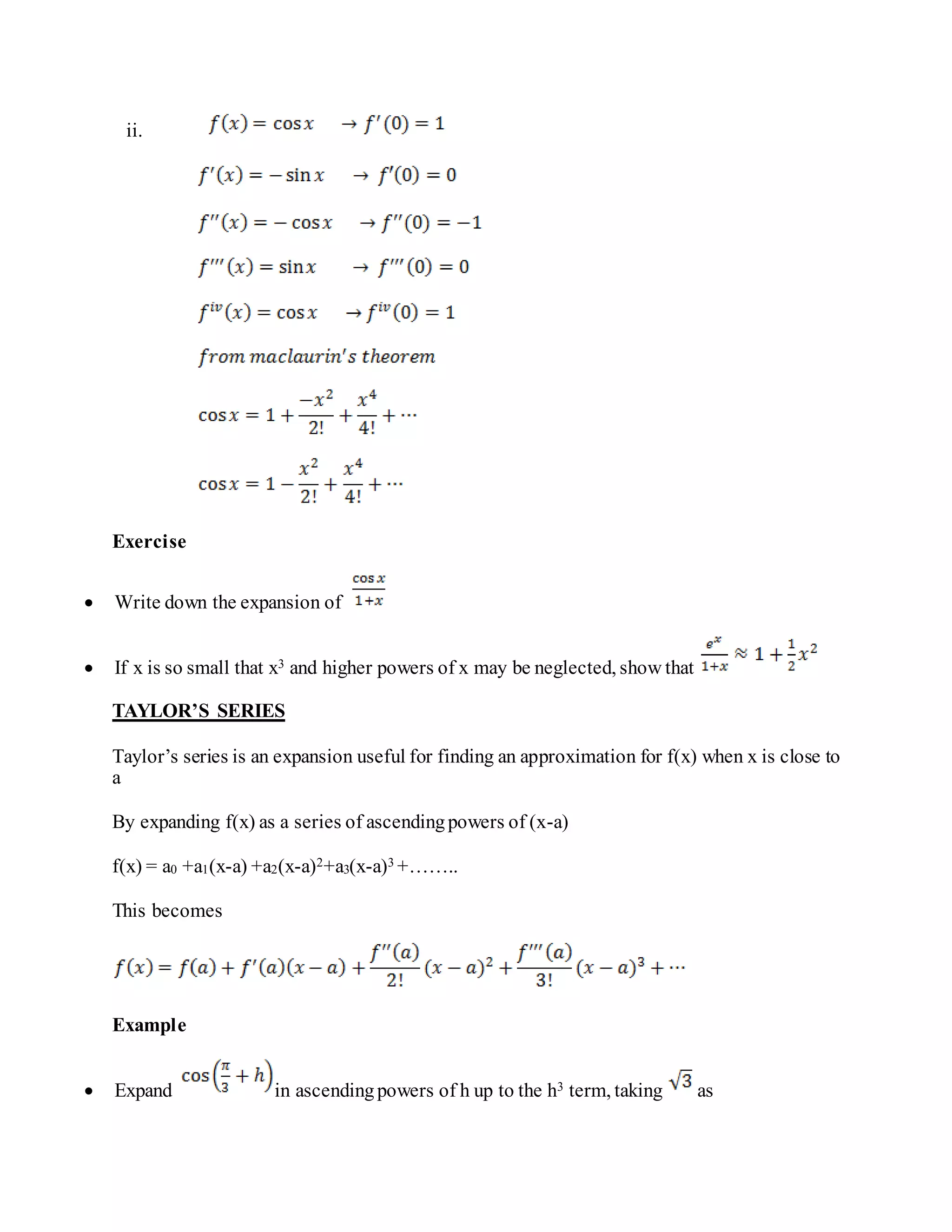
ii) f(x) = cos x
Solution
i.
ii.
Exercise
 Write down the expansion of
 If x is so small that x3 and higher powers of x may be neglected, show that
TAYLOR’S SERIES
Taylor’s series is an expansion useful for finding an approximation for f(x) when x is close to
a
By expanding f(x) as a series of ascendingpowers of (x-a)
f(x) = a0 +a1(x-a) +a2(x-a)2+a3(x-a)3 +……..
This becomes
Example
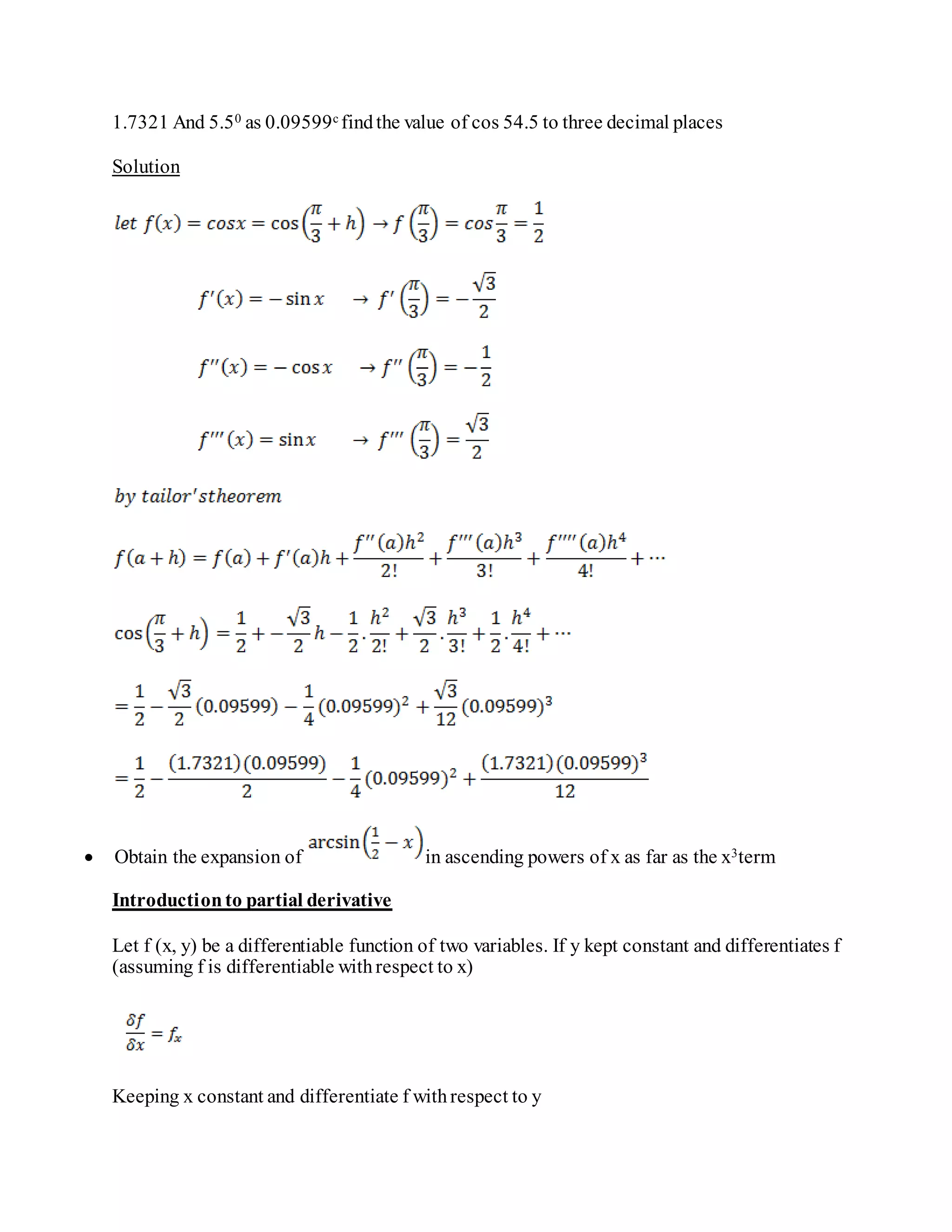
 Expand in ascendingpowers of h up to the h3 term, taking as
1.7321 And 5.50 as 0.09599c findthe value of cos 54.5 to three decimal places
Solution
 Obtain the expansion of in ascending powers of x as far as the x3term
Introductionto partial derivative
Let f (x, y) be a differentiable function of two variables. If y kept constant and differentiates f
(assuming f is differentiable withrespect to x)
Keeping x constant and differentiate f withrespect to y
Example
 find the partial derivatives of fx and fy
If f(x, y) = x2y +2x+y
Solution
 Find fx and fy if f (x,y) is given by
f(x, y) = sin(xy) +cos x
Solution
Exercise
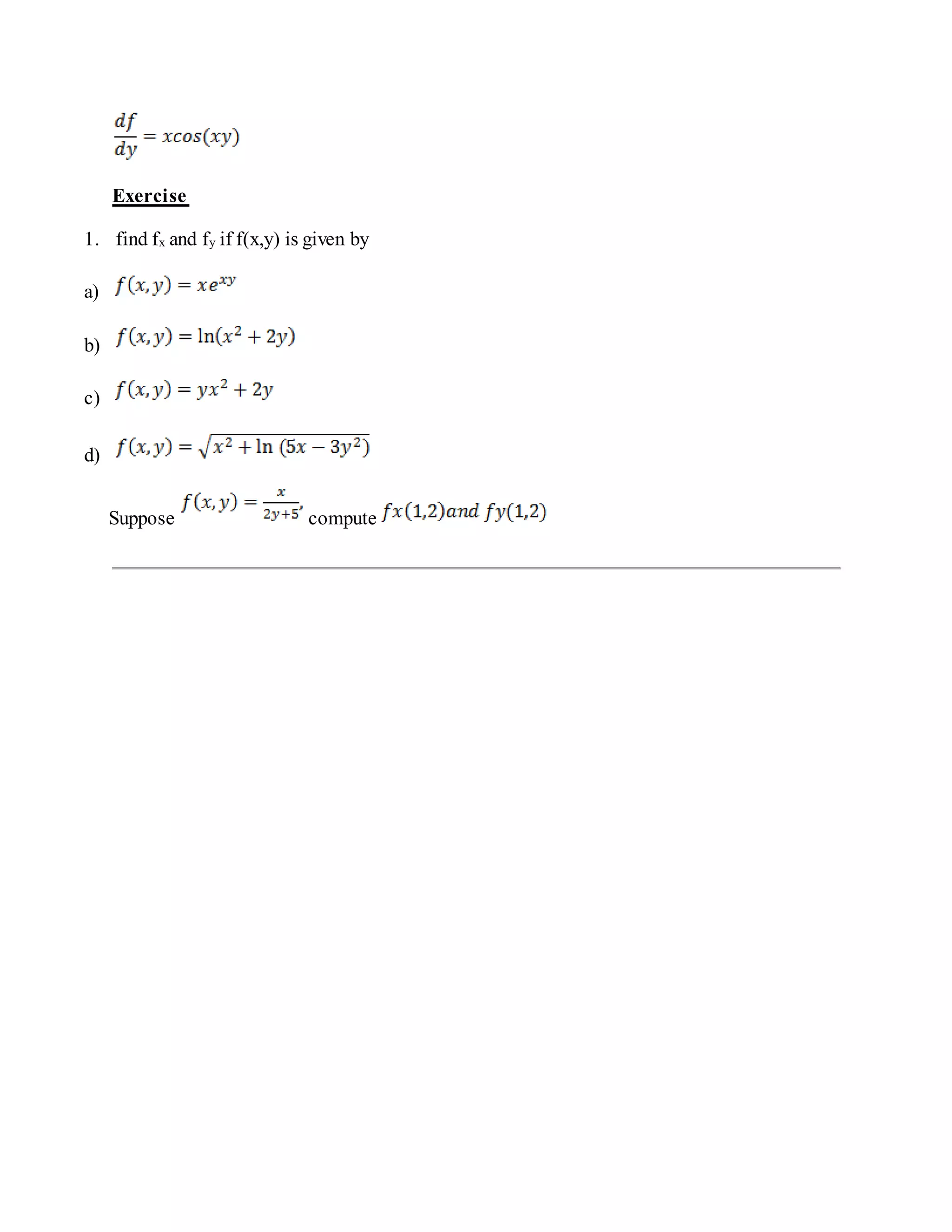
1. find fx and fy if f(x,y) is given by
a)
b)
c)
d)
Suppose compute

DIFFERENTIATION

  • 1.
    DIFFERENTIATION DERIVATIVES Slope of acurve A curve has different slopes at each point. Let A, B, and C be different points of a curve f (x) Where ðxis the small increase inx ðy is the small increase iny The slope of chordAC = If C moves right up to A the chord AC becomes the tangent to the curve at A and the slope at A is the limiting value of Therefore
  • 2.
    = The gradient atA is = or This is known as differentiatingby first principle From the first principle i) f(x)= x ii) f(x)= x2
  • 3.
    = ∴ iii) f(x) =x3 iv)f(x)= xn By binomial series
  • 4.
    In general If Example Differentiatethe followingwithrespect to x i)y = x2+3x Solution y =x2+3x ii) 2x4+5
  • 5.
    iii) = Differentiationofproducts functions [product rule] Let y =uv Where u and v are functions of x If x → x+ðx u → u +ðu v → v+ðv y → ðy+y y= uv ……i) Therefore y+ðy = [ u+ðu][v+ðv] y+ðy = uv +uðv+vðu +ðuðv….ii Subtract (i) from (ii) δy =uðv+vðu +ðuðv Therefore
  • 6.
    Therefore Therefore If y= uv Itis the product rule Examples Differentiatethe followingwith respect to x i) y = [ x2+3x] [4x+3] ii) y = [ +2] [x2+2] Solution Y = [x2+3x] [4x+3] Let u = x2+3x = 2x+3 V = 4x+3 Therefore =4x2+12x+8x2+12x+6x+9
  • 7.
    =12x2+30x+9 ii)Let u =+2 → v = x2+2 =2x Therefore DIFFERENTIATION OF A QUOTIENT [QUOTIENT RULE] Let y = where u and v are functions of x
  • 8.
    As Exercise Differentiatethe followingwith respectto x I. II. DIFFERENTIATION OF A FUNCTION [CHAIN RULE] If y = f(u), where u = f(x) Then Therefore PARAMETRIC EQUATIONS Let y = f(t) , and x = g (t)
  • 9.
    Example I. Find ify = at2 and x = 2at Solution 2at IMPLICIT FUNCTION Implicit functionis the one which is neither x nor y a subject e.g. 1) x2+y2 = 25 2) x2+y2+2xy=5 One thing to remember is that y is the functionof x
  • 10.
    Then 1. ∴ 2. x2 +y2+ 2xy = 5 Exercise
  • 11.
    Find when x3+ y3 – 3xy2 = 8 Differentiationoftrigonometricfunctions 1) Let y = sin x….. i …(ii , Providedthat x is measuredin radian [small angle]
  • 12.
    2. Let y= cos x …… (i) 3. Let From the quotient rule
  • 13.
    4. Let y= cot x ∴ 5. y =
  • 14.
  • 15.
    2) Let y= cos-1 x x= cos y 3) Let y = tan -1 x x = tan y
  • 16.
    Let y = X= ∴ Exercises  Differentiate the followingwith respect to x. i) Sin 6x ii) Cos (4x2+5) iii) Sec x tan 2 x  Differentiate sin2 (2x+4)withrespect to x  Differentiate the followingfrom first principle
  • 17.
  • 18.
    Find the derivativeof Solution By quotient rule 2- Let y =
  • 19.
    DifferentiationofExponents 1) Let y= ax If a functionis in exponential form apply natural logarithms on bothsides i.e. ln y = ln ax ln y =x ln a 2) Let
  • 20.
    Since â„®x doesnot depend on h,then Therefore Example Find the derivative of y = 105x Solution Y = 105x Iny = In105x
  • 21.
    Therefore Exercise Find the derivativesof the followingfunctions a) a) Y = b) b) Y = c) c)Y= APPLICATION OF DIFFERENTIATION Differentiation is applied when finding the rates of change, tangent of a curve, maximum and minimum etc i) The rate of change Example The side of a cube is increasing at the rate of 6cm/s. find the rate of increase of the volume when the length of a side is 9cm Solution
  • 22.
    A hollow rightcircular cone is held vertex down wards beneath a tap leaking at the rate of 2cm3/s. find the rate of rise of the water level when the depth is 6cm given that the height of the cone is 18cm and its radius is 12cm. Solution Volume of the cone V The ratio of correspondingsides Given = 20cm3/s V= So , Then,
  • 23.
    A horse troughhas triangular cross section of height 25cm and base 30cm and is 2m long. A horse is drinking steadily and when the water level is 5cm below the top is being lowered at the rate of 1cm/minfindthe rate of consumptionin litres per minute Solution Volume of horse trough From the ratio of the correspondingsides
  • 24.
    A rectangle istwice as long as it is broad find the rate change of the perimeter when the width of the rectangle is 1m and its area is changing at the rate of 18cm2/s assuming the expansion is uniform Solution
  • 26.
    TANGENTS AND NORMALS Froma curve we can find the equations of the tangent and the normal Example i. Find the equations of the tangents to the curve y =2x2 +x-6 when x=3 Solution (x. y)= (3, 5) is the point of contact of the curve with the tangent But Gradient of the tangent at the curve is
  • 27.
    Example ii. Find theequation of the tangent and normal to the curve y = x2 – 3x + 2 at the point where it cuts y axis Solution The curve cuts y – axis when x = 0 Slope of the tangent [m] = -3 Equation of the tangent at (0, 2) is Slope of the normal From; m1m2 = -1,Given m1=-3
  • 28.
    Equation of thenormal is Exercise  Find the equation of the tangent to 2x2 – 3x which has a gradient of 1  Find the equations of the normal to the curve y = x2-5x +6 at the points where the curve cuts the x axis Stationarypoints [turning points] A stationarypoint is the one where by = 0 it involves:  Minimum turning point  Maximum turning point  Point of inflection
  • 29.
    Nature of thecurve of the function At point A, a maximum value of a functionoccurs At point B, a minimum value of a functionoccurs At point C, a point of inflectionoccurs At the point of inflectionis a form of S bend Note that Points A, B and C are calledturning points on the graph or stationaryvalues of the function Investigating the nature of the turning point Minimum points At turning points the gradient changes from beingnegative to positive i.e. Increasing as x- increases Is positive at the minimum point Is positive for minimum value of the functionof (y) Maximum points At maximum periodthe gradient changes from positive to negative
  • 30.
    i.e. Decreasesas x- increases Isnegative at the maximum value of the function(y) Point ofinflection This is the changes of the gradient from positive to positive Is positive just to the left and just to the left This is changes of the gradient from negative to negative.
  • 31.
    Is negative justto the left and just to the right Is zero for a point of inflectioni.e Is zero for point of inflection Examples Find the stationary points of the and state the nature of these points of the following functions Y = x4 +4x3-6 Solution At stationarypoints Therefore, Then the value of a function At x = 0, y = -6 X= -3, y =-33 Stationary point at (0,-6) and (-3,-33) At (0,-6)
  • 32.
    Point (0,-6) isapoint of inflection  At (-3,-33) At (-3, -33) is aminimum point Alternatively, You test by taking values of x just to the right and left of the turning point Exercise 1) 1. Find and classifythe stationarypoints of the followingcurves a) (i) y = 2x-x2 b) (ii) y = +x c) (iii) y= x2(x2- 8x) 2) 2. Determine the smallest positive value of x at which a point of inflection occurs on the graph of y = 3â„®2x cos (2x-3) 3) 3. If 4x2 + 8xy +9y2 8x – 24y+4 =0 show that when = 0, x + y = 1. Hence find the maximum and minimum values of y Example
  • 33.
     1. Afarmer has 100m of metal railing with which to form two adjacent sides of a rectangular enclosure, the other two sides being two existing walls of the yard meeting at right angles, what dimensions will give the maximum possible area? Solution Where, W is the width of the new wall L is the length of the new wall The length of the metal railingis 100m
  • 34.
     2. Anopen card board box width a square base is required to hold 108cm3 what should be the dimensions if the areaof cardboardused is as small as possible Solution
  • 35.
    Exercise The gradient functionof y = ax2 +bx +c is 4x+2. The function has a maximum value of 1, find the values of a, b, and c
  • 36.
    MACLAURIN’S SERIES [frompower series ] Let f(x) = a1 +a2x+a3x2 +a4x3 +a5x4+ a6x5…….i In order to establish the series we have to find the values of the constant co efficient a1, a2, a3, a4, a5, a6 etc Put x = 0 in …i
  • 37.
    Puttingthe expressionsa1,a2,a3,a4,a5,.........backtothe originalseriesandget whichisthe maclaurinseries. Examples Expand the following i) â„®x ii) f(x) = cos x Solution i.
  • 38.
    ii. Exercise  Write downthe expansion of  If x is so small that x3 and higher powers of x may be neglected, show that TAYLOR’S SERIES Taylor’s series is an expansion useful for finding an approximation for f(x) when x is close to a By expanding f(x) as a series of ascendingpowers of (x-a) f(x) = a0 +a1(x-a) +a2(x-a)2+a3(x-a)3 +…….. This becomes Example  Expand in ascendingpowers of h up to the h3 term, taking as
  • 39.
    1.7321 And 5.50as 0.09599c findthe value of cos 54.5 to three decimal places Solution  Obtain the expansion of in ascending powers of x as far as the x3term Introductionto partial derivative Let f (x, y) be a differentiable function of two variables. If y kept constant and differentiates f (assuming f is differentiable withrespect to x) Keeping x constant and differentiate f withrespect to y
  • 40.
    Example  find thepartial derivatives of fx and fy If f(x, y) = x2y +2x+y Solution  Find fx and fy if f (x,y) is given by f(x, y) = sin(xy) +cos x Solution
  • 41.
    Exercise 1. find fxand fy if f(x,y) is given by a) b) c) d) Suppose compute