General Double Integrals
We will define double integrals over two types of
nonrectangular domains:
General Double Integrals
We will define double integrals over two types of
nonrectangular domains:
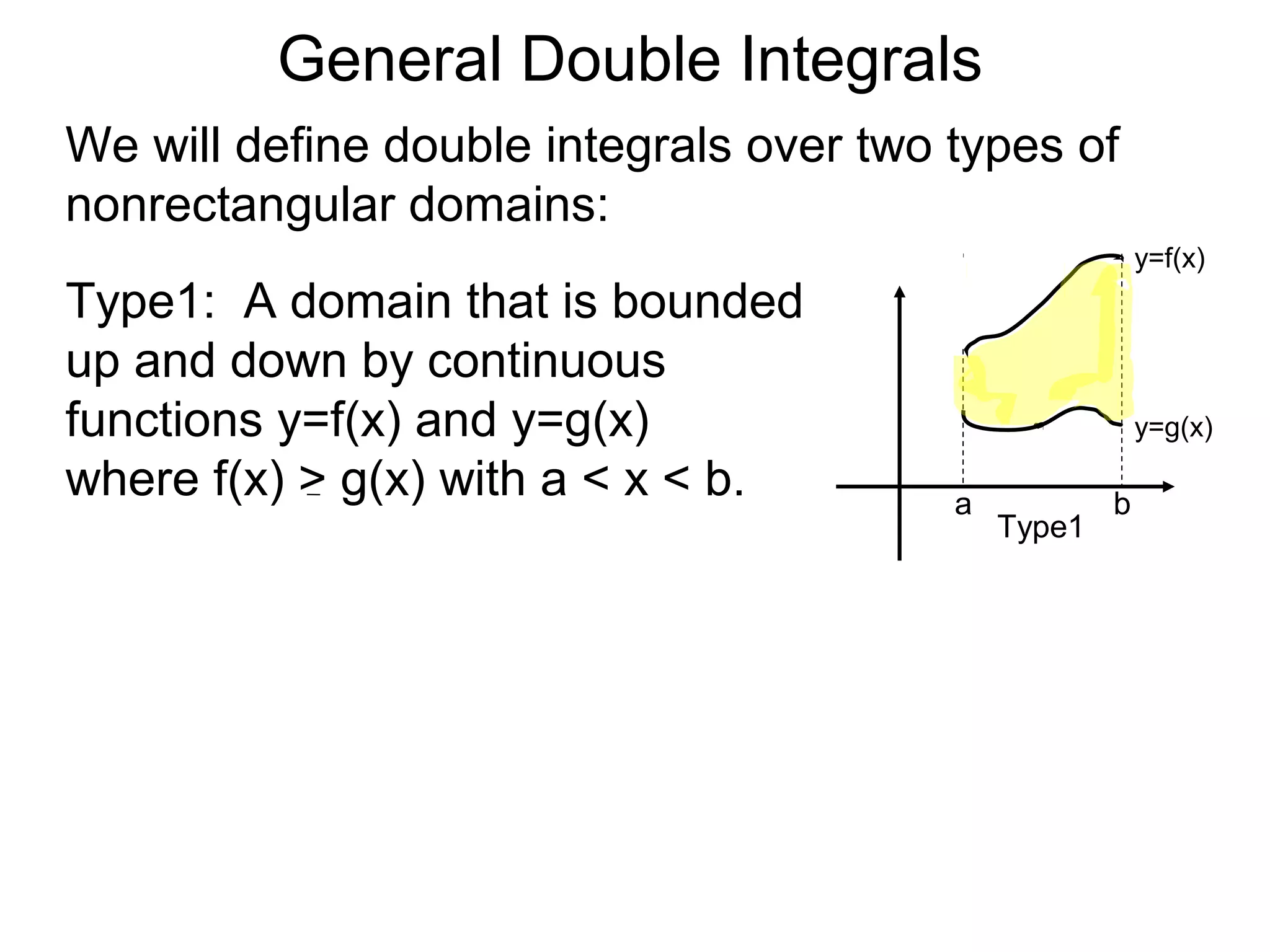
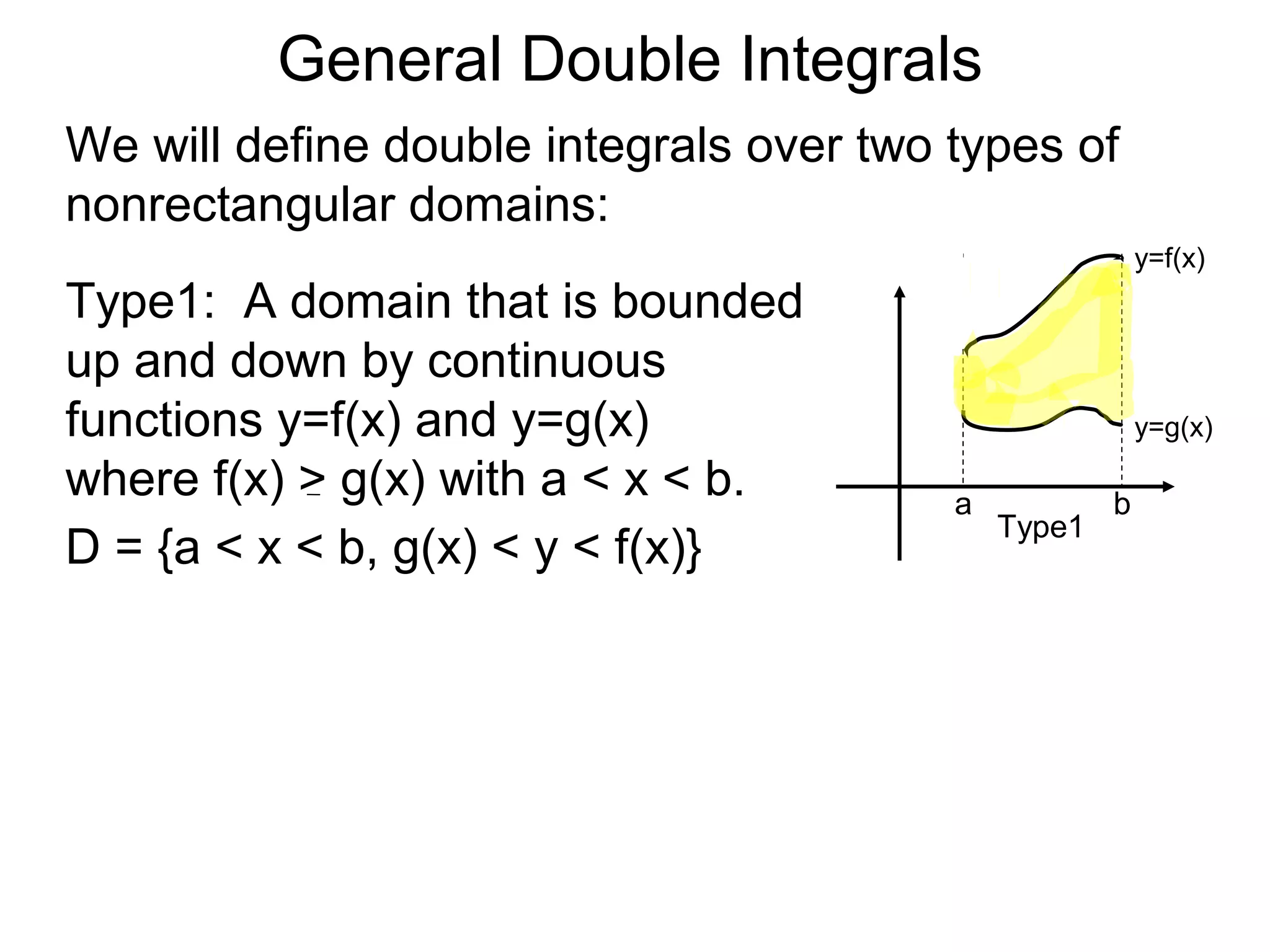
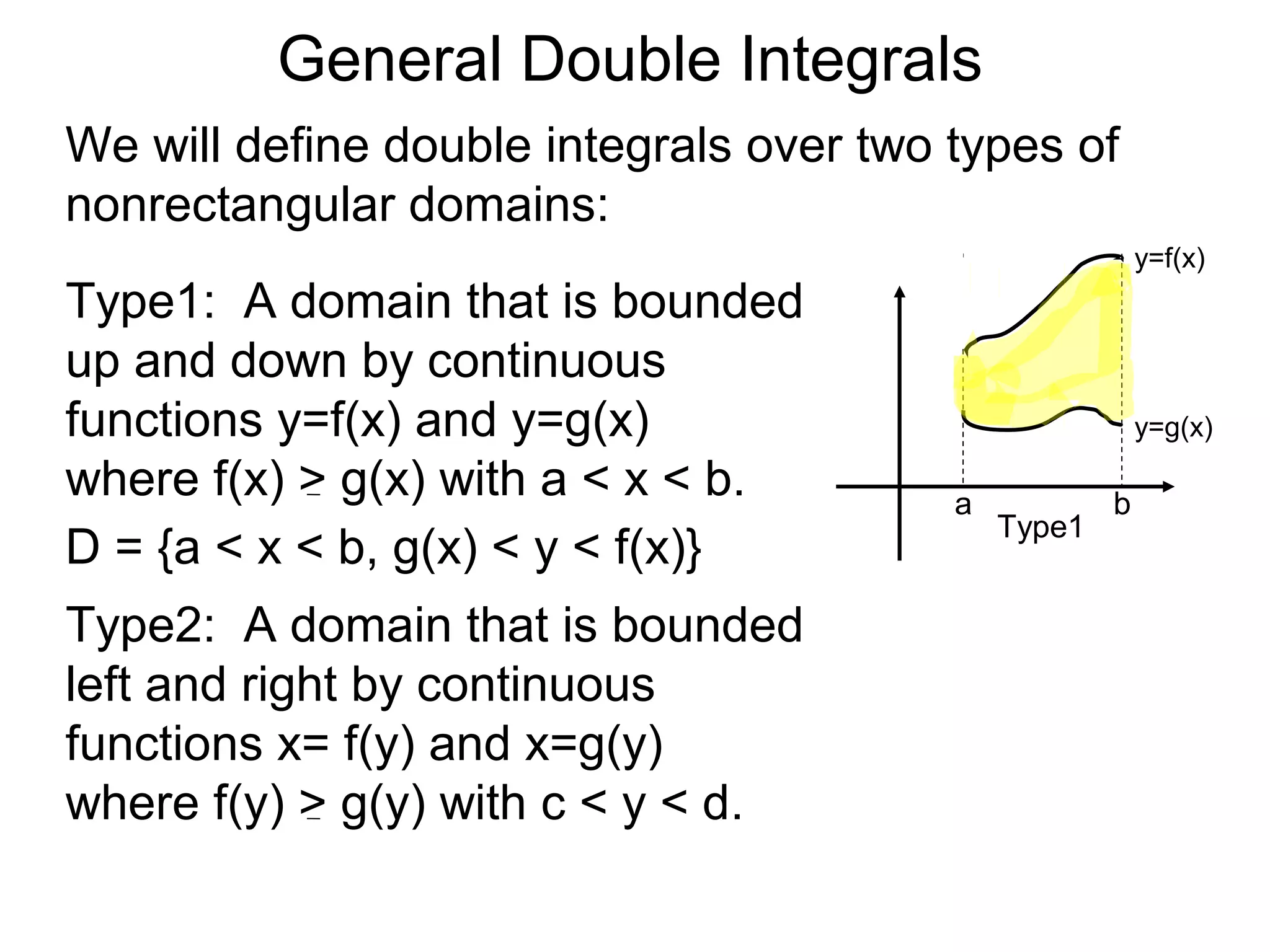
Type1: A domain that is bounded
up and down by continuous
functions y=f(x) and y=g(x)
where f(x) > g(x) with a < x < b.
General Double Integrals
We will define double integrals over two types of
nonrectangular domains:
Type1: A domain that is bounded
up and down by continuous
functions y=f(x) and y=g(x)
where f(x) > g(x) with a < x < b. a b
Type1
y=f(x)
y=g(x)
General Double Integrals
We will define double integrals over two types of
nonrectangular domains:
Type1: A domain that is bounded
up and down by continuous
functions y=f(x) and y=g(x)
where f(x) > g(x) with a < x < b. a b
Type1
y=f(x)
y=g(x)
D = {a < x < b, g(x) < y < f(x)}
General Double Integrals
We will define double integrals over two types of
nonrectangular domains:
Type1: A domain that is bounded
up and down by continuous
functions y=f(x) and y=g(x)
where f(x) > g(x) with a < x < b.
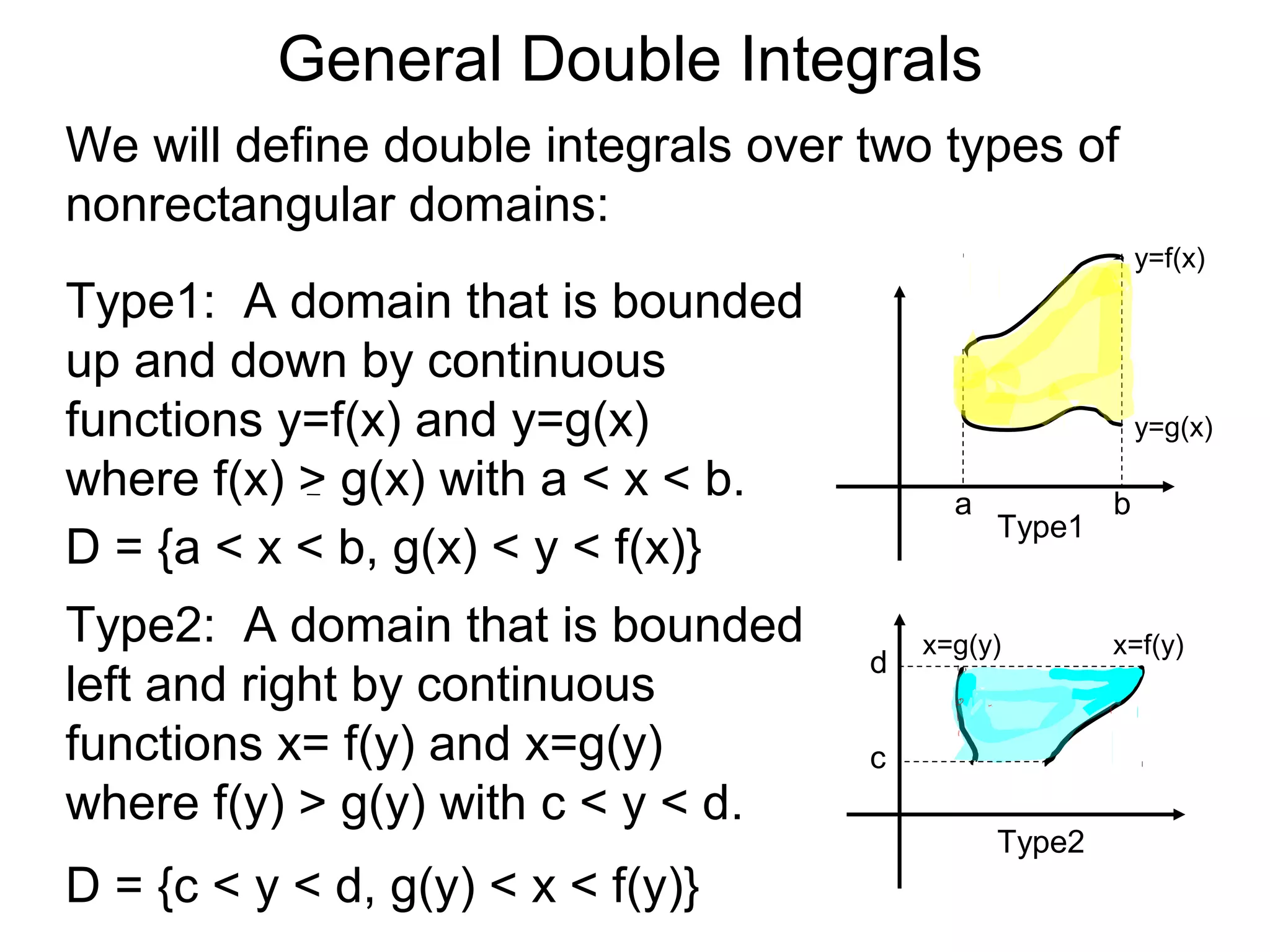
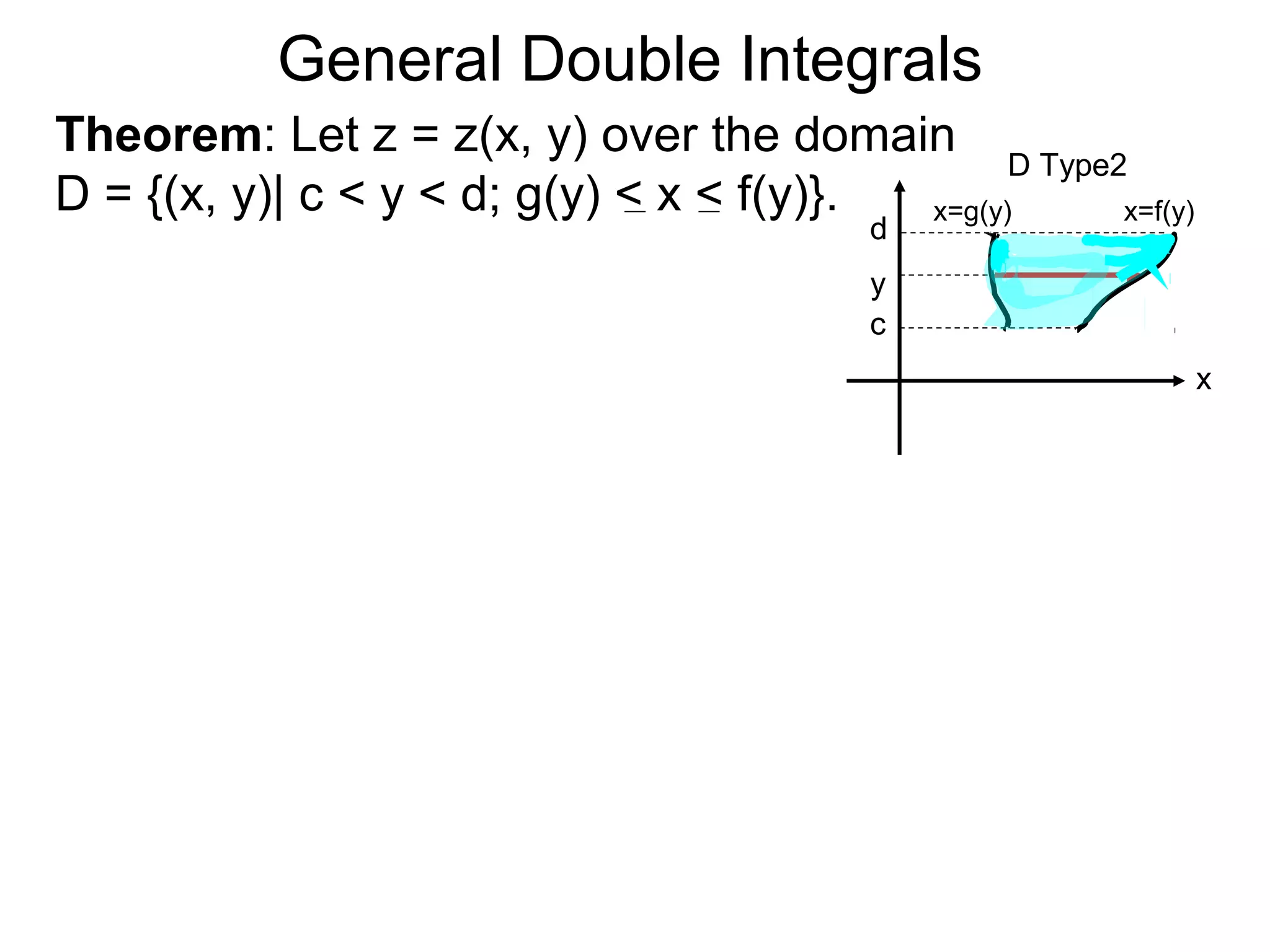
Type2: A domain that is bounded
left and right by continuous
functions x= f(y) and x=g(y)
where f(y) > g(y) with c < y < d.
a b
Type1
y=f(x)
y=g(x)
D = {a < x < b, g(x) < y < f(x)}
General Double Integrals
We will define double integrals over two types of
nonrectangular domains:
Type1: A domain that is bounded
up and down by continuous
functions y=f(x) and y=g(x)
where f(x) > g(x) with a < x < b.
Type2: A domain that is bounded
left and right by continuous
functions x= f(y) and x=g(y)
where f(y) > g(y) with c < y < d.
a b
x=f(y)x=g(y)
d
c
Type1
Type2
y=f(x)
y=g(x)
D = {a < x < b, g(x) < y < f(x)}
D = {c < y < d, g(y) < x < f(y)}
General Double Integrals
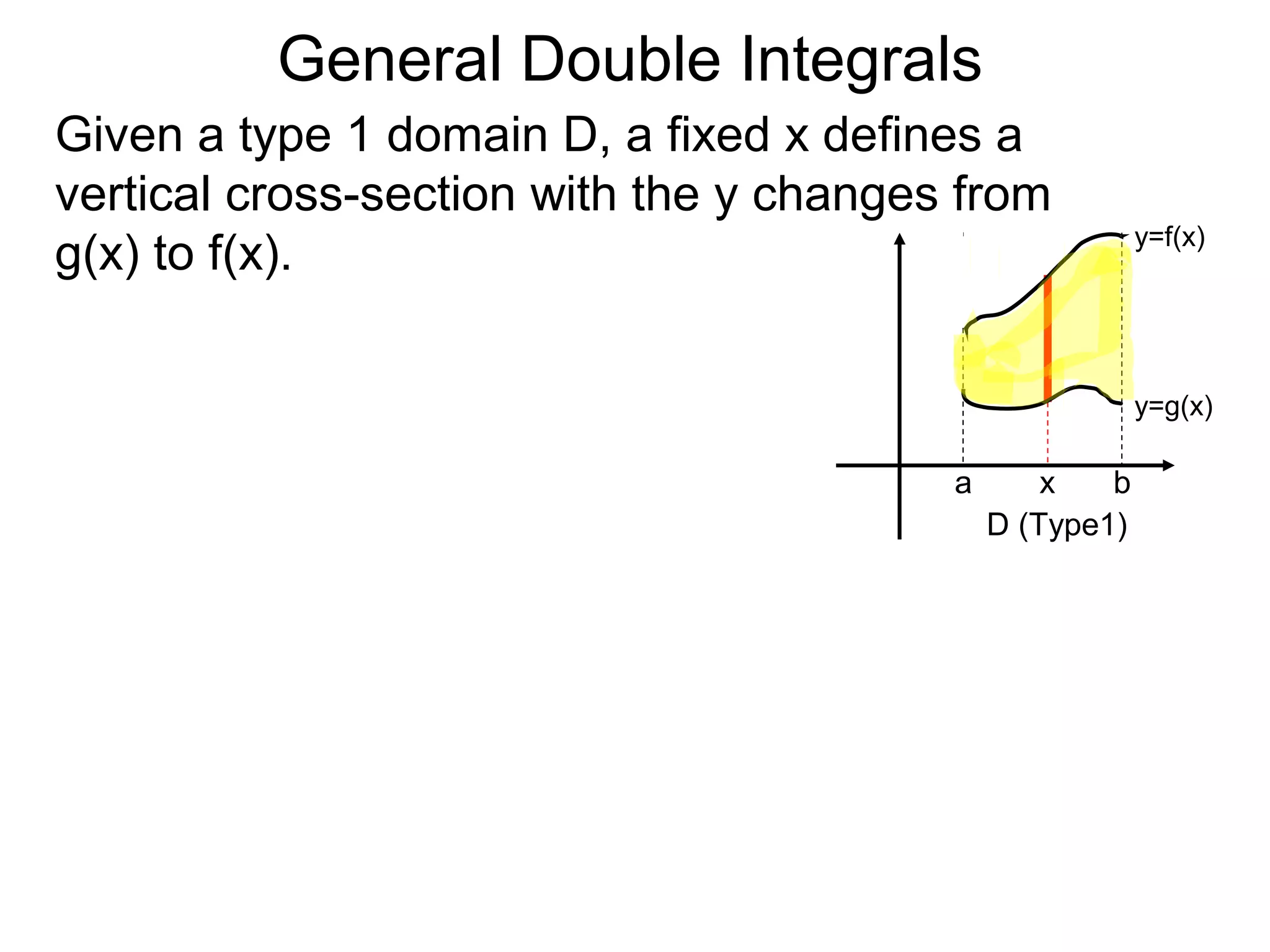
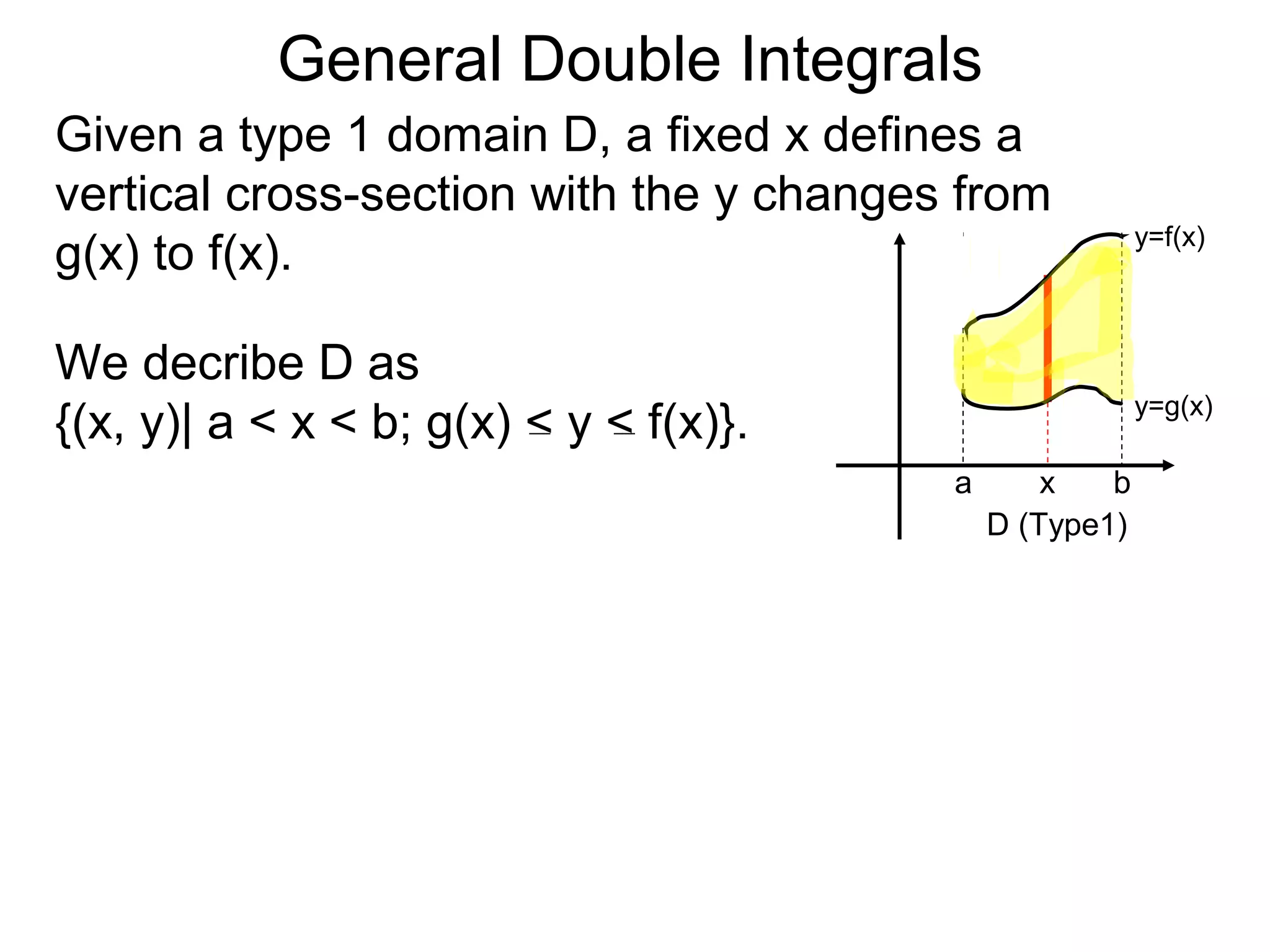
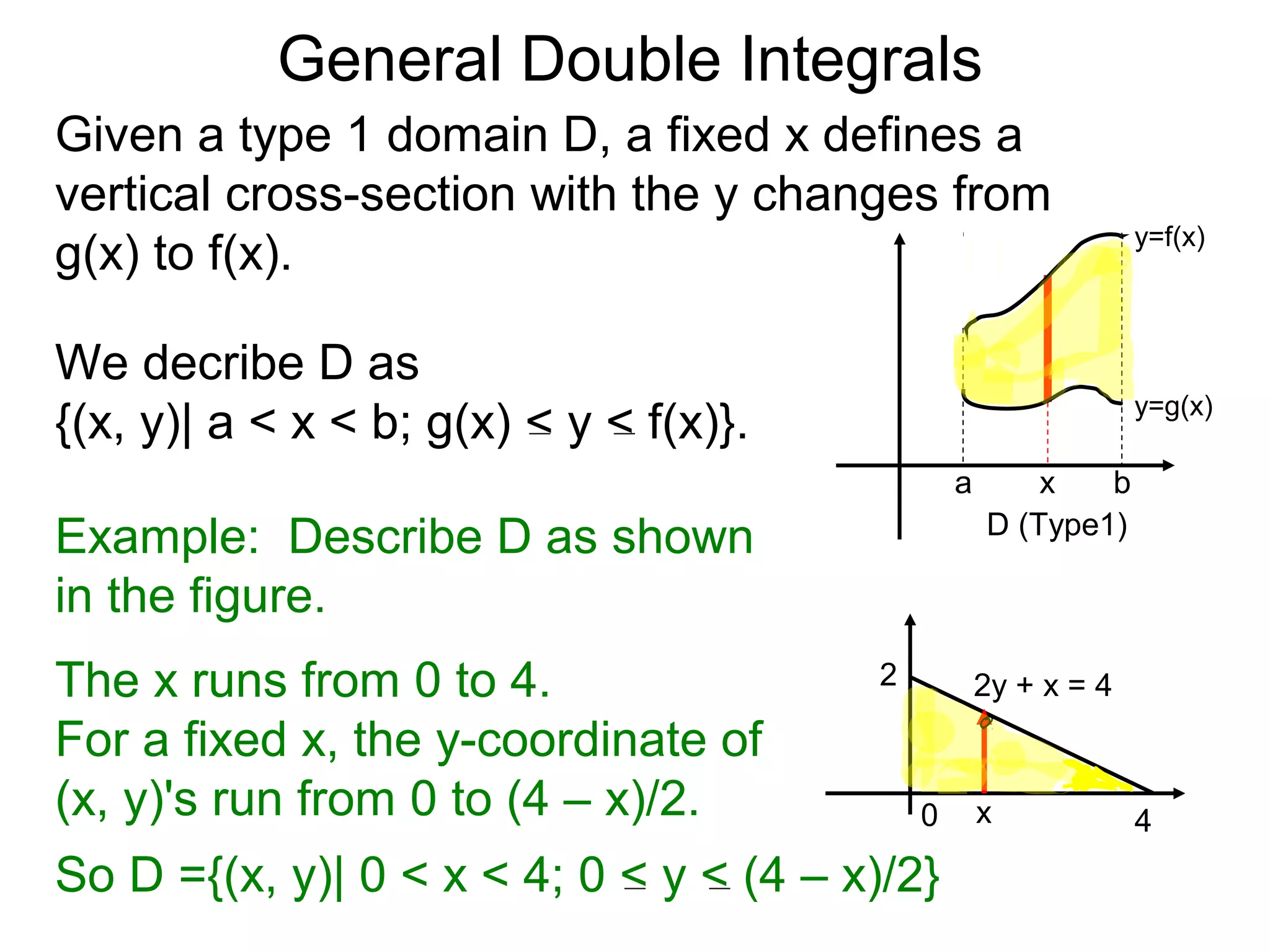
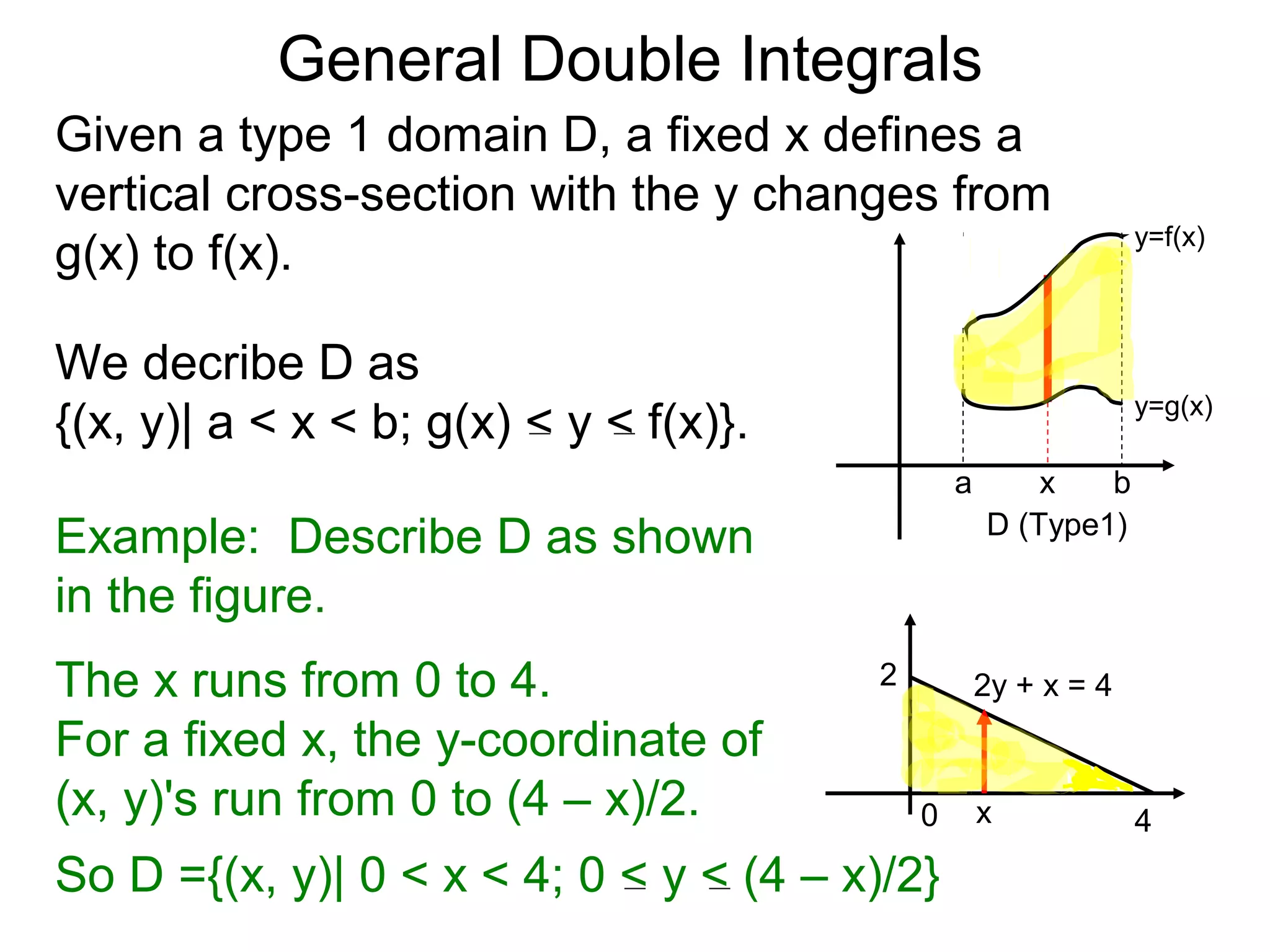
Given a type 1 domain D, a fixed x defines a
vertical cross-section with the y changes from
g(x) to f(x).
a b
y=f(x)
y=g(x)
D (Type1)
x
General Double Integrals
Given a type 1 domain D, a fixed x defines a
vertical cross-section with the y changes from
g(x) to f(x).
a b
y=f(x)
y=g(x)
D (Type1)
x
We decribe D as
{(x, y)| a < x < b; g(x) < y < f(x)}.
General Double Integrals
Given a type 1 domain D, a fixed x defines a
vertical cross-section with the y changes from
g(x) to f(x).
a b
y=f(x)
y=g(x)
D (Type1)
x
We decribe D as
{(x, y)| a < x < b; g(x) < y < f(x)}.
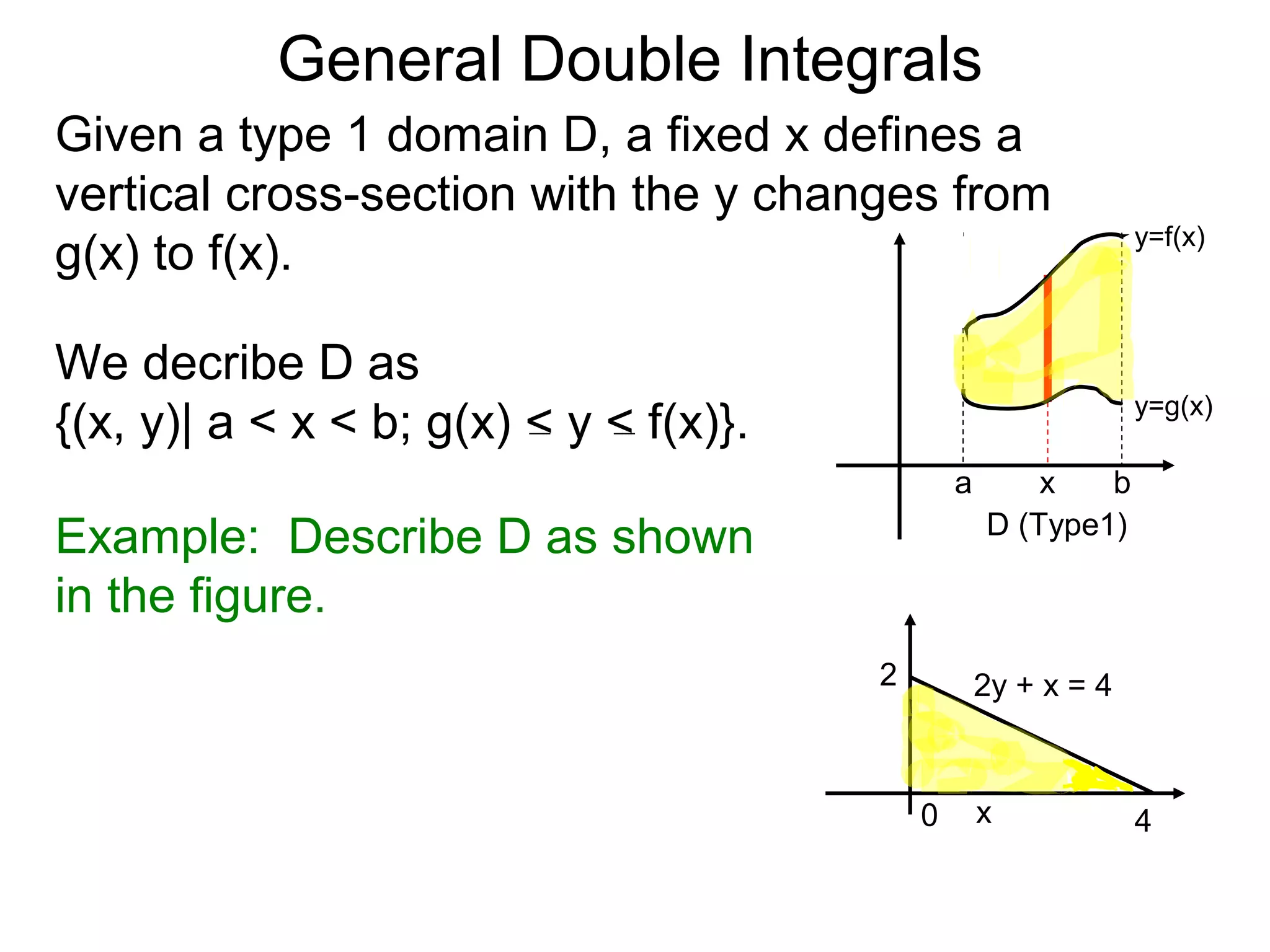
Example: Describe D as shown
in the figure.
2y + x = 4
0 4
2
x
General Double Integrals
Given a type 1 domain D, a fixed x defines a
vertical cross-section with the y changes from
g(x) to f(x).
a b
y=f(x)
y=g(x)
D (Type1)
x
We decribe D as
{(x, y)| a < x < b; g(x) < y < f(x)}.
Example: Describe D as shown
in the figure.
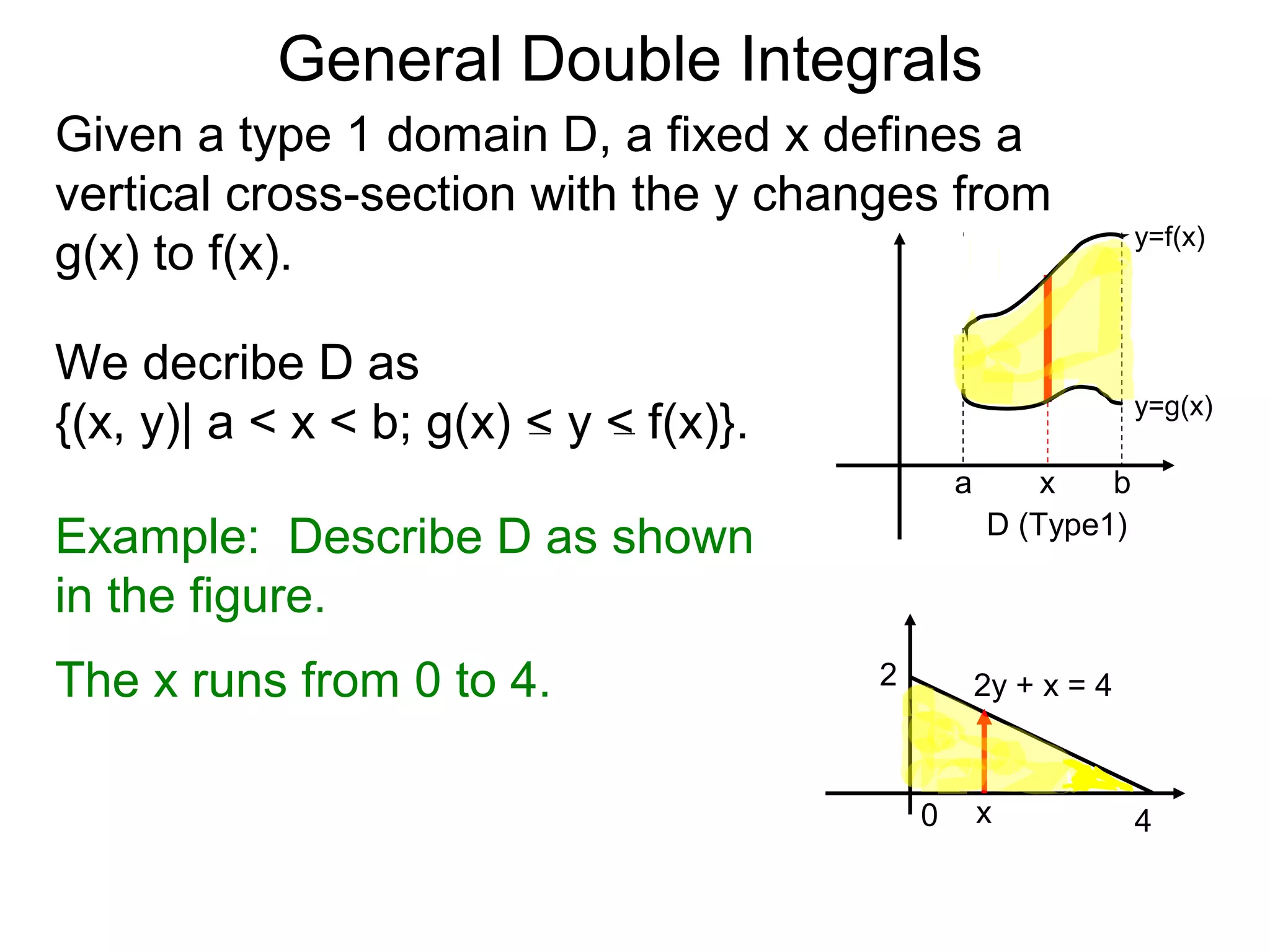
The x runs from 0 to 4. 2y + x = 4
0 4
2
x
General Double Integrals
Given a type 1 domain D, a fixed x defines a
vertical cross-section with the y changes from
g(x) to f(x).
a b
y=f(x)
y=g(x)
D (Type1)
x
We decribe D as
{(x, y)| a < x < b; g(x) < y < f(x)}.
Example: Describe D as shown
in the figure.
The x runs from 0 to 4.
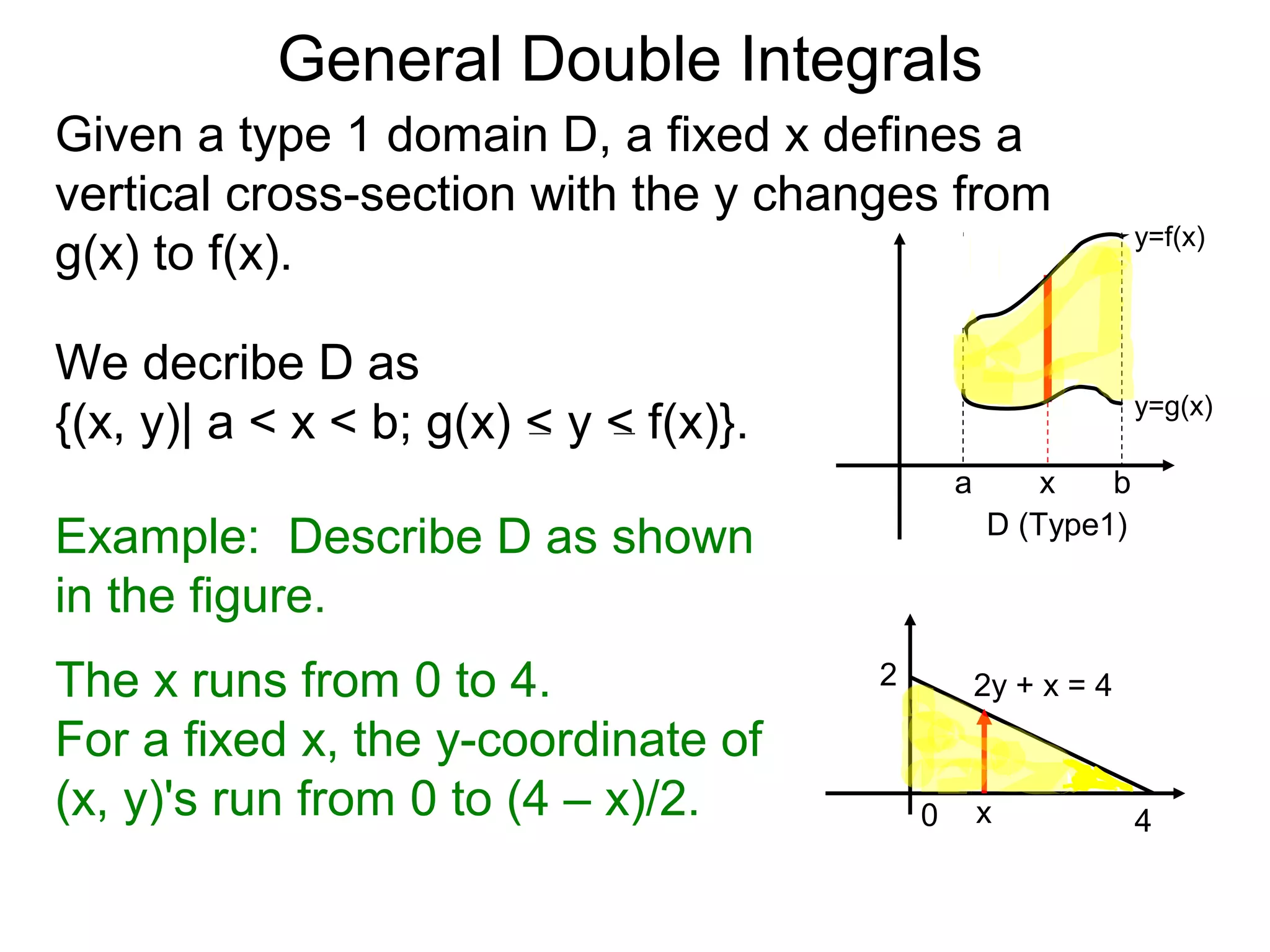
For a fixed x, the y-coordinate of
(x, y)'s run from 0 to (4 – x)/2.
2y + x = 4
0 4
2
x
General Double Integrals
Given a type 1 domain D, a fixed x defines a
vertical cross-section with the y changes from
g(x) to f(x).
a b
y=f(x)
y=g(x)
D (Type1)
x
We decribe D as
{(x, y)| a < x < b; g(x) < y < f(x)}.
Example: Describe D as shown
in the figure.
The x runs from 0 to 4.
For a fixed x, the y-coordinate of
(x, y)'s run from 0 to (4 – x)/2.
2y + x = 4
0 4
2
So D ={(x, y)| 0 < x < 4; 0 < y < (4 – x)/2}
x
General Double Integrals
Given a type 1 domain D, a fixed x defines a
vertical cross-section with the y changes from
g(x) to f(x).
a b
y=f(x)
y=g(x)
D (Type1)
x
We decribe D as
{(x, y)| a < x < b; g(x) < y < f(x)}.
Example: Describe D as shown
in the figure.
The x runs from 0 to 4.
For a fixed x, the y-coordinate of
(x, y)'s run from 0 to (4 – x)/2.
2y + x = 4
0 4
2
So D ={(x, y)| 0 < x < 4; 0 < y < (4 – x)/2}
x
General Double Integrals
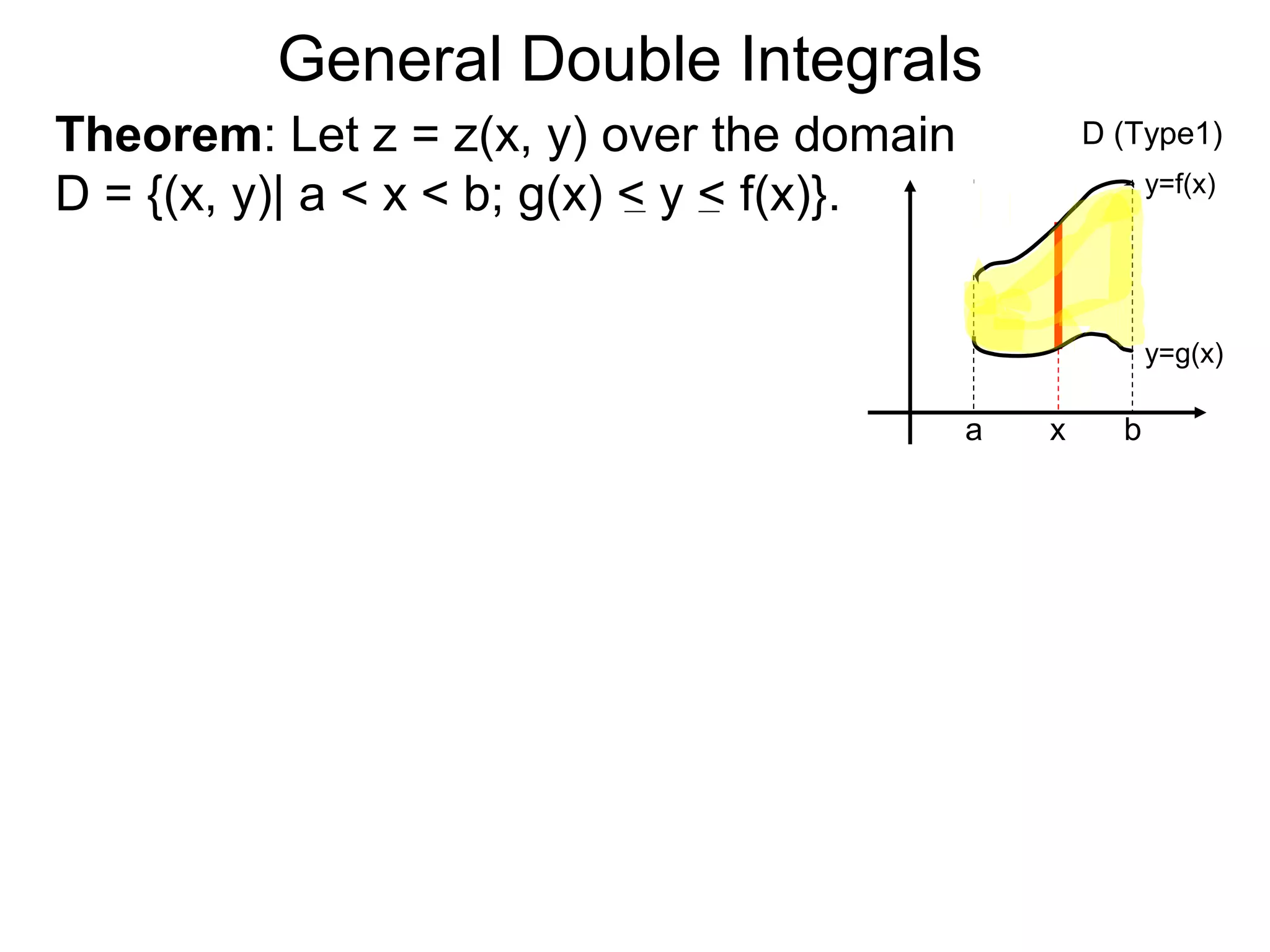
Theorem: Let z = z(x, y) over the domain
D = {(x, y)| a < x < b; g(x) < y < f(x)}.
a b
y=f(x)
y=g(x)
D (Type1)
x
General Double Integrals
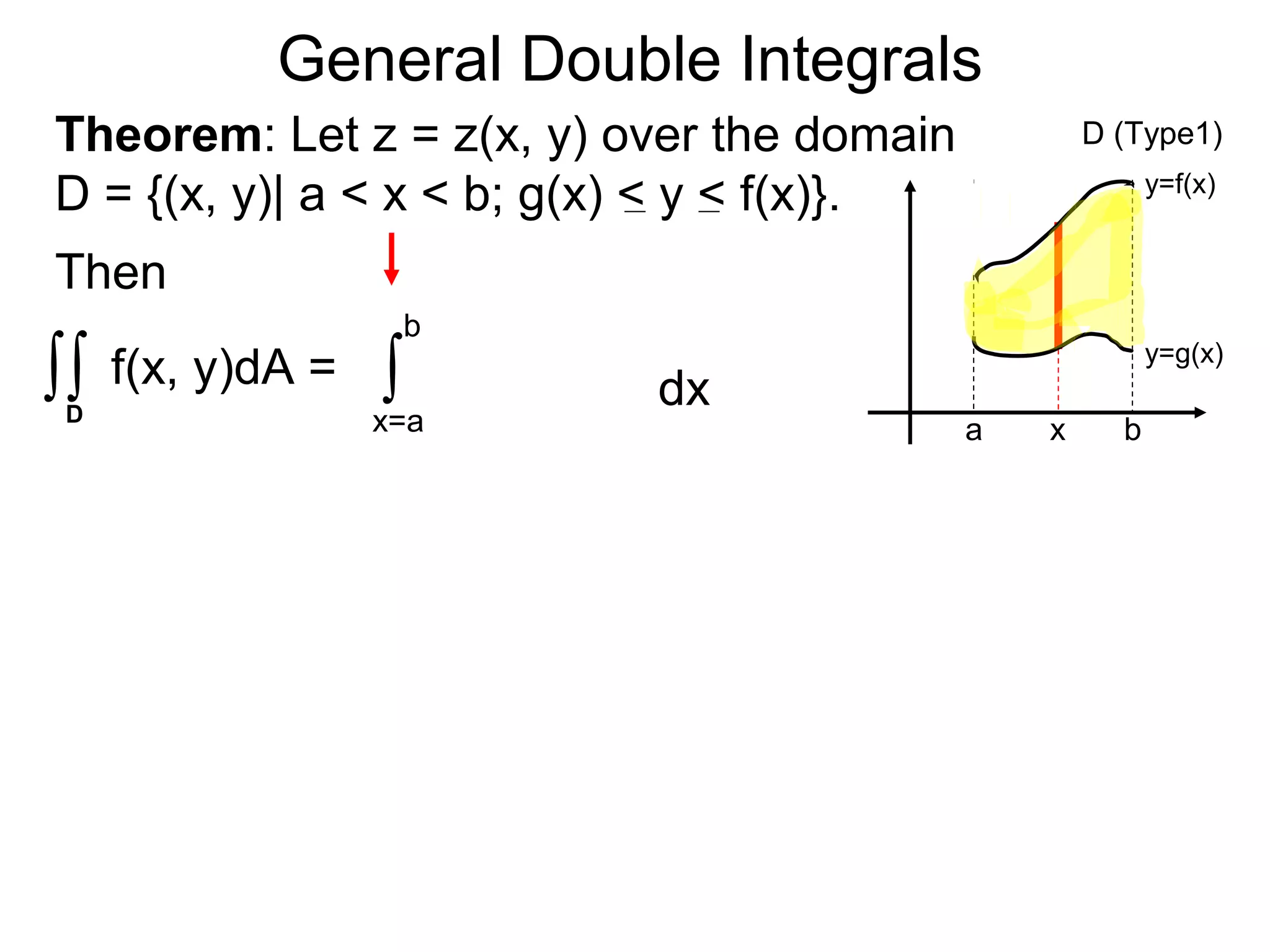
Theorem: Let z = z(x, y) over the domain
D = {(x, y)| a < x < b; g(x) < y < f(x)}.
a b
y=f(x)
y=g(x)
D (Type1)
x
Then
∫ f(x, y)dA =∫ ∫
x=a
b
dxD
General Double Integrals
Theorem: Let z = z(x, y) over the domain
D = {(x, y)| a < x < b; g(x) < y < f(x)}.
a b
y=f(x)
y=g(x)
D (Type1)
x
Then
∫ f(x, y)dA =∫ ∫ z(x, y)dy ]dx.
x=a
b
∫y=g(x)
y=f(x)
[
D
General Double Integrals
Theorem: Let z = z(x, y) over the domain
D = {(x, y)| a < x < b; g(x) < y < f(x)}.
a b
y=f(x)
y=g(x)
D (Type1)
x
Then
∫ f(x, y)dA =∫ ∫ z(x, y)dy ]dx.
x=a
b
∫y=g(x)
y=f(x)
[
The important thing here is the order of the
integration. It is set according to the the description
of the domain D.
D
General Double Integrals
Theorem: Let z = z(x, y) over the domain
D = {(x, y)| a < x < b; g(x) < y < f(x)}.
a b
y=f(x)
y=g(x)
D (Type1)
x
Then
∫ f(x, y)dA =∫ ∫ z(x, y)dy ]dx.
x=a
b
∫y=g(x)
y=f(x)
[
The important thing here is the order of the
integration. It is set according to the the description
of the domain D.
Note that if D is the rectangle [a, b] x [c, d], then
D = {a < x < b; c < y < d} and the double integral is
∫ f(x, y)dA =∫ ∫ z(x, y)dy ]dx.
x=a
b
∫y=c
d
[
D
D
General Double Integrals
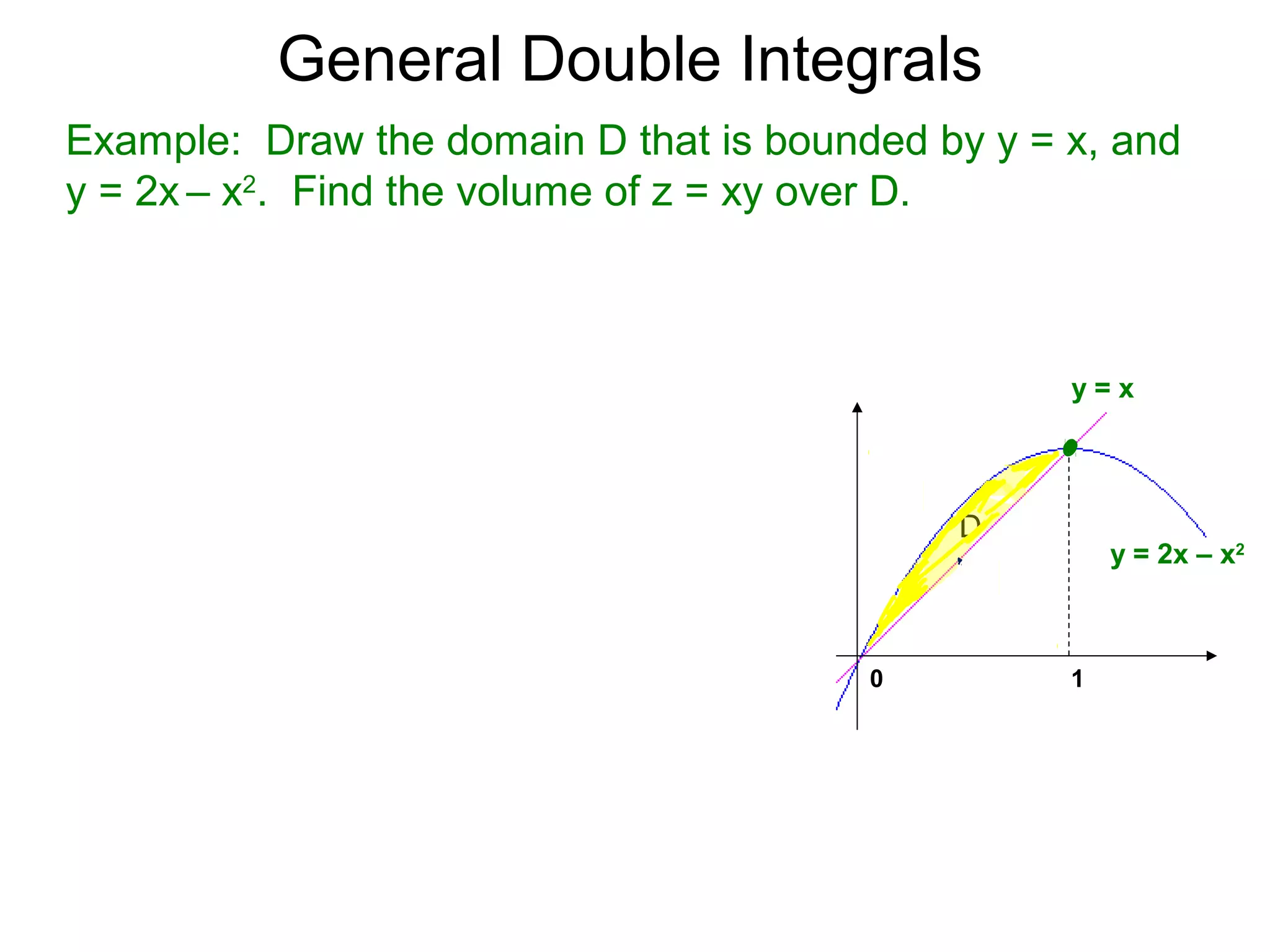
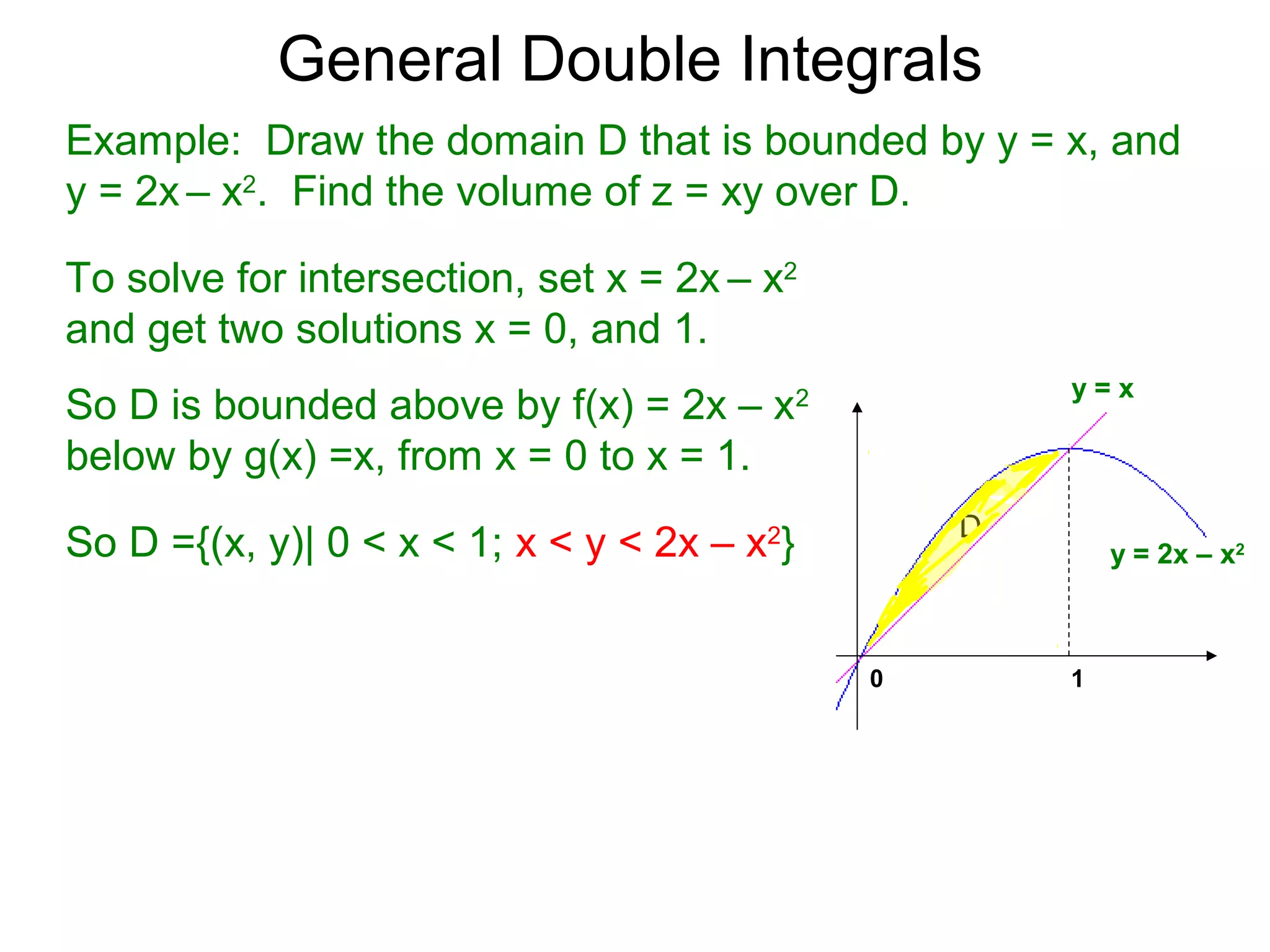
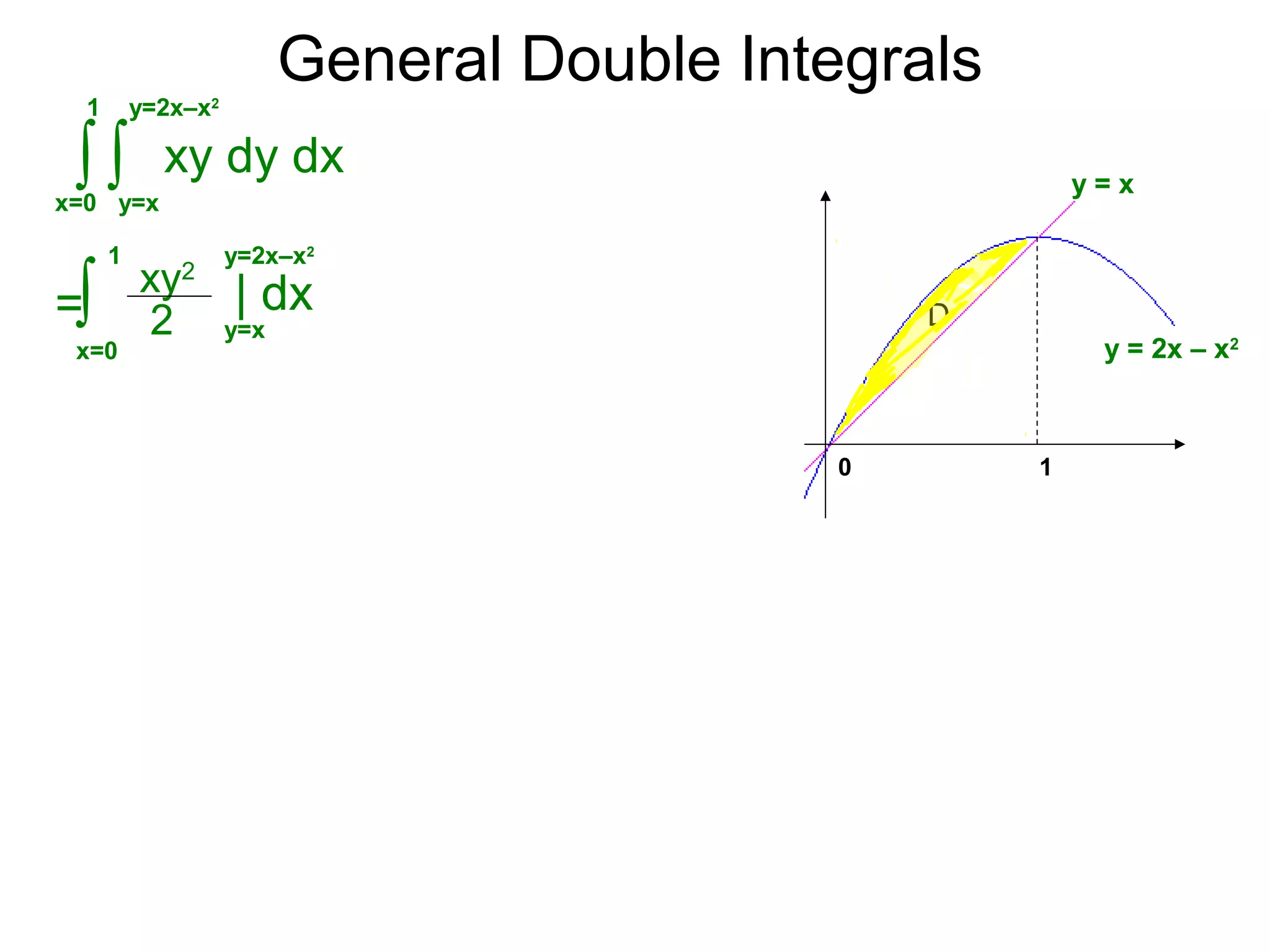
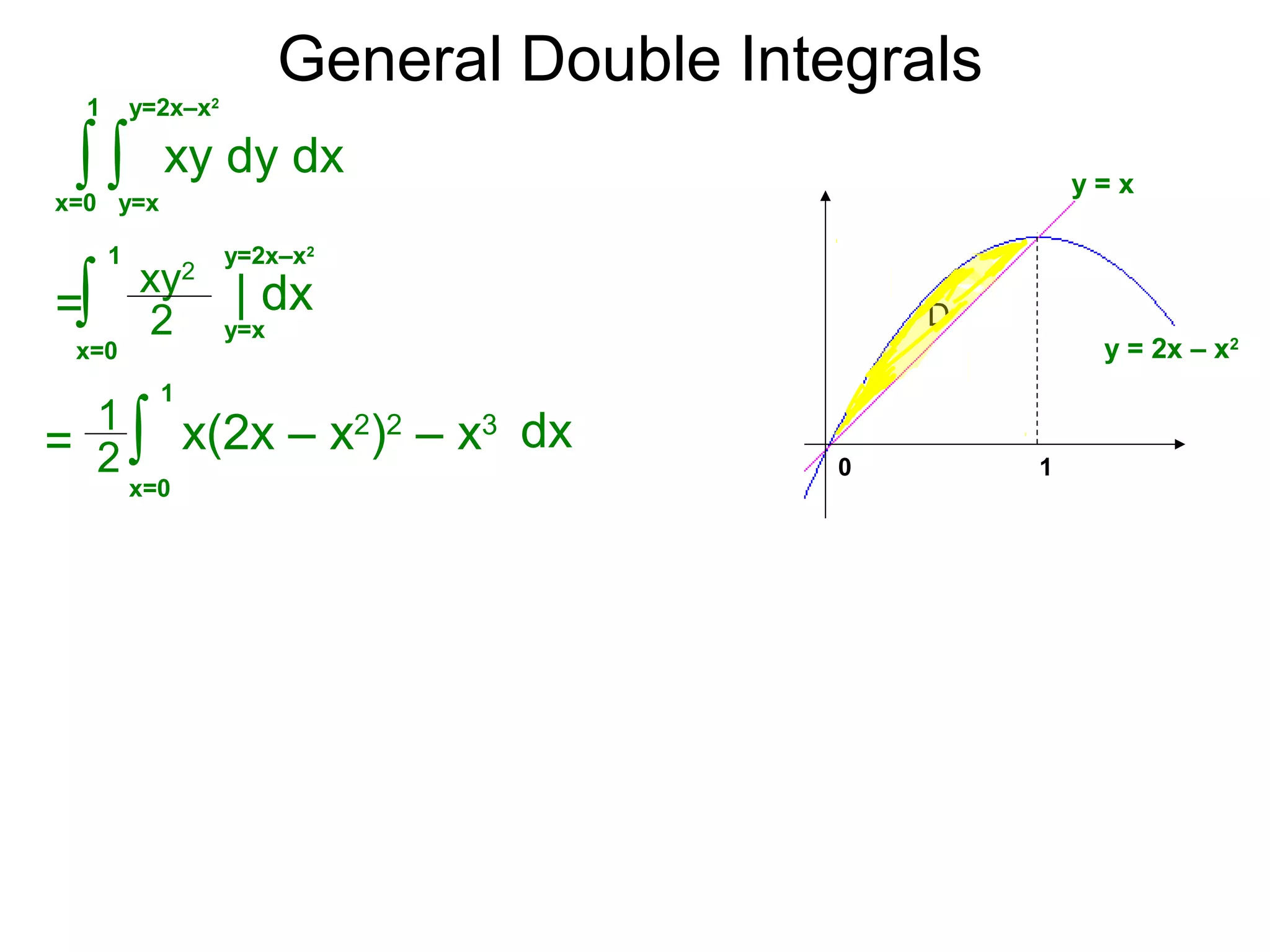
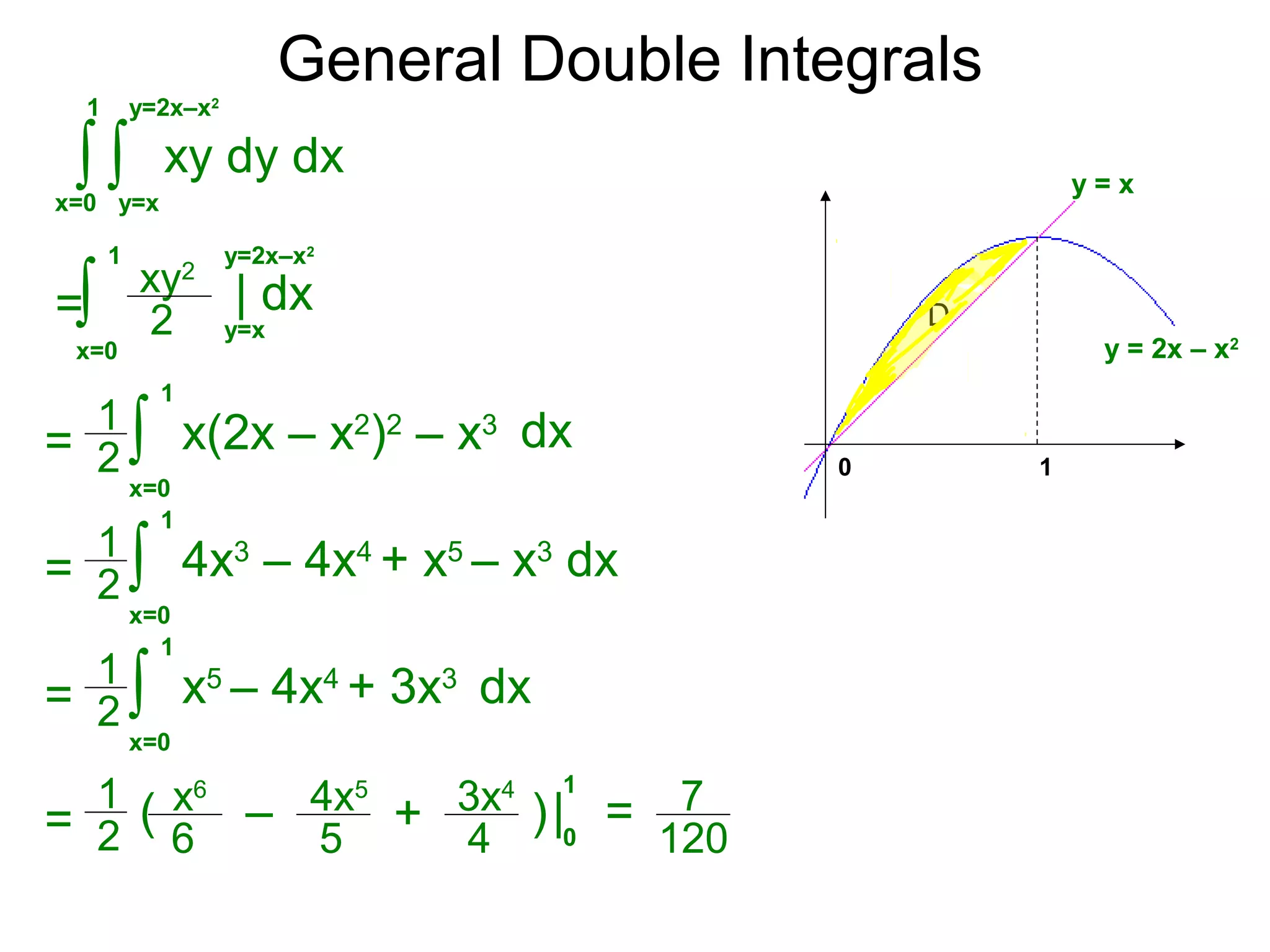
Example: Draw the domain D that is bounded by y = x, and
y = 2x – x2
. Find the volume of z = xy over D.
General Double Integrals
Example: Draw the domain D that is bounded by y = x, and
y = 2x – x2
. Find the volume of z = xy over D.
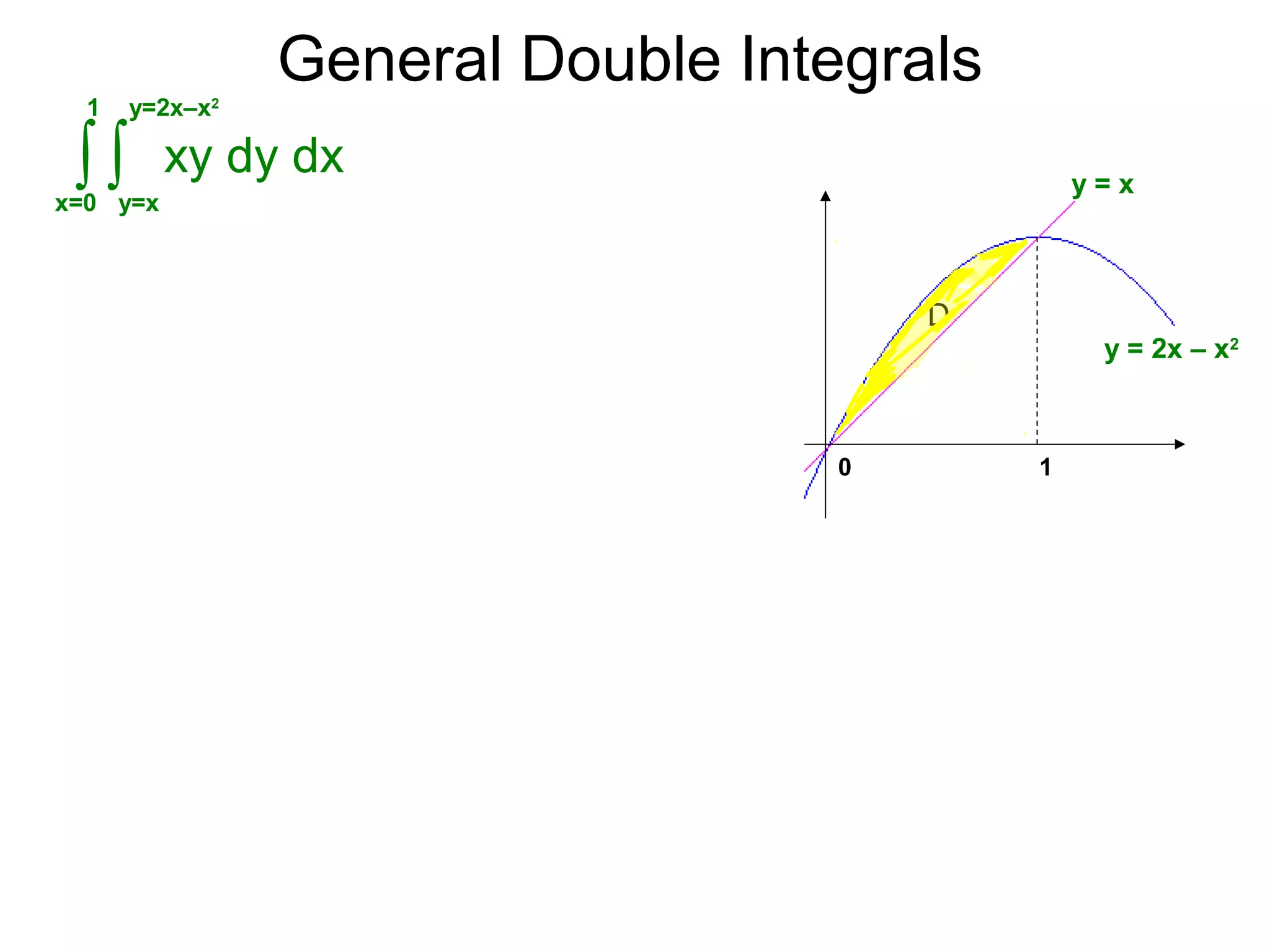
0 1
D
y = x
y = 2x – x2
General Double Integrals
Example: Draw the domain D that is bounded by y = x, and
y = 2x – x2
. Find the volume of z = xy over D.
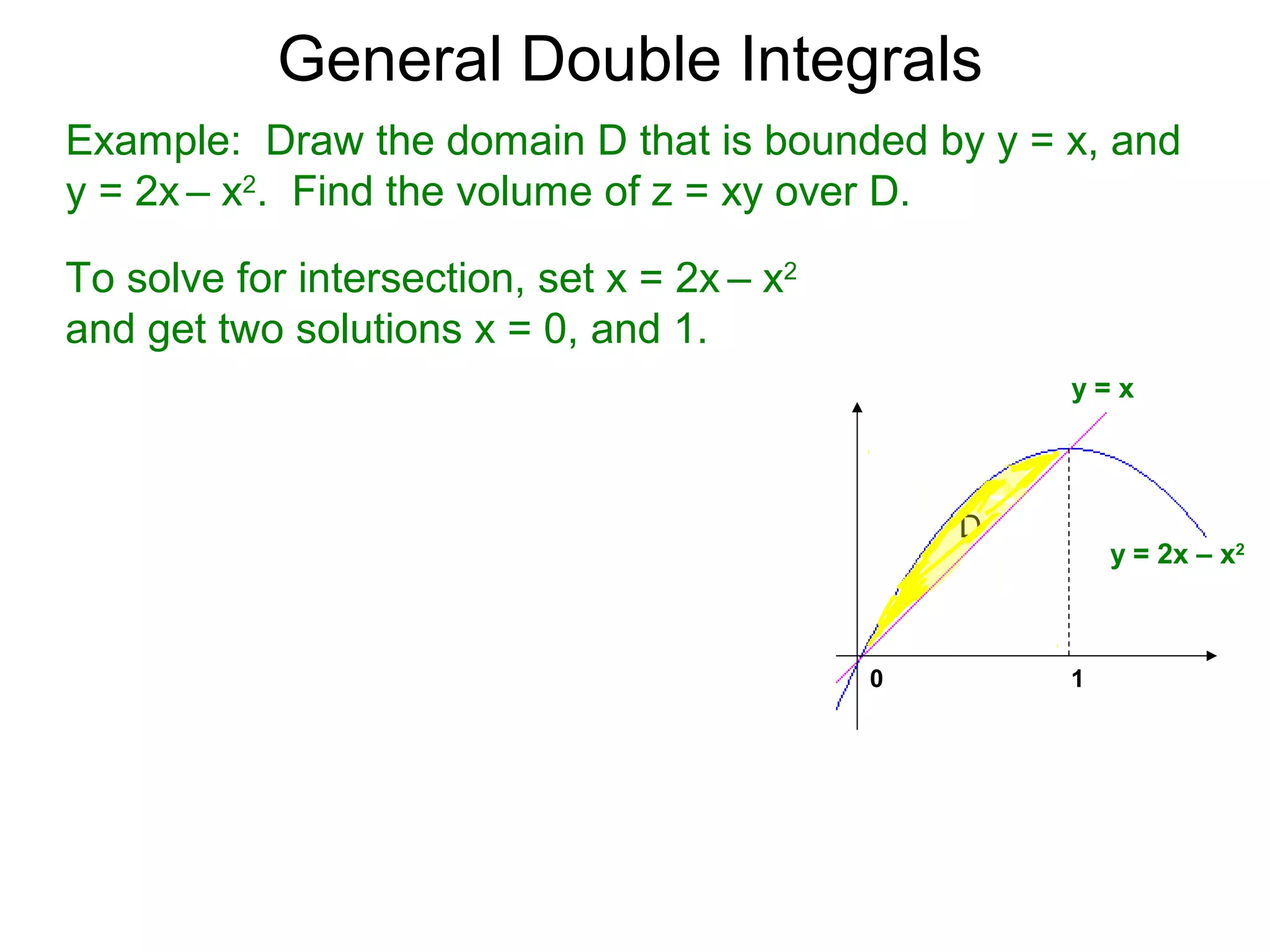
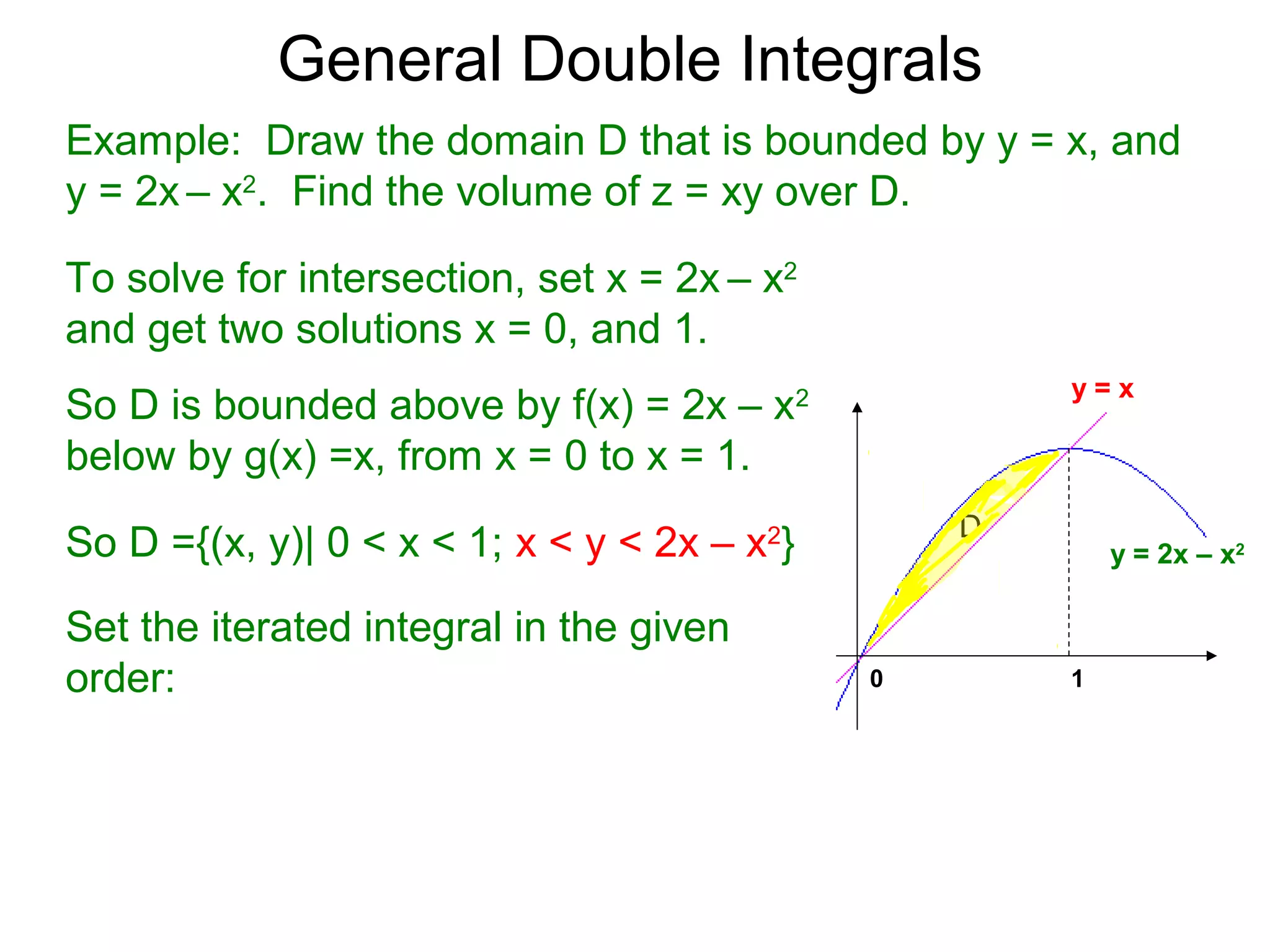
To solve for intersection, set x = 2x – x2
and get two solutions x = 0, and 1.
0 1
D
y = x
y = 2x – x2
General Double Integrals
Example: Draw the domain D that is bounded by y = x, and
y = 2x – x2
. Find the volume of z = xy over D.
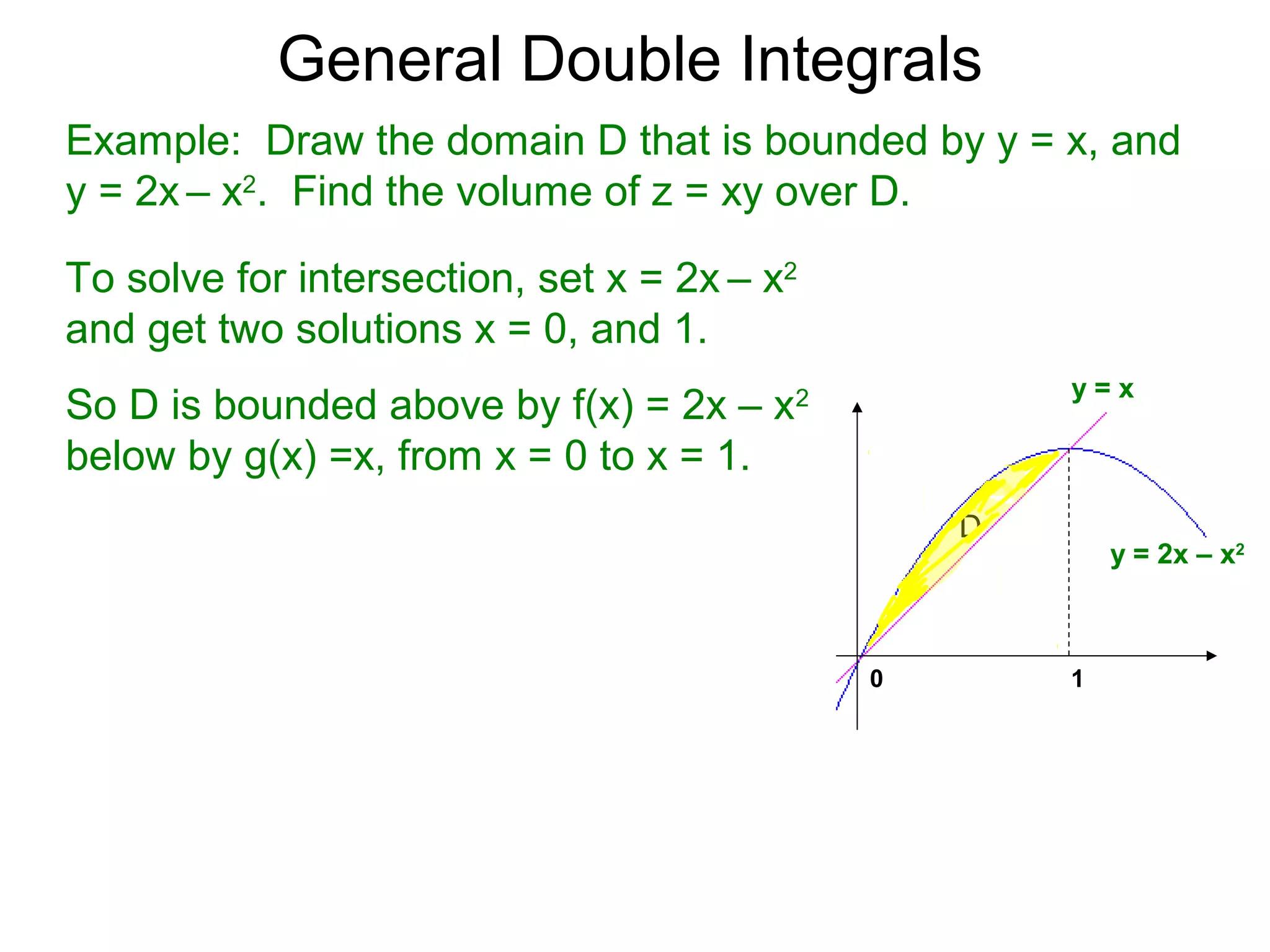
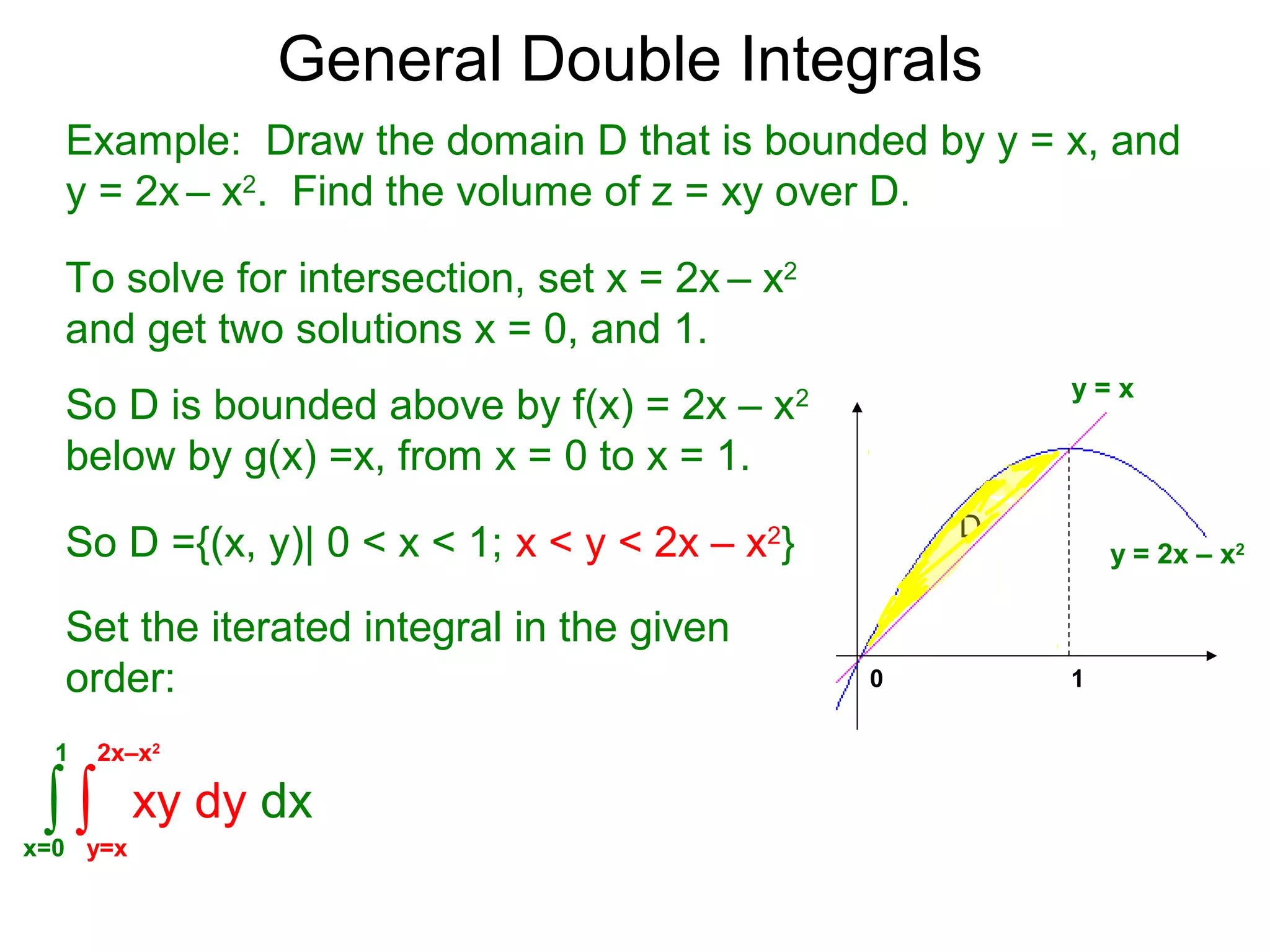
So D is bounded above by f(x) = 2x – x2
below by g(x) =x, from x = 0 to x = 1.
To solve for intersection, set x = 2x – x2
and get two solutions x = 0, and 1.
0 1
D
y = x
y = 2x – x2
General Double Integrals
Example: Draw the domain D that is bounded by y = x, and
y = 2x – x2
. Find the volume of z = xy over D.
So D is bounded above by f(x) = 2x – x2
below by g(x) =x, from x = 0 to x = 1.
To solve for intersection, set x = 2x – x2
and get two solutions x = 0, and 1.
0 1
D
y = 2x – x2
y = x
So D ={(x, y)| 0 < x < 1; x < y < 2x – x2
}
General Double Integrals
Example: Draw the domain D that is bounded by y = x, and
y = 2x – x2
. Find the volume of z = xy over D.
So D is bounded above by f(x) = 2x – x2
below by g(x) =x, from x = 0 to x = 1.
To solve for intersection, set x = 2x – x2
and get two solutions x = 0, and 1.
0 1
D
y = 2x – x2
y = x
So D ={(x, y)| 0 < x < 1; x < y < 2x – x2
}
Set the iterated integral in the given
order:
General Double Integrals
Example: Draw the domain D that is bounded by y = x, and
y = 2x – x2
. Find the volume of z = xy over D.
So D is bounded above by f(x) = 2x – x2
below by g(x) =x, from x = 0 to x = 1.
To solve for intersection, set x = 2x – x2
and get two solutions x = 0, and 1.
xy dy dx∫∫ y=xx=0
1 2x–x2
0 1
D
y = 2x – x2
y = x
So D ={(x, y)| 0 < x < 1; x < y < 2x – x2
}
Set the iterated integral in the given
order:
General Double Integrals
xy dy dx∫∫ y=xx=0
1 y=2x–x2
0 1
D
y = x
y = 2x – x2
General Double Integrals
=
xy2
∫ y=x
x=0
1
2
| dx
y=2x–x2
0 1
D
y = x
y = 2x – x2
xy dy dx∫∫ y=xx=0
1 y=2x–x2
General Double Integrals
=
xy2
∫ y=x
x=0
1
2
| dx
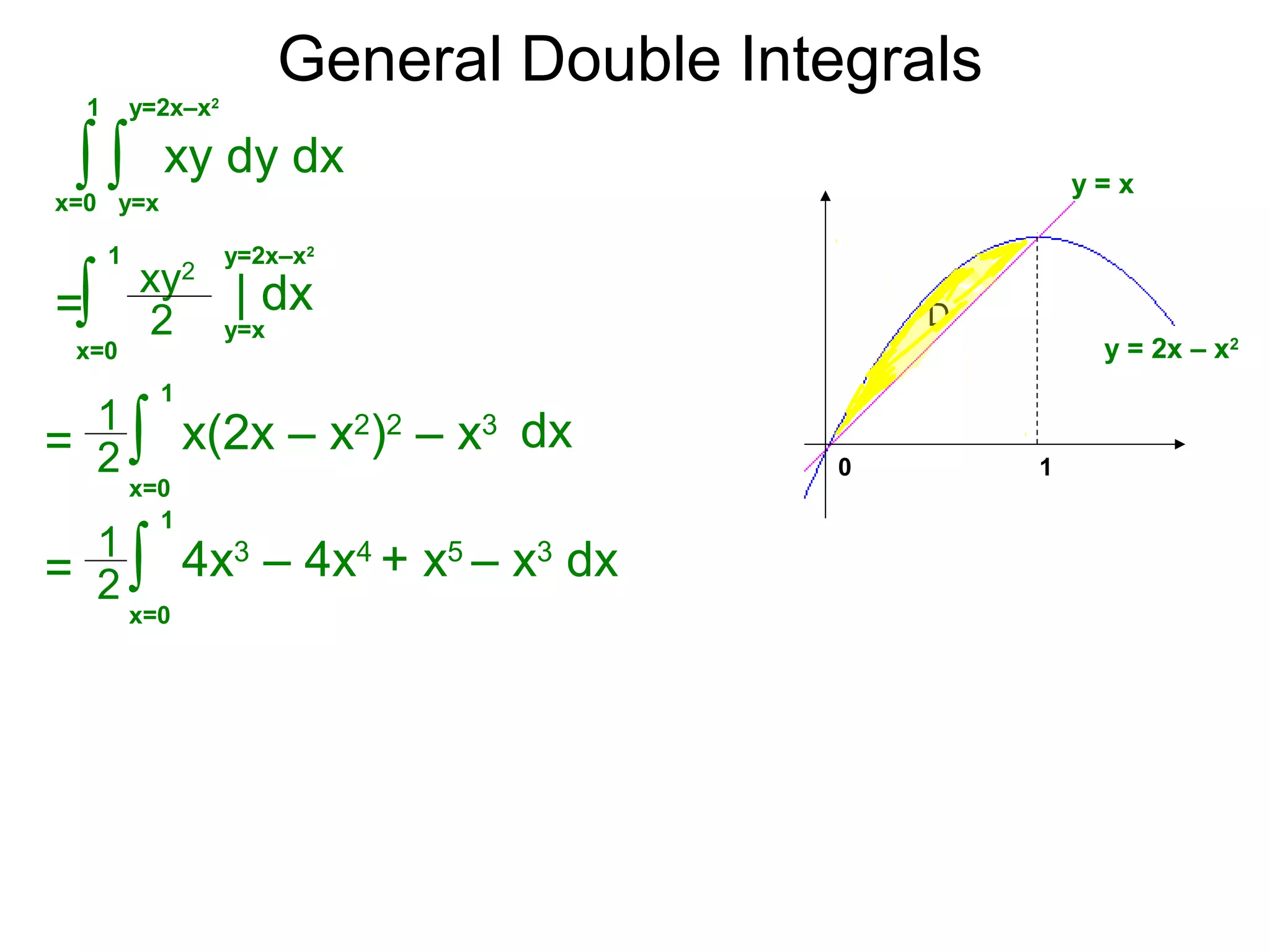
= x(2x – x2
)2
– x3
∫
x=0
1
dx1
2
y=2x–x2
0 1
D
y = x
y = 2x – x2
xy dy dx∫∫ y=xx=0
1 y=2x–x2
General Double Integrals
=
xy2
∫ y=x
x=0
1
2
| dx
= x(2x – x2
)2
– x3
∫
x=0
1
dx1
2
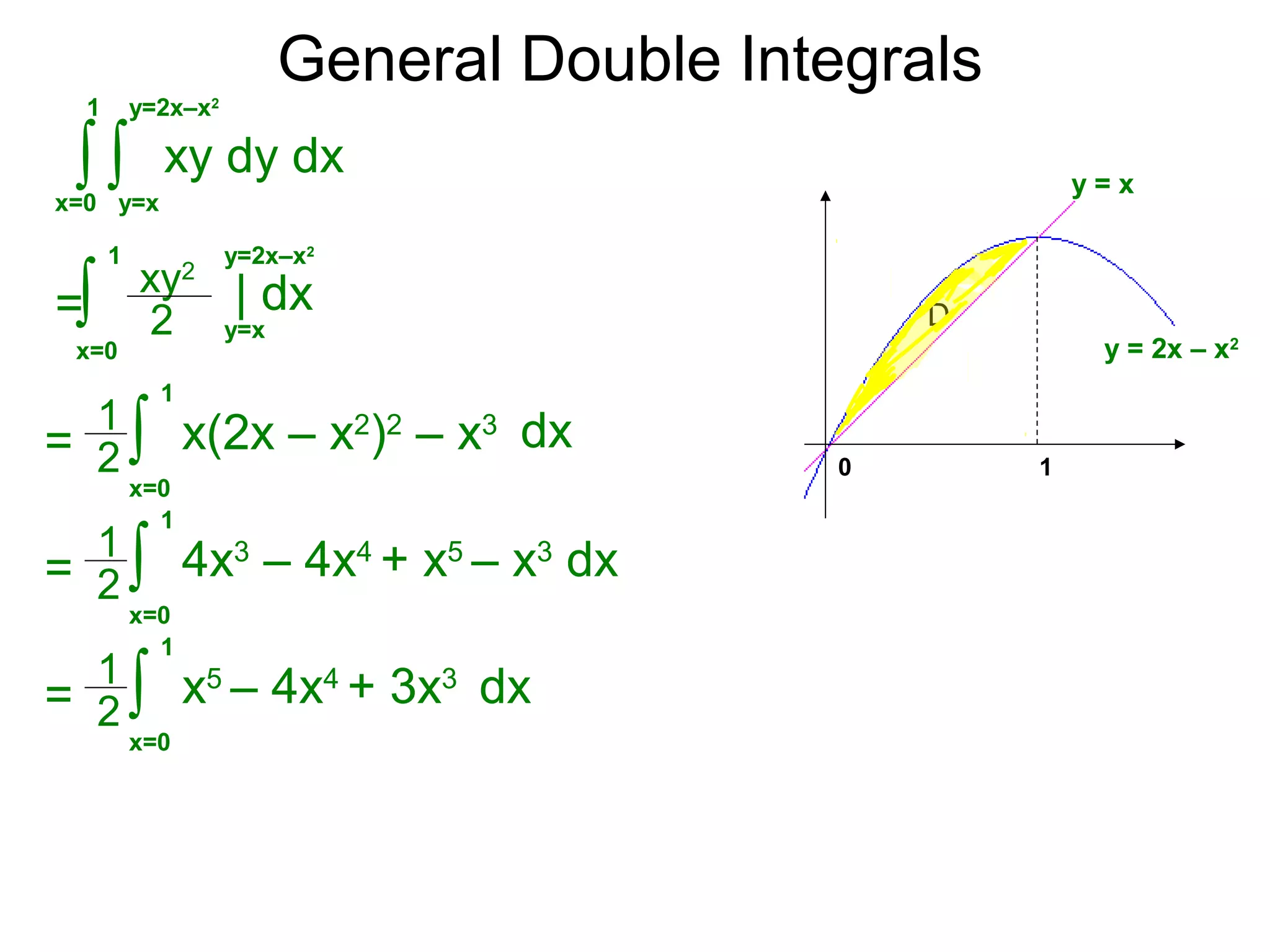
= 4x3
– 4x4
+ x5
– x3
dx∫
x=0
1
1
2
y=2x–x2
0 1
D
y = x
y = 2x – x2
xy dy dx∫∫ y=xx=0
1 y=2x–x2
General Double Integrals
=
xy2
∫ y=x
x=0
1
2
| dx
= x(2x – x2
)2
– x3
∫
x=0
1
dx1
2
= 4x3
– 4x4
+ x5
– x3
dx∫
x=0
1
1
2
= x5
– 4x4
+ 3x3
dx∫
x=0
1
1
2
y=2x–x2
0 1
D
y = x
y = 2x – x2
xy dy dx∫∫ y=xx=0
1 y=2x–x2
General Double Integrals
=
xy2
∫ y=x
x=0
1
2
| dx
= x(2x – x2
)2
– x3
∫
x=0
1
dx1
2
= 4x3
– 4x4
+ x5
– x3
dx∫
x=0
1
1
2
= x5
– 4x4
+ 3x3
dx∫
x=0
1
1
2
=
1
2 6
( x6
+5
4x5
)|
1
0
y=2x–x2
–
4
3x4
0 1
D
=
120
7
y = x
y = 2x – x2
xy dy dx∫∫ y=xx=0
1 y=2x–x2
General Double Integrals
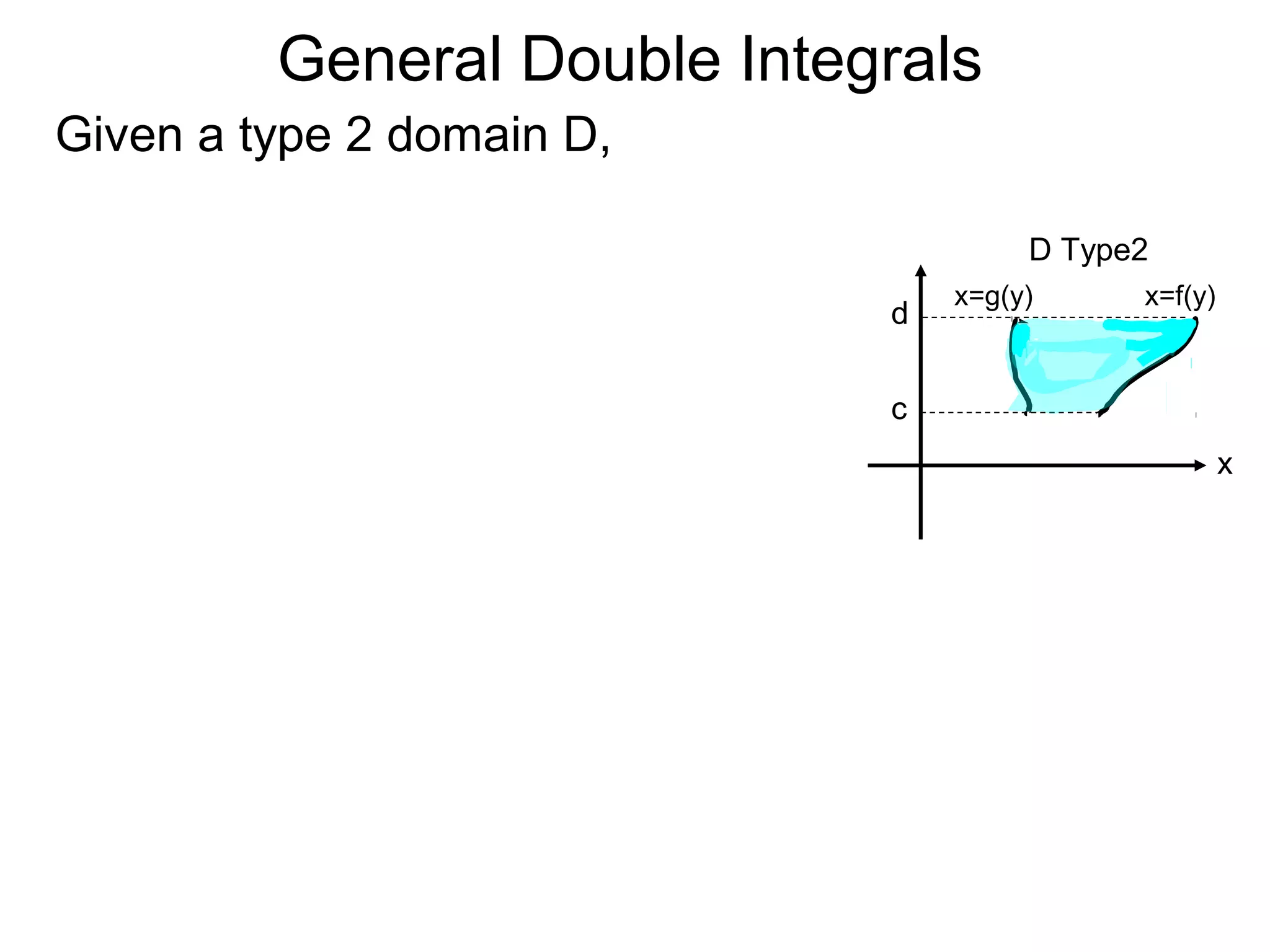
Given a type 2 domain D,
x=f(y)x=g(y)
d
c
D Type2
x
General Double Integrals
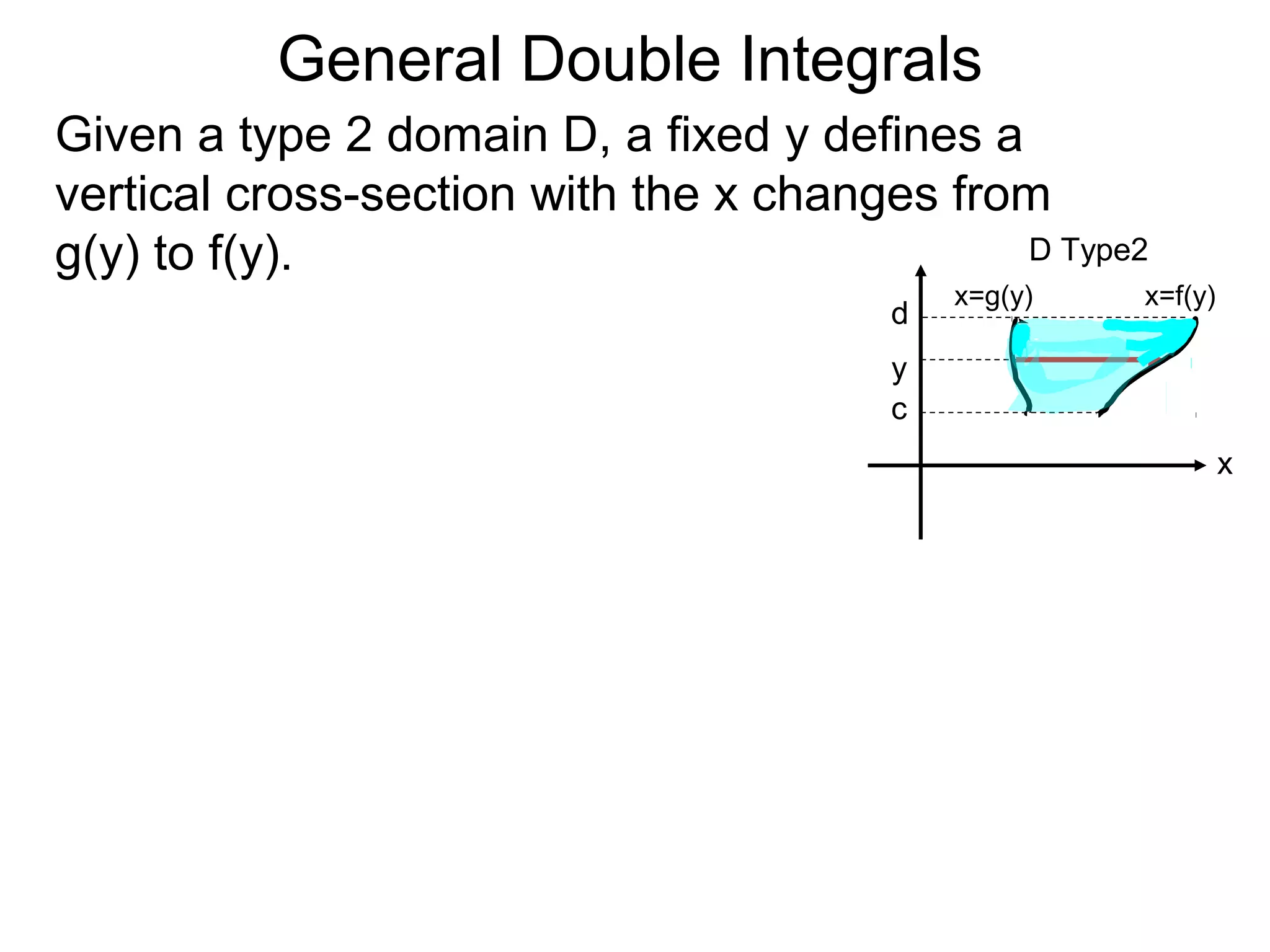
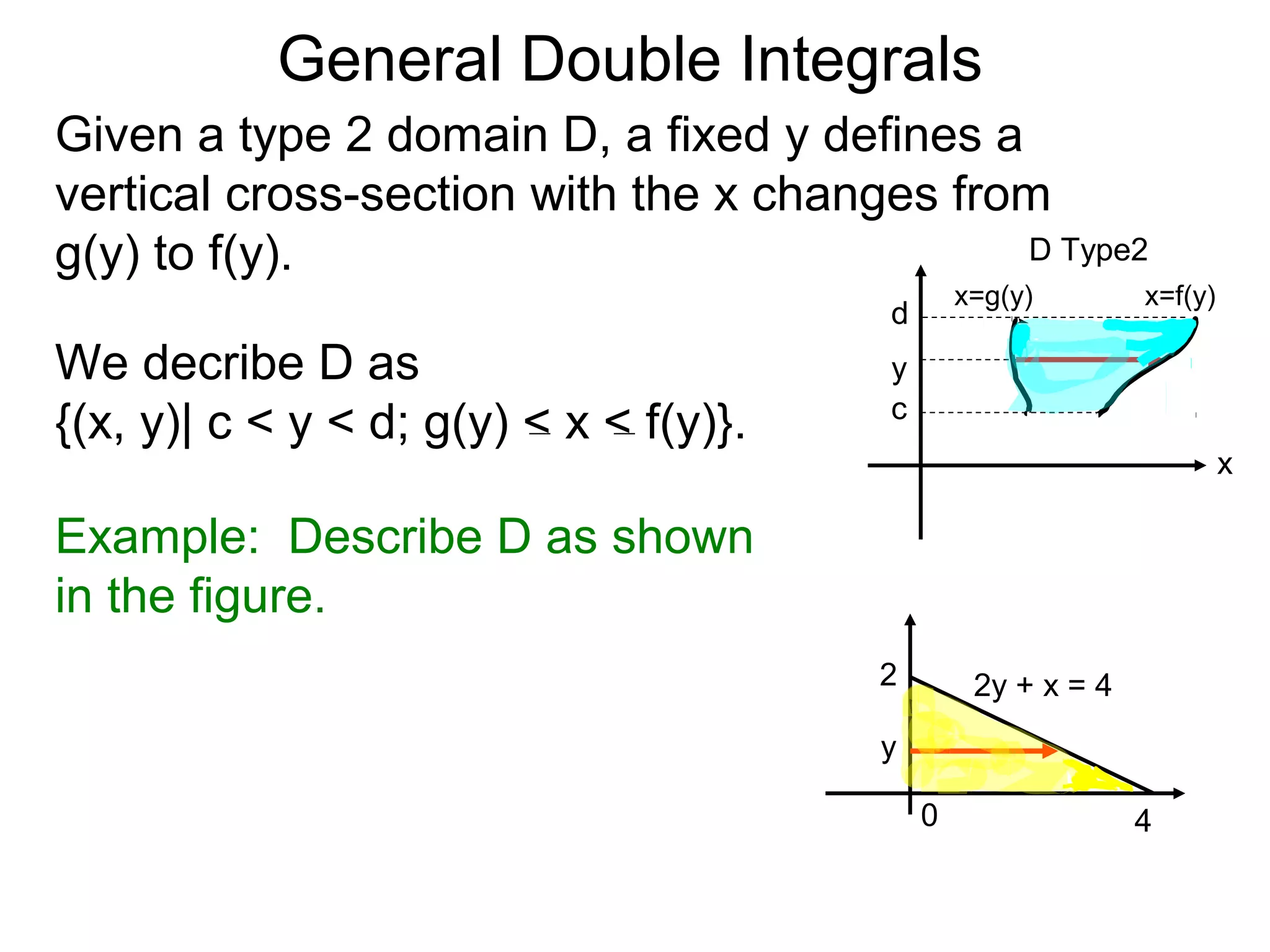
Given a type 2 domain D, a fixed y defines a
vertical cross-section with the x changes from
g(y) to f(y).
x=f(y)x=g(y)
d
c
D Type2
x
y
General Double Integrals
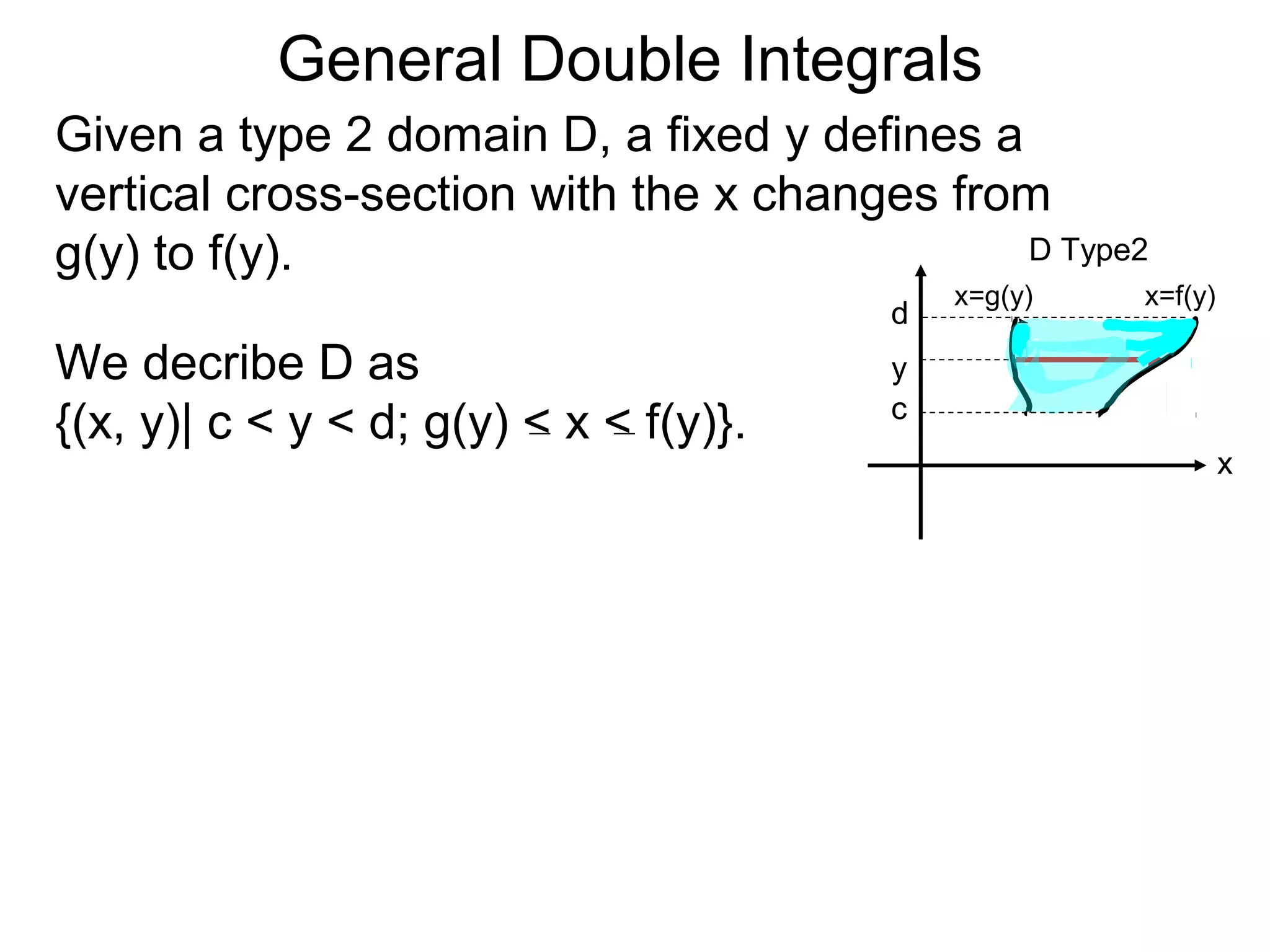
Given a type 2 domain D, a fixed y defines a
vertical cross-section with the x changes from
g(y) to f(y).
We decribe D as
{(x, y)| c < y < d; g(y) < x < f(y)}.
x=f(y)x=g(y)
d
c
D Type2
x
y
General Double Integrals
Given a type 2 domain D, a fixed y defines a
vertical cross-section with the x changes from
g(y) to f(y).
We decribe D as
{(x, y)| c < y < d; g(y) < x < f(y)}.
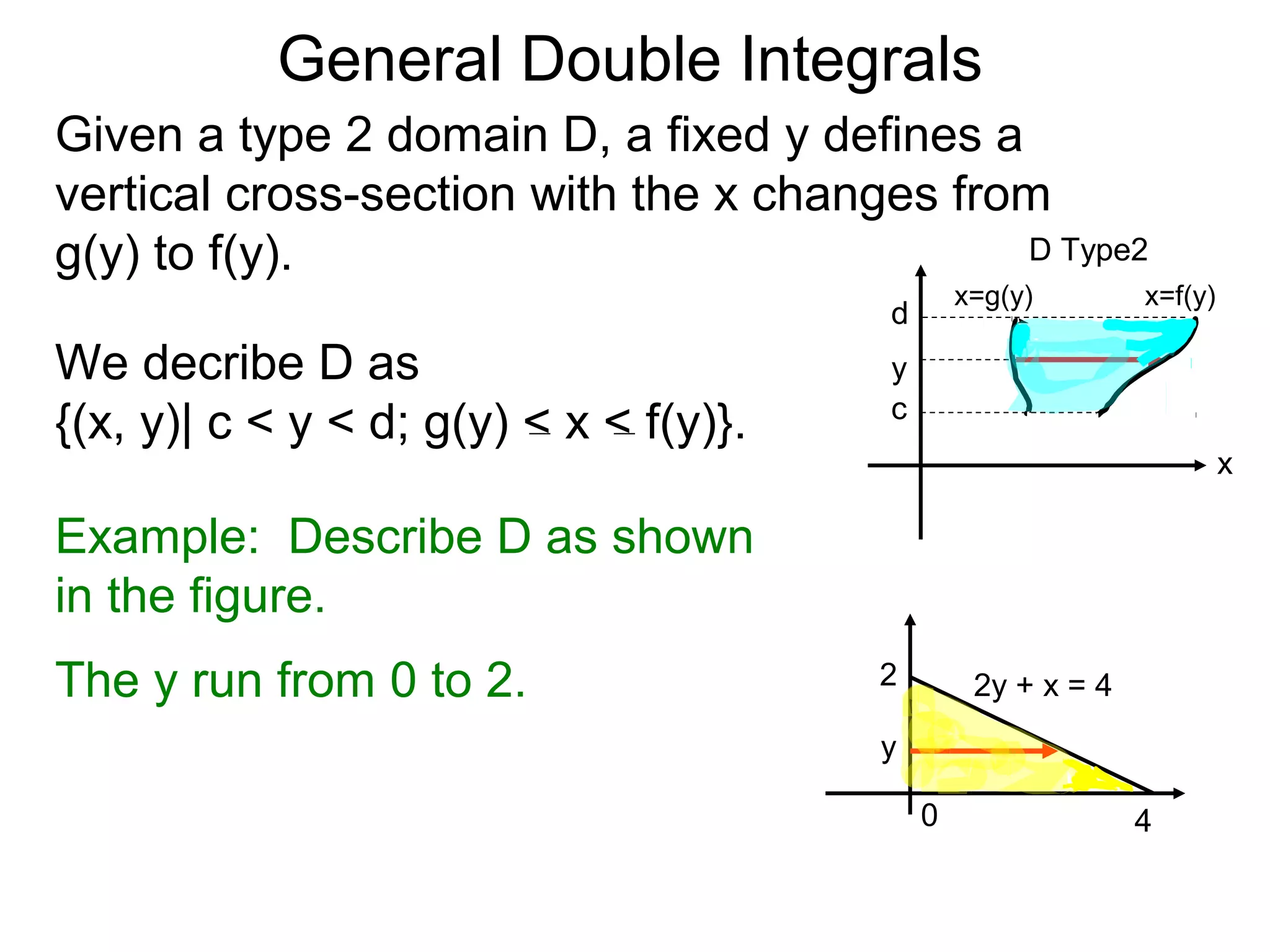
Example: Describe D as shown
in the figure.
2y + x = 4
0 4
2
y
x=f(y)x=g(y)
d
c
D Type2
x
y
General Double Integrals
Given a type 2 domain D, a fixed y defines a
vertical cross-section with the x changes from
g(y) to f(y).
We decribe D as
{(x, y)| c < y < d; g(y) < x < f(y)}.
Example: Describe D as shown
in the figure.
The y run from 0 to 2. 2y + x = 4
0 4
2
y
x=f(y)x=g(y)
d
c
D Type2
x
y
General Double Integrals
Given a type 2 domain D, a fixed y defines a
vertical cross-section with the x changes from
g(y) to f(y).
We decribe D as
{(x, y)| c < y < d; g(y) < x < f(y)}.
Example: Describe D as shown
in the figure.
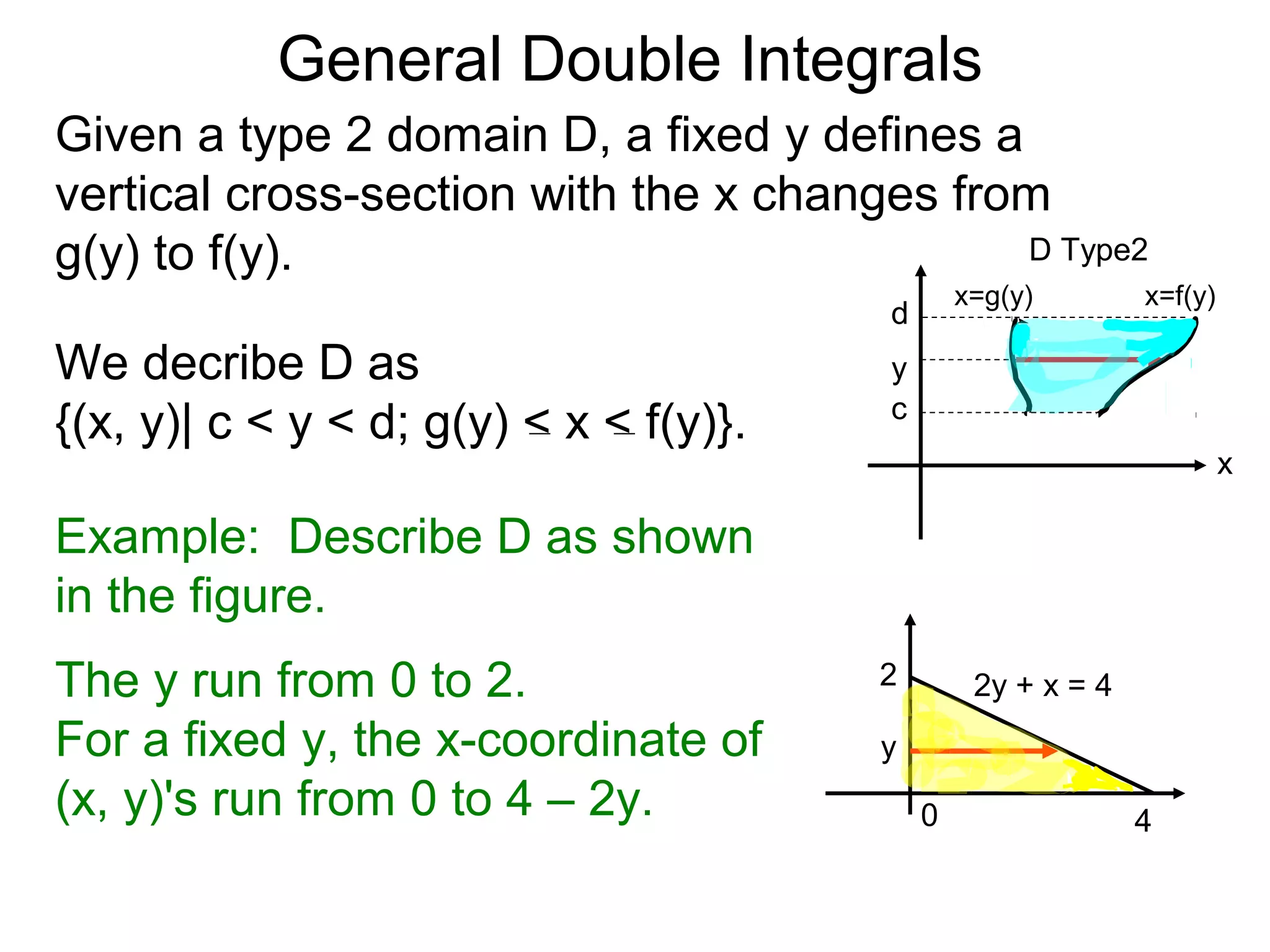
The y run from 0 to 2.
For a fixed y, the x-coordinate of
(x, y)'s run from 0 to 4 – 2y.
2y + x = 4
0 4
2
y
x=f(y)x=g(y)
d
c
D Type2
x
y
General Double Integrals
Given a type 2 domain D, a fixed y defines a
vertical cross-section with the x changes from
g(y) to f(y).
We decribe D as
{(x, y)| c < y < d; g(y) < x < f(y)}.
Example: Describe D as shown
in the figure.
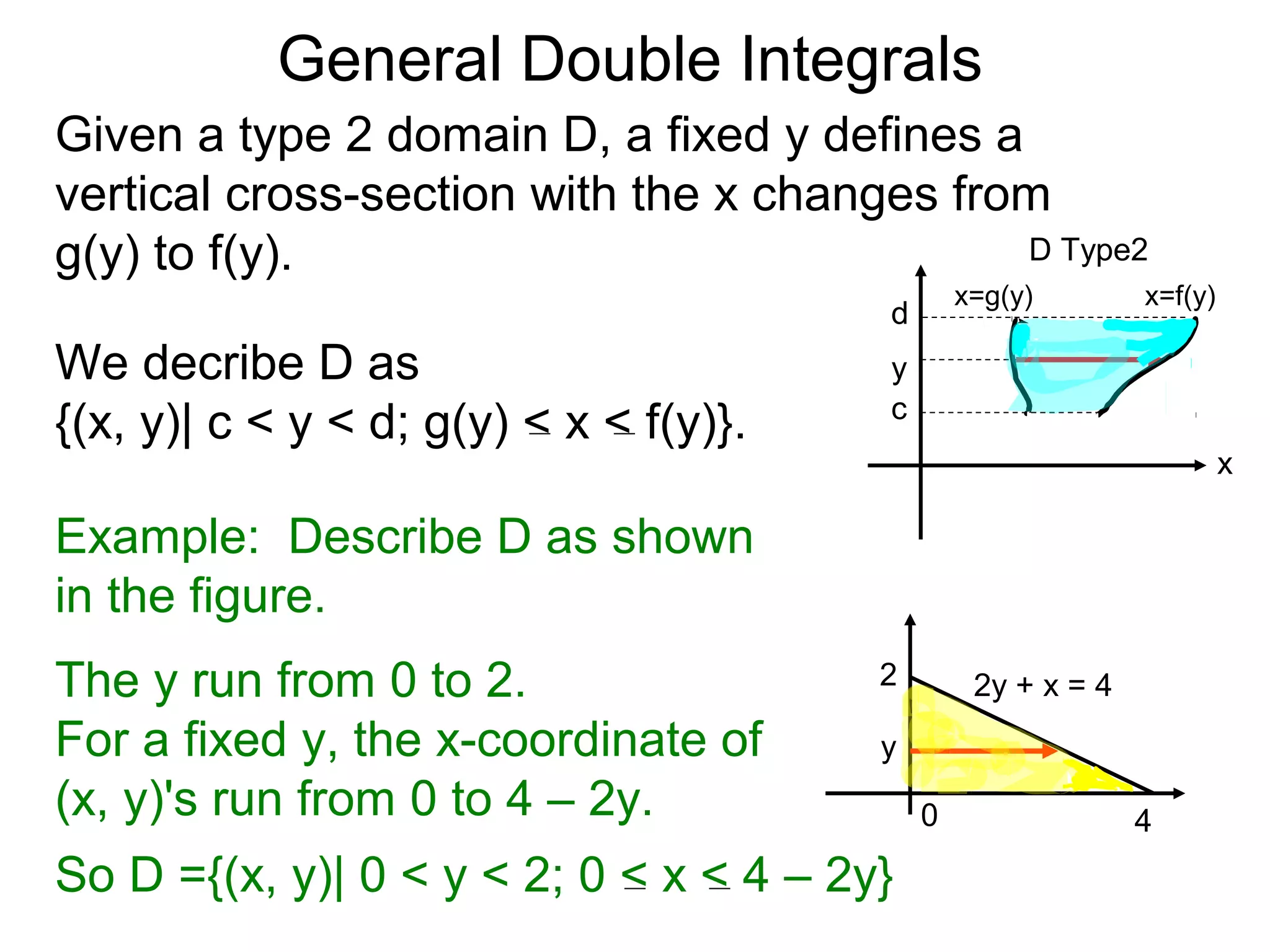
The y run from 0 to 2.
For a fixed y, the x-coordinate of
(x, y)'s run from 0 to 4 – 2y.
2y + x = 4
0 4
2
So D ={(x, y)| 0 < y < 2; 0 < x < 4 – 2y}
y
x=f(y)x=g(y)
d
c
D Type2
x
y
General Double Integrals
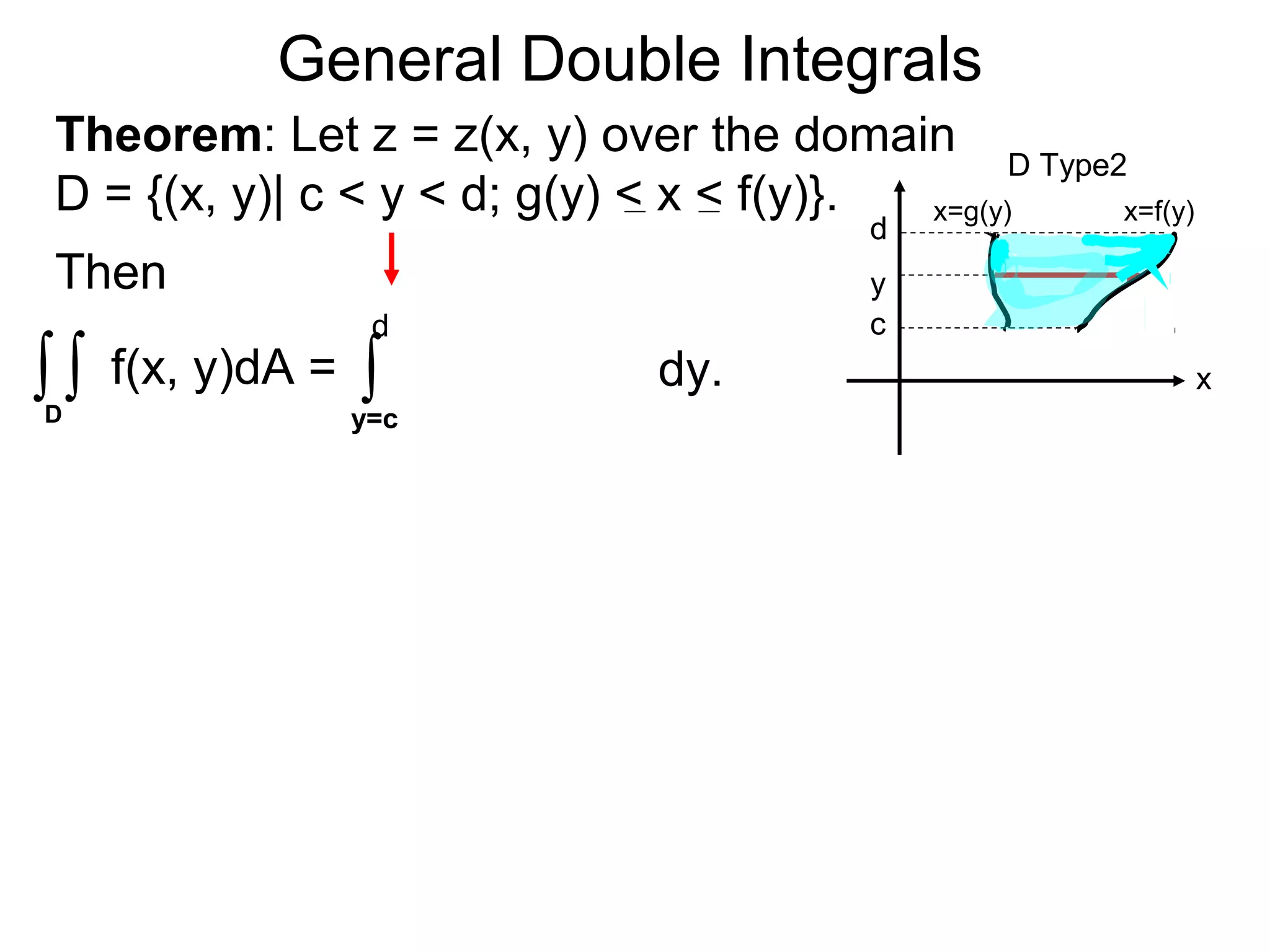
Theorem: Let z = z(x, y) over the domain
D = {(x, y)| c < y < d; g(y) < x < f(y)}. x=f(y)x=g(y)
d
c
D Type2
x
y
General Double Integrals
Theorem: Let z = z(x, y) over the domain
D = {(x, y)| c < y < d; g(y) < x < f(y)}.
Then
∫ f(x, y)dA =∫ ∫ dy.
y=c
d
D
x=f(y)x=g(y)
d
c
D Type2
x
y
General Double Integrals
Theorem: Let z = z(x, y) over the domain
D = {(x, y)| c < y < d; g(y) < x < f(y)}.
Then
∫ f(x, y)dA =∫ ∫ z(x, y)dx ]dy.
y=c
d
∫x=g(y)
f(y)
[
D
x=f(y)x=g(y)
d
c
D Type2
x
y
General Double Integrals
Theorem: Let z = z(x, y) over the domain
D = {(x, y)| c < y < d; g(y) < x < f(y)}.
Then
∫ f(x, y)dA =∫ ∫ z(x, y)dx ]dy.
y=c
d
∫x=g(y)
f(y)
[
The order of the integration is set according to the the
description of the domain D with ∫ dy outside and ∫ dx
inside to be calculated first.
D
x=f(y)x=g(y)
d
c
D Type2
x
y
General Double Integrals
Theorem: Let z = z(x, y) over the domain
D = {(x, y)| c < y < d; g(y) < x < f(y)}.
Then
∫ f(x, y)dA =∫ ∫ z(x, y)dx ]dy.
y=c
d
∫x=g(y)
f(y)
[
The order of the integration is set according to the the
description of the domain D with ∫ dy outside and ∫ dx
inside to be calculated first.
Again, if D is the rectangle [a, b] x [c, d], then
D = {c < y < d; a < x < b } and the double integral is
∫ f(x, y)dA =∫ ∫ z(x, y)dx ]dy.
y=c
d
∫x=a
b
[
D
D
x=f(y)x=g(y)
d
c
D Type2
x
y
General Double Integrals
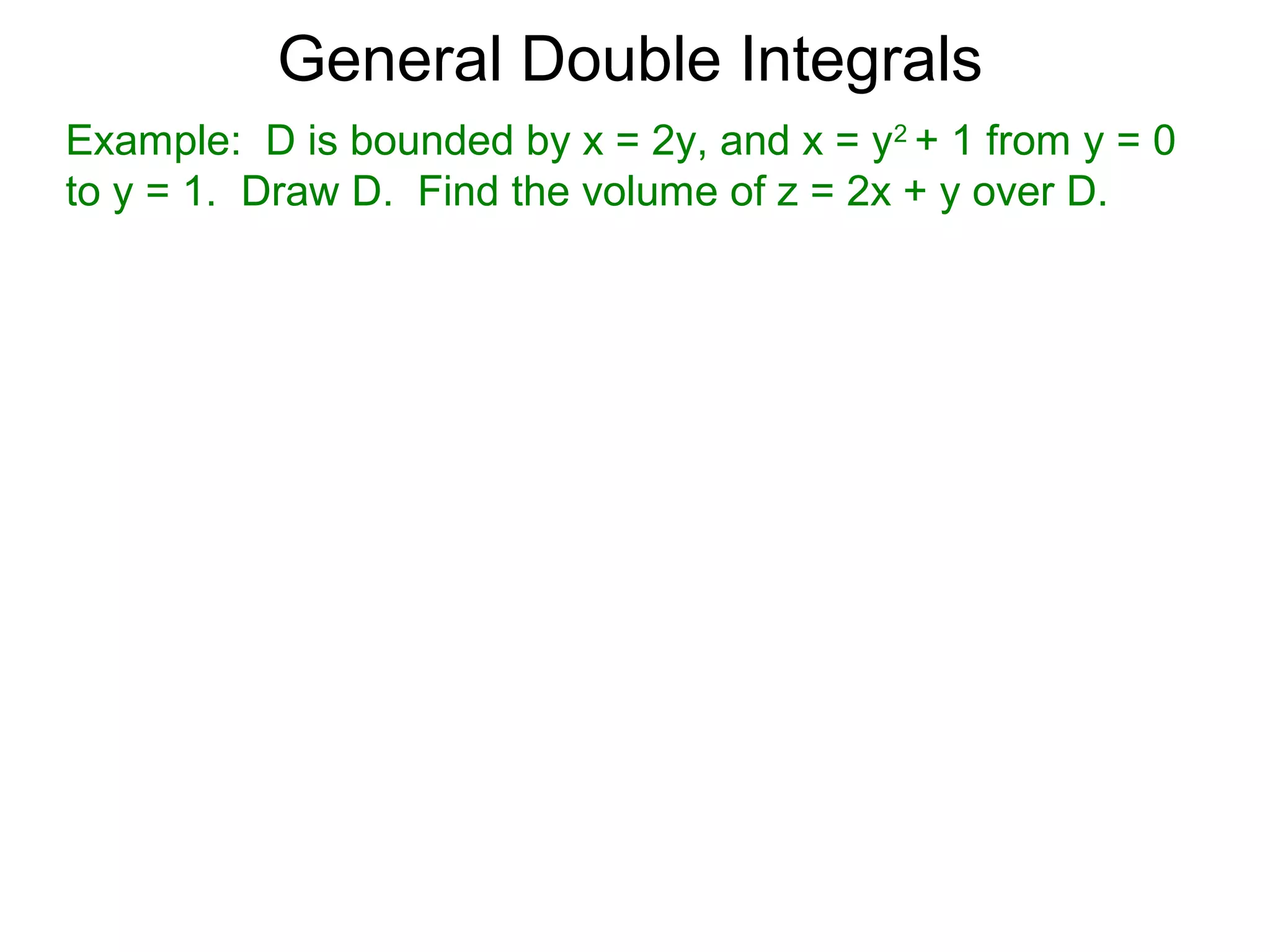
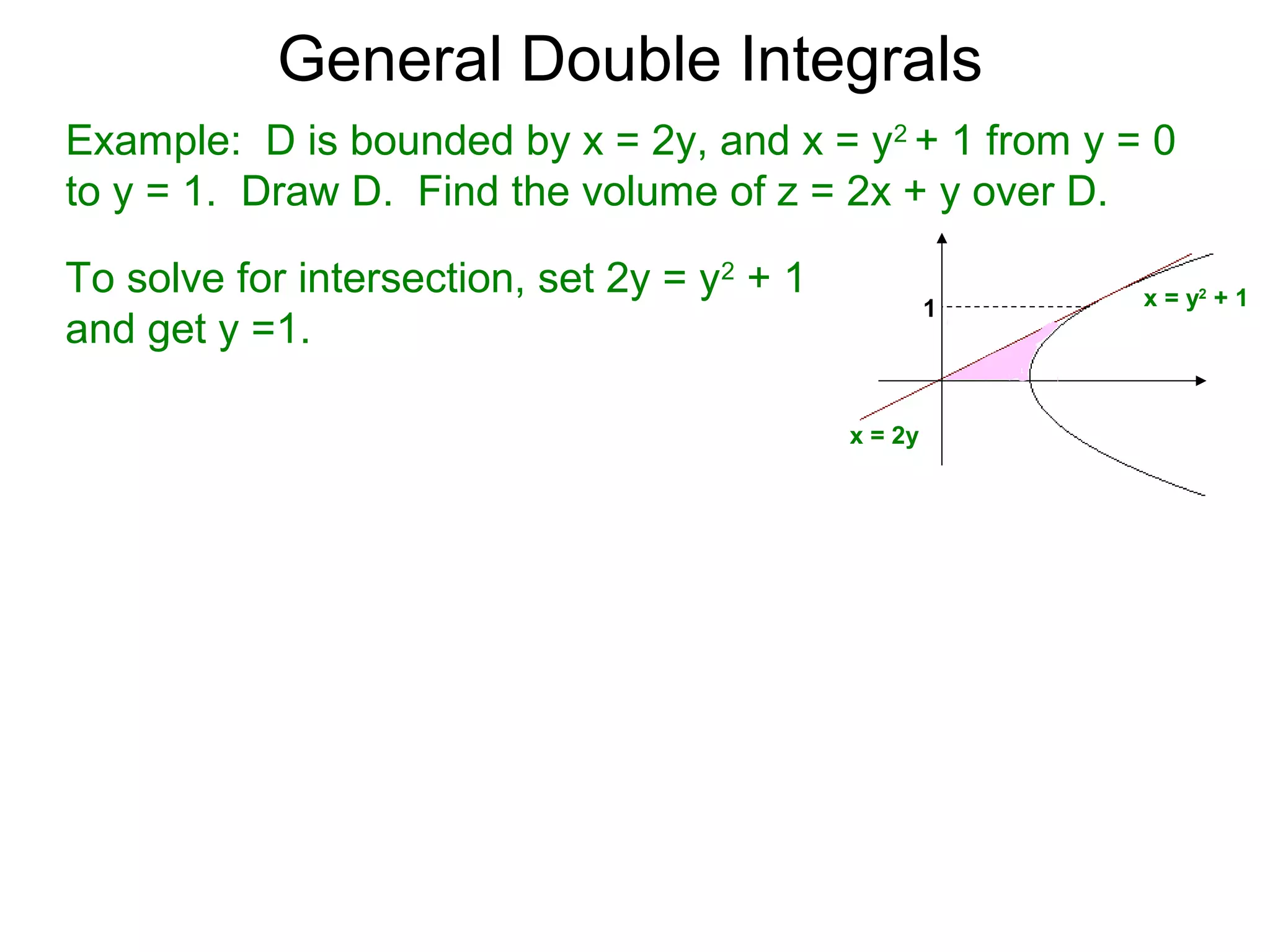
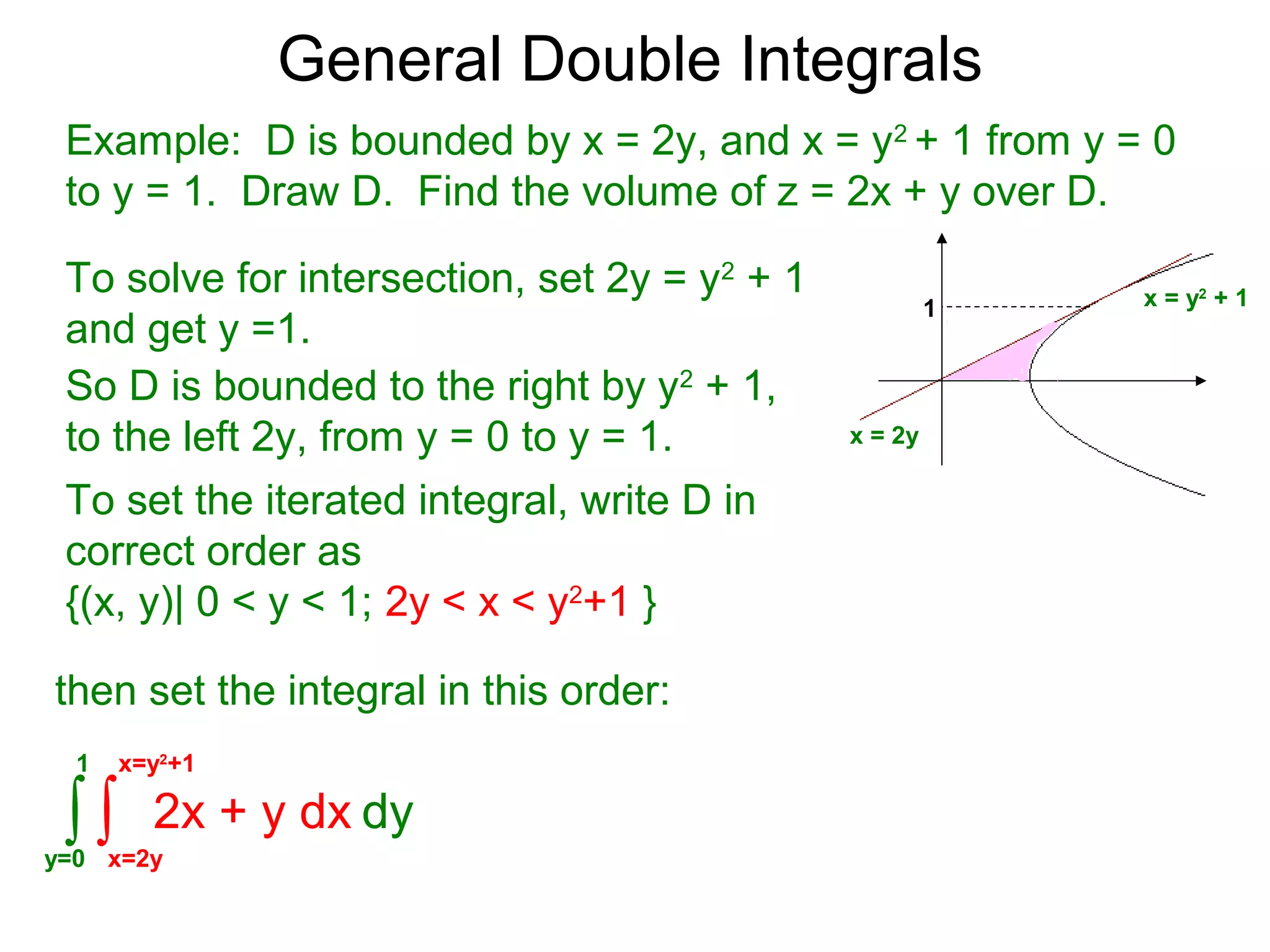
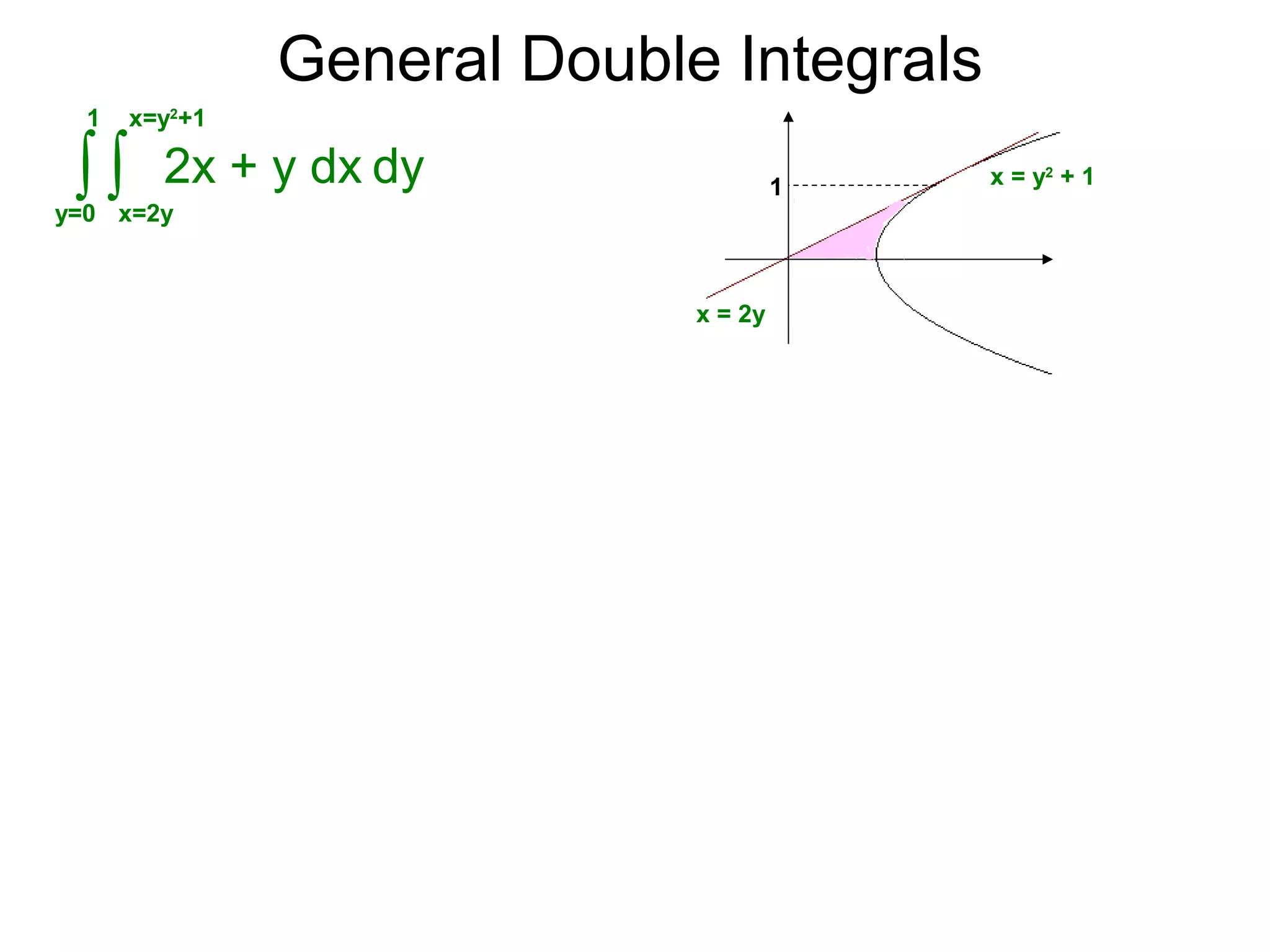
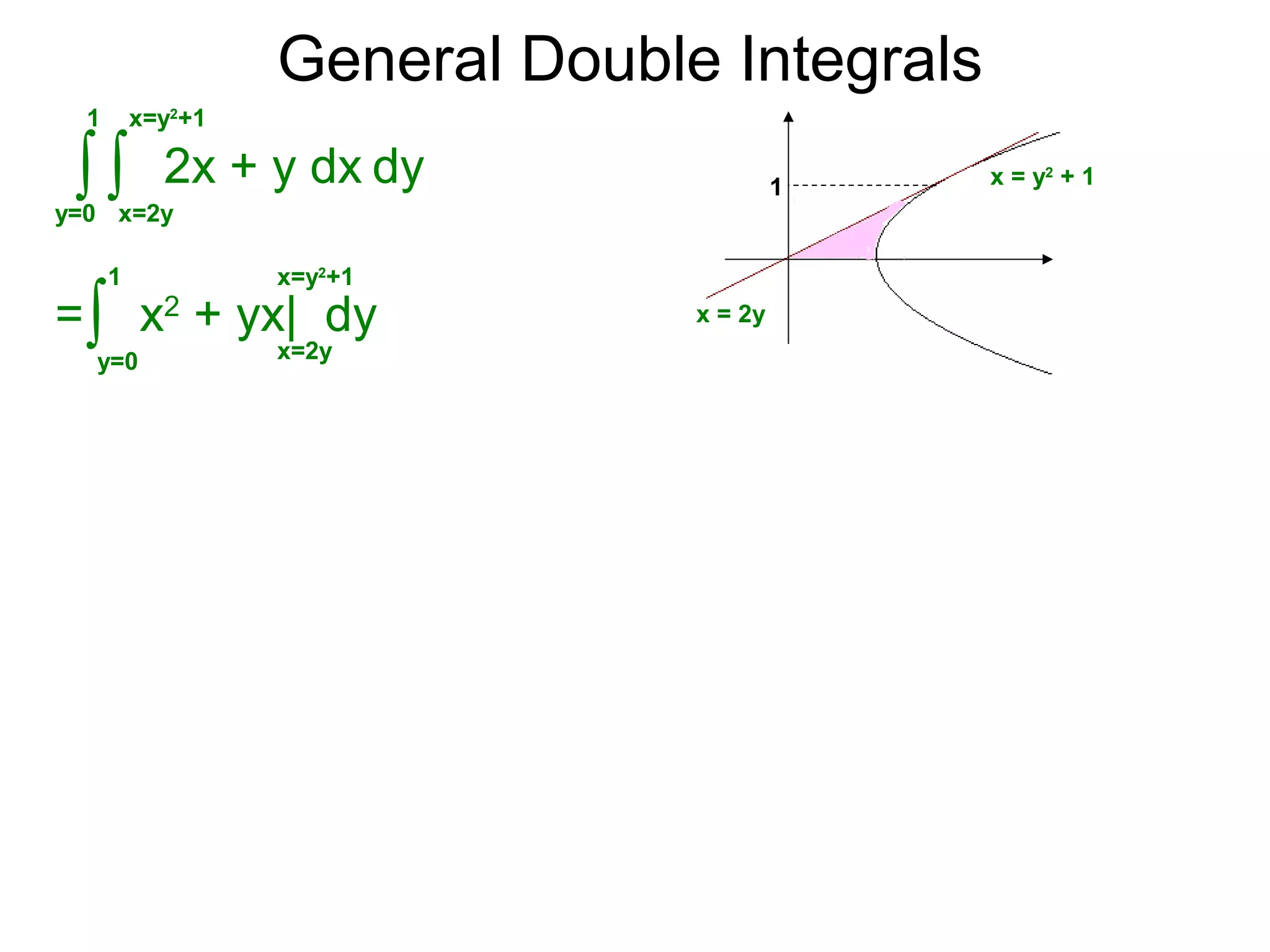
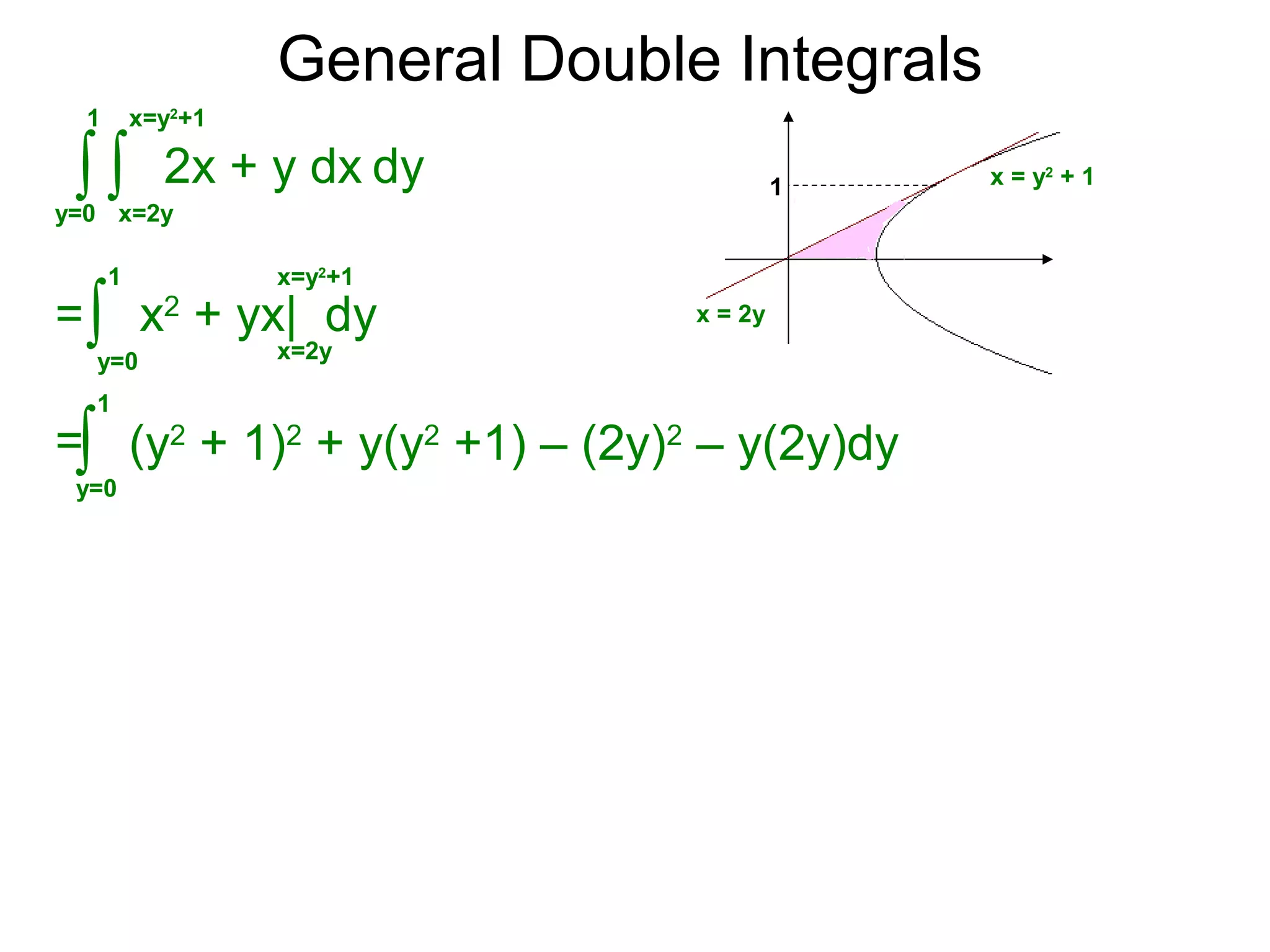
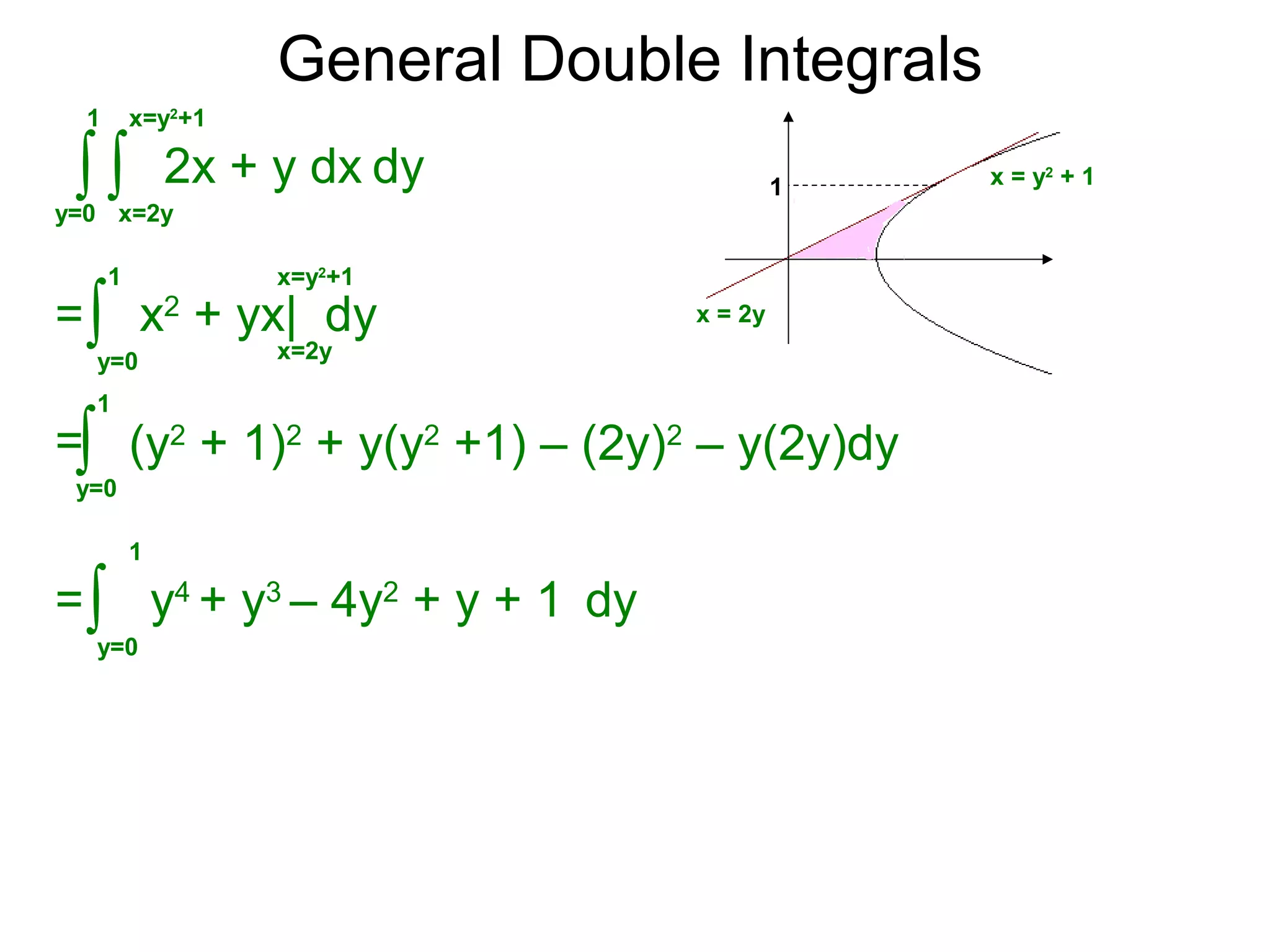
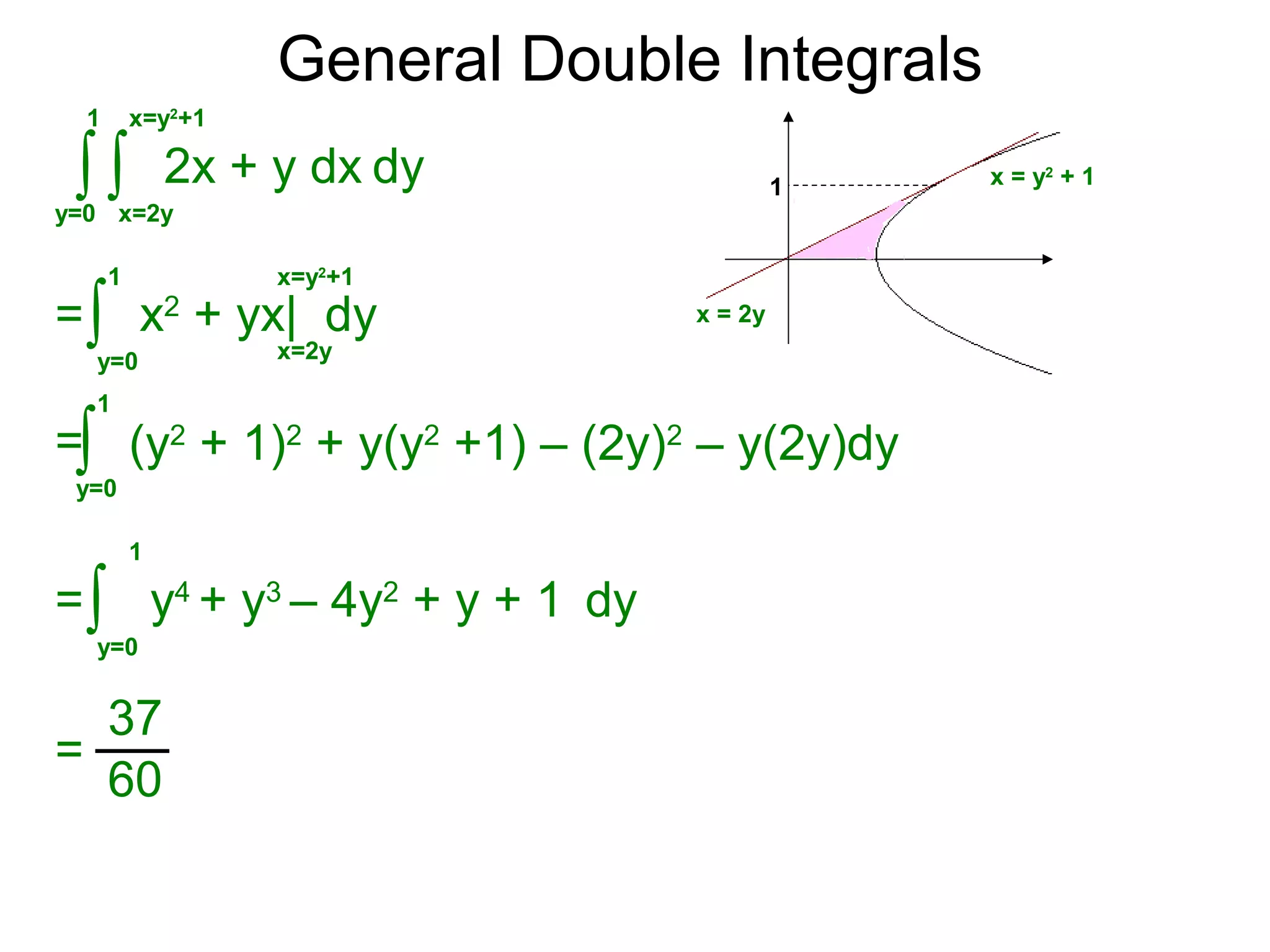
Example: D is bounded by x = 2y, and x = y2
+ 1 from y = 0
to y = 1. Draw D. Find the volume of z = 2x + y over D.
General Double Integrals
Example: D is bounded by x = 2y, and x = y2
+ 1 from y = 0
to y = 1. Draw D. Find the volume of z = 2x + y over D.
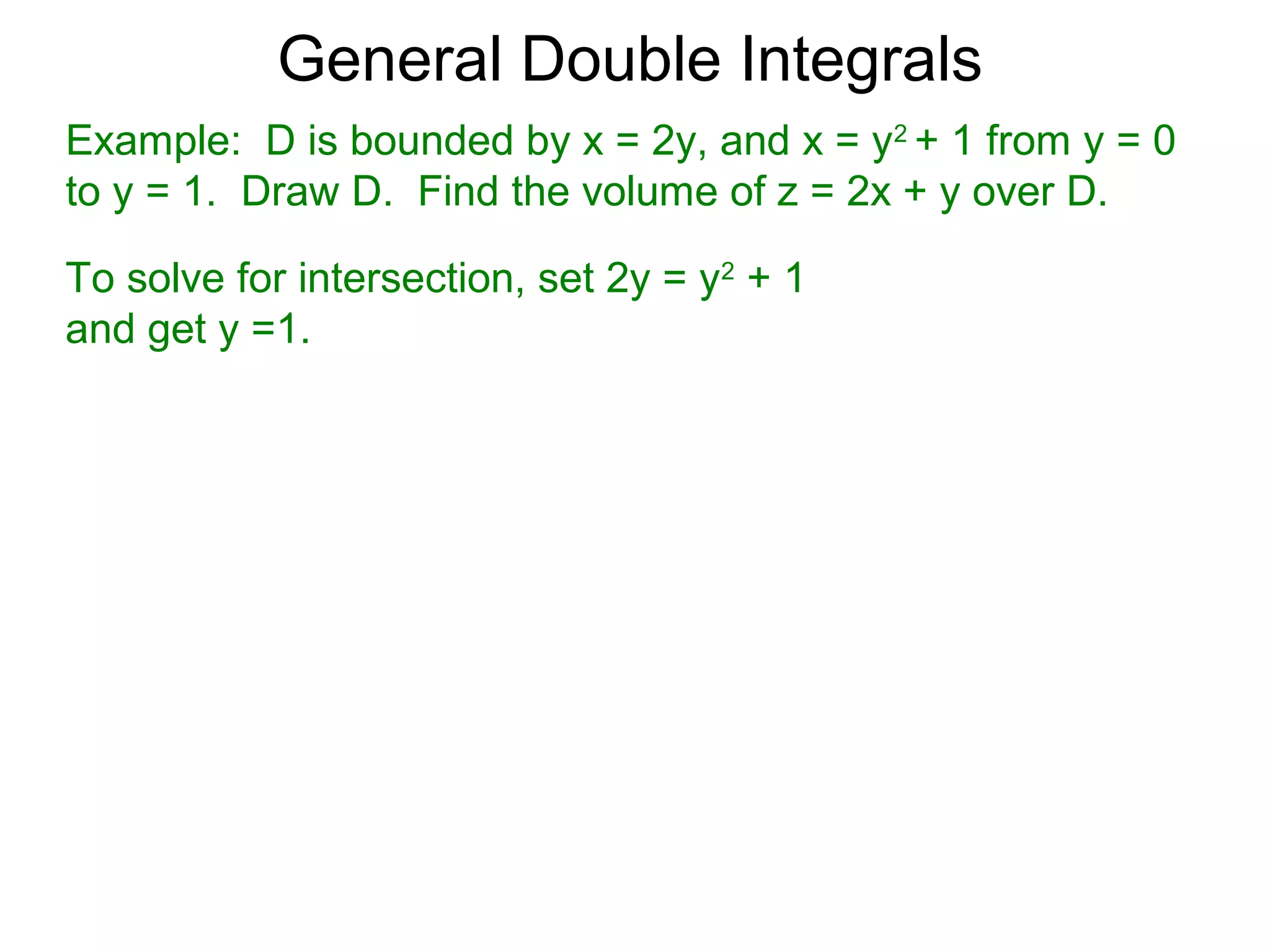
To solve for intersection, set 2y = y2
+ 1
and get y =1.
General Double Integrals
Example: D is bounded by x = 2y, and x = y2
+ 1 from y = 0
to y = 1. Draw D. Find the volume of z = 2x + y over D.
To solve for intersection, set 2y = y2
+ 1
and get y =1.
1 x = y2
+ 1
x = 2y
General Double Integrals
Example: D is bounded by x = 2y, and x = y2
+ 1 from y = 0
to y = 1. Draw D. Find the volume of z = 2x + y over D.
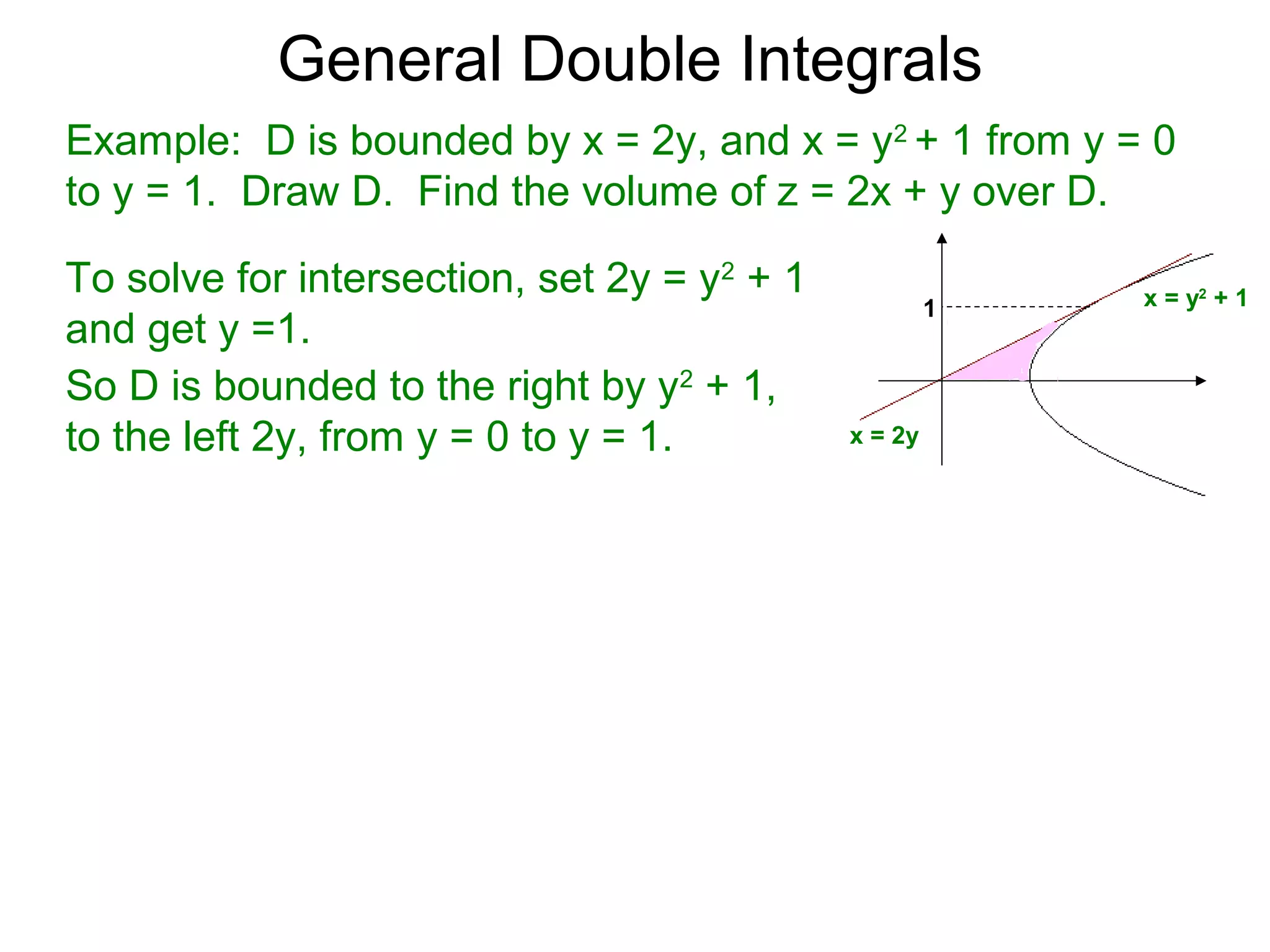
So D is bounded to the right by y2
+ 1,
to the left 2y, from y = 0 to y = 1.
To solve for intersection, set 2y = y2
+ 1
and get y =1.
1 x = y2
+ 1
x = 2y
General Double Integrals
Example: D is bounded by x = 2y, and x = y2
+ 1 from y = 0
to y = 1. Draw D. Find the volume of z = 2x + y over D.
So D is bounded to the right by y2
+ 1,
to the left 2y, from y = 0 to y = 1.
To solve for intersection, set 2y = y2
+ 1
and get y =1.
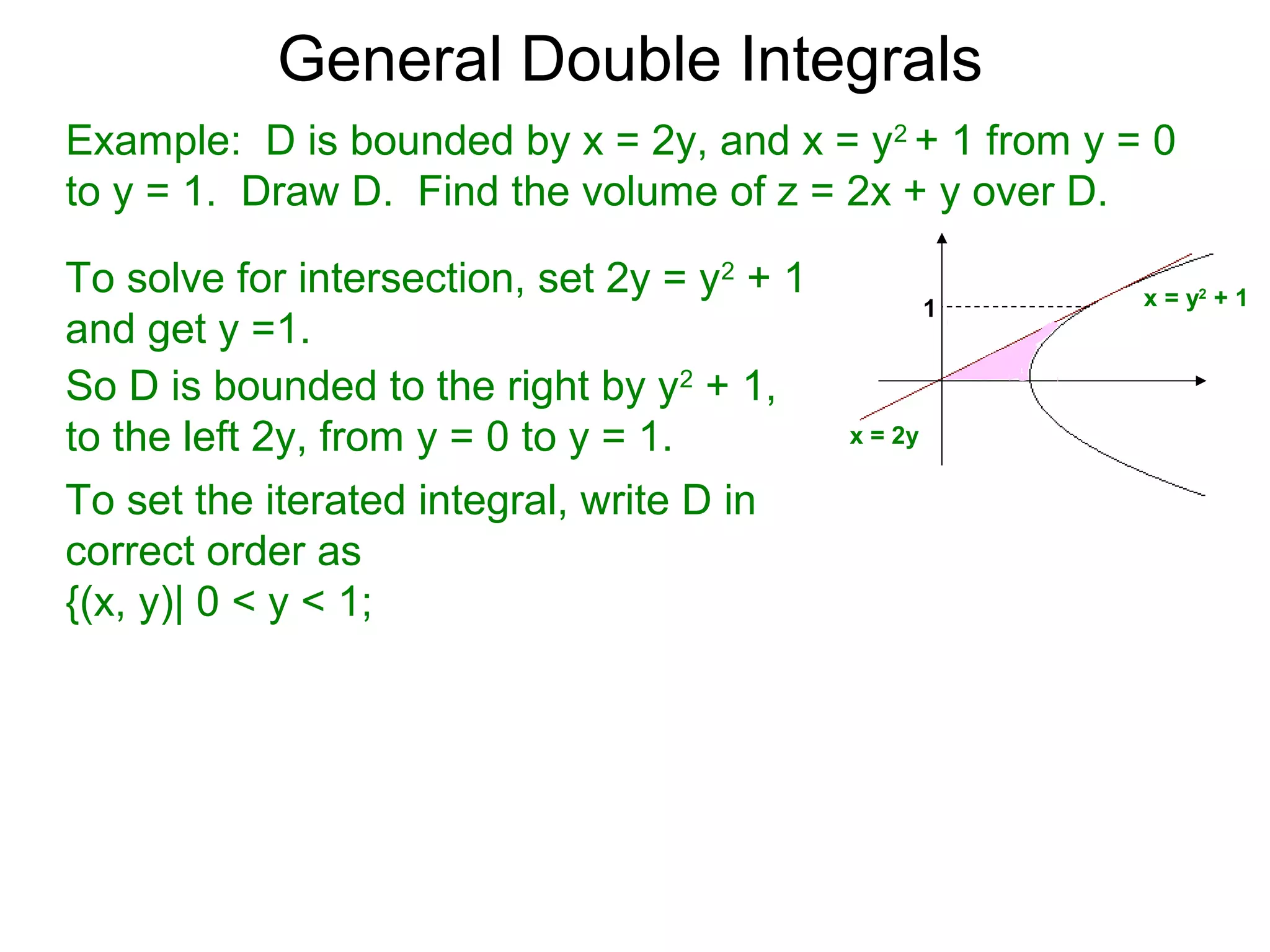
To set the iterated integral, write D in
correct order as
{(x, y)| 0 < y < 1;
1 x = y2
+ 1
x = 2y
General Double Integrals
Example: D is bounded by x = 2y, and x = y2
+ 1 from y = 0
to y = 1. Draw D. Find the volume of z = 2x + y over D.
So D is bounded to the right by y2
+ 1,
to the left 2y, from y = 0 to y = 1.
To solve for intersection, set 2y = y2
+ 1
and get y =1.
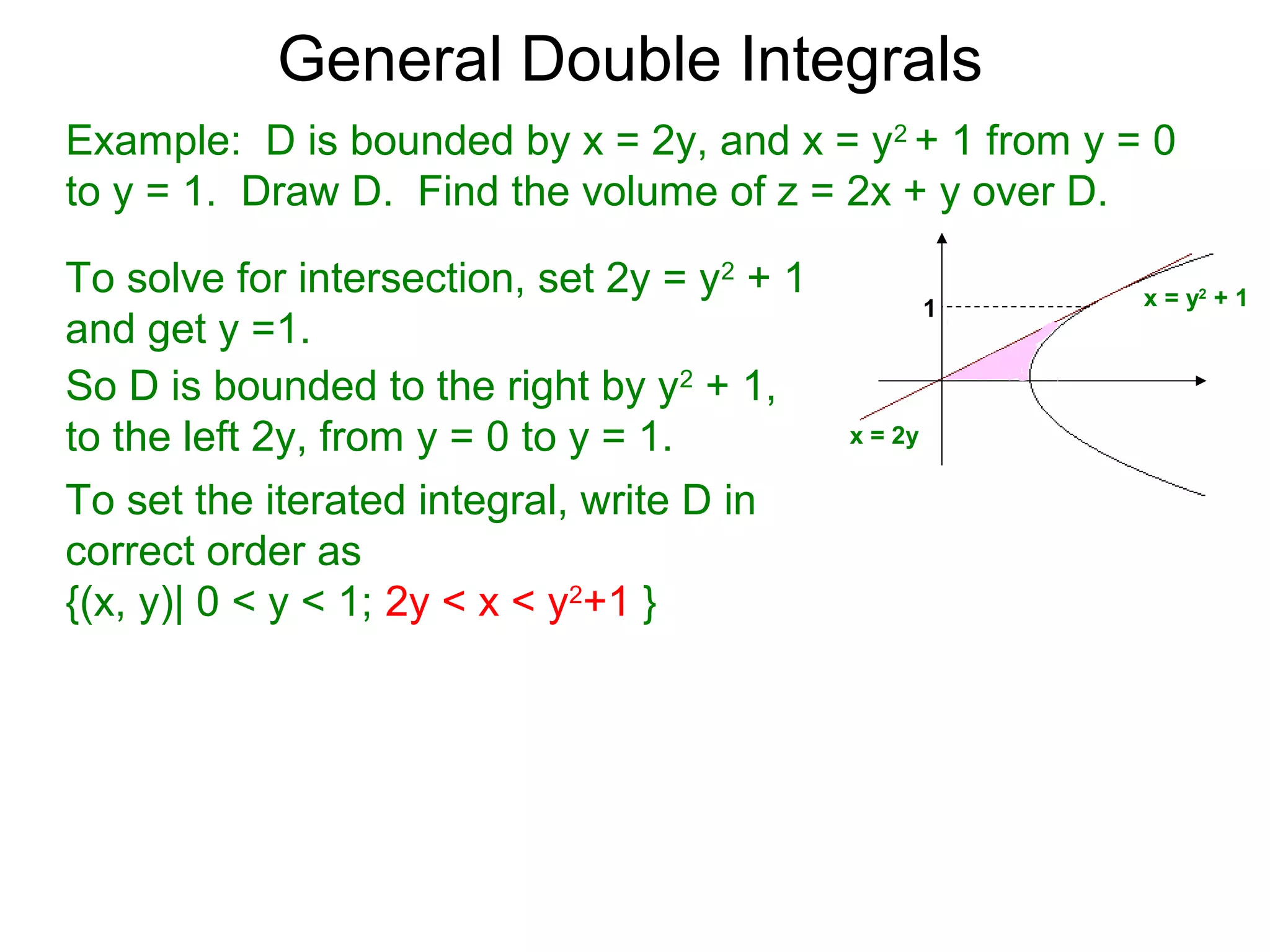
To set the iterated integral, write D in
correct order as
{(x, y)| 0 < y < 1; 2y < x < y2
+1 }
1 x = y2
+ 1
x = 2y
General Double Integrals
Example: D is bounded by x = 2y, and x = y2
+ 1 from y = 0
to y = 1. Draw D. Find the volume of z = 2x + y over D.
So D is bounded to the right by y2
+ 1,
to the left 2y, from y = 0 to y = 1.
To solve for intersection, set 2y = y2
+ 1
and get y =1.
To set the iterated integral, write D in
correct order as
{(x, y)| 0 < y < 1; 2y < x < y2
+1 }
then set the integral in this order:
dy∫y=0
1
1 x = y2
+ 1
x = 2y
2x + y dx
x=y2
+1
∫x=2y
General Double Integrals
dy∫y=0
1
2x + y dx
x=y2
+1
∫x=2y
1 x = y2
+ 1
x = 2y
General Double Integrals
=∫y=0
1
dy∫y=0
1
2x + y dx
x=y2
+1
∫x=2y
x2
+ yx| dy
x=2y
x=y2
+1
1 x = y2
+ 1
x = 2y
General Double Integrals
=∫y=0
1
= (y2
+ 1)2
+ y(y2
+1) – (2y)2
– y(2y)dy∫y=0
1
dy∫y=0
1
2x + y dx
x=y2
+1
∫x=2y
x2
+ yx| dy
x=2y
x=y2
+1
1 x = y2
+ 1
x = 2y
General Double Integrals
=∫y=0
1
= (y2
+ 1)2
+ y(y2
+1) – (2y)2
– y(2y)dy∫y=0
1
=∫y=0
1
dy∫y=0
1
2x + y dx
x=y2
+1
∫x=2y
x2
+ yx| dy
x=2y
x=y2
+1
1 x = y2
+ 1
x = 2y
y4
+ y3
– 4y2
+ y + 1 dy
General Double Integrals
=∫y=0
1
= (y2
+ 1)2
+ y(y2
+1) – (2y)2
– y(2y)dy∫y=0
1
=∫y=0
1
dy∫y=0
1
2x + y dx
x=y2
+1
∫x=2y
x2
+ yx| dy
x=2y
x=y2
+1
1 x = y2
+ 1
x = 2y
y4
+ y3
– 4y2
+ y + 1 dy
=
37
60
General Double Integrals
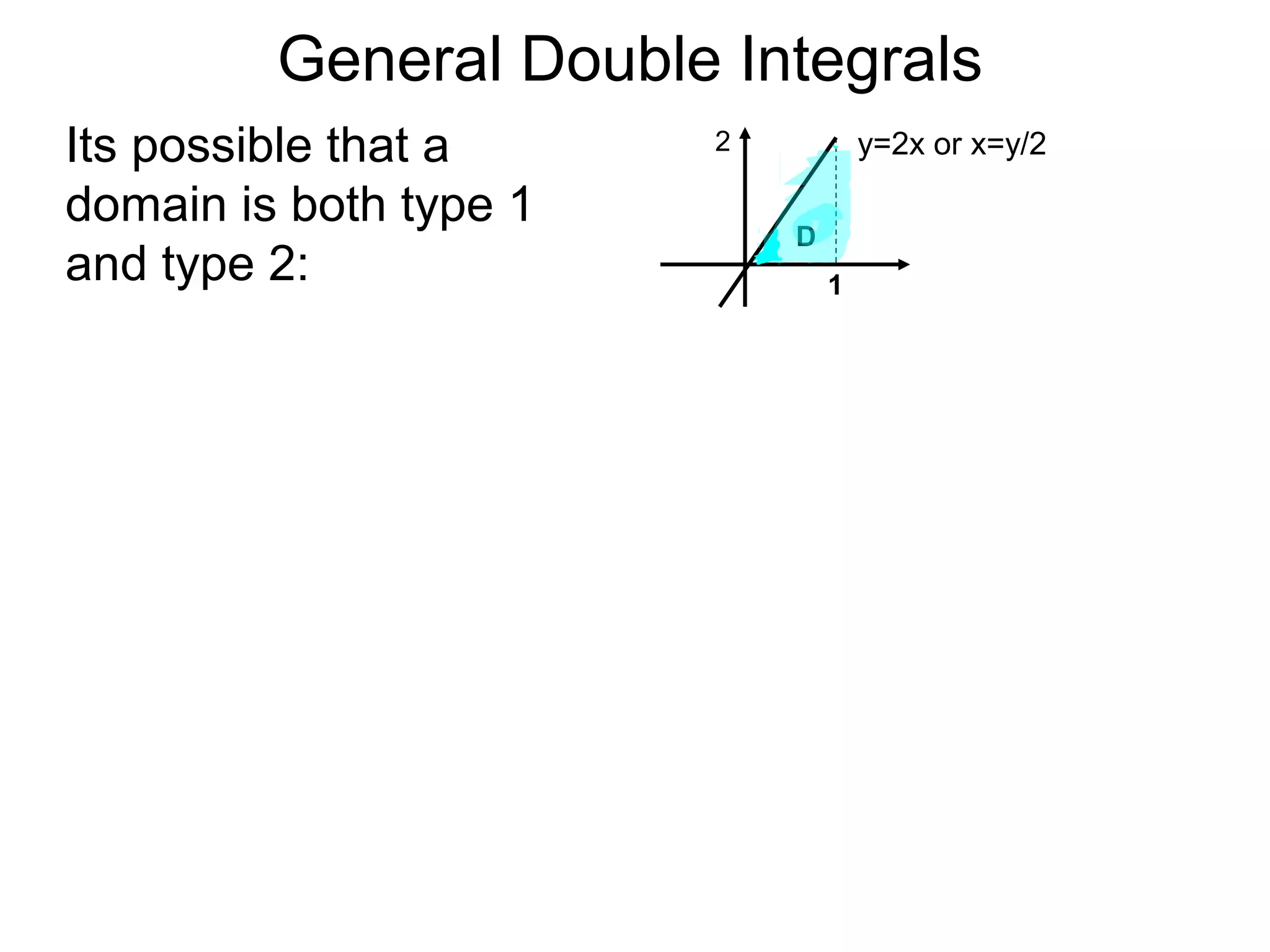
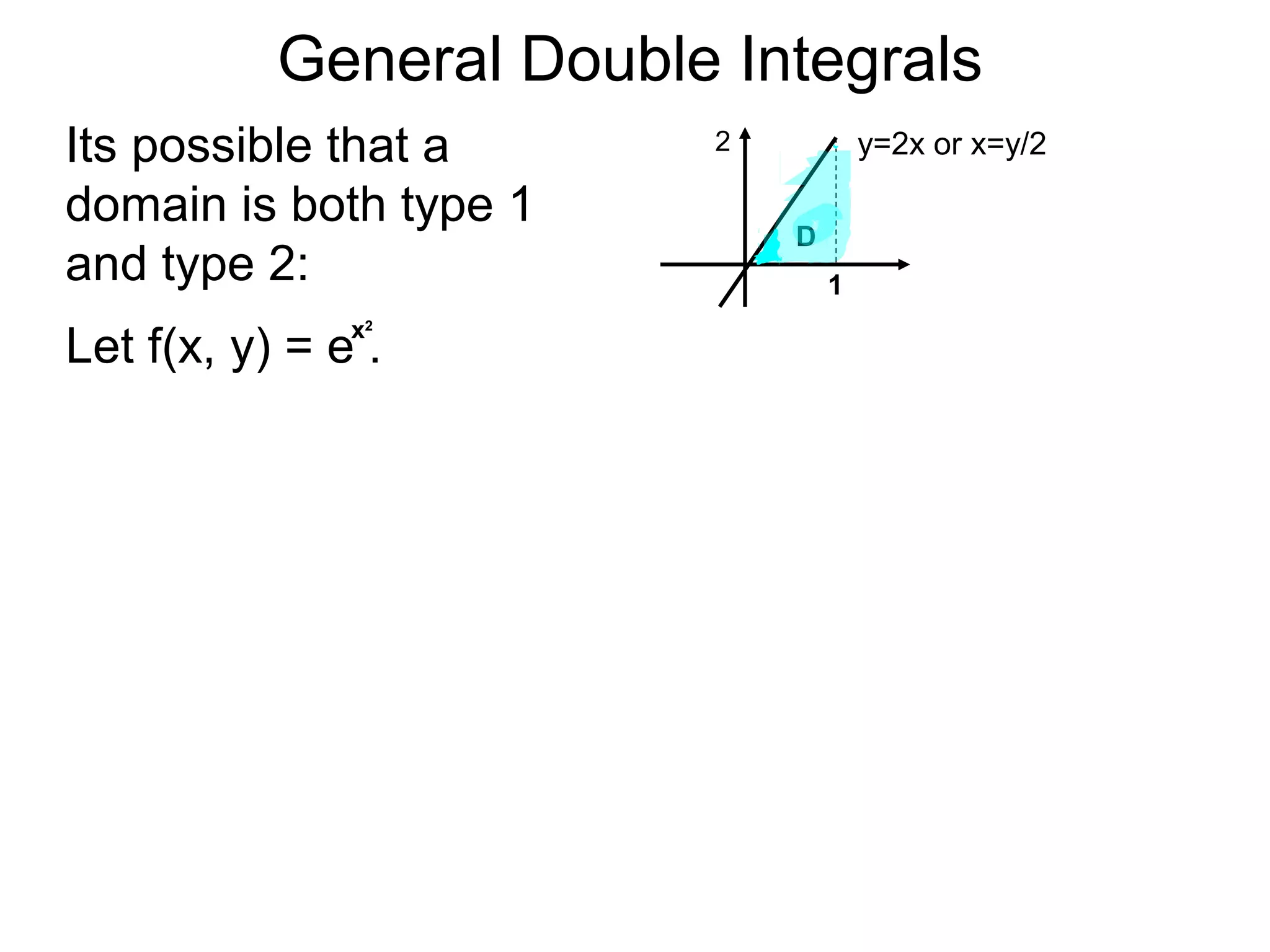
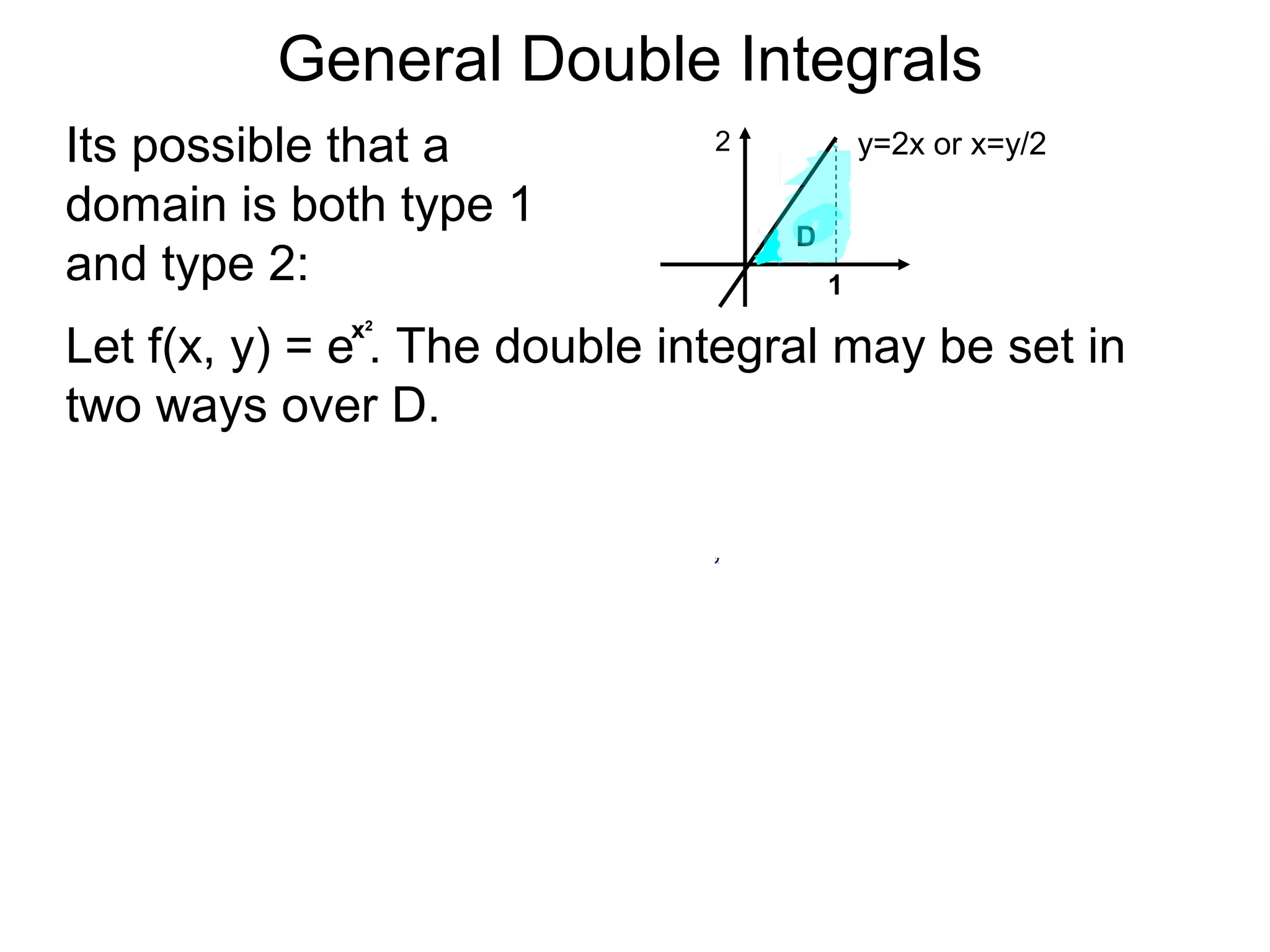
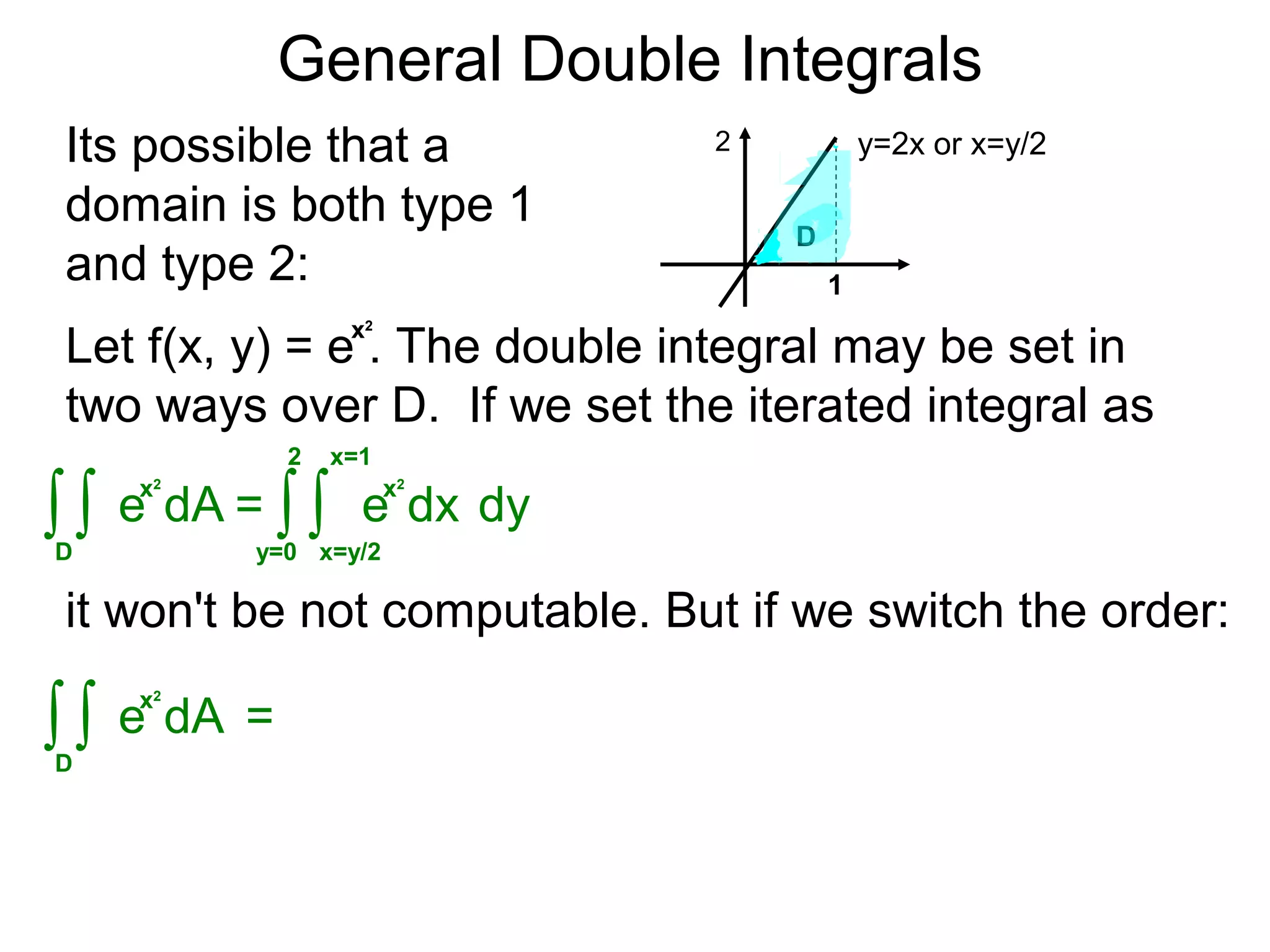
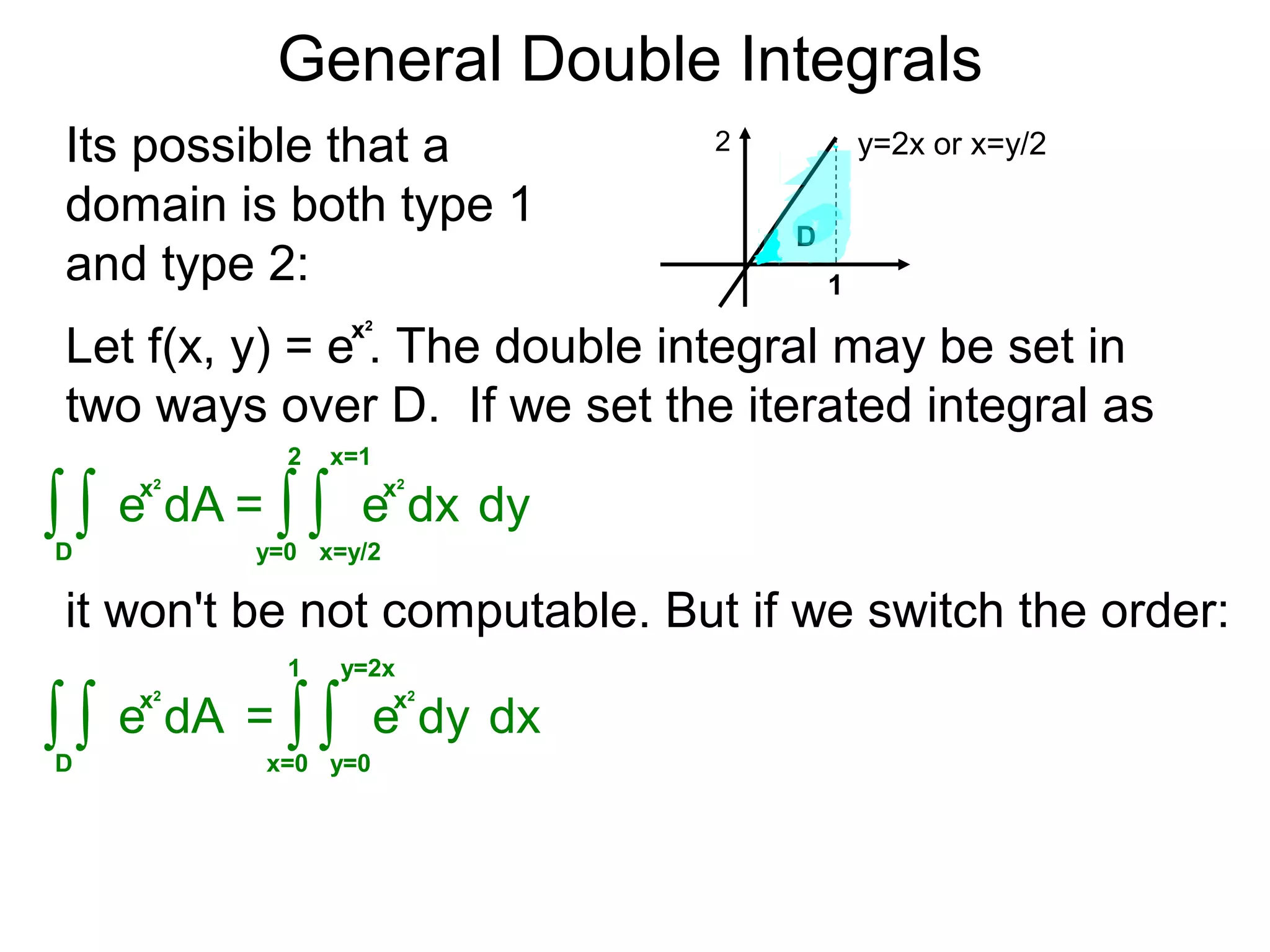
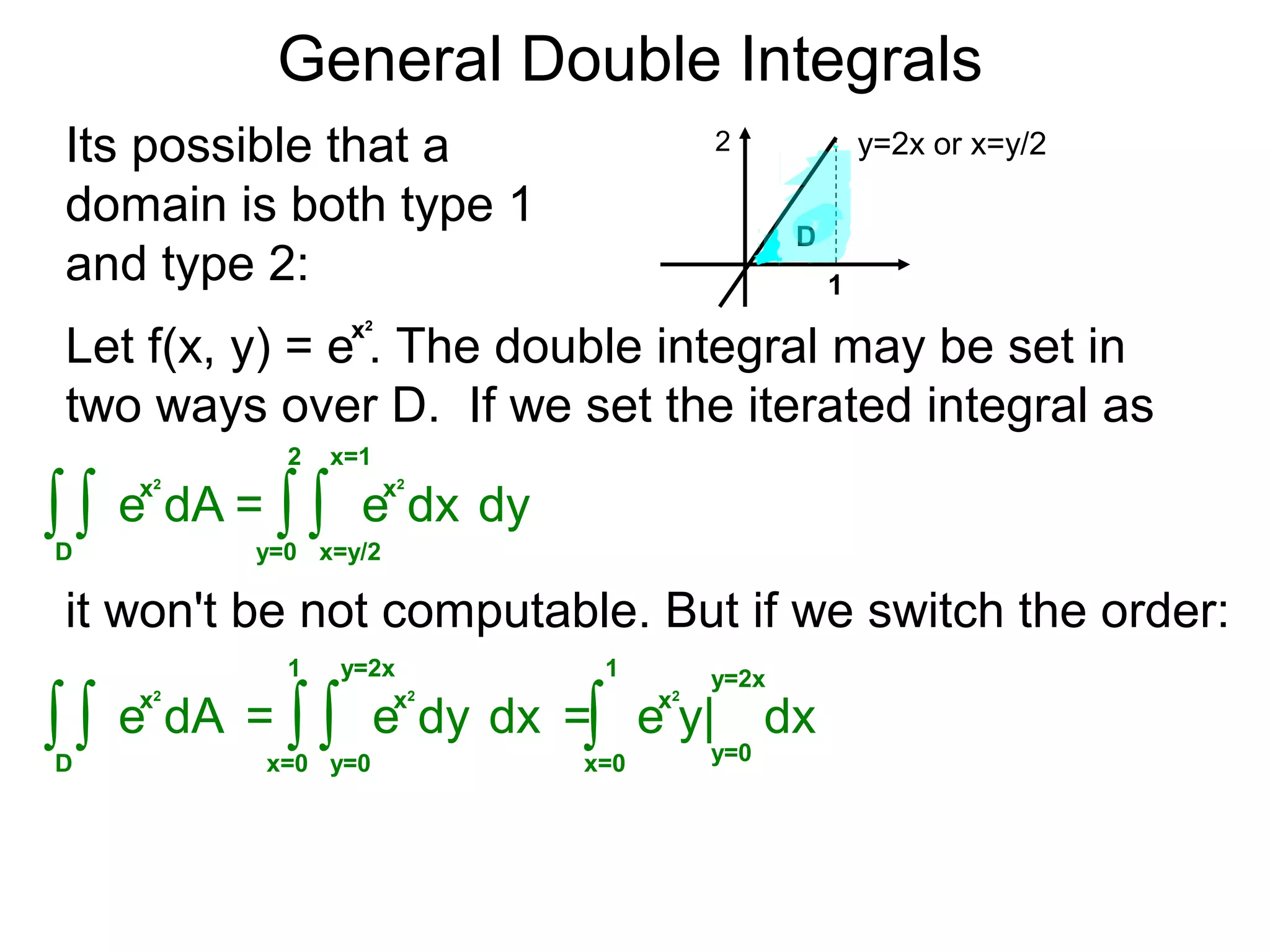
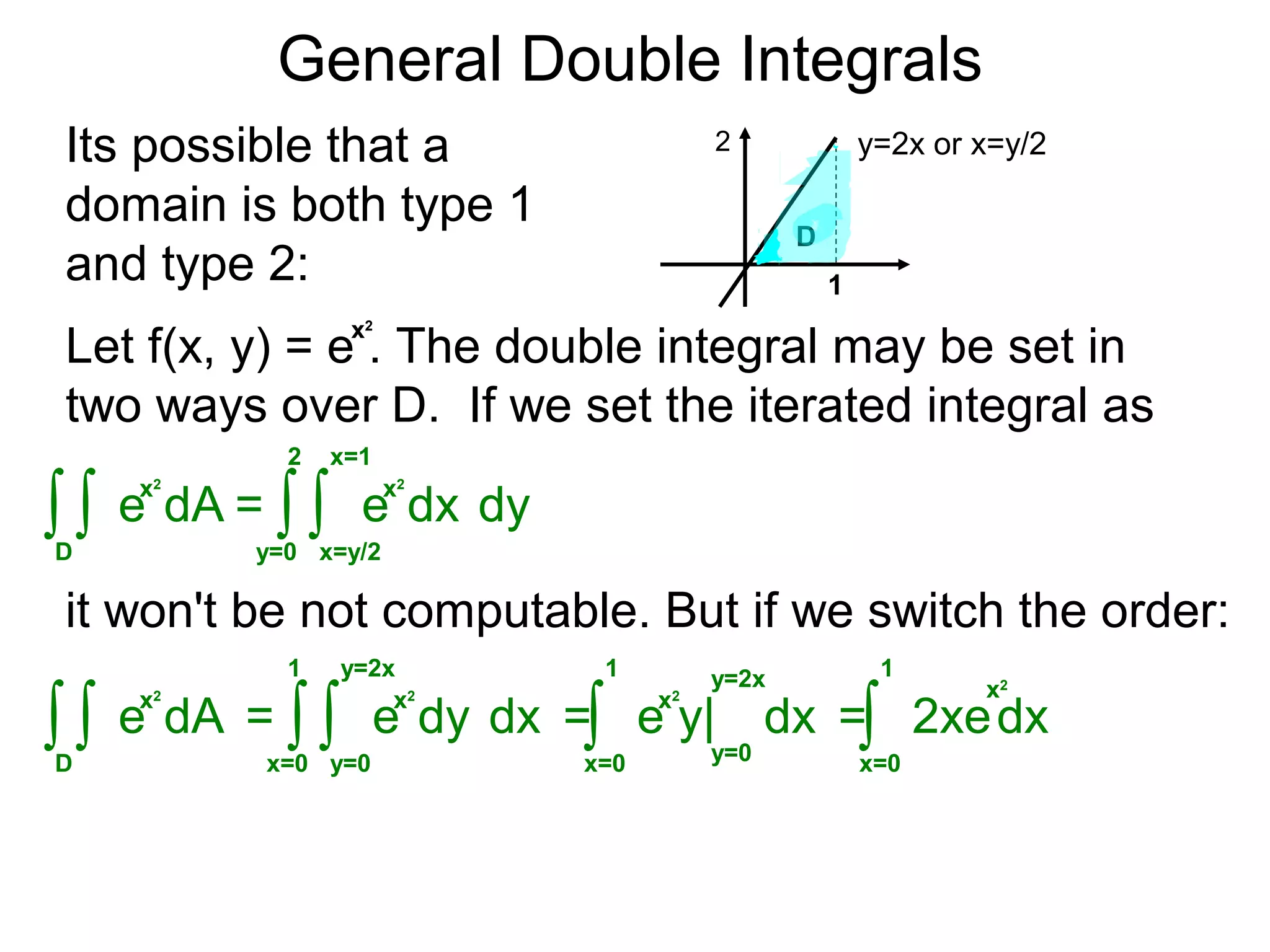
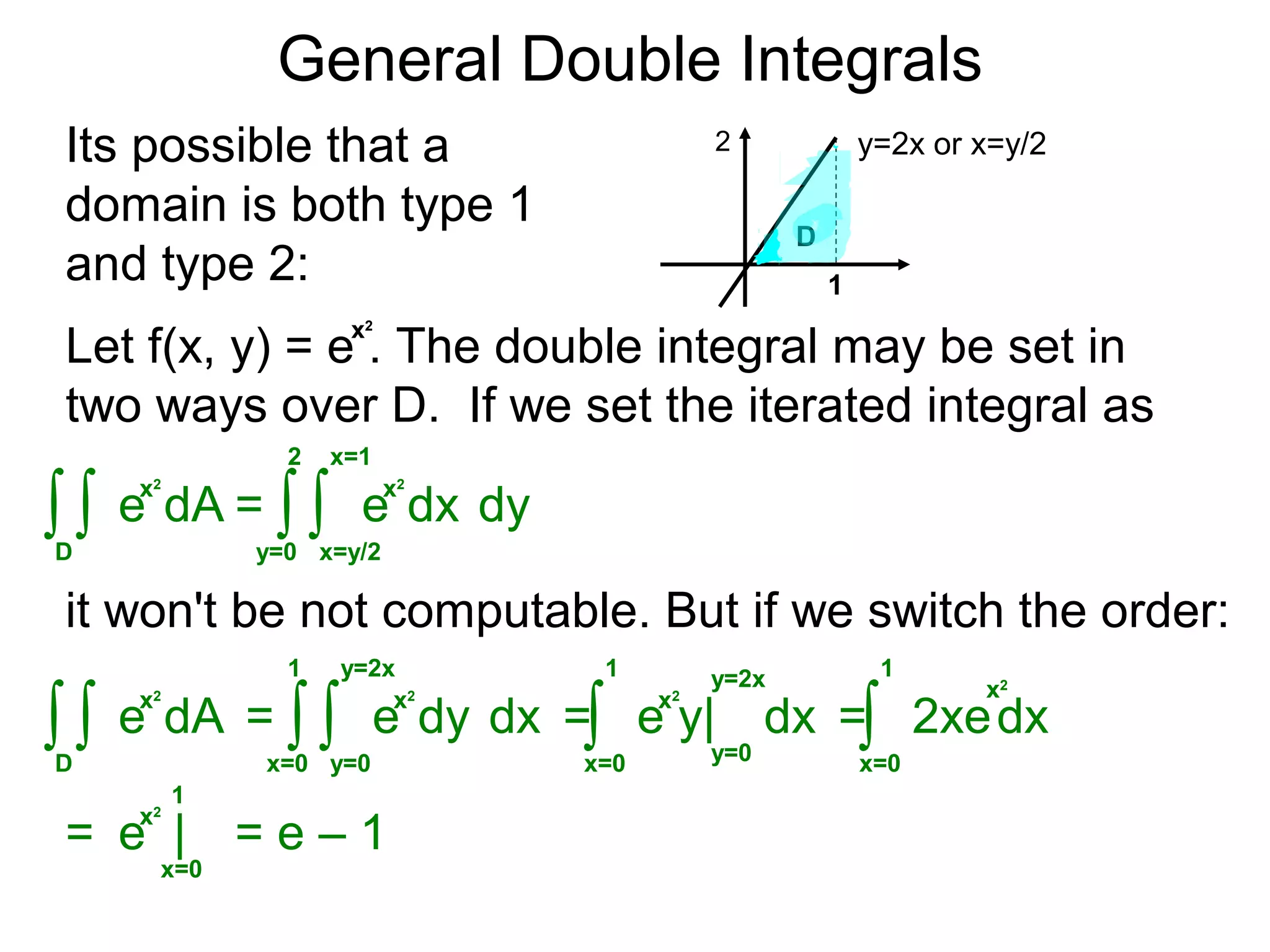
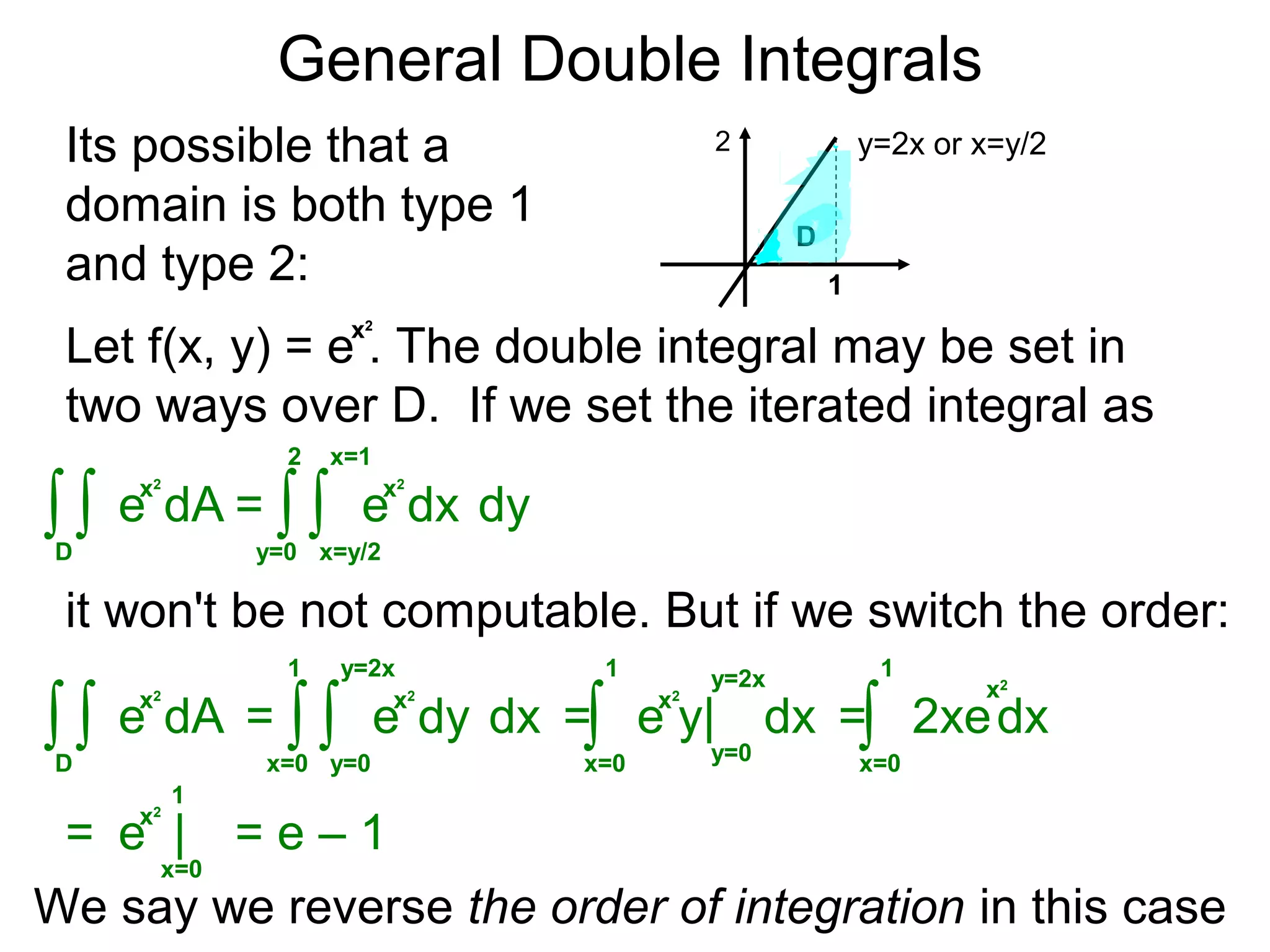
Its possible that a
domain is both type 1
and type 2:
General Double Integrals
Its possible that a
domain is both type 1
and type 2:
y=2x or x=y/2
1
2
D
General Double Integrals
Its possible that a
domain is both type 1
and type 2:
y=2x or x=y/2
1
Let f(x, y) = e .
2
D
x2
General Double Integrals
Its possible that a
domain is both type 1
and type 2:
y=2x or x=y/2
1
Let f(x, y) = e . The double integral may be set in
two ways over D.
2
D
x2
General Double Integrals
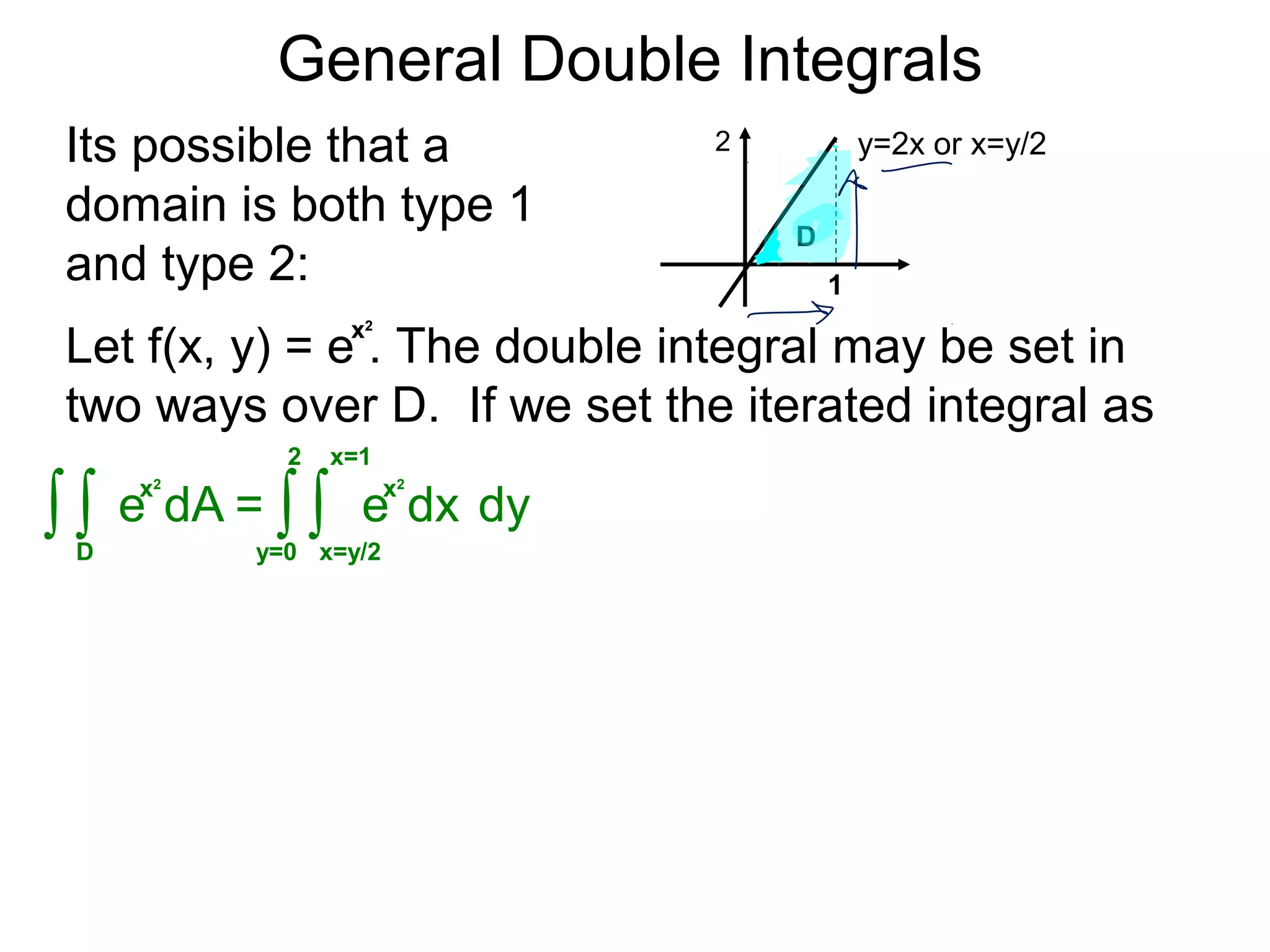
= dy∫y=0
2
dx
x=1
∫x=y/2
Its possible that a
domain is both type 1
and type 2:
y=2x or x=y/2
1
Let f(x, y) = e . The double integral may be set in
two ways over D. If we set the iterated integral as
∫ D
dA∫
2
D
x2
x2
e
x2
e
General Double Integrals
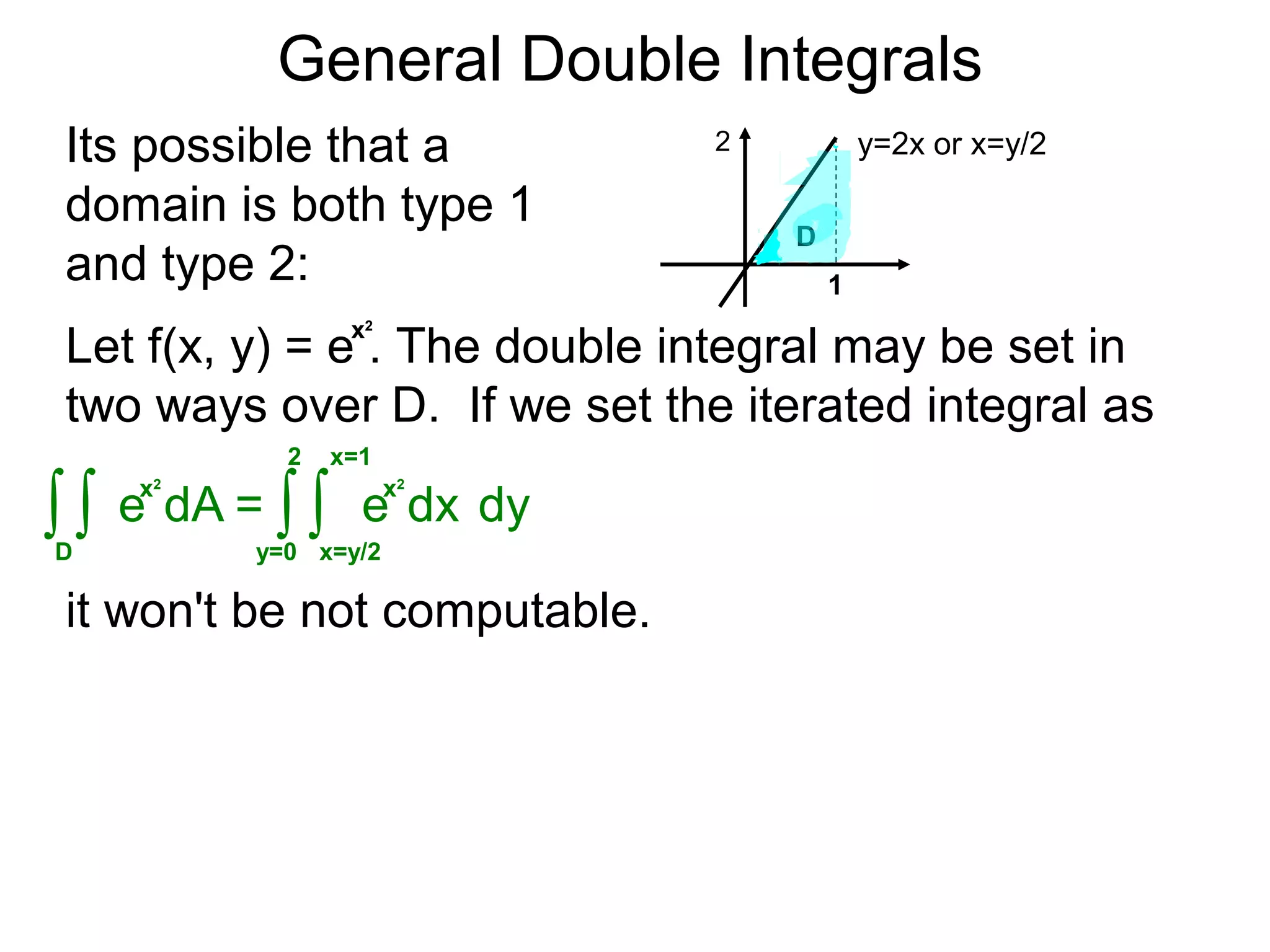
= dy∫y=0
2
dx
x=1
∫x=y/2
Its possible that a
domain is both type 1
and type 2:
y=2x or x=y/2
1
Let f(x, y) = e . The double integral may be set in
two ways over D. If we set the iterated integral as
∫D
dA∫
2
D
it won't be not computable.
x2
x2
e
x2
e
General Double Integrals
= dy∫y=0
2
dx
x=1
∫x=y/2
Its possible that a
domain is both type 1
and type 2:
y=2x or x=y/2
1
Let f(x, y) = e . The double integral may be set in
two ways over D. If we set the iterated integral as
∫D
dA∫
2
D
it won't be not computable. But if we switch the order:
x2
x2
e
x2
e
=∫D
dA∫
x2
e
General Double Integrals
= dy∫y=0
2
dx
x=1
∫x=y/2
Its possible that a
domain is both type 1
and type 2:
y=2x or x=y/2
1
Let f(x, y) = e . The double integral may be set in
two ways over D. If we set the iterated integral as
∫D
dA∫
2
D
it won't be not computable. But if we switch the order:
x2
x2
e
x2
e
= dx∫x=0
1
dy
y=2x
∫y=0
∫D
dA∫
x2
e
x2
e
General Double Integrals
= dy∫y=0
2
dx
x=1
∫x=y/2
Its possible that a
domain is both type 1
and type 2:
y=2x or x=y/2
1
Let f(x, y) = e . The double integral may be set in
two ways over D. If we set the iterated integral as
∫D
dA∫
2
D
it won't be not computable. But if we switch the order:
x2
x2
e
x2
e
= dx∫x=0
1
dy
y=2x
∫y=0
∫D
dA∫
x2
e
x2
e = dx∫x=0
1 y=2x
y=0
x2
e y|
General Double Integrals
= dy∫y=0
2
dx
x=1
∫x=y/2
Its possible that a
domain is both type 1
and type 2:
y=2x or x=y/2
1
Let f(x, y) = e . The double integral may be set in
two ways over D. If we set the iterated integral as
∫D
dA∫
2
D
it won't be not computable. But if we switch the order:
x2
x2
e
x2
e
= dx∫x=0
1
dy
y=2x
∫y=0
∫D
dA∫
x2
e
x2
e = dx∫x=0
1 y=2x
y=0
x2
e y| = dx∫x=0
1
x2
2xe
General Double Integrals
= dy∫y=0
2
dx
x=1
∫x=y/2
Its possible that a
domain is both type 1
and type 2:
y=2x or x=y/2
1
Let f(x, y) = e . The double integral may be set in
two ways over D. If we set the iterated integral as
∫D
dA∫
2
D
it won't be not computable. But if we switch the order:
x2
x2
e
x2
e
= dx∫x=0
1
dy
y=2x
∫y=0
∫D
dA∫
x2
e
x2
e = dx∫x=0
1 y=2x
y=0
x2
e y| = dx∫x=0
1
2xe
x=0
1
x2
e |= = e – 1
x2
General Double Integrals
= dy∫y=0
2
dx
x=1
∫x=y/2
Its possible that a
domain is both type 1
and type 2:
y=2x or x=y/2
1
Let f(x, y) = e . The double integral may be set in
two ways over D. If we set the iterated integral as
∫D
dA∫
2
D
it won't be not computable. But if we switch the order:
x2
x2
e
x2
e
= dx∫x=0
1
dy
y=2x
∫y=0
∫D
dA∫
x2
e
x2
e = dx∫x=0
1 y=2x
y=0
x2
e y| = dx∫x=0
1
2xe
x=0
1
x2
e |= = e – 1
We say we reverse the order of integration in this case
x2
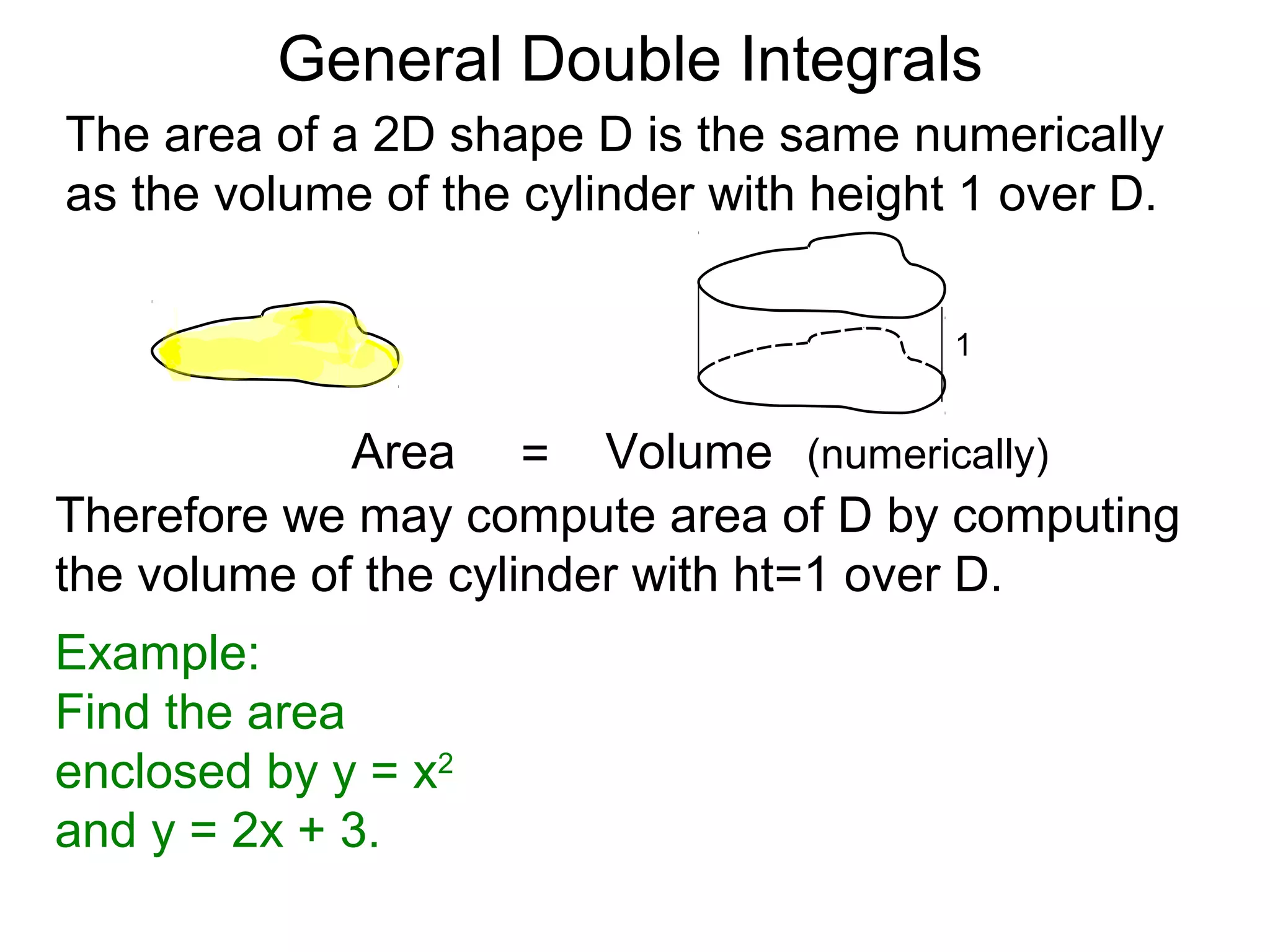
General Double Integrals
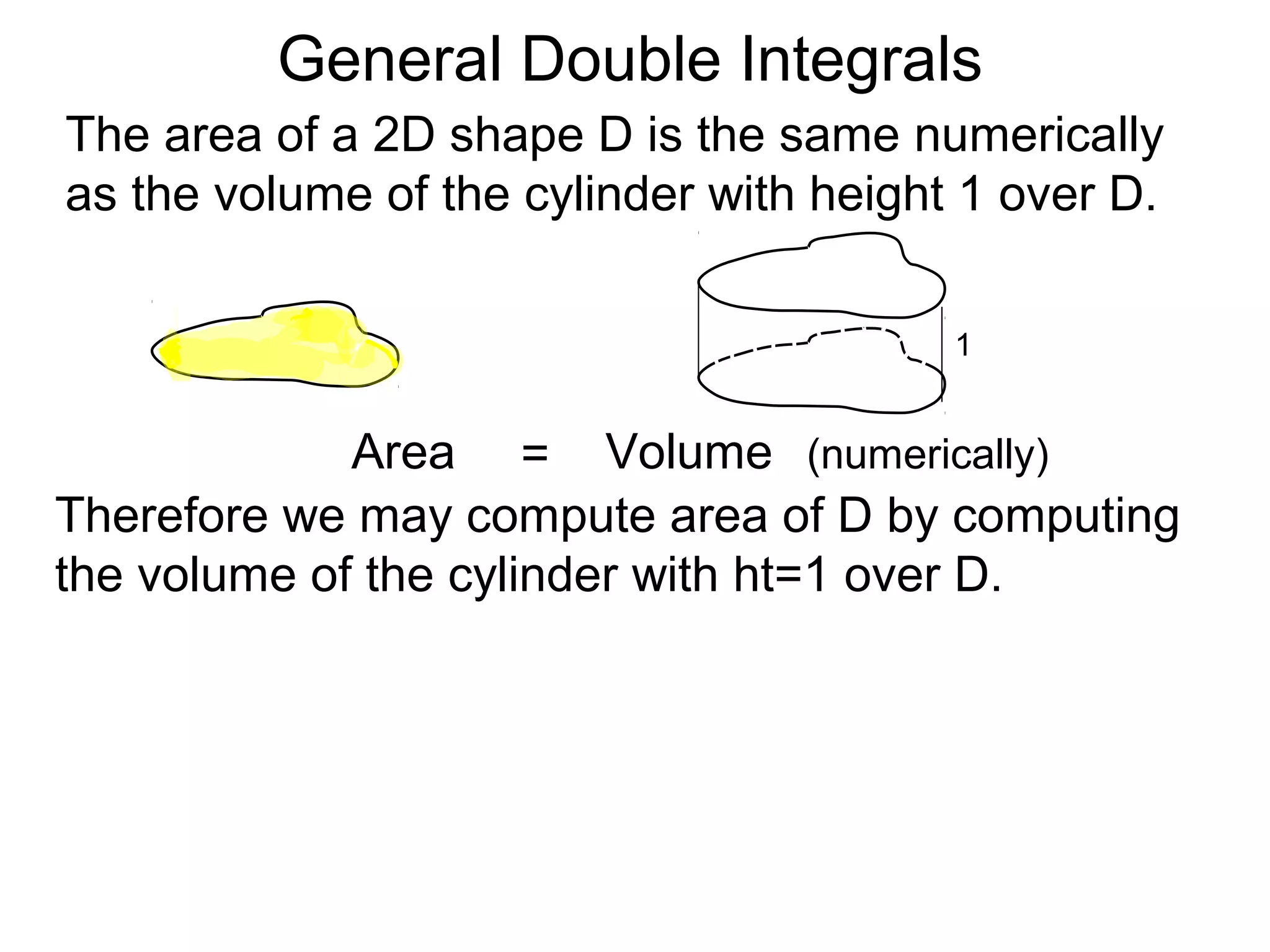
The area of a 2D shape D is the same numerically
as the volume of the cylinder with height 1 over D.
General Double Integrals
The area of a 2D shape D is the same numerically
as the volume of the cylinder with height 1 over D.
=Area Volume
1
(numerically)
General Double Integrals
The area of a 2D shape D is the same numerically
as the volume of the cylinder with height 1 over D.
Therefore we may compute area of D by computing
the volume of the cylinder with ht=1 over D.
=Area Volume
1
(numerically)
General Double Integrals
The area of a 2D shape D is the same numerically
as the volume of the cylinder with height 1 over D.
Therefore we may compute area of D by computing
the volume of the cylinder with ht=1 over D.
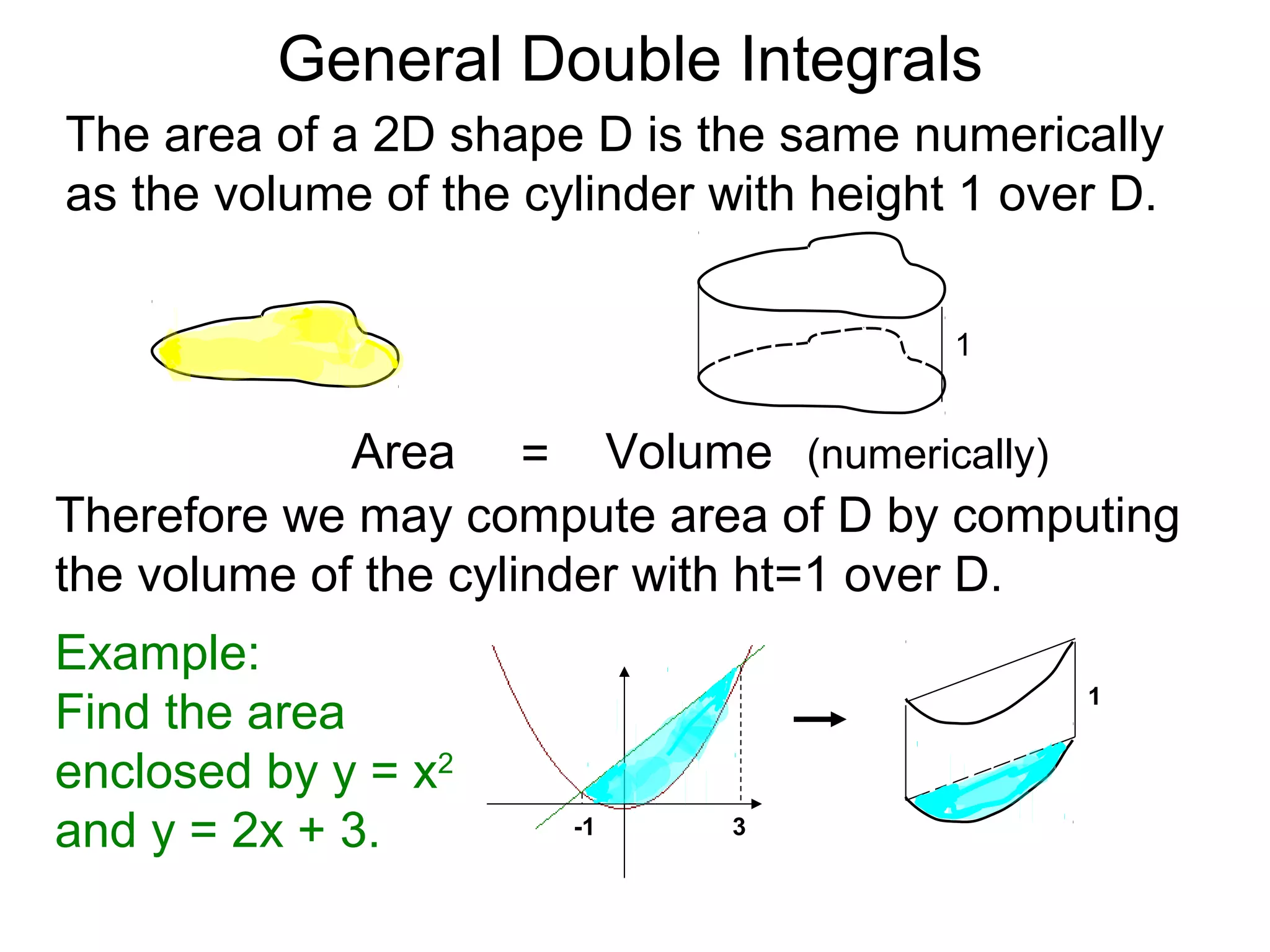
Example:
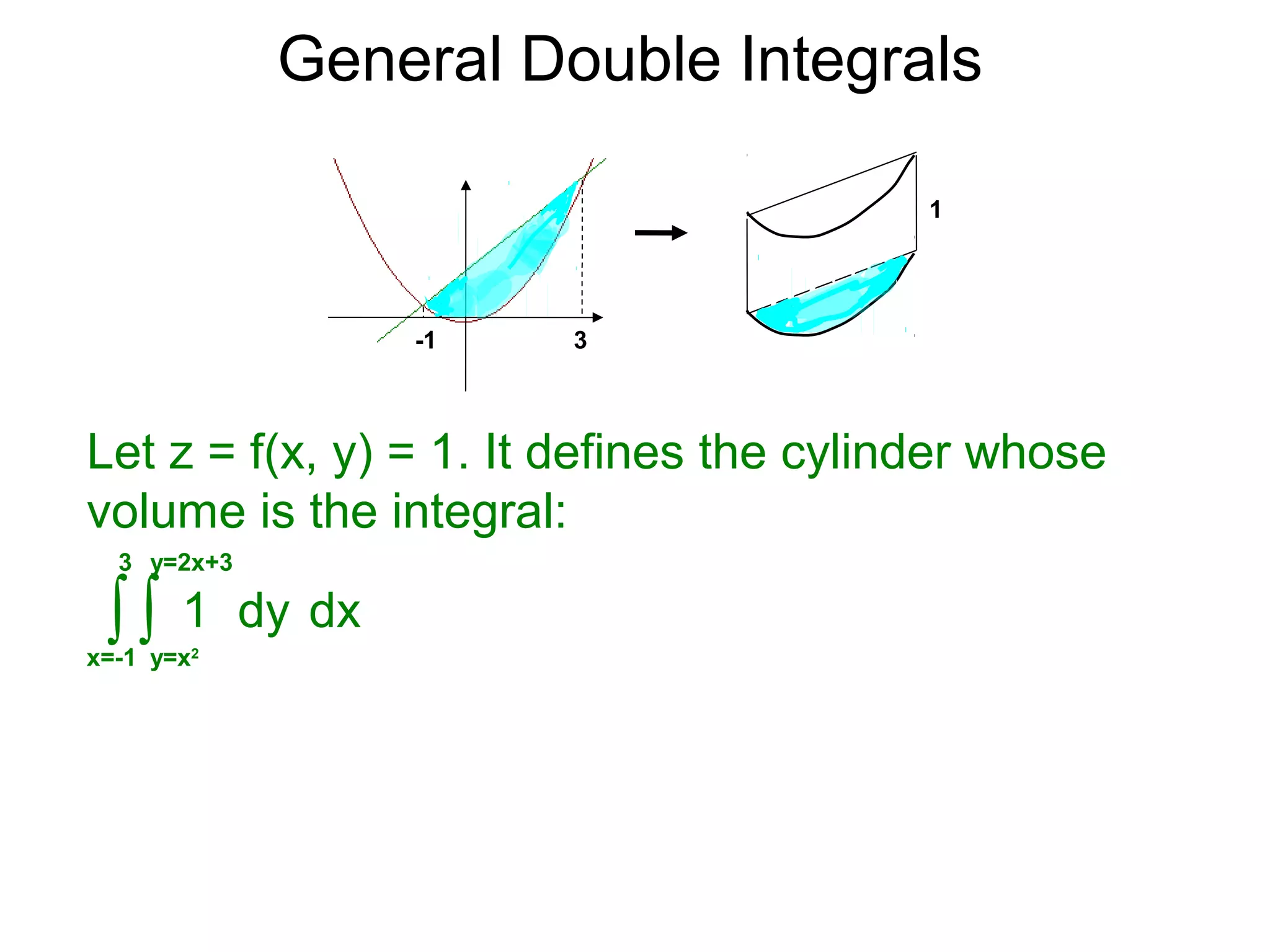
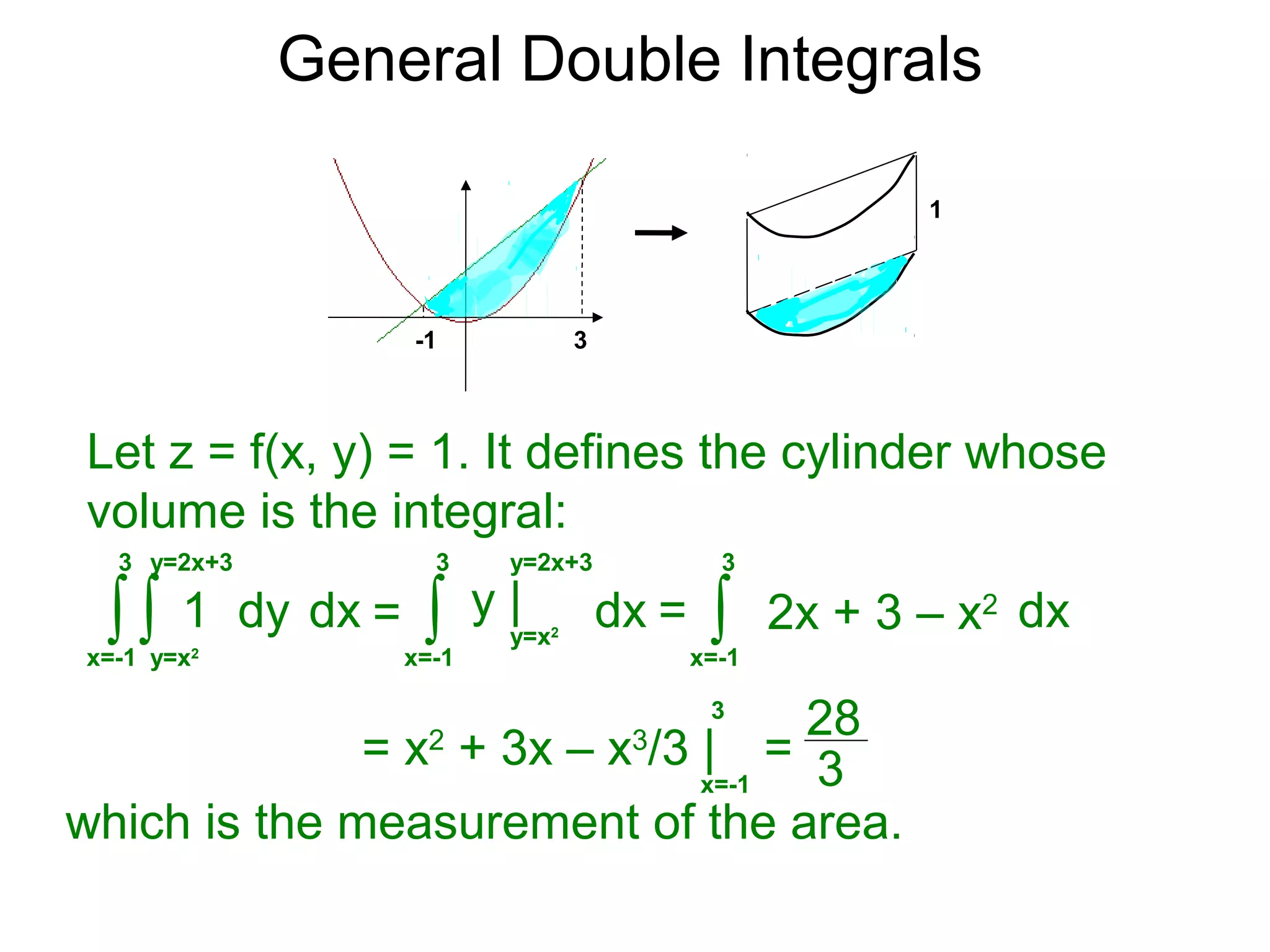
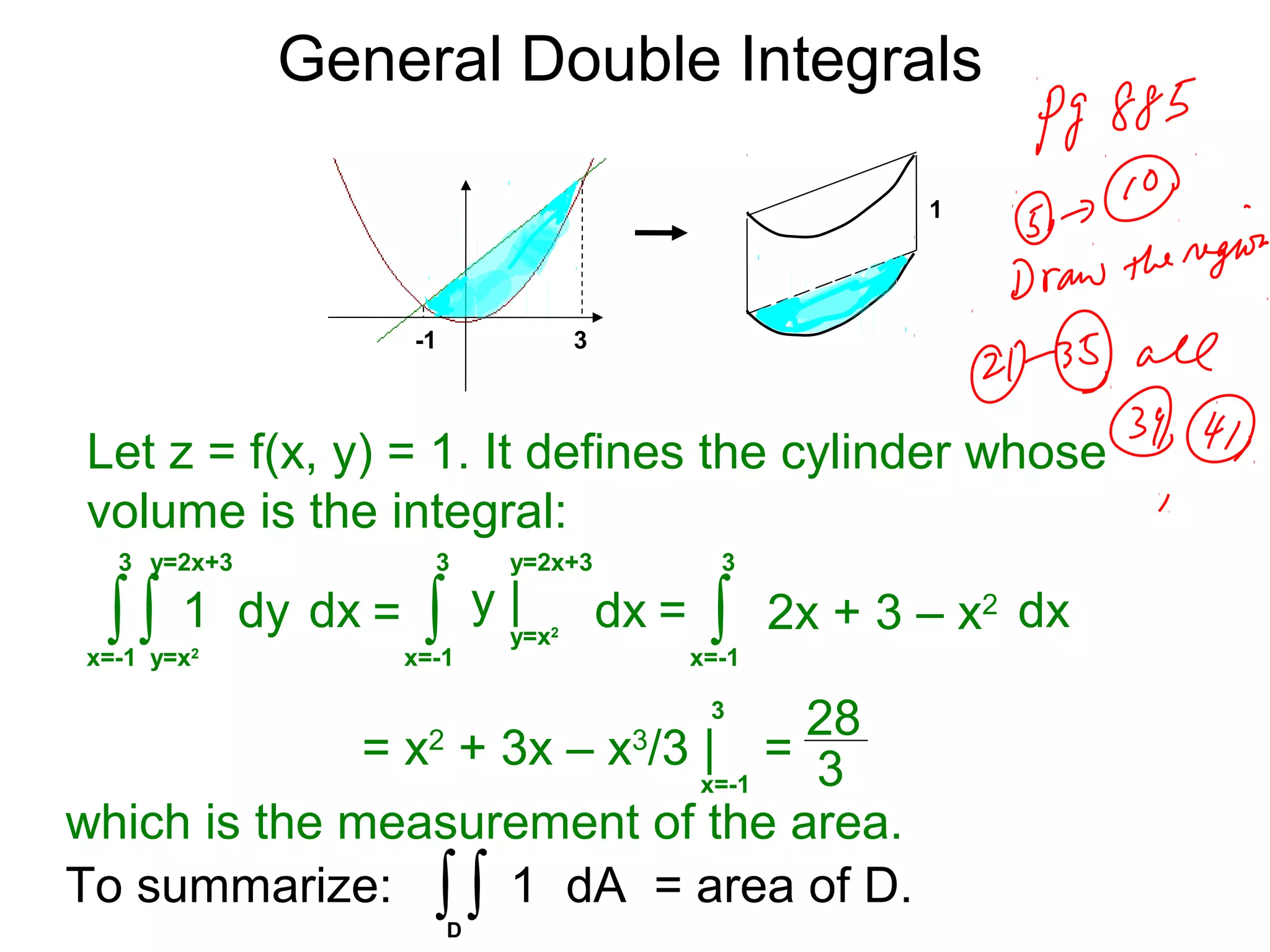
Find the area
enclosed by y = x2
and y = 2x + 3.
=Area Volume
1
(numerically)
General Double Integrals
The area of a 2D shape D is the same numerically
as the volume of the cylinder with height 1 over D.
Therefore we may compute area of D by computing
the volume of the cylinder with ht=1 over D.
Example:
Find the area
enclosed by y = x2
and y = 2x + 3.
=Area Volume
1
(numerically)
-1 3
1
General Double Integrals
The area of a 2D shape D is the same numerically
as the volume of the cylinder with height 1 over D.
Therefore we may compute area of D by computing
the volume of the cylinder with ht=1 over D.
Example:
Find the area
enclosed by y = x2
and y = 2x + 3.
=Area Volume
1
(numerically)
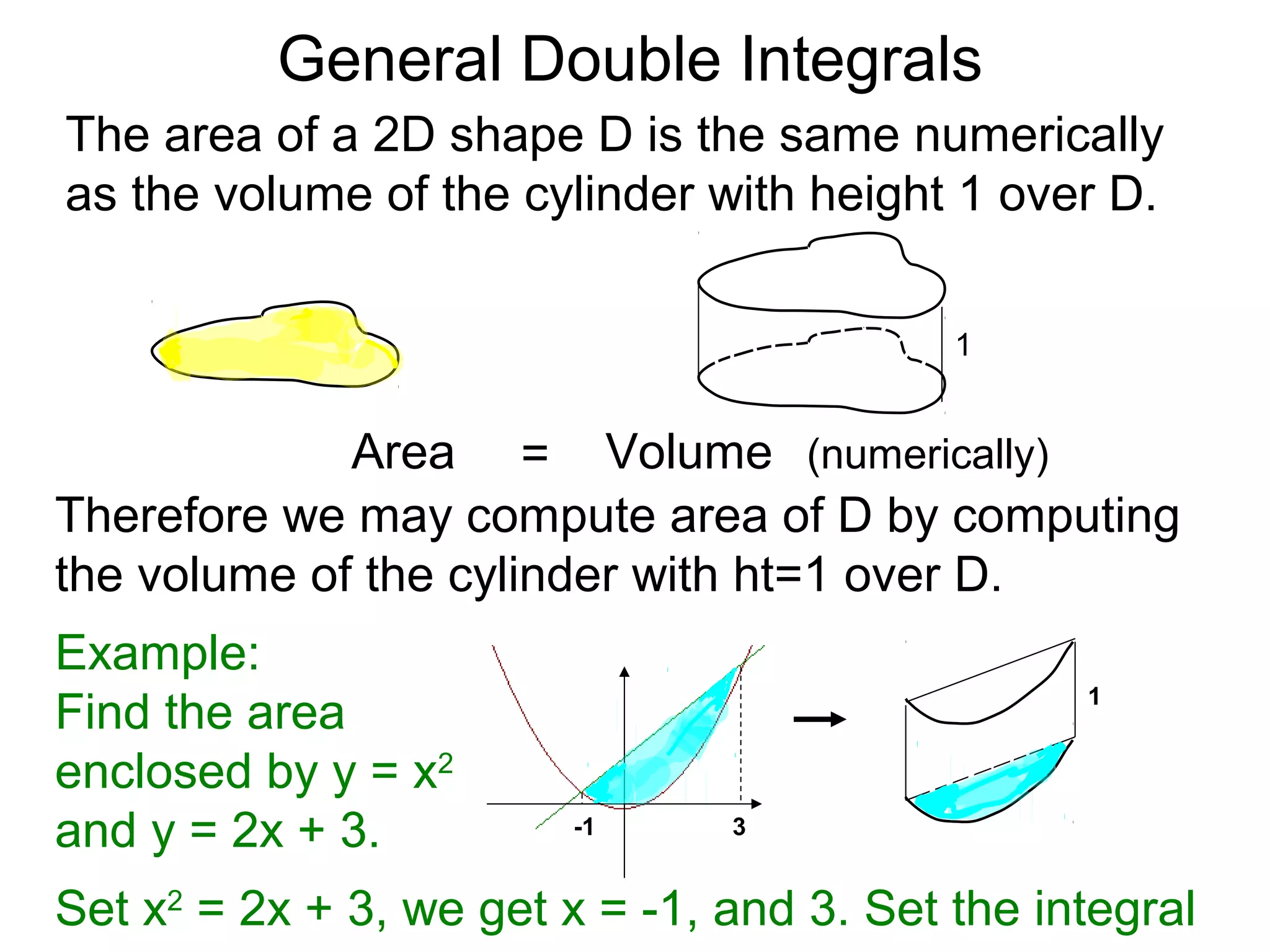
Set x2
= 2x + 3, we get x = -1, and 3. Set the integral
-1 3
1
General Double Integrals
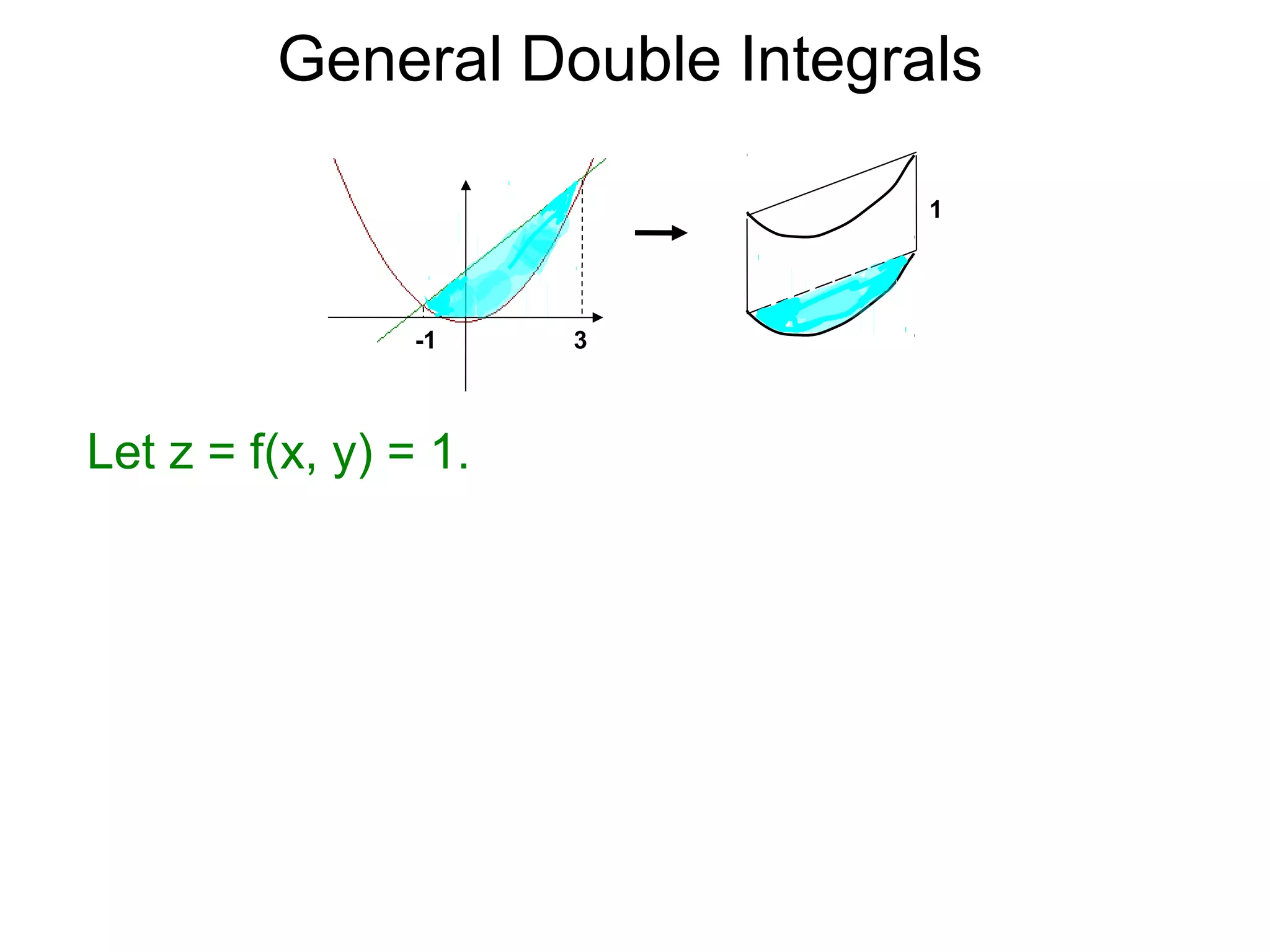
Let z = f(x, y) = 1.
x=-1
-1 3
1
General Double Integrals
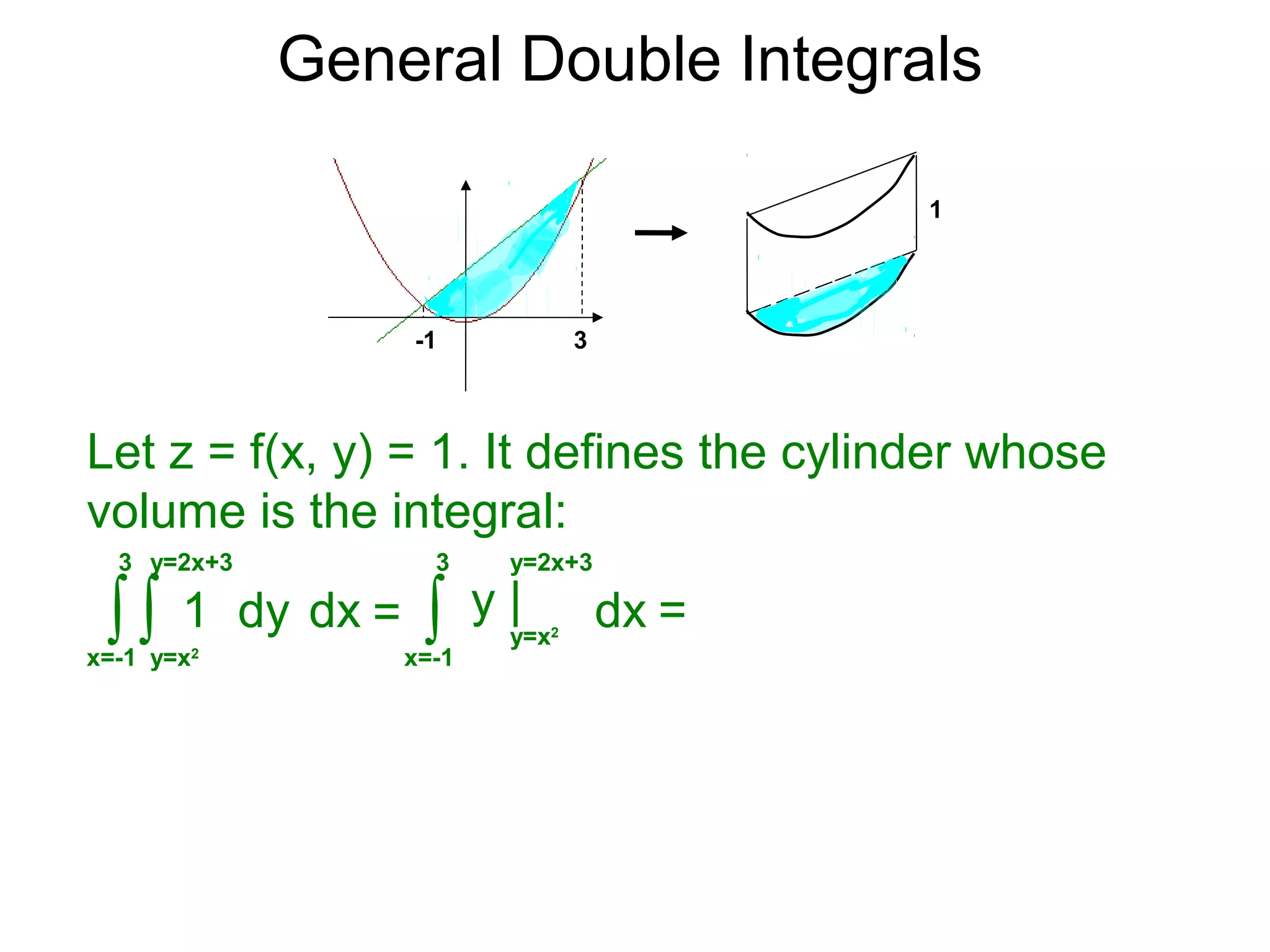
Let z = f(x, y) = 1. It defines the cylinder whose
volume is the integral:
dx∫x=-1
3
dy
y=2x+3
∫y=x2
1
x=-1
-1 3
1
General Double Integrals
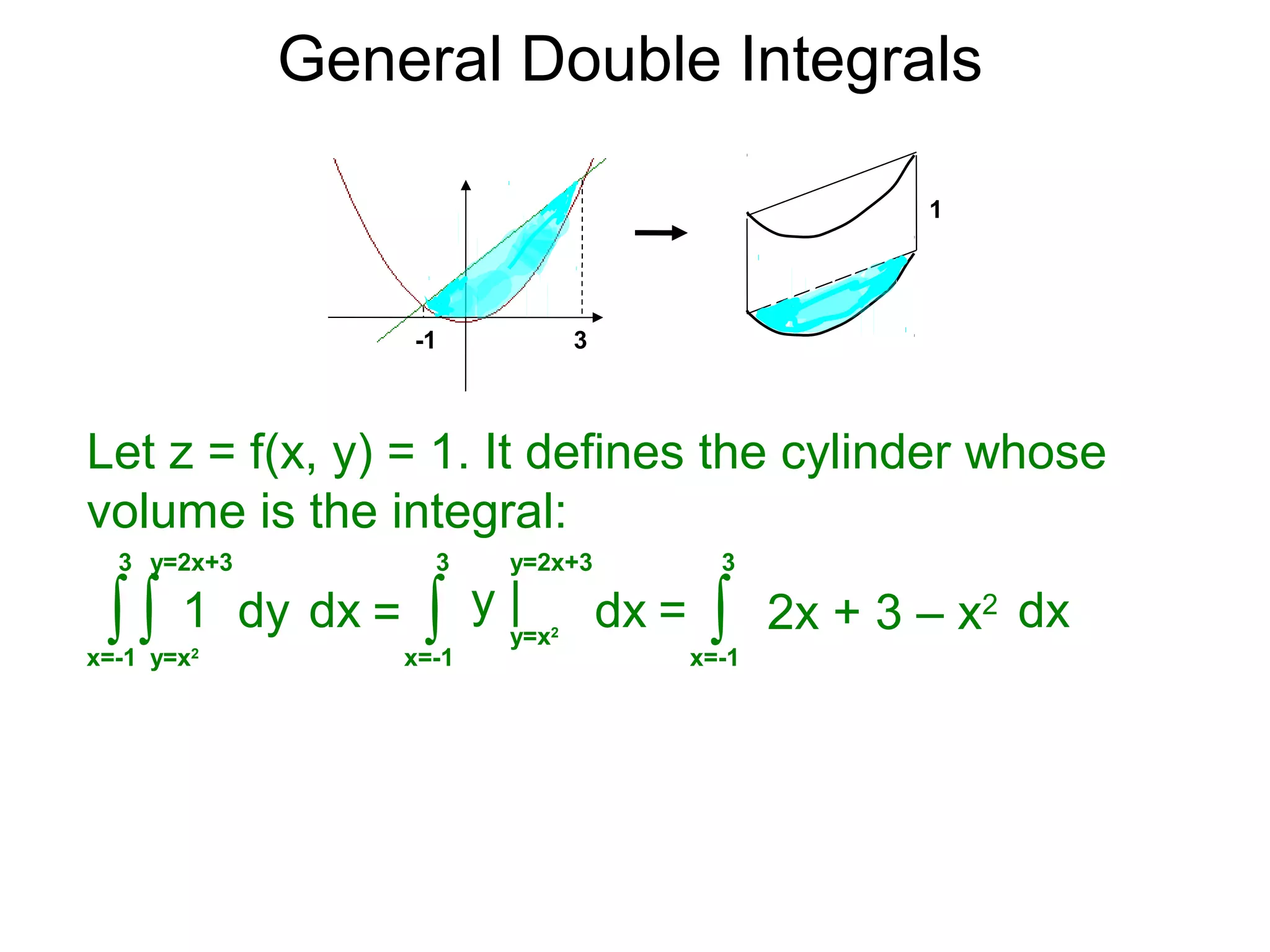
Let z = f(x, y) = 1. It defines the cylinder whose
volume is the integral:
dx∫x=-1
3
dy
y=2x+3
∫y=x2
1 = dx∫x=-1
3
y |
y=2x+3
y=x2
=
x=-1
-1 3
1
General Double Integrals
Let z = f(x, y) = 1. It defines the cylinder whose
volume is the integral:
dx∫x=-1
3
dy
y=2x+3
∫y=x2
1 = dx∫x=-1
3
y |
y=2x+3
y=x2
= dx∫x=-1
3
2x + 3 – x2
x=-1
-1 3
1
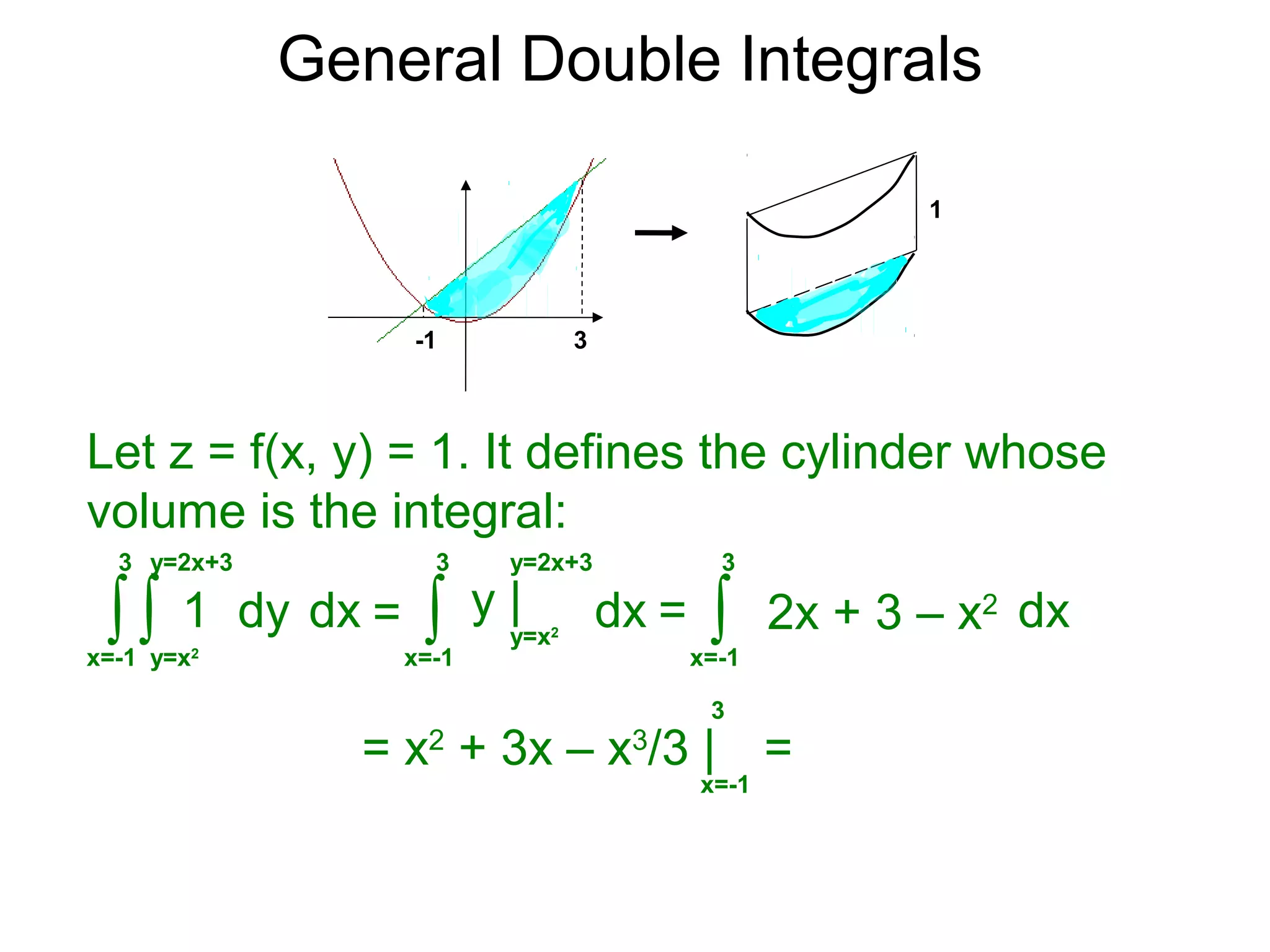
General Double Integrals
Let z = f(x, y) = 1. It defines the cylinder whose
volume is the integral:
dx∫x=-1
3
dy
y=2x+3
∫y=x2
1 = dx∫x=-1
3
y |
y=2x+3
y=x2
= dx∫x=-1
3
2x + 3 – x2
= x2
+ 3x – x3
/3 |
x=-1
3
=
-1 3
1
x=-1
General Double Integrals
Let z = f(x, y) = 1. It defines the cylinder whose
volume is the integral:
dx∫x=-1
3
dy
y=2x+3
∫y=x2
1 = dx∫x=-1
3
y |
y=2x+3
y=x2
= dx∫x=-1
3
2x + 3 – x2
= x2
+ 3x – x3
/3 |
x=-1
3
=
28
3
-1 3
1
x=-1
which is the measurement of the area.
General Double Integrals
Let z = f(x, y) = 1. It defines the cylinder whose
volume is the integral:
dx∫x=-1
3
dy
y=2x+3
∫y=x2
1 = dx∫x=-1
3
y |
y=2x+3
y=x2
= dx∫x=-1
3
2x + 3 – x2
= x2
+ 3x – x3
/3 |
x=-1
3
=
28
3
-1 3
1
x=-1
which is the measurement of the area.
To summarize: ∫ dA = area of D.∫ 1
D

23 general double integrals

  • 1.
  • 2.
    General Double Integrals Wewill define double integrals over two types of nonrectangular domains:
  • 3.
    General Double Integrals Wewill define double integrals over two types of nonrectangular domains: Type1: A domain that is bounded up and down by continuous functions y=f(x) and y=g(x) where f(x) > g(x) with a < x < b.
  • 4.
    General Double Integrals Wewill define double integrals over two types of nonrectangular domains: Type1: A domain that is bounded up and down by continuous functions y=f(x) and y=g(x) where f(x) > g(x) with a < x < b. a b Type1 y=f(x) y=g(x)
  • 5.
    General Double Integrals Wewill define double integrals over two types of nonrectangular domains: Type1: A domain that is bounded up and down by continuous functions y=f(x) and y=g(x) where f(x) > g(x) with a < x < b. a b Type1 y=f(x) y=g(x) D = {a < x < b, g(x) < y < f(x)}
  • 6.
    General Double Integrals Wewill define double integrals over two types of nonrectangular domains: Type1: A domain that is bounded up and down by continuous functions y=f(x) and y=g(x) where f(x) > g(x) with a < x < b. Type2: A domain that is bounded left and right by continuous functions x= f(y) and x=g(y) where f(y) > g(y) with c < y < d. a b Type1 y=f(x) y=g(x) D = {a < x < b, g(x) < y < f(x)}
  • 7.
    General Double Integrals Wewill define double integrals over two types of nonrectangular domains: Type1: A domain that is bounded up and down by continuous functions y=f(x) and y=g(x) where f(x) > g(x) with a < x < b. Type2: A domain that is bounded left and right by continuous functions x= f(y) and x=g(y) where f(y) > g(y) with c < y < d. a b x=f(y)x=g(y) d c Type1 Type2 y=f(x) y=g(x) D = {a < x < b, g(x) < y < f(x)} D = {c < y < d, g(y) < x < f(y)}
  • 8.
    General Double Integrals Givena type 1 domain D, a fixed x defines a vertical cross-section with the y changes from g(x) to f(x). a b y=f(x) y=g(x) D (Type1) x
  • 9.
    General Double Integrals Givena type 1 domain D, a fixed x defines a vertical cross-section with the y changes from g(x) to f(x). a b y=f(x) y=g(x) D (Type1) x We decribe D as {(x, y)| a < x < b; g(x) < y < f(x)}.
  • 10.
    General Double Integrals Givena type 1 domain D, a fixed x defines a vertical cross-section with the y changes from g(x) to f(x). a b y=f(x) y=g(x) D (Type1) x We decribe D as {(x, y)| a < x < b; g(x) < y < f(x)}. Example: Describe D as shown in the figure. 2y + x = 4 0 4 2 x
  • 11.
    General Double Integrals Givena type 1 domain D, a fixed x defines a vertical cross-section with the y changes from g(x) to f(x). a b y=f(x) y=g(x) D (Type1) x We decribe D as {(x, y)| a < x < b; g(x) < y < f(x)}. Example: Describe D as shown in the figure. The x runs from 0 to 4. 2y + x = 4 0 4 2 x
  • 12.
    General Double Integrals Givena type 1 domain D, a fixed x defines a vertical cross-section with the y changes from g(x) to f(x). a b y=f(x) y=g(x) D (Type1) x We decribe D as {(x, y)| a < x < b; g(x) < y < f(x)}. Example: Describe D as shown in the figure. The x runs from 0 to 4. For a fixed x, the y-coordinate of (x, y)'s run from 0 to (4 – x)/2. 2y + x = 4 0 4 2 x
  • 13.
    General Double Integrals Givena type 1 domain D, a fixed x defines a vertical cross-section with the y changes from g(x) to f(x). a b y=f(x) y=g(x) D (Type1) x We decribe D as {(x, y)| a < x < b; g(x) < y < f(x)}. Example: Describe D as shown in the figure. The x runs from 0 to 4. For a fixed x, the y-coordinate of (x, y)'s run from 0 to (4 – x)/2. 2y + x = 4 0 4 2 So D ={(x, y)| 0 < x < 4; 0 < y < (4 – x)/2} x
  • 14.
    General Double Integrals Givena type 1 domain D, a fixed x defines a vertical cross-section with the y changes from g(x) to f(x). a b y=f(x) y=g(x) D (Type1) x We decribe D as {(x, y)| a < x < b; g(x) < y < f(x)}. Example: Describe D as shown in the figure. The x runs from 0 to 4. For a fixed x, the y-coordinate of (x, y)'s run from 0 to (4 – x)/2. 2y + x = 4 0 4 2 So D ={(x, y)| 0 < x < 4; 0 < y < (4 – x)/2} x
  • 15.
    General Double Integrals Theorem:Let z = z(x, y) over the domain D = {(x, y)| a < x < b; g(x) < y < f(x)}. a b y=f(x) y=g(x) D (Type1) x
  • 16.
    General Double Integrals Theorem:Let z = z(x, y) over the domain D = {(x, y)| a < x < b; g(x) < y < f(x)}. a b y=f(x) y=g(x) D (Type1) x Then ∫ f(x, y)dA =∫ ∫ x=a b dxD
  • 17.
    General Double Integrals Theorem:Let z = z(x, y) over the domain D = {(x, y)| a < x < b; g(x) < y < f(x)}. a b y=f(x) y=g(x) D (Type1) x Then ∫ f(x, y)dA =∫ ∫ z(x, y)dy ]dx. x=a b ∫y=g(x) y=f(x) [ D
  • 18.
    General Double Integrals Theorem:Let z = z(x, y) over the domain D = {(x, y)| a < x < b; g(x) < y < f(x)}. a b y=f(x) y=g(x) D (Type1) x Then ∫ f(x, y)dA =∫ ∫ z(x, y)dy ]dx. x=a b ∫y=g(x) y=f(x) [ The important thing here is the order of the integration. It is set according to the the description of the domain D. D
  • 19.
    General Double Integrals Theorem:Let z = z(x, y) over the domain D = {(x, y)| a < x < b; g(x) < y < f(x)}. a b y=f(x) y=g(x) D (Type1) x Then ∫ f(x, y)dA =∫ ∫ z(x, y)dy ]dx. x=a b ∫y=g(x) y=f(x) [ The important thing here is the order of the integration. It is set according to the the description of the domain D. Note that if D is the rectangle [a, b] x [c, d], then D = {a < x < b; c < y < d} and the double integral is ∫ f(x, y)dA =∫ ∫ z(x, y)dy ]dx. x=a b ∫y=c d [ D D
  • 20.
    General Double Integrals Example:Draw the domain D that is bounded by y = x, and y = 2x – x2 . Find the volume of z = xy over D.
  • 21.
    General Double Integrals Example:Draw the domain D that is bounded by y = x, and y = 2x – x2 . Find the volume of z = xy over D. 0 1 D y = x y = 2x – x2
  • 22.
    General Double Integrals Example:Draw the domain D that is bounded by y = x, and y = 2x – x2 . Find the volume of z = xy over D. To solve for intersection, set x = 2x – x2 and get two solutions x = 0, and 1. 0 1 D y = x y = 2x – x2
  • 23.
    General Double Integrals Example:Draw the domain D that is bounded by y = x, and y = 2x – x2 . Find the volume of z = xy over D. So D is bounded above by f(x) = 2x – x2 below by g(x) =x, from x = 0 to x = 1. To solve for intersection, set x = 2x – x2 and get two solutions x = 0, and 1. 0 1 D y = x y = 2x – x2
  • 24.
    General Double Integrals Example:Draw the domain D that is bounded by y = x, and y = 2x – x2 . Find the volume of z = xy over D. So D is bounded above by f(x) = 2x – x2 below by g(x) =x, from x = 0 to x = 1. To solve for intersection, set x = 2x – x2 and get two solutions x = 0, and 1. 0 1 D y = 2x – x2 y = x So D ={(x, y)| 0 < x < 1; x < y < 2x – x2 }
  • 25.
    General Double Integrals Example:Draw the domain D that is bounded by y = x, and y = 2x – x2 . Find the volume of z = xy over D. So D is bounded above by f(x) = 2x – x2 below by g(x) =x, from x = 0 to x = 1. To solve for intersection, set x = 2x – x2 and get two solutions x = 0, and 1. 0 1 D y = 2x – x2 y = x So D ={(x, y)| 0 < x < 1; x < y < 2x – x2 } Set the iterated integral in the given order:
  • 26.
    General Double Integrals Example:Draw the domain D that is bounded by y = x, and y = 2x – x2 . Find the volume of z = xy over D. So D is bounded above by f(x) = 2x – x2 below by g(x) =x, from x = 0 to x = 1. To solve for intersection, set x = 2x – x2 and get two solutions x = 0, and 1. xy dy dx∫∫ y=xx=0 1 2x–x2 0 1 D y = 2x – x2 y = x So D ={(x, y)| 0 < x < 1; x < y < 2x – x2 } Set the iterated integral in the given order:
  • 27.
    General Double Integrals xydy dx∫∫ y=xx=0 1 y=2x–x2 0 1 D y = x y = 2x – x2
  • 28.
    General Double Integrals = xy2 ∫y=x x=0 1 2 | dx y=2x–x2 0 1 D y = x y = 2x – x2 xy dy dx∫∫ y=xx=0 1 y=2x–x2
  • 29.
    General Double Integrals = xy2 ∫y=x x=0 1 2 | dx = x(2x – x2 )2 – x3 ∫ x=0 1 dx1 2 y=2x–x2 0 1 D y = x y = 2x – x2 xy dy dx∫∫ y=xx=0 1 y=2x–x2
  • 30.
    General Double Integrals = xy2 ∫y=x x=0 1 2 | dx = x(2x – x2 )2 – x3 ∫ x=0 1 dx1 2 = 4x3 – 4x4 + x5 – x3 dx∫ x=0 1 1 2 y=2x–x2 0 1 D y = x y = 2x – x2 xy dy dx∫∫ y=xx=0 1 y=2x–x2
  • 31.
    General Double Integrals = xy2 ∫y=x x=0 1 2 | dx = x(2x – x2 )2 – x3 ∫ x=0 1 dx1 2 = 4x3 – 4x4 + x5 – x3 dx∫ x=0 1 1 2 = x5 – 4x4 + 3x3 dx∫ x=0 1 1 2 y=2x–x2 0 1 D y = x y = 2x – x2 xy dy dx∫∫ y=xx=0 1 y=2x–x2
  • 32.
    General Double Integrals = xy2 ∫y=x x=0 1 2 | dx = x(2x – x2 )2 – x3 ∫ x=0 1 dx1 2 = 4x3 – 4x4 + x5 – x3 dx∫ x=0 1 1 2 = x5 – 4x4 + 3x3 dx∫ x=0 1 1 2 = 1 2 6 ( x6 +5 4x5 )| 1 0 y=2x–x2 – 4 3x4 0 1 D = 120 7 y = x y = 2x – x2 xy dy dx∫∫ y=xx=0 1 y=2x–x2
  • 33.
    General Double Integrals Givena type 2 domain D, x=f(y)x=g(y) d c D Type2 x
  • 34.
    General Double Integrals Givena type 2 domain D, a fixed y defines a vertical cross-section with the x changes from g(y) to f(y). x=f(y)x=g(y) d c D Type2 x y
  • 35.
    General Double Integrals Givena type 2 domain D, a fixed y defines a vertical cross-section with the x changes from g(y) to f(y). We decribe D as {(x, y)| c < y < d; g(y) < x < f(y)}. x=f(y)x=g(y) d c D Type2 x y
  • 36.
    General Double Integrals Givena type 2 domain D, a fixed y defines a vertical cross-section with the x changes from g(y) to f(y). We decribe D as {(x, y)| c < y < d; g(y) < x < f(y)}. Example: Describe D as shown in the figure. 2y + x = 4 0 4 2 y x=f(y)x=g(y) d c D Type2 x y
  • 37.
    General Double Integrals Givena type 2 domain D, a fixed y defines a vertical cross-section with the x changes from g(y) to f(y). We decribe D as {(x, y)| c < y < d; g(y) < x < f(y)}. Example: Describe D as shown in the figure. The y run from 0 to 2. 2y + x = 4 0 4 2 y x=f(y)x=g(y) d c D Type2 x y
  • 38.
    General Double Integrals Givena type 2 domain D, a fixed y defines a vertical cross-section with the x changes from g(y) to f(y). We decribe D as {(x, y)| c < y < d; g(y) < x < f(y)}. Example: Describe D as shown in the figure. The y run from 0 to 2. For a fixed y, the x-coordinate of (x, y)'s run from 0 to 4 – 2y. 2y + x = 4 0 4 2 y x=f(y)x=g(y) d c D Type2 x y
  • 39.
    General Double Integrals Givena type 2 domain D, a fixed y defines a vertical cross-section with the x changes from g(y) to f(y). We decribe D as {(x, y)| c < y < d; g(y) < x < f(y)}. Example: Describe D as shown in the figure. The y run from 0 to 2. For a fixed y, the x-coordinate of (x, y)'s run from 0 to 4 – 2y. 2y + x = 4 0 4 2 So D ={(x, y)| 0 < y < 2; 0 < x < 4 – 2y} y x=f(y)x=g(y) d c D Type2 x y
  • 40.
    General Double Integrals Theorem:Let z = z(x, y) over the domain D = {(x, y)| c < y < d; g(y) < x < f(y)}. x=f(y)x=g(y) d c D Type2 x y
  • 41.
    General Double Integrals Theorem:Let z = z(x, y) over the domain D = {(x, y)| c < y < d; g(y) < x < f(y)}. Then ∫ f(x, y)dA =∫ ∫ dy. y=c d D x=f(y)x=g(y) d c D Type2 x y
  • 42.
    General Double Integrals Theorem:Let z = z(x, y) over the domain D = {(x, y)| c < y < d; g(y) < x < f(y)}. Then ∫ f(x, y)dA =∫ ∫ z(x, y)dx ]dy. y=c d ∫x=g(y) f(y) [ D x=f(y)x=g(y) d c D Type2 x y
  • 43.
    General Double Integrals Theorem:Let z = z(x, y) over the domain D = {(x, y)| c < y < d; g(y) < x < f(y)}. Then ∫ f(x, y)dA =∫ ∫ z(x, y)dx ]dy. y=c d ∫x=g(y) f(y) [ The order of the integration is set according to the the description of the domain D with ∫ dy outside and ∫ dx inside to be calculated first. D x=f(y)x=g(y) d c D Type2 x y
  • 44.
    General Double Integrals Theorem:Let z = z(x, y) over the domain D = {(x, y)| c < y < d; g(y) < x < f(y)}. Then ∫ f(x, y)dA =∫ ∫ z(x, y)dx ]dy. y=c d ∫x=g(y) f(y) [ The order of the integration is set according to the the description of the domain D with ∫ dy outside and ∫ dx inside to be calculated first. Again, if D is the rectangle [a, b] x [c, d], then D = {c < y < d; a < x < b } and the double integral is ∫ f(x, y)dA =∫ ∫ z(x, y)dx ]dy. y=c d ∫x=a b [ D D x=f(y)x=g(y) d c D Type2 x y
  • 45.
    General Double Integrals Example:D is bounded by x = 2y, and x = y2 + 1 from y = 0 to y = 1. Draw D. Find the volume of z = 2x + y over D.
  • 46.
    General Double Integrals Example:D is bounded by x = 2y, and x = y2 + 1 from y = 0 to y = 1. Draw D. Find the volume of z = 2x + y over D. To solve for intersection, set 2y = y2 + 1 and get y =1.
  • 47.
    General Double Integrals Example:D is bounded by x = 2y, and x = y2 + 1 from y = 0 to y = 1. Draw D. Find the volume of z = 2x + y over D. To solve for intersection, set 2y = y2 + 1 and get y =1. 1 x = y2 + 1 x = 2y
  • 48.
    General Double Integrals Example:D is bounded by x = 2y, and x = y2 + 1 from y = 0 to y = 1. Draw D. Find the volume of z = 2x + y over D. So D is bounded to the right by y2 + 1, to the left 2y, from y = 0 to y = 1. To solve for intersection, set 2y = y2 + 1 and get y =1. 1 x = y2 + 1 x = 2y
  • 49.
    General Double Integrals Example:D is bounded by x = 2y, and x = y2 + 1 from y = 0 to y = 1. Draw D. Find the volume of z = 2x + y over D. So D is bounded to the right by y2 + 1, to the left 2y, from y = 0 to y = 1. To solve for intersection, set 2y = y2 + 1 and get y =1. To set the iterated integral, write D in correct order as {(x, y)| 0 < y < 1; 1 x = y2 + 1 x = 2y
  • 50.
    General Double Integrals Example:D is bounded by x = 2y, and x = y2 + 1 from y = 0 to y = 1. Draw D. Find the volume of z = 2x + y over D. So D is bounded to the right by y2 + 1, to the left 2y, from y = 0 to y = 1. To solve for intersection, set 2y = y2 + 1 and get y =1. To set the iterated integral, write D in correct order as {(x, y)| 0 < y < 1; 2y < x < y2 +1 } 1 x = y2 + 1 x = 2y
  • 51.
    General Double Integrals Example:D is bounded by x = 2y, and x = y2 + 1 from y = 0 to y = 1. Draw D. Find the volume of z = 2x + y over D. So D is bounded to the right by y2 + 1, to the left 2y, from y = 0 to y = 1. To solve for intersection, set 2y = y2 + 1 and get y =1. To set the iterated integral, write D in correct order as {(x, y)| 0 < y < 1; 2y < x < y2 +1 } then set the integral in this order: dy∫y=0 1 1 x = y2 + 1 x = 2y 2x + y dx x=y2 +1 ∫x=2y
  • 52.
    General Double Integrals dy∫y=0 1 2x+ y dx x=y2 +1 ∫x=2y 1 x = y2 + 1 x = 2y
  • 53.
    General Double Integrals =∫y=0 1 dy∫y=0 1 2x+ y dx x=y2 +1 ∫x=2y x2 + yx| dy x=2y x=y2 +1 1 x = y2 + 1 x = 2y
  • 54.
    General Double Integrals =∫y=0 1 =(y2 + 1)2 + y(y2 +1) – (2y)2 – y(2y)dy∫y=0 1 dy∫y=0 1 2x + y dx x=y2 +1 ∫x=2y x2 + yx| dy x=2y x=y2 +1 1 x = y2 + 1 x = 2y
  • 55.
    General Double Integrals =∫y=0 1 =(y2 + 1)2 + y(y2 +1) – (2y)2 – y(2y)dy∫y=0 1 =∫y=0 1 dy∫y=0 1 2x + y dx x=y2 +1 ∫x=2y x2 + yx| dy x=2y x=y2 +1 1 x = y2 + 1 x = 2y y4 + y3 – 4y2 + y + 1 dy
  • 56.
    General Double Integrals =∫y=0 1 =(y2 + 1)2 + y(y2 +1) – (2y)2 – y(2y)dy∫y=0 1 =∫y=0 1 dy∫y=0 1 2x + y dx x=y2 +1 ∫x=2y x2 + yx| dy x=2y x=y2 +1 1 x = y2 + 1 x = 2y y4 + y3 – 4y2 + y + 1 dy = 37 60
  • 57.
    General Double Integrals Itspossible that a domain is both type 1 and type 2:
  • 58.
    General Double Integrals Itspossible that a domain is both type 1 and type 2: y=2x or x=y/2 1 2 D
  • 59.
    General Double Integrals Itspossible that a domain is both type 1 and type 2: y=2x or x=y/2 1 Let f(x, y) = e . 2 D x2
  • 60.
    General Double Integrals Itspossible that a domain is both type 1 and type 2: y=2x or x=y/2 1 Let f(x, y) = e . The double integral may be set in two ways over D. 2 D x2
  • 61.
    General Double Integrals =dy∫y=0 2 dx x=1 ∫x=y/2 Its possible that a domain is both type 1 and type 2: y=2x or x=y/2 1 Let f(x, y) = e . The double integral may be set in two ways over D. If we set the iterated integral as ∫ D dA∫ 2 D x2 x2 e x2 e
  • 62.
    General Double Integrals =dy∫y=0 2 dx x=1 ∫x=y/2 Its possible that a domain is both type 1 and type 2: y=2x or x=y/2 1 Let f(x, y) = e . The double integral may be set in two ways over D. If we set the iterated integral as ∫D dA∫ 2 D it won't be not computable. x2 x2 e x2 e
  • 63.
    General Double Integrals =dy∫y=0 2 dx x=1 ∫x=y/2 Its possible that a domain is both type 1 and type 2: y=2x or x=y/2 1 Let f(x, y) = e . The double integral may be set in two ways over D. If we set the iterated integral as ∫D dA∫ 2 D it won't be not computable. But if we switch the order: x2 x2 e x2 e =∫D dA∫ x2 e
  • 64.
    General Double Integrals =dy∫y=0 2 dx x=1 ∫x=y/2 Its possible that a domain is both type 1 and type 2: y=2x or x=y/2 1 Let f(x, y) = e . The double integral may be set in two ways over D. If we set the iterated integral as ∫D dA∫ 2 D it won't be not computable. But if we switch the order: x2 x2 e x2 e = dx∫x=0 1 dy y=2x ∫y=0 ∫D dA∫ x2 e x2 e
  • 65.
    General Double Integrals =dy∫y=0 2 dx x=1 ∫x=y/2 Its possible that a domain is both type 1 and type 2: y=2x or x=y/2 1 Let f(x, y) = e . The double integral may be set in two ways over D. If we set the iterated integral as ∫D dA∫ 2 D it won't be not computable. But if we switch the order: x2 x2 e x2 e = dx∫x=0 1 dy y=2x ∫y=0 ∫D dA∫ x2 e x2 e = dx∫x=0 1 y=2x y=0 x2 e y|
  • 66.
    General Double Integrals =dy∫y=0 2 dx x=1 ∫x=y/2 Its possible that a domain is both type 1 and type 2: y=2x or x=y/2 1 Let f(x, y) = e . The double integral may be set in two ways over D. If we set the iterated integral as ∫D dA∫ 2 D it won't be not computable. But if we switch the order: x2 x2 e x2 e = dx∫x=0 1 dy y=2x ∫y=0 ∫D dA∫ x2 e x2 e = dx∫x=0 1 y=2x y=0 x2 e y| = dx∫x=0 1 x2 2xe
  • 67.
    General Double Integrals =dy∫y=0 2 dx x=1 ∫x=y/2 Its possible that a domain is both type 1 and type 2: y=2x or x=y/2 1 Let f(x, y) = e . The double integral may be set in two ways over D. If we set the iterated integral as ∫D dA∫ 2 D it won't be not computable. But if we switch the order: x2 x2 e x2 e = dx∫x=0 1 dy y=2x ∫y=0 ∫D dA∫ x2 e x2 e = dx∫x=0 1 y=2x y=0 x2 e y| = dx∫x=0 1 2xe x=0 1 x2 e |= = e – 1 x2
  • 68.
    General Double Integrals =dy∫y=0 2 dx x=1 ∫x=y/2 Its possible that a domain is both type 1 and type 2: y=2x or x=y/2 1 Let f(x, y) = e . The double integral may be set in two ways over D. If we set the iterated integral as ∫D dA∫ 2 D it won't be not computable. But if we switch the order: x2 x2 e x2 e = dx∫x=0 1 dy y=2x ∫y=0 ∫D dA∫ x2 e x2 e = dx∫x=0 1 y=2x y=0 x2 e y| = dx∫x=0 1 2xe x=0 1 x2 e |= = e – 1 We say we reverse the order of integration in this case x2
  • 69.
    General Double Integrals Thearea of a 2D shape D is the same numerically as the volume of the cylinder with height 1 over D.
  • 70.
    General Double Integrals Thearea of a 2D shape D is the same numerically as the volume of the cylinder with height 1 over D. =Area Volume 1 (numerically)
  • 71.
    General Double Integrals Thearea of a 2D shape D is the same numerically as the volume of the cylinder with height 1 over D. Therefore we may compute area of D by computing the volume of the cylinder with ht=1 over D. =Area Volume 1 (numerically)
  • 72.
    General Double Integrals Thearea of a 2D shape D is the same numerically as the volume of the cylinder with height 1 over D. Therefore we may compute area of D by computing the volume of the cylinder with ht=1 over D. Example: Find the area enclosed by y = x2 and y = 2x + 3. =Area Volume 1 (numerically)
  • 73.
    General Double Integrals Thearea of a 2D shape D is the same numerically as the volume of the cylinder with height 1 over D. Therefore we may compute area of D by computing the volume of the cylinder with ht=1 over D. Example: Find the area enclosed by y = x2 and y = 2x + 3. =Area Volume 1 (numerically) -1 3 1
  • 74.
    General Double Integrals Thearea of a 2D shape D is the same numerically as the volume of the cylinder with height 1 over D. Therefore we may compute area of D by computing the volume of the cylinder with ht=1 over D. Example: Find the area enclosed by y = x2 and y = 2x + 3. =Area Volume 1 (numerically) Set x2 = 2x + 3, we get x = -1, and 3. Set the integral -1 3 1
  • 75.
    General Double Integrals Letz = f(x, y) = 1. x=-1 -1 3 1
  • 76.
    General Double Integrals Letz = f(x, y) = 1. It defines the cylinder whose volume is the integral: dx∫x=-1 3 dy y=2x+3 ∫y=x2 1 x=-1 -1 3 1
  • 77.
    General Double Integrals Letz = f(x, y) = 1. It defines the cylinder whose volume is the integral: dx∫x=-1 3 dy y=2x+3 ∫y=x2 1 = dx∫x=-1 3 y | y=2x+3 y=x2 = x=-1 -1 3 1
  • 78.
    General Double Integrals Letz = f(x, y) = 1. It defines the cylinder whose volume is the integral: dx∫x=-1 3 dy y=2x+3 ∫y=x2 1 = dx∫x=-1 3 y | y=2x+3 y=x2 = dx∫x=-1 3 2x + 3 – x2 x=-1 -1 3 1
  • 79.
    General Double Integrals Letz = f(x, y) = 1. It defines the cylinder whose volume is the integral: dx∫x=-1 3 dy y=2x+3 ∫y=x2 1 = dx∫x=-1 3 y | y=2x+3 y=x2 = dx∫x=-1 3 2x + 3 – x2 = x2 + 3x – x3 /3 | x=-1 3 = -1 3 1 x=-1
  • 80.
    General Double Integrals Letz = f(x, y) = 1. It defines the cylinder whose volume is the integral: dx∫x=-1 3 dy y=2x+3 ∫y=x2 1 = dx∫x=-1 3 y | y=2x+3 y=x2 = dx∫x=-1 3 2x + 3 – x2 = x2 + 3x – x3 /3 | x=-1 3 = 28 3 -1 3 1 x=-1 which is the measurement of the area.
  • 81.
    General Double Integrals Letz = f(x, y) = 1. It defines the cylinder whose volume is the integral: dx∫x=-1 3 dy y=2x+3 ∫y=x2 1 = dx∫x=-1 3 y | y=2x+3 y=x2 = dx∫x=-1 3 2x + 3 – x2 = x2 + 3x – x3 /3 | x=-1 3 = 28 3 -1 3 1 x=-1 which is the measurement of the area. To summarize: ∫ dA = area of D.∫ 1 D