helpdesk@construction-productivity.co.uk
htt://www.construction-productivity.co.uk
WORK BREAK DOWNWORK BREAK DOWN
STRUCTURE (WBS)STRUCTURE (WBS)
WORK BRAEK DOWN STRUCTURE (WBS)
A technique by which
the work of a project is
divided and sub divided
for management, and
control purposes.
WORK BRAEK DOWN STRUCTURE
(WBS)
The work is developed through successive
increasing levels of details.
Advantage
• work delegated into coherent packages
• work defined at appropriate levels of detail
for cost control
WORK BRAEK DOWN STRUCTURE
(WBS)
• work defined at appropriate levels of detail
for nesting plans i.e. rolling wave of
program.
• Variances can be measured between
Planned and Actual.
• The work packages are more stable than
long chains of discontinuous work
activities.
• As a result risk is more contained and
measured more accurately.
WORK BRAEK DOWN STRUCTURE
(WBS)
• successive levels of detail may be evolved
• the project sponsor may call for reports
from the Project manager based on the
work content at Level 1, 2 and sometimes

at Level 3,
WORK BRAEK DOWN STRUCTURE
(WBS)
• the Project Manger may call for Reports
from Project Contributors based on work
content at Level 3, 4 and 5,
• the contractor’s Construction Management
Team also may ask for report from Site
Engineers at Level 5 and below Level 5,
WORK BRAEK DOWN STRUCTURE
(WBS)
• Different Levels Breakdown
and Work Package require
different Project Contributors
with different Responsibilities.
• The flow is from Left to Right.
WORK BRAEK DOWN STRUCTURE
(WBS)
• successively at each Level, may be
made to mirror the timing of the work;
• and facilities a Rolling Wave or
Nested Programme;
• from project level down to the lowest
task orientated package level.
WORK BRAEK DOWN STRUCTURE
(WBS)
• each work package can be identified with
a unique cost code;
• and Actual and Planned Cost variances
compared;
• each work package can be fully described,
for example:
• Content;
• what is included and what is excluded in a
package statement.
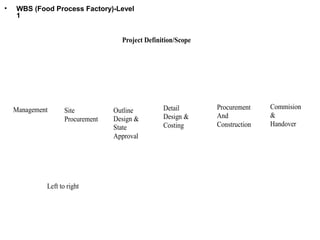
• WBS (Food Process Factory)-Level
1
Project Definition/Scope
Management Site
Procurement
Outline
Design &
State
Approval
Detail
Design &
Costing
Procurement
And
Construction
Commision
&
Handover
Left to right
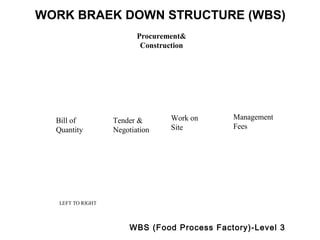
WORK BRAEK DOWN STRUCTURE (WBS)
Procurement&
Construction
Bill of
Quantity
Tender &
Negotiation
Work on
Site
Management
Fees
LEFT TO RIGHT
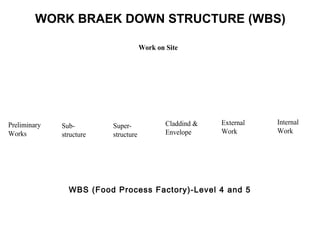
WBS (Food Process Factory)-Level 3
WORK BRAEK DOWN STRUCTURE (WBS)
Work on Site
Preliminary
Works
Sub-
structure
Super-
structure
Claddind &
Envelope
External
Work
Internal
Work
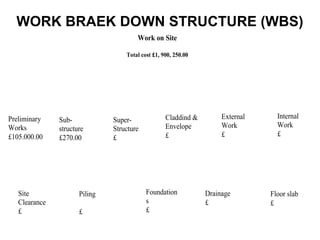
WBS (Food Process Factory)-Level 4 and 5
WORK BRAEK DOWN STRUCTURE (WBS)
Work on Site
Total cost £1, 900, 250.00
Preliminary
Works
£105.000.00
Sub-
structure
£270.00
Super-
Structure
£
Claddind &
Envelope
£
External
Work
£
Internal
Work
£
Site
Clearance
£
Piling
£
Foundation
s
£
Drainage
£
Floor slab
£
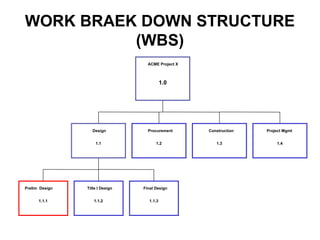
WORK BRAEK DOWN STRUCTURE
(WBS)
Project Mgmt
Prelim Design
1.1.1
Title I Design
1.1.2
Final Design
1.1.3
Design
1.1
Procurement
1.2
Construction
1.3 1.4
ACME Project X
1.0
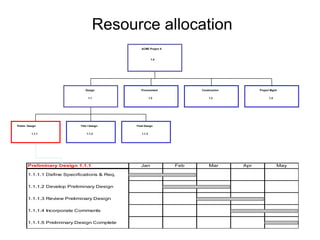
Resource allocation
Project Mgmt
Prelim Design
1.1.1
Title I Design
1.1.2
Final Design
1.1.3
Design
1.1
Procurement
1.2
Construction
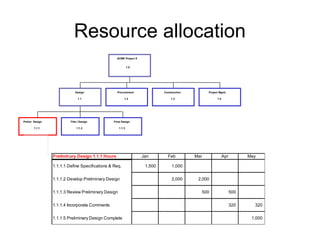
1.3 1.4
ACME Project X
1.0
Preliminary Design 1.1.1 Jan Feb Mar Apr May
1.1.1.1 Define Specifications & Req.
1.1.1.2 Develop Preliminary Design
1.1.1.3 Review Preliminary Design
1.1.1.4 Incorporate Comments
1.1.1.5 Preliminary Design Complete
Resource allocation
Project Mgmt
Prelim Design
1.1.1
Title I Design
1.1.2
Final Design
1.1.3
Design
1.1
Procurement
1.2
Construction
1.3 1.4
ACME Project X
1.0
Preliminary Design 1.1.1 Hours Jan Feb Mar Apr May
1.1.1.1 Define Specifications & Req. 1,500 1,000
1.1.1.2 Develop Preliminary Design 2,000 2,000
1.1.1.3 Review Preliminary Design 500 500
1.1.1.4 Incorporate Comments 320 320
1.1.1.5 Preliminary Design Complete 1,000
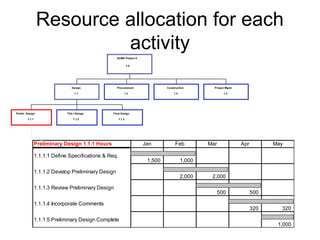
Resource allocation for each
activity
Project Mgmt
Prelim Design
1.1.1
Title I Design
1.1.2
Final Design
1.1.3
Design
1.1
Procurement
1.2
Construction
1.3 1.4
ACME Project X
1.0
Preliminary Design 1.1.1 Hours Jan Feb Mar Apr May
1.1.1.1 Define Specifications & Req.
1,500 1,000
1.1.1.2 Develop Preliminary Design
2,000 2,000
1.1.1.3 Review Preliminary Design
500 500
1.1.1.4 Incorporate Comments
320 320
1.1.1.5 Preliminary Design Complete
1,000
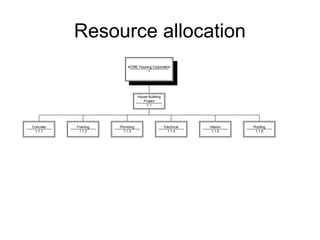
Resource allocation
ACME Housing Corporation
1
House Building
Project
1.1
Concrete
1.1.1
Framing
1.1.2
Plumbing
1.1.3
Electrical
1.1.4
Interior
1.1.5
Roofing
1.1.6
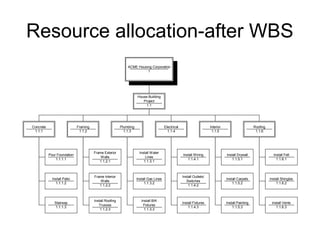
Resource allocation-after WBS
ACME Housing Corporation
1
House Building
Project
1.1
Concrete
1.1.1
Pour Foundation
1.1.1.1
Install Patio
1.1.1.2
Stairway
1.1.1.3
Framing
1.1.2
Frame Exterior
Walls
1.1.2.1
Frame Interior
Walls
1.1.2.2
Install Roofing
Trusses
1.1.2.3
Plumbing
1.1.3
Install Water
Lines
1.1.3.1
Install Gas Lines
1.1.3.2
Install B/K
Fixtures
1.1.3.3
Electrical
1.1.4
Install Wiring
1.1.4.1
Install Outlets/
Switches
1.1.4.2
Install Fixtures
1.1.4.3
Interior
1.1.5
Install Drywall
1.1.5.1
Install Carpets
1.1.5.2
Install Painting
1.1.5.3
Roofing
1.1.6
Install Felt
1.1.6.1
Install Shingles
1.1.6.2
Install Vents
1.1.6.3
MILESTONE PROGRAMMING
• The Milestone programmes provide the
‘administrative level’ in the planning
hierarchy.
• The activity programme provides the
detailed ‘technical level’.
• It focused on goals and not on the method of
reaching them.
• The Milestones and Objectives remain
reasonably constant through out the project.
• Methods of reaching goals may change.
MILESTONE PROGRAMMING
• Goal Directed Project Management
(GDPM) is a powerful, pragmatic
approach for gaining consensus from
all stakeholders on the overall
objectives of a business program or
project.
MILESTONE PROGRAMMING
• The approach is fully compatible with
industry standards such as:
• PRINCE2
• SUMMIT
• V-Model or HERMES
• It provides a single-page, top-level view of
the goals of the project (a milestone plan).
DEVELOPING THE MILESTONE PROGRAMME
1-The planning team
• The team responsible for ensuring
that the project objectives are met
should be present to formulate the
Milestone programme.
2-The result paths
• The project Objectives and Scope are
set out in the project definition
Document.
MILESTONE PROGRAMMING
• The team considers at each level, the
Primary Objectives such as:
• How will success be judged?
• What are the critical factors to monitor?
• What are Key Performance Indicators for
this project?
DEVELOPING THE MILESTONE PROGRAMME
3-Milestones
• The team actively generates ideas for the
like list of Milestones.
• Each Milestone description should:
• form a check point towards the final
objective,
• describe a condition or state that the
project must occupy at various stages in
order to reach it’s final objective,
DEVELOPING THE MILESTONE
PROGRAMME
• show a logical sequence towards the final
objective;
• state what to achieve, and not how to
achieve;
• focus on the goal;
• state a specific outcome, such as,
approval of a report and who approve it;
DEVELOPING THE MILESTONE
PROGRAMME
• Also Milestone should:
• be natural;
• represent important decisions;
• be controllable, either quantitively or
qualitatively;
• be few in number (10 TO 20);
• be at useful intervals(ie monthly);
4- Drafting the Milestone Plan
NESTED PROGRAMMING
• The primary objectives of the project
are provided in the Level 1 Project
Programme.
• Below The Work Breakdown Structure
(WBS) most projects are capable of
being split into a member of Stages or
Phases (Work Packages).
NESTED PROGRAMMING
• A milestoneplan may be produced
for each of these phases.
• for example at Level 1-Reported at
20 max controlled Milestones.
• Or at Level-2- let us say 4 Stages –
each Reported at 20 max controlled
Milestones.
NESTED PROGRAMMING
• At Level 3 and below, the influence of
detail activities can make it difficult to
develop meaningful Milestone
Programme.
• At this level down on the WBS, it is
normal to revert to activity
programmes.
NESTED PROGRAMMING
• At the lowest activity and task levels,
Milestones occur along the path of
networked activities (CPM) and are shown
as ‘Flagging’ up on the network or Gantt
chart.
• Some packages allow them to be fixed
and generate ‘Supper Critical Paths’. (See
Oxford Brookes University-Micro Planner).
DEVELOPING THE MILESTONE
PROGRAMME
Conclusion
• The Milestone methods is purely a means of
monitoring and controlling progress towards the
Projects Objectives at the highest level of WBS.
• It is useful where there is insufficient detailed
information to produce meaningful accurate
lower level Activities based programmes.
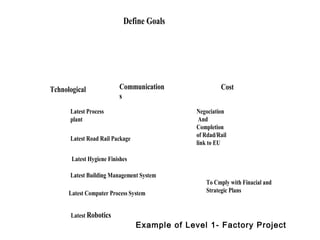
Define Goals
Tchnological Communication
s
Cost
Latest Process
plant
Latest Road Rail Package
Latest Hygiene Finishes
Latest Building Management System
Latest Computer Process System
Latest Robotics
Negociation
And
Completion
of Rdad/Rail
link to EU
To Cmply with Finacial and
Strategic Plans
Example of Level 1- Factory Project
134 work break break down structure

134 work break break down structure

  • 1.
  • 2.
    WORK BRAEK DOWNSTRUCTURE (WBS) A technique by which the work of a project is divided and sub divided for management, and control purposes.
  • 3.
    WORK BRAEK DOWNSTRUCTURE (WBS) The work is developed through successive increasing levels of details. Advantage • work delegated into coherent packages • work defined at appropriate levels of detail for cost control
  • 4.
    WORK BRAEK DOWNSTRUCTURE (WBS) • work defined at appropriate levels of detail for nesting plans i.e. rolling wave of program. • Variances can be measured between Planned and Actual. • The work packages are more stable than long chains of discontinuous work activities. • As a result risk is more contained and measured more accurately.
  • 5.
    WORK BRAEK DOWNSTRUCTURE (WBS) • successive levels of detail may be evolved • the project sponsor may call for reports from the Project manager based on the work content at Level 1, 2 and sometimes at Level 3,

  • 6.
    WORK BRAEK DOWNSTRUCTURE (WBS) • the Project Manger may call for Reports from Project Contributors based on work content at Level 3, 4 and 5, • the contractor’s Construction Management Team also may ask for report from Site Engineers at Level 5 and below Level 5,
  • 7.
    WORK BRAEK DOWNSTRUCTURE (WBS) • Different Levels Breakdown and Work Package require different Project Contributors with different Responsibilities. • The flow is from Left to Right.
  • 8.
    WORK BRAEK DOWNSTRUCTURE (WBS) • successively at each Level, may be made to mirror the timing of the work; • and facilities a Rolling Wave or Nested Programme; • from project level down to the lowest task orientated package level.
  • 9.
    WORK BRAEK DOWNSTRUCTURE (WBS) • each work package can be identified with a unique cost code; • and Actual and Planned Cost variances compared; • each work package can be fully described, for example: • Content; • what is included and what is excluded in a package statement.
  • 10.
    • WBS (FoodProcess Factory)-Level 1 Project Definition/Scope Management Site Procurement Outline Design & State Approval Detail Design & Costing Procurement And Construction Commision & Handover Left to right
  • 11.
    WORK BRAEK DOWNSTRUCTURE (WBS) Procurement& Construction Bill of Quantity Tender & Negotiation Work on Site Management Fees LEFT TO RIGHT WBS (Food Process Factory)-Level 3
  • 12.
    WORK BRAEK DOWNSTRUCTURE (WBS) Work on Site Preliminary Works Sub- structure Super- structure Claddind & Envelope External Work Internal Work WBS (Food Process Factory)-Level 4 and 5
  • 13.
    WORK BRAEK DOWNSTRUCTURE (WBS) Work on Site Total cost £1, 900, 250.00 Preliminary Works £105.000.00 Sub- structure £270.00 Super- Structure £ Claddind & Envelope £ External Work £ Internal Work £ Site Clearance £ Piling £ Foundation s £ Drainage £ Floor slab £
  • 14.
    WORK BRAEK DOWNSTRUCTURE (WBS) Project Mgmt Prelim Design 1.1.1 Title I Design 1.1.2 Final Design 1.1.3 Design 1.1 Procurement 1.2 Construction 1.3 1.4 ACME Project X 1.0
  • 15.
    Resource allocation Project Mgmt PrelimDesign 1.1.1 Title I Design 1.1.2 Final Design 1.1.3 Design 1.1 Procurement 1.2 Construction 1.3 1.4 ACME Project X 1.0 Preliminary Design 1.1.1 Jan Feb Mar Apr May 1.1.1.1 Define Specifications & Req. 1.1.1.2 Develop Preliminary Design 1.1.1.3 Review Preliminary Design 1.1.1.4 Incorporate Comments 1.1.1.5 Preliminary Design Complete
  • 16.
    Resource allocation Project Mgmt PrelimDesign 1.1.1 Title I Design 1.1.2 Final Design 1.1.3 Design 1.1 Procurement 1.2 Construction 1.3 1.4 ACME Project X 1.0 Preliminary Design 1.1.1 Hours Jan Feb Mar Apr May 1.1.1.1 Define Specifications & Req. 1,500 1,000 1.1.1.2 Develop Preliminary Design 2,000 2,000 1.1.1.3 Review Preliminary Design 500 500 1.1.1.4 Incorporate Comments 320 320 1.1.1.5 Preliminary Design Complete 1,000
  • 17.
    Resource allocation foreach activity Project Mgmt Prelim Design 1.1.1 Title I Design 1.1.2 Final Design 1.1.3 Design 1.1 Procurement 1.2 Construction 1.3 1.4 ACME Project X 1.0 Preliminary Design 1.1.1 Hours Jan Feb Mar Apr May 1.1.1.1 Define Specifications & Req. 1,500 1,000 1.1.1.2 Develop Preliminary Design 2,000 2,000 1.1.1.3 Review Preliminary Design 500 500 1.1.1.4 Incorporate Comments 320 320 1.1.1.5 Preliminary Design Complete 1,000
  • 18.
    Resource allocation ACME HousingCorporation 1 House Building Project 1.1 Concrete 1.1.1 Framing 1.1.2 Plumbing 1.1.3 Electrical 1.1.4 Interior 1.1.5 Roofing 1.1.6
  • 19.
    Resource allocation-after WBS ACMEHousing Corporation 1 House Building Project 1.1 Concrete 1.1.1 Pour Foundation 1.1.1.1 Install Patio 1.1.1.2 Stairway 1.1.1.3 Framing 1.1.2 Frame Exterior Walls 1.1.2.1 Frame Interior Walls 1.1.2.2 Install Roofing Trusses 1.1.2.3 Plumbing 1.1.3 Install Water Lines 1.1.3.1 Install Gas Lines 1.1.3.2 Install B/K Fixtures 1.1.3.3 Electrical 1.1.4 Install Wiring 1.1.4.1 Install Outlets/ Switches 1.1.4.2 Install Fixtures 1.1.4.3 Interior 1.1.5 Install Drywall 1.1.5.1 Install Carpets 1.1.5.2 Install Painting 1.1.5.3 Roofing 1.1.6 Install Felt 1.1.6.1 Install Shingles 1.1.6.2 Install Vents 1.1.6.3
  • 20.
    MILESTONE PROGRAMMING • TheMilestone programmes provide the ‘administrative level’ in the planning hierarchy. • The activity programme provides the detailed ‘technical level’. • It focused on goals and not on the method of reaching them. • The Milestones and Objectives remain reasonably constant through out the project. • Methods of reaching goals may change.
  • 21.
    MILESTONE PROGRAMMING • GoalDirected Project Management (GDPM) is a powerful, pragmatic approach for gaining consensus from all stakeholders on the overall objectives of a business program or project.
  • 22.
    MILESTONE PROGRAMMING • Theapproach is fully compatible with industry standards such as: • PRINCE2 • SUMMIT • V-Model or HERMES • It provides a single-page, top-level view of the goals of the project (a milestone plan).
  • 23.
    DEVELOPING THE MILESTONEPROGRAMME 1-The planning team • The team responsible for ensuring that the project objectives are met should be present to formulate the Milestone programme. 2-The result paths • The project Objectives and Scope are set out in the project definition Document.
  • 24.
    MILESTONE PROGRAMMING • Theteam considers at each level, the Primary Objectives such as: • How will success be judged? • What are the critical factors to monitor? • What are Key Performance Indicators for this project?
  • 25.
    DEVELOPING THE MILESTONEPROGRAMME 3-Milestones • The team actively generates ideas for the like list of Milestones. • Each Milestone description should: • form a check point towards the final objective, • describe a condition or state that the project must occupy at various stages in order to reach it’s final objective,
  • 26.
    DEVELOPING THE MILESTONE PROGRAMME •show a logical sequence towards the final objective; • state what to achieve, and not how to achieve; • focus on the goal; • state a specific outcome, such as, approval of a report and who approve it;
  • 27.
    DEVELOPING THE MILESTONE PROGRAMME •Also Milestone should: • be natural; • represent important decisions; • be controllable, either quantitively or qualitatively; • be few in number (10 TO 20); • be at useful intervals(ie monthly); 4- Drafting the Milestone Plan
  • 28.
    NESTED PROGRAMMING • Theprimary objectives of the project are provided in the Level 1 Project Programme. • Below The Work Breakdown Structure (WBS) most projects are capable of being split into a member of Stages or Phases (Work Packages).
  • 29.
    NESTED PROGRAMMING • Amilestoneplan may be produced for each of these phases. • for example at Level 1-Reported at 20 max controlled Milestones. • Or at Level-2- let us say 4 Stages – each Reported at 20 max controlled Milestones.
  • 30.
    NESTED PROGRAMMING • AtLevel 3 and below, the influence of detail activities can make it difficult to develop meaningful Milestone Programme. • At this level down on the WBS, it is normal to revert to activity programmes.
  • 31.
    NESTED PROGRAMMING • Atthe lowest activity and task levels, Milestones occur along the path of networked activities (CPM) and are shown as ‘Flagging’ up on the network or Gantt chart. • Some packages allow them to be fixed and generate ‘Supper Critical Paths’. (See Oxford Brookes University-Micro Planner).
  • 32.
    DEVELOPING THE MILESTONE PROGRAMME Conclusion •The Milestone methods is purely a means of monitoring and controlling progress towards the Projects Objectives at the highest level of WBS. • It is useful where there is insufficient detailed information to produce meaningful accurate lower level Activities based programmes.
  • 33.
    Define Goals Tchnological Communication s Cost LatestProcess plant Latest Road Rail Package Latest Hygiene Finishes Latest Building Management System Latest Computer Process System Latest Robotics Negociation And Completion of Rdad/Rail link to EU To Cmply with Finacial and Strategic Plans Example of Level 1- Factory Project