Work Breakdown Structure
WBS Characteristics:
• The Work Breakdown Structure is a hierarchy
which specifies the list of tasks involved in a
project – down to the finest detail.
• The WBS splits the task list up into major
‘packages’
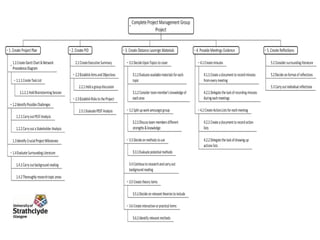
• On the following slide, is the WBS for the
project to outsource these Learning Materials.
Packages:
• The split of the task list into different packages
should be logical, and also compatible with
regards to cost control and reporting.
• For each Package, it should be possible to test
whether the entire package is completed or
not.
• You will see 5 different packages in the
previous example.
Lowest Level:
• The lowest level of each activity on a WBS
should be an individual task
• This task should be possible to complete by an
individual, or team, within a reasonable
defined period of time.
• For example, delegating the task of drawing
up action lists could be completed by an
individual within a defined period of
time, such as one afternoon.
Limitations to the WBS:
• No consideration for the order in which tasks
should be carried out, and whether a task is
dependant on another.
• No representation of how long each task
might take.
• Does not show you who, or what resources
are involved in each task.
Alternatives to WBS:
• Product Breakdown Structure
• Cost Breakdown Structure – Completed AFTER
the Work Breakdown Structure and Product
Breakdown Structure
Product Breakdown
Structure:
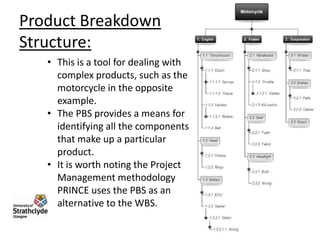
• This is a tool for dealing with
complex products, such as the
motorcycle in the opposite
example.
• The PBS provides a means for
identifying all the components
that make up a particular
product.
• It is worth noting the Project
Management methodology
PRINCE uses the PBS as an
alternative to the WBS.
Cost Breakdown Structure:

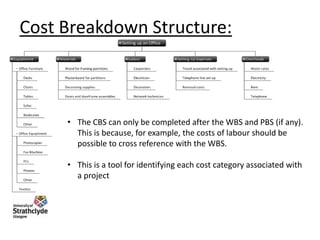
• The CBS can only be completed after the WBS and PBS (if any).
This is because, for example, the costs of labour should be
possible to cross reference with the WBS.

• This is a tool for identifying each cost category associated with
a project
Further Reading:
• Field & Keller, Chapter 2.1
• Servello & Evans, 2002
• Rook, 1991

Work breakdown structure

  • 1.
  • 2.
    WBS Characteristics: • TheWork Breakdown Structure is a hierarchy which specifies the list of tasks involved in a project – down to the finest detail. • The WBS splits the task list up into major ‘packages’ • On the following slide, is the WBS for the project to outsource these Learning Materials.
  • 4.
    Packages: • The splitof the task list into different packages should be logical, and also compatible with regards to cost control and reporting. • For each Package, it should be possible to test whether the entire package is completed or not. • You will see 5 different packages in the previous example.
  • 5.
    Lowest Level: • Thelowest level of each activity on a WBS should be an individual task • This task should be possible to complete by an individual, or team, within a reasonable defined period of time. • For example, delegating the task of drawing up action lists could be completed by an individual within a defined period of time, such as one afternoon.
  • 6.
    Limitations to theWBS: • No consideration for the order in which tasks should be carried out, and whether a task is dependant on another. • No representation of how long each task might take. • Does not show you who, or what resources are involved in each task.
  • 7.
    Alternatives to WBS: •Product Breakdown Structure • Cost Breakdown Structure – Completed AFTER the Work Breakdown Structure and Product Breakdown Structure
  • 8.
    Product Breakdown Structure: • Thisis a tool for dealing with complex products, such as the motorcycle in the opposite example. • The PBS provides a means for identifying all the components that make up a particular product. • It is worth noting the Project Management methodology PRINCE uses the PBS as an alternative to the WBS.
  • 9.
    Cost Breakdown Structure: •The CBS can only be completed after the WBS and PBS (if any). This is because, for example, the costs of labour should be possible to cross reference with the WBS. • This is a tool for identifying each cost category associated with a project
  • 10.
    Further Reading: • Field& Keller, Chapter 2.1 • Servello & Evans, 2002 • Rook, 1991