Engineering Economics
Work Breakdown
Structure
Introduction
 For project budgetary planning and control
purposes, dividing complex projects to simpler
and manageable tasks is the process identified
as Work Breakdown Structure (WBS).
 Usually, the project managers use this method for
simplifying the project execution.
 In WBS, much larger tasks are broken-down to
manageable chunks of work.
 These chunks can be easily supervised and
estimated.
A Work Breakdown Structure
 A work breakdown structure element may be a
product, data, a service, or any combination.
 A WBS also provides the necessary framework
for detailed cost estimating and control along with
providing guidance for schedule development and
control.
Why WBS in a Project?
 Accurate and readable project organization.
 Accurate assignment of responsibilities to the
project team.
 Indicates the project milestones and control
points.
 Helps to estimate the cost, time and risk.
 Illustrate the project scope, so the stakeholders
can have a better understanding of the same.
Purpose of WBS
1. First reason is that it helps more accurately and
specifically to define and organize the scope of
total project.
2. The second reason for using a WBS in your
projects is to help with assigning
responsibilities, resource allocation, monitoring
the project, and controlling the project
3. Finally, it allows you double check all the
deliverables' specifics with the stakeholders and
make sure there is nothing missing or
overlapping.
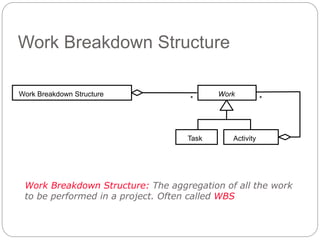
Work Breakdown Structure
*
Task
*
Work
Activity
Work Breakdown Structure
Work Breakdown Structure: The aggregation of all the work
to be performed in a project. Often called WBS
Activities, Tasks and Functions
 Activity: A major unit of work with precise dates
that consists of smaller activities or tasks. It
culminates in a project milestone.
 Task: Smallest unit of work subject to
management. Small enough for adequate
planning and tracking. Large enough to avoid
micro management
 Project Function: An activity or set of activities
that span the duration of the project
Some Important Definitions
 Project:
 A Project has a duration and consists of functions,
activities and tasks
 Work Package:
 A description of the work to be accomplished in an
activity or task
 Work Product:
 Any tangible item that results from a project function,
activity or task.
 Project Baseline:
 A work product that has been formally reviewed and
agreed upon.
 A project baselines can only be changed through a
formal change procedure
 Project Deliverable:
 A work product to be delivered to the customer
How do you develop a good
WBS?
 Top down approach:
 Start at the highest, top level activities and
systematically develop increasing levels of detail for all
activities.
 Bottom up approach (“Brainstorming”):
 Generate all activities you can think of that will have to
be done and then group them into categories.
 Which one you use depends on
 how familiar you and your team are with the project,
 whether similar projects have successfully been
performed in the past, and
 how many new methods and technologies will be used.
The Top Down WBS
Development
 Specify all activities required for the entire project
to be finished
 Determine all tasks required to complete each
activity
 If necessary, specify sub-activities required to
complete each task
 Continue in this way until you have adequately
detailed your project.
 Top Down WBS Approach is good if
 You are familiar with the problem (or your team)
 You have successfully managed a similar project in
the past
 You are not introducing new methodologies,
methods or tools
The Brainstorming WBS
Development
 On a single list, write any activities you think will have to
be performed for your project.
 Brainstorming means you
 Don’t worry about overlap or level of detail
 Don’t discuss activity wordings or other details
 Don’t make any judgements
 Write everything down
 Then study the list and group activities into a few major
categories with common characteristics
 If appropriate, group identified activities into higher level
activities
 Consider each category you have created and use the
top-down WBS development to determine any additional
activities you may have overlooked.
Displaying Work Breakdown
Structures
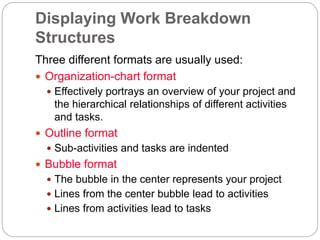
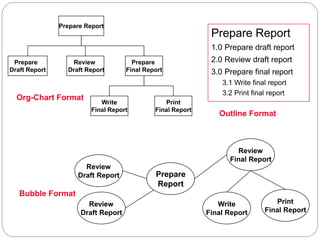
Three different formats are usually used:
 Organization-chart format
 Effectively portrays an overview of your project and
the hierarchical relationships of different activities
and tasks.
 Outline format
 Sub-activities and tasks are indented
 Bubble format
 The bubble in the center represents your project
 Lines from the center bubble lead to activities
 Lines from activities lead to tasks
Prepare Report
1.0 Prepare draft report
2.0 Review draft report
3.0 Prepare final report
3.1 Write final report
3.2 Print final report
Review
Draft Report Prepare
Report
Review
Draft Report
Review
Final Report
Print
Final Report
Write
Final Report
Prepare Report
Prepare
Draft Report
Review
Draft Report
Prepare
Final Report
Write
Final Report
Print
Final Report
Org-Chart Format
Outline Format
Bubble Format
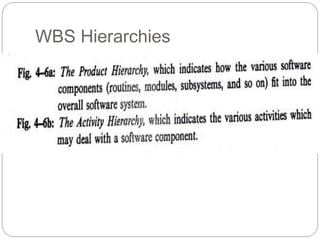
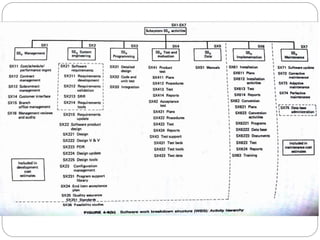
WBS Hierarchies
Engineering Economics|Work Breakdown Structure

Engineering Economics|Work Breakdown Structure

  • 1.
  • 2.
  • 3.
    Introduction  For projectbudgetary planning and control purposes, dividing complex projects to simpler and manageable tasks is the process identified as Work Breakdown Structure (WBS).  Usually, the project managers use this method for simplifying the project execution.  In WBS, much larger tasks are broken-down to manageable chunks of work.  These chunks can be easily supervised and estimated.
  • 4.
    A Work BreakdownStructure  A work breakdown structure element may be a product, data, a service, or any combination.  A WBS also provides the necessary framework for detailed cost estimating and control along with providing guidance for schedule development and control.
  • 5.
    Why WBS ina Project?  Accurate and readable project organization.  Accurate assignment of responsibilities to the project team.  Indicates the project milestones and control points.  Helps to estimate the cost, time and risk.  Illustrate the project scope, so the stakeholders can have a better understanding of the same.
  • 6.
    Purpose of WBS 1.First reason is that it helps more accurately and specifically to define and organize the scope of total project. 2. The second reason for using a WBS in your projects is to help with assigning responsibilities, resource allocation, monitoring the project, and controlling the project 3. Finally, it allows you double check all the deliverables' specifics with the stakeholders and make sure there is nothing missing or overlapping.
  • 7.
    Work Breakdown Structure * Task * Work Activity WorkBreakdown Structure Work Breakdown Structure: The aggregation of all the work to be performed in a project. Often called WBS
  • 8.
    Activities, Tasks andFunctions  Activity: A major unit of work with precise dates that consists of smaller activities or tasks. It culminates in a project milestone.  Task: Smallest unit of work subject to management. Small enough for adequate planning and tracking. Large enough to avoid micro management  Project Function: An activity or set of activities that span the duration of the project
  • 9.
    Some Important Definitions Project:  A Project has a duration and consists of functions, activities and tasks  Work Package:  A description of the work to be accomplished in an activity or task  Work Product:  Any tangible item that results from a project function, activity or task.  Project Baseline:  A work product that has been formally reviewed and agreed upon.  A project baselines can only be changed through a formal change procedure  Project Deliverable:  A work product to be delivered to the customer
  • 10.
    How do youdevelop a good WBS?  Top down approach:  Start at the highest, top level activities and systematically develop increasing levels of detail for all activities.  Bottom up approach (“Brainstorming”):  Generate all activities you can think of that will have to be done and then group them into categories.  Which one you use depends on  how familiar you and your team are with the project,  whether similar projects have successfully been performed in the past, and  how many new methods and technologies will be used.
  • 11.
    The Top DownWBS Development  Specify all activities required for the entire project to be finished  Determine all tasks required to complete each activity  If necessary, specify sub-activities required to complete each task  Continue in this way until you have adequately detailed your project.  Top Down WBS Approach is good if  You are familiar with the problem (or your team)  You have successfully managed a similar project in the past  You are not introducing new methodologies, methods or tools
  • 12.
    The Brainstorming WBS Development On a single list, write any activities you think will have to be performed for your project.  Brainstorming means you  Don’t worry about overlap or level of detail  Don’t discuss activity wordings or other details  Don’t make any judgements  Write everything down  Then study the list and group activities into a few major categories with common characteristics  If appropriate, group identified activities into higher level activities  Consider each category you have created and use the top-down WBS development to determine any additional activities you may have overlooked.
  • 13.
    Displaying Work Breakdown Structures Threedifferent formats are usually used:  Organization-chart format  Effectively portrays an overview of your project and the hierarchical relationships of different activities and tasks.  Outline format  Sub-activities and tasks are indented  Bubble format  The bubble in the center represents your project  Lines from the center bubble lead to activities  Lines from activities lead to tasks
  • 14.
    Prepare Report 1.0 Preparedraft report 2.0 Review draft report 3.0 Prepare final report 3.1 Write final report 3.2 Print final report Review Draft Report Prepare Report Review Draft Report Review Final Report Print Final Report Write Final Report Prepare Report Prepare Draft Report Review Draft Report Prepare Final Report Write Final Report Print Final Report Org-Chart Format Outline Format Bubble Format
  • 15.

Editor's Notes

  • #10 “formally reviewed and agreed upon” does not mean a baseline is frozen! Avoid this term by any means!
  • #11 Break Example for previous slide: You are at the beach, you are building a sandcastl e, somebody else too, soon you are noticing that the wall, your wall!, is used by the oterh kid. War! Sandwar! This type of war is typical, if you mix approaches, for example if you mix the functional WBS with the product component approach.