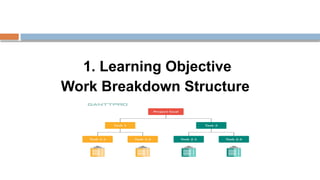
Work Breakdown Structure
Awork breakdown structure (WBS) is a project
management tool that takes a step-by-step
approach to complete large projects with several
moving pieces. By breaking down the project into
smaller components, a WBS can integrate scope,
cost and deliverables into a single tool.
5.
Create aWBS Template when you need to deconstruct your
team's work into smaller, well-defined elements to make it more
manageable. It’s a helpful project management tool that can
keep team members informed, identify specific project
deliverables, and help you develop a project schedule.
This hierarchical structure makes it easier for a project
manager to oversee a complex project and make sure every
task gets done.
6.
Work Breakdown StructureExample
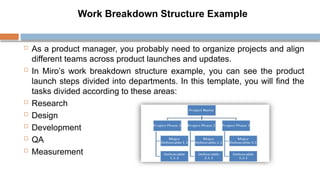
As a product manager, you probably need to organize projects and align
different teams across product launches and updates.
In Miro’s work breakdown structure example, you can see the product
launch steps divided into departments. In this template, you will find the
tasks divided according to these areas:
Research
Design
Development
QA
Measurement
7.
How to Createa Work Breakdown Structure in 3
Steps
1. Set goals & objectives
First, scope the entire project and make sure you understand the goals and
objectives. That means determining what your project team is trying to accomplish
with the project, how it fits into the broader goals of your organization.
2. Lay out deliverables
Next, catalog all of the major high-level deliverables of the project. These will be
the second tier of the structure, and will be comprised of sub-projects that work
towards the overall goals & objectives laid out in the first step.
3. Break deliverables into individual tasks
Finally, break those high-level deliverables into smaller pieces for a third level of
activities that need to be done to complete the project. These are the specific daily
sub-tasks required to get the project off the ground and ultimately completed.
8.
Why Create aWork Breakdown Structure?
A work breakdown structure (WBS) is a tool that can be used for projects, programs, and even initiatives to understand
the work that has to be done to successfully produce a deliverable . The benefits of creating a WBS include:
it defines and organizes the work required
it facilitates the quick development of a schedule by allocating effort estimates to specific sections of the WBS
it provides a visual of entire scope
it can be used to identify communication points
it provides a visual of impacts when deliverables are falling behind
it can be used to show and assign accountabilities and responsibilities
it can show control points and milestones
it provides a way to estimates project costs
it ensures no important deliverables are forgotten
it can assist with resource allocation
it provides a proven and repeatable approach to planning projects
it provides a tool for team brainstorming and collaboration
it provides an opportunity to engage the team and make them feel invested in the planning
9.
Importance of WBS
Creating Measurable and Independent Tasks
The main purpose of a WBS is to reduce complicated activities to a collection of
tasks. This is important for the project manager because she can oversee the
tasks more effectively than the complex activities. Tasks must be measurable and
independent, with clearly defined limits. All the project work must be included in
one of the tasks and the tasks must not include any non-project work.
Assigning Costs to Each Task
Because the WBS tasks are measurable, the project management can assign
specific costs to each task. The WBS lets project managers distribute the project
budget into defined packages linked to the tasks and check to make sure that the
task costs in total don't exceed the total project cost.
10.
Track Progressin a Schedule
The WBS is important for tracking progress in the project schedule. Because
the WBS tasks have clearly defined limits, the project management can
determine how advanced the project is by checking which of the tasks are
finished. Even within each task, the project management can check for
percent completion because each task is measurable.
Define the Scope of the Project
One of the key functions of the project management is to define the scope of
the project. The challenge is to make sure that everything within the project
scope is completed without carrying out any extra work. The WBS helps
define scope by listing individual tasks that make up the project. The project
team completes all the listed tasks but no additional work.
11.
Assign Responsibilityfor the Tasks
An important part of project management is to assign responsibility for
the work. With a WBS, the project management assigns responsibility
for each of the tasks. The task manager is responsible for completing
the full scope of the project on time, within the budget and with all of its
planned functionality intact.
Fulfill Intended Purposes
A major criterion for project success is that it fulfills its intended purpose.
The tasks of the WBS each implement a part of the overall function. A
task is only complete when it fulfills its partial function. When all tasks
are finished, all the partial functions add up to a fully functional project.
12.
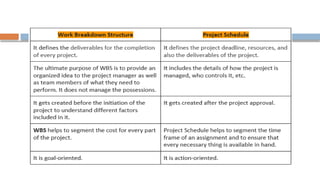
Key Differences Betweenthe WBS and the Project
Schedule
The main difference between the two is the scope as a WBS
covers the project in its entirety while a project plan focuses on
a smaller part of a project. So a project can have a WBS that
compartmentalizes it into several parts. Each of these
parts would then have a project plan.
14.
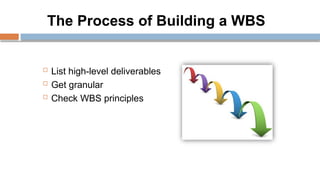
The Process ofBuilding a WBS
List high-level deliverables
Get granular
Check WBS principles
15.
Levels of aWork Breakdown Structure
WBS is used for large and demanding projects. With the help
of this tool, we are breaking down the project into more
manageable pieces to make it easier to deliver, schedule, and
plan. That’s why each WBS has four main levels:
The top-level: the final deliverable or project title.
Controls account: the main deliverables and project phases.
Work packages: the group of tasks that lead to controls
account levels.
Activities: all the tasks required to complete work packages.
16.
Guidelines for EffectiveWBS
100% Rule: The WBS should define the total scope of the project and capture ALL
deliverables, including project management. If not, the risk of gaps and missing
components is high.
Mutual Exclusivity: It is important that there is no overlap in scope definition
between two elements of a WBS. This ambiguity could result in duplicated work.
Deliverables, Not Actions: Deliverables are the desired ends of the project, such
as a product, result, or service and can be predicted accurately. Actions, on the
other hand, may be difficult to predict accurately.
Reasonable Level of Detail: Don’t go into too much detail. What you’re looking for
is enough detail so you can plan, manage and control the project. An effective limit
of WBS granularity may be reached when it is no longer possible to define
deliverables and the only details remaining are actions. The lowest level in the WBS
is called a “Work Package”.
17.
Schedule Development Process
Schedule Development is a formal process of developing and
approving a schedule through estimating and sequencing
activities, durations and resources in accordance with their
dependencies set for the current working environment
18.
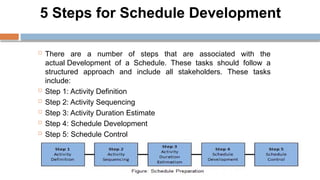
5 Steps forSchedule Development
There are a number of steps that are associated with the
actual Development of a Schedule. These tasks should follow a
structured approach and include all stakeholders. These tasks
include:
Step 1: Activity Definition
Step 2: Activity Sequencing
Step 3: Activity Duration Estimate
Step 4: Schedule Development
Step 5: Schedule Control
19.
Managing the Risk,Managing the
Estimates
There lies the key challenge. How do you manage the uncertainty that is naturally involved
with the estimating process. Since these estimates form the foundation for the project
schedule and the project budget, we must implement techniques and approaches that allow
us to properly manage this risk and the expectations of our stakeholders.
While this subject of estimating and risk could easily slip into a review of statistics,
probability, standard deviations, skewed distributions, and Monte Carlo analysis, we will not
go there. In many real-world environments, these advanced concepts and techniques are
not utilized to estimate work and to manage the associated risk, and these topics would be
outside the scope of this book. Our focus will be understanding the impact that estimating
the work has on our overall risk management approach and what we can do to minimize the
those risks.
20.
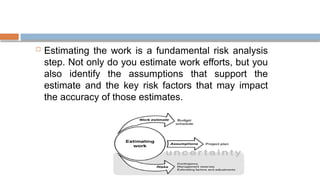
Estimating thework is a fundamental risk analysis
step. Not only do you estimate work efforts, but you
also identify the assumptions that support the
estimate and the key risk factors that may impact
the accuracy of those estimates.
21.
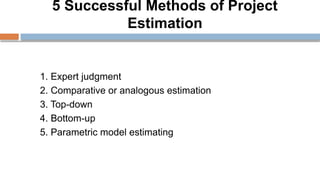
Four Project EstimationTechniques
Factor estimating :The first and most high-level technique available is factor
estimating. It derives its name from applying derivative factors for the
preparation of the investment estimate of a project. You can use this when the
project is not well defined yet: the scope is incomplete and there are possibly
still a number of alternatives that need to be worked out in more detail.
Parametric estimating :Often, companies possess a lot of historical project
information that sits unused. Among this might be a collection of previous
quotes, contract values and prices. A cost engineer can put this to use by
developing parametric estimation techniques. Try to look for relationships
between the specifications of previously procured materials or labor.
22.
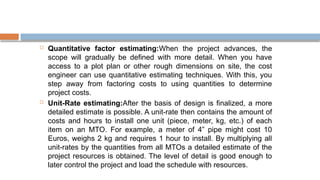
Quantitative factorestimating:When the project advances, the
scope will gradually be defined with more detail. When you have
access to a plot plan or other rough dimensions on site, the cost
engineer can use quantitative estimating techniques. With this, you
step away from factoring costs to using quantities to determine
project costs.
Unit-Rate estimating:After the basis of design is finalized, a more
detailed estimate is possible. A unit-rate then contains the amount of
costs and hours to install one unit (piece, meter, kg, etc.) of each
item on an MTO. For example, a meter of 4” pipe might cost 10
Euros, weighs 2 kg and requires 1 hour to install. By multiplying all
unit-rates by the quantities from all MTOs a detailed estimate of the
project resources is obtained. The level of detail is good enough to
later control the project and load the schedule with resources.
The Impact ofthe Project Schedule
The project schedule is the tool that merges all of the work tasks to be
performed, their relationships, their estimated durations, and their
assigned resources to a calendar. The project schedule reflects all of
the following:
WBS
Resource plan
Work estimates
Key milestones
Responsibility assignments (RASIC)
Quality management plan
Risk management plan
Communications management plan
Procurement management plan
26.
Develop Schedule Process
Develop Schedule is the process of analyzing activity
sequences, durations, resource requirements, and schedule
constraints to create the project schedule model. At the end of
develop schedule process, you will have a finalized project
schedule which includes the start and end dates of each
project activity, the relationship of activities, the resource of
activities, the total duration of the project etc.
27.
Key Inputs forBuilding a Schedule
Project scope statement: Project scope statement is at the top of the list of
what you need for develop schedule process, no doubt. Because your project’s
main goal is completing the project scope on agreed time and budget with the
agreed quality.
Activity list: Activity list shows the individual activities that need to be
performed to complete work packages and respectively the overall project
scope.
Network diagram: Network diagrams show the flow of project activities from
the start of the project until the end. Therefore, while defining the
interrelationship of activities in develop schedule process, it will be critical to
have network diagram in hand.
Activity duration estimates: They provide the time estimates for each activity.
After interrelationship of activities is put on the project schedule, once the time
estimates are defined in each project activity, start and end dates of each
activity will be determined respectively during the develop schedule process.
28.
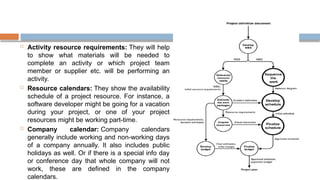
Activity resourcerequirements: They will help
to show what materials will be needed to
complete an activity or which project team
member or supplier etc. will be performing an
activity.
Resource calendars: They show the availability
schedule of a project resource. For instance, a
software developer might be going for a vacation
during your project, or one of your project
resources might be working part-time.
Company calendar: Company calendars
generally include working and non-working days
of a company annually. It also includes public
holidays as well. Or if there is a special info day
or conference day that whole company will not
work, these are defined in the company
calendars.
29.
Creating and Presentinga Schedule
How to create a Project Schedule
Create the Project Scope
Establish the Sequence of Tasks
Group Tasks
Link Task Dependencies
Find the Critical Path
Assign Resources
30.
Creating and Presentinga Schedule
Here are the seven steps you should cover when presenting a
project plan:
I. Provide an overview
II. Review the OKRs (objectives and key results)
III. Cover expectations and exclusions
IV. Present a high-level schedule
V. Introduce your team
VI. Define communications
VII. Discuss the unexpected.
31.
The Impact ofthe Project Budget
Do it anyway Develop a project budget anyway. This exercise will build your
project management skills, enable you to recognize project performance issues
sooner, and better prepare you for senior management discussions about your
project.
Follow the money You should have determined this as part of project definition, but
just in case you have not yet, make sure you are totally clear on who is financially
sponsoring the project and who controls any financial-based decision to be made
about your project. This awareness is key in your efforts to manage expectations
and to understand the political aspects of your project.
The project budget estimates all of the costs the project will incur, when they will
be incurred, and is a key component of the overall project plan.The reasons are:
Planning validator Since the project schedule is a main driver for the project
budget, the budget can serve as an excellent cross-reference for the validity of the
schedule and vice versa.
Performance measurement By measuring project progress against a cost
32.
Principles of anEffective Budget
1. Preparation of a budget forces top management to set long-term goals.
Also, it is necessary to name the managers who are responsible for achieving
these goals.
2. A budget’s success or failure is mainly determined by how well the human
aspects of the process are handled. The budget can force the coordination of
activity within an organization.
Top management must communicate the importance of the budget timetable
to all stakeholders, ensuring that coordination from all sections of the
business is forthcoming.
3. Budgets are important guides to the actions of management. However, they
should always be treated as guides—not as absolute truths. After all, since
budgets are finalized weeks or months in advance, unexpected changes may
take place.A manager should not ignore changes in the business
environment. A procedure for considering these changes and their effect on
budgeting should be worked out as part of the budget implementation.
33.
4. The economicuse of money is facilitated through the process
of budgeting. Budgets are prepared almost a year in advance
and a timetable with deadlines is also set for all levels and parts
of the year’s operating plans.
5. Budgetary control and planning work hand-in-hand in any
good management system.If planning is unsatisfactory, the plan
should be corrected; if the plan is satisfactory but performance
can be improved, steps are taken to bring future performance in
line with the plan.
34.
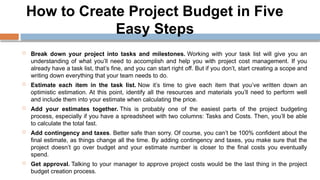
How to CreateProject Budget in Five
Easy Steps
Break down your project into tasks and milestones. Working with your task list will give you an
understanding of what you’ll need to accomplish and help you with project cost management. If you
already have a task list, that’s fine, and you can start right off. But if you don’t, start creating a scope and
writing down everything that your team needs to do.
Estimate each item in the task list. Now it’s time to give each item that you’ve written down an
optimistic estimation. At this point, identify all the resources and materials you’ll need to perform well
and include them into your estimate when calculating the price.
Add your estimates together. This is probably one of the easiest parts of the project budgeting
process, especially if you have a spreadsheet with two columns: Tasks and Costs. Then, you’ll be able
to calculate the total fast.
Add contingency and taxes. Better safe than sorry. Of course, you can’t be 100% confident about the
final estimate, as things change all the time. By adding contingency and taxes, you make sure that the
project doesn’t go over budget and your estimate number is closer to the final costs you eventually
spend.
Get approval. Talking to your manager to approve project costs would be the last thing in the project
budget creation process.
35.
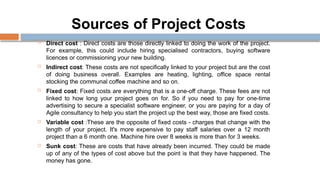
Sources of ProjectCosts
Direct cost : Direct costs are those directly linked to doing the work of the project.
For example, this could include hiring specialised contractors, buying software
licences or commissioning your new building.
Indirect cost: These costs are not specifically linked to your project but are the cost
of doing business overall. Examples are heating, lighting, office space rental
stocking the communal coffee machine and so on.
Fixed cost: Fixed costs are everything that is a one-off charge. These fees are not
linked to how long your project goes on for. So if you need to pay for one-time
advertising to secure a specialist software engineer, or you are paying for a day of
Agile consultancy to help you start the project up the best way, those are fixed costs.
Variable cost :These are the opposite of fixed costs - charges that change with the
length of your project. It's more expensive to pay staff salaries over a 12 month
project than a 6 month one. Machine hire over 8 weeks is more than for 3 weeks.
Sunk cost: These are costs that have already been incurred. They could be made
up of any of the types of cost above but the point is that they have happened. The
money has gone.
36.
Developing an InitialBudget
1. Imagine Your Financial Future.
2. Try Budgeting Tools.
3. Consider Budget Types.
4. Determine Your Monthly Income.
5. Add Up Monthly Expenses.
6. Cut Expenses.
7. Decide on Savings Priorities.
8. Create a Savings Plan.
37.
Finalizing a Budget
1.Know what you want to accomplish before you even think
about a budge
2. Invite participation to promote ownership
3. Ensure you understand your organization’s financial strengths
and weaknesses
4. Think long-term
5. Combine the preliminary budgets into the overall budget and
identify possible cuts
38.
6.Consider preparing contingencybudgets
7.Present a draft of the primary and contingency budgets
to the finance committee for review and approval.
8. Present an updated draft to the full governing board for
approval.
9. Communicate the final budget to all stakeholders.
10. Monitor the budget quarterly to identify and respond
to potential shortages.
39.
10 Common BudgetChallenges
1. Being indecisive about finances
2. Shopping impulsively
3. Not having financial goals
4. Not using the right budgeting method
5. Fear of facing debt
6. Eating out too much
7. Not budgeting for savings
8. Not budgeting consistently
9. Racking up credit card debt
10. Unexpected expenses