RANA HAMID
RUET CE’16
 Economics interrelates between infinite demand and limited resources
 It quantifies the benefits and costs associating with engineering projects
to determine if they save enough money to warrant their capital
investments
 What is ECONOMICS?
 What is ENGINEERING ECONOMICS?
 It’s the social science that deals with the production, distribution ,
and consumption of goods and services
 It deals with the method that enables one to take economic decision
towards minimizing cost and maximizing benefits to business organization
An engineer is one who could make
something for one dollar what others
can make for two…
Engineering is not just knowing how to
design something.
“
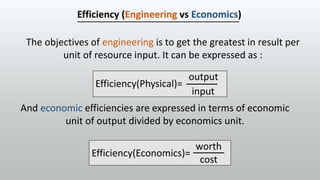
And economic efficiencies are expressed in terms of economic
unit of output divided by economics unit.
The objectives of engineering is to get the greatest in result per
unit of resource input. It can be expressed as :
Efficiency(Physical)=
Efficiency (Engineering vs Economics)
output
input
Efficiency(Economics)=
worth
cost
 Projects that are technically feasible but economically infeasible are discarded
Economics aspect on Civil Engineering:
 A Civil Engineer designs and constructs structures that the people demands which
makes people's lives easier, convenient and safer
 It costs money to design, supervise, construct & maintain structures that engineers
build & the only way to be effective at doing this whole cycle is to have proper
knowledge of economics
 An Engineer that designs something that the world doesn't need or doesn't want, then
that engineer wouldn't sell his design, that’s why having a knowledge of demand and
supply is necessary
 To ensure minimum waste & maximum usage of resources knowledge of economics is
a must
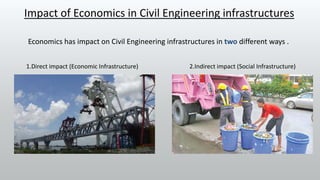
Economics has impact on Civil Engineering infrastructures in two different ways .
Impact of Economics in Civil Engineering infrastructures
1.Direct impact (Economic Infrastructure) 2.Indirect impact (Social Infrastructure)
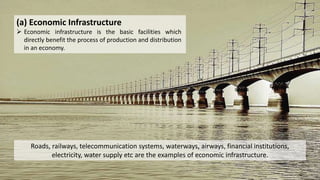
(a) Economic Infrastructure
 Economic infrastructure is the basic facilities which
directly benefit the process of production and distribution
in an economy.
Roads, railways, telecommunication systems, waterways, airways, financial institutions,
electricity, water supply etc are the examples of economic infrastructure.
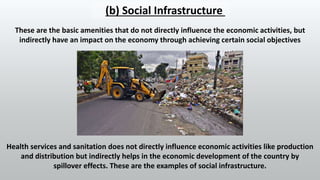
These are the basic amenities that do not directly influence the economic activities, but
indirectly have an impact on the economy through achieving certain social objectives
Health services and sanitation does not directly influence economic activities like production
and distribution but indirectly helps in the economic development of the country by
spillover effects. These are the examples of social infrastructure.
(b) Social Infrastructure
Sector
No of
Projects
ADP FY19
Share (%) ADP
FY19
Share (%)
RADP FY18
Share (%)
ADP FY18
Growth (%)
ADP FY19 over
RADP FY18
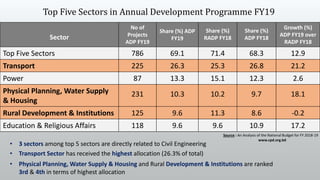
Top Five Sectors 786 69.1 71.4 68.3 12.9
Transport 225 26.3 25.3 26.8 21.2
Power 87 13.3 15.1 12.3 2.6
Physical Planning, Water Supply
& Housing
231 10.3 10.2 9.7 18.1
Rural Development & Institutions 125 9.6 11.3 8.6 -0.2
Education & Religious Affairs 118 9.6 9.6 10.9 17.2
Top Five Sectors in Annual Development Programme FY19
• 3 sectors among top 5 sectors are directly related to Civil Engineering
• Transport Sector has received the highest allocation (26.3% of total)
• Physical Planning, Water Supply & Housing and Rural Development & Institutions are ranked
3rd & 4th in terms of highest allocation
Source : An Analysis of the National Budget for FY 2018-19
www.cpd.org.bd
Economics in Civil Engineering

Economics in Civil Engineering

  • 1.
  • 2.
     Economics interrelatesbetween infinite demand and limited resources  It quantifies the benefits and costs associating with engineering projects to determine if they save enough money to warrant their capital investments  What is ECONOMICS?  What is ENGINEERING ECONOMICS?  It’s the social science that deals with the production, distribution , and consumption of goods and services  It deals with the method that enables one to take economic decision towards minimizing cost and maximizing benefits to business organization
  • 3.
    An engineer isone who could make something for one dollar what others can make for two… Engineering is not just knowing how to design something. “
  • 4.
    And economic efficienciesare expressed in terms of economic unit of output divided by economics unit. The objectives of engineering is to get the greatest in result per unit of resource input. It can be expressed as : Efficiency(Physical)= Efficiency (Engineering vs Economics) output input Efficiency(Economics)= worth cost
  • 5.
     Projects thatare technically feasible but economically infeasible are discarded Economics aspect on Civil Engineering:  A Civil Engineer designs and constructs structures that the people demands which makes people's lives easier, convenient and safer  It costs money to design, supervise, construct & maintain structures that engineers build & the only way to be effective at doing this whole cycle is to have proper knowledge of economics  An Engineer that designs something that the world doesn't need or doesn't want, then that engineer wouldn't sell his design, that’s why having a knowledge of demand and supply is necessary  To ensure minimum waste & maximum usage of resources knowledge of economics is a must
  • 6.
    Economics has impacton Civil Engineering infrastructures in two different ways . Impact of Economics in Civil Engineering infrastructures 1.Direct impact (Economic Infrastructure) 2.Indirect impact (Social Infrastructure)
  • 7.
    (a) Economic Infrastructure Economic infrastructure is the basic facilities which directly benefit the process of production and distribution in an economy. Roads, railways, telecommunication systems, waterways, airways, financial institutions, electricity, water supply etc are the examples of economic infrastructure.
  • 8.
    These are thebasic amenities that do not directly influence the economic activities, but indirectly have an impact on the economy through achieving certain social objectives Health services and sanitation does not directly influence economic activities like production and distribution but indirectly helps in the economic development of the country by spillover effects. These are the examples of social infrastructure. (b) Social Infrastructure
  • 9.
    Sector No of Projects ADP FY19 Share(%) ADP FY19 Share (%) RADP FY18 Share (%) ADP FY18 Growth (%) ADP FY19 over RADP FY18 Top Five Sectors 786 69.1 71.4 68.3 12.9 Transport 225 26.3 25.3 26.8 21.2 Power 87 13.3 15.1 12.3 2.6 Physical Planning, Water Supply & Housing 231 10.3 10.2 9.7 18.1 Rural Development & Institutions 125 9.6 11.3 8.6 -0.2 Education & Religious Affairs 118 9.6 9.6 10.9 17.2 Top Five Sectors in Annual Development Programme FY19 • 3 sectors among top 5 sectors are directly related to Civil Engineering • Transport Sector has received the highest allocation (26.3% of total) • Physical Planning, Water Supply & Housing and Rural Development & Institutions are ranked 3rd & 4th in terms of highest allocation Source : An Analysis of the National Budget for FY 2018-19 www.cpd.org.bd