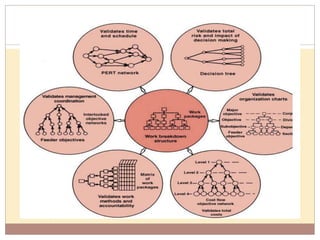

WBS
 it is a visual representation of the high-level
deliverables broken down into manageable
components.
 A WBS is not a chart of the activities to complete the
work—it is a breakdown of the deliverables.
 project manager must structure the work into small
elements that are:
• Manageable, in that specific authority and responsibility can be
assigned
• Independent, or with minimum interfacing with and
dependence on other ongoing elements
• Integratable so that the total package can be seen
• Measurable in terms of progress
 The smallest element in the WBS is called the work
package.
 The components in the WBS are typically mapped
against a code of accounts, which is a tool to number
and identify the elements within the WBS
 The components in the WBS should be included in a
WBS dictionary.
 A WBS dictionary is a reference tool to explain the
WBS components, the nature of the work package,
the assigned resources, and the time and billing
estimates for each element.
 The WBS also identifies the relationship between
work packages. Finally, the WBS should be updated
to reflect changes to the project scope.
 The following are some essential elements you must
know about the WBS:
 It serves as a major component of the project scope baseline.
 It’s one of the most important project management tools.
 It serves as the foundation for planning, estimating, and project
control.
 It visualizes the entire project.
 Work not included in the WBS is not part of the project.
 It builds team consensus and buy-in to the project.
 It serves as a control mechanism to keep the project on track.
 It allows for accurate cost and time estimates.
 It serves as a deterrent to scope change
 WBS is an input to the following five core processes
 Cost estimating
 Cost budgeting
 Resource planning
 Risk management planning
 Activity definition
 After project requirements definition, the first major step in the
planning process is the development of the Work Breakdown
Structure (WBS).
 A Work Breakdown Structure (WBS) is a product-oriented family
tree subdivision of the hardware, services, and data required to
produce the end product.
 The Work Breakdown Structure (WBS) is structured in accordance
with the way the work will be performed and reflects the way in
which project costs and data will be summarized and eventually
reported.
 Preparation of the Work Breakdown Structure (WBS) also considers
other areas that require structured data, such as scheduling,
configuration management, contract funding, and technical
performance parameters.
 It is the single most important element because it
provides a common framework from which:
• Total program can be described as a summation of subdivided
elements
• Planning can be performed
• Costs and budgets can be established
• Time, cost, and performance can be tracked
• Objectives can be linked to company resources in a logical
manner
• Schedules and status-reporting procedures can be established
• Network construction and control planning can be initiated
• Responsibility assignments for each element can be established
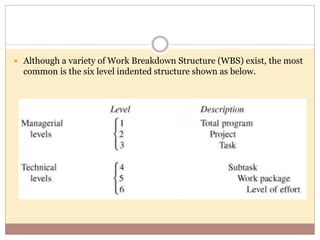
 Although a variety of Work Breakdown Structure (WBS) exist, the most
common is the six level indented structure shown as below.
 As the figure shows, Level 1 is the total program and is
composed of a set of projects. The summation of the
activities and costs associated with each project must
equal the total program.
 Each project, however, can be broken down into tasks,
where the summation of all tasks equals the summation
of all projects, which, in turn, comprises the total
program.
 The reason for this subdivision of effort is simply ease of
control. Program management therefore, becomes
synonymous with the integration of activities, and the
project manager acts as the integrator, using the work
breakdown structure as the common framework.
Wbs, gant charts
Wbs, gant charts

Wbs, gant charts

  • 1.
  • 2.
     it isa visual representation of the high-level deliverables broken down into manageable components.  A WBS is not a chart of the activities to complete the work—it is a breakdown of the deliverables.
  • 3.
     project managermust structure the work into small elements that are: • Manageable, in that specific authority and responsibility can be assigned • Independent, or with minimum interfacing with and dependence on other ongoing elements • Integratable so that the total package can be seen • Measurable in terms of progress
  • 4.
     The smallestelement in the WBS is called the work package.  The components in the WBS are typically mapped against a code of accounts, which is a tool to number and identify the elements within the WBS
  • 5.
     The componentsin the WBS should be included in a WBS dictionary.  A WBS dictionary is a reference tool to explain the WBS components, the nature of the work package, the assigned resources, and the time and billing estimates for each element.  The WBS also identifies the relationship between work packages. Finally, the WBS should be updated to reflect changes to the project scope.
  • 6.
     The followingare some essential elements you must know about the WBS:  It serves as a major component of the project scope baseline.  It’s one of the most important project management tools.  It serves as the foundation for planning, estimating, and project control.  It visualizes the entire project.  Work not included in the WBS is not part of the project.  It builds team consensus and buy-in to the project.  It serves as a control mechanism to keep the project on track.  It allows for accurate cost and time estimates.  It serves as a deterrent to scope change
  • 7.
     WBS isan input to the following five core processes  Cost estimating  Cost budgeting  Resource planning  Risk management planning  Activity definition
  • 8.
     After projectrequirements definition, the first major step in the planning process is the development of the Work Breakdown Structure (WBS).  A Work Breakdown Structure (WBS) is a product-oriented family tree subdivision of the hardware, services, and data required to produce the end product.  The Work Breakdown Structure (WBS) is structured in accordance with the way the work will be performed and reflects the way in which project costs and data will be summarized and eventually reported.  Preparation of the Work Breakdown Structure (WBS) also considers other areas that require structured data, such as scheduling, configuration management, contract funding, and technical performance parameters.
  • 9.
     It isthe single most important element because it provides a common framework from which: • Total program can be described as a summation of subdivided elements • Planning can be performed • Costs and budgets can be established • Time, cost, and performance can be tracked • Objectives can be linked to company resources in a logical manner • Schedules and status-reporting procedures can be established • Network construction and control planning can be initiated • Responsibility assignments for each element can be established
  • 10.
     Although avariety of Work Breakdown Structure (WBS) exist, the most common is the six level indented structure shown as below.
  • 11.
     As thefigure shows, Level 1 is the total program and is composed of a set of projects. The summation of the activities and costs associated with each project must equal the total program.  Each project, however, can be broken down into tasks, where the summation of all tasks equals the summation of all projects, which, in turn, comprises the total program.  The reason for this subdivision of effort is simply ease of control. Program management therefore, becomes synonymous with the integration of activities, and the project manager acts as the integrator, using the work breakdown structure as the common framework.