Planning and Implementing
Project
Dr. Parmeshwar Biradar
MBA (Finance, HR, Operations Management), SET, PhD (
Commerce and Management)
2
Planning and
Implementing Project
2.1 Planning a Project
2.2 Business Project Management Plan
2.3 Project Feasibility
2.4 Identifying and managing risk
2.5 Effective work schedule
2.6 Monitoring a Business Project
2.7 Managing Change
2.8 Addressing Problem
The planning
Planning
Planning
Planning : Bridges the gap from where we are to, where
we want to go
Planning
1.1.
A) Meaning:
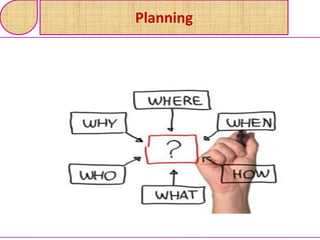
In simple words, planning is deciding in advance what is to be done, when, where, how
and by whom it is to be done.
Planning bridges the gap from where we are to, where we want to go.
It includes the selection of objectives, policies, procedures and programs from among
alternatives.
Planning
1.1.
B) Definitions:
Following are the definitions of the planning given by various authors:
1) Alford and Betty:
"Planning is the thinking process, the organised foresight, the vision based on fact and
experience that is required for intelligent action.“
2) Theo Haimann:
"Planning is deciding in advance what is to be done.
Planning
1.1.
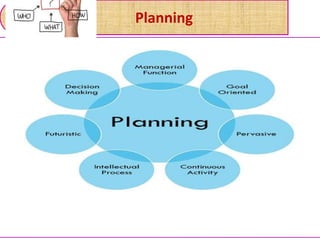
C) Characteristics / Nature / Features of Planning:
Planning is an
Intellectual
Process
Planning
Contributes to
the Objectives
Planning is a
Primary Function
of Management
It is a Continuous
Process
Pervasiveness of
Planning
Essentially a
Decision-making
Process
Integrated
Process
Selective Process Flexible
Formation of
Premises
Directed towards
Efficiency
Future Oriented Action Oriented
Inter-dependent
Process
Involves
Participation
Planning
1.1.
D) Objectives of Planning:
Planning
1.1.
E) Advantages of Planning:
Achievement of
Objectives
Elimination of
Uncertainty
Planning Promotes
Internal
Coordination
Optimum Utilisation
of Resources
Basis for Control
It Facilitates
Budgeting
Planning Ensures
Relatedness among
Decisions
Enables the
Identification of
Problems
Planning Reduces
Mistakes and
Oversights
Planning Helps
Company to Remain
More Competitive in
its Industry
Planning
1.1.
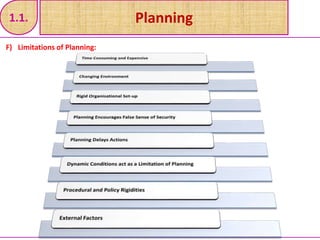
F) Limitations of Planning:
Planning
1.1.
G) Steps of Planning:
Providing Follow-up to the Proposed Course of Action
Timing and Sequence of Operation
Preparation of Derivative Plans
Evaluation of Alternatives and Selection of Courses of Action
Determination of Alternative Courses
Establishment of Planning Premises/ context
Determination of Objectives
Planning
1.1.
G) Steps of Planning:
Planning
1.1.
H) Methods of Planning:
Methods of Planning
Standing Plans
Objectives Policies Procedures Methods Rules
Single-use Plans
Budgets Programmes Strategies
Planning
1.1.
I) Essentials of Good Planning:
Objective
Clear,
Logical and
Simple
Controllable Flexible Stable
Complete
and
Integrated
Planning
1.1.
J) Obstacles in Planning:
Project Management Plan
• A project management plan is a formal
document that defines how a project is going to
be carried out.
• It outlines the
scope,
goals,
budget,
timeline,
deliverables of a project,
and it's essential for keeping a project on track.
Project Management plan
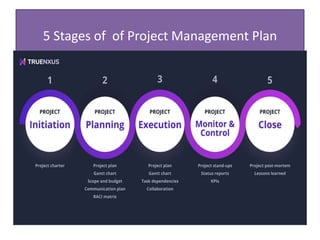
5 Stages of of Project Management Plan
Project feasibility
• Project feasibility is the study of a project's
various elements to determine if it has the
potential for success.
• Before a project begins, a company can
evaluate the project's feasibility to identify
obstacles, form strategies to overcome them
and ultimately attract investors
Types of Feasibility Study
• Technical Feasibility. This assessment focuses
on the technical resources available to the
organization. ...
• Economic Feasibility. ...
• Legal Feasibility. ...
• Operational Feasibility. ...
• Scheduling Feasibility.
1. Technical Feasibility
• This assessment focuses on the technical
resources available to the organization.
• It helps organizations determine whether the
technical resources meet capacity and whether
the technical team is capable of converting the
ideas into working systems.
• Technical feasibility also involves the evaluation
of the hardware, software, and other technical
requirements of the proposed system.
2. Economic Feasibility
• This assessment typically involves a cost/
benefits analysis of the project, helping
organizations determine the viability, cost, and
benefits associated with a project before
financial resources are allocated.
3. Legal Feasibility
• This assessment investigates whether any aspect of the
proposed project conflicts with legal requirements like
zoning laws, data protection acts or social media laws.
• Let’s say an organization wants to construct a new
office building in a specific location. A feasibility study
might reveal the organization’s ideal location isn’t
zoned for that type of business.
• That organization has just saved considerable time and
effort by learning that their project was not feasible
right from the beginning.
4. Operational Feasibility
• This assessment involves undertaking a study
to analyse and determine whether—and how
well—the organization’s needs can be met by
completing the project.
• Operational feasibility studies also examine
how a project plan satisfies the requirements
identified in the requirements analysis phase
of system development.
5. Scheduling Feasibility
• This assessment is the most important for
project success; after all, a project will fail if
not completed on time. In scheduling
feasibility, an organization estimates how
much time the project will take to complete.
Benefits of feasibility study
• The feasibility analysis helps identify any
constraints the proposed project may face,
including:
• Internal Project Constraints: Technical,
Technology, Budget, Resource, etc.
• Internal Corporate Constraints: Financial,
Marketing, Export, etc.
• External Constraints: Logistics, Environment,
Laws, and Regulations, etc.
Other benefits of conducting a feasibility study:
Improves project teams’ focus
Identifies new opportunities
Provides valuable information for a “go/no-go”
decision
Narrows the business alternatives
Identifies a valid reason to undertake the project
Enhances the success rate by evaluating multiple
parameters
Aids decision-making on the project
Identifies reasons not to proceed
Project Risk
• A project risk is an uncertain event that may
or may not occur during a project.
• Contrary to our everyday idea of what “risk”
means, a project risk could have either a
negative or a positive effect on progress
towards project objectives.
1. Technology Risk
• The tech aspect of a project poses a critical threat
to data security, organization services,
compliance and information security.
• Risks associated with technology are more
challenging because implementing new IT
programs often requires fresh personnel training
and software acquisition.
• There are also other technological-related risks
like service outages that might lead to delays and
project failure.
2. Communication risk
• Effective and timely communication is a
significant work ethic that you must strictly
observe when you are in charge of a project.
3. Scope creep risk
• Uncontrolled and unauthorized change to the
initial intended project scope may lead to the
extra cost of additional features, products or
functions.
• Almost all projects face this risk, and
sometimes it poses an irreversible challenge
because some of the added functions are
significant to the project and desirable to the
project's success.
4. Cost risk
• A shortage or mismanagement of project
funds resulting from an inflated budget or
other constraints is a threat to the project's
completion.
• When the project cost is higher than the
budgeted funds, the risk might shift to other
operations and workforce segments.
• The reduction of the funds may also
contribute to an occurrence of a scope risk.
5. Operational risk
• A project may stall or terminate if there is a poor
implementation of critical operations and core
processes such as production or procurement.
• The risks could result in a direct or indirect loss owing
to inadequacy or failed qualitative, quantitative or
strategies.
• Depending on the project type, operational risks are:
a) IT system risk
b) Human and process direct implementation risk
c) Human and process indirect implementation risk
d) Financial capacity risk
6.Health and safety risk
• Health and safety is a type of risk that can
compromise a company's compliance rules.
• An organization should have its health and safety
standards monitored and evaluated regularly to
identify potential risks that can lead the company
to losses or fines.
• The management is responsible for establishing
continuous health and safety risk monitoring in
the company premises and its products or
services.
7. Skills resource risk
• Leveraging on internal staff is a potentially high-
project risk because sometimes the project
activities are staggered in different waves at
various locations, requiring in-house personnel
attendance.
• The overlap of the waves becomes a potential
distress source.
• Staff incompetence in various project divisions is
another risk that may contribute to the additional
cost of personnel retraining or transfers.
8. Performance risk
• When a project is unlikely to achieve the
results as intended, there is a perceived
performance risk.
• The risk has an inherent impact on the overall
performance of the business.
• Such a problem may lead to the additional
need for financing, a likely penalty for non-
performance and it may also leverage the
competitors' performance.
9. Market risk
• When a project fails to meet the stated results,
market risk is likely to occur.
• Competitors might take the advantage to cripple
the business and eliminate it from the market.
• Another market risk could occur in commodity
and foreign market trades, which might not
favour the project's initial estimates.
• Liquidity, credit and fluctuation of interest rates
also pose as a potential market distracter to the
project's product sales.
10. External hazards risk
• A likely adverse event beyond the control of
the project management is a potential risk.
• Such risks manifest in various types and
forms, including terrorism, storms, floods,
vandalism, earthquakes and civil unrest.
• A project may stall or discontinue when such
events occur.
Project Schedule
• A project schedule is a timetable that shows
the start and end date of all project tasks,
how the tasks relate to each other and
usually which team members or other
resources are responsible for delivery. It is a
dynamic document that is created during
initial the planning stage
Types of project schedule
• Master project schedule: a summary level schedule
that highlights the key tasks and their estimated
duration. This is useful as a high-level overview
document for senior management or external
stakeholders who don’t need the detail.
• Milestone schedule: tracks major milestones but not
every task or deliverable. It’s great for reporting status
and helping teams see their progress at a glance.
• Detailed project schedule: this is a more operational
level schedule that tracks every project activity. It’s
designed for the project team and managers to keep
track of every element of the project.
The benefits of effective project scheduling
• Contributes heavily to project success
• Provides a clear roadmap to everyone at the
beginning of the project
• Manages stakeholder expectations
• Monitors and communicates project progress
• Ensures buy-in and accountability for tasks and
deadlines
• Lets the team know which tasks rely on others
• Reserves your resources for when you need them
Project scheduling tools and techniques
• Task list
• GANTT chart
• Work breakdown structure
• Schedule network analysis
• Critical path method
• PERT charts
Project Monitoring
• Project monitoring is the process of keeping a
close eye on the entire project management
life cycle and ensuring project activities are
on the right track.
Change Management
• Change management is a systematic approach
to dealing with the transition or
transformation of an organization's goals,
processes or technologies. The purpose of
change management is to implement
strategies for effecting change, controlling
change and helping people to adapt to
change.
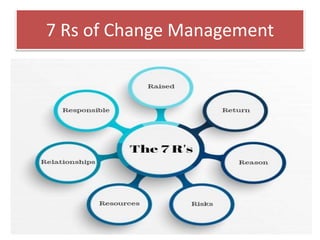
7 Rs of Change Management
1. Who raised the change?
2. What is the reason for the change?
3. What return is required from the change?
4. What are the risks involved in the change?
5. What resources are required to deliver the
change?
6. Who is responsible for the “build, test, and
implement” portion of the change?
7. What is the relationship between this change
and other changes?
Addressing a Problem

Planning and implementing project.pptx

  • 1.
    Planning and Implementing Project Dr.Parmeshwar Biradar MBA (Finance, HR, Operations Management), SET, PhD ( Commerce and Management)
  • 2.
    2 Planning and Implementing Project 2.1Planning a Project 2.2 Business Project Management Plan 2.3 Project Feasibility 2.4 Identifying and managing risk 2.5 Effective work schedule 2.6 Monitoring a Business Project 2.7 Managing Change 2.8 Addressing Problem
  • 3.
  • 4.
  • 5.
  • 6.
    Planning : Bridgesthe gap from where we are to, where we want to go
  • 7.
    Planning 1.1. A) Meaning: In simplewords, planning is deciding in advance what is to be done, when, where, how and by whom it is to be done. Planning bridges the gap from where we are to, where we want to go. It includes the selection of objectives, policies, procedures and programs from among alternatives.
  • 8.
    Planning 1.1. B) Definitions: Following arethe definitions of the planning given by various authors: 1) Alford and Betty: "Planning is the thinking process, the organised foresight, the vision based on fact and experience that is required for intelligent action.“ 2) Theo Haimann: "Planning is deciding in advance what is to be done.
  • 9.
    Planning 1.1. C) Characteristics /Nature / Features of Planning: Planning is an Intellectual Process Planning Contributes to the Objectives Planning is a Primary Function of Management It is a Continuous Process Pervasiveness of Planning Essentially a Decision-making Process Integrated Process Selective Process Flexible Formation of Premises Directed towards Efficiency Future Oriented Action Oriented Inter-dependent Process Involves Participation
  • 10.
  • 11.
    Planning 1.1. E) Advantages ofPlanning: Achievement of Objectives Elimination of Uncertainty Planning Promotes Internal Coordination Optimum Utilisation of Resources Basis for Control It Facilitates Budgeting Planning Ensures Relatedness among Decisions Enables the Identification of Problems Planning Reduces Mistakes and Oversights Planning Helps Company to Remain More Competitive in its Industry
  • 12.
  • 13.
    Planning 1.1. G) Steps ofPlanning: Providing Follow-up to the Proposed Course of Action Timing and Sequence of Operation Preparation of Derivative Plans Evaluation of Alternatives and Selection of Courses of Action Determination of Alternative Courses Establishment of Planning Premises/ context Determination of Objectives
  • 14.
  • 15.
    Planning 1.1. H) Methods ofPlanning: Methods of Planning Standing Plans Objectives Policies Procedures Methods Rules Single-use Plans Budgets Programmes Strategies
  • 16.
    Planning 1.1. I) Essentials ofGood Planning: Objective Clear, Logical and Simple Controllable Flexible Stable Complete and Integrated
  • 17.
  • 18.
    Project Management Plan •A project management plan is a formal document that defines how a project is going to be carried out. • It outlines the scope, goals, budget, timeline, deliverables of a project, and it's essential for keeping a project on track.
  • 19.
  • 20.
    5 Stages ofof Project Management Plan
  • 21.
    Project feasibility • Projectfeasibility is the study of a project's various elements to determine if it has the potential for success. • Before a project begins, a company can evaluate the project's feasibility to identify obstacles, form strategies to overcome them and ultimately attract investors
  • 22.
    Types of FeasibilityStudy • Technical Feasibility. This assessment focuses on the technical resources available to the organization. ... • Economic Feasibility. ... • Legal Feasibility. ... • Operational Feasibility. ... • Scheduling Feasibility.
  • 24.
    1. Technical Feasibility •This assessment focuses on the technical resources available to the organization. • It helps organizations determine whether the technical resources meet capacity and whether the technical team is capable of converting the ideas into working systems. • Technical feasibility also involves the evaluation of the hardware, software, and other technical requirements of the proposed system.
  • 25.
    2. Economic Feasibility •This assessment typically involves a cost/ benefits analysis of the project, helping organizations determine the viability, cost, and benefits associated with a project before financial resources are allocated.
  • 26.
    3. Legal Feasibility •This assessment investigates whether any aspect of the proposed project conflicts with legal requirements like zoning laws, data protection acts or social media laws. • Let’s say an organization wants to construct a new office building in a specific location. A feasibility study might reveal the organization’s ideal location isn’t zoned for that type of business. • That organization has just saved considerable time and effort by learning that their project was not feasible right from the beginning.
  • 27.
    4. Operational Feasibility •This assessment involves undertaking a study to analyse and determine whether—and how well—the organization’s needs can be met by completing the project. • Operational feasibility studies also examine how a project plan satisfies the requirements identified in the requirements analysis phase of system development.
  • 28.
    5. Scheduling Feasibility •This assessment is the most important for project success; after all, a project will fail if not completed on time. In scheduling feasibility, an organization estimates how much time the project will take to complete.
  • 29.
    Benefits of feasibilitystudy • The feasibility analysis helps identify any constraints the proposed project may face, including: • Internal Project Constraints: Technical, Technology, Budget, Resource, etc. • Internal Corporate Constraints: Financial, Marketing, Export, etc. • External Constraints: Logistics, Environment, Laws, and Regulations, etc.
  • 30.
    Other benefits ofconducting a feasibility study: Improves project teams’ focus Identifies new opportunities Provides valuable information for a “go/no-go” decision Narrows the business alternatives Identifies a valid reason to undertake the project Enhances the success rate by evaluating multiple parameters Aids decision-making on the project Identifies reasons not to proceed
  • 31.
    Project Risk • Aproject risk is an uncertain event that may or may not occur during a project. • Contrary to our everyday idea of what “risk” means, a project risk could have either a negative or a positive effect on progress towards project objectives.
  • 32.
    1. Technology Risk •The tech aspect of a project poses a critical threat to data security, organization services, compliance and information security. • Risks associated with technology are more challenging because implementing new IT programs often requires fresh personnel training and software acquisition. • There are also other technological-related risks like service outages that might lead to delays and project failure.
  • 33.
    2. Communication risk •Effective and timely communication is a significant work ethic that you must strictly observe when you are in charge of a project.
  • 34.
    3. Scope creeprisk • Uncontrolled and unauthorized change to the initial intended project scope may lead to the extra cost of additional features, products or functions. • Almost all projects face this risk, and sometimes it poses an irreversible challenge because some of the added functions are significant to the project and desirable to the project's success.
  • 35.
    4. Cost risk •A shortage or mismanagement of project funds resulting from an inflated budget or other constraints is a threat to the project's completion. • When the project cost is higher than the budgeted funds, the risk might shift to other operations and workforce segments. • The reduction of the funds may also contribute to an occurrence of a scope risk.
  • 36.
    5. Operational risk •A project may stall or terminate if there is a poor implementation of critical operations and core processes such as production or procurement. • The risks could result in a direct or indirect loss owing to inadequacy or failed qualitative, quantitative or strategies. • Depending on the project type, operational risks are: a) IT system risk b) Human and process direct implementation risk c) Human and process indirect implementation risk d) Financial capacity risk
  • 37.
    6.Health and safetyrisk • Health and safety is a type of risk that can compromise a company's compliance rules. • An organization should have its health and safety standards monitored and evaluated regularly to identify potential risks that can lead the company to losses or fines. • The management is responsible for establishing continuous health and safety risk monitoring in the company premises and its products or services.
  • 38.
    7. Skills resourcerisk • Leveraging on internal staff is a potentially high- project risk because sometimes the project activities are staggered in different waves at various locations, requiring in-house personnel attendance. • The overlap of the waves becomes a potential distress source. • Staff incompetence in various project divisions is another risk that may contribute to the additional cost of personnel retraining or transfers.
  • 39.
    8. Performance risk •When a project is unlikely to achieve the results as intended, there is a perceived performance risk. • The risk has an inherent impact on the overall performance of the business. • Such a problem may lead to the additional need for financing, a likely penalty for non- performance and it may also leverage the competitors' performance.
  • 40.
    9. Market risk •When a project fails to meet the stated results, market risk is likely to occur. • Competitors might take the advantage to cripple the business and eliminate it from the market. • Another market risk could occur in commodity and foreign market trades, which might not favour the project's initial estimates. • Liquidity, credit and fluctuation of interest rates also pose as a potential market distracter to the project's product sales.
  • 41.
    10. External hazardsrisk • A likely adverse event beyond the control of the project management is a potential risk. • Such risks manifest in various types and forms, including terrorism, storms, floods, vandalism, earthquakes and civil unrest. • A project may stall or discontinue when such events occur.
  • 42.
    Project Schedule • Aproject schedule is a timetable that shows the start and end date of all project tasks, how the tasks relate to each other and usually which team members or other resources are responsible for delivery. It is a dynamic document that is created during initial the planning stage
  • 45.
    Types of projectschedule • Master project schedule: a summary level schedule that highlights the key tasks and their estimated duration. This is useful as a high-level overview document for senior management or external stakeholders who don’t need the detail. • Milestone schedule: tracks major milestones but not every task or deliverable. It’s great for reporting status and helping teams see their progress at a glance. • Detailed project schedule: this is a more operational level schedule that tracks every project activity. It’s designed for the project team and managers to keep track of every element of the project.
  • 46.
    The benefits ofeffective project scheduling • Contributes heavily to project success • Provides a clear roadmap to everyone at the beginning of the project • Manages stakeholder expectations • Monitors and communicates project progress • Ensures buy-in and accountability for tasks and deadlines • Lets the team know which tasks rely on others • Reserves your resources for when you need them
  • 47.
    Project scheduling toolsand techniques • Task list • GANTT chart • Work breakdown structure • Schedule network analysis • Critical path method • PERT charts
  • 54.
    Project Monitoring • Projectmonitoring is the process of keeping a close eye on the entire project management life cycle and ensuring project activities are on the right track.
  • 56.
    Change Management • Changemanagement is a systematic approach to dealing with the transition or transformation of an organization's goals, processes or technologies. The purpose of change management is to implement strategies for effecting change, controlling change and helping people to adapt to change.
  • 57.
    7 Rs ofChange Management
  • 58.
    7 Rs ofChange Management 1. Who raised the change? 2. What is the reason for the change? 3. What return is required from the change? 4. What are the risks involved in the change? 5. What resources are required to deliver the change? 6. Who is responsible for the “build, test, and implement” portion of the change? 7. What is the relationship between this change and other changes?
  • 59.