Unit-2
Project Identification,
Selection & Planning
Presented By:
Snehal D.Shipne
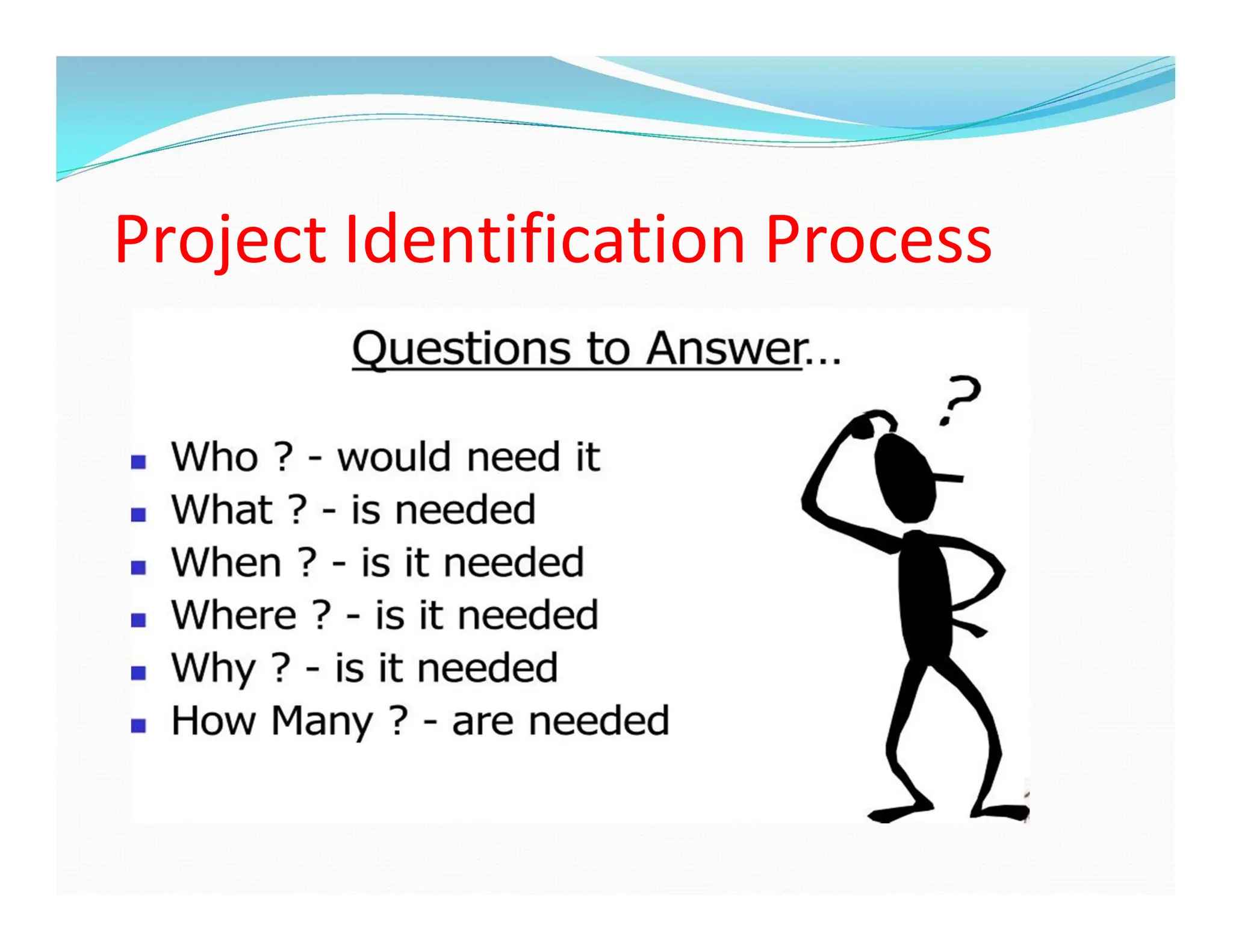
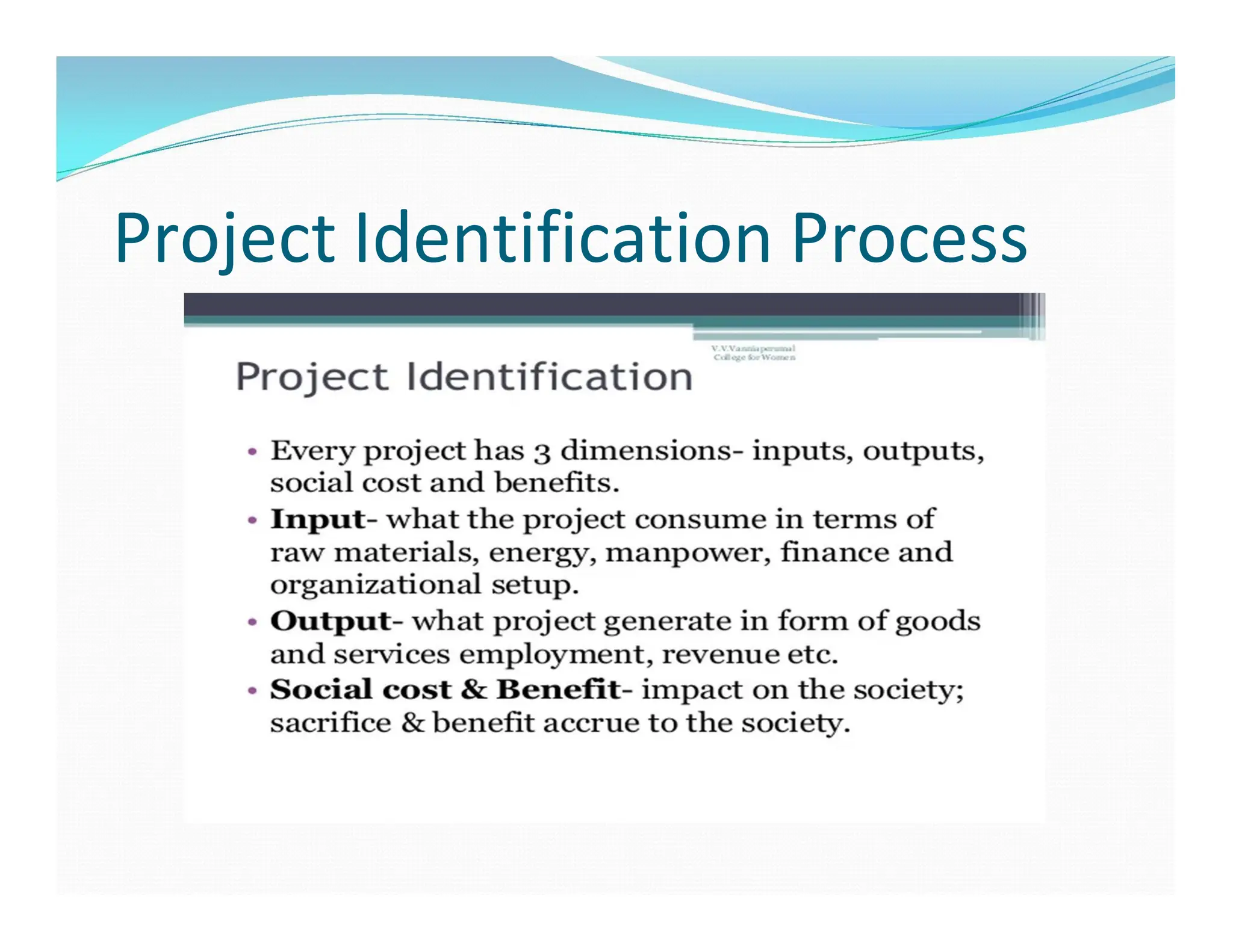
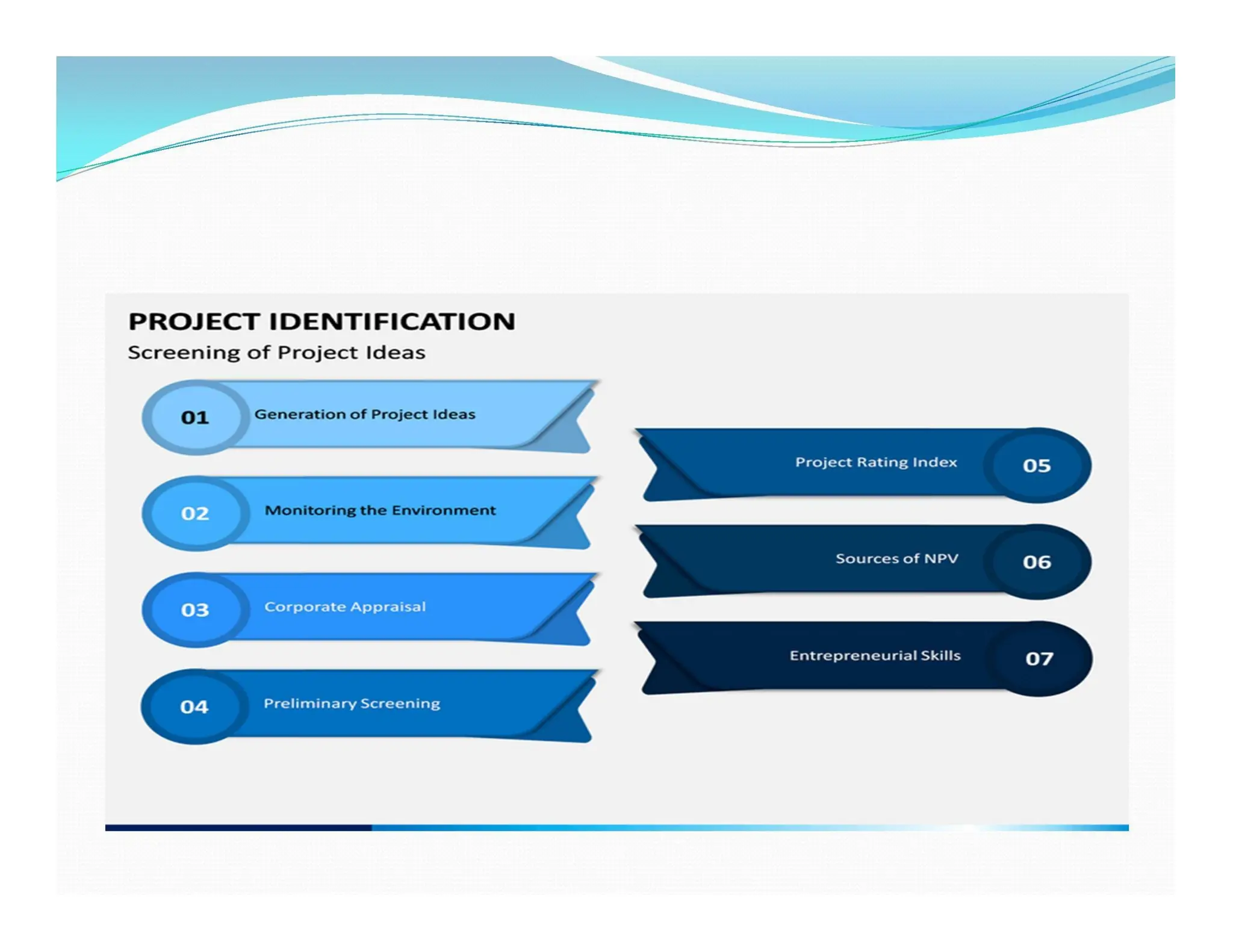
Project Identification Process
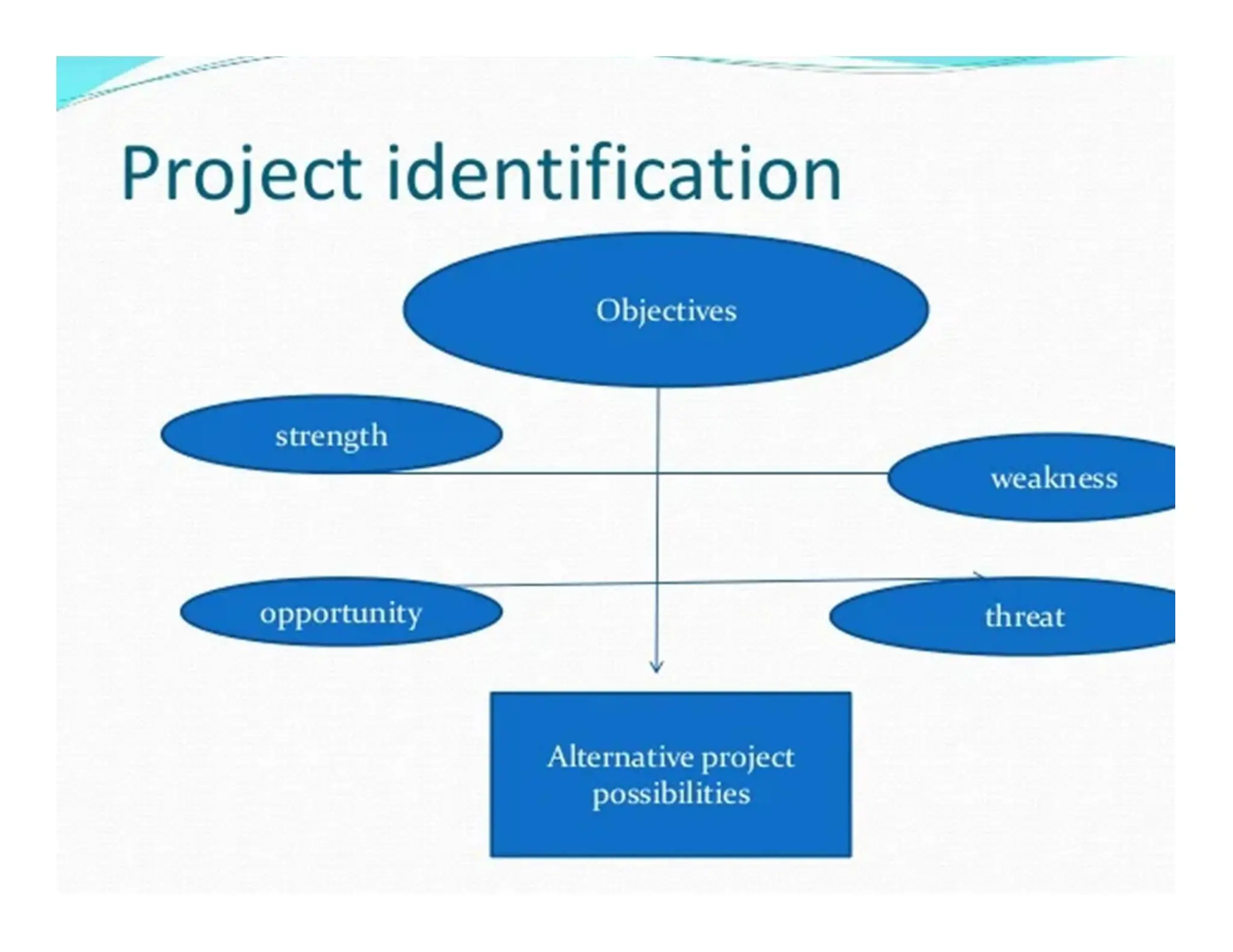
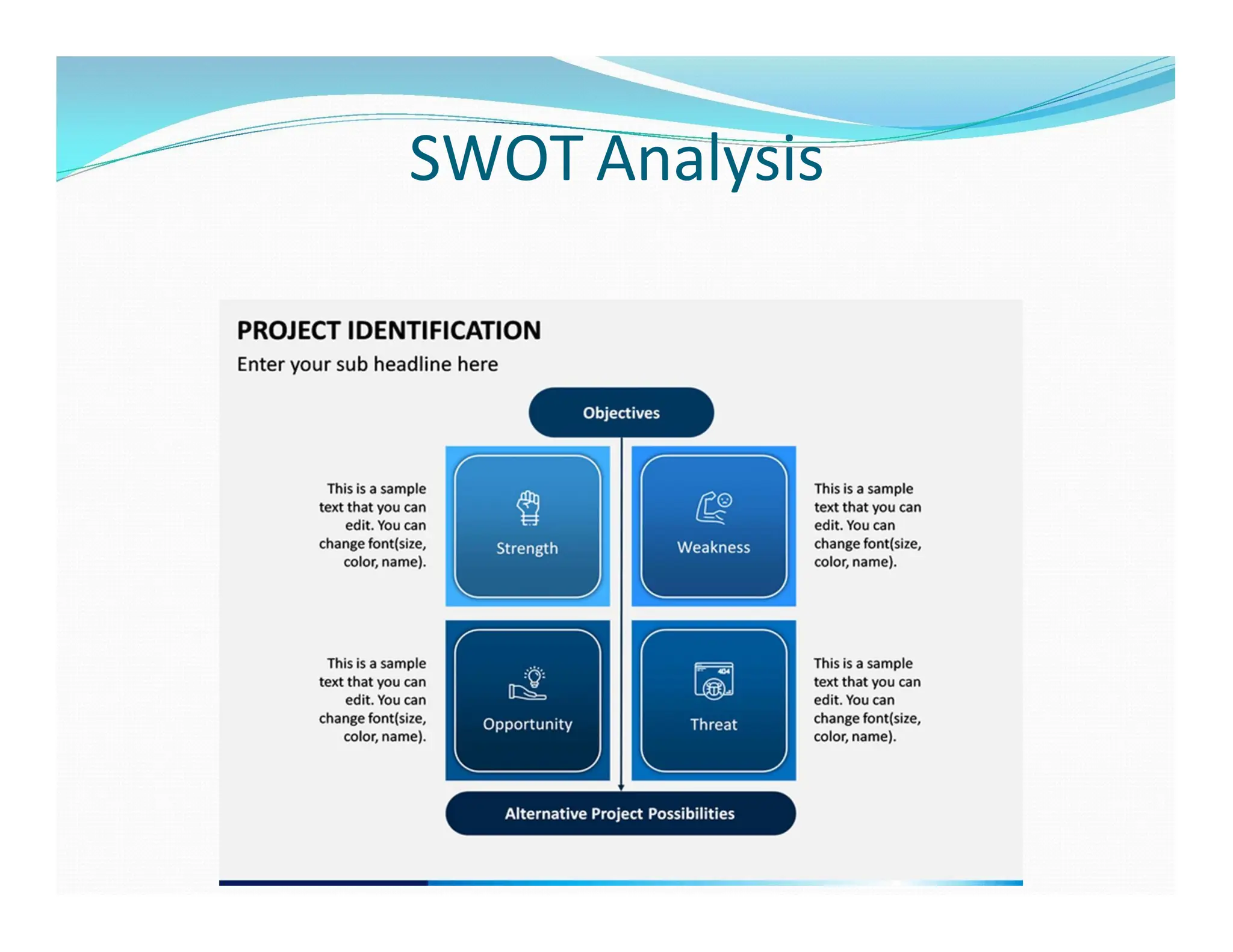
SWOT Analysis
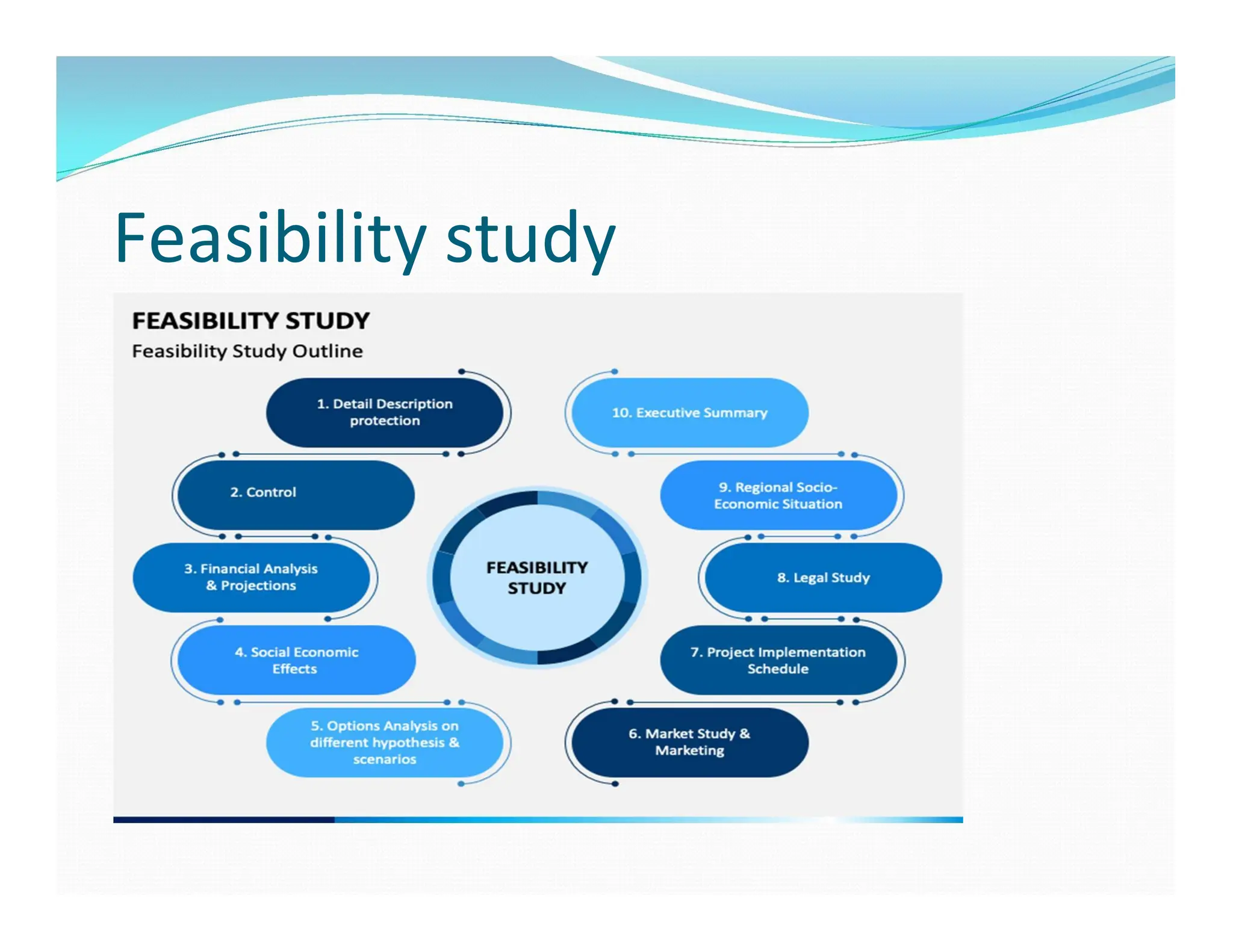
Feasibility study
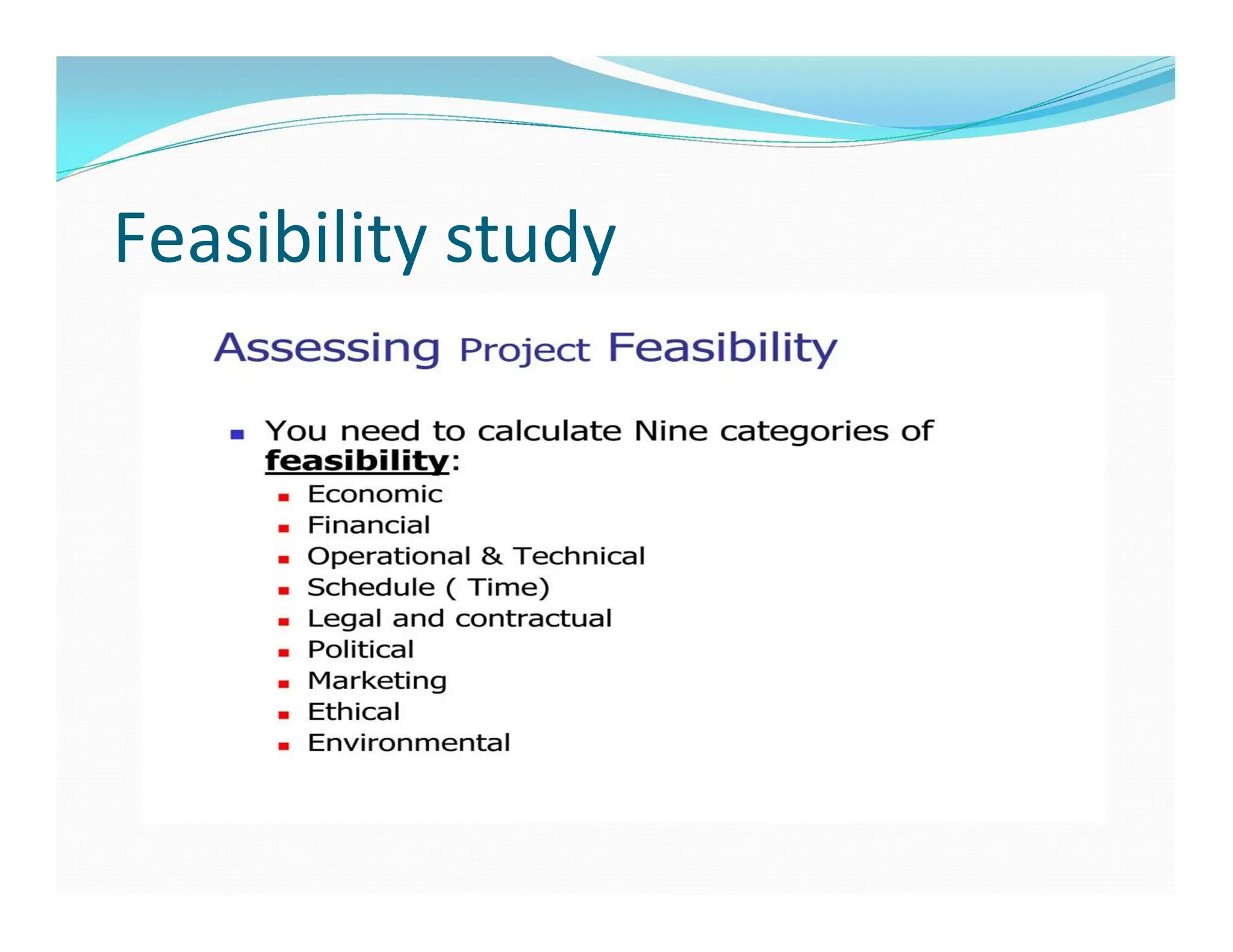
Feasibility study
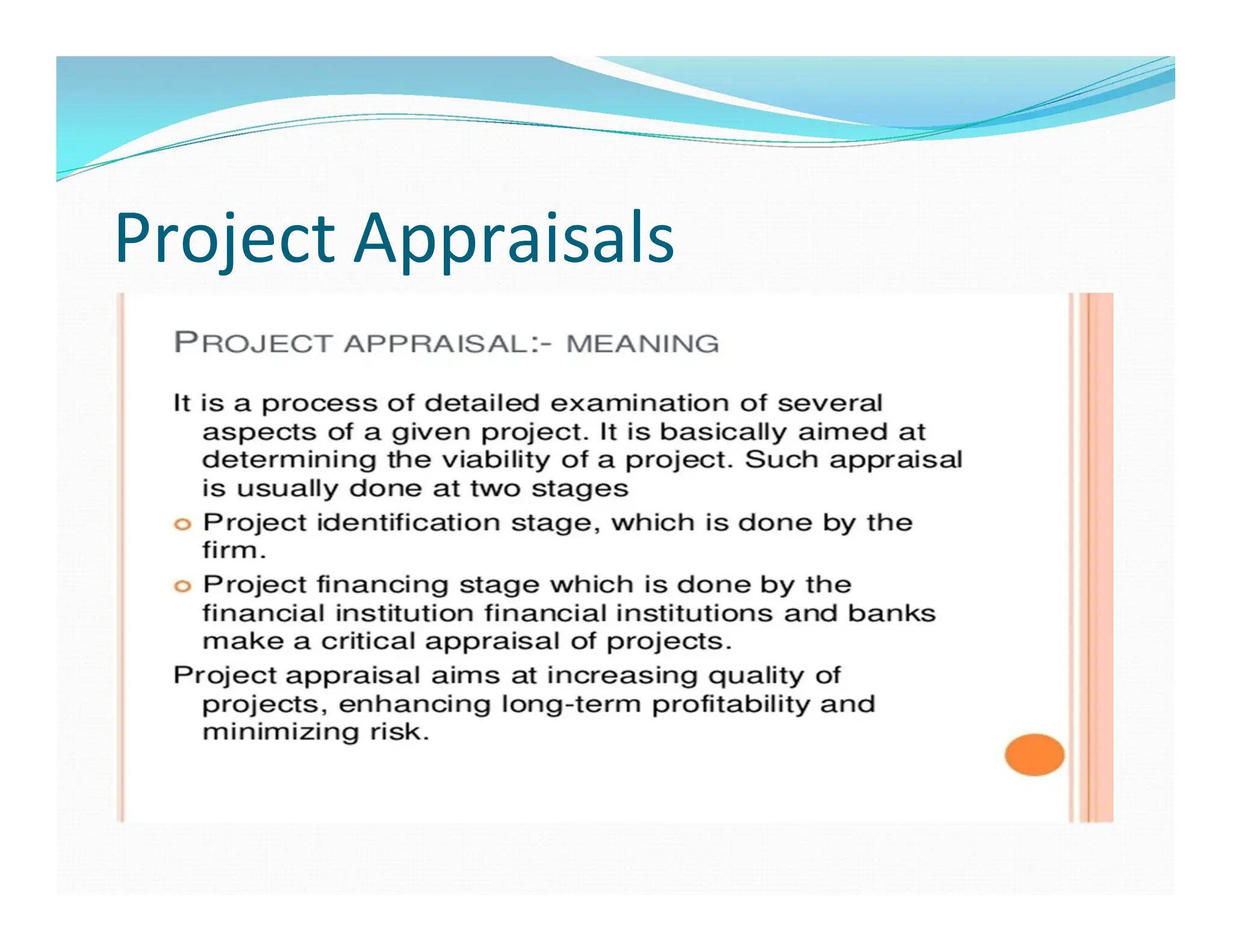
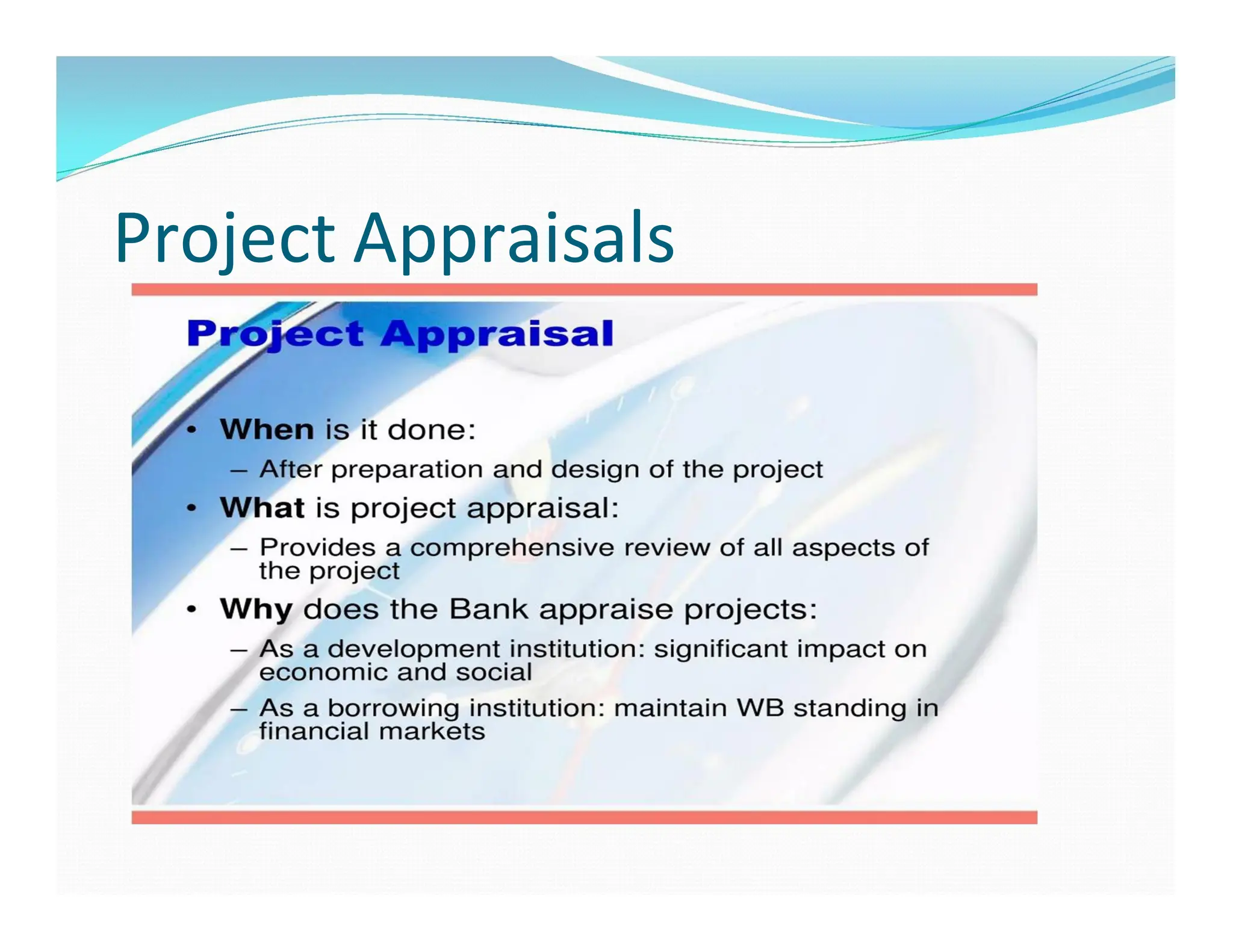
Project Appraisals
Project Appraisals
Project Appraisals
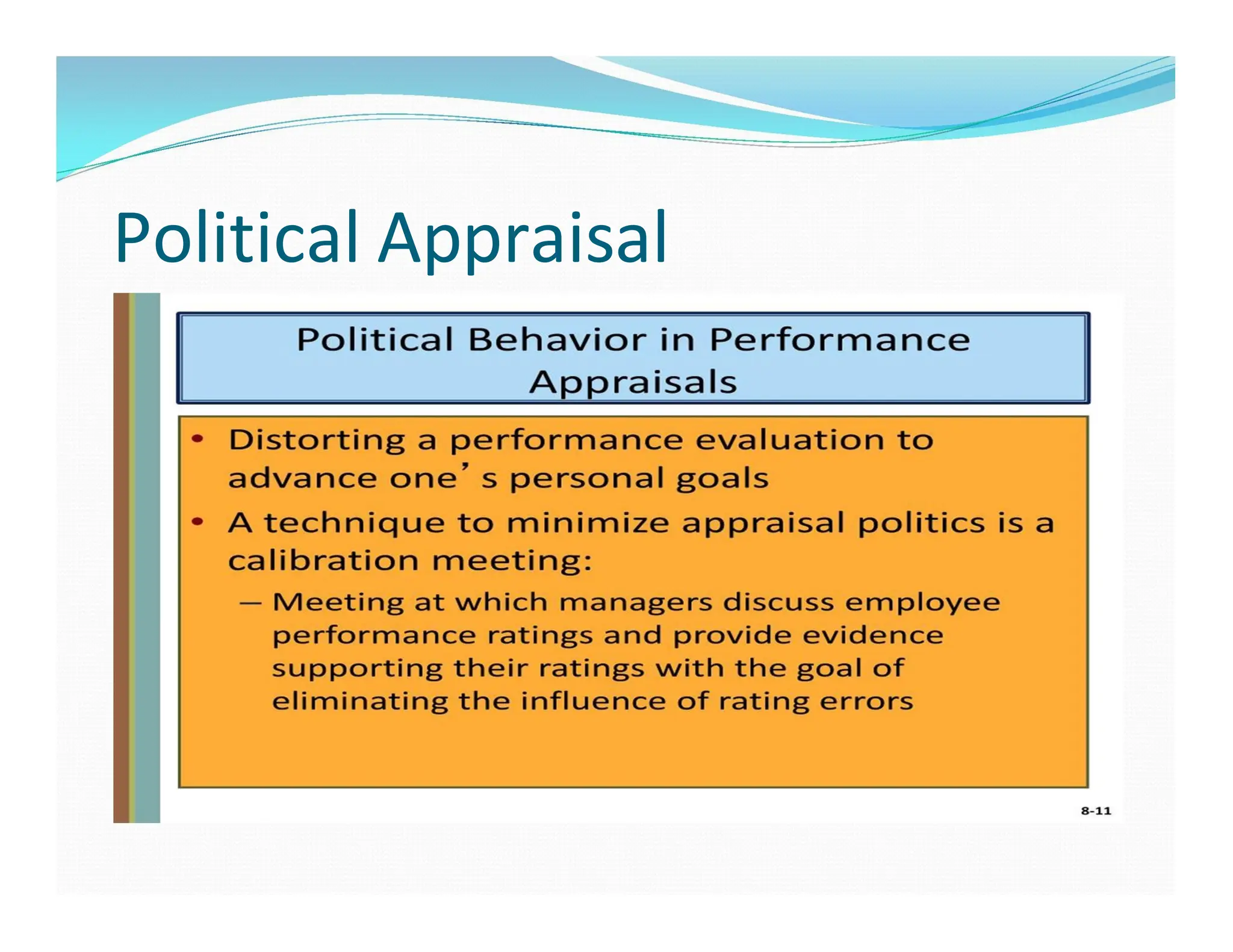
Political Appraisal
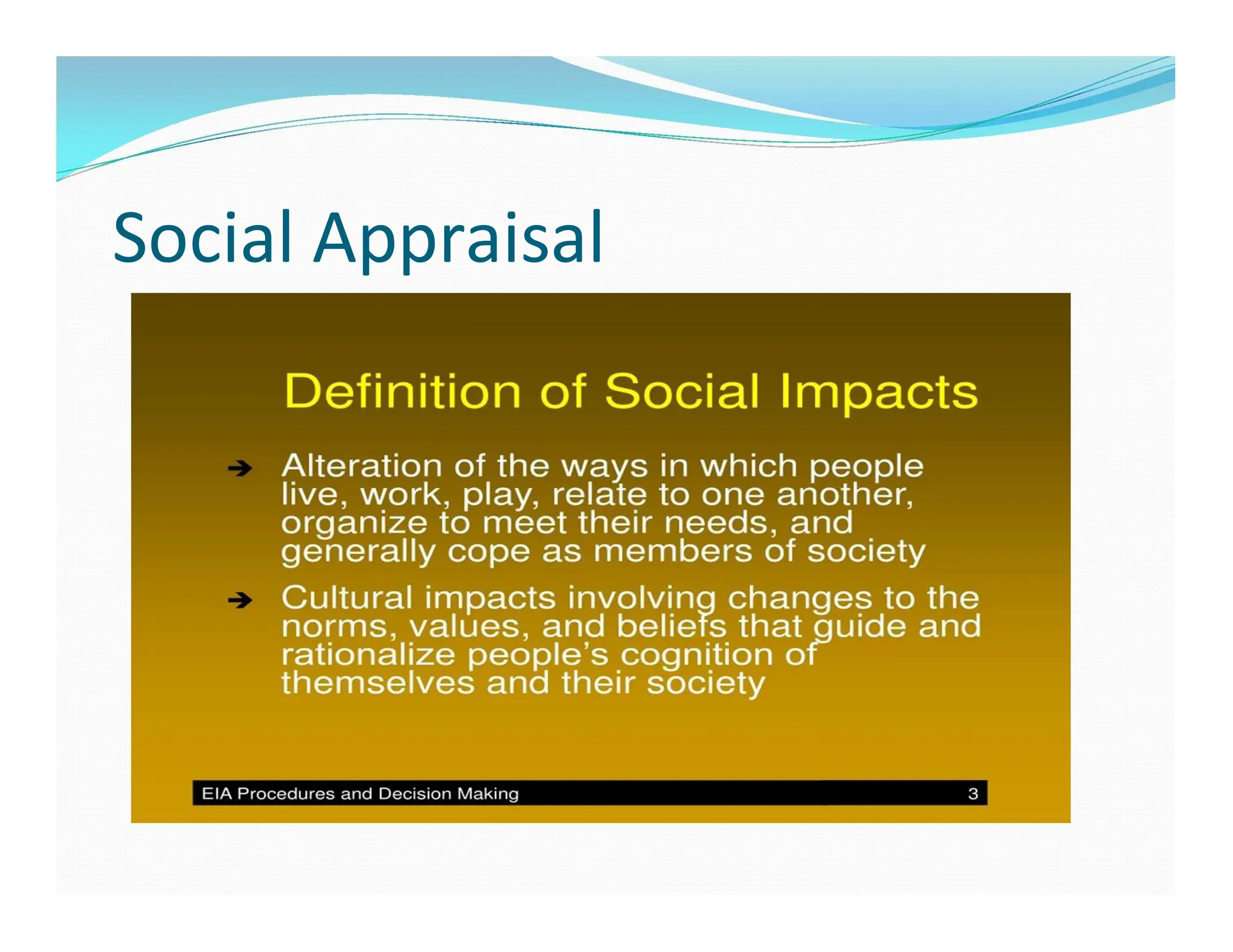
Social Appraisal
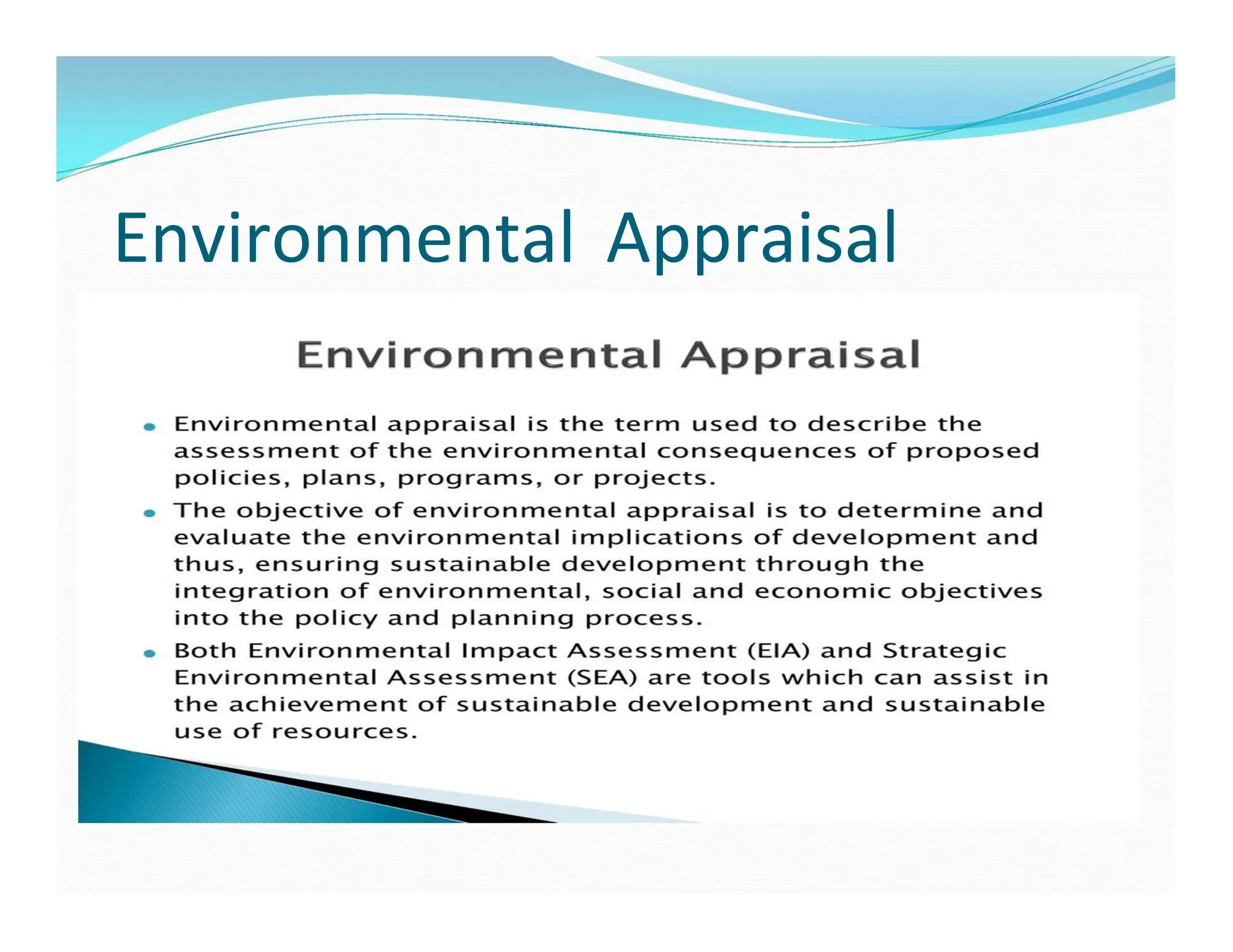
Environmental Appraisal
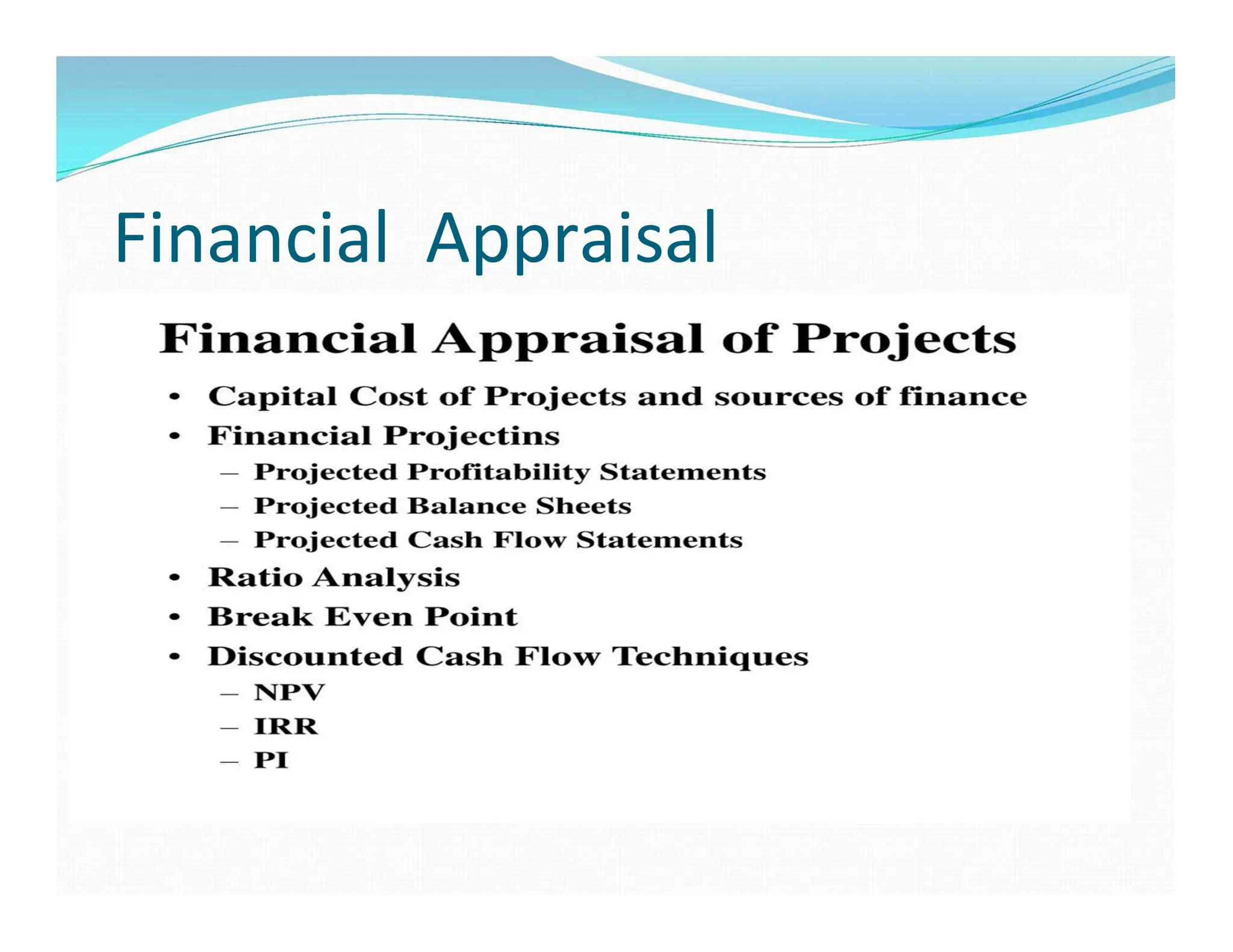
Financial Appraisal
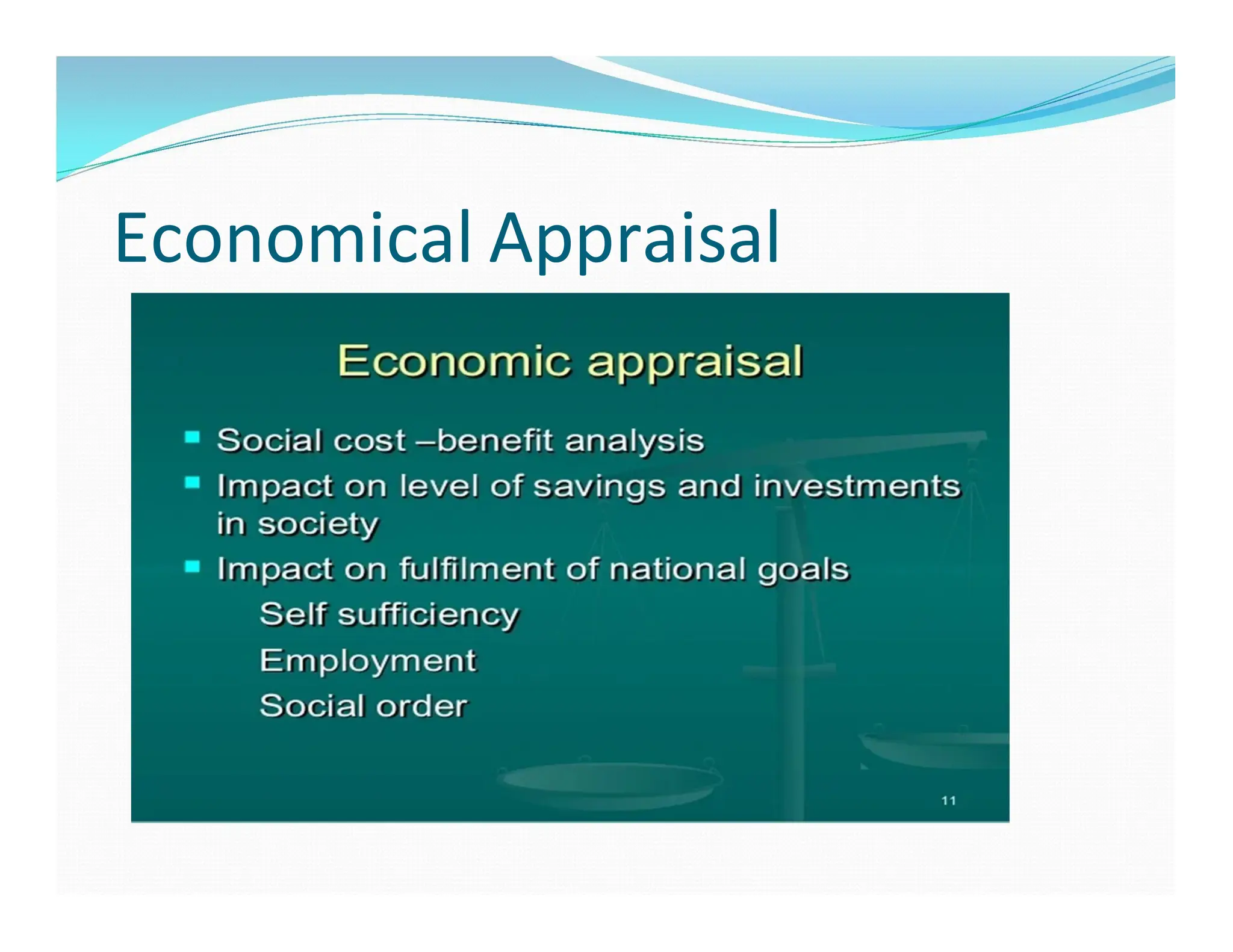
Economical Appraisal
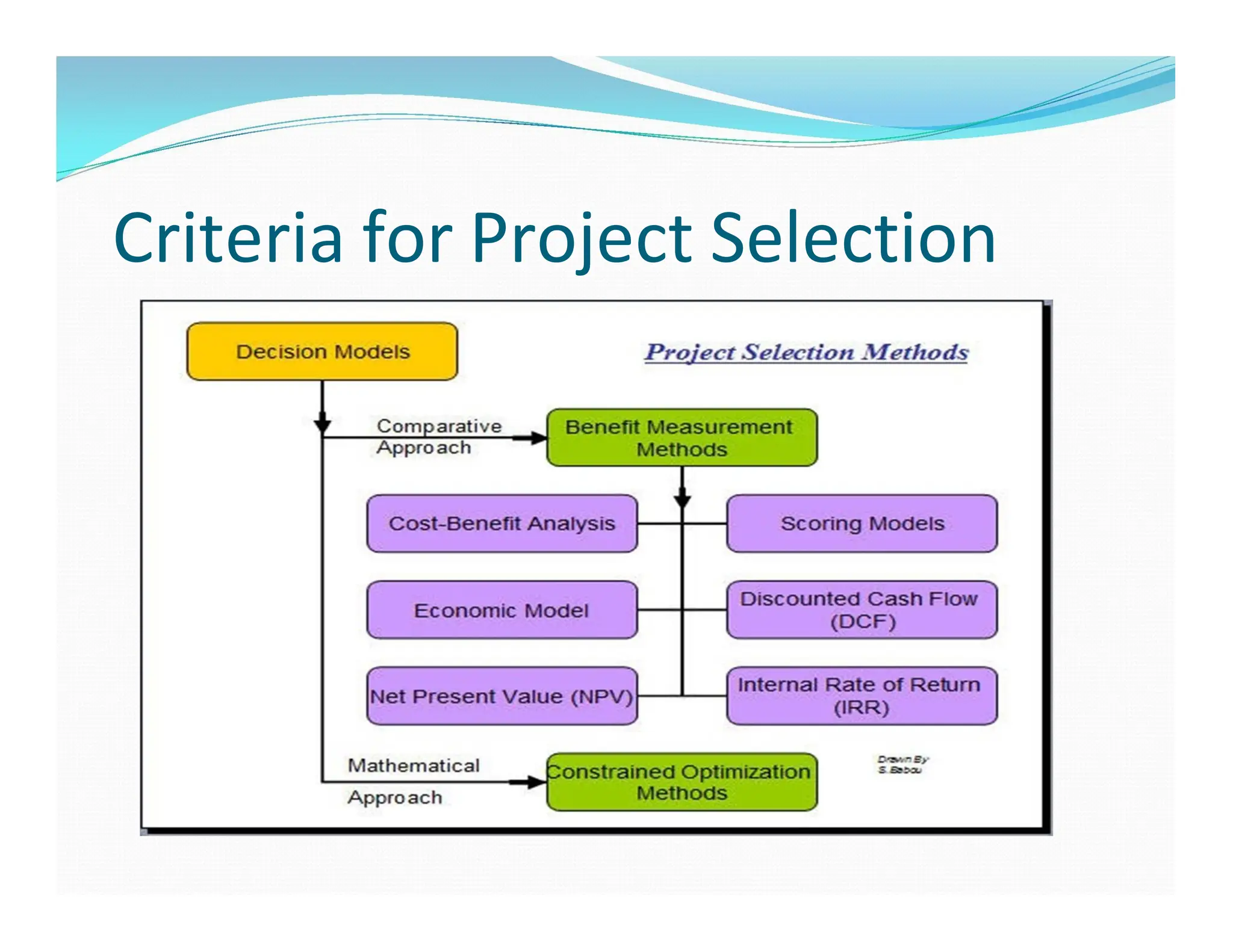
Criteria for Project Selection
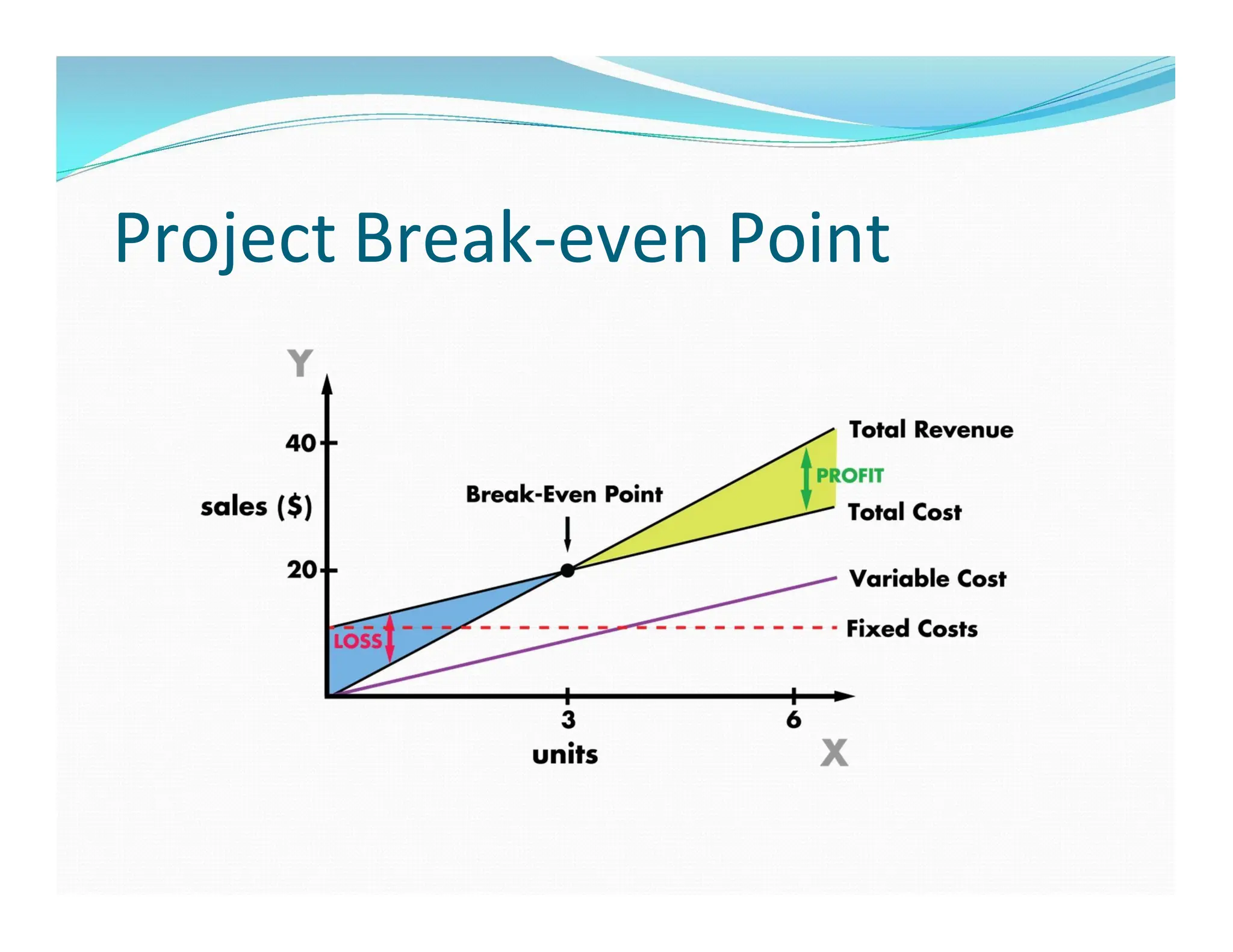
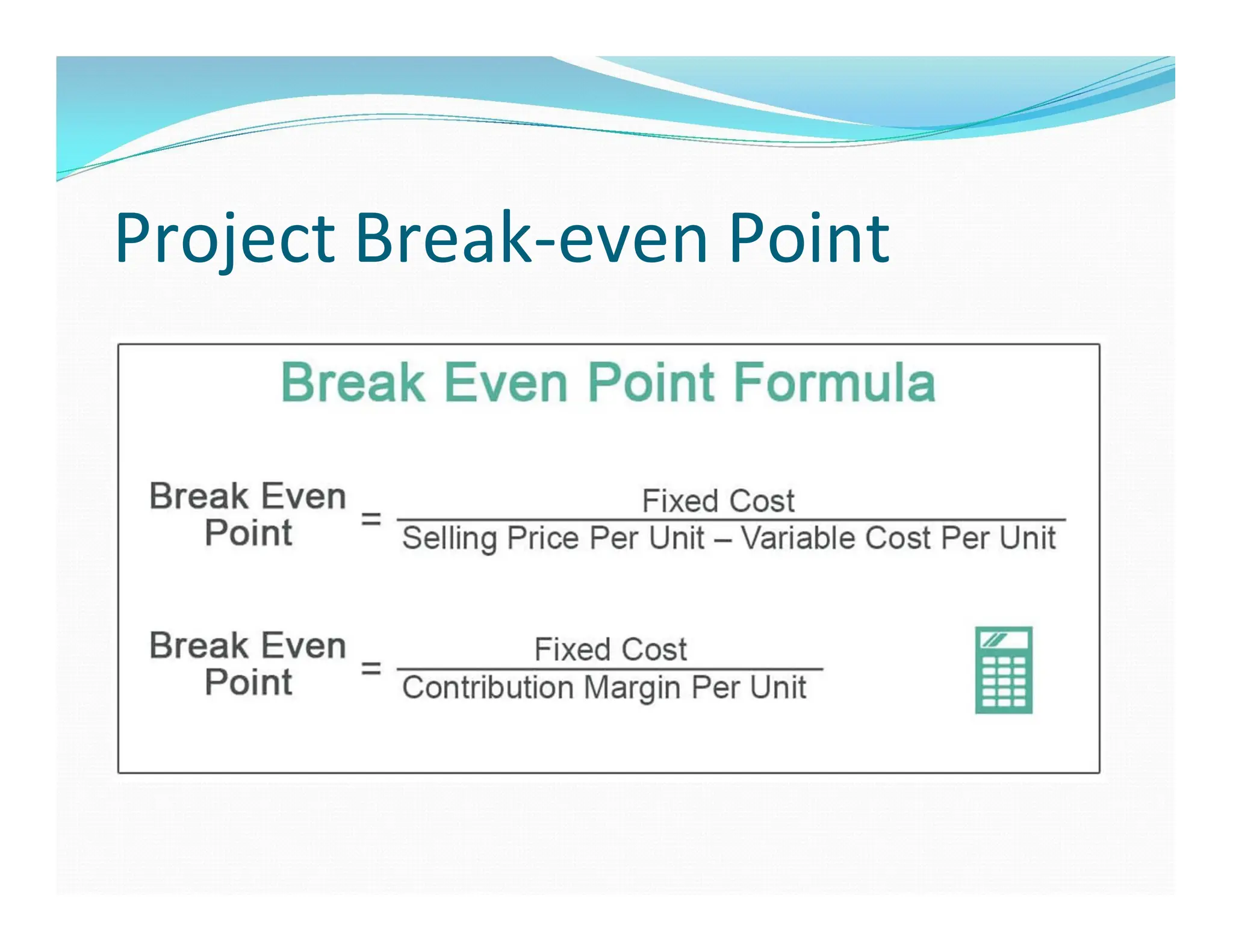
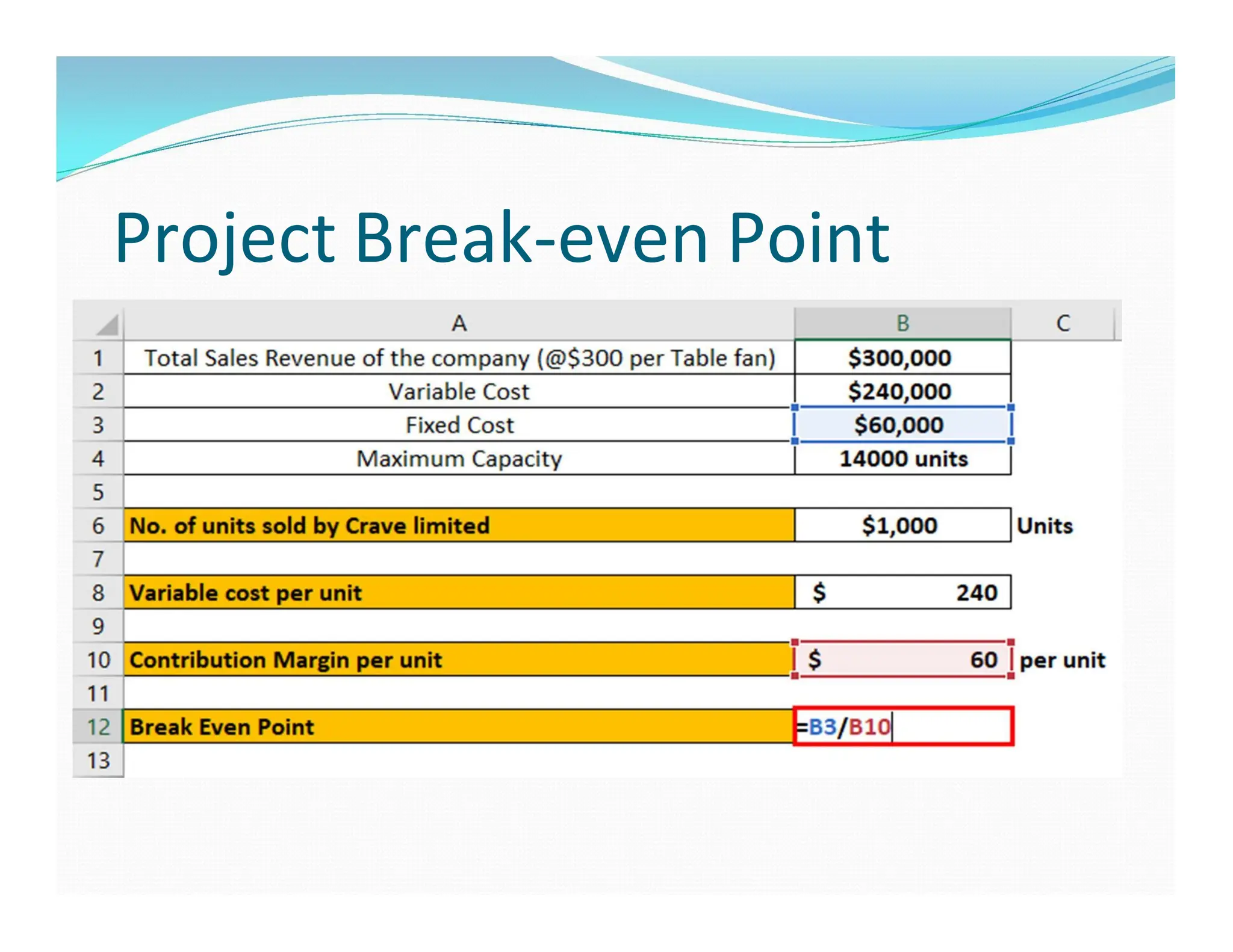
Project Break-even Point
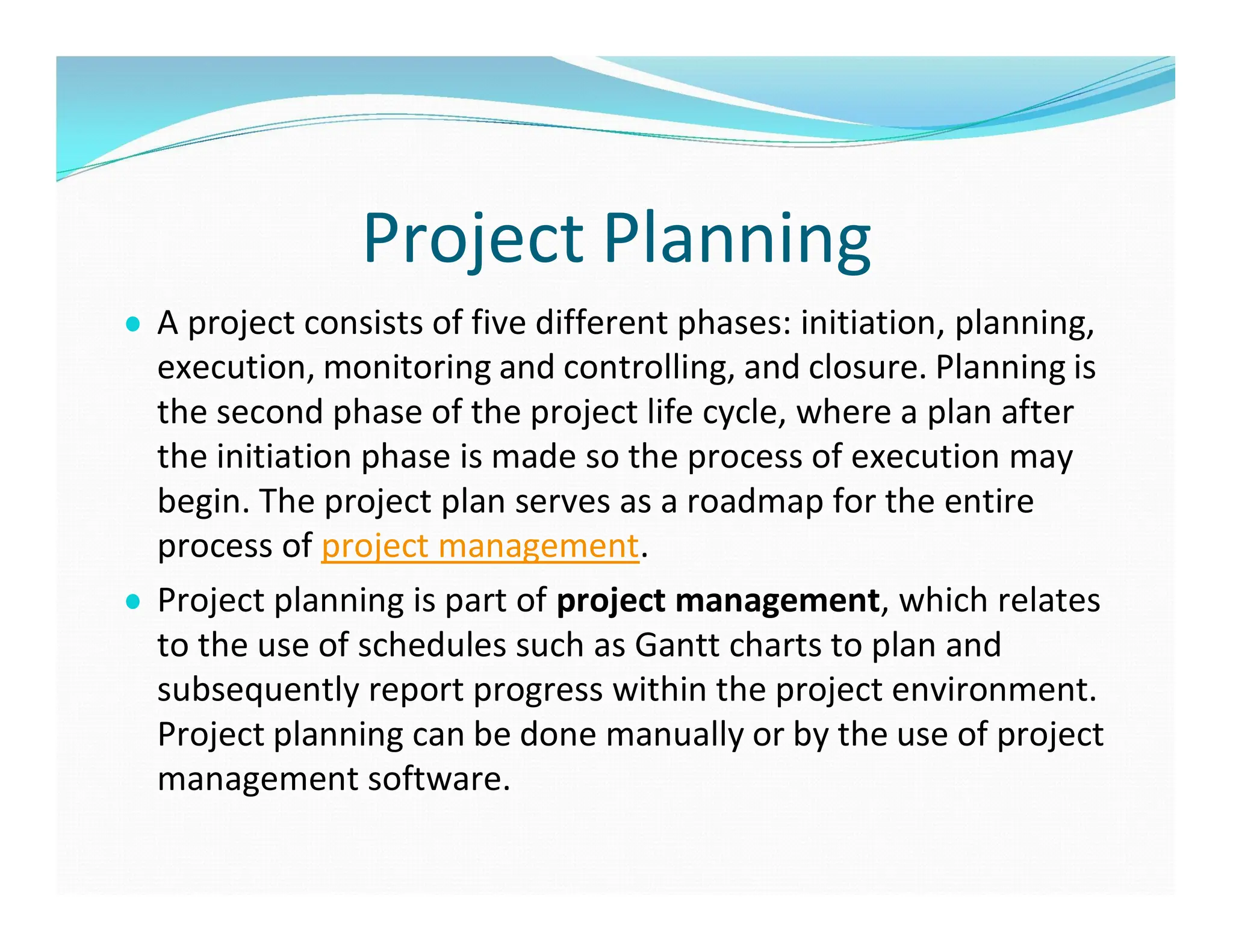
Project Planning
● A project consists of five different phases: initiation, planning,
execution, monitoring and controlling, and closure. Planning is
the second phase of the project life cycle, where a plan after
the initiation phase is made so the process of execution may
begin. The project plan serves as a roadmap for the entire
process of project management.
● Project planning is part of project management, which relates
to the use of schedules such as Gantt charts to plan and
subsequently report progress within the project environment.
Project planning can be done manually or by the use of project
management software.
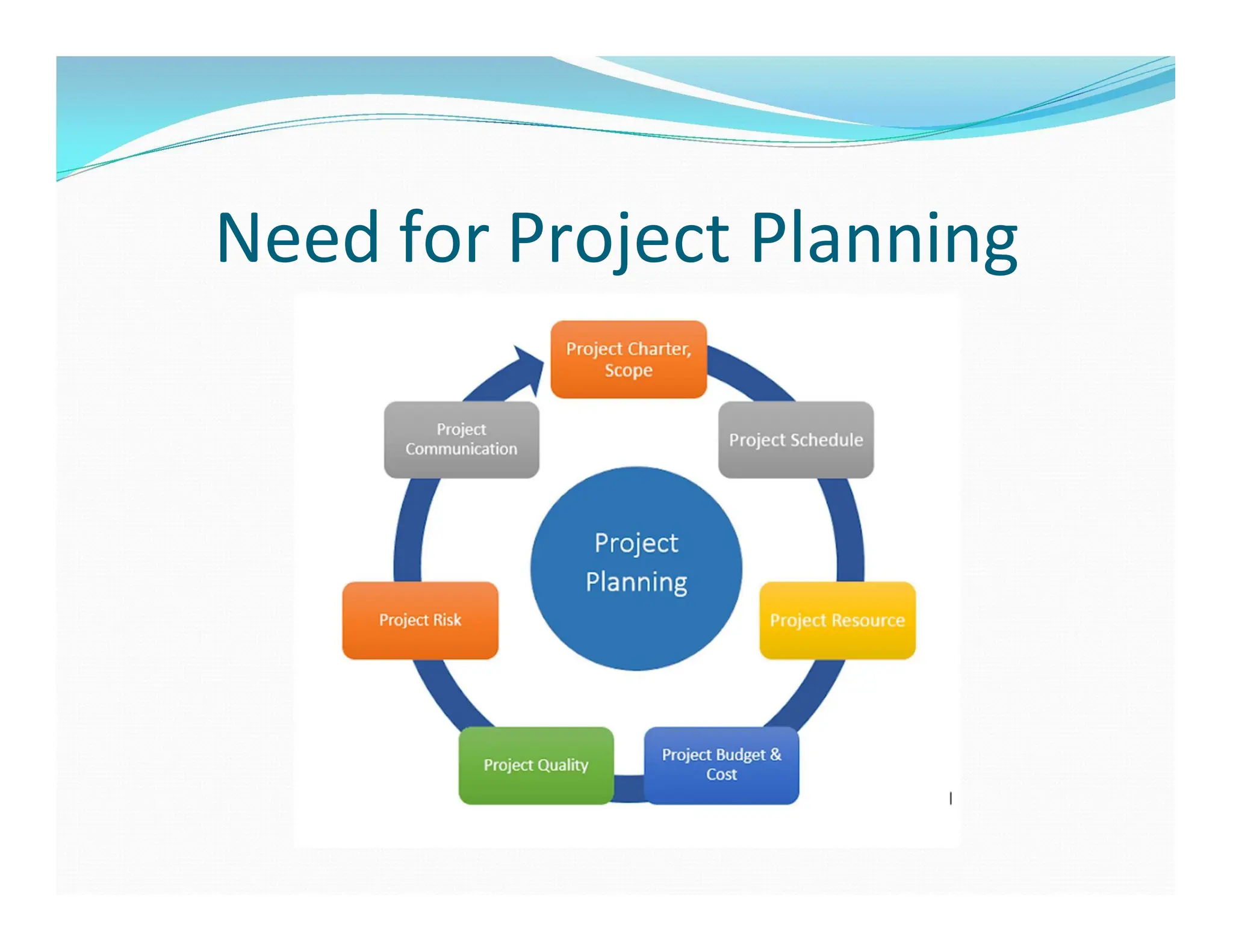
Need for Project Planning
● 1. Planning helps you set appropriate goals
● 2. Planning breaks a problem or goal into smaller pieces
● 3. Planning reveals weaknesses (and strengths)
● 4. Planning increases certainty and confidence
● 5. Planning increases efficiency
● 6. Planning reduces risk
● 7. Planning increases your credibility
● 8. Planning encourages creativity
● 9. Planning improves decision-making
● 10. Planning equals more peace of mind
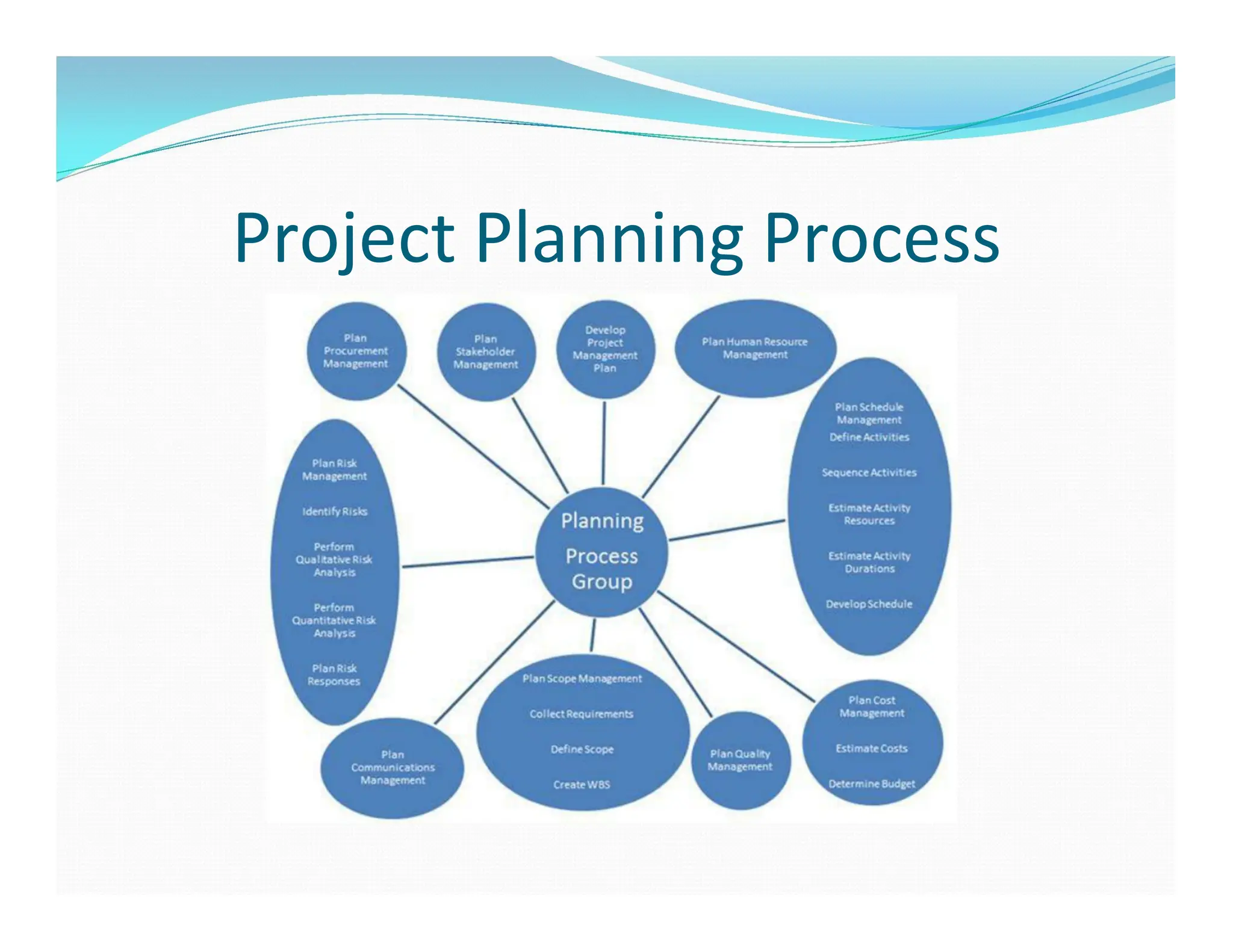
Project Planning Process
● 1. Determine the project goals and objectives:-The first step in the project
planning phase is to define the goals and objectives of your project.
● 2. Determine the project scope:- Your project scope protects you from
unrealistic expectations, conflicting interests, and unattainable demands as
the project progresses. To determine your scope, look at your project goals
and objectives. What do you need to do to achieve them? What isn’t
necessary? For example, the scope of a new housing project may be
limited to erecting and finishing the building but might not include
landscaping or the construction of an outdoor pool.
● 3. Build your work breakdown structure (WBS)
● At this stage, start determining which tasks, subtasks, and deliverables
must be carried out to complete the project. You can do this by referring to
your scope and creating a work breakdown structure—a structured
decomposition of tasks needed to complete a project.
Project Planning Process
● 4. Set timelines :-Set milestones for project phases: An example of
a milestone could be that 2 months from the start date, the engineers
will have completed their work on the backend of the e-commerce site.
● Be conscious of time constraints: Your timeline might have to fit the
deadline given by clients. In this case, you may need to follow the
critical path.
● 5. Determine and plan resources:-For a project to succeed, you need
the right people and resources. The resource planning process in
project management involves a lot of project assumptions and making
estimates. But from the past steps—especially your WBS, scope, and
goals—you should have a rough idea of what resources you need.
● 6. Estimate costs:-One of the challenges in the project planning
process is balancing your budget with your stakeholders' desire to save
money. However, if you underestimate costs, you might find yourself
without funds in the middle of the project.
Project Planning Process
● 7. Determine risks and constraints:-No project exists without
risks or constraints. The key to avoiding a project failure is
identifying the potential pitfalls and creating an action plan to
handle them.
● 8. Plan out communication:-Creating a communication
blueprint is essential in developing a project plan. "No matter
what role you’re playing on a project, if you’re not making a
strong effort to communicate with your team, you will likely fail“
● 9. Make plans for quality control and assurance:-Planning
for project quality control involves providing guidelines for
managing, assuring, and maintaining standards within the
project.
Roles & Responsibilities of Team
● What is a project team?
● A project team is a group of individuals who are working on a
shared project together, with shared goals and objectives.
Everyone on the project team has a responsibility to perform
their tasks and contribute to the success of the project.
● The typical makeup of a project team includes:-
● Project manager
● Project team members
● Project sponsor
● Project stakeholders
● Business analyst
Roles & Responsibilities of Team
● 1. Project manager:-The project manager is an essential part of most projects, as
these are the professionals who keep the project on schedule and within budget.
● Project manager responsibilities
● Creating a schedule
● Providing regular updates
● Assigning task to individuals
● 2. Project team member:-Any individual who works on the project, no matter if
they're full-time or part-time, is a project team member. This may include both in-
house employees and external individuals who may be consultants, experts, or
vendors.
● Project team member responsibilities:
● Completing their work on time and within budget
● Working with users to establish business needs
● Providing expertise
● Documenting the process
Roles & Responsibilities of Team
● 3. Project sponsor:-Project sponsor responsibilities
● Making key business decisions about the project
● Approving any increases to the budget and schedule
adjustments
● Regularly communicating with the project manager
and members of the team to reestablish goals and help
the project manager source the education and other
resources team members may need for their work
● Resolving conflicts among the team members if the
project manager cannot.
Roles & Responsibilities of Team
● 4. Project stakeholders:-Project stakeholders or collaborators include
anyone who works toward, funds or is affected by the project’s final result.
● Project stakeholder responsibilities:
● Identifying project constraints
● Naming project risks
● Offering expertise
● Giving feedback
● 5. Business analyst:-A business analyst is responsible for improving an
organization, and they often play an important role in a project
team. Business analyst responsibilities:
● Defining the project
● Establishing the project’s goals
● Documenting the technical requirements for an effective project team
● Making sure that the deliverables the team comes up with support the
overarching objective of the project and business.
Work Breakdown Structure
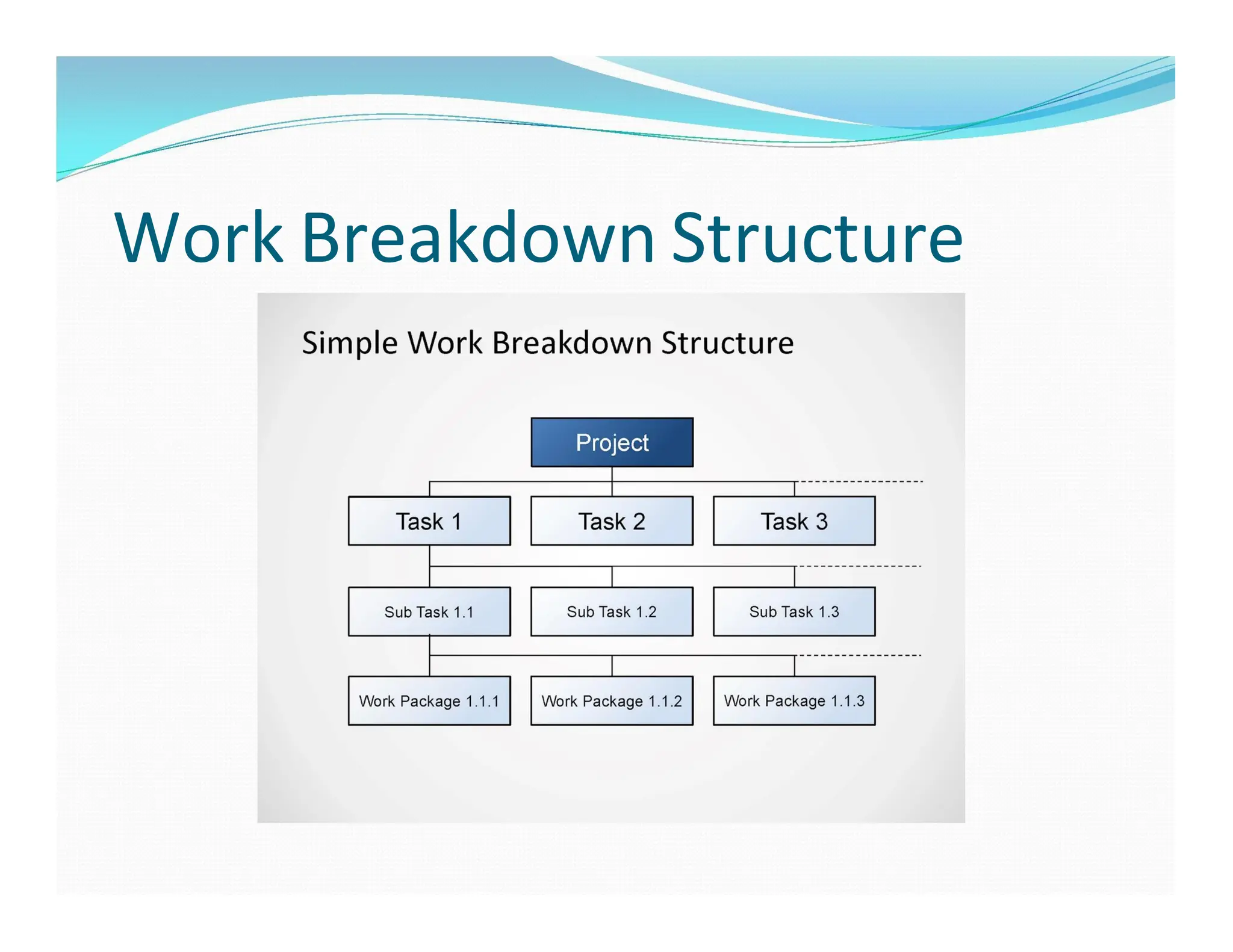
● A work breakdown structure (WBS) is a visual,
hierarchical and deliverable-oriented deconstruction
of a project. It is a helpful diagram for project
managers because it allows them to break down their
project scope and visualize all the tasks.
● The Work Breakdown Structure (WBS) is developed
to establish a common understanding of project
scope. It is a hierarchical description of the work that
must be done to complete the deliverables of a
project.
Work Breakdown Structure
Why Use a WBS ?
● Making a WBS is the first step in developing a project
schedule. It defines all the work that needs to be
completed (and in what order) to achieve the project
goals and objectives. By visualizing your project in this
manner, you can understand your project scope, and
allocate resources for all your project tasks.
● A well-constructed work breakdown structure helps
with important project management process
groups and knowledge areas such as:
Types of WBS
● There are two main types of WBS: deliverable-based, and
phase-based. They depend on whether you want to divide
your project in terms of time or scope.
● Deliverable-Based Work Breakdown Structure:-A deliverable-
based WBS first breaks down the project into all the major
areas of the project scope as control accounts and then divides
those into project deliverables and work packages
● Phase-Based Work Breakdown Structure:-The phase-based
WBS displays the final deliverable on top, with the WBS levels
below showing the five phases of a project (initiation,
planning, execution, control and closeout). Just as in the
deliverable-based WBS, the project phases are divided into
project deliverables and work packages
Types of WBS Charts
● Once you’ve chosen a deliverable-based or phase-based WBS, you can also
choose between different types of WBS diagrams. Let’s take a look at the
main types of work breakdown structure charts.
● Work Breakdown Structure List: Also known as an outline view, this is a list
of work packages, tasks and deliverables. It’s probably the simplest method
to make a WBS, which is sometimes all you need.
● Work Breakdown Structure Tree Diagram: The most commonly seen
version, the tree structure depiction of a WBS is an organizational chart
that has all the same WBS elements of the list (phases, deliverables, tasks
and work packages) but represents the workflow or progress as defined by
a diagrammatic representation.
● Work Breakdown Structure Gantt Chart: A Gantt chart is both a
spreadsheet and a timeline. The Gantt chart is a WBS that can do more
than a static task list or tree diagram. With a dynamic Gantt chart, you can
link dependencies, set milestones, even set a baseline. This is the most
common version in project management software.
WBS Elements
● WBS Dictionary: A WBS dictionary is a document that defines
the various WBS elements. It’s an important component of a
WBS because it allows the project participants and
stakeholders to understand the work breakdown structure
terminology with more clarity.
● WBS Levels: The WBS levels are what determines the
hierarchy of a WBS element. Most work breakdown structures
have 3 levels that represent the project’s main deliverable,
control accounts, project deliverables and work packages.
● Control Accounts: Control accounts are used to group work
packages and measure their status. They’re used to control
areas of your project scope.
WBS Elements
● Project Deliverables: Project deliverables are the desired outcome
of project tasks and work packages. In our WBS example, we can
observe some examples of project deliverables such as the project
budget or interior work. Both of them are the result of smaller tasks
and work packages.
● Work Packages: As defined by the project management
institute (PMI) in its project management body of knowledge book
(PMBOK) a work package is the “lowest level of the WBS”. That’s
because a work package is a group of related tasks that are small
enough to be assigned to a team member or department. As a
project manager, you can estimate costs and duration of these work
packages, which makes them an essential WBS element.
● Tasks: Your tasks make up your work packages and therefore, your
project scope. A WBS will help you define each task requirements,
status, description, task owner, dependencies, and duration.
UNIT-2 PPT project management presentation

UNIT-2 PPT project management presentation

  • 1.
    Unit-2 Project Identification, Selection &Planning Presented By: Snehal D.Shipne
  • 2.
  • 3.
  • 6.
  • 7.
  • 8.
  • 9.
  • 10.
  • 11.
  • 12.
  • 13.
  • 14.
  • 15.
  • 16.
  • 17.
  • 18.
  • 19.
  • 20.
  • 21.
    Project Planning ● Aproject consists of five different phases: initiation, planning, execution, monitoring and controlling, and closure. Planning is the second phase of the project life cycle, where a plan after the initiation phase is made so the process of execution may begin. The project plan serves as a roadmap for the entire process of project management. ● Project planning is part of project management, which relates to the use of schedules such as Gantt charts to plan and subsequently report progress within the project environment. Project planning can be done manually or by the use of project management software.
  • 22.
  • 23.
    Need for ProjectPlanning ● 1. Planning helps you set appropriate goals ● 2. Planning breaks a problem or goal into smaller pieces ● 3. Planning reveals weaknesses (and strengths) ● 4. Planning increases certainty and confidence ● 5. Planning increases efficiency ● 6. Planning reduces risk ● 7. Planning increases your credibility ● 8. Planning encourages creativity ● 9. Planning improves decision-making ● 10. Planning equals more peace of mind
  • 24.
  • 25.
    Project Planning Process ●1. Determine the project goals and objectives:-The first step in the project planning phase is to define the goals and objectives of your project. ● 2. Determine the project scope:- Your project scope protects you from unrealistic expectations, conflicting interests, and unattainable demands as the project progresses. To determine your scope, look at your project goals and objectives. What do you need to do to achieve them? What isn’t necessary? For example, the scope of a new housing project may be limited to erecting and finishing the building but might not include landscaping or the construction of an outdoor pool. ● 3. Build your work breakdown structure (WBS) ● At this stage, start determining which tasks, subtasks, and deliverables must be carried out to complete the project. You can do this by referring to your scope and creating a work breakdown structure—a structured decomposition of tasks needed to complete a project.
  • 26.
    Project Planning Process ●4. Set timelines :-Set milestones for project phases: An example of a milestone could be that 2 months from the start date, the engineers will have completed their work on the backend of the e-commerce site. ● Be conscious of time constraints: Your timeline might have to fit the deadline given by clients. In this case, you may need to follow the critical path. ● 5. Determine and plan resources:-For a project to succeed, you need the right people and resources. The resource planning process in project management involves a lot of project assumptions and making estimates. But from the past steps—especially your WBS, scope, and goals—you should have a rough idea of what resources you need. ● 6. Estimate costs:-One of the challenges in the project planning process is balancing your budget with your stakeholders' desire to save money. However, if you underestimate costs, you might find yourself without funds in the middle of the project.
  • 27.
    Project Planning Process ●7. Determine risks and constraints:-No project exists without risks or constraints. The key to avoiding a project failure is identifying the potential pitfalls and creating an action plan to handle them. ● 8. Plan out communication:-Creating a communication blueprint is essential in developing a project plan. "No matter what role you’re playing on a project, if you’re not making a strong effort to communicate with your team, you will likely fail“ ● 9. Make plans for quality control and assurance:-Planning for project quality control involves providing guidelines for managing, assuring, and maintaining standards within the project.
  • 28.
    Roles & Responsibilitiesof Team ● What is a project team? ● A project team is a group of individuals who are working on a shared project together, with shared goals and objectives. Everyone on the project team has a responsibility to perform their tasks and contribute to the success of the project. ● The typical makeup of a project team includes:- ● Project manager ● Project team members ● Project sponsor ● Project stakeholders ● Business analyst
  • 29.
    Roles & Responsibilitiesof Team ● 1. Project manager:-The project manager is an essential part of most projects, as these are the professionals who keep the project on schedule and within budget. ● Project manager responsibilities ● Creating a schedule ● Providing regular updates ● Assigning task to individuals ● 2. Project team member:-Any individual who works on the project, no matter if they're full-time or part-time, is a project team member. This may include both in- house employees and external individuals who may be consultants, experts, or vendors. ● Project team member responsibilities: ● Completing their work on time and within budget ● Working with users to establish business needs ● Providing expertise ● Documenting the process
  • 30.
    Roles & Responsibilitiesof Team ● 3. Project sponsor:-Project sponsor responsibilities ● Making key business decisions about the project ● Approving any increases to the budget and schedule adjustments ● Regularly communicating with the project manager and members of the team to reestablish goals and help the project manager source the education and other resources team members may need for their work ● Resolving conflicts among the team members if the project manager cannot.
  • 31.
    Roles & Responsibilitiesof Team ● 4. Project stakeholders:-Project stakeholders or collaborators include anyone who works toward, funds or is affected by the project’s final result. ● Project stakeholder responsibilities: ● Identifying project constraints ● Naming project risks ● Offering expertise ● Giving feedback ● 5. Business analyst:-A business analyst is responsible for improving an organization, and they often play an important role in a project team. Business analyst responsibilities: ● Defining the project ● Establishing the project’s goals ● Documenting the technical requirements for an effective project team ● Making sure that the deliverables the team comes up with support the overarching objective of the project and business.
  • 32.
    Work Breakdown Structure ●A work breakdown structure (WBS) is a visual, hierarchical and deliverable-oriented deconstruction of a project. It is a helpful diagram for project managers because it allows them to break down their project scope and visualize all the tasks. ● The Work Breakdown Structure (WBS) is developed to establish a common understanding of project scope. It is a hierarchical description of the work that must be done to complete the deliverables of a project.
  • 33.
  • 34.
    Why Use aWBS ? ● Making a WBS is the first step in developing a project schedule. It defines all the work that needs to be completed (and in what order) to achieve the project goals and objectives. By visualizing your project in this manner, you can understand your project scope, and allocate resources for all your project tasks. ● A well-constructed work breakdown structure helps with important project management process groups and knowledge areas such as:
  • 35.
    Types of WBS ●There are two main types of WBS: deliverable-based, and phase-based. They depend on whether you want to divide your project in terms of time or scope. ● Deliverable-Based Work Breakdown Structure:-A deliverable- based WBS first breaks down the project into all the major areas of the project scope as control accounts and then divides those into project deliverables and work packages ● Phase-Based Work Breakdown Structure:-The phase-based WBS displays the final deliverable on top, with the WBS levels below showing the five phases of a project (initiation, planning, execution, control and closeout). Just as in the deliverable-based WBS, the project phases are divided into project deliverables and work packages
  • 36.
    Types of WBSCharts ● Once you’ve chosen a deliverable-based or phase-based WBS, you can also choose between different types of WBS diagrams. Let’s take a look at the main types of work breakdown structure charts. ● Work Breakdown Structure List: Also known as an outline view, this is a list of work packages, tasks and deliverables. It’s probably the simplest method to make a WBS, which is sometimes all you need. ● Work Breakdown Structure Tree Diagram: The most commonly seen version, the tree structure depiction of a WBS is an organizational chart that has all the same WBS elements of the list (phases, deliverables, tasks and work packages) but represents the workflow or progress as defined by a diagrammatic representation. ● Work Breakdown Structure Gantt Chart: A Gantt chart is both a spreadsheet and a timeline. The Gantt chart is a WBS that can do more than a static task list or tree diagram. With a dynamic Gantt chart, you can link dependencies, set milestones, even set a baseline. This is the most common version in project management software.

  • 37.
    WBS Elements ● WBSDictionary: A WBS dictionary is a document that defines the various WBS elements. It’s an important component of a WBS because it allows the project participants and stakeholders to understand the work breakdown structure terminology with more clarity. ● WBS Levels: The WBS levels are what determines the hierarchy of a WBS element. Most work breakdown structures have 3 levels that represent the project’s main deliverable, control accounts, project deliverables and work packages. ● Control Accounts: Control accounts are used to group work packages and measure their status. They’re used to control areas of your project scope.
  • 38.
    WBS Elements ● ProjectDeliverables: Project deliverables are the desired outcome of project tasks and work packages. In our WBS example, we can observe some examples of project deliverables such as the project budget or interior work. Both of them are the result of smaller tasks and work packages. ● Work Packages: As defined by the project management institute (PMI) in its project management body of knowledge book (PMBOK) a work package is the “lowest level of the WBS”. That’s because a work package is a group of related tasks that are small enough to be assigned to a team member or department. As a project manager, you can estimate costs and duration of these work packages, which makes them an essential WBS element. ● Tasks: Your tasks make up your work packages and therefore, your project scope. A WBS will help you define each task requirements, status, description, task owner, dependencies, and duration.